


Abstract
Rapid industrial development of metallurgy, electroplating, textile and other manufacturing industries has resulted in a marked deterioration of water quality, which poses a significant risk to public health and the ecological balance of receiving water bodies. With the continuous upgrading of environmental emission standards, engineering cost-competitive and ecologically benign substrates for enhanced removal of aquatic pollutants remains a key challenge in environmental remediation. Herein, a nanostructured aminated wood aerogel (PNWA) was successfully fabricated via sodium periodate oxidation followed by polyethyleneimine (PEI) grafting modification. The optimized PNWA integrates a large specific surface area (SSA) and well-exposed surface amine functionalities, exhibiting great application potential for high-efficiency wastewater purification. Equilibrium adsorption isotherms revealed that PNWA exhibited uptake capacities of 131, 143, 151, 154 and 139 mg/g for Cu2+, Pb2+, Cr6+, methyl orange (MO) and Congo red (CR), respectively. These values outperform most previously reported biomass-based adsorbents. Kinetic and isotherm fitting results confirm that the adsorption process fits well with the pseudo-second-order kinetic and Langmuir isotherm model, revealing a dominant monolayer chemisorption mechanism. The superior adsorption performance originates from two core interactions: the chelation effect between amino groups and cationic heavy metal ions and the pronounced electrostatic affinity between the protonated PNWA surface and the anionic dye species. Combining facile preparation and prominent adsorption performance, the synthesized PNWA acts as a high-efficiency and sustainable adsorbent for practical wastewater remediation. The present study offers a viable route for engineering sustainable, biomass-derived adsorbents toward efficient removal of aqueous pollutants.
1. Introduction
Given the accelerating expansion of electroplating, metallurgy, metal processing, and the textile printing and dyeing industries, water systems have been increasingly contaminated by heavy metal ions and synthetic dye molecules. Due to their high toxicity, poor biodegradability, and bioaccumulation and environmental accumulation characteristics, these contaminants constitute a substantial threat to public health and the ecological integrity of receiving water bodies [1,2]. To address water pollution issues, a variety of wastewater remediation technologies, including chemical precipitation [3], ion exchange [4], membrane separation [5], and adsorption [6], have been extensively developed and widely applied. Among them, adsorption has become a prevalent and reliable water purification technology by virtue of its exceptional adsorption performance, excellent selectivity, simple operation, and cost effectiveness [7].
Commonly used adsorption materials include activated carbon [8], natural minerals [9,10], synthetic resins [11], and carbon-based nanomaterials [12]. Nevertheless, most conventional adsorbents suffer from inherent drawbacks, such as high preparation cost, slow adsorption kinetics, poor regenerability, low removal efficiency toward hydrophilic contaminants, limited pollutant adaptability, and insufficient adsorption capacity [13,14,15]. In recent years, bio-based adsorbents have garnered tremendous research attention by virtue of their unique advantages, including biodegradability, eco-friendliness, sustainability, and abundant raw-material availability [16,17,18].
Wood, a natural porous biopolymeric material, exhibits a multiscale hierarchical pore structure, a considerable specific surface area, and rich surface functionalities [19]. Its inherent three-dimensional network structure endows wood with reliable mechanical stability, making it a promising natural template for designing high-efficiency wastewater treatment materials [20]. For instance, Vitas et al. [21] fabricated carboxyl-functionalized wood by grafting carboxyl groups onto beech wood through esterification with citric anhydride and succinic anhydride. The modified wood cell retains the natural porous structure and achieves efficient uptake of Cu2+ from aqueous media. In a previous investigation, Zhu et al. [22] constructed a three-dimensional wood membrane through in situ grafting of thiol moieties, and subsequently assembled it into a trilayer filtration device for effective heavy metal sequestration. Similarly, Chen et al. [23] successfully immobilized palladium nanoparticles (PdNPs) in situ within the pore channels of linden wood via a hydrothermal strategy. The rich hydroxyl functionalities on the wood cell walls act as effective binding sites for PdNPs immobilization, thereby facilitating the rapid catalytic degradation of methylene blue (MB) in wastewater. Nevertheless, natural wood exhibits a relatively low specific surface area owing to its uneven pore distribution, which restricts sufficient interfacial contact between the material and wastewater and thus limits adsorption efficiency [24]. Furthermore, the cellulose skeleton of natural wood is tightly encapsulated by lignin and hemicellulose via covalent crosslinking and hydrogen bonding, resulting in insufficient exposed reactive hydroxyl groups for chemical functionalization [25,26].
To circumvent these drawbacks, carbonization treatments have been widely adopted to enhance the removal efficiency of biomass-derived adsorbents for heavy metal ions through surface functionalization. Earlier works by Zhang et al. [27] and Antonietti et al. [28] have demonstrated that carbonized wood achieves high removal efficiency toward organic dyes and Cr6+ contaminants, benefiting from its hierarchical porous architecture, large specific surface area, and tunable surface functionality. For example, Jeon et al. [29] embedded ZIF-8 nanoparticles into wood-derived carbon aerogels via a carbonization-activation strategy, and the composites deliver a high Rhodamine B adsorption capacity of 169.4 mg/g. Nevertheless, carbonized wood still suffers from inevitable limitations in large-scale production uniformity, long-term structural stability, and cyclic reusability.
In recent years, delignification combined with oxidative modification has been developed to reconstruct wood cell wall structures [30,31]. The effective modification strategy greatly enlarges the SSA of wood and exposes rich surface functionalities in cellulose, which enables the facile fabrication of high-performance wood aerogels [32,33]. By inheriting the intrinsic skeletal structure of natural wood, this strategy provides sufficient porous space and abundant anchoring sites for the subsequent immobilization and modification of polymers, inorganic compounds, and metal-based functional materials [34,35]. Accordingly, the modified wood aerogels exhibit greatly improved pollutant adsorption and remediation performance for wastewater treatment.
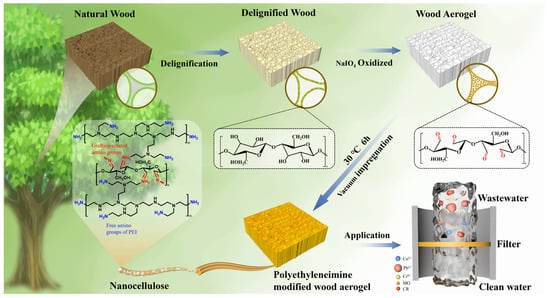
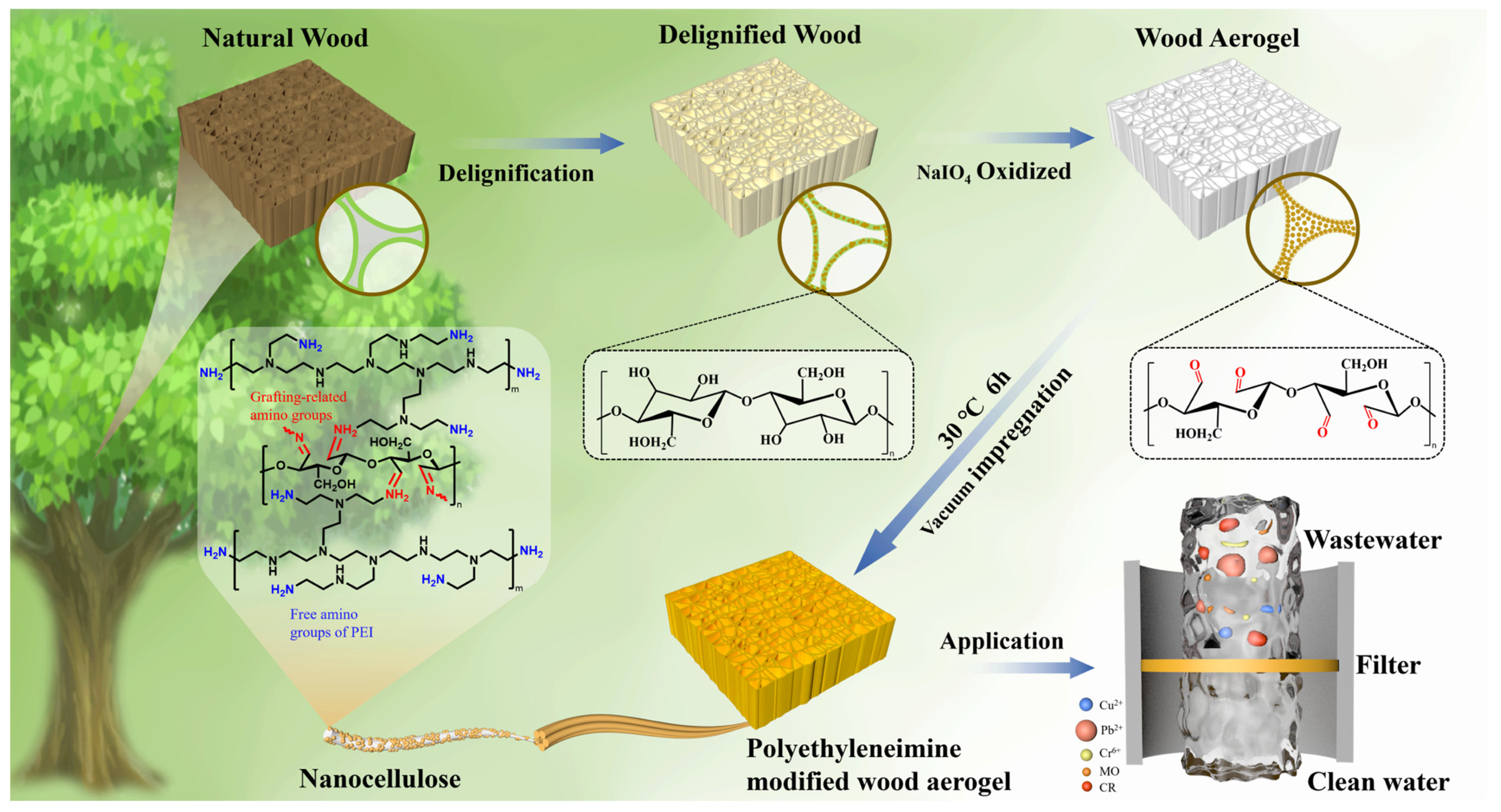
In this work, a novel nanostructured aminated wood aerogel (PNWA) was successfully fabricated via a two-step cell-wall nanostructuring and amino- functionalization strategy for efficient simultaneous decontamination of heavy metals and anionic dyes from aqueous effluents. Delignified balsa wood was adopted as the raw material, and sodium periodate (NaIO4) was used as an oxidant to selectively oxidize the vicinal diols at C2 and C3 of the anhydroglucose units to dialdehyde functionalities. The oxidation reaction breaks the intra- and intermolecular hydrogen bonds of cellulose microfibrils, creating numerous micro-/nano-scale pores on wood cell walls. Subsequently, polyethyleneimine (PEI) was grafted in situ onto the cellulose chains of wood aerogel via imine condensation between aldehyde functionalities and amine groups (Figure 1). As a result, the fabricated highly nanostructured aminated wood aerogel (PNWA) exhibits exceptional excellent adsorption performance and recyclability toward heavy-metal ions (Cu2+, Pb2+, Cr6+) and anionic dyes (methyl orange, MO and Congo red, CR). This study presents a robust modification route for engineering aminated wood aerogels, thereby establishing a sustainable platform for advanced water purification.
Figure 1.
Schematic fabrication route of the construction of aminated wood aerogels with hierarchical nanostructures for heavy metal and dye removal.
2. Results and Discussion
2.1. Microstructure and Chemical Characterization of Nwa
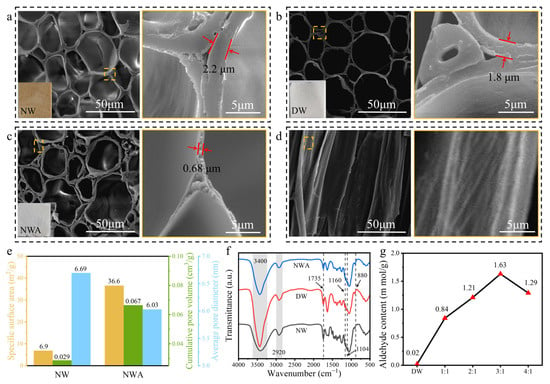
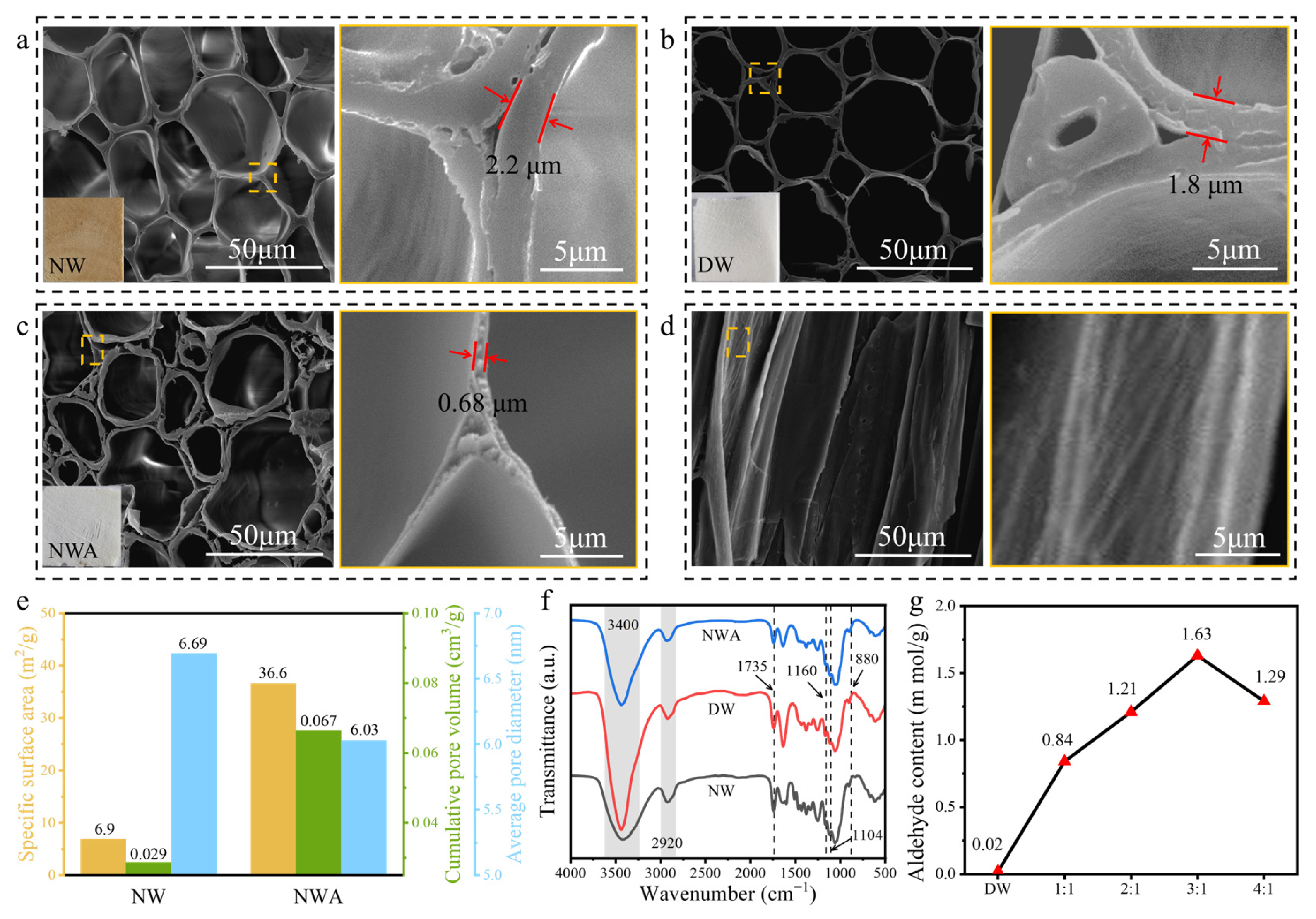
The morphologies of NW, DW, and NWA at both macro- and micro-scales are shown in Figure 2a–d. In the cross-section of NW, vessels, tracheids, and axial parenchyma cells are clearly observed, with tissue cells tightly bonded via the compound middle lamella (Figure 2a). After delignification, the cell walls of DW became thinner and the cell corners expanded, accompanied by a lighter sample color (Figure 2b). After oxidation with NaIO4, the intercellular spaces and cell corners further expanded, and numerous nanopores emerge on the cell walls of NWA (Figure 2c). Moreover, a distinct microfibril network is visible on the longitudinal section of NWA cell walls (Figure 2d), demonstrating that the macrofibers on the cell wall are broken down into microfibers upon NaIO4 oxidation. Consequently, NWA exhibits a significantly higher SSA and cumulative pore volume than DW and NW, along with a small average pore diameter of 6.03 nm (Figure 2e and Figure S1). These findings confirm the successful fabrication of a highly nanoporous structure in NWA. After delignification and NaIO4 oxidation, the bulk density of NWA decreased to 0.047 g/cm3, which is only 20.4% of that of pristine NW (Figure S2). The density reduction is attributed to cellulose degradation during oxidation.
Figure 2.
(a–c) Cross-sectional SEM micrographs of NW, DW, and NWA, respectively. (d) Longitudinal-sectional SEM images of NWA. (e) Textural properties of NW and NWA. (f) FT-IR spectra of NW, DW, and NWA. (g) Aldehyde content of NW, DW and NWA.
Figure 2f presents the FT-IR spectra of the prepared specimens, enabling the identification of the surface chemical moieties. Compared with NW, the absorption band at 1504 cm−1, which is assignable to the aromatic C=C stretching vibration [36], almost disappears in DW, confirming the effective removal of lignin. This trend corroborates the chemical composition analysis (Figure S3), which reveals a residual lignin content of only 1.62% in NW. For NWA, new characteristic peaks assigned to -CHO groups are detected at 1735 cm−1 and 880 cm−1, while the intensity of the -OH stretching peak at 3400 cm−1 is markedly reduced compared with DW [37]. These alterations in the recorded spectra demonstrate the oxidation of hydroxyl species on cellulose backbones to form aldehyde groups. Furthermore, the aldehyde content increases gradually with the rising molar ratios of NaIO4 to DW, reaching a maximum of 1.63 mmol/g for NWA (Figure 2g). However, oxidation disrupted the orderly arrangement of cellulose molecular chains, resulting in a decrease in the crystallinity of NWA (Figure S4). Collectively, these results verify the NaIO4 selectively oxidizes the C2 and C3 hydroxyl groups on the cellulose backbone to aldehyde functionalities, which provides favorable conditions for subsequent amination modification [38].
2.2. Physical and Chemical Characteristics of Pnwa
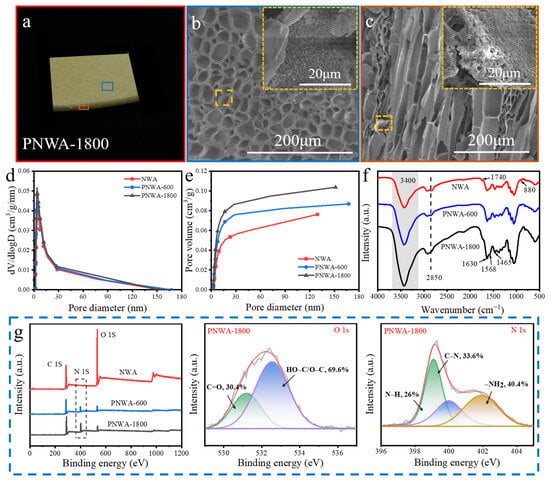
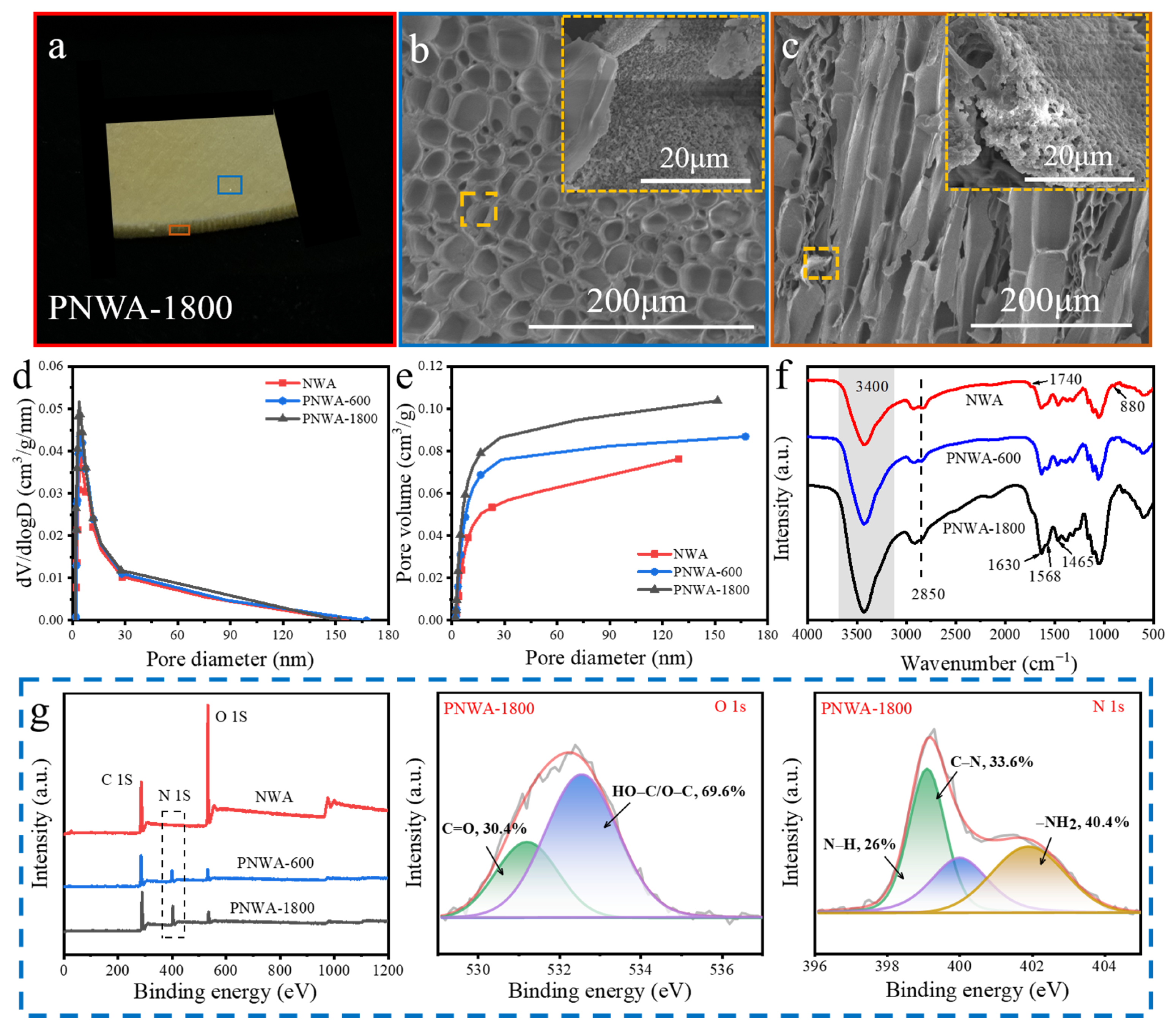
On this basis, PEI with molecular weights of 600 and 1800 was grafted onto NWA via an in-situ grafting, yielding two modified materials denoted as PNWA-600 and PNWA-1800. Visually, all PNWA samples display a yellowish appearance in contrast to pristine white NWA, with PNWA-1800 presenting the darkest color (Figure 3a and Figure S5). Cross-sectional observation of PNWA-1800 reveals that the cell lumens, intercellular spaces, and cell wall nanopores are fully filled with grafted PEI (Figure 3b). The longitudinal section further confirms that the cellulose microfibrils on the cell wall are densely encapsulated by PEI, constructing a continuous three-dimensional network with abundant micro- and nanopores (Figure 3c). Furthermore, BET characterization demonstrates that pristine NWA has a dense cell wall architecture dominated by irregular macropores and mesopores. After PEI grafting, PEI macromolecular chains gradually infiltrated the micro-interstices of the wood cell wall. Such infiltration not only fragments the original macropores into abundant nanoscale mesopores and micropores but also drives the construction of a dense nano-network skeleton within the lignocellulosic matrix. Consequently, both PNWA-600 and PNWA-1800 present significantly improved total pore volume and nanopore proportion, verifying the successful embedding of PEI into the cell wall matrix. The uniform distribution of numerous nanoscale pores and channels directly verifies the successful nanostructure reconstruction of the cell wall architecture (Figure 3d,e). With the increase in PEI molecular weight, more PEI is deposited on the NWA skeleton, resulting in a gradual increase in the SSA of PNWA samples. Among all samples, PNWA-1800 possesses the maximum SSA of 60.2 m2/g, while its average pore diameter reduced to 5.17 nm (Figure S6). These superior structural characteristics (high SSA and abundant nanopores) accelerate wastewater diffusion and boost the elimination of heavy metal ions and organic dye pollutant.
Figure 3.
(a) Photograph of the macroscopic PNWA-1800 sample. (b) Cross-sectional and (c) longitudinal-sectional SEM micrographs of PNWA-1800. (d) Nitrogen adsorption–desorption isotherm of NWA, PNWA-600, and PNWA-1800. (e) Pore volume distribution of NWA, PNWA-600, and PNWA-1800. (f) FT-IR spectra of NW, PNWA-600, and PNWA-1800. (g) XPS survey spectra of NW, PNWA-600, and PNWA-1800, along with high-resolution O 1s and N 1s spectra of PNWA-1800.
Further chemical characterization was performed to elucidate the synthesis mechanism of PNWA. FT-IR spectra show that the characteristic peaks of aldehyde and hemiacetal groups of NWA at 1740 cm−1 and 880 cm−1 disappear in both PNWA-600 and PNWA-1800 (Figure 3f). Instead, a new absorption signal emerges at 1630 cm−1, which is attributed to the C=N bonds formed between PEI and NWA [39]. In addition, the C–H stretching band at 2850 cm−1 is intensified owing to the abundant aliphatic groups in PEI molecular chains. An additional peak at 1568 cm−1, assigned to the bending vibrations of N–H groups [40], appears and progressively intensifies with increasing PEI molecular weight. Meanwhile, the spectral overlap originating from N–H and –OH bands contributes to an enhanced absorption intensity at approximately 3440 cm−1 for both PNWA-600 and PNWA-1800 samples [41]. These spectral results confirm that PEI is successfully grafted onto the NWA skeleton. Moreover, the crystallinity of PEI-modified wood aerogels decreases with the increase in PEI molecular weight (Figure S7). This enhancement originates from the chemical interaction between the amino functionalities of PEI and the hydroxyl moieties along the cellulose backbone.
XPS analysis was performed to examine changes in chemical elements and bonding states (Figure 3g and Figure S8). Compared with pristine NWA, PNWA-600 and PNWA-1800 exhibit a distinct N 1s peak in their survey spectra along with a marked decrease in the C 1s and O 1s peak intensities. High-resolution O 1s deconvoluted spectra displayed two distinct peaks at 531.1 eV (O1) and 532.7 eV (O2), which correspond to C=O and C–O/C–OH functional groups [42]. Notably, the area ratio of O1 to O2 decreases sharply from 0.83 (NWA) to 0.49 (PNWA-600) and 0.44 (PNWA-1800), indicating that most aldehyde groups are consumed by the amine functionalities of PEI through imine formation. For the deconvoluted high-resolution N 1s spectrum, the components at 399.1 eV (N1), 399.9 eV (N2), and 401.4 eV (N3) are assigned to C–N, N–H, and –NH2 groups [43], respectively. The proportion of the N3 (–NH2) component increases from 23.7% for PNWA-600 to 40.4% for PNWA-1800, further verifying the successful PEI grafting and the higher content of free amino groups in PNWA-1800.
2.3. Equilibrium Adsorption and Mechanism of Pnwa Toward Heavy Metal Ions
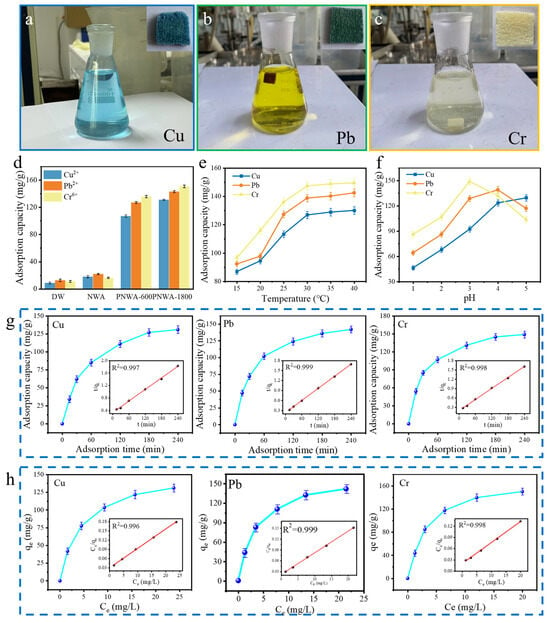
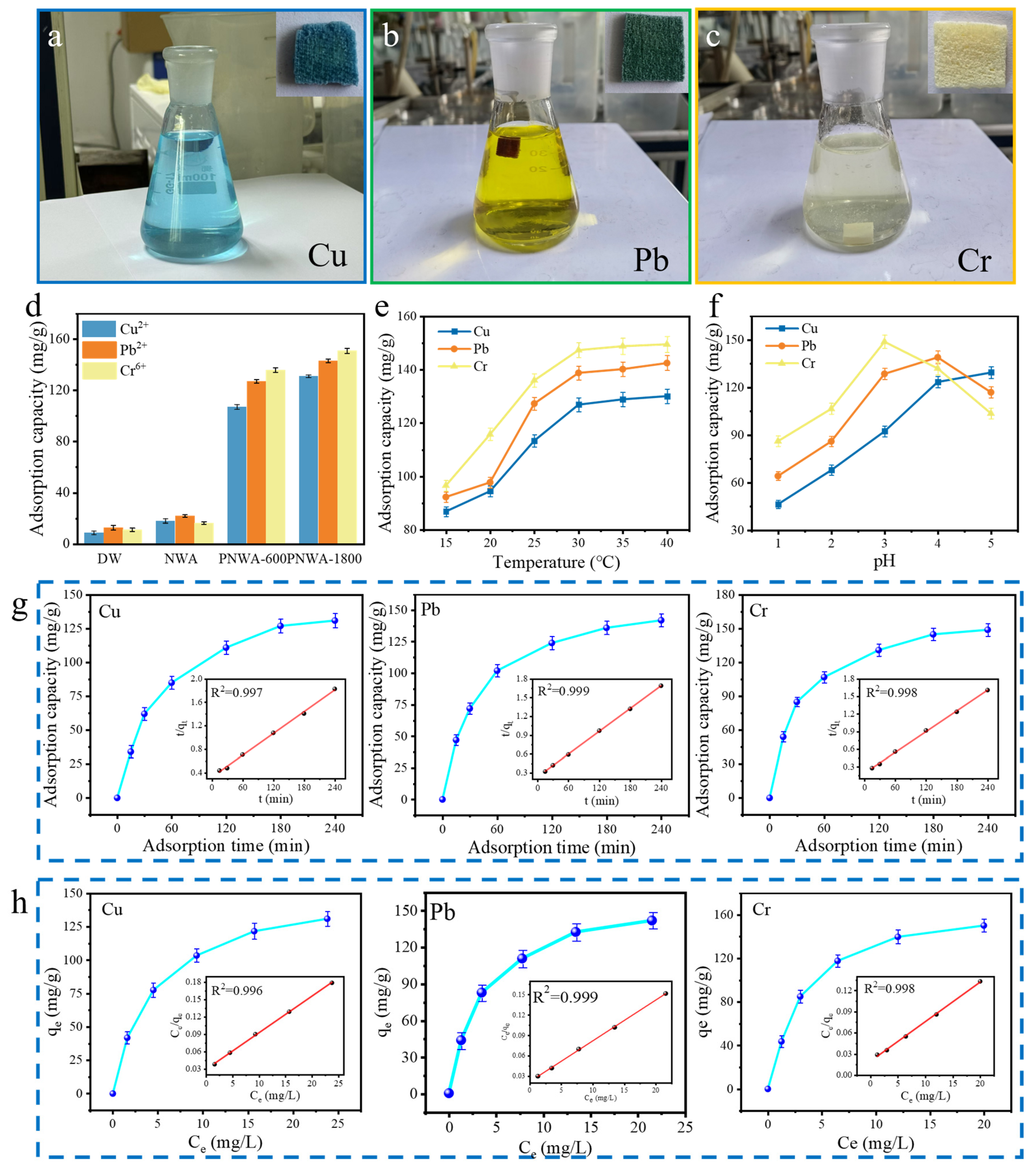
The static adsorption performance of DW, NWA, PNWA-600, and PNWA-1800 toward Cu2+, Pb2+, and Cr6+ in aqueous solution was systematically investigated. As shown in Figure 4a–c, PNWA-1800 exhibits blue, green, and pale yellow coloration after the adsorption of Cu2+, Pb2+, and Cr6+, respectively, which is consistent with previous literature reports. Furthermore, elemental mapping analysis verifies the uniform dispersion of heavy metal ions on both the cross-sectional and longitudinal sections of PNWA (Figure S9, Tables S1 and S2). Notably, PNWA presents a far higher adsorption capacity than pristine DW and NWA. In particular, PNWA-1800 exhibited maximum adsorption capacities of 131 mg/g for Cu2+, 143 mg/g for Pb2+, and 151 mg/g for Cr6+ (Figure 4d). These values rival or exceed those of previously reported biomass-based adsorbents [36,44,45,46,47,48] (Table S8). Such excellent adsorption performance is ascribed to the high SSA and abundant amino functional groups of PNWA-1800, which serve as effective chelation sites for heavy metal ions. The influence of solution temperature and pH on the adsorption performance of PNWA-1800 was further examined. As illustrated in Figure 4e, the adsorption capacity rises with temperature from 15 °C and 30 °C and then increases slightly until reaching the maximum value at 40 °C. This positive temperature dependence originates from the enhanced ion mobility at higher temperatures, which promotes the intraparticle diffusion of metal species within the porous network of PNWA-1800. To evaluate the practical applicability, the pH of the solution was varied between 1 and 5. The adsorption capacities for Cu2+, Pb2+, and Cr6+ first increase and then decrease with the rise in solution pH (Figure 4f). Under strongly acidic conditions, the amino groups of PNWA-1800 are heavily protonated and positively charged, generating electrostatic repulsion toward cationic heavy metal ions and thus limiting adsorption. With increasing pH, the deprotonation of amino groups reduces electrostatic repulsion and exposes abundant active sites for metal chelation, thereby improving adsorption capacity. Nevertheless, excessively high pH induces the hydrolysis and precipitation of heavy metal cations, which decreases the effective adsorption efficiency.
Figure 4.
(a–c) Photograph of PNWA-1800 after adsorbing (a) Cu2+, (b) Pb2+, and (c) Cr6+. (d) Equilibrium adsorption capacities of DW, NW, PNWA-600, and PNWA-1800 toward Cu2+, Pb2+, and Cr6+. (e) Temperature-dependent adsorption of heavy metals on PNWA-1800. (f) Role of solution pH in the heavy metal uptake by PNWA-1800. (g) Adsorption kinetics and corresponding pseudo-second-order model fittings for Cu2+, Pb2+, and Cr6+ on PNWA-1800. (h) Adsorption isotherms and corresponding Langmuir model fittings for Cu2+, Pb2+, and Cr6+ on PNWA-1800.
To further explore the adsorption kinetic behavior of PNWA-1800 for Cu2+, Pb2+, and Cr6+, static adsorption kinetic curves are displayed in Figure 4g. The adsorption rate increased rapidly within the initial 0–1.5 h for all metal ions due to the high density of surface amino functionalities on PNWA-1800, which provide abundant chelation sites. Subsequently, the adsorption rate gradually declines from 1.5 h to 4 h because of the decreased mass transfer of metal ions into the porous cell wall matrix. The adsorption process attained equilibrium within 4 h, indicating the full occupation of all available adsorption sites. Figure 4g and Figure S10 display the fitted curves of the pseudo-first-order and pseudo-second-order kinetic models. The pseudo-second-order model yielded excellent fits to the kinetic data, with correlation coefficient (R2) values of 0.997, 0.999, and 0.998 for Cu2+, Pb2+, and Cr6+, respectively. This result suggests that the adsorption of heavy metal ions is dominated by chemisorption, which is mainly mediated by the grafted amino groups on the cell wall microfibrils. Furthermore, the high pseudo-second-order rate constants (k2) for Cu2+, Pb2+, and Cr6+ benefit from the large SSA and rich amino active sites of PNWA-1800, enabling rapid ion permeation and adsorption (Table S3). Adsorption isotherms are further fitted by the Langmuir and Freundlich isotherm models to explore the adsorption mechanism (Figure 4h and Figure S11). The linear correlation coefficients (R2) of the Langmuir model exceeded 0.995 for the three metal ions (Table S4), verifying a typical monolayer adsorption mechanism, where heavy metal ions are uniformly immobilized by the amino active sites on cell wall microfibrils.
2.4. Adsorption Behavior and Mechanism of Anionic Dyes onto Pnwa Under Batch Conditions
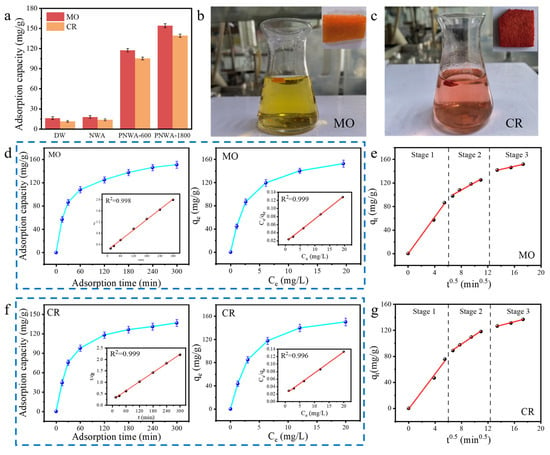
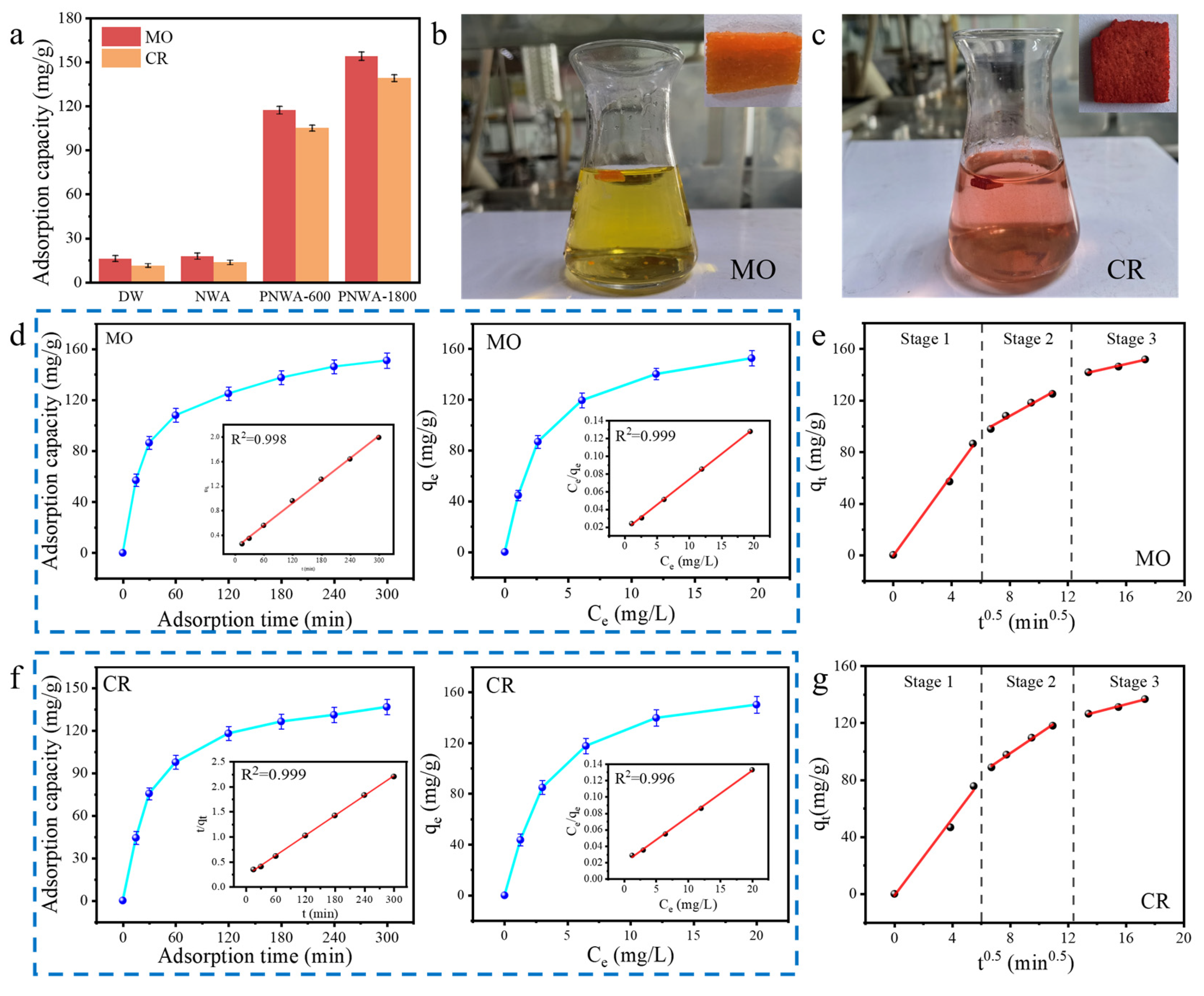
In this study, MO and CR were adopted as representative anionic pollutants to explore the adsorption characteristics of the fabricated wood aerogels. Compared with pristine DW and NWA, PNWA exhibits a significantly improved adsorption capacity after PEI grafting modification. Notably, PNWA-1800 presents excellent adsorption performance toward MO and CR with the maximal adsorption amounts reaching 154 mg/g (MO) and 139 mg/g (CR), respectively (Figure 5a). Visually, the pale-yellow PNWA-1800 turns orange-yellow after MO adsorption and deep red after CR adsorption (Figure 5b,c). Benefiting from its lower molecular weight and smaller molecular size, MO molecules more easily penetrate the micro-/nanopore channels of PNWA-1800, thus achieving a higher adsorption capacity than CR. Furthermore, PNWA-1800 outperforms most previously reported biomass-based adsorbents in terms of adsorption capacity and is comparable to those of synthetic adsorbents [49,50,51] (Table S9). The influence of solution temperature and pH on the dye adsorption performance of PNWA-1800 is further examined (Figure S12). The dye adsorption capacity first increases and then decreases within the temperature range of 15–40 °C. Above 30 °C, the adsorption capacity declined markedly, owing to the thermal desorption of adsorbed dye molecules. Under acidic environments, both MO and CR molecules ionize to produce negatively charged -SO3− groups, which can be effectively captured by protonated positive-charged amino groups via strong electrostatic attraction. Accordingly, the adsorption capacity increases as the pH decreases.
Figure 5.
(a) Static adsorption capacities of DW, NWA, PNWA-600, and PNWA-1800 toward MO and CR. (b,c) Photographs of PNWA-1800 after adsorption of MO and CR, respectively. (d) Adsorption kinetics, pseudo-second-order model fittings, adsorption isotherms, and Langmuir model fittings for MO adsorption on PNWA-1800. (e) Intra-particle diffusion model fitting for MO adsorption kinetics on PNWA-1800. (f) Adsorption kinetics, pseudo-second-order model fittings, adsorption isotherms, and Langmuir model fittings for CR adsorption on PNWA-1800. (g) Intra-particle diffusion model fitting for CR adsorption kinetics on PNWA-1800.
Comparison with the adsorption process of heavy metal ions, the adsorption dye adsorption requires a longer equilibrium time of approximately 6 h. This longer equilibration duration originates from the slow diffusion rate of large dye macromolecules into the internal pore network of PNWA-1800 (Figure 5d,f). The high correlation coefficients (R2 = 0.998 for MO and 0.999 for CR) indicate that the dye adsorption kinetics are well described by the pseudo-second-order model (Figure 5d and Figure S13 and Table S5), indicating a chemisorption-dominated adsorption process. This favorable adsorption is ascribed to the strong electrostatic interactions between the protonated amine groups (-RNH3+) on PNWA-1800 and the anionic sulfonic groups (-SO3−) on dye molecules, as well as the hydrogen bonding interaction between amino groups and hydroxyl groups of dyes. Furthermore, the adsorption isotherms were successfully fitted using the Langmuir model (Figure S14 and Table S6), verifying that the adsorption of MO and CR on PNWA-1800 follows a typical monolayer chemisorption mechanism. To further explore the diffusion behavior of MO and CR molecules during adsorption, the intra-particle diffusion model was adopted for linear fitting analysis (Figure 5e,g). The calculated intra-particle diffusion rate constants Kid and corresponding R2 values (Table S7) confirm the good fitting effect of the model. Notably, none of the fitting curves pass through the origin, indicating that the dye adsorption kinetics are governed by both surface chemisorption and intraparticle diffusion. The overall adsorption process comprises three consecutive steps: liquid-film diffusion, intraparticle diffusion, and surface binding at active sites. Among them, intra-particle diffusion presents the slowest mass transfer rate and serves as the dominant rate-limiting step. Initially, the dye molecules rapidly occupy the outer active sites on the PNWA-1800 surface driven by a high concentration gradient. The gradual diffusion of dye molecules into the internal pores during the second stage lowers the concentration gradient, which in turn retards the adsorption kinetics. Finally, the adsorption system reaches a dynamic equilibrium state in the third stage.
2.5. Selective Adsorption Capacity and Recyclability of Pnwa-1800
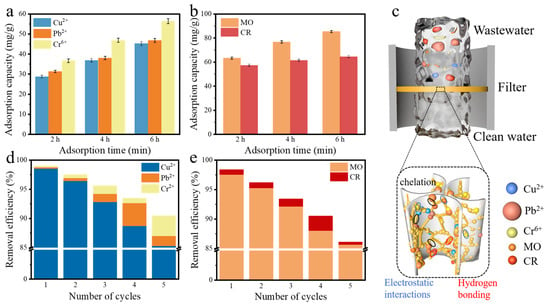
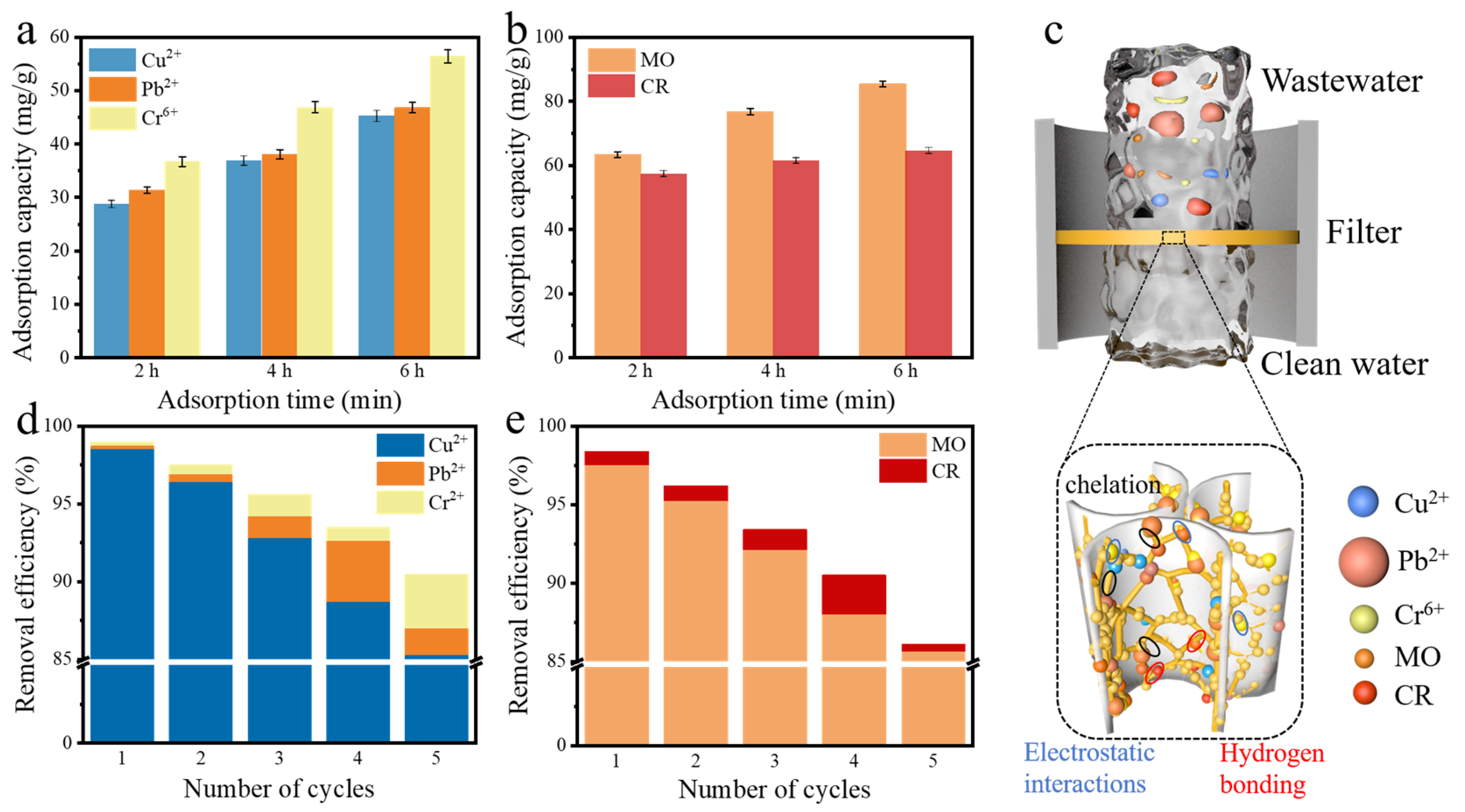
The selective adsorption performance of PNWA-1800 in mixed multi-heavy metal ion solutions is illustrated in Figure 6a. In this multi-ion coexisting system, the active sites on PNWA-1800 are competitively occupied by various metal ions, which reduces the adsorption capacity of each individual ion. After 2 h of competitive adsorption, the adsorption capacities for Cu2+, Pb2+, and Cr6+ reach 28.7, 31.4, and 36.7 mg/g, respectively. When the adsorption reaches equilibrium, the corresponding capacities increase to 45.2 mg/g, 46.8 mg/g, and 56.4 mg/g for Cu2+, Pb2+, and Cr6+, respectively. Notably, Cr6+ presents a far stronger competitive adsorption affinity than Cu2+ and Pb2+. This distinct selectivity is ascribed to the speciation of Cr6+ in aqueous solution. Specifically, Cr6+ primarily exists in the form of CrO42− anions, which can bind with the protonated amino groups of PNWA-1800 via electrostatic interaction. In contrast, Cu2+ and Pb2+ are present as cations in water and only form chelation coordination with amino groups through lone-pair electron donation. As a long-range and high-strength intermolecular force, electrostatic interaction features a faster binding rate and higher stability than chelation coordination. This allows chromate anions to preferentially occupy the limited active sites in a multi-ion coexisting system. Therefore, Cr6+ delivers superior competitive adsorption performance and binding affinity toward PNWA-1800.
Figure 6.
(a) Competitive adsorption of Cu2+, Pb2+, and Cr6+ by PNWA-1800 in a multi-ion coexisting system. (b) Competitive adsorption of MO and CR by PNWA-1800 in a mixed-dye system. (c) Schematic representation of the adsorption mechanism of PNWA-1800 toward wastewater contaminants. (d) Recyclability of PNWA-1800 for the removal of Cu2+, Pb2+, and Cr6+. (e) Recyclability of PNWA-1800 for the removal of MO and CR.
Similarly, for the CR/MO mixed-dye system (Figure 6b), the equilibrium adsorption capacities are significantly lower than those measured in single-dye solutions. Nevertheless, MO exhibits a higher adsorption capacity than CR due to its smaller molecular size and lower molecular weight, which enables faster diffusion into the internal pore network of PNWA-1800. This result is well supported by the larger intra-particle diffusion rate constants (Kid) for MO at different stages. Figure 6c illustrates the proposed adsorption mechanism of PNWA-1800 toward heavy metal cations and anionic dyes, revealing the uniform distribution of amine functionalities on the cell wall and within the lumens. The reusability and operational stability of PNWA-1800 were further assessed through cyclic adsorption–desorption tests. After adsorption saturation, the contaminated PNWA-1800 samples were collected and gently rinsed with deionized water to remove unbound surface contaminants. Subsequently, the samples were immersed in 0.1 M HCl solution for desorption treatment under constant shaking at 25 °C. After desorption, the samples were repeatedly rinsed and dried for 12 h to obtain regenerated PNWA-1800 for the next adsorption cycle. Following five successive regeneration runs, PNWA-1800 maintained pollutant removal efficiencies of 85.3%, 87.0%, 90.5%, 85.5%, and 86.1% toward Cu2+, Pb2+, Cr6+, MO and CR (Figure 6d,e), respectively. This remarkable retention rate verifies the excellent reusability and structure stability of PNWA-1800 for practical wastewater treatment.
3. Materials and Methods
3.1. Materials
Balsa wood (density: 0.23 g/cm3; moisture content: 12–15%) was supplied by Beijing Haibei Si Co., Ltd. (Beijing, China). Sodium chlorite (NaClO2, 80 wt.%) and ethylene glycol (C2H6O2, ≥98%) were purchased from Macklin Biochemical (Shanghai, China). Acetic acid (CH3COOH), sodium periodate (NaIO4), and polyethyleneimine (PEI, Mn = 600 and 1800) were obtained from Sinopharm Chemical Reagent Co., Ltd. (Shanghai, China). All reagents were of analytical grade and used as received without further purification.
3.2. Preparation of Naio4-Oxidized Wood Aerogel (Nwa)
Delignified wood (DW) was prepared following our previously established protocol. In brief, natural wood (NW) was sliced into blocks measuring 50 mm (R) × 50 mm (T) × 2 mm (L) and treated with NaClO2 solution to obtain DW [31]. Subsequently, deionized water, NaIO4, and DW were mixed in an aluminum foil-wrapped beaker at a mass ratio of 200:3:1. The mixture was magnetically stirred at 60 °C for 4 h while being protected from light. After the oxidation, the reaction mixture was quenched by adding ethylene glycol [20]. The obtained sample was vacuum-impregnated with ethylene glycol for 2 h, repeatedly rinsed with deionized water, and lyophilized for 24 h to produce the NaIO4-oxidized wood aerogel (denoted as NWA).
3.3. Preparation of Polyethyleneimine Grafted Wood Aerogel (Pnwa)
PEIs with molecular weights of 600 and 1800 were selected for the grafting reaction. PEI powder was homogeneously dispersed in deionized water with continuous magnetic agitation to prepare a 2 wt.% aqueous solution. The NWA samples were soaked in the PEI solution at a solid/liquid mass ratio of 1:100 and treated via vacuum impregnation at 30 °C for 6 h to facilitate the full formation of Schiff base bonds between NWA and PEI molecules. Thereafter, subsequent water rinsing was performed to neutralize the filtrate pH value, which effectively stripped off residual PEI residues from the material surface. Finally, the treated samples were lyophilized to afford PEI-grafted wood aerogels, which were designated as PNWA-600 and PNWA-1800, respectively.
3.4. Characterizations
The surface morphology and elemental spatial distribution of the samples were characterized via field-emission scanning electron microscopy (FE-SEM, S4800F, Hitachi, Japan) coupled with energy-dispersive X-ray spectroscopy (EDS) mapping under an accelerating voltage of 0.5 kV. Nitrogen physisorption measurements were performed using an ASAP2020 analyzer (Micromeritics, Norcross, GA, USA) to obtain the specific surface area and pore size distribution. Prior to adsorption tests, the specimens were degassed at 100 °C for 12 h to remove adsorbed contaminants. Fourier-transform infrared (FT-IR) spectra were collected on a VERTEX80V spectrometer (Bruker, Karlsruhe, Germany) within the wavenumber range of 400–4000 cm−1 at a spectral resolution of 4 cm−1. X-ray diffraction (XRD) profiles were recorded on a Rigaku diffractometer equipped with Cu-Kα radiation (40 kV, 30 mA). The diffraction patterns were scanned over a 2θ range of 5–50°, with a step size of 0.02° and a scanning rate of 5°·min−1. The crystallinity was calculated via the Segal method from XRD patterns. X-ray photoelectron spectroscopy (XPS) was carried out on an AXIS Ultra DLD instrument (Shimadzu, Kyoto, Japan) using a monochromatic Al-Kα X-ray source, and the diameter of the analysis spot was set to 650 μm. The absorbance values of heavy metal ions in the solutions were determined using an AA900T atomic absorption spectrophotometer (AAS, Washington, DC, USA).
Determination of Aldehyde Group Content. The aldehyde content of samples was determined by the hydroxylamine hydrochloride method. Briefly, 0.018~0.022 g of each sample was incubated in 5 mL 0.25 M hydroxylamine hydrochloride solution (pH ≈ 4.5) under shaking for 44 h. After dilution, the solution was titrated with 0.01 M NaOH to the original pH. The aldehyde group content was calculated according to Equation (1):
where V (L) is the consumed volume of 0.01 M NaOH solution, and m (g) is the mass of the dry sample.
Adsorption Performance of PEI-Grafted Wood Aerogels. Static adsorption experiments for Cu2+, Pb2+, Cr6+, MO, and CR were performed at room temperature. All batch adsorption tests were performed at an initial pH of 5.0. Taking Cu2+ as a model pollutant, a 50 mg/L Cu2+ solution (50 mL) was prepared and transferred into a conical flask. Subsequently, 10 mg of the prepared adsorbent was loaded into the pre-prepared PEI solution. The obtained mixture underwent continuous shaking for 12 h under thermostatic conditions to achieve adsorption equilibrium. After adsorption equilibrium, 0.5 mL of the supernatant was pipetted and diluted 20-fold with deionized water. The residual Cu2+ concentration was quantified via atomic absorption spectrometry (AAS). The equilibrium uptake (qe, mg/g) and the percentage removal (R, %) were derived from the initial and residual concentrations based on Equations (2) and (3):
The equilibrium uptake (qe, mg/g) was derived from the mass balance relationship between the initial and final concentrations. Here, C0 and Ce (mg·L−1) stand for Cu2+ levels at the initial state and adsorption equilibrium, V (L) represents the total solution volume, and m (g) is the loading mass of the adsorbent. For the other metallic ionic species and anionic dyes, the uptake amounts were obtained following the identical procedure described above.
Adsorption kinetics experiments were conducted using Cu2+ selected as the target adsorbate. Specifically, an Erlenmeyer flask was charged with 50 mL aqueous Cu2+ solution at a concentration of 50 mg·L−1. Subsequently, 10 mg of the adsorbent was suspended in the solution under magnetic stirring, followed by continuous shaking. At scheduled time intervals, aliquots were withdrawn and the residual Cu2+ concentration was measured via AAS. The adsorption kinetics were interpreted via the pseudo-first-order (Equation (4)) and pseudo-second-order (Equation (5)) models, as expressed below:
where qe (mg/g) and qt (mg/g) stand for the equilibrium and time-dependent Cu2+ uptake values at time t (min), while k1 (min−1) and k2 (g·mg−1·min−1) are the respective rate constants associated with pseudo-first-order and pseudo-second-order, respectively. The kinetic performance of Pb2+, Cr6+, MO, and CR were also assessed under identical experimental conditions.
To explore the effects of MO and CR diffusion on the adsorption rate on the adsorbent surface, the intra-particle diffusion behavior was analyzed via Equation (6):
Here, qt (mg/g) stands for the amount of adsorbate captured at time t, and kd (mg·g−1·min−0.5) and C (mg/g) correspond to the intraparticle diffusion rate constant and boundary layer constant, respectively.
The adsorption isotherms were determined as follows. For the adsorption isotherm, 50 mL of Cu2+ aqueous solutions with initial concentrations of 10, 20, 30, 40, and 50 mg·L−1 were prepared, and 10 mg of each adsorbent was added to each solution. After continuous stirring over 12 h to achieve adsorption equilibrium, the residual Cu2+ concentration of each supernatant was determined. The corresponding equilibrium adsorption capacities were calculated and plotted versus the equilibrium concentration to construct the adsorption isotherms. The adsorption isotherm datasets of Cu2+ were fitted and interpreted based on the Langmuir (Equation (7)) and Freundlich (Equation (8)) models:
where qe (mg/g) denotes the equilibrium adsorption uptake, qm (mg/g) corresponds to the theoretical maximum uptake amount, and Ce (mg/L) refers to the Cu2+ concentration attained at adsorption equilibrium. The Langmuir constant kL (L/mg) and Freundlich constants kF ((mg·L−1)1/n·g−1) denote the corresponding model constants, and n is the dimensionless Freundlich exponent, indicating the adsorption intensity. Adsorption isotherms for Pb2+, Cr6+, MO, and CR were quantified following the same experimental setup.
4. Conclusions
Overall, a hierarchically nanostructured amine-functionalized wood aerogel was successfully fabricated via a facile and efficient preparation strategy. After delignification and NaIO4 oxidation, the densely packed microfibrils in the natural wood cell walls were loosened and separated, constructing a robust and stable three-dimensional network. The obtained wood aerogel (WA) delivers a high SSA of 48.5 m2/g and an aldehyde group content of 1.63 mmol/g. Further functionalization via in-situ PEI grafting reaction endows the aerogel with abundant amino active sites. The optimized PNWA-1800 presents a large SSA of 60.2 m2/g, which verifies the successful preparation of a highly nanostructured and aminated wood aerogel membrane via Schiff base reaction. Benefiting from its unique structural and chemical advantages, PNWA-1800 exhibits excellent adsorption capacities for Cu2+, Pb2+, Cr6+, MO, and CR, with maximum values of 131, 143, 151, 154, and 139 mg/g, respectively. These adsorption values substantially outperform those of most reported biomass-derived adsorbents and are comparable to advanced synthetic adsorbent materials. Systematic mechanism investigations indicate that the adsorption of heavy metal ions and anionic dyes on PNWA-1800 is dominated by monolayer chemisorption. Furthermore, PNWA-1800 retained over 85% of its initial removal capacity after five regeneration cycles, highlighting its promising reusability and robust structure for practical wastewater treatment. Therefore, the integration of wood nanotechnology and functional molecule grafting provides a feasible and high-efficiency strategy for the design and fabrication of high-performance wood-based materials for environmental remediation. Combining its high pollutant removal efficiency, excellent cyclic stability, sustainable characteristics, and superior biodegradability, PNWA-1800 possesses considerable potential for practical applications in wastewater purification.
Supplementary Materials
The following supporting information can be downloaded at https://www.mdpi.com/article/10.3390/molecules31224148/s1, Figure S1. (a) Nitrogen absorption-desorption isotherm, (b) pore size distribution, and (c) pore volume distribution of NW, DW and NWA; Figure S2. The density of NW, DW and NWA; Figure S3. Chemical composition of NW, DW and NWA; Figure S4. (a) X-ray diffraction of NW, DW and NWA. (b) Crystallinity of NW, DW and NWA; Figure S5. Physical diagrams of PNWA-600 and PNWA-1800; Figure S6. (a) Specific surface area of PNWA-600 and PNWA-1800. (b) Nitrogen absorption-desorption isotherm of PNWA-600 and PNWA-1800. (c) Pore size distribution of PNWA-600 and PNWA-1800. (d) Pore volume distribution of PNWA-600 and PNWA-1800; Figure S7. (a) XRD curves of PNWA-600 and PNWA-1800. (b) Crystallinity of PNWA-600 and PNWA-1800; Figure S8. (a) O 1s high-resolution spectra of NWA. (b) O 1s high-resolution spectra of PNWA-600. (c) N 1s high-resolution spectra of PNWA-1800; Figure S9. Element distribution of the cross section for PNWA-1800 after adsorption of (a) Cu2+, (b) Pb2+ and (c) Cr6+. Element distribution of the longitudinal section for PNWA-1800 after adsorption of (d) Cu2+, (e) Pb2+ and (f) Cr6+; Figure S10. The pseudo-first-order adsorption kinetic model of PNWA-1800 adsorption of (a) Cu2+, (b) Pb2+ and (c) Cr6+; Figure S11. PNWA-1800 fits Freundlich models of (a) Cu2+, (b) Pb2+ and (c) Cr6+; Figure S12. Effect of (a) temperature and (b) pH on the equilibrium uptake of MO and CR onto PNWA-1800. (Experiments were performed with 10 mg adsorbent in 50 mL dye solution, initial dye concentration: 50 mg/L.); Figure S13. Pseudo-first-order adsorption kinetic model of PNWA-1800 adsorption of (a) MO and (b) CR; Figure S14. PNWA-1800 fits Freundlich models of (a) MO and (b) CR; Table S1. Content of elements in the cross section of PNWA-1800; Table S2. Content of elements in the longitudinal section of PNWA-1800; Table S3. Kinetic model parameters of adsorption of Cu2+, Pb2+ and Cr6+ ions by PNWA-1800; Table S4. Isotherm model parameters of adsorption of Cu2+, Pb2+ and Cr6+ ions by PNWA-1800; Table S5. Kinetic model parameters of adsorption of MO and CR by PNWA-1800; Table S6. Isotherm model parameters of adsorption of MO and CR by PNWA-1800; Table S7. Fitting parameters of intra-particle diffusion model by PNWA-1800 for MO and CR adsorption kinetics; Table S8. Comparison of the adsorption performance of other adsorbent materials for heavy metal ions [31,36,44,45,46,47,48]; Table S9. Comparison of the adsorption performance of other adsorbent materials for ionic dyes [46,49,50,51].
Author Contributions
W.H.: Writing—review & editing, Supervision, Project administration. X.X.: Writing—review & editing, Supervision, Project administration. R.W.: Writing—original draft, Methodology, Investigation, Conceptualization. X.Z.: Investigation, Formal analysis. Q.J.: Investigation, Formal analysis. W.L.: Investigation, Resources. M.Z.: Investigation, Resources. F.R.: Investigation, Resources. All authors have read and agreed to the published version of the manuscript.
Funding
This work was financially supported by the National Key R&D Program of China (Grant No. 2024YFD2201203).
Institutional Review Board Statement
Not applicable.
Data Availability Statement
The original contributions presented in this study are included in the article/Supplementary Material. Further inquiries can be directed to the corresponding author.
Conflicts of Interest
The authors declare no conflicts of interest.
References
- Ajith, M.P.; Priyadarshini, E.; Rajamani, P. Effective and selective removal of heavy metals from industrial effluents using sustainable Si-CD conjugate based column chromatography. Bioresour. Technol. 2020, 314, 123786. [Google Scholar] [CrossRef] [Scilit]
- Ewuzie, U.; Saliu, O.D.; Dulta, K.; Ogunniyi, S.; Bajeh, A.O.; Iwuozor, K.O.; Ighalo, J.O. A review on treatment technologies for printing and dyeing wastewater (PDW). J. Water Process Eng. 2022, 50, 103273. [Google Scholar] [CrossRef] [Scilit]
- Liu, J.; Qiu, Z.; Yang, J.; Cao, L.; Zhang, W. Recovery of Mo and Ni from spent acrylonitrile catalysts using an oxidation leaching-chemical precipitation technique. Hydrometallurgy 2016, 164, 64–70. [Google Scholar] [CrossRef] [Scilit]
- Li, H.; Chen, Y.; Long, J.; Jiang, D.; Liu, J.; Li, S.; Qi, J.; Zhang, P.; Wang, J.; Gong, J.; et al. Simultaneous removal of thallium and chloride from a highly saline industrial wastewater using modified anion exchange resins. J. Hazard. Mater. 2017, 333, 179–185. [Google Scholar] [CrossRef] [Scilit]
- Tajuddin, M.H.A.; Jaafar, J.; Hasbullah, H.; Awang, N.; Ismail, A.F.; Othman, M.H.D.; Rahman, M.A.; Yusof, N.; Aziz, F.; Salleh, W.N.W. Metal organic framework in membrane separation for wastewater treatment: Potential and way forward. Arab. J. Sci. Eng. 2021, 46, 6109–6130. [Google Scholar] [CrossRef] [Scilit]
- Wadhawan, S.; Jain, A.; Nayyar, J.; Mehta, S.K. Role of nanomaterials as adsorbents in heavy metal ion removal from waste water: A review. J. Water Process Eng. 2020, 33, 101038. [Google Scholar] [CrossRef] [Scilit]
- Mahfoudhi, N.; Boufi, S. Nanocellulose as a novel nanostructured adsorbent for environmental remediation: A review. Cellulose 2017, 24, 1171–1197. [Google Scholar] [CrossRef] [Scilit]
- Phillimon, A.; Phu, N.A.M.M.; Wi, E.; Singha, N.R.; Lee, W.; Ko, Y.; Chang, M. Fe-aminoclay functionalized activated carbon for adsorptive removal of phosphate and methyl orange from aqueous solutions. Sep. Purif. Technol. 2025, 379, 134946. [Google Scholar] [CrossRef] [Scilit]
- Dehmani, Y.; Bentahar, I.; Lgaz, H.; El-Kordy, A.; Aldalbahi, A.; Alrashdi, A.A.; Dehbi, A.; Lamhasni, T.; Hammouti, B.; Sadik, A. A critical review of natural clay minerals: Structural characterization, textural properties, and adsorption mechanisms for sustainable wastewater treatment. Mater. Today Adv. 2026, 29, 100682. [Google Scholar] [CrossRef] [Scilit]
- Li, Y.; Jiang, Y.; Deng, Q.; Wu, Y.; Wang, R. Insights into performance, structure-property relationship and adsorption mechanism to efficiently remove Ni2+ by corn stalk cellulose functionalized with amino groups. Cellulose 2020, 27, 5149–5168. [Google Scholar] [CrossRef] [Scilit]
- Waheed, A.; Mansha, M.; Kazi, I.W.; Ullah, N. Synthesis of a novel 3,5-diacrylamidobenzoic acid based hyper-cross-linked resin for the efficient adsorption of Congo Red and Rhodamine B. J. Hazard. Mater. 2019, 369, 528–538. [Google Scholar] [CrossRef] [Scilit]
- Hamda, A.S.; Areti, H.A.; Gudeta, R.L.; Abo, L.D.; Jayakumar, M. Carbon-based nanomaterials for water treatment: A comprehensive review of recent advances and mechanisms. Chem. Eng. J. Adv. 2025, 23, 100834. [Google Scholar] [CrossRef] [Scilit]
- Bhatnagar, A.; Sillanpää, M.; Witek-Krowiak, A. Agricultural waste peels as versatile biomass for water purification—A review. Chem. Eng. J. 2015, 270, 244–271. [Google Scholar] [CrossRef] [Scilit]
- d’Halluin, M.; Rull-Barrull, J.; Bretel, G.; Labrugère, C.; Le Grognec, E.; Felpin, F.-X. Chemically modified cellulose filter paper for heavy metal remediation in water. ACS Sustain. Chem. Eng. 2017, 5, 1965–1973. [Google Scholar] [CrossRef] [Scilit]
- Dong, Y.-D.; Zhang, H.; Zhong, G.-J.; Yao, G.; Lai, B. Cellulose/carbon composites and their applications in water treatment—A review. Chem. Eng. J. 2021, 405, 126980. [Google Scholar] [CrossRef] [Scilit]
- Mo, L.; Pang, H.; Tan, Y.; Zhang, S.; Li, J. 3D multi-wall perforated nanocellulose-based polyethylenimine aerogels for ultrahigh efficient and reversible removal of Cu(II) ions from water. Chem. Eng. J. 2019, 378, 122157. [Google Scholar] [CrossRef] [Scilit]
- Huang, Z.; Huang, Z.; Feng, L.; Luo, X.; Wu, P.; Cui, L.; Mao, X. Modified cellulose by polyethyleneimine and ethylenediamine with induced Cu(II) and Pb(II) adsorption potentialities. Carbohydr. Polym. 2018, 202, 470–478. [Google Scholar] [CrossRef] [Scilit]
- Cai, W.; Wei, J.; Li, Z.; Liu, Y.; Zhou, J.; Han, B. Preparation of amino-functionalized magnetic biochar with excellent adsorption performance for Cr(VI) by a mild one-step hydrothermal method from peanut hull. Colloids Surf. A 2019, 563, 102–111. [Google Scholar] [CrossRef] [Scilit]
- Song, J.; Chen, C.; Zhu, S.; Zhu, M.; Dai, J.; Ray, U.; Li, Y.; Kuang, Y.; Li, Y.; Quispe, N.; et al. Processing bulk natural wood into a high-performance structural material. Nature 2018, 554, 224–228. [Google Scholar] [CrossRef] [Scilit]
- Zhu, Y.; Wang, S.; Liu, Y.; Han, J.; Duan, G.; Fu, Q.; Han, X.; Zhang, C.; He, S.; Jiang, S. Structure modifications of wood-based materials for water treatment applications: A review. Mater. Today 2025, 87, 252–286. [Google Scholar] [CrossRef] [Scilit]
- Vitas, S.; Keplinger, T.; Reichholf, N.; Figi, R.; Cabane, E. Functional lignocellulosic material for the remediation of copper(II) ions from water: Towards the design of a wood filter. J. Hazard. Mater. 2018, 355, 119–127. [Google Scholar] [CrossRef] [Scilit]
- Zhu, M.; Li, Y.; Chen, G.; Jiang, F.; Yang, Z.; Luo, X.; Wang, Y.; Lacey, S.D.; Dai, J.; Wang, C.; et al. Tree-inspired design for high-efficiency water extraction. Adv. Mater. 2017, 29, 1704017. [Google Scholar] [CrossRef] [Scilit]
- Chen, F.; Gong, A.S.; Zhu, M.; Chen, G.; Lacey, S.D.; Jiang, F.; Li, Y.; Wang, Y.; Dai, J.; Yao, Y.; et al. Mesoporous, three-dimensional wood membrane decorated with nanoparticles for highly efficient water treatment. ACS Nano 2017, 11, 4275–4282. [Google Scholar] [CrossRef] [Scilit]
- Mei, B.; Jiao, P.; Xie, Y.; Zhao, Y.; Li, Y.; Liu, H. Wood derived conductive aerogel with ultrahigh specific surface area and exceptional mechanical flexibility for pressure sensing. Chem. Eng. J. 2024, 500, 157020. [Google Scholar] [CrossRef] [Scilit]
- Zhu, M.; Song, J.; Li, T.; Gong, A.; Wang, Y.; Dai, J.; Yao, Y.; Luo, W.; Henderson, D.; Hu, L. Highly anisotropic, highly transparent wood composites. Adv. Mater. 2016, 28, 5181–5187, Correction in Adv. Mater. 2016, 28, 7563. https://doi.org/10.1002/adma.201604084. [Google Scholar] [CrossRef] [Scilit]
- Zhu, X.; Hu, J.; Liu, G.; Xu, D.; Wei, Y.; Li, D.; Chang, S.; Li, X.; Liu, Y. Unique 3D interpenetrating capillary network of wood veneer for highly efficient cross flow filtration. J. Mater. Sci. 2020, 56, 3155–3167. [Google Scholar] [CrossRef] [Scilit]
- Zhang, Y.; Zhang, X.; Zhou, Z.; Liu, G.; Wang, C. A review of the conversion of wood biomass into high-performance bulk biochar: Pretreatment, modification, characterization, and wastewater application. Sep. Purif. Technol. 2025, 361, 131448. [Google Scholar] [CrossRef] [Scilit]
- Gong, Y.; Xie, L.; Chen, C.; Liu, J.; Antonietti, M.; Wang, Y. Bottom-up hydrothermal carbonization for the precise engineering of carbon materials. Prog. Mater. Sci. 2023, 132, 101048. [Google Scholar] [CrossRef] [Scilit]
- Jeon, Y.; Kim, D.; Lee, S.; Lee, K.; Ko, Y.; Kwon, G.; Park, J.; Kim, U.-J.; Hwang, S.Y.; Kim, J.; et al. Multiscale porous carbon materials by in situ growth of metal-organic framework in the micro-channel of delignified wood for high-performance water purification. Nanomaterials 2023, 13, 2695. [Google Scholar] [CrossRef] [Scilit]
- Lin, F.; You, Y.; Yang, X.; Jiang, X.; Lu, Q.; Wang, T.; Huang, B.; Lu, B. Microwave-assisted facile synthesis of TEMPO-oxidized cellulose beads with high adsorption capacity for organic dyes. Cellulose 2017, 24, 5025–5040. [Google Scholar] [CrossRef] [Scilit]
- He, W.; Cao, J.; Guo, F.; Guo, Z.; Zhou, P.; Wang, R.; Liang, S.; Pang, Q.; Wei, B.; Jiao, Y.; et al. Nanostructured carboxylated-wood aerogel membrane for high-efficiency removal of Cu (II) ions from wastewater. Chem. Eng. J. 2023, 468, 143747. [Google Scholar] [CrossRef] [Scilit]
- Liu, P.; Pang, B.; Dechert, S.; Zhang, X.C.; Andreas, L.B.; Fischer, S.; Meyer, F.; Zhang, K. Structure selectivity of alkaline periodate oxidation on lignocellulose for facile isolation of cellulose nanocrystals. Angew. Chem. Int. Ed. 2019, 59, 3218–3225. [Google Scholar] [CrossRef] [Scilit]
- Liang, R.; Zhu, Y.-H.; Wen, L.; Zhao, W.-W.; Kuai, B.-B.; Zhang, Y.-L.; Cai, L.-P. Exploration of effect of delignification on the mesopore structure in poplar cell wall by nitrogen absorption method. Cellulose 2019, 27, 1921–1932. [Google Scholar] [CrossRef] [Scilit]
- Isogai, A.; Zhou, Y. Diverse nanocelluloses prepared from TEMPO-oxidized wood cellulose fibers: Nanonetworks, nanofibers, and nanocrystals. Curr. Opin. Solid State Mater. Sci. 2019, 23, 101–106. [Google Scholar] [CrossRef] [Scilit]
- Huang, X.; Hadi, P.; Joshi, R.; Alhamzani, A.G.; Hsiao, B.S. A comparative study of mechanism and performance of anionic and cationic dialdehyde nanocelluloses for dye adsorption and separation. ACS Omega 2023, 8, 8634–8649. [Google Scholar] [CrossRef] [Scilit]
- Zhang, N.; Zang, G.-L.; Shi, C.; Yu, H.-Q.; Sheng, G.-P. A novel adsorbent TEMPO-mediated oxidized cellulose nanofibrils modified with PEI: Preparation, characterization, and application for Cu(II) removal. J. Hazard. Mater. 2016, 316, 11–18. [Google Scholar] [CrossRef] [Scilit]
- Wang, Q.; Hu, L.; Ma, H.; Venkateswaran, S.; Hsiao, B.S. High-flux nanofibrous composite reverse osmosis membrane containing interfacial water channels for desalination. ACS Appl. Mater. Interfaces 2023, 15, 26199–26214. [Google Scholar] [CrossRef] [Scilit]
- Fernández-Santos, J.; Valls, C.; Cusola, O.; Roncero, M.B. Periodate oxidation of nanofibrillated cellulose films for active packaging applications. Int. J. Biol. Macromol. 2024, 267, 131553. [Google Scholar] [CrossRef] [Scilit]
- Liu, H.; Zhou, Y.; Yang, Y.; Zou, K.; Wu, R.; Xia, K.; Xie, S. Synthesis of polyethylenimine/graphene oxide for the adsorption of U(VI) from aqueous solution. Appl. Surf. Sci. 2019, 471, 88–95. [Google Scholar] [CrossRef] [Scilit]
- Bettaieb, F.; Abdelaziz, M.A.; Alatawi, I.S.; Aljowni, M.A.; Parveen, H.; Mukhtar, S.; Omer, N.; Jame, R.; Alshareef, S.A.; Owda, M.E.; et al. Polyethylenimine-grafted cellulose nanofibril composites: Adsorbents for anionic dye removal with thermodynamic insights. Int. J. Biol. Macromol. 2025, 310, 143354. [Google Scholar] [CrossRef] [Scilit]
- Qin, Y.; Chai, B.; Sun, Y.; Zhang, X.; Fan, G.; Song, G. Amino-functionalized cellulose composite for efficient simultaneous adsorption of tetracycline and copper ions: Performance, mechanism and DFT study. Carbohydr. Polym. 2024, 332, 121935. [Google Scholar] [CrossRef] [Scilit]
- Yuan, Z.; Li, F.; Zhang, X.; Li, M.-C.; Chen, Y.; Hoop, C.F.d.; Qi, J.; Huang, X. Bio-based adsorption foam composed of MOF and polyethyleneimine-modified cellulose for selective anionic dye removal. Environ. Res. 2024, 248, 118263. [Google Scholar] [CrossRef] [Scilit]
- Yuan, M.; Liu, D.; Song, Z.; Liu, W.; Shang, S.; Cao, H.; Du, J.; Ren, J.; Cui, S. Tannic acid-assisted construction of amino-functionalized cellulose nanofiber composite aerogel for high-performance adsorption of Cr(VI), Cu(II) and Congo red: Experimental and DFT studies. Sep. Purif. Technol. 2024, 350, 127979. [Google Scholar] [CrossRef] [Scilit]
- Mo, L.; Pang, H.; Lu, Y.; Li, Z.; Kang, H.; Wang, M.; Zhang, S.; Li, J. Wood-inspired nanocellulose aerogel adsorbents with excellent selective pollutants capture, superfast adsorption, and easy regeneration. J. Hazard. Mater. 2021, 415, 125612. [Google Scholar] [CrossRef] [Scilit]
- Mayer, F.; Schweng, P.; Braeuer, S.; Hummer, S.; Koellensperger, G.; Mautner, A.; Woodward, R.; Bismarck, A. Best of both worlds: Adsorptive ultrafiltration nanocellulose-hypercrosslinked polymer hybrid membranes for metal ion removal. Small Sci. 2024, 4, 2400182. [Google Scholar] [CrossRef] [Scilit]
- Zhao, X.; Yang, M.; Shi, Y.; Sun, L.; Zheng, H.; Wu, M.; Gao, G.; Ma, T.; Li, G. Multifunctional bacterial cellulose-bentonite@polyethylenimine composite membranes for enhanced water treatment: Sustainable dyes and metal ions adsorption and antibacterial properties. J. Hazard. Mater. 2024, 477, 135267. [Google Scholar] [CrossRef] [Scilit]
- Chu, Q.; Liu, Z.; Feng, F.; Chen, D.; Qin, J.; Bai, Y.; Feng, Y. A novel bio-based fluorescent N, P-CDs@CMC/PEI composite hydrogel for sensitive detection and efficient capture of toxic heavy metal ions. J. Hazard. Mater. 2024, 474, 134757. [Google Scholar] [CrossRef] [Scilit]
- Li, X.; Li, M.; Shi, Q.; Guo, H.; Wang, L.; Guo, X.; Chen, Z.; Sessler, J.L.; Xiao, H.; James, T.D. Exhausted Cr(VI) sensing/removal aerogels are recycled for water purification and solar-thermal energy generation. Small 2022, 18, 2201949. [Google Scholar] [CrossRef] [Scilit]
- Zhang, J.; Zhang, X.; Tian, Y.; Zhong, T.; Liu, F. Novel and wet-resilient cellulose nanofiber cryogels with tunable porosity and improved mechanical strength for methyl orange dyes removal. J. Hazard. Mater. 2021, 416, 125897. [Google Scholar] [CrossRef] [Scilit]
- Qin, W.-H.; Li, M.-X.; Zhang, Y.-B.; Li, W.; Jia, R.; Xiong, Y.-S.; Lu, H.-Q.; Zhang, S.-Y. High capacity and selective adsorption of Congo red by cellulose-based aerogel with mesoporous structure: Adsorption properties and statistical data simulation. Int. J. Biol. Macromol. 2024, 259, 129137. [Google Scholar] [CrossRef] [Scilit]
- Salama, A. Novel cellulose derivative containing aminophenylacetic acid as sustainable adsorbent for removal of cationic and anionic dyes. Int. J. Biol. Macromol. 2023, 253, 126687. [Google Scholar] [CrossRef] [Scilit]
Disclaimer/Publisher’s Note: The statements, opinions and data contained in all publications are solely those of the individual author(s) and contributor(s) and not of MDPI and/or the editor(s). MDPI and/or the editor(s) disclaim responsibility for any injury to people or property resulting from any ideas, methods, instructions or products referred to in the content. |
© 2026 by the authors. Licensee MDPI, Basel, Switzerland. This article is an open access article distributed under the terms and conditions of the Creative Commons Attribution (CC BY) license.