


Abstract
Liquid organic hydrogen carriers require catalysts that balance catalytic performance, operating severity, stability-related properties, and cost. This study applies a CRITIC-TOPSIS framework based on the literature to prioritize nine catalysts for methylcyclohexane dehydrogenation under a nominal scenario targeting 18,000 t H2 yr−1. Eight source-reported descriptors were used: operating temperature, H2-release rate, fresh-catalyst cost, process cost, MCH conversion, reaction or test time, BET surface area, and toluene selectivity. The CRITIC weights reproduced from the supplied calculation annex were highest for selectivity (18.60%), BET surface area (15.72%), and reported time (13.95%). TOPSIS ranked 0.4 wt.% Pt/CB first and 1 wt.% Pt/AC second, with closeness coefficients of 66.09% and 58.94%, respectively. The result is a screening outcome rather than an intrinsic kinetic comparison because the source experiments were not harmonized and the reporting bases for release rate and reaction time were not uniform. Activation energy, turnover frequency, and active-site-specific activity were not calculated because common kinetic and site-density data were unavailable. No formal sensitivity analysis was performed because the supplied sources contained neither evidence-based uncertainty intervals nor a documented perturbation protocol. The process-cost criterion was strongly correlated with operating temperature (r = 0.959), indicating partial duplication of operating-severity information. The ranking therefore identifies candidates for standardized validation and does not establish universal catalyst superiority.
1. Introduction
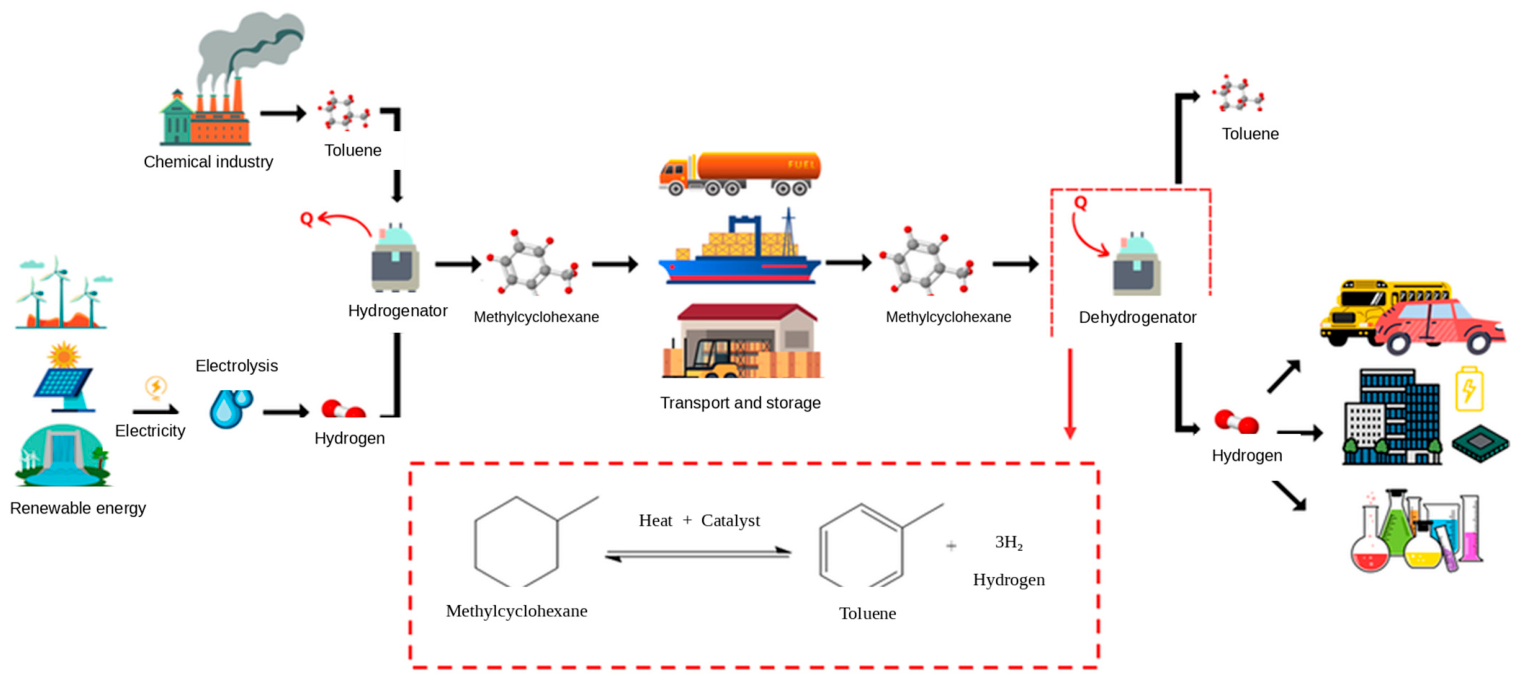
Hydrogen can connect renewable-electricity production with industrial, transport, and energy-storage demand, but its low volumetric density complicates large-scale storage and long-distance transport. Liquid organic hydrogen carriers (LOHCs) address this constraint by reversibly binding hydrogen in liquids that can be handled with infrastructure similar to that used for conventional fuels [1,2]. The carrier is hydrogenated before transport and dehydrogenated at the point of use, where hydrogen and the hydrogen-lean liquid are recovered (Figure 1).
The methylcyclohexane–toluene (MCH-TOL) pair is widely studied because both compounds are liquid under practical handling conditions, the carrier has a hydrogen capacity of approximately 6.2 wt.%, and the chemistry is compatible with established liquid-fuel logistics [3,4]. Its main operational difficulty is the endothermic dehydrogenation step. Catalyst choice affects conversion, selectivity, operating temperature, hydrogen-release rate, deactivation, and the cost of releasing hydrogen.
Pt-based catalysts dominate the available MCH-dehydrogenation literature, but reported performance depends on metal loading, promoter, support, dispersion, pretreatment, reactor configuration, temperature, pressure, feed composition, catalyst mass, and time basis [5,6,7,8,9]. A catalyst that performs well according to conversion may require a higher temperature or have a less favorable cost. Conversely, a low-temperature alternative may have a lower reported release rate. A single metric therefore cannot represent the full decision problem.
Multicriteria decision-making has been used for catalyst selection in other reaction systems. Noyan Tekeli et al. [10] compared decision methods for catalyst selection in formic-acid production, and Nath et al. [11] used VIKOR to rank heterogeneous catalysts for biodiesel production. The present work does not propose a new MCDM algorithm. Its contribution is a traceable screening application for MCH dehydrogenation that integrates the technical descriptors and cost inputs recorded in the original study and calculation annex.
CRITIC was selected because the matrix is quantitative and no formal expert-elicitation record was available. It derives weights from criterion dispersion and intercriterion correlation [12]. TOPSIS then ranks alternatives according to their distance from positive and negative ideal solutions and can accommodate benefit and cost criteria [13]. This combination is fit for the supplied dataset, but it is not method-independent and does not eliminate uncertainty inherited from the source studies.
Figure 1.
MCH-TOL liquid-organic-hydrogen-carrier pathway from hydrogenation and transport to endothermic dehydrogenation and hydrogen use, adapted from Rao and Yoon [14].
Accordingly, the objective was to reproduce and critically interpret the CRITIC-TOPSIS prioritization of nine MCH-dehydrogenation catalysts without introducing new measurements, inferred values, or unreported uncertainty ranges. Particular attention was given to data comparability, the meaning of screening-level descriptors, the dependence between operating temperature and process cost, and the limits of the resulting ranking.
2. Materials and Methods
2.1. Study Design and Evidence Basis
The study is documentary and quantitative. The original work searched Scopus and ScienceDirect and followed references to identify experimental studies of catalysts used for MCH dehydrogenation. The retained catalyst set was restricted to alternatives represented by a complete row in the supplied decision matrix. Missing technical values were not imputed. The nine-row calculation annex was treated as the controlling numerical source for the CRITIC weights and TOPSIS ranking.
The original source did not preserve a complete search string, search-date log, or a study-screening flow. The literature acquisition should therefore be interpreted as a targeted review rather than a systematic review. The retained set is a data-qualified subset of the catalyst literature and may favor catalyst families that are more extensively characterized.
2.2. Evaluation Criteria and Screening-Level Descriptors
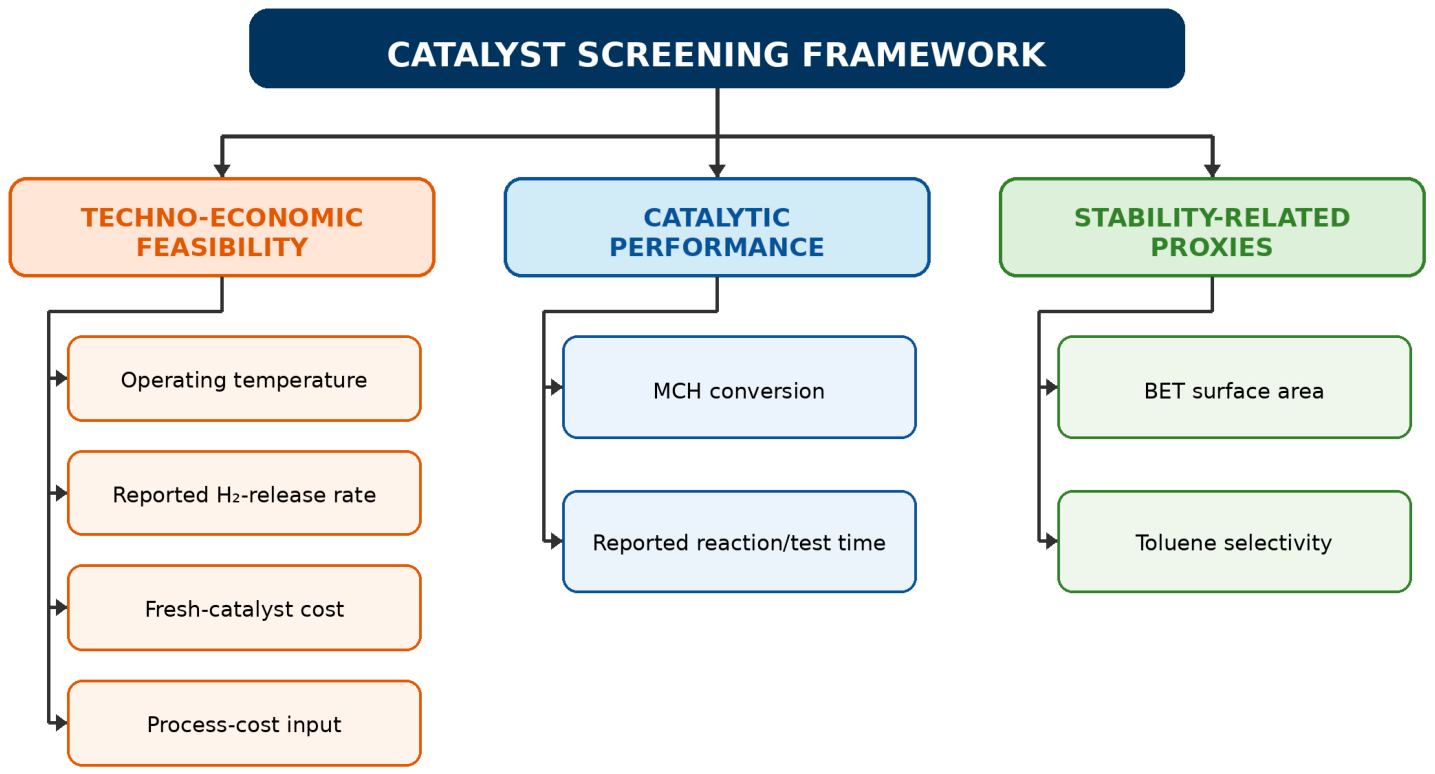
The eight descriptors were grouped as techno-economic feasibility, catalytic performance, and stability-related proxies (Figure 2). A screening-level descriptor is a value available for every retained alternative and usable in the decision matrix, while retaining the conditions and normalization basis of its source. Such a descriptor supports pre-experimental prioritization but is not equivalent to an intrinsic kinetic or durability parameter.
Figure 2.
Evaluation hierarchy used in the supplied decision matrix. Only the eight descriptors included in the numerical calculations are shown.
Operating temperature, fresh-catalyst cost, process cost, and reported reaction or test time were treated as cost criteria. Reported H2-release rate, MCH conversion, BET surface area, and TOL selectivity were treated as benefit criteria. Conversion and selectivity were entered as percentages, not fractions. The H2-release values retain the nominal unit reported in the source matrix (mmol g−1 min−1); a common denominator based on catalyst mass, active-metal mass, or accessible sites could not be confirmed for every publication. Similarly, the time values may represent different experimental concepts and are therefore labelled as reported reaction or test time.
Activation energy, turnover frequency, and activity normalized by metal mass or accessible active sites were not calculated. The supplied sources do not provide a common set of kinetic measurements, Pt dispersion values, or site concentrations needed for those calculations. Nominal metal loading was not used as a substitute for active site density. BET area and selectivity were retained as the available stability-related proxies, but neither is a direct measure of catalyst lifetime, regenerability, coking rate, or sintering resistance.
The original source gives qualitative by-product observations for several catalysts, including no detected liquid by-products for cases with 100% reported TOL selectivity and low by-product formation for cases near 99–99.9% selectivity. It does not provide a common quantitative by-product profile across all nine alternatives. Consequently, no additional by-product criterion was created.
2.3. Source-Based Economic Inputs
2.3.1. Fresh-Catalyst Cost
The fresh-catalyst cost values were taken directly from the source study and calculation annex. The source reports that CatCost was used to represent raw materials, material losses, preparation steps, equipment, utilities, labor, and direct and indirect cost contributions for precommercial catalyst manufacture [15]. The criterion is expressed as US$ kg−1 of fresh catalyst. It does not include service life, replacement frequency, regeneration, spent-catalyst disposal, or recovery of precious metals.
Detailed case files and route-by-route inputs for the nine catalyst estimates were not included among the supplied annexes. The reported final values were therefore used without recalculation. They should be interpreted as comparative screening inputs rather than supplier quotations or lifecycle catalyst costs.
2.3.2. Process-Cost Criterion
The original study supplied three screening-level process-cost values associated with operating temperatures of 300, 350, and 400 °C under a nominal target of 18,000 t H2 yr−1. The reported accounting basis combines hydrogen used to provide additional heat with contributions assigned to a reactor, pump, two heaters, flash separator, and boiler. The source also reports a five-year evaluation period, an initial investment of US$2,693,720, a 10.5% return assumption, and a hydrogen value of US$10.70 kg−1.
The final source values were US$1,014,539.29 at 300 °C, US$1,235,945.11 at 350 °C, and US$1,317,091.34 at 400 °C. Catalysts assigned the same operating temperature therefore received the same process-cost value. The supplied files do not contain sufficiently granular, fully linked records to reconstruct every total independently. For this reason, these values were used as fixed source-reported inputs and are not described as complete annual operating costs, levelized hydrogen costs, or detailed techno-economic results.
2.4. CRITIC Weighting
The supplied calculation annex was used without changing the decision matrix, the ideal and anti-ideal entries, or the recorded normalization conventions. After min–max transformation, the annex calculates the standard deviation of each criterion and the Pearson correlation coefficient between each pair of criteria. CRITIC defines the information content of criterion j as the product of its contrast intensity and its aggregate conflict with the remaining criteria [12]:
The objective weight is obtained by normalizing the information-content values:
The weights therefore describe the statistical structure of this nine-alternative matrix. They are not universal importance coefficients and must be recalculated if alternatives or criteria are added or removed.
2.5. TOPSIS Ranking
TOPSIS was applied to the original decision matrix using the CRITIC weights. Each column was vector-normalized and multiplied by its criterion weight:
The positive and negative ideal vectors were defined using the benefit or cost direction of each criterion. Euclidean separation distances were then calculated:
The relative closeness coefficient was calculated as:
A larger CCi indicates greater proximity to the positive ideal alternative.
2.6. Comparability and Robustness Boundary
The source experiments were conducted under different temperatures, pressures, feed compositions, catalyst loadings, space velocities, reactor configurations, pretreatments, and measurement protocols. Unit normalization supports numerical aggregation but does not remove these experimental differences. The ranking consequently compares the reported condition-specific values and should not be read as an intrinsic kinetic benchmark.
A formal sensitivity or uncertainty analysis was not performed. The supplied sources contain neither common experimental uncertainty intervals nor a documented perturbation protocol. Introducing arbitrary ± ranges, a probability distribution, or an unreported leave-one-out calculation would create results not present in the evidence base. Robustness is therefore discussed qualitatively from the supplied correlation matrix and the spacing of the TOPSIS coefficients.
3. Results and Discussion
3.1. Decision Matrix and Data Provenance
Table 1 reproduces the nine-alternative numerical matrix from the calculation annex. Technical values were reported in the cited catalyst studies, whereas the two cost columns were taken from the original study’s economic calculations. No values were interpolated or inferred for this revision.
Table 1.
Source decision matrix for CRITIC-TOPSIS evaluation of MCH-dehydrogenation catalysts.
The matrix illustrates why direct performance claims require caution. Conversion ranges from 59.35% to 99.9%, but the values were measured under different conditions. Selectivity is narrowly distributed between 99% and 100%, while BET area ranges from 6.37 to 1240 m2 g−1. These spreads influence CRITIC even though BET area is only a structural proxy and selectivity is not a lifetime measurement.
3.2. CRITIC Weights and Intercriterion Dependence
Selectivity received the largest weight (18.60%), followed by BET area (15.72%) and reported time (13.95%). These weights reflect dispersion and nonredundancy within the nine-row matrix; they do not establish universal scientific importance. In particular, the high weights of BET area and selectivity should not be interpreted as proof that these variables directly measure long-term stability (Table 2).
Table 2.
Criterion directions and CRITIC weights reproduced from the supplied calculation annex.
The supplied correlation matrix gives r = 0.959 between operating temperature and process cost. This strong association follows from assigning one process-cost value to each temperature level. CRITIC includes correlation when calculating information content, but both variables remain separate TOPSIS criteria; their joint inclusion can therefore give operating severity a double representation in the final distance calculation. The source files do not contain a ranking with either criterion removed, so the magnitude of this influence could not be quantified without generating a new analysis.
3.3. TOPSIS Ranking
Within the supplied matrix, 0.4 wt.% Pt/CB and 1 wt.% Pt/AC provide the highest overall proximity to the positive ideal. Both combine a 300 °C operating temperature with large BET areas and relatively favorable cost inputs. Their first and second positions are outcomes of the eight-criterion aggregation, not proof of superior intrinsic kinetics or durability (Table 3).
Table 3.
TOPSIS ranking reproduced from the formula output in the supplied calculation annex.
The ranking does not support a general monometallic-versus-bimetallic conclusion. The Pt-Mo/SiO2 alternative ranks third, whereas Pt/Y2O3 ranks ninth. In addition, Pt-Mo/SiO2, Pt/Ce-Mg-Al-O, and Cu-Pt/S-1 have closely spaced coefficients (52.38%, 51.76%, and 51.59%). Their relative order should therefore be treated as tentative until a source-grounded robustness analysis is available.
3.4. Scientific Interpretation and Limitations
The scientific value of the comparison lies in screening. It organizes heterogeneous evidence, makes trade-offs visible, and identifies candidates for testing under a common protocol. It does not convert values from the literature into intrinsic kinetic constants. Normalization changes scale, not experimental comparability, and a high TOPSIS score cannot substitute for direct measurements of turnover frequency, activation energy, accessible-site density, time-on-stream deactivation, coke deposition, or regenerability.
The principal limitations are the small complete-case dataset, heterogeneous reaction and reporting conditions, incomplete by-product information, proxy-based representation of stability, source-reported cost inputs that cannot be fully reconstructed from the supplied annexes, strong dependence between temperature and process cost, and the absence of a formal sensitivity analysis. These constraints prevent claims of universal catalyst superiority or ranking invariance.
Future work should first test the leading alternatives under the same temperature, pressure, feed composition, space velocity, catalyst loading, particle size, and analytical method. The resulting dataset should report conversion and carbon balance, identified by-products, rates normalized by catalyst and active metal, Pt dispersion, turnover frequency, activation energy, time-on-stream loss, coke content, and regeneration performance. Economic inputs should include catalyst inventory, lifetime, replacement and recovery. Sensitivity analysis should then use measured uncertainty ranges and should test criterion removal, alternative weighting, and alternative ranking methods.
4. Conclusions
The source-grounded CRITIC-TOPSIS analysis integrates eight technical and economic descriptors for nine reported MCH-dehydrogenation catalysts. In the supplied matrix, 0.4 wt.% Pt/CB and 1 wt.% Pt/AC rank first and second, with closeness coefficients of 66.09% and 58.94%. The result is useful for prioritizing standardized experiments, but it is conditional on the selected alternatives, source-specific test conditions, the recorded normalization and weighting procedure, and the source-reported cost inputs.
The review questions reveal two material limits. The process-cost criterion is strongly correlated with operating temperature and may duplicate part of the same operating-severity signal. In addition, the evidence base does not support a formal sensitivity analysis, activation-energy calculation, turnover-frequency comparison, or a quantitative by-product assessment. No unsupported values were introduced to fill these gaps. The ranking should therefore be presented as a transparent hypothesis-generation tool whose leading candidates require validation under a harmonized experimental and economic protocol.
Supplementary Materials
The following supporting information can be downloaded at: https://www.mdpi.com/article/10.3390/molecules31224055/s1, Supplementary File S1 contains the supplied CRITIC and TOPSIS worksheets, including the decision matrix, normalized matrices, correlation matrix, information-content values, weights, ideal solutions, separation distances, closeness coefficients, and ranking. Detailed case files used to derive the two cost columns are not included.
Author Contributions
Conceptualization, M.A.-O., J.C.O. and F.M.-M.; methodology, E.S.B.-S., J.D.M.-L., M.A.-O. and J.C.O.; validation, M.A.-O., J.C.O. and D.F.M.-D.; formal analysis, E.S.B.-S., J.D.M.-L. and M.A.-O.; investigation, E.S.B.-S., J.D.M.-L. and M.A.-O.; data curation, M.A.-O., J.C.O. and F.M.-M.; writing—original draft preparation, E.S.B.-S., J.D.M.-L. and M.A.-O.; writing—review and editing, J.C.O., D.F.M.-D. and F.M.-M.; supervision, D.F.M.-D. and F.M.-M.; project administration, D.F.M.-D. and F.M.-M.; funding acquisition, D.F.M.-D. and F.M.-M. All authors have read and agreed to the published version of the manuscript.
Funding
This research was funded by Universidad del Valle, grant SGR BPIN 2024000100089, CI 1354.
Institutional Review Board Statement
Not applicable.
Informed Consent Statement
Not applicable.
Data Availability Statement
The numerical decision matrix and the CRITIC-TOPSIS calculations are provided in Supplementary File S1. The detailed cost-estimation case files and a complete systematic-search record are not available in the supplied materials; the corresponding inputs should therefore be treated as source-reported values.
Acknowledgments
The authors thank the Universidad del Valle for the technical and financial support provided for the execution of this work. During the preparation of this manuscript, the authors used ChatGPT-6 and Gemini Google 2026 solely to support English translation and grammar and spelling review. The authors reviewed and edited all outputs and take full responsibility for the scientific content of the publication.
Conflicts of Interest
The authors declare no conflicts of interest. The funders had no role in the design of the study; collection, analysis, or interpretation of data; writing of the manuscript; or decision to publish the results.
Abbreviations
| Abbreviation | Definition |
| LOHC | Liquid organic hydrogen carrier |
| MCH | Methylcyclohexane |
| TOL | Toluene |
| MCDM | Multicriteria decision-making |
| CRITIC | Criteria Importance Through Intercriteria Correlation |
| TOPSIS | Technique for Order Preference by Similarity to Ideal Solution |
| BET | Brunauer–Emmett–Teller surface-area method |
| CB | Waste-tire-derived carbon black support |
| AC | Activated carbon |
References
- Niermann, M.; Timmerberg, S.; Drünert, S.; Kaltschmitt, M. Liquid Organic Hydrogen Carriers and alternatives for international transport of renewable hydrogen. Renew. Sustain. Energy Rev. 2021, 135, 110171. [Google Scholar] [CrossRef] [Scilit]
- Aakko-Saksa, P.T.; Cook, C.; Kiviaho, J.; Repo, T. Liquid organic hydrogen carriers for transportation and storing of renewable energy—Review and discussion. J. Power Sources 2018, 396, 803–823. [Google Scholar] [CrossRef] [Scilit]
- Oner, O.; Khalilpour, K. Evaluation of green hydrogen carriers: A multi-criteria decision analysis tool. Renew. Sustain. Energy Rev. 2022, 168, 112764. [Google Scholar] [CrossRef] [Scilit]
- Zhang, C.; Song, P.; Zhang, Y.; Xiao, L.; Hou, J.; Wang, X. Technical and cost analysis of imported hydrogen based on MCH-TOL hydrogen storage technology. Int. J. Hydrogen Energy 2022, 47, 27717–27732. [Google Scholar] [CrossRef] [Scilit]
- Kim, T.W.; Jeong, H.; Baik, J.H.; Suh, Y.W. State-of-the-art catalysts for hydrogen storage in liquid organic hydrogen carriers. Chem. Lett. 2022, 51, 239–255. [Google Scholar] [CrossRef] [Scilit]
- Cho, J.Y.; Kim, H.; Oh, J.E.; Park, B.Y. Recent advances in homogeneous/heterogeneous catalytic hydrogenation and dehydrogenation for potential liquid organic hydrogen carrier systems. Catalysts 2021, 11, 1497. [Google Scholar] [CrossRef] [Scilit]
- Sekine, Y.; Higo, T. Recent trends on the dehydrogenation catalysis of liquid organic hydrogen carrier: A review. Top. Catal. 2021, 64, 470–480. [Google Scholar] [CrossRef] [Scilit]
- Meng, J.; Zhou, F.; Ma, H.; Yuan, X.; Wang, Y.; Zhang, J. A review of catalysts for methylcyclohexane dehydrogenation. Top. Catal. 2021, 64, 509–520. [Google Scholar] [CrossRef] [Scilit]
- Jo, Y.; Suh, Y.W. Advanced design strategies for active metals in LOHC dehydrogenation: From static catalyst architectures to dynamic site evolution. Appl. Catal. A General. 2025, 706, 120484. [Google Scholar] [CrossRef] [Scilit]
- Tekeli, F.N.; Filiz, B.C.; Yörüklü, H.C.; Figen, A.K. Multi-criteria decision framework for catalyst selection: Production of formic acid as a circular liquid organic hydrogen carrier in the hydrogen economy. J. Clean. Prod. 2024, 452, 142125. [Google Scholar] [CrossRef] [Scilit]
- Nath, B.; Basumatary, B.; Wary, N.; Basumatary, U.R.; Basumatary, J.; Rokhum, S.L.; Azam, M.; Min, K.; Basumatary, S. Agricultural waste-based heterogeneous catalyst for the production of biodiesel: A ranking study via the VIKOR method. Int. J. Energy Res. 2023, 2023, 7208754. [Google Scholar] [CrossRef] [Scilit] [PubMed]
- Diakoulaki, D.; Mavrotas, G.; Papayannakis, L. Determining objective weights in multiple criteria problems: The CRITIC method. Comput. Oper. Res. 1995, 22, 763–770. [Google Scholar] [CrossRef] [Scilit]
- Opricovic, S.; Tzeng, G.-H. Compromise solution by MCDM methods: A comparative analysis of VIKOR and TOPSIS. Eur. J. Oper. Res. 2004, 156, 445–455. [Google Scholar] [CrossRef] [Scilit]
- Rao, P.C.; Yoon, M. Potential liquid-organic hydrogen carrier systems: A review on recent progress. Energies 2020, 13, 6040. [Google Scholar] [CrossRef] [Scilit]
- Van Allsburg, K.M.; Tan, E.C.D.; Super, J.D.; Schaidle, J.A.; Baddour, F.G. Early-stage evaluation of catalyst manufacturing cost and environmental impact using CatCost. Nat. Catal. 2022, 5, 342–353. [Google Scholar] [CrossRef] [Scilit]
- Yan, J.; Wang, W.; Miao, L.; Wu, K.; Chen, G.; Huang, Y.; Yang, Y. Dehydrogenation of methylcyclohexane over Pt-Sn supported on Mg-Al mixed metal oxides derived from layered double hydroxides. Int. J. Hydrogen Energy 2018, 43, 9343–9352. [Google Scholar] [CrossRef] [Scilit]
- Yang, X.; Song, Y.; Cao, T.; Wang, L.; Song, H.; Lin, W. The double tuning effect of TiO2 on Pt catalyzed dehydrogenation of methylcyclohexane. Mol. Catal. 2020, 492, 110971. [Google Scholar] [CrossRef] [Scilit]
- Zhang, X.; He, N.; Lin, L.; Zhu, Q.; Wang, G.; Guo, H. Study of the carbon cycle of a hydrogen supply system over a supported Pt catalyst: Methylcyclohexane-toluene-hydrogen cycle. Catal. Sci. Technol. 2020, 10, 1171–1181. [Google Scholar] [CrossRef] [Scilit]
- Miao, L.; Yan, J.; Wang, W.; Huang, Y.; Li, W.; Yang, Y. Dehydrogenation of methylcyclohexane over Pt supported on Mg-Al mixed oxides catalyst: The effect of promoter Ir. Chin. J. Chem. Eng. 2020, 28, 2337–2342. [Google Scholar] [CrossRef] [Scilit]
- Shukla, A.; Pande, J.V.; Biniwale, R.B. Dehydrogenation of methylcyclohexane over Pt/V2O5 and Pt/Y2O3 for hydrogen delivery applications. Int. J. Hydrogen Energy 2012, 37, 3350–3357. [Google Scholar] [CrossRef] [Scilit]
- Zhang, C.; Liang, X.; Liu, S. Hydrogen production by catalytic dehydrogenation of methylcyclohexane over Pt catalysts supported on pyrolytic waste tire char. Int. J. Hydrogen Energy 2011, 36, 8902–8907. [Google Scholar] [CrossRef] [Scilit]
- Wang, W.; Miao, L.; Wu, K.; Chen, G.; Huang, Y.; Yang, Y. Hydrogen evolution in the dehydrogenation of methylcyclohexane over Pt/Ce-Mg-Al-O catalysts derived from their layered double hydroxides. Int. J. Hydrogen Energy 2019, 44, 2918–2925. [Google Scholar] [CrossRef] [Scilit]
- Li, X.; Ma, D.; Bao, X. Dispersion of Pt catalysts supported on activated carbon and their catalytic performance in methylcyclohexane dehydrogenation. Chin. J. Catal. 2008, 29, 259–263. [Google Scholar] [CrossRef] [Scilit]
- Boufaden, N.; Pawelec, B.; Fierro, J.L.G.; Saïd Zina, M. Hydrogen storage in liquid hydrocarbons: Effect of platinum addition to partially reduced Mo-SiO2 catalysts. Mater. Chem. Phys. 2018, 209, 188–199. [Google Scholar] [CrossRef] [Scilit]

Disclaimer/Publisher’s Note: The statements, opinions and data contained in all publications are solely those of the individual author(s) and contributor(s) and not of MDPI and/or the editor(s). MDPI and/or the editor(s) disclaim responsibility for any injury to people or property resulting from any ideas, methods, instructions or products referred to in the content. |
© 2026 by the authors. Licensee MDPI, Basel, Switzerland. This article is an open access article distributed under the terms and conditions of the Creative Commons Attribution (CC BY) license.