


Abstract
The volatile fraction (VF) of the aerial parts of Sphagnum magellanicum Brid. (Sphagnaceae), collected in southern Ecuador (2740 m a.s.l), was obtained for the first time by steam distillation using a Dean–Stark adapted apparatus and characterized by gas chromatography coupled to mass spectrometry (GC-MS) and flame ionization detection (GC-FID). A total of 89 compounds representing 95.28 ± 1.95% of the total VF were identified. The predominant chemical classes were n-alkanes (39.94%), alcohols (17.56%), sesquiterpene hydrocarbons (13.10%), and oxygenated sesquiterpenes (6.48%). Phytol was the major single compound (16.09 ± 0.07%), followed by n-tricosane (9.25 ± 0.82%), n-heneicosane (9.17 ± 0.54%), hexacosane (7.30 ± 0.99%), nonacosane (5.42 ± 0.14%), (Z)-caryophyllene (4.08 ± 0.32%), hexadecanoic acid (3.64 ± 0.25%), and dotriacontane (2.93 ± 0.21%). The VF was evaluated in vitro for acetylcholinesterase (AChE) inhibitory activity using the Ellman colorimetric assay, yielding a moderate inhibitory effect with an IC50 value of 77.0 ± 1.03 µg/mL. These results provide the first phytochemical and pharmacological characterization of S. magellanicum from Ecuador, establishing it as a potential source of bioactive volatile constituents with potential relevance for further pharmacological investigation.
1. Introduction
Mosses belong to the division Bryophyta and comprise over 13,000 described species, making them the second most diverse group of land plants after angiosperms [1,2]. They are widely distributed across all continents, with particular abundance in humid and shaded environments of the Northern Hemisphere [2,3]. The genus Sphagnum is recognized for a notable diversity of secondary metabolites, including sterols, triterpenoids (such as ursolic acid), fatty acids, fatty alcohols, and phenolic compounds [4,5]. Chemical characterization studies using gas chromatography coupled to mass spectrometry (GC-MS) have revealed metabolic profiles that vary seasonally, highlighting the presence of carbohydrates, phytosterols, and diterpenes that contribute to the biological properties of these organisms [6].
The volatile fraction of bryophytes has received growing attention as a source of biologically active constituents [7,8]. The identification of volatile compounds in mosses through simultaneous distillation–extraction techniques has revealed the presence of aldehydes and terpenoids, which are key constituents of the volatile fraction of these organisms [9,10]. Studies on Sphagnum species specifically have documented the use of in vitro cultures to stabilize and characterize these chemical profiles, confirming the presence of characteristic volatiles in the genus [11]. The phytochemical characterization of the VF of S. magellanicum from South American habitats remains largely unexplored, representing a significant knowledge gap in the bryophyte chemistry literature.
The inhibition of acetylcholinesterase (AChE) constitutes a primary therapeutic strategy for the management of Alzheimer’s disease (AD) and related neurodegenerative disorders [12,13]. AChE catalyzes the hydrolysis of the neurotransmitter acetylcholine (ACh) in cholinergic synapses; its inhibition increases ACh availability and improves cholinergic transmission, which is clinically beneficial in early and moderate stages of AD [12]. Current FDA-approved AChEIs, including donepezil, rivastigmine, and galantamine, provide only symptomatic relief and are associated with adverse effects that limit long-term use, thus motivating the search for novel plant-derived inhibitors with improved safety profiles [13,14]. In this context, volatile fractions from aromatic plants and their terpenoid constituents have shown AChE inhibitory capacity, which in some studies has been suggested to involve synergistic interactions among constituents [15,16]. Monoterpenes and sesquiterpenes commonly found in plant volatile fractions, such as α-pinene, limonene, 1,8-cineole, and caryophyllene, have been specifically identified as active agents in AChE inhibition [17,18].
Ecuador possesses one of the highest bryophyte diversities in the world [19], representing a vast reservoir of bioactive compounds with antibacterial, antioxidant, and antiproliferative properties [20]. In the regional context, bryophytes have also attracted attention for their potential cholinesterase-related activity. A survey of 39 bryophyte species representing 16 families detected cholinesterase activity in 30 species from 13 families, highlighting the potential of bryophytes as a source of bioactive compounds associated with the cholinergic system [21], thus establishing a relevant precedent for the investigation of S. magellanicum. Beyond their pharmacological potential, the ethnomedicinal use of Sphagnum species across diverse cultures, particularly for wound care, infection treatment, and fever management, provides a traditional basis for the scientific investigation of their bioactivity [1,2].
In the present study, we report for the first time the chemical composition and AChE inhibitory activity of the volatile fraction obtained by steam distillation from the aerial parts of S. magellanicum Brid. GC-MS and GC-FID were used to analyze the volatile fraction, and the anticholinesterase potential was evaluated using an in vitro Ellman assay.
2. Results
2.1. Volatile Fraction Yield and Chemical Composition
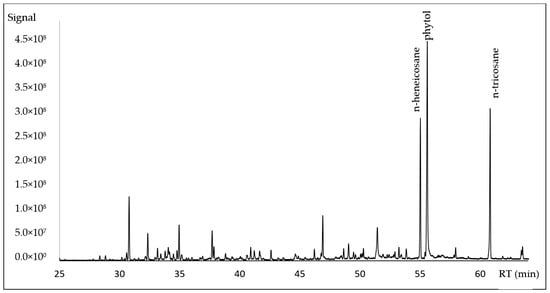
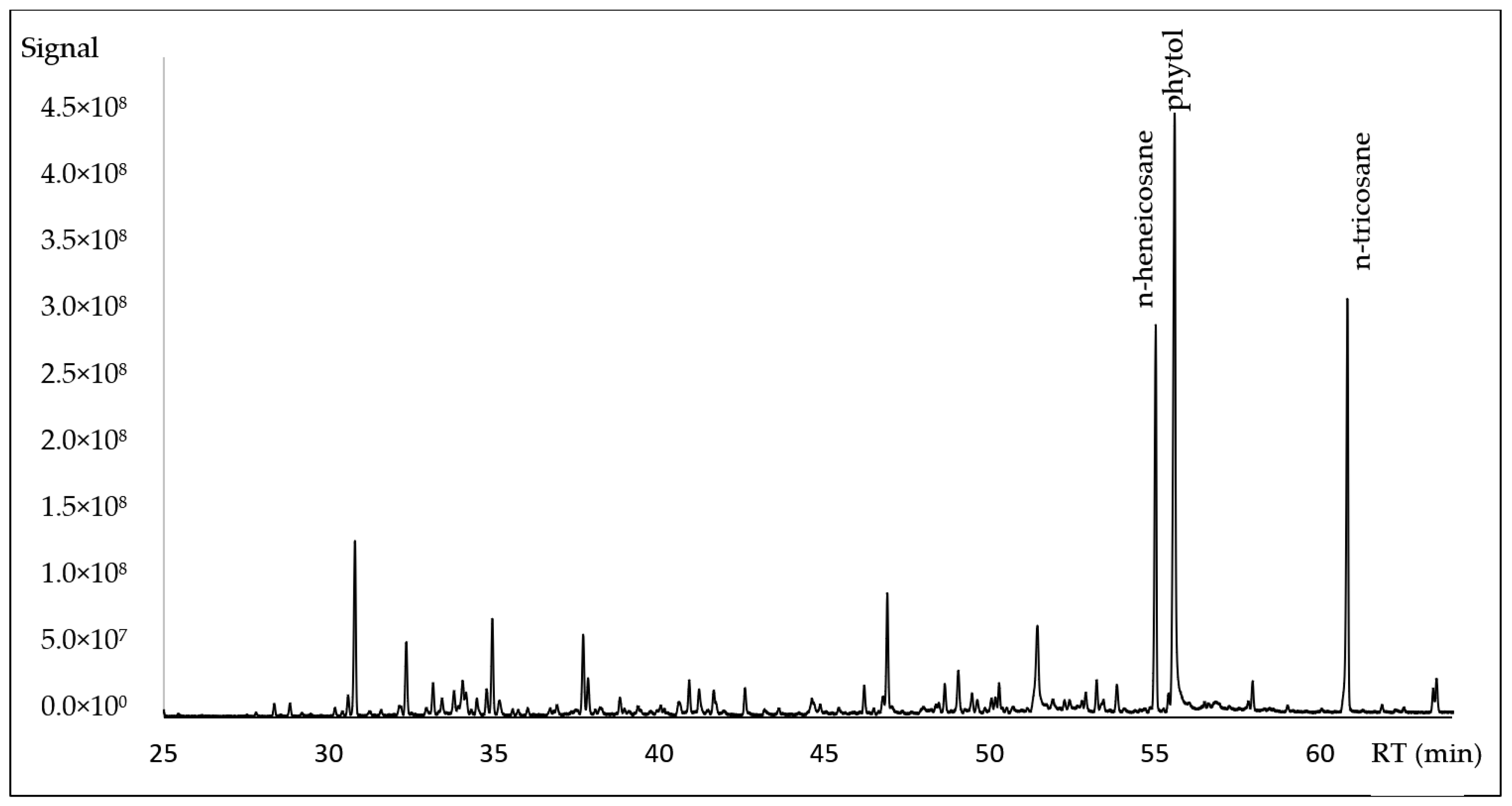
The volatile fraction of the aerial parts of S. magellanicum Brid. was obtained by steam distillation, yielding an average of 0.032% (w/w). The GC-MS analysis using a DB-5ms capillary column (Figure 1) identified 89 compounds, which accounted for 93.03%, 96.41%, and 96.41% of the total volatile fraction in each replicate, respectively. The complete qualitative and quantitative composition was presented in Table 1. We classified the identified compounds into twelve chemical classes. Alkanes were the dominant group, accounting for 39.94% ± 0.39%. The second most abundant class was alcohols (17.56% ± 0.30%), followed by sesquiterpene hydrocarbons (13.10% ± 1.15%), oxygenated sesquiterpenes (6.10% ± 0.89%), aldehydes (4.56% ± 1.22%), and fatty acids (4.05% ± 0.02%). Minor classes included ketones (3.39% ± 0.25%), diterpenes (2.15% ± 0.27%), esters (1.17% ± 0.20%), lactones (0.72% ± 0.31%), and monoterpene hydrocarbons (0.20% ± 0.02%).
Figure 1.
GC-MS total ion chromatogram (TIC) of the volatile fraction of S. magellanicum from Ecuador (TR-5MS column). Labelled peaks: phytol, n-heneicosane and n-tricosane.
Table 1.
Chemical composition of the volatile fraction of Sphagnum magellanicum Brid.
The eleven most abundant compounds (>2.0% mean content), which accounted for approximately 64.88% of the total identified fraction, were summarized in Table 2. Phytol was identified as the dominant compound (16.09% ± 0.07%), followed by n-tricosane (9.25% ± 0.82%), n-heneicosane (9.17% ± 0.54%), hexacosane (7.30% ± 0.99%), nonacosane (5.42% ± 0.14%), (Z)-caryophyllene (4.08% ± 0.32%), hexadecanoic acid (3.64% ± 0.25%), and dotriacontane (2.93% ± 0.21%).
Table 2.
Major compounds (>2.0%) in the volatile fraction of S. magellanicum Brid.
2.2. Acetylcholinesterase Inhibitory Activity
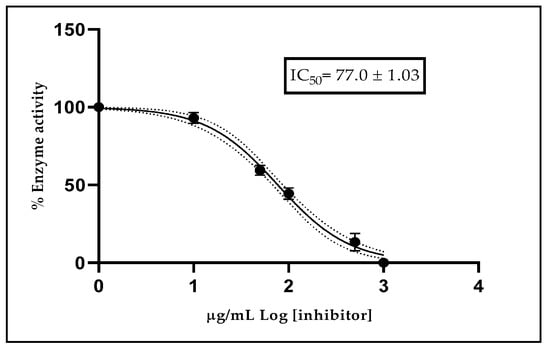
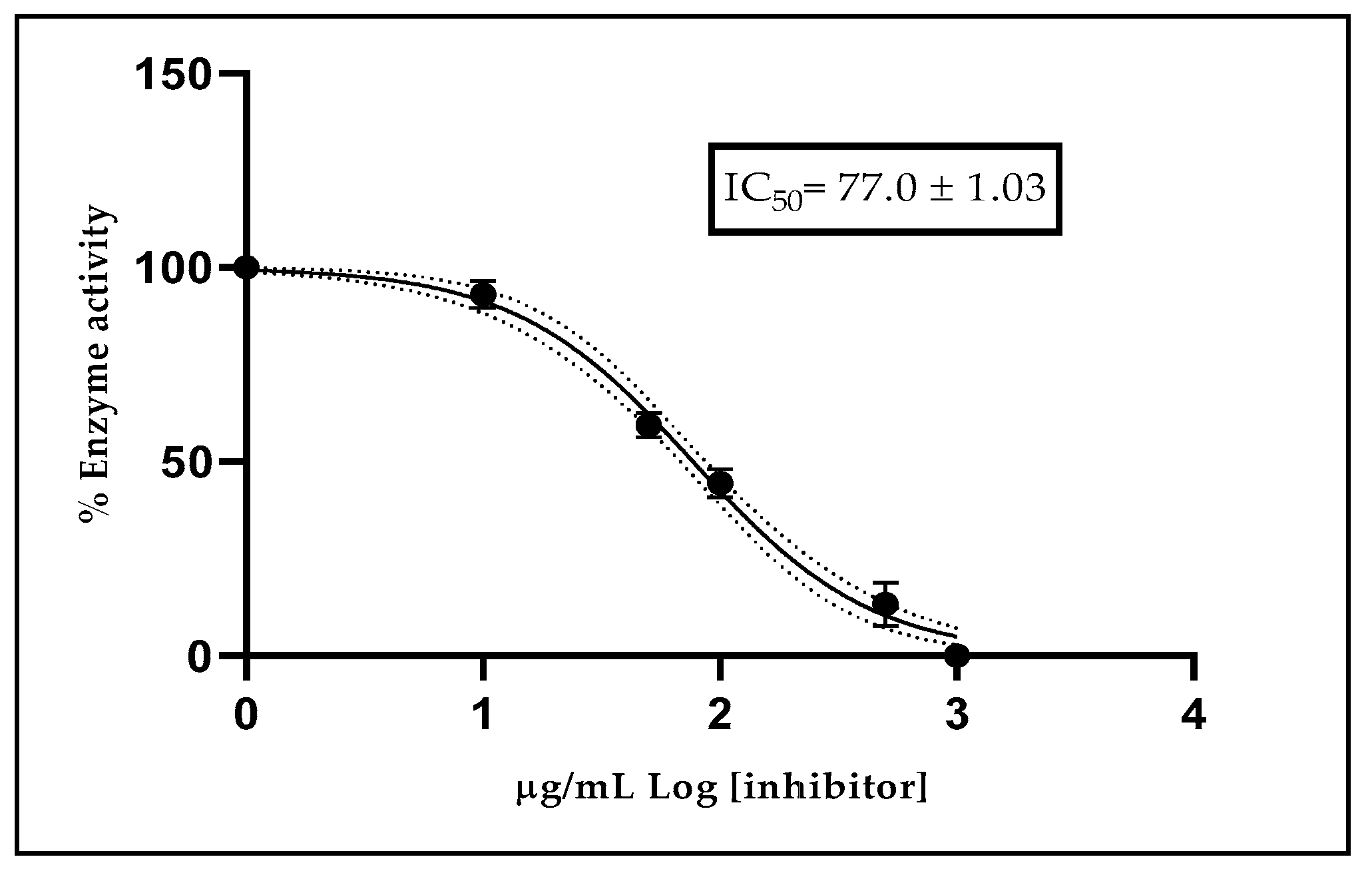
The VF of S. magellanicum was evaluated for its AChE inhibitory potential using the Ellman colorimetric assay. Figure 2 shows the concentration-response curve. The volatile fraction exhibited moderate AChE inhibitory activity, with an IC50 value of 77.0 ± 1.03 µg/mL. For comparison, the IC50 of donepezil hydrochloride (12.40 ± 1.35 nM; molar mass 415.96 g/mol) corresponds to approximately 5.2 ± 0.6 ng/mL (0.0052 µg/mL), indicating that the VF is about four orders of magnitude less potent on a mass-concentration basis. This comparison involves a complex mixture and a pure compound and is therefore not equivalent on a molar basis.
Figure 2.
AChE inhibitory activity of the volatile fraction of S. magellanicum from Ecuador. The IC50 values were calculated from concentration-response curves (mean ± SD, n = 3).
3. Discussion
The volatile fraction of Sphagnum magellanicum Brid. collected in southern Ecuador was characterized for the first time, revealing a profile of 89 identified compounds representing 93.03–96.41% of the total VF. The dominant chemical class was n-alkanes (39.94%), specifically n-heneicosane (C21, 9.17 ± 0.54%), n-tricosane (C23, 9.25 ± 0.82%), hexacosane (C26, 7.30 ± 0.99%), nonacosane (C29, 5.42 ± 0.14%), and dotriacontane (C32, 2.93 ± 0.21%). This predominance is consistent with the well-documented composition of the genus Sphagnum, in which n-alkane distributions in cuticle waxes are typically dominated by mid- to long-chain homologues (C21–C33), with C23 or C25 as the major homologues across multiple species and geographic regions [23,24]. In bryophytes, long-chain n-alkanes are structural components of cuticular waxes, playing a key role in waterproofing and desiccation tolerance [25]. These functions are particularly relevant for plants growing in areas with fluctuating humidity levels, such as the Andes and the Amazon [26]. The higher proportions of alkanes observed in our Ecuadorian material relative to European Sphagnum extracts [3] may thus reflect an adaptive response to the environmental stress conditions of the collection site at c.a. 2740 m a.s.l.
Phytol was the most abundant compound and a finding of considerable pharmacological significance [27]. As an acyclic diterpene alcohol derived from the phytol side chain of chlorophyll through hydrolysis and reduction [28], phytol is ubiquitous in photosynthetic biomass, and its occurrence in Sphagnum extracts has been documented previously, although not as a major constituent [3]. The broad pharmacological profile of phytol is well established: Islam et al. [27] demonstrated significant anti-inflammatory activity through inhibition of COX-1, COX-2, NF-κB, and IL-1β pathways in preclinical models, while Claro-Cala et al. [29] confirmed its anti-inflammatory effect on primary human monocytes-macrophages. A systematic meta-analysis confirmed a significant association between phytol and cytotoxicity in cancer cell models (OR: 1.81; 95% CI = 1.12–2.65, p < 0.05), supporting its anticancer potential [30]. Additionally, in silico studies suggest that phytol interacts with the AChE active site gorge through hydrophobic contacts with key residues (Trp86, Tyr337) [12,31]; however, its contribution to the AChE inhibition observed for the VF cannot be inferred from the present data.
The sesquiterpene fraction comprising (Z)-caryophyllene (4.08 ± 0.32%), δ-amorphene (2.15 ± 0.19%), α-humulene (2.01 ± 0.18%), caryophyllene oxide (1.79 ± 0.17%), and germacrene D (0.65 ± 0.06%) contributes an additional pharmacological dimension to the VF. Caryophyllene sesquiterpenes are widely recognized for their genoprotective, cytoprotective, antiproliferative, and chemosensitizing activities [32]. The presence of a sesquiterpene fraction exceeding 19% in Ecuadorian specimens of Sphagnum magellanicum, in stark contrast to its absence in material from high-latitude regions of Europe [3], suggests a strong geographic and environmental influence on its lipid profile. The chemical profile of S. magellanicum of Baltic origin is characterized by low complexity and is dominated by fatty acids, sterols and triterpenes. No sesquiterpenes were detected in its lipid fraction [3]. This marked variation in chemical composition can be explained by the stress induced by Andean-Amazonian conditions (temperature fluctuations and high UV radiation), which stimulate the accumulation of terpenoids as cellular photoprotectors [33]. In bryophytes, the regulation and dynamics of sesquiterpene synthesis in response to abiotic stress primarily depend on the activity of microbial-type terpene synthases (MTPSLs) [33].
Hexadecanoic acid (palmitic acid, 3.64 ± 0.25%), the dominant fatty acid in the VF, was previously reported as a biologically active constituent of multiple Sphagnum species analyzed by GC-MS [6]. Structurally, hexadecanoic acid acts as a competitive inhibitor of phospholipase A2 (PLA2), the enzyme initiating prostaglandin and leukotriene biosynthesis, thereby conferring anti-inflammatory properties validated by crystallographic and in vivo data [34,35]. Its co-occurrence with phytol and (Z)-caryophyllene in the VF raises the possibility of additive anti-inflammatory effects, a synergistic phenomenon documented for complex plant volatile fractions [15,16].
The volatile profile of S. magellanicum from Ecuador differs markedly from those reported for other bryophytes by steam distillation. Sim-Sim et al. [11] reported predominantly oxygenated sesquiterpene profiles for S. palustre and S. magellanicum from Portugal, with no dominant diterpene alcohol. These interspecific and interregional contrasts reflect the well-documented influence of geographic origin, altitude, season, and extraction methodology on the secondary metabolite profiles of bryophytes [5] and underscore the chemical distinctiveness of the Ecuadorian chemotype described here. The volatile fraction was obtained by steam distillation, which provides material suitable for bioassays, but which may not fully reflect the composition of the headspace of living moss and may generate thermal artefacts. Complementary techniques, such as headspace solid-phase microextraction (HS-SPME), would enable the comparison of profiles obtained using different extraction methods, and are proposed for future work.
The VF of S. magellanicum demonstrated moderate AChE inhibitory activity (IC50 = 77.0 ± 1.03 µg/mL), the first report of this biological activity for the species. While this value is considerably higher than that of the synthetic reference donepezil (IC50 = 0.0052 µg/mL). In the regional context, the VF of the Ecuadorian liverwort Syzygiella rubricaulis showed a stronger inhibitory effect (IC50 = 26.75 ± 1.03 µg/mL), which may be related to its markedly distinct sesquiterpene-dominated profile (hydrocarbon sesquiterpenes: 48.35%; oxygenated sesquiterpenes: 46.89%) [36]. This comparison is in line with reports suggesting a relationship between sesquiterpene content and AChE inhibitory potency: Venditti et al. [16] suggest that an increase in sesquiterpenoid proportion relative to monoterpenoids considerably improves AChE inhibition capacity, and Hung et al. [15] confirmed that VFs with high sesquiterpene concentrations systematically show stronger activity. The moderate AChE inhibitory activity observed for S. magellanicum may be related to its chemical profile, which is dominated by n-alkanes and alcohols, compounds for which AChE inhibitory activity appears to be highly dependent on their specific chemical structures and concentrations [37,38].
The whole-fraction assay used here does not allow the contribution of individual constituents to the observed AChE inhibition to be determined, and no attribution of the activity to specific compounds. Previous studies on EOs and VFs have reported cholinesterase-inhibitory effects for some terpenoid constituents, including sesquiterpenes such as caryophyllene. However, these effects are highly dependent on molecular structure, concentration, and assay conditions [12,15,17,37,39]. The present data do not allow us to determine whether the terpenoid constituents present in this VF (e.g., phytol and caryophyllane-type sesquiterpenes) participate in the activity measured here. Similarly, synergistic or additive interactions, which have been suggested for complex volatile fractions [15,16], cannot be assessed with a single whole-fraction assay and should be evaluated using a single whole-fraction assay and are therefore hypothetical. Bioassay-guided fractionation and testing of isolated constituents, individually and in combination, would be necessary to clarify their contribution.
4. Materials and Methods
4.1. Plant Material Collection and Preparation
Aerial parts of Sphagnum magellanicum Brid. (Sphagnaceae) were collected on May, June and July 2024 at Sector El Tiro, Sabanilla, Zamora Chinchipe province, southern Ecuador (latitude 3°58′05.9″ S, longitude 79°08′00.5″ W, altitude 2740 m a.s.l.). The collection was conducted under permit No. MAATE-ARSFC-2022-2839 issued by the Ministerio del Ambiente, Agua y Transición Ecológica (MAATE) of Ecuador. Botanical identification of the specimen was carried out by Dr. Ángel Benítez, botanist at the Herbarium of the Universidad Técnica Particular de Loja (HUTPL), Loja, Ecuador. A reference voucher specimen has been deposited at the HUTPL Herbarium (HUPTPL AB-1331).
To ensure uniformity in environmental growth conditions and population source, plant material was collected from the same specific plant community. Upon arrival at the laboratory, extraneous material and debris were manually removed. The plant material was ground using a mechanical mill to reduce particle size and maximize surface area, facilitating more efficient volatile release during steam distillation. The processed material was used immediately for volatile fraction extraction.
4.2. Isolation of the Volatile Fraction by Steam Distillation
A total of 1502.41, 1201.03, and 1302.50 g of processed plant material were distributed uniformly across three round-bottom flasks. The VF was obtained by steam distillation using a laboratory-adapted Dean–Stark apparatus, as previously described by Calva et al. [40] and Maldonado et al. [41]. The condensed VF was separated from the aqueous phase, dried over anhydrous sodium sulfate (Na2SO4), filtered, transferred to amber glass vials, and stored at −7 °C until analysis. The yield of the volatile fraction was calculated as the mean percentage (w/w) relative to the fresh weight of plant material used.
4.3. GC-MS Analysis
Qualitative identification of volatile fraction constituents was performed using the methodology of Calva et al. [40], gas chromatography coupled to mass spectrometry (GC-MS) using a Thermo Scientific TRACE 1310–ISQ™ 7000 chromatograph (Waltham, MA, USA) equipped with a TR-5MS capillary column (30 m × 0.25 mm i.d. × 0.25 µm film thickness, equivalent to DB-5ms). Samples were prepared by dissolving 10 µL of the volatile fraction in 990 µL of dichloromethane (DCM, analytical grade); each preparation was injected in duplicate. Injection volume was 1 µL in split mode at a split ratio of 1:20, with an injector temperature of 230 °C.
The oven temperature program was as follows: initial hold at 50 °C for 10 min; temperature ramp at 3 °C min−1 to 170 °C; ramp at 10 °C min−1 to 230 °C; ramp at 15 °C min−1 to 280 °C, held for 10 min; total run time 70 min. Helium was used as the carrier gas at a constant flow. The mass spectrometer was operated in electron ionization (EI) mode at 70 eV, with a mass transfer line temperature of 230 °C and an ion source temperature of 230 °C. The mass scan range was m/z 40–400, with a solvent delay of 3 min. Compound identification was carried out by comparing calculated linear retention indices (LRIcal) with literature reference values (LRIlit) from the Adams database [22], and by spectral matching against the NIST 2017 mass spectral library, with a minimum accepted match factor of 80%.
4.4. GC-FID Analysis
Quantitative composition of the volatile fraction was determined by gas chromatography with flame ionization detection (GC-FID) on the same chromatographic platform described in Section 4.3. Analyses were performed in split mode at a ratio of 40:1. The oven temperature program consisted of an initial hold at 50 °C for 3 min, followed by a linear ramp to 230 °C over 3 min. The relative percentage of each identified compound was calculated by peak area normalization against the total chromatogram area, without the application of response correction factors. Results are reported as the mean percentage ± standard deviation (% ± SD) from three independent sample preparations (M1, M2, and M3). Percentages represent relative peak areas (area normalization without response factors) and should be interpreted as relative composition rather than absolute concentrations. FID response differs between hydrocarbons and oxygenated compounds; oxygenated constituents such as phytol may therefore be modestly underestimated relative to hydrocarbons.
4.5. Calculation of Linear Retention Indices
Linear retention indices (LRI) were calculated for all detected peaks according to the Van Den Dool and Kratz method [42], using a homologous series of n-alkane standards (C9–C25) injected under identical chromatographic conditions as the volatile fraction samples. Compound identity was confirmed when both the LRIcal and the mass spectral fragmentation pattern corresponded to the respective entry in the Adams reference database [21] and/or the NIST library. Compounds for which no adequate spectral or retention index match was obtained are reported as “not identified” in Table 1, together with their calculated LRI values.
4.6. Acetylcholinesterase Inhibitory Activity Assay
The AChE inhibitory activity of the volatile fraction was evaluated in vitro following the colorimetric Ellman method [43], with minor modifications as detailed below.
4.6.1. Sample Preparation
A stock solution of the volatile fraction (10,000 µg/mL) was prepared by dissolving 10 mg of the VF in 1 mL of methanol (MeOH, HPLC grade). Serial dilutions were prepared in MeOH to yield working concentrations of 1000, 500, 100, 50, and 10 µg/mL. Methanol was selected as a non-selective protic solvent and employed as the negative control at a maximum final concentration of 10% (v/v) in the reaction mixture, a level previously confirmed to exert no significant effect on AChE enzymatic activity.
4.6.2. Enzymatic Assay Procedure
The reaction mixture was assembled in a 96-well flat-bottom microplate as follows: 40 µL of Tris buffer (pH 8.0), 20 µL of the test sample at the corresponding working concentration, 100 µL of 5,5′-dithiobis-(2-nitrobenzoic acid) (DTNB, 3 mM in Tris buffer), and 20 µL of acetylthiocholine iodide (ATCh, 15 mM in phosphate-buffered saline, PBS, pH 7.4). The mixture was pre-incubated for 3 min at 25 °C with continuous agitation. The enzymatic reaction was initiated by adding 20 µL of acetylcholinesterase (AChE, 0.5 U/mL, from Electrophorus electricus, Sigma-Aldrich, St. Louis, MO, USA). The formation of the chromogenic product 5-thio-2-nitrobenzoate (TNB), resulting from the reaction of thiocholine with DTNB, was monitored spectrophotometrically at 405 nm using an EPOCH 2 microplate reader (BioTek Instruments, Winooski, VT, USA) at 25 °C over 60 min. A standard calibration curve of DTNB and L-glutathione (L-GSH) at multiple molar concentrations was constructed to convert absorbance readings to product release rates (mM min−1).
4.6.3. Controls, IC50 Determination, and Data Analysis
Donepezil hydrochloride (Sigma-Aldrich, ≥98% purity) was employed as the positive reference AChEI. Under the same experimental conditions described above, donepezil yielded a calculated IC50 of 12.40 ± 1.35 nM, confirming assay system validity and reproducibility. The percentage of AChE inhibition was calculated according to Equation (1) [44]:
where Vsample and Vcontrol represent the reaction velocities (mM min−1) measured in the presence and absence of the test sample, respectively. IC50 values were determined from concentration–response curves by nonlinear regression analysis (log[inhibitor] vs. normalized response, variable slope model) using GraphPad Prism software (version 9.0; GraphPad Software, San Diego, CA, USA) [45]. All assays were performed in triplicate.
%Inhibition = (1 − Vsample/Vcontrol) × 100
4.7. Statistical Analysis
All quantitative data are expressed as mean ± standard deviation (SD) from three independent experimental replicates (n = 3). The relative percentage composition of the volatile fraction was determined by peak area normalization of GC-FID chromatograms. IC50 values for AChE inhibition were calculated by nonlinear regression analysis using GraphPad Prism v9.0 (GraphPad Software, San Diego, CA, USA). Statistical significance was set at p < 0.05.
5. Conclusions
The present study reports, for the first time, the chemical characterization and acetylcholinesterase inhibitory activity of the volatile fraction obtained by steam distillation from the aerial parts of Sphagnum magellanicum Brid. collected in southern Ecuador. A total of 89 compounds were identified, accounting for 93.03–96.41% of the total volatile fraction. The chemical profile of the volatile fraction was dominated by n-alkanes (39.94%), a finding consistent with the lipid geochemistry previously described for the genus Sphagnum, though the specific alkane distribution and the remarkable abundance of phytol (16.09 ± 0.07%) as the single most prevalent compound represent a distinctive feature of this Ecuadorian chemotype. Phytol and caryophyllene-type sesquiterpenes, which co-occur in the VF, have been associated in the literature with anti-inflammatory and antinociceptive activities [27,28,29,30,31,32]; their relevance to the AChE inhibition observed here was not evaluated. The volatile fraction demonstrated moderate acetylcholinesterase (AChE) inhibitory activity with an IC50 value of 77.0 ± 1.03 µg/mL in the Ellman in vitro assay, representing the first report of anticholinesterase potential for this species. This moderate activity may be related to the predominance of n-alkanes over sesquiterpenes in the VF, given that sesquiterpene-rich profiles are typically associated with higher AChE inhibitory potency. The results further validate the pharmacological relevance of Ecuadorian bryophytes as a largely untapped source of bioactive secondary metabolites and encourage expanded phytochemical investigation of the genus Sphagnum in the megadiverse Andean region.
Author Contributions
Conceptualization, J.C. and Á.B.; methodology, J.F.D. and J.C.; investigation, J.F.D. and J.C.; writing—original draft preparation, J.C., Á.B., and E.V.; writing—review and editing, J.C. and E.V. All authors have read and agreed to the published version of the manuscript.
Funding
This research was funded internally by the Universidad Técnica Particular de Loja through the Vice-Rectorate of Research, under project number POA_VIN 56.
Institutional Review Board Statement
Not applicable.
Informed Consent Statement
Not applicable.
Data Availability Statement
The data generated by this research are presented throughout the manuscript. If you have any questions, please contact the corresponding author.
Acknowledgments
The authors would like to thank UTPL for funding the research and supporting the open-access publication of the manuscript.
Conflicts of Interest
The authors declare no conflicts of interest.
Abbreviations
The following abbreviations are used in this manuscript:
| VF | Volatile Fraction |
| GC-FID | Gas chromatography with Flame Ionization Detector |
| GC-MS | Gas chromatography coupled to mass spectrometry |
| AChE | Acetilcholinesterase |
References
- Chandra, S.; Chandra, D.; Barh, A.; Pandey, R.K.; Sharma, I.P. Bryophytes: Hoard of remedies, an ethno-medicinal review. J. Tradit. Complement. Med. 2017, 7, 94–99. [Google Scholar] [CrossRef] [Scilit] [PubMed]
- Lueth, V.M.; Reski, R. Mosses. Curr. Biol. 2023, 33, R1175–R1181. [Google Scholar] [CrossRef] [Scilit] [PubMed]
- Klavina, L.; Springe, G.; Nikolajeva, V.; Martsinkevich, I.; Nakurte, I.; Dzabijeva, D.; Steinberga, I. Chemical Composition Analysis, Antimicrobial Activity and Cytotoxicity Screening of Moss Extracts (Moss Phytochemistry). Molecules 2015, 20, 17221–17243. [Google Scholar] [CrossRef] [Scilit] [PubMed]
- Costică, M.; Stratu, A.; Costică, N.; Costică, M. Liverworts and mosses from Romania with medicinal potential. Acta Biol. Marisiensis 2023, 6, 113–127. [Google Scholar] [CrossRef] [Scilit]
- Klavina, L.; Springe, G.; Steinberga, I.; Mežaka, A.; Ievinsh, G. Seasonal changes of chemical composition in boreonemoral moss species. Environ. Exp. Biol. 2018, 16, 9–19. [Google Scholar] [CrossRef] [Scilit]
- Serebrennikova, O.V.; Duchko, M.A.; Koronatova, N.G.; Strelnikova, E.B. Concentrations and composition of Sphagnum peat lipids depending on temperature in the climatic zones of Western Siberia. Solid Fuel Chem. 2018, 52, 36–43. [Google Scholar] [CrossRef] [Scilit]
- Valarezo, E.; Meneses, M.A.; Jaramillo-Fierro, X.; Radice, M.; Benítez, A. Volatile Compounds and Oils from Mosses and Liverworts. In Bioactive Compounds in Bryophytes and Pteridophytes; Springer: Berlin/Heidelberg, Germany, 2022; pp. 1–53. [Google Scholar]
- Saritas, Y.; Sonwa, M.M.; Iznaguen, H.; König, W.A.; Muhle, H.; Mues, R. Volatile constituents in mosses (Musci). Phytochemistry 2001, 57, 443–457. [Google Scholar] [CrossRef] [Scilit] [PubMed]
- Alves, R.J.M.; Miranda, T.G.; Pinheiro, R.O.; de Souza Pinheiro, W.B.; Andrade, E.H.A.; Tavares-Martins, A.C.C. Volatile chemical composition of Octoblepharum albidum Hedw. (Bryophyta) from the Brazilian Amazon. BMC Chem. 2022, 16, 76. [Google Scholar] [CrossRef] [Scilit] [PubMed]
- Asakawa, Y.; Ludwiczuk, A.; Nagashima, F. Chemical Constituents of Bryophytes: Bio- and Chemical Diversity, Biological Activity, and Chemosystematics; Progress in the Chemistry of Organic Natural Products; Springer: Berlin/Heidelberg, Germany, 2013; Volume 95. [Google Scholar] [CrossRef] [Scilit]
- Sim-Sim, M.; Abreu, M.; Garcia, C.; Sergio, C.; Figueiredo, A.C. Essential oil composition of two Sphagnum species grown in Portugal and their in vitro culture establishment. Nat. Prod. Commun. 2017, 12, 1203–1206. [Google Scholar] [CrossRef] [Scilit]
- Orhan, I.; Kartal, M.; Kan, Y.; Şener, B. Activity of essential oils and individual components against acetyl- and butyrylcholinesterase. Z. Für Naturforschung C 2008, 63, 547–553. [Google Scholar] [CrossRef] [Scilit] [PubMed]
- Ma, H.; Johnson, S.L.; Liu, W.; DaSilva, N.A.; Meschwitz, S.; Dain, J.A.; Seeram, N.P. Evaluation of polyphenol anthocyanin-enriched extracts of blackberry, black raspberry, blueberry, cranberry, red raspberry, and strawberry for free radical scavenging, reactive carbonyl species trapping, anti-glycation, anti-β-amyloid aggregation, and microglial neuroprotective effects. Int. J. Mol. Sci. 2018, 19, 461. [Google Scholar] [CrossRef] [Scilit] [PubMed]
- Ma, Z.; Wang, N.; He, H.; Tang, X. Therapeutic potential of aromatic plant extracts in Alzheimer’s disease: Comprehensive review of their underlying mechanisms. CNS Neurosci. Ther. 2023, 29, 2045–2059. [Google Scholar] [CrossRef] [Scilit] [PubMed]
- Hung, N.H.; Quan, P.M.; Satyal, P.; Dai, D.N.; Hoa, V.V.; Huy, N.G.; Setzer, W.N. Acetylcholinesterase inhibitory activities of essential oils from traditional Vietnamese medicinal plants. Molecules 2022, 27, 7092. [Google Scholar] [CrossRef] [Scilit] [PubMed]
- Venditti, A.; Frezza, C.; Sciubba, F.; Serafini, M.; Bianco, A.; Cianfaglione, K.; Maggi, F. Volatile components, polar constituents and biological activity of tansy daisy (Tanacetum macrophyllum (Waldst. et Kit.) Schultz Bip.). Ind. Crops Prod. 2018, 118, 225–235. [Google Scholar] [CrossRef] [Scilit]
- Akdeniz, M.; Yener, I.; Kandemir, S.I.; Kocakaya, Ş.Ö.; Fırat, M.; Yiğitkan, S.; Kolak, U. Determination of essential oil and biological activities of Hypericum ternatum Poulter and H. scabrum L. species collected from different localities. Turk. J. Chem. 2022, 46, 1956–1971. [Google Scholar] [CrossRef] [Scilit] [PubMed]
- Gonçalves, M.F.M.; Martins, A.P. Terpenes as potential anti-Alzheimer’s disease agents. Appl. Sci. 2022, 14, 3898. [Google Scholar] [CrossRef] [Scilit]
- Gradstein, S.R. Checklist of the liverworts and hornworts of Ecuador. Frahmia 2020, 17, 1–40. [Google Scholar] [CrossRef] [Scilit]
- Benítez, Á.; Gradstein, S.R. Adiciones a la flora de briófitas del Ecuador. Cryptogam. Bryol. 2011, 32, 65–74. [Google Scholar] [CrossRef] [Scilit]
- Gupta, A.; Thakur, S.S.; Uniyal, P.L.; Gupta, R. A survey of bryophytes for presence of cholinesterase activity. Am. J. Bot. 2001, 88, 2133–2135. [Google Scholar] [CrossRef] [Scilit]
- Adams, R. Identification of Essential Oil Components Using Gas Chromatography/Mass Spectrometry; Texensis Publishing: Gruver, TX, USA, 2017; Volume 5, pp. 46–52. [Google Scholar]
- Ficken, K.J.; Barber, K.E.; Eglinton, G. Lipid biomarker, δ13C and plant macrofossil stratigraphy of a Scottish montane peat bog over the last two millennia. Org. Geochem. 1998, 28, 217–237. [Google Scholar] [CrossRef] [Scilit]
- Nott, C.J.; Xie, S.; Avsejs, L.A.; Maddy, D.; Chambers, F.M.; Evershed, R.P. A comparative study of lipids in Sphagnum species. Org. Geochem. 2020, 31, 193–216. [Google Scholar] [CrossRef] [Scilit]
- Buda, G.J.; Barnes, W.J.; Fich, E.A.; Park, S.; Yeats, T.H.; Zhao, L.; Domozych, D.D.; Rose, J.K. An ATP binding cassette transporter is required for cuticular wax deposition and desiccation tolerance in the moss Physcomitrella patens. Plant Cell 2013, 25, 4000–4013. [Google Scholar] [CrossRef] [Scilit] [PubMed]
- Keyl, A.C.; Schrick, K.; Haslam, R.P. Divergent evolution of the alcohol-forming pathway of wax biosynthesis among bryophytes. New Phytol. 2024, 242, 2198–2213. [Google Scholar] [CrossRef] [Scilit] [PubMed]
- Islam, M.T.; Ali, E.S.; Uddin, S.J.; Shaw, S.; Islam, M.A.; Ahmed, M.I.; Chandra Shill, M.; Karmakar, U.K.; Yarla, N.S.; Khan, I.N.; et al. Phytol: A review of biomedical activities. Food Chem. Toxicol. 2018, 121, 82–94. [Google Scholar] [CrossRef] [Scilit] [PubMed]
- Carvalho, A.M.; Heimfarth, L.; Pereira, E.W.M.; Oliveira, F.S.; Menezes, I.R.; Coutinho, H.D.; Picot, L.; Antoniolli, A.R.; Quintans, J.; Quintans-Júnior, L.J. Phytol, a chlorophyll component, produces antihyperalgesic, anti-inflammatory, and antiarthritic effects: Possible NFκB pathway involvement and reduced levels of the proinflammatory cytokines TNF-α and IL-6. J. Nat. Prod. 2020, 83, 1107–1117. [Google Scholar] [CrossRef] [Scilit] [PubMed]
- Claro-Cala, C.M.; Grao-Cruces, E.; Toscano, R.; Millán-Linares, M.C.; Montserrat-de la Paz, S.; Martín, M.E. Acyclic diterpene phytol from hemp seed oil (Cannabis sativa L.) exerts anti-inflammatory activity on primary human monocytes-macrophages. Foods 2022, 11, 2366. [Google Scholar] [CrossRef] [Scilit] [PubMed]
- Alencar, M.V.O.B.; Islam, M.T.; Ali, E.S.; Santos, J.V.O.; Paz, M.F.C.J.; Sousa, J.M.C.; Mishra, S.K.; Cavalcante, A.A.C.M. Association of phytol with toxic and cytotoxic activities in an antitumoral perspective: A meta-analysis and systematic review. Anticancer Agents Med. Chem. 2018, 18, 1828–1837. [Google Scholar] [CrossRef] [Scilit] [PubMed]
- Guimarães, A.G.; Quintans, J.S.S.; Quintans-Júnior, L.J. Monoterpenes with analgesic activity—A systematic review. Phytother. Res. 2013, 27, 1–15. [Google Scholar] [CrossRef] [Scilit] [PubMed]
- Di Sotto, A.; Mancinelli, R.; Gullì, M.; Eufemi, M.; Mammola, C.L.; Mazzanti, G.; Di Giacomo, S. Chemopreventive Potential of Caryophyllane Sesquiterpenes: An Overview of Preliminary Evidence. Cancers 2020, 12, 3034. [Google Scholar] [CrossRef] [Scilit] [PubMed]
- Chen, F.; Ludwiczuk, A.; Wei, G.; Chen, X.; Crandall-Stotler, B.; Bowman, J.L. Terpenoid secondary metabolites in bryophytes: Chemical diversity, biosynthesis and biological functions. Crit. Rev. Plant Sci. 2018, 37, 357–381. [Google Scholar] [CrossRef] [Scilit]
- Aparna, V.; Dileep, K.V.; Mandal, P.K.; Karthe, P.; Sadasivan, C.; Haridas, M. Anti-inflammatory property of n-hexadecanoic acid: Structural evidence and kinetic assessment. Chem. Biol. Drug Des. 2012, 80, 434–439. [Google Scholar] [CrossRef] [Scilit] [PubMed]
- Carta, G.; Murru, E.; Banni, S.; Manca, C. Palmitic acid: Physiological role, metabolism and nutritional implications. Front. Physiol. 2017, 8, 902. [Google Scholar] [CrossRef] [Scilit] [PubMed]
- Morocho, V.; Benitez, Á.; Carrión, B.; Cartuche, L. Novel Study on Chemical Characterization and Antimicrobial, Antioxidant, and Anticholinesterase Activity of Essential Oil from Ecuadorian Bryophyte Syzygiella rubricaulis (Nees) Stephani. Plants 2024, 13, 935. [Google Scholar] [CrossRef] [Scilit] [PubMed]
- Burčul, F.; Blažević, I.; Radan, M.; Politeo, O. Terpenes, phenylpropanoids, sulfur and other essential oil constituents as inhibitors of cholinesterases. Curr. Med. Chem. 2020, 27, 4297–4343. [Google Scholar] [CrossRef] [Scilit] [PubMed]
- Miyazawa, M.; Watanabe, H.; Umemoto, K.; Kameoka, H. Inhibition of acetylcholinesterase activity by essential oils of Mentha species. J. Agric. Food Chem. 1998, 46, 3431–3434. [Google Scholar] [CrossRef] [Scilit]
- Orhan, I.E. Nature: A substantial source of auspicious substances with acetylcholinesterase inhibitory action. Curr. Neuropharmacol. 2013, 11, 379–387. [Google Scholar] [CrossRef] [Scilit] [PubMed]
- Calva, J.; Cuenca, M.B.; León, A.; Benítez, Á. Chemical Composition, Acetylcholinesterase-Inhibitory Potential and Antioxidant Activity of Essential Oils from Three Populations of Parthenium hysterophorus L. in Ecuador. Molecules 2025, 30, 2712. [Google Scholar] [CrossRef] [Scilit] [PubMed]
- Maldonado, Y.E.; Betancourt, E.A.; León, E.S.; Malagón, O.; Cumbicus, N.; Gilardoni, G. New Essential Oils from Ecuadorian Gynoxys cuicochensis Cuatrec. and Gynoxys sancti-antonii Cuatrec. Chemical Compositions and Enantioselective Analyses. ACS Omega 2024, 9, 27153–27165. [Google Scholar] [CrossRef] [Scilit] [PubMed]
- Van Den Dool, H.; Kratz, P.D. A generalization of the retention index system including linear temperature programmed gas–liquid partition chromatography. J. Chromatogr. 1963, 11, 463–471. [Google Scholar] [CrossRef] [Scilit] [PubMed]
- Ellman, G.L.; Courtney, K.D.; Andres, V., Jr.; Featherstone, R.M. A new and rapid colorimetric determination of acetylcholinesterase activity. Biochem. Pharmacol. 1961, 7, 88–95. [Google Scholar] [CrossRef] [Scilit] [PubMed]
- Calva, J.; Ramírez, J. Chemical Composition and Preliminary Screening of Anticholinesterase and Antioxidant Activities of the Essential Oil of Ambrosia arborescens Mill. from Southern Ecuador. Plants 2026, 15, 1447. [Google Scholar] [CrossRef] [Scilit] [PubMed]
- GraphPad Software. Prism 8 Curve Fitting Guide: Log(inhibitor) vs. Response—Variable Slope; GraphPad Software, LLC: San Diego, CA, USA, 2019; Available online: https://www.graphpad.com/guides/prism/latest/curve-fitting/reg_dr_inhibit_variable.htm (accessed on 7 September 2026).

Disclaimer/Publisher’s Note: The statements, opinions and data contained in all publications are solely those of the individual author(s) and contributor(s) and not of MDPI and/or the editor(s). MDPI and/or the editor(s) disclaim responsibility for any injury to people or property resulting from any ideas, methods, instructions or products referred to in the content. |
© 2026 by the authors. Licensee MDPI, Basel, Switzerland. This article is an open access article distributed under the terms and conditions of the Creative Commons Attribution (CC BY) license.