


Abstract
The rational design and fabrication of semiconductor photocatalysts possessing high intrinsic activity are pivotal for the remediation of tetracycline (TC)-contaminated aqueous streams. Herein, we synthesized a LaVO4/Bi2O2S heterostructure and comprehensively interrogated its physicochemical attributes through a synergistic suite of techniques—X-ray diffraction (XRD), N2 adsorption/desorption isotherms, Fourier-transform infrared spectroscopy (FT-IR), UV–Vis diffuse reflectance spectroscopy (UV-Vis DRS), field-emission scanning and transmission electron microscopy (FE-SEM/TEM), X-ray photoelectron spectroscopy (XPS), steady-state photoluminescence (PL), and photoelectrochemical measurements. These analyses collectively revealed that the LVO/BOS composite with an equal mass ratio of LaVO4 and Bi2O2S manifested pronounced visible-light harvesting, markedly suppressed charge-carrier recombination, and accelerated interfacial charge transfer, as evidenced by enhanced photocurrent response and reduced PL intensity relative to the constituent LaVO4 and Bi2O2S phases. Consequently, under simulated solar irradiation, LVO/BOS achieved a TC degradation efficiency of ≈89% within 90 min, outperforming bare LaVO4 (41%) and Bi2O2S (44%). The corresponding apparent first-order rate constant (k ≈ 0.0214 min−1) exceeded those of LaVO4 (0.0031 min−1) and Bi2O2S (0.0053 min−1) by factors of 6.90 and 4.04, respectively. Radical-scavenging assays coupled with electron-spin-resonance (ESR) spectroscopy identified superoxide (•O2−) as the dominant reactive oxygen species driving TC mineralization. Guided by the experimentally determined band alignments and the observed preferential preservation of high-potential holes in LaVO4 and high-energy electrons in Bi2O2S, an S-scheme (step-scheme) heterojunction mechanism was postulated to rationalize the superior photocatalytic performance. This work underscores the strategic merit of S-scheme LaVO4/Bi2O2S heterostructures as robust, visible-light-driven platforms for the abatement of refractory organic pollutants.
1. Introduction
In recent years, water contamination has become a pressing global environmental challenge, threatening aquatic ecosystem integrity and water resource security across multiple societies. Discharges of harmful organic contaminants, particularly antibiotics, pose a grave threat to freshwater systems [1,2,3,4]. TC, a widely administered antibiotic, has emerged as a critical environmental pollutant due to its persistence, bioaccumulation potential, and role in propagating antibiotic-resistant genes [5,6]. To address this issue, a suite of conventional physical, biological, and chemical water treatment processes—including membrane filtration [7], adsorption [8], coagulation–flocculation [9] and biological treatment [10]—have been deployed to remove organic pollutants from water. Regrettably, these conventional processes fail to achieve effective mineralization of non-biodegradable substances, and are accompanied by considerable energy consumption and operational costs. In contrast, advanced oxidation technologies, especially semiconductor-based photocatalysis, have emerged as a highly promising solution: leveraging solar energy as a driving force, this technology can degrade TC in wastewater with high efficiency, cost-effectiveness, and environmental sustainability [1,2,11,12].
Vanadate-based semiconductors have emerged as a preeminent class of photocatalysts for organic pollutant degradation, owing to their tunable bandgaps and optimal band edge positions that align with the redox potentials of target degradation reactions [5,12,13,14]. Among them, lanthanum vanadate (LaVO4) has attracted extensive research interest as a high-potential visible-light-driven photocatalyst, attributed to its unique electronic and structural attributes: its valence band is dominated by V 3d orbitals, enabling efficient visible-light absorption via direct bandgap transitions, and it readily crystallizes into a thermodynamically stable monoclinic phase with high coordination symmetry, endowing it with robust structural stability under photocatalytic reaction conditions [13,15]. In recent years, monoclinic LaVO4 (m-LaVO4) has gained surging research attention, driven by its suite of desirable physicochemical and optoelectronic properties: a narrow bandgap of ~2.0 eV that overlaps well with the visible-light spectrum, low raw material cost, high visible-light responsivity, distinct monoclinic crystal architecture, and superior intrinsic catalytic activity [15,16,17]. Notwithstanding these merits, pristine LaVO4 suffers from intrinsic drawbacks that severely constrain its photocatalytic performance and large-scale practical deployment [13,15,18]. These limitations include a low specific surface area, insufficient accessible surface active sites, suboptimal visible-light harvesting capacity, and ultrafast recombination of photogenerated electron–hole (e−/h+) pairs, all of which collectively impede its photocatalytic efficiency and commercial translation.
To address these bottlenecks, a range of modification strategies have been explored, including element doping, morphology and structural engineering, and heterojunction construction [14,15,19]. Among these approaches, constructing heterojunctions with other semiconductor photocatalysts has been proven to be the most effective strategy to boost photocatalytic performance. Such heterostructures enable efficient spatial separation of photogenerated charge carriers, accelerated interfacial charge transfer kinetics, and broadened spectral light absorption range, collectively delivering photocatalytic performance far superior to that of single-component photocatalysts [1,5,15,19]. Particularly, ultrathin two-dimensional (2D) bismuth oxysulfide (Bi2O2S) has emerged as a highly promising coupling candidate for heterojunction construction, owing to its unique layered crystal structure and favorable optoelectronic properties. It crystallizes in a characteristic alternating stacking architecture of positively charged [Bi2O2]2n2n+ layers and S2− anionic layers, held together by weak van der Waals interlayer interactions [20,21]. The intercalation of S2− anions between the bismuth–oxygen cationic layers triggers synergistic structural and electronic modulation: it fine-tunes the band structure of the material, creates efficient interlayer charge transport pathways, and enhances the structural stability of the 2D framework under reaction conditions [20,21]. With a narrow bandgap ranging from 1.2 to 1.5 eV, Bi2O2S can efficiently harvest both visible and near-infrared (NIR) photons, substantially expanding its spectral response window to cover a broader fraction of the solar spectrum [20,21]. Additionally, Bi2O2S is composed of earth-abundant, low-toxicity elements, and can be synthesized via simple, scalable protocols, making it an ideal building block for sustainable photocatalytic systems [22]. Driven by these advantages, Bi2O2S has been widely employed as a functional component to construct heterojunctions with diverse semiconductor photocatalysts over the past two decades, leading to significantly boosted photocatalytic performance of the resulting composite systems. Representative heterojunctions reported to date include Bi2O2S/W18O49 [23], BiVO4/Bi2O2S [5], Bi2O2S/NiTiO3 [24], and Bi2O2S/In2O3 [25]. To the best of our knowledge, however, no prior studies have reported on the rational construction of LaVO4/Bi2O2S heterojunctions for photocatalytic applications, leaving a significant research gap in the combinatorial utilization of these two high-potential semiconductors with complementary optoelectronic properties.
Motivated by this research gap, in this work we report the facile hydrothermal synthesis of LaVO4/Bi2O2S heterojunctions for highly efficient visible-light-driven photocatalytic degradation of organic pollutants. The photocatalytic performance of the as-prepared samples was systematically evaluated via degradation of TC, a recalcitrant antibiotic pollutant ubiquitously detected in aquatic environments, as a model target contaminant. A comprehensive suite of characterization techniques, including structural, morphological, optical, and photoelectrochemical analyses, were employed to elucidate the chemical composition, micromorphology, and optoelectronic properties of the as-fabricated composites. Based on the systematic experimental results, a plausible S-scheme charge transfer pathway and corresponding photocatalytic degradation mechanism for the LaVO4/Bi2O2S heterostructure were proposed and discussed.
2. Results and Discussions
2.1. Catalysts Characterization
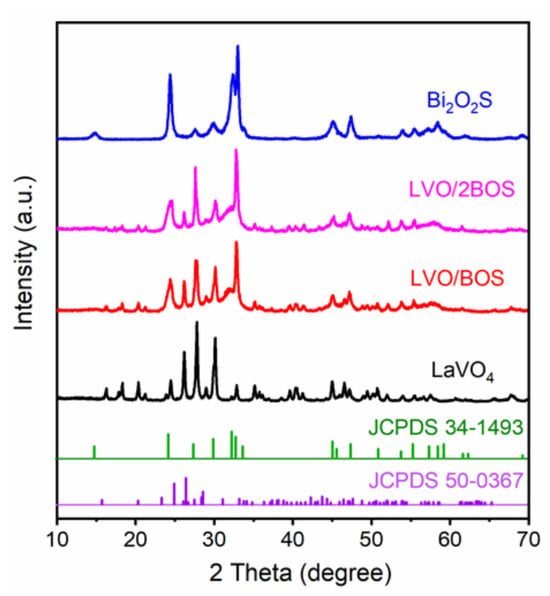
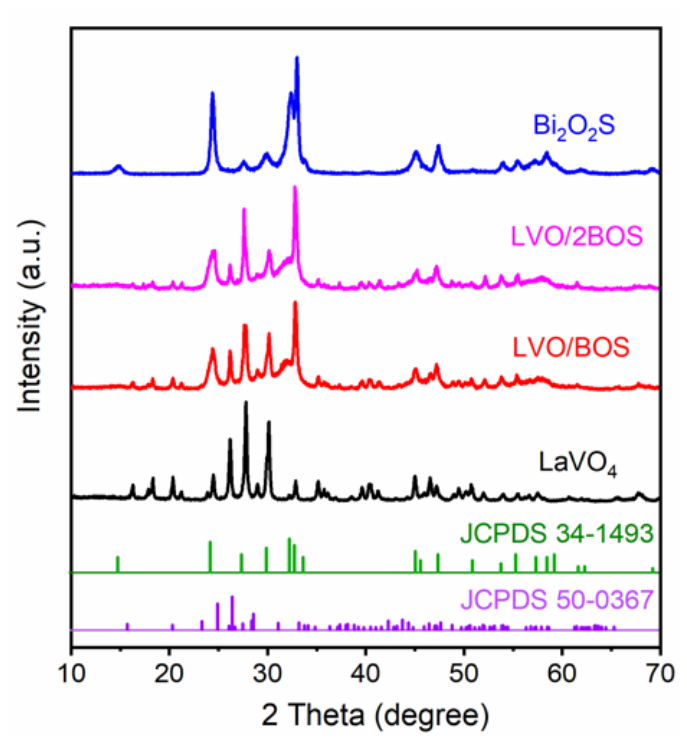
The crystalline phase constitution and structural integrity of the pristine LaVO4, bare Bi2O2S, and LaVO4/Bi2O2S binary composites were first probed via XRD analysis. As presented in Figure 1, the XRD patterns of all three as-synthesized samples were systematically collected. Well-resolved diffraction peaks are discernible at 2θ = 24.46°, 26.18°, 27.79°, and 30.11°, which are unambiguously indexed to the (020), (200), (120) and (012) crystallographic planes of the well-crystallized m-LaVO4 phase (JCPDS No. 50-0367) [15,17,26]. For the bare Bi2O2S reference sample, its XRD pattern exhibits a set of distinct peaks at 2θ = 24.23°, 29.96°, 32.29°, 32.78°, 45.04°, and 47.36°, which are consistently assigned to the (110), (040), (130), (101), (141), and (002) planes of the layered orthorhombic Bi2O2S phase (JCPDS No. 34-1493) [5,27]. For the LaVO4/Bi2O2S composites, their XRD patterns concurrently manifest all fingerprint diffraction peaks inherent to both constituent LaVO4 and Bi2O2S phases, directly verifying the successful in-situ assembly of the two-phase heterostructures without observable phase separation. Notably, no extraneous impurity peaks are detected across the full 2θ scanning range of any composite pattern, confirming the high phase purity of the as-fabricated materials. Moreover, a clear compositional dependence of the diffraction peak intensities is observed: with decreasing LaVO4 loading content in the composites, the relative intensities of the Bi2O2S characteristic peaks increase monotonically, which further corroborates the successful fabrication of the targeted LaVO4/Bi2O2S heterostructures.
Figure 1.
XRD patterns of as-obtained photocatalysts of LaVO4, Bi2O2S, LVO/BOS and LVO/2BOS composites.
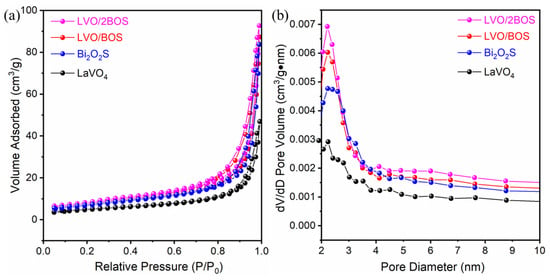
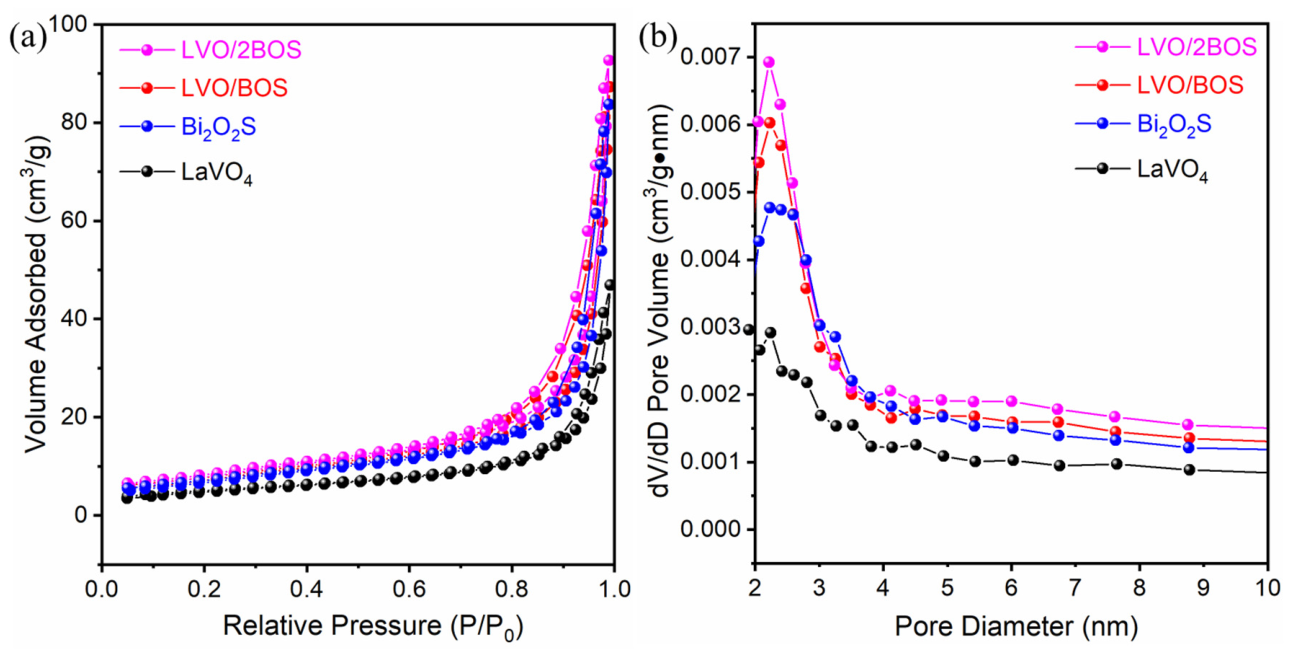
The specific surface area and pore structural characteristics of the as-prepared photocatalysts were systematically characterized via N2 adsorption–desorption isotherms at 77 K, with the corresponding data summarized in Figure 2. As depicted in Figure 2a, all the as-synthesized samples present typical Type-IV adsorption isotherms accompanied by H3-type hysteresis loops, a signature feature of mesoporous materials reported in the literature [5]. The specific surface area (SBET) of each sample was calculated in strict accordance with the Brunauer–Emmett–Teller (BET) algorithm. The calculated SBET values for pristine LaVO4, Bi2O2S, LVO/BOS and LVO/2BOS heterojunctions are 17.0, 24.5, 26.6 and 28.9 m2/g, respectively. These results evidently demonstrate that the introduction of Bi2O2S induces a marked augmentation in the specific surface area of the hybrid photocatalysts, relative to the single-phase LaVO4. The pore size distribution curves of the as-prepared samples were derived from the Barrett–Joyner–Halenda (BJH) model based on the desorption branch, as presented in Figure 2b. The average pore diameters of the LaVO4, Bi2O2S, LVO/BOS and LVO/2BOS are 15.7, 21.0, 19.5 and 19.8 nm, respectively, while the corresponding pore volumes are 0.07, 0.13, 0.13 and 0.14 cm3/g, respectively. These results further corroborate the successful construction of a hierarchical mesoporous architecture within the LaVO4/Bi2O2S heterostructure. This unique structural feature endows the LaVO4/Bi2O2S composites with abundant accessible active sites for TC adsorption and subsequent photocatalytic degradation, thereby positioning them as highly promising candidates for high-efficiency photocatalytic applications [28].
Figure 2.
(a) N2 adsorption–desorption curves and (b) the corresponding average pore size distribution plots of LaVO4, Bi2O2S, LVO/BOS and LVO/2BOS composites.
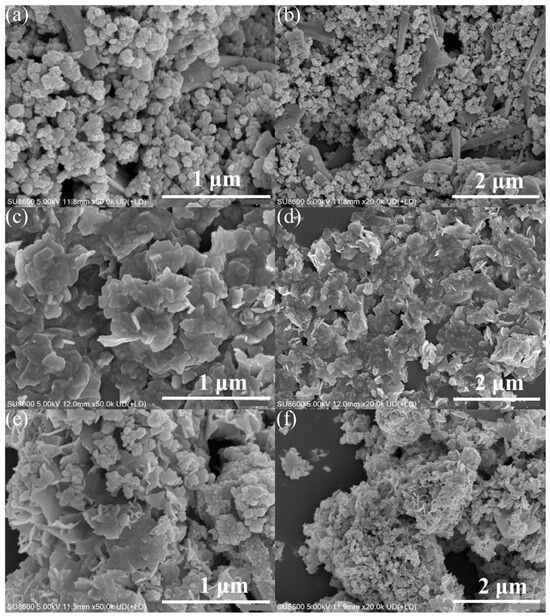
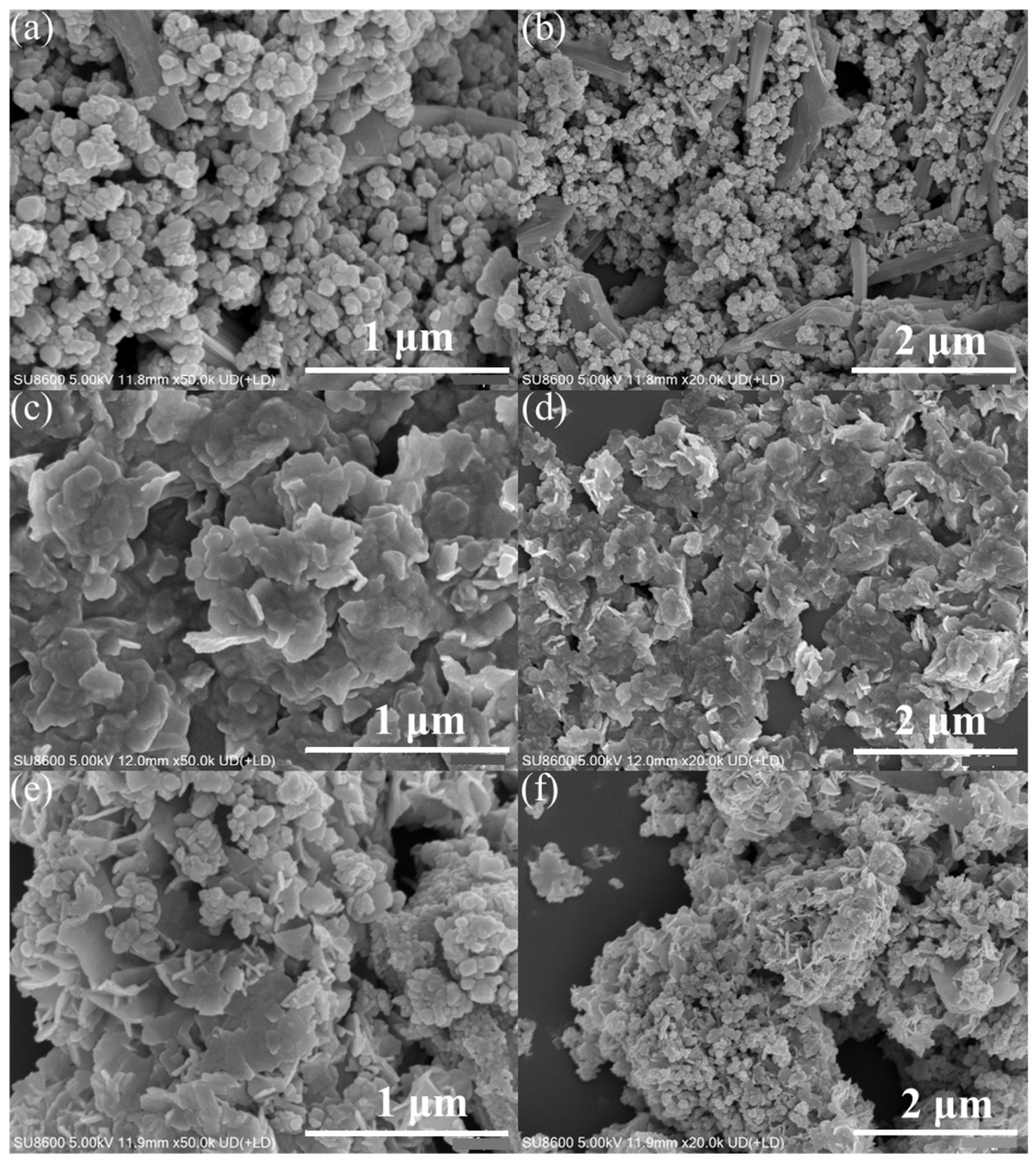
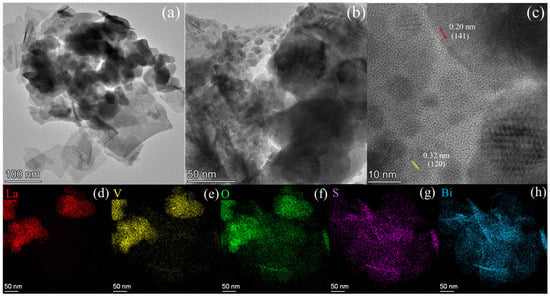
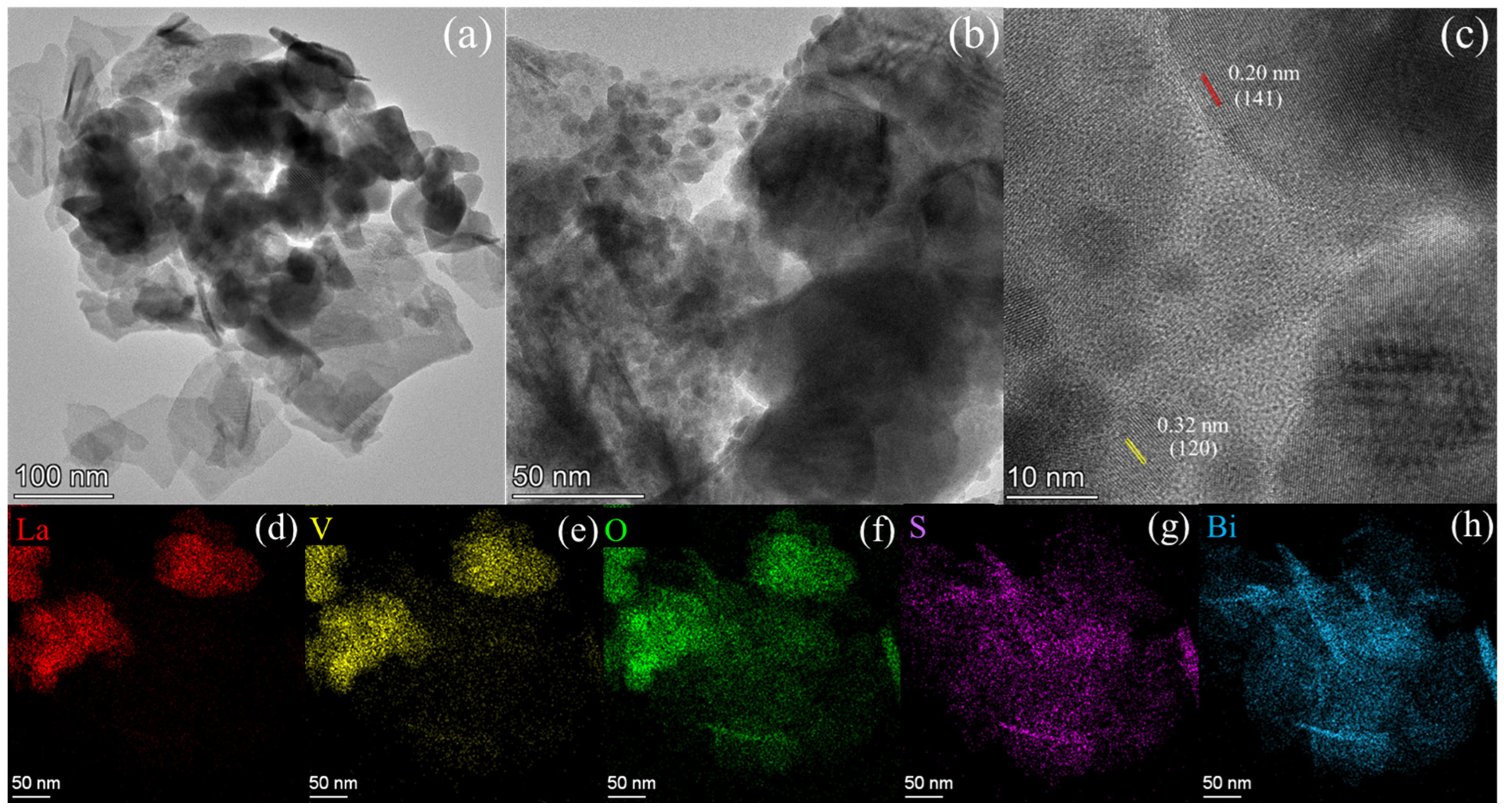
The morphology of the as-synthesized specimens was first interrogated by FE-SEM and TEM. As illustrated in Figure 3a,b, pristine LaVO4 manifests as a dense agglomeration of irregular, nanoscale particles. Conversely, Figure 3c,d disclose that Bi2O2S adopts a distinctly lamellar architecture—a structural motif that is wholly congruent with the observations reported in our earlier investigation [5]. In the LVO/BOS heterojunction composite (Figure 3e,f), the disparate morphologies of the irregular LaVO4 nanoparticles and the ultrathin Bi2O2S nanosheets are readily discernible, thereby attesting to the simultaneous presence of both phases within the hybrid. To procure deeper structural insight, complementary TEM and high-resolution TEM (HRTEM) analyses were undertaken (Figure 4). Notably, the HRTEM images revealed a profusion of LaVO4 nanoparticles uniformly dispersed upon the surface of Bi2O2S nanosheets, evidencing successful hybridization. This intimate interfacial contact engendered a synergistic electronic coupling between the LaVO4 and Bi2O2S constituents, which was conducive to enhanced charge-carrier separation and transfer. The HRTEM micrograph displayed in Figure 4c exhibited unambiguous lattice fringes at 0.20 nm, assignable to the (141) plane of Bi2O2S, and at 0.32 nm, correlating with the (120) plane of LaVO4, furnishing definitive proof of the LaVO4/Bi2O2S heterojunction formation. Complementary energy-dispersive X-ray spectroscopy (EDS) elemental mapping (Figure 4d–h) further substantiated the homogeneous spatial distribution of La, V, O, Bi, and S throughout the LVO/BOS architecture, each element rendered in a distinct chromatic code. It could be observed from the elemental mapping that La and V exhibit identical overlapping regions, while Bi and S showed the same co-localization pattern. Moreover, the oxygen mapping revealed both of these overlapping areas, confirming the presence of LaVO4 and Bi2O2S and indicating that the two phases are closely integrated with each other. Collectively, these multimodal characterizations furnished compelling, robust evidence for the successful synthesis, structural fidelity, and compositional uniformity of the LVO/BOS photocatalyst, thereby establishing a solid platform for its pronounced photocatalytic performance.
Figure 3.
Representative FE-SEM images of LaVO4 (a,b), Bi2O2S (c,d), and LVO/BOS composite (e,f) at different magnifications.
Figure 4.
TEM (a,b), HRTEM images (c), and the EDX elemental mapping images (d–h) of LVO/BOS composite (La, V, O, S and Bi elements). Note: Red and yellow lines in panel (c) denote Bi2O2S and LaVO4, respectively.
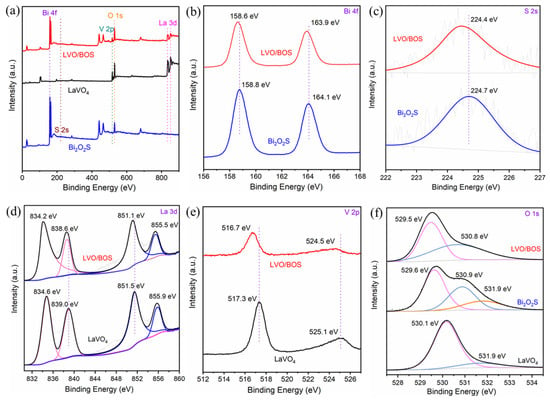
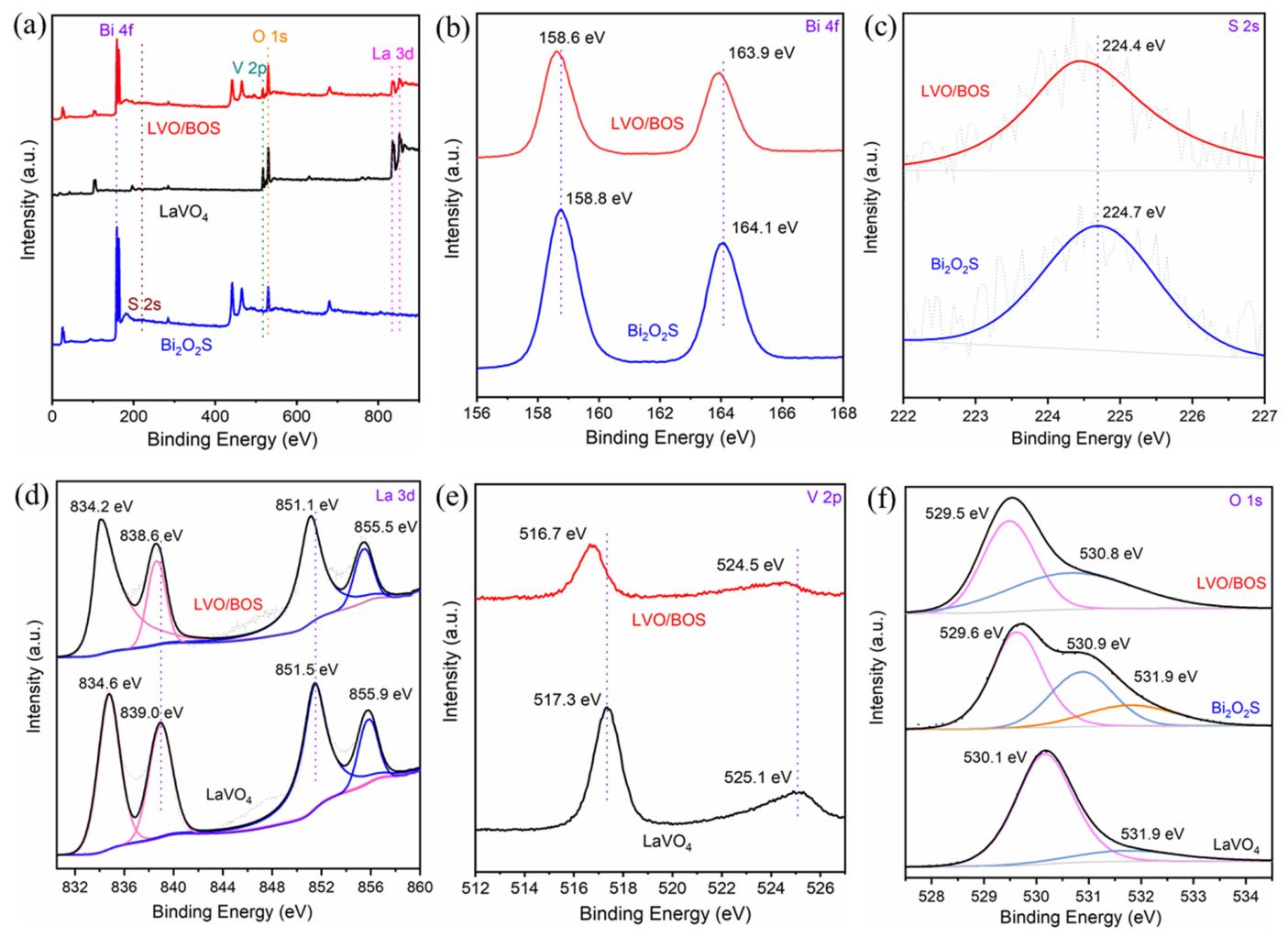
To systematically decode the elemental constitution and surface chemical valence states of the as-synthesized photocatalysts, rigorous XPS characterizations were performed on bare LaVO4, monolithic Bi2O2S, and the engineered LVO/BOS heterojunction, with the corresponding analytical outcomes compiled and presented in Figure 5. As depicted in Figure 5a, the wide-scan survey spectra of bare LaVO4 and monolithic Bi2O2S exclusively display signature peaks assignable to La, V, O and Bi, O, S, respectively. In contrast, the survey spectrum of the LVO/BOS composite integrates all aforementioned elemental signatures, providing unequivocal evidence for the successful construction of the binary heterojunction. Subsequent deconvolution of high-resolution XPS fine spectra was carried out to interrogate the chemical valence states of each constituent element. For the high-resolution Bi 4f spectrum of bare Bi2O2S (Figure 5b), two deconvoluted peaks centered at 164.1 eV and 158.8 eV are unambiguously ascribed to Bi 4f7/2 and Bi 4f5/2, respectively. Notably, relative to the peaks observed in bare Bi2O2S, the Bi 4f peaks of the LVO/BOS heterojunction display a marked negative shift in binding energy, moving to 163.9 eV for Bi 4f7/2 and 158.6 eV for Bi 4f5/2. This negative shift phenomenon is extensively reported in previously documented heterojunction systems with analogous interfacial charge transfer characteristics, and can be attributed to interfacial charge redistribution driven by the superior intrinsic conductivity of Bi2O2S [5,29], thereby offering compelling evidence for robust interfacial interactions between LaVO4 and Bi2O2S. Furthermore, the spin–orbit splitting energy of Bi 4f remains invariant at 5.3 eV for both bare Bi2O2S and the LVO/BOS composite, confirming that Bi maintains a +3 oxidation state across the single-component materials and the heterojunction [21,29]. Additionally, the high-resolution S 2s spectra presented in Figure 5c indicate that S persists in a -2 oxidation state in both the bare Bi2O2S and LVO/BOS composite [21]. Figure 5d presents the deconvoluted results of the high-resolution La 3d spectra: as illustrated, four peaks are resolved for both samples, with peaks at 834.6 eV and 839.0 eV assigned to La 3d3/2, and peaks at 851.5 eV and 855.9 eV assigned to La 3d5/2 for bare LaVO4; for the LVO/BOS composite, the corresponding peaks shift slightly to 834.2 eV, 838.6 eV, 851.1 eV and 855.5 eV, respectively. The spin–orbit splitting energy of ~4.4 eV further confirms that La adopts a +3 valence state in both bare LaVO4 and the LVO/BOS composite [14,16,26]. Figure 5e displays the high-resolution V 2p spectrum acquired from bare LaVO4, wherein two signature V 2p peaks are resolved. Specifically, the peaks at 517.3 eV and 525.1 eV are assigned to V 2p3/2 and V 2p1/2, respectively [30]. In the LVO/BOS composite, these V 2p peaks shift to lower binding energies compared to pure LaVO4, a phenomenon attributable to strong electronic coupling between LaVO4 and Bi2O2S [30]. This observation can be ascribed to the presence of V in its pentavalent oxidation state (V5+ in VO43− units) in the LaVO4 samples, and the characteristic V5+ peak is also discernible in the LVO/BOS composite [16]. Figure 5f shows the high-resolution O 1s spectrum of the as-synthesized photocatalysts. For monolithic Bi2O2S, three resolved O 1s signals at binding energies of 529.6 eV, 530.9 eV and 531.9 eV are detected, which are ascribed to lattice oxygen associated with Bi–O bonds, oxygen vacancies, and surface hydroxyl groups, respectively [22,31]. While the bare LaVO4 exhibits only two distinct O 1s peaks located at 530.1 eV and 531.9 eV, corresponding to lattice oxygen and oxygen vacancies, respectively [26,32]. Notably, the O 1s peaks in the LVO/BOS composite exhibit a slight negative shift in binding energy relative to the single-component precursors, further providing compelling evidence for the formation of robust interfacial electronic interactions between LaVO4 and Bi2O2S.
Figure 5.
XPS spectra: (a) survey spectra, (b) Bi 4f, (c) S 2s, (d) La 3d, (e) V 2p and (f) O 1s for the photocatalysts.
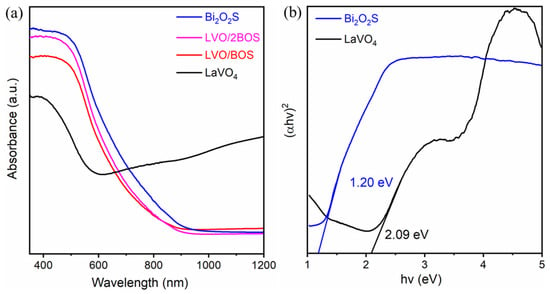
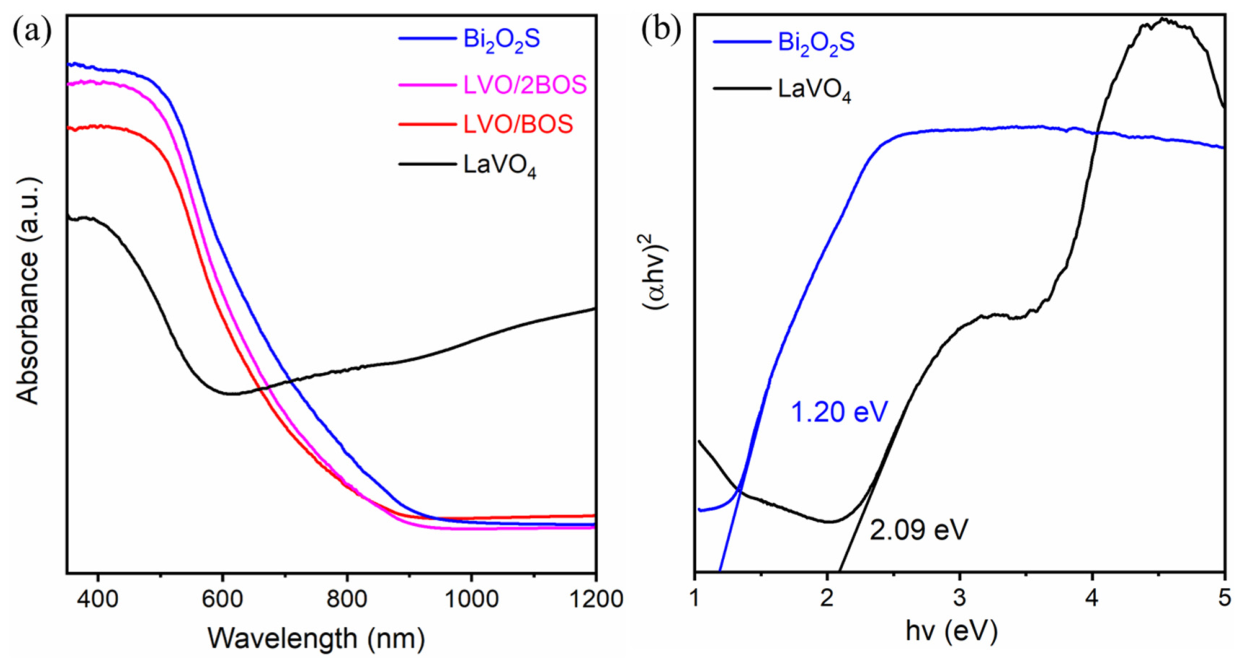
The spectral light-harvesting capability of a semiconductor serves as a pivotal determinant governing its photocatalytic activity [5,33,34,35]. To this end, UV-Vis DRS characterization was systematically conducted on the as-synthesized photocatalysts to elucidate their optical response profiles and derive fundamental electronic structure parameters. As evident from the UV-Vis DRS profiles in Figure 6a, pristine LaVO4 exhibits light absorption confined to a narrow window of the visible spectrum. In contrast, the absorption band edge of the LaVO4/Bi2O2S heterojunction composite undergoes a distinct redshift relative to pure LaVO4, signifying an extended photo-response range. This result confirms that the incorporation of Bi2O2S substantially enhances the visible-light harvesting capacity of LaVO4, far surpassing the performance of the single-phase material. Furthermore, a composition-dependent shift in the absorption edge is discernible: as the Bi2O2S loading increases, the absorption edge of the composite progressively migrates toward that of pristine Bi2O2S, verifying that heterojunction construction effectively modulates the optical properties of the LaVO4 matrix. To further elucidate the electronic structure of the samples, the bandgap energy (Eg) of the semiconductors was derived from the Kubelka–Munk (K-M) function, following the established empirical relationship: αhν = A(hν − Eg)n, where α denotes the absorption coefficient, h represents Planck’s constant, ν refers to the incident photon frequency, A is an empirical constant, and the exponent n is determined by the nature of the electronic transition [5,34,35]. Based on the Tauc plots (Figure 6b) constructed from the UV-Vis DRS data, the bandgap energies of pristine LaVO4 and Bi2O2S are determined to be approximately 1.20 eV and 2.09 eV, respectively.
Figure 6.
(a) UV-Vis spectra of LaVO4, Bi2O2S, LVO/BOS and LVO/2BOS composite and (b) corresponding Tauc plots for LaVO4 and Bi2O2S.
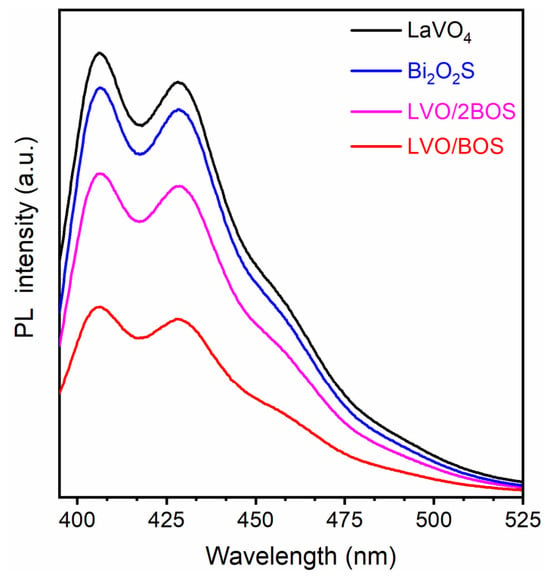
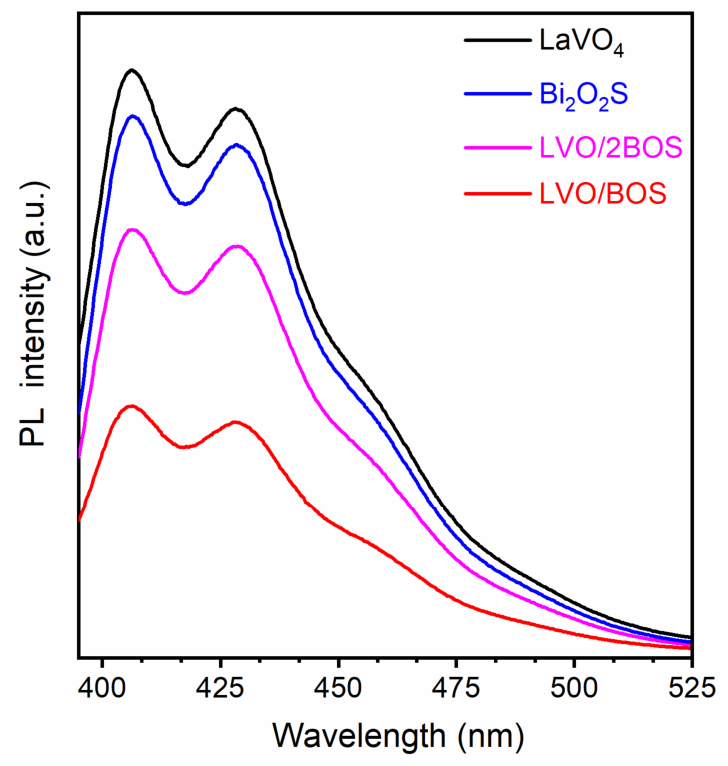
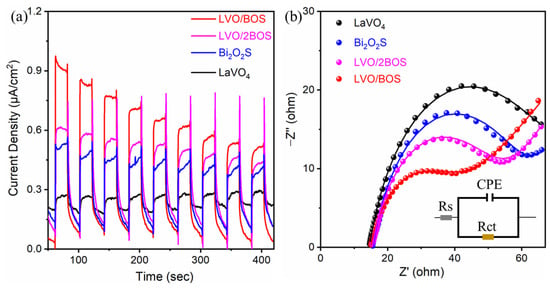
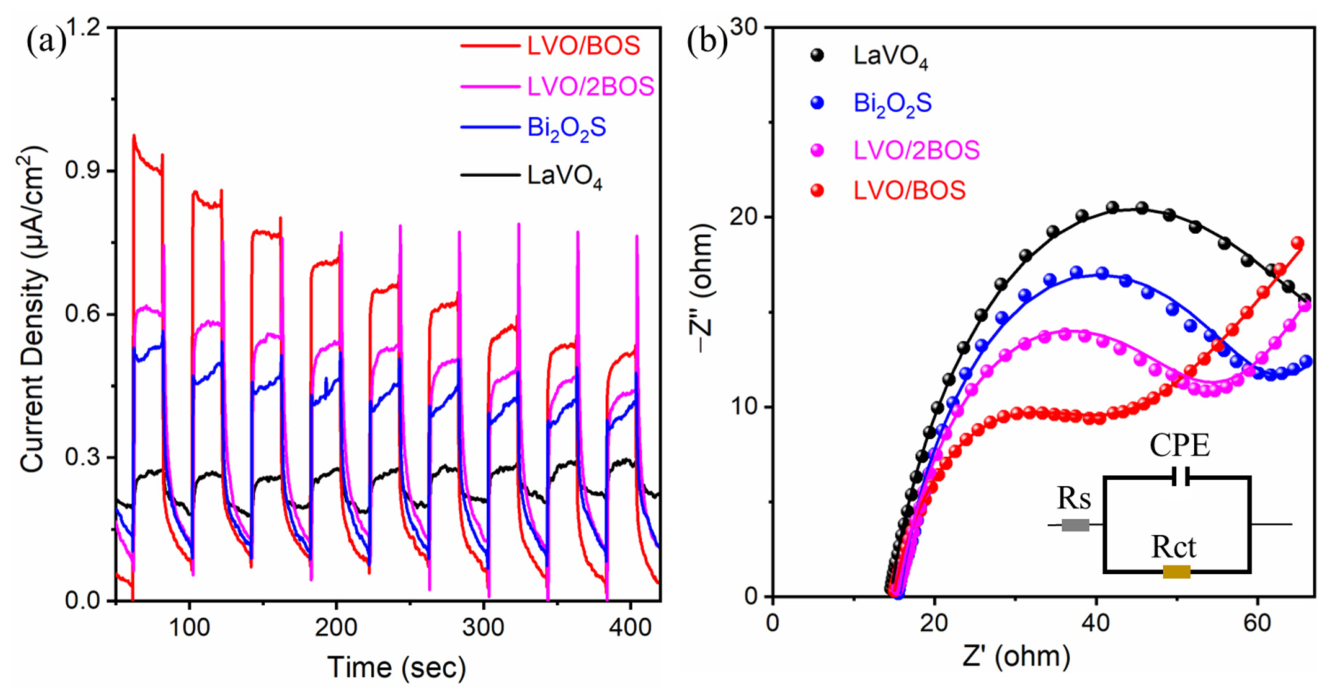
Steady-state PL spectroscopy was first deployed to interrogate the intrinsic optoelectronic properties of the as-synthesized photocatalysts, specifically quantifying the separation efficiency, recombination kinetics, and interfacial charge transfer dynamics of photogenerated carriers. As a well-established characterization benchmark in photocatalysis, the PL emission intensity exhibits an inherent inverse correlation with the separation efficiency of photogenerated e−-h+ pairs: diminished PL intensity signifies suppressed radiative recombination of charge carriers, which in turn elevates the probability of effective charge migration to reactive sites, ultimately endowing the material with superior photocatalytic performance [5,15,26]. As depicted in Figure 7, the intense PL emission peaks observed for the pristine LaVO4 and Bi2O2S single-component semiconductors indicate severe charge carrier recombination within these materials, where the vast majority of photogenerated e−-h+ pairs recombine via radiative pathways before they can be extracted for catalytic reactions. By contrast, the LaVO4/Bi2O2S heterojunction composites exhibit markedly suppressed PL emission relative to both individual LaVO4 and Bi2O2S components, directly evidencing the enhanced separation efficiency of photogenerated e−-h+ pairs across the heterointerface. Among all prepared samples, the LVO/BOS composite delivers the most pronounced PL quenching effect, registering the lowest PL emission intensity, which correlates strongly with its optimal photocatalytic activity. To further validate the charge separation and migration behavior inferred from the PL results, complementary photoelectrochemical characterizations, including transient photocurrent response measurements and electrochemical impedance spectroscopy (EIS), were subsequently performed to quantify the dynamic transport kinetics of photogenerated carriers at the electrode/electrolyte interface [5,36,37]. As presented in Figure 8a, the LaVO4/Bi2O2S composites deliver substantially higher photocurrent densities than the individual LaVO4 and Bi2O2S electrodes, directly confirming the faster interfacial charge transfer kinetics across the heterojunction interface in the composite systems. Further mechanistic insights into the interfacial charge transfer processes were obtained via EIS analysis, with the corresponding Nyquist plots presented in Figure 8b. As a standard characterization for interfacial charge transport properties, the EIS spectra of all samples typically comprise three frequency-dependent components: (i) ohmic resistance (Rs) originating from the electrolyte, electrode substrate, and external circuit connections; (ii) charge transfer resistance (Rct) representing the kinetic barrier for charge migration across the electrode/electrolyte interface; and (iii) a constant phase element (CPE) introduced to correct for the non-ideal capacitive behavior arising from surface roughness and heterogeneous charge distribution at the electrode surface [5,17,36,37]. It is widely acknowledged that a smaller Rct value corresponds to faster charge transfer kinetics at the electrode/electrolyte interface, and the magnitude of Rct can be directly visualized by the radius of the semicircular arc in the high-frequency region of the Nyquist plot [5,17,36,37]. As explicitly shown in Figure 8b and Table 1, the LVO/BOS heterostructure delivers the lowest charge-transfer resistance (Rct) among all evaluated samples. This result directly reflects its superior interfacial charge transfer capability relative to the other tested systems. This minimized interfacial resistance facilitates rapid migration of photogenerated carriers to the electrode surface for participation in redox reactions, thereby providing additional support for its superior photocatalytic performance.
Figure 7.
PL spectra of LaVO4, Bi2O2S, LVO/BOS and LVO/2BOS composites.
Figure 8.
(a) Transient photocurrent response and (b) EIS of LaVO4, Bi2O2S, LVO/BOS and LVO/2BOS composites.
Table 1.
The fitting parameter of EIS results of all the samples in Figure 8b.
2.2. Photocatalytic Degradation of TC
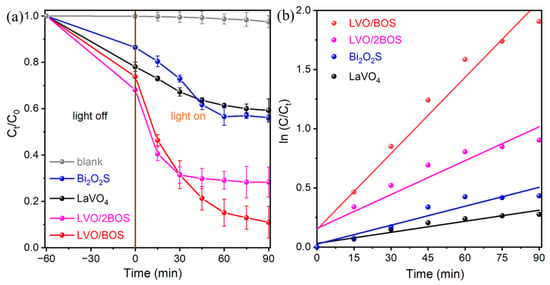
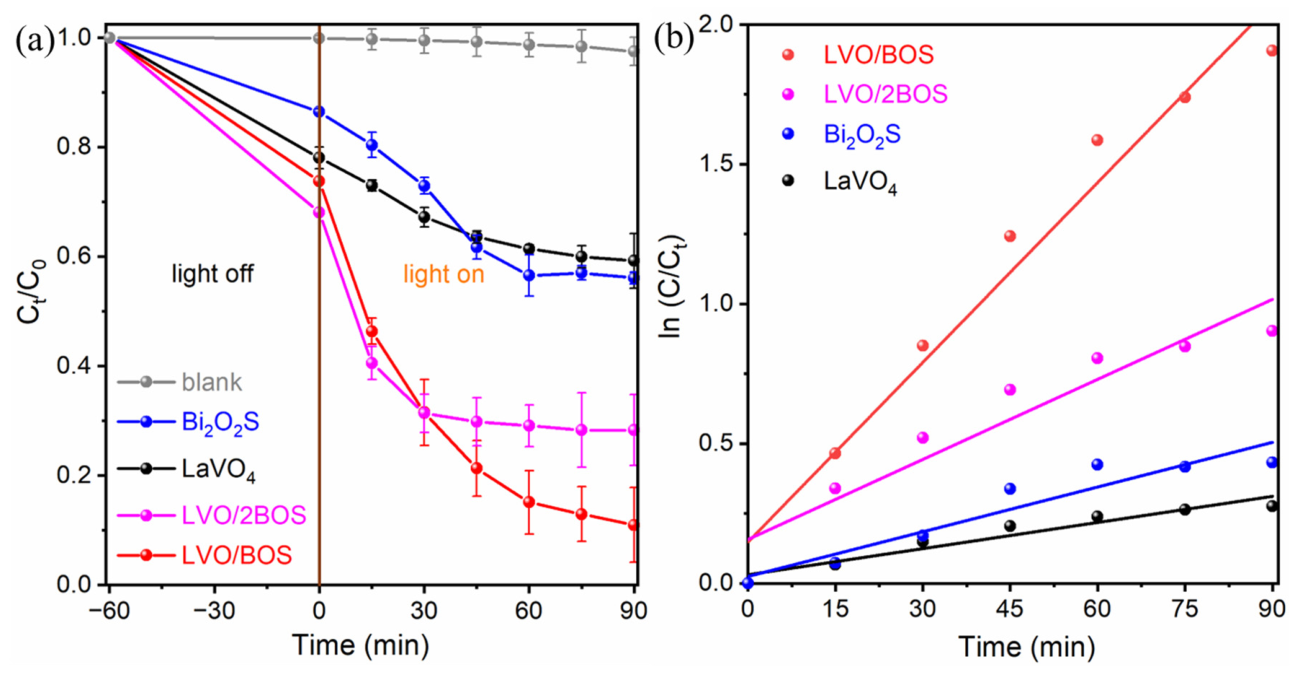
A recalcitrant antibiotic pollutant ubiquitously detected in aquatic ecosystems, was selected as a model target contaminant to benchmark the visible-light photocatalytic activity of the four as-fabricated catalysts [38]. Prior to light irradiation, a 60-min dark adsorption pre-treatment was conducted to establish adsorption–desorption equilibrium across the entire reaction system, eliminating the interference of adsorption-induced concentration fluctuations on subsequent photocatalytic degradation quantification. The visible-light photocatalytic degradation profiles of TC over the as-synthesized samples are compiled in Figure 9; notably, the blank control experiment of pristine TC self-degradation exhibited negligible conversion (<3% after 90 min irradiation), confirming that TC loss in the absence of catalysts can be safely excluded from subsequent performance evaluation. As illustrated in Figure 9a, the monolithic LaVO4 and Bi2O2S single-component catalysts demonstrated comparatively low photocatalytic degradation efficiencies of 41% and 44%, respectively, after 90 min of visible-light irradiation. This limited photocatalytic activity is primarily ascribed to the ultrafast recombination of photogenerated e−-h+ pairs within the single-component semiconductor lattices, which severely restricts the supply of active redox species for TC mineralization. In sharp contrast, the LVO/BOS and LVO/2BOS binary heterostructures demonstrated markedly superior photocatalytic performance, achieving TC degradation efficiencies of ~89% and 72% over the same 90 min irradiation period, far outperforming both individual LaVO4 and Bi2O2S components. This pronounced enhancement in photocatalytic activity of the LaVO4/Bi2O2S heterostructures can be rationalized by two synergistic factors: (i) the S-scheme charge transfer pathway at the LaVO4/Bi2O2S interface that effectively suppresses e−-h+ recombination and prolongs the lifetime of photogenerated charge carriers; (ii) the broadened visible-light absorption range and enhanced light-harvesting capacity enabled by the coupled semiconductor system, which generates a higher density of photogenerated carriers under visible illumination.
Figure 9.
(a) Photocatalytic degradation of TC (C0 represents the initial TC concentration) and (b) pseudo-first-order reaction kinetics of the LaVO4, Bi2O2S, LVO/BOS, and LVO/2BOS heterostructure.
To further elucidate the intrinsic degradation kinetics of TC over the different catalysts, the photocatalytic degradation data were fitted to a pseudo-first-order kinetic model, which is widely adopted to describe photocatalytic degradation processes of organic pollutants under mild reaction conditions [5,38,39]. As displayed in Figure 9b, the apparent rate constants of the four catalysts were derived from linear regression of ln(C/Ct) against irradiation time, where C and Ct represent the residual tetracycline concentration after dark adsorption and instantaneous TC concentration at reaction time t, respectively. Based on the kinetic fitting results, the apparent rate constants of the four catalysts were extracted quantitatively. As summarized in Figure 9b, the LVO/BOS heterostructure exhibits the maximum k value of 0.0214 min−1, which is significantly higher than those of the pristine LaVO4 (0.0031 min−1), Bi2O2S (0.0053 min−1), and LVO/2BOS (0.0095 min−1) catalysts. Notably, the k of the optimal LVO/BOS heterostructure is approximately 6.90-fold, 4.04-fold, and 2.25-fold higher than those of the pristine LaVO4, Bi2O2S, and LVO/2BOS catalysts, respectively. This marked amplification in photocatalytic activity provides compelling evidence for the synergistic effect generated by the rational integration of LaVO4 and Bi2O2S components into the binary heterostructure, further underscoring the excellent interfacial charge transfer dynamics and superior visible-light photocatalytic efficiency of the LaVO4/Bi2O2S composite system.
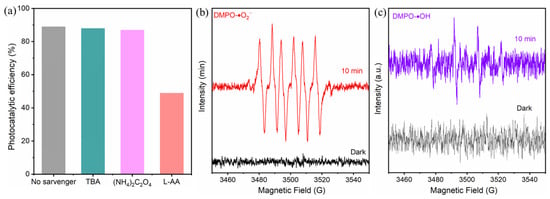
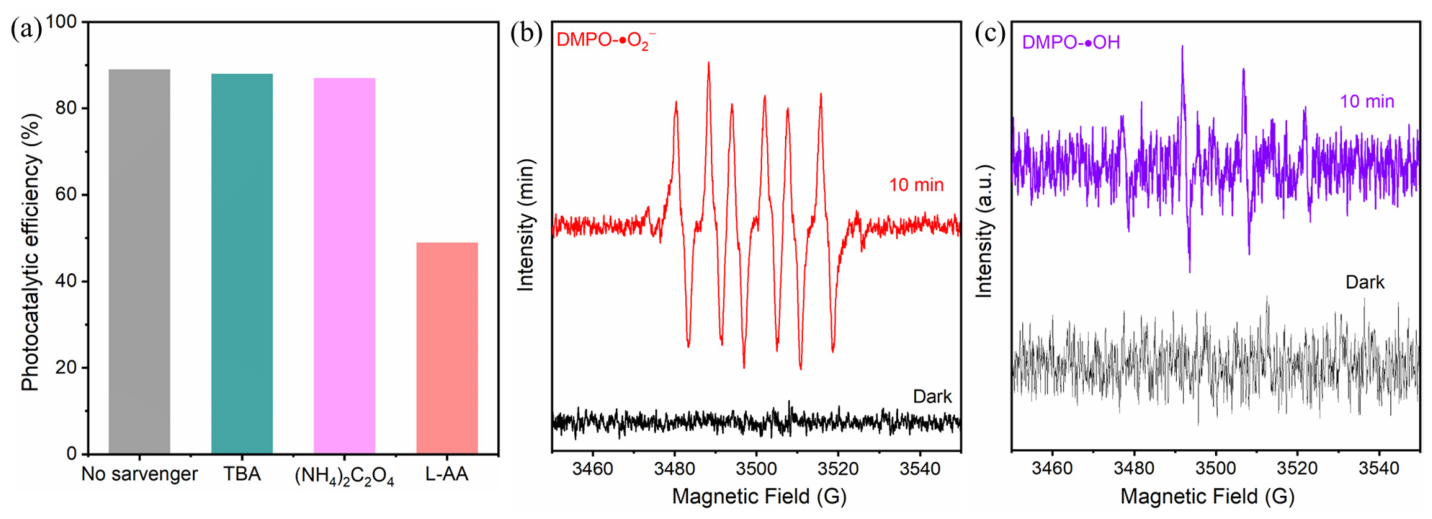
Reactive species scavenging experiments constitute a core methodology for deconvoluting the charge transfer pathway and reaction mechanism of heterogeneous photocatalysts. To further decipher the dominant reactive species orchestrating photocatalytic TC degradation over the LVO/BOS heterojunction, a rigorously designed series of species-specific quenching tests was systematically executed under uniform visible-light irradiation conditions, with strict control of all other reaction parameters to guarantee the statistical robustness and inter-group comparability of the results. In reactive species scavenging experiments, ammonium oxalate ((NH4)2C2O4), 10 mmol L−1), L-ascorbic acid (L-AA, 1 mmol L−1), and tert-butyl alcohol (TBA, 2 mL) were employed as targeted scavengers to selectively quench photogenerated h+, •O2−, and •OH, respectively [12,40]. As illustrated in Figure 10a, the blank control group (without any scavenger addition) exhibited a TC degradation efficiency of 89%, which was defined as the normalized reference for quantifying the individual contribution of each reactive species. Notably, the addition of L-AA induced a pronounced 40% suppression of TC degradation, with the removal efficiency plummeting to 45%—this dramatic inhibition unambiguously identifies •O2− as the primary reactive species driving TC mineralization. In contrast, the introduction of (NH4)2C2O4 and TBA only triggered marginal suppressive effects, with degradation efficiencies of 87% and 88% recorded, corresponding to inhibition extents of ~2% and ~1%, respectively; these modest inhibitions confirm that h+ and •OH act as secondary reactive species with negligible contributions to the overall degradation process. To further substantiate the in-situ generation of reactive oxygen species during the photocatalytic degradation of TC over the LVO/BOS composite, ESR spectra were systematically acquired. As exhibited in Figure 10b,c, no discernible signals corresponding to the DMPO-•OH and DMPO-•O2− adducts were detected under dark conditions, whereas distinct characteristic signals of the DMPO-•O2− adduct emerged within a 10-min visible-light irradiation period, accompanied by faint but discernible signals of the DMPO-•OH adduct. These observations confirm the light-driven generation of both •OH and •O2− radicals on the LVO/BOS surface under visible-light illumination. Notably, •O2− radicals constitute the predominant reactive species in this system, while •OH radicals play a comparatively subordinate role, a conclusion that aligns perfectly with the outcomes of radical trapping experiments.
Figure 10.
(a) Photocatalytic TC degradation performance of LVO/BOS heterostructure with various radical scavengers; ESR spectra of LVO/BOS for DMPO-•O2− (b) and DMPO-•OH (c).
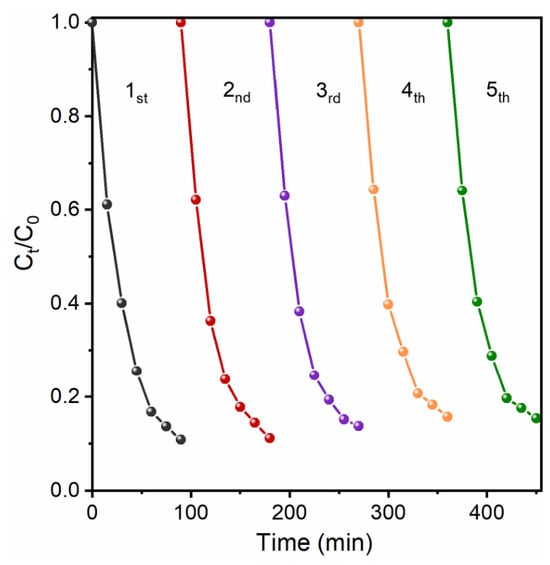
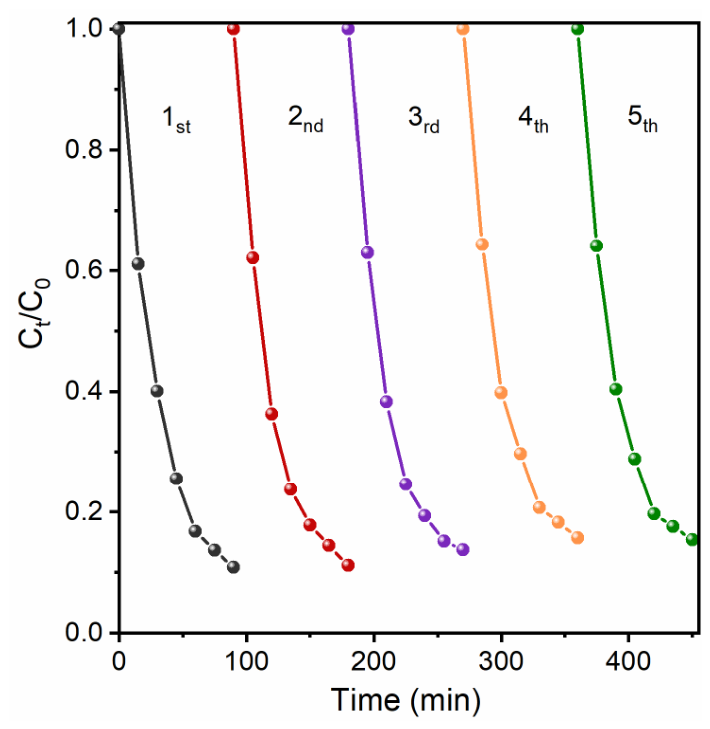
Stability constitutes a cardinal metric for gauging the translational viability of high-performance photocatalysts, especially under the stringent operational demands of refractory wastewater decontamination. Consequently, a systematic and rigorous evaluation of the operational reusability and long-term structural integrity of the LVO/BOS heterostructure is of paramount importance for its practical deployment. To quantitatively probe its cyclic durability, five consecutive photocatalytic degradation runs of TC under simulated visible-light irradiation were performed, with the resultant degradation efficiencies summarized in Figure 11. Encouragingly, relative to the initial catalytic cycle, the heterostructure displayed a negligible attenuation of merely ~4% in TC degradation efficiency after five successive runs. This minimal performance decay can be rationally ascribed to minor material abrasion or partial shedding of surface active sites, both of which are triggered by iterative light irradiation and subsequent catalyst recovery procedures.
Figure 11.
Five-cycle recycling test of LVO/BOS heterostructure for photocatalytic TC degradation.
2.3. Photocatalytic Mechanism
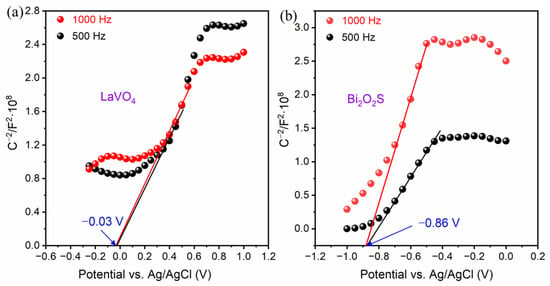
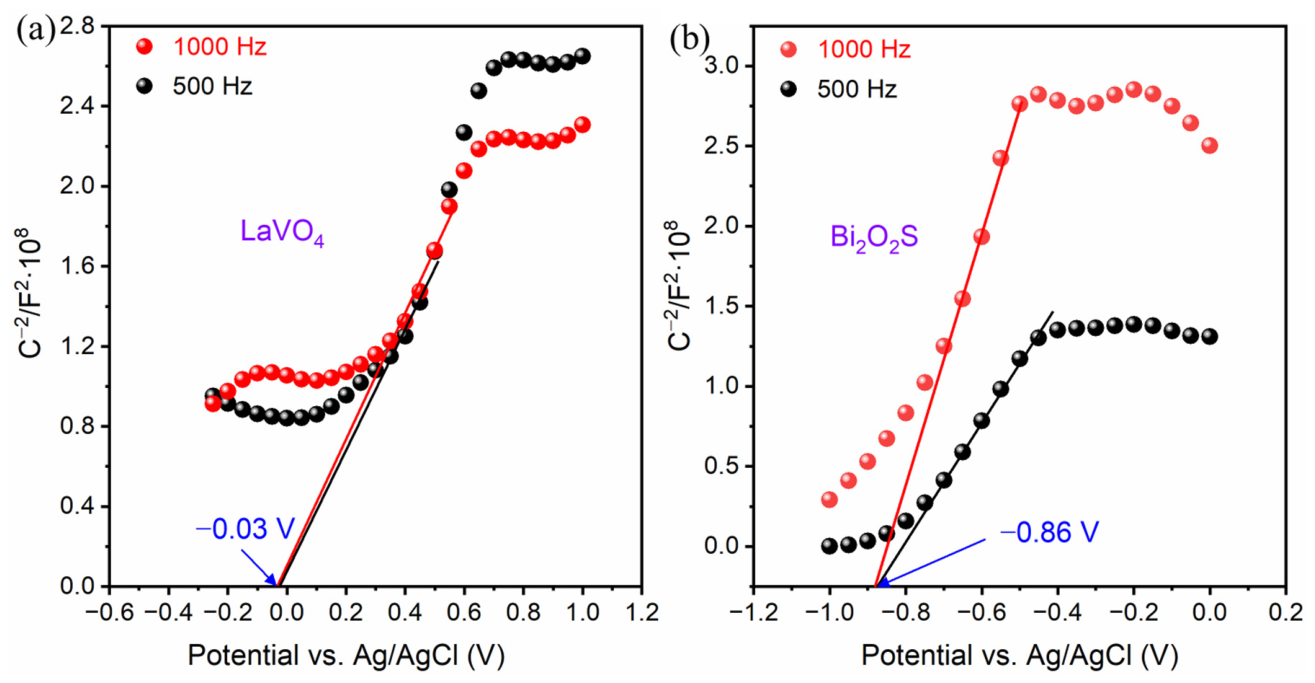
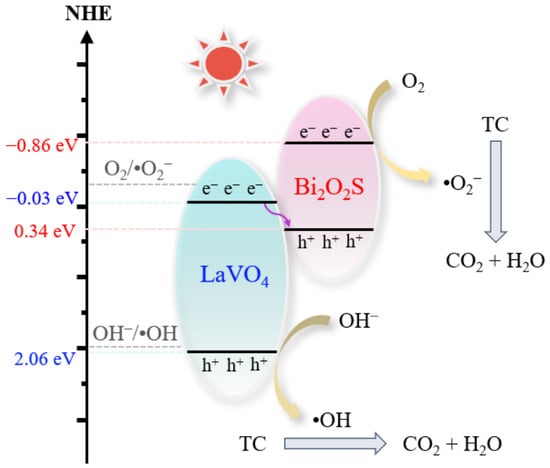
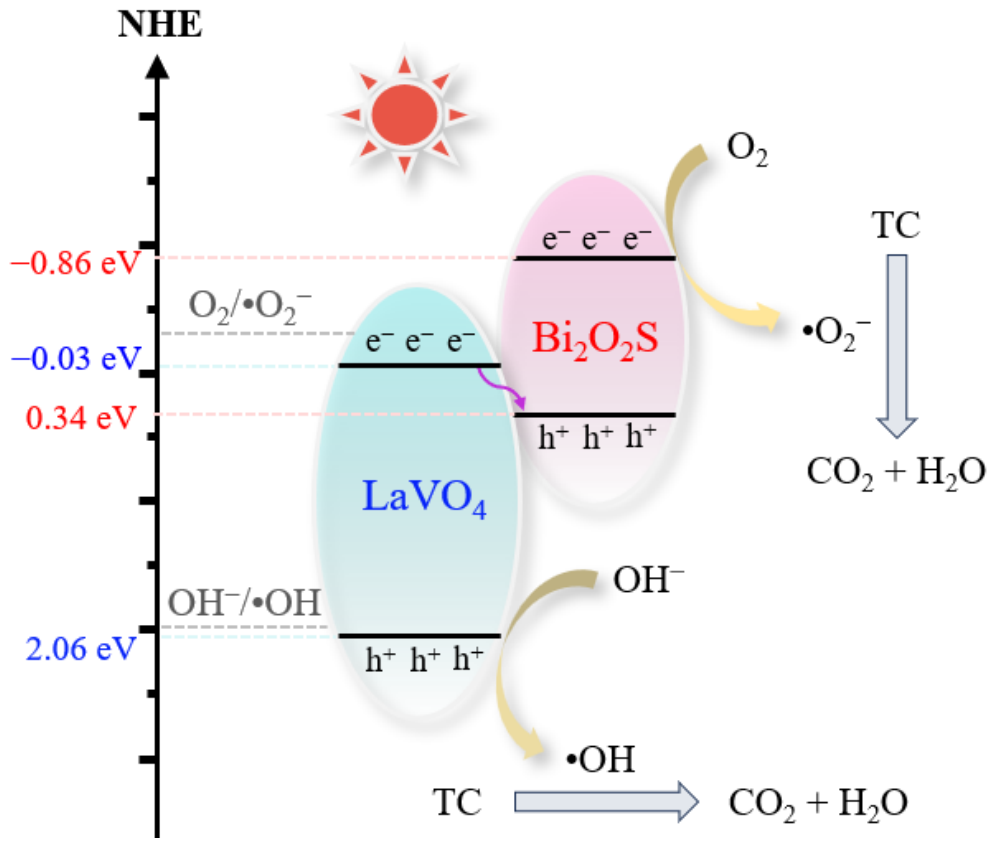
To construct a rigorous energy band framework for rational interpretation of the photocatalytic behavior of the LVO/BOS composite, Mott–Schottky (M-S) electrochemical profiling was performed to precisely quantify the flat-band potential (Efb) of each semiconductor component. Cross-referenced with UV-Vis DRS-derived Eg values, this dataset enables the quantitative derivation of the absolute conduction band minimum (ECB) and valence band maximum (EVB) positions for both phases. As depicted in Figure 12, the M–S plots of both LaVO4 and Bi2O2S exhibit typical positive slopes across the measured potential window, an intrinsic electrochemical signature of n-type semiconductors, thereby directly confirming the n-type semiconducting nature of the two constituents. The Efb values were extrapolated from the x-intercepts of the linear regimes of the M–S plots referenced to the Ag/AgCl electrode, yielding values of −0.03 V for LaVO4 and −0.86 V for Bi2O2S, respectively. Under the tested pH = 7 condition, these Ag/AgCl-referenced potentials were converted to the normal hydrogen electrode (NHE) scale via the Nernst equation (ENHE = EAg/AgCl + 0.197, pH = 7), affording calibrated Efb values of 0.17 V and −0.66 V for LaVO4 and Bi2O2S, respectively [41]. Drawing on the well-established relationship between flat-band potential and band edge positions for different semiconductor types, the Efb of n-type semiconductors lies 0.1–0.3 eV more positive than the ECB at the semiconductor/electrolyte junction, whereas the Efb of p-type semiconductors lies 0.1–0.3 eV more negative than the EVB [41,42]. Applying this empirical correction, the CB positions of LaVO4 and Bi2O2S were estimated to be −0.03 V and −0.86 V vs. NHE, respectively. Complementarily, the optical bandgaps of LaVO4 and Bi2O2S were extracted from Tauc plots constructed from the UV-Vis DRS data (Figure 6b), yielding Eg values of 2.09 eV and 1.20 eV, respectively. Leveraging the fundamental semiconductor energy relation ECB = EVB − Eg [41,42], the remaining band edge positions are further derived: the VB edges of LaVO4 and Bi2O2S were calculated to be +2.06 V and +0.34 V vs. NHE, respectively.
Figure 12.
Mott−Schottky plots for different catalysts at specific frequencies (1000 and 500 Hz) obtained in darkness, (a) LaVO4; (b) Bi2O2S.
By synthesizing experimental evidence from radical quenching assays, ESR spectroscopy, redox potential thermodynamic assessments, and interfacial charge transfer analysis, a step-scheme (S-scheme) heterojunction photocatalytic mechanism is proposed, as schematically illustrated in Figure 13. Under visible-light irradiation, the LVO/BOS composite absorbs incident photons to generate photogenerated e−–h+ pairs, which migrate toward the heterojunction interface. A preliminary inference of the II-type heterojunction structure suggests that it would suppress the production of •O2− and •OH radicals. As reflected by the band edge positions, the ECB of LaVO4 (−0.03 eV vs. NHE) is less negative (i.e., more positive) than the standard redox potential of the O2/•O2− couple (−0.33 eV vs. NHE), while the EVB of Bi2O2S (+0.34 eV vs. NHE) is less positive (i.e., more negative) than the standard oxidation potential of the OH−/•OH couple (+1.99 eV vs. NHE), rendering the formation of both radicals thermodynamically unfavorable [5,43]. However, the unambiguous detection of both •O2− and •OH radicals via ESR spectroscopy and radical trapping experiments confirms their active participation in TC photodegradation, indicating that the type II style fails to account for the altered local reaction environment and surface defect states at the heterojunction interface. To resolve this discrepancy, a refined S-scheme photocatalytic mechanism is proposed, as visualized in Figure 13. In this configuration, the photogenerated electrons in the ECB of LaVO4 migrate to the heterojunction interface and recombine with holes in the EVB of Bi2O2S, effectively suppressing bulk e−–h+ recombination. Consequently, reducing electrons are retained in the ECB of Bi2O2S, while oxidizing holes are preserved in the EVB of LaVO4. The retained electrons in the ECB of Bi2O2S (−0.86 eV vs. NHE) possess a sufficiently negative potential to drive the reduction of molecular oxygen to superoxide radicals (•O2−), as this potential is more negative than the standard redox potential of the O2/•O2− couple [44,45]. Simultaneously, the holes localized in the EVB of LaVO4 (+2.06 eV vs. NHE) exhibit strong oxidative capacity that can oxidize surface hydroxyl groups or water molecules to generate •OH. This S-scheme charge transfer pathway not only maximizes photogenerated e−–h+ separation efficiency, but also preserves the strongest redox capacities of both charge carriers, leading to enhanced generation of •O2− and •OH radicals, which serve as the dominant reactive species driving TC photodegradation.
Figure 13.
Possible S-scheme heterojunction photocatalytic reaction mechanism for the LaVO4/Bi2O2S heterostructure.
3. Experimental Section
3.1. Catalyst Preparation
3.1.1. Preparation of LaVO4 Catalyst
The pristine LaVO4 was synthesized by adapting the synthetic protocol reported in the prior literature, with only minor modifications to the original procedure [13]. Specifically, stoichiometric quantities of ammonium metavanadate (NH4VO3, 0.4095 g) and lanthanum nitrate hexahydrate (La(NO3)3·6H2O, 1.5155 g) were precisely weighed and individually dissolved in 35 mL of deionized water under constant magnetic stirring until complete dissolution was achieved. The as-prepared NH4VO3 solution was first pre-equilibrated in a thermostatic water bath set to 80 °C to stabilize temperature and precursor supersaturation, after which the La(NO3)3·6H2O solution was added dropwise under continuous agitation; the mixture was further stirred for an additional 30 min post-addition to guarantee full homogenization of the precursor sol. The homogeneous mixed sol was then transferred to a 100 mL polytetrafluoroethylene (PTFE)-lined stainless-steel autoclave, hermetically sealed, and subjected to hydrothermal crystallization at 180 °C in an oven for 24 h. Upon completion of the reaction, the autoclave was allowed to cool naturally to ambient temperature, and the obtained precipitate was harvested via centrifugation (the speed is 7546× g, i.e., 8000 rpm), followed by three consecutive centrifugal washing cycles with copious deionized water to eliminate surface-adsorbed residual ionic species. Finally, the purified sample was dried in a forced-air drying oven set to 90 °C for 5 h, and subsequently ground using an agate mortar to obtain phase-pure LaVO4 powder.
3.1.2. Preparation of Bi2O2S Catalyst
The single Bi2O2S was synthesized according to the work of Seling et al. [27]. Specifically, about 1 g of Bi(NO3)3·5H2O was added into 200 mL of deionized water and ultrasonicate for 30 min to obtain a homogeneous, transparent bismuth precursor solution. In a separate vial, 78.53 mg of thiourea (CH4N2S) and 6.7 mL of hydrazine hydrate (N2H4·H2O) are added and ultrasonicated for 30 min to prepare a mixed sulfur source-reductant solution. The above two solutions are mixed and ultrasonicated for another 30 min to ensure uniform dispersion, after which 1.2 g of KOH and 3.2 g of NaOH are added to the mixed solution. Ultrasonication is continued until the alkali is completely dissolved. The mixture is then stirred at room temperature for 8 h. After the reaction is completed, the generated brown precipitate is collected, washed three times with deionized water via centrifugation to remove impurities, dried in a 150 °C forced-air oven for 12 h, and ground to obtain pure-phase Bi2O2S powder.
3.1.3. Preparation of LaVO4/Bi2O2S Heterojunction Composites
The composites are prepared via an in-situ compounding method. Following the single-phase Bi2O2S synthesis procedure up to the step where the alkali is fully dissolved under ultrasonication, predetermined masses of pure-phase LaVO4 powder are added to the mixed solution to achieve theoretical mass ratios of 1:1, and 1:2 (LaVO4:Bi2O2S), labeled as LVO/BOS and LVO/2BOS, respectively. The mixture is then stirred continuously at room temperature for 12 h to ensure full hybridization of the heterojunction structure. After the reaction, the precipitate is collected, washed three times with deionized water via centrifugation to remove surface-adsorbed residual reactants, and finally dried in a 150 °C forced-air oven for 12 h to obtain LaVO4/Bi2O2S heterojunction composites with different loading ratios.
3.2. Catalyst Characterization
The crystallographic architecture of the catalysts was deciphered via high-resolution XRD analysis employing a Bruker D8-Advance diffractometer utilizing Cu Kα radiation. SBET and hierarchical pore size distribution were precisely quantified at 77 K through N2 physisorption isotherms acquired on a Micromeritics (Norcross, GA, USA) ASAP 2020 adsorption–desorption system. Before the tests, the samples were pre-treated under vacuum at 300 °C for 8 h to ensure complete drying and degassing. Surface chemistry and molecular bonding configurations were comprehensively interrogated using FT-IR (FTIR-8400S, Shimadzu, Kyoto, Japan) and monochromatic Al Kα XPS (ESCALAB 250, Thermo Fisher Scientific, Waltham, MA, USA), respectively. Optical bandgap profiles and sub-bandgap absorption dynamics were probed via UV-Vis DRS across 200–1200 nm, with BaSO4 serving as the inert reflectance standard (UV3600IPLUS, Shimadzu, Kyoto, Japan). PL spectra were recorded at ambient temperature using a HITACHI F-7000 spectrophotometer (F-7000, Hitachi, Tokyo, Japan) to assess charge carrier recombination kinetics. Prior to each measurement, approximately 5 mg of the sample is weighed and dispersed into 10 mL of anhydrous ethanol, followed by ultrasonication for about 10 min. Nanoscale morphology and atomic-scale structural motifs were correlated through FE-SEM (FE-SEM, SU8600, Hitachi, Tokyo, Japan) and TEM (FEI Talos F200X, FEI, Hillsboro, OR, USA). Critically, transient radical intermediates were detected and quantified via ESR spectroscopy (JES-FA300, Bruker, Karlsruhe, Germany), employing 5,5-dimethyl-1-pyrroline N-oxide (DMPO) as the spin-trapping agent to selectively capture hydroxyl (•OH) and superoxide (•O2−) radicals through stable spin-adduct formation.
3.3. Photoelectrochemical Measurements
All electrochemical characterizations were conducted on a CHI 660D potentiostatic workstation (Chenhua, Shanghai, China). A standard three-electrode electrochemical cell was assembled for all tests, wherein a platinum (Pt) wire functioned as the auxiliary (counter) electrode, Ag/AgCl electrode served as the reference electrode, and the as-fabricated catalyst films were deployed as the working electrodes. Photocurrent density-response measurements were acquired in a quiescent 0.5 M Na2SO4 aqueous electrolyte under simulated solar irradiation delivered by a 300 W xenon (Xe) arc lamp. Electrochemical impedance spectroscopy (EIS) measurements were performed in the identical Na2SO4 electrolyte, with a 10 mV amplitude alternating current (AC) small-signal perturbation applied across a swept frequency range of 105 to 10−1 Hz, to interrogate the interfacial charge transfer kinetics and charge transport resistance of the electrode/electrolyte interface.
3.4. Photocatalytic Tests
The visible-light-driven photocatalytic degradation performance of the as-synthesized photocatalysts was systematically appraised and benchmarked using TC as a representative refractory organic model contaminant. A 300 W Xe arc lamp (model: PLS-SXE 300BF, Merry Change, Beijing, China) fitted with a 420 nm UV-cutoff filter was deployed as the simulated visible-light irradiation source. For performance evaluation, 50 mg of the as-synthesized photocatalyst was homogeneously dispersed in 50 mL of 10 mg L−1 tetracycline aqueous solution, followed by 60 min of continuous stirring in absolute darkness to preclude photonic interference during the pre-equilibration stage and ensure complete establishment of adsorption–desorption equilibrium at the catalyst-solution interface. At predefined temporal intervals (every 15 min), 3 mL reaction aliquots were promptly withdrawn from the suspension, rapidly filtered through 0.22 μm microfiltration membranes, and subsequently quantified via ultraviolet-visible (UV-Vis) absorption spectroscopy at the characteristic λmax of 357 nm for TC. The photocatalytic degradation reaction was conducted under visible-light irradiation over a total duration of ~90 min. Additionally, the operational durability and long-term structural stability of the as-prepared LVO/BOS heterojunction photocatalyst were systematically probed via five sequential cyclic degradation runs, during which the photocatalyst was retrieved, reactivated, and redeployed following each individual cycle to evaluate its recyclability and quantify the extent of photocatalytic activity retention across successive cycles. The specific steps are as follows: after each photocatalytic reaction, the catalyst is collected from the reaction solution via centrifugation at 8000 rpm (corresponding to 7546× g) for 10 min. The collected catalyst is then dried at 60 °C for 24 h. The mass of catalyst lost during each operation is replenished with fresh catalyst to ensure that the total catalyst loading for each run is 50 mg.
4. Conclusions
In conclusion, a binary S-scheme LaVO4/Bi2O2S heterojunction has been successfully constructed via a simple hydrothermal strategy. Comprehensive physicochemical characterization coupled with photocatalytic activity assays reveal that the incorporation of Bi2O2S not only streamlines interfacial charge transport across the LaVO4 matrix, but also endows the composite with markedly enhanced surface catalytic oxidative potency. Under visible-light-driven photocatalytic TC degradation, the optimized LVO/BOS heterojunction achieves a degradation efficiency of 89%, far outperforming its pristine single-component counterparts (bare LaVO4: 41%; monolithic Bi2O2S: 44%). The intrinsic S-scheme charge transfer pathway drives efficient spatial charge separation, wherein photogenerated electrons are preferentially populated on the negative conduction band of Bi2O2S, while holes migrate to the positive valence band of LaVO4, thereby amplifying the redox capability of the separated charge carriers. Collectively, this work provides novel insights into the rational design of visible-light-responsive high-efficiency photocatalysts, and paves the way for the scalable solar-energy-driven remediation of organic pollutants.
Author Contributions
Conceptualization, D.C. and Z.J.; methodology, Y.Z. (Yang Zhang) and Y.Z. (Yuhao Zeng); resources, D.C. and X.L.; data curation, Y.Z. (Yuhao Zeng) and F.C.; writing—original draft preparation, Y.Z. (Yuhao Zeng) and Y.Z. (Yang Zhang); writing—review and editing, D.C., C.L. and B.Z.; supervision, D.C. and S.L.; project administration, D.C.; funding acquisition, D.C. and Z.J. All authors have read and agreed to the published version of the manuscript.
Funding
This work was financially supported by the Zhaoqing University Natural Science Project (Grant Nos. ZD202408, qn202526 and qn202606), the Guangdong Scientific and Technological Project (2024A0505050041), the Funded Project for Innovative Scientific Research Teams of Zhaoqing University (Grant No. TD202418), the Zhaoqing City Science and Technology Innovation Guidance Project (Grant Nos. 250824110810674, 241220170090183 and 241225150090970) and the Innovative Entrepreneurship Project of Chinese College Students (Grant Nos. S202610580059, S202510580067).
Institutional Review Board Statement
Not applicable.
Informed Consent Statement
Not applicable.
Data Availability Statement
The data presented in this article can be obtained from the corresponding author upon reasonable request.
Acknowledgments
The authors wish to express their sincere appreciation to the School of Environmental and Chemical Engineering, Zhaoqing University, for the generous provision of experimental resources and state-of-the-art characterization facilities underpinning this study.
Conflicts of Interest
The authors declare no conflicts of interest.
References
- Huang, Z.; Huang, L.; Fang, S.; Yang, Y.; Lai, M.; Zhong, X.; Liao, C.; Wu, Z.; Liu, J. Construction of Z-scheme C-LaFeO3/Co-doped g-C3N4 heterojunction for synergistic photocatalysis-PMS activation in antibiotic degradation. Chem. Eng. J. 2026, 537, 176283. [Google Scholar] [CrossRef] [Scilit]
- Zhang, T.; Xia, Z.; Li, R.; Wang, H.; Zhang, T.; Qi, L.; Tan, Y.; Liu, Y.; Gao, A.; Wang, B.; et al. In situ revealed photogenerated charge transfer in FeOOH-BiOI/KCN heterojunction photocatalysts for efficient photocatalysis-self-Fenton degradation of antibiotics. J. Environ. Sci. 2026; in press. [CrossRef] [Scilit]
- Niemirowicz-Laskowska, K.; Basa, A.; Breczko, J.; Kiszkiel-Taudul, I.; Wielgat, P.; Skonieczna, B.; Car, H.; Regulska, E. Sunlight-activated nanocomposites for antibiotic degradation: How NiFe2O4@TiO2@Au tackles tigecycline and its biotoxicity. Surf. Interfaces 2025, 58, 105889. [Google Scholar] [CrossRef] [Scilit]
- Breczko, J.; Basa, A.; Niemirowicz-Laskowska, K.; Skonieczna, B.; López-Martín, R.; De Toro, J.A.; Car, H.; Regulska, E. Magnetic AuNPs@TiO2@NF heterojunction for solar-light degradation of antibiotics and mitigation of bacterial resistance risk. RSC Adv. 2025, 15, 41862–41873. [Google Scholar] [CrossRef] [Scilit]
- Chen, D.; Hu, S.; Jia, Z.; Zhang, Y.; Zhang, B.; Liu, S.; Li, X. Construction of S-scheme BiVO4/Bi2O2S heterojunction for highly effective photocatalysis of antibiotic pollutants. Molecules 2026, 31, 136. [Google Scholar] [CrossRef] [Scilit]
- Chen, D.; Li, L.; Zhuang, L.; Liu, Y.; Zhang, B.; Jia, Z. Highly efficient CoFe LDO/α-Bi2O3/g-C3N4 heterojunction for photocatalytic elimination of antibiotic pollutants. Appl. Catal. O Open 2024, 194, 206992. [Google Scholar] [CrossRef] [Scilit]
- Liu, H.; Zhang, H.; Dong, X.; Wu, C.; Lichtfouse, E. Removal of antibiotics from black water by a membrane filtration-visible light photocatalytic system. J. Water Process Eng. 2023, 53, 103605. [Google Scholar] [CrossRef] [Scilit]
- Obi, C.C.; Abonyi, M.N.; Ohale, P.E.; Onu, C.E.; Nwabanne, J.T.; Igwegbe, C.A.; Kamuche, T.T.; Ozofor, I.H. Adsorption of antibiotics from aqueous media using nanocomposites: Insight into the current status and future perspectives. Chem. Eng. J. 2024, 497, 154767. [Google Scholar] [CrossRef] [Scilit]
- Feng, Q.; Guo, K.; Liu, B.; Wang, C.; Yan, B.; Yue, Q.; Gao, Y.; Gao, B. Recent advances and prospects in antibiotics removal by coagulation technique: A systematic review. J. Clean. Prod. 2025, 514, 145825. [Google Scholar] [CrossRef] [Scilit]
- Zhao, X.; Xie, E.; Xie, H. Biological treatment strategies for antibiotic contamination: Mechanisms, applications, and future perspectives. RSC Adv. 2026, 16, 25787–25805. [Google Scholar] [CrossRef] [Scilit]
- Zhang, B.; Li, C.; Liu, S.; Zhuang, L.; Zhang, W.; Huang, L.; Jia, Z.; Chen, D.; Li, X. Porous CaMnO3-promoted g-C3N4 as an effective photocatalyst for tetracycline degradation. RSC Adv. 2024, 14, 36181–36192. [Google Scholar] [CrossRef] [Scilit]
- Chen, D.; Zhang, W.; Jia, Z.; Zhang, Y.; Zhang, B.; Liu, S.; Li, X. Fabrication of novel CuBi2O4/CeVO4 heterostructure with enhanced photocatalytic activity. Nano 2026, 2650054. [Google Scholar] [CrossRef] [Scilit]
- Sasikruba, S.; Siranjeevi, R.; Muthuvel, I.; Thirunarayanan, G.; Chinnasamy, S.; Rajachandrasekar, T. Evaluation of LaVO4/ZnO nanohetero-junction for the photocatalytic degradation of carcinogenic acid dye. Inorg. Chem. Commun. 2025, 174, 113907. [Google Scholar] [CrossRef] [Scilit]
- Yan, L.; Zhang, F.; Liu, F.; Lei, X.; Liu, X.; Jin, X.; Zhu, X.; Pei, T.; Chen, H. LaVO4 with alkali metal doping for enhanced photocatalytic water splitting. New J. Chem. 2024, 48, 9748–9755. [Google Scholar] [CrossRef] [Scilit]
- He, Y.; Cai, J.; Zhang, L.; Wang, X.; Lin, H.; Teng, B.; Zhao, L.; Weng, W.; Wan, H.; Fan, M. Comparing two new composite photocatalysts, t-LaVO4/g-C3N4 and m-LaVO4/g-C3N4, for their structures and performances. Ind. Eng. Chem. Res. 2014, 53, 5905–5915. [Google Scholar] [CrossRef] [Scilit]
- Ma, J.; Liu, S.; Qi, G. Synthesis of m-LaVO4/BiOBr composite photocatalysts and their photocatalytic performance under visible light. Mater. Res. Bull. 2017, 95, 146–151. [Google Scholar] [CrossRef] [Scilit]
- Shivaganga, G.S.; Ranganatha, V.L.; Soundarya, T.L.; Mallikarjunaswamy, C.; Nagaraju, G.; Parameswara, P. Green synthesis of m-LaVO4 nanoparticles using Costus igneus leaves extracts and its photocatalytic and electrochemical applications. Ionics 2024, 30, 3443–3454. [Google Scholar] [CrossRef] [Scilit]
- Mahboob, I.; Shafique, S.; Shafiq, I.; Akhter, P.; Belousov, A.S.; Show, P.-L.; Park, Y.-K.; Hussain, M. Mesoporous LaVO4/MCM-48 nanocomposite with visible-light-driven photocatalytic degradation of phenol in wastewater. Environ. Res. 2023, 218, 114983. [Google Scholar] [CrossRef] [Scilit]
- He, X.; Kai, T.; Ding, P. Heterojunction photocatalysts for degradation of the tetracycline antibiotic: A review. Environ. Chem. Lett. 2021, 19, 4563–4601. [Google Scholar] [CrossRef] [Scilit]
- Jiang, L.; Li, J.; Li, Y.; Wu, X.; Zhang, G. Promoted charge separation from nickel intervening in [Bi2O2]2+ layers of Bi2O2S crystals for enhanced photocatalytic CO2 conversion. Appl. Catal. B-Environ. 2021, 294, 120249. [Google Scholar] [CrossRef] [Scilit]
- Zhang, W.; Liu, D.; Jin, W.; Zhang, D.; Sun, T.; Liu, E.; Hu, X.; Miao, H. In-situ construction of 2D/1D Bi2O2S/Bi2S3 heterojunction from the topological transformation of Bi2O2S with significantly enhanced photoelectrochemical performance. Int. J. Hydrogen Energ. 2024, 51, 1545–1557. [Google Scholar] [CrossRef] [Scilit]
- Rong, P.; Gao, S.; Zhang, M.; Ren, S.; Lu, H.; Jia, J.; Jiao, S.; Zhang, Y.; Wang, J. Large-area hierarchical Bi2O2S flowers composed of 2D ultrathin nanosheets for high performance self-powered IR photodetector. J. Alloys Compd. 2022, 928, 167128. [Google Scholar] [CrossRef] [Scilit]
- Luo, Y.; Hu, J.; Yang, Y.; Yang, D.; Yang, Z. Interfacial W-S bond bridged Bi2O2S/W18O49 S-scheme heterostructure with rich oxygen vacancies: Enhancing charge transfer kinetics for CO2 photoreduction. J. Mater. Chem. A 2026, 14, 35859–35870. [Google Scholar] [CrossRef] [Scilit]
- Jayeola, K.D.; Sipuka, D.S.; Sebokolodi, T.I.; Babalola, J.O.; Zhou, M.; Marken, F.; Arotiba, O.A. Interfacial engineering of a Z-scheme Bi2O2S/NiTiO3 heterojunction photoanode for the degradation of sulfamethoxazole in water. ACS Appl. Mater. Inter. 2024, 17, 1385–1398. [Google Scholar] [CrossRef] [Scilit]
- Pacquette, A.L.; Hagiwara, H.; Ishihara, T.; Gewirth, A.A. Fabrication of an oxysulfide of bismuth Bi2O2S and its photocatalytic activity in a Bi2O2S/In2O3 composite. J. Photochem. 2014, 277, 27–36. [Google Scholar] [CrossRef] [Scilit]
- Liu, X.; Gao, L.; Qi, G.; Zhang, J.; Liu, B.; Chen, Y. Enhanced visible light photocatalytic water-splitting activity over LaVO4/g-C3N4 with oxygen defects. New J. Chem. 2021, 45, 18615–18622. [Google Scholar] [CrossRef] [Scilit]
- Seling, T.R.; Kumar Shringi, A.; Wang, K.; Riaz, U.; Yan, F. Bi2O2S nanosheets for effective visible light photocatalysis of anionic dye degradation. Mater. Lett. 2024, 361, 136136. [Google Scholar] [CrossRef] [Scilit]
- Tan, Y.; Liu, X.; Madhusudan, P.; Zhang, J. Half reaction over a Ni2P/Bi2O2S composite for photocatalytic overall nitrogen fixation. New J. Chem. 2025, 49, 1262–1267. [Google Scholar] [CrossRef] [Scilit]
- Liu, X.; Zhang, Z.; Wu, Y.; Wang, T.; Wang, W.; Su, X.; Shi, D.; Zhan, H.; Wang, Y. Interfacial engineering of [Bi2O2]2+-layer structures at Bi2O2S/Bi12TiO20 heterojunctions for enhanced photocatalytic degradation of 2, 4-dichlorophenol. J. Environ. Chem. Eng. 2024, 12, 111778. [Google Scholar] [CrossRef] [Scilit]
- Yang, Q.; Tan, G.; Yin, L.; Liu, W.; Zhang, B.; Feng, S.; Bi, Y.; Liu, Y.; Liu, T.; Wang, Z.; et al. Full-spectrum broad-spectrum degradation of antibiotics by BiVO4@BiOCl crystal plane S-type and Z-type heterojunctions. Chem. Eng. J. 2023, 467, 143450. [Google Scholar] [CrossRef] [Scilit]
- Luo, Y.; Han, H.; Li, J.; Wang, Q.; Zhang, W.; Jia, Y. Fe doped Bi2O2S nanosheets for improved organic pollutants photo-Fenton degradation and CO2 photoreduction. Sep. Purif. Technol. 2023, 306, 122734. [Google Scholar] [CrossRef] [Scilit]
- Wu, M.; Gao, M.; Qu, S.; Liu, Y.; Sun, W.; Zhang, X.; Liang, C.; Zhang, X.; Yang, Y.; Pan, H. LaVO4 prepared by a high–yield method for superior catalysis to the hydrogen storage of MgH2. J. Magnes. Alloys 2025, 13, 613–625. [Google Scholar] [CrossRef] [Scilit]
- Yan, Y.; Hao, L.; Ren, Z.; Shen, R.; Liang, G.; Zhang, P.; Teng, Y.; Xu, D.; Li, X. Design and modification strategies of covalent organic frameworks for photocatalytic hydrogen/hydrogen peroxide production. J. Mater. Sci. Technol. 2026, 249, 305–332. [Google Scholar] [CrossRef] [Scilit]
- Rescigno, R.; Sacco, O.; Venditto, V.; Fusco, A.; Donnarumma, G.; Lettieri, M.; Fittipaldi, R.; Vaiano, V. Photocatalytic activity of P-doped TiO2 photocatalyst. Photochem. Photobiol. Sci. 2023, 22, 1223–1231. [Google Scholar] [CrossRef] [Scilit]
- Nissi, J.R.; Sheebha, I.; Vidhya, B. Synthesis and characterization of BiVO4/g-C3N4/GO heterostructure for photocatalytic application: A study on the effect of the ratio of g-C3N4/GO. J. Mater. Sci. Mater. Electron. 2024, 35, 906. [Google Scholar] [CrossRef] [Scilit]
- Bai, Y.; Hu, K.; Liu, J. Enhanced photocatalytic tetracycline degradation using Nb2C/g-C3N5 nanoheterostructures activated by peroxymonosulfate. ChemPhysChem 2026, 27, e202500796. [Google Scholar] [CrossRef] [Scilit]
- Deng, W.; Xiao, L.; Zhang, Y.; Liang, B.; Hong, Y.; Li, R.; Zhou, Z.; Liao, R.; Hu, G. Efficient photocatalytic degradation of tetracycline on lanthanum-doped BiOBr/g-C3N5 Z-scheme heterojunction under visible-light. Colloid Surf. A 2026, 741, 140295. [Google Scholar] [CrossRef] [Scilit]
- Feng, Q.-J.; Guo, S.-N.; Bai, Z.-P.; Pu, Y.; Zhang, H.-T.; Wang, J.-X. Highly efficient photocatalytic degradation of tetracycline antibiotic enabled by TiO2 nanodispersion. J. Ind. Eng. Chem. 2025, 145, 755–763. [Google Scholar] [CrossRef] [Scilit]
- Song, M.; He, J.; Liu, Y.; Wu, Y.; Su, Y. Degradation of tetracycline by photocatalysis combined with activated peroxymonsulfate over S-scheme BiVO4/Fe2O3 heterojunction. J. Environ. Chem. Eng. 2024, 12, 113300. [Google Scholar] [CrossRef] [Scilit]
- Liu, Z.; Li, Y.; Li, C.; Thummavichai, K.; Feng, C.; Li, Z.; Liu, S.; Zhang, S.; Wang, N.; Zhu, Y. MOF-derived biochar composites for enhanced high performance photocatalytic degradation of tetracycline hydrochloride. RSC Adv. 2022, 12, 31900–31910. [Google Scholar] [CrossRef] [Scilit]
- Liu, Z.; Ma, J.; Hong, M.; Sun, R. Potassium and sulfur dual sites on highly crystalline carbon nitride for photocatalytic biorefinery and CO2 reduction. ACS Catal. 2023, 13, 2106–2117. [Google Scholar] [CrossRef] [Scilit]
- Zheng, J.; Lei, Z. Incorporation of CoO nanoparticles in 3D marigold flower-like hierarchical architecture MnCo2O4 for highly boosting solar light photo-oxidation and reduction ability. Appl. Catal. B-Environ. 2018, 237, 1–8. [Google Scholar] [CrossRef] [Scilit]
- Huyen, P.T.M.; Dung, N.X. Green synthesis and characterization of ZnO/CoFe2O4 nanocomposites for photocatalytic degradation of tetracycline under visible light. Molecules 2026, 31, 2772. [Google Scholar] [CrossRef] [Scilit]
- Yu, W.; Hu, C.; Bai, L.; Tian, N.; Zhang, Y.; Huang, H. Photocatalytic hydrogen peroxide evolution: What is the most effective strategy? Nano Energy 2022, 104, 107906. [Google Scholar] [CrossRef] [Scilit]
- Lai, C.; Zhang, T.; Chen, Y.; Chen, J.; Zhong, J.; Li, J.; Huang, S.; Dou, L.; Li, M.; Jiang, Z. In-situ preparation of N-doped Bi0/OVs-BiVO4 photocatalysts with enhanced photocatalytic properties. J. Alloys Compd. 2024, 972, 172852. [Google Scholar] [CrossRef] [Scilit]

Disclaimer/Publisher’s Note: The statements, opinions and data contained in all publications are solely those of the individual author(s) and contributor(s) and not of MDPI and/or the editor(s). MDPI and/or the editor(s) disclaim responsibility for any injury to people or property resulting from any ideas, methods, instructions or products referred to in the content. |
© 2026 by the authors. Licensee MDPI, Basel, Switzerland. This article is an open access article distributed under the terms and conditions of the Creative Commons Attribution (CC BY) license.