


Abstract
A novel organic–inorganic ionic crystal 2,4-diamino-6-phenyl-1,3,5-triaziniumperchlorate (C9H10N5+·ClO4−) was synthesized via the reaction of benzoguanamine with perchloric acid. Its structure was affined by single-crystal XRD and characterized by UV-Vis and FT-IR spectroscopies. It crystallizes in a monoclinic system, with P21/c space group and lattice parameters of a = 13.7975 (6), b = 5.0711 (2), c = 16.6471 (9) Å, and β = 91.869 (2) ° and a cell volume of V = 1164.15 (9) Å3. Additionally, the 3D-supramolecular network illustrates a supramolecular layer-by-layer arrangement. The two-dimensional fingerprint plots and Hirshfeld surface analysis showed that H∙∙∙O/O∙∙∙H dominates the interactions, contributing with 33.4%. The UV-Vis spectrum revealed two strong absorption bands at 204 and 247nm, indicating π→π* and n→π* electronic transitions, respectively, which were corroborated by TD-DFT calculations. FT-IR spectroscopy confirmed key vibrational modes consistent with triazinium cations and perchlorate anions, demonstrating strong agreement with the affined structure. TGA/DTG demonstrated enhanced thermal stability until 290 °C compared to benzoguanamine, with a four-stage degradation profile, illustrating robust thermal resilience. Moreover, BSSE-corrected interaction-energy calculations revealed that the charge-assisted cation–anion N-H···O hydrogen bond is the main cohesive force in the crystal, with a strong stabilization energy of −248.8 kJ mol−1, while π-associated contacts mainly contribute to layered supramolecular packing. C9H10N5+·ClO4− exhibits enhanced NLO properties in comparison to urea, due to the cooperative effect of ionic hydrogen bonding and ordered π-stacking.
1. Introduction
Organic–inorganic hybrid materials are an advanced class of functional materials combining organic and inorganic components. Their key advantage is the synergistic interaction that leads to enhanced or novel properties. This synergy enables the design of materials with tailored characteristics for diverse industrial applications. Recent research focuses on nanoscale structure–property relationships to better control material performance [1]. Precise engineering at submicrometer levels improves mechanical, optical, and electronic properties [2]. Hybrid perovskites have revolutionized optoelectronics with tunable band gaps and strong photophysical behavior. Hybrid metamaterials exhibit switchable mechanical properties, enabling smart and adaptive systems [3,4,5]. Advanced synthesis methods have improved applications in sensing, catalysis, and energy technologies [6]. Emerging fields include magnetic and quantum hybrids for spintronics and next-generation computing. Challenges such as stability and sustainability are driving the development of greener and lead-free hybrid materials [7].
The ability of hybrids to successfully combine the frequently disparate qualities of organic and inorganic components into a single material is their most evident benefit. As a result, their appeal extends far beyond mechanical strength, encompassing improved thermal and chemical resistance, optical properties, and more [8,9,10,11,12,13,14,15,16,17]. In particular, organic–inorganic hybrid materials incorporating the 1,3,5-triazine ring have shown enhanced or novel properties that make them highly suitable for advanced industrial uses. These materials exhibit thermal stability and are widely used as fire-retardant additives for polymeric materials as well as in the formation of hybrid materials [18,19,20,21].
Moreover, hybrids play a vital role in the synthesis of supramolecular structures and high-molecular architectures. The triazine core functions as both a hydrogen-bond donor and acceptor, facilitate the construction of one-, two-, and three-dimensional supramolecular motifs in combination with various carboxylic acids. Their derivatives are also known to form hydrogen-bonded self-assemblies with well-defined surface structures, which have been effectively used as templates in surface-based supramolecular chemistry [22,23,24,25,26,27,28].
1,3,5-triazines derivatives are widely recognized for their low reactivity and good thermal stability. These compounds are particularly suitable for the formation of organic–inorganic hybrids capable of generating well-defined non-covalent architectures through multiple hydrogen bonds, owing to their complementary arrays of hydrogen-bonding sites. Structurally, triazines are planar, nitrogen-rich compounds, with the ability to form both mono- and diprotonated cationic species. Their use in the design of hydrogen-bonded supramolecular assemblies is well-established [27,28,29].
In this context, we report the synthesis of a hybrid ionic compound based on a 1,3,5-triazine derivative: 2,4-diamino-6-phenyl-1,3,5-triazinium (also known as benzoguanamine). Benzoguanamine is a white crystalline solid known for its excellent chemical and structural stability. It finds extensive use in the production of thermosetting resins, resin modifiers, enamels, thermoplastic resins, and plastic additives. It serves as a stabilizer for water-soluble formaldehyde solutions and as a chemical intermediate in the synthesis of pesticides, pharmaceuticals, and dyes [30].
Due to its superior resistance to detergents, benzoguanamine is also employed in amino resins used for laundry coatings [31]. In industrial paint formulations, it is incorporated into melamine alkyd-based enamels to enhance gloss, flexibility, and alkali resistance. It is particularly useful in the preparation of daylight fluorescent paints, contributing to improved weathering durability. Likewise, it works effectively as a stabilizer in aqueous formaldehyde solutions, preventing the precipitation of formaldehyde polymers [32].
In this paper, and as a continuation of our previous work on hybrid ionic materials [10,11,12,13,28,29], we report here the synthesis, the structure, and the properties of a new organic–inorganic ionic material: a single crystal of 2,4-diamino-6-phenyl-1,3,5-triazinium perchlorate. The presence of a phenyl substituent enhances the aromatic character and extends the π-electron conjugation of the molecule, while increasing its hydrophobicity compared to triazine derivatives substituted with a hydroxy group. The two amino groups act as effective hydrogen-bond donors, promoting the formation of intermolecular N-H···O with the oxygen atoms of the perchlorate anion. Consequently, crystal stacking is primarily stabilized by cation–anion electrostatic interactions and by a network of hydrogen bonds, with additional contributions from weak π-π stacking interactions between neighboring phenyl rings when favorable molecular orientations occur. Due to its relatively small molecular size and the oxidizing nature of the perchlorate anion, this compound exhibits a simpler supramolecular architecture than phosphate-based triazinium salts and may exhibit distinct thermal and physicochemical properties [33,34].
The molecular structure was determined via single-crystal X-ray diffraction (SXRD), allowing us to analyze in detail the resulting three-dimensional supramolecular network. To further investigate the nature of intermolecular interactions, Hirshfeld surface (HS) analysis was conducted, providing both qualitative and quantitative insights. In addition, spectroscopic techniques, such as UV-Visible and FT-IR spectroscopy, were employed to characterize the optical and vibrational behavior of hybrid materials. UV-Vis spectroscopy offered insights into electronic transitions, while FT-IR spectroscopy enabled the identification of functional groups and validation of structural features. These tools, when combined with theoretical calculations, strengthen the understanding of structure–property relationships in such hybrid systems. Finally, the thermal behavior of this hybrid material was investigated by thermogravimetric and differential analysis (TGA/DTG) techniques providing key information on its stability and decomposition profile.
2. Experimental Setup
2.1. Synthesis and Crystal Growth
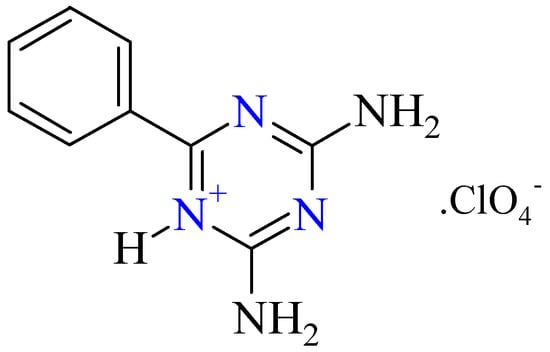
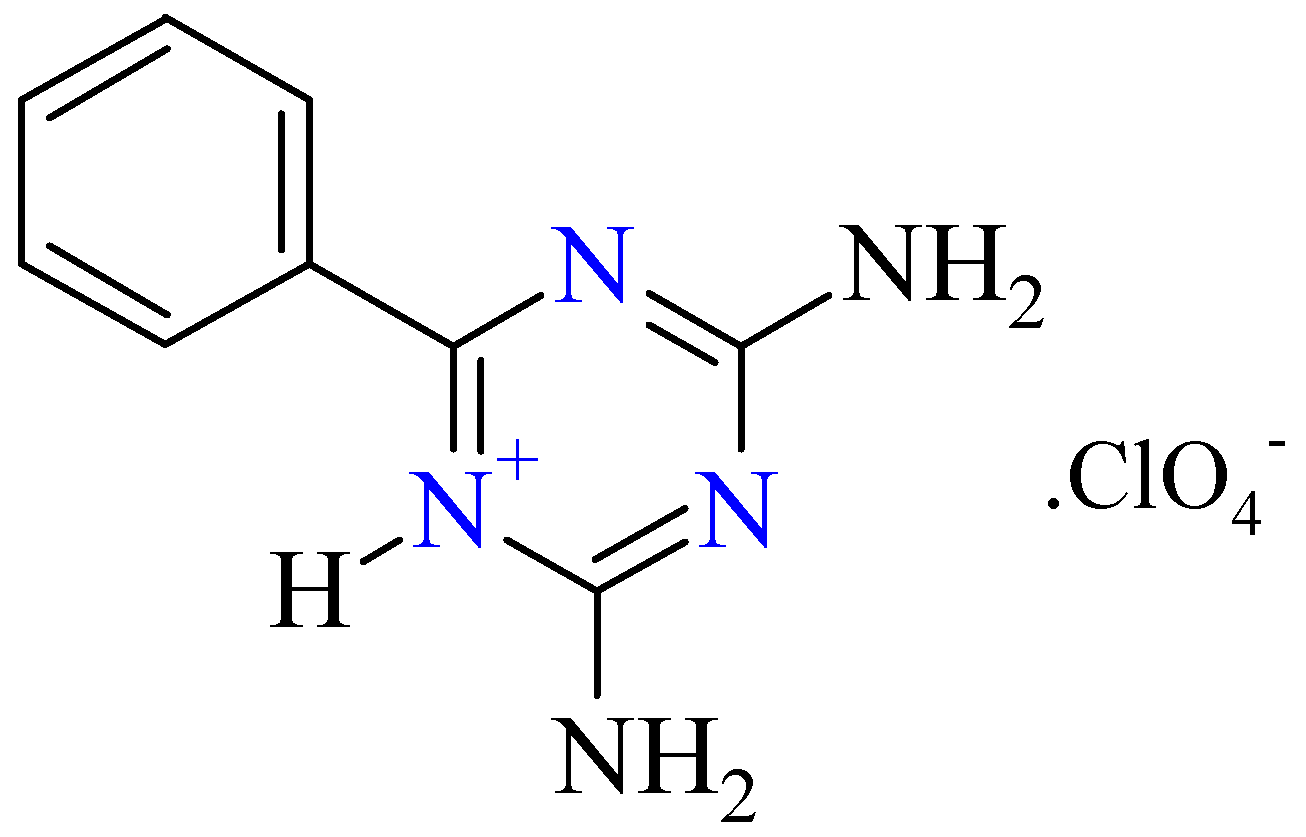
The starting compounds were analytical-grade benzoguanamine and perchloric acid, which were used as received, without further purification. A total of 10 mmol of benzoguanamine was dissolved in 30 mL of hot distilled water under continuous stirring. Separately, 30 mmol of perchloric acid was diluted in 15 mL of distilled water, then added dropwise to a hot aqueous solution of benzoguanamine. The resulting mixture was heated under reflux for 6 h, after which it was allowed to cool to room temperature, leading to the formation of a white precipitate. The solid was then filtered, washed several times with ethanol, and air-dried. The single crystals of 2,4-diamino-6-phenyl-1,3,5-triazinium perchlorate (C9H10N5+·ClO4−) (Scheme 1) were grown from the aqueous solution using a slow solvent-evaporation process. The synthesis was performed several times, and no significant differences were observed between the runs.
Scheme 1.
Developed empirical formula for 2,4-diamino-6-phenyl-1,3,5-triaziniumperchlorate.
2.2. Single-Crystal X-Ray Diffraction (SXRD)
SXRD was carried out at 150K, utilizing a Bruker D8 Venture photon diffractometer, equipped with a Mo (Kα1) anticathode and a graphite monochromator, giving an incident wavelength of λ = 0.71073 Å. The refinements were performed by the method of full-matrix least squares utilizing SHELXL-2017 software [35]. All observed reflections and data reduction were used to refine the unit cell by means of CrysAlisRed software [36]. Finally, the structures plotted in this paper were created using Mercury software [12]. In addition, the SXRD data were deposited at the Cambridge Crystallographic Data Centre (CCDC), under the deposition number 2412879.
The crystals were growth in water by adopting the slow solvent-evaporation method at room temperature, where well-defined crystals appeared after four days. Crystal growth was reproducible.
2.3. Hirschfield Surface Analysis
The 3-dimensional Hirshfeld surfaces mapped using dnorm, shape index, and curvedness, along with the corresponding 2-dimensional fingerprint plots of the refined crystal structure, were generated using CrystalExplorer-17.5 software [37].
2.4. UV-Vis and FT-IR Spectroscopies
The UV-Vis spectrum of C9H10N5+·ClO4− was measured at room temperature in the range of 200–800 nm in distilled water using a JASCO V680 spectrophotometer. The infrared spectrum was recorded using a FT-IR 4200 JASCO spectrometer, in the wavenumber range of 600–4000 cm−1, at room temperature.
2.5. Thermal Analysis
The thermal behavior of the title single crystal was studied over the temperature range from room temperature to 1200 °C utilizing simultaneous thermogravimetric analysis and differential thermal analysis (TGA–DTG) techniques. Measurements were performed under a nitrogen atmosphere at a heating rate of 20 °C/min, using Perkin Elmer TGA 4000 apparatus.
2.6. Quantum Calculations Details
Gaussian-09 software was utilized for theoretical calculations based on the density functional theory (DFT), considering three Beck exchange parameters correlated to LYP functional (Lee, Yang and Parr) and 6-311G++(d, p) basis sets. The optimized molecular structures were investigated, as well as the vibrational modes, in which no symmetry restrictions were used for calculating the infrared spectra. The output frequencies were corrected by a factor of 0.96. Additionally, global quantum chemical descriptors (GQCDs) were computed from the frontier molecular orbitals energies.
In addition, the intermolecular interaction energies of the four selected dimers (Figure 10) were evaluated using a DFT-based counterpoise approach in ORCA software in order to quantify the main cohesive motifs identified from the crystallographic and Hirshfeld analyses. Single-point calculations were performed at the unrestricted Kohn–Sham wB97X-D3/aug-cc-pVTZ level using NoSym, VeryTight SCF, and SlowConv. Basis-set superposition error (BSSE) was corrected using the Boys–Bernardi counterpoise scheme, by computing the full dimer energy together with the two monomer-in-dimer-basis energies containing ghost functions. The BSSE-corrected interaction energy was obtained according to:
is the total energy of the full dimer AB calculated in the full dimer basis set. and are the energies of fragments A and B, respectively, computed in the same dimer basis set using ghost orbitals from the other fragment. Thus, Formula (1) gives the interaction energy corrected for basis-set superposition error (BSSE).
According to the sign convention adopted here, a negative BSSE-corrected interaction energy indicates an attractive and stabilizing molecular pair, whereas a positive value indicates that the isolated dimer geometry is energetically unfavorable relative to the separated fragments.
3. Results and Discussion
3.1. SXRD Study
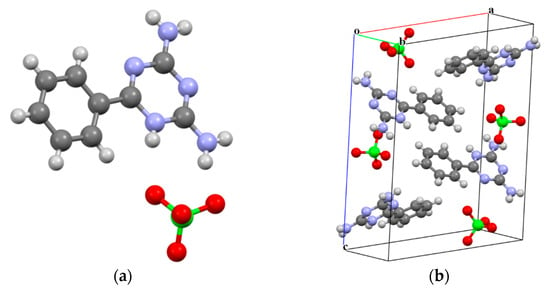
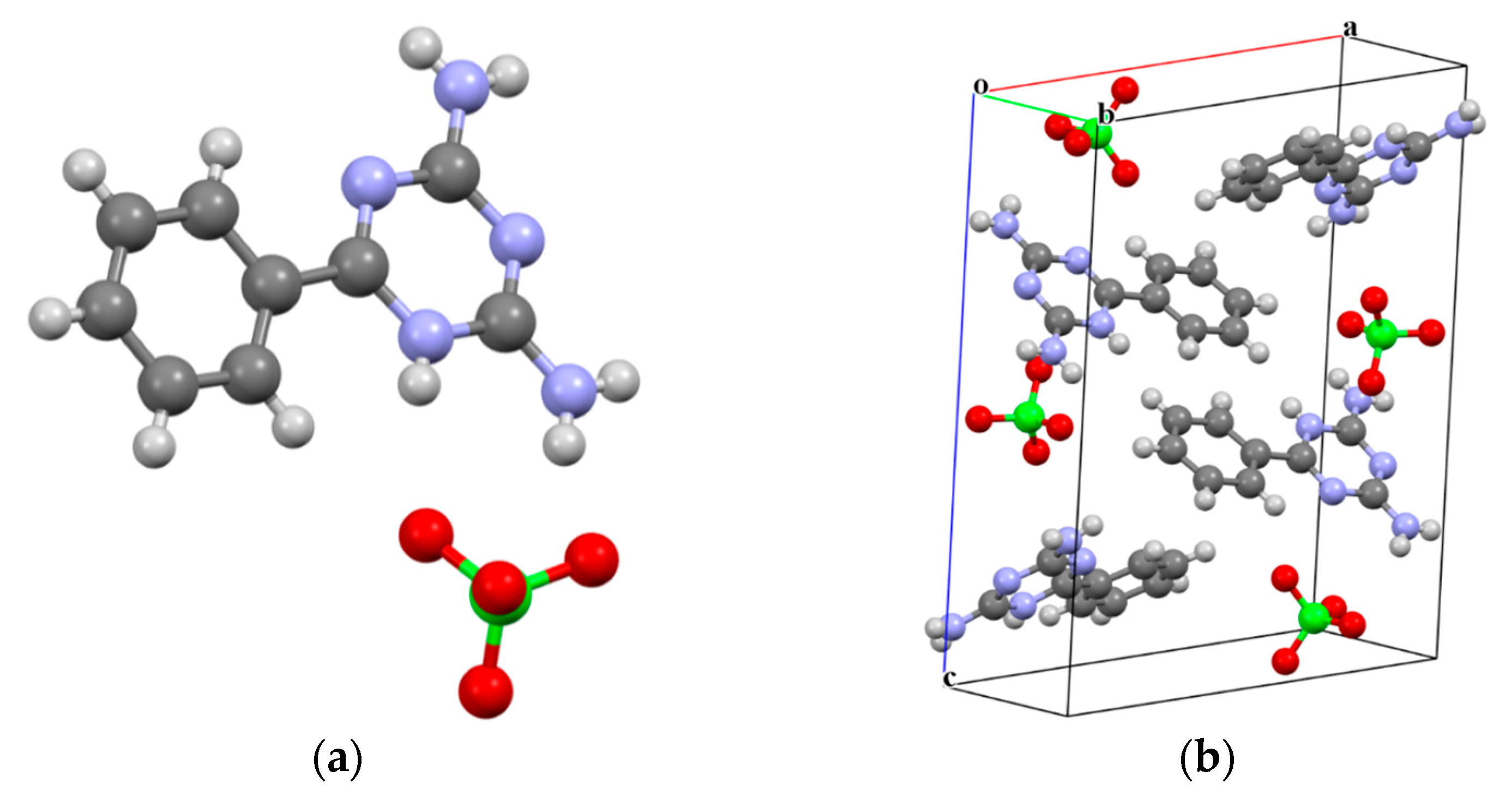
The single-crystal X-ray analysis of C9H10N5+·ClO4− indicates that the asymmetric unit was formed by one perchlorate anion (ClO4−) and one 2,4-diamino-6-phenyl-1,3,5-triazinium cation (C9H10N5+), as depicted in Figure 1a. Table 1 summarizes the crystal data and refinement parameters, while Table S1 collects selected geometric features, including bond lengths, bond angles, and torsion angles. All structural parameters fell within the expected ranges, with no observed anomalies [12,13,14,15,16,17,18,19,20,21,22,23,24,25,26,27,28,29,30,31,32,33,34,35,36,37,38,39]. In addition, the material crystallized in a monoclinic system (Figure 1b), with lattice parameters a = 13.7975 (6), b = 5.0711 (2), c = 16.6471 (9) Å, and β = 91.869 (2) ° and P21/c symmetry group. Furthermore, the SXRD analysis highlighted that the crystal structure is stabilized primarily by weak intermolecular interactions, particularly hydrogen bonds. Considering a maximum donor–acceptor distance of 3.5 Å, twelve intermolecular hydrogen bonds per unit cell were identified, and their geometric parameters are provided in Table S2. This extended hydrogen-bonding network not only stabilizes the crystal structure, but also gives rise to a three-dimensional supramolecular framework, characteristic of type I organic–inorganic hybrid materials, where discrete organic and inorganic components are interconnected via non-covalent interactions.
Figure 1.
(a) Asymmetric unit; (b) unit cell of 2,4-diamino-6-phenyl-1,3,5-triaziniumperchlorate.
Table 1.
Crystal data structure and the parameters of refinement.
Three-Dimensional Supramolecular Network
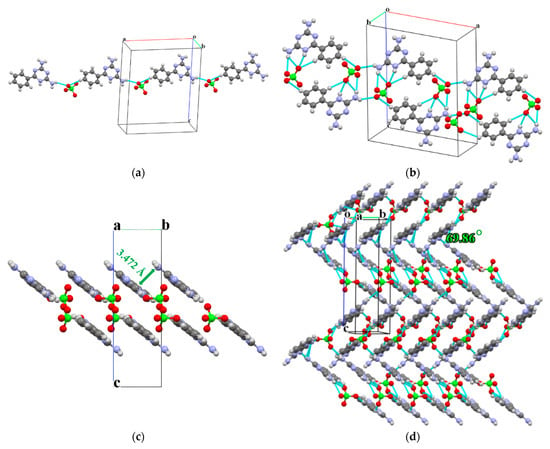
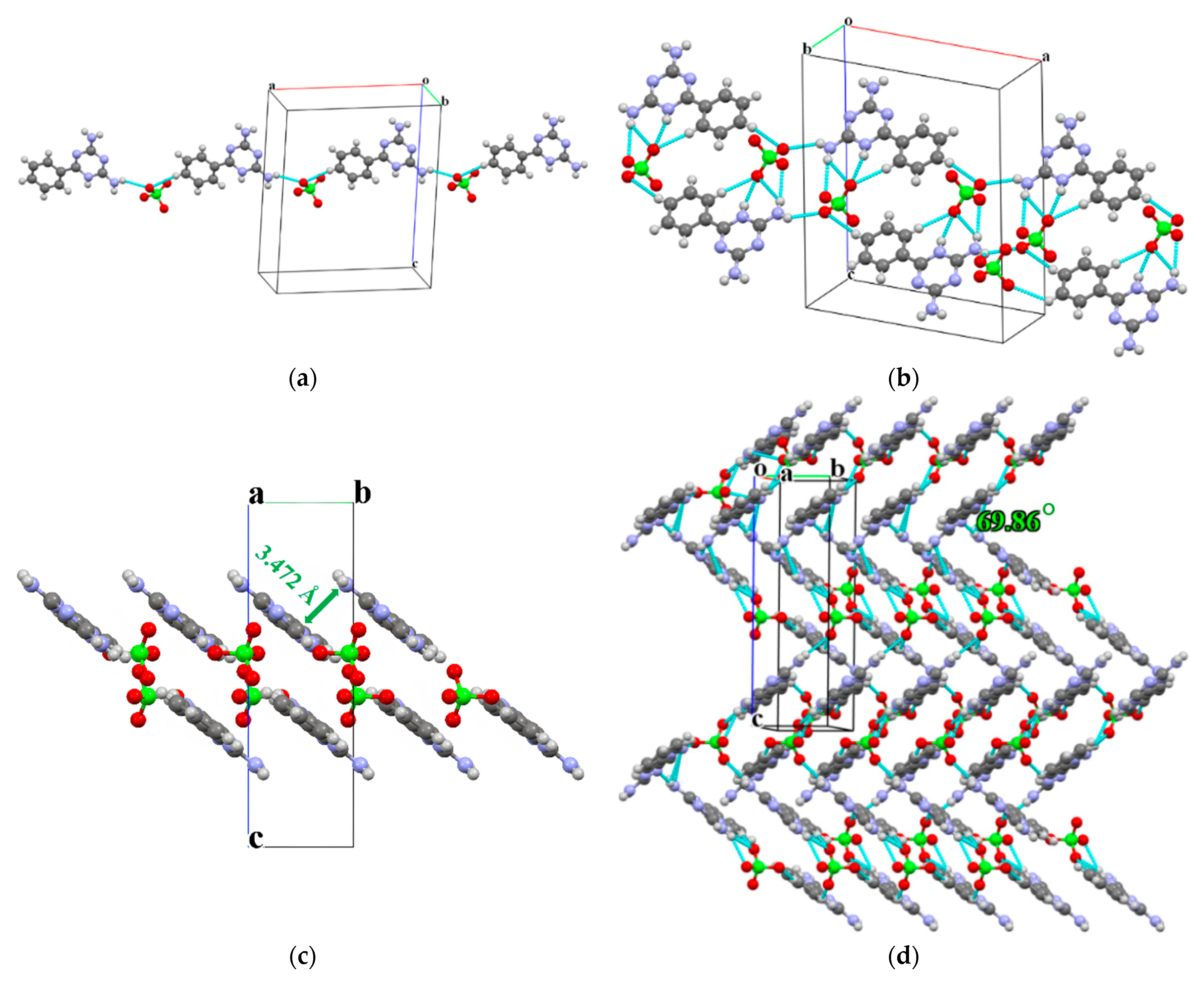
Figure 2 presents the 3D supramolecular network of the material under investigation. It shows that the network was formed by supramolecular chains extending along the a axis ([1 0 0] direction) as shown in (Figure 2a). These chains consisted of alternating C9H10N5+ cations and ClO4− anions, where each anion links adjacent cations through the following hydrogen bonds: C7—H7···O4 and N4—H4N···O4. In addition, the two largest supramolecular ring motifs observed were designated as and . Each of these rings is centered and formed around a symmetry center and contributes to the parallel and oppositely oriented arrangement of adjacent chains (Figure 2b).
Figure 2.
(a) Supramolecular chains along the [1 0 0] direction, (b) supramolecular parallel-displaced π-stacking along the [0 1 0] direction, (c) supramolecular network along the [0 1 0] direction, and (d) 3D supramolecular network, illustrating the layer-by-layer arrangement along the direction [0 0 1].
Perpendicular to this direction, along the b axis ([0 1 0] direction), the crystal structure displayed parallel-displaced π–π stacking interactions (Figure 2c), with a centroid-to-centroid distance of 3.472 Å between benzene rings. Notably, two additional hydrogen bonds, N4—H4O···O1 and N4—H4N···O1, were observed between the stacked molecules. The stacked molecules form two supramolecular organic layers, as shown in the Figure 2d. These layers are interconnected by a network of intermolecular hydrogen bonds involving N5—H5N···N2, N5—H5N···N4, N5—H5N···N4, and N4—H4N···N5, forming a supramolecular layered arrangement with an interlayer angle of 69.86°, in which the anions are located between each two successive supramolecular organic layers (Figure 2d). In conclusion, the synthetized compound can be classified as a type I organic–inorganic hybrid material, characterized by a layer-by-layer self-assembled supramolecular architecture.
For comparison, the hybrid perchlorate salt C9H10N5+.ClO4− based on 2,6-diaminopyridinium cations was reported to crystallize in the monoclinic space group P21, also exhibiting structural stabilization through N–H···O hydrogen bonds between protonated amine groups and perchlorate oxygen atoms. In both systems, the ClO4− anion retains a quasi-regular tetrahedral geometry with a Cl–O bond length consistent with typical literature values, while the C–N and C–C bond lengths within the organic cations remain within the expected ranges for related derivatives [40].
3.2. Hirschfield Surface Analysis (HS)
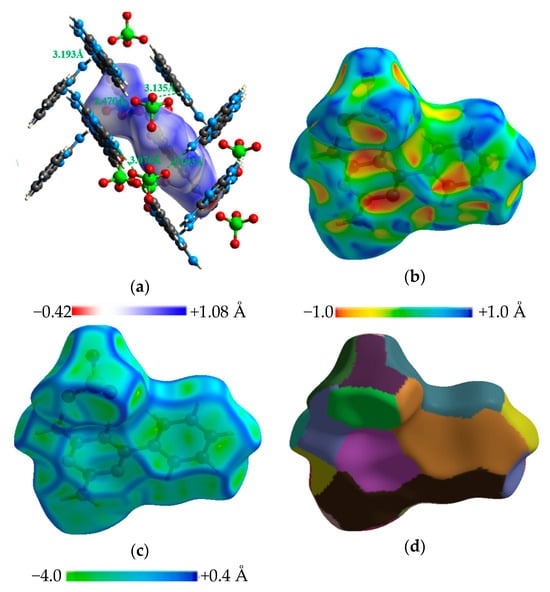
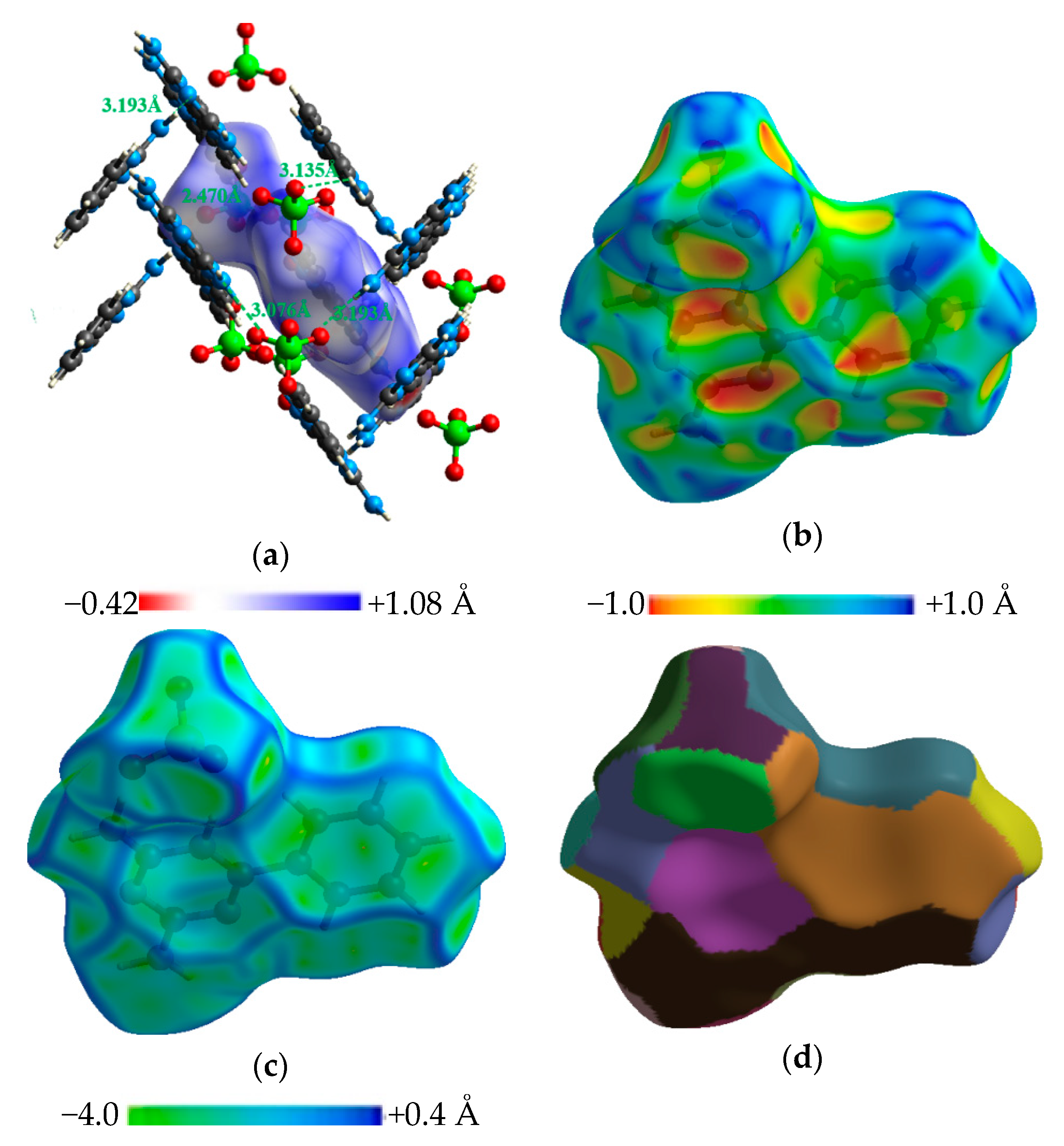
The molecular HS mapped with dnorm, shape index, and curvedness are shown in Figure 3. The molecular HS of C9H10N5+·ClO4− was generated using a standard (high) surface resolution, with the 3D dnorm surfaces and the intermolecular contacts illustrated in Figure 3a, mapped over a fixed color scale range of −0.42 (red) to +1.08 Å (blue). The shape index is mapped in the color range of −1.0 to +1.0 Å (Figure 3b) and curvedness is in the range of −4.0 to +0.4 Å (Figure 3c). For each of the structures that were computed, the surfaces were demonstrated to be transparent to yellow in color with the same orientation. Using the 3D dnorm surface, very close intermolecular interactions were found.
Figure 3.
Hirshfeld surfaces of C9H10N5+·ClO4−: (a) 3D dnorm surface showing the various intermolecular contacts in the crystal, (b) surface index, (c) curvedness, and (d) fragment patch.
The shape index’s information is compatible with 2D fingerprint plots, and it is particularly sensitive to even the smallest changes in the surface shape. The nearest neighbor coordination environment of a molecule was identified from the color patches on the Hirshfeld surface depending on their closeness to adjacent molecules (Figure 3d).
Quantitative measures (Table 2) such as volume (VH = 285.12 Å3), area (SH = 279.39 Å2), globularity (G = 0.75), and asphericity (Ω = 0.13) were also computed using the HS. The globularity is reported to be <1, which suggests that the molecular surface is not a sphere [41], and asphericity is a measure of structural anisotropy [42,43].
Table 2.
Some quantitative measures of the Hirshfeld surface characteristics of the crystal under investigation.
Additionally, Crystal Explorer offers tools for dividing fingerprint plots into contributions via specific types of interactions. Currently, the user can only highlight interactions according to the type of atom (C, N, O, etc.). The selection of interactions is based on the sort of atoms present in the HS and those outside of it. By using the “include reciprocal contacts” option, it is also possible to include the interactions with the switched atoms on the inside and outside. The interactions (O∙∙∙H contacts) with hydrogen atoms outside of the HS and oxygen atoms inside it were chosen, including reciprocal contacts (H∙∙∙O contacts).
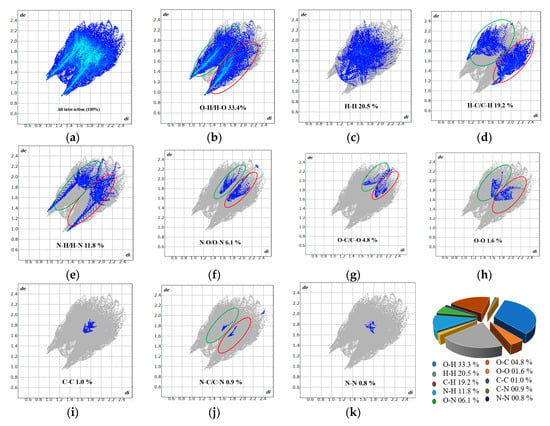
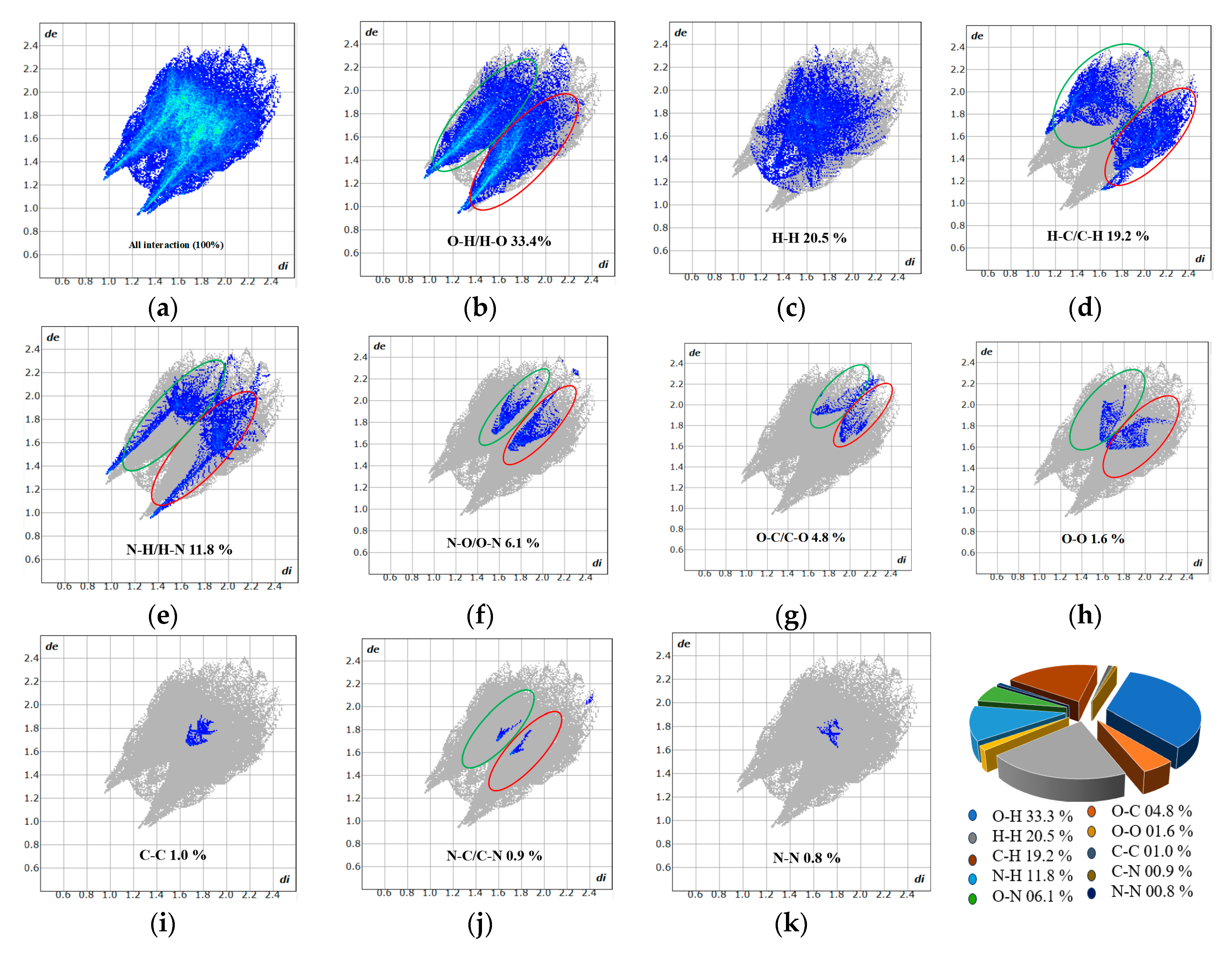
Figure 4 shows that the parts of the fingerprint corresponding to these interactions remained colored while the rest of the plot was grayed out, and simultaneously, the displayed HS coloring was grayed out with the exception of the regions involving the interaction. A percentage contribution of the interaction is reported based on the total area of these regions divided by the entire surface area of the HS.
Figure 4.
Two-dimensional fingerprint plots of C9H10N5+·ClO4−: showing the percentages of contacts contributing to the total Hirshfeld surface area of the molecule ( = internal distance, = external distance).
The 2D fingerprint plots of C9H10N5+.ClO4− are presented in Figure 4, showing that the principal intermolecular interactions are H∙∙∙O/O∙∙∙H contacts at 33.4% represented by the largest region in the 2D fingerprint plot (Figure 4b) (di = 1.68 Å and de = 1.7 Å), H∙∙∙H contacts at 20.5% represented by a large area (Figure 2c), and H∙∙∙C/C∙∙∙H at 19.2% represented by a large area at the top and small area at the bottom in the right and left sides, respectively; these contacts are marked with red and green ellipses, respectively (Figure 4d). The N∙∙∙H/H∙∙∙N contacts with 11.8% are represented by large areas on the left and the right sides, respectively, and are also marked with a green and red ellipse, respectively (Figure 4e). Additionally, other weak contributions are remarked as N∙∙∙O/O∙∙∙N contacts with 6.1% (Figure 4f), O∙∙∙C/C∙∙∙O with 4.8% (Figure 4g), O∙∙∙O with 1.6% (Figure 4h), C∙∙∙C with 1.0% (Figure 4i), N∙∙∙C/C∙∙∙N with 0.9% (Figure 4j), and N∙∙∙N with 0.8% (Figure 4k). These results clearly demonstrate that H···O and O···H hydrogen-bonding contacts dominated the intermolecular landscape, followed by H···H and H···C/C···H interactions, which also contributed significantly to the overall molecular packing.
3.3. Spectroscopy Studies
3.3.1. UV-Visible Spectroscopy
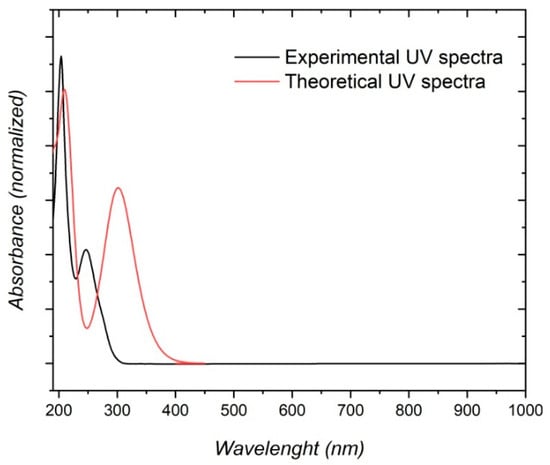
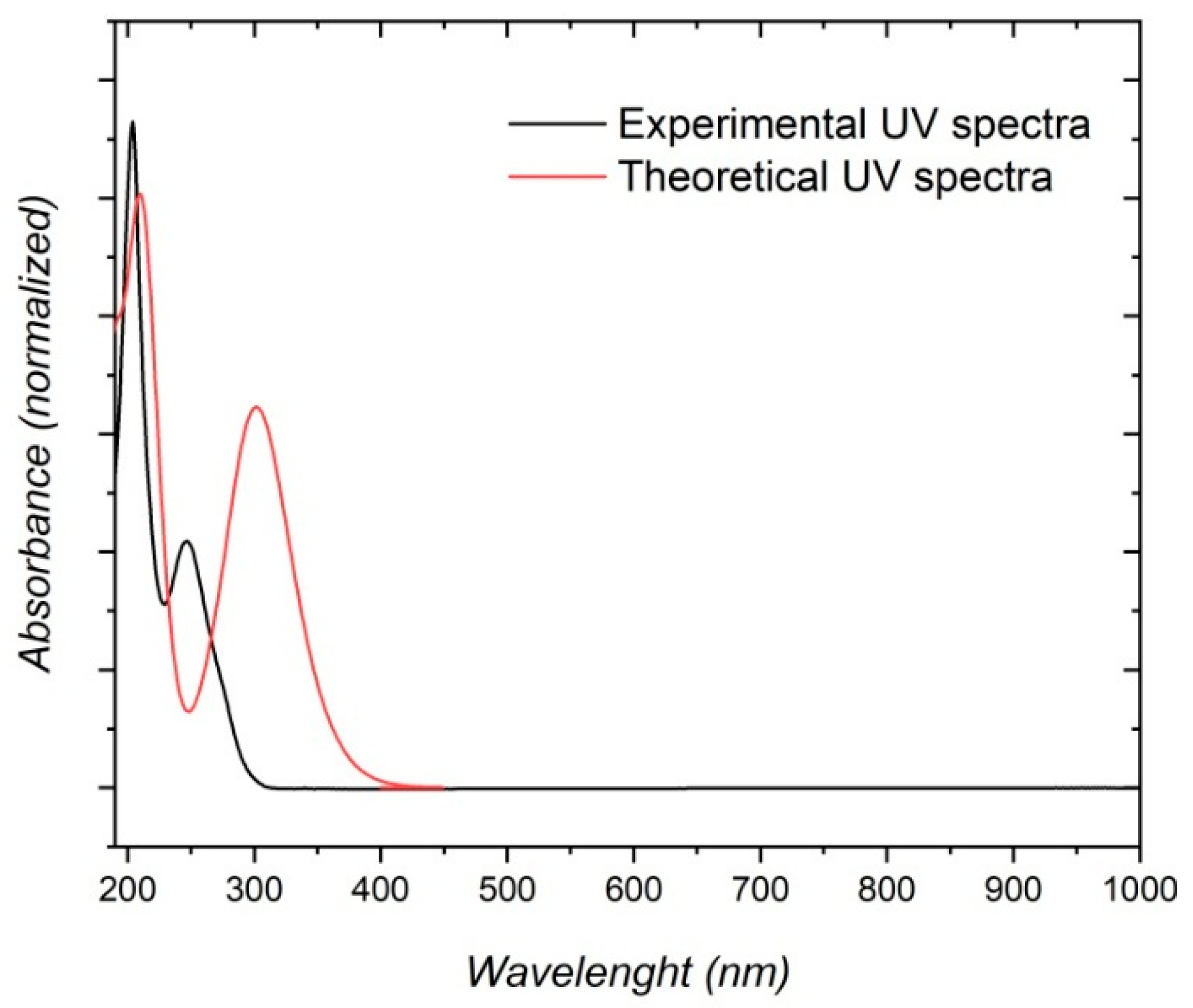
The UV-Visible absorption spectrum of the hybrid crystal 2,4-diamino-6-phenyl-1,3,5-triazinium perchlorate (C9H10N5+·ClO4−) displays two distinct and intense absorption bands at 204 nm and 247 nm, as illustrated in Figure 5. These bands are characteristic of electronic transitions within the molecule’s extended π-conjugated system.
Figure 5.
UV-Vis analysis: comparison of simulated and experimental spectra of 2,4-diamino-6-phenyl-1,3,5-triaziniumperchlorate.
The absorption peak at 204 nm was attributed to π→π* transitions, which involve the excitation of electrons from bonding π orbitals to antibonding π* orbitals. This type of transition typically occurs in molecules with delocalized π-electron systems, such as the fused triazine and phenyl rings present in the cationic moiety. In contrast, the absorption at 247 nm was assigned to n→π* transitions, involving the promotion of nonbonding electrons, primarily from lone pairs on nitrogen atoms into π* antibonding orbitals. These n→π* transitions are more sensitive to environmental effects and often exhibit lower intensity compared to π→π* transitions due to their symmetry-forbidden nature in isolated systems. This behavior is consistent with that reported for materials with a similar structural nature [11,12,29].
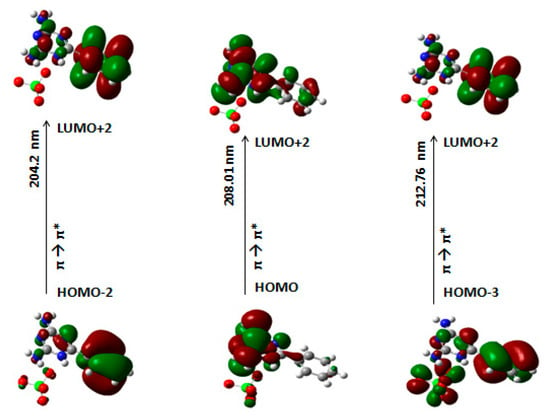
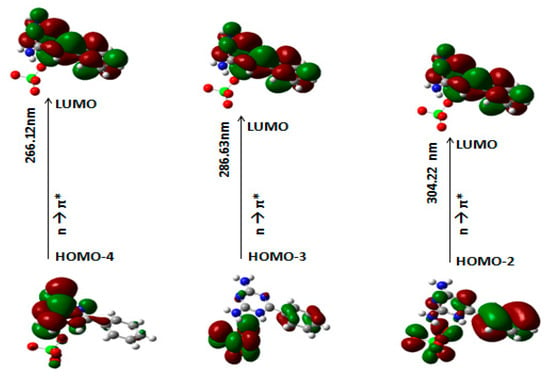
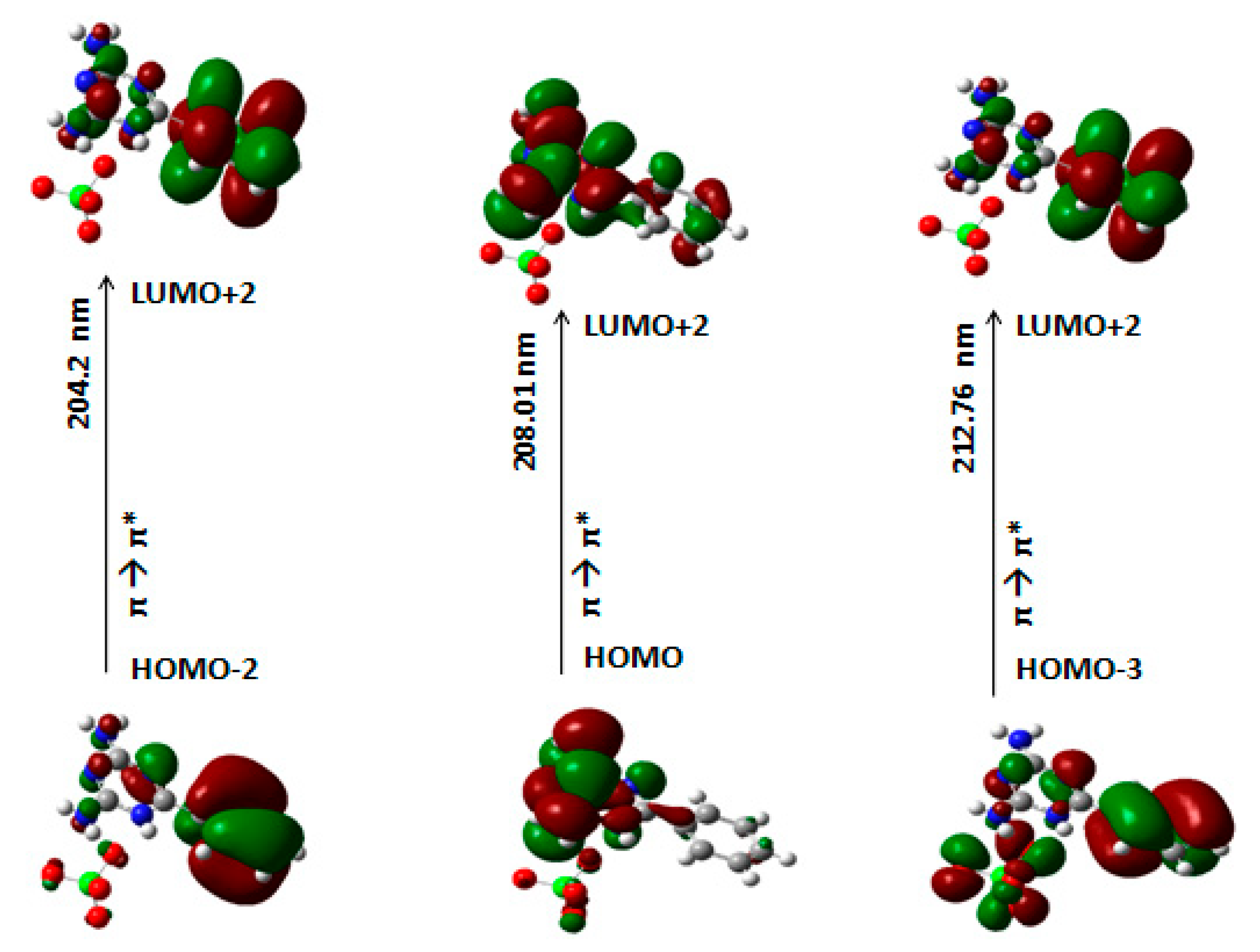
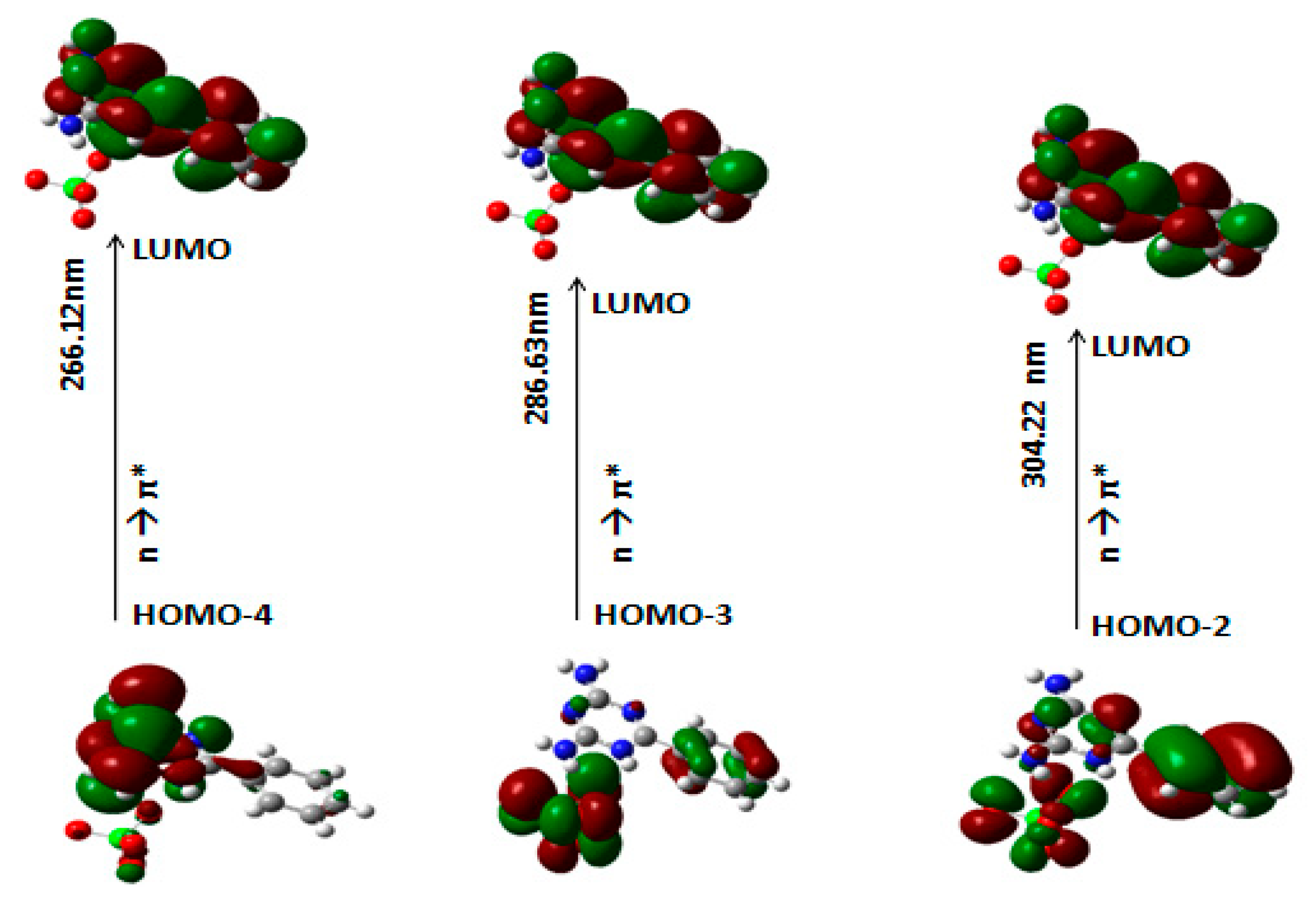
While the experimental data showed two main absorption bands, the TD-DFT (Figure 6) simulations predicted a series of singlet–singlet transitions within the range of 208–337 nm, which were in good agreement with the measured spectrum but also revealed some differences worth discussing. Notably, the calculated transitions at 208.01 nm and 212.76 nm closely corresponded to the experimental band at 204 nm, confirming its dominant π→π* and mixed n→π* characters. However, the broader experimental band observed at 247 nm did not match a single distinct transition in the calculated spectrum. Instead, it likely arose from a convolution of multiple calculated transitions located at 266.12 nm, 286.63 nm, 304.22 nm, and 336.99 nm. These discrepancies may be attributed to several factors. Firstly, TD-DFT calculations are known to slightly overestimate excitation wavelengths, particularly for n→π* transitions, due to limitations in the exchange-correlation functionals used. Secondly, solvent effects and potential molecular aggregation in the experimental aqueous medium may induce spectral broadening or subtle wavelength shift phenomena that are only partially captured by the implicit solvation models employed in the simulations. Lastly, the experimental spectra also include vibronic coupling and thermal effects, which are not considered in vertical excitation energy calculations. Despite these differences, the TD-DFT calculations reproduce the overall profile of the experimental spectrum reasonably well, especially in terms of the nature and sequence of the dominant transitions.
Figure 6.
Key spectral features, including absorption maxima (nm), electronic transition characteristics (e.g., π→π, n→π), and molecular orbital geometry (HOMO-LUMO spatial distribution), were analyzed for the 2,4-diamino-6-phenyl-1,3,5-triazinium perchlorate derivative to correlate experimental UV-Vis data with computational electronic structure calculations.
A detailed analysis of the theoretical excitations is summarized in Table 3, providing further insight into the electronic structure of the compound. The most intense transition at 208.01 nm was attributed to HOMO→LUMO+2, with a 50.1% contribution, consistent with a strong π→π* character localized over the triazine–phenyl framework. A similar transition was observed at 212.76 nm, corresponding to HOMO-3→LUMO+2, with a 48.7% contribution. Here, the HOMO-3 orbital includes a lone pair density from nitrogen atoms, suggesting a mixed n→π* and π→π* nature. A weaker excitation was predicted at 266.12 nm (HOMO-4→LUMO, 10.9%), likely involving more localized or mixed orbital interactions. In contrast, the transition at 286.63 nm (HOMO-3→LUMO) exhibited a strong 90.8% contribution, reflecting a nearly pure n→π* transition dominated by lone pairs from nitrogen centers. At 304.22 nm, the HOMO-2→LUMO transition contributed 69.4%, indicating a significant π→π* character involving conjugated aromatic orbitals. Finally, the transition at 336.99 nm (HOMO-1→LUMO, 24.7%) showed a more moderate contribution, likely resulting from a shared excitation between overlapping orbitals.
Table 3.
UV-Vis absorption spectral analysis: experimental and theoretical electronic transitions.
In summary, the UV-Vis absorption behavior of the hybrid crystal 2,4-diamino-6-phenyl-1,3,5-triazinium perchlorate (C9H10N5+·ClO4−) appears to be primarily influenced by a combination of π→π* and n→π* electronic transitions, involving delocalized π systems and lone pairs from heteroatoms. While some differences remain between the experimental and calculated spectra, the TD-DFT results offer a reasonable level of agreement and help to elucidate the likely molecular origins of the main absorption bands. The complementary use of experimental data and theoretical modeling provides useful insight into the electronic structure of the compound and highlights the potential of TD-DFT methods despite their limitations for interpreting the optical properties of complex molecular systems. Overall, these findings suggest that the extended π conjugation within the molecule plays a significant role in shaping its absorption characteristics, which may be of interest in the future development of materials for optoelectronic, photonic, or molecular-sensing applications.
3.3.2. FT-IR Spectroscopy
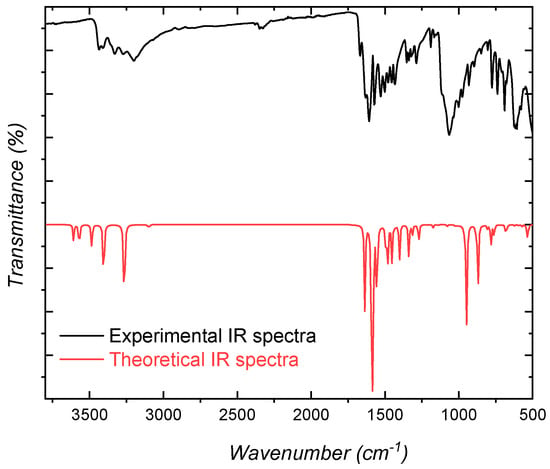
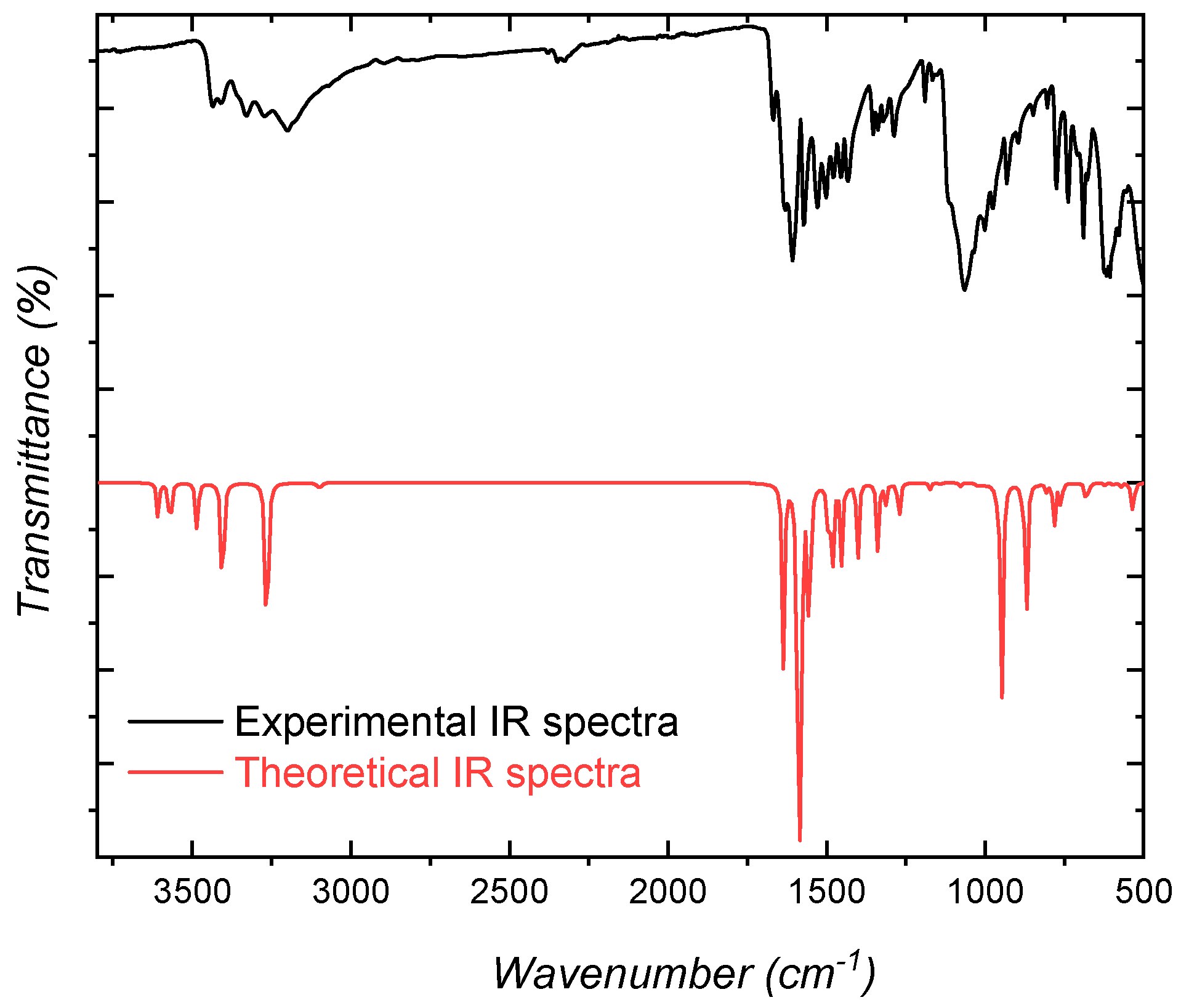
The FT-IR spectrum of the synthesized hybrid crystal C9H10N5+·ClO4− (Figure 7) provides key insights into its molecular vibrations and intermolecular interactions. The most significant absorption bands corresponded to characteristic vibrational modes of the organic cation (C9H10N5+), the perchlorate anion (ClO4−), and hydrogen-bonded interactions. The detailed band assignments are summarized in Table 4. For a deeper interpretation, the experimental spectrum was compared with the theoretically calculated vibrational frequencies.
Figure 7.
Comparative analysis of simulated and experimental FT-IR spectra.
Table 4.
Comparative analysis of simulated and experimental IR spectra: vibrational mode assignment for 2,4-Diamino-6-phenyl-1,3,5-triazinium perchlorate.
Broad absorption features observed in the range of 3430–3050 cm−1 were attributed to N–H and C–H stretching vibrations [10], as well as hydrogen bonding involving NH2 groups [11]. These bands are typical of triazine-based systems and indicate strong intermolecular interactions, consistent with the supramolecular hydrogen-bonding network observed in SXRD and Hirshfeld surface analyses. In comparison, the calculated spectrum reproduces these stretching modes but displays sharper and slightly higher-frequency bands. The observed red shift and significant broadening in the experimental spectrum arise from hydrogen-bonding interactions and solid-state effects within the crystal lattice, which are not accounted for in gas-phase harmonic calculations.
The bending vibration of NH2 groups appeared prominently at 1669 cm−1, while the bands in the region of 1630–1420 cm−1 corresponded to the stretching vibrations of the triazine ring, particularly the C=N and C–N bonds [44]. These modes are well-reproduced in the theoretical spectrum, showing good agreement in both positions and relative intensities. Minor frequency deviations (typically within the range of 10–30 cm−1) can be attributed to the harmonic approximation employed in the DFT calculations and the absence of intermolecular interactions in the theoretical model.
Additionally, the ClO4− anion exhibited a distinct and intense band at 1064 cm−1, characteristic of its symmetric stretching mode [13]. The calculated spectrum successfully predicts a strong vibrational mode in this region, confirming the presence of the perchlorate anion. However, slight shifts and subtle band-shape modifications observed experimentally suggest a reduction in the ideal tetrahedral symmetry of ClO4− in the solid state, likely due to hydrogen bonding and electrostatic interactions with the organic cation. Such symmetry-lowering effects are typical in hybrid ionic crystals and further support the structural arrangement determined by crystallographic analysis.
Overall, the IR spectroscopic analysis, reinforced by theoretical calculations, confirms the structural integrity and functional group environment of the synthesized compound. The remaining discrepancies are mainly attributed to harmonic approximation limitations and crystal packing effects, particularly hydrogen-bonding interactions in the solid state. This comprehensive vibrational characterization contributes a valuable insight into the compound’s potential in optoelectronic, sensor, or coordination chemistry applications.
3.4. Mapping Electrostatic Potential (MEP)
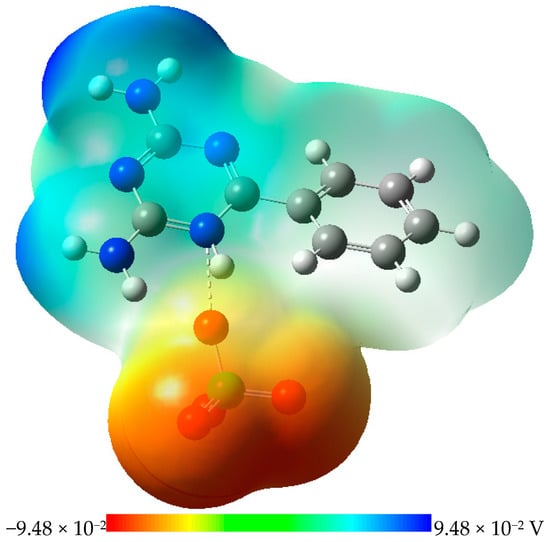
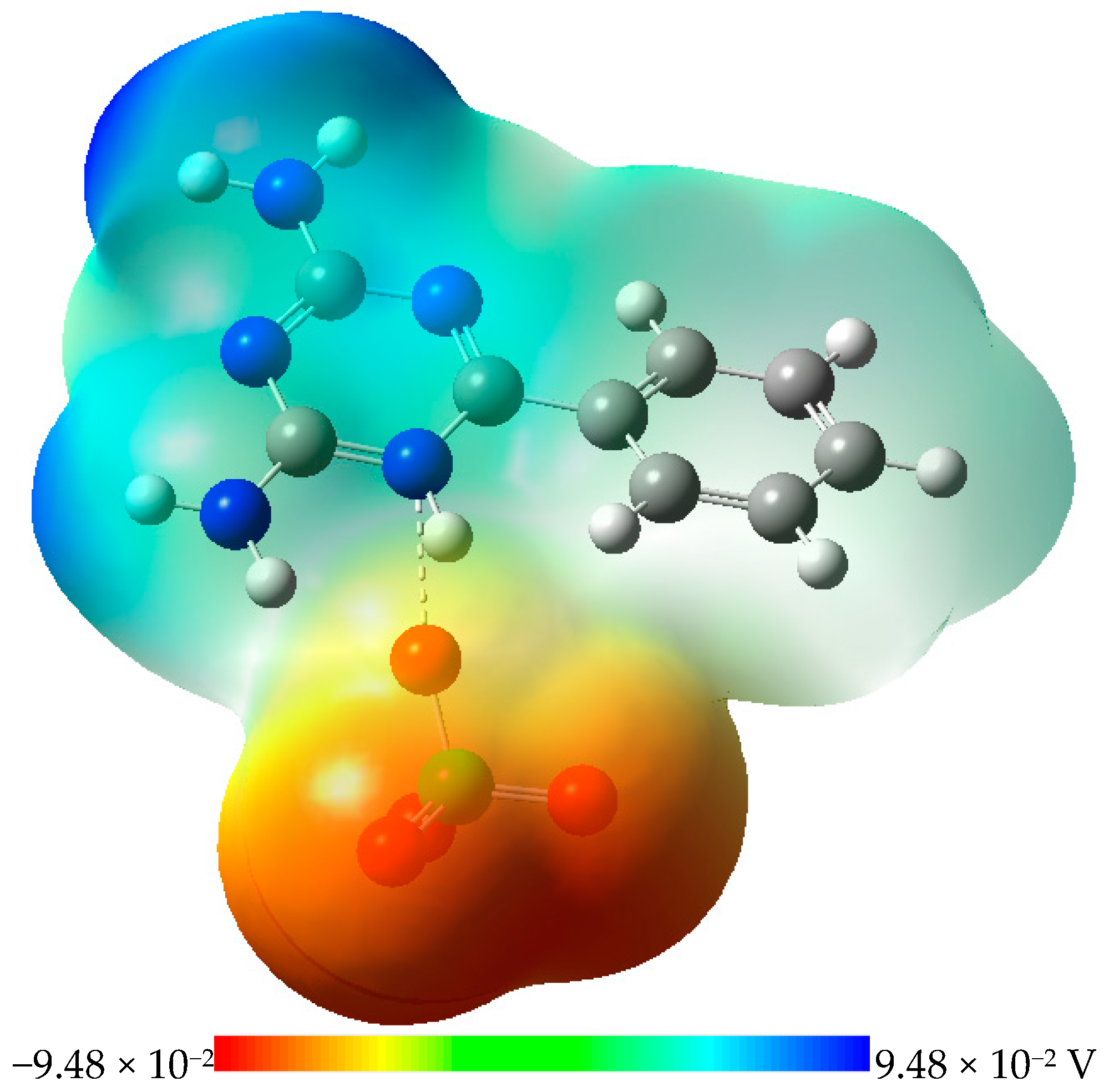
The Figure 8 presents the total electron density surfaces mapped with the electrostatic potential (MEP) of the asymmetric unit of the compound under investigation, which exhibits positive potential indicated by the blue color around the cationic geometric zones, where the highest potential can be observed around the nitrogen atoms, giving a symmetric value of the electrostatic potential: 9.48 × 10⁻² V. In return, the negative potential indicated by the red color is localized around the anionic moieties, giving the lowest potential value of −9.48 × 10⁻² V. The dipolar moment was found to be 18.372 Debye. The high values were consistent with the non-homogeneity of the electrostatic potential.
Figure 8.
Total electron density surfaces mapped with electrostatic potential (MEP) of the asymmetric unit of title compound.
3.5. Thermogravimetric Studies
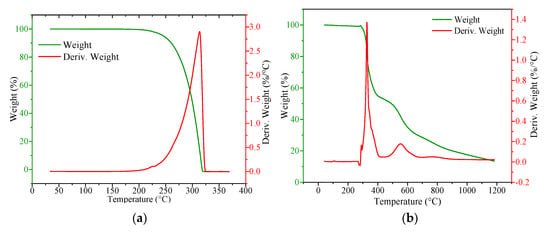
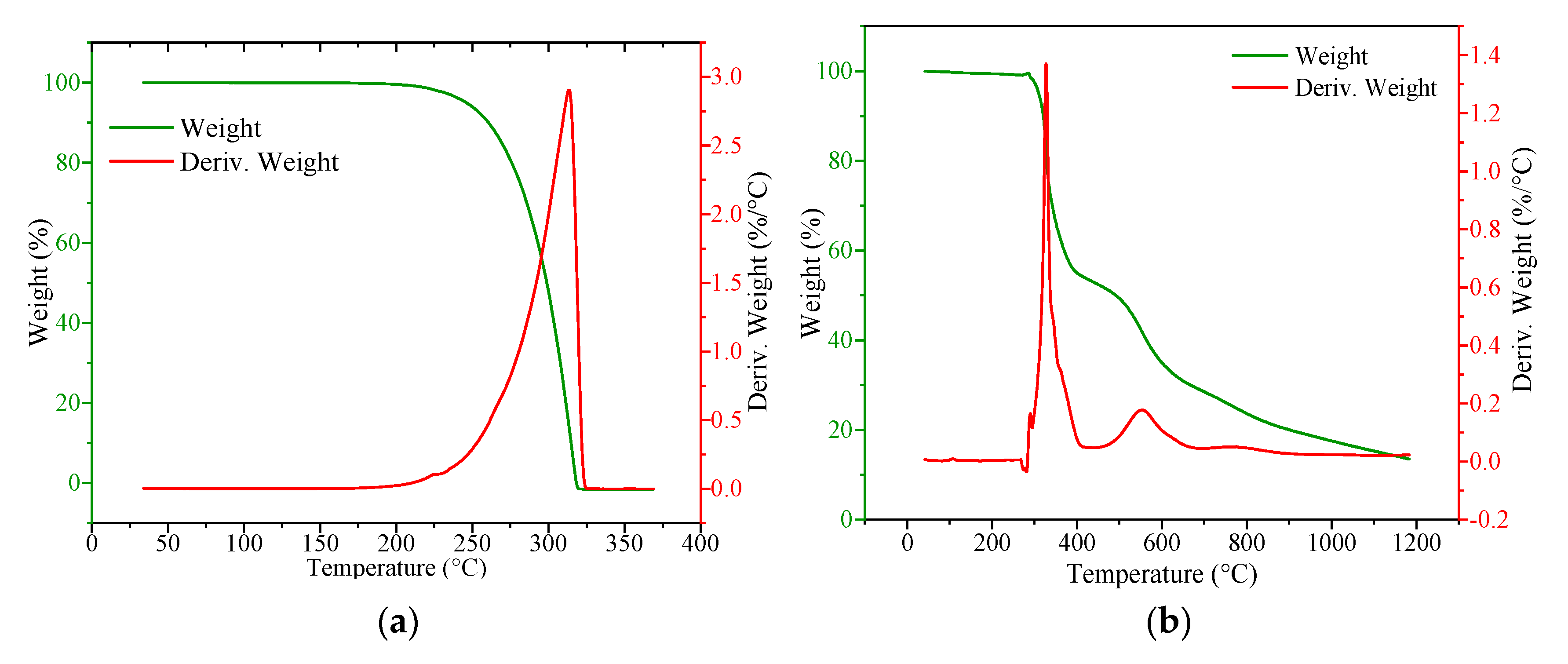
TGA and DTG curves characteristic of the starting material and the synthesized hybrid ionic material are shown in Figure 9a and Figure 9b, respectively.
Figure 9.
TGA/DTG curves of (a) benzoguanamine and (b) 2,4-diamino-6-phenyl-1,3,5-triazinium perchlorite.
It can be seen from the figure that the starting material, benzoguanamine, is thermally stable until 200 °C, and its decomposition occurs in one stage accompanied by rapid weight loss that takes place in the temperature range of between 205 °C and 325 °C, with a weight loss value of 100% corresponding to the DTG peak at 324 °C. The TGA curve of the starting material illustrates that the benzoguanamine is thermally stable until 200 °C, followed by complete decomposition centered at 324 °C, as shown by the non-asymmetric DTG curve. Benzoguanamine is characterized by multi-stage decomposition occurring in a narrow temperature range, presenting the absence of intermediate stable byproducts. This result aligns with reports on nitrogen-rich triazine compounds, which often show rapid, single-stage degradation via amino and ring fragmentation [12].
The TGA curve of the hybrid material showed enhanced thermal stability up to 290 °C, similar to benzoguanamine. There was no mass loss observed around 100 °C, which indicated the absence of water in this hybrid [45]. A more gradual decomposition can be seen, occurring in four stages. The first, the second, and the third stages took place in the temperature from 290 to 640 °C with a significant weight-loss of 68.42%, accompanied by DTG peaks at 327, 362, and 553 °C, which are attributed primarily to the progressive degradation of the organic cation. These peaks can be interpreted as stepwise processes: the initial peak (327 °C) corresponds to deamination with possible NH3 release [46]; the second peak (362 °C) reflects the fragmentation of the triazine ring [47]; and the third peak (553 °C) can be assigned to the further breakdown and carbonization of the remaining aromatic structure, leading to the formation of carbonaceous residues [48]. The broad temperature range and multiple DTG maxima suggest a complex degradation pathway influenced by strong hydrogen bonding and electrostatic interactions within the crystal lattice.
The last decomposition stage that started at 640 °C and is associated with a DTG peak at 771 °C can be assigned to the gradual breakdown of the perchlorate anion. As a strong oxidizing agent, ClO4− decomposes by releasing oxygen and reducing to lower chlorine oxide species, ultimately forming chloride-containing residues. This high-temperature step further confirms the stabilizing effect of ionic interactions in the hybrid crystal.
Additionally, T50% was 492 °C for the ionic material; while T50% was 302 °C for the starting compound.
The produced triazinium perchlorate hybrid shows remarkable thermal stability when compared to other triazine-based materials documented in the literature. The inherent thermal endurance of the triazine core is demonstrated by 1,3,5-triazine derivatives such as TCZT and TIDT, which exhibit 5% weight-loss temperatures in the range of around 370–384 °C [49].
3.6. Quantitative Intermolecular-Interaction Energy Analysis
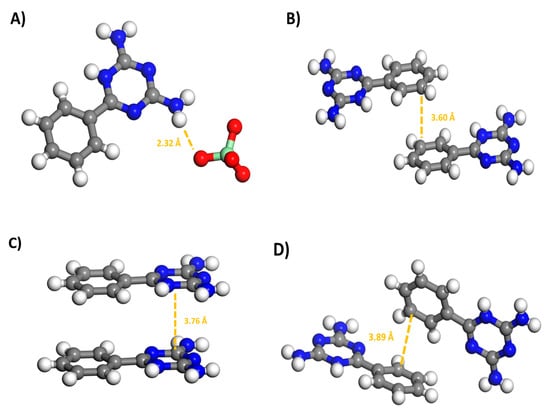
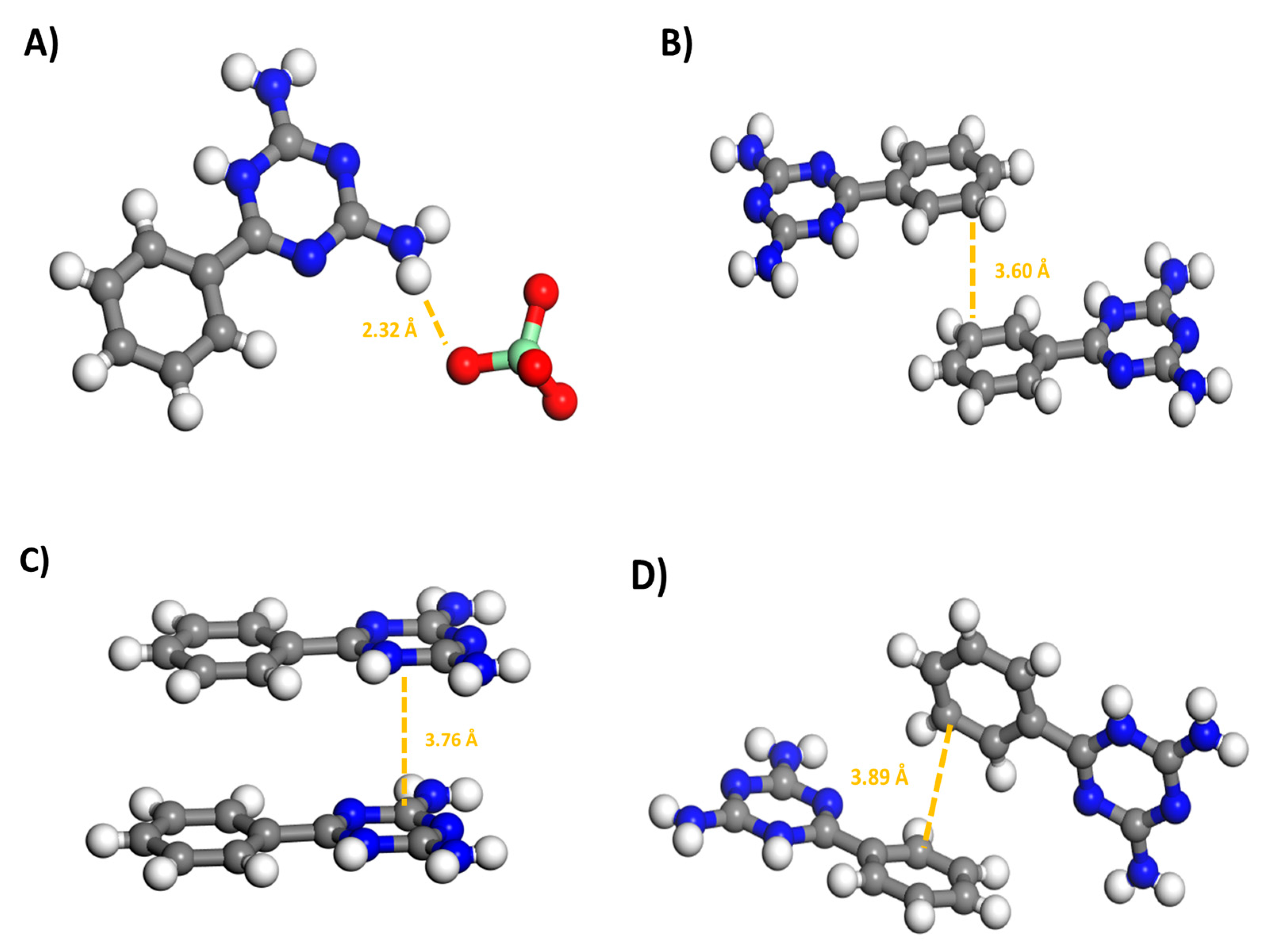
To complement the crystallographic and Hirshfeld surface analyses, four dominant intermolecular motifs were selected as representative of supramolecular organization: (i) the cation–anion perchlorate O---H-N hydrogen-bonded pair (Figure 10A), (ii) a parallel face-to-face π---π interaction between carbon-based aromatic rings (Figure 10B), (iii) face-to-face π---π contact involving the N-C-N-C heteroaromatic ring (Figure 10C), and (iv) a perpendicular π-contact between carbon-based aromatic rings (Figure 10D). The corresponding characteristic intermolecular distances are 2.32 Å, 3.60 Å, 3.76 Å, and 3.93 Å. This selection is fully consistent with the experimental structure, which reveals a layered assembly sustained by strong hydrogen bonding and aromatic packing. In particular, the Hirshfeld surface analysis shows that H---O/O---H contacts dominate the intermolecular landscape (33.4%), while the SXRD study identifies parallel-displaced aromatic stacking with a centroid-to-centroid distance of 3.472 Å, confirming the structural relevance of both ionic and π-associated contacts.
Figure 10.
Selected intermolecular dimers used for the quantitative interaction-energy analysis of 2,4-diamino-6-phenyl-1,3,5-triazinium perchlorate: (A) cation–anion perchlorate O---H–N hydrogen-bonded pair; (B) parallel face-to-face π---π interaction between carbon-based aromatic rings; (C) face-to-face π---π interaction involving the N-C-N-C heteroaromatic ring; (D) perpendicular π-contact between carbon-based aromatic rings.
The most relevant intermolecular distances are indicated for each dimer. The corresponding BSSE-corrected interaction energies are summarized in Table 5.
Table 5.
Selected dominant intermolecular interaction motifs and corresponding BSSE-corrected interaction energies in the crystal structure of 2,4-diamino-6-phenyl-1,3,5-triazinium perchlorate.
It is important to distinguish between the geometrical occurrence of an intermolecular contact in the crystal and its pairwise energetic contribution. Hirshfeld surface percentages quantify the relative occurrence of different contact types over the molecular surface, whereas the interaction energies calculated for extracted dimers determine whether a selected molecular pair is attractive or repulsive when considered independently. Similarly, a short intermolecular or centroid-to-centroid distance confirms the structural occurrence of a contact but does not necessarily demonstrate that the corresponding isolated dimer is energetically stabilizing. The counterpoise-corrected calculations were therefore used to establish the energetic character of each representative crystallographic pair.
The BSSE-corrected interaction energies reveal a clearly unbalanced energetic hierarchy. The cation–anion O···H–N pair exhibits a strongly negative interaction energy of −248.8 kJ mol−1, demonstrating that this motif is highly stabilizing. This value reflects not only the N–H···O hydrogen bond, but also the strong electrostatic attraction between the positively charged triazinium cation and the perchlorate anion, together with induction, polarization, and dispersion contributions. Accordingly, this interaction is more accurately described as a charge-assisted cation–anion hydrogen-bonded motif. Its dominant energetic role is consistent with the short H···O contact and with the Hirshfeld surface analysis, in which H···O/O···H contacts account for the largest contribution, namely 33.4% of the molecular surface. In contrast, the three selected π-associated dimers exhibit positive BSSE-corrected interaction energies of +148.9 kJ mol−1 for the parallel carbon-ring arrangement, +118.8 kJ mol−1 for the face-to-face contact involving the N–C–N–C heteroaromatic ring, and +165.5 kJ mol−1 for the perpendicular carbon-ring arrangement. With the energy convention used in this work, a positive interaction energy indicates that the isolated dimer, frozen in its crystallographic geometry, is energetically less favorable than the two infinitely separated fragments. These molecular pairs must therefore be regarded as repulsive or destabilizing when considered independently and should not be described as attractive or stabilizing π–π interactions. Among the three arrangements, the heteroaromatic face-to-face dimer exhibits the smallest energetic penalty, whereas the perpendicular carbon-ring contact is the most unfavorable. The presence of these energetically unfavorable isolated pairs in the experimental crystal structure does not imply that the complete lattice is unstable. Crystal packing results from the collective balance of many simultaneous interactions rather than from the energy of a single extracted dimer. In the periodic solid, each ionic unit participates in several charge-assisted N–H···O hydrogen bonds, additional N–H···N and C–H···O contacts, long-range electrostatic interactions, dispersion interactions with multiple neighboring molecules, and steric packing constraints. The strongly favorable cation–anion interaction network can therefore compensate for the energetic penalty associated with individual aromatic-pair geometries. Consequently, the π-associated contacts are interpreted here as geometrically relevant packing motifs that determine the orientation and propagation of the organic layers, rather than as independent sources of lattice stabilization.
Because the three π-associated interaction energies are positive, it would not be physically meaningful to express them as positive percentages of the total attractive stabilization energy. Such a calculation would incorrectly treat repulsive energetic penalties as stabilizing contributions. For descriptive comparison only, the absolute magnitudes of the three positive π-dimer energies correspond to approximately 59.8%, 47.7%, and 66.5% of the magnitude of the cation–anion interaction energy. These percentages do not represent cohesive-energy contributions; they only compare the magnitudes of the repulsive pair energies with the magnitude of the attractive cation–anion interaction. A rigorous separation into electrostatic, exchange–repulsion, induction, and dispersion terms would require a dedicated energy-decomposition analysis and is beyond the scope of the present study.
Overall, the calculations establish that the charge-assisted cation–anion O···H–N motif is the principal energetic anchor of the crystal structure, whereas the π-associated contacts mainly describe the geometrical organization of the layered packing. The present results therefore distinguish clearly between energetic cohesion and structural propagation: the former is dominated by the hydrogen-bonded ionic network, while the latter is influenced by the relative orientation of the aromatic cations within the complete periodic environment.
3.7. Nonlinear Optical (NLO) Properties
Molecular materials’ nonlinear optical (NLO) properties have received a lot of attention in recent decades; molecular materials with high NLO effects can be utilized in several optic and optoelectronic applications [50,51,52,53]. The NLO properties were calculated for a single isolated molecule, which is not centrosymmetric, rather than for the crystal structure, which is centrosymmetric.
In this study, some quantum parameters describing the NLO behavior of the isolated molecule were computed using DFT, such as the polarizability (α), polarizability anisotropy (∆α) describing how a molecule’s electronic cloud can be distorted by an external electric field, and the first-order hyper-polarizability (βtot) describing the molecule’s first nonlinear order response. These quantum NLO’s parameters are associated with numerous nonlinear optics phenomena [54]. Formulas (2)–(4) provide their definitions, and the obtained values are listed in Table 6:
<α> = 1/3(αxx+ αyy + αzz)
Δα = 1/2[(αxx − αyy)2 + (αxx − αzz)2 + (αyy − αzz)2]1/2
βtot = [(βxxx + βxyy + βxzz)2 + (βyyy + βyxx + βyzz)2 + (βzzz + βzxx + βzyy)2]1/2
Table 6.
Nonlinear optical parameters of C9H10N5+·ClO4−.
According to the results, C9H10N5+·ClO4− has the higher linear polarizability and also higher anisotropy polarizability than urea, which is a model molecule employed as a reference for the NLO features of molecular systems, showing that the computed βtot value was roughly 50-times higher than that of urea, confirming nonlinear activity.
Moreover, the strongly polarized supramolecular architecture is particularly significant for C9H10N5+·ClO4−. The presence of a dominant charge-assisted hydrogen-bonding network induces pronounced asymmetry in electron density distribution, which is a key requirement for second-order nonlinear optical (NLO) activity in non-centrosymmetric systems. This behavior is consistent with the measured large-dipole moment (18.372 Debye), indicating strong intrinsic molecular polarity. Such a highly polar value is directly associated with enhanced first-order hyperpolarizability (β), which governs second-harmonic generation and related second-order NLO processes in molecular materials [55,56].
In addition, the ionic hydrogen bond within the 3D network of C9H10N5+·ClO4− acts as the principal pathway for charge displacement under an external electromagnetic field, thereby reinforcing molecular hyperpolarizability and facilitating cooperative polarization effects. Meanwhile, although the π-associated interactions are not energetically stabilizing on a pairwise basis, they play an essential structural role by enforcing directional packing and maintaining long-range order. Such supramolecular organization is critical because efficient macroscopic NLO responses require not only large β values but also non-centrosymmetric and well-aligned molecular arrangements to avoid the cancellation of dipolar contributions in the bulk crystal [57,58].
Therefore, C9H10N5+·ClO4− can be understood as a synergistic NLO active system in which the strongly polar hydrogen-bonded ionic network provides the dominant source of nonlinearity, while π-stacking interactions ensure structural coherence and directional alignment. This combination leads to an optimized balance between molecular polarity and crystal packing, both of which are essential for efficient second-order nonlinear optical performance.
4. Conclusions
A novel organic–inorganic ionic compound, 2,4-diamino-6-phenyl-1,3,5-triazinium perchlorate (C9H10N5+·ClO4−), was successfully synthesized and structurally characterized. Single-crystal X-ray diffraction revealed that the compound crystallizes in the monoclinic system, space group P21/c, with the lattice parameters a = 13.7975 (6), b = 5.0711 (2), c = 16.6471 (9) Å, and β = 91.869 (2) °. The analysis of crystal packing shows the formation of a three-dimensional supramolecular network, built through layer-by-layer self-assembly mediated by hydrogen bonding. Hirshfeld surface analysis and the corresponding two-dimensional fingerprint plots highlight that H···O/O···H hydrogen bonds were the predominant intermolecular interactions, contributing 33.4% to the total Hirshfeld surface, indicating their critical role in the structural stabilization of the material. These findings confirm the hybrid nature of the compound and underline the importance of non-covalent interactions in shaping its supramolecular architecture. BSSE-corrected interaction-energy calculations further confirmed that O---H-N hydrogen bonding is the dominant cohesive interaction in the crystal structure, while π-associated contacts mainly support layered supramolecular packing. The UV-Vis analysis confirmed the presence of characteristic π→π* and n→π* transitions at 204 and 247 nm, respectively, and showed strong agreement with TD-DFT computational predictions. Furthermore, FT-IR spectroscopy highlighted key vibrational features including NH2 bending, triazine-ring stretching, and perchlorate stretching modes. These spectroscopic findings reinforce the structural results obtained from XRD. Finally, thermal analysis was also investigated using TGA/DTG techniques, illustrating enhanced thermal properties in comparison to the starting benzoguanamine compound, resulting in increased thermal stability up to 290 °C and a more gradual decomposition occurring in four stages. This gradual degradation profile suggests robust thermal resilience, advantageous for high-temperature applications. Collectively, the structural, spectroscopic, and thermal data highlight the material’s potential in optoelectronics, sensing technologies, and hybrid material engineering, driven by its tailored supramolecular architecture and stability. Future research directions and potential applications have been highlighted, including prospects in optoelectronics, sensing, and hybrid functional materials. Further studies may focus on tuning supramolecular interactions to tailor properties and combine experimental and computational approaches to better understand structure–property relationships and charge-transfer mechanisms.
Supplementary Materials
The following supporting information can be downloaded at: https://www.mdpi.com/article/10.3390/molecules31193369/s1, Table S1. Selected characteristic geometric parameters (Å, °); Table S2. Geometric properties of the hydrogen bonds (Å, °). crystallographic information file (CIF) for 2,4-diamino-6-phenyl-1,3,5-triazinium perchlorate (CCDC 2412879).
Author Contributions
L.O.: conception, theoretical calculations, and writing—original draft; R.K.: synthesis, spectroscopic analysis, and data acquisition; L.B.: theoretical calculations and writing—original draft; H.A.Y.: conception, synthesis, and thermal analysis; A.A.: spectroscopic analysis and XRD analysis; T.R.: XRD analysis; R.B.: conception, theoretical calculations, and writing—original draft. All authors have read and agreed to the published version of the manuscript.
Funding
This research received no external funding.
Institutional Review Board Statement
Not applicable.
Informed Consent Statement
Not applicable.
Data Availability Statement
The crystallographic data have been deposited with the Cambridge Crystallographic Data Centre (CCDC) under deposition number 2412879. The supporting crystallographic information file (CIF) is provided with the Supplementary Materials. Other data are contained within the article.
Acknowledgments
The authors acknowledge the Algerian Ministry of Higher Education and Scientific Research and the Algerian Directorate General for Scientific Research and Technological Development. The DFT calculations were carried out using the Computational Chemistry HPC facility at University College London.
Conflicts of Interest
The authors declare no conflict of interest.
Abbreviations
The following abbreviations are used in this manuscript:
| SXRD | Single-crystal X-ray diffraction |
| UV-Vis | Ultraviolet–visible spectroscopy |
| FT-IR | Fourier Transform Infrared |
| TGA | Thermogravimetric analysis |
| DTG | Derivative thermogravimetry |
| CCDC | Cambridge Crystallographic Data Centre |
| 3D | Three- dimensional |
| 2D | Two-dimensional |
| XRD | X-ray diffraction |
| HS | Hirshfeld surface |
| dnorm | Normalized contact-distance mapping is utilized to categorize areas of specific interest for intermolecular interactions |
| di | Distance of any HS point to the inner surface of the closest nucleus to the surface |
| de | Distance of any HS point to the outer surface of the closest nucleus to the surface |
| vdW | Van der Waals |
| Van der Waals radius of the appropriate atom (internal) | |
| Van der Waals radius of the appropriate atom (external) |
References
- Lin, H.; Liu, W.; Wu, X. Organic-Inorganic Hybrids: A class of Material with Infinite opportunities. Crystals 2024, 14, 535. [Google Scholar] [CrossRef] [Scilit]
- García-Martínez, J.-M.; Collar, E.P. Current and Future Insights in Organic-Inorganic Hybrid Materials. Polymers 2024, 16, 3043. [Google Scholar] [CrossRef] [Scilit] [PubMed]
- Arya, M.; Heera, S.; Meenu, P.; Deepa, K.G. Organic-inorganic hybrid materials and architectures in optoelectronic devices: Recent advancements. Chem. Phys. Mater. 2024, 3, 252–272. [Google Scholar] [CrossRef] [Scilit]
- Liu, F.; Yao, S.; Li, J.; Huang, K.; Zhang, D.; Wong, T.M.; Tang, R.; Yeung, K.W.K.; Wu, J. Inorganic-organic hybrid metamaterials with switchable high stiffness and elasticity. Nat. Commun. 2025, 16, 4423. [Google Scholar] [CrossRef] [Scilit] [PubMed]
- Nikshitha, M.; Sudhakara, S.M.; Shetty, M.S. Organic-inorganic hybrids: A comprehensive review on synthesis and their potential applications. Mater. Chem. Phys. 2025, 331, 130181. [Google Scholar] [CrossRef] [Scilit]
- Ran, Q.; Wang, R.; Yang, X.; Chen, Z.; Luo, D.; Wan, Z.; Qian, Q. Emerging Physics in Magnetic Organic-Inorganic Hybrid Systems. ACS Nano 2025, 19, 5063–5076. [Google Scholar] [CrossRef] [Scilit] [PubMed]
- Hao, L.T.; Kim, S.; Lee, M.; Park, S.B.; Koo, J.M.; Jeon, H.; Park, J.; Oh, D.X. Next-generation all-organic composites: A sustainable successor to organic–inorganic hybrid materials. Int. J. Biol. Macromol. 2024, 269, 132129. [Google Scholar] [CrossRef] [Scilit] [PubMed]
- Cordoncillo, E.; Escribano, P.; Guaita, F.J.; Philippe, C.; Viana, B.; Sanchez, C. Optical properties of lanthanide doped hybrid organic-inorganic materials. J. Sol-Gel Sci. Technol. 2002, 24, 155–165. [Google Scholar] [CrossRef] [Scilit]
- Sanchez, C.; Lebeau, B.; Chaput, F.; Boilot, J.P. Optical properties of functional hybrid organic–inorganic nanocomposites. Adv. Mater. 2003, 15, 1969–1994. [Google Scholar] [CrossRef] [Scilit]
- Youcef, H.A.; Chafaa, S.; Doufnoune, R.; Douadi, T. Synthesis, characterization and thermal behavior of tetrakis (melamine2+) bis (melamine+) pentakis (monohydrogenphosphate) tetrahydrate. J. Mol. Struct. 2016, 1123, 138–143. [Google Scholar] [CrossRef] [Scilit]
- Bourzami, R.; AitYoucef, H.C.; Hamdouni, N.; Sebais, M. Synthesis, crystal structure, vibrational spectra and thermal properties of novel ionic organic-inorganic hybrid material. Chem. Phys. Lett. 2018, 711, 220–226. [Google Scholar] [CrossRef] [Scilit]
- AitYoucef, H.C.; Bourzami, R. Synthesis, single crystal X-ray structure and vibrational spectroscopic characterization study of a new hybrid material crystal: Bis(2,4,6-trihydroxy-1,3,5-triazin-1-ium) bischloride monohydrate. J. Mol. Struct. 2019, 1191, 218–224. [Google Scholar] [CrossRef] [Scilit]
- Fellahi, Z.; Aityoucef, H.C.; Hannachi, D.; Djedouani, A.; Ouksel, L.; François, M.; Fleutot, S.; Bourzami, R. Synthesis, X-ray crystallography, Hirshfeld surface analysis, thermal properties and DFT/TD-DFT calculations of a new material hybrid ionic (C10H18N2O82+.2ClO4−.4H2O). J. Mol. Struct. 2021, 1244, 130955. [Google Scholar] [CrossRef] [Scilit]
- Debrus, S.; Marchewka, M.K.; Drozd, M.; Ratajczak, H. Vibrational, calorimetric and nonlinear optical studies of melaminium-bis (trichloroacetate) monohydrate molecular–ionic crystal. Opt. Mater. 2007, 29, 1058–1062. [Google Scholar] [CrossRef] [Scilit]
- Mammeri, F.; Bourhis, E.L.; Rozes, L.; Sanchez, C. Mechanical properties of hybrid organic–inorganic materials. J. Mater. Chem. 2005, 15, 3787–3811. [Google Scholar] [CrossRef] [Scilit]
- Sreekumar, S.; Ganguly, A.; Khalil, S.; Chakrabarti, S.; Hewitt, N.; Mondol, J.; Shah, N. Thermo-optical characterization of novel MXene/Carbon-dot hybrid nanofluid for heat transfer applications. J. Clean. Prod. 2023, 434, 140395. [Google Scholar] [CrossRef] [Scilit]
- Nicole, L.; Laberty-Robert, C.; Rozes, L.; Sanchez, C. Hybrid materials science: A promised land for the integrative design of multifunctional materials. Nanoscale 2014, 6, 6267–6292. [Google Scholar] [CrossRef] [Scilit] [PubMed]
- Siimer, K.; Cristjanson, P.; Kaljuvee, T.; Pekh, T.; Lasn, I.; Saks, I. TG-DTA study of melamine-urea-formaldehyde resins. J. Therm. Anal. Calorim. 2008, 92, 19–27. [Google Scholar] [CrossRef] [Scilit]
- Kuryla, W.C.; Papa, A.J. Flame Retardancy of Polymeric Materials; Dekker: New York, NY, USA, 1973; Volumes 1–5. [Google Scholar]
- Kanagathara, N.; Marchewka, M.K.; Sivakumar, N.; Gayathri, K.; Renganathan, N.G.; Gunasekaran, S.; Anbalagan, G. A study of thermal and dielectric behavior of melaminium perchlorate monohydrate single crystals. J. Therm. Anal. Calorim. 2013, 112, 1317–1323. [Google Scholar] [CrossRef] [Scilit]
- Xiao, J.; Hu, Y.; Yang, L.; Cai, Y.; Song, L.; Chen, Z.; Fan, W. Fire retardant synergism between melamine and triphenyl phosphate in poly(butylene terephthalate). Polym. Degrad. Stab. 2006, 91, 2093–2100. [Google Scholar] [CrossRef] [Scilit]
- Julio, P.G.; Janczak, J. Supramolecular architectures in crystals of melamine and aromatic carboxylic acids. J. Mol. Struct. 2008, 891, 429–436. [Google Scholar] [CrossRef] [Scilit][Green Version]
- Lindoy, L.F.; Atkinson, I.M. Self-Assembly in Supramolecular Systems; Monographs in Supramolecular Chemistry; Royal Society of Chemistry: Cambridge, NY, USA, 2000; Volume 7. [Google Scholar]
- Krische, M.J.; Lehn, J.M. The utilization of persistent H-bonding motifs in the self-assembly of supramolecular architectures. Struct. Bond. 2000, 96, 3–29. [Google Scholar] [CrossRef] [Scilit] [PubMed]
- Gamez, P.; Reedijk, J. 1,3,5-Triazine-based synthons in supramolecular chemistry. Eur. J. Inorg. Chem. 2006, 2006, 29–42. [Google Scholar] [CrossRef] [Scilit]
- Russell, K.C.; Lehn, J.-M.; Kyritsakas, N.; DeCian, A.; Fischer, J. Self-assembly of hydrogen-bonded supramolecular strands from complementary melamine and barbiturate components with chiral selection. New J. Chem. 1998, 22, 123–128. [Google Scholar] [CrossRef] [Scilit]
- Perpetuo, G.J.; Janczak, J. Two crystals of doubly protonated melaminium salts: Melaminium bis (trifluoroacetate) trihydrate and melaminium bis (trichloroacetate) dehydrate. Acta Cryst. C 2006, 62, 372–375. [Google Scholar] [CrossRef] [Scilit] [PubMed]
- Latoui, M.; AitYoucef, H.C.; Benghanem, F.; Dorcet, V.; Bourzami, R. New organic-inorganic hybrid ionic material Tris (melaminium) monodrogenphosphate dihydrogenphosphate tetrahydrate: Synthesis, single-crystal structure, Hirshfeld surface analysis, spectroscopic characterization, and thermal behavior. J. Mol. Struct. 2024, 1300, 137312. [Google Scholar] [CrossRef] [Scilit]
- Latoui, M.; AitYoucef, H.C.; Benghanem, F.; Boudjema, L.; Bourzami, R. A comprehensive exploration of the structural, vibrational, optical, and thermal properties of 2, 4, 6-triamino-1, 3, 5-triazinium perchlorate monohydrate layered hybrid ionic material. J. Mol. Struct. 2025, 1324, 140903. [Google Scholar] [CrossRef] [Scilit]
- Lewis, R.J., Sr. (Ed.) Hawley’s Condensed Chemical Dictionary, 12th ed.; Van Nostrand Rheinhold Co.: New York, NY, USA, 1993; p. 131. [Google Scholar]
- Kirk-Othmer Encyclopedia of Chemical Technology, 4th ed.; John Wiley and Sons: New York, NY, USA, 1991; Volume 1, p. V2 607.
- Gerhartz, W. (Ed.) Ullmann’s Encyclopedia of Industrial Chemistry, 5th ed.; VCH Publishers: Deerfield Beach, FL, USA, 1985; Volume A1, p. VA16 182. [Google Scholar]
- Nemtareva, A.V.; Mironova, V.F.; Fayzullina, R.R.; Litvinova, I.A.; Musina, R.Z. Reactions of Arylenedioxytrihalophosphoranes with Acetylenes: XV.1 Reaction of 2,2,2-Tribromo-4,6-di-tert-butylbenzo-1,3,2λ5-dioxaphospholedioxaphosphole with Pent-1-yne. Russ. J. Gen. Chem. 2018, 88, 2290–2295. [Google Scholar] [CrossRef] [Scilit]
- Oxford Diffraction. CrysAlisCCD and CrysAlisRED, Versions 170.10; Oxford Diffraction Poland Sp: Wrocław, Poland, 2003.
- Macrae, C.F.; Bruno, I.J.; Chisholm, J.A.; Edgington, P.R.; McCabe, P.; Pidcock, E.; Rodriguez-Monge, L.; Taylor, R.; van de Streek, J.; Wood, P.A. Mercury CSD 2.0-new features for thevisualization and investigation of crystal structures. J. Appl. Crystallogr. 2008, 41, 466–470. [Google Scholar] [CrossRef] [Scilit]
- Wolff, S.K.; Grinwood, D.J.; McKinnon, J.J.; Jayatilaka, D.; Spackman, M.A. Crystal Explorer, 2.0; University of Western: Perth, Australia, 2007.
- Ouksel, L.; Chafaa, S.; Bourzami, R.; Hamdouni, N.; Sebais, M.; Chafai, N. Crystal structure, vibrational, spectral investigation, quantum chemical DFT calculations and thermal behavior of Diethyl [hydroxy (phenyl) methyl] phosphonate. J. Mol. Struct. 2017, 1144, 389–395. [Google Scholar] [CrossRef] [Scilit]
- Ouksel, L.; Bourzami, R.; Hamdouni, N.; Boudjada, A. Synthesis, supramolecular structure, spectral properties and correlation between nonlinear optic, thermochemistry and thermal behavior of an α-Hydroxyphosphonate acid ester, dual experimental and DFT approaches. J. Mol. Struct. 2021, 1229, 129792–129803. [Google Scholar] [CrossRef] [Scilit]
- Bouaziz, E.; Kammoun, O.K.; Slassi, A.; Cornil, D.; Lhoste, J.; Auguste, S.; Boujelbene, M. A supramolecular non centrosymmetric 2,6-diaminopyridinium perchlorate salt: Crystal structure and optoelectronic DFT study. J. Mol. Struct. 2022, 1267, 133561. [Google Scholar] [CrossRef] [Scilit]
- Meyer, A.Y. The Size of Molecules. Chem. Soc. Rev. 1986, 15, 449–474. [Google Scholar] [CrossRef] [Scilit]
- Rudnick, J.; Gaspari, G. The aspherity of random walks. J. Phys. A Math. Gen. 1986, 19, 191–193. [Google Scholar] [CrossRef] [Scilit]
- Baumgartner, A. Shapes of flexible vesicles at constant volume. J. Chem. Phys. 1993, 98, 7496–7501. [Google Scholar] [CrossRef] [Scilit]
- Selvaraj, S.; Kumar, A.R.; Ahilan, T.; Kesavan, M.; Goncagul, S.; Rajkumar, P.; Mani, M.; Gunasekaran, S.; Kumaresan, S. Experimental and Theoretical Spectroscopic Studies of the Electronic Structure of 2-Ethyl-2-phenylmalonamide. Phys. Chem. Res. 2022, 10, 333–344. [Google Scholar] [CrossRef]
- Yuan, X.; Luo, K.; Zhang, K.; He, J.; Zhao, Y.; Yu, D. Combinatorial vibration-mode assignment for the ftir spectrum of crystalline melamine: A strategic approach toward theoretical ir vibrational calculations of triazine-based compounds. J. Phys. Chem. A 2016, 120, 7427–7433. [Google Scholar] [CrossRef] [Scilit] [PubMed]
- Abbas, M.; Kumar, R.; Biswas, S. Effect on the performance of a hybrid rocket using AP in the PVC and HTPB-based hybrid fuel. FirePhysChem 2025, 5, 129–137. [Google Scholar] [CrossRef] [Scilit]
- Worzakowska, M.; Sztanke, M.; Sztanke, K. Experimental Studies on the Thermal Properties and Decomposition Course of a Novel Class of Heterocyclic Anticancer Drug Candidates. Int. J. Mol. Sci. 2023, 24, 6190. [Google Scholar] [CrossRef] [Scilit] [PubMed]
- Paul, B.; Bailly, L.; Bégué, D.; Lartigau-Dagron, C.; Hassoune-Rhabbour, B.; Nassiet, V. Thermal degradation mechanisms of the cured phenolic triazine thermoset resin (PT30) studied under nitrogen. Polym. Degrad. Stab. 2023, 208, 110250. [Google Scholar] [CrossRef] [Scilit]
- Wang, L.; Du, E.; Liu, Z.; Liu, Z. Preparation, Thermal, and Optical Properties of D-A-Type Molecules Based on 1,3,5-Triazine for Violet-Blue Fluorescent Materials. Materials 2025, 18, 2043. [Google Scholar] [CrossRef] [Scilit] [PubMed]
- Yan, Z.; Lu, T.; Liu, Y.; Liu, W.; Zhao, B.; Wang, Y.; Ge, Z. High Thermal Stability and Insensitive Fused Triazole-Triazine Trifluoromethyl-Containing Explosives (TFX). ACS Omega 2021, 6, 18591–18597. [Google Scholar] [CrossRef] [Scilit] [PubMed]
- Zyss, J. (Ed.) Molecular Nonlinear Optics: Materials, Physics, and Devices; Academic Press: Boston, MA, USA, 1993. [Google Scholar]
- Levin, D.; Marder, S.R.; McCordmaughon, D.; Perry, J.W.; Rockel, H.; Rumi, M.; Subramaniam, C.; Albota, W.M.; Beljonne, D.; Brédas, J.L.; et al. Design of Organic Molecules with Large Two-Photon Absorption Cross Sections. Science 1988, 28, 1653. [Google Scholar]
- Krishnan, K.G.; Sivakumar, R.; Thanikachalam, V.; Saleem, H.; Arockia doss, M. Synthesis, spectroscopic investigation and computational study of 3-(1-(((methoxycarbonyl) oxy) imino)ethyl)-2H-chromen-2-one. Spectrochim. Acta Part A 2015, 144, 29–42. [Google Scholar] [CrossRef] [Scilit] [PubMed]
- Jayaprakash, P.; Sangeetha, P.; Mohamed, M.P.; Vinitha, G.; Muthu, S.; Prakash, M.; Caroline, M.L. Growth and characterization of DL-Mandelic acid (C6H5CH(OH)CO2H) single crystal for third-order nonlinear optical applications. J. Mol. Struct. 2017, 1148, 314–321. [Google Scholar] [CrossRef] [Scilit]
- Jayaprakash, P.; Caroline, M.L.; Sudha, S.; Ravisankar, R.; Vinitha, G.; Ramesh, P.; Raju, E. Synthesis, Growth, optical and third order nonlinear optical properties of L-Phenylalanine D-Mandelic acid single crystal for photonic device applications. J. Mater. Sci. Mater. Electron. 2020, 31, 20460–20471. [Google Scholar] [CrossRef] [Scilit]
- Oudar, J.L.; Chemla, D.S. Hyperpolarizabilities of the nitroanilines and their relations to the excited state dipole moment. J. Chem. Phys. 1977, 66, 2664–2668. [Google Scholar] [CrossRef] [Scilit]
- Marder, S.R.; Perry, J.W.; Schaefer, W.P. Synthesis of organic salts with large second-order optical nonlinearities. Science 1989, 245, 626–628. [Google Scholar] [CrossRef] [Scilit] [PubMed]
- Haug, H.; Koch, S.W.; Keldysh, L.V. Quantum Theory of the Optical and Electronic Properties of Semiconductors. Phys. Today 1994, 47, 106–108. [Google Scholar] [CrossRef] [Scilit]
- Williams, D.J. (Ed.) Nonlinear Optical Properties of Organic and Polymeric Materials; ACS Symposium Series; American Chemical Society: Washington, DC, USA, 1983; Volume 233. [Google Scholar] [CrossRef] [Scilit]

Disclaimer/Publisher’s Note: The statements, opinions and data contained in all publications are solely those of the individual author(s) and contributor(s) and not of MDPI and/or the editor(s). MDPI and/or the editor(s) disclaim responsibility for any injury to people or property resulting from any ideas, methods, instructions or products referred to in the content. |
© 2026 by the authors. Licensee MDPI, Basel, Switzerland. This article is an open access article distributed under the terms and conditions of the Creative Commons Attribution (CC BY) license.