


Abstract
Malaria remains a major public health challenge, particularly in sub-Saharan Africa, necessitating the development of environmentally sustainable alternatives to conventional insecticides. This study evaluated the larvicidal efficacy of essential oils extracted from Cymbopogon citratus, Tanacetum cinerariifolium and Salvia rosmarinus against Anopheles arabiensis larvae. The phytochemical composition of the essential oils was characterized using gas chromatography–mass spectrometry (GC–MS), while their potential molecular mechanisms of action were investigated through molecular docking against selected mosquito larval target proteins. All essential oils exhibited concentration-dependent larvicidal activity, with T. cinerariifolium (LC50 = 511.0 mg/L; 95% CI: 473.3–547.1 mg/L) and C. citratus (LC50 = 602.7 mg/L; 95% CI: 559.3–648.5 mg/L) demonstrating the greatest potency. GC–MS analysis identified sesquiterpene hydrocarbons as the predominant constituents of T. cinerariifolium, whereas oxygenated monoterpenes dominated the oils of C. citratus and S. rosmarinus. Hierarchical molecular docking followed by MM-GBSA analysis against mosquito juvenile hormone-binding protein (JHBP) and sterol carrier protein-2 (SCP-2) revealed that 87.13% and 77.23% of the identified phytochemicals, respectively, exhibited favorable binding affinities toward these targets, indicating that a substantial proportion of the essential oil constituents have the potential to interact with proteins critical for mosquito development and survival. Farnesol emerged as the most promising multitarget phytochemical, displaying consistently favorable docking scores and binding free energies against both proteins, while 1,10-di-epi-cubenol and (5Z,9Z)-farnesyl acetone exhibited the strongest target-specific interactions with JHBP and SCP-2, respectively. In addition, the lead compounds satisfied Tice’s insecticide-likeness criteria, supporting their suitability as insecticidal leads. Collectively, these findings demonstrate that the larvicidal activity of the investigated essential oils is likely mediated through the synergistic action of multiple phytochemicals acting on complementary molecular targets, highlighting T. cinerariifolium and C. citratus as promising sources of eco-friendly botanical larvicides for mosquito vector control.
1. Introduction
Malaria remains one of the most important vector-borne diseases worldwide which continues to pose a major public health challenge, particularly in sub-Saharan Africa, where it accounts for a substantial burden of morbidity and mortality [1]. The disease is caused by Plasmodium parasites transmitted through the bites of infected female Anopheles mosquitoes, with the African region accounting for approximately 94% of global malaria cases due to the prevalence of highly efficient vector species and the dominance of Plasmodium falciparum [2]. Given the critical role of mosquito vectors in malaria transmission, effective vector control remains one of the most important strategies for reducing disease incidence and transmission. Among the available vector management strategies, larval control has gained considerable attention because it targets mosquitoes before they emerge as disease-transmitting adults, thereby reducing vector populations and interrupting disease transmission. Consequently, the development of effective and eco-friendly larvicidal agents has become increasingly important, particularly in the face of growing insecticide resistance and the environmental concerns associated with synthetic insecticides.
The growing concerns surrounding the extensive use of synthetic insecticides, including their toxicity to non-target organisms, environmental persistence, bioaccumulation and the emergence of resistant insect populations, have intensified the search for safer and more sustainable alternatives [3,4]. Natural products represent a rich source of bioactive compounds and have been successfully utilized in pest management owing to their biodegradability, reduced ecological footprint, target specificity and lower propensity to induce resistance [5]. Among the natural products, essential oils have attracted considerable attention as potential mosquito larvicides due to their rich composition of bioactive secondary metabolites, including terpenes, terpenoids and phenylpropanoids. Essential oils are generally biodegradable, environmentally friendly and possess diverse modes of action that may reduce the likelihood of resistance development [4]. Moreover, numerous plant essential oils have demonstrated significant larvicidal activity against mosquito vectors, highlighting their potential as effective and sustainable tools for malaria vector control.
Among the plant species considered in this study are Cymbopogon citratus (Poaceae), Tanacetum cinerariifolium (Asteraceae) and Salvia rosmarinus (Lamiaceae), all of which are recognized for producing essential oils with insecticidal properties. C. citratus has demonstrated larvicidal activity against Anopheles arabiensis in extract form [6], while T. cinerariifolium is renowned as the natural source of pyrethrins, potent insecticidal compounds widely used in mosquito control [7]. Similarly, the essential oils of S. rosmarinus have been reported to exhibit insecticidal, repellent, and larvicidal activities against several mosquito species [8]. Despite these promising bioactivities, information on the larvicidal efficacy of the essential oils of these plants against An. arabiensis remains limited. This knowledge gap is particularly important given the increasing reports of insecticide resistance in An. arabiensis populations, which threaten the effectiveness of conventional vector control interventions [9]. Therefore, evaluating the larvicidal activity of these plant-derived essential oils against An. arabiensis, alongside Azadirachta indica oil, a well-established botanical insecticide used as a positive control [10], may provide valuable comparative evidence and insights into the potential of these essential oils as sustainable alternatives for malaria vector management.
Recent advances in computational tools have accelerated the discovery of novel insecticidal agents by enabling rapid screening of bioactive compounds against key molecular targets. Molecular docking is widely used to predict the binding affinities and interactions of candidate compounds with proteins involved in insect growth, development, and survival [11]. In this study, docking was employed to evaluate the interactions of essential oil constituents with two mosquito larval targets: juvenile hormone-binding protein (JHBP) and sterol carrier protein-2 (SCP-2). These proteins regulate critical processes including growth and metamorphosis and lipid transport, respectively [12,13]. Accordingly, this study evaluated the larvicidal activity of essential oils from C. citratus, T. cinerariifolium and S. rosmarinus against An. arabiensis and integrated GC–MS characterization with molecular docking analyses to identify putative bioactive constituents and elucidate their interactions with key mosquito target proteins.
2. Results and Discussion
2.1. Larvicidal Activity of the Essential Oils Against Anopheles arabiensis Larvae
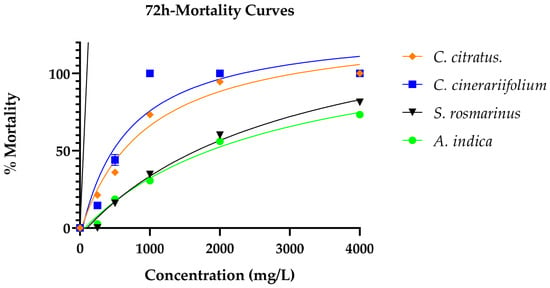
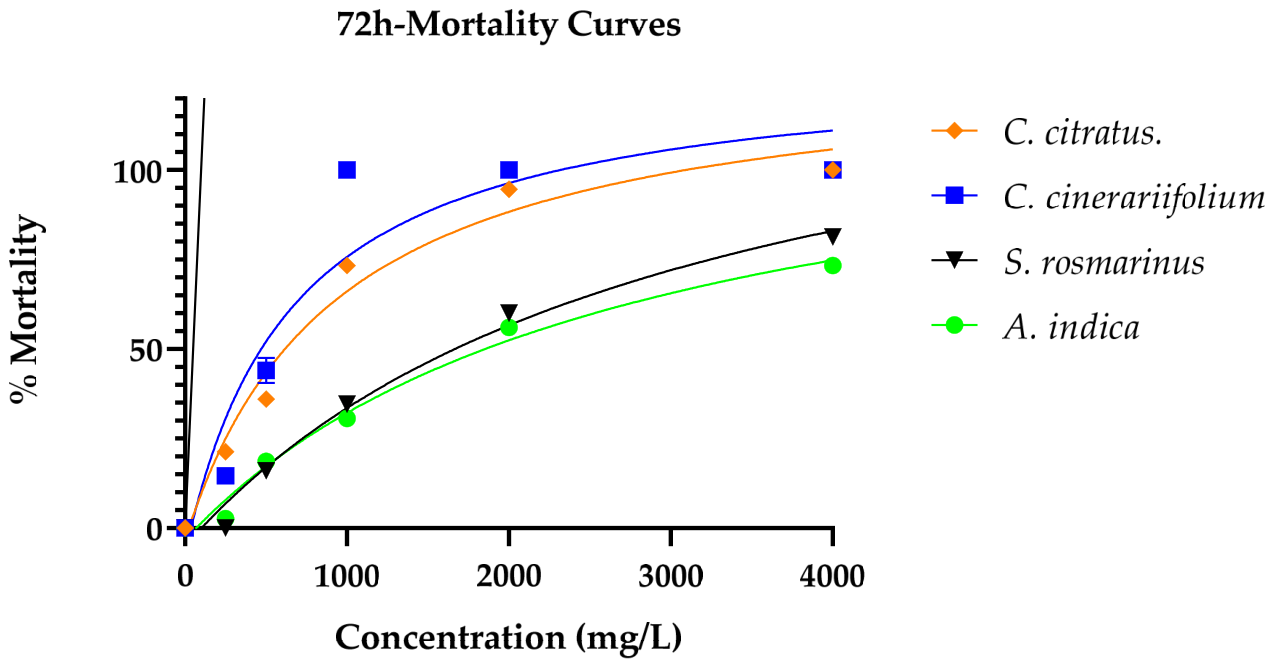
The larvicidal activities of essential oils obtained from C. citratus, T. cinerariifolium and S. rosmarinus were assessed against An. arabiensis larvae under controlled laboratory conditions. The results, summarized in Table 1 and Figure 1, were compared with those of A. indica, a well-established botanical insecticide used as a positive control [10]. The bioassay was conducted at multiple concentrations to investigate concentration-dependent larvicidal effects, and mortality rates were assessed over a 72-h exposure period. Essential oils from all the plant species exhibited concentration-dependent larvicidal activity against An. arabiensis larvae. Mortality increased progressively with increasing concentration and exposure duration, with T. cinerariifolium and C. citratus showing the greatest efficacy, achieving complete larval mortality at 2000–4000 mg/L and 4000 mg/L, respectively, after 72 h of exposure. Based on the LC50 values, T. cinerariifolium (511.0 mg/L; 95% confidence interval (CI): 473.3–547.1 mg/L) and C. citratus (602.7 mg/L; 95% CI: 559.3–648.5 mg/L) exhibited the highest larvicidal activity against An. arabiensis larvae, with T. cinerariifolium showing greater potency than C. citratus.
Table 1.
Mean percent larval mortality rate of An. arabiensis following 72 h exposure to essential oils from C. citratus, T. cinerariifolium and S. rosmarinus.
Figure 1.
Nonlinear concentration–response curves of the tested essential oils and Azadirachta indica against An. arabiensis larvae after 72 h of exposure.
As shown in Table 2 and Figure 1, both T. cinerariifolium and C. citratus exhibited significantly greater larvicidal activity against An. arabiensis larvae than the positive control (A. indica) at most concentrations tested (p < 0.05), corroborating their lower LC50 values of 511.0 mg/L and 602.7 mg/L, respectively. In contrast, the activity of S. rosmarinus was generally comparable to that of A. indica, with no significant differences observed at most concentrations (p > 0.05). Direct comparison between T. cinerariifolium and C. citratus revealed significantly higher activity for T. cinerariifolium at 250, 1000, and 2000 mg/L, whereas no significant difference was detected at 500 mg/L. In addition, both essential oils achieved complete larval mortality at 4000 mg/L. These findings indicate that the essential oils of T. cinerariifolium and C. citratus exhibited the greatest larvicidal efficacy among the tested treatments and showed higher potency than the positive control, A. indica. The lower LC50 value of T. cinerariifolium indicates greater potency than C. citratus, suggesting that the former may be particularly promising for further investigation as a botanical larvicide. The strong concentration-dependent activity observed for both oils, together with their relatively low LC50 values, highlights their potential for mosquito larval control.
Table 2.
ANOVA results on the mortality of An. arabiensis mosquito larvae treated with various concentrations of C. citratus, T. cinerariifolium, S. rosmarinus and A. indica oils after 72 h exposure.
To further characterize the concentration–mortality relationships, nonlinear concentration–response regression was performed to estimate the 72-h LC50 values and assess the goodness of fit of the fitted models. The nonlinear concentration–response analysis showed a strong fit for all treatments, with R2 values ranging from 0.9845 to 0.9905 (Table 1). These high coefficients of determination indicate that the fitted concentration–mortality models explained approximately 98.45–99.05% of the variation in larval mortality, supporting the reliability of the estimated concentration–response relationships. The highest goodness of fit was observed for S. rosmarinus (R2 = 0.9905), followed by C. citratus (R2 = 0.9897), A. indica (R2 = 0.9887) and T. cinerariifolium (R2 = 0.9845). Although the R2 value for T. cinerariifolium was comparatively lower, it still indicated an excellent fit, demonstrating that concentration was strongly associated with larval mortality. The Hill slope values ranged from 1.33 to 3.80 indicating differences in the steepness of the concentration–response relationships among the treatments. T. cinerariifolium exhibited the highest Hill slope (3.80), indicating a particularly steep response around its LC50. Thus, relatively small changes in concentration around the LC50 were associated with pronounced changes in mortality. This steep response is consistent with the rapid increase in mortality observed between 500 and 1000 mg/L, where mortality increased from 44% to 100% at 72 h. C. citratus also showed a relatively steep concentration–response relationship (Hill slope = 1.96), although less pronounced than that of T. cinerariifolium. In contrast, S. rosmarinus (1.59) and A. indica (1.33) exhibited lower Hill slopes, indicating more gradual changes in mortality with increasing concentration. Importantly, the Hill slope reflects the steepness of the concentration–response curve rather than overall larvicidal potency; potency is more appropriately interpreted from the LC50 values. Overall, the combination of high R2 values and biologically interpretable Hill slopes supports the adequacy of the nonlinear regression models for describing the concentration-dependent larvicidal effects.
The larvicidal activity observed in the present study is consistent with previous reports demonstrating the larvicidal potential of these essential oils against diverse mosquito species. C. citratus essential oil has shown pronounced larvicidal activity against several Anopheles species, including An. sinensis, An. gambiae and An. funestus, as well as Aedes species [14,15,16,17,18]. Similarly, S. rosmarinus essential oil has demonstrated activity against Ae. aegypti and Ae. albopictus [19]. T. cinerariifolium has a well-established insecticidal history against mosquitoes through its pyrethrin constituents, but relatively little information is available specifically on its chemically characterized essential oil against Anopheles larvae [20,21,22]. In their mechanisms of action, constituents of C. citratus essential oil have been associated with inhibition of acetylcholinesterase activity while S. rosmarinus essential oil with acetylcholinesterase and α-amylase activities [14,19]. These findings, together with the activity observed against An. arabiensis in the present study, suggest that the tested essential oils possess broad-spectrum mosquitocidal potential. Differences in activity among studies may reflect variations in mosquito species and larval susceptibility, developmental stage, plant material, essential-oil composition, exposure duration and assay conditions.
2.2. Chemical Composition of the Essential Oils
GC–MS analysis of the essential oil extracted from C. citratus resulted in the identification of 50 constituents. The distribution of these compounds according to their chemical classes is summarized in Table 3. The essential oil was predominantly composed of oxygenated monoterpenes (68.56%), with geranial (28.00%), neral (19.01%), 1,8-Cineole (eucalyptol) (11.76%) and verbenone (2.60%) identified as the major constituents. The predominance of the citral isomers, geranial and neral, which together accounted for 47.01% of the total oil composition, indicates a citral-rich chemotype characteristic of C. citratus essential oil [23]. Citral, a mixture of the geometric isomers geranial (trans-citral) and neral (cis-citral), is widely recognized as the principal bioactive constituent of lemongrass oil and is largely responsible for its characteristic lemon aroma and diverse biological activities. The high abundance of these compounds in the present study is consistent with previous reports identifying citral as the dominant constituent of C. citratus essential oil [24]. Monoterpene hydrocarbons represented the second largest chemical class (18.81%), predominantly comprising α-pinene, limonene, camphene, and myrcene. Oxygenated sesquiterpenes occurred only in trace amounts (0.90%), and no phenylpropanoid constituents were detected. The proposed constituents were assigned using an integrated assessment of GC–MS spectral matches, similarity index (SI) scores, and retention indices (RI). Most experimental RIs closely matched the reported literature values, including 1,8-cineole (1032 vs. 1032), α-pinene (933 vs. 933), limonene (1029 vs. 1030), and caryophyllene oxide (1581 vs. 1587), providing additional confidence in the compound identifications [25,26].
Table 3.
Chemical class composition of C. citratus essential oils identified by GC–MS Analysis.
GC–MS analysis of the essential oil from T. cinerariifolium resulted in the identification of 66 constituents and their classification into various chemical classes presented in Table 4. The oil was predominantly composed of sesquiterpene hydrocarbons (79.0%), with γ-muurolene (30.98%), β-farnesene (27.73%), α-farnesene (4.42%), bicyclogermacrene (3.52%), and δ-cadinene (2.78%) identified as the major constituents. This chemical profile is consistent with previously reported constituents of pyrethrum (T. cinerariifolium) essential oil, which is typically dominated by sesquiterpene hydrocarbons [27,28]. Oxygenated sesquiterpenes constituted the second most abundant class (approximately 12.7%), represented mainly by nerolidol (3.40%), sesquilavandulol (2.09%), cadin-4-en-10-ol (1.03%), and T-muurolol (0.98%). Monoterpenes were present only in trace amounts, with oxygenated monoterpenes and monoterpene hydrocarbons accounting for 0.76% and 0.07% of the total oil composition, respectively. Experimental retention indices were interpreted alongside GC–MS assignments and spectral similarity scores to strengthen compound identification. The experimental RIs generally showed close agreement with literature values, including β-farnesene (1452 vs. 1452), γ-muurolene (1481 vs. 1478), α-farnesene (1502 vs. 1504) and isogermacrene D (1444 vs. 1447) among others, supporting the proposed identifications based on the combined GC–MS, SI, and RI evidence [25,26].
Table 4.
Chemical class composition of T. cinerariifolium essential oils identified by GC–MS Analysis.
GC–MS analysis of the essential oil extracted from S. rosmarinus resulted in the identification of 57 constituents. The GC–MS data presented in Table 5, revealed that oxygenated monoterpenes constituted the predominant fraction of the S. rosmarinus essential oil, accounting for 56.5% of the total composition, followed by monoterpene hydrocarbons (33.0%). Sesquiterpenes (0.82%) and phenylpropanoids (0.45%) were present in relatively low proportions, while other compounds and unidentified constituents comprised 9.2% of the oil. This distribution highlights the predominance of monoterpenoid compounds, a characteristic feature of rosemary essential oils, and is indicative of a verbenone-rich chemotype [29]. The major constituents contributing to these chemical classes were α-pinene (21.96%), eucalyptol (1,8-cineole) (20.04%), verbenone (13.42%), geraniol (5.60%), borneol (4.94%) and camphor (3.14%). The dominant constituents and the overall predominance of monoterpenes are consistent with the characteristic chemical profile of S. rosmarinus essential oil. Although the oil exhibited a comparatively high verbenone content and a relatively low levels of camphor, such variations fall within the range of natural chemical diversity reported among rosemary populations [30]. Differences in the relative abundance of these constituents have been attributed to factors such as genotype, geographical origin, environmental conditions, developmental stage, and harvesting season, highlighting the considerable chemotypic variability that exists within the species [31]. The proposed constituents were supported by the combined GC–MS, SI, and RI evidence, with close experimental and literature RI values agreement for major compounds such as 1,8-cineole (1031 vs. 1032), α-pinene (933 vs. 933), and verbenone (1206 vs. 1208).
Table 5.
Chemical class composition of S. rosmarinus essential oils identified by GC–MS Analysis.
2.3. Molecular Docking Studies
To elucidate the molecular mechanisms underlying the observed larvicidal activity, molecular docking studies were employed to evaluate the binding interactions of the essential oil’s major constituents with two critical mosquito larval targets: juvenile hormone-binding protein (JHBP) and sterol carrier protein-2 (SCP-2). These proteins were selected due to their indispensable roles in larval survival and development. Specifically, JHBP is responsible for the hemolymph transport of juvenile hormone, a vital regulator of insect growth and metamorphosis [12,32] and SCP-2 mediates intracellular lipid trafficking, which is essential for energy storage and membrane synthesis in rapidly developing larvae [13]. Consequently, disruption of these molecular targets by bioactive essential oil constituents may interfere with endocrine regulation, lipid metabolism, and cellular signaling pathways, ultimately leading to impaired larval development and mortality. The molecular docking approach therefore provided valuable insights into the potential modes of action through which the essential oil exerts its larvicidal effects.
2.3.1. Juvenile Hormone Binding Protein (PDB ID: 5V13)
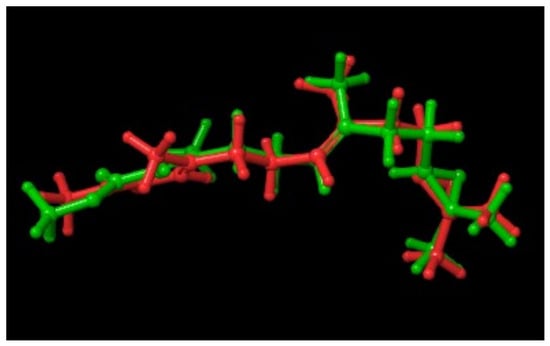
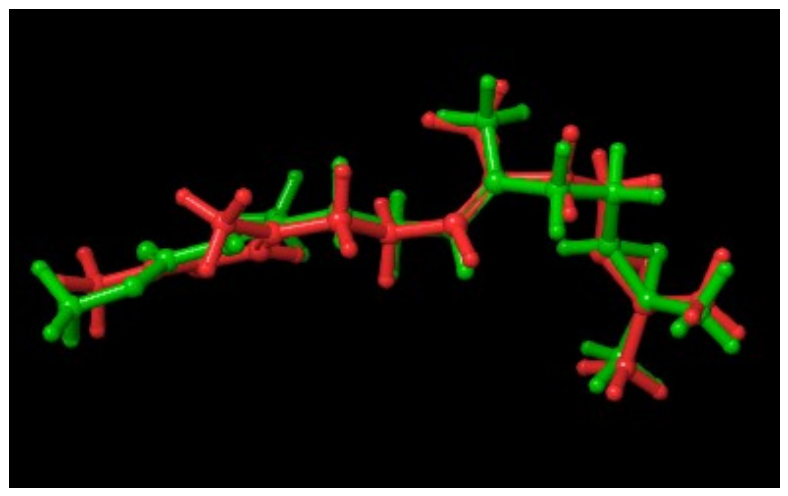
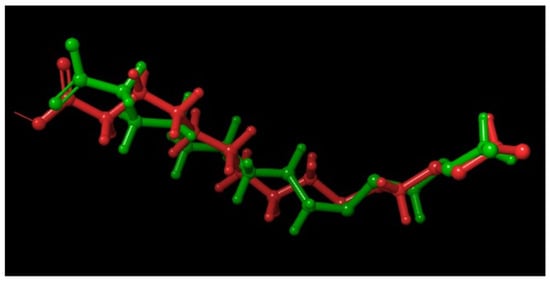
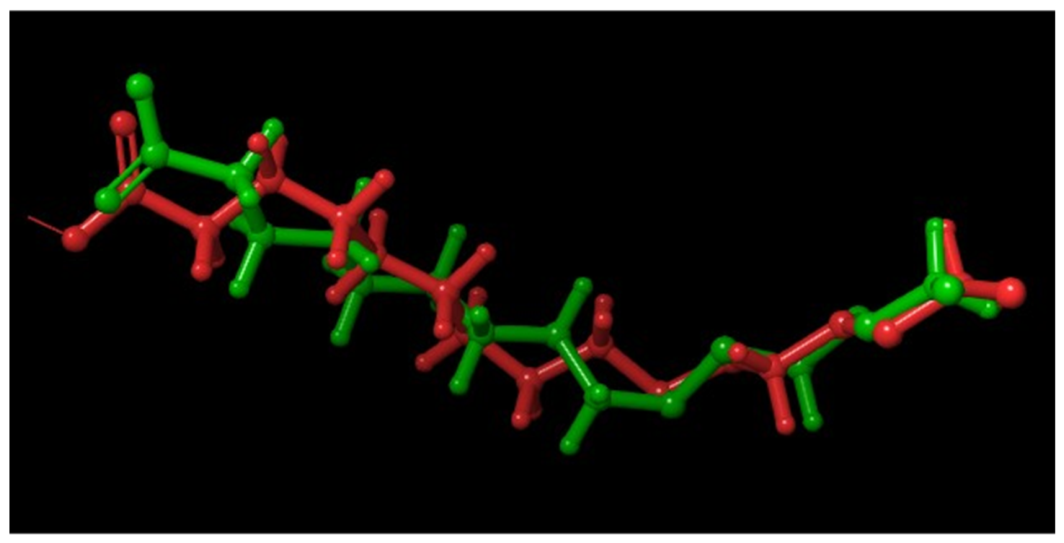
Following protein preparation, the receptor grid for PDB ID: 5V13 was generated by centering the grid box on the co-crystallized ligand, yielding grid coordinates of x = 252.28, y = 8.95, and z = 352.45. The docking protocol was validated by re-docking the co-crystallized ligand into the active site of the target protein. As shown in Figure 2, the superimposition of the co-crystallized and re-docked ligand poses yielded a root-mean-square deviation (RMSD) of 2.1 Å, indicating close agreement between the experimental and predicted binding poses [33]. Although the RMSD was marginally above the commonly applied 2.0 Å criterion, the observed structural agreement provided supportive evidence for the applicability of the docking protocol to subsequent screening of ligands against JHBP, while recognizing the limitation of the redocking validation. A total of 101 compounds identified by GC–MS were initially screened against the mosquito juvenile hormone-binding protein (JHBP; PDB ID: 5V13) using HTVS, resulting in the selection of 88 promising lead compounds. These leads were subsequently evaluated using the Glide Standard Precision (SP) docking protocol, followed by Extra Precision (XP) docking to improve the accuracy and selectivity of binding pose prediction. This hierarchical virtual screening workflow identified the 15 highest-ranked candidate compounds, whose docking scores and MM-GBSA binding free energy values are presented in Table 6. The top-ranked phytochemicals exhibited docking scores ranging from −8.261 to −9.482 kcal/mol, indicating favorable binding affinities toward JHBP. Although none of the compounds surpassed the co-crystallized ligand (docking score = −9.985 kcal/mol; ΔG_bind = −78.10 kcal/mol), several displayed comparable binding affinities, suggesting their potential to bind within the JHBP ligand-binding pocket and potentially interfere with juvenile hormone transport.
Figure 2.
Superposition of the 5V13 co-crystallized ligand and redocked ligand within the binding site. The co-crystallized ligand is shown in green, while the redocked ligand is shown in red.
Table 6.
Docking scores and MM-GBSA binding free energy results for the top 15 candidate compounds and the co-crystalized ligand, on Mosquito Juvenile Hormone-binding protein.
Among the screened phytochemicals, 1,10-di-epi-cubenol, a sesquiterpene alcohol identified in C. citratus, exhibited the most favorable docking score (−9.482 kcal/mol). The other the remaining top-ranked compounds, including farnesol (−8.840 kcal/mol), α-zingiberene, (E)-α-bisabolene and β-bisabolene, were identified in T. cinerariifolium. Despite ranking third based on docking score, farnesol exhibited the most favorable MM-GBSA binding free energy (ΔG_bind = −69.29 kcal/mol), approaching that of the co-crystallized ligand (−78.10 kcal/mol), suggesting the formation of a highly stable protein–ligand complex. Similarly, nerolidol (−55.02 kcal/mol), α-zingiberene (−52.87 kcal/mol), (E)-α-bisabolene (−44.17 kcal/mol) and β-bisabolene (−42.14 kcal/mol) also exhibited favorable binding free energies, indicating stable interactions with JHBP. In contrast, α-muurolol (ΔG_bind = 6.33 kcal/mol) and globulol (ΔG_bind = −7.89 kcal/mol) exhibited relatively weak binding free energies despite their favorable docking scores, highlighting the importance of MM-GBSA analysis in refining docking predictions by providing a more realistic estimate of ligand–protein binding stability. Collectively, these findings identify 1,10-di-epi-cubenol from C. citratus and farnesol, nerolidol, α-zingiberene and (E)-α-bisabolene from T. cinerariifolium as the most promising phytochemical candidates for targeting mosquito juvenile hormone-binding protein.
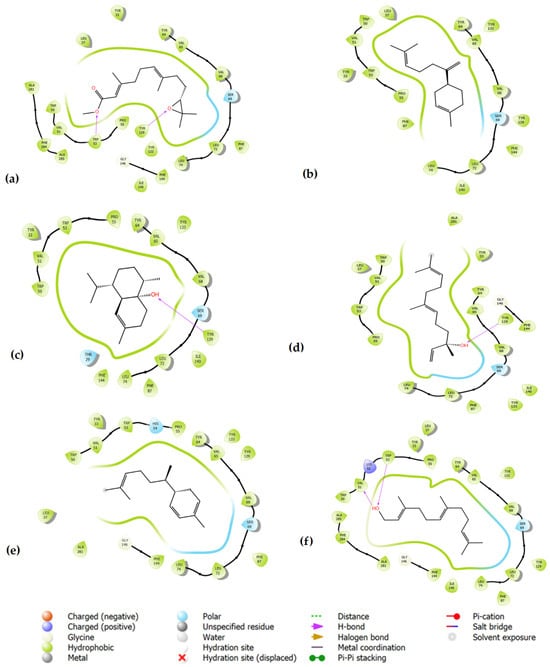
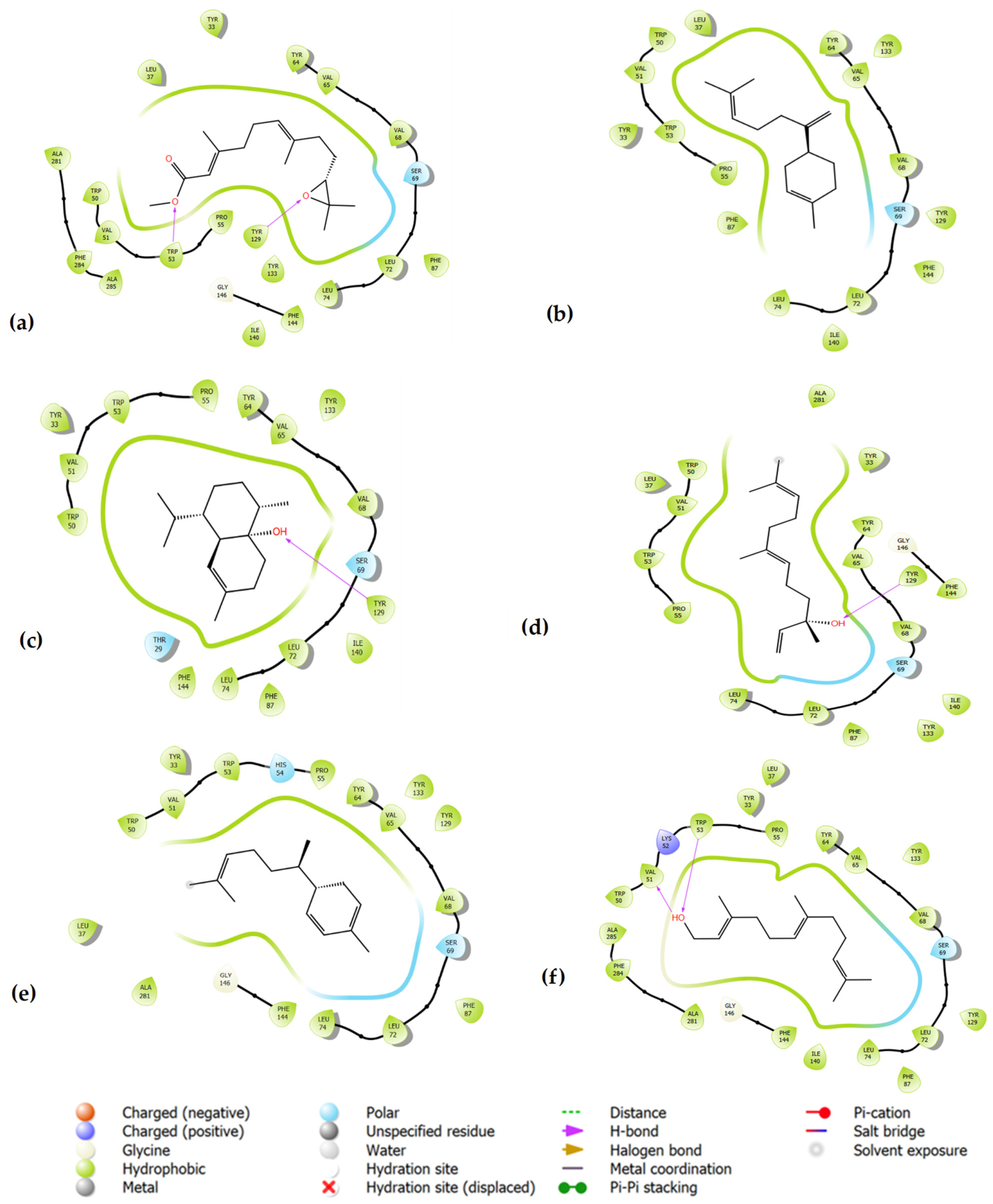
Two-dimensional (2D) interaction analysis of the top-ranked phytochemicals and the co-crystallized ligand within the juvenile hormone-binding protein (JHBP) binding pocket revealed a highly conserved binding mode characterized predominantly by hydrophobic interactions (Figure 3), consistent with the hydrophobic ligand-binding cavity reported for insect JHBP, which facilitates the binding and transport of the lipophilic juvenile hormone [34]. The co-crystallized ligand was stabilized by extensive hydrophobic contacts with TRP50, VAL51, TRP53, PRO55, TYR64, VAL65, VAL68, LEU72, LEU74, PHE87 TYR129, TYR133, PHE144, and ILE140, together with hydrogen bonds involving TRP53 and TYR129. Similarly, the top-ranked phytochemicals occupied the same hydrophobic cavity and shared many of these key interacting residues, suggesting a common binding mechanism. β-Bisabolene and α-zingiberene, which are non-polar sesquiterpene hydrocarbons, interacted almost exclusively through hydrophobic contacts. In contrast, the hydroxyl-containing sesquiterpenes formed additional hydrogen-bonding interactions while maintaining extensive hydrophobic contacts with surrounding residues. Specifically, 1,10-di-epi-cubenol formed a hydrogen bond with TRP50, nerolidol with TYR129 and farnesol formed hydrogen bonds with TRP53 and VAL51. The combination of hydrogen bonding and hydrophobic contacts likely contributes to the enhanced binding stability observed for these oxygenated compounds, particularly farnesol, which exhibited the most favorable MM-GBSA binding free energy [35,36]. The recurrence of residues TRP50, TRP53, VAL51, VAL65, VAL68, LEU72, LEU74, TYR64, TYR129, TYR133, PHE87 and PHE144 across the interaction profiles highlights their critical role in ligand recognition and stabilization within the JHBP binding pocket. Collectively, these findings indicate that the identified phytochemicals mimic the binding mode of the native ligand and support their potential to competitively occupy the juvenile hormone-binding cavity, thereby potentially disrupting juvenile hormone transport and mosquito larval development.
Figure 3.
Two-dimensional (2D) visualization of protein–ligand interactions for top-ranked compounds and co-crystalized ligand within the 5V13 binding pocket: (a) co-crystalized ligand, (b) β-bisabolene, (c) 1,10-di-epi-cubenol, (d) nerolidol, (e) α-zingiberene and (f) farnesol.
2.3.2. Sterol Carrier Protein-2 (PDB ID:1PZ4)
Following the target protein preparation, the generated grid box coordinates for PDB ID 1PZ4 were x = 24.65, y = 29.57, z = 55.94. Re-docking of the co-crystallized ligand into the receptor grid-defined active site demonstrated a close agreement between the experimental crystallographic pose and the predicted binding conformation, yielding a root-mean-square deviation (RMSD) of 1.846 Å (Figure 4). This RMSD value falls below the widely accepted validation threshold of 2.0 Å, indicating that the docking protocol accurately reproduced the native binding mode and is therefore reliable for predicting ligand binding within the sterol carrier protein-2 (SCP-2) active site. A total of 101 GC–MS-identified compounds were screened against sterol carrier protein-2 (SCP-2) using a hierarchical molecular docking workflow comprising High-Throughput Virtual Screening (HTVS), which identified 78 promising lead compounds. These lead compounds were subsequently evaluated using Glide Standard Precision (SP) docking, followed by Extra Precision (XP) docking to improve the accuracy and selectivity of binding pose prediction. The 15 highest-ranked compounds, together with the co-crystallized ligand, are presented in Table 7. The selected phytochemicals exhibited docking scores ranging from −7.338 to −10.091 kcal/mol, indicating favorable binding affinities toward the SCP-2 binding pocket. Notably, (5Z,9Z)-farnesyl acetone, a sesquiterpene constituent of T. cinerariifolium, achieved the most favorable docking score (−10.091 kcal/mol), followed by β-bisabolene and the co-crystallized ligand (−8.285 kcal/mol). These results indicate that (5Z,9Z)-farnesyl acetone and the other top phytochemicals exhibit favorable predicted binding interaction with the SCP-2 active site and highlights their potential as a promising inhibitor of the target protein.
Figure 4.
Superposition of the 1PZ4 co-crystallized ligand and redocked ligand within the binding site. The co-crystallized ligand is shown in green, while the redocked ligand is shown in red.
Table 7.
Docking scores and MM-GBSA binding free energy results for the top 15 candidate compounds and the co-crystalized ligand, on Sterol Carrier Protein-2.
As previously noted, (5Z,9Z)-farnesyl acetone exhibited the most favorable docking score (−10.091 kcal/mol), followed by the co-crystallized ligand (−8.285 kcal/mol), and was associated with a favorable MM-GBSA binding free energy (ΔG_bind = −70.23 kcal/mol), suggesting a stable predicted interaction with the SCP-2 binding site. Although the co-crystallized ligand exhibited the lowest binding free energy (ΔG_bind = −79.03 kcal/mol), tridecyl methyl ketone (docking score = −8.018 kcal/mol; ΔG_bind = −72.93 kcal/mol) and farnesol (−7.860 kcal/mol; ΔG_bind = −65.47 kcal/mol) also demonstrated favorable predicted binding. Similarly, β-bisabolene (−8.375 kcal/mol; ΔG_bind = −52.37 kcal/mol), α-zingiberene (−8.166 kcal/mol; ΔG_bind = −51.64 kcal/mol) and sesquilavandulol (−7.722 kcal/mol; ΔG_bind = −54.51 kcal/mol) displayed favorable docking scores that were generally supported by their MM-GBSA binding free energies, whereas α-copaene, cyclosativene, isogermacrene D and δ-elemene exhibited comparatively weak MM-GBSA binding free energies despite favorable docking scores. Collectively, these findings illustrate the complementary value of MM-GBSA calculations in refining docking-based predictions by providing additional insight into the relative stability of predicted protein–ligand complexes [36]. Collectively, the combined docking and MM-GBSA analyses identify (5Z,9Z)-farnesyl acetone, tridecyl methyl ketone, farnesol, β-bisabolene, α-zingiberene and sesquilavandulol as the most promising phytochemical candidates for targeting mosquito sterol carrier protein-2, supporting their potential to disrupt sterol transport and lipid metabolism essential for mosquito growth and development.
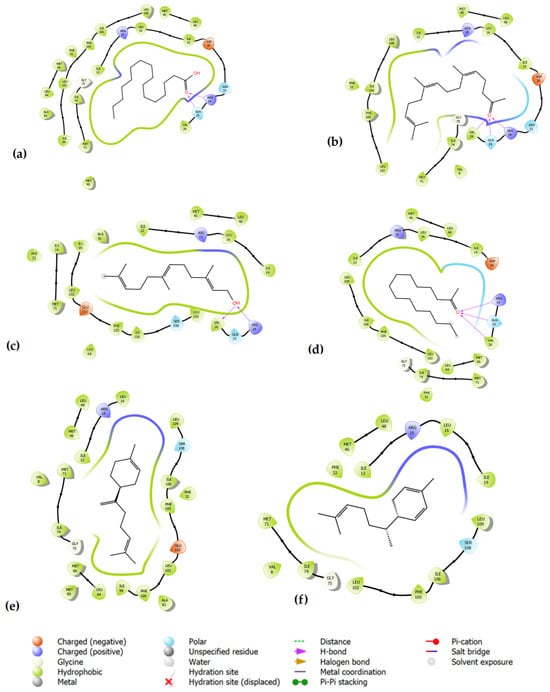
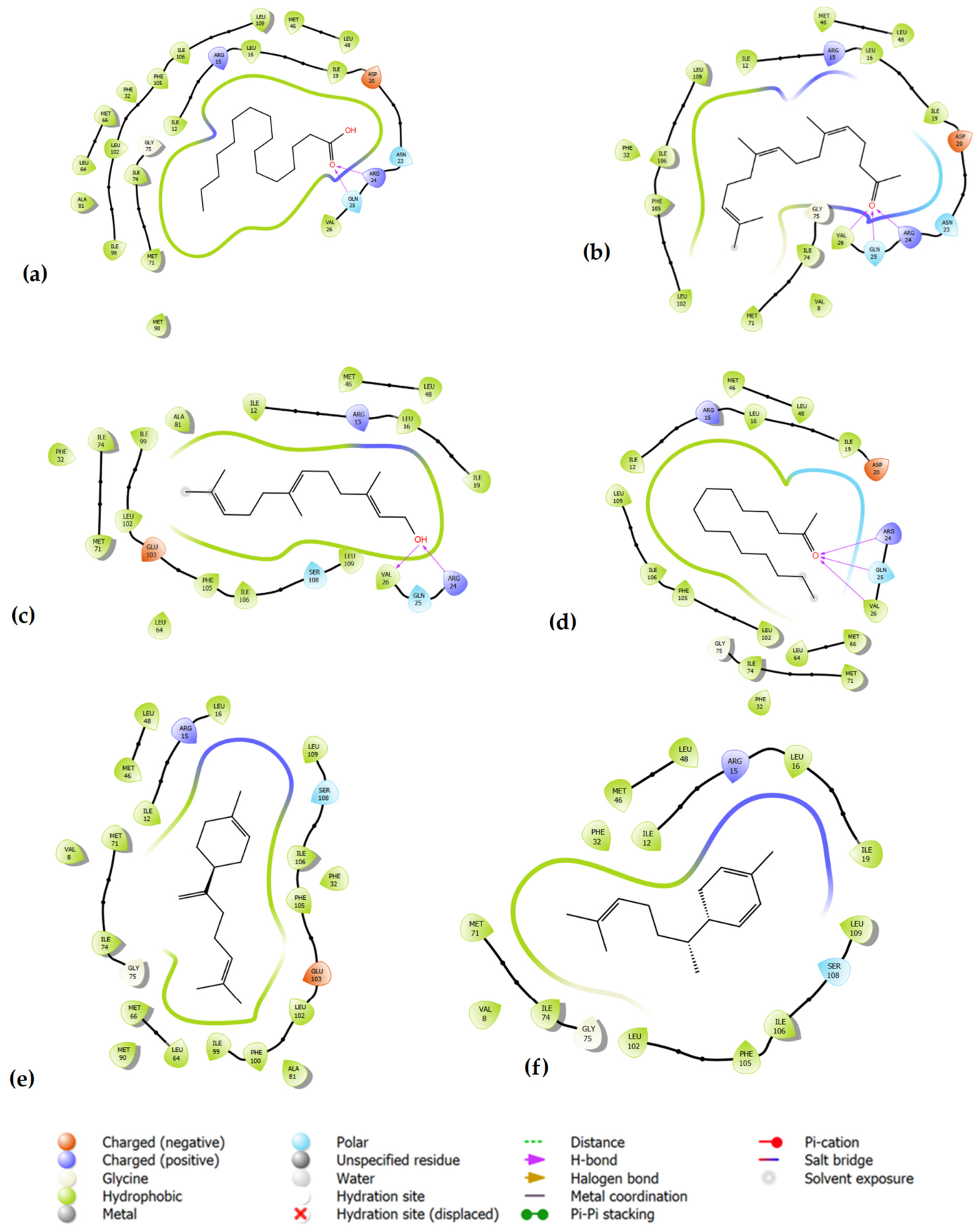
Two-dimensional (2D) interaction analysis within the sterol carrier protein-2 pocket (Figure 5) revealed that the top-ranked phytochemicals occupied the same binding cavity as the co-crystallized ligand within SCP-2 and were stabilized predominantly by hydrophobic interactions, reflecting the lipophilic nature of the sterol-binding pocket [37]. The co-crystallized ligand formed hydrogen bonds with ARG24 and GLN25, together with hydrophobic contacts involving LEU16, ILE19, LEU48, LEU64, MET46, MET66, MET71, ILE74, ALA81, ILE99, LEU102, PHE105, ILE106 and LEU109. A similar binding mode was observed for (5Z,9Z)-farnesyl acetone, tridecyl methyl ketone and farnesol, which each formed hydrogen bonds with ARG24 and GLN25 in addition to extensive hydrophobic interactions. These interaction profiles are consistent with their favorable MM-GBSA binding free energies, particularly for (5Z,9Z)-farnesyl acetone (−70.23 kcal/mol), tridecyl methyl ketone (−72.93 kcal/mol) and farnesol (−65.47 kcal/mol.). In contrast, the hydrocarbon sesquiterpenes β-bisabolene and α-zingiberene, which lack polar functional groups, interacted almost exclusively through hydrophobic contacts with residues including LEU16, LEU48, MET46, MET66, MET71, ILE74, LEU64, ILE99, LEU102, PHE105, ILE106 and LEU109, reflecting the predominantly hydrophobic nature of the SCP-2 binding pocket. Collectively, these findings indicate that the identified phytochemicals mimic the binding mode of the co-crystallized ligand, with hydrophobic interactions serving as the principal driving force for binding and hydrogen bonds providing additional stabilization for oxygenated compounds [35]. This interaction pattern supports the potential of these phytochemicals to competitively occupy the SCP-2 sterol-binding cavity and interfere with sterol transport, a process that is essential for mosquito growth, development, and survival.
Figure 5.
Two-dimensional (2D) visualization of protein–ligand interactions for top-ranked compounds and co-crystalized ligand within the 1PZ4 binding pocket: (a) co-crystalized ligand, (b) (5Z,9Z)-farnesyl acetone, (c) farnesol, (d) tridecyl methyl ketone, (e) β-bisabolene and (f) α-Zingiberene.
The molecular docking analyses demonstrated that the phytochemicals identified from C. citratus, T. cinerariifolium and S. rosmarinus exhibited favorable binding affinities toward both juvenile hormone-binding protein (JHBP) and sterol carrier protein-2 (SCP-2), suggesting that these compounds may contribute to larvicidal activity through a multitarget mechanism. Several phytochemicals displayed favorable interactions with both proteins, although variations in docking scores and MM-GBSA binding free energies indicate differing degrees of target preference and binding stability. Notably, the majority of the top-ranked compounds were identified in the essential oil of T. cinerariifolium, suggesting that its sesquiterpene-rich phytochemical profile may have contributed to its superior larvicidal activity. Only a few high-ranking compounds originated from the other essential oils, including 1,10-di-epi-cubenol, tridecyl methyl ketone and geranic acid from C. citratus and thymol, p-cymene and carvone from S. rosmarinus. The predominance of T. cinerariifolium-derived phytochemicals among the highest-ranked ligands is consistent with its superior larvicidal activity observed in the bioassays, suggesting that its sesquiterpene-rich composition may underpin its enhanced inhibitory potential against multiple mosquito molecular targets.
Although the highest-ranked docking candidates were not always the most abundant constituents, analysis of the major phytochemicals identified by GC–MS provides additional insight into the larvicidal potential of each essential oil (Table 8). In C. citratus, the predominant constituents geranial (28.00%), neral (19.01%), α-pinene (11.83%) and 1,8-Cineole (11.76%) all exhibited moderate binding affinities toward both juvenile hormone-binding protein (JHBP) and sterol carrier protein-2 (SCP-2) (Table 7). Likewise, the sesquiterpene-rich essential oil of T. cinerariifolium was dominated by γ-muurolene (30.98%) and β-farnesene (27.73%). Of these, γ-muurolene displayed relatively strong binding to JHBP (−8.169 kcal/mol) and SCP-2 (−7.218 kcal/mol), whereas β-farnesene exhibited only moderate binding despite its high abundance. In S. rosmarinus, the major constituents α-pinene (21.96%), verbenone (13.42%), geraniol (5.60%), and borneol (4.94%) also showed moderate docking scores with both JHBP and SCP-2. Overall, these findings demonstrate that favorable protein–ligand interactions were not restricted to the most abundant constituents but were distributed among both major and minor phytochemicals. This observation suggests that the larvicidal potential of the investigated essential oils is influenced by their overall phytochemical composition rather than by the abundance of a single dominant constituent, providing a mechanistic basis for the differences in larvicidal activity observed among the three essential oils [38,39].
Table 8.
Relative abundance and molecular docking scores of the major phytochemical constituents identified by GC–MS from the essential oils of C. citratus, T. cinerariifolium, and S. rosmarinus against JHBP (5V13) and SCP-2 (1PZ4).
Hierarchical virtual screening revealed that a remarkably high proportion of the GC–MS-identified phytochemicals exhibited favorable affinity toward the selected mosquito targets. Of the 101 compounds screened, 88 (87.13%) and 78 (77.23%) progressed beyond HTVS against juvenile hormone-binding protein (JHBP) and sterol carrier protein-2 (SCP-2), respectively, indicating that most constituents possess the structural features required for productive interactions with these proteins. This widespread target recognition suggests that the larvicidal activity of the investigated essential oils is unlikely to be mediated by a single dominant constituent, but rather by the collective action of multiple phytochemicals with varying binding affinities and target preferences. Such a multitarget mode of action is characteristic of essential oils, whose biological activities arise from the additive or synergistic interactions of numerous constituents rather than from individual compounds acting alone [38,39]. The ability of a large proportion of the identified phytochemicals to interact with two distinct proteins involved in juvenile hormone transport and sterol metabolism further supports the hypothesis that these essential oils interfere with complementary physiological pathways essential for mosquito growth and development. This broad spectrum of molecular interactions may contribute to the superior larvicidal activity observed for T. cinerariifolium and C. citratus, while also reducing the likelihood of resistance development compared with single-target insecticides [40].
Farnesol, β-bisabolene, α-zingiberene, and sesquilavandulol consistently ranked among the highest-scoring compounds against both JHBP and SCP-2. In particular, farnesol achieved docking scores of −8.840 and −7.860 kcal/mol, with corresponding MM-GBSA binding free energies of −69.29 and −65.47 kcal/mol against JHBP and SCP-2, respectively. Two-dimensional interaction analysis further revealed that farnesol formed hydrogen bonds and extensive hydrophobic interactions within both binding pockets, contributing to the stability of the protein–ligand complexes. Its ability to interact strongly with two proteins involved in juvenile hormone transport and sterol homeostasis suggests a multitarget mode of action that could simultaneously disrupt complementary physiological pathways essential for mosquito larval development. Such multitarget activity is particularly advantageous in botanical insecticides, where the combined action of compounds against complementary biological pathways may enhance efficacy while reducing the likelihood of resistance development compared with single-target insecticides [40,41]. Given its consistent performance across both targets and its favorable binding energies, farnesol represents one of the most promising lead phytochemicals for further investigation as a mosquito larvicidal agent.
2.4. Insecticide-Likeness
Evaluation of the physicochemical properties of the lead phytochemicals according to Tice’s insecticide-likeness criteria demonstrated that all four compounds, farnesol, β-bisabolene, α-zingiberene, and sesquilavandulol, satisfied the recommended thresholds without any rule violations, indicating favorable characteristics for insecticidal activity (Table 9). All compounds possessed relatively low molecular weights (204.19–222.20 g/mol), which are advantageous for diffusion through the insect cuticle and access to intracellular targets [32,42]. Likewise, their lipophilicity (logP = 4.42–5.21) fell within the acceptable range, suggesting an appropriate balance between membrane permeability and aqueous solubility. Farnesol and sesquilavandulol each contained one hydrogen bond donor and one hydrogen bond acceptor, with moderate topological polar surface areas (20.23 Å2), potentially enabling additional hydrogen-bonding interactions with target proteins while maintaining good permeability [42]. In contrast, the hydrocarbon sesquiterpenes β-bisabolene and α-zingiberene lacked hydrogen-bonding functionalities (TPSA = 0 Å2) but retained favorable insecticide-likeness owing to their hydrophobic nature, which may facilitate penetration through the lipid-rich insect cuticle. Collectively, these results indicate that the identified lead compounds possess physicochemical properties consistent with those of successful insecticidal molecules, supporting their potential for further development as botanical larvicidal agents. Their favorable insecticide-likeness, together with their strong docking affinities and binding stability, further reinforces their suitability as multitarget inhibitors of mosquito proteins.
Table 9.
Physicochemical properties and insecticide-likeness assessment of the lead phytochemicals based on Tice’s insecticide-likeness criteria.
3. Materials and Methods
3.1. Reagents and Materials
All reagents and solvents used were of analytical grade obtained from Sigma-Aldrich. Petroleum ether was of b.p. 40–60 °C range, and diethyl ether was peroxide-free. An. arabiensis mosquito colonies were obtained from Kenya Medical Research Institute (KEMRI) and their larvae were reared at the University of Nairobi Insectary. C. citratus and S. rosmarinus samples were obtained from Tharaka Nithi County, Kenya whereas T. cinerariifolium samples were obtained from the neighboring Meru County. A. indica seeds were obtained from Tharaka University’s main campus grounds. The leaf samples were identified by a taxonomist from the National Museums of Kenya, and a voucher specimen was deposited in the Tharaka University Herbarium.
3.2. Sample Preparation and Extraction
Essential oils were extracted from the plant samples by hydrodistillation at 40–60 °C for 2–3 h. The extraction procedure was repeated three times per batch to ensure adequate oil recovery. For A. indica oil, the lean, air-dried seeds were first dehulled and ground into powder. The powder was further air-dried between 40–50 °C to remove residual moisture prior to extraction. The sample was then subjected to solvent extraction by maceration. Briefly, the seed powder was soaked in petroleum ether at a solvent-to-sample ratio of 1:5 (w/v). The mixture was kept at room temperature for 24 h with intermittent shaking to enhance extraction efficiency. The extraction procedure was repeated thrice for the same sample. After exhaustive maceration, the mixture was filtered using Whatman No. 1 filter paper to remove solid residues. The filtrate was then concentrated under reduced pressure using a rotary evaporator at 40–50 °C to recover the solvent and obtain the crude fixed oil. The extracted oil was left to dry further in a fume chamber to remove residual solvent and stored in amber vials at 4 °C until analysis.
3.3. Larvicidal Assay
The larvicidal activity was tested based WHO guidelines for laboratory and field-testing of larvicides [43]. All the oil samples were tested at 4000, 2000, 1000, 500 and 250 mg/L to get the activity range. Briefly, batches of twenty-five third- and fourth-instar larvae were transferred into 100 mL beakers containing an appropriate concentration of the test solution and distilled water. A. indica (neem) seed oil was used as a positive control while ethanol in distilled water was used as a negative control. A. indica oil was used as the positive control owing to its well-documented larvicidal activity against mosquito vectors, including Anopheles species, and its widespread use as a reference botanical insecticide in larvicidal bioassays [44,45]. The experiment was conducted for 72 h period under optimal conditions (a temperature between 24–32 °C and 85% relative humidity) in the insectary. Each experiment was conducted in triplicate. The number of dead larvae was counted after a 24-, 48- and 72-h exposure and the mortality rate was calculated per the replicates.
3.4. GC-MS Analysis
Each essential oil sample was diluted to 0.2% (v/v) in 100% hexane and filtered through a 0.22 µm PTFE syringe filter into a clean autosampler vial prior to analysis. A 1 µL aliquot of each sample was injected into the GC–MS system. Compound separation was achieved using an SH-Rxi-5Sil MS capillary column (30 m × 0.25 mm i.d., 0.25 µm film thickness). Ultrapure helium served as the carrier gas at a flow rate of 0.7 mL/min. The injector temperature was maintained at 280 °C, and samples were introduced in split mode at a ratio of 10:1. The oven temperature program was set from 50 °C (0 min hold) to 330 °C at a rate of 3 °C/min, resulting in a total run time of 93 min. Mass spectra were acquired in full-scan mode over a mass range of 50–500 m/z, with a solvent cut time of 3.8 min. The ion source and interface temperatures were maintained at 200 °C and 250 °C, respectively. Identification of the eluted compounds was performed by comparing the acquired mass spectra with reference spectral data. For C. citratus, T. cinerariifolium, and S. rosmarinus, compound assignments were based on comparison with the FFNSC-3 (Flavors and Fragrances, Natural and Synthetic Compounds) library. Chemical constituents were assigned using an integrated assessment of GC–MS spectral matches, similarity index (SI) scores, and retention indices (RI). The complete GC–MS dataset for the three essential oils, including retention times, retention indices, similarity indices, relative abundances, and compound identifications, together with the corresponding total ion chromatograms (TICs), is provided in Supplementary Materials.
3.5. Molecular Docking Analyses
3.5.1. Target Protein Preparation
The three-dimensional crystal structures of: juvenile hormone-binding protein (pdb: 5V13) and sterol carrier protein-2 (pdb:1PZ4) were retrieved from the protein data bank (https://www.rcsb.org). Protein preparation step for each target was performed using the Protein Preparation Wizard module in the Schrödinger Suite (Release 2021-2). The retrieved structure was pre-processed by assigning proper bond orders, adding missing hydrogen atoms, and correcting incomplete side chains and missing residues. Missing loops and side chains were also reconstructed using the Prime module. Water molecules located beyond 5 Å from the co-crystallized ligand or not involved in critical bridging interactions were removed. The hydrogen-bonding network was subsequently optimized at physiological pH of 7.4 using the PROPKA empirical prediction algorithm. Finally, restrained energy minimization was carried out with an OPLS4 force field.
3.5.2. Receptor Grid Generation
Receptor grid generation was accomplished using the Receptor Grid Generation panel, with the binding site defined by co-crystallized ligand coordinates. The Grid boxes were centered on the identified binding sites with dimensions of 20 × 20 × 20 Å to accommodate ligand flexibility while maintaining computational efficiency. The Van der Waals scaling factors were set at 1.0 for receptor atoms and at 0.8 for ligand atoms to account for minor conformational adjustments during docking.
3.5.3. Ligand Preparation
Compounds identified through GC–MS analysis of the essential oils from each plant species were tabulated in Microsoft Excel, annotated with their corresponding Simplified Molecular Input Line Entry System (SMILES) strings, and exported as a CSV file for subsequent in silico analyses. The compounds together with the corresponding co-crystallized ligands of the respective protein targets were prepared using the LigPrep module of the Schrödinger Suite. Ionization states, protonation patterns, and tautomeric forms were generated at physiological conditions (pH = 7.4 ± 0.5) using Epik. Stereoisomer generation was permitted where applicable, yielding a total of 101 energetically minimized three-dimensional ligand conformations from the original candidate pool.
3.5.4. Ligand Docking
Initially, all the prepared 101 ligand conformations obtained after LigPrep processing were subjected to High-Throughput Virtual Screening (HTVS). Compounds that demonstrated favorable binding characteristics during the HTVS phase were subsequently advanced to Standard Precision (SP) docking, and later to Extra Precision (XP) docking. The co-crystallized ligand of each protein target was concurrently docked under the same XP docking conditions to serve as a benchmark for comparative binding assessment.
3.5.5. MM-GBSA Binding Free Energy Rescoring
To improve the accuracy of binding affinity prediction beyond docking scores alone, the top XP-docked protein–ligand complexes alongside the co-crystallized ligand of each protein target were subjected to Molecular Mechanics-Generalized Born Surface Area (MM-GBSA) binding free energy calculations using the Prime MM-GBSA module in Schrödinger. Calculations were performed using the OPLS4 force field in combination with the VSGB solvation model. The binding free energy ( was estimated according to the following equation:
where , , and represent the minimized free energies of the protein–ligand complex, the isolated receptor, and the unbound ligand, respectively.
3.5.6. Docking Protocol Validation
Validation of the docking protocol was carried out by extracting, preparing and re-docking of the co-crystalized ligand into the original active site of each of the target proteins to validate the reliability of the docking procedure. This was done for every protein target.
3.5.7. Pesticide-Likeness Analysis (CoPLA)
Physicochemical properties of each of the top compounds were evaluated in-silico using the AdmetLab 3.0 web server [46]. The canonical SMILES representations of all selected compounds were individually submitted to the platform to assess their compliance with Tice’s rules of insecticide-likeness [47]. Six key molecular descriptors were evaluated to determine their desirability, including molecular weight (MW), calculated lipophilicity (clogP), number of hydrogen bond donors (HBD), number of hydrogen bond acceptors (HBA), number of rotatable bonds (RB), and topological polar surface area (TPSA).
3.6. Statistical Analysis
All experiments were done in triplicates, and mortality rates reported as mean values. The results were expressed as mean ± SE (standard error). The results were subjected to one-way ANOVA using Minitab 22.4.0. Median lethal concentration (LC50) values were estimated by nonlinear regression analysis, and concentration–response curves were generated using GraphPad Prism 11.0.2.
4. Conclusions
This study demonstrates that all essential oils exhibited concentration-dependent larvicidal activity, with T. cinerariifolium (LC50 = 511.0 mg/L; 95% CI: 473.3–547.1 mg/L) and C. citratus (LC50 = 602.7 mg/L; 95% CI: 559.3–648.5 mg/L) demonstrating the greatest potency. GC–MS analysis revealed distinct phytochemical profiles among the investigated essential oils, with sesquiterpene hydrocarbons predominating in T. cinerariifolium and oxygenated monoterpenes dominating C. citratus and S. rosmarinus. Hierarchical molecular docking and MM-GBSA analyses demonstrated that a substantial proportion of the identified phytochemicals exhibited favorable binding affinities toward mosquito juvenile hormone-binding protein (JHBP) and sterol carrier protein-2 (SCP-2), supporting a multitarget mode of action. Among the identified compounds, farnesol emerged as the most promising multitarget phytochemical, exhibiting consistently favorable binding affinities and binding free energies against both proteins, while 1,10-di-epi-cubenol and (5Z,9Z)-farnesyl acetone showed strong target-specific interactions with JHBP and SCP-2, respectively. Furthermore, the lead phytochemicals satisfied Tice’s insecticide-likeness criteria, indicating favorable physicochemical properties for insecticidal development. Collectively, these findings suggest that the larvicidal activity of the investigated essential oils is likely mediated by the combined action of multiple phytochemicals acting on complementary molecular targets involved in juvenile hormone transport and sterol metabolism. The integration of experimental bioassays with phytochemical profiling and computational analyses provides a mechanistic basis for the observed biological activity and highlights T. cinerariifolium and C. citratus as promising sources of environmentally sustainable botanical larvicides. Future studies should focus on isolating the most active constituents, validating their inhibitory activity through biochemical and in vivo assays, and investigating potential synergistic interactions among the constituent compounds to facilitate the development of effective mosquito control agents.
Supplementary Materials
The following supporting information can be downloaded at: https://www.mdpi.com/article/10.3390/molecules31183346/s1. Complete GC–MS dataset (File S1) and TIC chromatograms for C. citratus (Figure S1), T. cinerariifolium (Figure S2), and S. rosmarinus (Figure S3) essential oils.
Author Contributions
Conceptualization, E.K.O., N.M.K., A.M. and F.N.; methodology, E.K.O., B.M.K. and N.M.K.; software, E.K.O., N.M.K. and M.A.A.; validation, E.K.O. and N.M.K.; formal analysis, N.M.K., N.R. and A.M.; investigation, E.K.O., N.M.K. and B.A.N.; resources, M.A.A., N.M.K. and F.N.; data curation, E.K.O., B.M.K. and N.M.K.; writing—original draft preparation, E.K.O.; writing—review and editing, E.K.O., N.R., N.M.K., A.M., F.N., B.M.K. and B.A.N.; visualization, E.K.O.; supervision, N.M.K., A.M. and F.N.; project administration, N.M.K.; funding acquisition, E.K.O., F.N., N.R. and M.A.A. All authors have read and agreed to the published version of the manuscript.
Funding
The Larvicidal bioassay of this study was supported by Tharaka University’s internal research fund (https://www.tharaka.ac.ke/, (accessed on 2 July 2026)). The APC was funded by the Govan Mbeki Research and Development Center (GMRDC) at the University of Fort Hare (https://www.ufh.ac.za/, (accessed on 2 July 2026)).
Data Availability Statement
The original contributions presented in this study are included in the article/Supplementary Material. Further inquiries can be directed to the corresponding authors.
Acknowledgments
The authors wish to acknowledge Abraham Ndoto Matuku (Tharaka University) for his assistance with sample preparation, and Richard Ochieng Odak and Phoebe Akinyi Mbadi (University of Nairobi) for their assistance with the larvicidal bioassays.
Conflicts of Interest
The authors declare no conflicts of interest.
Abbreviations
| Abbreviation | Full term |
| ANOVA | Analysis of variance |
| CSV | Comma-separated values |
| ΔG | Gibbs free energy |
| F | F-statistic |
| GC–MS | Gas chromatography–mass spectrometry |
| HBA | Hydrogen-bond acceptor |
| HBD | Hydrogen-bond donor |
| HTVS | High-throughput virtual screening |
| CI | Confidence interval |
| JHBP | Juvenile hormone-binding protein |
| LC50 | Median lethal concentration |
| MM-GBSA | Molecular mechanics/generalized Born surface area |
| PDB | Protein Data Bank |
| p-value | Probability value |
| RB | Rotatable bond |
| RMSD | Root-mean-square deviation |
| R2 | Coefficient of determination |
| SCP-2 | Sterol carrier protein-2 |
| SMILES | Simplified Molecular Input Line Entry System |
| SP | Standard precision |
| TPSA | Topological polar surface area |
| WHO | World Health Organization |
| XP | Extra precision |
References
- Obradović, Z.; Smječanin, E.; Pindzo, E.; Omerović, H.; Cibo, N. A literature review on vector borne diseases. Int. J. Med. Rev. Case Rep. 2022, 6, 27–34. [Google Scholar] [CrossRef] [Scilit]
- Asale, A.; Duchateau, L.; Devleesschauwer, B.; Huisman, G.; Yewhalaw, D. Zooprophylaxis as a control strategy for malaria caused by the vector Anopheles arabiensis (Diptera: Culicidae): A systematic review. Infect. Dis. Poverty 2017, 6, 160. [Google Scholar] [CrossRef] [Scilit] [PubMed]
- Munywoki, D.N.; Kokwaro, E.D.; Mwangangi, J.M.; Muturi, E.J.; Mbogo, C.M. Insecticide resistance status in Anopheles gambiae (sl) in coastal Kenya. Parasites Vectors 2021, 14, 207. [Google Scholar] [CrossRef] [Scilit] [PubMed]
- Şengül Demirak, M.Ş.; Canpolat, E. Plant-based bioinsecticides for mosquito control: Impact on insecticide resistance and disease transmission. Insects 2022, 13, 162. [Google Scholar] [CrossRef] [Scilit] [PubMed]
- Chengala, L.; Singh, N. Botanical pesticides—A major alternative to chemical pesticides: A review. Int. J. Life Sci. 2017, 5, 722–729. [Google Scholar]
- Karunamoorthi, K.; Ilango, K. Larvicidal activity of Cymbopogon citratus. Eur. Rev. Med. Pharmacol. Sci. 2010, 14, 57–62. [Google Scholar] [PubMed]
- Yamashiro, T.; Shiraishi, A.; Satake, H.; Nakayama, K. Draft genome of Tanacetum cinerariifolium, the natural source of mosquito coil. Sci. Rep. 2019, 9, 18249. [Google Scholar] [CrossRef] [Scilit] [PubMed]
- Zeghib, F.; Tine-Djebbar, F.; Zeghib, A.; Bachari, K.; Sifi, K.; Soltani, N. Chemical composition and larvicidal activity of Rosmarinus officinalis essential oil against west Nile vector mosquito Culex pipiens (L.). J. Essent. Oil Bear. Plants 2020, 23, 1463–1474. [Google Scholar] [CrossRef] [Scilit]
- Orondo, P.W.; Nyanjom, S.G.; Atieli, H.; Githure, J.; Ondeto, B.M.; Ochwedo, K.O.; Omondi, C.J.; Kazura, J.W.; Lee, M.-C.; Zhou, G. Insecticide resistance status of Anopheles arabiensis in irrigated and non-irrigated areas in western Kenya. Parasites Vectors 2021, 14, 335. [Google Scholar] [CrossRef] [Scilit] [PubMed]
- Juma, P.; Njau, N.; Micheni, C.M.; Khan, H.A.; Mitalo, O.W.; Odongo, D. Trends in neem (Azadirachta indica)-based botanical pesticides. In New and Future Development in Biopesticide Research: Biotechnological Exploration; Springer: Berlin/Heidelberg, Germany, 2022; pp. 137–156. [Google Scholar]
- Pinzi, L.; Rastelli, G. Molecular docking: Shifting paradigms in drug discovery. Int. J. Mol. Sci. 2019, 20, 4331. [Google Scholar] [CrossRef] [Scilit] [PubMed]
- Kim, I.H.; Pham, V.; Jablonka, W.; Goodman, W.G.; Ribeiro, J.M.; Andersen, J.F. A mosquito hemolymph odorant-binding protein family member specifically binds juvenile hormone. J. Biol. Chem. 2017, 292, 15329–15339. [Google Scholar] [CrossRef] [Scilit] [PubMed]
- Perera, H.; Wijerathna, T. Sterol carrier protein inhibition-based control of mosquito vectors: Current knowledge and future perspectives. Can. J. Infect. Dis. Med. Microbiol. 2019, 2019, 7240356. [Google Scholar] [CrossRef] [Scilit] [PubMed]
- Tang, Y.; Li, H.; Song, Q. Lemongrass essential oil and its major component citronellol: Evaluation of larvicidal activity and acetylcholinesterase inhibition against Anopheles sinensis. Parasitol. Res. 2024, 123, 315. [Google Scholar] [CrossRef] [Scilit] [PubMed]
- Mutagwaba, E.; Urassa, R.; Ngenda, E.; Mafuru, T.; Matinde, R.; Kimaro, E.; Kapala, J.; Thomas, A.; Joseph, T.; Luanda, A. Comparative larvicidal efficacy of essential oils from Cymbopogon citratus stalks and leaves against Anopheles gambiae sensu stricto. Malar. J. 2025, 24, 444. [Google Scholar] [CrossRef] [Scilit] [PubMed]
- Akono Ntonga, P.; Baldovini, N.; Mouray, E.; Mambu, L.; Belong, P.; Grellier, P. Activity of Ocimum basilicum, Ocimum canum, and Cymbopogon citratus essential oils against Plasmodium falciparum and mature-stage larvae of Anopheles funestus s.s. Parasite 2014, 21, 33. [Google Scholar] [CrossRef] [Scilit] [PubMed]
- Vera, S.S.; Zambrano, D.F.; Méndez-Sanchez, S.C.; Rodríguez-Sanabria, F.; Stashenko, E.E.; Duque Luna, J.E. Essential oils with insecticidal activity against larvae of Aedes aegypti (Diptera: Culicidae). Parasitol. Res. 2014, 113, 2647–2654. [Google Scholar] [CrossRef] [Scilit] [PubMed]
- Vivekanandhan, P. Mosquitocidal, immunostimulatory, and molecular effects of Cymbopogon citratus (D.C.) essential oil on Aedes albopictus (Skuse, 1894). Exp. Parasitol. 2025, 278, 109046. [Google Scholar] [CrossRef] [Scilit] [PubMed]
- Ali, A.; Tahir, H.M.; Ghaffar, A.; Parveen, Z.; Munir, F.; Muzamil, A.; Butt, S.A.; Ijaz, F. Screening of larvicidal activities and potential mode of action of Citrus limon (Rutaceae) and Salvia rosmarinus (Lamiaceae) essential oils against Aedes aegypti and Aedes albopictus. J. Med. Entomol. 2025, 62, 905–913. [Google Scholar] [CrossRef] [Scilit] [PubMed]
- Khatib, S.; Sobeh, M.; Faraloni, C.; Bouissane, L. Tanacetum species: Bridging empirical knowledge, phytochemistry, nutritional value, health benefits and clinical evidence. Front Pharmacol. 2023, 14, 1169629. [Google Scholar] [CrossRef] [Scilit] [PubMed]
- Rants’o, T.A.; Koekemoer, L.L.; van Zyl, R.L. The insecticidal activity of essential oil constituents against pyrethroid-resistant Anopheles funestus (Diptera: Culicidae). Parasitol. Int. 2023, 95, 102749. [Google Scholar] [CrossRef] [Scilit] [PubMed]
- Maharaj, R.; Maharaj, V.; Crouch, N.R.; Bhagwandin, N.; Folb, P.I.; Pillay, P.; Gayaram, R. Screening of selected ethnomedicinal plants from South Africa for larvicidal activity against the mosquito Anopheles arabiensis. Malar. J. 2012, 11, 320. [Google Scholar] [CrossRef] [Scilit] [PubMed]
- Truong, H.T.H.; Ho, N.T.H.; Ho, H.N.; Duong, T.T. Integrated molecular and phytochemical characterization of lemongrass (Cymbopogon spp.) germplasm from Vietnam and Laos: HTH Truong et al. Genet. Resour. Crop Evol. 2026, 73, 118. [Google Scholar]
- Cortes-Torres, A.G.; López-Castillo, G.N.; Marín-Torres, J.L.; Portillo-Reyes, R.; Luna, F.; Baca, B.E.; Sandoval-Ramírez, J.; Carrasco-Carballo, A. Cymbopogon citratus essential oil: Extraction, GC–MS, phytochemical analysis, antioxidant activity, and in silico molecular docking for protein targets related to CNS. Curr. Issues Mol. Biol. 2023, 45, 5164–5179. [Google Scholar] [CrossRef] [Scilit] [PubMed]
- Adams, R.P. Identification of Essential Oil Components by Gas Chromatography/Mass Spectrometry; Allured Publishing Corporation: Carol Stream, IL, USA, 2007; Volume 456. [Google Scholar]
- Babushok, V.; Linstrom, P.; Zenkevich, I. Retention indices for frequently reported compounds of plant essential oils. J. Phys. Chem. Ref. Data 2011, 40, 043101. [Google Scholar] [CrossRef] [Scilit]
- Saggar, P.; Wamicha, W.; Chhabra, S.; Ndalut, P. Isolation, identification and bioassay of repellent factors in the essential oil of pyrethrum for grain protection against Sitophilus zeamais (Molts.). Pyrethrum Post 1997, 19, 126–131. [Google Scholar]
- Shrestha, S.; Satyal, P.; Pandit, G.; Setzer, W.N. Chemical composition of the essential oil from the aerial parts of Chrysanthemum cinerariifolium growing in Nepal. Am. J. Essent. Oils Nat. Prod. 2014, 2, 1–3. [Google Scholar]
- Satyal, P.; Jones, T.H.; Lopez, E.M.; McFeeters, R.L.; Ali, N.A.A.; Mansi, I.; Al-Kaf, A.G.; Setzer, W.N. Chemotypic characterization and biological activity of Rosmarinus officinalis. Foods 2017, 6, 20. [Google Scholar] [CrossRef] [Scilit] [PubMed]
- Jordán, M.; Lax, V.; Martínez, C.; Aouissat, M.; Sotomayor, J. Chemical intraspecific variability and chemotype determination of Rosmarinus officinalis L. in the region of Murcia. In Proceedings of the XXVIII International Horticultural Congress on Science and Horticulture for People (IHC2010): A New Look at Medicinal and Aromatic Plants Seminar, Lisbon, Portugal, 31 December 2011; pp. 109–114. [Google Scholar]
- Li, G.; Cervelli, C.; Ruffoni, B.; Shachter, A.; Dudai, N. Volatile diversity in wild populations of rosemary (Rosmarinus officinalis L.) from the Tyrrhenian Sea vicinity cultivated under homogeneous environmental conditions. Ind. Crops Prod. 2016, 84, 381–390. [Google Scholar] [CrossRef] [Scilit]
- Osoro, E.K.; Abdulwahab, A.A.; Nkemehule, F.E.; Owolade, A.J.-J.; Oladosu, M.A.; Ndarawit, W.K.; Oluwatobiloba, D.O.; Abah, M.A.; Ngugi, F.; Kimani, N.M.; et al. Integrated in silico and in vivo larvicidal evaluation of compounds targeting juvenile hormone for malaria vector control. PLoS ONE 2026, 21, e0352147. [Google Scholar] [CrossRef] [Scilit] [PubMed]
- Omoboyowa, D.A.; Kareem, J.A.; Saibu, O.A.; Bodun, D.S.; Ajayi, T.M.; Oyeneyin, O.E. Identification of phyto-compounds from Ilex Kudingcha as inhibitors of sterol-14α-demethylase protease: A computational approach against Chagas disease. Chem. Afr. 2023, 6, 1335–1347. [Google Scholar] [CrossRef] [Scilit]
- Kolodziejczyk, R.; Bujacz, G.; Jakób, M.; Ożyhar, A.; Jaskolski, M.; Kochman, M. Insect juvenile hormone binding protein shows ancestral fold present in human lipid-binding proteins. J. Mol. Biol. 2008, 377, 870–881. [Google Scholar] [CrossRef] [Scilit] [PubMed]
- Ferreira, L.G.; Dos Santos, R.N.; Oliva, G.; Andricopulo, A.D. Molecular docking and structure-based drug design strategies. Molecules 2015, 20, 13384–13421. [Google Scholar] [CrossRef] [Scilit] [PubMed]
- Genheden, S.; Ryde, U. The MM/PBSA and MM/GBSA methods to estimate ligand-binding affinities. Expert Opin. Drug Discov. 2015, 10, 449–461. [Google Scholar] [CrossRef] [Scilit] [PubMed]
- Dyer, D.H.; Wessely, V.; Forest, K.T.; Lan, Q. Three-dimensional structure/function analysis of SCP-2-like2 reveals differences among SCP-2 family members. J. Lipid Res. 2008, 49, 644–653. [Google Scholar] [CrossRef] [Scilit] [PubMed]
- Bakkali, F.; Averbeck, S.; Averbeck, D.; Idaomar, M. Biological effects of essential oils–a review. Food Chem. Toxicol. 2008, 46, 446–475. [Google Scholar] [CrossRef] [Scilit] [PubMed]
- Bassolé, I.H.N.; Juliani, H.R. Essential oils in combination and their antimicrobial properties. Molecules 2012, 17, 3989–4006. [Google Scholar] [CrossRef] [Scilit] [PubMed]
- Isman, M.B. Botanical insecticides in the twenty-first century—Fulfilling their promise? Annu. Rev. Entomol. 2020, 65, 233–249. [Google Scholar] [CrossRef] [Scilit] [PubMed]
- Rasoanaivo, P.; Wright, C.W.; Willcox, M.L.; Gilbert, B. Whole plant extracts versus single compounds for the treatment of malaria: Synergy and positive interactions. Malar. J. 2011, 10, S4. [Google Scholar] [CrossRef] [Scilit] [PubMed]
- Tice, C.M. Selecting the right compounds for screening: Does Lipinski’s Rule of 5 for pharmaceuticals apply to agrochemicals? Pest Manag. Sci. Former. Pestic. Sci. 2001, 57, 3–16. [Google Scholar] [CrossRef] [Scilit] [PubMed]
- WHO. Guidelines for Testing Mosquito Adulticides for Indoor Residual Spraying and Treatment of Mosquito Nets; WHO: Geneva, Switzerland, 2006. [Google Scholar]
- Okumu, F.O.; Knols, B.G.; Fillinger, U. Larvicidal effects of a neem (Azadirachta indica) oil formulation on the malaria vector Anopheles gambiae. Malar. J. 2007, 6, 63. [Google Scholar] [CrossRef] [Scilit] [PubMed]
- Dua, V.K.; Pandey, A.C.; Raghavendra, K.; Gupta, A.; Sharma, T.; Dash, A.P. Larvicidal activity of neem oil (Azadirachta indica) formulation against mosquitoes. Malar. J. 2009, 8, 124. [Google Scholar] [CrossRef] [Scilit] [PubMed]
- Fu, L.; Shi, S.; Yi, J.; Wang, N.; He, Y.; Wu, Z.; Peng, J.; Deng, Y.; Wang, W.; Wu, C. ADMETlab 3.0: An updated comprehensive online ADMET prediction platform enhanced with broader coverage, improved performance, API functionality and decision support. Nucleic Acids Res. 2024, 52, W422–W431. [Google Scholar] [CrossRef] [Scilit] [PubMed]
- Avram, S.; Funar-Timofei, S.; Borota, A.; Chennamaneni, S.R.; Manchala, A.K.; Muresan, S. Quantitative estimation of pesticide-likeness for agrochemical discovery. J. Cheminform. 2014, 6, 42. [Google Scholar] [CrossRef] [Scilit] [PubMed]

Disclaimer/Publisher’s Note: The statements, opinions and data contained in all publications are solely those of the individual author(s) and contributor(s) and not of MDPI and/or the editor(s). MDPI and/or the editor(s) disclaim responsibility for any injury to people or property resulting from any ideas, methods, instructions or products referred to in the content. |
© 2026 by the authors. Licensee MDPI, Basel, Switzerland. This article is an open access article distributed under the terms and conditions of the Creative Commons Attribution (CC BY) license.