This is an early access version, the complete PDF, HTML, and XML versions will be available soon.
Article

UV/Chlorine Treatment of Sulfamethoxazole: Removal, Transformation Products, Ecotoxicity, and Environmental Fate


by
Waldemar Studziński
1,*,
Alicja Gackowska
1,
Edyta Kudlek
2 and
Maciej Przybyłek
3,4
1
Department of Food Analysis and Environmental Protection, Faculty of Chemical Technology and Engineering, Bydgoszcz University of Science and Technology, Seminaryjna 3, 85-326 Bydgoszcz, Poland
2
Department of Water and Wastewater Engineering, Faculty of Energy and Environmental Engineering, Silesian University of Technology, Konarskiego 18, 44-100 Gliwice, Poland
3
Department of Physical Chemistry, Faculty of Pharmacy, Nicolaus Copernicus University in Toruń, Ludwik Rydygier Collegium Medicum in Bydgoszcz, Kurpińskiego 5, 85-950 Bydgoszcz, Poland
4
Institute of Advanced Studies, Nicolaus Copernicus University in Toruń, Wileńska 4, 87-100 Toruń, Poland
*
Author to whom correspondence should be addressed.
Molecules 2026, 31(18), 3220; https://doi.org/10.3390/molecules31183220 (registering DOI)

Submission received: 11 August 2026 / Revised: 9 September 2026 / Accepted: 9 September 2026 / Published: 12 September 2026
(This article belongs to the Special Issue Advances in Remediation Methods of Pharmaceutical Pollutants in Water)

Abstract

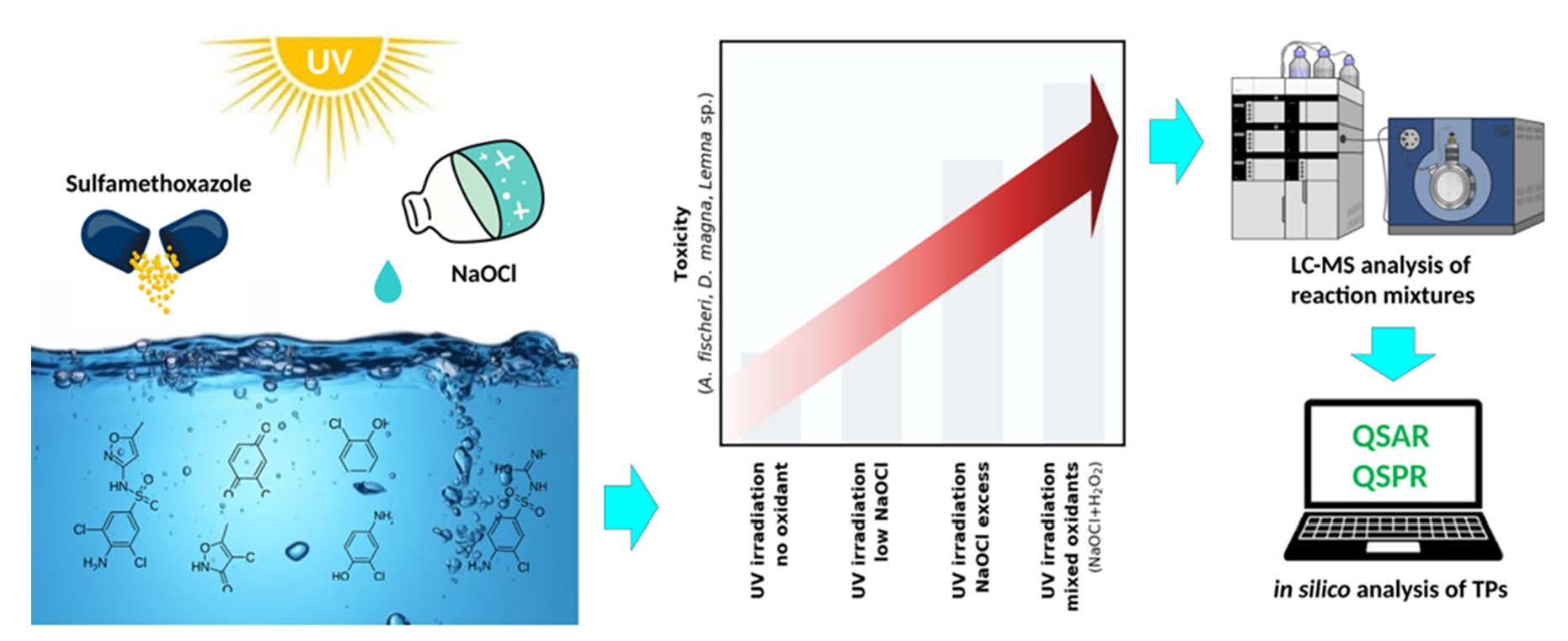
UV/NaOCl and UV/H2O2/NaOCl treatments of sulfamethoxazole (SMX) were compared across several reagent ratios using pseudo-first-order kinetics, LC-DAD/LC-MS screening of transformation products (TPs), multi-trophic bioassays, and quantitative structure–activity relationship (QSAR)-based toxicity and fate screening. Increasing the NaOCl proportion from an SMX:NaOCl molar ratio of 1:1 to 1:10 increased the pseudo-first-order rate constant from 0.215 to 0.818 min−1, but faster SMX removal did not correspond to a more favorable post-treatment bioassay profile. The 1:1 and 1:2 UV/NaOCl systems achieved substantial SMX removal within 10 min and gave the lowest responses among the treated systems in the Microtox®, Daphtox F®, and Lemna sp. assays. Higher NaOCl loadings and the mixed-oxidant systems produced stronger post-treatment bioassay responses and larger signals for ECOSAR-prioritized chlorinated aromatics and coupling products. Fate screening further distinguished more persistent, strongly sorbing products from TPs with lower sorption or greater predicted transport potential. The tested reagent ratios therefore revealed a trade-off between removal kinetics and the biological and environmental profile of the resulting mixtures.
Keywords: sulfamethoxazole; UV/NaOCl treatment; advanced oxidation processes; transformation products; ecotoxicological assessment; in silico screening; environmental fate sulfamethoxazole; UV/NaOCl treatment; advanced oxidation processes; transformation products; ecotoxicological assessment; in silico screening; environmental fate
Graphical Abstract