


Abstract
A DMAP-catalyzed Michael addition/cyclization cascade reaction has been developed for the efficient construction of a bispirooxindole–cyclopentene–isoxazolone framework. Under the optimized conditions (10 mol% DMAP, CH2Cl2, room temperature), the desired product was obtained in 92% yield with >20:1 diastereoselectivity. The reaction exhibited broad substrate scope, tolerating various substituents on both the isoxazolone and oxindole rings, and affording the corresponding products in 72–96% yields. The relative configuration of a representative product was determined as rel-(2’S,3R,3’R) by X-ray single-crystal diffraction. The utility of this method was further demonstrated by a gram-scale experiment (82% yield). This cascade reaction provides a concise and efficient route to structurally novel spiroisoxazolone derivatives bearing a cyano group and multiple spiro chiral centers.
1. Introduction
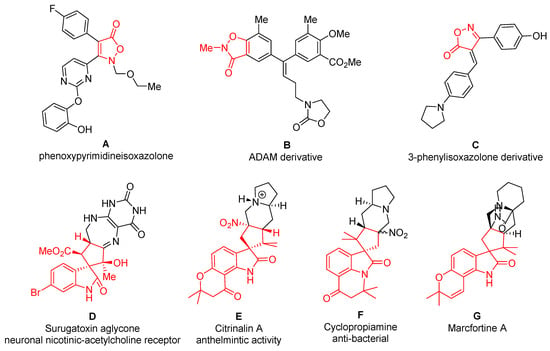
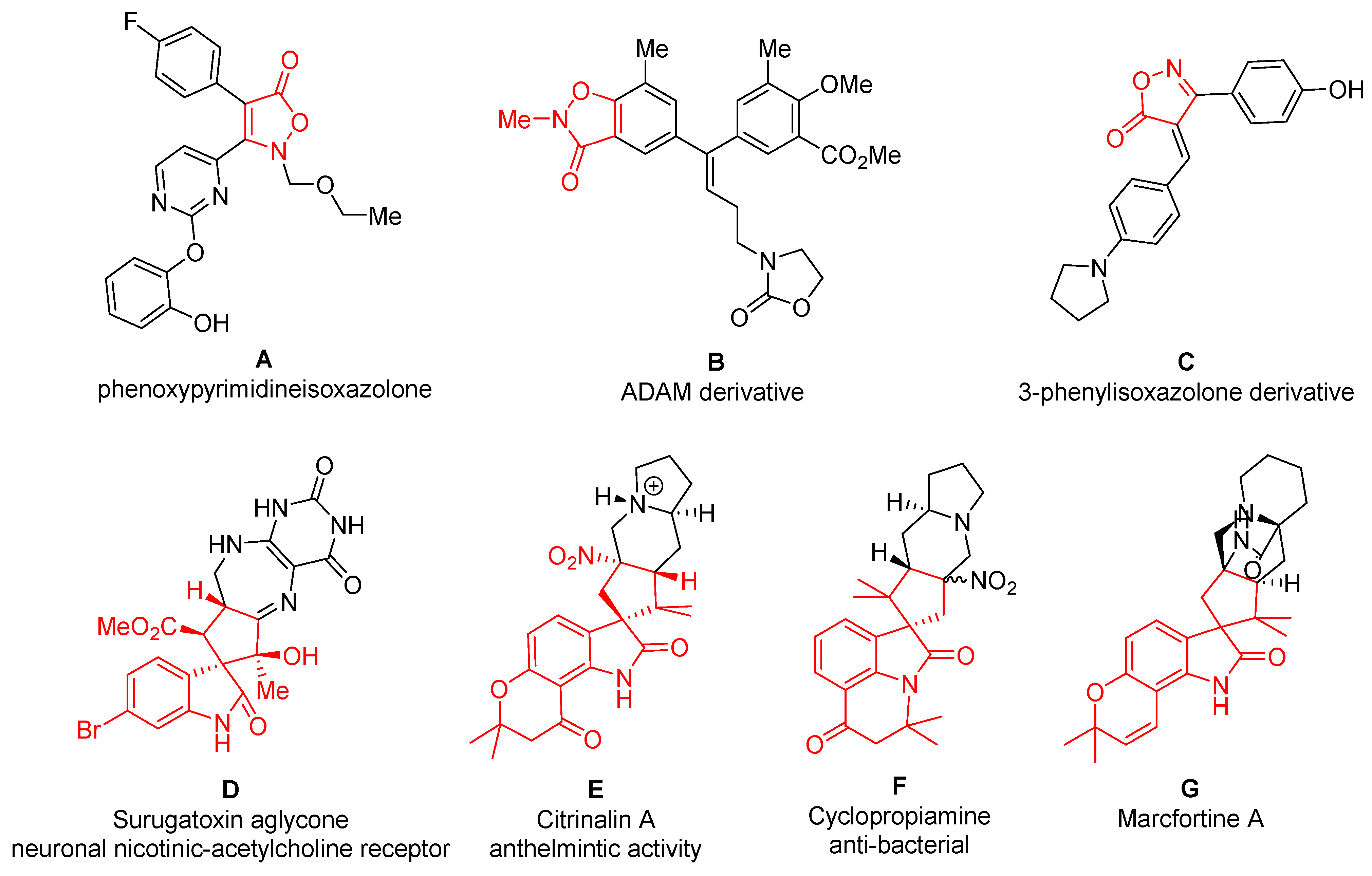
Isoxazolones are an important class of five-membered nitrogen- and oxygen-containing heterocyclic compounds widely found in natural products, pharmaceuticals, and agrochemicals. This heterocyclic system exhibits diverse pharmacological properties in clinical therapy, particularly in antitumor, antimicrobial (including fungi, viruses, and Mycobacterium tuberculosis), and anti-inflammatory applications [1,2,3,4,5,6]. For example, phenoxypyrimidine–isoxazolone Figure 1A can be used as a tumor necrosis factor-α (TNF-α) inhibitor [7]; the structurally modified isoxazolone–alkenyldiarylmethane hybrid Figure 1B retains anti-HIV activity while its enhanced metabolic stability effectively reduces systemic toxicity [8]; and (Z)-4-(4-pyrrolidinylbenzylidene)-3-phenyl-5(4H)-isoxazolone Figure 1C has been successfully employed as a potent androgen antagonist, displaying significant inhibitory effects on LNCaP cells expressing a point-mutated, constitutively active androgen receptor, with low side effects(Figure 1) [9].
Figure 1.
Examples of biologically active isoxazolone and spirocyclic compounds.
Spirocyclic compounds are abundant in natural products and drug molecules [10,11,12], characterized by a polycyclic system connected through a spiro quaternary carbon. This topological feature endows them with significant stereochemical advantages: the spatial interactions between adjacent stereocenters impart a rigid conformation and a complex three-dimensional structure that distinguishes spirocycles from ordinary monocyclic compounds or planar systems. This can induce special electronic effects (e.g., inter-ring conjugation), thereby effectively modulating pharmacokinetic properties and enhancing drug potency and target selectivity when used as pharmaceutically active scaffolds [13,14,15,16,17,18,19,20]. Compounds featuring a multi-spirocyclopentane–oxindole framework represent a highly representative class of such structures. For instance, Surugatoxin aglycone Figure 1D exhibits nanomolar inhibitory activity against neuronal nicotinic acetylcholine receptors; the alkaloids citrinadin Figure 1E, hydroxyquinamide Figure 1F, and marcfortine Figure 1G show pronounced anthelmintic and antibacterial activities (Figure 1). Meanwhile, malononitrile derivatives have attracted considerable attention because their cyano groups can be efficiently converted into various functional groups such as carboxylic acids, amides, and heterocycles [21,22].
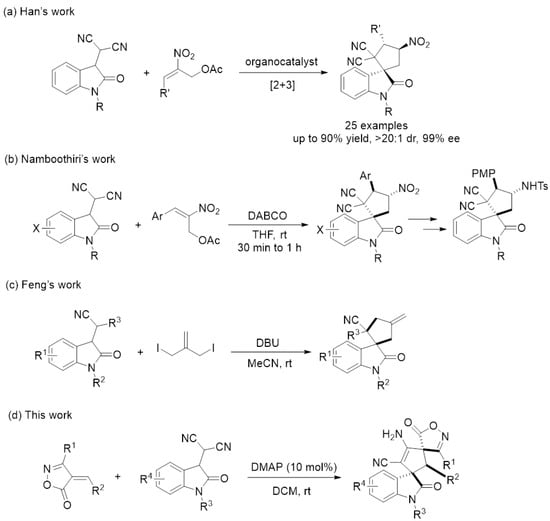
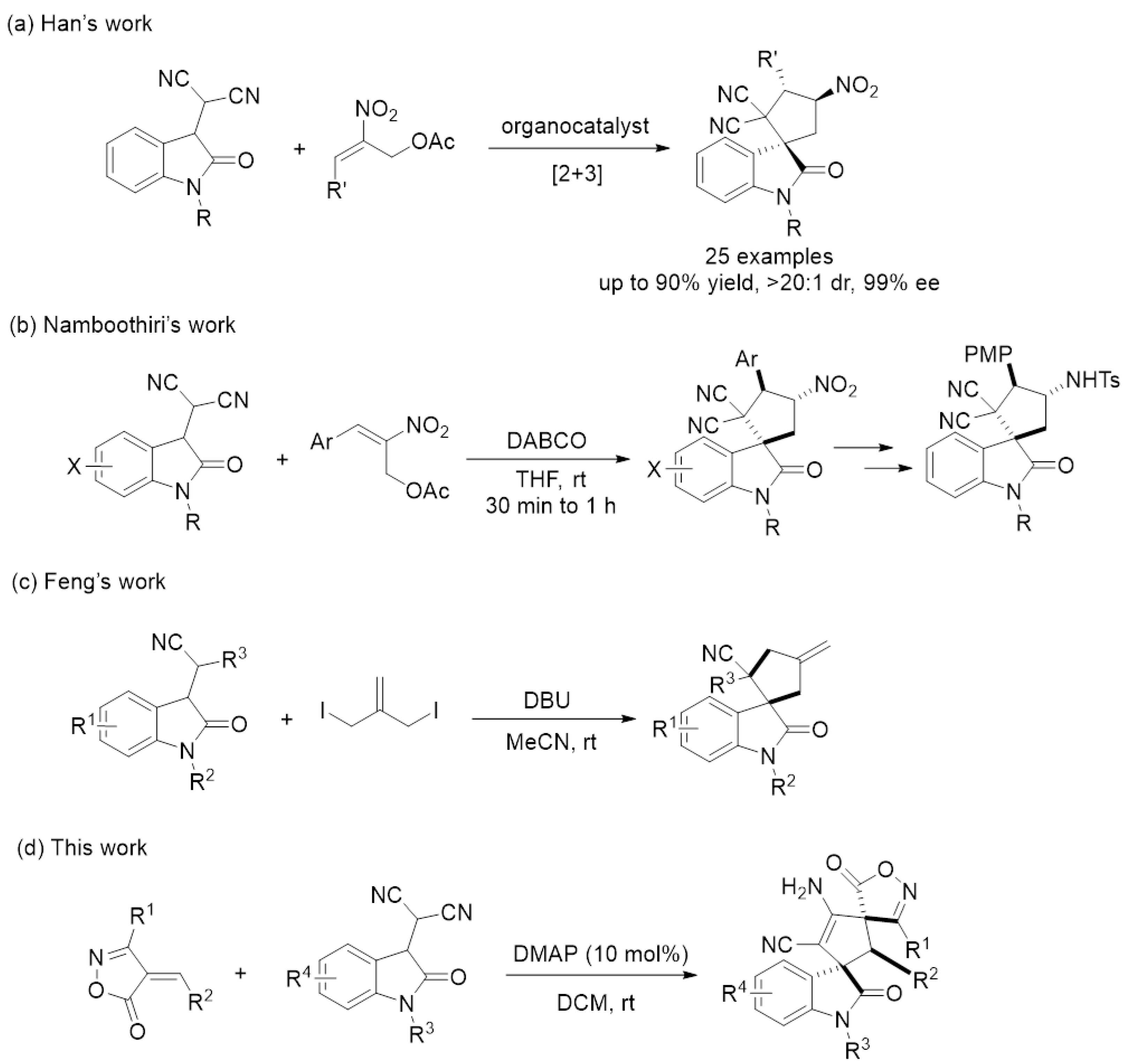
To date, there have been reports on the construction of cyano-containing spirooxindoles using malononitrile derivatives [23,24]. Han and co-workers [25] employed 2-(2-oxoindolin-3-yl)malononitrile as 1,2-bisnucleophiles in an asymmetric catalytic [3 + 2] cycloaddition to efficiently build highly enantioselective spirocyclopentane–oxindoles. Similarly, Namboothiri [26] utilized a [3 + 2] cycloaddition strategy to achieve the highly stereoselective annulation of 2-(2-oxoindolin-3-yl)malononitrile with MBH acetates of nitroalkenes, providing a new approach to multi-stereocenter spirocyclic compounds. Feng and co-workers [27] reported a base-mediated [2 + 3] annulation of 2-(2-oxoindolin-3-yl)malononitrile with 3-iodo-2-iodomethylprop-1-ene to access methylenecyclopentane spirooxindoles (Scheme 1).
Scheme 1.
Studies on the transformation of 3-(2-oxoindolin-3-yl)malononitriles and our work [25,26,27].
However, these efforts have mostly focused on the construction of spirocyclopentane or spiroquinoline frameworks, and efficient methods for the synthesis of bispirocyclic systems remain scarce, especially those involving malononitrile units as 1,3-bisnucleophiles in cascade cyclizations. Based on the above research status, the present study aims to develop an organocatalytic strategy to promote a Michael addition/cyclization cascade reaction between 4-benzylidene unsaturated isoxazol-5-ones and 2-(2-oxoindolin-3-yl)malononitriles, with the goal of accessing a novel class of cyano-containing bispirooxindole–cyclopentene–isoxazolone derivatives.
2. Results and Discussion
2.1. Optimization of Reaction Conditions
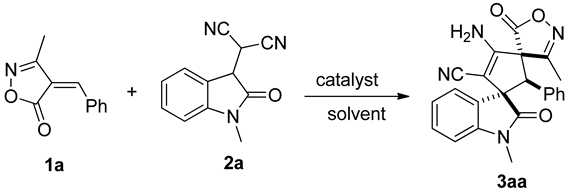
In the initial experimental stage, the Michael addition/cyclization cascade reaction of (Z)-4-benzylidene-3-methylisoxazol-5(4H)-one (1a) with 2-(1-methyl-2-oxoindolin-3-yl)malononitrile (2a) was attempted. Using 10 mol% triethylamine (Et3N) as the base in CH2Cl2 at room temperature for 10 h, the corresponding bispiro(isoxazolone-cyclopentenyl)oxindole 3aa was obtained in 58% yield with excellent diastereoselectivity. Although the yield was moderate, this result preliminarily validated the feasibility of the reaction pathway, suggesting that further optimization could lead to improved efficiency. Consequently, subsequent screenings of catalyst type, catalyst loading, reaction temperature, and solvent were carried out using this model reaction.
First, the effect of the solvent was evaluated. When the protic solvent ethanol was used, the cascade reaction did not proceed as efficiently; the yield decreased slightly to 53% compared to that obtained with CH2Cl2. A series of aprotic solvents was then tested. Tetrahydrofuran, which has a polarity comparable to that of CH2Cl2, gave a yield of 55%, showing only a minor fluctuation. Using chloroform or the non-polar solvent toluene afforded 3aa in yields of 56% and 57%, respectively. In contrast, when the strongly polar solvent acetonitrile was employed, the yield dropped significantly to 45%. Notably, excellent diastereoselectivity was maintained throughout all these solvent screenings.
Subsequently, a screening of catalysts was performed using CH2Cl2 as the solvent. When the organic bases 4-(dimethylamino)pyridine (DMAP), N,N-diisopropylethylamine (DIPEA), and 1,8-diazabicyclo[5.4.0]undec-7-ene (DBU) were employed, DMAP gave the highest yield of the cascade cyclization product (90%), while DIPEA and DBU afforded 3aa in 76% and 55% yields, respectively. The promoting effect of several inorganic bases was also examined. NaHCO3 gave a yield comparable to that obtained with Et3N (57%), whereas the significantly stronger base Na2CO3 increased the yield to 87%. The influence of K2CO3 and Cs2CO3 was also evaluated; K2CO3 resulted in only a 43% yield, while Cs2CO3 maintained the yield at 63%. To gain a comprehensive understanding of the reaction between benzylidene unsaturated isoxazol-5-one 1a and 2-(1-methyl-2-oxoindolin-3-yl)malononitrile 2a, a control experiment was conducted in the absence of any catalyst (Table 1, entry 14). The results showed that the reaction still proceeded, indicating that the chosen substrates possess excellent inherent reactivity.
Table 1.
Optimization of reaction conditions.
Elevating the temperature had a negative impact, likely due to the occurrence of side reactions, reducing the yield to 45%. When the temperature was raised to 50 °C, it was detrimental, giving only a 45% yield (Table 1, entry 15), whereas lowering the temperature to −10 °C maintained a high yield of 78% (Table 1, entry 16). In addition, the catalyst loading was optimized. When 20 mol% of DMAP was used, the product yield dropped to 57%; reducing the loading to 5 mol% still gave a yield of 77%. Therefore, 10 mol% DMAP was selected. Using CH2Cl2 as the solvent with 10 mol% DMAP, the effect of reaction temperature was further investigated. Throughout the entire optimization process, the diastereoselectivity (dr) consistently remained excellent (>20:1), which may be attributed to the inherent structural rigidity of the substrates or the kinetic advantage of the Michael addition step. For cases where dr is reported as >20:1, the minor diastereomer was not detectable by 1H NMR analysis of the crude reaction mixture.
Based on the above results, the optimal reaction conditions were established as follows: 10 mol% DMAP as the catalyst, CH2Cl2 as the solvent, and the reaction carried out at room temperature. Subsequently, the substrate scope was investigated under these optimized conditions.
2.2. Substrate Scope
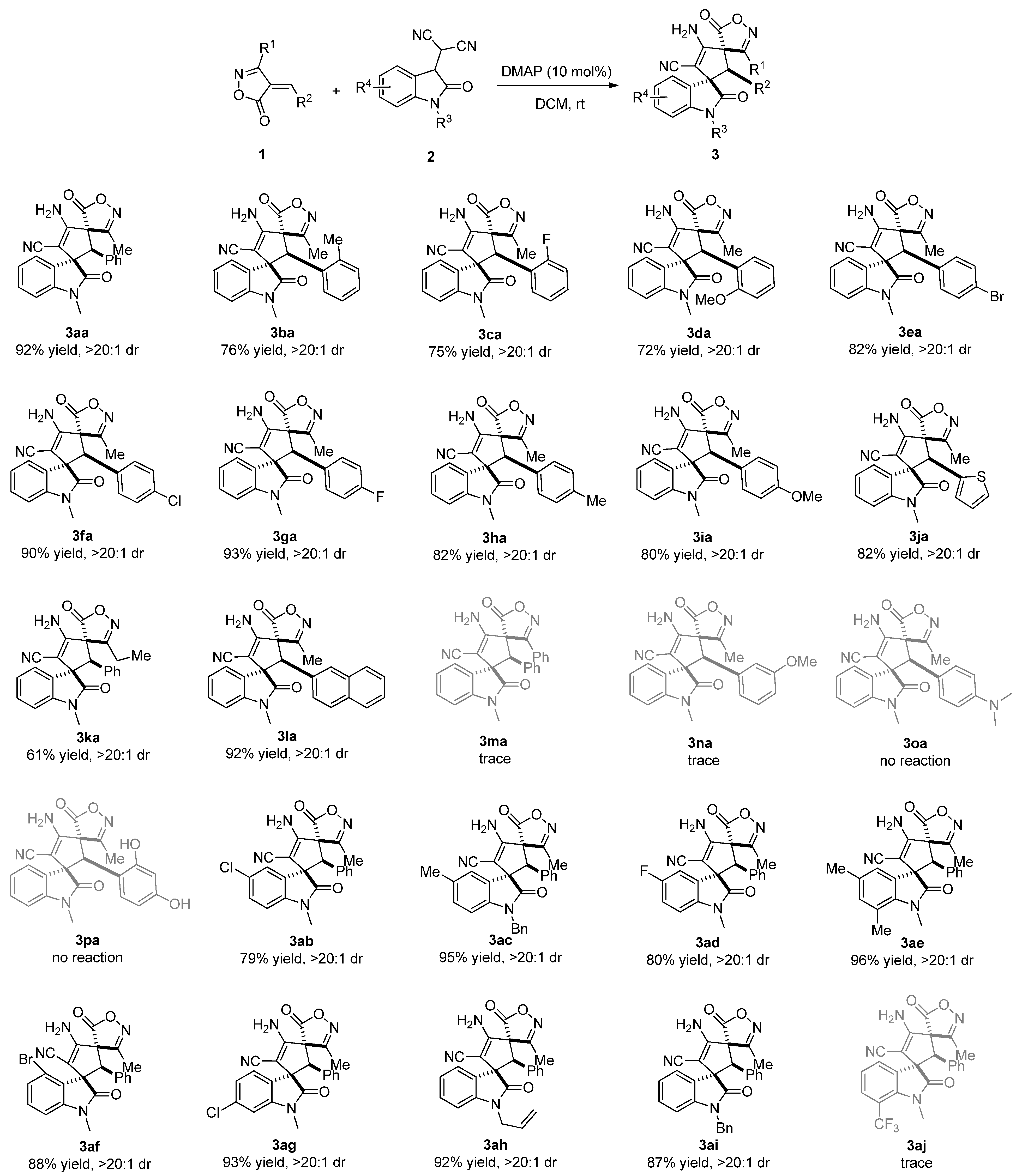
Based on the established optimal reaction conditions, the influence of the spatial distribution and electronic properties of substituents on the aromatic ring of the unsaturated isoxazol-5-ones, as well as the position and electronic nature of substituents on 2-(2-oxoindolin-3-yl)malononitriles, was systematically investigated. A series of structurally novel bispirooxindole–cyclopentene–isoxazol-5-one heterocyclic compounds were synthesized (Scheme 2).
Scheme 2.
Unless otherwise specified, the reaction conditions were as follows: 1 (0.15 mmol), 2 (0.20 mmol), and DMAP (10 mol%) in 1.0 mL of CH2Cl2, stirred at room temperature for 12 h. Yields are isolated yields after column chromatography, and dr values were determined by 1H NMR analysis.
Experimental data showed that under the standard conditions, the target product 3aa was obtained in a 92% isolated yield in the absence of substituents. First, the effect of different substituents on the aromatic ring at the 4-position of the isoxazol-5-one was examined. When a substituent was present at the ortho position of the aromatic ring, regardless of whether it was electron-withdrawing or electron-donating, a significant decrease in yield was observed. For methyl or methoxy substituents, products 3ba and 3da were obtained in 76% and 72% yield, respectively; a fluorine substituent gave product 3ca in 75% yield. When halogen substituents (F, Cl, Br) were present at the para position (R2), the reaction proceeded smoothly with good activity, reaching completion within 6–7 h. Products 3ea, 3fa, and 3ga were obtained in 82%, 90%, and 93% yield, respectively. Electron-donating groups (methoxy, methyl) at the para position were also compatible, albeit with longer reaction times, and the yields of products 3ha and 3ia remained satisfactory. Furthermore, after replacing the aromatic ring with a naphthyl or a β-thienyl ring, the reaction still proceeded smoothly, affording the target products 3ja (82%) and 3la (92%) in good yields.
When a methoxy group was present at the meta position of the aromatic ring, only a trace amount of product 3na was detected. When a strongly electron-donating group (dimethylamino) was located at the para position, the cascade cycloaddition was completely suppressed and did not occur as expected. The same outcome was observed when the substituent was changed to a moderately to strongly electron-donating group (hydroxy). When R1 was replaced by an ethyl or a phenyl group, the Michael/cyclization cascade reaction performed poorly: product 3ka was obtained in only 61% yield, while product 3ma could only be detected as a trace, presumably due to steric hindrance.
Subsequently, the diversity of the target products was examined by introducing various substituents onto the 2-(2-oxoindolin-3-yl)malononitrile component. It was found that both the electronic nature and the position of the substituents significantly influenced the reaction outcome. When electron-withdrawing groups were introduced at the 5-position, products 3ab and 3ad were obtained in only moderate yields. In contrast, electron-donating groups at the same position, as exemplified by 3ac and 3ae, led to excellent results. Furthermore, the introduction of electron-withdrawing groups at the 4- and 6-positions also proved to be well tolerated, affording the corresponding products in good yields (3af, 3ag). Finally, the installation of allyl or benzyl groups at the 1-position of the oxindole ring still allowed the reaction to proceed smoothly, delivering the desired products in 92% and 87% yields (3ah, 3ai).
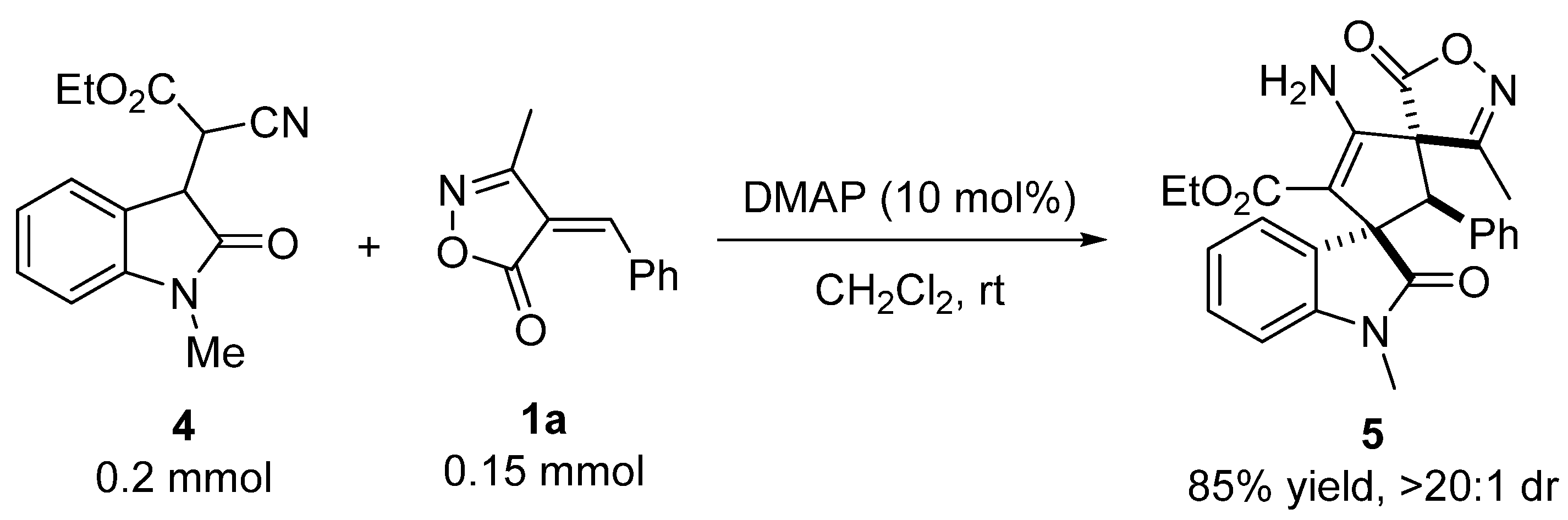
After a systematic investigation of the substrate scope of the Michael/cyclization cascade reaction, a specifically designed substrate, ethyl 2-cyano-2-(1-methyl-2-oxoindolin-3-yl)acetate (4), was synthesized. Under the standard reaction conditions, compound 4 was subjected to the cascade reaction with unsaturated isoxazolones, and the results showed that the catalytic system exhibited good reactivity, affording product 5 in 85% yield (as shown in Scheme 3). This outcome demonstrated that even a rationally designed less active substrate could still be efficiently transformed in this catalytic system.
Scheme 3.
Substrate scope of ethyl 2-cyano-2-(1-methyl-2-oxoindolin-3-yl)acetate.
2.3. Scaled-Up Synthesis
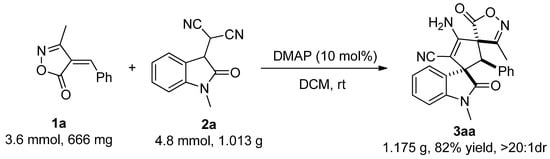
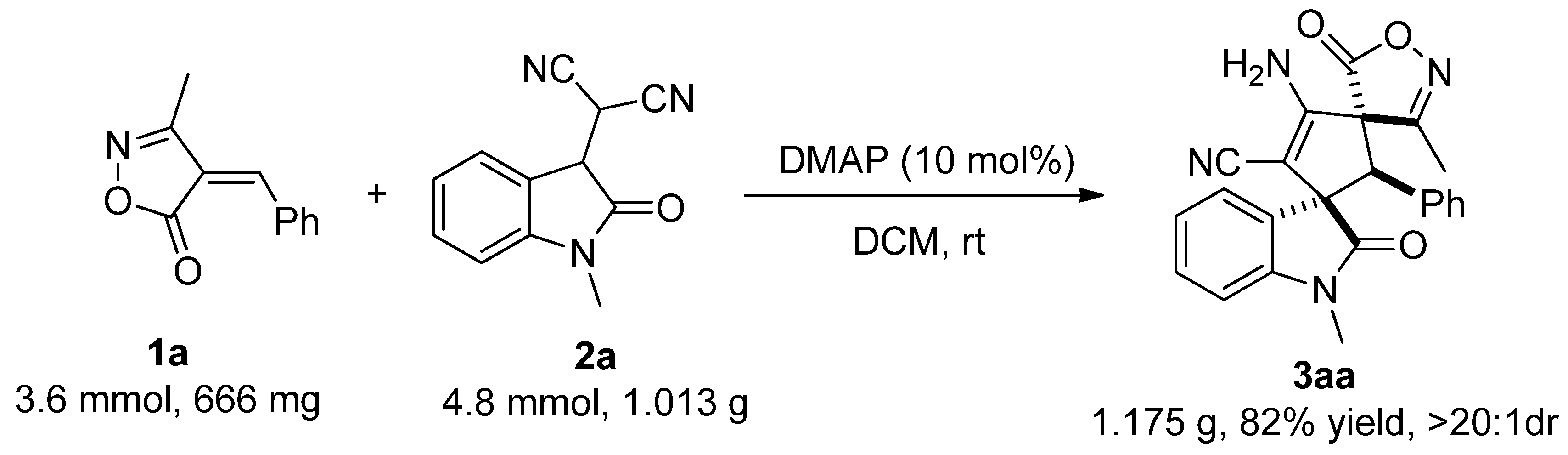
To evaluate the synthetic application potential of this Michael addition/cyclization cascade reaction, a gram-scale preparation was carried out under the optimized reaction conditions (as shown in Scheme 4). When the amount of reactants was scaled up to the gram level, the isolated yield of the target product showed a certain decrease compared to that obtained in the 0.1 mmol-scale reaction. Nevertheless, the stereochemical control of the product remained high during the scale-up process. This observation suggests that the stereochemistry-determining step in the reaction mechanism is only marginally affected by the reaction scale, whereas the change in yield might be related to engineering factors such as mass transfer efficiency or local concentration gradients.
Scheme 4.
Gram-scale synthesis of 3aa.
2.4. X-Ray Crystal Structure
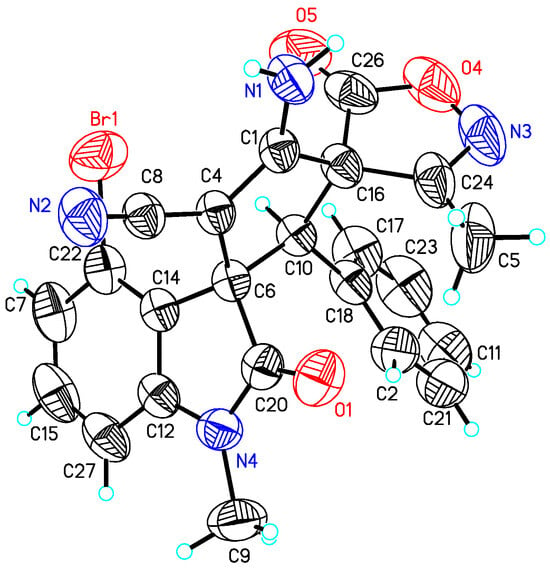
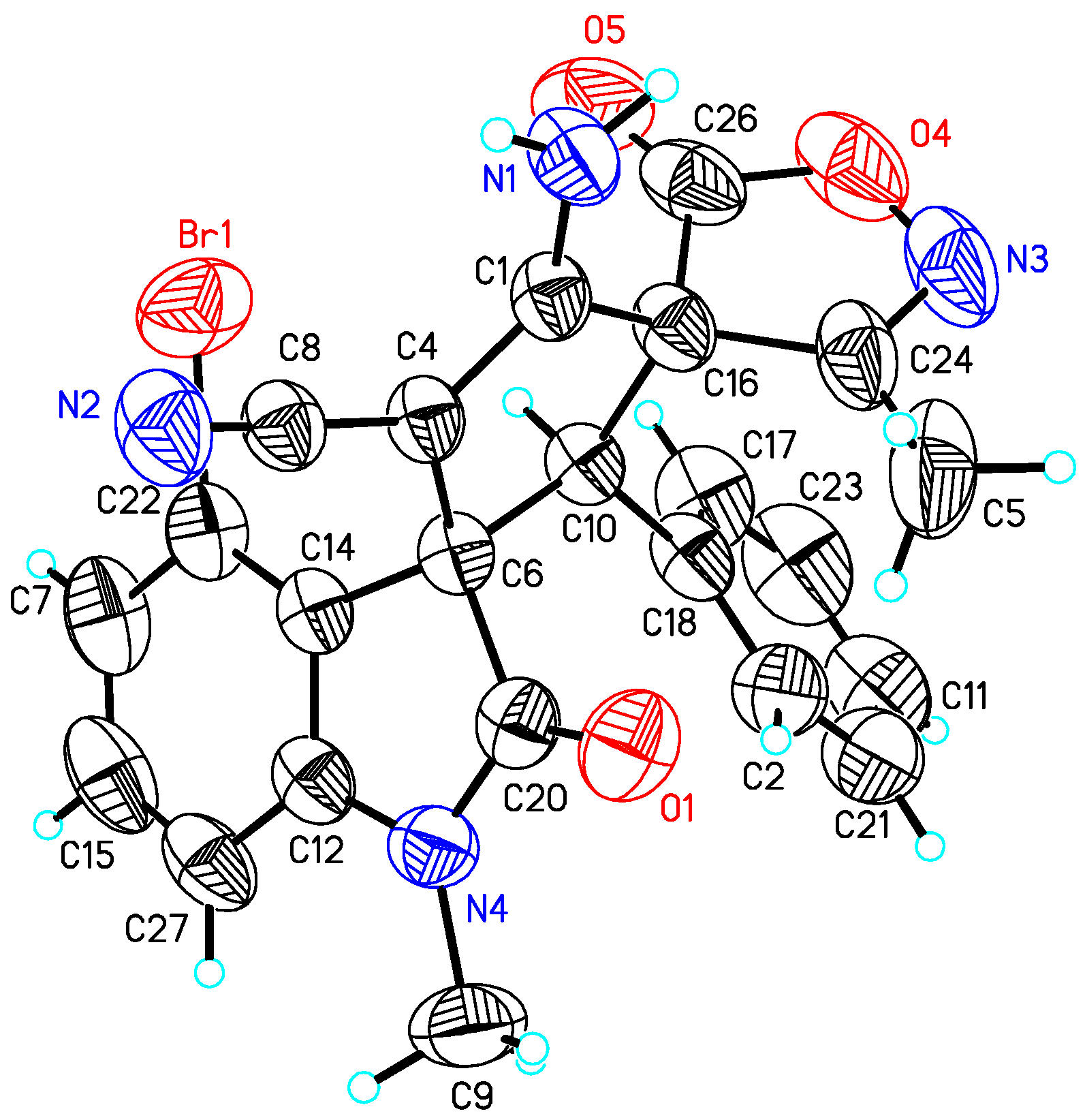
The stereochemical structure of compound 3af was determined by X-ray single-crystal diffraction analysis. The experimental results showed that the major diastereoisomer adopts a relative configuration of rel-(2’S,3R,3’R) [28] (Figure 2). Based on these structural elucidation results, the relative configurations of the other homologues were effectively assigned by analogy.
Figure 2.
X-ray crystal structure of 3af (one solvent ethyl acetate molecule was omitted for clarity).
2.5. Reaction Mechanism
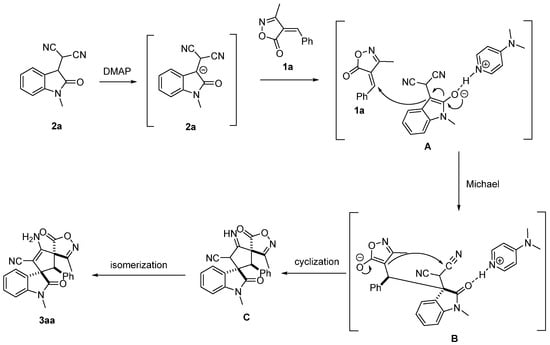
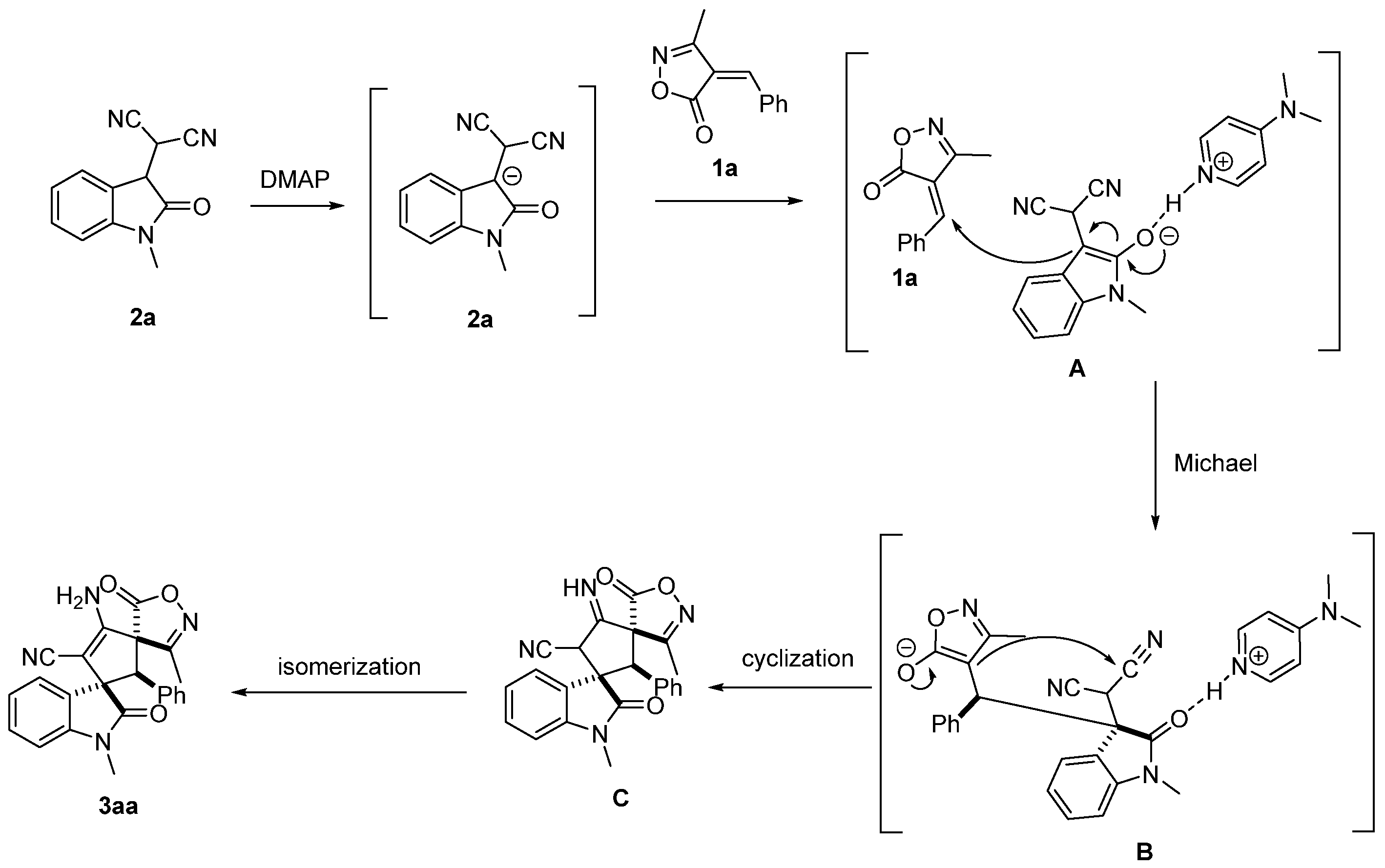
To better understand the Michael addition/cyclization cascade reaction developed in this work, a plausible reaction mechanism is proposed based on the relative configuration of product 3af (Scheme 5). First, the methine group of 2-(1-methyl-2-oxoindolin-3-yl)malononitrile 2a is deprotonated by DMAP to generate an enolate. This enolate attacks the β-position of 3-methyl-4-benzylideneisoxazol-5-one 1a via transition state A, leading to the formation of enolate intermediate B through a Michael addition. Subsequently, intermediate B undergoes an intramolecular cyclization to afford imine intermediate C, which then isomerizes to give the bispirocyclic product 3aa and regenerates the catalyst for the next cycle.
Scheme 5.
Proposed reaction mechanism.
3. Materials and Methods
3.1. General Information
Commercially available compounds were used without further purification. Solvents were dried according to standard procedures. Column chromatography was performed with silica gel (200–300 mesh) (Xinnuo, Yantai, China). Melting points were determined with a WRX-4 melting-point apparatus (Yice, Shanghai, China) and are uncorrected. 1H NMR spectra were measured with a Bruker Ascend 400 MHz spectrometer (Billerica, MA, USA), chemical shifts were reported in δ (ppm) units relative to tetramethylsilane (TMS) as internal standard. 13C NMR spectra were measured at 101 MHz with a 400 MHz spectrometer, chemical shifts are reported in ppm relative to tetramethylsilane and referenced to solvent peak (DMSO-d6, δC = 39.43). The 19F NMR spectra were measured at 376 MHz. Proton coupling patterns are intricately characterized as diverse spectroscopic signatures, ranging from singlets (s) to doublets (d), triplets (t), quartets (q), multiplets (m), and broadened signals (br s). High-resolution mass spectra were acquired using the Agilent 6520 accurate-mass-Q-TOF MS system (Agilent, Beijing, China), which incorporates an electrospray ionization (ESI+) source.
3.2. Experimental Materials
A series of unsaturated isoxazolones were synthesized according to procedures in the literature [29,30,31], while the synthesis of 2-(2-oxoindolin-3-yl)malononitriles 2a−j followed procedures in the literature, the synthesis of organocatalysts followed procedures in the literature [32,33,34].
3.3. General Procedure for the Synthesis of Spirooxindole–Cyclopentene–Isoxazolones 3
Under a dry atmosphere, a 4 mL reaction vial was charged with 4-unsaturated isoxazol-5-one 1 (0.15 mmol) and 2-(2-oxoindolin-3-yl)malononitrile 2 (0.20 mmol) using a precision analytical balance. Then, 10 mol% of 4-dimethylaminopyridine (DMAP) was added as the catalyst. The reaction mixture was dissolved in 1.0 mL of CH2Cl2, and the resulting mixture was stirred magnetically at 25 ± 2 °C. The reaction progress was monitored by thin-layer chromatography (eluent: petroleum ether/ethyl acetate = 3:1, v/v). After complete consumption of the starting materials, the mixture was concentrated under reduced pressure, and the residue was purified by flash column chromatography on silica gel using a gradient elution of CH2Cl2/ethyl acetate from 10:1 to 3:1 (v/v) to afford the desired product 3.
- rel-(2’S,3S,3’R)-4’-amino-1,3’’-dimethyl-2,5’’-dioxo-2’-phenyl-5’’H-dispiro[indoline-3,1’-cyclopentane-3’,4’’-isoxazol]-4’-ene-5’-carbonitrile (3aa): according to the general procedure, the product was obtained as a white solid (54.9 mg, 92% yield), m.p. 237–240 °C; 1H NMR (400 MHz, DMSO-d6): δ 8.14 (d, J = 7.2 Hz, 1H), 7.46 (s, 2H), 7.31 (td, J1 = 7.6 Hz, J2 = 0.8 Hz, 1H), 7.22–7.15 (m, 2H), 7.08 (t, J = 7.6 Hz, 2H), 6.98–6.91 (m, 3H), 4.22 (s, 1H), 3.05 (s, 3H), 2.28 (s, 3H) ppm; 13C NMR (101 MHz, DMSO-d6): δ 176.2, 175.94, 175.89, 165.7, 155.9, 143.1, 130.7, 129.5, 129.4, 129.0, 128.4, 127.7, 126.9, 122.5, 115.5, 109.0, 79.4, 67.1, 62.8, 56.9, 26.5, 11.9 ppm. HRMS (ESI): m/z calcd. for C23H19N4O3 [M + H]+ 399.1452, found 399.1449.
- rel-(2’S,3S,3’R)-4’-amino-1,3’’-dimethyl-2,5’’-dioxo-2’-(o-tolyl)-5’’H-dispiro[indoline-3,1’-cyclopentane-3’,4’’-isoxazol]-4’-ene-5’-carbonitrile (3ba): according to the general procedure, the product was obtained as a white solid (47.0 mg, 76% yield), m.p. 239–242 °C; 1H NMR (400 MHz, DMSO-d6): δ 8.07 (dd, J1 = 7.4 Hz, J2 = 0.6 Hz, 1H), 7.47 (s, 2H), 7.28 (td, J1 = 7.6 Hz, J2 = 1.2 Hz, 1H), 7.20 (td, J1 = 7.6, J2 = 0.8 Hz, 1H), 7.06 (t, J = 6.4 Hz, 2H), 7.02–6.98 (m, 1H), 6.88 (d, J = 7.6 Hz, 1H), 6.76 (t, J = 7.4 Hz, 1H), 4.72 (s, 1H), 3.04 (s, 3H), 2.29 (s, 3H), 2.21 (s, 3H) ppm; 13C NMR (101 MHz, DMSO-d6): δ 176.4, 176.2, 165.7, 155.8, 143.0, 137.4, 130.5, 129.4, 129.2, 128.9, 128.3, 127.6, 127.0, 125.3, 122.4, 115.5, 108.9, 79.4, 67.1, 62.9, 50.7, 26.5, 19.2, 12.2 ppm. HRMS (ESI): m/z calcd. for C24H21N4O3 [M + H]+ 413.1608, found 413.1622.
- rel-(2’S,3S,3’R)-4’-amino-2’-(2-fluorophenyl)-1,3’’-dimethyl-2,5’’-dioxo-5’’H-dispiro[indoline-3,1’-cyclopentane-3’,4’’-isoxazol]-4’-ene-5’-carbonitrile (3ca): according to the general procedure, the product was obtained as a white solid (46.8 mg, 75% yield), m.p. 225–228 °C; 1H NMR (400 MHz, DMSO-d6): δ 8.13 (d, J = 7.2 Hz, 1H), 7.53 (s, 2H), 7.35 (td, J1 = 7.7 Hz, J2 = 1.1 Hz, 1H), 7.26–7.21 (m, 2H), 7.15–7.10 (m, 1H), 7.01–6.95 (m, 2H), 6.86–6.81 (m, 1H), 4.77 (d, J = 0.8 Hz, 1H), 3.06 (s, 3H), 2.25 (s, 3H) ppm; 13C NMR (101 MHz, DMSO-d6): δ 176.0, 175.5, 165.6, 160.4 (1JC-F = 247.0 Hz), 155.4, 143.2, 131.0 (3JC-F = 9.0 Hz), 129.84, 129.83, 129.76, 127.3, 126.8, 124.1 (4JC-F = 3.3 Hz), 122.6, 117.3 (3JC-F = 12.0 Hz), 115.268 (2JC-F = 23.5 Hz), 115.264, 109.1, 79.5, 66.8, 62.1, 55.9, 26.5, 11.6 ppm. 19F NMR (376 MHz, DMSO-d6) δ −117.6 ppm. HRMS (ESI): m/z calcd. for C23H18FN4O3 [M + H]+ 417.1357, found 417.1378.
- rel-(2’S,3S,3’R)-4’-amino-2’-(2-methoxyphenyl)-1,3’’-dimethyl-2,5’’-dioxo-5’’H-dispiro[indoline-3,1’-cyclopentane-3’,4’’-isoxazol]-4’-ene-5’-carbonitrile (3da): according to the general procedure, the product was obtained as a white solid (46.82mg, 72% yield), m.p. 225–228 °C; 1H NMR (500 MHz, DMSO-d6): δ 8.10 (d, J = 7.0 Hz, 1H), 7.39 (s, 2H), 7.34 (t, J = 7.5 Hz), 7.21 (t, J = 7.5 Hz, 1H), 7.11 (t, J = 7.8 Hz, 1H), 6.94 (d, J = 8.0 Hz, 1H), 6.89 (d, J = 8.5 Hz 2H), 6.50 (t, J = 7.5 Hz, 1H), 5.10 (s, 1H), 3.70 (s, 3H), 3.04 (s, 3H), 2.24 (s, 3H) ppm; 13C NMR (101 MHz, DMSO-d6): δ 176.3, 175.8, 165.9, 157.5, 155.7, 143.3, 129.7, 129.4, 129.2, 128.1, 126.9, 122.3, 119.7, 118.9, 115.5, 111.2, 108.9, 79.9, 67.1, 62.1, 55.94, 55.86, 26.5, 11.9 ppm. HRMS (ESI): m/z calcd. for C24H21N4O4 [M + H]+ 429.1557, found 429.1563.
- rel-(2’S,3S,3’R)-4’-amino-2’-(4-bromophenyl)-1,3’’-dimethyl-2,5’’-dioxo-5’’H-dispiro[indoline-3,1’-cyclopentane-3’,4’’-isoxazol]-4’-ene-5’-carbonitrile (3ea): according to the general procedure, the product was obtained as a white solid (58.6 mg, 82% yield), m.p. 242–245 °C; 1H NMR (400 MHz, DMSO-d6): δ 8.10 (d, J = 7.1 Hz, 1H), 7.50 (s, 2H), 7.36–7.30 (m, 3H), 7.21 (t, J = 7.3 Hz, 1H), 6.96–6.93 (m, 3H), 4.20 (s, 1H), 3.07 (s, 3H), 2.29 (s, 3H) ppm; 13C NMR (101 MHz, DMSO-d6): δ 176.0, 175.8, 165.7, 155.7, 143.1, 131.5, 131.3, 129.9, 129.6, 127.3, 126.7, 122.7, 122.6, 115.4, 109.1, 79.1, 66.8, 62.5, 56.0, 26.5, 11.8 ppm. HRMS (ESI): m/z calcd. for C23H1879BrN4O3 [M + H]+ 477.0557, found 477.0559; calcd. for C23H1881BrN4O3 [M + H]+ 479.0536, found 479.0543.
- rel-(2’S,3S,3’R)-4’-amino-2’-(4-chlorophenyl)-1,3’’-dimethyl-2,5’’-dioxo-5’’H-dispiro[indoline-3,1’-cyclopentane-3’,4’’-isoxazol]-4’-ene-5’-carbonitrile (3fa): according to the general procedure, the product was obtained as a white solid (58.3 mg, 90% yield), m.p. 234–236 °C; 1 H NMR (400 MHz, DMSO-d6): δ 8.10 (dd, J1 = 7.6 Hz, J2 = 0.8 Hz, 1H), 7.49 (s, 2H), 7.34 (td, J1 = 7.7 Hz, J2 =1.2 Hz, 1H), 7.23–7.15 (m, 3H), 7.02–6.99 (m, 2H), 6.95 (d, J = 7.6 Hz, 1H), 4.21 (s, 1H), 3.06 (s, 3H), 2.28 (s, 3H) ppm; 13C NMR (101 MHz, DMSO-d6): δ 176.0, 175.8, 165.7, 155.7, 143.1, 133.9, 131.2, 131.1, 129.6, 129.5, 128.4, 127.3, 126.7, 122.6, 115.4, 109.0, 79.1, 66.9, 62.6, 56.0, 26.5, 11.8 ppm. HRMS (ESI): m/z calcd. for C23H18ClN4O3 [M + H]+ 433.1062, found 433.1070.
- rel-(2’S,3S,3’R)-4’-amino-2’-(4-fluorophenyl)-1,3’’-dimethyl-2,5’’-dioxo-5’’H-dispiro[indoline-3,1’-cyclopentane-3’,4’’-isoxazol]-4’-ene-5’-carbonitrile (3ga): according to the general procedure, the product was obtained as a white solid (58.1 mg, 93% yield), m.p. 248–250 °C; 1H NMR (400 MHz, DMSO-d6): δ 8.12 (d, J = 7.4 Hz, 1H), 7.49 (s, 2H), 7.33 (t, J = 7.5 Hz, 1H), 7.22 (t, J = 7.5 Hz, 1H), 7.06–7.02 (m, 2H), 6.97–6.92 (m, 3H), 4.23 (s, 1H), 3.06 (s, 3H), 2.29 (s, 3H) ppm; 13C NMR (101 MHz, DMSO-d6): δ 176.1, 175.8, 165.7, 162.1 (1JC-F = 247.6 Hz), 155.7, 143.1, 131.6 (3JC-F = 8.5 Hz), 129.6, 127.5, 126.8 (4JC-F = 3.1 Hz), 126.7, 122.5, 115.4, 115.3 (2JC-F = 21.5 Hz), 109.0, 79.1, 67.0, 62.7, 56.0, 26.5, 11.8 ppm. 19F NMR (376 MHz, DMSO-d6): δ −112.4 ppm. HRMS (ESI): m/z calcd. for C23H18FN4O3 [M + H]+ 417.1357, found 417.1373.
- rel-(2’S,3S,3’R)-4’-amino-1,3’’-dimethyl-2,5’’-dioxo-2’-(p-tolyl)-5’’H-dispiro[indoline-3,1’-cyclopentane-3’,4’’-isoxazol]-4’-ene-5’-carbonitrile (3ha): according to the general procedure, the product was obtained as a white solid (50.7 mg, 82% yield), m.p. 240–243 °C; 1H NMR (400 MHz, DMSO-d6): δ 8.16–8.11 (m, 1H), 7.44 (s, 2H), 7.31 (td, J1 = 7.6 Hz, J2 = 1.2 Hz, 1H), 7.20 (td, J1 = 7.6 Hz, J2 = 0.8 Hz, 1H), 6.93 (d, J = 7.7 Hz, 1H), 6.90–6.83 (m, 4H), 4.18 (s, 1H), 3.05 (s, 3H), 2.26 (s, 3H), 2.12 (s, 3H) ppm; 13C NMR (101 MHz, DMSO-d6): δ 176.2, 175.9, 165.7, 155.8, 143.1, 138.3, 129.4, 129.3, 128.9, 127.7, 127.6, 126.8, 122.4, 115.5, 108.9, 79.3, 67.1, 62.7, 56.7, 26.5, 20.4, 11.8 ppm. HRMS (ESI): m/z calcd. for C24H21N4O3 [M + H]+ 413.1608, found 413.1621.
- rel-(2’S,3S,3’R)-4’-amino-2’-(4-methoxyphenyl)-1,3’’-dimethyl-2,5’’-dioxo-5’’H-dispiro[indoline-3,1’-cyclopentane-3’,4’’-isoxazol]-4’-ene-5’-carbonitrile (3ia): according to the general procedure, the product was obtained as a white solid (51.5 mg, 80% yield), m.p. 240–243 °C; 1H NMR (400 MHz, DMSO-d6): δ 8.14 (d, J = 7.0 Hz, 1H), 7.44 (s, 2H), 7.32 (td, J1 = 7.6 Hz, J2 = 1.2 Hz, 1H), 7.24–7.17 (m, 1H), 6.94–6.89 (m, 3H), 6.62 (d, J = 8.8 Hz, 2H), 4.18 (s, 1H), 3.61 (s, 3H), 3.05 (s, 3H), 2.26 (s, 3H) ppm; 13C NMR (101 MHz, DMSO-d6): δ 176.3, 175.9, 165.7, 159.3, 155.8, 143.2, 130.7, 129.4, 127.8, 126.8, 122.4, 122.3, 115.5, 113.6, 108.9, 79.3, 67.2, 62.8, 56.4, 54.8, 26.5, 11.8 ppm. HRMS (ESI): m/z calcd. for C24H21N4O4 [M + H]+ 429.1557, found 429.1564.
- rel-(2’S,3S,3’R)-4’-amino-1,3’’-dimethyl-2,5’’-dioxo-2’-(thiophen-2-yl)-5’’H-dispiro[indoline-3,1’-cyclopentane-3’,4’’-isoxazol]-4’-ene-5’-carbonitrile (3ja): according to the general procedure, the product was obtained as a white solid (49.7 mg, 82% yield), m.p. 217–220 °C; 1H NMR (400 MHz, DMSO-d6): δ 8.14 (d, J = 7.4 Hz, 1H), 7.48 (s, 2H), 7.37 (t, J = 7.6 Hz, 1H), 7.32–7.30 (m, 1H), 7.21 (t, J = 7.5 Hz, 1H), 6.99 (d, J = 7.8 Hz, 1H), 6.82–6.78 (m, 2H), 4.58 (s, 1H), 3.10 (s, 3H), 2.28 (s, 3H) ppm; 13C NMR (101 MHz, DMSO-d6): δ 175.9, 175.2, 165.4, 155.2, 143.5, 131.5, 129.9, 129.1, 128.0, 127.3, 127.2, 126.2, 122.6, 115.3, 108.9, 79.1, 67.3, 62.3, 52.3, 26.6, 11.7 ppm. HRMS (ESI): m/z calcd. for C21H17N4O3S [M + H]+ 405.1016, found 405.1025.
- rel-(2’S,3S,3’R)-4’-amino-3’’-ethyl-1-methyl-2,5’’-dioxo-2’-phenyl-5’’H-dispiro[indoline-3,1’-cyclopentane-3’,4’’-isoxazol]-4’-ene-5’-carbonitrile (3ka): according to the general procedure, the product was obtained as a white solid (37.7 mg, 61% yield), m.p. 244–247 °C; 1H NMR (400 MHz, DMSO-d6): δ 8.12 (d, J = 6.8 Hz, 1H), 7.46 (s, 2H), 7.30 (td, J1 = 7.8 Hz, J2 = 1.2 Hz, 1H), 7.22–7.14 (m, 2H), 7.08 (t, J = 7.6 Hz, 2H), 6.96–6.90 (m, 3H), 4.25 (s, 1H), 3.05 (s, 3H), 2.87–2.75 (m, 1H), 2.61–2.52 (m, 1H), 1.26 (t, J = 7.3 Hz, 3H) ppm; 13C NMR (101 MHz, DMSO-d6): δ 176.2, 176.1, 169.1, 156.2, 143.1, 130.7, 129.4, 129.3, 128.8, 128.3, 127.7, 126.8, 122.5, 115.5, 108.9, 79.2, 67.0, 62.7, 57.0, 26.5, 20.2, 8.6 ppm. HRMS (ESI): m/z calcd. for C24H21N4O3 [M + H]+ 413.1608, found 413.1623.
- rel-(2’S,3S,3’R)-4’-amino-1,3’’-dimethyl-2’-(naphthalen-2-yl)-2,5’’-dioxo-5’’H-dispiro[indoline-3,1’-cyclopentane-3’,4’’-isoxazol]-4’-ene-5’-carbonitrile (3la): according to the general procedure, the product was obtained as a white solid (61.9 mg, 92% yield), m.p. 173–175 °C; 1H NMR (400 MHz, DMSO-d6): δ 8.25 (d, J = 7.1 Hz, 1H), 7.78–7.72 (m, 1H), 7.70–7.65 (m, 1H), 7.63–7.57 (m, 2H), 7.52 (s, 2H), 7.49–7.43 (m, 2H), 7.33–7.23 (m, 2H), 7.09 (d, J = 7.9 Hz, 1H), 6.87 (d, J = 7.5 Hz, 1H), 4.41 (s, 1H), 3.02 (s, 3H), 2.35 (s, 3H) ppm; 13C NMR (101 MHz, DMSO-d6): δ 176.2, 175.9, 165.8, 155.9, 143.1, 132.5, 132.1, 129.6, 129.5, 128.2, 127.69, 127.66, 127.2, 127.0, 126.8, 126.5, 126.1, 122.5, 115.5, 109.0, 79.2, 67.1, 62.8, 57.1, 26.4, 11.9 ppm. HRMS (ESI): m/z calcd. for C27H21N4O3 [M + H]+ 449.1608, found 449.1613.
- rel-(2’S,3S,3’R)-4’-amino-5-chloro-1,3’’-dimethyl-2,5’’-dioxo-2’-phenyl-5’’H-dispiro[indoline-3,1’-cyclopentane-3’,4’’-isoxazol]-4’-ene-5’-carbonitrile (3ab): according to the general procedure, the product was obtained as a white solid (51.2 mg, 79% yield), m.p. 244–247 °C; 1H NMR (500 MHz, DMSO-d6): δ 8.17 (d, J = 2.0 Hz, 1H), 7.58 (s, 2H), 7.40 (dd, J1 = 8.3 Hz, J2 = 2.3 Hz, 1H), 7.20 (t, J = 7.3 Hz, 1H), 7.13 (t, J = 7.5 Hz, 2H), 6.99–6.95 (m, 3H), 4.22 (s, 1H), 3.06 (s, 3H), 2.28 (s, 3H) ppm; 13C NMR (101 MHz, DMSO-d6): δ 176.2, 175.7, 165.6, 156.2, 142.0, 130.3, 129.7, 129.4, 129.1, 128.5, 126.7, 115.2, 110.6, 78.5, 66.8, 62.8, 56.7, 26.7, 11.8 ppm. HRMS (ESI): m/z calcd. for C23H18ClN4O3 [M + H]+ 433.1062, found 433.1078.
- rel-(2’S,3S,3’R)-4’-amino-1-benzyl-3’’,5-dimethyl-2,5’’-dioxo-2’-phenyl-5’’H-dispiro[indoline-3,1’-cyclopentane-3’,4’’-isoxazol]-4’-ene-5’-carbonitrile (3ac): according to the general procedure, the product was obtained as a white solid (58.7 mg, 95% yield), m.p. 243–245 °C; 1H NMR (400 MHz, DMSO-d6): δ 8.02 (s, 1H), 7.51 (s, 2H), 7.23 (t, J = 7.4 Hz, 1H), 7.16–7.04 (m, 5H), 7.00 (d, J = 7.5 Hz, 3H), 6.79 (d, J = 7.3 Hz, 2H), 6.56 (d, J = 8.0 Hz, 1H), 4.94 (d, J = 16.2 Hz, 1H), 4.72 (d, J = 16.2 Hz, 1H), 4.28 (s, 1H), 2.35 (s, 3H), 2.30 (s, 3H) ppm; 13C NMR (101 MHz, DMSO-d6): δ 176.4, 175.8, 165.7, 155.9, 139.8, 135.2, 131.4, 130.5, 129.7, 129.6, 129.0, 128.4, 128.2, 127.9, 127.7, 127.0, 126.2, 115.7, 109.2, 79.2, 66.9, 62.9, 57.3, 42.8, 20.9, 11.8 ppm. HRMS (ESI): m/z calcd. for C24H21N4O3 [M + H]+ 489.1921, found 489.1930.
- rel-(2’S,3S,3’R)-4’-amino-5-fluoro-1,3’’-dimethyl-2,5’’-dioxo-2’-phenyl-5’’H-dispiro[indoline-3,1’-cyclopentane-3’,4’’-isoxazol]-4’-ene-5’-carbonitrile (3ad): according to the general procedure, the product was obtained as a white solid (49.9 mg, 80% yield), m.p. 224−227 °C; 1H NMR (400 MHz, DMSO-d6): δ 7.97 (dd, J1 = 8.8 Hz, J2 = 2.7 Hz, 1H), 7.56 (s, 2H), 7.23–7.11 (m, 4H), 6.99–6.94 (m, 3H), 4.24 (s, 1H), 3.06 (s, 3H), 2.28 (s, 3H) ppm; 13C NMR (101 MHz, DMSO-d6): δ 176.2, 175.8, 165.6, 158.4 (1JC-F = 238.9 Hz), 156.1, 139.4 (4JC-F = 1.6 Hz), 130.4, 129.5 (3JC-F = 8.1 Hz), 129.10, 129.05, 128.5, 115.9 (2JC-F = 23.6 Hz), 115.2, 114.3 (2JC-F = 26.3 Hz), 110.0 (3JC-F = 8.2 Hz), 78.7, 66.8, 63.0, 56.7, 26.7, 11.8 ppm; 19F NMR (376 MHz, DMSO-d6) δ −120.1 ppm. HRMS (ESI): m/z calcd. for C23H18FN4O3 [M + H]+ 417.1357, found 417.1360.
- rel-(2’S,3S,3’R)-4’-amino-1,3’’,5,7-tetramethyl-2,5’’-dioxo-2’-phenyl-5’’H-dispiro[indoline-3,1’-cyclopentane-3’,4’’-isoxazol]-4’-ene-5’-carbonitrile (3ae): according to the general procedure, the product was obtained as a white solid (61.4 mg, 96% yield), m.p. 151−154 °C; 1H NMR (400 MHz, DMSO-d6): δ 7.84 (s, 1H), 7.40 (s, 2H), 7.18 (t, J = 7.3 Hz, 1H), 7.09 (t, J = 7.6 Hz, 2H), 6.96 (d, J = 7.4 Hz, 2H), 6.87 (s, 1H), 4.20 (s, 1H), 3.29 (s, 3H), 2.37 (s, 3H), 2.32 (s, 3H), 2.26 (s, 3H) ppm; 13C NMR (101 MHz, DMSO-d6): δ 176.8, 175.8, 165.7, 155.5, 138.5, 133.4, 131.0, 130.8, 129.5, 128.8, 128.4, 128.3, 125.5, 119.5, 115.6, 80.1, 67.0, 62.2, 57.0, 29.6, 20.6, 18.2, 11.8 ppm. HRMS (ESI): m/z calcd. for C25H23N4O3 [M + H]+ 427.1765, found 427.1776.
- rel-(2’S,3S,3’R)-4’-amino-4-bromo-1,3’’-dimethyl-2,5’’-dioxo-2’-phenyl-5’’H-dispiro[indoline-3,1’-cyclopentane-3’,4’’-isoxazol]-4’-ene-5’-carbonitrile (3af): according to the general procedure, the product was obtained as a white solid (62.8 mg, 88% yield), m.p. 148−151 °C; 1H NMR (400 MHz, DMSO-d6): δ 7.63 (s, 2H), 7.33 (dd, J1 = 8.0 Hz, J2 = 0.8 Hz, 1H), 7.29–7.20 (m, 4H), 6.94 (dd, J1 = 7.6 Hz, J2 = 0.4 Hz, 1H), 6.86 (d, J = 7.1 Hz, 2H), 4.86 (s, 1H), 2.96 (s, 3H), 2.60 (s, 3H) ppm; 13C NMR (101 MHz, DMSO-d6): δ 177.2, 175.0, 166.1, 157.5, 145.1, 131.5, 130.4, 129.2, 128.8, 128.4, 127.4, 124.6, 118.4, 115.6, 108.4, 75.7, 66.7, 64.2, 59.7, 26.3, 14.4 ppm. HRMS (ESI): m/z calcd. for C23H1879BrN4O3 [M + H]+ 477.0557, found 477.0533; calcd. for C23H1881BrN4O3 [M + H]+ 479.0536, found 479.0524.
- rel-(2’S,3S,3’R)-4’-amino-6-chloro-1,3’’-dimethyl-2,5’’-dioxo-2’-phenyl-5’’H-dispiro[indoline-3,1’-cyclopentane-3’,4’’-isoxazol]-4’-ene-5’-carbonitrile (3ag): according to the general procedure, the product was obtained as a white solid (60.3 mg, 93%% yield), m.p. 229−231 °C; 1H NMR (400 MHz, DMSO-d6): δ 8.12 (d, J = 8.1 Hz, 1H), 7.54 (s, 2H), 7.29 (dd, J1 = 8.1 Hz, J2 = 1.9 Hz, 1H), 7.22–7.17 (m, 1H), 7.15–7.09 (m, 3H), 6.97 (d, J = 7.4 Hz, 2H), 4.21 (s, 1H), 3.06 (s, 3H), 2.28 (s, 3H) ppm; 13C NMR (101 MHz, DMSO-d6): δ 176.3, 176.0, 165.6, 156.0, 144.6, 134.0, 130.4, 129.3, 129.1, 128.5, 128.1, 126.5, 122.3, 115.3, 109.6, 78.7, 66.9, 62.4, 56.8, 26.7, 11.8 ppm. HRMS (ESI): m/z calcd. for C23H18ClN4O3 [M + H]+ 433.1062, found 433.1051.
- rel-(2’S,3S,3’R)-1-allyl-4’-amino-3’’-methyl-2,5’’-dioxo-2’-phenyl-5’’H-dispiro[indoline-3,1’-cyclopentane-3’,4’’-isoxazol]-4’-ene-5’-carbonitrile (3ah): according to the general procedure, the product was obtained as a white solid (58.5 mg, 92% yield), m.p. 220−223 °C; 1H NMR (400 MHz, DMSO-d6): δ 8.16 (dd, J1 = 7.2 Hz, J2 = 0.8 Hz, 1H), 7.50 (s, 2H), 7.27 (td, J1 = 7.6 Hz, J2 = 1.2 Hz, 1H), 7.23–7.15 (m, 2H), 7.08 (t, J = 7.7 Hz, 2H), 6.98 (d, J = 7.5 Hz, 2H), 6.79 (d, J = 7.7 Hz, 1H), 5.68–5.58 (m, 1H), 4.83 (dd, J1 = 10.8 Hz, J2 = 0.8 Hz, 1H), 4.39 (dd, J1 = 17.6 Hz, J2 = 0.8 Hz, 1H), 4.433–4.27 (m, 1H), 4.22–4.14 (m, 2H), 2.281 (s, 3H) ppm; 13C NMR (101 MHz, DMSO-d6): δ 176.1, 175.8, 165.7, 155.9, 142.2, 130.7, 130.5, 129.6, 129.4, 129.0, 128.3, 127.7, 126.9, 122.4, 115.6, 115.2, 109.5, 79.1, 67.0, 62.8, 57.1, 41.5, 11.8 ppm. HRMS (ESI): m/z calcd. for C25H21N4O3 [M + H]+ 425.1608, found 425.1616.
- rel-(2’S,3S,3’R)-4’-amino-1-benzyl-3’’-methyl-2,5’’-dioxo-2’-phenyl-5’’H-dispiro[indoline-3,1’-cyclopentane-3’,4’’-isoxazol]-4’-ene-5’-carbonitrile (3ai): according to the general procedure, the product was obtained as a white solid (61.9 mg, 87% yield), m.p. 233−236 °C; 1H NMR (400 MHz, DMSO-d6): δ 8.19–8.16 (m, 1H), 7.53 (s, 2H), 7.24–7.06 (m, 8H), 7.00 (d, J = 7.4 Hz, 2H), 6.81 (d, J = 7.2 Hz, 2H), 6.70–6.67 (m, 1H), 4.97 (d, J = 16.2 Hz, 1H), 4.75 (d, J = 16.2 Hz, 1H), 4.29 (s, 1H), 2.30 (s, 3H) ppm; 13C NMR (101 MHz, DMSO-d6): δ 176.5, 175.8, 165.7, 156.1, 142.1, 135.1, 130.4, 129.7, 129.4, 129.0, 128.33, 128.27, 127.8, 127.1, 127.0, 126.2, 122.5, 115.6, 109.5, 79.0, 66.9, 62.9, 57.3, 42.7, 38.8, 11.8 ppm. HRMS (ESI): m/z calcd. for C29H23N4O3 [M + H]+ 475.1765, found 475.1776.
- ethyl rel-(2’S,3S,3’R)-4’-amino-1,3’’-dimethyl-2,5’’-dioxo-2’-phenyl-5’’H-dispiro[indoline-3,1’-cyclopentane-3’,4’’-isoxazol]-4’-ene-5’-carboxylate (5): according to the general procedure, the product was obtained as a white solid (56.8 mg, 85% yield), m.p. 227−229 °C; 1H NMR (400 MHz, DMSO-d6): δ 8.06–8.03 (m, 1H), 7.36 (s, 2H), 7.22 (td, J1 = 7.6 Hz, J2 = 1.2 Hz, 1H), 7.15 (t, J = 7.3 Hz, 1H), 7.10–7.03 (m, 3H), 6.96 (d, J = 7.4 Hz, 2H), 6.81 (d, J = 7.7 Hz, 1H), 4.13 (s, 1H), 3.80–3.68 (m, 2H), 3.00 (s, 3H), 2.27 (s, 3H), 0.77 (t, J = 7.1 Hz, 3H) ppm; 13C NMR (101 MHz, DMSO-d6): δ 178.0, 176.1, 166.0, 164.4, 154.6, 143.8, 143.6, 131.1, 129.8, 129.5, 128.6, 128.4, 128.1, 126.0, 121.6, 107.9, 101.0, 67.7, 61.8, 58.6, 56.6, 26.3, 13.6, 11.9 ppm. HRMS (ESI): m/z calcd. for C25H24N3O5 [M + H]+ 446.1710, found 446.1720.
3.4. Procedure for the Scaled-Up Synthesis of Compound 3aa
Under a dry atmosphere, a 100 mL reaction vial was charged with 4-unsaturated isoxazol-5-one 1a (3.6 mmol) and 2-(2-oxoindolin-3-yl)malononitrile 2a (4.8 mmol) using a precision analytical balance. Then, 10 mol% of 4-dimethylaminopyridine (DMAP) was added as the catalyst. The reaction mixture was dissolved in 25 mL of CH2Cl2, and the resulting mixture was stirred magnetically at 25 ± 2 °C. The reaction progress was monitored by TLC (eluent: petroleum ether/ethyl acetate = 3:1, v/v). After complete consumption of the starting materials, the mixture was concentrated under reduced pressure, and the residue was purified by flash column chromatography on silica gel using a gradient elution of CH2Cl2/ethyl acetate from 10:1 to 3:1 (v/v) to afford the desired product 3aa in 82% overall yield.
4. Conclusions
In summary, a DMAP-catalyzed Michael addition/cyclization reaction has been developed for the efficient construction of bispirooxindole/cyclopentene-fused isoxazolone derivatives. This protocol employs DMAP as the catalyst and CH2Cl2 as the solvent, and proceeds smoothly at room temperature, affording the target products in up to 96% isolated yield with >20:1 diastereoselectivity. Moreover, the reaction exhibits broad substrate compatibility; although substrates bearing strongly electron-withdrawing groups reduce the reaction efficiency, most derivatives still enable the efficient construction of the bispirooxindole/cyclopentene–isoxazolone scaffolds. The practical utility of this method was further demonstrated by gram-scale experiments and derivatization of the products. This strategy provides a new route for the rapid construction of a library of spiro heterocyclic compounds featuring complex structures and quaternary carbon stereocenters.
Supplementary Materials
The following supporting information can be downloaded at https://www.mdpi.com/article/10.3390/molecules31142461/s1, File S1: Copies of 1H and 13C NMR spectra of new compounds.
Author Contributions
W.Z. performed part of the experiments and wrote the preliminary manuscript; R.-R.Z. performed the experiments and acquired and analyzed the original data; D.-M.D. designed the research plan, supervised the experiments, modified all figures and schemes, analyzed and checked all the data, and revised this manuscript. Author D.-M.D. passed away prior to the publication of this manuscript. All authors have read and agreed to the published version of the manuscript.
Funding
This research received no external funding.
Institutional Review Board Statement
Not applicable.
Informed Consent Statement
Not applicable.
Data Availability Statement
Data are contained within this article and Supplementary Materials.
Acknowledgments
We thank the Analysis and Testing Center of the Beijing Institute of Technology for the measurement of NMR and mass spectrometry.
Conflicts of Interest
There are no conflicts of interest to declare.
References
- Tamao, K.; Nakamura, K.; Ishii, H.; Yamaguchi, S.; Shiro, M. Axially chiral spirosilanes via catalytic asymmetric intramolecular hydrosilation. J. Am. Chem. Soc. 1996, 118, 12469–12470. [Google Scholar] [CrossRef] [Scilit]
- Piotrowska, D.G.; Andrei, G.; Schols, D.; Snoeck, R.; Grabkowska-Drużyc, M. New isoxazolidine-conjugates of quinazolinones—Synthesis, antiviral and cytostatic activity. Molecules 2016, 21, 959. [Google Scholar] [CrossRef] [Scilit] [PubMed]
- Abbas, S.Y.; El-Bayouki, K.A.M.; Basyouni, W.M.; Mostafa, E.A. New series of 4(3H)-quinazolinone derivatives: Syntheses and evaluation of antitumor and antiviral activities. Med. Chem. Res. 2018, 27, 571–582. [Google Scholar] [CrossRef] [Scilit]
- Egorova, A.; Kazakova, E.; Jahn, B.; Ekins, S.; Makarov, V.; Schmidtke, M. Novel pleconaril derivatives: Influence of substituents in the isoxazole and phenyl rings on the antiviral activity against enteroviruses. Eur. J. Med. Chem. 2020, 188, 112007. [Google Scholar] [CrossRef] [Scilit] [PubMed]
- Das, P.; Boone, S.; Mitra, D.; Turner, L.; Tandon, R.; Raucher, D.; Hamme, A.T. Synthesis and biological evaluation of fluoro-substituted spiro-isoxazolines as potential anti-viral and anti-cancer agents. RSC Adv. 2020, 10, 30223–30237. [Google Scholar] [CrossRef] [Scilit] [PubMed]
- Wang, Q.; He, X.; Li, R.; Le, Y.; Liu, L. New isoxazolidine derivatives: Synthesis, spectroscopic analysis, X-ray, DFT calculation, biological activity studies. J. Mol. Struct. 2024, 1312, 138547. [Google Scholar] [CrossRef] [Scilit]
- Laughlin, S.K.; Clark, M.P.; Djung, J.F.; Golebiowski, A.; Brugel, T.A.; Sabat, M.; Bookland, R.G.; Laufersweiler, M.J.; VanRens, J.C.; Townes, J.A.; et al. The development of new isoxazolone based inhibitors of tumor necrosis factor-alpha (TNF-α) production. Bioorganic Med. Chem. Lett. 2005, 15, 2399–2403. [Google Scholar] [CrossRef] [Scilit]
- Deng, B.-L.; Hartman, T.L.; Buckheit, R.W.; Pannecouque, C.; De Clercq, E.; Cushman, M. Replacement of the metabolically labile methyl esters in the alkenyldiarylmethane series of non-nucleoside reverse transcriptase inhibitors with isoxazolone, isoxazole, oxazolone, or cyano substituents. J. Med. Chem. 2006, 49, 5316–5323. [Google Scholar] [CrossRef] [Scilit] [PubMed]
- Ishioka, T.; Tanatani, A.; Nagasawa, K.; Hashimoto, Y. Anti-Androgens with full antagonistic activity toward human prostate tumor LNCaP cells with mutated androgen receptor. Bioorganic Med. Chem. Lett. 2003, 13, 2655–2658. [Google Scholar] [CrossRef] [Scilit]
- Dhillon, S. Delgocitinib: First approval. Drugs 2020, 80, 609–615. [Google Scholar] [CrossRef] [Scilit] [PubMed]
- Pande, A.C. Analgesic efficacy of enadoline, a selective κ-opioid agonist. Biol. Psychiatry 1995, 37, 650. [Google Scholar] [CrossRef] [Scilit]
- Ochsenbein, P.; Bonin, M.; Fadaei-Tirani, F.; Lemée, M.-H.; Kieffer, J.; Görl, D.; El-Hajji, M.; Schenk-Joß, K. A score and nine years of irbesartan. CrystEngComm 2024, 26, 4566–4578. [Google Scholar] [CrossRef] [Scilit]
- Ren, L.; Han, Y.; Hou, X.; Ni, Y.; Zou, Y.; Jiao, T.; Wu, J. Aromaticity in fully π-conjugated multicyclic macrocycles. J. Am. Chem. Soc. 2023, 145, 12398–12406. [Google Scholar] [CrossRef] [Scilit] [PubMed]
- Hiesinger, K.; Dar’in, D.; Proschak, E.; Krasavin, M. Spirocyclic scaffolds in medicinal chemistry. J. Med. Chem. 2021, 64, 150–183. [Google Scholar] [PubMed]
- Li, T.; Liu, S.; Wu, S.; Cheng, Q.; Chen, Q.; Jiao, Y.; Zhang, Y.; Shi, F. Catalytic asymmetric [3 + 3] cycloaddition between different 2-indolylmethanols. Sci. China Chem. 2024, 67, 2629–2636. [Google Scholar] [CrossRef] [Scilit]
- Xie, X.; Huang, W.; Peng, C.; Han, B. Organocatalytic asymmetric synthesis of six-membered carbocycle-based spiro compounds. Adv. Synth. Catal. 2018, 360, 194–228. [Google Scholar]
- Yasui, M.; Ohbu, H.; Ishikawa, M.; Yoshida, T.; Takeda, N.; Hirao, S.; Abe, T.; Ueda, M. Synthesis of spiro[indole-3,3′-pyrrolidine]-2′-(thi)ones. J. Org. Chem. 2023, 88, 1093–1106. [Google Scholar] [PubMed]
- James, M.J.; O’Brien, P.; Taylor, R.J.K.; Unsworth, W.P. Synthesis of spirocyclic indolenines. Chem. A Eur. J. 2016, 22, 2856–2881. [Google Scholar]
- Müller, G.; Berkenbosch, T.; Benningshof, J.C.J.; Stumpfe, D.; Bajorath, J. Charting Biologically Relevant Spirocyclic Compound Space. Chem. A Eur. J. 2017, 23, 703–710. [Google Scholar]
- Basavaraja, D.; Doddamani, S.V.; Siby, A.; Sreelakshmi, V.; Ancy, A.; Somappa, S.B. Spiro-Heterocycles: Recent Advances in Biological Applications and Synthetic Strategies. Tetrahedron 2025, 173, 134468. [Google Scholar] [CrossRef] [Scilit]
- Li, K.; Zhen, S.; Wang, W. Fungicide-inspired precursors of π-allylpalladium intermediates for palladium-catalyzed decarboxylative cycloadditions. Chem. Sci. 2023, 14, 3024–3029. [Google Scholar] [CrossRef] [Scilit] [PubMed]
- Zhang, D.; Lian, M.; Liu, J.; Tang, S.; Liu, G.; Ma, C.; Meng, Q.; Peng, H.; Zhu, D. Preparation of O-protected cyanohydrins by aerobic oxidation of α-substituted malononitriles in the presence of diarylphosphine oxides. Org. Lett. 2019, 21, 2597–2601. [Google Scholar] [CrossRef] [Scilit] [PubMed]
- Qiao, D.-J.; Du, D.-M. Squaramide-Catalyzed Asymmetric Michael Addition/Cyclization Reaction for the Synthesis of Chiral Bisspiro Barbituric Acid–Oxindole Derivatives. Molecules 2025, 30, 2000. [Google Scholar] [CrossRef] [Scilit] [PubMed]
- Yao, W.; Chen, L.; Xie, X.; Cui, M.; Xie, J. Diastereoselective Preparation of Spiro[2,3-dihydrofuran-3,3’-oxindole] Derivatives by an Atom-economic Tandem Reaction in Water. Eur. J. Org. Chem. 2022, 2022, e202201034. [Google Scholar] [CrossRef] [Scilit]
- Ai, Y.; Li, D.; Li, G.; Li, H.; He, X.; Fu, X.; Wang, Y.; Zhan, G.; Han, B. Asymmetric synthesis of spirocyclopentane oxindoles via [2 + 3] annulation with 2-(2-Oxoindolin-3-yl)malononitriles as 1,2-carbon bisnucleophiles. Adv. Synth. Catal. 2021, 363, 3283–3289. [Google Scholar] [CrossRef] [Scilit]
- Pareek, A.; Sivanandan, S.T.; Bhagat, S.; Namboothiri, I.N.N. [3 + 2]-Annulation of oxindolinyl-malononitriles with Morita–Baylis–Hillman acetates of nitroalkenes for the regio- and diastereoselective synthesis of spirocyclopentane-indolinones. Tetrahedron 2022, 108, 132650. [Google Scholar] [CrossRef] [Scilit]
- Feng, J.; Wu, Y.; Xu, L.; Wang, X. Base-Mediated Substrate-Dependent [2 + 3] and [3 + 3] Annulation of Bisnucleophiles: Enabling the Modular Synthesis of Functionalized Spirocyclopentane Oxindoles and Tetrahydro-α-Carbolines. J. Org. Chem. 2025, 90, 10379–10385. [Google Scholar] [CrossRef] [Scilit] [PubMed]
- CCDC 2571789 (for 3af) Contains the Supplementary Crystallographic Data for This Paper. These Data Can Be Obtained Free of Charge Via. Available online: http://www.ccdc.cam.ac.uk/structures/ (accessed on 30 June 2026).
- Vekariya, R.H.; Patel, K.D.; Patel, H.D. Fruit Juice of Citrus Limon as a Biodegradable and Reusable Catalyst for Facile, Eco-friendly and Green Synthesis of 3,4-Disubstituted Isoxazol-5(4H)-ones and Dihydropyrano[2,3-c]-pyrazole Derivatives. Res. Chem. Intermed. 2016, 42, 7559–7579. [Google Scholar] [CrossRef] [Scilit]
- Laroum, R.; Debache, A. New Eco-friendly Procedure for the Synthesis of 4-Arylmethylene-isoxazol-5(4H)-ones Catalyzed by Pyridinium p-Toluenesulfonate (PPTS) in Aqueous Medium. Synth. Commun. 2018, 48, 1876–1882. [Google Scholar] [CrossRef] [Scilit]
- Rikani, A.B.; Setamdideh, D. One-Pot and Three-Component Synthesis of Isoxazol-5(4H)-one Derivatives in the Presence of Citric Acid. Orient. J. Chem. 2016, 32, 1433–1437. [Google Scholar] [CrossRef] [Scilit]
- Yoneda, N.; Fukata, Y.; Asano, K.; Matsubara, S. Asymmetric synthesis of spiroketals with aminothiourea catalysts. Angew. Chem. Int. Ed. 2015, 54, 15497–15500. [Google Scholar] [CrossRef] [Scilit]
- Zhu, Y.; Malerich, J.P.; Rawal, V.H. Squaramide-catalyzed enantioselective Michael addition of diphenyl phosphite to nitroalkenes. Angew. Chem. Int. Ed. 2010, 49, 153–156. [Google Scholar]
- Yang, W.; Du, D. Chiral Squaramide-catalyzed highly enantioselective Michael addition of 2-hydroxy-1,4-naphthoquinones to nitroalkenes. Adv. Synth. Catal. 2011, 353, 1241–1246. [Google Scholar] [CrossRef] [Scilit]

Disclaimer/Publisher’s Note: The statements, opinions and data contained in all publications are solely those of the individual author(s) and contributor(s) and not of MDPI and/or the editor(s). MDPI and/or the editor(s) disclaim responsibility for any injury to people or property resulting from any ideas, methods, instructions or products referred to in the content. |
© 2026 by the authors. Licensee MDPI, Basel, Switzerland. This article is an open access article distributed under the terms and conditions of the Creative Commons Attribution (CC BY) license.