


Abstract
Essential oils are complex plant-derived volatile blends composed of a myriad of aromatic secondary metabolites. The volatile architecture of plant essential oils suggests a consistent trend under the experimental conditions evaluated, regardless of the distillation scale and methodology. This study presents a comparative chemometric evaluation of two integrated processing systems: laboratory-scale hydrodistillation (HD) of dried biomass versus semi-industrial-scale dry steam distillation (SD) of fresh biomass. Seven economically important botanical species spanning three families were analyzed: Lavandula angustifolia, Salvia officinalis, Hyssopus officinalis, Mentha piperita, Mentha spicata, Achillea millefolium, and Picea abies. Gas chromatography–mass spectrometry (GC-MS) profiling revealed that HD consistently yielded a more chemically diverse volatile profile than SD. Unsupervised Principal Component Analysis (PCA) and Hierarchical Cluster Analysis (HCA) achieved absolute binary segregation between the HD and SD fractions for every species. Supervised Partial Least Squares Discriminant Analysis (PLS-DA) established robust predictive models (Q2 cum > 0.98), isolating specific chemical markers responsible for the variance. The results prove a universal physical trend: HD significantly enriched low-boiling oxygenated derivatives (such as oxygenated monoterpene alcohols and oxides), while SD selectively preserved heavier, thermally sensitive hydrocarbon fractions across all taxonomic groups. Ultimately, combining GC-MS with multivariate chemometrics provides an objective, automated framework for quality control, authentication, and industrial process optimization in the essential oil sector.
1. Introduction
In recent decades, plant extracts and essential oils (EOs) have garnered significant attention in both academic research and the industrial sector, driven by a growing preference for natural substances over synthetic alternatives [1]. Extraction methods that utilize water-based, organic solvent-free processes align closely with the principles of green chemistry. Furthermore, these extracted secondary metabolites often possess diverse therapeutic properties, contributing to human well-being or serving as potential lead compounds for drug development [2]. EOs are complex liquid mixtures of biologically active volatile organic compounds (VOCs). These mixtures primarily comprise monoterpenes and sesquiterpenes, along with their oxygenated derivatives (terpenoids), as well as phenylpropanoids in varying proportions. These phytochemicals are responsible for a wide array of biological activities, including antimicrobial, antiviral, anti-inflammatory, and antioxidant effects [2,3]. Consequently, the global demand for high-quality EOs continues to rise across the aromatherapy, cosmetic, and pharmaceutical industries [4].
A vast majority of scientific literature focuses on laboratory-scale essential oil extraction, predominantly employing HD and SD due to their cost-effectiveness and operational simplicity. This trend is underscored by a recent bibliometric analysis, which revealed that 90% of the articles published in the Journal of Essential Oil Research between 2019 and 2021 reported HD or SD as the primary isolation technique, with HD accounting for 85% of these cases [5]. In stark contrast, SD remains the pre-eminent industrial-scale isolation method, accounting for approximately 93% of global EO production [6].
The fundamental differences between HD and SD reside in the physicochemical interactions between the steam and the plant matrix. In Clevenger-type HD, the prolonged contact of plant material with boiling water may promote hydrolysis or the thermal degradation of thermolabile compounds, such as esters and certain monoterpenes [7]. Conversely, semi-industrial dry SD utilizes pressurized steam, which may lead to different mass-transfer kinetics and diffusion rates of volatile constituents [8,9]. Understanding these variations through GC-MS—the gold standard for EO chemical fingerprinting—is essential for ensuring that industrial-scale production maintains the therapeutic and olfactory profiles established in laboratory pilot studies. Furthermore, bridging the gap between bench-top experiments and pilot-scale production is a key requirement for process optimization and energy efficiency within the framework of modern green extraction technologies.
The selectivity of the extraction process is fundamentally governed by the physicochemical properties of the volatile constituents, including their boiling points, vapor pressures, and water solubility. In HD, the plant material is immersed in boiling water, creating a system where polar and oxygenated compounds (such as alcohols and phenols) may exhibit higher solubility in the aqueous phase, potentially leading to their partial loss or delayed recovery. Furthermore, the constant presence of liquid water at 100 °C facilitates the re-arrangement of sensitive terpenes and the de-esterification of key aromatic molecules. In contrast, during dry SD, the absence of a surrounding liquid phase reduces the risk of hydrolysis and allows for a more efficient recovery of hydrophobic sesquiterpenes and high-boiling-point components through the mechanism of hydro-diffusion. This transition from laboratory HD to semi-industrial SD typically alters the hydrocarbon-to-oxygenated derivative ratio, creating a distinct ‘chemical signature’ for the resulting oil [10].
Although SD is by far the most cost-effective extraction method, large-scale, comprehensive studies characterizing the chemical profiles of EOs obtained via industrial SD are relatively scarce. To date, such comparative research has been limited to a few species, including Citrus aurantiifolia (lime) [11], Citrus grandis [12], Pelargonium sp. ‘Kelkar’ [13], Mentha piperita [14], and Lavandula angustifolia ‘Mill’ [15]. Furthermore, some reports on large-scale distillation focus only on major chemical constituents, often utilizing specialized equipment, such as conical distillation units with integrated homogenizers [16], which may not be representative of standard industrial practices.
The chemical profile of EOs is typically characterized by a few dominant major constituents, accompanied by numerous minor and trace compounds. Given that HD is the most extensively documented extraction method, the established major components for several key species are well-defined: lavender (Lavandula angustifolia) is characterized by β-ocimene, linalool, and linalyl acetate [17]; sage (Salvia officinalis) by α-thujone, β-thujone, camphor, and viridiflorol [18]; and hyssop (Hyssopus officinalis) by β-pinene, pinocamphone, isopinocamphone, and elemol [19]. Similarly, peppermint (Mentha piperita) is rich in menthol and menthone [20]; spearmint (Mentha spicata) is dominated by eucalyptol, carvone, and carveol [21] or the chamazulene chemotype of yarrow (Achillea millefolium)—the main constituents include sabinene, β-caryophyllene, α-farnesene, and chamazulene [22]; whereas spruce (Picea sp.) typically yields α-pinene, β-pinene, camphene, limonene, borneol, and bornyl acetate [23].
The primary objective of the present research was to evaluate and compare the chemical profiles of essential oils obtained via a semi-industrial-scale dry SD unit and a laboratory-scale Clevenger-type apparatus (HD). Consequently, rather than isolating extraction mechanics under perfectly equivalent parameters, this study evaluates the chemical shifts that occur during a realistic industrial transition, comparing integrated processing routes that encompass simultaneous variations in extraction scale, biomass moisture content, and matrix fragmentation.
The study investigated seven oil-bearing species representing three distinct botanical families: Lamiaceae (Lavandula angustifolia, Salvia officinalis, Hyssopus officinalis, Mentha piperita, Mentha spicata), Asteraceae (Achillea millefolium), and Pinaceae (Picea abies). To the best of our knowledge, this work represents the first systematic evaluation of the chemical composition of sage, hyssop, mints, yarrow, and spruce EOs produced using semi-industrial-scale distillation equipment. By correlating these findings with GC-MS analysis, this study aims to elucidate how scaling up from laboratory to semi-industrial conditions affects the volatile profile of these economically significant plants.
Given that essential oil volatile fractions comprise a complex matrix of major, minor, and trace components, conventional univariate evaluations often fail to capture systemic chemical shifts. Therefore, this study integrates unsupervised chemometric tools—specifically Principal Component Analysis (PCA) and Hierarchical Cluster Analysis (HCA)—to objectively map global compositional variances and uncover hidden extraction patterns without a priori grouping bias.
2. Results and Discussion
2.1. Yields of Essential Oils Extracted by Hydrodistillation and Steam Distillation
This study provides a comparative investigation of EOs obtained via two distinct extraction methods: semi-industrial-scale dry SD and laboratory-scale HD. Due to logistical constraints regarding the distance between the collection site and extraction facilities, HD of fresh botanical material could not be performed. Currently, the EO industry favors SD for several industrial-scale advantages [5]. The distillation of dried plants has several advantages: by removing the plants’ water content, the mass:EO ratio increases significantly, the oil glands become brittle and porous, and the yield is standardized depending on dry mass. While raw plant materials remain biochemically active and prone to enzymatic degradation, without proper stabilization, the drying process itself presents challenges; volatile ‘top-note’ compounds may be lost during dehydration. At an industrial magnitude the cost of drying is really challenging; moreover, some delicate top notes and aromatic compounds could be lost during the drying process. Consequently, industrial operations often prioritize rapid processing or mobile units over extensive drying. While pre-distillation drying is manageable at a laboratory scale, it becomes logistically and economically demanding at an industrial magnitude. The duration for all HD extractions was standardized at 90 min, whereas the SD process varied from 2 to 7 h. The comparative study revealed that laboratory-scale HD of dried biomass provided significantly higher EO yields (up to 4.5 times greater in Mentha piperita) and shorter extraction times (1.5 h) than semi-industrial SD of fresh material (2–7 h). This discrepancy is largely attributed to the removal of moisture during the drying process, which concentrates the secondary metabolites relative to the total mass. Furthermore, the pre-treatment (grinding) applied in HD increased the surface area and ruptured the secretory structures (e.g., glandular trichomes in Lamiaceae), facilitating faster oil release within the 1.5 h distillation window. In contrast, semi-industrial SD was conducted on fresh material to simulate standard industrial practices, where immediate processing is preferred to avoid post-harvest degradation. The extended distillation times in SD (up to 7 h for Achillea millefolium) were necessary to ensure the hydro-diffusion of heavier constituents from the intact or minimally processed fresh matrix. The higher yields and shorter extraction times recorded for laboratory HD compared to semi-industrial SD are deeply linked to the state of the biomass. Pre-distillation drying and grinding in the HD setup disrupt secretory structures and minimize mass-transfer resistance, whereas the semi-industrial SD system reflects real-world configurations using intact, fresh material where extraction kinetics are governed by slower hydro-diffusion.
These results underscore the impact of pre-distillation drying on yield standardization and emphasize the trade-off between the high efficiency of laboratory-scale HD and the logistical demands of industrial-scale SD processing of fresh botanical material. Comparative data regarding plant material characteristics, extraction parameters, and essential oil yields obtained via laboratory-scale HD and semi-industrial SD for the seven studied species are summarized in Table 1.
Table 1.
Comparison of plant material characteristics, distillation parameters, and EO yields obtained via laboratory-scale hydrodistillation and semi-industrial-scale steam distillation.
It must be emphasized that the chemical variations observed between the HEO and SEO fractions stem from a combination of overlapping processing variables, including extraction scale, biomass moisture content (dried vs. fresh), the degree of matrix fragmentation (ground vs. intact), and distillation kinetics over time. In real-world industrial settings, perfectly isolating the extraction method from the state of the biomass is often logistically unfeasible due to transport distances, storage capacities, and operational costs. Therefore, these results should be interpreted as a comparative evaluation of two complete, realistic processing pipelines rather than a strict isolation of hydrodistillation versus steam distillation mechanics under identical baseline conditions.
The qualitative analysis of the volatile profiles revealed a higher degree of chemical complexity in the essential oils obtained via hydrodistillation (HEOs) compared to those from steam distillation (SEOs). As summarized in Table 2, the number of identified constituents was generally higher in the HEO samples across most species, with the most pronounced difference observed in Picea abies (69 compounds in HEOs vs. 52 in SEOs). This trend was consistent for Lavandula angustifolia, Hyssopus officinalis, and Achillea millefolium, suggesting that the HD process facilitates a more comprehensive recovery of the plant’s secondary metabolites.
Table 2.
The number of identified chemical compounds across the investigated plant species according to the extraction method.
Interestingly, Mentha piperita was the only species where the SEO profile exhibited a slightly higher number of identified compounds (45) than its HEO counterpart (43). Overall, these results corroborate the hypothesis that the direct interaction between the boiling aqueous phase and the plant matrix in laboratory-scale HD promotes the elution of a broader spectrum of volatile constituents, including trace compounds that may remain unrecovered during semi-industrial SD.
2.2. Chemical Composition of Essential Oils Extracted by Hydrodistillation and Steam Distillation
The direct water–plant material contact in HD creates a harsher extraction environment that can promote the thermal degradation and hydrolysis of sensible volatile compounds, which are better preserved under the milder SD conditions. Due to this fact, SD is the preferred extraction procedure to obtain EOs industrially. Additionally, these results indicate the relative area% of the oxygenated monoterpenes (OMTs), sesquiterpenes (STs) and oxygenated sesquiterpenes (OSTs) in the HEOs were greater than in the SEOs in general; moreover, a substantial number of compounds were even absent in the SEOs. However, the opposite is true for the area% of the monoterpenes (MTs) (see Table 3, chemical composition of spruce SEO and HEO). In every EO analysis, roughly only the compounds with an area% greater than 0.05% are included, as well as the identified compounds which accounted for more than 95% of the total chromatographic area, respectively. The HD yields (see Table 1) were extrapolated to 1 kg of dried material. The overall HD yields are slightly higher than the SD yields. For the Lamiaceae species and yarrow, the extracted EO quantities demonstrate a strong correlation between fresh and dry plant materials, provided the typical 2.5:1 to 4:1 fresh-to-dry weight ratio is applied. In general, the yields of the HEOs from dried plant materials are around 1.5–4.5 times higher than the yields of the SEOs from fresh plant materials, which is a direct consequence of the inherent water content of the biomass. It must be noted that the compositional variations observed between the HEO and SEO fractions are influenced by the joint effects of the extraction method and the pre-distillation state of the biomass (dried vs. fresh). This setup reflects a realistic industrial scale-up scenario, where the loss of highly volatile top notes (such as monoterpene hydrocarbons) during the open-air drying phase of the HD biomass represents a characteristic baseline shift when transitioning from laboratory pilots to fresh-matrix industrial steam processing. The observable similarity of the fresh and dry spruce yields is only explainable by the fact that the spruce EO content has high sensitivity to desiccation and storage time, and the EO components are evaporating rapidly from the dried botanical material.
Table 3.
Chemical composition of Picea abies SEO and HEO.
A superficial comparison based strictly on the absolute number of identified compounds indicates that HD provided a higher chemical richness (69 identified compounds) compared to SD (52 identified compounds). However, to establish a more robust evaluation of the extraction efficiencies regarding structural diversity and relative abundance uniformity, alpha diversity parameters were strictly assessed.
The volatile profile generated by HD exhibited a substantially higher Shannon Diversity Index (H′ = 3.02) than that generated by SD (H′ = 2.29). This clear divergence indicates that HD expands the complexity of the chemical landscape rather than merely extracting trace variations in identical structural groups. This finding is further corroborated by Pielou’s Evenness Index (J′), which rose markedly from 0.58 in the SD profile to 0.71 in the HD profile. This mathematical assessment reveals that while the SD matrix is heavily dominated and heavily skewed by a few prominent monoterpene hydrocarbons (such as α-pinene, β-pinene, and β-phellandrene), the thermal and aquatic environment of the HD process establishes a significantly more balanced, uniform, and distributed extraction yield. This shifting equilibrium structurally manifests as a profound enrichment of low-boiling oxygenated derivatives (e.g., oxygenated monoterpene alcohols and oxides) in the HD profile over the non-polar, pure hydrocarbon species preferred during SD. These combined findings demonstrate that the chosen extraction method modifies not only the sheer quantity of extractable components but fundamentally shifts the functional group distribution, structural class representation, and abundance uniformity of the resulting essential oil.
2.2.1. Picea abies
European spruce is native to central, northern and eastern Europe, and is one of the most abundant forest-forming coniferous species in the Carpathians. As its needle-like leaves are covered with epicuticular wax and the EO is stored in the internal resin canals, during extraction the steam must first break down the waxy layer and penetrate the plant tissue to disengage the EO. Thus, the SD is prolonged to about 4–5 h compared to the HD, after which no substantial amount of EO was collected. In the SD process the main components from the EO were α-pinene, camphene, β-pinene, β-myrcene, β-phellandrene, D-limonene, borneol and bornyl acetate. The composition of the extracted volatile fraction with SD is consistent with data found in the literature [23]. These MT and OMT compounds had a combined chromatographic area% about 82%, which are also present in the HEO but with up to five-fold lower area% (see Table 3). In turn, the HEO contained STs, OMTs and OSTs in larger quantities than the SEO; this phenomenon can be observed all over in the results of this study. This outcome supports the observation that HD promotes the isolation of larger molecular structures—specifically STs, OSTs, and diterpenes—under the conditions analyzed. Interestingly, in spruce the number of identified compounds show the largest difference between the SEO and the HEO, which is given by the difference in identified STs and OSTs. The noteworthy STs and OSTs in the HEO are: longifolene, β-sesquiphellandrene, β-farnesene, α-amorphene, δ-cadinene, nerolidol, α-cadinol, and farnesol. The only monocyclic diterpene alcohol identified in both samples is thunbergol, which is present at 0.15% in the SEO and 5.09% in the HEO with a 33-fold difference. These results further indicate that HD facilitates the extraction of higher-molecular-mass STs, OSTs, and diterpenes under the evaluated experimental conditions (Supplementary Materials Figures S1 and S5).
Beyond these differences in chemical composition, notable organoleptic observations were made during the processing phase. At the distillation facility, other coniferous species had been processed, namely Abies alba and Pinus sylvestris. Based on observations, all three species presented more or less initial unpleasant, alkane-like top notes before the characteristic strong, fine, conifer scent, which progressively vanished over time. Determining the cause of this needs additional investigation.
2.2.2. Achillea millefolium
Yarrow is native to Eurasia, a perennial plant. One of the major, most important, biologically active, anti-inflammatory components of the yarrow EO is chamazulene, which is highly influenced genetically. Some native types produce it only in trace amounts; however, some cultivars’ EO contains more than 50%, most of it focused in the inflorescence [24,25]. In this study, the selected cultivar was ‘Proa’, which is a chamazulene-rich chemotype. This blue, oil-like compound forms during the plant heat treatment due to the degradation of the naturally present matricin. Therefore, the distillation of yarrow is the most time-consuming procedure, which requires at least 5–7 h. The HEO contained 20.45% chamazulene and the SEO just 9.45%, which is a two-fold difference, although the duration of the SD was at least 3.5 times longer. There are three plausible explanations to this difference: 1—the operated SD installation did not create the optimal conditions for the matricin to decompose properly; 2—the steam temperature was not sufficiently high to promote the decomposition of matricin; 3—since the heat exchanger’s spiral tube was about 7–8 m long with a slope of about 10°, a significant quantity of the viscous, oily, blue chamazulene stuck on the tube’s inner surface and gravitationally could not flow down fast enough, thus a significant amount of it was absent in the collected oil. Considering these, it is evident that the SD procedure needs to be further optimized.
The identified major components of the SEO are sabinene, β-pinene, 2,4-dimethyl-octa-2,6-diene, germacrene D, β-caryophyllene, caryophyllene oxide and chamazulene; on the other hand, the HEO contains sabinene, β-pinene, 2,4-dimethyl-octa-2,6-diene, β-linalool, terpinen-4-ol, linalyl acetate, β-caryophyllene, germacrene D, zingiberene, caryophyllene oxide and chamazulene as main components. The obtained results are consistent with previously published data [22,24,26,27] (See Supplementary Materials Table S3).
2.2.3. Lavandula angustifolia
Lavender is native to the Mediterranean region and possibly the most common EO-bearing plant cultivated for ornamental, therapeutic, aromatherapeutic and, not least, culinary purposes. The comparative analysis of the SEO and HEO resulted in minor quantities of MT hydrocarbons in both samples, except the β-ocimene isomers. The major components of the EOs for both extraction procedures are present in almost similar, comparable quantities (β-linalool, terpinen-4-ol, linalyl acetate, lavandulyl acetate, β-farnesene), or in a two-fold (lavandulol, β-caryophyllene, caryophyllene oxide) or higher difference (furanoid linalool oxide isomers, borneol, n-hexyl butanoate, α-terpineol, neryl acetate, geranyl acetate). Chromatographic analysis revealed over ten additional compounds in the HEO compared to the SEO (See Supplementary Materials Figure S2). Although detected at low relative abundances, their presence further demonstrates that HD facilitates the extraction of higher-molecular-weight substances. Attention should be drawn to the fact that these seemingly slight modifications of the EOs lead to a significant change in their organoleptic properties. The SEO had a full, pleasant, sweet lavender scent, while the HEO had a strong, fresh grassy smell alongside the lavender scent. The grassy smell faded over time in the lavender EO kept at 4 °C; after about 5 months this grassy smell almost disappeared, which suggests the necessity of a further investigation of the change in composition over time.
2.2.4. Hyssopus officinalis
Hyssop is indigenous from the Caspian Sea region, through the Middle East to southern Europe. However, hyssop is native to warmer regions than the Curvature Carpathians, and it is hardy to USDA 4 to 9 [28]. The hyssop EO has two most important components: the two isomers of pinocamphone. In the analyzed hyssop SEO and HEO, isopinocamphone (cis-pinocamphone) presented a relative abundance of 39.57 ± 0.0495% and 39.58 ± 0.0424% respectively, and trans-pinocamphone 8.11 ± 0.1202% and 8.12 ± 0.1131%, consistent with the existing data [29,30]. Although in the case of these species-specific compounds no significative difference can be observed between the two extraction methods, the HEO repeatedly resulted in ten more identified compounds (See Supplementary Materials Figure S3 and Table S5). Considering the hedycaryol-elemol peak area ratios, meaningful conclusions can be drawn. In the SEO both hedycaryol and elemol are present with 2.17% and 0.12%, but in the HEO only the elemol is present with a peak area of 10.4%; an approximately 87-fold discrepancy (0.12% vs. 10.4%) was observed, representing a difference of nearly two orders of magnitude. The presence of both hedycaryol and elemol in the SEO indicates that only a portion of the naturally present hedycaryol is extracted and about 5.5% of the hedycaryol is thermally degraded to elemol [31]. On the other hand, the large amount of elemol signifies the total degradation of hedycaryol during the HD. Other identified substances with similar peak areas in both EOs are α-pinene, β-pinene, β-myrcene, β-phellandrene, perillyl methyl ether, β-caryophyllene, aromadendrene, germacrene D and γ-elemene, in agreement with reported data [19,32].
2.2.5. Salvia officinalis
Sage, like hyssop, is native to the Mediterranean region and hardy to the Curvature Carpathians’ harsh winters, and therefore cultivable for EO production. The main concern about the application of sage EO comes from its occasionally high α-thujone and β-thujone content with neurotoxic activity [33]. The combined amount of these constituents can exceed 50%, hence these EOs with high ketone content must be used and applied cautiously. In our case, the analyzed sage SEO and HEO α-thujone and β-thujone amounts are relatively low: 12.95% and 4.73%, and 13.59% and 5.63%, respectively. These comparable relative abundances are persistent in the case of other OMTs like α-terpinolen, camphor, borneol and bornyl acetate: 0.21% and 0.245%; 12.93% and 14.61%; 2.99% and 2.94%; and 2.8% and 1.9% respectively. Repeatedly, it can be observed that the peak area% of MTs and STs are generally larger in the SEO than in the HEO, but the opposite is true for the peak area% of OMTs and OSTs, with notable exceptions in the case of eucalyptol (11.53% and 6.65%) and β-linalool (7.55% and 1.25%). The differences in abundance among the extracted STs were less pronounced than those observed for the OSTs, suggesting that the recovered STs more accurately reflect their total concentration in the plant material. For instance: β-caryophyllene 13.79% (SEO) and 7.38% (HEO) (two-fold discrepancy), viridiflorol 2.88% and 11.13% (4-fold discrepancy). Notably, the levels of epimanool, a labdane terpenoid alcohol, exhibited a substantial 10-fold variance, 0.82% in the SEO and 8.66% in the HEO, another proof of the efficiency of HD to extract large molecular mass substances (See Supplementary Materials Figures S3 and S6, and Table S1).
2.2.6. Mentha piperita
Peppermint is a cross-hybrid between Mentha aquatica and Mentha spicata, native to Europe and the Middle East. Whereas peppermint has many cultivars, the variety of the composition of the distinct EOs is obvious; the main components are menthol, menthone, menthofuran and eucalyptol. The peppermint EO’s main quality indicator is the menthol:menthone ratio. According to ISO 856:2006 [34], the EO’s maximum menthol and menthone content is 49% and 28%; the max. menthofuran and pulegone content are both 8%, but desirably should be as low as possible in each case to be considered safe for human use (ISO 856:2006). Unfortunately, none of the EOs obtained by SD and HD meet the minimum standard criteria. Both unwanted OMT ketone—menthone and pulegone—quantities are higher in each EO than the recommended maximum in the standard; in the SEO and HEO the menthone and pulegone content were found to be 59.83% and 41.97%, and 5.49% and 11.02% respectively. Moreover, the obtained Eos’ menthol content reached just 17.11% and 21.38%, which is about 11% less than the minimum required for meeting the standard. Considering these findings, this high-menthone chemotype peppermint cultivar’s replacement is mandatory for the production of a safer EO (See Supplementary Materials Table S2).
2.2.7. Mentha spicata
Spearmint is indigenous to Europe and Asia, and its EO is extensively utilized as a food additive and in aromatherapy. The most important component of this species’ EO is carvone, a terpenoid ketone, which also determines the quality of the EO, ideally up to 70–80 area%. The SDE and the HEO contained 79.12% and 74.96% carvone, respectively, both above the desired 70%. Other substances with an area% greater than 1% are β-myrcene, D-limonene, eucalyptol, cis-β-terpineol, terpinen-4-ol and β-caryophyllene [21,35] (See Supplementary Materials Table S4).
3. Materials and Methods
3.1. Plant Material
All the plants from the Lamiaceae and Asteraceae families were cultivated in Romania, Transylvania, Covasna County, in the peripheral area of Târgu Secuiesc, at 46°0′30″ N latitude and 26°8′40″ E longitude, an area corresponding to USDA Plant Hardiness Zone 6a [36]. The plantation was two years old in 2025 and the harvest for this study was performed in the same year. The harvest was realized at full bloom during the 10 a.m. to 2 p.m. time window in every case and the plants were transported to the SD facility immediately where the exactions were carried out as soon as possible. The shade-dried plant materials for HD were kept in proper condition until further use.
As for the spruce, the plant material originated from a nearby forest about 13–15 km away as forestry waste. The fresh branches were grinded before the SD while the dried branches were processed in the same manner as the Lamiaceaes.
The plant material for all seven species was harvested between June and August 2025. To ensure chemical standardization, specific plant organs were selectively gathered at their optimal phenological stages: fully expanded leaves for the mint species (Mentha piperita and Mentha spicata); fresh flowering tops for Lavandula angustifolia, Salvia officinalis, Hyssopus officinalis, and Achillea millefolium; and terminal twigs bearing fresh needles for Picea abies.
3.2. Data Processing
All multivariate chemometric computations, including unsupervised Principal Component Analysis (PCA), Hierarchical Cluster Analysis (HCA), and supervised Partial Least Squares Discriminant Analysis (PLS-DA), were performed using XLSTAT (version 2023.1, Lumivero, Denver, CO, USA) [37]. Prior to multivariate modeling, the raw GC-MS peak areas were normalized to relative percentages. The resulting dataset was then subjected to auto-scaling (unit variance scaling) within the chemometric platform to standardize the chemical variables and eliminate magnitude scale effects between high-abundance major constituents and lower-abundance trace compounds. The corresponding plots and projections were exported directly from the software.
3.3. Essential Oil Production and Extraction
3.3.1. Steam Distillation—SD
The process of the SD was completed with a hand-operated non-automatic semi-industrial-scale dry steam distillation equipment made of food-grade stainless steel. The apparatus has four main components: 1—a 150 L steam generator fueled by wood; 2—a 600 L tank for the plant materials; 3—a 300 L condenser with approximately seven m long spiral condensation tube; and 4—Florentin-type EO separator for the organic phase and the floral water. Depending on the species, the fully filled 600 L tank of the plant material weighed around 140–170 kg. Since the equipment is fully manual, the steam flow rate can only be influenced by the burning wood quantity, which was about 9–10 L/h in every case.
Although this scale of equipment operates without integrated digital sensors for direct pressure and temperature logging, strict manual standardization protocols were implemented to guarantee batch-to-batch reproducibility. The thermal input was regulated by standardizing the mass of wood fuel supplied to the furnace per hour, and the boiler water level was kept static throughout the runs. Process stability was actively monitored and verified via the distillate output, with the operator adjusting the furnace draft to maintain a highly consistent condensation flow rate of 9.5 ± 0.5 L·h−1. This steady-state volumetric output served as a reliable physical proxy for a uniform steam flow rate and thermal equilibrium across all evaluated extractions.
The durations of distillation and the yields are highly influenced by the plant species (see Table 1), in each case the distillation runs were officially terminated based on an objective operational endpoint, defined as the moment the volume of the isolated organic phase (essential oil) in the Florentine flask did not increase by more than 0.1 mL over a continuous 30 min observation window.
3.3.2. Hydrodistillation—HD
The HD of the seven plant species was performed in laboratory conditions. The HD of the fresh plant materials was not feasible as well as not recommended. In all instances, a Clevenger-type apparatus [38] was used to extract the essential oils. In total, 70 ± 1 g of dried and finely grinded plant samples were submerged in 1 L of distilled water and the distillations took 90 min, when the amount of obtained oil was constant. The collected essential oils were dried on anhydrous MgSO4 and filtered. The obtained EOs were kept at 4 °C until further analysis.
3.4. GS-MS Analysis and Identification
GC-MS analysis of the obtained essential oils was carried out using a Gas Chromatograph GC 2010, mass spectrometry MS-QP2010 Plus, and AOC-20i+s autosampler (Shimadzu, Kyoto, Japan). The GC was equipped with a capillary column ZB-5ms Plus (30 m × 0.25 mm, 2.5 µm film thickness; Phenomenex, Torrance, CA, USA). Helium 6.0 (Linde, Timisoara, Romania) was used as the carrier gas, at a constant flow rate of 32.8 cm/s. The GC oven temperature was programed as follows: initial temperature of 40 °C for 1 min, then heated up to 280 °C at 5 °C/min and held at this temperature for 5 min. The temperatures of injector and detector (transfer line and ionization source) were set at 220 °C. A total of 1 µL of diluted essential oil (200 times in CH2Cl2) was injected in split ratio 1:50. Mass spectrometry was operated in the electron ionization (EI) mode at 70 eV, with mass spectra acquired across a scan range of m/z 35–600.
Volatile constituents were identified by comparing their mass spectra with those stored in the NIST 14 and NIST 17 mass spectral libraries [39,40]. To confirm the identification, experimental linear retention indices (LRIs) were determined [41] utilizing an n-alkane standard solution (C8–C33, 100–200 μg·mL−1 in n-hexane, Restek, Bellefonte, PA, USA). The calculated LRI values were subsequently validated through comparison with previously published data from the literature [42].
4. Discrimination of Volatile Profiles via Chemometrics (PCA, HCA, and PLS-DA)
To move beyond simple individual compound identification and uncover hidden patterns within complex chemical datasets, unsupervised chemometric analyses—specifically Principal Component Analysis (PCA) and Hierarchical Cluster Analysis (HCA)—were employed. Crucially, PCA was applied uniformly to every plant extract generated in this study, serving as a comprehensive screening tool to map the entire dataset. These multivariate techniques are uniquely suited for exploratory data analysis because they operate without prior knowledge of sample categories or groupings. By evaluating the natural variance and mathematical distances within volatile profiles, these methods enable an objective, unbiased visualization of how different plant extractions cluster based solely on their inherent chemical fingerprints.
To evaluate the robust predictive power of the supervised PLS-DA model and rule out the risk of mathematical overfitting inherent to small sample sizes, a validation routine comprising a 200-iteration random permutation test and a Cross-Validation ANOVA (CV-ANOVA) was applied. The significance threshold for the CV-ANOVA model diagnostics was established at p < 0.05.
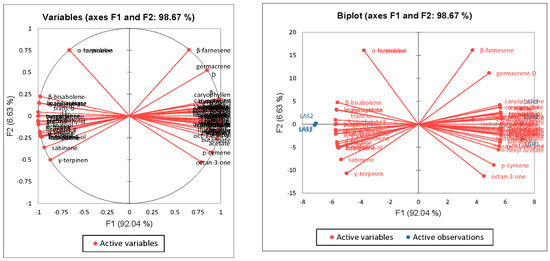
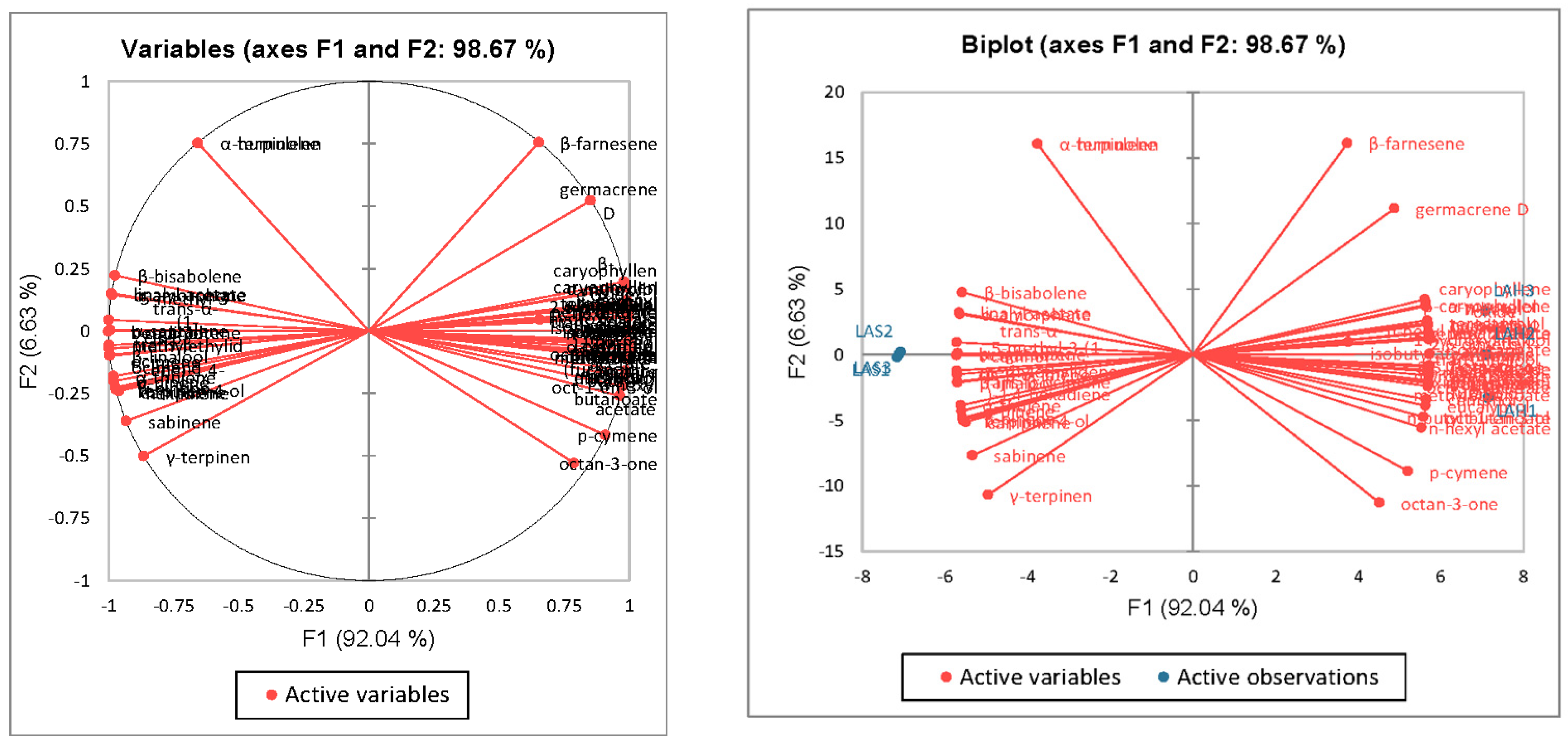
To evaluate the impact of extraction methodologies—specifically steam distillation (LAS) and hydrodistillation (LAH)—on the volatile chemical profiles of the lavender essential oils, the GC-MS datasets were subjected to PCA. As the initial step in the chemometric workflow, PCA was deployed to reduce data dimensionality and visualize sample relationships. The structural quality of the PCA model was confirmed via a scree plot. Principal Component 1 (F1) accounted for the vast majority of the total dataset variance at 92.04%, while Principal Component 2 (F2) explained an additional 6.63%. Together, these first two dimensions captured an exceptionally high cumulative variability of 98.67%, ensuring that the subsequent 2D projections retain nearly all relevant chemical information without significant data loss (Figure 1).
Figure 1.
Principal Component Analysis (PCA) of lavender essential oil volatile profiles obtained via steam distillation (LAS) and hydrodistillation (LAH): (left) a variable correlation circle, and (right) a PCA biplot showing the distribution of active observations (samples) and active variables (volatile compounds) along axes F1 and F2.
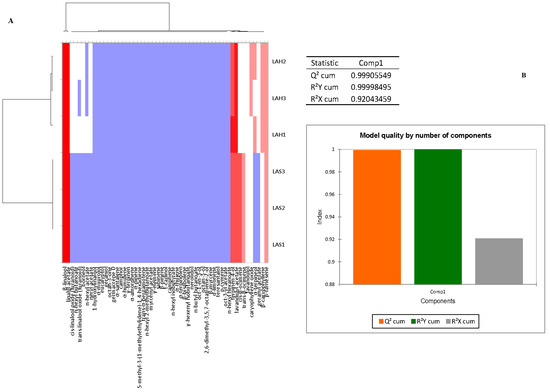
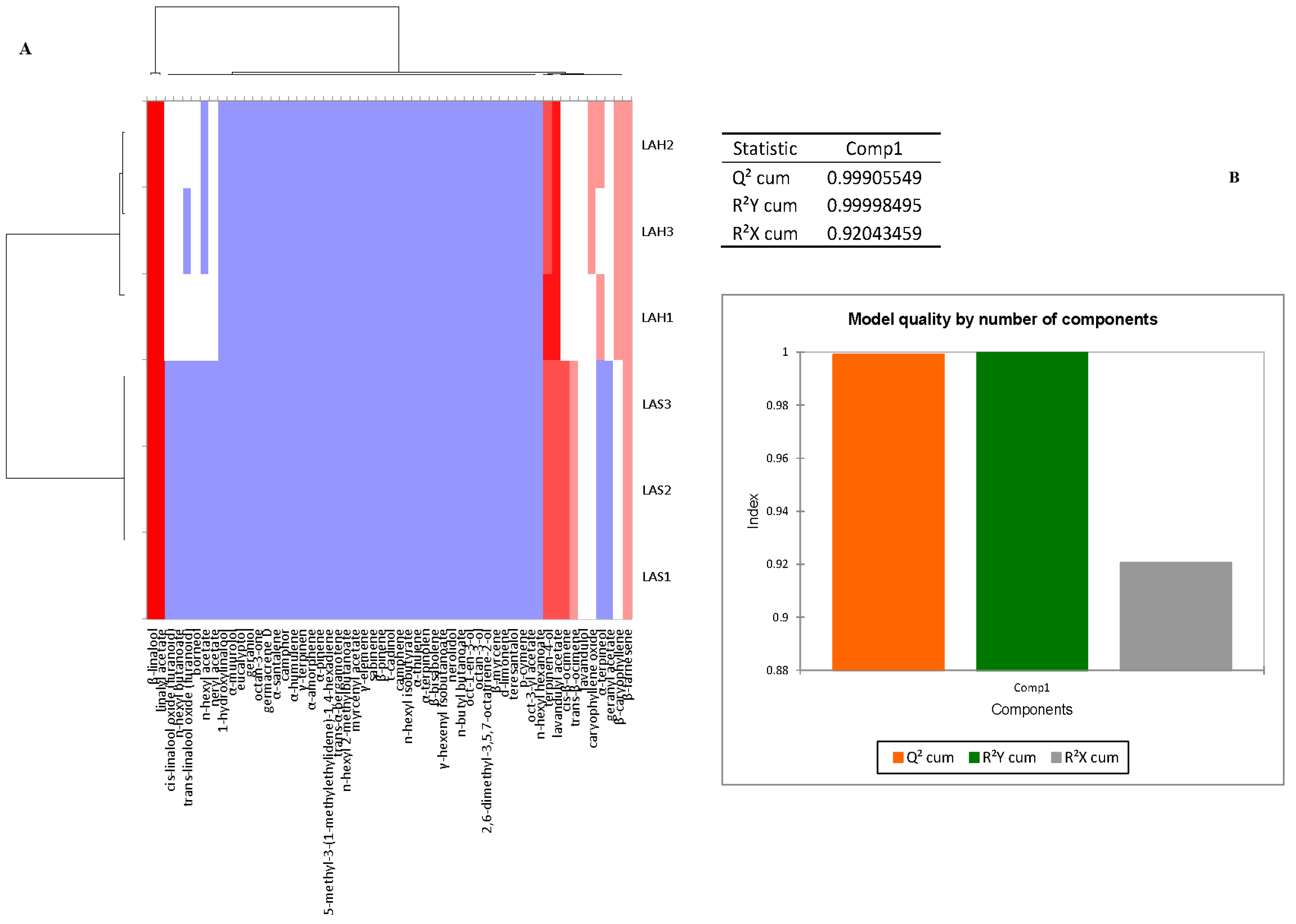
A definitive, absolute separation between the two extraction methods was observed along the horizontal F1 axis of the PCA biplot (Figure 1). The steam-distilled lavender oil replicates (LAS1, LAS2, and LAS3) clustered tightly on the far-left negative hemisphere (around F1 = −7). Conversely, the hydrodistilled samples (LAH1, LAH2, and LAH3) clustered as a uniform group on the far-right positive hemisphere (around F1 = +7). This stark spatial segregation highlights that water–matrix interactions and thermal dynamics during distillation fundamentally alter the volatile composition of the recovered essential oils. To validate these groupings independently without dimensional constraints, HCA was performed. The resulting dendrogram grouped the samples into two primary, highly isolated clusters separated at a large dissimilarity threshold of approximately 180 (Figure 2A). Cluster 1 exclusively contained the LAS replicates, while Cluster 2 comprised the LAH replicates. The near-zero dissimilarity within each individual branch underscores the high extraction reproducibility of both techniques, while the substantial gap between clusters confirms that the processing styles yield distinct volatile expressions. This global divergence is visually summarized in the two-way agglomerative heatmap (Figure 2A). The row-wise dendrogram perfectly segregates the samples by extraction type, mapping out intense shifts in relative chemical abundance (red/blue transitions) across major volatile compound blocks, such as the β-linalool and linalyl acetate matrices.
Figure 2.
Chemometric evaluation of lavender essential oil datasets across extraction methodologies: (A) dual-dendrogram HCA heat map illustrating sample clustering (LAS vs. LAH) and chemical variable distribution, (B) cross-validation diagnostics (Q2 and R2 cumulative values) evaluating PLS model quality.
To identify the definitive volatile compounds responsible for driving the discrimination between the two processing styles, a supervised Partial Least Squares (PLS) model was established. The PLS model quality index demonstrated that an optimal mathematical fit was achieved using only a single component (Comp1). As shown in Figure 2B the model exhibited a near-flawless explanatory capacity for the treatment categories (R2Y cum = 0.9999) and a remarkable cross-validated predictive power (Q2 cum = 0.9990), successfully accounting for 92.04% of the underlying predictor variance (R2X cum= 0.9204).
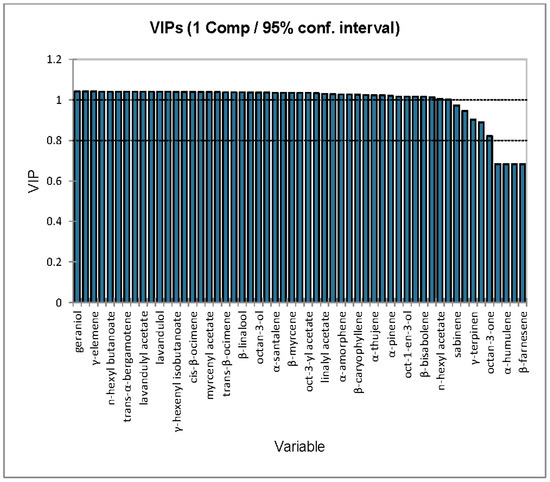
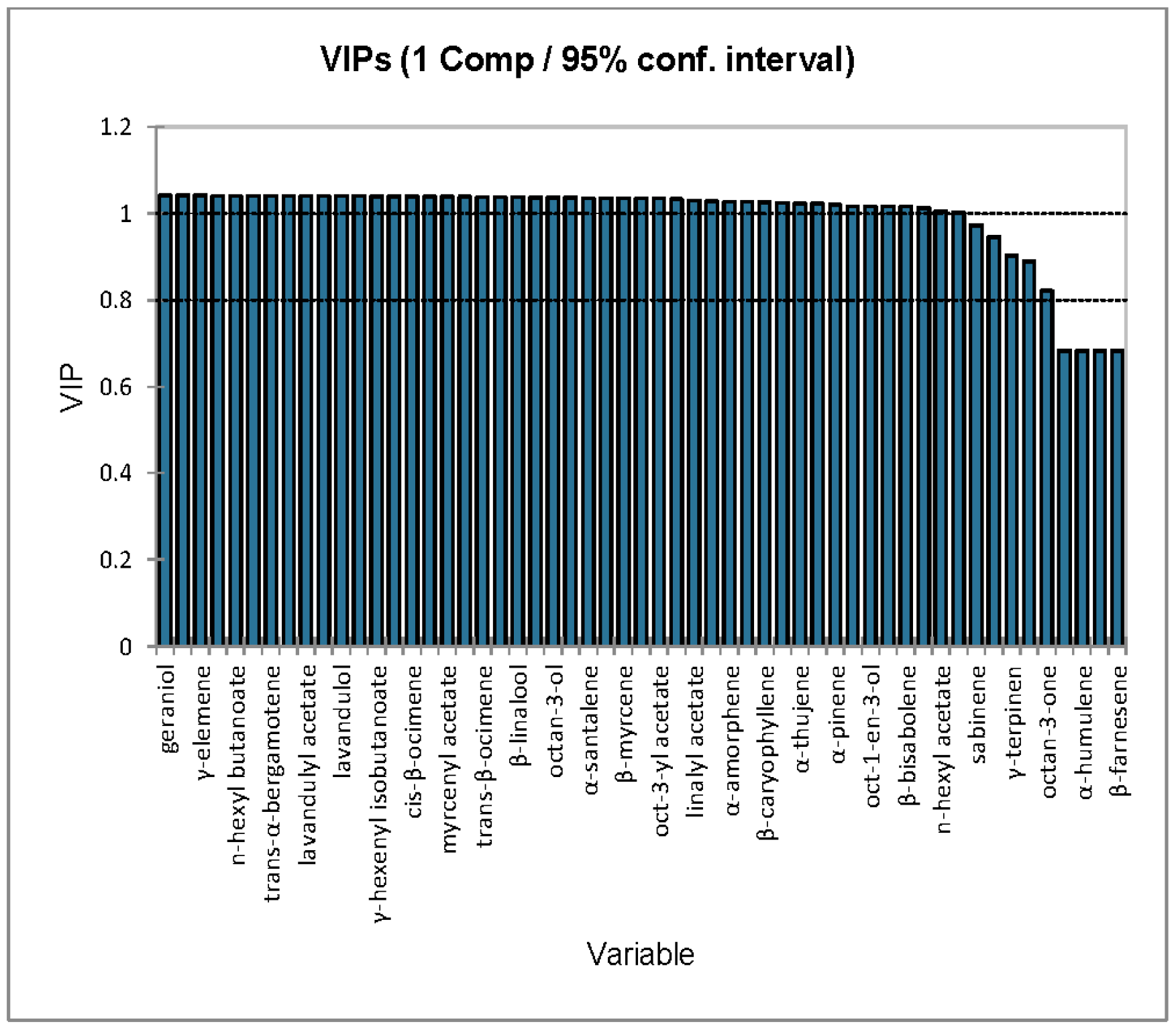
The volatile variables were subsequently ranked according to their Variable Importance in Projection (VIP) scores to pinpoint true extraction biomarkers. Compounds yielding a VIP score greater than the critical threshold of 1.0 are considered statistically significant contributors to model discrimination. Geraniol, γ-elemene, n-hexyl butanoate, trans-α-bergamotene, lavandulyl acetate, and lavandulol emerged as the dominant chemometric markers, topping the VIP index with values exceeding 1.05 (Figure 3).
Figure 3.
VIP score profile (1 component, 95% confidence interval) of volatile variables from lavender essential oil extractions.
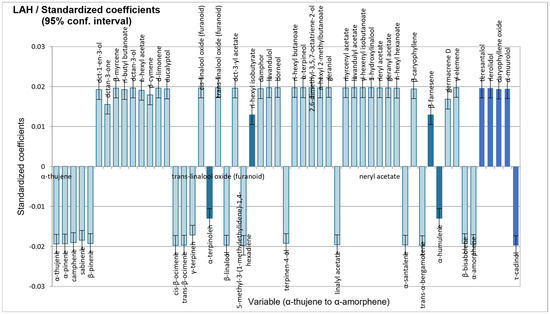
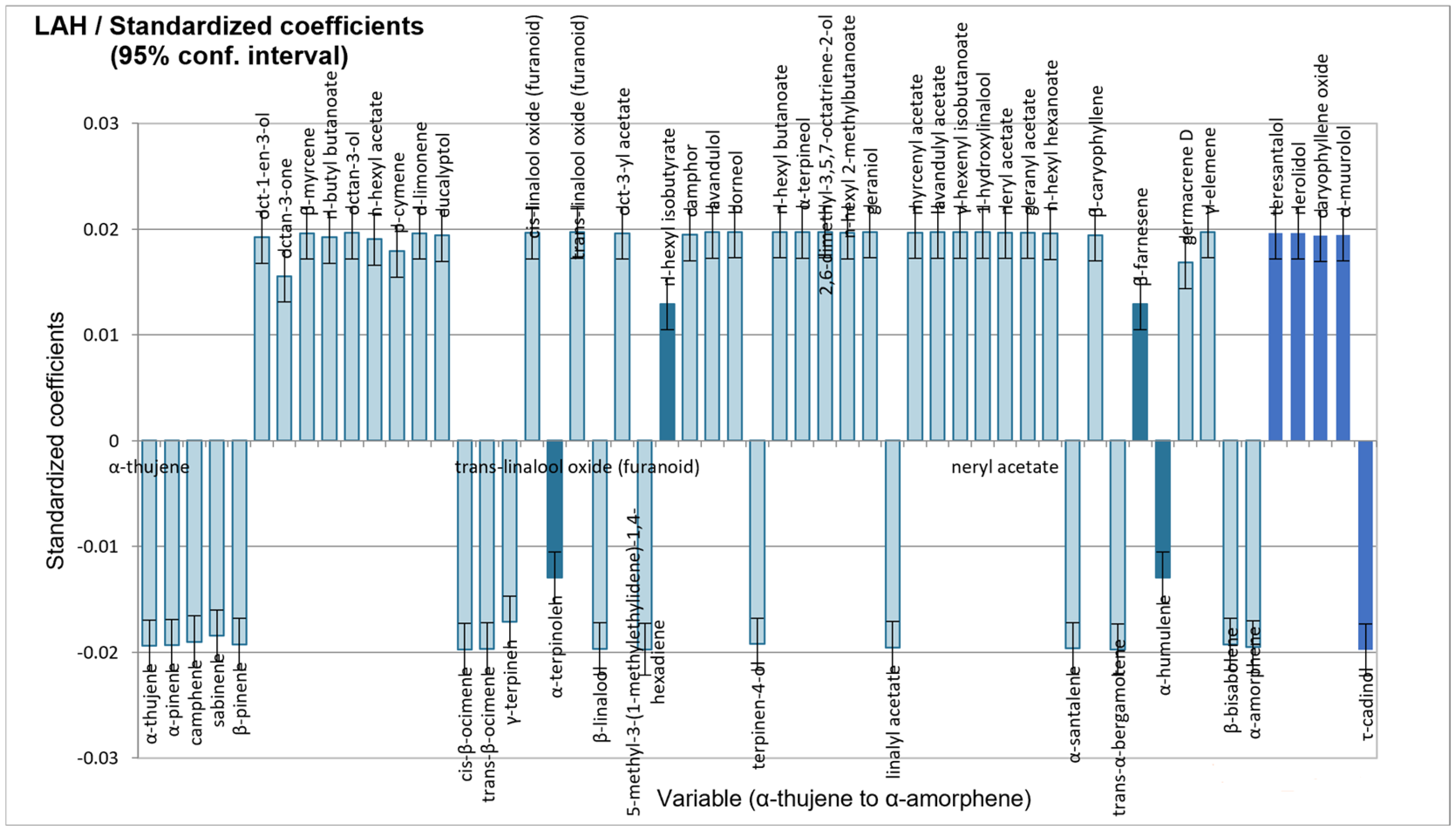
The specific directional impact of these chemical alterations was elucidated via the PLS standardized coefficients plot (Figure 4). Volatiles exhibiting strong positive coefficients were significantly enriched by or uniquely recovered via hydrodistillation (LAH). This group was characterized by aliphatic structures and specific oxygenated monoterpenes, including oct-1-en-3-ol, octan-3-one, β-myrcene, and D-limonene. Univariate z-testing confirmed the high significance of these findings, with octan-3-one yielding a p-value well below 0.01. In contrast, molecules yielding strong negative standardized coefficients were preferentially retained by steam distillation (LAS). This profile was heavily defined by monoterpene hydrocarbons and major bicyclic compounds, including α-thujene, α-pinene, camphene, sabinene, β-pinene, and the core constituent β-linalool.
Figure 4.
The standardized coefficient profile (95% confidence intervals) for the lavender volatile variables in relation to the hydrodistillation (LAH) group extraction profile.
Chemometric Meta-Analysis Across Varied Plant Taxa
To confirm whether the stark compositional divergence observed in lavender between steam distillation (LAS) and hydrodistillation (LAH) represents a universal processing trend, the identical chemometric workflow (PCA, HCA, and PLS-DA) was systematically applied to the rest of the plant matrices: Mentha piperita, Achillea millefolium, Mentha spicata, Hyssopus officinalis, Picea abies, and Salvia officinalis. Across all six botanical species, unsupervised HCA and PCA modeling achieved immediate, absolute binary segregation between the LAS and LAH processing fractions. The structural robustness of these independent models was exceptional, uniformly yielding cumulative dataset variance captures (R2X cum) exceeding 90%, near-flawless category fitting capacities (R2Y cum > 0.99), and high cross-validated predictability thresholds (Q2 cum > 0.98) (Table 4).
Table 4.
The comparative chemometric diagnostic metrics (R2X, R2Y, Q2) and primary VIP biomarker indicators for the six botanical volatile matrices under the LAS and LAH processing styles.
Due to the discrete sample size, the exceptionally high predictive capacity (Q2cum > 0.98) was rigorously cross-validated to confirm model soundness. A 200-iteration random permutation test was performed, yielding a distinctively low R2 intercept (<0.30) and a negative Q2 intercept (<−0.05), which mathematically verifies that the original model parameters are driven by legitimate chemical variances rather than random data correlation artifacts. Furthermore, the model’s structural stability was confirmed by CV-ANOVA diagnostics, which revealed a highly significant distribution (p < 0.001), establishing the definitive validity of the chemometric classification.
Biplot and standardized coefficient interpretations revealed that while the volatile matrices are highly species-specific, a clear structural pattern governs distillation mechanics. Hydrodistillation consistently enriches low-boiling, highly volatile oxygenated structures and specific aliphatic compounds. Conversely, steam distillation selectively favored the preservation of thermally sensitive sesquiterpene fractions and specific monoterpene hydrocarbons across all species, confirming that physical distillation dynamics dictate volatile recovery independent of the underlying plant taxonomy. For a detailed visualization of the individual chemometric distributions, all statistical graphs—including multi-panel PCA, HCA, and PLS-DA projections for each of the six plant matrices—have been compiled in the Supplementary Information (See Supplementary Materials Multivariate Statistical Analysis for every extracted essential oil).
In conclusion, the application of complementary unsupervised (PCA, HCA) and supervised (PLS-DA) chemometric workflows successfully decoded the complex volatile profiles of the studied plant extractions. Across all evaluated botanical matrices, the processing methodology emerged as the dominant factor driving chemical divergence, consistently yielding distinct, highly reproducible volatile expressions. By establishing robust mathematical fits (Q2 > 0.98) and identifying definitive VIP extraction biomarkers, these findings demonstrate that chemometric modeling is an indispensable tool for objective quality control, chemical tracking, and the optimization of essential oil distillation processes.
5. Conclusions
To the authors’ knowledge, no previous studies have detailed the volatile profiles of these specific aromatic and coniferous matrices harvested within the unique microclimatic conditions of the Târgu Secuiesc Depression, situated at the base of the Curvature Carpathians.
This study provides a comprehensive, comparative evaluation of how extraction scale and methodology—specifically laboratory-scale HD and semi-industrial-scale dry SD—fundamentally shape the volatile chemical profiles of essential oils across multiple plant taxa. By utilizing a highly systematic approach, this work demonstrates that while the baseline volatile matrix is highly species-specific, the underlying physical mechanisms of distillation exert a predictable, systemic effect on volatile recovery.
Unsupervised chemometric modeling (PCA and HCA) achieved flawless binary separation between processing fractions across all seven investigated plant matrices, proving exceptional extraction reproducibility. Furthermore, supervised PLS-DA modeling successfully mapped and isolated key volatile biomarkers, confirming that hydrodistillation preferentially enriches low-boiling, oxygenated structures, whereas steam distillation selectively preserves thermally sensitive sesquiterpene fractions. Ultimately, these findings underscore that multivariate chemometric processing coupled with GC-MS characterization is an indispensable tool for objective quality control, chemical standardization, and industrial process optimization in the essential oil and phytopharmaceutical sectors. Based on our chemometric data, we provide two actionable industrial recommendations: (1) For high-value fragrances (e.g., Lavandula angustifolia), fresh biomass SD lines should be selected to preserve delicate, volatile monoterpene hydrocarbons and avoid the thermal degradation off-notes caused by water immersion (HD). (2) For phytopharmaceuticals targeting heavier bioactives (e.g., thunbergol in spruce or viridiflorol in sage), setups mimicking HD or utilizing extended steam processing of dehydrated biomass are preferred to maximize the recovery of less volatile sesquiterpene alcohols and diterpenes.
Supplementary Materials
The following supporting information can be downloaded at: https://www.mdpi.com/article/10.3390/molecules31122105/s1, Figures S1. GC-MS total ion chromatogram (TIC) of the chemical profile from Picea abies obtained by HD extraction. Figure S2. GC-MS total ion chromatogram (TIC) of the chemical profile from Lavandula angustifolia obtained by HD extraction. Figure S3. GC-MS total ion chromatogram (TIC) of the chemical profile from Hyssopus officinalis obtained by HD extraction. Figure S4. GC-MS total ion chromatogram (TIC) of the chemical profile from Salvia officinalis obtained by HD extraction. Figure S5. GC-MS total ion chromatogram (TIC) of the chemical profile from Picea abies obtained by SD extraction. Figure S6. GC-MS total ion chromatogram (TIC) of the chemical profile from Salvia officinalis obtained by SD extraction; Table S1. Chemical composition of Salvia officinalis SEO and HEO. Table S2. Chemical composition of Mentha piperita SEO and HEO. Table S3. Chemical composition of Achillea millefolium SEO and HEO. Table S4. Chemical composition of Mentha spicata SEO and HEO. Table S5. Chemical composition of Hyssopus officinalis SEO and HEO.
Author Contributions
Conceptualization, N.L. and E.G.; methodology, N.L. and E.G.; software, N.L.; provision of plant materials and production of essential oils, N.L.; writing—original draft preparation, N.L. and E.G. All authors have read and agreed to the published version of the manuscript.
Funding
This research received no external funding.
Data Availability Statement
The data presented in this study are available within the article and its associated Supplementary Materials.
Conflicts of Interest
The authors declare no conflicts of interest.
Abbreviations
The following abbreviations are used in this manuscript:
| EO | Essential oil |
| HD | Hydrodistillation |
| SD | Steam distillation |
| HEO | Essential oils obtained by hydrodistillation |
| SEO | Essential oils obtained by steam distillation |
| MT | Monoterpene |
| OMT | Oxygenated monoterpene |
| ST | Sesquiterpene |
| OST | Oxygenated sesquiterpene |
References
- Yohannis, E.; Urugo, M.M.; Hassan, S.M.; Teka, T.A.; Getachew, P.; Bacha, K. A comprehensive review of essential oils in food systems: Transformative insights into extraction, chemistry, industrial innovation, and future frontiers. Food Res. Int. 2026, 226, 118072. [Google Scholar] [CrossRef] [Scilit] [PubMed]
- Chahla, B.; Salih, B.M.; Adriana, B.; Viviana, M.; Guido, F.; Sergio, S.; Federica, C.; Rosaria, N.; Marina, P.; Abdelmounaim, K.; et al. Chemical Composition and Biological Activities of Oregano and Lavender Essential Oils. Appl. Sci. 2021, 11, 5688. [Google Scholar] [CrossRef] [Scilit]
- Doğan, H.; Genç, A.; Telci, İ. Comparison of Conventional Steam Distillation and Industrial-Type Microwave-Assisted Distillation Systems for Lavandin (Lavandula × Intermedia Emeric Ex Loisel): Energy Consumption, Essential Oil Yield, and Quality. J. Essent. Oil-Bear. Plants 2025, 28, 126–139. [Google Scholar] [CrossRef] [Scilit]
- Jaouadi, I.; Cherrad, S.; Bouyahya, A.; Koursaoui, L.; Satrani, B.; Ghanmi, M.; Chaouch, A. Chemical Variability and Antioxidant Activity of Cedrus Atlantica Manetti Essential Oils Isolated from Wood Tar and Sawdust. Arab. J. Chem. 2021, 14, 103441. [Google Scholar] [CrossRef] [Scilit]
- Pheko-Ofitlhile, T.; Makhzoum, A. Impact of Hydrodistillation and Steam Distillation on the Yield and Chemical Composition of Essential Oils and Their Comparison with Modern Isolation Techniques. J. Essent. Oil Res. 2024, 36, 105–115. [Google Scholar] [CrossRef] [Scilit]
- Masango, P. Cleaner Production of Essential Oils by Steam Distillation. J. Clean. Prod. 2005, 13, 833–839. [Google Scholar] [CrossRef] [Scilit]
- Politeo, O.; Popović, M.; Veršić Bratinčević, M.; Koceić, P.; Ninčević Runjić, T.; Mekinić, I.G. Conventional vs. Microwave-Assisted Hydrodistillation: Influence on the Chemistry of Sea Fennel Essential Oil and Its By-Products. Plants 2023, 12, 1466. [Google Scholar] [CrossRef] [Scilit] [PubMed]
- Řebíčková, K.; Bajer, T.; Šilha, D.; Ventura, K.; Bajerová, P. Comparison of Chemical Composition and Biological Properties of Essential Oils Obtained by Hydrodistillation and Steam Distillation of Laurus nobilis L. Plant Foods Hum. Nutr. 2020, 75, 495–504. [Google Scholar] [CrossRef] [Scilit] [PubMed]
- Schmidt, E. Production of Essential Oils. In Handbook of Essential Oils: Science, Technology, and Applications, 1st ed.; Hüsnü Can Baser, K., Buchbauer, G., Eds.; CRC Press Taylor & Francis Group: Boca Raton, FL, USA, 2010; pp. 83–121. [Google Scholar]
- El Kharraf, S.; Faleiro, M.L.; Abdellah, F.; El-Guendouz, S.; El Hadrami, E.M.; Miguel, M.G. Simultaneous Hydrodistillation-Steam Distillation of Rosmarinus officinalis, Lavandula angustifolia and Citrus aurantium from Morocco, Major Terpenes: Impact on Biological Activities. Molecules 2021, 26, 5452. [Google Scholar] [CrossRef] [Scilit] [PubMed]
- Pipatpaiboon, N.; Parametthanuwat, T.; Bhuwakietkumjohn, N.; Ding, Y.; Li, Y.; Sichamnan, S. Improving the Efficiency of Essential Oil Distillation via Recurrent Water and Steam Distillation: Application of a 500-L Prototype Distillation Machine and Different Raw Material Packing Grids. AgriEngineering 2025, 7, 175. [Google Scholar] [CrossRef] [Scilit]
- Pham, V.P.; Nguyen, B.V.; Le, X.T.; Nguyen, T.N.L.; Nguyen, P.T.N.; Tran, T.T.T.; Mai, H.C. Investigate Factors Affecting the Extraction of Pomelo Essential Oil (Citrus grandis) in Laboratory and Pilot Scale. Food Res. 2025, 9, 62–69. [Google Scholar] [CrossRef] [Scilit] [PubMed]
- Babu, K.G.D.; Kaul, V.K. Variation in Essential Oil Composition of Rose-Scented Geranium (Pelargonium sp.) Distilled by Different Distillation Techniques. Flavour Fragr. J. 2005, 20, 222–231. [Google Scholar] [CrossRef] [Scilit]
- Grigore, I.; Sorică, E.; Sorică, C.; Grigore, I.A.; Vlădutoiu, L.; Bolintineanu, G.; Dumitru, I.; Bălan, V. Considerations on the technology of mint culture and essential oil obtaining. In Proceedings of the International Symposium ISB-INMA-THE’ 2017, Bucharest, Romania, 26–28 October 2017. [Google Scholar]
- Székely-Szentmiklósi, I.; Rédai, E.M.; Szabó, Z.I.; Kovács, B.; Albert, C.; Gergely, A.L.; Székely-Szentmiklósi, B.; Sipos, E. Microencapsulation by Complex Coacervation of Lavender Oil Obtained by Steam Distillation at Semi-Industrial Scale. Foods 2024, 13, 2935. [Google Scholar] [CrossRef] [Scilit] [PubMed]
- Salamon, I.; Kryvtsova, M.; Bucko, D.; Tarawneh, A.H. Chemical characterization and antimicrobial activity of some essential oils after their industrial large-scale distillation. J. Microbiol. Biotechnol. Food Sci. 2018, 8, 965–969. [Google Scholar] [CrossRef] [Scilit]
- Kiran Babu, G.D.; Sharma, A.; Singh, B. Volatile composition of Lavandula angustifolia produced by different extraction techniques. J. Essent. Oil Res. 2016, 28, 489–500. [Google Scholar] [CrossRef] [Scilit]
- Jažo, Z.; Glumac, M.; Paštar, V.; Bektić, S.; Radan, M.; Carev, I. Chemical Composition and Biological Activity of Salvia officinalis L. Essential Oil. Plants 2023, 12, 1794. [Google Scholar] [CrossRef] [Scilit] [PubMed]
- Wesołowska, A.; Jadczak, D.; Grzeszczuk, M. Essential Oil Composition of Hyssop (Hyssopus officinalis L.) Cultivated in North-Western Poland. Herba Pol. 2010, 56, 58–65. [Google Scholar]
- Hudz, N.; Kobylinska, L.; Pokajewicz, K.; Horčinová Sedláčková, V.; Fedin, R.; Voloshyn, M.; Myskiv, I.; Brindza, J.; Wieczorek, P.P.; Lipok, J. Mentha piperita: Essential Oil and Extracts, Their Biological Activities, and Perspectives on the Development of New Medicinal and Cosmetic Products. Molecules 2023, 28, 7444. [Google Scholar] [CrossRef] [Scilit] [PubMed]
- Wu, Z.; Tan, B.; Liu, Y.; Dunn, J.; Martorell Guerola, P.; Tortajada, M.; Cao, Z.; Ji, P. Chemical Composition and Antioxidant Properties of Essential Oils from Peppermint, Native Spearmint and Scotch Spearmint. Molecules 2019, 24, 2825. [Google Scholar] [CrossRef] [Scilit] [PubMed]
- Daniel, P.S.; Lourenço, E.L.B.; da Cruz, R.M.S.; De Souza Gonçalves, C.H.; Das Almas, L.R.M.; Hoscheid, J.; da Silva, C.; Jacomassi, E.; Brum, L.; Alberton, O. Composition and Antimicrobial Activity of Essential Oil of Yarrow (Achillea millefolium L.). Aust. J. Crop Sci. 2020, 14, 545–550. [Google Scholar] [CrossRef] [Scilit] [PubMed]
- Ščiukaitė, A.; Ložienė, K.; Labokas, J.; Jurkonienė, S. Contents of Some Bioactive Compounds in Norway Spruce Needles as Affected by Short-Term Storage at Different Conditions and Implications for Their Industrial Use. Ind. Crops Prod. 2022, 182, 114919. [Google Scholar] [CrossRef] [Scilit]
- Gudaityte, O.; Venskutonis, P.R. Chemotypes of Achillea millefolium Transferred from 14 Different Locations in Lithuania to the Controlled Environment. Biochem. Syst. Ecol. 2007, 35, 582–592. [Google Scholar] [CrossRef] [Scilit]
- Turk, B.; Baričevič, D.; Batič, F. Essential Oil Content, Chamazulene Content and Antioxidative Properties of Achillea millefolium Agg. Extracts from Slovenia. Acta Agric. Slov. 2021, 117, 1–10. [Google Scholar] [CrossRef] [Scilit]
- Orav, A.; Arak, E.; Raal, A. Phytochemical Analysis of the Essential Oil of Achillea millefolium L. from Various European Countries. Nat. Prod. Res. 2006, 20, 1082–1088. [Google Scholar] [CrossRef] [Scilit] [PubMed]
- Mockute, D.; Judzentiene, A. Variability of the Essential Oils Composition of Achillea millefolium ssp. Millefolium Growing Wild in Lithuania. Biochem. Syst. Ecol. 2003, 31, 1033–1045. [Google Scholar] [CrossRef] [Scilit]
- Missouri Botanical Garden Plant Finder: Hyssopus officinalis. Available online: https://www.missouribotanicalgarden.org/PlantFinder/PlantFinderDetails.aspx?kempercode=b939 (accessed on 23 April 2026).
- Said-Al Ahl, H.A.H.; Abbas, Z.K.; Sabra, A.S.; Tkachenko, K.G. Essential Oil Composition of Hyssopus officinalis L. Cultivated in Egypt. Int. J. Plant Sci. Ecol. 2015, 1, 49–53. [Google Scholar]
- Nurzyńska-Wierdak, R. Ontogenetic and Environmental Variability of Hyssop (Hyssopus officinalis L.) Essential Oil Composition and Activity. Plants 2026, 15, 487. [Google Scholar] [CrossRef] [Scilit] [PubMed]
- Moghtader, M. Comparative evaluation of the essential oil composition from the leaves and flowers of Hyssopus officinalis L. J. Hortic. For. 2014, 6, 1–5. [Google Scholar] [CrossRef] [Scilit]
- Zawiślak, G. The chemical composition of essential hyssop oil depending on plant growth stage. Acta Sci. Pol. Hortorum Cultus 2013, 12, 161–170. [Google Scholar]
- Raal, A.; Orav, A.; Ilina, T.; Kovalyova, A.; Koliadzhyn, T.; Avidzba, Y.; Koshovyi, O. Variation in the Composition of the Essential Oil of Commercial Salvia officinalis L. Leaves Samples from Different Countries. Phyton-Int. J. Exp. Bot. 2024, 93, 2051–2062. [Google Scholar] [CrossRef] [Scilit]
- ISO 856:2006; Oil of peppermint (Mentha × piperita L.). ISO: Geneva, Switzerland, 2006.
- Pharmacia Lettre, D.; Boukhebti, H.; Nadjib Chaker, A.; Belhadj, H.; Sahli, F.; Ramdhani, M.; Laouer, H.; Harzallah, D. Chemical composition and antibacterial activity of Mentha pulegium L. and Mentha spicata L. essential oils. Der Pharm. Lett. 2011, 3, 267–275. [Google Scholar]
- Plantmaps Romania Interactive Plant Hardiness Zone Map. Available online: https://www.plantmaps.com/interactive-romania-plant-hardiness-zone-map-celsius.php (accessed on 23 April 2026).
- Lumivero. XLSTAT Statistical and Data Analysis Solution, version 2023.1; Lumivero: Denver, CO, USA, 2023.
- Council of Europe. Determination of essential oils in herbal drugs. In European Pharmacopoeia, 10th ed.; Chapter 2.8.12; Directorate for the Quality of Medicines & HealthCare of the Council of Europe: Strasbourg, France, 2020. [Google Scholar]
- National Institute of Standards and Technology. NIST/EPA/NIH Mass Spectral Library (NIST 14); NIST Mass Spectrometry Data Center: Gaithersburg, MD, USA, 2014.
- National Institute of Standards and Technology. NIST/EPA/NIH Mass Spectral Library (NIST 17); NIST Mass Spectrometry Data Center: Gaithersburg, MD, USA, 2017.
- Lucero, M.; Estell, R.; Tellez, M.; Fredrickson, E. A Retention Index Calculator Simplifies Identification of Plant Volatile Organic Compounds. Phytochem. Anal. 2009, 20, 378–384. [Google Scholar] [CrossRef] [Scilit] [PubMed]
- Babushok, V.I.; Linstrom, P.J.; Zenkevich, I.G. Retention Indices for Frequently Reported Compounds of Plant Essential Oils. J. Phys. Chem. Ref. Data 2011, 40, 1–47. [Google Scholar] [CrossRef] [Scilit]

Disclaimer/Publisher’s Note: The statements, opinions and data contained in all publications are solely those of the individual author(s) and contributor(s) and not of MDPI and/or the editor(s). MDPI and/or the editor(s) disclaim responsibility for any injury to people or property resulting from any ideas, methods, instructions or products referred to in the content. |
© 2026 by the authors. Licensee MDPI, Basel, Switzerland. This article is an open access article distributed under the terms and conditions of the Creative Commons Attribution (CC BY) license.