


Abstract
Publications covering a new easy metal-free functionalization of pyridinoids (pyridines, quinolines, isoquinolines, acridine) under the action of the system of electron-deficient acetylenes (acetylenecarboxylic acid esters, acylacetylenes)/P-nucleophiles (phosphine chalcogenides, H-phosphonates) are reviewed. Special attention is focused on a SNH reaction of the regioselective cross-coupling of pyridines with secondary phosphine chalcogenides triggered by acylacetylenes to give 4-chalcogenophosphorylpyridines. In these processes, acetylenes act as three-modal adjuvants (i) activating the pyridine ring towards P-nucleophiles, (ii) deprotonating the P-H bond and (iii) facilitating the nucleophilic addition of the P-centered anion to a heterocyclic moiety followed by the release of the selectively reduced acetylenes (E-alkenes).
1. Introduction
Phosphorylated heterocyclic compounds have attracted steadily growing attention as perspective pharmaceuticals or their precursors [1,2,3], multipurpose ligands for the design of biologically active metal complexes [4,5,6,7] and catalysts [8,9,10,11], as well as building blocks for organic synthesis [12,13,14,15]. Among them, pyridines and their condensed derivatives (especially quinolines), with phosphorus-containing functional groups, are of particular research interest [1,2,5,6,7,8,9,10,11,12,13,14].
Significant endeavors have been directed towards the synthesis of such compounds, a transition metal-free nucleophilic substitution of hydrogen in a heteroaromatic ring (SNH reaction) by phosphorus-centered nucleophiles being one of the most dynamically developing approaches because of its apparent benefits (environmental friendliness, no pre-functionalization of the starting materials, no toxic waste). This has been evidenced by a series of reviews [16,17,18,19,20,21,22,23,24] by Mąkosza’s [16,22,25,26,27,28] and Chupakhin’s [18,19,20,21,23,24,29,30,31,32] groups, who pioneered this chemistry. Commonly, these processes meet three requirements: (i) the electrophilic activation of the aromatic ring, (ii) generation of the attacking anion with strong bases and (iii) aromatization of anionic σH-adducts or dihydro intermediates by external oxidants. As a rule, the nitro-substituents, or N-O bonds (N-oxide moiety), are employed activating groups. In particular, this was shown by the phosphorylation of nitroarene with phosphine anions, followed by the permanganate oxidation of the anionic species [27,28] or by the phosphorylation of acridinium salts with trialkylphosphite [32,33,34]. The extrinsic activation of quinolines, phenanthrolines and naphthyridines by sulfuric acid towards a nucleophilic attack by dimethyltrimethylsilylphosphite leading to the double phosphorylation of the heterocycle has also been implemented [35,36].
A short time ago [37,38,39,40], the nucleophilic substitution of hydrogen (SNH reaction) in non-activated pyridines and their fused derivatives by secondary phosphine chalcogenides (synthesized from red phosphorus [41,42,43,44]) in the presence of electron-deficient terminal and internal acetylenes was disclosed. These reactions involve the step of N-vinylation/C-phosphorylation of pyridinoids, and are often retained at this step [45,46,47,48,49]. Afterwards, a series of this finding’s follow-up works appeared.
This review covers publications (since 1999) concerning the reactions of pyridinoids with PH–nucleophiles in the presence of electron-deficient acetylenes which act as trimodal (polarization/deprotonation/oxidation) catalyst-like adjuvants.
2. SNH Phosphorylation of Pyridines Triggered and Driven by Electrophilic Acetylenes
2.1. One-Step SNH Phosphorylation
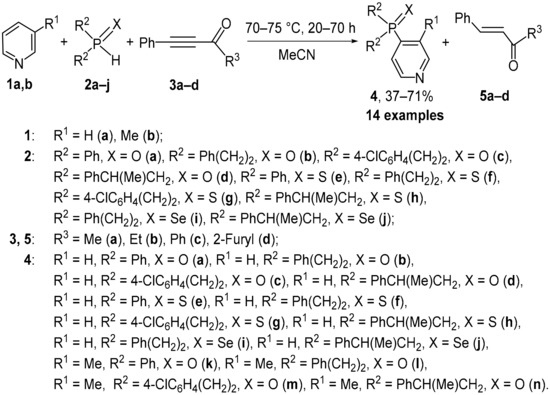
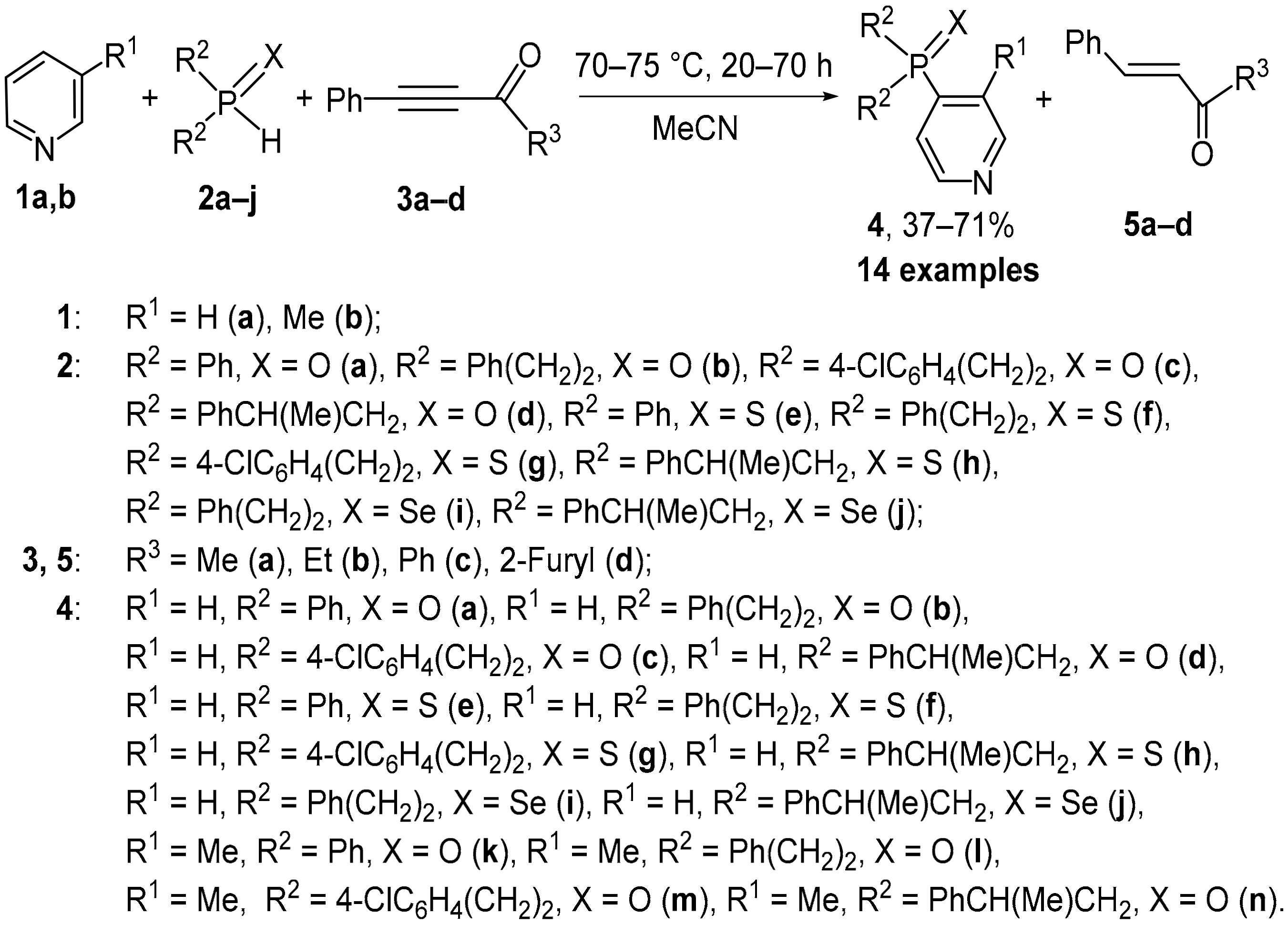
In 2018, it was found that the regioselective oxidative cross-coupling reaction between pyridines 1a,b and secondary phosphine chalcogenides 2a–j was triggered and further driven by electrophilic acetylenes 3a–d to produce SNH products, phosphorylated pyridines 4a–n, and E-acylphenylethenes 5a–d (Scheme 1) [37]. The reaction tolerates a quite representative number of structurally diverse secondary phosphine chalcogenides (oxides, sulfides and selenides), having both aromatic and alkyl aromatic substituents.
Scheme 1.
SNH cross-coupling of pyridines with secondary phosphine chalcogenides in the presence of acylphenylacetylenes.
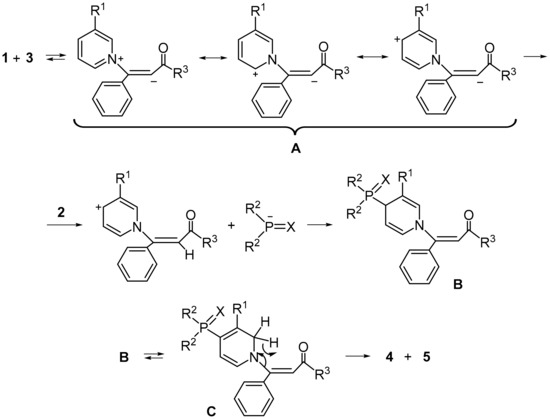
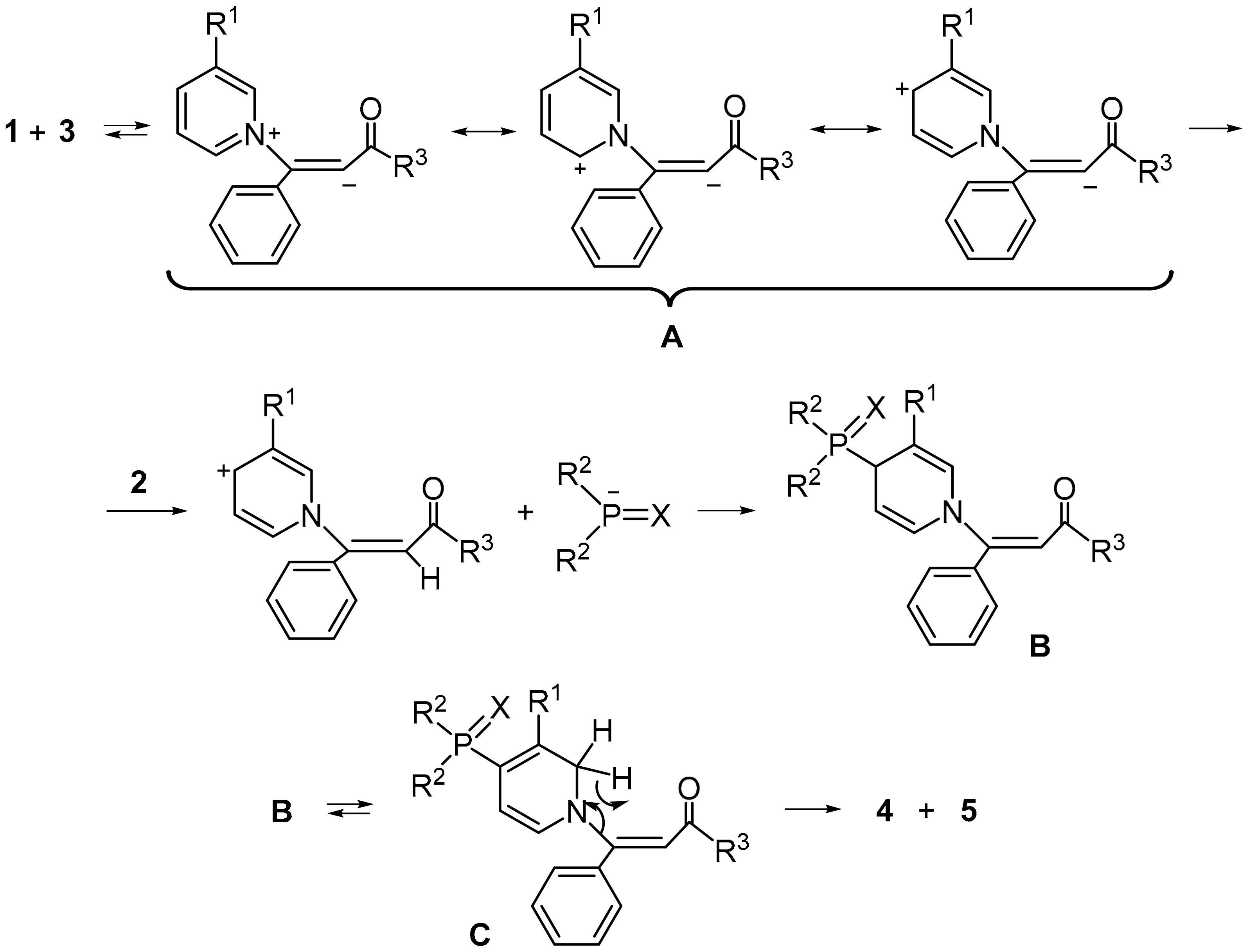
The reaction involves the reversible generation of 1,3-dipole A via a nucleophilic attack of pyridine nitrogen at the electron-deficient triple bond (Scheme 2) [37].
Scheme 2.
A plausible reaction pathway.
The intermediate A accepts a proton from the phosphine chalcogenides 2 to produce the P-centered anion, which regioselectively attacks position four of the pyridine ring delivering dihydropyridine B. Its aromatization occurs via the stereoselective elimination of E-acylphenylethenes 5 from isomerized intermediate B⇌C. The elimination includes the transfer of the hydride anion from position two of dihydropyridine to emerging carbocation. The driving force of the elimination is likely a higher thermodynamic stability of the final products (phosphorylated pyridines 4 and conjugated functionalized ethenes 5) as compared to intermediates B⇌C.
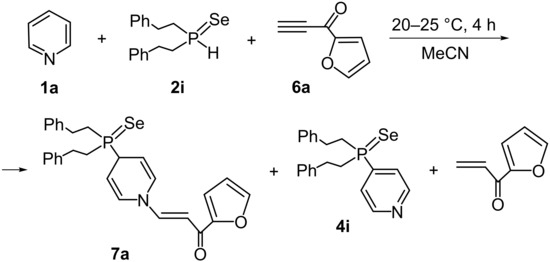
The mechanism is supported by the detection of the intermediate dihydropyridine 7a in a mixture (1H and 31P NMR) with the corresponding pyridine 4i, when pyridine 1a reacts (room temperature, MeCN, 4 h) with terminal furoylacetylene 6a (having no phenyl substituent in position two) and phosphine selenide 2i (Scheme 3).
Scheme 3.
Reaction of pyridine, phosphine selenide and furoylacetylene.
The perdeuteropyridine (pyridine-d5) with phosphine sulfide 2f and acetylene 3c afforded the isotopically labeled cross-coupling product, 4-[bis(2-phenylethyl)thiophosphoryl]pyridine-d4, in a 42% yield (for 50 h) [37]. The low yield and longer reaction time compared to those for non-deuterated pyridine (71%, 35 h) are likely due to the deuterium kinetic isotopic effect. Notably, 3-fluoropyridine appeared unable to undergo above cross-coupling, obviously because of its lower basicity/nucleophilicity (an electron-acceptor effect of the fluorine atom).
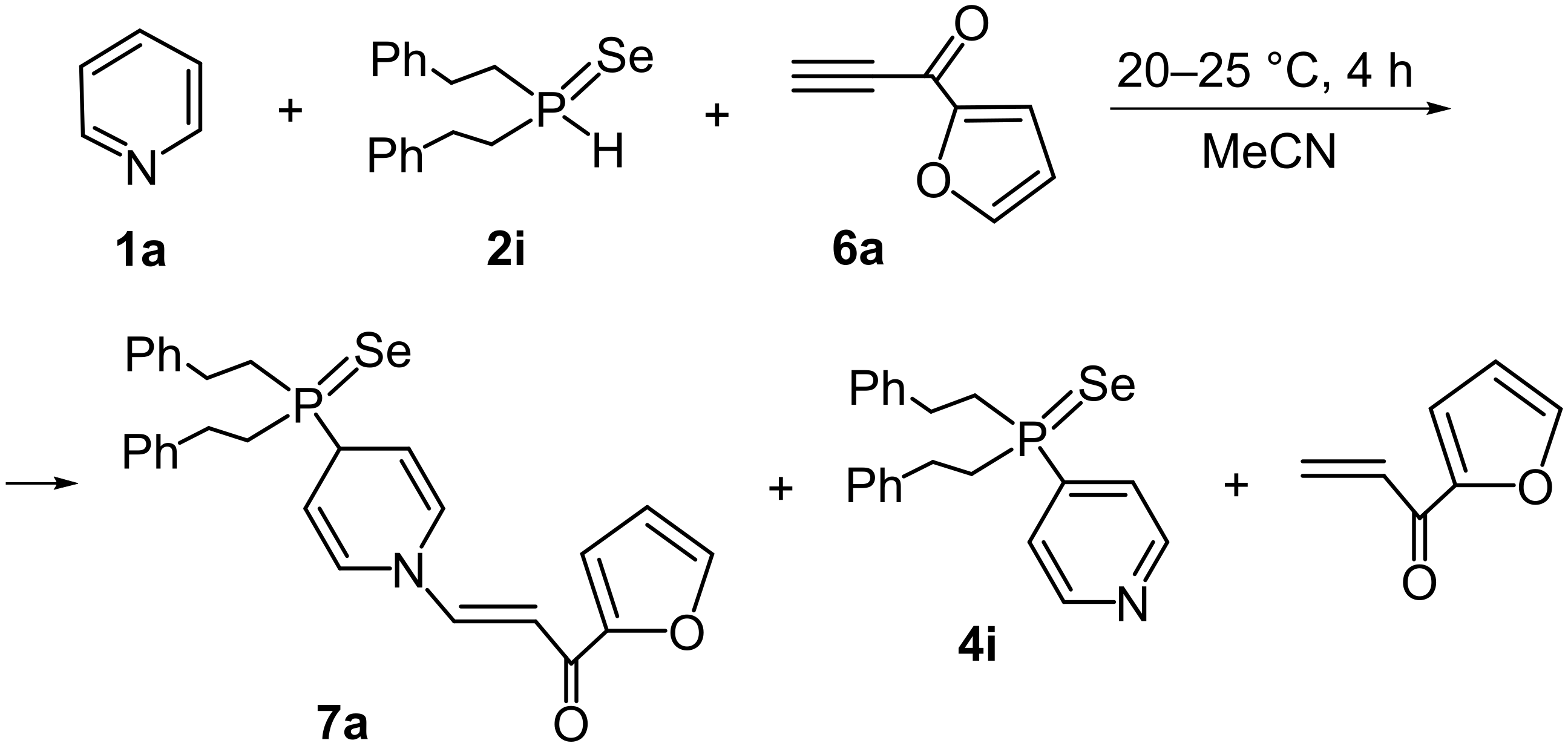
The observed moderate yields of the cross-coupling products with phosphine selenides 2i,j (37–40%) vs. the ones with phosphine oxides and sulfides [37] (55–71%) are due to the side selenylation of the starting acetylenes 3 to divinyl selenides 8 (Scheme 4).
Scheme 4.
Selenylation of the acylphenylacetylenes by secondary phosphine selenides.
The unusual selenium transfer from secondary phosphine selenides 2i,j to the electron-deficient triple bond involves trace water and can also proceed in aqueous media (70–72 °C, 3 h) [50,51].
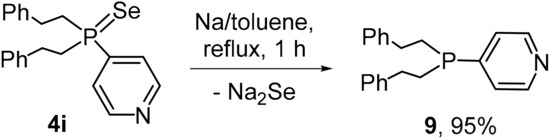
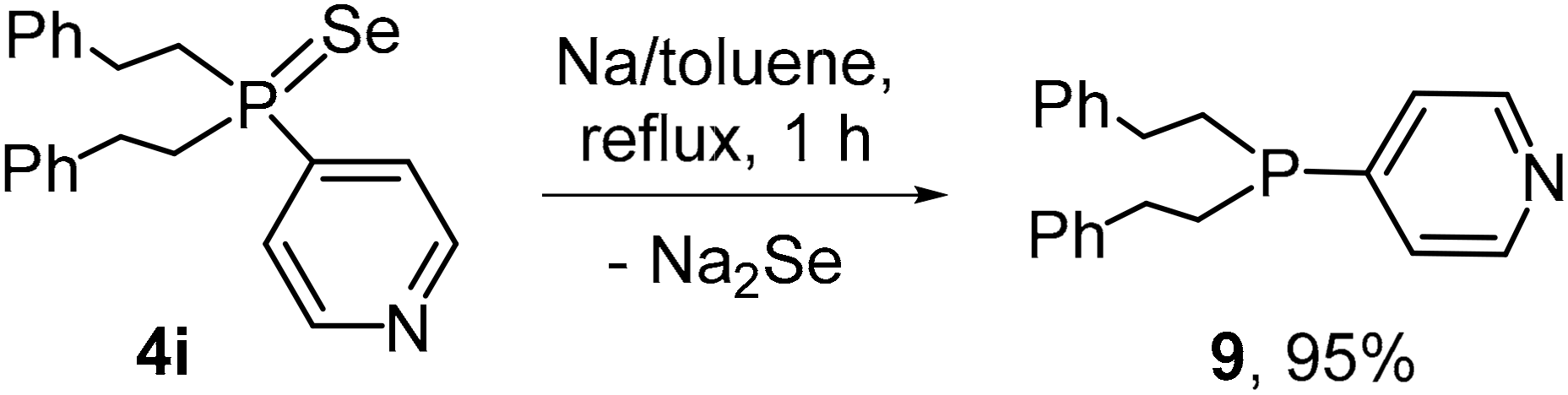
The above cross-coupling might open simple access to the related phosphines, sought-after ligands for new catalytically active metal complexes, having been demonstrated by the reduction in selenophosphorylpyridine 4i to phosphine 9 (Scheme 5) [37].
Scheme 5.
Synthesis of 4-pyridyl-bis(2-phenylethyl)phosphine.
The improved green route towards 4-chalcogenophosphorylpyridines 4 was also developed [38]. Therefore, it was found that the previously considered SNH cross-coupling of pyridine 1a and 3-methylpyridine 1b with bis(2-phenylethyl)phosphine oxide 2b or bis(2-phenylethyl)phosphine sulfide 2f in the presence of benzoylphenylacetylene 3c as an adjuvant can be realized in a solvent-free version for a much shorter time (5.5–7 h), similar to Scheme 1. This greener protocol for the synthesis of phosphorylated pyridines 4 is not only environmentally friendly, but in some cases provides better average yields.
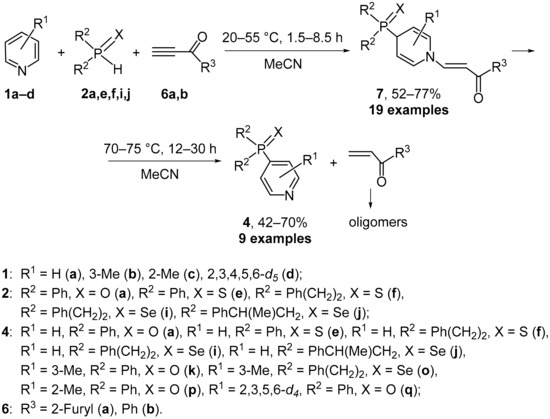
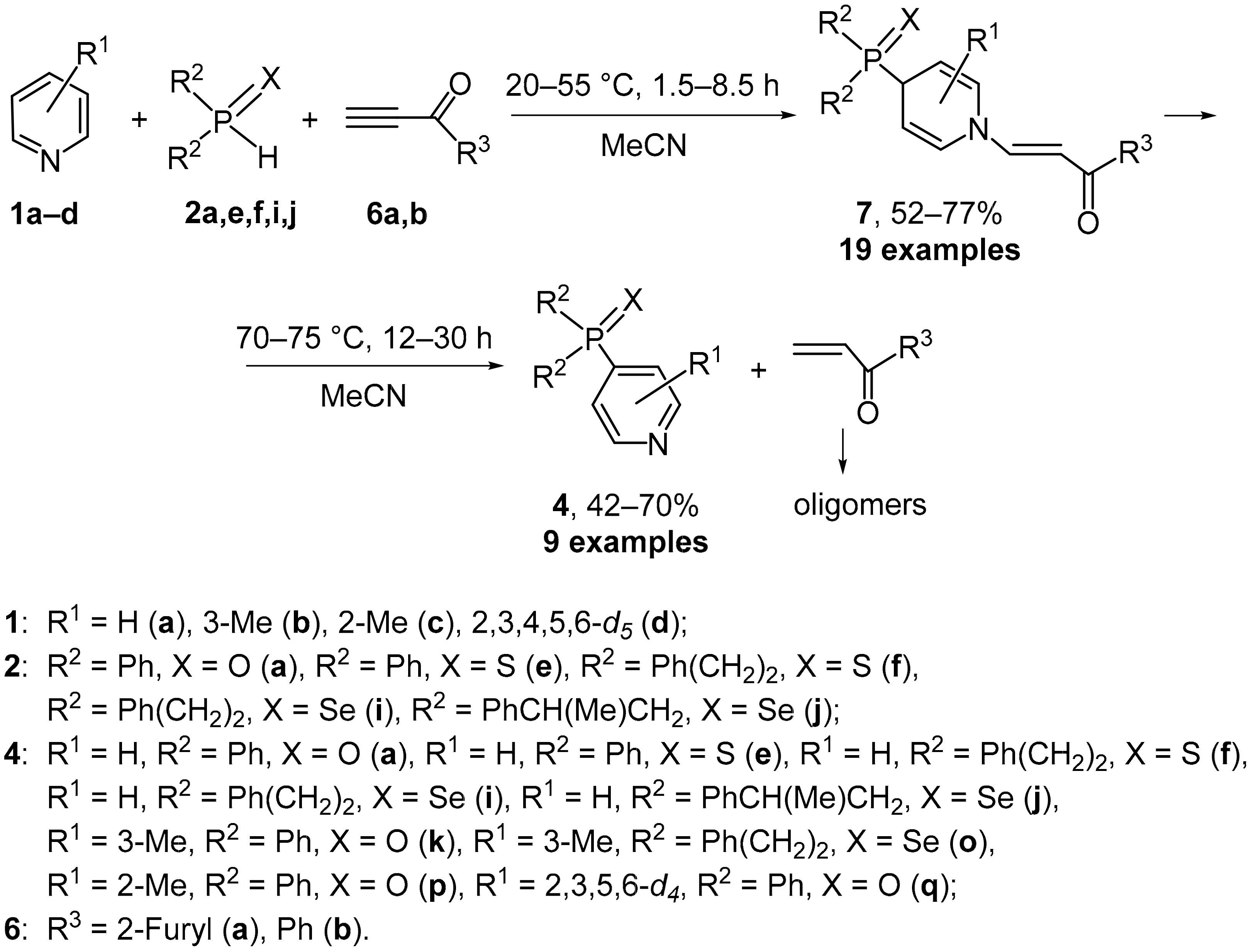
Terminal acylacetylenes 6a,b (2-furoyl- and benzoylacetylene) can also behave as adjuvants triggering and driving SNH cross-coupling of pyridines 1 with secondary phosphine chalcogenides 2 under similar conditions to afford 4-chalcogenophosphorylpyridines 4 in up to a 70% yield (Scheme 6). In the reaction, intermediate 1-acylvinyl-4-chalcogenophosphoryl dihydropyridines 7 were isolated (in 52–77% yields, see also Scheme 21 below), further undergoing the oxidative (relative to the dihydropyridine ring) elimination of vinyl ketone oligomers [39].
Scheme 6.
Formation and aromatization of dihydropyridines via elimination of vinyl ketones.
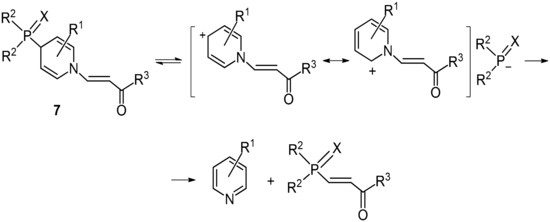
The cross-coupling starts with the prototropic shift in the 1,4-dihydropyridine ring to 1,2-isomers, from which the redox elimination of acylethenes takes place easier as a concerted step process. The moderate yields of the target products 4 and the presence of acylphosphorylethenes of phosphine chalcogenides to acylacetylenes in the reaction mixture were assigned [39] to the retro-aromatization of intermediates 7 to the starting pyridines. This likely resulted from the dissociation of the P-C bond and recombination of chalcogenophosphoryl anions with the leaving acylvinyl cations (Scheme 7).
Scheme 7.
Plausible retro-aromatization of dihydropyridines.
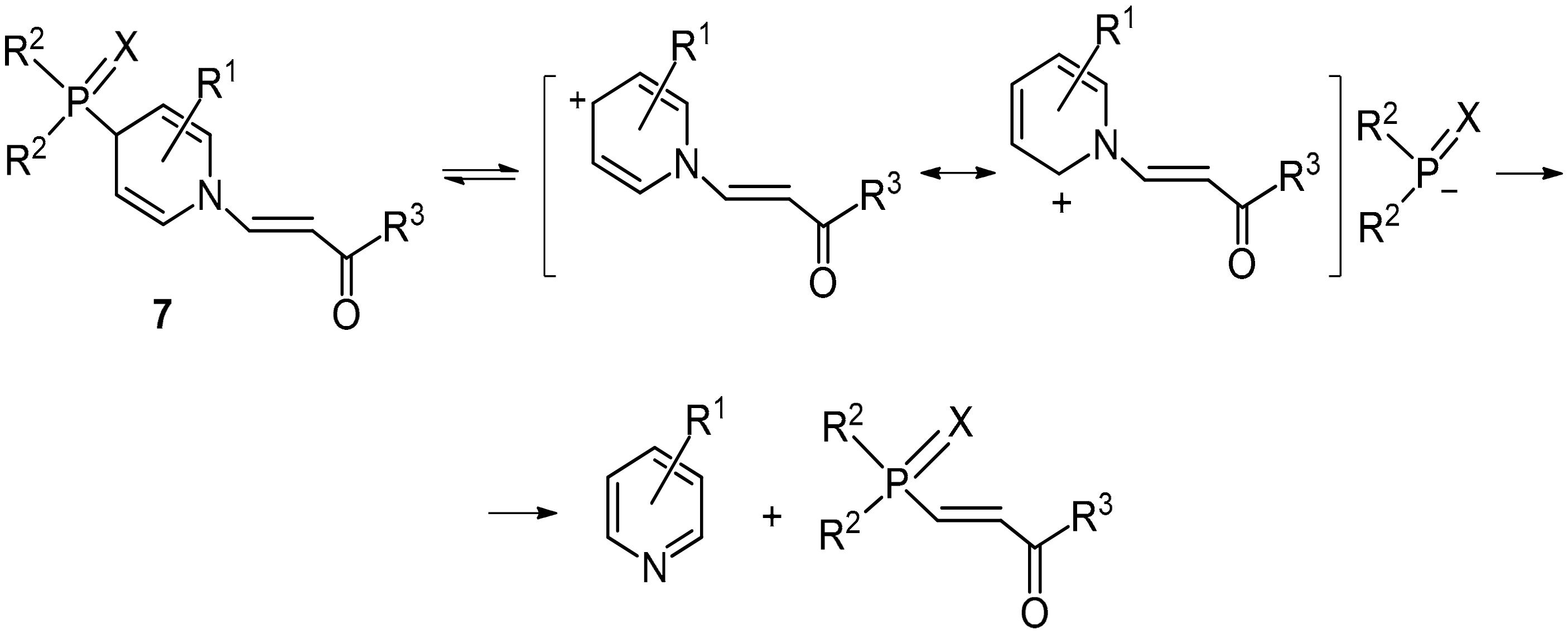
The reflux (80–85 °C, 96 h) of pyridine 1a, 3-phenyl-2-propynenitrile 10 and phosphine oxides 2a,b in MeCN led to the regioselective phosphorylation of pyridine to 4-phosphorylpyridines 4a,b in a 30–35% yield and 3-phenyl-2-propenenitrile oligomers (Scheme 8) [40].
Scheme 8.
SNH cross-coupling between pyridine and secondary phosphine oxides in the presence of 3-phenyl-2-propynenitrile.
All the above information has allowed for the generalization of a concept of trimodal (polarization/deprotonation/oxidation) adjuvant-like assistance of electron-deficient acetylenes in the SNH reaction of the pyridinoid heterocycles with PH–nucleophiles. This includes: (i) the repolarization of the pyridine ring, (ii) generation of phosphorus-centered anions by the deprotonation of the P-H bond and (iii) oxidation of the dihydropyridine ring.
2.2. N-Vinylated/C-Phosphorylated Pyridines: Delayed SNH Phosphorylation
As follows from the preceding Section, the possibility to stop the SNH phosphorylation of pyridines with secondary phosphine chalcogenides in the presence of electron-deficient acetylenes as adjuvants on the intermediate step, i.e., the formation of N-vinylated/C(4)-phosphorylated 1,4-dihydropyridines, provided a novel efficient approach to the synthesis of earlier inaccessible richly functionalized dihydropyridines.
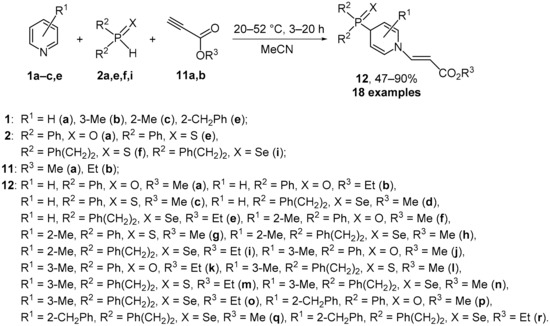
The synthesis of N-vinylated/C(4)-phosphorylated 1,4-dihydropyridines 12a–r in a 47–90% yield from pyridines 1, alkyl propiolates 11 and secondary phosphine chalcogenides 2 was implemented as a one-pot three-component reaction at 20–52 °C for 3–20 h (Scheme 9) [45,47].
Scheme 9.
Reductive N-vinylation/C-phosphorylation of pyridines with alkyl propiolates and secondary phosphine chalcogenides.
The reactions involving pyridine 1a and secondary phosphine sulfide 2f or selenide 2i proceeded at room temperature, though phosphine oxide 2a required slight heating (50–52 °C), likely due to its lower acidity. The same was observed in the case of 2-methylpyridine 1c, which we ascribed to steric hindrance.
The process is regioselective: the expected 1,2-dihydropyridines were not detected in the reaction mixture (1H, 31P NMR), though it was reported [52,53] that dialkyl (diphenyl) H-phosphonates reacted with electron-deficient acetylenes and pyridine to exclusively yield the corresponding N-ethenyl-1,2-dihydropyridines with (RO)2P(O)-group. The high stereoselectivity of the reaction (Scheme 9) is its advantage; the ethenyl moieties of 1,4-dihydropyridines 12 are of E-configuration exclusively.
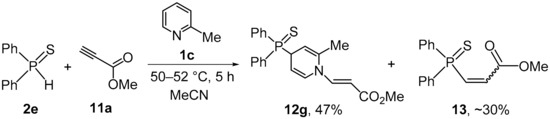
2-Methylpyridine 1c with methyl propiolate 11a and diphenylphosphine sulfide 2e gave dihydropyridine 12g in a 47% yield, along with E- and Z-isomers of diphenyl(methylpropenoate)phosphine sulfide 13 (content in the reaction mixture ≈30%, identified by 31P NMR) (Scheme 10) [45]. The side formation of vinylphosphine sulfide 13 was expected from the known data that secondary phosphine chalcogenides added to acyl- and cyanoacetylenes in the presence of the base [54].
Scheme 10.
Side formation of diphenylphosphine sulfide to methyl propiolate adduct.
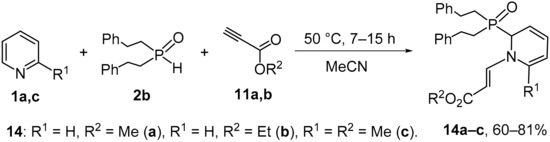
The replacement of diphenylphosphine oxide 2a in this reaction by bis(2-phenylethyl)phosphine oxide 2b changed the C-phosphorylation direction to the formation of 1-(E)-ethenyl-1,2-dihydropyridines 14a–c in a 60–81% yield (Scheme 11) [46].
Scheme 11.
Reaction of pyridines with alkyl propiolates and bis(2-phenylethyl)phosphine oxide.
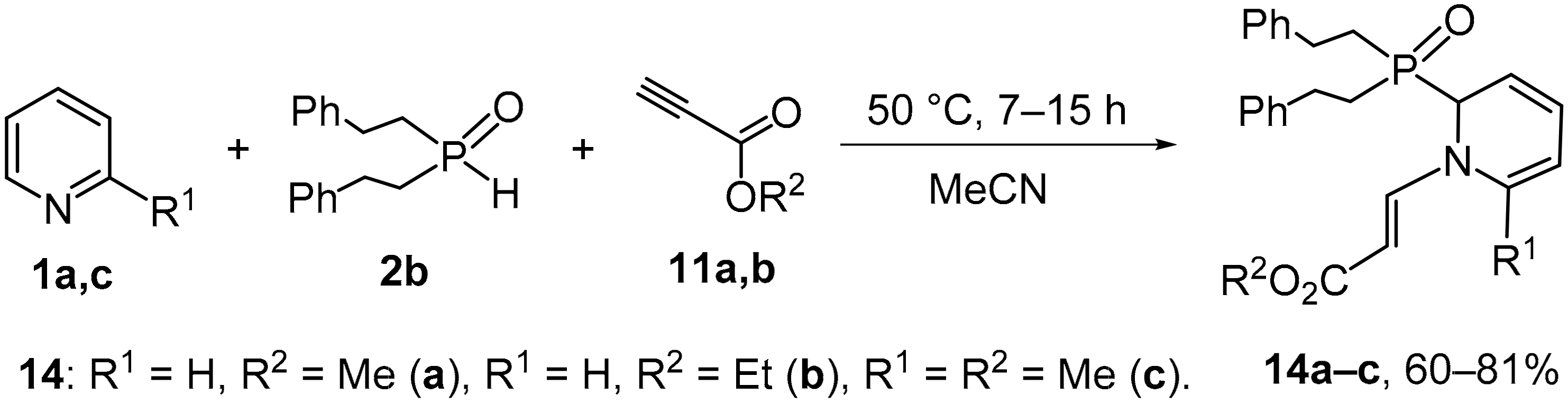
4-Methylpyridine 1f with alkyl propiolates 11a,b and secondary phosphine oxides 2a,b (60–62 °C, 3 h, MeCN) regio- and stereoselectively afforded 1-(E)-ethenyl-4-chalcogenophosphoryl-1,4-dihydropyridines 15a,b (yield 40–42%) in the case of phosphine oxide 2a or 1-(E)-ethenyl-2-chalcogenophosphoryl-1,2-dihydropyridines 16a,b (yield 77–80%) when using phosphine oxide 2b. Moderate yields of 1,4-dihydropyridines 15a,b probably owe to the formation of side products 17a,b, adducts of 4-methylpyridine to alkyl propiolates (Scheme 12) [48].
Scheme 12.
N-vinylation/C-phosphorylation of 4-methylpyridine with alkyl propiolates and secondary phosphine oxides.
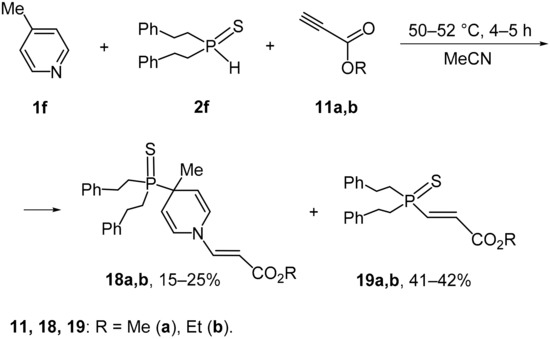
Under similar conditions (50–52 °C, 4–5 h, MeCN), the three-component vinylation/phosphorylation reaction of 4-methylpyridine 1f with secondary phosphine sulfide 2f and propiolates 11a,b was accompanied by the nucleophilic monoaddition of this PH–compound to the triple bond. As a result, 1-(E)-ethenyl-4-thiophosphoryl-1,4-dihydropyridines 18a,b and the adducts 19a,b were synthesized in 15–25% and 41–42% yields, respectively (Scheme 13) [47,48].
Scheme 13.
Side formation of bis(2-phenylethyl)phosphine sulfide to alkyl propiolates adducts.
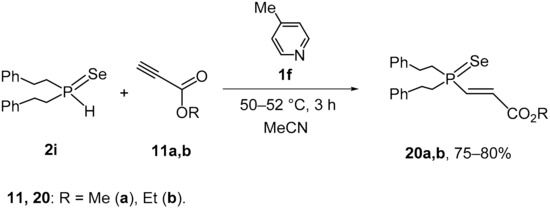
Secondary phosphine selenide 2i was not phosphorylated with 4-methylpyridine 1f in the presence of propiolates 11a,b, but instead formed adducts 20a,b in a 75–80% yield (Scheme 14) [47,48].
Scheme 14.
Formation of bis(2-phenylethyl)phosphine selenide to alkyl propiolate adducts.
To rationalize the formation of monoadducts 13, 19 and 20, especially with 4-methylpyridine (Scheme 12 and Scheme 13), the two competitive initial reactions should be analyzed [47]; the protonation of pyridines by the P-H bond (Scheme 15, a) and nucleophilic attack of pyridine nitrogen to the triple bond of alkyl propiolates to generate zwitterions A (Scheme 15, b).
Scheme 15.
Protonation of pyridines (path a) and generation of zwitterions (path b).
Assumingly, the protonation of 4-methylpyridine as more basic than 2- and 3-methyl congeners (pKa 6.05, 5.96, 5.68, respectively) is preferred, particularly by the most acidic secondary phosphine selenide 2i (compared with other phosphine chalcogenides [55]). This is why a two-component interaction between phosphine chalcogenides and acetylenes 11 took over. 4-Methylpyridine, in this case, plays a role of a basic catalyst.
At the same time, because of the weaker acidity of the secondary phosphine oxide, zwitterion A is not neutralized with the proton (the phosphine oxide remaining intact), but further reacts with the second molecule of methyl propiolate as an electrophile to furnish the Acheson adduct [48].
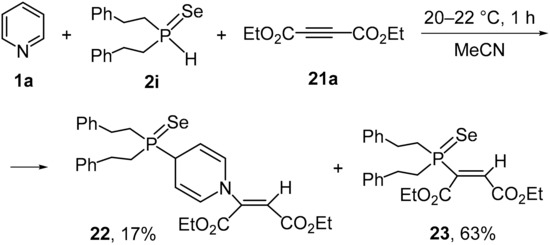
On the example of diethyl acetylenedicarboxylate 21a, pyridine 1a and bis(2-phenylethyl)phosphine selenide 2i, it was shown that internal acetylenes of such a type were less effective in the three-component reaction with pyridines and secondary phosphine chalcogenides [49]. Therefore, at an equimolar ratio of these reagents (room temperature, 1 h) E-isomer of N-ethenyl-1,4-dihydropyridine 22 was formed in a 17% yield (Scheme 16). Under these conditions, a competitive two-component reaction of the nucleophilic addition of secondary phosphine selenide 2i to electron-deficient acetylene 21a mainly proceeded to give E-monoadduct 23.
Scheme 16.
Reaction of pyridine, diethyl acetylenedicarboxylate and secondary phosphine selenide.
It is worthwhile to supplement that the phosphorylated dihydropyridines 12, 14–16 and 18 are frequent structural motifs in antihypertensive pharmaceuticals (amlodipine, nifedipine, felodipine) and prospective drug precursors in view of the similarity with known anticonvulsant [56], anticoagulant [57], antitumor [58], antitubercular [59] and cardiovascular [60] agents. The reaction found also develops the chemistry of zwitterionic adducts of pyridine to electron-deficient acetylenes, accessible reactive blocks for the synthesis of dihydropyridine derivatives [52,53,61,62,63,64,65,66] containing usually (until our investigation) 1,2-dihydropyridyl moiety.
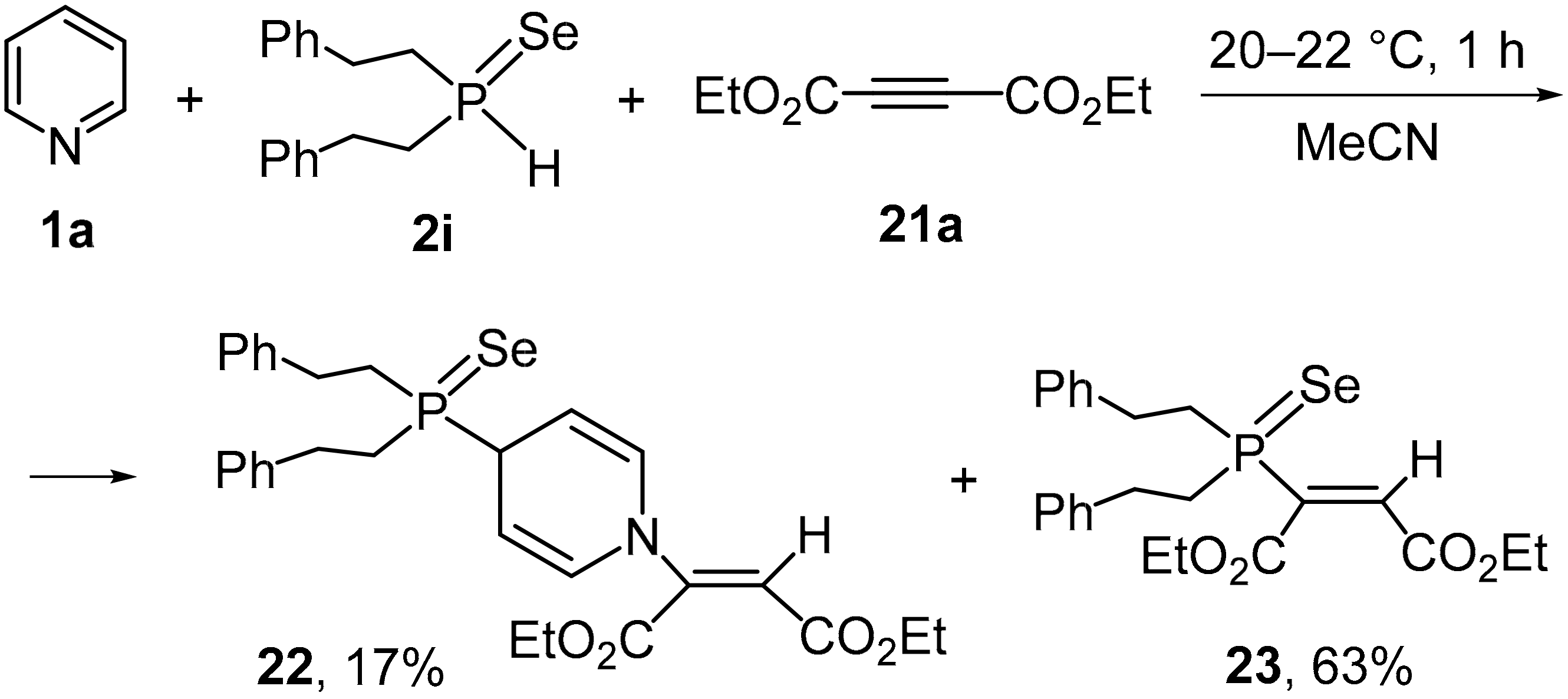
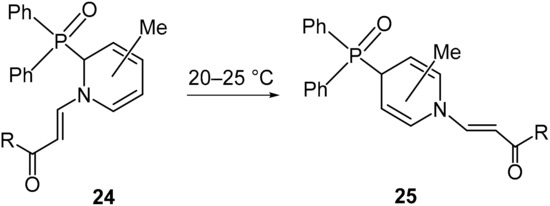
In [39], it was additionally confirmed that 1-acylvinyl-2-phosphoryl-1,2-dihydropyridines 24 are kinetic products of the phosphorylation of pyridines 1 with diphenylphosphine oxide 2a (Scheme 17).
Scheme 17.
Phosphorylation/vinylation of pyridines with diphenylphosphine oxide and acylacetylenes.
In these reactions, the stereoselectivity is probably a result of the steric screening of position two in the Z-configuration of adducts 24 (Scheme 17), while this is not the case in the E-configuration. Finally, due to the Z–E equilibrium, the addition proceeds as the E-selective process, i.e., to form only E-isomers of adducts 24.
Although the yields of dihydropyridines 24 were from good to excellent (72–94%), the reaction time differed considerably (from 3 to 21 h), indicating a significant substituents effect in the pyridine ring on the process rate. Indeed, the faster process occurred for 2- and 3-methylpyridines (4 and 3 h), whereas 3-fluoropyridine required a longer time (20–21 h). Noteworthy, the reactivity of perdeuteropyridine and non-deuterated pyridine is roughly the same that follows from close yields of the corresponding products (79–85%) and reaction times (5–5.5 h). This means that no breaking/forming of C-D bonds is involved in these steps. The more donating substituents at the P atom, as in phosphine oxide (PhCH2CH2)2P(O)H, preclude the phosphorylation [39] that agrees a lesser PH–acidity of these phosphine oxides [55].
Noteworthy, with terminal electron-deficient acetylenes 6, 11, the reaction stops on kinetic N-vinylated/C2-phosphorylated intermediates. Meanwhile, with internal acetylenes 3 and 10, the phosphorylation results in aromatization [37,38,40]. This was rationalized [37] by (i) the steric repulsion between pyridine hydrogen in position 6sixand aromatic substituent of the internal acetylene; (ii) the formation of a benzyl-like cationic intermediate; (iii) the generation of stable chalcones. Therefore, as shown above, in certain cases, the three-component reaction can be affected (delayed on the kinetic step) using terminal electron-deficient acetylenes [39,45,46,47,48].
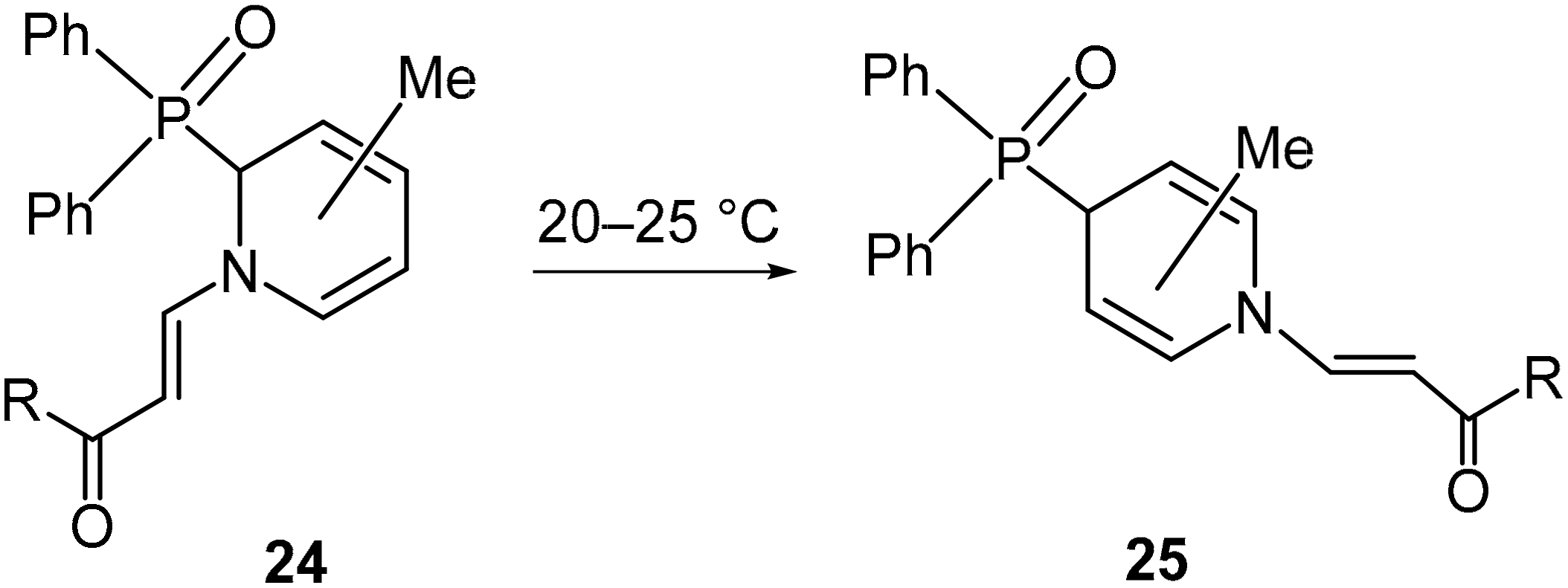
For products of methylpyridines 1b,c, a partial 2→4 transfer of the phosphoryl groups took place [39] to give mixtures of 2- 24 and 4-regioisomers 25 of dihydropyridines in a ≈ 3–6:1 ratio (Scheme 18).
Scheme 18.
The 2→4 migration of the phosphoryl group in 1-E-acylvinyl-2-diphenylphosphoryldihydropyridines.
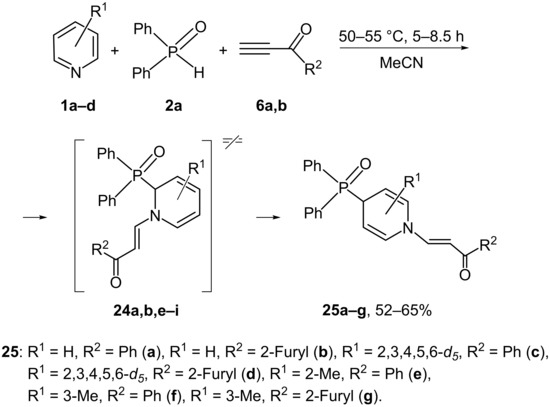
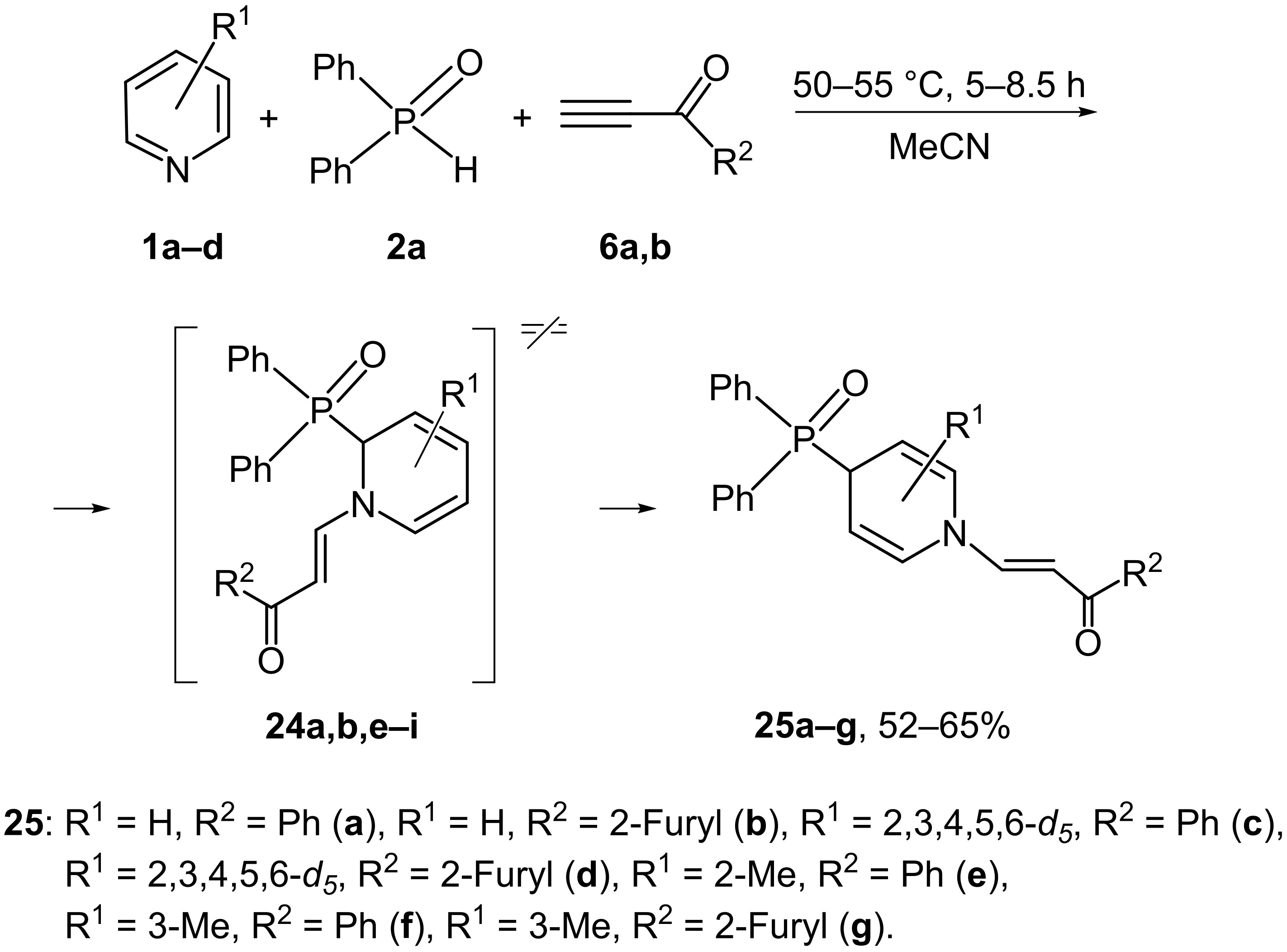
The rearrangement was completed when 1,2-dihydroadducts 24a,b,e–i were heated (50–55 °C, 5–8.5 h) to produce 1,4-dihydroadducts and E-acylvinyl-4-phosphorylpyridines 25a–g [39]. These products were synthesized directly from pyridines 1a–d, phosphine oxide 2a and acetylenes 6a,b under the same conditions (Scheme 19) [39].
Scheme 19.
The 2→4 migration of the phosphoryl group in 1,2-dihydroadducts during the vinylation/phosphorylation of pyridines.
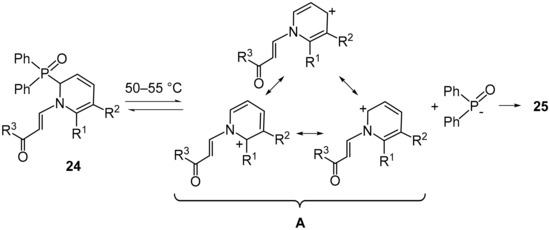
Fluoropyridine derivatives 24j,k turned out to be reluctantly relative to such a migration undergoing the backward aromatization to 3-fluoropyridine at a higher temperature (70–75 °C) or upon treatment with external oxidants (chloranil and DDQ). This was rationalized [39] in terms of an ion-pair interplay, including the cleavage of the C-P bond and exchange between pyridinium cation A and phosphine oxide anion (Scheme 20). Expectedly, the dissociation is easier the more stable the ions are (or ion-like species) formed. Consequently, the least sTable 3-fluoropyridinium cation or cation-like intermediate, due to the electron-withdrawing effect of fluorine substituent, should form in a lesser concentration, if any, and this is why the fluoro-containing 1,2-diadduct is not subjected to the rearrangement. Phosphine oxide anionic species migrate to position four to form the more thermodynamically stable 1,4-regioisomer 25.
Scheme 20.
Tentative dissociation of 1,2-dihydroadducts to ion pairs.
The higher thermodynamic stability of 1-E-benzoylvinyl-4-diphenylphosphoryl-1,4-dihydropyridine 25a (by 4.0 and 3.4 kcal/mol of enthalpy in the MeCN solution and gas phase, respectively, or by 5.0 and 4.8 kcal/mol of Gibbs free energy in the MeCN solution and gas phase, respectively) compared to the corresponding 1,2-dihydropyridine 24a was confirmed by quantum chemical calculations (B2PLYP/6-311 + G** // B3LYP/6-31 + G* + IEF PCM (B3LYP/6-31 + G*)) [39].
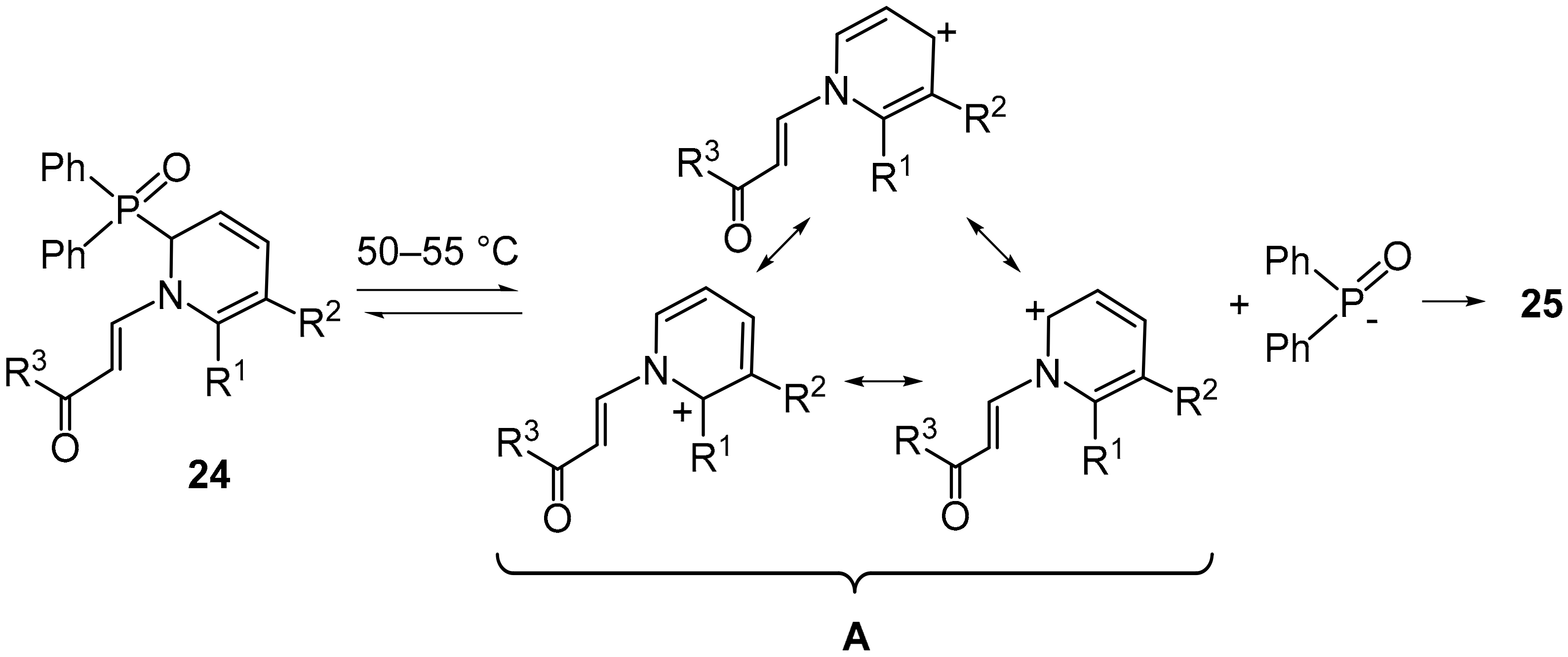
Secondary phosphine sulfides 2e,f and phosphine selenides 2i,j reacted with pyridines 1a–d in the presence of acylacetylenes 6a,b (1:1:1 molar ratio) at room temperature to directly afford 1,4-dihydroadducts, 1-E-acylvinyl-4-thio(seleno)phosphoryldihydropyridines 7a–l (Scheme 21) [39]. The yields for phosphine selenides 2i,j were better than those in the case of the corresponding sulfides 2e,f.
Scheme 21.
Phosphorylation/vinylation of pyridines with secondary phosphine sulfides or phosphine selenides and acylacetylenes.
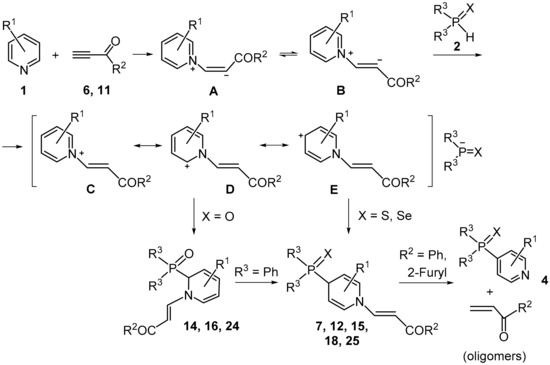
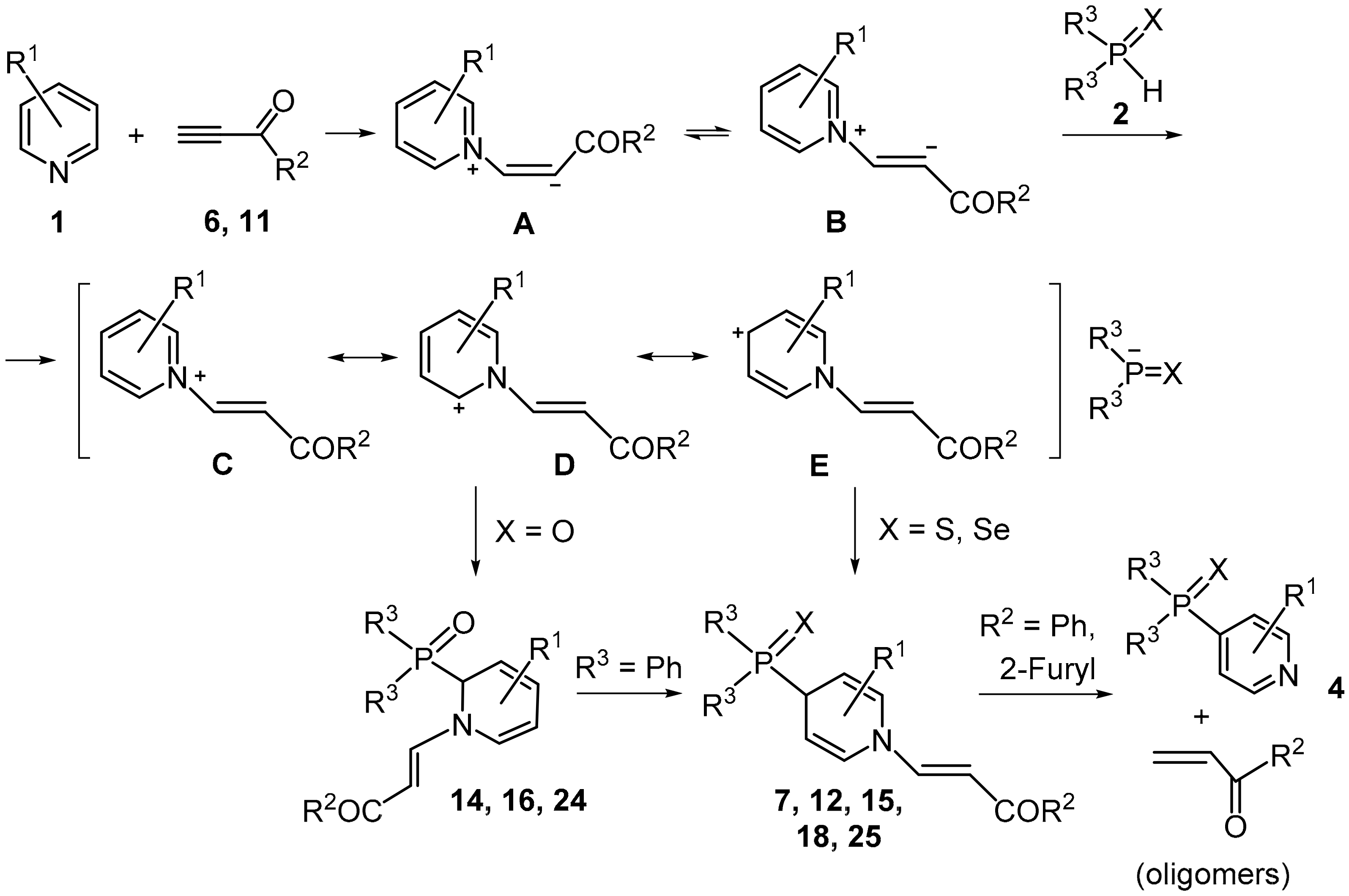
This version of terminal acetylene-driven 6, 11 phosphorylation seemingly includes the generation of the intermediate dipole A (Scheme 22) [45]. Further, the reaction likely proceeds via the intermediate B as stabilized by the attractive intramolecular interaction between the carbanionic center and positively charged nitrogen atom. Proton transfer from phosphine chalcogenides to carbanionic site of zwitterion B leads to N-vinylpyridinium cation. The phosphorus-centered anion, thereby formed, attacks the position 4 of the intermediate E in the case of phosphine sulfides and selenides or the position 2 of the intermediate D when less sterically loaded phosphine oxides are used to afford the final products 7, 12, 15, 18, 25 or 14, 16 and 24, respectively (Scheme 22) [39,45,46,47,48,49]. Compounds 7 and 25 are capable of eliminating vinyl ketones (as oligomers) to give 4-chalcogenophosphorylpyridines 4 (Scheme 22) [39].
Scheme 22.
A plausible pathway of the reaction between pyridines, terminal acetylenes and secondary phosphine chalcogenides.
Noteworthy was that the known processes involving zwitterionic species resulted from the addition of pyridine to electrophilic acetylenes and the subsequent trapping of these intermediates [61] with electrophiles (activated carbon–carbon double or triple bond [62], carbonyl [63] or isocyanate groups [64], acidic CH- [65], NH- [66] or PH- [52,53] function) lead exclusively to 1,2-dihydropyridines. This implies that the attack of P-centered anion (Scheme 22) is directed at the alpha position of the pyridine ring.
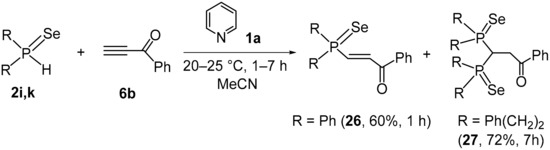
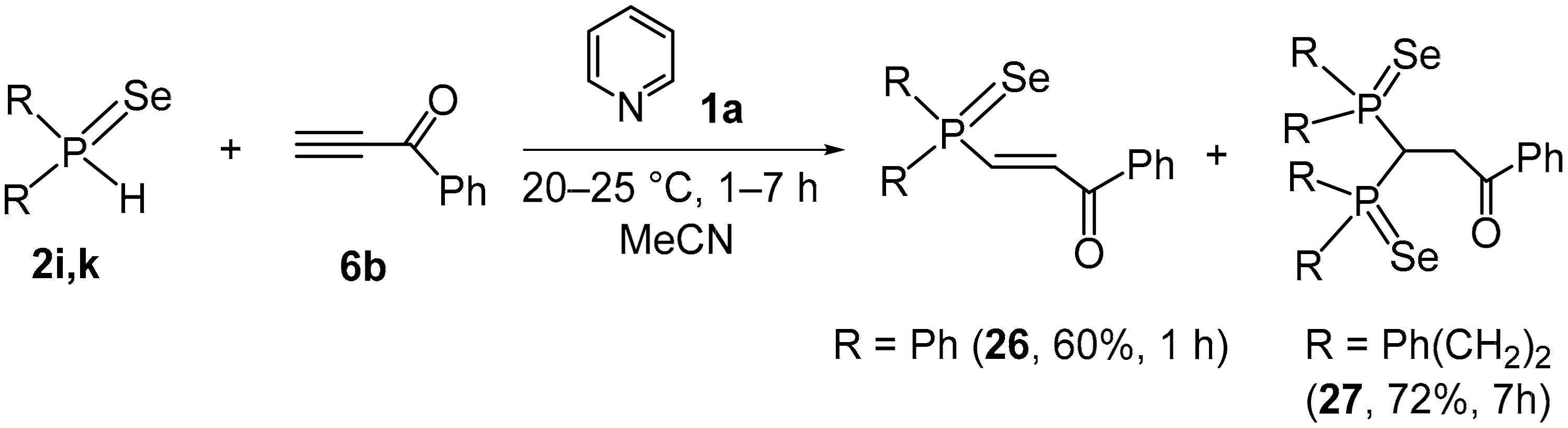
In the case of pyridine 1a or 3-fluoropyridine 1g, secondary phosphine selenides 2i,k, and terminal acylacetylene 6b, phosphorylation was not observed [39]. Instead, mono- 26 or diadduct 27 of phosphine selenide to acylacetylene were formed (Scheme 23).
Scheme 23.
Competitive nucleophilic addition of phosphine selenides to acylacetylenes.
It was suggested [39] that 3-fluoropyridine generates the initial zwitterions A in negligible concentration (Scheme 22), which is not enough for further phosphorylation. Overall, these results are in keeping with the above pseudo ion-pair mechanism, which implies a faster transfer of more stable chalcogenophosphoryl anions.
All the above information has evidenced two modalities of terminal acetylenes as catalysts/promoters (polarizing and deprotonating agents) in the SNH phosphorylation of pyridines with secondary phosphine chalcogenides: (i) the repolarization of the pyridine ring rendering it a cation-like character (Scheme 22) and (ii) producing P-centered anions by their deprotonation of the corresponding nucleophiles (Scheme 22). This gave the key intermediates, 2- and 4-phosphorylated acylvinylpyridines 24, 25 and 7 (Scheme 17, Scheme 19 and Scheme 21). The third modality of these electron-deficient acetylenes, i.e., to behave as inner oxidants, readily occurs at a high temperature.
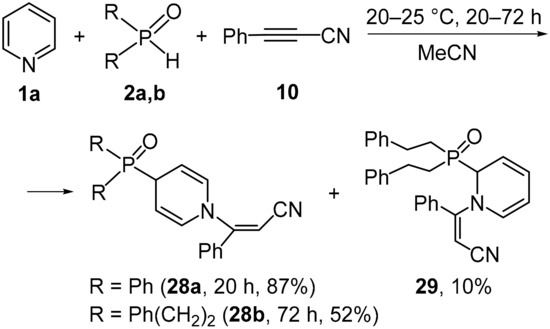
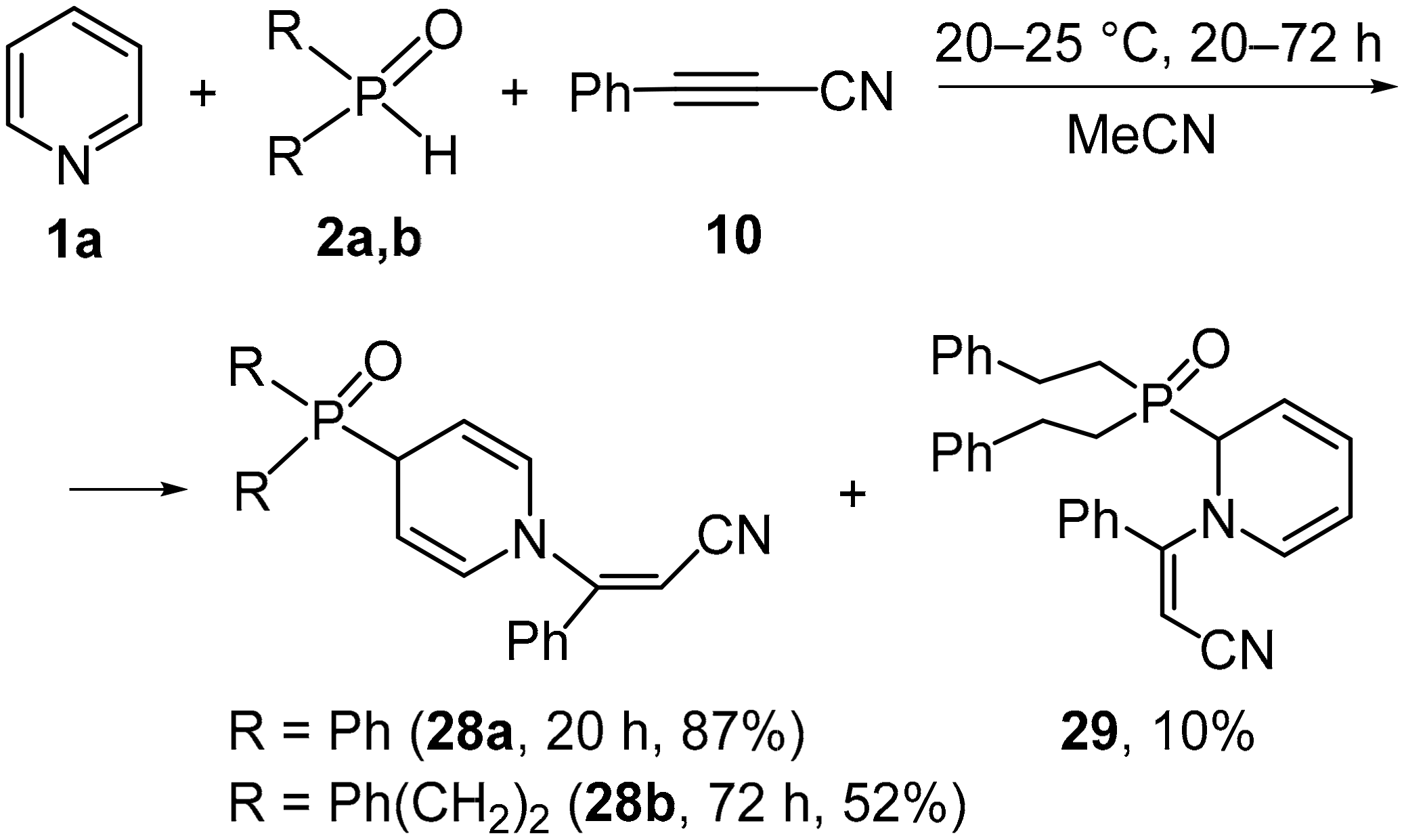
Likewise, another electron-deficient acetylene, 3-phenyl-2-propynenitrile 10, acted as an adjuvant in phosphorylation of pyridines (ambient temperature) with phosphine oxides 2a,b to regio- and stereoselectively afford (Z)-N-(2-cyano-1-phenyl)ethenyl-4-phosphoryl-1,4-dihydropyridines 28a,b, key intermediates of the delayed SNH reaction, in a 87% and 52% yield [40]. Only with phosphine oxide 2b was the formation of 1,2-dihydropyridine 29 in a 10% yield observed (Scheme 24).
Scheme 24.
Three-component reaction between 3-phenyl-2-propynenitrile, secondary phosphine oxides and pyridine.
Interestingly, 1,2-dihydropyridine 29 happened to be stable; the expected 2→4-migration [39] of the phosphoryl substituent did not take place even at a higher temperature (70–75 °C).
As it was shown above (see Section 2.1, Scheme 8), the anticipated SNH phosphorylation of pyridines was realized when the reactants were heated up to 85 °C; both 1,2- and 1,4-dihydropyridine intermediates gave 4-phosphorylpyridines 4a,b in 30–35% yields [40] with the elimination of 3-phenyl-2-propenenitrile oligomers (Scheme 8).
This SNH phosphorylation was assumed to follow the mechanism shown in Scheme 22, i.e., via the reversible generation of zwitterions A–B, intermediate cations C–E and phosphorus-centered anions [45]. The latter is attached to either position four of the intermediate E pyridinium ring in the case of phosphine oxide 2a or position two of the intermediate D with less spatially encumbered phosphine oxide 2b to afford the final products 28a,b and 29. Finally, dihydropyridine formed oxidatively (relative to dihydropyridine moiety) releases (upon heating) phenylpropenenitrile as oligomers to deliver SNH substitution products 4.
2.3. Phosphorylation of Pyridines with H-Phosphonates in the Presence of Electron-Deficient Acetylenes
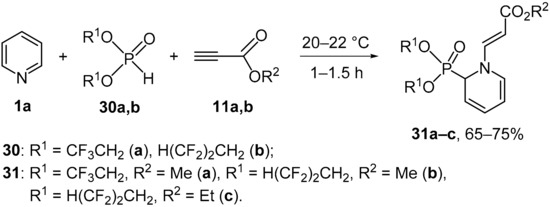
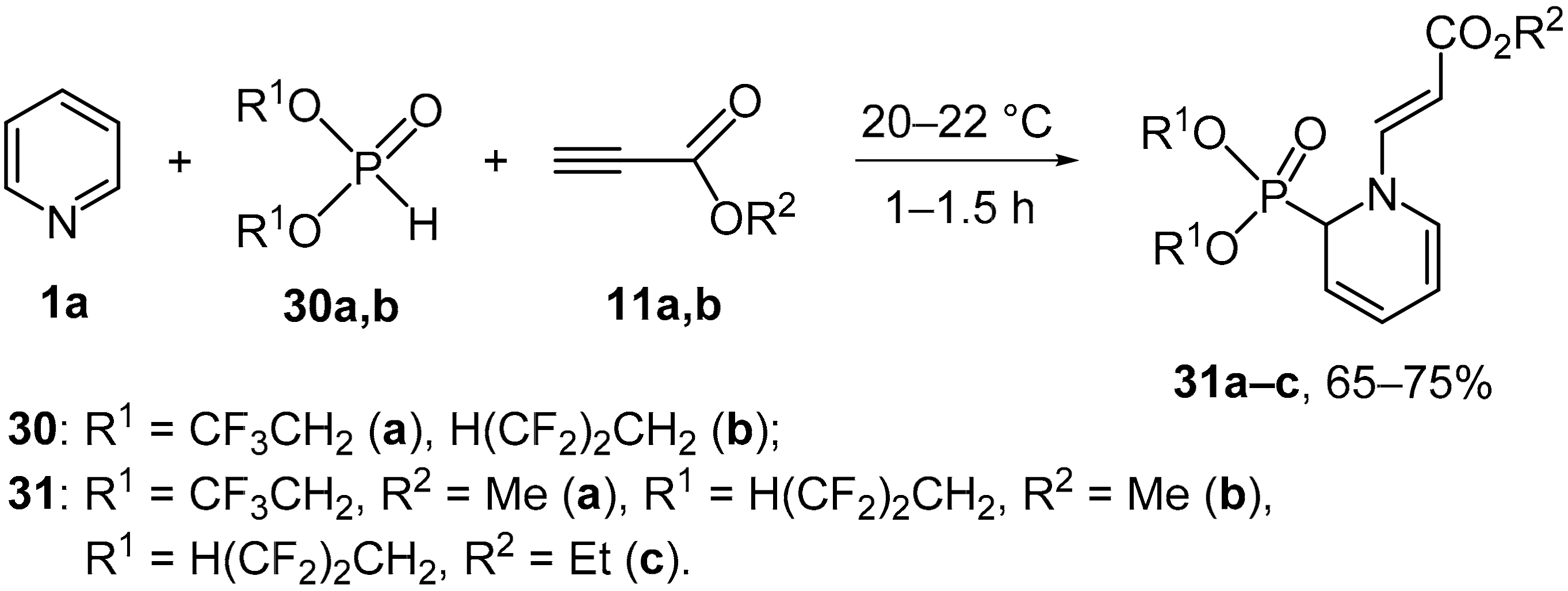
The SNH phosphorylation of pyridine 1a with bis(fluoroalkyl) H-phosphonates 30 in the presence of alkyl propiolates 11 retained on the formation of intermediate 1,2- and 1,4-dihydropyridines. With bis(2,2,2-trifluoroethyl) or bis(2,2,3,3-tetrafluoropropyl) H-phosphonates 30a,b, the phosphorylation (ambient temperature, no solvent) regio- and stereoselectively led to (E)-N-alkoxycarbonylethenyl-1,2-dihydropyridines 31a–c in a 65–75% yield (Scheme 25) [67].
Scheme 25.
Catalyst- and solvent-free N-vinylation/C(2)-phosphorylation of pyridine with alkyl propiolates and bis(fluoroalkyl) H-phosphonates.
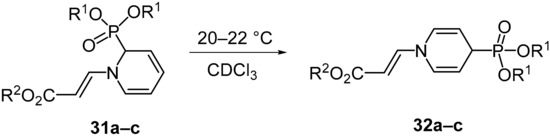
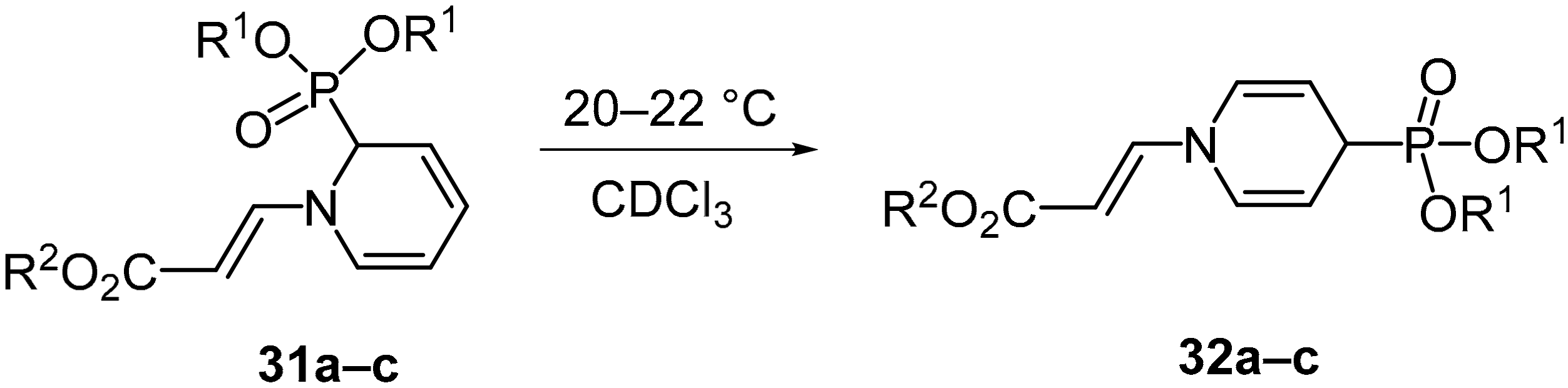
In the solid state, these 1,2-dihydropyridines 31a–c were stable at ambient temperature. However, in CDCl3, they rearranged to the corresponding 1,4-dihydropyridines 32a–c (Scheme 26) [67].
Scheme 26.
Rearrangement of functional 1,2-dihydropyridines to the 1,4-isomers.
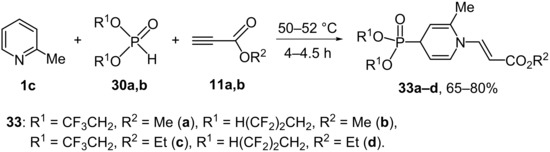
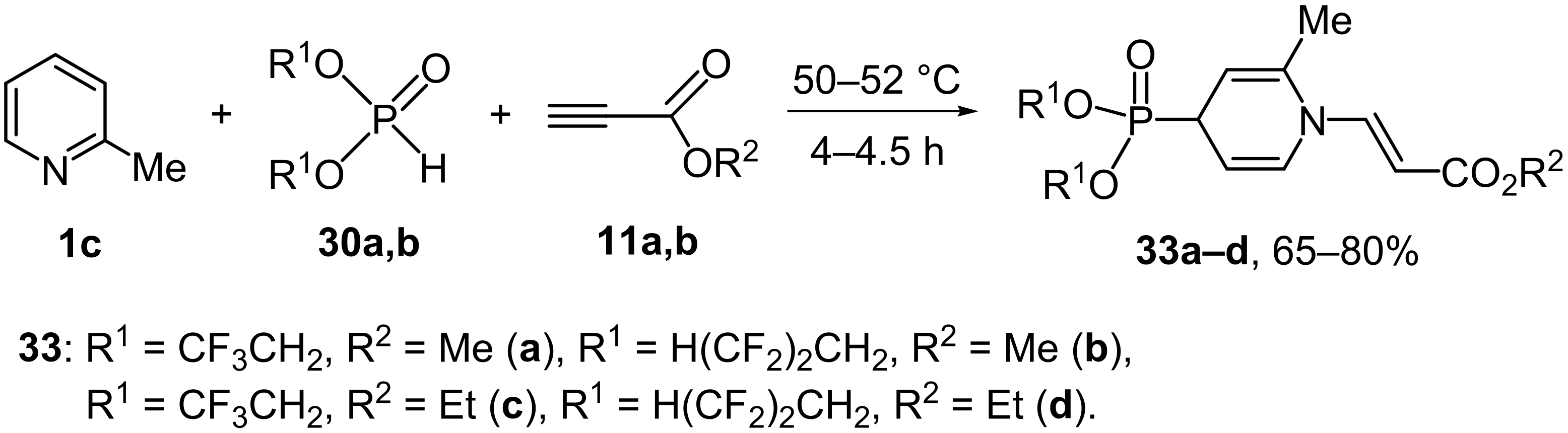
Noteworthy, the solvent-free phosphorylation of 2-methylpyridine 1c with the same fluorinated H-phosphonates 30a,b and alkyl propiolates 11a,b proceeded upon heating at 50–52 °C to furnish 1,4-dihydropyridines 33a–d in a 65–80% yield (Scheme 27) [67].
Scheme 27.
Catalyst- and solvent-free N-vinylation/C(4) phosphorylation of 2-methylpyridine with alkyl propiolates and bis(fluoroalkyl) H-phosphonates.
This reaction at room temperature lasted longer (20 h vs. 4–4.5 h) to form phosphonylated 1,2-dihydropyridines in a small concentration. This confirms that this step is a kinetic one [67].
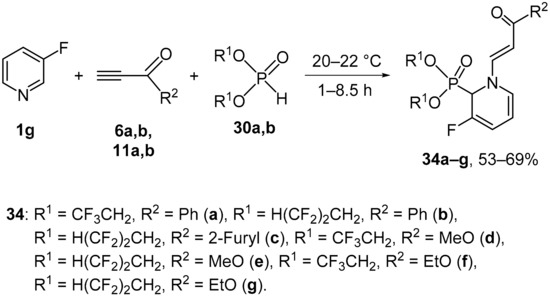
Under similar conditions (20–22 °C, 1–8.5 h and solvent-free), phosphonylated 1,2-dihydropyridines 34a–g were obtained from 3-fluoropyridine 1g, electron-deficient alkynes (alkyl propiolates 11a,b or acylacetylenes 6a,b) and bis(fluoroalkyl) H-phosphonates 30a,b (Scheme 28) [68].
Scheme 28.
Three-component reaction between 3-fluoropyridine, electron-deficient alkynes and bis(fluoroalkyl) H-phosphonates.
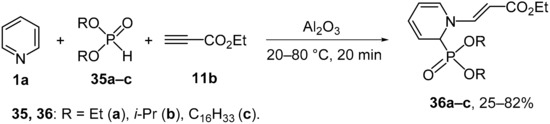
Earlier [52], the reaction of pyridine 1a, ethyl propiolate 11b and dialkyl H-phosphonates 35a–c in the presence of Al2O3 as a catalyst was shown to afford 1,2-dihydropyridine phosphonates 36a–c (Scheme 29).
Scheme 29.
Catalyst reaction between pyridines, alkyl propiolates and dialkyl H-phosphonates.
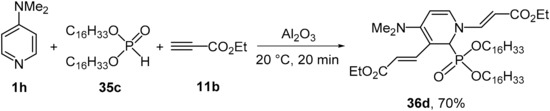
The outcome of the reaction depends on the pyridine ring substitution. Therefore, no reaction occurred with 2,6-1utidine, whereas, in the case of 4-dimethylamino-pyridine 1h (DMAP), 1,2-dihydropyridine phosphonate bis-adduct 36d, resulting from the addition of two ethyl propiolate moieties to the pyridinium ring, was obtained (Scheme 30) [52]. The electrophilic character of the unsaturated substrate was also important, since authors have never observed any of the expected reactions with acrylonitrile or ethyl acrylate. The dry medium process enhanced the addition rate and improved the yield with respect to the homogeneous medium.
Scheme 30.
Catalyst reaction between DMAP, ethyl propiolate and dialkyl H-phosphonate.
Thus, the results presented in Section 2.1, Section 2.2 and Section 2.3 indicate that the reactions of pyridines with PH–nucleophiles (phosphine chalcogenides, H-phosphonates) triggered and driven by electron-deficient acetylenes open convenient access to in-demand phosphorylated pyridines, the target SNH products and (or) deeply functionalized dihydropyridines, important intermediates for SNH phosphorylation.
3. SNH Phosphorylation of Quinolines and Isoquinolines
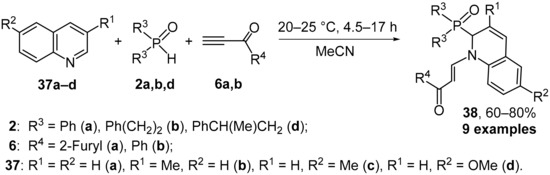
Quinolines 37a–d reacted with secondary phosphine oxides 2a,b,d and terminal acylacetylenes 6a,b (room temperature) [69] to yield N-acylvinyl-2-phosphoryldihydroquinolines 38 (Scheme 31), i.e., here, the first step of SNH phosphorylation (the reductive insertion of phosphine oxides 2a,b,d into the heterocyclic core) occurred.
Scheme 31.
Tandem regio- and stereoselective addition of acylacetylenes and secondary phosphine oxides to quinolines.
Under these conditions, oddly, only 1,2-adducts of acylacetylenes and phosphine oxides to quinolines were regioselectively formed with a complete regioselectivity of the enone moiety. All of these, together with much milder conditions, differ this reaction from that with pyridines [39]. Thus, the reaction stopped at the formation of the dihydro intermediates, i.e., a delayed SNH reaction took place here.
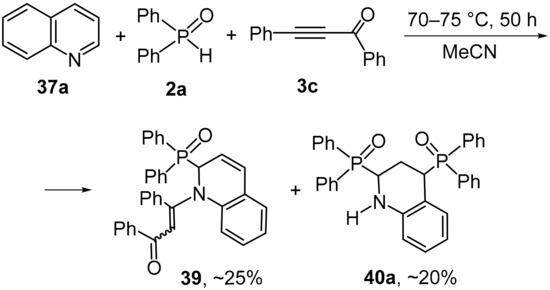
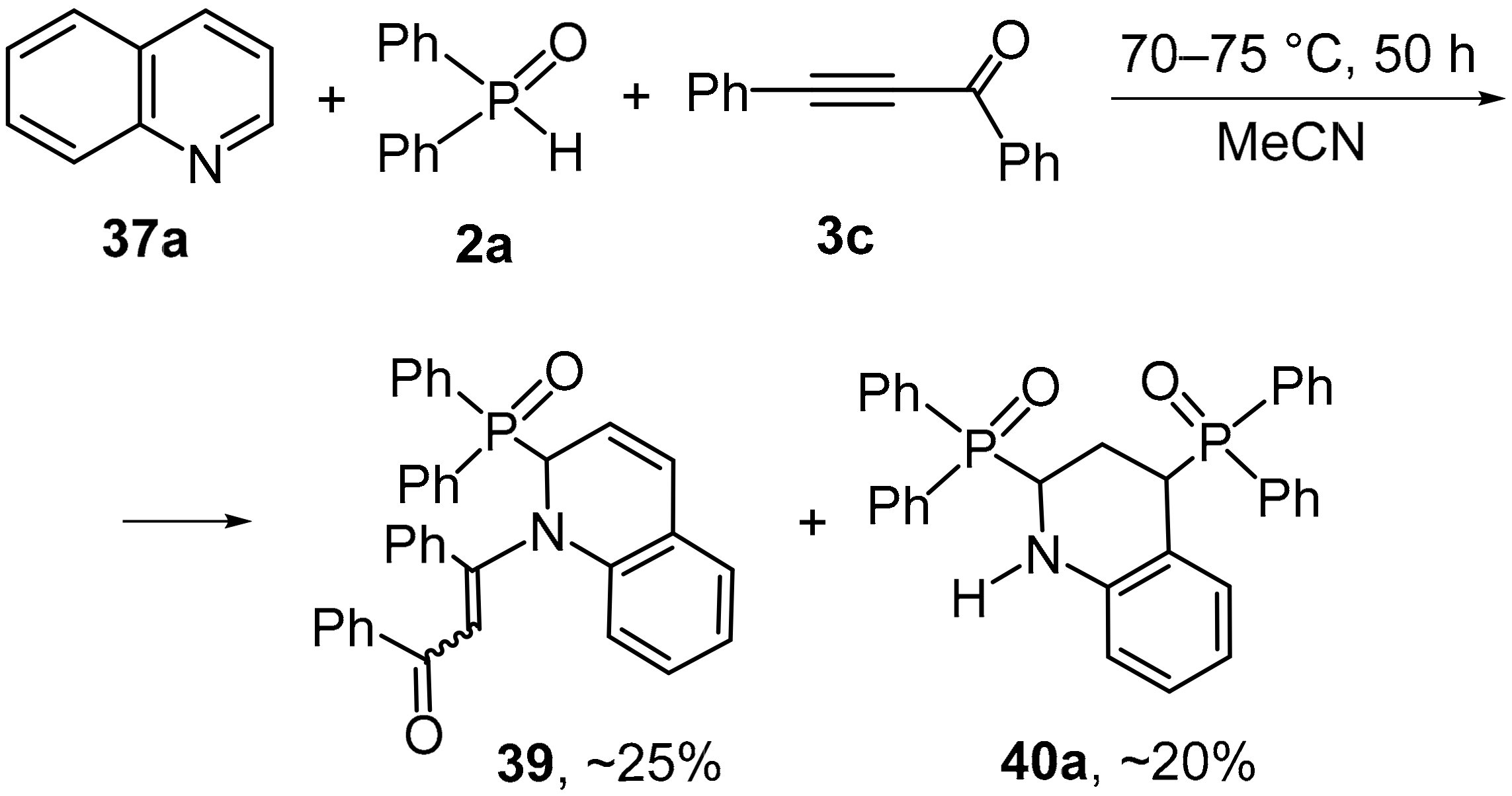
The longest duration of the process (17 h) was observed for the bulkiest nucleophile (phosphine oxide 2d). The decisive role of the steric effect in such a reaction was noted for an internal acylacetylene, i.e., benzoylphenylacetylene 3c; the reaction occurred at 70–75 °C for 50 h to give the expected N-benzoylvinyl-2-diphenylphosphoryldihydroquinoline 39 and, unexpectedly, 2,4-bis(diphenylphosphoryl)tetrahydroquinoline 40a (Scheme 32), the latter being obviously formed without acylacetylene 3c [69].
Scheme 32.
Reaction of benzoylphenylacetylene and diphenylphosphine oxide with quinoline.
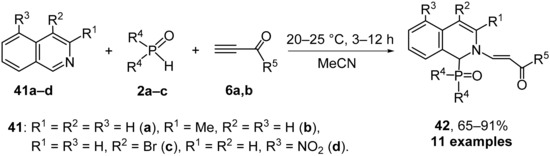
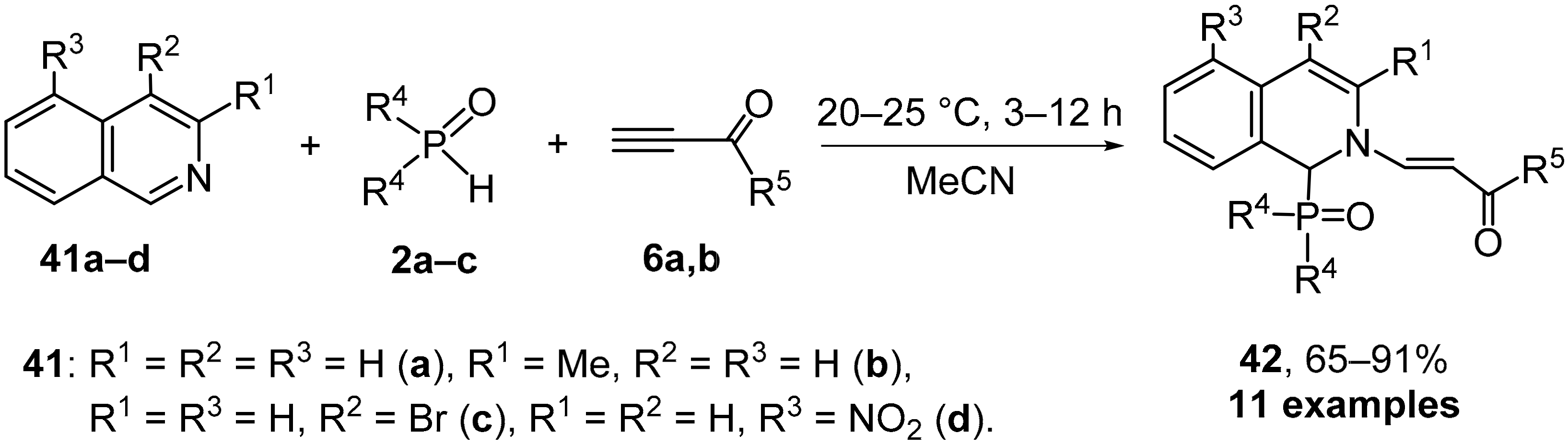
The reaction of isoquinolines 41a–d with secondary phosphine oxides 2a–c and terminal acylacetylenes 6a,b (room temperature, MeCN) was faster (3–12 h) and provided better yields (42, up to 91%) as compared to the quinolines (Scheme 33) [69].
Scheme 33.
Tandem regio- and stereoselective addition of acylacetylenes and secondary phosphine oxides to isoquinolines.
The slowest phosphorylations (10, 12 h) were for 4-bromo- and 5-nitroisoquinolines 41c,d, particularly when bulkier bis(2-phenylethyl)phosphine oxide 2b was employed, confirming the considerable contribution of the nitrogen atom basicity and steric screening of the phosphorus-centered anion to the reaction outcome. Evidently, the process is accelerated when isoquinoline basicity increases and steric constrains from the phosphine oxide side reduce.
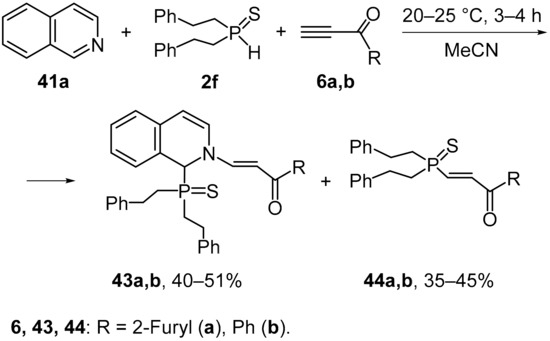
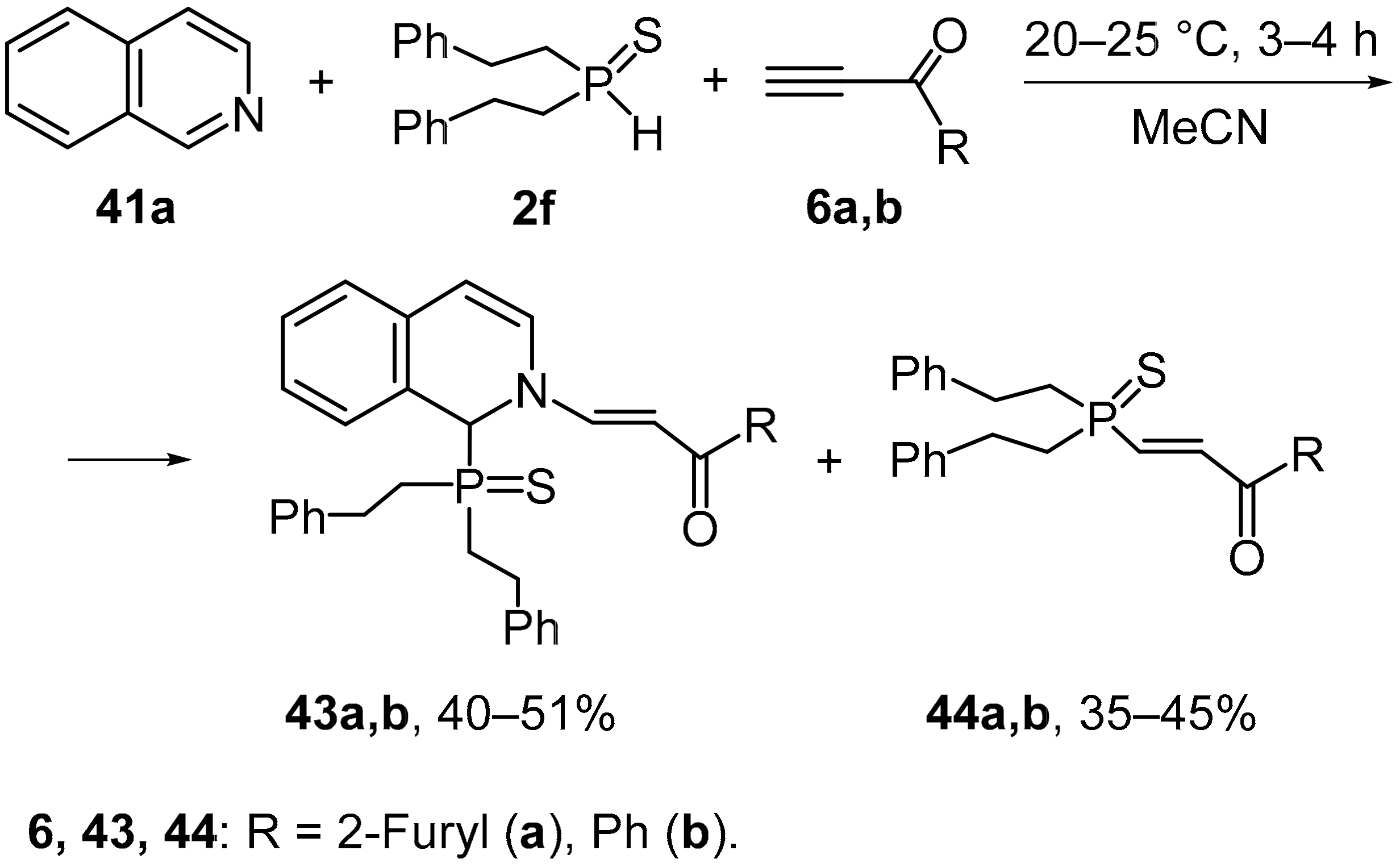
Noteworthy, the reaction with bis(2-phenylethyl)phosphine sulfide 2f gave, together with the anticipated N-acylvinyl-1-phosphorylated dihydroisoquinolines 43a,b, the adducts 44a,b of this phosphine chalcogenide to acylacetylenes (Scheme 34) [69].
Scheme 34.
Reaction of isoquinoline, bis(2-phenylethyl)phosphine sulfide and acylacetylenes.
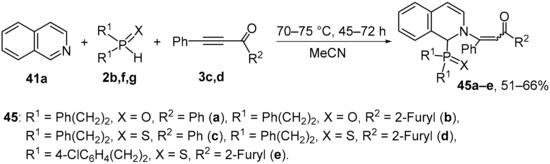
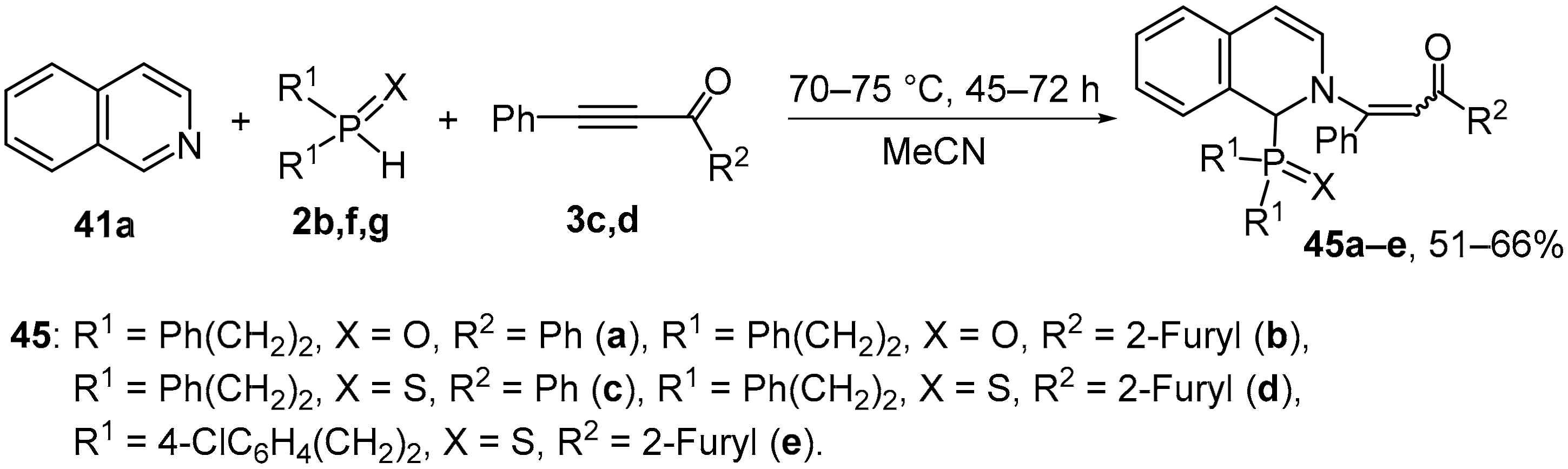
The key steric influence on this tandem vinylation/phosphorylation of isoquinoline was particularly displayed in the reaction with internal acetylenes 3c,d. In this case, even at a higher temperature (70–75 °C), the process was about ten times slower and the stereoselectivity was lost; the reaction mixture contained 70–75% of the 45 Z-isomer, which was proved to be a kinetic product (Scheme 35).
Scheme 35.
Tandem addition of acylphenylacetylenes and secondary phosphine chalcogenides to isoquinoline.
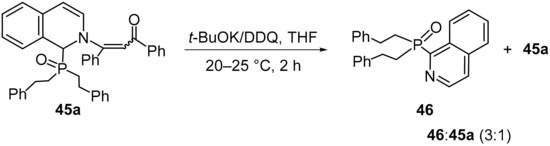
Common oxidants (chloranil or DDQ) induced [69] the retroaromatization to isoquinolines with the elimination of phosphine oxide 2b, which was fixed by quinones. The same transformation was observed for dihydroisoquinoline 45a under the action of t-BuOK in THF. The combination of t-BuOK with DDQ allowed reaching a positive result in the completion of the SNH reaction; the expected aromatic bis(2-phenylethyl)phosphorylisoquinoline 46 was detected among the reaction products along with the initial compound 45a (Scheme 36).
Scheme 36.
Aromatization of dihydroisoquinoline by t-BuOK/DDQ system.
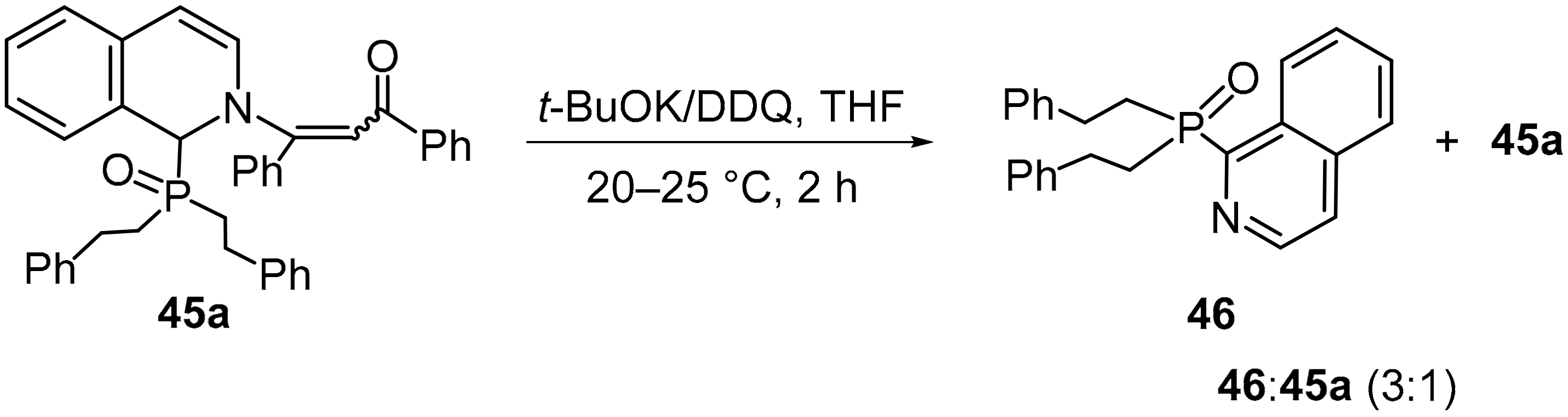
It is believed [69] that the above phosphorylation is triggered by acylacetylenes, which form with quinolines (isoquinolines) 1,3(4)-dipolar intermediate A. A further hydrogen transfer from phosphine chalcogenides to the carbanionic site of intermediate A occurs and the carbocationic intermediate B, thus produced, accepts the phosphorus-centered anion onto position two of the quinoline moiety to give the final products (Scheme 37).
Scheme 37.
Plausible mechanism of tandem addition of acylacetylenes and secondary phosphine chalcogenides to (iso)quinolines.
This mechanism is consistent with the experimental fact that the reaction with isoquinolines is more facile than that with quinolines; a higher basicity of isoquinoline compared to quinolines (pKa values 5.46 and 4.93, respectively) ensures a greater concentration of triggering intermediate A (Scheme 37). Thus, electron-withdrawing substituents in the isoquinoline ring slow down the reaction (Scheme 33). Additionally, a bulkier phosphine oxide 2b and internal acylacetylenes 3c,d significantly hamper the reaction due to steric hindrance for the generation of intermediates A and B. Consequently, the formation of E-isomers (with terminal acylacetylenes) and kinetic Z-isomers (in the case of internal acetylenes) is an expected result of steric prerequisites. The reaction regioselectivity is understood in terms of an anticipated stronger positive charge at the α position relative to the nitrogen atom, provided the process is a charge-controlled one [69].
The quantum chemical insight [69] (HF/6-311G**//B3LYP/6-311G**) reveals that positions two both in pyridine- and quinoline zwitterions are positively charged, while positions four are almost neutral. Meanwhile, the LUMO localization in position four of pyridine is higher than that in quinoline, the α positions have a much lower LUMO localization. It follows that the phosphorylation of pyridines activated by acylacetylenes is orbital controlled, while a similar reaction in quinoline or isoquinoline series depends on charge distribution. This theoretical assessment helps to understand the different behavior of pyridines and quinolines (isoquinolines) in acetylene-triggered/driven SNH phosphorylation; the complete aromatic substitution for the former and the delayed process on the dihydrointermediate step for the latter.
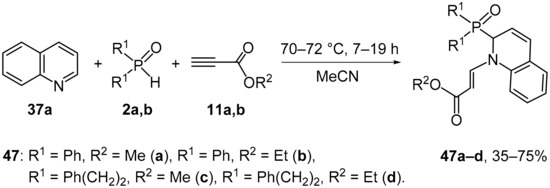
Alkyl propiolates 11a,b triggered and further driven SNH phosphorylation (70–72 °C, 7–19 h) of quinoline 37a with secondary phosphine oxides 2, which, such as the reaction with acylacetylenes, stopped on the formation of the intermediate dihydroquinolines 47a–d with alkyl propiolate substituents at the N atom (Scheme 38) [70].
Scheme 38.
N-vinylation/C-phosphorylation of quinoline with alkyl propiolates and secondary phosphine oxides.
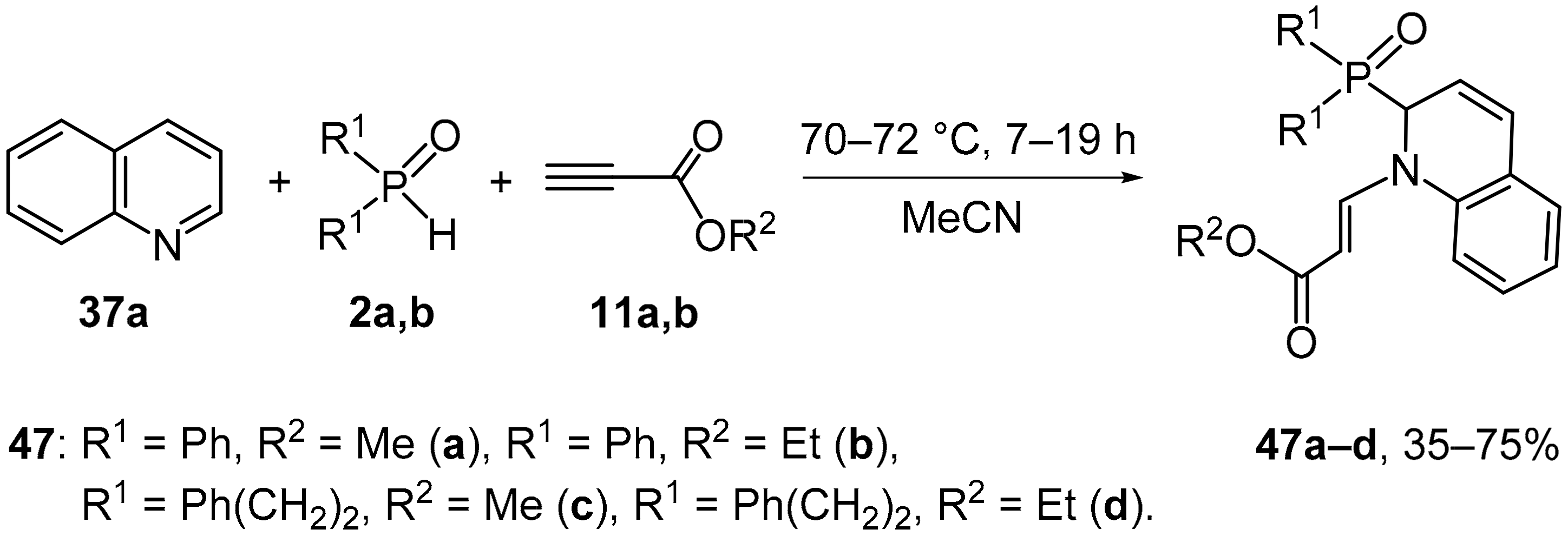
With isoquinoline 41a, the reaction was more facile, taking 1.5–3 h, and more efficient to afford 1,2-dihydroisoquinolines 48a–f in up to a 93% yield (Scheme 39) [70]. In both cases (Scheme 38 and Scheme 39), the reaction was regio- and stereoselective providing 1,2-dihydroisomers of the E-configuration relative to the double bond.
Scheme 39.
N-vinylation/C-phosphorylation of isoquinoline with alkyl propiolates and secondary phosphine chalcogenides.
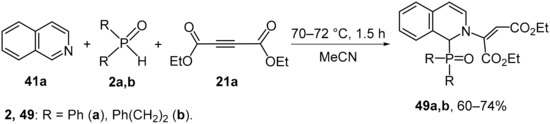
The same phosphorylation of isoquinoline 41a with secondary phosphine oxides 2a,b in the presence of diethyl acetylenedicarboxylate 21a as an adjuvant regio- and stereoselectively yielded (E)-N-ethenyl-1,2-dihydroisoquinolines 49a,b (Scheme 40) [70].
Scheme 40.
N-vinylation/C-phosphorylation of isoquinoline with acetylenedicarboxylate and secondary phosphine oxides.
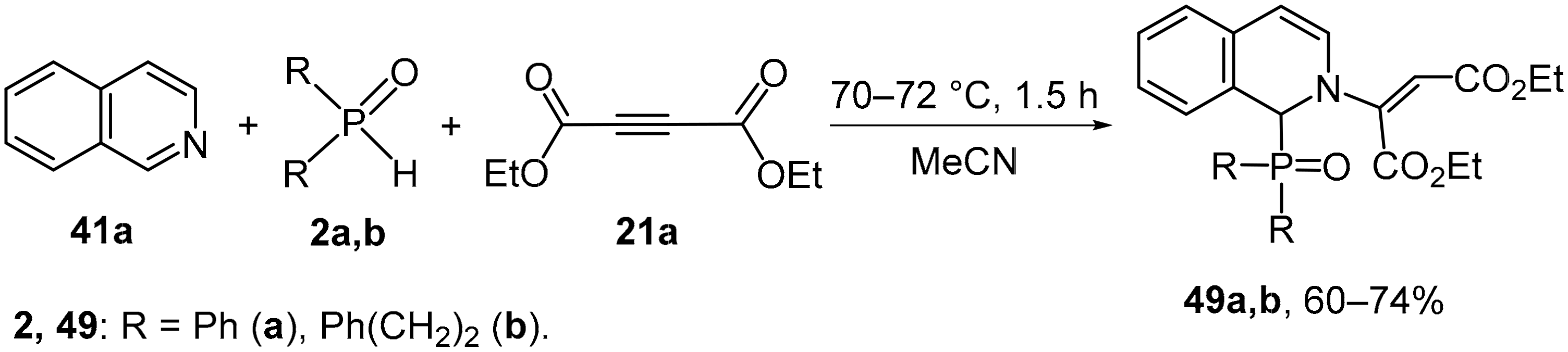
In the work [53], a three-component reaction between quinoline 37a, dialkyl H-phosphonates 35a,b,d and acetylenedicarboxylates 21a,b, providing phosphonylated 1,2-dihydroquinolines 50, was reported (Scheme 41). The reaction was stereoselective; the final products were mainly of the E-configuration.
Scheme 41.
N-vinylation/C-phosphorylation of quinoline with acetylenedicarboxylates and dialkyl H-phosphonates.
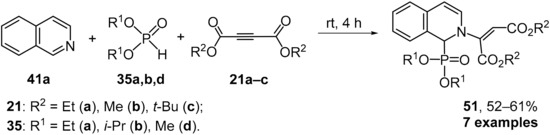
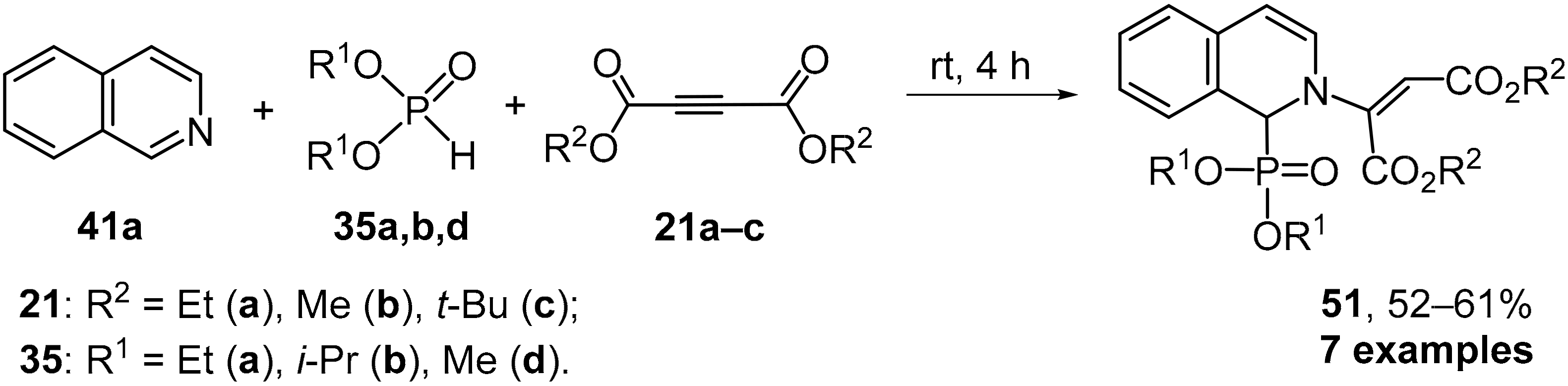
The authors also show [53] that isoquinoline 41a reacted with H-phosphonates 35a,b,d, and acetylenedicarboxylates 21a–c under solvent-free conditions at room temperature to give 1,2-dihydroisoquinolin-1-ylphosphonate derivatives 51 in good yields (Scheme 42).
Scheme 42.
N-vinylation/C-phosphorylation of isoquinoline with acetylenedicarboxylates and dialkyl H-phosphonates.
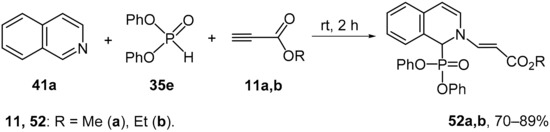
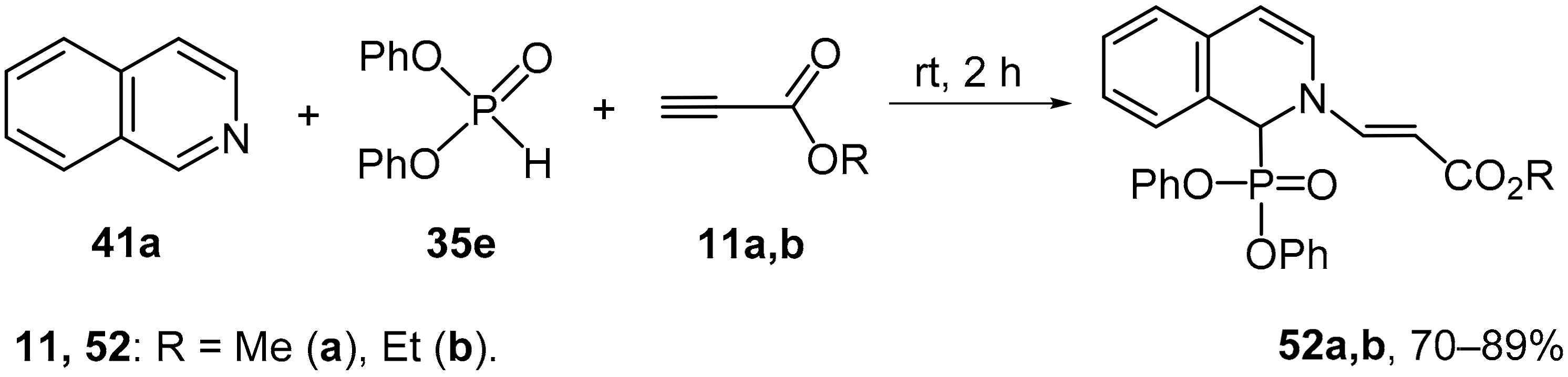
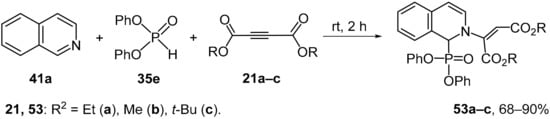
The reaction of isoquinoline 41a and electrophilic acetylenes 11a,b and 21a–c in the presence of diphenyl H-phosphonate 35e proceeded smoothly (rt, 2h) to deliver the corresponding 1,2-dihydroisoquinoline phosphonates 52a,b or 53a–c in a 68–90% yield (Scheme 43 and Scheme 44) [71].
Scheme 43.
N-vinylation/C-phosphorylation of isoquinoline with alkyl propiolates and diphenyl H-phosphonate.
Scheme 44.
N-vinylation/C-phosphorylation of isoquinoline with acetylenedicarboxylates and diphenyl H-phosphonate.
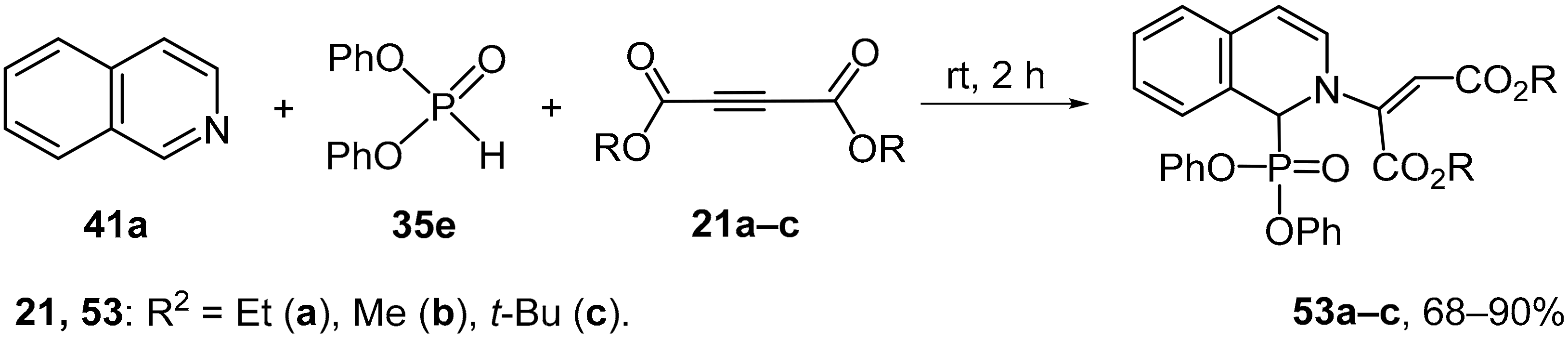
The reaction of quinine 54 with diphenylphosphine oxide 2a in the presence of furoylacetylene 6a (20–25 °C, 6 h, MeCN) did not lead to the C-phosphorylation of the quinoline core. Instead, the vinylation of the hydroxyl-containing substituent and parallel double addition of the phosphine oxide to the triple bond of acetylene occurred [72] (Scheme 45).
Scheme 45.
Acylacetylene in the reaction with quinine and diphenylphosphine oxide.
Recently [73,74], it was shown that the promoting role of electron-deficient acetylenes towards the quinoline core in SNH reactions can be simulated by the reactive P-H nucleophiles themselves via the reversible protonation of the pyridine nitrogen.
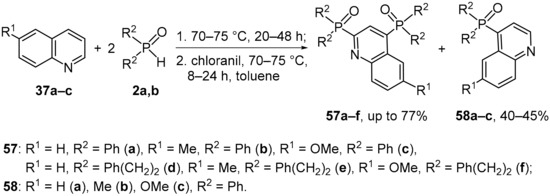
Indeed, the reaction of quinolines 37a–c with secondary phosphine oxides 2a,b without electron-deficient acetylenes followed by treatment with chloranil [73] led to 2,4-bisphosphorylquinolines 57a–c along with 4-phosphorylquinolines 58a–c (for phosphine oxide 2a) and 2,4-bisphosphorylquinolines 57d–f (with phosphine oxide 2b) (Scheme 46).
Scheme 46.
One-pot synthesis of 2,4-phosphorylated quinolines via SNH reaction.
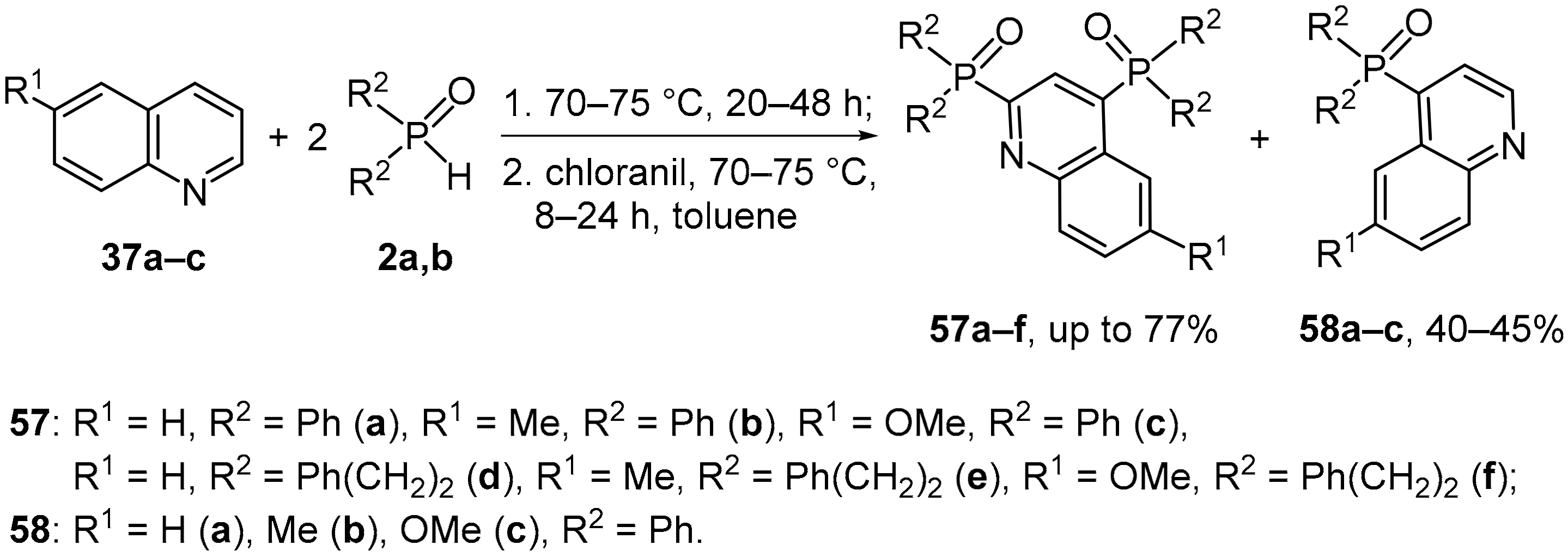
The intermediates of this unique SNH reaction, bisphosphoryltetrahydroquinolines 40, were observed (NMR) upon the heating of quinolines with phosphine oxides without external oxidants [73]. These intermediates turned out to be stable and isolable in excellent yields (Scheme 47).
Scheme 47.
Catalyst-free double addition of secondary phosphine oxides to quinolines.
The substituents in the quinoline ring slightly affected the reaction time (20–26 h for phosphine oxide 2a and 46–48 h for phosphine oxide 2b) and the yields of tetrahydroquinolines 40, which ranged 81–96% for phosphine oxide 2a and 70–76% for phosphine oxide 2b. A lowered reactivity for bis(2-phenylethyl)phosphine oxide 2b was assumed to be associated with the spatial interference of the voluminous substituent.
The expected monoadducts were not isolated at all, i.e., they were more reactive than the starting quinolines. It was explained [73] by the aromaticity loss of the quinoline core after its first phosphorylation and the increased reactivity of the remaining double bond, which also became more electrophilic due to the effect of the phosphoryl substituent.
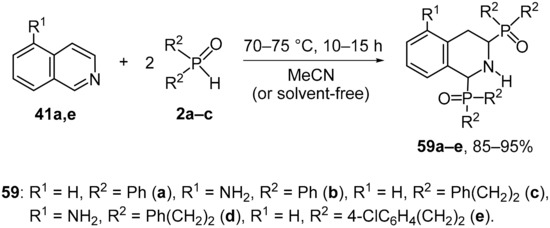
Isoquinolines 41a,e, when reacted with phosphine oxides 2a–c, displayed a much higher activity [73,74] as compared to quinolines, also exclusively affording diadducts, 1,3-bisphosphoryltetrahydroisoquinolines 59a–e in almost quantitative yields (Scheme 48).
Scheme 48.
Catalyst-free double addition of secondary phosphine oxides to isoquinolines.
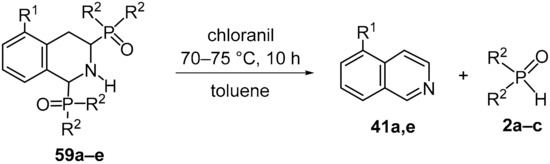
Bisphosphoryltetrahydroisoquinolines 59a–e when oxidized by chloranil eliminated the starting secondary phosphine oxides 2a–c to recover the initial isoquinolines 41a,e (Scheme 49) [73].
Scheme 49.
Oxidation of bisphosphoryltetrahydroisoquinolines.
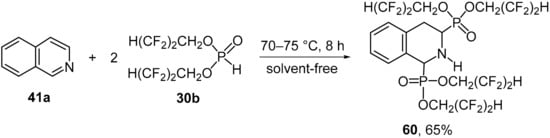
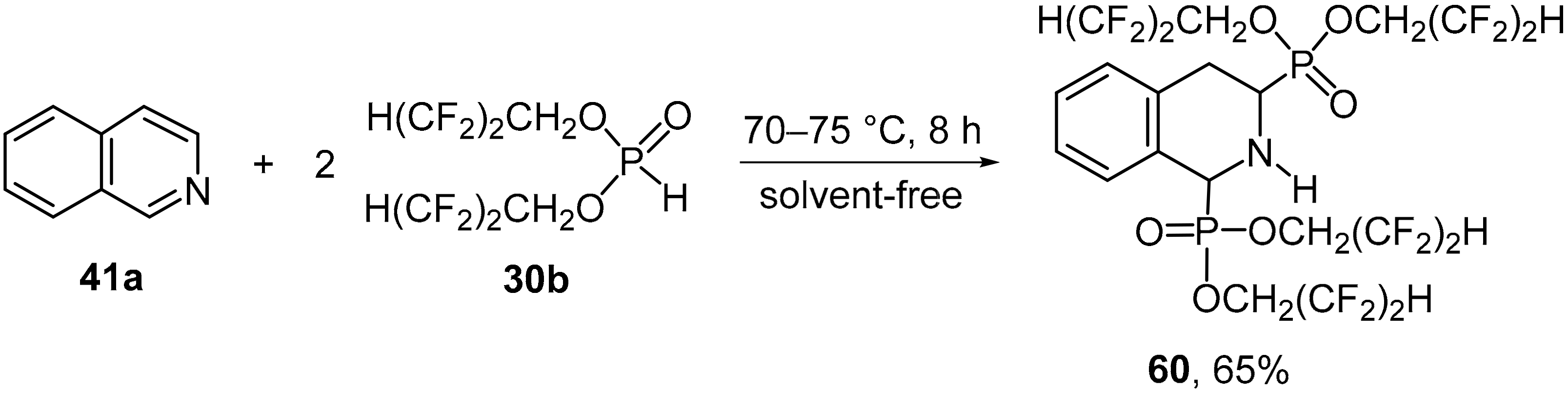
The above double phosphonylation of the isoquinoline ring also occurred [73] when H-phosphonates, e.g., bis(2,2,3,3-tetrafluoropropyl) phosphonate 30b, were employed as nucleophiles to afford the expected bisphosphonylated isoquinoline 60 in a 65% yield (Scheme 50).
Scheme 50.
Synthesis of 1,3-bisphosphonyltetrahydroisoquinoline.
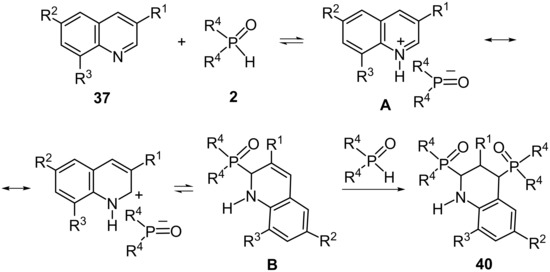
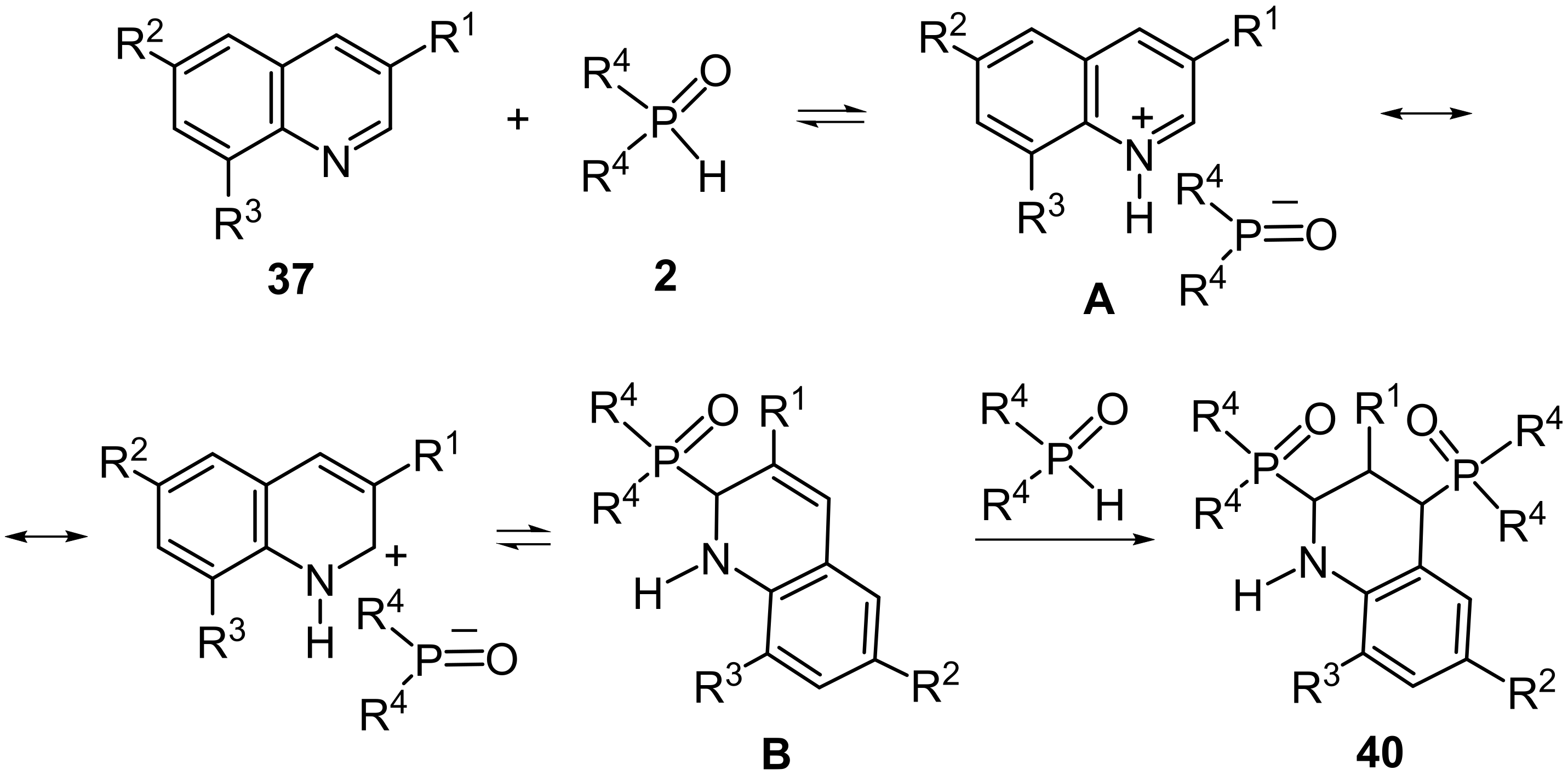
It was assumed [73] that the reaction began (Scheme 51) with the reversible protonation of quinoline 37’s counterpart by the P-H bond of phosphine oxides 2 to produce ion pair A and, next, the monoadduct B, which is further phosphorylated to the most stable diadducts 40.
Scheme 51.
Tentative mechanism of catalyst-free double addition of secondary phosphine oxides to quinolines.
Diphenylphosphine oxide 2a, being more acidic compared to bis(2-phenylethyl)phosphine oxide 2b, deeper protonated quinolines that, in agreement with the above mechanism, facilitated the reaction (Scheme 51).
4. SNH Phosphorylation of Acridines
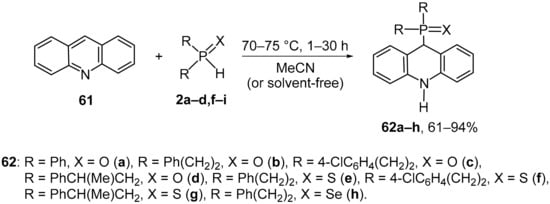
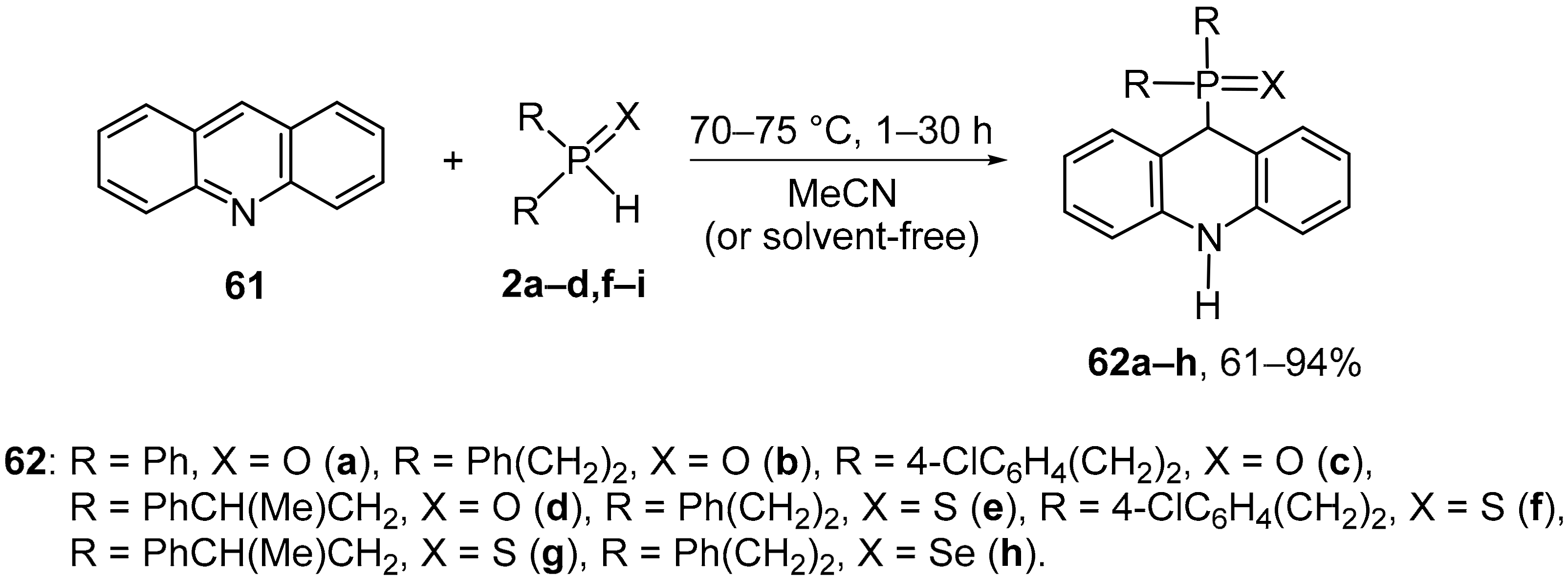
The attempt to transfer the above-considered (see Section 2.1) cross-coupling of pyridines with secondary phosphine chalcogenides [37] in the presence of electron-deficient acetylenes as adjuvants to acridine series has been undertaken. Unexpectedly, instead of the complete SNH reaction, a facile addition of secondary phosphine chalcogenides 2a–d,f–i to the 9,10-positions of acridine 61 took place to give 9-chalcogenophosphoryl-9,10-dihydroacridines 62a–h (Scheme 52) [75,76]. Surprisingly, this reaction did not require the presence of electron-deficient acetylenes.
Scheme 52.
Addition of secondary phosphine chalcogenides to acridine: synthesis of 9-chalcogenophosphoryl-9,10-dihydroacridines.
The substituents’ character and the nature of chalcogene in phosphine chalcogenides significantly affect the yields of dihydroacridines and the process duration; selenides appeared to be most reactive, then, followed by sulfides and oxides (Scheme 52, 62h,e,b). This allowed suggesting that the proton accelerated the addition process since the selenides were the most acidic [55].
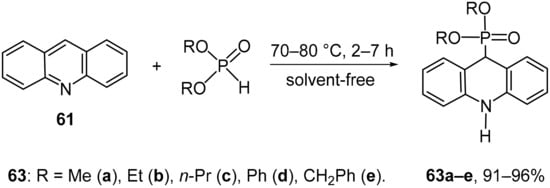
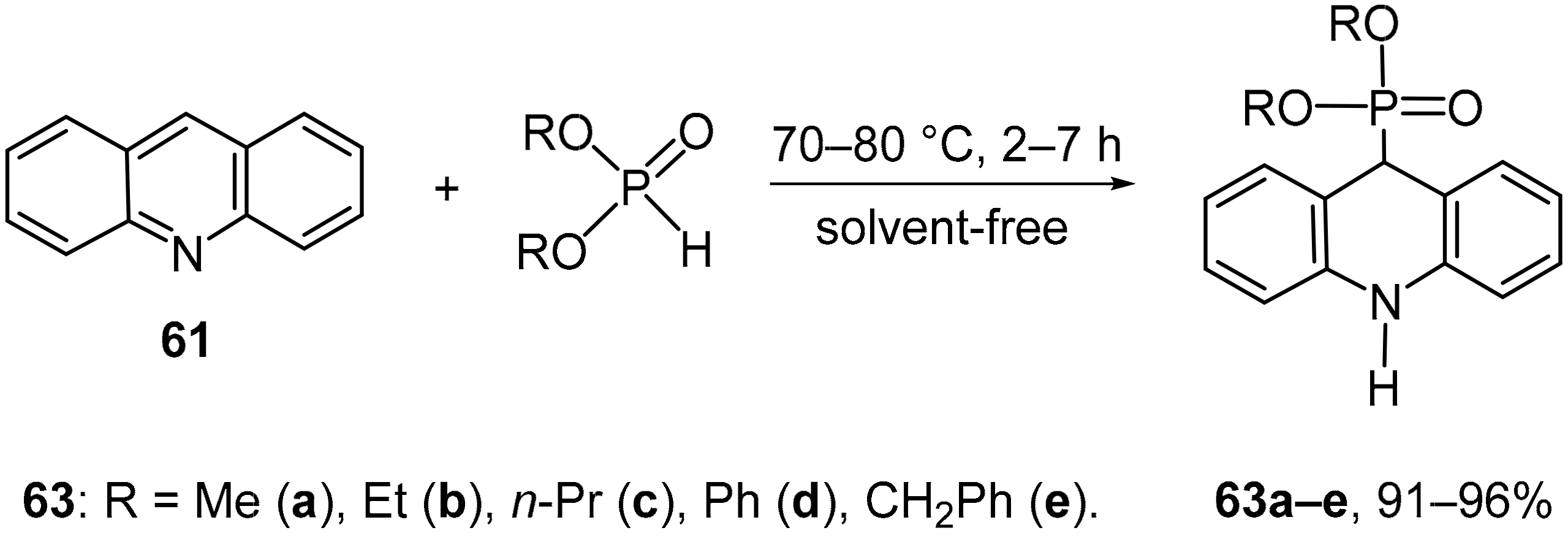
Scheme 53.
Addition of H-phosphonates to acridine.
Acridine dihydro intermediates were unable to be oxidized (aromatized) by electron-deficient acetylenes such as benzoylphenylacetylene. In the case of dihydroacridines with thiophosphoryl substituents, the restoring of the starting acridine occurred and the eliminated phosphine sulfides added to acylacetylenes [75].
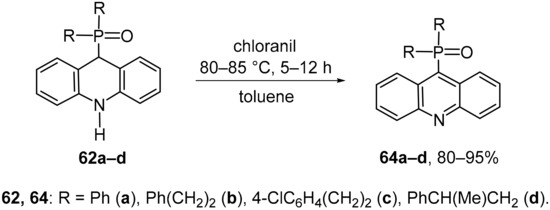
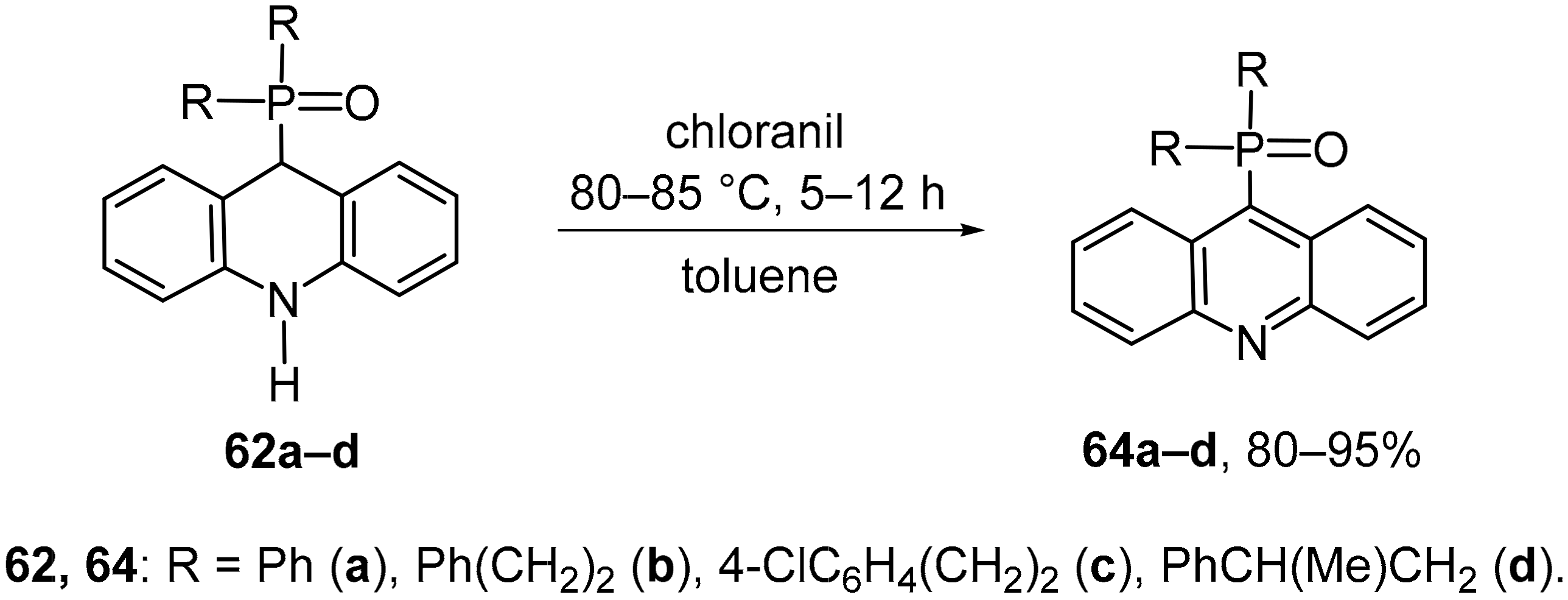
The anticipated SNH reaction was accomplished [75] by the oxidation of dihydroacridines 62a–d with a common external oxidant such as chloranil. The yields of aromatized products, 9-phosphorylacridines 64a–d reached 95% (Scheme 54). Tolerable to this reaction appeared to only be phosphoryl derivatives, while sulfur or selenium analogues gave complex mixtures of products.
Scheme 54.
Oxidative aromatization of 9-chalcogenophosphoryl-9,10-dihydroacridines with chloranil.
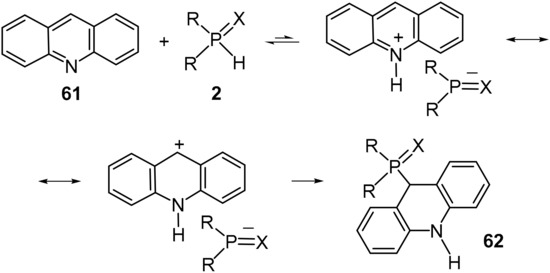
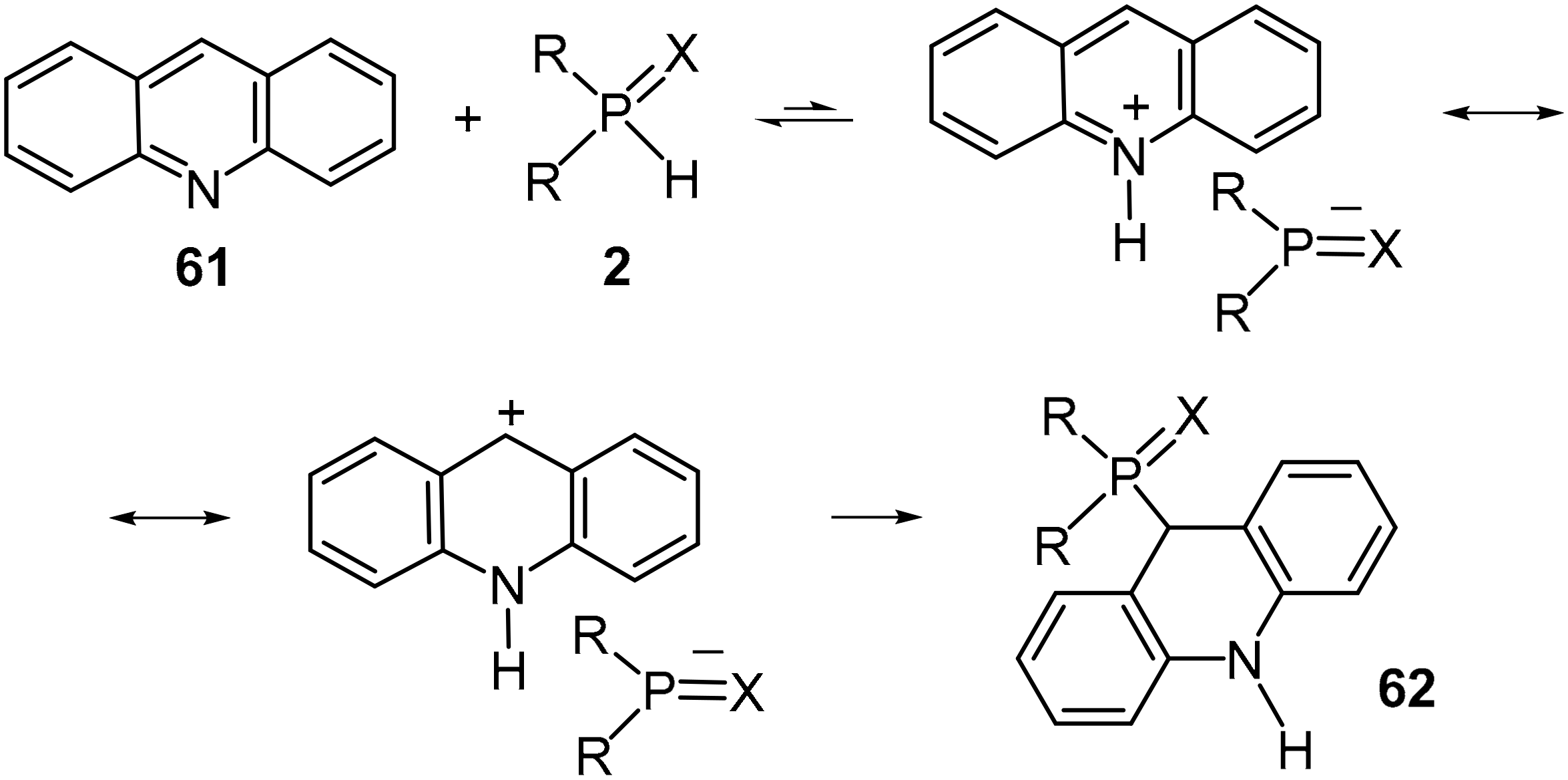
The resistance of acridine to a one-step SNH reaction in the presence of electron-deficient acetylenes was referred to the screening of the nitrogen atom by neighboring benzene ring protons precluding the approach of acetylenes to form the triggering zwitterions. Meanwhile [75], the proton acts as a competitive electrophile and readily attacks the electron lone pair of the acridine nitrogen. The ammonium-like intermediate, thus formed, triggers the addition of phosphine chalcogenides 2 to acridine (Scheme 55). The chalcogenophosphoryl anion, generated by the dissociation of this intermediate, attacks the cationic position nine, to form the final adducts 62.
Scheme 55.
Plausible mechanism of nucleophilic addition.
The key role of the proton in this mechanism is evidenced by the experiments (Scheme 52) showing that the reaction efficiency (yields and the process duration) improves for more acidic phosphine chalcogenides, as noted above. The carbon analogue of acridine, anthracene, which was not able to be protonated under the above conditions, did not add phosphine sulfide 2f as checked experimentally. The importance of steric requirements for the attack of secondary phosphine chalcogenides at position nine that follows from the mechanism proposed (Scheme 55) is also confirmed by the experimental results. In fact, higher yields and a shorter reaction time were observed [75] for less voluminous diphenylphosphine chalcogenides and otherwise (Scheme 52).
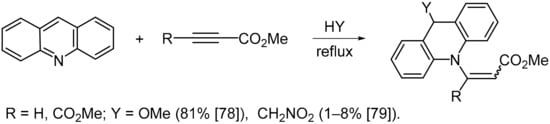
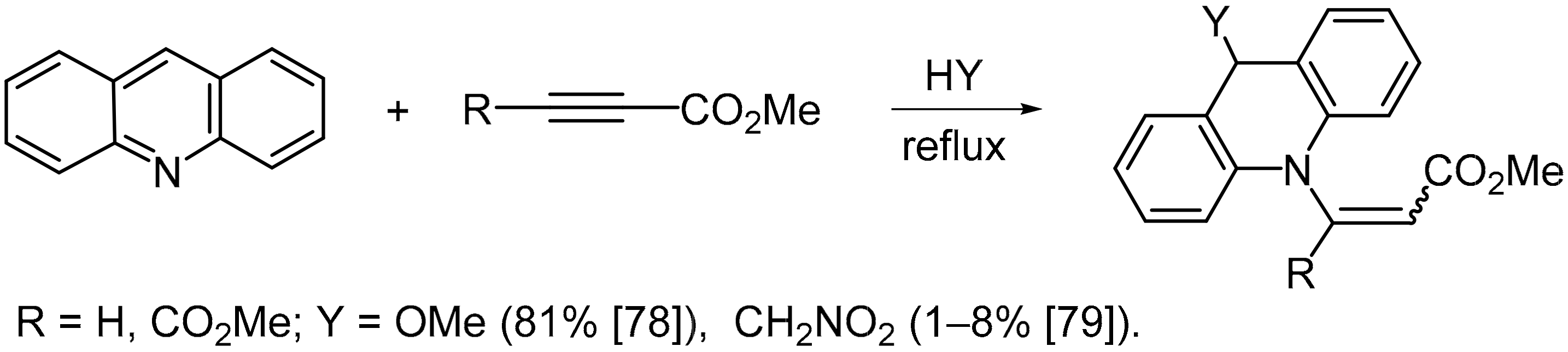
Remarkably, for the presumably less sterically demanding and more electrophilic acetylenecarboxylates, the nucleophilic attack of acridine nitrogen at the triple bond to generate carbanionic zwitterions is, in some cases, possible, as it was mentioned in earlier publications, wherein the three-component adducts with methanol or nitromethane were formed in 81% [78] and 1–8% [79] yields, respectively (Scheme 56).
Scheme 56.
Three-component reaction between acridine, acetylenecarboxylates and methanol or nitromethane.
Apparently, in these reactions, acetylenes become competitive over protons due to the lower acidity of methanol or nitromethane as compared to phosphine chalcogenides 2 (pKa 29.9 and 17.2 for MeOH and MeNO2, respectively).
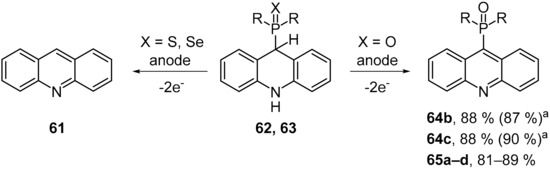
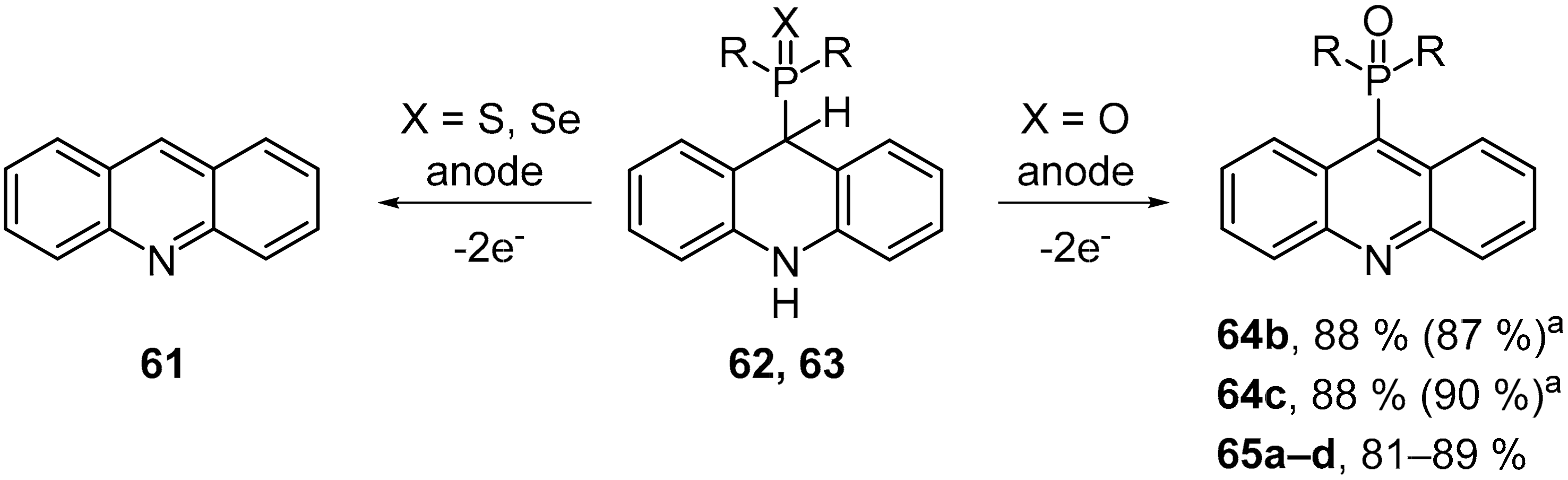
The anodic dehydroaromatization of 9-chalcogenophosphorylsubstituted 9,10-dihydroacridines expectedly proved to be a more efficient and environmentally benign compared to the chemical oxidation.
Indeed, in the case of dihydroacridines 62, 63, aromatization proceeded [77] with the saving of the phosphorus-containing substituents to afford the phosphorylated aromatic acridines 64b,c, 65a–d in high yields (81–89%) (Scheme 57). However, the decomposition of the starting dihydroacridines with phosphoryl sulfide and selenide substituents 62e,f,h with the cleavage of the C-P bond was observed (Scheme 57).
Scheme 57.
Electrochemical oxidation of dihydroacridines (a Chemical oxidation yields [75]).
The cyclic voltammetry showed [77] differences in the behavior of dihydroacridines 62, 63. The phosphoryl derivatives 62b,c, 63a,b,d,e (X = O) gave an irreversible peak of two-electron oxidation, while in the case of compounds 62e,f,h containing sulfur and selenium (X = S, Se), the voltammogram had two one-electron oxidation peaks. From the quantum chemical calculations of the HOMO followed that the growth of the HOMO population corresponded to a decrease in Epeak values [77].
5. Conclusions and Outlook
In this survey, the recent data on the nucleophilic substitution of hydrogen in the pyridine nucleus (SNH reaction) by PH–nucleophiles (phosphine chalcogenides, H-phosphonates) promoted by electron-deficient acetylenes were systematized and generalized. In these SNH reactions of a new type, electron-deficient acetylenes play a role of three-modal adjuvants triggering and further driving the whole process. The first modality of such acetylenic adjuvants consists of the activation of the pyridine ring by the reversible formation of 1,3(4)-dipolar donor–acceptor complexes with pyridinoids, which partially transfer their electron density over the anti-bonding orbital of the triple bond so that the repolarization of the system occurs; the former (basic) nucleophilic pyridine moiety now becomes electrophilic, while the acetylenic parts of the complexes acquire a vinyl carbanion character. The second modality is to abstract protons from the P-H bonds to generate N-vinyl ammonium-like cations and, correspondingly, P-centered anions further recombining to N-vinylphosphorylated dihydropyridinoids. The third modality is to aromatize the dihydropyridinoid intermediates by the internal redox elimination of the vinyl moieties, the former acetylenic counterpart, as functionalized alkenes of the E-configuration or their oligomers. In a number of cases, this SNH phosphorylation of pyridinoids can be retained on the step of dihydro intermediates, usually formed regio- and stereoselectively as 2- or 4-isomers having E- or Z-configuration of the functionalized vinyl substituents, depending on the structure of pyridinoids and the nature of PH–nucleophiles. From a synthetic and pharmaceutical view, such phosphorylated dihydroazines represent even a higher value than the corresponding aromatized phosphorylated products. It might be expected that this approach to promote the new type of SNH reaction can be extendable over other heterocycle/nucleophile/electrophilic acetylene triads. The keys to success of such an extension are (i) significant differences between nucleophilicity of heterocycles and electrophilicity of acetylenes, (ii) the moderate nucleophilicity of nucleophiles not enough for the addition to electrophilic acetylenes (two-component reaction), (iii) nucleophilicity of the anions formed after the abstraction of a proton from its neutral molecules should be appropriate for the addition to the heterocyclic ring activated by acetylenes and (iv) the dihydro intermediates should easily release the acetylenic counterpart (vinyl substituents) to complete the aromatization.
Author Contributions
Conceptualization, B.A.T. and P.A.V.; writing—original draft preparation, B.A.T., P.A.V. and A.A.T.; writing—review and editing, B.A.T. and A.A.T.; visualization, A.A.T.; supervision, B.A.T. All authors have read and agreed to the published version of the manuscript.
Funding
This work was supported by the Russian Science Foundation (grant no. 18-73-10080-P).
Institutional Review Board Statement
Not applicable.
Informed Consent Statement
Not applicable.
Data Availability Statement
Not applicable.
Acknowledgments
Authors acknowledge the Baikal Analytical Center for Collective use SB RAS for the equipment.
Conflicts of Interest
The authors declare no conflict of interest.
Sample Availability
Samples of the compounds are available from the authors.
References
- Lam, K.H.; Gambari, R.; Chun, M.; Yuen, W.; Kan, C.W.; Chan, P.; Xu, L.; Tang, W.; Chui, C.H.; Cheng, G.Y.M.; et al. The preparation of 2,6-disubstituted pyridinyl phosphine oxides as novel anti-cancer agents. Bioorg. Med. Chem. Lett. 2009, 19, 2266–2269. [Google Scholar] [CrossRef] [Scilit] [PubMed]
- Reddy, G.S.; Rao, K.U.M.; Sudha, S.S.; Reddy, N.B.; Sundar, C.S.; Raju, C.N.; Reddy, C.S. Facile synthesis, characterization and antimicrobial activities of diphenylphosphoryl derivatives of substituted aryl and nitrogen heterocycles. Org. Commun. 2013, 6, 41–46. [Google Scholar]
- Dziuganowska, Z.A.; Ślepokura, K.; Volle, J.-N.; Virieux, D.; Pirat, J.-L.; Kafarski, P. Structural Analogues of Selfotel. J. Org. Chem. 2016, 81, 4947–4954. [Google Scholar] [CrossRef] [Scilit]
- Gama, N.H.; Elkhadir, A.Y.F.; Gordhan, B.G.; Kana, B.D.; Darkwa, J.; Meyer, D. Activity of phosphino palladium(II) and platinum(II) complexes against HIV-1 and Mycobacterium tuberculosis. Biometals 2016, 29, 637–650. [Google Scholar] [CrossRef] [Scilit] [PubMed]
- Fereidoonnezhad, M.; Niazi, M.; Ahmadipour, Z.; Mirzaee, T.; Faghih, Z.; Faghih, Z.; Shahsavari, H.R. Cyclometalated Platinum(II) Complexes Comprising 2-(Diphenylphosphino)pyridine and Various Thiolate Ligands: Synthesis, Spectroscopic Characterization, and Biological Activity. Eur. J. Inorg. Chem. 2017, 2017, 2247–2254. [Google Scholar] [CrossRef] [Scilit]
- Ssemaganda, A.; Low, L.M.; Verhoeft, K.R.; Wambuzi, M.; Kawoozo, B.; Nabasumba, S.B.; Mpendo, J.; Bagaya, B.S.; Kiwanuka, N.; Stanisic, D.I.; et al. Gold(I) phosphine compounds as parasite attenuating agents for malaria vaccine and drug development. Metallomics 2018, 10, 444–454. [Google Scholar] [CrossRef] [Scilit] [PubMed]
- Kuchar, J.; Rust, J.; Lehmann, C.W.; Mohr, F. Silver(I) Complexes with Camphorsulfonato and Phosphine Ligands: Structural Diversity and Antibacterial Activity. Inorg. Chem. 2020, 59, 10557–10568. [Google Scholar] [CrossRef] [Scilit] [PubMed]
- Khin, C.; Hashmi, A.S.K.; Rominger, F. Gold(I) Complexes of P,N Ligands and Their Catalytic Activity. Eur. J. Inorg. Chem. 2010, 2010, 1063–1069. [Google Scholar] [CrossRef] [Scilit]
- Kumar, P.; Singh, A.K.; Pandey, R.; Pandey, D.S. Bio-catalysts and catalysts based on ruthenium(II) polypyridyl complexes imparting diphenyl-(2-pyridyl)-phosphine as a co-ligand. J. Organomet. Chem. 2011, 696, 3454–3464. [Google Scholar] [CrossRef] [Scilit]
- Yang, Y.; Gurnham, J.; Liu, B.; Duchateau, R.; Gambarotta, S.; Korobkov, I. Selective Ethylene Oligomerization with Chromium Complexes Bearing Pyridine–Phosphine Ligands: Influence of Ligand Structure on Catalytic Behavior. Organometallics 2014, 33, 5749–5757. [Google Scholar] [CrossRef] [Scilit]
- Ren, W.; Sun, F.; Chu, J.; Shi, Y. A Pd-Catalyzed Site-Controlled Isomerization of Terminal Olefins. Org. Lett. 2020, 22, 1868–1873. [Google Scholar] [CrossRef] [Scilit] [PubMed]
- Zhang, T.; Qin, Y.; Wu, D.; Zhou, R.; Yi, X.; Liu, C. One-Pot Synthetic Route to a Class of Polydental Pyridylphosphines. Synth. Commun. 2005, 35, 1889–1895. [Google Scholar] [CrossRef] [Scilit]
- Denton, R.M.; An, J.; Adeniran, B.; Blake, A.J.; Lewis, W.; Poulton, A.M. Catalytic Phosphorus(V)-Mediated Nucleophilic Substitution Reactions: Development of a Catalytic Appel Reaction. J. Org. Chem. 2011, 76, 6749–6767. [Google Scholar] [CrossRef] [Scilit]
- Alcarazo, M.; Suárez, R.M.; Goddard, R.; Fürstner, A. A New Class of Singlet Carbene Ligands. Chem. Eur. J. 2010, 16, 9746–9749. [Google Scholar] [CrossRef] [Scilit]
- Wassenaar, J.; Detz, R.J.; de Boer, S.Y.; Lutz, M.; van Maarseveen, J.H.; Hiemstra, H.; Reek, J.N.H. Enantioselective Synthesis of Tunable Chiral Clickphine P,N-Ligands and Their Application in Ir-Catalyzed Asymmetric Hydrogenation. J. Org. Chem. 2015, 80, 3634–3642. [Google Scholar] [CrossRef] [Scilit] [PubMed]
- Makosza, M.; Wojciechowski, K. Nucleophilic Substitution of Hydrogen in Heterocyclic Chemistry. Chem. Rev. 2004, 104, 2631–2666. [Google Scholar] [CrossRef] [Scilit] [PubMed]
- Gulevskaya, A.V.; Pozharskii, A.F. Nucleophilic Aromatic Substitution of Hydrogen as a Tool for Heterocyclic Ring Annulation. Adv. Heterocycl. Chem. 2007, 93, 57–115. [Google Scholar]
- Charushin, V.N.; Chupakhin, O.N. Nucleophilic aromatic substitution of hydrogen and related reactions. Mendeleev Commun. 2007, 17, 249–254. [Google Scholar] [CrossRef] [Scilit]
- Charushin, V.N.; Chupakhin, O.N. (Eds.) Metal Free CH Functionalization of Aromatics: Nucleophilic Displacement of Hydrogen; Topics in Heterocyclic Chemistry; Springer International Publishing: Cham, Switzerland, 2014; Volume 37. [Google Scholar]
- Chupakhin, O.N.; Charushin, V.N. Recent advances in the field of nucleophilic aromatic substitution of hydrogen. Tetrahedron Lett. 2016, 57, 2665–2672. [Google Scholar] [CrossRef] [Scilit]
- Chupakhin, O.N.; Charushin, V.N. Nucleophilic C–H functionalization of arenes: A new logic of organic synthesis. Pure Appl. Chem. 2017, 89, 1195–1208. [Google Scholar] [CrossRef] [Scilit]
- Makosza, M. Electrophilic and Nucleophilic Aromatic Substitutions are Mechanistically Similar with Opposite Polarity. Chem. Eur. J. 2020, 26, 15346–15353. [Google Scholar] [CrossRef] [Scilit] [PubMed]
- Chupakhin, O.N.; Shchepochkin, A.V.; Charushin, V.N. Application of electrochemical oxidative methods in the C(sp2)-H functionalization of heterocyclic compounds. Adv. Heterocycl. Chem. 2020, 131, 1–47. [Google Scholar]
- Akulov, A.A.; Varaksin, M.V.; Mampuys, P.; Charushin, V.N.; Chupakhin, O.N.; Maes, B.U.W. C(sp2)–H functionalization in non-aromatic azomethine-based heterocycles. Org. Biomol. Chem. 2021, 19, 297–312. [Google Scholar] [CrossRef] [Scilit]
- Makosza, M.; Jawdosiuk, M. Direct Nucleophilic Substitution of Hydrogen in Nitrobenzene with Some Carbanions. J. Chem. Soc. D. 1970, 648–649. [Google Scholar] [CrossRef] [Scilit]
- Makosza, M.; Golinski, J. Nucleophilic Substitution of Hydrogen in Nitroarenes by Phosphorus-Stabilized Carbanions having “Vicarious” Leaving Groups. Angew. Chem. Int. Ed. Engl. 1982, 21, 451–452. [Google Scholar] [CrossRef] [Scilit]
- Makosza, M.; Paszewski, M.; Sulikowski, D. Synthesis of Diphenyl(nitroaryl)phosphine Oxides via Oxidative Nucleophilic Substitution of Hydrogen in Nitroarenes with Diphenylphosphine Anion. Synlett 2008, 2008, 2938–2940. [Google Scholar] [CrossRef] [Scilit]
- Makosza, M.; Sulikowski, D. Synthesis of α-(Nitroaryl)benzylphosphonates via Oxidative Nucleophilic Substitution of Hydrogen in Nitroarenes. J. Org. Chem. 2009, 74, 3827–3832. [Google Scholar] [CrossRef] [Scilit]
- Chupakhin, O.N.; Trofimov, V.A.; Pushkareva, Z.V. Arylamination of quaternary acridinium salts. Chem. Heterocycl. Compd. 1969, 5, 713. [Google Scholar] [CrossRef] [Scilit]
- Trofimov, V.A.; Chupakhin, O.N.; Pushkareva, Z.V.; Rusinov, V.L. Reaction of acridine proton salts with arylamines in the presence of sulphur. Chem. Heterocycl. Compd. 1971, 7, 104–106. [Google Scholar] [CrossRef] [Scilit]
- Chupakhin, O.N.; Postovskii, I.Ya. Nucleophilic Substitution of Hydrogen in Aromatic Systems. Russ. Chem. Rev. 1976, 45, 454–468. [Google Scholar] [CrossRef] [Scilit]
- Chupakhin, O.N.; Shchepochkin, A.V.; Charushin, V.N.; Maiorova, A.V.; Kulikova, T.V.; Shunyaev, K.Yu.; Enyashin, A.N.; Slepukhin, P.A.; Suvorova, A.I. Electrochemical Oxidative Aromatization of 9-Substituted 9,10-Dihydroacridines: Cleavage of C-H vs C-X Bond. Chem. Heterocycl. Comp. 2019, 55, 956–963. [Google Scholar] [CrossRef] [Scilit]
- Motoyoshiya, J.; Tsuboi, S.; Kokin, K.; Takaguchi, Y.; Hayashi, S.; Aoyama, H. A relationship between chemiluminescence and reactivity of Wittig type reactions of phosphonate carbanions. Heterocycl. Commun. 1998, 4, 25–30. [Google Scholar] [CrossRef] [Scilit]
- Motoyoshiya, J.; Ikeda, T.; Tsuboi, S.; Kusaura, T.; Takeuchi, Y.; Hayashi, S.; Yoshioka, S.; Takaguchi, Y.; Aoyama, H. Chemiluminescence in Autoxidation of Phosphonate Carbanions. Phospha-1,2-dioxetanes as the Most Likely High-Energy Intermediates. J. Org. Chem. 2003, 68, 5950–5955. [Google Scholar] [CrossRef] [Scilit] [PubMed]
- De Blieck, A.; Masschelein, K.G.R.; Dhaene, F.; Rozycka-Sokolowska, E.; Marciniak, B.; Drabowicz, J.; Stevens, C.V. One-pot tandem 1,4–1,2-addition of phosphites to quinolines. Chem. Commun. 2010, 46, 258–260. [Google Scholar] [CrossRef] [Scilit]
- De Blieck, A.; Catak, S.; Debrouwer, W.; Drabowicz, J.; Hemelsoet, K.; Verstraelen, T.; Waroquier, M.; Van Speybroeck, V.; Stevens, C.V. Diphosphonylation of Aromatic Diazaheterocycles and Theoretical Rationalization of Product Yields. Eur. J. Org. Chem. 2013, 2013, 1058–1067. [Google Scholar] [CrossRef] [Scilit]
- Trofimov, B.A.; Volkov, P.A.; Khrapova, K.O.; Telezhkin, A.A.; Ivanova, N.I.; Albanov, A.I.; Gusarova, N.K.; Chupakhin, O.N. Metal-free site selective cross-coupling of pyridines with secondary phosphine chalcogenides using acylacetylenes as oxidants. Chem. Commun. 2018, 54, 3371–3374. [Google Scholar] [CrossRef] [Scilit]
- Volkov, P.A.; Ivanova, N.I.; Khrapova, K.O.; Telezhkin, A.A.; Borodina, T.N.; Gusarova, N.K.; Trofimov, B.A. Solvent-free synthesis of 4-chalcogenophosphorylpyridines via SNHAr reaction of pyridines with secondary phosphine chalcogenides. Mendeleev Commun. 2018, 28, 582–583. [Google Scholar] [CrossRef] [Scilit]
- Volkov, P.A.; Telezhkin, A.A.; Khrapova, K.O.; Ivanova, N.I.; Albanov, A.I.; Gusarova, N.K.; Trofimov, B.A. Metal-free SNH cross-coupling of pyridines with phosphine chalcogenides via 2-4 migration of phosphoryl group: Polarization/deprotonation/oxidation trimodal catalyst-like effect of terminal electron-deficient acetylenes. New J. Chem. 2021, 45, 6206–6219. [Google Scholar] [CrossRef] [Scilit]
- Volkov, P.A.; Gusarova, N.K.; Khrapova, K.O.; Telezhkin, A.A.; Albanov, A.I.; Vasilevskiy, S.F.; Trofimov, B.A. A mechanistic insight into the chemoselectivity of the reaction between 3-phenyl-2-propynenitrile, secondary phosphine oxides and pyridinoids. Mendeleev Commun. 2021, 31, 670–672. [Google Scholar] [CrossRef] [Scilit]
- Trofimov, B.A.; Arbuzova, S.N.; Gusarova, N.K. Phosphine in the synthesis of organophosphorus compounds. Russ. Chem. Rev. 1999, 68, 215–227. [Google Scholar] [CrossRef] [Scilit]
- Trofimov, B.A.; Gusarova, N.K. Elemental phosphorus in strongly basic media as phosphorylating reagent: A dawn of halogen-free ‘green’ organophosphorus chemistry. Mendeleev Commun. 2009, 19, 295–302. [Google Scholar] [CrossRef] [Scilit]
- Gusarova, N.K.; Arbuzova, S.N.; Trofimov, B.A. Novel general halogen-free methodology for the synthesis of organophosphorus compounds. Pure Appl. Chem. 2012, 84, 439–459. [Google Scholar] [CrossRef] [Scilit]
- Gusarova, N.K.; Trofimov, B.A. Organophosphorus chemistry based on elemental phosphorus: Advances and horizons. Russ. Chem. Rev. 2020, 89, 225–249. [Google Scholar] [CrossRef] [Scilit]
- Gusarova, N.K.; Volkov, P.A.; Ivanova, N.I.; Arbuzova, S.N.; Khrapova, K.O.; Albanov, A.I.; Smirnov, V.I.; Borodina, T.N.; Trofimov, B.A. One-pot reductive N-vinylation and C(4)-phosphorylation of pyridines with alkyl propiolates and secondary phosphine chalcogenides. Tetrahedron Lett. 2015, 56, 4804–4806. [Google Scholar] [CrossRef] [Scilit]
- Gusarova, N.K.; Volkov, P.A.; Ivanova, N.I.; Khrapova, K.O.; Albanov, A.I.; Trofimov, B.A. Steric control of regiodirectivity of reductive N-vinylation–C-phosphorylation of pyridines with the system alkyl propiolate–secondary phosphine oxide. Russ. J. Gen. Chem. 2016, 86, 731–734. [Google Scholar] [CrossRef] [Scilit]
- Gusarova, N.K.; Volkov, P.A.; Ivanova, N.I.; Khrapova, K.O.; Telezhkin, A.A.; Albanov, A.I.; Trofimov, B.A. Structural effect in the reductive vinylation/phosphorylation of pyridines with alkyl propiolates and secondary phosphine chalcogenides: Protonation vs. zwitterion generation. Mendeleev Commun. 2017, 27, 553–555. [Google Scholar] [CrossRef] [Scilit]
- Volkov, P.A.; Telezhkin, A.A.; Ivanova, N.I.; Khrapova, K.O.; Albanov, A.I.; Gusarova, N.K.; Trofimov, B.A. Three-Component Reaction of 4-Methylpyridine with Alkyl Propiolates and Secondary Phosphine Chalcogenides. Russ. J. Gen. Chem. 2018, 88, 912–918. [Google Scholar] [CrossRef] [Scilit]
- Volkov, P.A.; Ivanova, N.I.; Khrapova, K.O.; Albanov, A.I.; Arbuzova, S.N.; Gusarova, N.K.; Trofimov, B.A. Synthesis of new N-phosphorylated vinylhydropyridines. Russ. J. Gen. Chem. 2015, 85, 1978–1981. [Google Scholar] [CrossRef] [Scilit]
- Volkov, P.A.; Telezhkin, A.A.; Khrapova, K.O.; Ivanova, N.I.; Albanov, A.I.; Apartsin, K.A.; Gusarova, N.K.; Trofimov, B.A. Unexpected Carbon–Selenium Bond Formation in the Reaction of Secondary Phosphine Selenides with Benzoylphenylacetylene. Russ. J. Gen. Chem. 2017, 87, 2902–2903. [Google Scholar] [CrossRef] [Scilit]
- Volkov, P.A.; Gusarova, N.K.; Khrapova, K.O.; Telezhkin, A.A.; Ivanova, N.I.; Albanov, A.I.; Trofimov, B.A. Catalyst-free selenylation of acylacetylenes with secondary phosphine selenides and water: A short-cut to bis(2-acylvinyl) selenides. J. Organomet. Chem. 2018, 867, 79–85. [Google Scholar] [CrossRef] [Scilit]
- Albouy, D.; Laspéras, M.; Etemad-Moghadam, G.; Koenig, M. Role of Base Catalysts upon the Pudovik Reaction: Unexpected synthesis of 1,2-dihydropyridine phosphonate derivatives. Tetrahedron Lett. 1999, 40, 2311–2314. [Google Scholar] [CrossRef] [Scilit]
- Shaabani, A.; Sarvary, A.; Mousavi-Faraz, S.; Ng, S.W. Synthesis of 1,2-dihydroquinolin-2-ylphosphonates and 1,2-dihydroisoquinolin-1-ylphosphonates via three-component reactions. Monatsh. Chem. 2012, 143, 1061–1065. [Google Scholar] [CrossRef] [Scilit]
- Arbuzova, S.N.; Gusarova, N.K.; Trofimov, B.A. Nucleophilic and free-radical additions of phosphines and phosphine chalcogenides to alkenes and alkynes. Arkivoc 2006, 2006, 12–36. [Google Scholar] [CrossRef] [Scilit]
- Semenzin, D.; Etemad-Moghadam, G.; Albouy, D.; Diallo, O.; Koenig, M. Dual Radical/Polar Pudovik Reaction: Application Field of New Activation Methods. J. Org. Chem. 1997, 62, 2414–2422. [Google Scholar] [CrossRef] [Scilit]
- Prasanthi, G.; Prasad, K.V.S.R.G.; Bharathi, K. Synthesis, anticonvulsant activity and molecular properties prediction of dialkyl 1-(di(ethoxycarbonyl)methyl)-2,6-dimethyl-4-substituted-1,4-dihydropyridine-3,5-dicarboxylates. Eur. J. Med. Chem. 2014, 73, 97–104. [Google Scholar] [CrossRef] [Scilit]
- Kumar, R.S.; Idhayadhulla, A.; Nasser, A.J.A.; Selvin, J. Synthesis and anticoagulant activity of a new series of 1,4-dihydropyridine derivatives. Eur. J. Med. Chem. 2011, 46, 804–810. [Google Scholar] [CrossRef] [Scilit]
- Abbas, H.-A.S.; El Sayed, W.A.; Fathy, N.M. Synthesis and antitumor activity of new dihydropyridine thioglycosides and their corresponding dehydrogenated forms. Eur. J. Med. Chem. 2010, 45, 973–982. [Google Scholar] [CrossRef] [Scilit] [PubMed]
- Fassihi, A.; Azadpour, Z.; Delbari, N.; Saghaie, L.; Memarian, H.R.; Sabet, R.; Alborzi, A.; Miri, R.; Pourabbas, B.; Mardaneh, J.; et al. Synthesis and antitubercular activity of novel 4-substituted imidazolyl-2,6-dimethyl-N3,N5-bisaryl-1,4-dihydropyridine-3,5-dicarboxamides. Eur. J. Med. Chem. 2009, 44, 3253–3258. [Google Scholar] [CrossRef] [Scilit] [PubMed]
- Salazar, T.; Gonzalez, A.; Bandyopadhyay, D. Dihydropyridines as Calcium Channel Blockers: An Overview. J. Anal. Pharm. Res. 2017, 5, 00148. [Google Scholar] [CrossRef] [Scilit]
- Trofimov, B.A.; Andriyankova, L.V.; Shaikhudinova, S.I.; Kazantseva, T.I.; Mal’kina, A.G.; Zhivet’ev, S.A.; Afonin, A.V. Reaction of 3-(1-Hydroxycyclohexyl)-2-propynenitrile with Tris[2-(4-pyridyl)ethyl]phosphine Oxide. Synthesis 2002, 2002, 853–855. [Google Scholar] [CrossRef] [Scilit]
- Shaabani, A.; Rezayan, A.H.; Sarvary, A.; Khavasi, H.R. A novel pyridine-based three-component condensation reaction: Synthesis of highly substituted quinolizines. Tetrahedron Lett. 2008, 49, 1469–1472. [Google Scholar] [CrossRef] [Scilit]
- Asghari, S.; Habibi, A.K. One pot three-component regioselective and diastereoselective synthesis of halogenated pyrido[2,1-b][1,3]oxazines. Tetrahedron 2012, 68, 8890–8898. [Google Scholar] [CrossRef] [Scilit]
- Adib, M.; Yavari, H.; Mollahosseini, M. Efficient one-pot synthesis of 2-oxo-1,9a-dihydro-2H-pyrido[1,2-a]pyrimidine derivatives. Tetrahedron Lett. 2004, 45, 1803–1805. [Google Scholar] [CrossRef] [Scilit]
- Rezayan, A.H.; Sabahi, H.; Rahmati, A.; Maleki, A.; Kheirjou, S. Synthesis of a new class of tetronic acid derivatives: A one-pot three-component condensation reaction between isoquinoline or pyridine and dialkyl acetylenedicarboxylate with tetronic acid. Monatsh. Chem. 2013, 144, 1051–1055. [Google Scholar] [CrossRef] [Scilit]
- Charati, F.R.; Hossaini, Z.; Hosseini-Tabatabaei, M.R. Three component reactions of N-nucleophiles and activated acetylenes with NH-acids: A facile synthesis in water. J. Heterocycl. Chem. 2012, 49, 154–160. [Google Scholar] [CrossRef] [Scilit]
- Arbuzova, S.N.; Gusarova, N.K.; Kazantseva, T.I.; Verkhoturova, S.I.; Albanov, A.I.; Afonin, A.V.; Trofimov, B.A. One-pot synthesis of polyfluoroalkylphosphonylated dihydropyridines with a carboxylate function from pyridines, alkyl propiolates, and bis(fluoroalkyl) phosphonates. Tetrahedron Lett. 2016, 57, 3515–3517. [Google Scholar] [CrossRef] [Scilit]
- Arbuzova, S.N.; Gusarova, N.K.; Kazantseva, T.I.; Verkhoturova, S.I.; Albanov, A.I.; Trofimov, B.A. Regio- and stereoselective reaction of 3-fluoropyridine, electron-deficient alkynes and bis(fluoroalkyl) phosphites: Catalyst- and solvent-free synthesis of polyfluoroalkylphosphonylated 3-fluoro-1,2-dihydropyridines. J. Fluor. Chem. 2018, 210, 137–141. [Google Scholar] [CrossRef] [Scilit]
- Trofimov, B.A.; Volkov, P.A.; Khrapova, K.O.; Telezhkin, A.A.; Ivanova, N.I.; Albanov, A.I.; Gusarova, N.K.; Belogolova, A.M.; Trofimov, A.B. Acetylene-Triggered Reductive Incorporation of Phosphine Chalcogenides into a Quinoline Scaffold: Toward SNHAr Reaction. J. Org. Chem. 2019, 84, 6244–6257. [Google Scholar] [CrossRef] [Scilit]
- Gusarova, N.K.; Volkov, P.A.; Ivanova, N.I.; Khrapova, K.O.; Albanov, A.I.; Afonin, A.V.; Borodina, T.N.; Trofimov, B.A. One-pot regio- and stereoselective synthesis of tertiary phosphine chalcogenides with (E)-N-ethenyl-1,2-dihydroquinoline functionalities. Tetrahedron Lett. 2016, 57, 3776–3780. [Google Scholar] [CrossRef] [Scilit]
- Yavari, I.; Mirzaei, A.; Moradi, L. Solvent-free synthesis of α-aminophosphonates from N-heterocycles, activated acetylenes, and diphenyl phosphite. Synth. Commun. 2010, 40, 2407–2414. [Google Scholar] [CrossRef] [Scilit]
- Volkov, P.A.; Telezhkin, A.A.; Ivanova, N.I.; Khrapova, K.O.; Albanov, A.I.; Gusarova, N.K.; Trofimov, B.A. Chemoselective Vinylation of the Quinine Hydroxy Group with the System Electron-Deficient Acetylene/Diphenylphosphine Oxide: An Alternative to SNHAr Reaction. Russ. J. Org. Chem. 2019, 55, 1971–1974. [Google Scholar] [CrossRef] [Scilit]
- Trofimov, B.A.; Volkov, P.A.; Telezhkin, A.A.; Khrapova, K.O.; Ivanova, N.I.; Albanov, A.I.; Gusarova, N.K. Catalyst-Free Double CH-Functionalization of Quinolines with Phosphine Oxides via Two SNHAr Reaction Sequences. J. Org. Chem. 2020, 85, 4927–4936. [Google Scholar] [CrossRef] [Scilit] [PubMed]
- Volkov, P.A.; Gusarova, N.K.; Telezhkin, A.A.; Khrapova, K.O.; Ivanova, N.I.; Albanov, A.I.; Vakul’skaya, T.I.; Khutsishvili, S.S.; Trofimov, B.A. Catalyst-free regio- and chemoselective addition of secondary phosphine oxides to isoquinolines. Russ. Chem. Bull. 2020, 69, 1102–1105. [Google Scholar] [CrossRef] [Scilit]
- Volkov, P.A.; Khrapova, K.O.; Telezhkin, A.A.; Ivanova, N.I.; Albanov, A.I.; Gusarova, N.K.; Trofimov, B.A. Catalyst-Free Phosphorylation of Acridine with Secondary Phosphine Chalcogenides: Nucleophilic Addition vs SNHAr Reaction. Org. Lett. 2018, 20, 7388–7391. [Google Scholar] [CrossRef] [Scilit]
- Volkov, P.A.; Telezhkin, A.A.; Ivanova, N.I.; Khrapova, K.O.; Gusarova, N.K.; Trofimov, B.A. Unexpected Reaction of Secondary Phosphine Chalcogenides with Acridine. Russ. J. Gen. Chem. 2019, 89, 543–545. [Google Scholar] [CrossRef] [Scilit]
- Shchepochkin, A.V.; Chupakhin, O.N.; Demina, N.S.; Averkov, M.A.; Shimanovskaya, T.Yu.; Slepukhin, P.A.; Volkov, P.A.; Telezhkin, A.A.; Trofimov, B.A.; Charushin, V.N. Electrochemical Aromatization of Dihydroazines: Effect of Chalcogenophosphoryl (CGP) Substituents on Anodic Oxidation of 9-CGP-9,10-dihydroacridine. Synthesis 2021, 53, 3791–3798. [Google Scholar] [CrossRef] [Scilit]
- Acheson, R.M.; Burstall, M.L. The reaction between acridine and methyl acetylenedicarboxylate. J. Chem. Soc. 1954, 1954, 3240–3245. [Google Scholar] [CrossRef] [Scilit]
- Acheson, R.M.; Woollard, J. Addition reactions of heterocyclic compounds. Part LVII. Reactions of pyridines with acetylenic esters in the presence of carbanion sources. J. Chem. Soc. Perkin Trans. 1 1975, 1975, 438–446. [Google Scholar] [CrossRef] [Scilit]


Publisher’s Note: MDPI stays neutral with regard to jurisdictional claims in published maps and institutional affiliations. |
© 2021 by the authors. Licensee MDPI, Basel, Switzerland. This article is an open access article distributed under the terms and conditions of the Creative Commons Attribution (CC BY) license (https://creativecommons.org/licenses/by/4.0/).