Word Sense Disambiguation with Wikipedia Entities: A Survey of Entity Linking Approaches



Abstract
1. Introduction
1.1. Illustrative Example
1.2. Motivation
- Coverage: Wikipedia covers an extremely large number of entities and concepts, including named entities, domain-specific concepts, and many terms not present in traditional lexicons.
- Structure: Hyperlinks, redirects, disambiguation pages, categories, and infoboxes provide rich structural information that can be exploited for semantic relatedness and graph-based reasoning.
- Textual context: Each page contains descriptive text whose content can be used to learn semantic representations and to compare candidate senses with contextual words.
- Multilinguality: Inter-language links and multilingual editions support cross-lingual disambiguation and sense alignment.
1.3. Scope and Focus
- Wikipedia or a resource directly derived from it (e.g., BabelNet) is the primary sense inventory or a key part of a unified inventory;
- The task is to disambiguate words or mentions in context by linking them to Wikipedia pages or Wikipedia-based sense identifiers;
- The systems explicitly exploit Wikipedia’s structure (anchors, links, categories, redirects) or textual content for modeling.
- 1.
- 2.
- Unified WSD and EL frameworks such as Babelfy [1] and graph-based label propagation methods over Wikipedia-WordNet networks;
- 3.
- 4.
- 5.
- 6.
- 7.
1.4. Research Questions
- RQ1 (Inventory design): How is Wikipedia operationalized as a sense or entity inventory (pages, redirects, disambiguation pages, and derived resources such as BabelNet), and what design choices affect granularity and coverage?
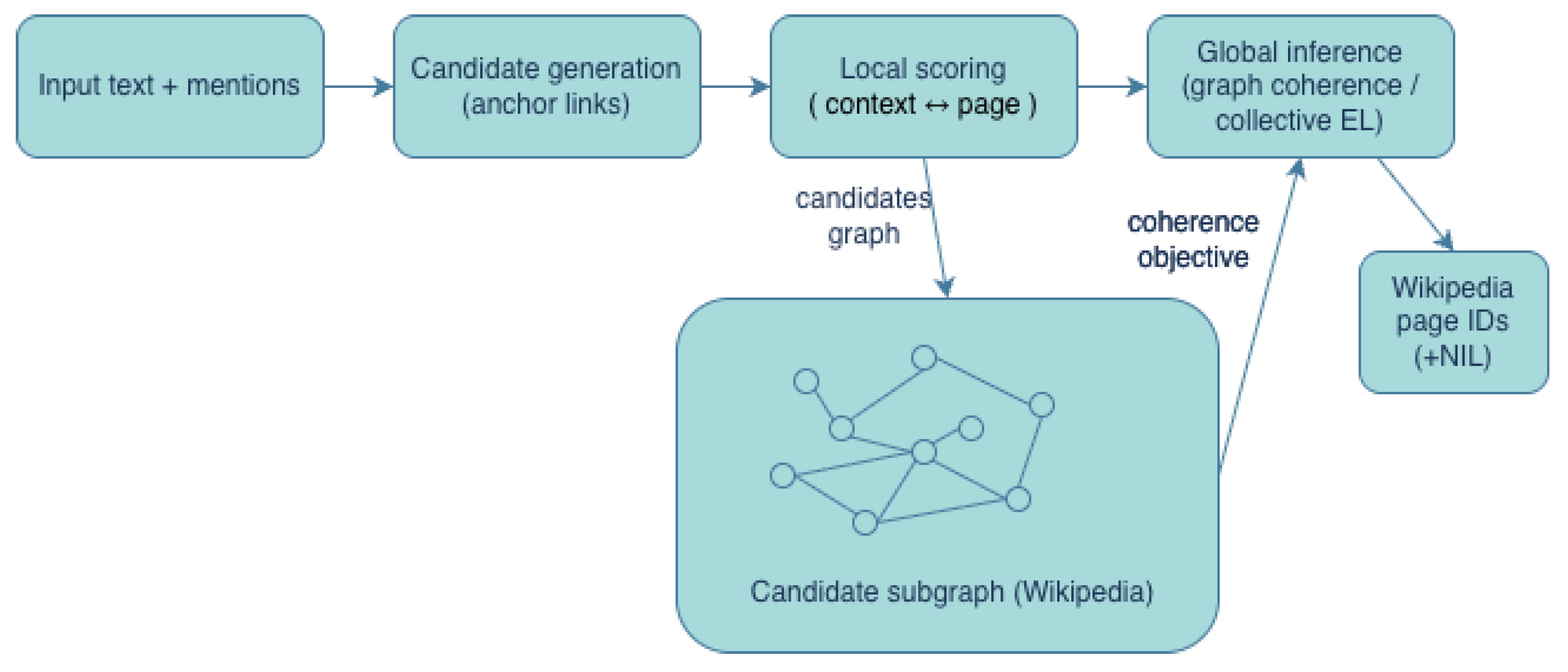
- RQ2 (Pipelines and inference): How do Wikipedia-grounded systems decompose the problem into candidate generation, local scoring, and global inference, and when is collective (graph-based) reasoning beneficial?
- RQ3 (Representation learning): How do neural and contextualized models encode mention and page semantics, and how are these representations combined with explicit Wikipedia structure?
- RQ4 (Multilinguality and robustness): What methods extend Wikipedia-grounded disambiguation across languages, modalities, and low-resource settings, and what failure modes arise from uneven Wikipedia coverage?
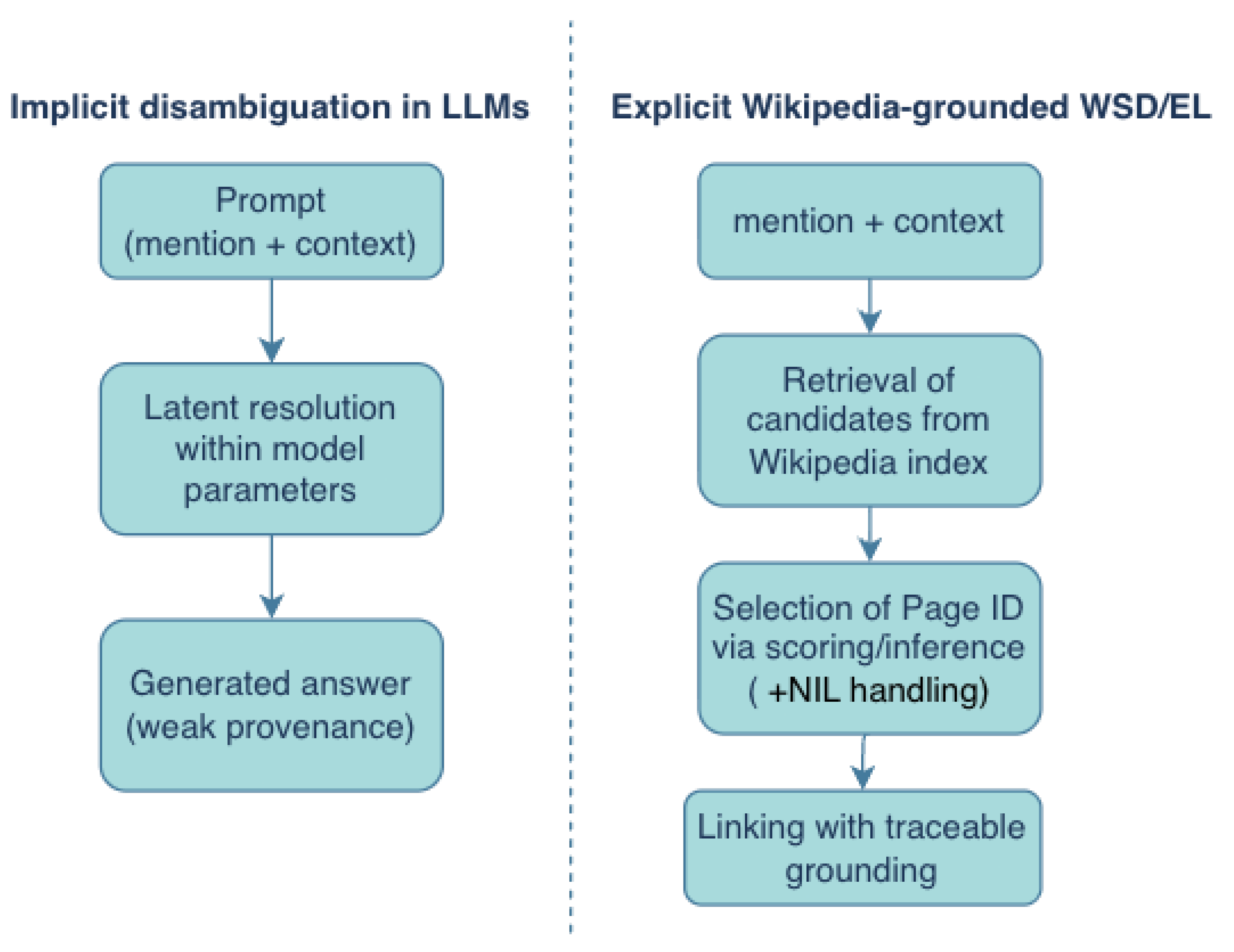
- RQ5 (LLM era): How does Wikipedia-grounded WSD and EL relate to implicit disambiguation in LLMs, and why does explicit grounding remain methodologically important (e.g., for auditability and stable evaluation)?
1.5. Contributions
- We introduce a taxonomy of Wikipedia-based WSD and EL approaches, highlighting common design dimensions and linking them to representative methods.
- We provide a detailed review of methods that use Wikipedia entities as sense identifiers, from early relatedness-based models to modern neural architectures.
- We describe multilingual and multimodal extensions in which Wikipedia acts as a pivot knowledge base and discuss large-scale semantic annotation pipelines grounded in Wikipedia.
- We discuss evaluation benchmarks and metrics for Wikipedia-based WSD and EL and analyze methodological challenges related to sense granularity, NIL entities, and dynamic inventories.
- We identify open research questions and future directions, including integration with large language models and alignment with structured knowledge bases such as Wikidata.
1.6. Organization
2. Materials and Methods
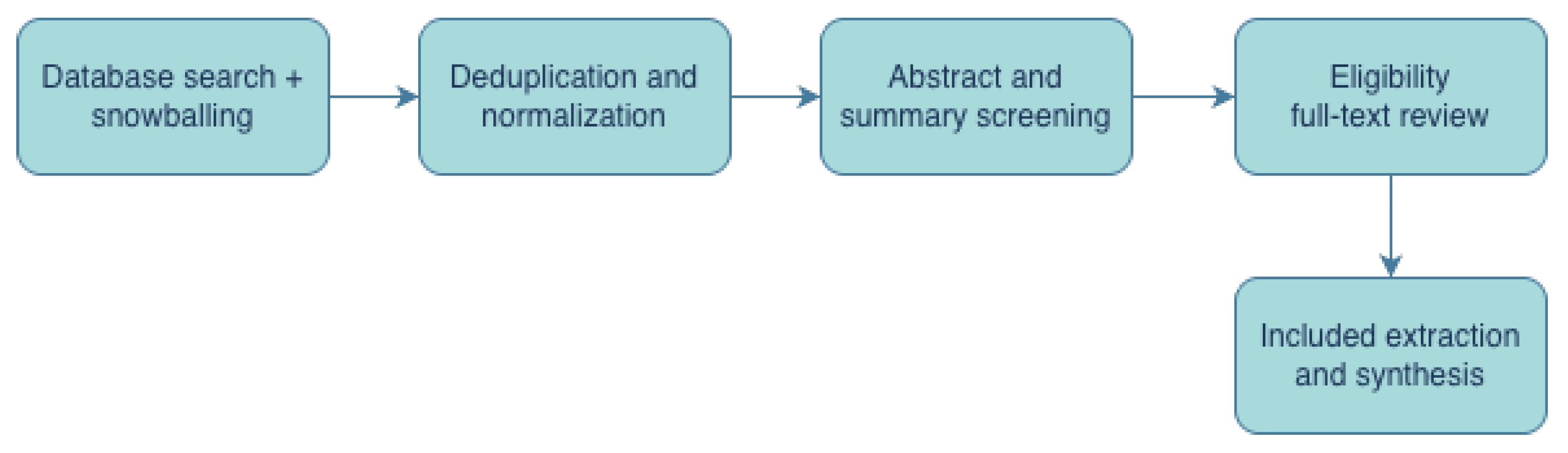
2.1. Protocol Overview
2.2. Information Sources and Search Strategy
2.3. Eligibility Criteria
- Wikipedia grounding: Wikipedia (or a directly derived resource such as BabelNet) is used as the primary inventory for disambiguation or as the target identifier space for linking.
- Technical specificity: The paper describes the candidate generation and disambiguation mechanism with sufficient detail to characterize the method (e.g., features or objectives, model architecture, or inference strategy).
- Empirical support: The paper reports an evaluation, a benchmark comparison, or a concrete downstream use case with measurable outcomes.
2.4. Screening Procedure
2.5. Extraction Schema
- Task framing: WSD, EL, joint or unified, or word sense linking.
- Inventory: Wikipedia pages vs. derived inventories (BabelNet or Wikidata alignment), handling of redirects or disambiguation pages, and NIL policy.
- Candidate generation: Anchor statistics, lexical retrieval, dense retrieval, or hybrid.
- Scoring and inference: Local context–page matching, graph-based collective inference, neural ranking, or hybrid objectives.
- Supervision: Distant supervision from Wikipedia hyperlinks, manually curated gold sets, self-training, or fully unsupervised.
- Evaluation: Datasets, metrics, and whether granularity and cross-lingual coverage are analyzed.
2.6. Synthesis and Taxonomy Mapping
2.7. Transparency Regarding AI-Assisted Tooling
3. Background and Taxonomy
3.1. Word Sense Disambiguation
3.2. Entity Linking
- 1.
- Mention detection: Identify possible mention spans.
- 2.
- Candidate generation: Retrieve candidate entities from the KB using lexical and alias information (e.g., anchor texts or redirects).
- 3.
- Local scoring: Compute compatibility scores between each candidate and its context.
- 4.
- Global inference: Jointly select candidates across the document using graph-based optimization or probabilistic models.
3.3. Wikipedia as a Semantic Resource
- Sense inventory: Each Wikipedia page is treated as a sense or entity; disambiguation amounts to choosing a page.
- Graph: Pages, redirects, categories, and hyperlinks form a large graph. Semantic relatedness can be computed by analyzing adjacency and link overlap [8].
- Textual resource: Page content provides definitions and example contexts. Methods such as ESA treat pages as dimensions in a concept space [4].
- Multilingual hub: Inter-language links connect pages across languages, enabling alignment and transfer.
3.4. Problem Formulation
3.5. Taxonomy of Approaches
- Knowledge-based vs. data-driven: Knowledge-based methods rely primarily on the structure and content of Wikipedia and related graphs, whereas data-driven methods train on labeled instances derived from Wikipedia or external corpora.
- Local vs. global inference: Local methods disambiguate each mention independently given its context; global methods jointly disambiguate all mentions in a document or corpus, exploiting coherence.
- Static vs. contextual representations: Earlier methods use static vector or graph representations; recent methods employ contextualized representations from transformers.
- Monolingual vs. multilingual: Some methods operate on a single language; others exploit cross-lingual signals via inter-language links or multilingual language models.
4. Approaches to Wikipedia-Grounded Disambiguation
4.1. Early Wikipedia-Based WSD and Semantic Relatedness
4.1.1. Using Wikipedia for Automatic WSD
- Lexical overlap between article texts;
- Shared categories;
- Link structure, such as common incoming links.
4.1.2. Link-Based Semantic Relatedness
- Ranking candidate entities by their relatedness to entities already selected in the context;
- Constructing coherence scores over sets of entities in global inference schemes.
4.1.3. Explicit Semantic Analysis
- Semantic similarity comparison between short texts and between words;
- Mapping of word contexts into concept distributions;
- Integration of encyclopedic knowledge into classification and retrieval tasks.
4.1.4. Generalized Wikipedia-Based WSD
- Article content (bag-of-words and TF–IDF features);
- Category hierarchy;
- Hyperlinks and disambiguation pages.
- 1.
- Coarse-grained disambiguation, where simple features and prior probabilities derived from anchor statistics are used to select a subset of promising senses.
- 2.
- Fine-grained reranking, where richer semantic relatedness measures, including graph-based and content-based similarities, are used to rerank the candidates.
4.2. Unified WSD and Entity Linking with Wikipedia and BabelNet
4.2.1. Babelfy and Unified Inventories
- 1.
- For each content word or mention in the input text, it retrieves a set of candidate BabelNet synsets, some of which are backed by WordNet senses while others are backed by Wikipedia pages.
- 2.
- It constructs a semantic graph whose nodes are candidate synsets and whose edges represent semantic relations from BabelNet, such as lexical relations, encyclopedic relations, and gloss overlaps.
- 3.
- It performs a graph algorithm involving random walks with restart and densest subgraph identification to select a subset of nodes that are both well connected and relevant to the input text.
4.2.2. Automatic Sense-Annotated Corpora: Train-O-Matic
- It uses BabelNet as the sense inventory, including Wikipedia-backed synsets.
- It identifies sentences where a target word is likely to be unambiguous, based on lexical and graph-based criteria.
- It assigns sense labels to occurrences where the context strongly favors a single candidate sense.
4.2.3. Multilingual Label Propagation: MuLaN
- Construct a multilingual graph whose nodes are senses (BabelNet synsets) and whose edges capture semantic relations and cross-lingual alignments.
- Use an initial set of labeled instances (e.g., from Train-O-Matic or existing sense-annotated corpora) as seeds.
- Propagate labels across the graph to annotate additional instances in multiple languages.
4.2.4. Joint Word–Entity Embeddings from Wikipedia
- Word–word co-occurrences in text;
- Word–entity co-occurrences in contexts where entities are mentioned;
- Entity–word co-occurrences based on the words in their associated Wikipedia pages.
- Ranking of candidate entities given a mention context;
- Computation of semantic relatedness between Wikipedia-based senses;
- Initialization of sense representations in neural WSD models.
4.2.5. Wikipedia Graph-Based Entity Linking Pipelines
- It identifies candidate keyphrases or terms to annotate.
- It generates candidate entities using lexical and anchor-based matching.
4.3. Neural and Contextualized Approaches
4.3.1. Neural WSD: An Overview
- They represent the context of a target word using distributed embeddings;
- They use classifiers, sequence models, or attention mechanisms to map contexts to sense distributions;
- They exploit large sense-annotated corpora, which are often automatically generated.
4.3.2. Sense Embeddings and SensEmBERT
- 1.
- Collecting sense-annotated occurrences from corpora such as those produced by Train-O-Matic [9] and other resources.
- 2.
- Encoding each occurrence with a pretrained BERT model to obtain a context-sensitive vector for the target word.
- 3.
- Aggregating these vectors (e.g., by averaging) for each sense to produce a sense-specific embedding.
4.3.3. Transformer-Based WSD Models
- The input sentence is fed into a pretrained transformer (e.g., BERT or RoBERTa).
- A classification head predicts a probability distribution over senses for each target word.
- The model is fine-tuned on sense-annotated corpora.
- It uses a multilingual transformer to encode contexts in multiple languages;
- It learns a shared embedding space for senses and contextual representations across languages;
- It exploits BabelNet as the sense inventory, relying on Wikipedia-derived cross- lingual links.
4.3.4. Unsupervised Transformer-Based WSD
- It extracts contextual representations for occurrences of ambiguous words;
- It clusters these representations to induce sense groups;
- It maps clusters to senses in an inventory, which may include Wikipedia-backed synsets, using similarity between cluster centroids and sense definitions or embeddings.
4.3.5. Unsupervised and Knowledge-Based Enhancements
- Using Wikipedia-derived semantic graphs instead of or in addition to WordNet;
- Exploiting link-based relatedness measures to guide clustering and selection.
4.3.6. Neuro-Symbolic and Task-Oriented WSD
- Neural components that produce contextual embeddings;
- A symbolic reasoning module that selects senses and propagates sentiment information along a knowledge graph.
4.4. Multilingual, Multimodal, and Low-Resource Settings
4.4.1. Multilingual Label Propagation
- Cross-lingual edges derived from inter-language links between Wikipedia editions;
- Semantic edges within each language derived from lexical and encyclopedic relations.
4.4.2. Multilingual Sense Inventories and Sense Bags
- Cross-lingual semantic similarity and translation selection;
- Multilingual information retrieval and question answering.
4.4.3. WSD in Machine Translation
4.4.4. Multimodal and Visual WSD
4.4.5. Low-Resource Languages
- Using parallel corpora and translation dictionaries to link low-resource language words to high-resource Wikipedia entities;
- Combining Wikipedia with local encyclopedias or specialized resources;
- Applying active learning or human-in-the-loop annotation to efficiently create gold data centered around Wikipedia entities.
4.4.6. Cross-Lingual Entity Linking with Wikipedia as a Pivot
4.4.7. Aligning Wikipedia with Wikidata and Other Multilingual Resources
4.4.8. Evaluation and Reporting Guidance for Multilingual and Low-Resource Settings
5. Evaluation
5.1. Datasets, Benchmarks, and Evaluation
5.1.1. Overview
5.1.2. Traditional WSD Benchmarks
- Many-to-one, namely when multiple WordNet senses correspond to a single Wikipedia page or BabelNet synset;
- One-to-many, namely when a Wikipedia page covers several WordNet senses;
- Partial or noisy when no perfect correspondence exists.
5.1.3. Automatically Constructed Corpora
5.1.4. Entity Linking Benchmarks
5.1.5. Evaluation Metrics and Protocols
- Should redirects and page renames be treated as equivalent?
- How should disambiguation pages be handled when they do not correspond to a specific sense?
- How should predictions that refer to a page that has been merged or deleted since the dataset was created be treated?
5.1.6. Challenges Specific to Wikipedia-Based Senses
- Dynamic inventory: Wikipedia evolves over time, and thus gold annotations may refer to pages that no longer exist or whose content has changed significantly. Freezing a snapshot mitigates this but reduces alignment with current data.
- Sense granularity: The granularity of Wikipedia pages differs from WordNet and from fine-grained sense inventories. Some pages aggregate multiple senses (e.g., a page for a person that also represents the corresponding fictional character), whereas others split senses that might be indistinguishable for many applications.
- Coverage biases: Wikipedia coverage varies by language, domain, and topic. Certain entities and concepts are over-represented, while others are under-represented or absent.
6. Challenges and Future Directions
6.1. From Static Inventories to Dynamic Knowledge Ecosystems
- Wikipedia pages are added, removed, renamed, and merged;
- New entities and concepts appear regularly;
- External knowledge bases (e.g., Wikidata) introduce new layers of structure and identifiers.
- Incrementally updating mappings between textual mentions and entities;
- Detecting and handling concept drift and changes in entity descriptions;
- Designing models that are robust to changes in the underlying knowledge base.
6.2. Integration with Large Language Models
6.2.1. Implicit vs. Explicit Disambiguation
6.2.2. Hybrid Systems: Retrieval and Grounding Around LLMs
6.2.3. Opportunities at the Interface of WSD/EL and LLMs
- Retrieval-augmented disambiguation: LLMs can be augmented with retrieval modules that fetch relevant Wikipedia pages at inference time, and disambiguation can be framed as selecting or reranking retrieved entities (see Figure 2).
- Sense-aware prompting and constrained decoding: Inputs can be enriched with candidate page summaries (or identifiers), and generation can be constrained to cite or condition on selected pages, strengthening auditability.
- Joint training with explicit identifiers: Models can be trained to predict Wikipedia page IDs as intermediate variables and use them as a bridge to downstream reasoning, aligning implicit representations with explicit inventories.
6.3. Multilinguality and Low-Resource Conditions
- Improved graph-based label propagation that accounts for language-specific phenomena;
- Combination of Wikipedia signals with local resources, such as national encyclopedias or domain-specific lexicons;
- Better modeling of cross-lingual sense divergence, where concepts may not align one-to-one across languages.
6.4. Sense Granularity and Evaluation
- Adopt hierarchical or type-based scoring, where correctness is graded according to ontological proximity (e.g., via categories or Wikidata types);
- Provide application-specific evaluation settings that quantify the benefit of disambiguation at various granularities;
- Incorporate human judgments about the usefulness of distinctions for specific tasks.
6.5. Efficiency and Scalability
- Efficient candidate generation and ranking in the face of large inventories;
- Leveraging approximate nearest neighbor searches and compressed representations for large sense and entity embeddings.
6.6. Answers to the Research Questions
- RQ1 (Inventory design): Wikipedia is operationalized as an inventory of page identifiers augmented by redirects, disambiguation pages, categories, and (in some systems) unified resources such as BabelNet. Inventory design mainly impacts granularity, coverage, and NIL behavior (Section 3 and Section 4).
- RQ2 (Pipelines and inference): Most systems decompose into candidate generation, local scoring, and optional global inference. Graph-based collective inference is most beneficial when multiple mentions are present and topical coherence can be enforced using a Wikipedia link structure (Figure 2; Section 4).
- RQ3 (Representation learning): Contextual encoders and ranking models improve local scoring by learning mention–page semantics from Wikipedia text and link supervision, while hybrid models retain graph constraints for global coherence (Section 4).
- RQ4 (Multilinguality and robustness): Wikipedia enables cross-lingual transfer via inter-language links and multilingual resources, while robustness depends on edition coverage and consistent identifier alignment. Reporting NIL rates and coverage diagnostics is critical in low-resource settings (Section 4).
- RQ5 (LLM era): LLMs can resolve ambiguity implicitly, but explicit Wikipedia grounding remains essential for auditability, updateability, and stable evaluation. Hybrid retrieval-augmented systems integrate these paradigms by retrieving and grounding based on Wikipedia evidence (Section 6).
7. Conclusions
Author Contributions
Funding
Data Availability Statement
Acknowledgments
Conflicts of Interest
Abbreviations
| NED | Named entity disambiguation |
| EL | Entity linking |
| WSD | Word sense disambiguation |
References
- Moro, A.; Raganato, A.; Navigli, R. Entity linking meets word sense disambiguation: A unified approach. Trans. Assoc. Comput. Linguist. 2014, 2, 231–244. [Google Scholar] [CrossRef]
- Bevilacqua, M.; Pasini, T.; Raganato, A.; Navigli, R. Recent trends in word sense disambiguation: A survey. In Proceedings of the Thirtieth International Joint Conference on Artificial Intelligence; IJCAI: Bremen, Germany, 2021. [Google Scholar]
- Wang, Y.; Wang, M.; Fujita, H. Word sense disambiguation: A comprehensive knowledge-based survey. Knowl.-Based Syst. 2020, 190, 105030. [Google Scholar] [CrossRef]
- Gabrilovich, E.; Markovitch, S. Wikipedia-based semantic interpretation for natural language processing. J. Artif. Intell. Res. 2009, 34, 443–498. [Google Scholar] [CrossRef]
- Li, C.; Sun, A.; Datta, A. A generalized method for word sense disambiguation based on Wikipedia. In European Conference on Information Retrieval; Springer: Berlin/Heidelberg, Germany, 2011. [Google Scholar]
- Li, C.; Sun, A.; Datta, A. TSDW: Two-stage word sense disambiguation using Wikipedia. J. Am. Soc. Inf. Sci. Technol. 2013, 64, 1203–1223. [Google Scholar] [CrossRef]
- Mihalcea, R. Using Wikipedia for automatic word sense disambiguation. In Human Language Technologies 2007: The Conference of the North American Chapter of the Association for Computational Linguistics; Association for Computational Linguistics: Stroudsburg, PA, USA, 2007. [Google Scholar]
- Milne, D.; Witten, I.H. An effective, low-cost measure of semantic relatedness obtained from Wikipedia links. In Proceedings of AAAI Workshop on Wikipedia and Artificial Intelligence; AAAI Press: Washington, DC, USA, 2008. [Google Scholar]
- Pasini, T.; Navigli, R. Train-O-Matic: Supervised word sense disambiguation with no (manual) effort. Artif. Intell. 2020, 279, 103215. [Google Scholar] [CrossRef]
- Barba, E.; Procopio, L.; Campolungo, N.; Pasini, T.; Navigli, R. MuLaN: Multilingual label propagation for word sense disambiguation. In Proceedings of the 29th International Joint Conference on Artificial Intelligence (IJCAI); IJCAI: Bremen, Germany, 2020. [Google Scholar]
- Ion, R.; Păiș, V.; Mititelu, V.B.; Irimia, E.; Mitrofan, M.; Badea, V.; Tufiș, D. Unsupervised word sense disambiguation using transformer’s attention mechanism. Mach. Learn. Knowl. Extr. 2025, 7, 10. [Google Scholar] [CrossRef]
- Scarlini, B.; Pasini, T.; Navigli, R. With more contexts comes better performance: Contextualized sense embeddings for all-round word sense disambiguation. In Proceedings of the 2020 Conference on Empirical Methods in Natural Language Processing (EMNLP); Association for Computational Linguistics: Stroudsburg, PA, USA, 2020. [Google Scholar]
- Scarlini, B.; Pasini, T.; Navigli, R. SensEmBERT: Context-enhanced sense embeddings for multilingual word sense disambiguation. In Proceedings of the AAAI Conference on Artificial Intelligence; AAAI Press: Washington, DC, USA, 2020. [Google Scholar]
- Su, Y.; Zhang, H.; Song, Y.; Zhang, T. Multilingual word sense disambiguation with unified sense representation. In Proceedings of the 29th International Conference on Computational Linguistics (COLING); International Committee on Computational Linguistics: Praha, Czech Republic, 2022; pp. 4193–4202. [Google Scholar]
- Vandenbussche, P.-Y.; Scerri, T.; Daniel, R., Jr. Word sense disambiguation with transformer models. In Proceedings of the SemDeep Workshop on Semantic Deep Learning; Association for Computational Linguistics: Stroudsburg, PA, USA, 2021. [Google Scholar]
- Ogezi, M.; Hauer, B.; Omarov, T.; Shi, N.; Kondrak, G. UAlberta at SemEval-2023 Task 1: Context augmentation and translation for multilingual visual word sense disambiguation. In Proceedings of the 17th International Workshop on Semantic Evaluation (SemEval-2023); Association for Computational Linguistics: Stroudsburg, PA, USA, 2023; pp. 2043–2051. [Google Scholar]
- Patankar, S.; Phadke, M.; Devane, S. Wiki sense bag creation using multilingual word sense disambiguation. Int. J. Artif. Intell. 2022, 11, 319–326. [Google Scholar] [CrossRef]
- Makris, C.; Simos, M.A. Novel techniques for text annotation with Wikipedia entities. In Artificial Intelligence Applications and Innovations (AIAI 2014); IFIP Advances in Information and Communication Technology; Iliadis, L., Maglogiannis, I., Papadopoulos, H., Eds.; Springer: Berlin/Heidelberg, Germany, 2014; Volume 436, pp. 508–518. [Google Scholar]
- Makris, C.; Simos, M.A. OTNEL: A distributed online deep learning semantic annotation methodology. Big Data Cogn. Comput. 2020, 4, 31. [Google Scholar] [CrossRef]
- Makris, C.; Pispirigos, G.; Simos, M.A. Text semantic annotation: A distributed methodology based on community coherence. Algorithms 2020, 13, 160. [Google Scholar] [CrossRef]
- Simos, M.A.; Makris, C. Computationally efficient context-free named entity disambiguation with Wikipedia. Information 2022, 13, 367. [Google Scholar] [CrossRef]
- Bejgu, A.S.; Barba, E.; Procopio, L.; Fernández-Castro, A.; Navigli, R. Word sense linking: Disambiguating outside the sandbox. In Findings of the Association for Computational Linguistics: ACL 2024; Association for Computational Linguistics: Stroudsburg, PA, USA, 2024. [Google Scholar]
- Palacios, M.A.C. Word sense disambiguation for linking domain-specific resources. In Proceedings of SWODCH 2024; CEUR Workshop Proceedings; RWTH Aachen University: Aachen, Germany, 2024. [Google Scholar]
- Zhang, X.; Mao, R.; He, K.; Cambria, E. Neuro-symbolic sentiment analysis with dynamic word sense disambiguation. In Findings of the Association for Computational Linguistics: EMNLP 2023; Association for Computational Linguistics: Stroudsburg, PA, USA, 2023; pp. 8772–8783. [Google Scholar]
- Yamada, I.; Shindo, H.; Takeda, H.; Takefuji, Y. Joint learning of the embedding of words and entities for named entity disambiguation. In Proceedings of the 20th SIGNLL Conference on Computational Natural Language Learning; Association for Computational Linguistics: Stroudsburg, PA, USA, 2016. [Google Scholar]
- Sherkat, E.; Milios, E. Vector embedding of Wikipedia concepts and entities. arXiv 2017, arXiv:1702.03470. [Google Scholar] [CrossRef]
- Rahman, N.; Borah, B. An unsupervised method for word sense disambiguation. J. King Saud Univ.-Comput. Inf. Sci. 2022, 34, 6643–6651. [Google Scholar] [CrossRef]
- Mizuki, S.; Okazaki, N. Semantic specialization for knowledge-based word sense disambiguation. In Proceedings of the 17th Conference of the European Chapter of the Association for Computational Linguistics (EACL); Association for Computational Linguistics: Stroudsburg, PA, USA, 2023. [Google Scholar]
- Raganato, A.; Scherrer, Y.; Tiedemann, J. An evaluation benchmark for testing the word sense disambiguation capabilities of machine translation systems. In Proceedings of the Twelfth Language Resources and Evaluation Conference (LREC); European Language Resources Association: Paris, France, 2020; pp. 3668–3675. [Google Scholar]
- Petroni, F.; Rocktäschel, T.; Riedel, S.; Lewis, P.; Bakhtin, A.; Wu, Y.; Miller, A. Language models as knowledge bases? In Proceedings of the 2019 Conference on Empirical Methods in Natural Language Processing and the 9th International Joint Conference on Natural Language Processing (EMNLP-IJCNLP); Association for Computational Linguistics: Stroudsburg, PA, USA, 2019. [Google Scholar]
- Guu, K.; Lee, K.; Tung, Z.; Pasupat, P.; Chang, M. REALM: Retrieval-augmented language model pre-training. In Proceedings of the 37th International Conference on Machine Learning (ICML), Online, 13–19 July 2020. [Google Scholar]
- Lewis, P.; Perez, E.; Piktus, A.; Petroni, F.; Karpukhin, V.; Goyal, N.; Küttler, H.; Lewis, M.; Yih, W.; Rocktäschel, T.; et al. Retrieval-augmented generation for knowledge-intensive NLP tasks. In Advances in Neural Information Processing Systems (NeurIPS); Curran Associates, Inc.: Red Hook, NY, USA, 2020. [Google Scholar]



| Mention | Context | Candidate Targets (Wikipedia Pages) |
|---|---|---|
| Bank | “She deposited her paycheck at the bank.” | Bank (financial institution) vs. River bank |
| Jordan | “Jordan signed a contract with the Bulls in 1984.” | Michael Jordan vs. Jordan (country)/Jordan River |
| Component | Template |
|---|---|
| Wikipedia constraint | (Wikipedia OR BabelNet OR DBpedia) |
| Task constraint | (word sense disambiguation OR WSD OR entity linking OR named entity disambiguation OR concept linking) |
| Method hints (optional) | (graph OR collective OR neural OR contextual OR embedding) |
| Category | Representative Works | Main Characteristics |
|---|---|---|
| Wikipedia-based relatedness and ESA | Mihalcea (2007) [7]; Milne and Witten (2008) [8]; Gabrilovich and Markovitch (2009) [4] | Use Wikipedia pages and links to compute concept-level similarity and disambiguate mentions via relatedness or vector space similarity. |
| Graph-based WSD or EL over Wikipedia or BabelNet | Li et al. (2011, 2013) [5,6]; Moro et al. (2014) [1]; Makris and Simos (2014) [18] Makris and Simos (2020) [19]; Simos and Makris (2022) [21] | Model candidate senses as nodes in a graph (often including Wikipedia entities) and perform global inference or label propagation to enforce coherence. |
| Automatic sense-annotated corpora and label propagation | Pasini and Navigli (2020) [9]; Barba et al. (2020) [10]; Makris et al. (2020) [20] | Generate large-scale sense annotations by exploiting unambiguous anchors and graph-based propagation, usually on BabelNet or Wikipedia graphs. |
| Neural and contextualized models | Scarlini et al. (2020) [12,13]; Vandenbussche et al. (2021) [15]; Su et al. (2022) [14]; Ion et al. (2025) [11] | Fine-tune neural encoders or build sense embeddings over automatically labeled corpora, often grounding senses in Wikipedia-backed inventories. |
| Dataset or Benchmark | Task | Sense Inventory or KB | Notes |
|---|---|---|---|
| Traditional WSD benchmarks (Senseval or SemEval) | All-words WSD | WordNet; sometimes mapped to BabelNet or Wikipedia | Standard WSD datasets, often remapped when systems use Wikipedia-based inventories [2,3]. |
| Train-O-Matic corpora [9] | All-words WSD | BabelNet (WordNet + Wikipedia) | Automatically generated sense-annotated corpora for multiple languages; widely used to train neural WSD models |
| MuLaN corpora [10] | Multilingual WSD | BabelNet or Wikipedia | Label-propagated multilingual sense annotations aligned across languages via Wikipedia entities |
| Raganato MT WSD benchmark [29] | WSD in MT | BabelNet | Tests sensitivity of MT systems to sense distinctions that significantly impact translation quality |
| Visual WSD (SemEval-2023 Task 1) [16] | Multilingual visual WSD | BabelNet or Wikipedia | Combines textual and visual context; many senses correspond to Wikipedia entities |
| Wikipedia-based EL corpora (e.g., AIDA-CoNLL) | Entity linking | Wikipedia | Mentions in news or web text linked to Wikipedia pages; often used for evaluating joint WSD/EL systems such as Babelfy [1]. |
| Dimension | Implicit (LLM-Internal) | Explicit (Wikipedia-Grounded) |
|---|---|---|
| Provenance | Often unavailable or post hoc | Page-level identifiers and retrievable evidence |
| Updateability | Requires retraining or model editing | Update index and inventory snapshot independently |
| Evaluation | Hard to isolate the linking decision | Directly measurable linking or WSD accuracy and NIL behavior |
| Control | Limited (prompting and decoding) | Constrained candidate sets, explicit NIL policies |
| Failure modes | Hallucinations, unstable attribution | Inventory gaps, candidate generation errors |
Disclaimer/Publisher’s Note: The statements, opinions and data contained in all publications are solely those of the individual author(s) and contributor(s) and not of MDPI and/or the editor(s). MDPI and/or the editor(s) disclaim responsibility for any injury to people or property resulting from any ideas, methods, instructions or products referred to in the content. |
© 2026 by the authors. Licensee MDPI, Basel, Switzerland. This article is an open access article distributed under the terms and conditions of the Creative Commons Attribution (CC BY) license.
Share and Cite
Simos, M.A.; Makris, C. Word Sense Disambiguation with Wikipedia Entities: A Survey of Entity Linking Approaches. Entropy 2026, 28, 236. https://doi.org/10.3390/e28020236
Simos MA, Makris C. Word Sense Disambiguation with Wikipedia Entities: A Survey of Entity Linking Approaches. Entropy. 2026; 28(2):236. https://doi.org/10.3390/e28020236
Chicago/Turabian StyleSimos, Michael Angelos, and Christos Makris. 2026. "Word Sense Disambiguation with Wikipedia Entities: A Survey of Entity Linking Approaches" Entropy 28, no. 2: 236. https://doi.org/10.3390/e28020236
APA StyleSimos, M. A., & Makris, C. (2026). Word Sense Disambiguation with Wikipedia Entities: A Survey of Entity Linking Approaches. Entropy, 28(2), 236. https://doi.org/10.3390/e28020236