


Abstract
Traditional pseudorandom number generators (PRNGs) are run by a single party, which is inadequate for multi-party applications requiring verifiable fairness, such as public lotteries. Contemporary lottery systems suffer from non-reproducible seeds and a decoupling between seed generation and participant data. This paper introduces the Verifiable Multi-party PRNG (VMP-PRNG), with a formal definition and security model. A Merkle-tree construction aggregates participant inputs into a publicly verifiable, reproducible seed. To enhance practical security, we define a three-phase timeline with a dual-root mechanism, a Commit-and-Reveal scheme, and a simultaneous-reveal rule in which aborted slots are void; these choices close the rushing and selective-abort bias channels. Two lottery drawing algorithms, hash-chain and CTR, are designed and proved correct in the random oracle model. The analysis establishes soundness, unpredictability, bias resistance under selective abort, and collusion resistance. Experiments on uniformity, NIST SP 800-22 tests, and efficiency up to 16,384 participants confirm the feasibility of the construction. Adversarial simulations show that tamper detection is complete by construction, and that the simultaneous-reveal, void-slot rule preserves the uniform winner distribution under selective abort, whereas sequential reveal lets even a small coalition drive the target’s win rate close to certainty.
1. Introduction
Pseudorandom number generation is a fundamental primitive in cryptography and information security. In most applications, a pseudorandom number generator (PRNG) is initialized with a secret seed and produces a deterministic sequence that is computationally indistinguishable from a truly random sequence. Classical constructions include stream ciphers and CTR-based block ciphers [1], the Micali–Schnorr generator [2], the Naor–Reingold function [3], the Blum–Blum–Shub algorithm [4], and more recent designs such as MELG-64 [5], Squares RNG [6], LXM [7], and Collatz–Weyl generators [8]. In all of these constructions, the seed is generated and held by a single party. This centralized model is inadequate when multiple participants wish to contribute to the randomness generation process, or when the resulting seed must be publicly verifiable.
In multi-party settings, the generation of a trustworthy random seed raises three information-theoretic challenges. First, entropy is distributed across participants, and a mechanism is needed to aggregate the individual contributions into a single output. Second, the aggregation must be publicly verifiable: any observer should be able to check that the seed was computed correctly from the participants’ data, without relying on a single trusted party. Third, the seed must be reproducible: given the same participant data and public parameters, the seed should be uniquely determined. These requirements arise in high-stakes applications such as public lottery drawings [9], but they are fundamentally about entropy aggregation and verifiable randomness extraction.
Several lines of work are related to this problem. A verifiable random function (VRF) provides a publicly verifiable pseudorandom output. The first VRF construction from standard assumptions was proposed in TCC’16 [10], followed by constructions from general primitives [11], tightness-optimal constructions [12], output-private VRFs for Web3 [13], aggregate and key-homomorphic VRFs [14], and unbiasable VRFs for leader elections [15]. Game-theoretic incentivized RNG protocols have also been proposed [16]. However, a VRF is typically generated by a single key holder and does not bind the output to multi-party input data. Distributed randomness generation protocols involve multiple parties but usually do not emphasize public verifiability of the seed generation transcript or seed reproducibility. Secure multi-party computation (MPC) provides strong privacy guarantees but incurs high communication overhead and is not designed for public auditability. Blockchain-based randomness achieves decentralization at the cost of consensus latency and on-chain storage. None of these primitives directly addresses the problem of aggregating multi-party entropy into a publicly verifiable and reproducible seed.
Existing distributed randomness protocols, such as RandHound and RandHerd [17], achieve scalable, bias-resistant randomness by using publicly verifiable secret sharing (PVSS); RandHound is leader driven and client–server, whereas RandHerd is a continuous variant. However, these protocols require heavy cryptographic operations, specifically bilinear pairings, and incur a computation and communication overhead of where c is the sharding group size. This makes them less practical for large-scale deployment scenarios.
To address these limitations, this paper introduces the notion of a Verifiable Multi-party PRNG (VMP-PRNG), which can be viewed as a multi-party randomness extraction mechanism: it extracts a uniformly random seed from the entropy contributed by all participants, while providing public verifiability of the extraction process. Our VMP-PRNG focuses on a semi-decentralized audit model. It requires only lightweight hash operations, and its overall communication overhead is bounded by in the worst case, which stems from n participants retrieving their respective Merkle proofs. This provides a highly scalable and practically deployable alternative for large-scale public lottery drawings. The contributions of this work are as follows.
- Formal definition and security model. We define the phases of VMP-PRNG (GenParty, Merge, PRNG, and Verify) and formalize its security goals, including completeness, soundness, unpredictability, bias resistance, and collusion resistance. To address practical vulnerabilities, we further introduce a strict three-phase security timeline with a dual-root mechanism, a Commit-and-Reveal scheme, a simultaneous-reveal rule, and void aborted slots, which defend against malicious organizers, rushing adversaries, and selective abort. We establish bias-resistance under selective abort (Proposition 1) for the resulting protocol.
- Merkle-tree-based construction. We propose a concrete construction that aggregates multi-party inputs into a single, publicly verifiable random seed using a Merkle tree [18], and we prove its security properties under standard assumptions on the hash function [19,20]. Compared with existing distributed randomness protocols like RandHound, our hash-based approach requires only lightweight operations, avoiding the heavy bilinear pairings and overhead.
- Verifiable lottery drawings. As an application, we design two verifiable lottery drawing algorithms based on VMP-PRNG and a sorting manner. We prove their correctness in the random oracle model, and we experimentally evaluate their randomness properties up to , their efficiency up to , and the bias induced by selective abort: with sequential reveal, a five-party coalition raises an honest target’s win rate from to , whereas the protocol’s simultaneous reveal with void slots keeps it at , statistically indistinguishable from the no-adversary control.
The remainder of this paper is organized as follows. Section 2 introduces preliminaries on PRNGs, cryptographic hash functions, and Merkle trees. Section 3 presents the definition, security model, and Merkle-tree-based construction of VMP-PRNG. Section 4 introduces two verifiable lottery drawing algorithms and proves their correctness. Section 5 reports the experimental evaluation, including uniformity tests, NIST statistical tests, and efficiency measurements. Section 6 concludes the paper and discusses future work.
2. Preliminaries
2.1. Pseudorandom Number Generators
A pseudorandom number generator (PRNG) is a deterministic algorithm that maps a d-bit seed to an m-bit output such that no probabilistic polynomial-time (PPT) distinguisher can distinguish from a uniformly random string of length m with non-negligible advantage, where the probability is taken over the uniform choice of and the randomness of the distinguisher.
In this work, we do not propose a new PRNG. Instead, we focus on the seed generation phase in a multi-party setting, and we assume that a standard secure PRNG is used once a seed has been established. The security of the PRNG phase is therefore inherited from the underlying primitive, and our analysis focuses on the process of merging multi-party data into a verifiable seed. Throughout this paper, we assume that the underlying PRNG satisfies the standard pseudorandomness notion above.
2.2. Cryptographic Hash Functions and Assumptions
A cryptographic hash function (CHF) h maps an arbitrary binary string to a fixed-length output of k bits. For cryptographic applications, we require the following standard properties [19].
- Preimage resistance. Given a hash output y, it is computationally infeasible to find any input x such that .
- Second-preimage resistance. Given an input , it is computationally infeasible to find another input such that .
- Collision resistance. It is computationally infeasible to find two distinct inputs such that .
We rely on the collision resistance of h when analyzing VMP-PRNG. Specifically, the soundness of the construction from Merkle tree relies on the collision resistance of h, while the unpredictability analysis is carried out in the random oracle model.
Several standardized hash functions are available, including SHA-256, SHA3-256, and SM3. SHA-256 and SM3 are based on the Merkle–Damgård construction, while SHA3-256 uses a sponge construction and is resistant to length-extension attacks. Although cryptanalytic attacks on reduced-round versions of SHA-256 and SHA3-256 have been reported [21,22], none of them threatens the full functions at the security levels required by our construction.
In this paper, we use SHA3-256 as a concrete instantiation of h. This choice is motivated by its resistance to length-extension attacks and its standardized sponge construction. A quantitative comparison of SHA-256, SHA3-256, and SM3 in our setting is reported in Section 5.4.
2.3. Merkle Tree
A Merkle tree over data items is a full binary tree obtained by repeatedly hashing pairs of child nodes from the leaves to the root [18]. For data , the leaf nodes are , and internal nodes are computed as
The root is , and the whole tree is denoted by . When n is not a power of two, we set and pad the tree by duplicating the last leaf until leaves are obtained. Since the duplicated value is public and fixed, this padding does not introduce additional bias.
To verify that a data item is a member of , one recomputes the leaf-to-root path using the sibling nodes
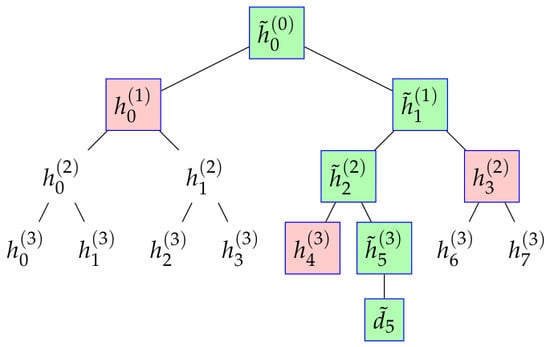
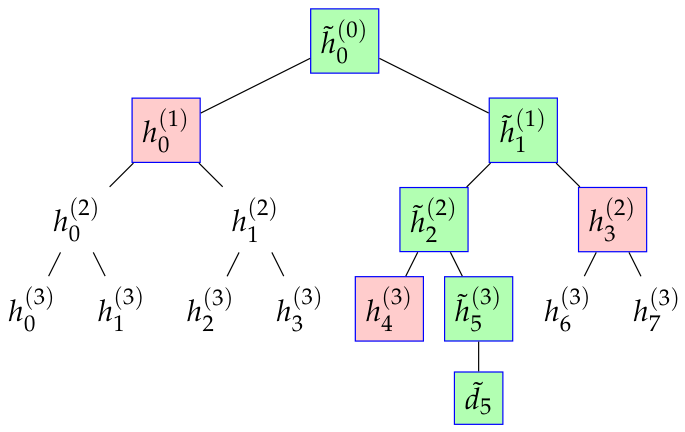
where and denotes the sibling of node i. The verification succeeds if and only if the recomputed root equals the original root . Figure 1 illustrates a Merkle tree with three levels and highlights the verification path for .
Figure 1.
A Merkle tree with three levels. Internal nodes are computed bottom–up by hashing pairs of child nodes. The highlighted path shows the verification of using sibling nodes .
3. Verifiable Multi-Party PRNG
3.1. Definition of VMP-PRNG
A Verifiable Multi-party PRNG (VMP-PRNG) consists of the following four phases.
- : Upon input of the number of parties n, generate n parties together with their data . Each should be related to the corresponding party and should have min-entropy at least , where is the security parameter. In practice, is instantiated aswhere and identify the party, is a timestamp chosen within a publicly announced time window, and is chosen uniformly at random by . The min-entropy assumption applies to , not to , , or , which are public; the nonce remains unknown to the adversary until . We instantiate unless stated otherwise. The hash function H produces a fixed-length digest for each party.
- : Upon input of the data of all parties, merge them into a fixed-length output r that serves as the random seed. In this paper, the merge phase is instantiated by a Merkle tree as described in Section 2.3.
- : Upon input of the seed r, use a standard secure PRNG to generate the random numbers for the parties , respectively.
- : Upon input of the submitted data and the seed r, verify the validity of r. Once r is verified, the validity of the subsequent random numbers follows immediately.
The PRNG phase relies on a standard secure PRNG, and its security is inherited from the underlying primitive. The focus of this work is therefore the merge phase, namely how to aggregate multi-party data into a publicly verifiable seed.
The four phases above define the functional interface. The three-phase timeline of Section 3.2 refines and with commitments and a synchronous reveal, and the security goals below are stated for the refined protocol.
Throughout the security analysis, the min-entropy of is supplied by ; , , and are public and contribute no entropy.
3.2. Adversarial Model
We consider n parties as , and allow a probabilistic polynomial-time (PPT) adversary to corrupt up to t of them. Corruption can be either static or adaptive. A corrupted party is assumed to be malicious and may behave arbitrarily, without following the prescribed protocol.
We work in a synchronous network with authenticated channels. Under these assumptions, every message from an honest party is eventually delivered and cannot be forged by . The adversary is allowed to manipulate and delay messages from corrupted parties and to choose their inputs. The reveal phase is a single round with a fixed deadline: the organizer publishes all reveals atomically, so no party can condition its reveal or abort decision on another party’s raw input. Two cases are distinguished:
- Non-rushing adversary. Every party, including corrupted ones, is required to commit to its input before seeing the inputs of other parties via external cryptographic commitment.
- Rushing adversary. Corrupted parties may choose their inputs adaptively after seeing the inputs of honest parties.
Defending against Rushing Adversaries and the Security Timeline. In the plain construction, a rushing adversary could observe the honest parties’ inputs and adapt its own to bias the Merkle root. To eliminate this vulnerability and prevent premature seed computation or censorship, we employ a strict Commit-and-Reveal mechanism and define a three-phase security timeline. The organizer is auditable but potentially malicious, and we assume the public bulletin board is append-only and immutable.
- Phase , Commitment Collection. Each party chooses a random salt and submits a blinded commitment to the organizer. The organizer must maintain a publicly accessible participant registry of all submitted commitments. At this stage, the raw inputs and salts remain hidden.
- Phase , Commitment Root Locking. The organizer computes the commitment tree over all and publishes the commitment root on the public bulletin board. Because the salts and raw data remain hidden, the final seed r cannot be verified or manipulated at this phase. serves as a strict structural binding for the participant registry; any attempt to tamper with the list by omitting a valid or altering the order will be immediately exposed by a mismatch with the reconstructed root.
- Phase , Simultaneous Reveal and Seed Generation. At a pre-announced deadline, all participants post their raw inputs in a single synchronous round, and the organizer publishes the complete set atomically. Upon accepting a reveal, the organizer returns a countersigned, timestamped receipt over and the round identifier; is evidence that the reveal was submitted before the deadline. A reveal that is not posted by the deadline is treated as an abort. Any observer then performs a two-level verification. First, they recompute each and check it against the corresponding leaf of the commitment tree, which proves that the revealed input matches the committed one and that the participant list is complete. If the registry is valid, they proceed to the second level: recompute , rebuild the final Merkle tree, and obtain the final seed root r. The lottery is drawn using r.
Reveal Timing and Publication Assumptions. The security of rests on three assumptions: (A1) is a single synchronous round with a fixed deadline; (A2) the organizer does not leak any reveal before the deadline and publishes all accepted reveals atomically; and (A3) each accepted reveal is acknowledged by a countersigned, timestamped receipt , or is posted to an append-only bulletin board with a publicly verifiable timestamp. A2 and A3 are trust assumptions in the current protocol rather than cryptographic guarantees; they can be enforced by a public bulletin board or a smart contract, but without such a mechanism the organizer must be trusted for timely, atomic, non-leaking publication. The commitment receipt does not prove timely submission of the reveal; or the board timestamp is the corresponding evidence. If A2 or A3 cannot be guaranteed, the protocol degrades to sequential reveal, and the bias quantified in Section 5.5 applies, up to for a five-party coalition. The selective-abort claims in this paper are therefore conditional on A1–A3.
Organizer’s Responsibilities and Powers. The organizer is responsible for authenticating participants, maintaining the public registry of submitted commitments, aggregating the commitment tree, and publishing the roots together with the revealed inputs. Its powers are confined to scheduling and aggregation. It cannot alter a submitted commitment, reorder or omit entries, or present different roots to different participants without being exposed at verification because every such action changes relative to the registry established in .
Handling Abort Attacks. A participant may refuse to reveal, either because it is faulty or because it attempts a selective abort. The unrevealed leaf is replaced by a pre-defined null hash, so the tree still has n leaves and r remains well defined. The aborted slot is then declared void: it is excluded from the winner set and carries no prize, and it is not reassigned. Consequently, the number of actual winners may be less than m. Reassigning a void slot would raise the remaining parties’ win probability to , where a is the number of aborted parties, creating a bias channel; the non-reassignment rule is therefore deliberate.
Because is a single synchronous round, the decision to reveal or abort is made before any other participant’s raw input is known. The abort choice therefore cannot be used to select among different seeds. An abort only forfeits the aborter’s own eligibility. If the synchronous-reveal assumption is violated and reveals become observable one by one, a coalition of size q regains candidate seeds; Section 5.5 quantifies this residual bias and shows that it vanishes under the stated rule.
Dispute Resolution and Residual Censorship Risks. Under the stated assumptions, any malicious manipulation or omission during and is fully detectable through a public dispute resolution process. If a participant’s reveal is missing from the published set at , they can publish their raw inputs together with the reveal receipt . Any observer can recompute the commitment and check it against the public participant registry established at . If the participant’s is valid but missing from the registry that produced , the organizer’s omission is mathematically proven. The reveal receipt establishes that the reveal was submitted before the deadline, whereas the receipt establishes only the commitment. This argument assumes that each participant holds a submission receipt, namely a countersigned acknowledgment of issued at . Without such a receipt, an organizer that later presents a different registry could deny that the commitment was ever submitted; the receipt is therefore part of the protocol rather than an implementation detail.
However, a residual censorship risk remains at the very beginning. The organizer could refuse to accept a participant’s registration before starts, or simply refuse to initialize the public registry. Eliminating this initial censorship requires an external trusted entity or a decentralized registration mechanism. While deploying the bulletin board as a smart contract mitigates root tampering, it incurs consensus latency and on-chain costs. Eliminating this residual trust entirely remains an open challenge for future work.
3.3. Security Goals
We define the following security goals for VMP-PRNG.
- Completeness. If every party submits the correct data , then the validity of the seed r can be verified.
- Soundness. If any party submits incorrect data , then the seed r will be judged invalid, except with negligible probability.
- Unpredictability. Given all public information, no PPT adversary can predict the seed r except with negligible probability, provided that at least one honest party contributes sufficient entropy.
- Bias-resistance. No PPT adversary controlling up to t parties can bias the distribution of r by more than a negligible amount. In the non-rushing setting, this property is achieved by the plain Merkle-tree-based construction; in the rushing setting, an additional mechanism such as Commit-and-Reveal are required.
- Collusion-resistance. Even if up to t parties collude, if at least one honest party contributes sufficient entropy, the seed r remains unpredictable and unbiased.
3.4. Security Analysis
Completeness follows directly from the determinism of the Merkle tree and therefore does not require a separate proof. We focus on soundness, unpredictability, bias-resistance, and collusion-resistance in the remainder of this section.
3.4.1. Soundness
Theorem 1 (Soundness).
Let the merge phase of VMP-PRNG be instantiated with a Merkle tree over n parties. If h is collision resistant, then VMP-PRNG satisfies soundness.
Proof.
It suffices to prove the case where n is a power of two, i.e., . The case where n is not a power of two follows by the same argument after padding the tree with duplicated leaves. Suppose, towards a contradiction, that a party submits incorrect data , yet the recomputed root equals the original root, i.e., . Then
Since the adversary controls and hence the internal nodes on the path from to the root, the two inputs to h at the top level are distinct whenever the recomputed root differs from the original one. By the second-preimage resistance of h, we obtain
which implies and . Applying the same argument iteratively to the lower levels, using the second-preimage resistance of h at each internal node, we eventually obtain for every . In particular, for the leaf corresponding to party , we have
with , which is a collision for h and contradicts the collision resistance of h. This completes the proof. □
3.4.2. Unpredictability
Theorem 2 (Unpredictability).
Suppose the random oracle model is adopted. If some honest party chooses a nonce with min-entropy at least λ and keeps it hidden until , then the probability that any PPT adversary controlling at most t parties predicts the seed r is bounded by .
Proof.
Fix a set S of at most t parties under the adversary’s control, and let be an honest party whose data has min-entropy at least . The adversary’s view consists of the public parameters of the protocol, the data and messages of all corrupted parties, all queries to the random oracle made by , and the corresponding responses.
Because is honest and has min-entropy at least , the value does not appear in ’s view. Consequently, has not queried the random oracle on any input that contains , except with probability at most , which corresponds to guessing .
The Merkle root r is obtained by a sequence of random oracle evaluations, one of which takes as part of its input at the leaf level. Since h is a random oracle, its output on any input not queried by is uniformly random and independent of ’s view. The computation of r involves at least one such input, namely the leaf , which has not queried. Hence, from ’s perspective, r is uniformly distributed, and the probability that correctly predicts r is bounded by . This completes the proof. □
3.4.3. Bias Resistance
Theorem 3 (Bias resistance under non-rushing adversaries).
Assume the random oracle model and the non-rushing setting. If some honest party chooses a nonce with min-entropy at least λ and keeps it hidden until , then any PPT adversary controlling at most t parties can only bias the distribution of r by a negligible amount.
Proof.
Let S denote the set of parties controlled by , with . Let be an honest party whose data has min-entropy at least . In the non-rushing setting, every party, including the corrupted ones, must commit to its input before seeing the inputs of other parties. In particular, the adversary’s choice of inputs for the corrupted parties is independent of .
We now argue that the distribution of the Merkle root r is uniform from the adversary’s perspective. The root r is computed by a sequence of random oracle evaluations on inputs that include . Since h is a random oracle, its output on any input not queried by is uniformly random and independent of ’s view. Because has not queried except with probability at most , the leaf is uniformly random from ’s perspective. This uniformity propagates up the Merkle tree, so the root r is uniformly distributed over .
Since the adversary’s choice of inputs is independent of , and r is uniform from the adversary’s view, the adversary cannot influence the distribution of r. The bias is therefore bounded by . □
Remark 1.
If the adversary may choose its input adaptively after seeing the inputs of honest parties (a rushing adversary), the plain Merkle-tree-based construction does not guarantee bias-resistance, and a Commit-and-Reveal mechanism is required.
3.4.4. Collusion-Resistance
Corollary 1 (Collusion-resistance).
Suppose the random oracle model is adopted. Even when t parties collude, the seed r stays unpredictable and unbiased, provided that some honest party chooses a nonce with min-entropy at least λ and keeps it hidden until .
Proof.
Consider a coalition S of at most t parties, and let be an honest party whose data has min-entropy at least . Since is honest, the joint view of S does not contain . Unpredictability follows directly from Theorem 2, which bounds the guessing probability by .
For unbiasedness, the non-rushing setting is covered by Theorem 3, so the colluding parties cannot shift the distribution of r. In the rushing setting, the plain construction is insufficient by Remark 1; once an additional commitment or timestamping mechanism is in place, Theorem 3 applies. □
3.4.5. Selective Abort
Proposition 1 (Bias-resistance under selective abort).
Assume the random oracle model, a synchronous reveal round , void aborted slots, at most t corrupted parties, and . If some honest party chooses a nonce with min-entropy at least λ and keeps it hidden until , then every valid party occupies one of the top m slots with probability , up to , independently of the coalition’s strategy; a void slot in the top m carries no prize.
Proof.
Let S be the coalition, , and let be honest with min-entropy at least . By the argument of Theorem 2, the adversary’s view determines only with probability . Because is a single synchronous round, the coalition fixes which of its parties abort before any honest input is revealed, so its choice of abort mask is independent of . Its choice of inputs at is likewise independent of because the commitments it observes are hiding. For every fixed mask, the final root r is obtained by a sequence of random-oracle evaluations on inputs that include ; hence r is uniform from the adversary’s view.
By Theorem 4 for hash chain or Theorem 5 for CTR, the lottery strings are then uniform and pairwise distinct except with negligible probability, so the rank of any valid party j is uniform over and its probability of falling in the top m is . A void slot in the top m simply carries no prize; it is not reassigned, so the rank distribution of the valid parties is unchanged. The only deviations are the event that the adversary guesses , which has probability at most , and a hash-collision event of probability . □
3.5. Efficiency Analysis
We analyze the computation and communication costs of VMP-PRNG in the GenParty, Merge, and Verify phases. Let n be the number of parties and k the output length of the hash function h.
Table 1 summarizes the costs. In the GenParty phase, each party computes one hash evaluation, resulting in total computation and communication when all parties submit their data. In the Merge phase, the Merkle tree is constructed by computing internal hashes, and only the root needs to be broadcast, resulting in communication. In the Verify phase, a verifier can either rebuild the entire tree in time or verify a single membership proof in time and communication.
Table 1.
Computation and communication costs of VMP-PRNG.
It is worth noting that if all n participants independently verify their membership proofs as the worst-case scenario, the aggregated total computation and communication overhead across the network scales as .
We compare VMP-PRNG with related approaches in terms of trust model, multi-party participation, data binding, public verifiability, seed reproducibility, round complexity, and computation/communication cost. Table 2 summarizes the comparison. Computation is the dominant party’s cost, Verification is aggregate over all n verifiers, and Communication counts all messages. The primitives are elliptic curves for VRF, bilinear pairings for RandHound, circuit gates for MPC, and hash functions for ours. RandHound is the closest one-shot baseline since it is a client–server protocol for on-demand randomness, and its lottery-authority scenario matches ours. RandHerd is a continuous beacon with communication/computation and expected rounds per epoch. Its DKG setup and continuous operation are not comparable to a one-shot draw, so we keep it out of the table.
Table 2.
Comparison of the hash-based VMP-PRNG with related approaches.
Table 2 shows the trade-off. VRF is the cheapest option but has a single key holder and does not bind multi-party data. RandHound and VMP-PRNG both use a coordinator—a leader/client in RandHound and an auditable organizer in ours. RandHound obtains unbiasability from PVSS and Byzantine agreement over four round-trips and bilinear pairings; VMP-PRNG uses only hash operations, three phases, and organizer computation. MPC provides strong privacy but no public verifiability. Selective abort is protocol specific rather than a like-for-like property: RandHound tolerates unavailable servers by selecting a subset of PVSS shares and does not define a winner-slot rule, while MPC fairness depends on the protocol; our protocol makes the rule explicit through simultaneous reveal and void slots. The comparison is therefore not a like-for-like asymptotic ranking: c is a protocol parameter, and the trust and adversarial assumptions differ.
Although our worst-case aggregate verification and communication are , the organizer’s computation is , which construct two Merkle trees with n leaves each. In contrast, the expression for RandHound and the expression for MPC involve massive constant factors due to bilinear pairings and complex circuit gates. For the semi-decentralized audit setting, VMP-PRNG therefore offers a practical and scalable cryptographic alternative. We emphasize that this comparison is analytical and based on the cost expressions of Table 2. A direct empirical end-to-end network comparison is left as future work, as it would require reproducing vastly different cryptographic environments. We stress that this is an analytical comparison, not an empirical end-to-end measurement: RandHound relies on PVSS and Byzantine agreement over four rounds and bilinear pairings, whereas our 26.6 ms measurement is the local organizer computation and excludes network communication and the extra Commit-and-Reveal hashing. A fair empirical comparison would require a common implementation, security parameter, network model, and participant scale; we therefore make no measured latency or throughput claim relative to RandHound.
4. Two Verifiable Lottery Drawing Algorithms Based on VMP-PRNG
4.1. Common Setup
Both lottery drawing algorithms share the same setup for participant data, timestamps, and the Merkle-tree-based seed generation. Let n be the number of participating parties and m the maximum number of winners, with ; the top-m rule may return fewer than m actual winners when a slot is void. The common setup consists of four parts: the data format submitted by each party, the standardization of timestamps, the generation of the random seed, and the verification procedure. We describe each part below.
- Data format. Each party submits a data stringwhere and identify the party and is a uniformly random value chosen by the party’s device and kept secret until . The nonce is the entropy source for the final seed; it also ensures that even parties with identical identity information produce distinct inputs.
- Timestamp standardization. Each party chooses a timestamp within a publicly announced time window . The value is encoded as a Unix timestamp in seconds. The window is fixed before the lottery starts and is included in the public parameters.
- Seed generation. The seed is produced by the – protocol of Section 3.2: commitments are locked under first, and only after the synchronous reveal does each party’s data become , where H is a cryptographic hash function instantiated as SHA3-256. The commitment salt is not included in : it exists only to hide , and including it would make the final leaf equal to the commitment leaf, so r would coincide with and be known at . The nonce inside supplies the entropy. A party that does not reveal by the deadline contributes the null hash instead. The values are used as the leaves of a Merkle tree . When n is not a power of two, we set and pad the tree by duplicating the last leaf until leaves are obtained. The rootis used as the random seed for both lottery drawing algorithms.
- Verification. After the lottery, any verifier first recomputes each from the published and checks it against the commitment tree under ; then it recomputes from the published and , rebuilds the Merkle tree with null leaves for non-revealed parties, and checks whether the recomputed root equals r. If both checks hold, the seed is valid and the subsequent lottery strings are trusted.
4.2. Algorithm 1: The Verifiable Hash-Chain Lottery Drawing Algorithm
Algorithm 1 describes the hash-chain lottery drawing algorithm, which derives the lottery strings by iteratively applying the hash function to the seed and selects the winners by sorting the resulting strings.
| Algorithm 1 The verifiable hash-chain lottery drawing algorithm |
|
We now establish the correctness of Algorithm 1, which shows that, under the random oracle model, sorting the lottery strings yields a uniform permutation of the parties.
Theorem 4.
Let denote a random oracle with k-bit output. Set for a uniformly random seed , and let for , where . If are sorted in descending order as , then with all but negligible probability in k, the sequence is a uniformly random permutation of .
Proof.
Define the collision events for . Since is a random oracle, we have . By induction on i, one obtains
Summing over all pairs with gives
which is negligible in k since . Hence, except with negligible probability, all are distinct. Since each is the output of a random oracle on a distinct input, the values are uniformly distributed in and independent. Sorting them therefore yields a uniformly random permutation . □
4.3. Algorithm 2: The Verifiable CTR-Based Lottery Drawing Algorithm
Algorithm 2 describes the CTR-based lottery drawing algorithm. It follows the same four-step structure as Algorithm 1, with the only difference in the lottery string generation step. It encrypts a sequence of counters with a symmetric cipher in CTR mode.
| Algorithm 2 The verifiable CTR-based lottery drawing algorithm |
|
We now establish the correctness of Algorithm 2. As in Algorithm 1, we model the underlying primitive as a random oracle; here the random oracle is instantiated by the CTR-mode cipher . The following theorem shows that sorting the resulting lottery strings yields a uniformly random permutation of the parties.
Theorem 5.
Let denote a random oracle with k-bit output, and fix a uniformly random seed . Define for , where . If are sorted in descending order, then with all but negligible probability in k, the sequence is a uniformly random permutation of .
Proof.
Since is a random oracle, each is uniformly distributed in for distinct i. The probability of a collision is bounded by
which is negligible in k. Hence, except with negligible probability, all are distinct and uniformly distributed in . Sorting them yields a uniformly random permutation . □
Remark 2.
By instantiating the random oracle in Theorem 5 as a symmetric encryption scheme with a uniformly random key r, the correctness of Algorithm 2 follows.
5. Experimental Evaluation
5.1. Experimental Setup
All experiments are conducted in Python 3.12 on a machine with an AMD Ryzen 5 7535U CPU @ 2.90GHz and 16GB RAM, running WSL2 on Windows 11. The cryptographic hash function is instantiated as SHA3-256 unless otherwise stated. All experiments use nonces, with of 16 bytes, matching the protocol instantiation of Section 3.1. The parallel implementation uses 11 worker processes.
We consider four scales, namely small with , medium with , medium-large with , and large with . To ensure comparability across scales, the uniformity experiments use a total of independent draws. Every party obtains one rank per draw, hence N samples, and the expected number of occurrences of each rank is
for , respectively. In all cases, , which is well above the standard rule-of-thumb threshold of (and the stricter threshold of ) for the Pearson test.
Following the notation of Section 4.2, the sorting rank of party is denoted by , and the goal of the uniformity test is to check whether
The experiments follow the same procedure as described in Section 4.1: user data and timestamps are generated, merged into a Merkle root, and then fed into Algorithms 1 and 2.
5.2. Uniformity Test
After N draws (), we record the sorting result matrix , where
Under the null hypothesis , the expected frequency is , and the Pearson statistic is
We set the significance level and compare with .
Table 3 reports the pass rates of both algorithms for n ranging from 128 to 1024. The pass rates range from 93.26% to 96.88%, with a mean of approximately 95.2%, which is close to the theoretical expectation of 95% at . Algorithms 1 and 2 perform comparably at every scale, and no systematic deviation from uniformity is observed as n increases.
Table 3.
Uniformity test results for the two lottery drawing algorithms.
5.3. NIST Statistical Tests
To evaluate the randomness quality beyond uniformity, we apply three standard tests from the NIST SP 800-22 suite: the frequency test, the runs test, and the block frequency test. While the full NIST suite contains 15 tests, we select these three specific tests because they directly target the most fundamental vulnerabilities that would compromise lottery fairness. Specifically, these tests evaluate balance, which checks whether 0s and 1s appear equally often at both the global and block levels, and autocorrelation, which checks whether consecutive bits are independent. A biased or autocorrelated bit sequence would directly translate into a predictable or skewed winner distribution. Furthermore, as emphasized by NIST guidelines, statistical tests alone cannot prove cryptographic security; the rigorous security guarantees of our construction are already established theoretically in Section 3.4 via the random oracle model.
The test statistics and p-value calculations for the three tests are defined as follows.
For the frequency test, given a binary sequence of length ℓ, let where . The test statistic is , and the p-value is .
For the runs test, let be the proportion of ones, and be the total number of runs. The test statistic is
and the p-value is calculated as .
For the block frequency test, the sequence is divided into N disjoint blocks of size M. Let be the proportion of ones in the i-th block. The test statistic is
and the p-value is computed using the incomplete gamma function as .
To provide a rigorous evaluation consistent with NIST guidelines, we evaluate the pass rates and p-value distributions over 100 independent sequences for each scale. A single sequence is the MSB-first concatenation of the n lottery strings , so it contains bits, which are bits at and bits at , the latter yielding a total tested dataset of over bits. A sequence is considered to pass if its p-value is greater than or equal to the significance level of .
Table 4 reports the results. The pass rates for all configurations range from 96% to 100%, which satisfies the NIST acceptance criterion for sequences since the lower bound of the 99% confidence interval is approximately 96%. Beyond the threshold test, we performed a chi-square goodness-of-fit test on the p-value distributions. The frequency and block-frequency uniformity p-values are above in every configuration. The runs test is the most sensitive of the three: its uniformity p-values range from to , and we report them as measured. The primary acceptance criterion, the pass rate, remains between 96% and 100% in every configuration.
Table 4.
NIST statistical test results over 100 independent runs. Data are shown as pass rate and uniformity p-value.
To separate a generator defect from a property of the test, we checked the implementation: the runs statistic follows the NIST SP 800-22 formula. The p-value distribution itself reveals the cause: across all configurations, the pooled runs p-values have mean rather than , of them exceed , whereas the frequency and block-frequency p-values have mean and pooled uniformity p-values of and . The runs test is therefore right-skewed because its normal approximation makes the per-sequence p-values pile up near 1; consequently, the chi-square uniformity check on their distribution yields a small p-value even though every sequence passes. A control on pseudorandom sequences of the same length generated independently of the construction shows the same right skew, with mean p-values – across ten independent control seeds, and its uniformity p-value falls below in one of the ten control seeds while the pass rates remain 99–. The sub- event is thus a property of the test rather than a generator defect.
5.4. Efficiency and Scalability
We evaluate the efficiency of VMP-PRNG in terms of merge time, verification time, and memory usage. It is important to clarify that all measurements exclusively capture the local CPU computation time for the Merkle tree construction. They do not include network communication overhead or the additional hash computation required by the Commit-and-Reveal mechanism.
Table 5 reports the merge and verification time and peak memory usage for SHA3-256, averaged over 100 independent runs. Table 6 compares SHA-256, SHA3-256, and SM3 at under the identical experimental environment. Both tables are derived from the same benchmarking sweep, so the SHA3-256 row at is identical across the two tables; this removes a potential source of inconsistency between them.
Table 5.
Efficiency of VMP-PRNG with SHA3-256 (averaged over 100 runs).
Table 6.
Hash function comparison at (averaged over 100 runs).
As shown in Table 5, the merge and verification times grow perfectly linearly with n, which is consistent with the complexity of the Merkle-tree-based construction. The figure reported in Table 2 refers to the worst-case aggregate cost when all n participants individually retrieve their Merkle proofs, whereas the centralized construction measured here performs hash evaluations and is therefore . To demonstrate scalability for massive-scale drawings, we extended our evaluation to . Even for this extreme scale, the merge time remains approximately ms, and the peak memory usage is merely MB.
Despite SHA-256 having a performance edge, we explicitly select SHA3-256 as the default hash function for our construction. This choice is a deliberate security trade-off. SHA-256 is based on the Merkle-Damgård construction, which is vulnerable to length-extension attacks. Because the intermediate hashes in our protocol are public, an adversary could potentially exploit this vulnerability to manipulate the Merkle tree structure. In contrast, SHA3-256 utilizes a sponge construction that fundamentally prevents length-extension attacks. As shown in Table 6, although it is approximately 83% slower than SHA-256 and about 28% faster than SM3, its robust security guarantees make it the optimal choice for a verifiable lottery protocol.
Total Computational Overhead and Distributed Phases. It is important to distinguish between centralized and distributed computations. In phase , each participant independently computes a commitment on their local device. This is a purely distributed operation requiring only a single hash evaluation per user, a cost that does not scale with n.
In contrast, the measurements in Table 5 strictly reflect the centralized computations performed by the organizer or verifiers during and . The protocol requires two Merkle trees: the commitment tree at and the final seed tree at . Because both trees have n leaves and use identical hash operations, their central computational costs are asymptotically identical, each following the scaling trend. Therefore, the total centralized computational overhead can be deduced as approximately twice the measured merge time. Even for , this total remains well within 100 ms, confirming the practical efficiency.
5.5. Security Property Verification
We complement the analysis of Section 3.4 with three sets of experiments. They use participants, winners, SHA3-256, and fresh salts in every trial. The two roots and r are computed and checked separately, and the protocol of Section 3.2 is followed in each trial unless stated otherwise. Each configuration is repeated over 2000–5000 independent trials, except for the tamper, binding, and plain-construction runs, which use 1000. We report the fraction of trials in which the stated event occurs, together with a 95% Wilson interval.
5.5.1. Tamper Detection
Table 7 reports five modification modes, each repeated over 1000 fresh trials. Every mode is rejected in all trials. This is the expected outcome rather than an empirical discovery: any change to a leaf, to the order of the leaves, or to either published root changes the recomputed root except with probability at most under collision resistance. The experiment therefore confirms that the implementation does not bypass the verification; the security property itself follows from Theorem 1.
Table 7.
Tamper detection over 1000 fresh trials ().
5.5.2. Post-Commitment Modification
To test the binding property of the commitment, we let an adversary control one party, observe all commitments in , and run 100 candidate modifications per trial, each replacing its committed input by a different with the same claimed . Across 1000 trials, amounting to 100,000 candidate modifications in total, no modification passed the reveal-phase check against the locked . This is again a sanity check rather than a proof: a successful modification is exactly a second preimage of H at , whose probability is negligible by assumption. Resistance to rushing follows from the binding property and from the locking of , not from the experiment.
5.5.3. Selective Abort and Winner Distribution
The remaining question is whether a coalition can steer the winner distribution by aborting. We fix an honest target party and measure the probability that it occupies one of the top slots in parties. Under honest execution this probability is . A coalition of size q commits at and may abort some of its parties at ; aborted slots are void, as in the protocol. We compare the protocol’s simultaneous reveal with the sequential reveal that results if the synchronous-round assumption is violated.
We use the top-m rule throughout: the target wins if and only if its rank is in the top m; a void slot in the top m carries no prize and is not reassigned, so the baseline is . In the sequential block, the coalition enumerates all reveal/abort masks after seeing the honest reveals and chooses one that maximizes the target’s win indicator. In the simultaneous block, it fixes the all-abort mask before any reveal; this is why the sequential block uses and the simultaneous block uses .
Table 8 shows that sequential reveal is the critical failure mode. The two blocks are not points on a single q-curve. With sequential reveal, each additional controlled party doubles the number of candidate seeds, so the rate grows monotonically, approximately as . The measured values are , , and for , and the analytic value would be approximately for or 64. Under the protocol’s simultaneous reveal, the rate stays at the baseline for every q, which is at both and , versus the no-adversary control, whose 95% CI contains the baseline, because the coalition cannot condition its abort choice on honest inputs. Voiding the aborted slots keeps the rank distribution of the valid parties unchanged, as Proposition 1 states.
Table 8.
Probability that a fixed honest party wins under selective abort (, ; baseline ). Sequential and simultaneous reveal are separate regimes; q varies within each block.
These results are consistent with Proposition 1. The experiment holds the void rule fixed and varies only the reveal order, and the observed bias under sequential reveal is consistent with the -choice prediction. It is a sanity check at the tested scale and does not replace the proof.
6. Conclusions
This paper introduced the notion of a Verifiable Multi-party PRNG (VMP-PRNG) for verifiable and fair randomness in multi-party settings. We proposed a Merkle-tree-based construction that aggregates participant data into a publicly verifiable and reproducible seed, and designed two verifiable lottery drawing algorithms, a hash-chain mode and a CTR mode. Theoretical analysis established soundness, unpredictability, bias resistance, which includes the selective-abort case, and collusion resistance. To address practical vulnerabilities, we explicitly defined a three-phase security timeline () with a dual-root mechanism to prevent premature seed computation. We further introduced a Commit-and-Reveal mechanism, a simultaneous-reveal rule, and a void-slot policy for aborted participants, which, under the stated synchronous-reveal and publication assumptions, close the rushing and selective-abort bias channels.
Compared with leader-driven protocols such as RandHound that incur computation and communication overheads due to their reliance on heavy bilinear pairings, VMP-PRNG offers a highly scalable and lightweight alternative. While its asymptotic communication complexity is , this overhead consists solely of lightweight hash operations and Merkle proofs. On a local CPU implementation, the organizer merge takes 26.6 ms at participants with 2.1 MB peak memory. Uniformity pass rates are –, NIST pass rates are 96–, and tamper detection succeeds in all 1000 trials for each modification mode. The runs test is the most sensitive of the three NIST tests: two configurations’ uniformity p-values fall below while their pass rates remain 100%, and a pseudorandom control shows the same behavior, so we treat this as a property of the test rather than a generator defect. Under selective abort the target’s win rate is , statistically indistinguishable from the no-adversary control, whereas sequential reveal lets a five-party coalition reach . This quantifies why the synchronous-reveal rule is part of the protocol rather than an implementation detail.
A limitation of the current construction is its reliance on an auditable organizer to coordinate the data collection and root commitment. While the public participant registry, the submission receipts, and the immutable bulletin board ensure that any tampering, omission, or equivocation is detectable, they do not entirely prevent registration censorship. Eliminating this residual trust by employing a smart contract or a public blockchain is a promising direction for future work, although it introduces practical trade-offs such as consensus overhead and on-chain storage constraints. If the atomic-publication or timely submission assumptions of Section 3.2 cannot be guaranteed, the protocol degrades to sequential reveal and the bias quantified in Section 5.5 applies; the selective-abort guarantee is therefore conditional on those assumptions.
Funding
This research was funded by the National Natural Science Foundation of China under grant number 61602143.
Informed Consent Statement
Not applicable.
Data Availability Statement
The data are available from the author on request.
Conflicts of Interest
The author declares no conflict of interest.
References
- Dworkin, M. Recommendation for block cipher modes of operation. NIST Spec. Publ. 2001, 800, 38B. [Google Scholar]
- Micali, S.; Schnorr, C.P. Efficient, perfect polynomial random number generators. J. Cryptol. 1991, 3, 157–172. [Google Scholar] [CrossRef] [Scilit]
- Naor, M.; Reingold, O. Number-theoretic constructions of efficient pseudo-random functions. J. ACM (JACM) 2004, 51, 231–262. [Google Scholar] [CrossRef] [Scilit]
- Blum, L.; Blum, M.; Shub, M. A simple unpredictable pseudo-random number generator. SIAM J. Comput. 1986, 15, 364–383. [Google Scholar] [CrossRef] [Scilit]
- Harase, S.; Kimoto, T. Implementing 64-bit maximally equidistributed F2-linear generators with Mersenne prime period. ACM Trans. Math. Softw. (TOMS) 2018, 44, 30. [Google Scholar] [CrossRef] [Scilit]
- Widynski, B. Squares: A fast counter-based rng. arXiv 2020, arXiv:2004.06278. [Google Scholar]
- Steele, G.L., Jr.; Vigna, S. LXM: Better splittable pseudorandom number generators (and almost as fast). Proc. Acm Program. Lang. 2021, 5, 148. [Google Scholar] [CrossRef] [Scilit]
- Działa, T.R. Collatz-Weyl generators: High quality and high throughput parameterized pseudorandom number generators. arXiv 2023, arXiv:2312.17043. [Google Scholar]
- Pan, Y.; Zhao, Y.; Liu, X.; Wang, G.; Su, M. FPLotto: A fair blockchain-based lottery scheme for privacy protection. In Proceedings of the 2022 IEEE International Conference on Blockchain (Blockchain), Espoo, Finland, 22–25 August 2022; pp. 21–28. [Google Scholar] [CrossRef] [Scilit]
- Hofheinz, D.; Jager, T. Verifiable random functions from standard assumptions. In Proceedings of the Theory of Cryptography Conference, Tel Aviv, Israel, 10–13 January 2016; Springer: Berlin/Heidelberg, Germany, 2016; pp. 336–362. [Google Scholar]
- Bitansky, N. Verifiable random functions from non-interactive witness-indistinguishable proofs. J. Cryptol. 2020, 33, 459–493. [Google Scholar] [CrossRef] [Scilit]
- Niehues, D. Verifiable random functions with optimal tightness. In Proceedings of the IACR International Conference on Public-Key Cryptography, Virtual, 10–13 May 2021; Springer: Berlin/Heidelberg, Germany, 2021; pp. 61–91. [Google Scholar]
- Kate, A.; Mangipudi, E.V.; Maradana, S.; Mukherjee, P. FlexiRand: Output Private (Distributed) VRFs and Application to Blockchains. In Proceedings of the ACM Conference on Computer and Communications Security, Copenhagen, Denmark, 26–30 November 2023; pp. 1776–1790. [Google Scholar]
- Malavolta, G. Key-homomorphic and aggregate verifiable random functions. In Proceedings of the Theory of Cryptography Conference, Milan, Italy, 2–6 December 2024; Springer: Berlin/Heidelberg, Germany, 2025; pp. 98–129. [Google Scholar]
- Giunta, E.; Stewart, A. Unbiasable verifiable random functions. In Proceedings of the Annual International Conference on the Theory and Applications of Cryptographic Techniques, Zurich, Switzerland, 26–30 May 2024; Springer: Berlin/Heidelberg, Germany, 2024; pp. 142–167. [Google Scholar]
- Fatemi, P.; Goharshady, A.K. Fortuna: A game-theoretic protocol to generate secret randomness on the blockchain. In Proceedings of the 2025 IEEE International Conference on Blockchain and Cryptocurrency (ICBC), Pisa, Italy, 2–6 June 2025; pp. 1–5. [Google Scholar]
- Syta, E.; Jovanovic, P.; Kogias, E.K.; Gailly, N.; Gasser, L.; Khoffi, I.; Fischer, M.J.; Ford, B. Scalable bias-resistant distributed randomness. In Proceedings of the 2017 IEEE Symposium on Security and Privacy (S&P), San Jose, CA, USA, 22–26 May 2017; pp. 444–460. [Google Scholar]
- Merkle, R.C. A digital signature based on a conventional encryption function. In Proceedings of the Conference on the Theory and Application of Cryptographic Techniques, Santa Barbara, CA, USA, 16–20 August 1987; Springer: Berlin/Heidelberg, Germany, 1987; pp. 369–378. [Google Scholar]
- Rogaway, P.; Shrimpton, T. Cryptographic hash-function basics: Definitions, implications, and separations for preimage resistance, second-preimage resistance, and collision resistance. In Proceedings of the International Workshop on Fast Software Encryption, Delhi, India, 5–7 February 2004; Springer: Berlin/Heidelberg, Germany, 2004; pp. 371–388. [Google Scholar]
- FIPS PUB 180-4; Federal Information Processing Standards Publication. Secure Hash Standard (SHS): Gaithersburg, MD, USA, 2015. [Google Scholar] [CrossRef] [Scilit]
- Mendel, F.; Nad, T.; Schläffer, M. Improving local collisions: New attacks on reduced SHA-256. In Proceedings of the Annual International Conference on the Theory and Applications of Cryptographic Techniques, Athens, Greece, 26–30 May 2013; Springer: Berlin/Heidelberg, Germany, 2013; pp. 262–278. [Google Scholar]
- Guo, J.; Liao, G.; Liu, G.; Liu, M.; Qiao, K.; Song, L. Practical collision attacks against round-reduced SHA-3. J. Cryptol. 2020, 33, 228–270. [Google Scholar] [CrossRef] [Scilit]

Disclaimer/Publisher’s Note: The statements, opinions and data contained in all publications are solely those of the individual author(s) and contributor(s) and not of MDPI and/or the editor(s). MDPI and/or the editor(s) disclaim responsibility for any injury to people or property resulting from any ideas, methods, instructions or products referred to in the content. |
© 2026 by the author. Licensee MDPI, Basel, Switzerland. This article is an open access article distributed under the terms and conditions of the Creative Commons Attribution (CC BY) license.