


Abstract
We propose two enhanced conditional innovation (CI) metrics for informed dynamic scheduling (IDS) in belief-propagation (BP) decoding of LDPC codes. The CI-based residual BP (CIRBP) algorithm uses the CI metric to guide the selection of the variable node (VN) to be updated and has been shown to outperform several existing IDS-based BP decoders, especially at the early decoding stage. However, the original CI metric uses only the absolute difference between the current and precomputed posterior probabilities and does not separately account for the reliability associated with each probability. By reformulating the CI metric relative to the decision boundary, we separate each posterior probability into its decision side and a linear-distance term reflecting reliability. Replacing the latter with the binary entropy complement yields the proposed entropy-based CI (E-CI) metric. Moreover, the proposed quadratic CI (Q-CI) metric is derived from the leading quadratic term in the local expansion of the entropy complement, avoiding the logarithmic operations required for direct E-CI evaluation. We apply both proposed metrics to the CIRBP decoder and its node-wise variant. Numerical results show that the proposed metrics generally provide lower frame error rates than the original CI metric, with their relative advantages depending on the code and decoding procedure.
1. Introduction
Low-density parity-check (LDPC) codes can achieve capacity-approaching error-rate performance under belief-propagation (BP) decoding [1] and have been adopted in many communication standards, such as IEEE 802.11 [2], fifth-generation (5G) New Radio (NR) [3], and DVB-S2 [4]. The conventional BP decoder, also known as the sum-product algorithm, typically employs a flooding schedule on the associated Tanner graph, in which variable nodes (VNs) and check nodes (CNs) iteratively exchange variable-to-check (V2C) and check-to-variable (C2V) messages in alternating parallel phases [1]. Although the flooding schedule offers a high degree of parallelism, it usually requires several decoding iterations to converge and may entail complex interconnections and substantial memory requirements for hardware implementation. To address these limitations, sequential and partially sequential schedules have been proposed. By processing only part of the code graph at a time, these schedules allow newly updated messages to be used in subsequent computations within the same decoding iteration. Two basic forms are layered BP (LBP) decoding, which sequentially updates individual CNs or groups of CNs [5], and shuffled BP (SBP) decoding, which similarly updates individual VNs or groups of VNs [6]. Various node grouping methods based on node and graph characteristics and message processing orders have subsequently been developed for these two scheduling schemes, with the processing order either predetermined or adapted according to information generated during iterative decoding [7,8,9,10,11,12].
Informed dynamic scheduling (IDS) is a family of adaptive scheduling strategies for BP decoding that has been widely studied in the literature. An IDS strategy uses information available during decoding, such as changes in message values and tentative VN decisions, to determine the order of message updates [13,14,15,16,17,18,19,20,21]. The residual belief-propagation (RBP) decoder is an early IDS-based BP decoder for LDPC codes [13]. The RBP decoder defines the residual of a C2V message as the magnitude of the difference between its current and precomputed values. At each update, the RBP algorithm selects the C2V message with the largest residual, propagates its precomputed value, and then updates the related V2C messages. Although the RBP decoder generally provides favorable error-rate performance in the first few decoding iterations, the greedy message selection rule adopted may cause a small group of edges to be repeatedly chosen. This behavior can waste decoding resources by repeatedly updating the associated C2V and V2C messages, thereby degrading the converged error-rate performance. To address this greedy behavior, several variants of the RBP decoder have been proposed. The node-wise RBP (NWRBP) algorithm [13] follows the RBP decoder in identifying the C2V message with the largest residual. Instead of propagating only that message, however, the NWRBP algorithm propagates all outgoing C2V messages from the corresponding CN simultaneously, thereby alleviating the greedy behavior caused by the maximum-residual selection rule. In [14], two RBP variants were proposed to prevent a small group of edges from dominating the update process within an iteration: the quota-based RBP algorithm limits the number of times each edge can be updated; the silent-variable-node-free RBP (SVNF-RBP) algorithm processes the VNs in a fixed order so that every VN can contribute its intrinsic information to the decoding process. In [15], the dynamic SVNF-RBP (DSVNF-RBP) algorithm dynamically determines the VN updating order and gives higher updating priority to C2V messages associated with unsatisfied CNs. By scaling each residual with a factor that decreases with the number of previous updates on the same edge, the residual-decaying-based RBP (RDRBP) algorithm [16] makes edges that have been updated more frequently less likely to be selected again within the same iteration. From another perspective, the update-before-propagate RBP (UBPRBP) algorithm [17] considers whether a CN has received new V2C information before propagating another C2V message from the same CN. Once a CN has propagated a C2V message, the CN is temporarily muted and cannot participate in the subsequent message selection until it receives a newly updated incoming V2C message.
In addition to modifying how C2V messages are selected and propagated, VN decision and reliability information have also been used to improve RBP decoding by determining which VN or message should be updated next [18,19,20,21]. For example, the informed variable-to-check residual BP (IVC-RBP) algorithm [18] combines V2C message residual information with the instability of a tentative VN decision; the decision is regarded as unstable when the current and precomputed total log-likelihood ratios (LLRs) have different signs. In [19], the oscillating-variable-node-based RBP (OVRBP) algorithm was developed to evaluate the reliability of a VN using its total LLR together with parity-check information; the OVRBP algorithm also explicitly handles oscillating VNs. The variable-node and variable-to-check-edge residual BP (V-VCRBP) algorithm introduced in [20] combines a stability criterion with residual measures for VNs and V2C messages. In [21], the reliability metric-based RBP (RM-RBP) algorithm adopts a VN-wise updating procedure that ensures every VN contributes its intrinsic information and gives each edge an opportunity to be updated, thereby alleviating greedy updating. In the same work, the TRM-TVRBP algorithm, which is based on two reliability metrics and two types of VN residuals, was also proposed. The TRM-TVRBP algorithm employs a two-step message selection strategy that first determines the VN to be updated according to VN reliability and then selects the information used to update that VN.
With the aim of identifying and correcting erroneous or unreliable tentative VN decisions as early as possible, the work in [22] adopted a VN-centric scheduling strategy and introduced conditional innovation (CI) as a metric for selecting the VN to be updated. The CI metric is defined as the absolute difference between the current and precomputed posterior probabilities. This probability-domain formulation is motivated by the fact that the posterior probability is directly related to the reliability of a tentative bit decision, while a change in the total LLR of a VN does not translate linearly into the corresponding change in its posterior probability and therefore does not directly represent the change in decision reliability. The analysis in [22] showed that a larger CI indicates that the current tentative decision is more likely to be erroneous and, if erroneous, more likely to be corrected after the VN is updated. Based on this metric, the CI-based RBP (CIRBP) decoder was developed and was shown to provide significantly improved error-rate performance.
Because the original CI metric depends only on the absolute difference between the current and precomputed posterior probabilities, different probability pairs having the same absolute difference are assigned the same CI value. The CI metric therefore cannot further distinguish among such pairs, even though the individual posterior probabilities may reflect different reliability levels of their corresponding tentative decisions. This limitation motivates us to further consider the information conveyed by the individual posterior probabilities when selecting the VN to be updated. To characterize such reliability, we use binary entropy, which quantifies the uncertainty associated with a binary posterior probability. Accordingly, we develop an entropy-based CI (E-CI) metric that represents each posterior probability by the complement of its binary entropy. The E-CI metric compares the resulting representations of the current and precomputed posterior probabilities while retaining the decision-side information associated with each probability. Moreover, because direct evaluation of the binary entropy requires logarithmic operations, we derive a simpler quadratic CI (Q-CI) metric from the local quadratic behavior of the entropy complement around the decision boundary, thereby avoiding direct entropy evaluation.
We first evaluate the two proposed metrics within the original CIRBP decoder by replacing its CI metric with each proposed metric while keeping all other decoding steps unchanged. In this decoding procedure, one incoming C2V message is selected and propagated to the target VN at each update. We also apply the two proposed metrics to the node-wise extension of the CIRBP decoder, in which all incoming C2V messages are propagated to the selected VN within the same update. Simulation results for the MacKay regular , IEEE 802.11 , and 5G NR LDPC codes show that both proposed metrics can generally provide lower frame error rate (FER) than that obtained with the original CI metric. The Q-CI metric avoids direct entropy evaluation and reduces the metric-evaluation complexity associated with the E-CI metric while maintaining favorable FER performance. These results suggest that considering the individual certainty levels of the current and precomputed posterior probabilities may provide additional information for differentiating among VNs when determining their update priorities, beyond relying solely on the absolute difference between the two posterior probabilities.
The rest of this paper is organized as follows. Section 2 provides the necessary preliminaries and reviews the IDS-based BP decoders used for comparison, including the CIRBP decoder and its CI metric. Section 3 develops the proposed E-CI and Q-CI metrics as replacements for the original CI metric and incorporates them into the generalized CIRBP decoder and its node-wise extension. Section 4 presents the simulation results and discusses the related complexity considerations. Finally, Section 5 concludes this paper.
2. Preliminaries
2.1. System Model and Conventional RBP Decoding
Consider a binary LDPC code , where N is the codeword length and K is the number of information bits; the code rate is . The code is characterized by an parity-check matrix , where M is the number of parity-check equations and . The corresponding Tanner graph contains N VNs, denoted by , , and M CNs, denoted by , . The VN corresponds to the nth coded bit (i.e., the nth column of ), and the CN corresponds to the mth parity-check equation (i.e., the mth row of ). An edge connects and if . Let E denote the total number of edges in the Tanner graph, or equivalently, the number of nonzero entries in .
Let denote a codeword, where . For binary phase-shift keying (BPSK) transmission over an additive white Gaussian noise (AWGN) channel, is mapped to , and the received sample is given by . The noise samples are independent and identically distributed (i.i.d.) zero-mean Gaussian random variables with variance , where is the two-sided noise power spectral density. The channel LLR associated with is .
Given these channel LLRs, the BP decoder performs iterative message updates on the Tanner graph. To describe these updates, let and respectively denote the index sets of the CNs connected to VN and the VNs connected to CN . The corresponding sets with one index excluded are denoted by and , respectively. Let denote the C2V message from to , and let denote the V2C message from to . At the beginning of BP decoding, the messages are initialized as and for all edges. The BP decoder performs the C2V and V2C message updates according to
and
The total LLR used to obtain the tentative decision at VN is
Define the hard-decision function as for and otherwise. The tentative bit decision associated with VN is then obtained as , and the resulting tentative decision vector is . To verify whether is a valid codeword, the syndrome vector is computed as , and the tentative decision vector is a valid codeword if and only if . The parity-check equation corresponding to CN is satisfied if ; otherwise, is referred to as an unsatisfied CN. The BP decoding process usually terminates when all parity-check equations are satisfied or when the number of decoding iterations reaches the predetermined maximum, denoted by .
For each edge , the RBP algorithm computes the precomputed C2V message using the currently available V2C messages incoming to according to (1), but does not propagate it immediately. Instead, the RBP algorithm first computes the corresponding C2V message residual as
The RBP algorithm then selects the edge with the largest residual according to
The precomputed C2V message on the selected edge then replaces the current C2V message and is propagated to , followed by updates of the total LLR of and the associated outgoing V2C messages. The CNs receiving the newly updated V2C messages then recompute the precomputed C2V messages and the corresponding residuals before the next message selection.
2.2. Related IDS-Based BP Decoders and the Conditional Innovation (CI) Metric
This subsection provides a brief review of the IDS-based BP decoders used for comparison in Section 4. The NWRBP decoder [13] identifies the edge with the largest C2V residual, as in the RBP decoder, but propagates all precomputed C2V messages from the corresponding CN rather than only the message on the selected edge. The SVNF-RBP algorithm [14] processes the VNs in the natural VN index order, . For each VN in this order, the incoming C2V message with the largest residual is propagated, and the updated VN then generates its outgoing V2C messages, ensuring that the intrinsic information of every VN can be used in the decoding process and preventing any VN from remaining silent. The DSVNF-RBP decoder [15] relaxes the fixed VN-order constraint imposed by the SVNF-RBP algorithm. It computes on-demand C2V residuals associated with the most recently updated VN and CN, gives priority to candidate edges connected to unsatisfied CNs, and selects the candidate with the largest residual for the next message update. The RDRBP algorithm proposed in [16] attenuates the residual of an edge according to the number of times that edge has already been chosen to be updated in the current iteration. Let denote this update count, which is reset to zero at the start of each iteration. The decayed residual is then given by
where is the residual-decay factor. At each update, the UBPRBP decoder [17] compares the largest C2V residual associated with each unmuted CN. After a C2V message is propagated, its source CN is muted, so that all C2V residuals associated with this CN are temporarily excluded from message selection. These C2V residuals are allowed to participate in the message selection again only after the CN receives new V2C information from one of its neighboring VNs. The OVRBP decoder [19] adopts a VN-level updating strategy and explicitly processes oscillating VNs. Its dynamic selection rule ranks VNs according to total LLR sign changes, the number of adjacent unsatisfied CNs, and VN residuals. After selecting a target VN for update, the OVRBP decoder updates all of its incoming C2V messages. When these updates reverse the sign of the VN’s total LLR, its tentative bit decision also changes, and the OVRBP decoder identifies this event as VN oscillation. With the oscillating VNs marked, the decoder then applies its oscillation-processing rule before generating the outgoing V2C messages.
Changes in a VN’s total LLR have been used in several IDS-based BP decoders to assess VN reliability and hence to guide the selection of VNs or edges to be updated [18,19,20,21]. The CIRBP algorithm also focuses on VN-level reliability, but evaluates the current and precomputed VN information in the probability domain rather than directly using the change in total LLR. For this purpose, the precomputed total LLR of is first defined as
The current and precomputed total LLRs are then mapped to their corresponding conditional posterior probabilities [22]. For an arbitrary LLR value ℓ, these probabilities are defined as
where and are the posterior probabilities that the coded bit takes the values 0 and 1, respectively. The original CI metric for is therefore given by
where the second equality follows from (8).
The two properties established in [22] provide the basis for using CI as a metric for selecting the VN to be updated. Assuming that the C2V messages can be modeled as i.i.d. Gaussian random variables and that the signal-to-noise ratio (SNR) is sufficiently high, a larger CI indicates that the current tentative decision of a VN is more likely to be erroneous and, conditioned on an erroneous decision, more likely to be corrected after an update. Therefore, the CIRBP decoder first identifies the VN with the largest CI value as the candidate VN for the next update. However, when the CI values of all VNs are small, CI alone may be less effective in identifying a VN whose tentative decision is erroneous and likely to be corrected by an update. To account for this case, the CIRBP decoder introduces a threshold . If the largest CI value is at least , the candidate VN is selected as the target VN, and the residual search is restricted to its incoming C2V messages, among which the message with the largest residual is propagated. Otherwise, a global residual search is performed over all edges in the Tanner graph, and the C2V message with the largest residual is selected for propagation, which corresponds to the original RBP selection rule [13].
3. Proposed Enhanced CI Metrics and Decoding Algorithms
3.1. Reformulation of the Original CI Metric
The original CI metric in (9) is determined by the absolute difference between the current and precomputed posterior probabilities. For convenience, denote these two probabilities by and , respectively, where and are the current and precomputed posterior probabilities that the coded bit associated with is 0. The original CI metric can then be written as
To further examine the information represented by each posterior probability in (10), we now express it relative to the decision boundary . Define the sign function as , 0, and for , , and , respectively. For any binary posterior probability ,
Since , the original CI metric can be equivalently reformulated as
Since , the posterior probability corresponds to an LLR of zero and represents the decision boundary between the two coded bit values. In the representation in (11), each posterior probability is described through two components: indicates its side of the decision boundary, and gives its linear distance from that boundary. When p is close to , the two coded bit values have similar posterior probabilities, and the corresponding tentative decision is less reliable. As p moves away from , the difference between the posterior probabilities of the two coded bit values increases, indicating a more reliable tentative decision.
Although the reformulation in (11) leaves the CI value unchanged, it separates the decision-side information from the reliability information represented by each posterior probability. In particular, the sign term identifies the side of the decision boundary, and the magnitude term provides a measure of the reliability of the corresponding tentative decision. This observation motivates replacing the linear-distance term with an alternative representation that more directly characterizes the reliability associated with each posterior probability.
3.2. Proposed Entropy-Based CI (E-CI) and Quadratic CI (Q-CI) Metrics
To relate this reliability to an information-theoretic quantity, we consider binary entropy, which provides a natural measure of posterior uncertainty. For a binary posterior probability p, it is defined as
with the convention . Since a larger indicates greater posterior uncertainty and hence a less reliable tentative decision, we use the entropy complement to represent posterior certainty. Note that although binary entropy and its complement are defined over the closed interval , the posterior probabilities considered here are obtained from finite LLRs according to (8) and therefore satisfy .
At the decision boundary , the coded bit values 0 and 1 have equal posterior probabilities, and . As p moves toward either 0 or 1, the posterior probability of one coded bit value increases while that of the other decreases, and increases toward 1. Thus, and the linear distance exhibit the same monotonic trend: both are zero at the decision boundary and increase as the posterior probability moves toward either 0 or 1. The entropy complement therefore provides an entropy-based representation of posterior certainty that varies consistently with the decision reliability represented by the linear-distance term in the reformulated original CI metric. Because , posterior probabilities symmetrically located with respect to have the same entropy-complement value. This symmetry is reasonable from the perspective of decision reliability, because posterior probabilities approaching 0 and 1 correspond to equally reliable tentative decisions, although they favor opposite coded bit values. However, the entropy complement alone cannot distinguish on which side of the decision boundary the posterior probability lies. We therefore retain the factor to preserve the decision-side information represented in (11).
Based on these properties, the entropy-based CI (E-CI) metric is defined as
For the current and precomputed posterior probabilities, the E-CI metric first forms their respective signed entropy complements. Here, represents posterior certainty, whereas indicates the side of the decision boundary on which the posterior probability lies. The E-CI metric then takes the absolute difference between the two signed entropy complements. Compared with the reformulated CI metric in (11), the proposed E-CI metric retains the sign terms that distinguish the decision sides and the absolute-difference structure used to compare the two signed representations, but replaces each linear-distance term with the corresponding entropy complement .
Relative to the original CI metric, direct evaluation of the proposed E-CI metric incurs additional computational cost because the computation of binary entropy requires logarithmic operations. To address this computational overhead, we approximate the entropy complement in a neighborhood of the decision boundary and use this approximation to obtain a simpler metric. Let , where denotes the signed deviation of p from the decision boundary for a finite LLR. The expansion of about (equivalently, ) is
As shown in (14), the constant and linear terms are both zero. Therefore, when is sufficiently small, the quadratic term is the leading nonzero term. As a result, in the vicinity of the decision boundary, the entropy complement can be approximated by keeping only this quadratic term. Substitution of this approximation into (13) yields
Moreover, since the positive factor in (15) does not affect the ordering of the metric values among VNs, we omit this common factor and define the quadratic CI (Q-CI) metric as
Note that the strict upper bounds in (13) and (16) follow from the fact that the posterior probabilities obtained from finite LLRs satisfy . The corresponding limiting values can only be approached as one of the relevant LLRs tends to and the other tends to .
The squared-distance term used in the Q-CI metric follows from the leading nonzero term in the expansion of the entropy complement about the decision boundary. Hence, when the current and precomputed posterior probabilities are both sufficiently close to the decision boundary, the E-CI and Q-CI metrics satisfy
This local proportionality does not generally hold over the entire probability interval. Nevertheless, the local expansion provides a theoretical basis for replacing the linear-distance term in the original CI metric with a squared-distance term in the Q-CI metric. In particular, the linear distance used in the original CI metric provides a monotonic indication of decision reliability, but does not capture the quadratic leading-order behavior of the entropy complement near the decision boundary. This neighborhood is particularly relevant to determining the update priorities of VNs, since posterior probabilities close to correspond to high posterior uncertainty and hence less reliable tentative decisions. In contrast, the squared distance matches the leading-order variation of in this region and therefore provides a quadratic representation of the entropy-based posterior certainty. Viewed from the reformulated original CI metric in (11), the Q-CI metric preserves the same decision-side information and absolute-difference structure, while replacing the linear distance with the squared distance . Thus, the Q-CI metric can be viewed as an entropy-motivated quadratic modification of the original CI metric that is locally proportional to the E-CI metric, with the proportionality factor given by , while avoiding the logarithmic operations required for direct evaluation of the E-CI metric.
3.3. Proposed E-CIRBP and Q-CIRBP Decoders
Replacing the CI metric with the proposed E-CI or Q-CI metric in the VN-selection step of the original CIRBP algorithm yields the E-CIRBP and Q-CIRBP decoders, respectively. For convenience, the CIRBP, E-CIRBP, and Q-CIRBP decoders are described under a unified notation: denotes the adopted metric, and denotes the corresponding metric value for . For each metric X, an associated threshold is used to determine whether the candidate VN identified by the metric is selected as the target VN for the current update. If the largest metric value is below , the decoder performs the global maximum-residual edge search used in the original RBP algorithm. Otherwise, the candidate VN is selected as the target VN, and the maximum-residual search is restricted to its incoming edges. The thresholds associated with the CI, E-CI, and Q-CI metrics are denoted by , , and , respectively. The resulting general decoding procedure is summarized in Algorithm 1.
At the initialization of Algorithm 1, all current C2V messages are set to zero, while every V2C message and VN total LLR is initialized to the channel LLR of the associated VN. The decoder then generates all precomputed C2V messages and computes their residuals. For each VN, it also computes the precomputed total LLR and the metric value , where is evaluated using the CI, E-CI, or Q-CI metric, as specified by X. At the beginning of each update, the decoder identifies the VN associated with the largest metric value by . This VN serves as the candidate VN for the current update. The subsequent threshold test determines whether is selected as the target VN or whether the global maximum-residual edge search is performed (lines 6–10). If , the decoder performs the global maximum-residual edge search used in the original RBP algorithm. That is, the global search jointly determines the VN to be updated and its incoming edge, and may therefore replace the candidate VN initially identified by the metric. If , the candidate VN is selected as the target VN, and the maximum-residual search is restricted to its incoming edges.
| Algorithm 1. General CI-Based RBP Decoder |
|
After has been determined in either case, the corresponding precomputed C2V message replaces the current C2V message and is propagated to (line 12). The decoder then sets the residual on the selected edge to zero and updates and . Next, generates and propagates to every adjacent CN other than . For the other VNs connected to these CNs, the decoder recomputes the corresponding precomputed C2V messages, residuals, precomputed total LLRs, and metric values before the next update (lines 15–17).
Thus, the E-CIRBP and Q-CIRBP decoders differ from the CIRBP decoder only in the metric used to identify the candidate VN and its associated threshold; all other decoding steps remain unchanged.
3.4. Proposed NW-E-CIRBP and NW-Q-CIRBP Decoders
Algorithm 1 propagates only one C2V message at each update. We further extend this decoding operation to a VN-centric node-wise form, in which multiple C2V messages associated with the selected VN are propagated within the same update. This operation is similar to the multi-message propagation used in the NWRBP decoder [13], but here the propagated messages are determined by the selected VN. Specifically, the VN with the largest is directly selected as the target VN for updating. All of its incoming precomputed C2V messages then replace the corresponding current C2V messages and are propagated to the selected VN within the same update. Since the target VN is selected directly according to and all of its incoming C2V messages are updated, neither a threshold comparison nor a residual-based edge search is required. The decoders employing the CI, E-CI, and Q-CI metrics under this node-wise (NW) operation are denoted by NW-CIRBP, NW-E-CIRBP, and NW-Q-CIRBP, respectively. Their common decoding procedure is summarized in Algorithm 2.
| Algorithm 2. General VN-Centric Node-Wise CI-Based RBP Decoder |
|
Algorithm 2 uses the same initialization for the C2V and V2C messages and VN total LLRs as Algorithm 1. At each update, the decoder selects the VN with the largest metric value as the target VN (line 6). All incoming precomputed C2V messages of the selected VN then replace their corresponding current C2V messages and are propagated to (line 8). After these messages have been propagated, the decoder sets and . Using the updated total LLR, then generates and propagates its outgoing V2C messages to all adjacent CNs. After each V2C message is propagated to an adjacent CN, the decoder recomputes, for every other VN connected to that CN, the corresponding precomputed C2V message, precomputed total LLR, and metric value (lines 12–14). Once these updates have been completed for all adjacent CNs, the decoder proceeds to the next VN selection.
Unlike Algorithm 1, Algorithm 2 does not perform residual-based edge selection, so C2V message residuals are not required. Thus, both the exhaustive residual computation at the beginning of decoding and the residual updates associated with regenerated precomputed C2V messages can be omitted. Moreover, when the precomputed C2V messages are regenerated during decoding, their corresponding residuals also do not need to be updated. For Algorithms 1 and 2, one decoding iteration is defined to be completed after a total of E C2V messages have been propagated.
4. Numerical Results
We evaluate the FER performance obtained with the proposed E-CI and Q-CI metrics under the two decoding procedures described in Section 3. As described in Section 2.1, the simulations consider BPSK transmission over an AWGN channel with . Three LDPC codes are considered: the MacKay regular code [23], denoted by M-1008, the IEEE 802.11 LDPC code [2], denoted by W-1944, and the rate- 5G NR LDPC code [3], denoted by N-3200. The N-3200 code is obtained by puncturing the first 128 VNs of a length-3328 mother code generated from Base Graph 2 (BG2) with lifting size . These punctured VNs correspond to the first two block columns of BG2 and are not transmitted. For the N-3200 code, the metric evaluations, precomputed total-LLR calculations, and VN updates are restricted to the core VNs. The degree-one VNs in the extension part are not dynamically updated; their channel LLRs are used as fixed V2C inputs when generating C2V messages for the connected CNs [9,17]. The stopping condition is evaluated using the parity-check equations associated with the core part. For this code, one decoding iteration is defined as the propagation of a number of C2V messages equal to the total number of incoming edges of the core-part VNs. The same treatment of the core and extension parts is applied to all considered decoding algorithms, including the reference decoders, for a fair comparison.
The proposed E-CIRBP and Q-CIRBP decoders are implemented according to Algorithm 1, and the reference decoders considered for the edge-wise updating case include the RBP [13], SVNF-RBP [14], DSVNF-RBP [15], RDRBP [16], UBPRBP [17], and the original CIRBP [22] algorithms. Similarly, the proposed NW-E-CIRBP and NW-Q-CIRBP decoders are implemented according to Algorithm 2. The reference decoders considered for this case include the NWRBP [13] and OVRBP [19] algorithms, both of which employ node-wise IDS updating strategies and propagate multiple C2V messages at each update, as well as the local-girth based grouped SBP (LG-GSBP) [10] and adaptive grouped SBP (AGSBP) [11] algorithms, which provide additional comparisons with SBP-based schedules designed from the perspectives of VN-oriented grouping and updating. The parameter settings for the reference decoders, including for RDRBP, for AGSBP, and the number of groups for LG-GSBP decoders, are specified in the corresponding performance figures, with the optimized values reported where applicable.
Let I denote the number of decoding iterations performed and the maximum number of iterations allowed in a simulation run. For Algorithms 1 and 2, one decoding iteration is completed after a total of E C2V messages have been propagated, following the definition given in Section 3.4. For NWRBP, OVRBP, LG-GSBP, and AGSBP algorithms, the iteration counts follow their respective original definitions [10,11,13,19].
4.1. FER Performance and Convergence Behavior
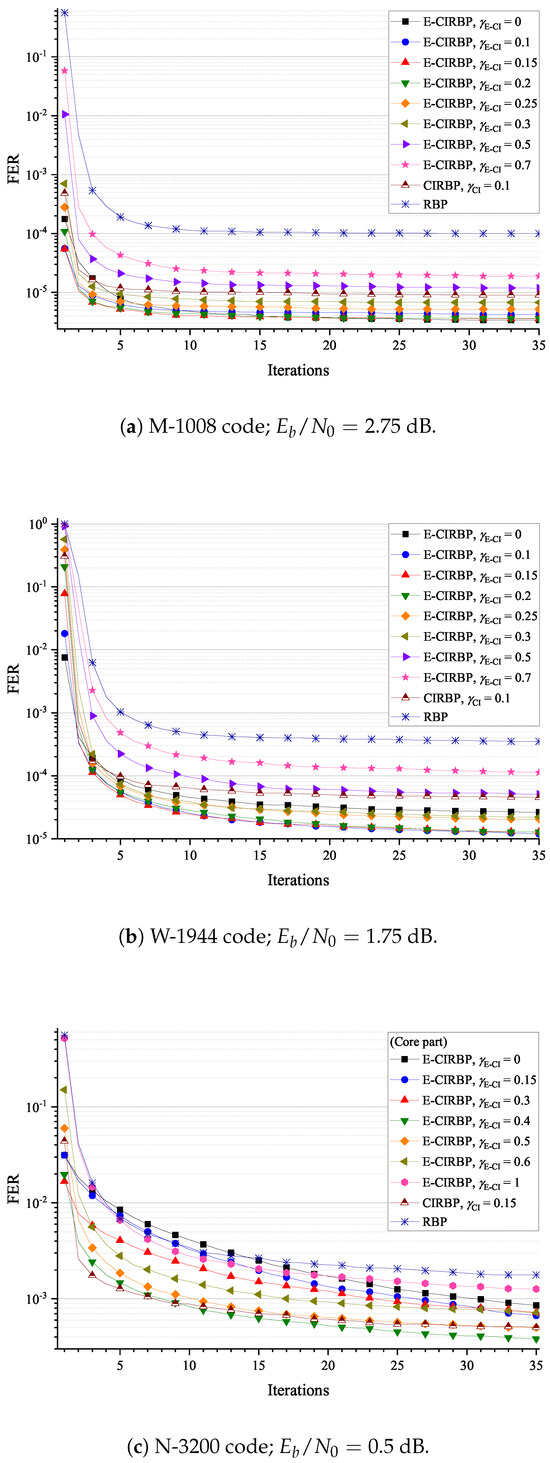
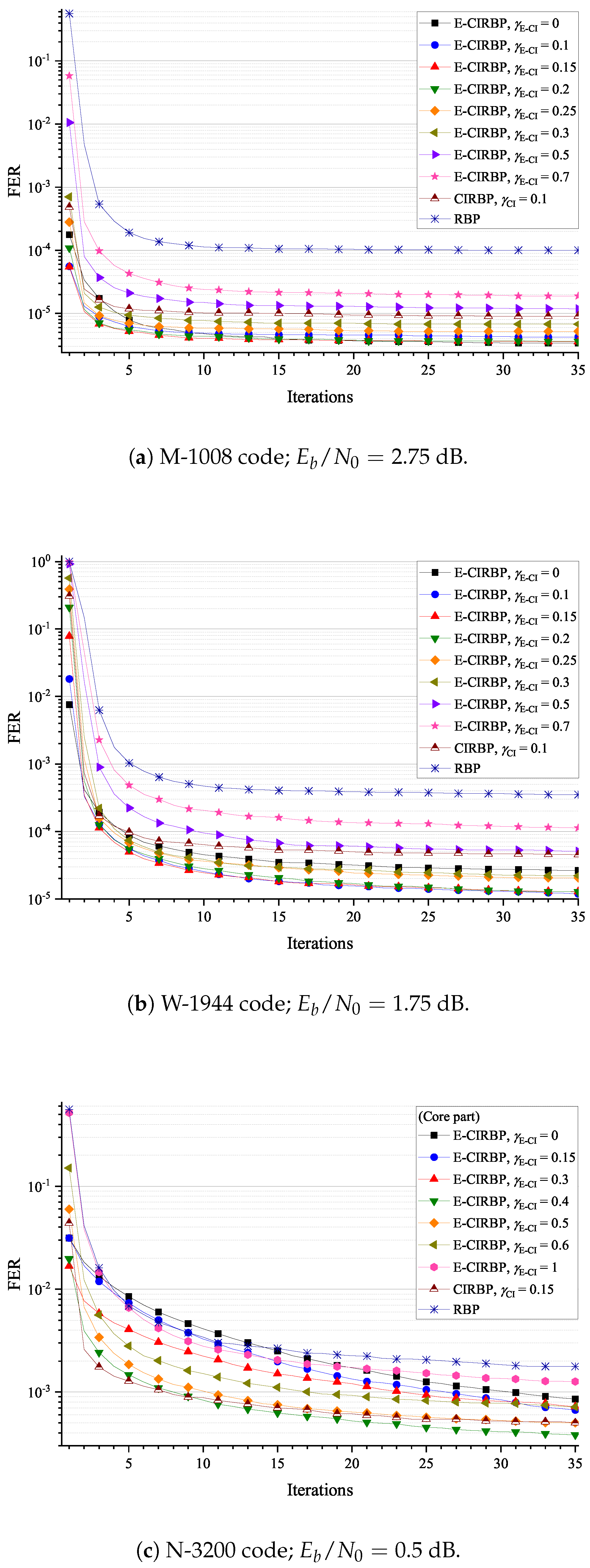
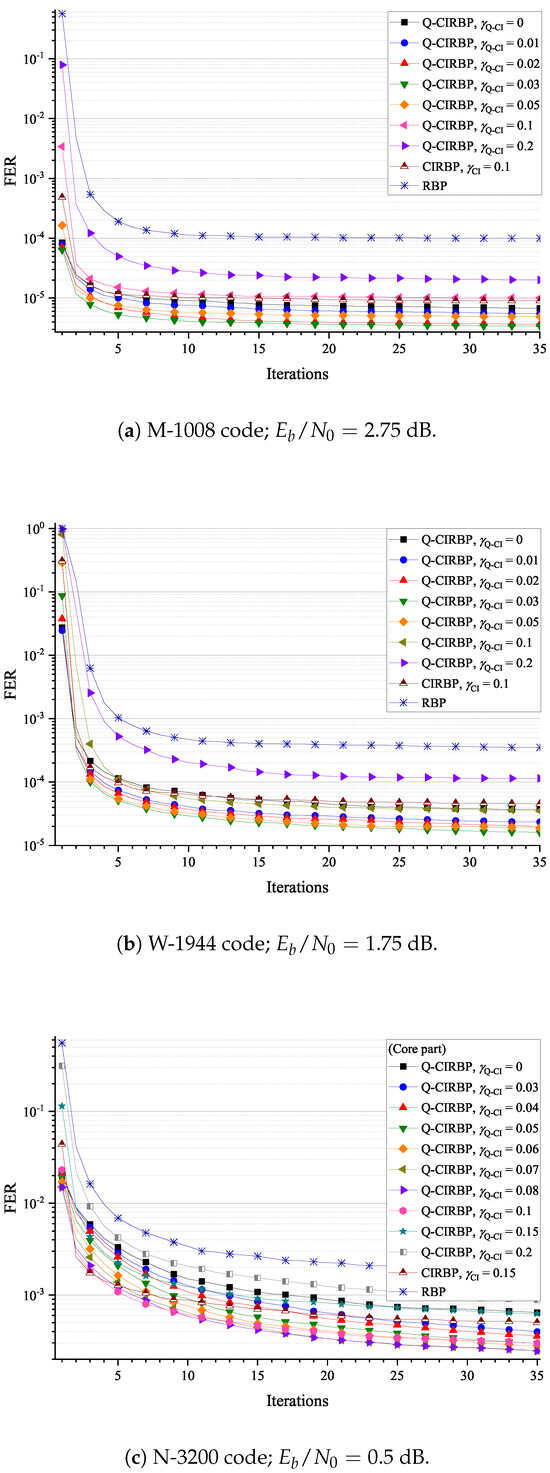
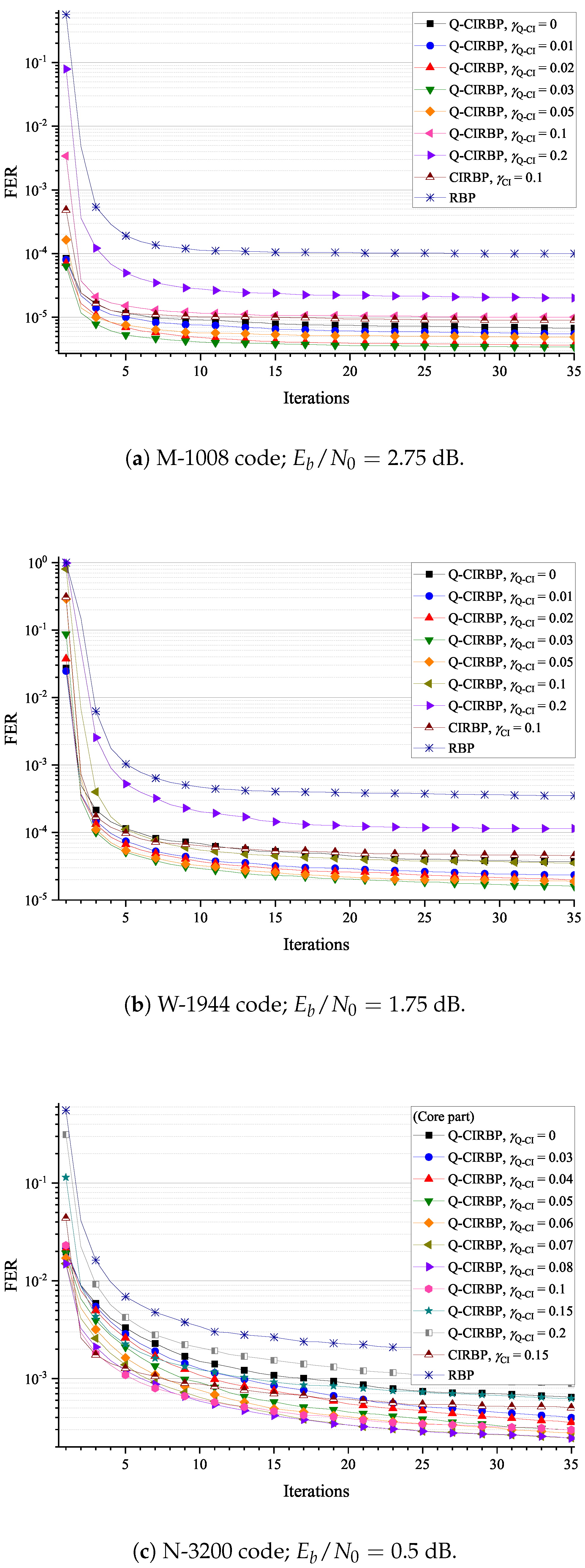
Figure 1 and Figure 2 show the FER convergence behavior of the proposed E-CIRBP and Q-CIRBP decoders for different threshold values and . The values of are set to dB, dB, and dB for the M-1008, W-1944, and N-3200 codes, respectively. The performance of the RBP decoder and that of the CIRBP decoder with its optimal threshold are also included for reference.
Figure 1.
FER convergence behavior of the proposed E-CIRBP decoder for different values with the rate- M-1008, rate- W-1944, and rate- N-3200 codes.
Figure 2.
FER convergence behavior of the proposed Q-CIRBP decoder for different values with the rate- M-1008, rate- W-1944, and rate- N-3200 codes.
Figure 1a shows that, for , different choices of lead to different tradeoffs between the FER performance in the early and later decoding iterations for the M-1008 code. Among the tested values, generally provides the best performance for almost all the observed iterations. A similar tradeoff is observed for the W-1944 code, although the favorable balance shifts to , as seen in Figure 1b. For the Q-CIRBP decoder, the results in Figure 2 suggest that suitable values of lie approximately between 0 and for both the M-1008 and W-1944 codes. Among the tested values, provides the lowest FER for in both cases and is therefore selected for the subsequent comparisons. For the N-3200 code, the results in Figure 1c indicate that different threshold values lead to different convergence behavior of the E-CIRBP decoder. Among the tested values, generally provides the best overall FER performance over the observed decoding iterations and is therefore adopted in the subsequent comparisons. For the Q-CIRBP decoder, Figure 2c shows that generally yields the best FER performance among the threshold values tested and is selected as the optimal threshold.
Based on these observations, unless otherwise specified, , , and are used for the E-CIRBP decoder with the M-1008, W-1944, and N-3200 codes, respectively, whereas , , and are respectively chosen for the Q-CIRBP decoder with the three codes.
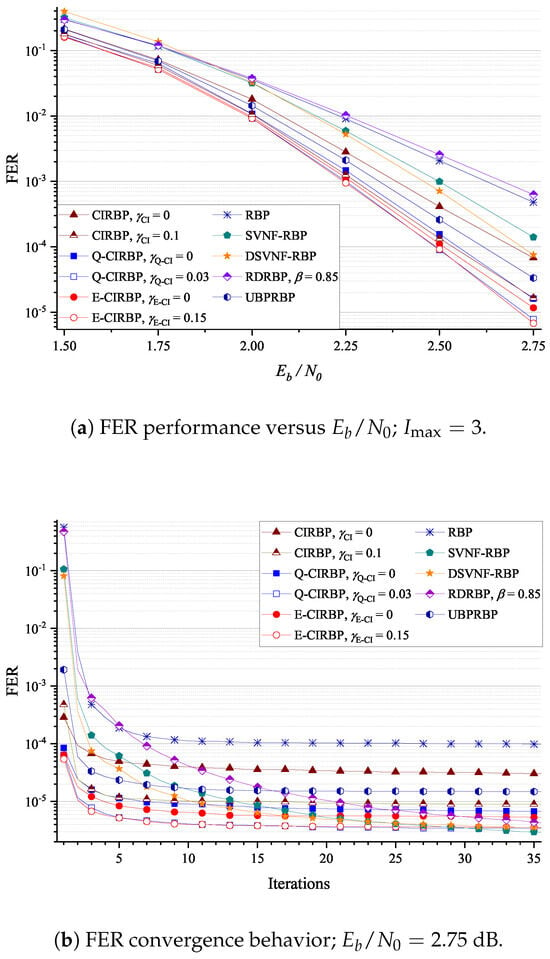
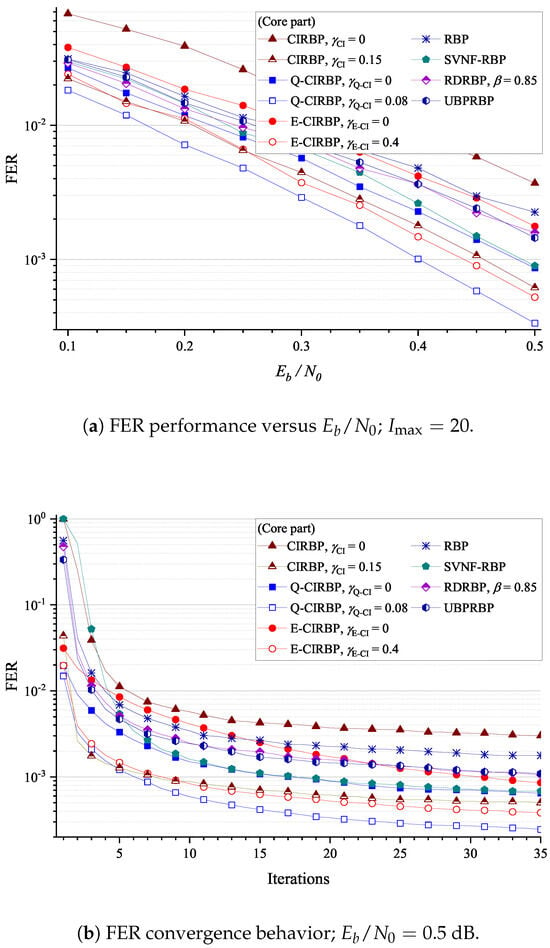
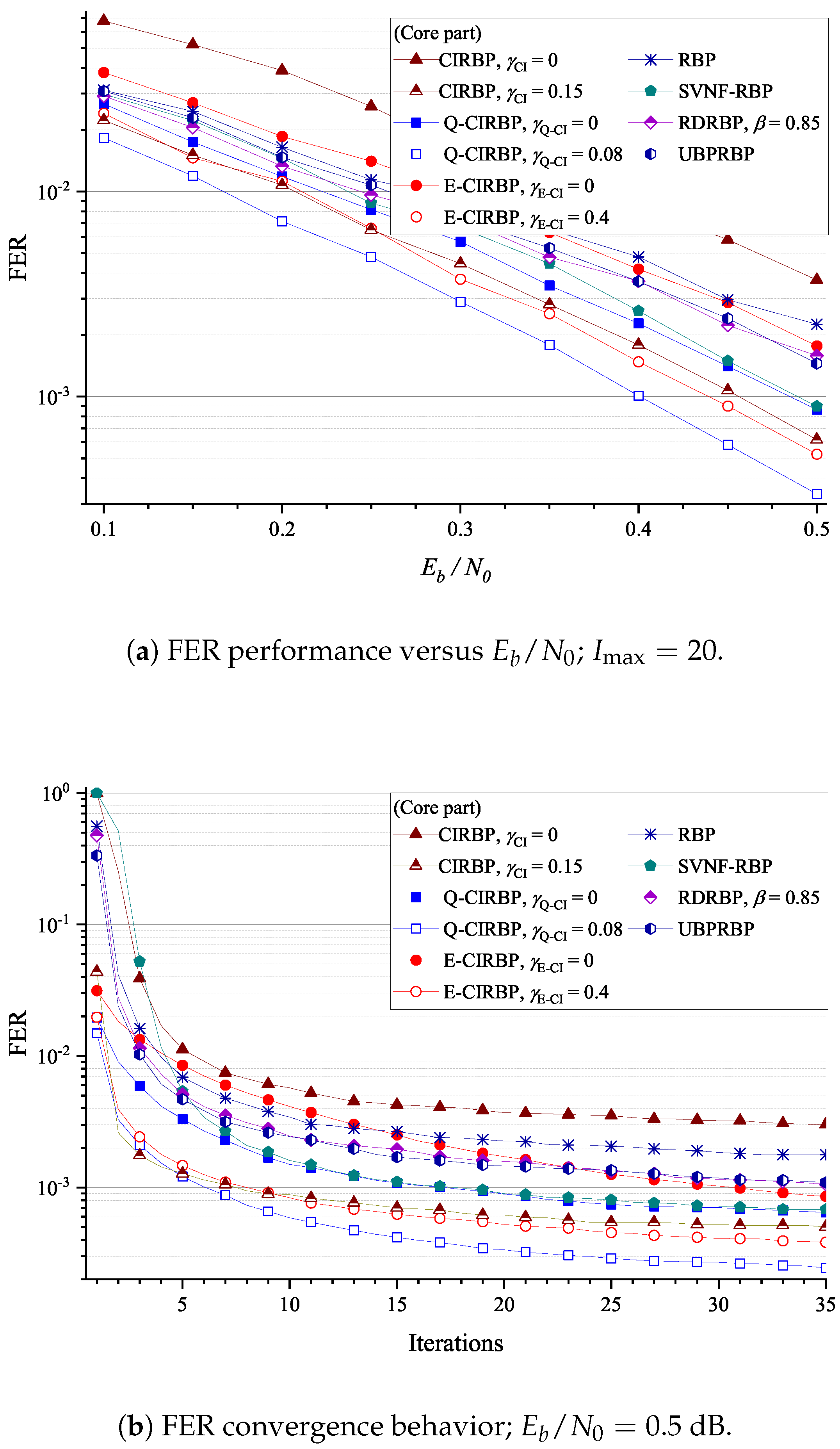
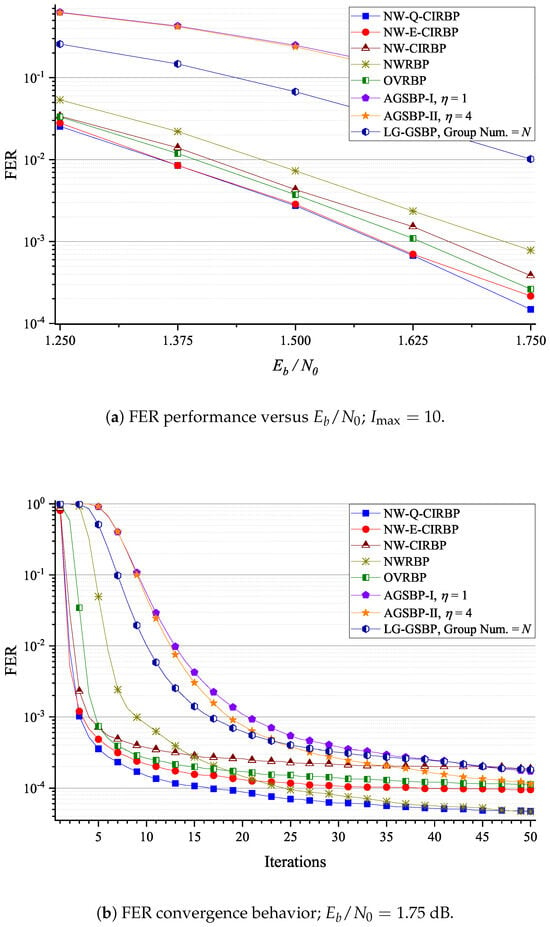
Figure 3a compares the FER performance of the proposed E-CIRBP and Q-CIRBP decoders with the original CIRBP decoder and the other IDS-based BP decoders for the M-1008 code at . It can be seen that the E-CIRBP decoder achieves the lowest FER over the entire simulated range. At FER , the E-CIRBP decoder provides a gain of approximately dB over the CIRBP algorithm with the optimal threshold , as determined through simulation. At FER , it also provides a gain of at least dB over the other reference decoders. The Q-CIRBP decoder provides similar improvements. At FER , it achieves a gain of approximately dB over the CIRBP decoder with , and at FER , it provides a gain of approximately dB over the UBPRBP algorithm.
Figure 3.
FER performance and convergence behavior of various IDS-based BP decoders for the rate- M-1008 code.
Figure 3b further presents the FER convergence behavior at dB over . The results indicate that the E-CIRBP decoder gives the lowest FER among the compared decoders for approximately the first 30 iterations. The Q-CIRBP decoder follows a similar trend, and its FER remains close to that of the E-CIRBP algorithm throughout the observed iteration range. For the later iterations, most of the decoders are already close to convergence, whereas the FER of the SVNF-RBP algorithm continues to decrease and becomes competitive near the end of the observed range. Nevertheless, the advantage of the proposed E-CIRBP and Q-CIRBP decoders is particularly evident during the first few decoding iterations. Specifically, when the first iteration is completed, the FERs achieved by E-CIRBP and Q-CIRBP are approximately and , respectively, of that achieved by CIRBP with its optimal threshold .
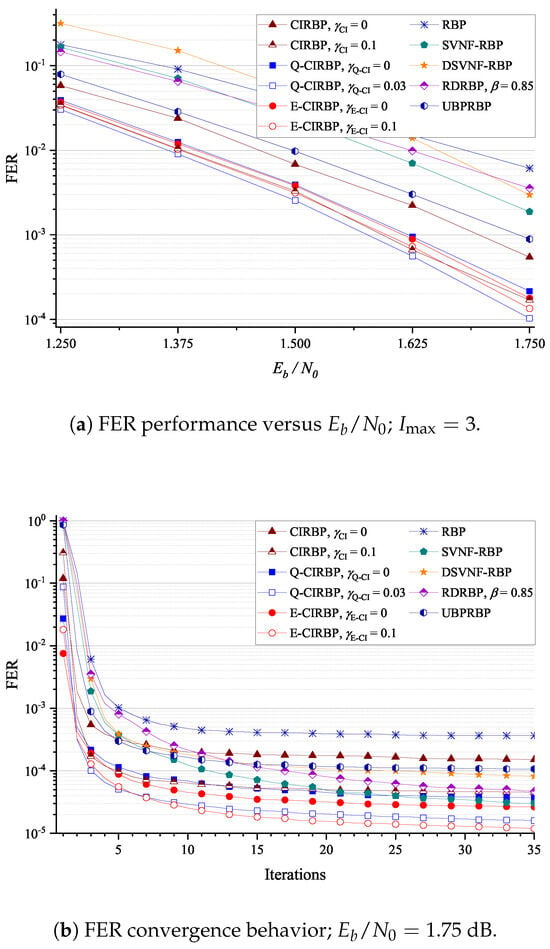
For the W-1944 code, Figure 4a compares the FER performance of the considered decoders at . With its optimal threshold , the CIRBP decoder already outperforms the other reference IDS-based BP decoders. For example, it provides a gain of approximately dB over UBPRBP at FER , while the proposed E-CIRBP and Q-CIRBP decoders provide further FER improvements over CIRBP throughout the simulated range. The corresponding convergence behavior is shown in Figure 4b for dB and . It can be observed that both the E-CIRBP and Q-CIRBP algorithms achieve lower FER than the CIRBP decoder with its optimal threshold and the other reference IDS-based BP decoders throughout the observed iteration range. This advantage is particularly evident at the beginning of the decoding process. Specifically, when the first iteration is completed, the FER achieved by E-CIRBP is approximately one-tenth of that achieved by CIRBP, whereas that of Q-CIRBP is approximately one-third.
Figure 4.
FER performance and convergence behavior of various IDS-based BP decoders for the rate- W-1944 code.
For the N-3200 code, Figure 5a compares the FER performance of the considered decoders at . The Q-CIRBP decoder provides superior performance over the entire simulated range. The E-CIRBP decoder also outperforms the CIRBP decoder with the optimized threshold and the compared IDS-based BP decoders throughout the simulated range. Figure 5b further presents the FER convergence behavior at dB over . The Q-CIRBP decoder yields the lowest FER at the first decoding iteration and for most of the subsequent decoding iterations. The E-CIRBP decoder also achieves better FER performance compared with the CIRBP decoder in the later decoding iterations.
Figure 5.
FER performance and convergence behavior of various IDS-based BP decoders for the rate- N-3200 code.
Figure 3b and Figure 4b also reveal an interesting tradeoff between the initial and converged FER performance of the original CIRBP decoder under different threshold settings. When is used, the global maximum-residual search is never activated during decoding. This setting results in a considerably lower FER at the first decoding iteration, but the converged FER is less favorable than that obtained with the optimized nonzero threshold. In contrast, CIRBP with the optimized nonzero threshold shows less favorable FER in the beginning, but provides better performance in the later iterations. This observation indicates that the selection of may involve a tradeoff among several requirements, such as decoding latency, converged FER performance, and computational complexity. The proposed E-CIRBP and Q-CIRBP decoders, however, exhibit less sensitivity to this tradeoff. In particular, when and are both set to zero, the two proposed decoders still provide favorable FER at the first decoding iteration, while their converged performance remains satisfactory. More importantly, Figure 3b and Figure 4b show that, even with zero thresholds, the proposed E-CIRBP and Q-CIRBP decoders can still outperform the CIRBP decoder using its optimized nonzero threshold throughout the observed iteration range. These results suggest that, compared with the original CI metric, the proposed E-CI and Q-CI metrics may provide improved FER performance with reduced sensitivity to threshold selection. However, for the N-3200 code, the selected nonzero thresholds are more important for achieving improved FER performance with the proposed metrics. As shown in Figure 5b, using these thresholds substantially improves the FER performance of both the E-CIRBP and Q-CIRBP decoders relative to their corresponding zero-threshold settings and enables them to achieve favorable performance relative to the CIRBP decoder with its optimized nonzero threshold. This observation indicates that the sensitivity to threshold selection can be code-dependent.
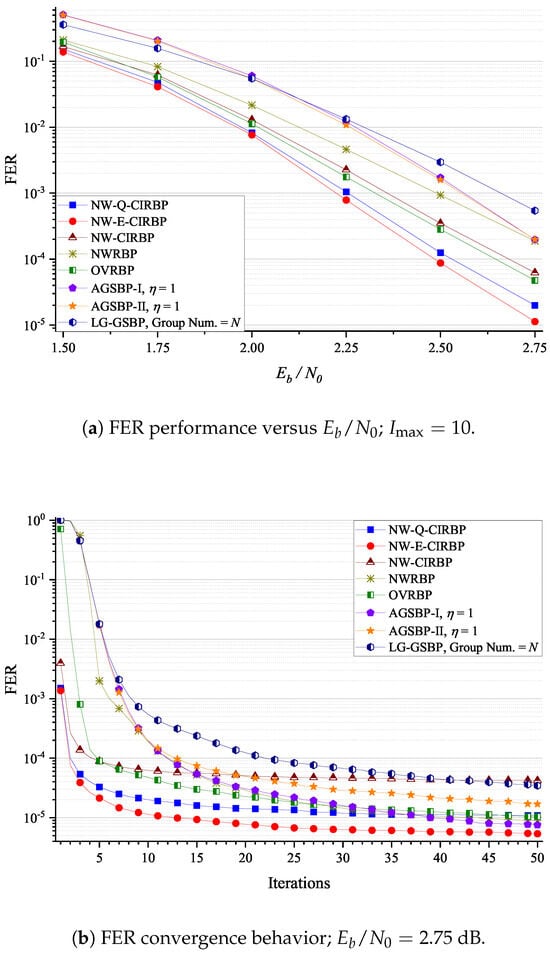
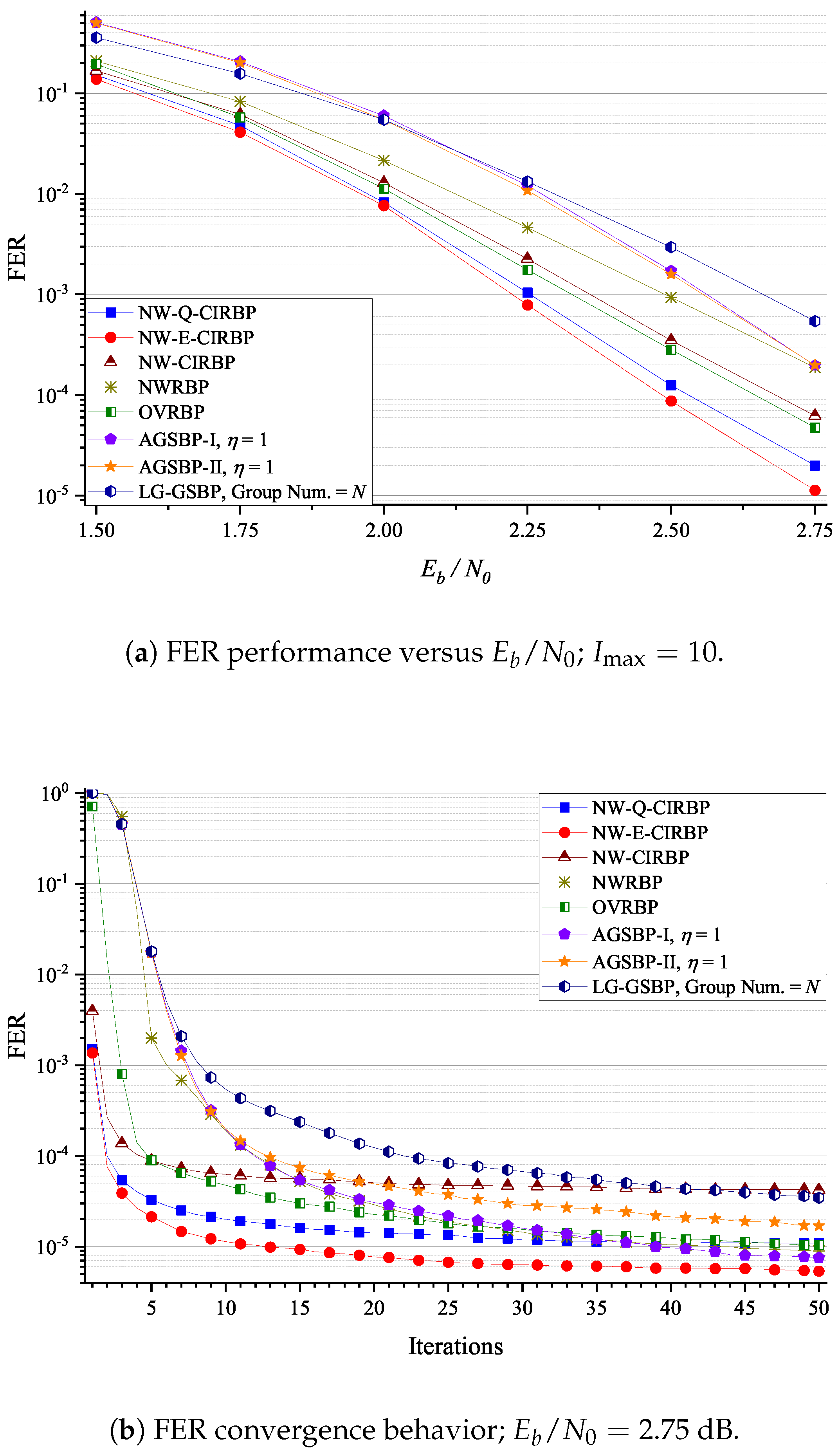
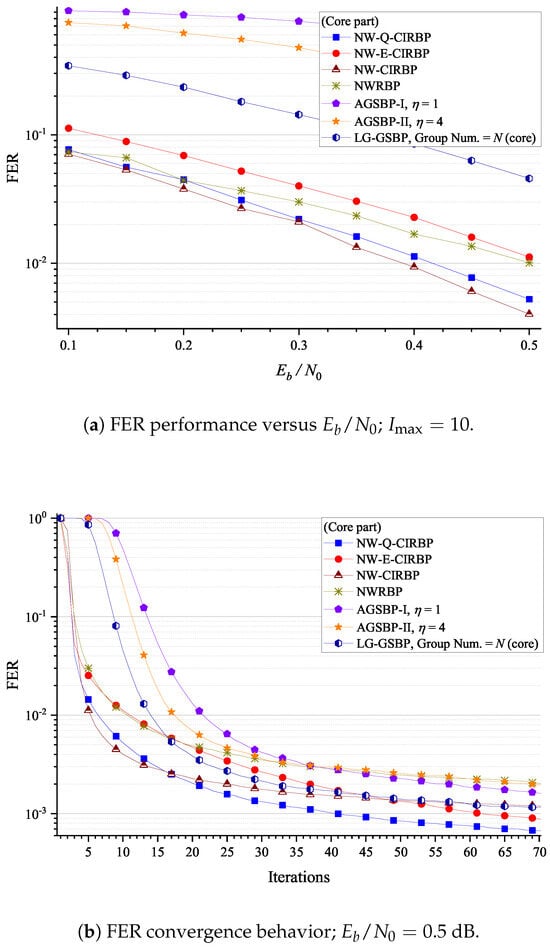
Figure 6a, Figure 7a and Figure 8a present the FER performance of various BP decoders with multiple-edge updates at for the M-1008, W-1944, and N-3200 codes. The NW-CIRBP decoder employs the original CI metric, whereas the NW-E-CIRBP and NW-Q-CIRBP decoders employ the proposed E-CI and Q-CI metrics. Figure 6a demonstrates that the NW-E-CIRBP decoder outperforms all the other compared decoders for the M-1008 code. At FER , it provides gains of approximately dB over the OVRBP decoder and dB over the NW-CIRBP decoder. The NW-Q-CIRBP decoder also outperforms these two decoders at the same FER, providing gains of approximately dB over the OVRBP decoder and dB over the NW-CIRBP decoder. For the W-1944 code, the results in Figure 7a indicate that the NW-E-CIRBP decoder achieves the lowest FER when dB, whereas the NW-Q-CIRBP decoder provides the best performance at dB. Nevertheless, both the proposed NW-E-CIRBP and NW-Q-CIRBP algorithms outperform the other compared decoders over the entire simulated range. For the N-3200 code, Figure 8a shows a different relative performance among the three CI-based node-wise decoders. At , the NW-CIRBP decoder provides the best FER performance over the simulated range, while the NW-Q-CIRBP decoder provides comparable performance. In particular, at dB, the FER of the NW-Q-CIRBP decoder is approximately lower than that of the NWRBP decoder.
Figure 6.
FER performance and convergence behavior of various node-wise BP decoders for the rate- M-1008 code.
Figure 7.
FER performance and convergence behavior of various node-wise BP decoders for the rate- W-1944 code.
Figure 8.
FER performance and convergence behavior of various node-wise BP decoders for the rate- N-3200 code.
The FER convergence behavior of the considered BP decoders with multiple-edge updates for the M-1008 code is presented in Figure 6b, where dB. It can be observed that, when , the NW-CIRBP, NW-E-CIRBP, and NW-Q-CIRBP decoders all provide substantial FER improvements over the NWRBP and OVRBP decoders. Furthermore, for , the proposed NW-E-CIRBP and NW-Q-CIRBP decoders significantly outperform the NW-CIRBP decoder, and this advantage is maintained until convergence. Among the compared decoders, the proposed NW-E-CIRBP decoder achieves the lowest FER. By , its FER is reduced to approximately of that achieved by the NW-CIRBP decoder. A similar advantage of the proposed metrics can also be observed for the W-1944 code in Figure 7b, where dB. During the first 10 iterations, both the NW-E-CIRBP and NW-Q-CIRBP decoders provide noticeably lower FER than that achieved by the NW-CIRBP, NWRBP, and OVRBP decoders. As the decoding proceeds, the performance differences gradually decrease. For , the NW-E-CIRBP and OVRBP decoders achieve similar FER performance, while the NW-Q-CIRBP decoder performs comparably to the NWRBP decoder. For the N-3200 code, the convergence behavior at dB is shown in Figure 8b over . The NW-CIRBP decoder provides better FER performance during the earlier decoding iterations. As the decoding proceeds, the FER of the NW-Q-CIRBP decoder continues to decrease and becomes lower than that of the NW-CIRBP decoder after approximately 20 iterations. The FER of the NW-E-CIRBP decoder also continues to decrease and becomes lower than that of the NW-CIRBP decoder in the later observed iterations. By , both the NW-E-CIRBP and NW-Q-CIRBP decoders provide lower FER than the NW-CIRBP decoder. Across the three codes, the LG-GSBP and AGSBP decoders generally exhibit slower FER reduction during the early decoding iterations, while the performance differences become smaller as decoding proceeds.
Taken together, these performance results suggest that the proposed E-CI and Q-CI metrics may be more effective than the original CI metric for determining the update priorities of VNs under both the procedure in which a single C2V message is propagated at each update, as described in Algorithm 1, and the node-wise procedure in which multiple C2V messages are propagated at each update, as described in Algorithm 2, with their relative FER advantages depending on the code, updating strategy, and number of decoding iterations.
4.2. Complexity Considerations
Table 1 summarizes the computational requirements per scheduling update for the proposed decoders and the reference IDS-based BP decoders. The comparison includes C2V message propagations, V2C message updates, C2V precomputations, the comparisons required to select the VN and/or edge to be updated, and, for the CI-based decoders, the number of CI-related metric updates. In the table, and denote the average VN and CN degrees, respectively, and denotes the number of unmuted CNs at the current update. In addition, for the GSBP-based decoders, message precomputation and scheduling-comparison costs are absent (for LG-GSBP [10]) or negligible (for AGSBP [11]) relative to those of the IDS-based decoders, and their computational requirements are therefore treated as those of conventional SBP decoding, involving only V2C and C2V message updates.
Table 1.
Summary of the required computational complexity per update for the proposed and reference IDS-based BP decoders.
For the CIRBP, E-CIRBP, and Q-CIRBP decoders, comparisons are first required to identify the VN with the largest CI-related metric, followed by one comparison with the corresponding threshold. When the largest metric value is greater than or equal to the threshold, the residual search is restricted to the incoming edges of the selected VN, resulting in comparisons. If the metric value is below the threshold, a global residual search is performed instead and additional comparisons are required. The comparison requirement is therefore indicated by in Table 1. For the arithmetic-operation accounting of the CI-related metrics, additions and subtractions are assumed to have the same computational cost and are collectively referred to as additions (ADDs). Following the original CIRBP implementation [22], the posterior probabilities corresponding to the current and precomputed total LLRs are obtained by table look-up. Therefore, the exponential and division operations in the direct evaluation of (8) are not included in the operation counts. At each CI-related metric update, only the quantity associated with the posterior probability whose corresponding total LLR has changed needs to be recomputed. For the original CI metric, one ADD is required to compute the difference between the current and precomputed posterior probabilities. For the E-CI metric, computing the entropy complement for the changed posterior probability requires, in addition to the original CI computation, three ADDs, two multiplications (MULs), and two logarithmic operations (LOGs). The three additional ADDs are required to compute for the changed posterior probability, to combine the two terms in , and to obtain the entropy complement . For the Q-CI metric, one additional ADD is required to compute , and one extra MUL is needed for the squared term. The signs of and in the evaluation of the E-CI and Q-CI metrics can be directly obtained from the signs of the corresponding total LLRs. Hence, sign extraction, sign inversion, and the final absolute-value operation are assumed to be implemented through sign-bit manipulation and are not included in the arithmetic-operation count.
The threshold setting of the edge-wise CI-based decoders also results in a tradeoff between the edge-selection complexity and FER performance. As indicated in Table 1, when or , the global maximum-residual edge search is avoided, and the number of comparisons becomes per scheduling update. Figure 3b and Figure 4b show that, under these zero-threshold settings, the E-CIRBP and Q-CIRBP decoders still outperform the CIRBP decoder with its optimized nonzero threshold throughout the observed decoding iterations. Therefore, for the M-1008 and W-1944 codes, the global maximum-residual edge search can be avoided while the proposed decoders still provide better FER performance than the CIRBP decoder using its optimized nonzero threshold. For the N-3200 code, however, the selected nonzero thresholds provide better FER performance than the corresponding zero-threshold settings, as discussed above. The threshold setting therefore affects both the FER performance and the edge-selection complexity, and the preferred setting can depend on the code being decoded.
To further compare the computational requirements of the CI, E-CI, and Q-CI metrics under the same node-wise decoding framework, Table 2 and Table 3 report the average decoding iterations (denoted by ) and the corresponding normalized CI-related metric operation counts for the NW-CIRBP, NW-E-CIRBP, and NW-Q-CIRBP decoders with . For each frame, decoding is terminated once all parity-check equations are satisfied; otherwise, it continues until is reached. To focus on the relative arithmetic costs of the three CI-related metrics, the operation counts in Table 2 and Table 3 are normalized on a per-metric-update basis for one VN. As a result, for an average number of decoding iterations , the normalized metric-operation counts are obtained by multiplying by the number of arithmetic operations required for one CI-related metric update. Specifically, the normalized metric evaluation requires ADDs for the NW-CIRBP decoder, ADDs, MULs, and LOGs for the NW-E-CIRBP decoder, and ADDs and MULs for the NW-Q-CIRBP decoder.
Table 2.
Average decoding iterations and normalized CI-related metric operation counts for the M-1008 code; .
Table 3.
Average decoding iterations and normalized CI-related metric operation counts for the W-1944 code; .
As shown in Table 2 and Table 3, both the NW-E-CIRBP and NW-Q-CIRBP decoders require fewer average decoding iterations than the NW-CIRBP decoder at all the tested values. This is consistent with the faster FER reduction of the proposed metrics during the early decoding iterations observed in Figure 6b and Figure 7b. Since the three decoders use the same node-wise updating procedure, the reduced iteration counts can also reduce the common decoding operations, including C2V message propagations, V2C updates, C2V precomputations, and related comparisons. Among the three CI-based node-wise algorithms, the NW-E-CIRBP decoder requires the fewest average decoding iterations at every tested , while the values obtained with the NW-Q-CIRBP decoder remain close to those of NW-E-CIRBP. The normalized ADD and MUL counts of NW-Q-CIRBP are approximately one half of those of NW-E-CIRBP, and NW-Q-CIRBP requires no LOG operation. Therefore, the Q-CI metric requires fewer metric-evaluation operations than the E-CI metric, while retaining a similar reduction in the average number of decoding iterations. Compared with the original CI metric, both proposed metrics have higher normalized CI-related arithmetic-operation counts, even after the reduction in average decoding iterations is taken into account. On the other hand, the NW-E-CIRBP and NW-Q-CIRBP decoders provide better FER performance and require fewer average decoding iterations than the NW-CIRBP decoder for the cases considered above. The additional metric operations are therefore traded for improved FER performance and faster decoding convergence, with the Q-CI metric providing a lower-complexity alternative to the E-CI metric while preserving most of its convergence improvement.
5. Conclusions
In this paper, we proposed the E-CI and Q-CI metrics to improve the original CI metric used for determining the update priorities of VNs in IDS-based BP decoding of LDPC codes. The E-CI metric uses the binary entropy complement to represent the certainty of the current and precomputed posterior probabilities, whereas the Q-CI metric is derived from the leading quadratic term in the local expansion of the entropy complement to reduce the computational cost associated with direct E-CI evaluation. Both proposed metrics were incorporated into the generalized CIRBP decoding procedure and its node-wise extension, allowing different metrics to be used for determining the update priorities of VNs. Simulation results for the M-1008, W-1944, and N-3200 codes indicate that the proposed E-CI and Q-CI metrics can generally provide lower FER than the original CI metric under the considered decoding procedures. The relative FER advantages provided by the E-CI and Q-CI metrics depend on the code, the updating strategy, and the number of decoding iterations. In addition to their FER performance, the two proposed metrics also differ in the computational cost of evaluating the metrics themselves, with the Q-CI metric avoiding the logarithmic operations required for direct E-CI evaluation. Although both metrics require more computational effort for each metric evaluation than the original CI metric, the improved early-iteration decoding performance obtained with the proposed metrics indicates the potential for faster decoding convergence. This behavior is further supported by the complexity analysis for the M-1008 and W-1944 codes, where the node-wise decoders employing the proposed metrics require fewer average decoding iterations than the NW-CIRBP decoder. Therefore, when the costs of metric evaluation and the decoding convergence behavior are considered jointly, the additional computational cost of metric evaluation may be partly balanced by the reduction in the average number of decoding iterations. The results reported in this paper further suggest that considering the individual reliability levels associated with the current and precomputed posterior probabilities, rather than relying solely on their absolute difference, may provide additional discriminative information for designing metrics that prioritize VNs for updating. Future work may investigate whether other characteristics of the posterior probabilities can be utilized to further enhance VN-selection metric design.
Two practical directions also deserve further investigation. One is how different scheduling metrics and updating strategies for IDS-based BP decoding can be adapted to practical block-structured LDPC codes, such as QC-LDPC codes used in Wi-Fi and 5G NR, including the development of suitable block-level metrics and block-parallel scheduling rules. In such an extension, the VN-level metric values within a block would need to be appropriately combined to determine block-level priorities, while the message-updating strategy within and across the selected blocks would also need to be designed. Different choices may result in different tradeoffs among decoding performance, computational complexity, and parallelism.
The other practical direction concerns finite-precision implementation of IDS-based decoding and the associated scheduling metrics. For the proposed E-CI and Q-CI metrics, quantization can be introduced at different stages of the decoding and metric computations, including the LLR-related quantities, the current and precomputed posterior probabilities, the quantities involved in metric evaluation, and the resulting metric values. Since these quantities have different numerical ranges and are involved in different numerical operations, the appropriate quantization design can differ across these stages. Such implementation choices may affect the computed metric values, the resulting candidate ordering, and ultimately the decoding performance. Future work could therefore investigate finite-precision implementations of different scheduling metrics for IDS-based BP decoding under systematically designed quantization settings.
Author Contributions
Conceptualization, T.C.-Y.C.; methodology, T.C.-Y.C. and C.-E.L.; software, C.-E.L. and Y.-R.J.; validation, C.-E.L. and Y.-R.J.; investigation, C.-E.L. and Y.-R.J.; data curation, C.-E.L. and Y.-R.J.; visualization, C.-E.L. and Y.-R.J.; writing—original draft preparation, T.C.-Y.C., C.-E.L. and Y.-R.J.; writing—review and editing, T.C.-Y.C. and D.-C.L.; supervision, T.C.-Y.C.; project administration, T.C.-Y.C. All authors have read and agreed to the published version of the manuscript.
Funding
This research was funded by the National Science and Technology Council (NSTC), Taiwan, under Grant NSTC 114-2221-E-027-051-MY2.
Institutional Review Board Statement
Not applicable.
Informed Consent Statement
Not applicable.
Data Availability Statement
The original contributions presented in this study are included in the article. Further inquiries can be directed to the corresponding author.
Acknowledgments
During the preparation of this manuscript, the authors used ChatGPT (GPT-5.6) (OpenAI) for language polishing and format checking. The authors have reviewed and edited the output and take full responsibility for the content of this publication.
Conflicts of Interest
The authors declare no conflicts of interest.
References
- Gallager, R.G. Low-Density Parity-Check Codes; MIT Press: Cambridge, MA, USA, 1963. [Google Scholar]
- IEEE Std 802.11-2016; IEEE Standard for Information Technology–Telecommunications and Information Exchange Between Systems Local and Metropolitan Area Networks–Specific Requirements–Part 11: Wireless LAN Medium Access Control (MAC) and Physical Layer (PHY) Specifications. IEEE: New York, NY, USA, 2016.
- 3GPP. 5G; NR; Multiplexing and Channel Coding; Technical Specification (TS) 38.212, Release 15; 3rd Generation Partnership Project (3GPP): Sophia Antipolis, France, 2018. [Google Scholar]
- ETSI EN 302 307-1 V1.4.1; Digital Video Broadcasting (DVB); Second Generation Framing Structure, Channel Coding and Modulation Systems for Broadcasting, Interactive Services, News Gathering and Other Broadband Satellite Applications; Part 1: DVB-S2. ETSI: Sophia Antipolis, France, 2014.
- Hocevar, D.E. A reduced complexity decoder architecture via layered decoding of LDPC codes. In Proceedings of the 2004 IEEE Workshop on Signal Processing Systems (SIPS 2004), Austin, TX, USA, 13–15 October 2004; pp. 107–112. [Google Scholar]
- Zhang, J.; Fossorier, M.P.C. Shuffled iterative decoding. IEEE Trans. Commun. 2005, 53, 209–213. [Google Scholar] [CrossRef]
- Chang, C.-Y.; Chen, Y.-L.; Lee, C.-M.; Su, Y.T. New group shuffled BP decoding algorithms for LDPC codes. In Proceedings of the 2009 IEEE International Symposium on Information Theory (ISIT), Seoul, Republic of Korea, 28 June–3 July 2009; pp. 1664–1668. [Google Scholar]
- Kim, M.; Kim, D.; Lee, Y.H. Serial scheduling algorithm of LDPC decoding for multimedia transmission. In Proceedings of the 2012 IEEE International Symposium on Broadband Multimedia Systems and Broadcasting (BMSB), Seoul, Republic of Korea, 27–29 June 2012; pp. 1–4. [Google Scholar]
- Wang, B.; Zhu, Y.; Kang, J. Two effective scheduling schemes for layered belief propagation of 5G LDPC codes. IEEE Commun. Lett. 2020, 24, 1683–1686. [Google Scholar] [CrossRef] [Scilit]
- Manada, A.; Yoshida, K.; Morita, H.; Tatsukawa, R. A grouping based on local girths for the group shuffled belief propagation decoding. IEEE Commun. Lett. 2016, 20, 2133–2136. [Google Scholar] [CrossRef] [Scilit]
- Chang, T.C.-Y.; Su, Y.T. Adaptive group shuffled decoding for LDPC codes. IEEE Commun. Lett. 2017, 21, 2118–2121. [Google Scholar] [CrossRef] [Scilit]
- Touati, H.; de Lamare, R.C. Weighted residual layered belief propagation for LDPC decoding. In Proceedings of the 2024 19th International Symposium on Wireless Communication Systems (ISWCS), Rio de Janeiro, Brazil, 14–17 July 2024; pp. 1–6. [Google Scholar]
- Vila Casado, A.I.; Griot, M.; Wesel, R.D. Informed dynamic scheduling for belief-propagation decoding of LDPC codes. In Proceedings of the 2007 IEEE International Conference on Communications (ICC), Glasgow, UK, 24–28 June 2007; pp. 932–937. [Google Scholar]
- Lee, H.-C.; Ueng, Y.-L.; Yeh, S.-M.; Weng, W.-Y. Two informed dynamic scheduling strategies for iterative LDPC decoders. IEEE Trans. Commun. 2013, 61, 886–896. [Google Scholar] [CrossRef] [Scilit]
- Aslam, C.A.; Guan, Y.L.; Cai, K.; Han, G. Low-complexity belief-propagation decoding via dynamic silent-variable-node-free scheduling. IEEE Commun. Lett. 2017, 21, 28–31. [Google Scholar] [CrossRef] [Scilit]
- Zhang, H.; Chen, S. Residual-decaying-based informed dynamic scheduling for belief-propagation decoding of LDPC codes. IEEE Access 2019, 7, 23656–23666. [Google Scholar] [CrossRef] [Scilit]
- Chang, T.C.-Y.; Lee, I.-H.; Wang, P.-H.; Weng, J.-J.; Su, Y.T. Enhanced informed dynamic BP decoding scheduling strategies for 5G NR LDPC codes. In Proceedings of the 2022 IEEE 96th Vehicular Technology Conference (VTC2022-Fall), London, UK, 26–29 September 2022; pp. 1–6. [Google Scholar]
- Gong, Y.; Liu, X.; Ye, W.; Han, G. Effective informed dynamic scheduling for belief propagation decoding of LDPC codes. IEEE Trans. Commun. 2011, 59, 2683–2691. [Google Scholar] [CrossRef] [Scilit]
- Liu, X.; Zhang, Y.; Cui, R. Variable-node-based dynamic scheduling strategy for belief-propagation decoding of LDPC codes. IEEE Commun. Lett. 2015, 19, 147–150. [Google Scholar] [CrossRef] [Scilit]
- Liu, X.; Zhou, Z.; Cui, R.; Liu, E. Informed decoding algorithms of LDPC codes based on dynamic selection strategy. IEEE Trans. Commun. 2016, 64, 1357–1366. [Google Scholar] [CrossRef] [Scilit]
- Liu, X.; Zi, L.; Yang, D.; Wang, Z. Improved decoding algorithms of LDPC codes based on reliability metrics of variable nodes. IEEE Access 2019, 7, 35769–35778. [Google Scholar] [CrossRef] [Scilit]
- Chang, T.C.-Y.; Wang, P.-H.; Weng, J.-J.; Lee, I.-H.; Su, Y.T. Belief-propagation decoding of LDPC codes with variable node–centric dynamic schedules. IEEE Trans. Commun. 2021, 69, 5014–5027. [Google Scholar] [CrossRef] [Scilit]
- MacKay, D.J.C. Encyclopedia of Sparse Graph Codes. Available online: http://www.inference.phy.cam.ac.uk/mackay/codes/data.html (accessed on 3 September 2026).

Disclaimer/Publisher’s Note: The statements, opinions and data contained in all publications are solely those of the individual author(s) and contributor(s) and not of MDPI and/or the editor(s). MDPI and/or the editor(s) disclaim responsibility for any injury to people or property resulting from any ideas, methods, instructions or products referred to in the content. |
© 2026 by the authors. Licensee MDPI, Basel, Switzerland. This article is an open access article distributed under the terms and conditions of the Creative Commons Attribution (CC BY) license.