


Abstract
This paper introduces the notion of multi-sensitivity with respect to a vector within the context of non-autonomous dynamical systems on uniform spaces and provides insightful results regarding -sensitivity and strongly multi-sensitivity, along with their behaviors under various conditions. The main results established are as follows: (1) For a k-periodic nonautonomous dynamical system on a Hausdorff uniform space , the system exhibits -sensitivity (or strongly multi-sensitivity) if and only if the system displays -sensitivity (or strongly multi-sensitivity). (2) Consider a finitely generated family of surjective maps on uniform space . If the system is -sensitive, then the system is also -sensitive. When the family is feebly open, the converse statement holds true as well. (3) Within a finitely generated family on uniform space , -sensitivity (and strongly multi-sensitivity) persists under iteration. (4) We present a sufficient condition under which an nonautonomous dynamical system on infinite Hausdorff uniform space demonstrates -sensitivity.
1. Introduction
Chaos refers to the inherent unpredictability that arises in deterministic systems in the absence of stochastic variables. It is a fundamental area of study in nonlinear science, representing a universal dynamical behavior of nonlinear systems. Furthermore, chaos profoundly and globally influences the evolution of nonlinear dynamics. Sensitivity is a critical element of chaos, attracting significant attention from scholars for research purposes [1,2,3,4,5,6,7,8,9,10,11,12,13,14].
Ruelle and Takens provided the first definition of sensitivity in 1971 [1]. It describes the unpredictable nature of chaotic processes and is essential to different kinds of chaos. Even a small change in a dynamical system’s initial configuration might result in significantly different behavior later on. In 1980, Auslander and Yorke applied sensitivity to topological dynamical system [2]. In 1989, the famous Devaney chaos was proposed [3]. Since then, the study of sensitivity became popular. If a system is topologically transitive, contains a dense collection of periodic points, and is sensitive to initial conditions, it is said to be Devaney chaotic [3]. Later, Banks et al. proved that the third condition (sensitivity) of the Devaney chaos is implied by the first two characteristics (transitivity and dense periodic points set) [4]. Glasner and Weiss expanded it to demonstrate that a transitive non-minimal system with dense minimal points is sensitive [5].
One indicator of a system’s sensitivity is the “largeness” of the time set where sensitivity occurs. From this perspective, Moothathu presented a number of stronger forms of sensitivity, namely, cofinite sensitivity, multisensitivity, and syndetic sensitivity [6]. His work further deepened the study of sensitivity. Later, Li presented the concept of ergodic sensitivity [7], which is another stronger form of sensitivity. He also present some sufficient conditions for dynamical system to be ergodically sensitive. Liu et al. introduced thick sensitivity, syndetic sensitivity, thickly syndetic sensitivity, and strong sensitivity [8]. For more results about sensitivity, we refer to [9,10,11,12,13,14]
Recently, there has been significant research interest in studying sensitivity and chaoticity on uniform spaces for dynamical systems. Ahmadi et al. studied the topological shadowing property, chain transitivity, total chain transitivity, and chain mixing property for dynamical systems on uniform spaces [15]. Shah et al. presented and investigated the concept of distributional chaos on uniform spaces [16]. The notions of weak uniformity, uniform rigidity, and multi-sensitivity for uniform spaces were initially proposed by Wu et al. in 2019 [17]. The concepts of mean sensitivity and Banach mean sensitivity are expanded to uniform spaces by Wu et al. [18].
Consider a continuous map operating on a compact metric space . A non-autonomous discrete system difference equation refers to
where each is a continuous self-map on X. It should be noted that the autonomous dynamical system is a particular case of system (1). For other concepts and notations covered in this section, see Section 2.
The study of non-autonomous dynamical systems focuses on systems that vary with time, and compared to autonomous dynamical systems, the dynamics of non-autonomous dynamical systems are more complex. The applications of non-autonomous dynamical systems have been explored in various fields, including ecology, economics, climate science, biomedicine, and control engineering. These systems offer a valuable tool for understanding and predicting the behavior of dynamic systems under external influences and disturbances. By considering the time-varying nature of these systems, researchers can gain deeper insights into the intricacies of their dynamics and make more accurate predictions. The versatility and wide-ranging applications of non-autonomous dynamical systems make them an essential framework for studying and analyzing complex real-world phenomena. As a result, academics have been drawn to examine the complexity of such systems in recent years due to the rich dynamics [19,20,21,22,23,24,25,26,27].
Salman et al. introduced the notions of sensitivity, multi-sensitivity, cofinite sensitivity, and syndetic sensitivity within the realm of nonautonomous dynamical systems on uniform spaces. Additionally, they identified several adequate conditions wherein topological transitivity and the presence of densely distributed periodic points lead to sensitivity in nonautonomous systems residing on Hausdorff uniform spaces [28].
Inspired by their works, we present the notions of multi-sensitivity with respect to a vector, as well as -sensitivity and strongly multi-sensitivity, within the context of nonautonomous dynamical systems on uniform spaces. Furthermore, we provide criteria under which a nonautonomous dynamical system on infinite Hausdorff uniform space demonstrates -sensitivity.
The rest of the paper is organized as follows. In Section 2, some basic concepts are given. In Section 3, some stronger versions of sensitivities, namely, multi-sensitivity with respect to a vector, -sensitive and strongly multi-sensitivity are introducd to nonautonomous dynamical systems on uniform spaces. In Section 4, it gives some sufficient conditions for an infinite Hausdorff uniform space to be -sensitive.
2. Preliminaries
Throughout the paper, consider the symbols and . Consider a nonempty set S, the diagonal of is denoted by . Suppose that , which is defined by is called the inverse of A. Specially, if , then A is said to be symmetric. Assume that are subsets of , the composite refer to the collection . Denote .
The introduction of the notion of uniform space was attributed to Weil in [29]. In this section, we provide a concise overview of uniform space, but for a more in-depth understanding, readers are encouraged to refer to ([30], Chapter 8) for a comprehensive introduction to the subject.
Definition 1
([31]). Let be a nonempty sets consist of the subsets of , is called a uniform structure on S, if the following conditions hold:
- ;
- If and , then ;
- For any ;
- For any , there exists such that .
A uniform space is defined as a pair , where S is a non-empty set and is a uniform structure on it. Generally, we call entourages.
In a uniform space denoted as , a uniform topology can be established on S. This is characterized by a neighborhood base at each point s that belongs to S. This neighborhood base is composed of sets , with D representing all entourages of the uniform space . For a map on a uniform space , if , then f is said to be uniformly continuous on .
Next, we will introduce non-autonomous dynamical systems on uniform spaces. A nonautonomous discrete system is defined as , is a nontrivial uniform space and for any , is uniformly continuous. This system consists of a sequence of uniformly continuous maps acting on the uniform space S. Denote that is the orbit of x for each , where and . When for any , the above system is an autonomous dynamical system . For , let and the kth iterate .
Consider a nonautonomous dynamical system , if is a finite set, is called finitely generated. If there is an satisfing for each and each , is said to be periodic. is feebly open if for each nonempty set and each , (where denote the interior of the set V).
For the periodic points for non-autonomous dynamical systems, scholars proposed two different definitions from different perspectives. Here, the two different periodic points is distinguish by P1 and P2.
Definition 2
([27,32]). (P1) Consider a point x in S, x is called P1-periodic, if there is an such that for each .
(P2) Consider a point x of S, x is called P2-periodic, if there is an such that for each .
Obviously, P2-periodic implies P1-periodic and the orbit of a periodic point in the sense of (P2) must be finite. However, by the Example 4.4 of [33], the orbit of a periodic point in sense of (P1) has the potential to be infinite.
Assume that D is a subset of and V is a subset of S. Denote
Assume that is the collection of all subsets of . is called a Furstenberg family if it satisfies and imply (for details see [34]).
The following definition about sensitivity were generated by Huang et al. [35] and Salman et al. [28]. Let be a Furstenberg family. A non-autonomous dynamical system on a uniform space is said to be sensitive, if there exists an entourage such that for any nonempty open subset V of S, . Typically, E is called a sensitive entourage. If is cofinite set, i.e., is finite, then the system becomes cofinitely sensitive. The entourage is called cofinitely sensitive entourage respectively. when is syndetic set, i.e., there exists such that for every , the system is called syndetically sensitive. If , the system is said to be -sensitive. If there is an entourage such that for each and each nonempty open subsets of S, , then the system is called multi-sensitive. The entourage E is called multi-sensitive entourage, respectively.
Definition 3
([36]). A system is said to be multi-transitive if is topologically transitive for every . Equivalently, if for every collection of nonempty open subsets of S, there exists an such that , for each and for every .
3. Multi-Sensitivity with Respect to a Vector for Nonautonomous Dynamical System on Uniform Spaces
This section will introduce some stronger versions of sensitivity, namely, multi-sensitivity with respect to a vector, -sensitive and strongly multi-sensitivity for nonautonomous dynamical systems on uniform spaces.
Definition 4.
Consider a nonautonomous dynamical system , where is a uniform space. Let . is said to be
- multi-sensitive with respect to , if there exists an entourage such that for any nonempty open subsets of S, .
- -sensitive, if there exists an entourage , for any , .
- strongly multi-sensitive, if there is an entourage , is multi-sensitive with respect to any vector in and any .
Clearly, cofinite sensitive ⇒ strongly multi-sensitive ⇒ multi-sensitive
strongly multi-sensitive -sensitive
Theorem 1.
A k-periodic nonautonomous dynamical system on a Hausdorff uniform space is -sensitive if and only if is as well.
Proof.
For convenience, denote
“⇒”. Let be nonempty open sets of S. Assume the is -sensitive with respect to a entourage . Suppose that and is k-periodic. then
“⇐”. Let be -sensitive with respect to . For any non-empty open sets , let , for any
As is -sensitive, Take , using k periodicity of , .
Therefore, Thus, is -sensitive. □
Theorem 2.
A k-periodic nonautonomous dynamical system on Hausdorff uniform space is strongly multi-sensitive if and only if is as well.
Proof.
For convenience, denote . Note that as is k-periodic, .
For the necessity, assume that is strongly multi-sensitive, where . For any vector and any non-empty open sets , as is multi-sensitive with respect to , that is, there exists an entourage such that . As system is k-periodic, so , hence .
For the sufficiency, suppose that is strongly multi-sensitive. For any and any vector , let be any nonempty open sets of S. By the hypothesis, is multi-sensitive with respect to vector . That is, there is an entourage D in such that . As for, we can get . Hence .
□
Theorem 3.
A nonautonomous dynamical system on uniform space is -sensitive if and only if for any nonempty open sets , , where denote the collection of all infinite subsets of .
Proof.
Since sufficiency is obvious, we only need to prove necessity. Assume that is -sensitive with sensitive entourage . We use the counterfactual. Suppose are any nonempty open subset of S and . Denote k is the maximum of the set and take . Given S is a uniform space, there exists an such that . Fix and let . Choose open neighhoors of with . Clearly, for any , . This indicates that for any given , . According to the -sensitivity of , it can be deduce the existence of ℓ and such that . This means . This contradicts with the notion that k is the maximum of the set . □
Remark 1.
By employing analogous reasoning, it can be confirmed that the aforementioned theorem holds true for cases of strong multi-sensitivity as well.
We subsequently demonstrate that for a modified nonautonomous dynamical system with a feeble open family , where , -sensitivity as well as strongly multi-sensitivity are preserved.
Theorem 4.
Assume that is a uniform space and is finitely generated, where each be surjective. If the system exhibits -sensitivity, it follows that the system also displays -sensitivity. Conversely, if the family is feebly open, the converse holds true as well.
Proof.
As is -sensitive and by Theorem 3, there exists an entourage such that for any nonempty open sets , .
Consider a set of generators for the , and let’s fix an arbitrary integer k greater than or equal to 2. Define , then take any element from the set , denote for . We define the composition of these generators as .
Clearly, each map , where , exhibits uniform continuity. This observation leads us to conclude that the set .
As is surjective and continuous, it follows that are nonempty open sets, by the -sensitivity of and Theorem 3, , there exists and such that . Denote that . Obviously, for each ,
Note that
Select a positive integer p and a non-negative integer r such that and the equation holds. note that .
Denote that , as , then for each , and . This together with
By the choice of E, this implies that , then .
Conversely, assume that is -sensitive with sensitive entourage . For nonempty open sets of S, due to the feeble openness exhibited by the family , it can be inferred that are nonempty open subsets of S. As is -sensitive, there exists . This implies that there are such that .
Choose with and . therefore
Denote that , therefore
As each is uniform continuous, there exists . This together with (3), implies that , . Therefore is -sensitive. □
Evidently, the aforementioned outcome holds valid in the context of strong multi-sensitivity as well.
Theorem 5.
Consider a finitely generated family on a uniform space . The pair possesses -sensitivity if and only if, for any , the pair also exhibits -sensitivity.
Proof.
Sufficiency: This is readily evident.
Necessity: Consider a generator set for , and let k be any integer greater than or equal to 2. Suppose that is -sensitive with the -sensitive entourage . For nonempty open sets , according to the Theorem 3, . Consequently, there exist elements and in , where , such that the pair lies outside the bounds of D, that is . Select a positive integer p and a non-negative integer r such that and the equation holds. Denote , For any , where , define . Evidently, the uniform continuity holds for every where belongs to the set . This leads to the implication that . Denote that , . Obviously, . Hence
Due to the selection of set E, it follows that , i.e., , thus is -sensitive. □
Remark 2.
Using analogous reasoning, it can be established that the aforementioned theorem holds valid in the context of strong multi-sensitivity as well.
4. Sufficient Condition for -Sensitivity
In this section, We will present certain conditions that are adequate for an infinite Hausdorff uniform space to exhibit -sensitivity.
Definition 5
([28]). For a sequence within a uniform space , converges uniformly to f if for every entourage D in , there exists a natural number N such that, for all x in S and all , the pair .
Lemma 1
([28] (Lemma 4.1)). In a Hausdorff uniform space , a map is uniformly continuous if and only if, for every D in , there exists an entourage E in such that, for each of E, the pair .
Lemma 2
([28] (Proposition 4.1)). Consider a Hausdorff uniform space . Assume that the sequence of maps uniformly converges to f. If each individual map is uniformly continuous, it follows that the map f itself is uniformly continuous.
Lemma 3
([28] (Proposition 4.2)). Consider a Hausdorff uniform space . If the sequence of maps uniformly converges to f, then for each natural number k, the k-th iteration of , denoted as , also uniformly converges to the k-th power of f, denoted as .
Lemma 4
([36] (Lemma 3.1)). If is multi-transitive, then the set , for each , for any collection of nonempty open sets ; is infinite.
Lemma 5
([28] (Theorem 4.1 Claim 1)). Consider an infinite Hausdorff uniform space without isolated points, and suppose the convergence of to f is uniform. Assuming that possesses a dense set of periodic points as defined by , there exists an entourage such that, for any , there exists a periodic point p of f such that, for all positive integers n, the pair falls outside the scope of E, denoted as
Theorem 6.
Consider an infinite Hausdorff uniform space without isolated points, where the convergence of to f is uniform. If satisfies both multi-transitivity and possesses a dense set of periodic points as defined by , then it exhibits -sensitivity.
Proof.
Consider an entourage derived from Lemma 5, and select an entourage D in such that D composed with itself four times, i.e., , is contained within E. For any nonempty open sets , we can find . Since has a dense set of periodic points, there exist periodic points of such that . Suppose that the period of each is . By Lemma 5, there exist periodic points of f satisfying that for all , .
Applying Lemmas 2 and 3, Consequently, we can deduce that exhibits uniform continuity for every , where . This implies that for each , there is a small enough open set with such that for each and , the following equation hold:
By leveraging the multi-transitivity of along with the insights from Lemma 4, we can conclude that the set is of infinite size. This implies the existence of both and an increasing sequence , such that
Applying Lemma 3, yield that converges uniformly to as , . This indicates that there exists such that
hold for all and all . By using (4), we get that there exist such that
Then by (3), we have
According to (5)
By (6) and (7)
According to the hyperthesis, and . Since , then . Therefore
Hence is -sensitive. □
5. Examples
In this section, examples will be given to support the Theorems.
Example 1.
Let I be the unit interval , consider a nonautonomous dynamical system , the maps are defined by
Denote that . As f is triangle-tent map, the values of alternate between 0 and 1 in the images. For any nonempty open set , there is a large enough such that is covered by . Hence f is sensitive. Since sensitivity is equivalent cofinite sensitivity for continuous map in the interval, then f is cofinitely sensitive. Therefore is cofinitely sensitive. It follows that is strongly multi-sensitive and -sensitive.
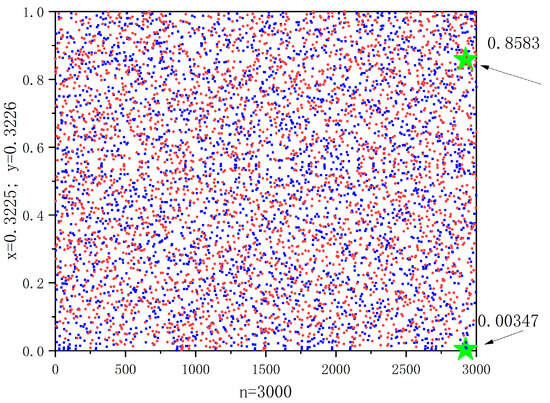
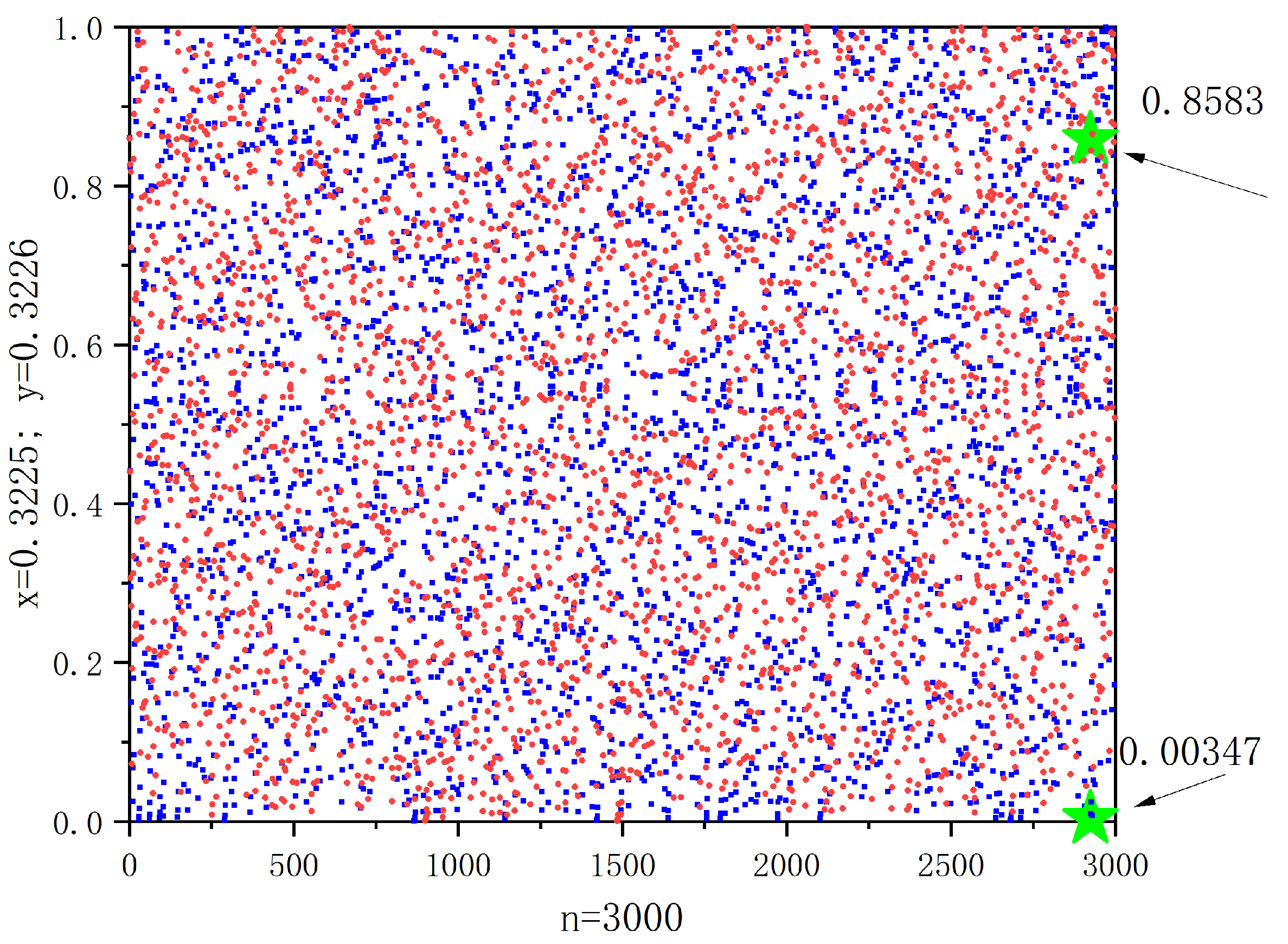
Figure 1 shows a computer simulation with an explanation of sensitivity. As can be seen in the Figure 1, the orbit of x (or y) is ergodic and disordered. The initial values and iterate for 3000 times, respectively, as shown by the blue and red dots, respectively. It is evident that there is a significant disparity between the iterations after a certain number of times, even with a tiny variation between the beginning values x and y ().
Figure 1.
Chaotic behaviors of in Example 1 with the initial date , and .
Example 2.
Let I be the closed unit interval and be defined by
As each is tent map, is cofinitely sensitive. Denote that . Actually, for any non-empty open set . If , since there exists and such that , and noting that , it follows that for . If , let J be an open interval of U. Suppose that for each , , then the length of is times the length of J. Since m increases to infinity later, there must be some such that the length of greater than 1. This forms a contradiction. Therefore, there exists such that . Thus, as previously stated, there is also an n such that . This implies that is sensitive. According to the equivalence between sensitivity and cofinite sensitivity on the interval ([6] Theorem 2), is cofinitely sensitive.
For any non-empty open set , denote and , noting that and for any , thus maps and are not feebly open. Since , is not even sensitive. This example suggests that the condition “feebly open” is necessary in the converse of Theorem 4.
6. Conclusions
This paper introduces the concept of multi-sensitivity with respect to a vector in the context of non-autonomous dynamical systems on uniform spaces, providing an insights into -sensitivity and strongly multi-sensitivity, as well as their behaviors under varying conditions. Compared to previous work, this article further extends the concept of strongly sensitivity and enriches the research on strongly sensitivity. Existing research work forms the basis for our work, and our work further extends and expands upon this existing research. We acknowledge the findings and methodologies established by previous studies and use them as a starting point. Our work builds upon the foundation laid by previous research and pushes the boundaries by delving deeper into the subject matter or applying the concepts in different contexts. We presents a sufficient condition under which a nonautonomous dynamical system on an infinite Hausdorff uniform space demonstrates -sensitivity. However, what is a sufficient condition for a system to be strongly multi-sensitive? This is an interesting future direction of work.
Author Contributions
Conceptualization, L.J.; validation, L.W., H.W. and N.W.; formal analysis, L.J.; writing—original draft preparation, L.J.; writing—review and editing, H.W. and L.W.; supervision, H.W. and L.W.; funding acquisition, H.W. and L.W. All authors have read and agreed to the published version of the manuscript.
Funding
This research was supported by Project of Guangdong Natural Science Foundation, Grant No. 2022A1515011848; Guangzhou Philosophy and Social Science, Grant No. 2020GZYB04. Guangdong Philosophy and Social Science, Grant No. GD22YYJ15. Innovation and Cultivation Project of Zhuhai College of Science and Technology (2020XJCQ006), PhD Promotion Program of Zhuhai College of Science and the Funds for construction of key disciplines of Zhuhai College of Science and Technology (2019XJCQ001).
Institutional Review Board Statement
Not applicable.
Informed Consent Statement
Not applicable.
Data Availability Statement
Data will be made available on reasonable request.
Acknowledgments
The authors would like to thank all the experts who have provided valuable feedback for this article.
Conflicts of Interest
The authors declare no conflict of interest regarding the publication of this paper.
References
- Ruelle, D.; Takens, F. On the nature of turbulence. Commun. Math. Phys. 1971, 20, 167–192. [Google Scholar] [CrossRef] [Scilit]
- Auslander, J.; Yorke, J.A. Interval maps, factors of maps and chaos. Tôhoku Math. J. 1980, 32, 177–188. [Google Scholar] [CrossRef] [Scilit]
- Devaney, R.L. An Introduction to Chaotic Dynamical Systems. In Addison-Wesley Studies in Nonlinearity; Addison-Wesley Publishing Company: Redwood City, CA, USA, 1989. [Google Scholar]
- Banks, J.; Brooks, J.; Cairns, G.; Davis, G.; Stacey, P. On Devaney’s defnition of chaos. Am. Math. Mon. 1992, 99, 332–334. [Google Scholar] [CrossRef] [Scilit]
- Glasner, E.; Weiss, B. Sensitive dependence on initial conditions. Nonlinearity 1993, 6, 1067–1075. [Google Scholar] [CrossRef] [Scilit]
- Moothathu, T.K.S. Stronger forms of sensitivity for dynamical systems. Nonlinearity 2007, 20.9, 2115–2126. [Google Scholar] [CrossRef] [Scilit]
- Li, R. A note on stronger forms of sensitivity for dynamical systems. Chaos Soliton. Fract. 2012, 45, 753–758. [Google Scholar] [CrossRef] [Scilit]
- Liu, H.; Liao, L.; Wang, L. Thickly syndetical sensitivity of topological dynamical system. Dyn. Nat. Soc. 2014, 2014, 583431. [Google Scholar] [CrossRef] [Scilit]
- Liu, L.; Yan, X.; Wang, L. Weak-mixing implies sensitive dependence. J. Math. Anal. Appl. 2004, 299, 300–304. [Google Scholar]
- Xiong, J. Chaos in topologically transitive systems. Sci. China Ser. A Math. 2005, 35, 302–311. [Google Scholar] [CrossRef] [Scilit]
- Ye, X.; Huang, W.; Shao, S. An Introduction to Dynamical Systems; Science Press: Beijing, China, 2008. [Google Scholar]
- Miller, A.; Money, C. Syndetic sensitivity in semifows. Topol. Appl. 2015, 196, 1–7. [Google Scholar] [CrossRef] [Scilit]
- Wu, X.; Chen, G. Sensitivity and transitivity of fuzzified dynamical systems. Inf. Sci. 2017, 396, 14–23. [Google Scholar] [CrossRef] [Scilit]
- Li, J.; Oprocha, P.; Wu, X. Furstenberg families, sensitivity and the space of probability measures. Nonlinearity 2017, 30, 987–1005. [Google Scholar] [CrossRef] [Scilit]
- Ahmadi, S.A.; Wu, X.; Chen, G. Topological chain and shadowing properties of dynamical systems on uniform spaces. Topol. Appl. 2020, 275, 107153. [Google Scholar] [CrossRef] [Scilit]
- Shah, S.; Das, T.; Das, R. Distributional Chaos on Uniform Spaces. Qual. Theor. Dyn. Syst. 2020, 19, 4. [Google Scholar] [CrossRef] [Scilit]
- Wu, X.; Luo, Y.; Ma, X.; Lu, T. Rigidity and sensitivity on uniform spaces. Topol. Appl. 2019, 252, 145–157. [Google Scholar] [CrossRef] [Scilit]
- Wu, X.; Liang, S.; Ma, X.; Lu, T.; Ahmadi, S.A. The Mean Sensitivity and Mean Equicontinuity in Uniform Spaces. Int. J. Bifurcat. Chaos 2020, 30, 2050122. [Google Scholar] [CrossRef] [Scilit]
- Vasisht, R.; Das, R. Specification and shadowing properties for non-autonomous systems. J. Dyn. Control Syst. 2021, 28, 481–492. [Google Scholar] [CrossRef] [Scilit]
- Yin, Z.; He, S.; Chen, Z. Mean Li-Yorke Chaos and Mean Sensitivity in Non-autonomous Discrete Systems. J. Dyn. Control Syst. 2023, 29, 245–262. [Google Scholar] [CrossRef] [Scilit]
- Salman, M.; Das, R. Multi-sensitivity and other stronger forms of sensitivity in non-autonomous discrete systems. Chaos Soliton. Fract. 2018, 115, 341–348. [Google Scholar] [CrossRef] [Scilit]
- Yin, Z.; Xiang, Q.; Wu, X. Reiterative distributional chaos in non-autonomous discrete systems. Qual. Theor. Dyn. Syst. 2021, 20, 88. [Google Scholar] [CrossRef] [Scilit]
- Lan, Y.; Peris, A. Weak stability of non-autonomous discrete dynamical systems. Topol. Appl. 2018, 250, 53–60. [Google Scholar] [CrossRef] [Scilit]
- Jiang, Y.; Lu, T.; Pi, J.; Anwar, W. The retentivity of four kinds of shadowing properties in non-autonomous discrete dynamical systems. Entropy 2022, 24, 397. [Google Scholar] [CrossRef] [Scilit] [PubMed]
- Li, N.; Wang, L. Sensitivity and chaoticity on nonautonomous dynamical systems. Int. J. Bifurcat. Chaos 2020, 30, 2050146. [Google Scholar] [CrossRef] [Scilit]
- Vasisht, R.; Das, R. On stronger forms of sensitivity in non-autonomous systems. Taiwan J. Math. 2018, 22, 1139–1159. [Google Scholar] [CrossRef] [Scilit]
- Zhu, H.; Shi, Y.; Shao, H. Devaney Chaos in Nonautonomous Discrete Systems. Int. J. Bifurcat. Chaos 2016, 26, 1650190. [Google Scholar] [CrossRef] [Scilit]
- Salman, M.; Wu, X.; Das, R. Sensitivity of Nonautonomous Dynamical Systems on Uniform Spaces. Int. J. Bifurcat. Chaos 2021, 31, 2150017. [Google Scholar] [CrossRef] [Scilit]
- Weil, A. Sur les Espaces á Structure Uniforme et sur la Topologie Générale; Hermann: Paris, France, 1938. [Google Scholar]
- Engelking, R. General Topology; Polish Scientific Publishers: Warszawa, Poland, 1977. [Google Scholar]
- Kelley, J. General Topology; D. Van Nostrand Company: New York, NY, USA, 1955. [Google Scholar]
- Miralles, A.; Murillo-Arcila, M.; Sanchis, M. Sensitive dependence for nonautonomous discrete dynamical systems. J. Math. Anal. Appl. 2018, 463, 268–275. [Google Scholar] [CrossRef] [Scilit]
- Salman, M.; Das, R. Dynamics of weakly mixing nonautonomous systems. Int. J. Bifurcat. Chaos 2019, 29, 1950123. [Google Scholar] [CrossRef] [Scilit]
- Akin, E. Recurrence in Topological Dynamics, Furstenberg Families and Ellis Actions; The University Series in Mathematics; Plenum Press: New York, NY, USA, 1997. [Google Scholar]
- Huang, Q.; Shi, Y.; Zhang, L. Sensitivity of non-autonomous discrete dynamical systems. Appl. Math. Lett. 2015, 39, 31–34. [Google Scholar] [CrossRef] [Scilit]
- Salman, M.; Das, R. Multi-transitivity in non-autonomous discrete systems. Topol. Appl. 2020, 278, 107237. [Google Scholar] [CrossRef] [Scilit]
Disclaimer/Publisher’s Note: The statements, opinions and data contained in all publications are solely those of the individual author(s) and contributor(s) and not of MDPI and/or the editor(s). MDPI and/or the editor(s) disclaim responsibility for any injury to people or property resulting from any ideas, methods, instructions or products referred to in the content. |
© 2024 by the authors. Licensee MDPI, Basel, Switzerland. This article is an open access article distributed under the terms and conditions of the Creative Commons Attribution (CC BY) license (https://creativecommons.org/licenses/by/4.0/).