


Abstract
The paper presents an type control procedure for multi-agent systems taking into account possible data dropout in the communication network. The data dropout is modelled using a standard homogeneous Markov chain leading to an type control problem for stochastic multi-agent systems with Markovian jumps. The considered type criterion includes, besides the components corresponding to the attenuation condition of exogenous disturbance inputs, quadratic terms aiming to acquire the consensus between the agents. It is shown that in the case of identical agents, a state-feedback controller with Markov parameters may be determined solving two specific systems of Riccati equations whose dimension does not depend on the number of agents. Iterative procedures to solve such systems are also presented together with an illustrative numerical example.
1. Introduction
Multi-agent systems received a considerable interest in control engineering over the last decades due to their wide area of applications including terrestrial, maritime, aerial and space surveillance and monitoring missions. Some early developments and comprehensive surveys in this field may be found, for instance, in [1,2,3,4]. The design requirements for the control of multi-agent systems may be formulated from different perspectives, a lot of literature treating these topics being available these days. Although the review of the control design methodologies for multi-agent systems is beyond the purpose of this paper, one will mention however some monographs as [5,6,7,8], presenting different multi-agent control problems. An important aspect related the multi-agent systems is their distributed control which is characterised, in contrast with the centralised case, by the absence of a control decision-maker. Such formulations, primarily considered for agents with single and double integrators models (see, e.g., [9]) have been then investigated for more general linear systems, as in [10]. Consensus of nonlinear agents using output feedback has been analysed, for instance, in [11] and an algorithm based on feedback linearisation of nonlinear agents with output measurements may be found in [12]. In [13], a stability analysis from the perspective of a hybrid modelling is proposed using invariant sets and the Lyapunov stability theory. Consensus problems for Bernoulli networks have been considered for instance in [14] and for high-order multi-agent systems under deterministic and Markovian switching network topologies, in [15]. Other consensus problems in stochastic sense have been investigated, for instance, in [16] and in [17] under Markov switching networks for agents with first and second order dynamics. Many formulations of the control problems for multi-agent systems include optimisation criteria. As shown for instance, in [18], the complexity associated with the computation of distributed optimal controller significantly increases. In [19], the authors study the structural properties of optimal control problems with infinite-horizon linear-quadratic criteria by analysing the spatial structure of the solution to corresponding Lyapunov operator and Riccati equations. A problem of synthesising a distributed dynamic output feedback achieving performance is presented in [20]. In [21], a decentralised Markovian control problem is considered for first-order dynamics of the agents in presence of time-delay conditions; the optimal control is expressed in terms of the solutions of a system of linear matrix inequalities depending on the dynamics of the multi-agent system. An state-feedback consensus controller for undirected multi-agent systems is derived in [22] for a more general class of N identical agents; the complexity of the consensus problem is reduced by representing the problem by N number linear systems. In fact, optimal control problems of multi-agent systems remain a domain of interest due to the design and implementation complexity of the control laws, even in the case of identical agents (see, for instance, [22,23,24,25]). In [26], a linear-quadratic control problem for identical agents is considered, for which it is proved that the optimal solution depends on the number of agents and on the stabilising solutions of two Riccati equations having the same order as the agents dynamics. This conclusion shows that the computational requirements may be significantly reduced, especially for large-scale multi-agent systems. The research has been continued in [27] where the robustness properties of the decentralised linear-quadratic optimal controller are analysed.
More recently, an optimisation problem for identical stochastic linear models corrupted with multiplicative noises was formulated and solved in [28], aiming to provide disturbance attenuation performance together with robust stability with respect to parametric uncertainties in the agents models. Based on the state-feedback gains of the centralised state-feedback controller, a distributed controller depending on the adjacency matrix associated with the undirected graph of the communication network was obtained using the spectra of Lyapunov operators.
In this paper, the loss of links between agents is modelled by linear stochastic systems with Markovian jumps. The proposed methodology allows to consider different configurations of the network, each of them corresponding to a state of the Markov chain. Markov switching network models may be found in many papers between which one mentions [29,30,31]. The formulation and the developments presented in this paper considers stochastic models both for the agents and for the network. The cost function for the optimal control design includes, besides the expression for the attenuation of exogenous disturbance inputs, quadratic terms aiming to acquire the state consensus between the agents. The optimal state-feedback gains are expressed in terms of the stabilising solutions of two systems of coupled game-theoretic Riccati equations having the same order as the dynamics of a single agent. This coupling between the Riccati equations is typical in the optimal control of stochastic Markovian systems, depending on the elements of the stationary transition rate matrix.
The paper is organised as follows: the control problem for stochastic system with Markovian jumps is formulated and solved in Section 2. The optimal gains of the control law are expressed in terms of the stabilising solution of a system of coupled algebraic Riccati equations with indefinite sign. A convergent iterative algorithm to determine the stabilising solution of this system of coupled Riccati equations is also presented. The Section 3 analyses the case of multi-agent control. The main result of this section allows to determine the optimal control law for multi-agent systems solving two specific systems of coupled game-theoretic Riccati equations corresponding to the dimension of a single agent. In Section 4, the case of dropout data packages in the communication networks is discussed and illustrated by a numerical example for a large-scale multi-agent system with two states of the Markov chain. The paper ends with some concluding remarks.
2. Type Control for Stochastic Systems with Markovian Jumps; The Case of a Single Agent
Consider the linear stochastic system
where denotes the state vector, is an exogenous input, stands for the control input, is the quality output and denotes the measured output. Throughout the paper denotes a continuous Markov chain with the state space and with the probability transition matrix in which the stationary transition rate matrix of is with and if .
The triple denotes a given probability space, stands for the expectation of the random variable x, represents the conditional expectation of x with respect to the -algebra and is the conditional expectation with respect to the event . In the following developments it will be assumed that and . For invertible , , if these assumptions are not accomplished one may perform the following change of the control variable u
for which one can easily check that with the new control variable the orthogonality condition holds and , .
For a multi-agent system with N agents, the indexes will be used to define the connection between the agents k and ℓ.
Some known definitions and results used in the following developments will be briefly reminded (more details and proofs may be found, for instance, in [32,33]).
Definition 1.
The stochastic system with Markov parameters
is called exponentially stable in mean square (ESMS) if there exists and such that , where denotes the fundamental (random) solution of the differential system (2).
Proposition 1.
The stochastic system (2) is ESMS if and only if there exist the matrices , verifying the system of Lyapunov-type inequalities
Throughout the paper it is assumed that the system
is stochastically detectable, namely there exist a set of matrices such that the system is ESMS.
The proof of the next result may be found, for instance, in [33] (Theorem 7 of Chapter 3).
Proposition 2.
If the system (4) is stochastically detectable and if the system of Lyapunov-type equations
has a symmetric solution with , then it is ESMS.
Proposition 3.
If is a function of class for every then
where is the solution of the system (2) with the initial condition .
The main result of this section is the following theorem.
Theorem 1.
If the system of coupled Riccati equations
has a stabilizing solution with for a certain , namely if the stochastic system with Markov jumps
is ESMS, where
then the state-feedback control law stabilises the system (1) and
for all , where the quality output is determined with the initial condition of the system (1).
Proof.
In order to prove that the state feedback gain (6) stabilises (1) one may firstly rewrite the Riccati system (5) as
with . On the other hand, since the system (4) is assumed stochastically detectable, it follows that the system
is also stochastically detectable and then, based on Proposition 2, one concludes that the above stochastic system with the state matrix is ESMS. Since the system (1) with the control law has the same state matrix it follows that the state-feedback (6) is stabilising.
In order to prove the last part of the theorem one introduces the function . Using Proposition 3 for a certain initial condition , it follows that
Adding and using (5) one obtains
Taking into account (5), one obtains
For and , from the above equation it follows that
where . Then, for , the inequality (7) directly follows and it becomes equality for . □
Remark 1.
Matrix Riccati equations with indefinite sign as in the system (5) appear in control ([34]) and in mixed control problems ([35]) in the deterministic framework.
The next result proved in [36] gives a numerical procedure to compute the stabilising solution of the system of game theoretic Riccati-type Equation (5) assuming that such a solution exists.
Proposition 4.
Assume that the system (1) is stochastically detectable and that the system of Riccati Equation (5) has a stabilising solution. Then the sequences defined by and , , where are the stabilising solutions of the system of Riccati type equations
are the stabilising solutions of the un-coupled Riccati equations
and where
are convergent and the limit of when is the stabilising solution of the system (5).
An iterative algorithm to solve the system of coupled Riccati equations with definite sign is given for completeness in Appendix A. The proof of the algorithm convergence may be found in [33] (Theorem 21 of Chapter 4).
3. Markovian Controller Design for Multi-Agent Systems
Consider agents with identical dynamics of form
with and , and .
Remark 2.
Although in (9) one considered the same standard homogeneous Markov chain for all agents one may also treat the case when each agent is modelled with its own stochastic process . Indeed, if each agent dynamics is modelled with a standard homogenous Markov chain with d states then one may consider for the multi-agent system (9) an extended Markov chain with states. Since in the present paper the Markov parameters are used to characterise the availability or the link failure between agents it follows that the maximal number of states of the Markov chain in these applications is .
The dynamics of the multi-agent system (9) may be written in the following compact form
in which , , , and , , , , where ⊗ denotes the Kronecker product.
For define the cost function
where and are positive semidefinite weighting matrices. Then (11) may be rewritten as
in which has the block elements
Choosing , , it follows that the block elements of the matrix are
One can easily check that
where
with satisfying the condition
. Therefore the cost function (11) may be rewritten as
where . Moreover, since it was assumed that and it follows that and and therefore one may apply Theorem 1 for the Markov stochastic system
with the cost function (15).
The main result of this section is given by the following theorem.
Theorem 2.
(i) If the system of coupled Riccati equations
has a stabilising solution with then the stochastic system with Markov parameters
where , , is ESMS and for the initial condition ,
for all .
(ii) The solution of (17) has the following structure
in which and are the solutions of the Riccati type equations
and
respectively.
Proof.
Part (i) of the statement is a direct consequence of Theorem 1.
The proof of (ii) is inspired by the arguments given in Theorems 1 and 2 of [26] for the multi agent linear quadratic control problem in deterministic framework. Thus, the stabilising solution of (17) has an blocks structure, each of them having the size . Since all the matrix coefficients in (17) are diagonal it follows that the diagonal and the off-diagonal elements of are equal, respectively. Then the diagonal block elements will be denoted by and the off-diagonal ones by . The blocks of (17) have the form
Denoting and summing up the terms of the k-th row of (17) it follows that verifies (20). Further, for any off-diagonal block with and , direct computations give
Using the fact that and that from the above equation it follows that is a solution of (21).
For part (iii) of the statement, one will prove that the stochastic system
is ESMS, namely there exist the positive definite matrices such that
Since is the stabilising solution of the Riccati-type system (20) it follows that the stochastic system
where one denoted , is ESMS and therefore there exist the positive definite matrices such that
Similarly, based on the fact that is the stabilising solution of (21), there exist the positive definite matrices such that
Define
for which the inequalities (23) become:
where
and
. Defining the matrix
direct computations give
in which ∗ denotes irrelevant elements. Due to the triangular structure of the above system it follows that the spectra of is given by the reunion of the spectra of and of , respectively, . On the other hand, one may direcly check that coincide with the left hand sides of (24), . Further, using the above expressions of and , it follows that
. Since (24) remains true if are replaced by for any , from (25) it follows that for a small enough , . Thus one concludes that and therefore is the stabilising solution of the Riccati system (17). The fact that given by (19) are positive semidefinite directly follows taking into account that
and using the assumption that and are positive semidefinite. Thus the proof ends. □
Remark 3.
Based on the expressions of and , it follows that has the following structure
where
4. The Data Packet Dropout Case
From (26) and (29) it follows that the control of each agent is determined as a combination of its own states and the states of all other network agents. The case when the states of all agents are available for every agent represents the nominal case and it will be denoted as the state of the set . In the case when the state of a certain agent is not available, the corresponding terms in the control expression of the other agents will be zero which is equivalent with the fact that . This case will be associated with the state of . Supposing that the communication network fails at a certain moment of time, it follows that and . The condition is accomplished if the weights corresponding to the coupling terms in (11) are taken to be zero, namely if and if the corresponding row in the stationary transition rate matrix has null elements. To conclude, in the above considered scenario in which either the communication network properly works or it completely fails leads to a Markovian model with states of the set . If the connection with a single agent, let say k is lost then the gain will have all extra diagonal elements of the k-th column equal to zero. Similarly, in the case when the connections with more agents fail, the columns of corresponding to these agents will have zero extra diagonal elements; in this situation the Markov chain will have maximum states.
In order to illustrate these ideas one considers a networked system with agents whose planar motions are described by the kinematic equations
where and denote the Cartesian coordinates and and their commanded accelerations, respectively. Two states of the Markov chain have been considered in this example. The first one corresponds to the case when the communication properly works and the states of all agents are available for all others; the second state of the Markov chain characterizes the situation in which each agent can only access its own state vector. Assuming that the quality outputs (denoted in Section 3 by ) are it follows that the matrix coefficients in the representation (1) are identical for both states of the Markov chain, namely
only the weights in the cost function (11) being different for the two states. Thus for one chose (namely ) and for , , for all . It was assumed that stationary transition rate matrix of is
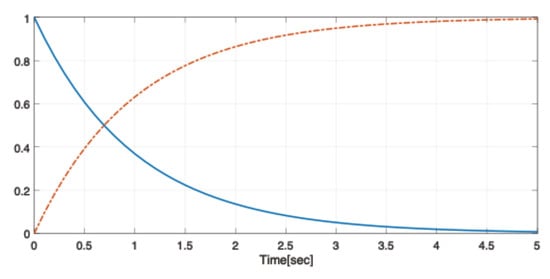
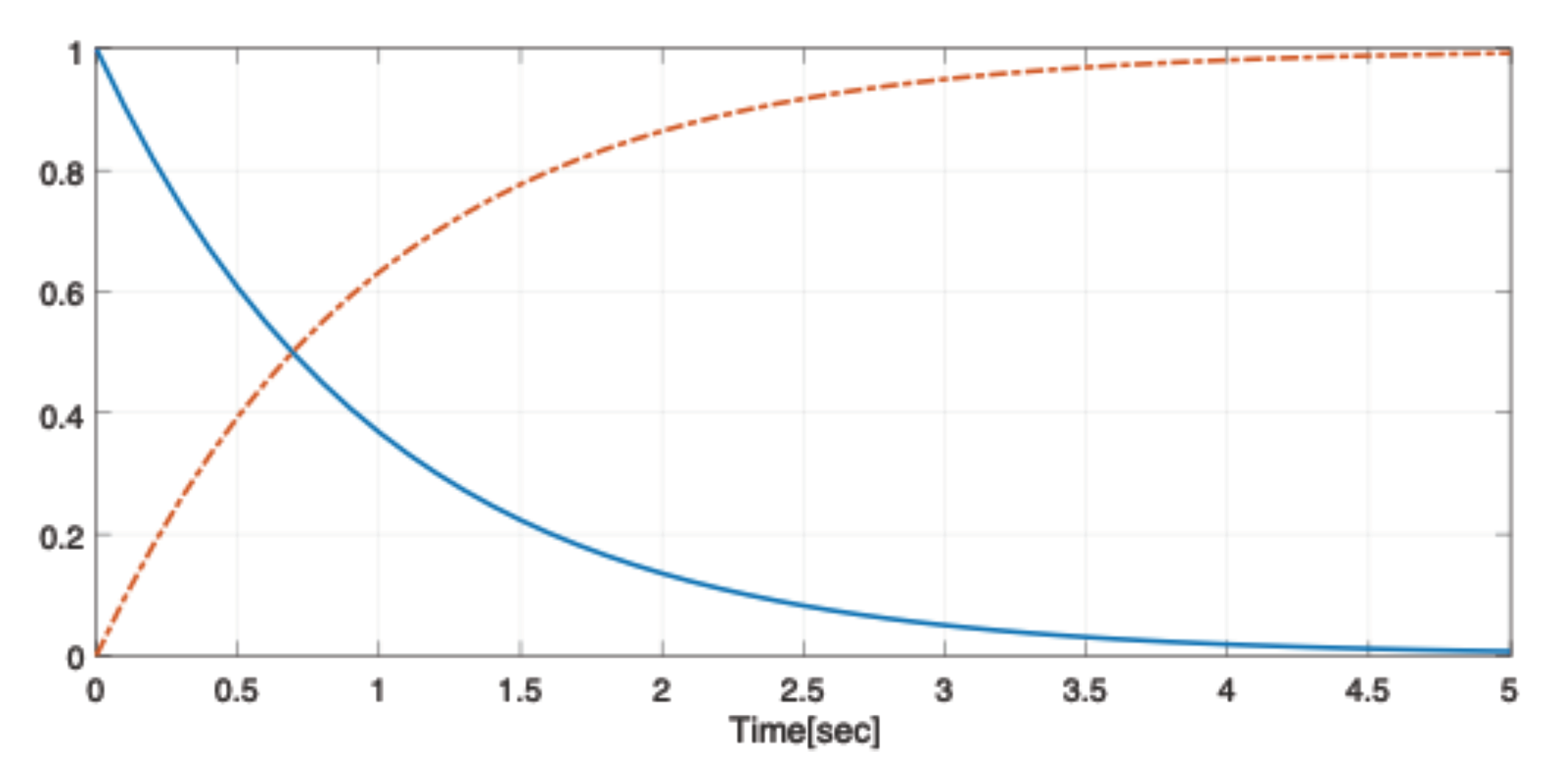
The elements of the second row of the stationary transition matrix were taken zero in order to accomplish the condition . Indeed, for and for , the unique stabilising solution of the Riccati system (21) has the form since is the stabilising solution of (20). The elements of the first row of have been chosen such that the transition from the nominal first state to the second one corresponding to the network failure takes place in about 5 s as illustrated in Figure 1.
Figure 1.
Transition probabilities: -solid line, -dash-dotted line.
Solving the Riccati systems (20) and (21) for one obtains
resulting the following gains
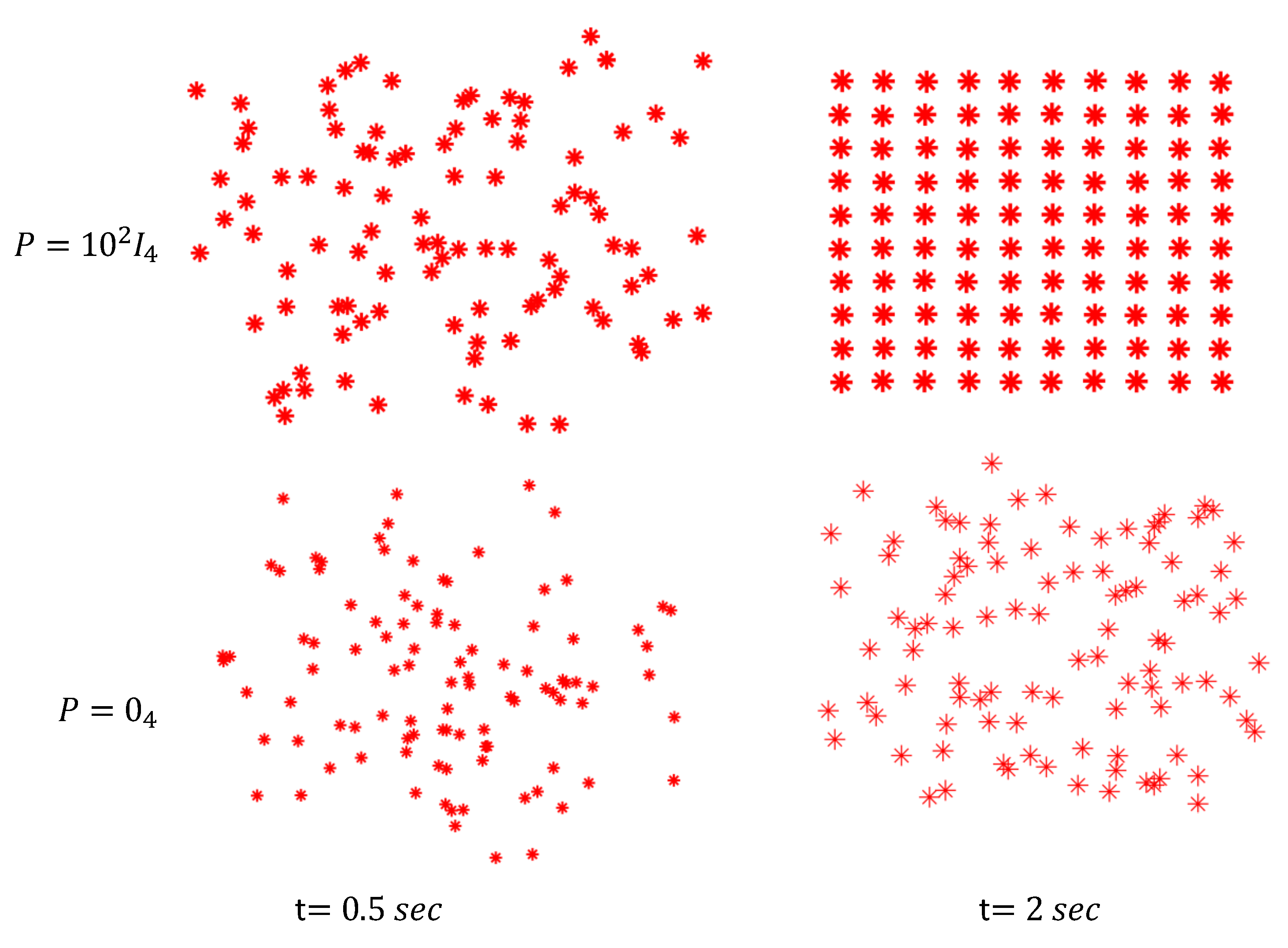
Using the aforementioned gains one determined the agents planar trajectories for both cases when the network communication properly works and the case when it fails, respectively. Figure 2 presents two snapshots at t = 0.5 s and at t = 2 s obtained for random initial positions of the agents in both cases. One can see from the two snapshots in the upper half of the figure, that the matrix gain P giving the coupling between agents is important in determining a short settling time. By contrast, numerical simulations show that in the case when the communication network is not available the settling time is about 6.5 s.
Figure 2.
Snapshots for two different coupling weighting matrices of the agents.
5. Concluding Remarks
An optimal type control method for large-scale multi-agent systems with identical dynamics and independently actuated is presented. It is shown that regardless the number of agents, the optimal solution may be obtained solving two systems of algebraic Riccati equations whose dimension correspond to a single agent. Convergent iterative numerical procedures are presented and used for a case study revealing the benefits of the coupling between agents. The proposed design methodology may be also used in applications in which only some of the links between agents fail. The dimension of the Riccati equations remains the same but their number increases due to the larger number of states of the Markov chain. Future research will be devoted to applications in which a sensitivity analysis with respect to the transition probabilities will be included.
Author Contributions
Conceptualization and methodology, A.-M.S.; software, A.-M.S.; validation, A.-M.S. and S.C.S.; formal analysis, S.C.S.; investigation, S.C.S.; writing—original draft preparation, S.C.S.; writing—review and editing, S.C.S. All authors have read and agreed to the published version of the manuscript.
Funding
This research received no external funding.
Institutional Review Board Statement
Not applicable.
Informed Consent Statement
Not applicable.
Data Availability Statement
Not applicable.
Conflicts of Interest
The authors declare no conflict of interest.
Appendix A
The following convergent algorithm is used to solve the system of coupled Riccati equations with definite sign (8), assuming that the stochastic system
where , , is stabilisable, namely there exist such that the resulting system obtained for , namely
is ESMS.
Step 1. Determine and , such that
The above system of inequalities may be solved using a linear matrix inequalities (LMIs) solver, denoting and solving the resulting system of LMIs with respect to and , . Then, .
Step 2. For an arbitrary solve the following system of LMIs
with respect to .
Step 3. With and determined at Steps 1 and 2, respectively and with an arbitrary , solve iteratively for the system of Lyapunov equations
Since in [33] it is proved that the sequence tends to the stabilising solution of (8) when , Step 3 will be repeated until are small enough.
References
- Dorri, A.; Kanhere, S.; Jurdak, R. Multi-Agent Systems. A survey. IEEE Access 2018, 6, 28573–28593. [Google Scholar] [CrossRef] [Scilit]
- Sandell, N.R.; Varaiya, P.; Athans, M.; Safonov, M. Survey of Descentralised Control Methods for Large Scale Systems. IEEE Trans. Autom. Control 1978, 23, 108–128. [Google Scholar] [CrossRef] [Scilit]
- Siljak, D.D. Complex Dynamics Systems: Dimensionality, Structure and Uncertainty. Large Scale Syst. 1983, 4, 279–291. [Google Scholar]
- Tsitsiklis, J.N.; Bertsekas, D.P.; Athans, M. Distributed asynchronous deterministic and stochastic gradient optimization algorithms. IEEE Trans. Autom. Control 1986, 31, 803–812. [Google Scholar] [CrossRef] [Scilit]
- Ren, W.; Cao, Y. Distributed Coordination of Multi-Agent Networks; Springer: London, UK, 2011. [Google Scholar]
- Shamma, J. Cooperative Control of Distributed Multi-Agent Systems; Wiley: Hoboken, NJ, USA, 2007. [Google Scholar]
- Wang, Y.; Garcia, E.; Casbeer, D.; Zhang, F. Cooperative Control of Multi-Agent Systems: Theory and Applications; Wiley: Hoboken, NJ, USA, 2017. [Google Scholar]
- Wang, J.; Wang, C.; Xin, M.; Ding, Z.; Shan, J. Cooperative Control of Multi-Agent Systems: An Optimal and Robust Perspective; Academic Press: London, UK, 2020. [Google Scholar]
- Ren, W.; Beard, R.W.; Atkins, E.M. Information Consensus in Multivehicle Cooperative Control. IEEE Control. Syst. Mag. 2007, 27, 71–81. [Google Scholar]
- Seo, J.; Shima, H.; Black, J. Consensus of high-order linear systems using dynamic output feedback compensator: Low gain approach. Automatica 2007, 43, 1049–1057. [Google Scholar] [CrossRef] [Scilit]
- Wu, Z.; Wu, Y.; Wu, Z.G. Synchronization of multi-agent systems via static output feedback control. J. Frankl. Inst. 2017, 354, 1049–1057. [Google Scholar] [CrossRef] [Scilit]
- Rehak, B.; Lynnyk, V. Consensus of nonlinear multi-agent system with output measurements. IFAC PapersOnLine 2021, 54, 400–405. [Google Scholar] [CrossRef] [Scilit]
- Yu, Z.; Li, X.; Xu, L.; Nasr, E.A.; Mahmoud, H. Stability analysis method and application of multi-agent systems from the perspective of hybrid systems. Meas. Control 2021, 54, 1347–1355. [Google Scholar] [CrossRef] [Scilit]
- Tahbaz-Salehi, A.; Jadbabaie, A. A necessary and sufficient condition for consensus over random networks. IEEE Trans. Autom. Control 2008, 53, 791–795. [Google Scholar] [CrossRef] [Scilit]
- Vengertsev, D.; Kim, H.; Seo, J.H.; Shim, H. Consensus of output-coupled high-order linear multi-agent systems under deterministic and Markovian switching networks. Int. J. Syst. Sci. 2013, 46, 1790–1799. [Google Scholar] [CrossRef] [Scilit]
- Zhang, Y.; Tian, Y.P. Consentability and Protocol Design of Multi-Agent Systems with Stable and Unstable Subsystems. An Average Dwell Time Approach. In Proceedings of the American Control Conference, Chicago, IL, USA, 28–30 June 2000; pp. 1055–1061. [Google Scholar]
- Miao, G.; Xu, S.; Zou, Y. Necessary and Sufficient Conditions for Mean Square Consensus over Markov Switching Topologies. Int. J. Syst. Sci. 2013, 44, 178–186. [Google Scholar] [CrossRef] [Scilit]
- Gupta, V.; Hassibi, B.; Murray, R.M. A sub-optimal algorithm to synthesize control laws for a network of dynamic agents. Int. J. Control. 2005, 78, 1302–1313. [Google Scholar] [CrossRef] [Scilit]
- Motee, N.; Jadbabaie, A. Optimal control of spatially distributed systems. IEEE Trans. Autom. Control 2008, 53, 1616–1629. [Google Scholar] [CrossRef] [Scilit]
- Langbort, C.; Chandra, R.S.; D-Andrea, R. Distributed control of heterogeneous systems. IEEE Trans. Autom. Control 2008, 49, 1502–1519. [Google Scholar] [CrossRef] [Scilit]
- Abdollahi, F.; Khorasani, K. A decentralised Markovian Jump H∞ Control Strategy for Mobile Multi-Agent Networked Systems. IEEE Trans. Control. Syst. Technol. 2011, 19, 269–283. [Google Scholar] [CrossRef]
- Wanigasekara, C.; Zhang, L.; Swain, A. H∞ State-Feedback Consensus of Linear Multi-Agent Systems. Proceeding of the 17th International Conference on Control & Automation, Naples, Italy, 27–30 June 2022; pp. 710–715. [Google Scholar]
- Bauso, D.; Giarre, L.; Pesenti, R. Consensus for networks with unknown but bounded disturbances. SIAM J. Control Optim. 2009, 48, 1756–1770. [Google Scholar] [CrossRef] [Scilit]
- Dal Col, L.; Tarbouriech, S.; Zaccarian, L. H∞ design for synchronisation of identical linear multi-agent systems. Int. J. Control. 2017, 91, 2214–2229. [Google Scholar] [CrossRef] [Scilit]
- Zhao, Y.; Chen, G. Distributed H∞ consensus of multi-agent systems: A performance region-based approach. Int. J. Control. 2012, 85, 332–341. [Google Scholar] [CrossRef] [Scilit]
- Borrelli, F.; Keviczky, T. Distributed LQR design for identical dynamically decoupled systems. IEEE Trans. Autom. Control 2008, 53, 1901–1912. [Google Scholar] [CrossRef] [Scilit]
- Tomic, I.; Haliakis, G.D. Robustness Properties of Distributed Configurations in Multi-Agent Systems; IFAC-PapersOnLine; Elsevier: Amsterdam, The Netherlands, 2016; Volume 49, pp. 86–91. [Google Scholar]
- Stoica, A.-M. H∞ Type Control for Multi Agent Systems Subject to Stochastic State Dependent Noise. SICON submitted for publication.
- Djouadi, S.M.; Charalambous, C.D.; Repperger, D.W. A convex programming approach to the multiobjective H2/H∞ problem. In Proceedings of the 2002 American Control Conference, Anchorage, AL, USA, 8–10 May 2002; pp. 4315–4320. [Google Scholar]
- Jadbabaie, A.; Lin, J.; Morse, A.S. Coordination of groups of mobile autonomous agents using nearest neighbour rules. IEEE Trans. Autom. Control 2003, 48, 988–1001. [Google Scholar] [CrossRef] [Scilit]
- Olfati-Saber, R.; Murray, R. Agreement Problems in Networks with Directed Graphs and Switching Topology. In Proceedings of the 42nd IEEE International Conference on Decision and Control, Maui, HI, USA, 9–12 December 2003; pp. 4126–4132. [Google Scholar]
- Costa, O.L.V.; Fragoso, M.D.; Todorov, M.G. Continuous-Time Markov Jump Linear Systems; Springer: New York, NY, USA, 2013. [Google Scholar]
- Dragan, V.; Morozan, T.; Stoica, A.-M. Mathematical Methods in Robust Control of Linear Stochastic Systems; Springer: New York, NY, USA, 2006. [Google Scholar]
- Doyle, J.C.; Glover, K.; Khargonekar, P.P.; Francis, B. State-space solutions to standard H2 and H∞ problems. IEEE Trans. Automat. Control 1989, 34, 831–847. [Google Scholar] [CrossRef] [Scilit]
- Khargonekar, P.P.; Rotea, M.A. Mixed H2/H∞ control: A convex optimization approach. IEEE Trans. Automat. Control 1991, 36, 824–837. [Google Scholar] [CrossRef] [Scilit]
- Dragan, V.; Freiling, G.; Morozan, T.; Stoica, A.-M. Iterative Algorithms for Stabilizing Solutions of Game Theoretic Riccati Equations of Stochastic Control. In Proceedings of the Mathematical Theory of Networks and Systems (MTNS2008), Virginia Tech, Blacksburg, VA, USA, 28 July–1 August 2008. [Google Scholar]
Publisher’s Note: MDPI stays neutral with regard to jurisdictional claims in published maps and institutional affiliations. |
© 2022 by the authors. Licensee MDPI, Basel, Switzerland. This article is an open access article distributed under the terms and conditions of the Creative Commons Attribution (CC BY) license (https://creativecommons.org/licenses/by/4.0/).