


Abstract
Edge-independent random graphs are a model of random graphs in which each potential edge appears independently with an individual probability. Based on the relative entropy method, we determine the upper and lower bounds for the extremal vertex degrees using the edge probability matrix and its largest eigenvalue. Moreover, an application to random graphs with given expected degree sequences is presented.
1. Introduction
Edge-independent random graphs are random graph models with independent but (possibly) heterogeneous edge probabilities, generalizing the model with constant edge probability introduced by Erdős and Rényi [1,2]. Given a real symmetric matrix with , the edge-independent random graph model [3] is defined as a random graph on the vertex set , which includes each edge with probability independently. Clearly, the classical Erdős-Rényi random graphs and the Chung–Lu models [4] with given expected degrees are two special examples of .
Edge-independent random graphs are applicable in a range of areas such as modeling of social networks, and detection of community structures [5,6], etc. The number of interacting nodes is typically large in practical applications, and it is appropriate to investigate the statistical properties of parameters of interest. The Estrada index and the normalized Laplacian Estrada index of for large n are examined in [7]. The problem of bounding the difference between eigenvalues of A and those of the adjacency matrix of , together with its Laplacian spectra version, has been studied intensively recently; see, e.g., [3,8,9]. It is revealed in [9] that large deviation from the expected spectrum is caused by vertices with extremal degrees, where abnormally high-degree and low-degree vertices are obstructions to concentration of the adjacency and the Laplacian matrices, respectively. A regularization technique is employed to address this issue.
Relative entropy [10] is a key notion in quantum information theory, ergodic theory, and statistical mechanics. It measures the difference between two probability distributions; see e.g., [11,12,13,14,15,16,17] for various applications of relative entropy on physical, chemical and engineering sciences.
Inspired by the above consideration, we in this paper study the extremal degrees of the edge-independent random graph in the thermodynamic limit, namely, as n tends to infinity. Our approach is based on concentration inequalities, where the notation of relative entropy plays a critical role. We first build the theory for maximum and minimum degrees for in Section 2, and then present an application for the random graph model with given expected degree sequence w and a discussion regarding possible future direction in Section 3. Various combinatorial and geometric properties of including the hyperbolicity and warmth have been reported; see, e.g., [18,19,20].
2. Bounds for Maximum and Minimum Degrees
Recall that is a real symmetric matrix. Its eigenvalues can be ordered as . Given a graph , let and be its maximum and minimum degrees, respectively. The maximum expected degree of G is denoted by , which is equivalent to the maximum row sum of A. Let and represent the maximum and minimum elements, respectively, in A. We say that a graph property holds in asymptotically almost surely (a.a.s.) if the probability that a random graph has converges to 1 as n goes to infinity.
Theorem 1.
For an edge-independent random graph G, suppose that . Then
Proof.
The lower bound is straightforward since
by employing Theorem 1 in [3].
For the upper bound, we set as the degree of vertex i in G. By construction, follows the sum of n independent Bernoulli distributions. If , the upper bound in Equation (1) holds true trivially. Therefore, we assume in the sequel.
For any non-decreasing function on the interval , the Markov inequality [2] implies that for ,
Recall the Taylor expansion of . For any , we have and
Now, we choose satisfying . Therefore, if as , the above comments and the inequality (4) yield
By assumption, we have . We choose . Hence, the estimate (6) implies that asymptotically almost surely, which concludes the proof of the upper bound. ☐
Remark 1.
Remark 2.
The use of Markov’s inequality in (3) is of course reminiscent of the Chernoff bound, which is a common tool in bounding tail probabilities [2]. However, we mention that the relative entropy here plays an essential role that cannot be simply replaced by the Chernoff-type bounds. The Chernoff’s inequality (see, e.g., Lem. 1 in [4]) gives
which may produce a fit upper bound only if . The similar comments can be applied to Theorem 2 below for the minimum degree of .
Remark 3.
Notice that . It is easy to see that the upper bound holds a.a.s. provided . In fact, it suffices to take in the above proof.
Remark 4.
If for all i and j, the edge-independent model reduces to the Erdős-Rényi random graph (with possible self-loops; however, this is not essential throughout this paper). Since , Theorem 1 implies that for , if , we have a.a.s.. However, this result is already known to be true under an even weaker condition, namely, (see, e.g., p.72, Cor. 3.14 in [1], [21]). It is viable to expect that our Theorem 1 holds as long as . Unfortunately, we do not have a proof presently.
This also lends support to the conjecture made in [3] that Theorem 1 therein (regarding the behavior of adjacency eigenvalues of edge-independent random graphs) holds when . A partial solution in this direction can be found in [8].
Theorem 2.
Let G be an edge-independent random graph.
- (A)
- If , then
- (B)
- If , then
Proof.
The statement (B) holds directly from Theorem 1 by noting that , where is the complement of G. Since and , the upper bound in the statement (A) follows immediately from Remark 3. It remains to prove the lower bound of the statement (A).
To show the lower bound, we address three cases separately.
Case 1. . It it clear that a.a.s. in this case.
Case 2. .
For any non-decreasing function on the interval , the Markov inequality indicates that for ,
By choosing , we obtain from (8) that
where is the relative entropy defined in the proof of Theorem 1.
In the following, we choose and as . Hence, from (9) we obtain
where in the second inequality we have used the following estimation
By assumption we set for some . By choosing , we obtain
Combining (10) and (12) we arrive at as .
Finally, by our choice of parameters, as . Hence, , which completes the proof in this case.
Case 3. .
Notice that can be viewed as a random graph in . Hence, the same arguments towards (4) imply that
for any satisfying .
In the following, we take . Thus, the relative entropy in (13) can be bounded below as
where is a constant. Combining (13) and (14) we obtain
where is a constant. Here, in the second inequality of (15), we have employed the assumptions and .
Take in the inequality (15). It is direct to check that and as under our assumptions. Hence, we have , and
The last equality holds since . The proof is then complete. ☐
Remark 5.
Similarly as in Remark 1, the upper and lower bounds of Theorem 2 are essentially best possible.
Remark 6.
When for all i and j, Theorem 2 reduces to the fact for Erdős-Rényi model that a.a.s. provided . This result is already known (see, e.g., p.152 in [2]) and is proved by a more sophisticated method called Stein’s method. A more or less similar approach appears in [21].
3. An Application to Random Graphs with Given Expected Degrees
The random graph model with given expected degree sequence is defined by including each edge between vertex i and j independently with probability , where the volume [4,18]. By definition we have , and , where . Moreover, let the second-order volume and the expected second-order average degree be and , respectively.
An application of Theorem 1 to yields the following corollary on the maximum degree of .
Corollary 1.
For a random graph , suppose that . Then
Proof.
The results follow immediately from Theorem 1 by noting that (see, e.g., p.163, Lem. 8.7 in [18]). ☐
Analogously, the following result is for the minimum degree of .
Corollary 2.
Let G be a random graph in .
- (A)
- If , then
- (B)
- If , then
To illustrate the availability of the above results, we study two numerical examples.
Example 1.
Consider the random graph model with and . This model is more or less similar to homogeneous Erdős-Rényi random graphs. It is straightforward to check that all conditions in Corollary 1 and Corollary 2 hold. In Table 1, we compare the theoretical bounds of maximum degrees obtained in Corollary 1 with numerical values using Matlab software. The analogous results for minimum degrees are reported in Table 2. We observe that the simulations are in line with the theory. It turns out that the upper bound for the maximum degree and the lower bound for the minimum degree are more accurate.
Table 1.
Maximum degree of with (with half of the numbers being ). The theoretical upper and lower bounds are calculated from Corollary 1. Numerical results are based on average over 20 independent runs.
Table 2.
Minimum degree of with (with half of the numbers being ). The theoretical upper and lower bounds are calculated from Corollary 2. Numerical results are based on average over 20 independent runs.
Example 2.
Power-law graphs, which are prevalent in real-life networks, can also be constructed based on the Chung–Lu model [18]. Given a scaling exponent β, an average degree , and , a power-law random graph is defined by taking for , where
We choose , , and . It is direct to check that the conditions in Corollary 1 and Corollary 2 hold.
In Figure 1 we show the maximum and minimum degrees as well as the theoretical bounds for with different number of vertices. Note that the upper bound in (19) is worse than that in (18) for this example. We thus invoke the same upper bounds for both and in Figure 1.
Figure 1.
Extremal degree versus the number of vertices n. The theoretical upper and lower bounds are from (17) and (18). Each data point is obtained by means of a mixed ensemble averaging of 30 independent runs of 10 graphs yielding a statistically ample sampling.
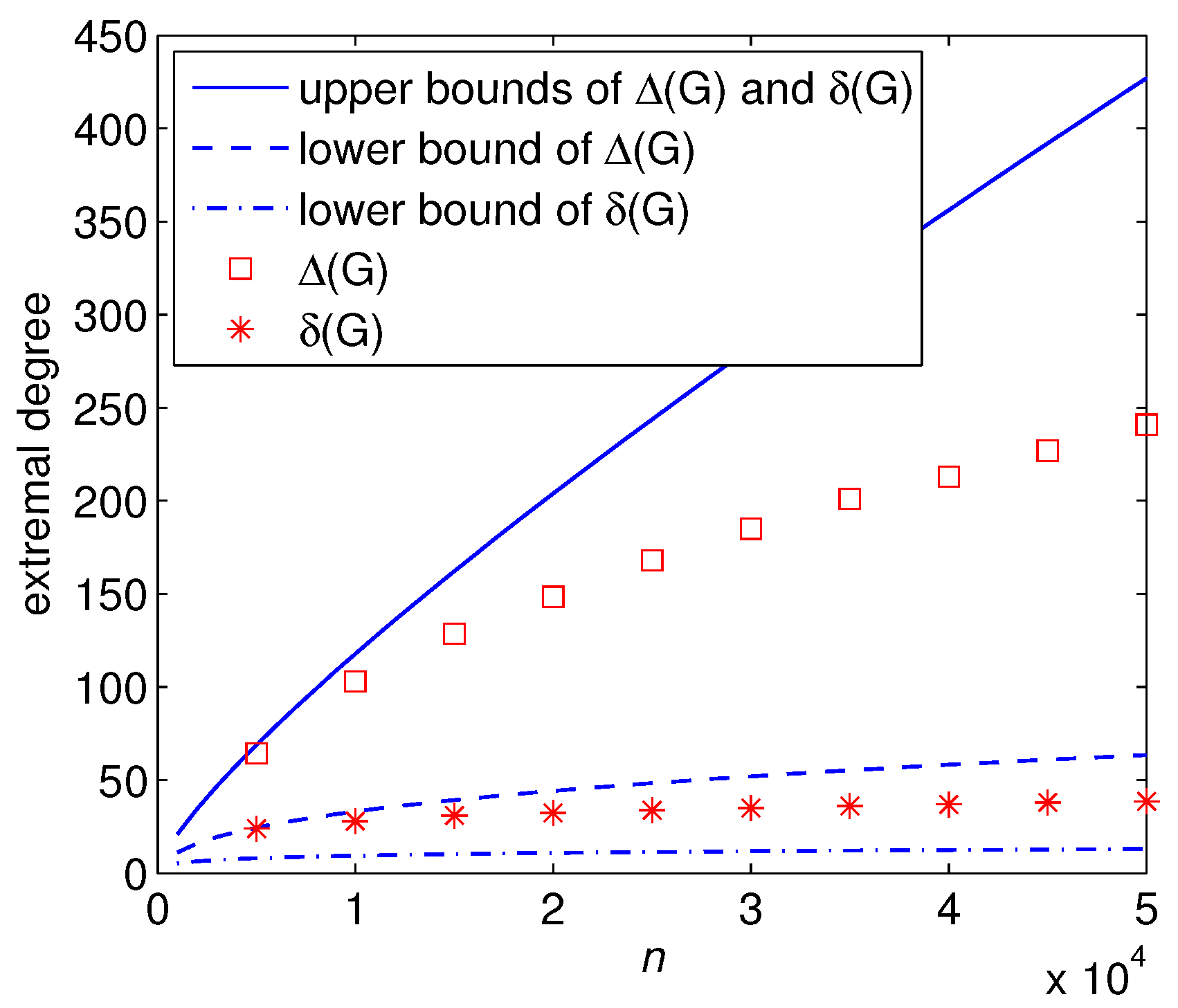
We observe interestingly, as in Example 1, that the upper bound for the maximum degree and the lower bound for the minimum degree seem to be more accurate. As is known that large deviation phenomena are normally associated with a global hard constraint which fights against a local soft constraint. We contend that the deviations from the expected degree sequence are due here to a fight of the constrained degree sequence with the imposed edge-independency.
Figure 2.
A depiction of the small-world graph with , , and .
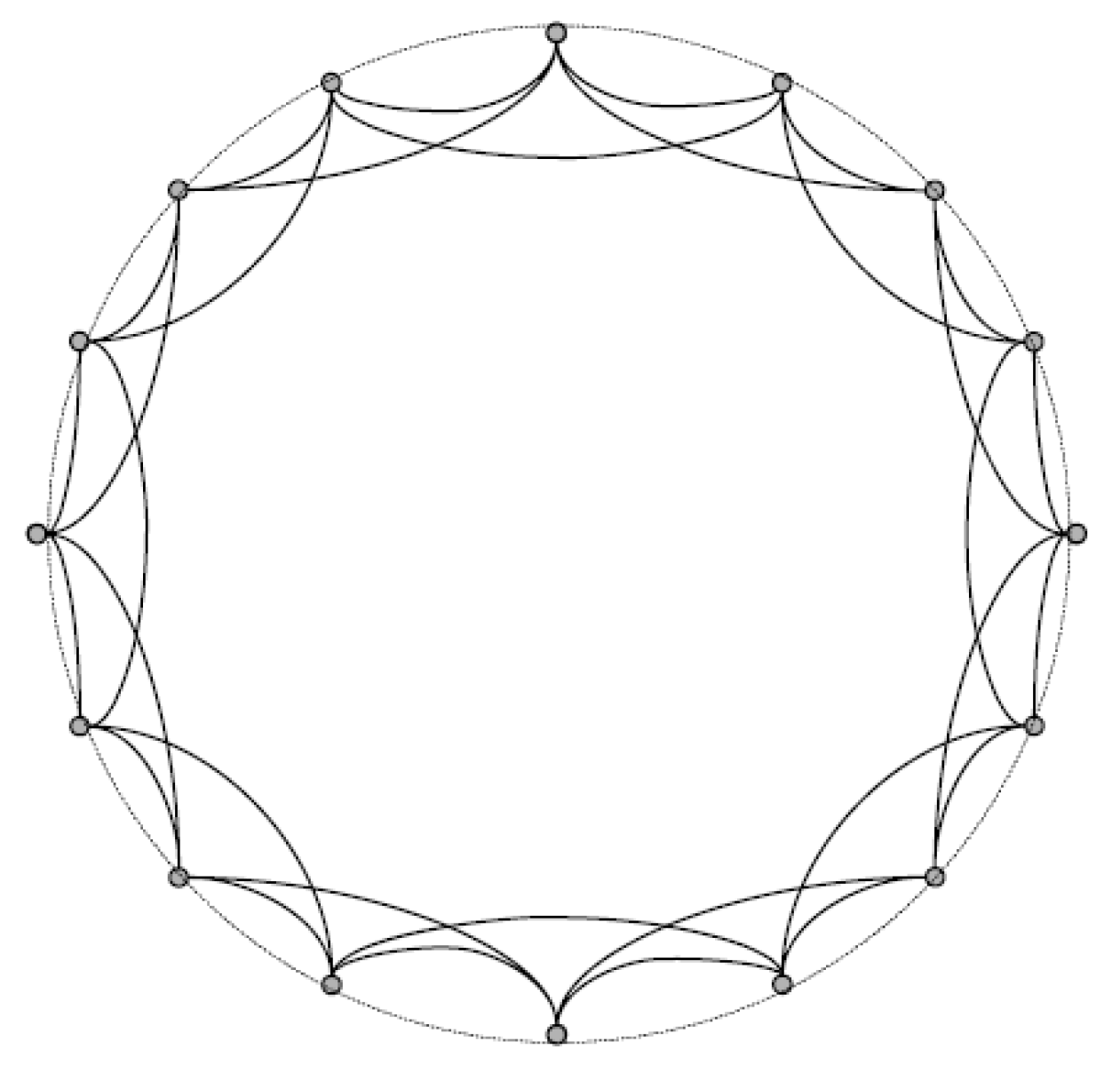
As a follow up work, inspired by the above examples, it would be of interest to identify all the graphs that are close to the theoretical upper or lower bounds. As an illustrating example, we consider the small-world graph () studied in [22,23], which can be viewed as the join of a random graph and a ring on n vertices, each of which has edges to precisely k subsequent and k previous neighbors (see, e.g., Figure 2). In the special case of , G becomes a regular graph, and we know that , where A is the adjacency matrix of G. If holds, it follows from Theorem 1 that
Clearly, the upper bound is close if k is large, while the lower bound tends to be more accurate if k is small. In general, when holds, for any it follows from Theorem 1 that
Note that the second largest eigenvalue of the adjacency matrix of , which is a circulant matrix, is
as . Utilizing the edge version of Cauchy’s interlacing theorem, (22) and (23), we derive the following estimation
The gap between upper and lower bounds can be quite close provided k attains it maximum, namely, .
Acknowledgments
The author would like to thank the anonymous reviewers and Academic Editor for the insightful and constructive suggestions. This work is funded by the National Natural Science Foundation of China (11505127), the Shanghai Pujiang Program (15PJ1408300), and the Program for Young Excellent Talents in Tongji University (2014KJ036).
Conflicts of Interest
The author declares no conflict of interest.
References
- Bollobás, B. Random Graphs, 2nd ed.; Cambridge University Press: Cambridge, UK, 2001. [Google Scholar]
- Janson, S.; Łuczak, T.; Ruciński, A. Random Graphs; Wiley: New York, NY, USA, 2000. [Google Scholar]
- Lu, L.; Peng, X. Spectra of edge-independent random graphs. Electron. J. Comb. 2013; arXiv:1204.6207. [Google Scholar]
- Chung, F.; Lu, L. Connected components in random graphs with given expected degree sequences. Ann. Comb. 2002, 6, 125–145. [Google Scholar] [CrossRef]
- Abbe, E.; Sandon, C. Community detection in the general stochastic block model: Fundamental limits and efficient algorithms for recovery. In Proceedings of 56th Annual IEEE Symposium on Foundations of Computer Science, Berkely, CA, USA, 18–20 October 2015.
- Chin, P.; Rao, A.; Vu, V. Stochastic block model and community detection in the sparse graphs: A spectral algorithm with optimal rate of recovery. In Proceedings of JMLR Workshop and Conference, Paris, France, 2–6 July 2015.
- Shang, Y. Estrada and L-Estrada indices of edge-independent random graphs. Symmetry 2015, 7, 1455–1462. [Google Scholar] [CrossRef]
- Lei, J.; Rinaldo, A. Consistency of spectral clustering in stochastic block models. Ann. Stat. 2015, 43, 215–237. [Google Scholar] [CrossRef]
- Le, C.M.; Vershynin, R. Concentration and regularization of random graphs. 2015; arXiv:1506.00669. [Google Scholar]
- Cover, T.M.; Thomas, J.A. Elements of Information Theory; Wiley-Interscience: New York, NY, USA, 1991. [Google Scholar]
- Vedral, V. The role of relative entropy in quantum information theory. Rev. Mod. Phys. 2002, 74. [Google Scholar] [CrossRef]
- Blanco, D.D.; Casini, H.; Hung, L.-Y.; Myers, R.C. Relative entropy and holography. J. High Energy Phys. 2013, 2013. [Google Scholar] [CrossRef]
- Lin, S.; Gao, S.; He, Z.; Deng, Y. A pilot directional protection for HVDC Transmission line based on relative entropy of wavelet energy. Entropy 2015, 17, 5257–5273. [Google Scholar] [CrossRef]
- Gaveau, B.; Granger, L.; Moreau, M.; Schulman, L.S. Relative entropy, interation energy and the nature of dissipation. Entropy 2014, 16, 3173–3206. [Google Scholar] [CrossRef]
- Prehl, J.; Boldt, F.; Essex, C.; Hoffmann, K.H. Time evolution of relative entropies for anomalous diffusion. Entropy 2013, 15, 2989–3006. [Google Scholar] [CrossRef]
- Lods, B.; Pistone, G. Information geometry formalism for the spatially homogeneous Boltzmann equation. Entropy 2015, 17, 4323–4363. [Google Scholar] [CrossRef]
- Mohammad-Djafari, A. Entropy, information theory, information geometry and Bayesian inference in data, signal and image processing and inverse problems. Entropy 2015, 17, 3989–4027. [Google Scholar] [CrossRef]
- Chung, F.; Lu, L. Complex Graphs and Networks; American Mathematical Society: Providence, RI, USA, 2006. [Google Scholar]
- Shang, Y. Non-hyperbolicity of random graphs with given expected degrees. Stoch. Model. 2013, 29, 451–462. [Google Scholar] [CrossRef]
- Shang, Y. A note on the warmth of random graphs with given expected degrees. Int. J. Math. Math. Sci. 2014, 2014, 749856–749860. [Google Scholar] [CrossRef]
- Löwe, M.; Vermet, F. Capacity of an associative memory model on random graph architectures. Bernoulli 2015, 21, 1884–1910. [Google Scholar] [CrossRef]
- Gu, L.; Zhang, X.-D.; Zhou, Q. Consensus and synchronization problems on small-world networks. J. Math. Phys. 2010, 51, 082701. [Google Scholar] [CrossRef]
- Shang, Y. A sharp threshold for rainbow connection in small-world networks. Miskolc Math. Notes 2012, 13, 493–497. [Google Scholar]
© 2016 by the author; licensee MDPI, Basel, Switzerland. This article is an open access article distributed under the terms and conditions of the Creative Commons by Attribution (CC-BY) license (http://creativecommons.org/licenses/by/4.0/).