


Abstract
Graph Neural Networks (GNNs) have become a foundational tool for e-commerce recommendation systems, yet they consistently fail in zero-shot cold-start scenarios where new products enter the market without prior interactions. In this paper, we diagnose this failure as a structural vulnerability rather than a simple data sparsity issue. We introduce the concept of asymmetric learning, demonstrating that in severely imbalanced bipartite graphs, minority-type nodes (products) become disproportionately reliant on topological signals. By evaluating this phenomenon alongside a relatively balanced control dataset, we confirm that this performance collapse is a byproduct of the data structure rather than architectural design. To mitigate this limitation, we propose Similarity-Driven History Augmentation (SHA), a data-centric approach that assigns synthetic interaction histories to cold-start products by matching them with semantically similar established donors. To prevent these synthetic signals from degrading the representations of established nodes, we further introduce a decoupled hybrid framework alongside an enhanced SHA strategy that selectively filters active customers. Comprehensive evaluations across multiple real-world e-commerce datasets, including DataCo and Amazon Gift Cards, confirm the effectiveness and stability of our approach across different GNN architectures.
1. Introduction
Modern e-commerce platforms increasingly rely on personalized recommendation systems to help customers discover relevant products, improve user engagement, and enhance business performance. At the core of these systems lies the ability to accurately predict future customer-product interactions from historical purchasing behavior [1]. Since these interactions naturally form heterogeneous bipartite graphs connecting customers and products, Graph Neural Networks (GNNs) with their message-passing mechanism can directly learn from these bipartite graphs to predict future interactions [2,3,4]. Although GNNs produce strong results for nodes with well-established interaction histories in heterogeneous graphs [5,6], they face a fundamental limitation in zero-shot cold-start scenarios, situations where new nodes enter the graph with no prior interactions at all. This limitation is particularly severe in temporal link prediction, and for a structural reason: unlike node classification, where a newly added node can still draw information from its existing neighbors during inference, cold-start nodes in link prediction have no such connections to rely on, because those future connections are exactly the prediction targets. As a result, information cannot flow through the graph to these nodes, and their predicted scores tend to collapse to near-random performance, regardless of how expressive or well-trained the underlying GNN is. The problem becomes even more acute in bipartite graphs where the two node types are heavily imbalanced, such as in retail settings where a large and constantly growing customer base interacts with a comparatively small and stable product catalog.
Prior work often frames the cold-start problem as a general issue of data sparsity [7]. In contrast, our study identifies a deeper structural failure mode specific to imbalanced bipartite graphs, which we call asymmetric learning. In a typical retail graph, minority-type nodes (products) are linked to a very large number of majority-type nodes (customers). During training, message passing sends a disproportionately large number of updates toward minority-type embeddings, causing product representations to drift substantially away from their original content-based values. At the same time, majority-type customer nodes receive fewer updates and, therefore, remain closer to their initial representations. This asymmetry produces a structural dependency in which established products rely heavily on topological signals. When a new product appears without interaction history, the model is unable to place it effectively within the learned embedding space, leading to a complete collapse in performance. Importantly, this failure mode is not tied to any specific architecture: we observe it consistently across HGT [5], GAT [8], and GraphSAGE [9] across multiple severely imbalanced e-commerce datasets. By comparing these results against a relatively balanced control condition, we confirm that this stems from the data structure rather than architectural design choices.
To address this structural weakness, we propose a data-centric method called Similarity-Driven History Augmentation (SHA). Instead of changing the model architecture, SHA reconstructs the missing structural signal for cold-start nodes using content-based embeddings to find semantically similar donor nodes in the training set and transferring their interaction histories to the isolated nodes. In this way, the method converts a zero-shot problem into a simulated warm-start setting. We further extend this idea with enhanced SHA, which combines multi-donor aggregation with selective active-customer filtering.
Our ablation study also reveals that while synthetic history is crucial for cold-start nodes, it introduces distribution shifts that can hurt performance on established nodes when both are trained together in a single framework. To avoid this interference, we design a decoupled hybrid framework that routes predictions according to the product’s temporal status: interactions involving warm-start products are processed by an established-product expert trained on authentic data, whereas interactions involving cold-start products are handled by an emerging-product expert trained on SHA-augmented data.
In summary, the main contributions of this work are as follows:
- Diagnosis of Asymmetric Learning: We identify and analyze a structural failure mode specific to imbalanced bipartite graphs, showing how minority nodes become highly dependent on interaction history and collapse to random performance at zero-shot inference time. We validate this behavior consistently across multiple GNN architectures and contrasting structural conditions, including severely imbalanced and balanced control datasets.
- Similarity-Driven History Augmentation (SHA): We introduce a data-level augmentation strategy that synthesizes plausible interaction histories for cold-start nodes through content-based donor matching, without requiring architectural modifications and with applicability across GNN families.
- Decoupled Hybrid Framework: We propose a dual-expert system that removes the interference between authentic and synthetic data distributions, maintaining strong performance on established nodes while significantly improving cold-start performance.
- Architectural Capacity and Augmentation Strategy: We show empirically and interpretively that the optimal active-customer filtering ratio depends on the receiving architecture’s ability to discriminate neighbor informativeness, establishing a principled link between data-level augmentation design and model-level inductive bias.
- Empirical Validation with Robustness Analysis: We present a comprehensive evaluation across multiple real-world e-commerce datasets and three GNN architectures, including sensitivity analysis of the design parameters and an ablation study isolating the effect of the filtering mechanism.
The remainder of this paper is organized as follows: Section 2 reviews the related work, Section 3 presents the proposed methodology, Section 4 discusses the experimental results, Section 5 examines the limitations of the proposed approach and outlines directions for future research, and Section 6 concludes the paper.
2. Related Work
Graph neural networks excel at modeling bipartite structures where two distinct node types interact. Structural imbalance, where one node type significantly outnumbers the other, appears across diverse real-world applications: customers and products in retail markets, users and content creators in social networks, and participants in recommendation systems. Such imbalance profoundly affects representation learning, particularly when interaction data are sparse or absent for certain nodes.
In retail demand forecasting, traditional machine learning approaches have shown promise. Random forests achieve 92% accuracy in predicting customer satisfaction [10], while hybrid statistical-boosting models improve purchase predictions for travel services [11]. Sequential and behavioral extensions incorporate temporal dynamics through causal reinforcement learning [12] and fare product analysis [13]. However, these approaches treat products independently and operate on tabular data representations that treat customer-product interactions as isolated records, limiting their effectiveness for newly launched products with no historical interactions. In contrast, Gandhudi et al. [14] demonstrated that equivariant graph neural networks capturing e-commerce purchase behavior outperformed conventional machine learning and deep learning baselines by over 10% in R-squared value, highlighting the advantage of learnable graph architectures in modeling complex customer interactions.
Graph representations transform transactions into relational structures where node embeddings are learned through neighborhood aggregation, capturing higher-order relationships and collaborative signals invisible to traditional models. In supply chain management, Kotecha and del Rio Chanona [3] combined GNNs with multi-agent reinforcement learning for adaptive inventory control. Yu et al. [15] introduced a multi-behavior graph convolutional network leveraging both explicit and implicit user–item relationships, while Chen et al. [16] demonstrated that integrating recycling data with purchase histories in a lifecycle-based graph model increases F1-scores by 30% for household recommendations. Ma et al. [17] demonstrated the effectiveness of heterogeneous graph neural networks with attention-based fusion mechanisms in capturing complex relationships across different data modalities. Recent surveys [18] provide comprehensive comparisons of homogeneous and heterogeneous GNNs in recommender systems, highlighting the importance of graph structure and embedding techniques.
Despite these advances, most widely adopted GNN frameworks, including GraphSAGE [9], GAT [8], and HGT [5], learn node representations through neighborhood aggregation. In structurally imbalanced retail graphs, nodes with dense neighborhoods receive stronger optimization signals, while sparsely connected or isolated nodes remain weakly adapted. In the majority of retail transaction datasets, there are usually more unique customers than unique products. In such graphs with thousands of customers and relatively few products, the optimizer adapts product embeddings more heavily due to their denser neighborhoods, while customer embeddings remain closer to their initial content-based values. Consequently, new products entering as isolated nodes cannot develop meaningful representations, causing prediction performance to collapse. This failure mode, consistently observed across GNN variants including GAT, GraphSAGE, and HGT, stems from the absence of structural context rather than architectural deficiency.
The cold-start problem has been extensively studied in recommendation systems, where traditional solutions rely on content-based filtering or hybrid approaches [19]. Zanardini and Serrano [20] introduced zero-shot out-of-graph all-links prediction, demonstrating the feasibility of using GNNs for completely isolated nodes, though without addressing structural imbalance inherent in retail bipartite graphs. Temporal extensions such as R-GraphSAGE [21] incorporate recurrent structures to capture evolving patterns, while Zhu et al. [22] integrate temporal convolutional networks with GNNs for temporal–relational modeling. R-GraphSAGE and similar approaches are designed for scenarios where new nodes will eventually form connections that can be leveraged during representation learning. In temporal link prediction tasks, where new products emerge in validation or test sets with zero historical interactions, this assumption does not hold. The complete absence of neighboring edges prevents these nodes from participating in message passing at any stage, creating a zero-shot scenario that even regular inductive mechanisms cannot address.
Graph data augmentation has primarily been explored as a regularization strategy. Structure-aware perturbation [23] and multi-strategy adaptive frameworks [24] improve generalization by modifying existing graph topology. In the context of handling severe class imbalance, Berkmans and Karthick [25] demonstrated that combining data-level balancing techniques with multi-view heterogeneous graph neural networks can improve classification performance on fraud detection tasks. Their approach used synthetic minority oversampling before training to address the imbalance between fraudulent and legitimate transactions. While effective for balancing existing class distributions, such pre-training data augmentation differs from our approach of creating synthetic histories specifically for zero-shot cold-start nodes during temporal prediction. Huda et al. [26] proposed a hybrid graph structure learning approach that combines adaptive structural learning with differentiable graph sparsification to generate high-quality initial graphs for semantic dependency parsing. Their work demonstrates that graph structure learning methods adhering to fundamental principles of homophily, sparsity, and degree distribution can enhance GNN representation capabilities. While their approach focuses on modifying graph topology for existing nodes in natural language processing tasks, our method addresses a complementary scenario: constructing synthetic neighborhoods specifically for zero-shot cold-start nodes in temporal retail graphs.
The cold-start problem has been extensively studied in recommender systems beyond graph-based approaches. Content-based methods are widely used for new-item recommendation by exploiting item attributes or metadata when interaction history is absent or too sparse [27,28]. These methods are commonly combined with collaborative filtering, allowing content information to compensate for missing interaction signals while collaborative information improves personalization as interaction data become available [29]. This content–collaborative paradigm provides the general foundation for our approach; however, the present work considers a setting in which newly introduced products are completely disconnected from the temporal interaction graph. Rather than using content information only to estimate or initialize an item’s representation, our approach exploits content similarity to identify a semantically aligned established product and uses its observed interaction history to reconstruct structural context for the newly introduced product. Meta-learning approaches provide another perspective by formulating cold-start recommendation as a few-shot adaptation problem, where shared knowledge or initialization parameters are learned and subsequently adapted using a small number of interactions [30,31]. Related studies also investigate transferring prior knowledge from data-rich users or items to entities with limited interaction history [32]. Our setting differs in that the newly introduced product has no observed interactions available for adaptation. Consequently, rather than relying on a support set for rapid model adaptation, our approach reconstructs the missing structural context before GNN training through content-guided matching with established products. Cross-domain recommender systems address sparsity and cold-start by transferring knowledge from a data-rich source domain to a data-sparse target domain [33], building on transfer-learning mechanisms that exploit shared knowledge across domains [34]. Our approach follows the broader intuition of knowledge transfer but performs it within the same recommendation domain, transferring information between established and newly introduced products in a single bipartite interaction graph. Furthermore, the transferred information consists of observed interaction histories used to provide structural context, rather than model parameters or latent representations transferred across domains. More recently, large language models have emerged as an active direction in recommender systems, including the use of language-based representations to capture the semantic information contained in item descriptions and other textual data [35]. In this broader context, pretrained sentence-transformer models such as all-MiniLM-L6-v2 can provide semantic representations of item text, enabling textual information to be incorporated into recommendation models. In our work, such a pretrained representation is used to exploit the semantic information contained in product names when constructing product representations and subsequently identifying semantically related products. This provides a connection to recent language-based recommendation research while retaining the graph-based nature of our approach. Within this broader cold-start literature, our work focuses on a more specific structural setting in which newly introduced products are absent from the training graph and therefore cannot acquire interaction-driven representations through conventional message passing. We identify and analyze an asymmetric learning phenomenon in structurally imbalanced bipartite graphs and use content similarity to reconstruct missing structural context by transferring observed interaction histories from semantically aligned established products. The proposed Similarity-Driven History Augmentation (SHA) operationalizes this idea at the data level, while enhanced SHA further extends the mechanism through additional donor selection and selective filtering of transferred interactions based on customer activity. Thus, the contribution of SHA is not the use of content similarity itself, which is well established in cold-start recommendation, but its use as a mechanism for reconstructing graph neighborhoods for newly introduced products with no historical interactions and enabling standard GNN architectures to learn from the resulting structural context.
3. Methods
Our methodology addresses the zero-shot cold-start problem in temporal link prediction for structurally imbalanced bipartite retail graphs through a data-centric approach. We demonstrate and validate our approach using the DataCo SMART SUPPLY CHAIN FOR BIG DATA ANALYSIS dataset [36] and the Gift_Cards subset of the Amazon Reviews’23 dataset [37], both of which exhibit severe customer-product structural imbalance, while the UCI Online Retail dataset [38] is used exclusively as a relatively balanced control condition for examining the relationship between structural imbalance and asymmetric learning.
Given transactional records capturing purchase interactions between customers and products over time, we construct a heterogeneous bipartite graph representation where nodes represent entities (customers and products), and edges represent historical purchase relationships. Retail transaction datasets typically exhibit structural imbalance, as they generally contain many more unique customers than unique products. This characteristic profoundly influences how GNNs learn node representations during training and is also reflected in the two severely imbalanced datasets considered in this study [36,37].
3.1. Graph Construction
Representing transactional data as a graph enables the model to exploit relational dependencies between entities through neighborhood aggregation rather than treating each interaction as an isolated record. This graph-based representation has been shown to improve the extraction of structural information for downstream learning tasks by allowing node features to be refined through message passing [39]. Following this principle, we converted each transactional dataset into a heterogeneous bipartite graph . The graph’s node sets are (Customers) and (Products). We define two directed relation types for message passing: buys (Customer → Product) and its inverse, bought by (Product → Customer).
To handle repeated purchases, we aggregated interactions independently within each (training, validation, test) split. We retained a single edge per (customer, product) pair, assigning it an integer weight equal to the pair’s total occurrences in that split. This method preserves interaction intensity without parallel edges.
Formally, the weight of the edge between customer i and product j in split is defined as follows:
where counts occurrences within split s. This per-split aggregation prevents leakage of interaction counts across temporal ranges.
For the two severely imbalanced datasets, the final graphs exhibit a pronounced structural imbalance between customer and product nodes. In DataCo, there are 12,296 customers and 96 products, while the Amazon Gift_Cards dataset contains 131,682 users and 1113 products. This asymmetry concentrates message aggregation on product nodes, which tend to receive messages from many customers, while customers, on the other hand, typically have fewer product neighbors, which is a key factor that dictates the GNN’s learning dynamics, as detailed in our methodology.
3.2. Node Representation and Embedding Construction
Node embeddings provide a vector representation for each node that the GNN uses as input and refines through message passing. We employ dataset-specific content-based representations to initialize node features, with all resulting representations mapped to a 64-dimensional embedding space. The available customer and product attributes differ across datasets, and the corresponding feature construction is therefore adapted to the information provided by each dataset, as illustrated in Figure 1 and Figure 2.
Figure 1.
Customer representation construction for the DataCo, Amazon Gift_Cards, and Online Retail datasets. Dataset-specific customer attributes are used where available, while Amazon Gift_Cards uses learnable customer-ID embeddings because suitable customer side information is unavailable.
Figure 2.
Product representation construction for the DataCo, Amazon Gift_Cards, and Online Retail datasets, combining dataset-specific structured attributes with textual product representations obtained using all-MiniLM-L6-v2 where product names are available.
For DataCo customer nodes, we encode a small set of categorical attributes: state (regional market indicator), segment (customer category), and country. Each attribute is one-hot encoded, and the resulting vectors are concatenated into a single raw customer feature vector. For product nodes, we combine structured and textual information by one-hot encoding the product category identifier and a discretized version of the product price. To capture semantic information from the product name, we use the pretrained sentence transformer model all-MiniLM-L6-v2 [40]. The resulting 384-dimensional textual representation is concatenated with the one-hot vectors for category and price to form the raw product feature vector.
For the Online Retail dataset, customer representations are constructed from the available customer country information, which is one-hot encoded. Product representations combine the product name, encoded using all-MiniLM-L6-v2, with a discretized and one-hot encoded version of the unit price. These features provide content-based representations for the customer and product nodes while preserving the same general representation strategy.
For the Amazon Gift_Cards dataset, no customer attributes suitable for content-based representation are available. Customer nodes are therefore represented using learned 64-dimensional embeddings indexed by customer identity. For product nodes, we use the available category information together with the semantic representation of the product name obtained from all-MiniLM-L6-v2. The category representation and textual embedding are combined to form the raw product representation.
After constructing the raw content vectors for each node v, where v denotes either a customer node () or a product node (), and whose dimensionality depends on the node type and selected attributes, we apply a learnable linear projection to map every node to the 64-dimensional embedding space:
where and are learnable parameters associated with node type T. Although the raw content inputs are deterministic, the content-based embeddings produced by this projection are initialized from random parameters and are refined jointly with the rest of the model during optimization. This projection both reduces dimensionality and lets the model learn how to scale and combine attribute contributions into a unified embedding space.
For Amazon Gift_Cards customer nodes, which do not have usable side attributes, the initial 64-dimensional representation is instead obtained directly through a learnable customer-ID embedding.
The resulting product representations serve two purposes in the proposed framework. They are first used as the initial feature representations for product nodes in the GNN and are also reused by our augmentation strategy to identify semantically similar donor products.
3.3. Diagnosing the GNN’s Failure Mode on Cold-Start Nodes
The evaluation of the baseline GNN models reveals a consistent asymmetry between cold-start customers and cold-start products across the two severely imbalanced datasets, DataCo and Amazon Gift_Cards. Across HGT, GAT, and GraphSAGE, interactions involving newly introduced customers and established products remain substantially easier to predict than interactions involving established customers and newly introduced products. This consistent pattern suggests that the observed failure is closely related to the structural imbalance of the customer-product graphs rather than to a particular GNN architecture.
This asymmetry arises from how GNNs are optimized in imbalanced bipartite interaction graphs. In such graphs, one node type strongly outnumbers the other. In DataCo, 12,296 customers interact with only 96 products, while Amazon Gift_Cards contains 131,682 users and 1113 products. In both cases, the product nodes constitute the minority node type and consequently receive interaction-driven information from a much larger population of customer nodes. To minimize the global loss, the optimization process therefore adapts the product representations more strongly through message passing, while customer representations remain comparatively closer to their initial representations. As a result, the learned product embedding space becomes strongly dependent on interaction-derived structural information, whereas customer representations retain a stronger connection to their initial feature representations.
When a new customer appears at validation or test time, its embedding is generated using the same content-based feature pipeline as existing customers and is evaluated against well-trained product embeddings. Since link prediction is dominated by the product-side representation, the absence of customer-side interaction history has limited impact on performance.
For products, the situation is different. Because product representations are learned mainly through repeated aggregation of customer interactions, a product that does not appear during training lacks the structural signals required to position its embedding in the learned space. Although content features are available, the model has not learned to rely on them as a standalone signal for products. Consequently, the scores produced by the link prediction decoder for cold-start products are poorly calibrated.
The consistency of this behavior across the two severely imbalanced datasets and across HGT, GAT, and GraphSAGE indicates that the failure is not tied to a particular architecture, but instead reflects the interaction between node-type imbalance and neighborhood-based representation learning. In particular, the absence of a learned structural context is most damaging for the cold-start product nodes, providing the motivation for enriching their training neighborhoods through the data-level augmentation strategy introduced in the next subsections.
3.4. Limitations of Existing Inductive Mechanisms in Temporal Graph Models
This zero-shot product scenario presents a more severe inductive problem than that addressed by foundational GNNs like GraphSAGE [9] and GAT [8]. Those architectures were primarily evaluated on node classification, where the graph’s structure is an input feature, and using a new node’s connections at inference time is a valid procedure. This fundamentally differs from temporal link prediction. In our task, the future links are the prediction targets. Using a new node’s validation or test set neighbors to generate its embedding during the test’s message passing would constitute direct data leakage. Because new products in our time-ordered dataset have zero connections to the training graph, the standard inductive mechanisms of GNNs cannot be applied.
The fundamental issue arises from an inherent conflict between temporal data ordering requirements and standard GNN training practices. In time series forecasting and temporal prediction tasks, strict chronological ordering is essential; the dataset must be partitioned sequentially into training, validation, and test splits to prevent data leakage and ensure the model learns only from past information. However, conventional GNN link prediction frameworks employ stratified random sampling that explicitly guarantees all nodes appearing in validation and test sets also exist in the training set with established neighborhoods. This design choice is deliberate: it ensures that during inference, when message passing occurs using only training-graph edges to avoid target leakage, every node has access to at least some training-time neighbors for representation learning. The temporal ordering requirement breaks this guarantee: nodes appearing for the first time in chronologically later validation or test periods are completely absent from the training graph, possessing zero edges for message aggregation, because edges themselves are the prediction targets in link prediction tasks. This creates the zero-shot cold-start scenario where such nodes cannot participate in message passing at any stage, fundamentally distinguishing our problem from standard inductive settings.
3.5. Proposed Method: Similarity-Driven History Augmentation (SHA)
To solve this zero-shot cold-start problem, we introduce Similarity-Driven History Augmentation (SHA), a data-level strategy that synthetically integrates cold-start products into the training graph. This allows the GNN encoder to learn meaningful, structurally-aware representations for previously isolated nodes. The process involves the following steps. For each cold-start product, , we identify its most semantically similar “donor” product, , from the eligible pool of established, warm-start products. However, because the interaction distribution is substantially sparser in Amazon Gift_Cards, some established products have very limited interaction histories, including products with only a single training interaction. Using such products as donors could provide insufficient structural information for effective message passing and representation learning. Therefore, before donor selection, we restrict the candidate donor pool to established products with at least 200 training interactions. This criterion is applied consistently when constructing the donor set for both imbalanced datasets. The similarity is computed using cosine similarity on the raw features . Cosine similarity is widely used for comparing embeddings because it is scale-invariant, efficient, and aligns well with many embedding objectives [40,41]. Several studies suggest that cosine similarity can outperform alternative measures in certain settings, including sentence retrieval, speaker embeddings, face recognition, trajectory retrieval, and some document- or kernel-based applications [40,42,43].
Once the most similar donor product is identified, SHA transfers its interaction history to the cold-start product by replicating customer–timestamp pairs and replacing the product identifier. Formally, for every interaction (Customer, , Timestamp) in the training data, a synthetic interaction is generated (Customer, , Timestamp).
This procedure produces a synthetic transaction set that mirrors the temporal and relational structure of an existing product, enabling the cold-start product to do the following:
- participate in message passing during training;
- receive gradients during optimization;
- be embedded consistently within the product representation space.
- Importantly, SHA does not introduce new customers or timestamps; it only reuses observed structural patterns in a controlled manner.
For clarity and reproducibility, Algorithm 1 summarizes the base SHA procedure.
| Algorithm 1: Base Similarity-Driven History Augmentation (SHA) |
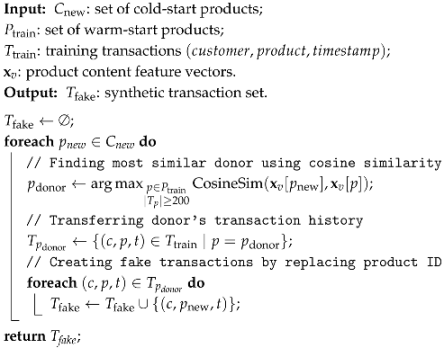 |
It is important to distinguish history augmentation from directly copying a donor’s learned embedding. In SHA, the cold-start product retains its own content-based initial representation and is subsequently optimized by the GNN using the synthetic interaction history transferred from the donor. Thus, the donor provides structural information through its observed neighborhood, while the representation of the cold-start product remains free to adapt to its own content and the transferred graph structure. In contrast, directly copying the donor’s trained embedding would replace the cold-start product’s own initial representation with the donor’s final representation and would not allow the new product to be learned from its own content during message passing. Therefore, the two procedures are not equivalent: SHA performs structural transfer followed by representation learning, whereas direct vector copying constitutes a direct parameter initialization or replacement.
3.6. Enhanced Similarity-Driven History Augmentation
While base SHA provides cold-start products with an initial structural footprint, it assumes that the interaction history of the most similar donor product is sufficiently informative. In practice, this assumption does not always hold, as some donor products exhibit sparse interaction histories that are inadequate for stable representation learning in GNNs.
To address this limitation, we introduce an enhanced SHA strategy that selectively incorporates additional donor products when the primary donor is interaction-sparse. The goal is to enrich the synthetic history of cold-start products while avoiding the introduction of noisy or low-probability edges.
For each cold-start product , donor products are ranked according to cosine similarity in the content feature space, following the same formulation used in base SHA. The most similar is always selected, and its full interaction history is transferred. When the number of interactions associated with the is below a predefined lower threshold , the synthetic history is considered insufficient. In this case, the second and third most similar donors are additionally examined.
However, directly transferring the full interaction histories of secondary donors can be harmful when these donors are highly active. Such products may be associated with thousands of transactions, leading to repeated exposure of the same customers in the synthetic data and biasing the optimization process, while also introducing noisy or low-probability edges into the message-passing process. Prior work has shown that aggregating irrelevant neighbors during message passing leads to noise accumulation and degraded predictive performance [44]. To mitigate this effect, we introduce a selective interaction filtering mechanism. Specifically, when a secondary donor exceeds the interaction threshold , only interactions involving the most active (or “famous”) customers are retained. These customers are identified as the top of customers ranked by interaction frequency in the training data.
This selective transfer preserves high-probability structural signals while suppressing the propagation of weak or noisy interactions, thereby enriching cold-start products with meaningful message-passing context without overwhelming the model.
Algorithm 2 summarizes the enhanced SHA procedure.
Section 4.4.2 presents the empirical gap underlying our choice, along with a sensitivity analysis determining per architecture.
| Algorithm 2: Enhanced Similarity-Driven History Augmentation |
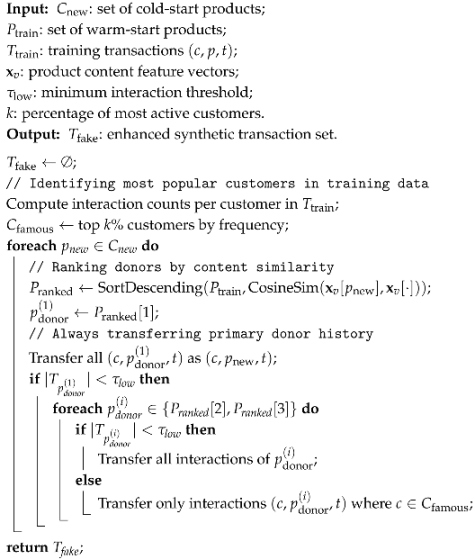 |
3.7. A Decoupled, Two-Model Hybrid Framework
Although SHA controls the quality of synthetic edges, ablation experiments showed that training a single model on the combined interaction set degrades warm-start performance. In the augmented setting, each synthetic interaction (Customer, , Timestamp) is derived from an original donor interaction (Customer, , Timestamp) by replacing the product identifier. While original product–customer pairs are not duplicated, customers appearing in donor histories now participate in additional interactions with newly introduced products. Optimizing jointly over therefore increases the effective degree of certain customers, altering the natural interaction distribution and biasing representation learning. This empirical behavior is consistent with prior findings that unbalanced neighbor aggregation can distort node embeddings and reduce predictive performance [44].
To prevent this structural distortion, we adopt a decoupled hybrid framework in which the two interaction sets are optimized separately.
The model trained on is responsible for the below:
- warm-start products interacting with either warm-start or cold-start customers.
The model trained on is dedicated to the following:
- cold-start products interacting with either warm-start or cold-start customers.
Since cold-start products lack structural context in , synthetic history is necessary to position their embeddings meaningfully, whereas warm-start predictions should remain governed solely by genuine interactions. By separating the optimization objectives, the framework preserves the integrity of the original interaction distribution while enabling targeted structural augmentation only where structural signals are absent. Figure 3 provides a high-level architectural view of the complete pipeline.
Figure 3.
Architectural overview of the decoupled hybrid framework.
4. Experiments, Results and Discussion
In this section, we describe the datasets used in this study. Then, we present a series of experiments designed to validate our proposed contributions; we detail our baseline experimental setup, which remains consistent across all tests. We then present the results of our architectural ablations and the performance of our final hybrid framework.
4.1. Dataset Overview
The experimental study is conducted primarily on two real-world e-commerce datasets. The DataCo SMART SUPPLY CHAIN FOR BIG DATA ANALYSIS dataset [36] provides transactional records containing customer, product, pricing, and temporal information, making it suitable for constructing temporal customer-product interaction graphs and evaluating cold-start link prediction. The Gift_Cards subset of the Amazon Reviews’23 dataset [37] provides timestamped user-item interactions together with product metadata and a substantially larger product catalogue than DataCo. Both datasets are used throughout the complete experimental evaluation.
For the analysis of the relationship between structural imbalance and asymmetric learning, we additionally consider the Online Retail dataset from the UCI Machine Learning Repository [38]. This dataset contains real transactional records from a UK-based online retailer, including customer identifiers, product identifiers, transaction timestamps, product descriptions, unit prices, and customer country information. This dataset is used exclusively as a balanced control condition for the baseline cold-start diagnosis and is not employed in the subsequent SHA-based experiments.
4.2. Data Preparation and Cleaning
4.2.1. Imbalanced E-Commerce Datasets
For the DataCo SMART SUPPLY CHAIN FOR BIG DATA ANALYSIS dataset [36], the original 2015–2018 transaction data required preprocessing for data consistency and a temporally coherent foundation for graph construction. We excluded cancelled and suspected-fraud transactions to reduce noise, yielding 172,765 valid purchase records, which were sorted by order date. This chronological ordering is essential for our temporal split, ensuring the model learns only from past interactions and preventing data leakage from future ones, as shown in Figure 4.
Figure 4.
Transaction volume over time for the DataCo SMART SUPPLY CHAIN FOR BIG DATA ANALYSIS dataset (2015–2018).
For DataCo, an initial 80%-10%-10% temporal split revealed a severe mismatch in cold-start node proportions between validation and test (e.g., 74.67% new customers in test vs. 2.58% in validation). Validating under conditions where cold-start nodes are nearly absent, then testing where they dominate, makes the validation set an unreliable proxy for test-time difficulty. This mismatch stems from the transaction volume decline visible in the final months of the collection period (Figure 4), where monthly volume drops to less than half of its stable average. Since splits are defined by transaction count, this sparse tail pulls the test window from a period with comparatively little preceding history, causing an unusually large share of customers and products to appear for the first time, not from genuine population turnover, but as an artifact of the collection period’s instability. To correct this issue in DataCo, we trim the most recent transactions prior to splitting. We evaluated the cold-start distributional gap across progressively larger trims and found it stabilized once the final 5% was removed, with no further improvement beyond this point. We adopt this 5% trim as the minimal correction needed, while acknowledging it narrows rather than eliminates the residual gap between validation and test, an expected property of non-stationary temporal data. This final dataset contains 164,126 transactions (from 12,296 unique customers and 96 unique products), which were then split chronologically into 131,300 train, 16,413 validation, and 16,413 test interactions. Table 1 details these statistics.
Table 1.
DataCo dataset statistics before and after removing the last 5% of transactions (applied prior to the 80%–10%–10% temporal split).
For the Gift_Cards subset of the Amazon Reviews’23 dataset [37], 152,410 user-item interactions were initially available. Preprocessing focused on product records for which category information was unavailable: interactions associated with products having an empty category list were removed. This resulted in 150,932 remaining interactions. After this filtering step, the dataset contained 131,682 unique users and 1113 unique products. The retained interactions were ordered chronologically using their timestamps to provide the temporal structure required for subsequent graph construction and evaluation. Figure 5 illustrates the transaction volume over time for the resulting Amazon dataset.
Figure 5.
Transaction volume over time for the Amazon Reviews’23 dataset (2009–2023).
4.2.2. Balanced E-Commerce Dataset
For the Online Retail dataset from the UCI Machine Learning Repository [38], preprocessing was limited to removing records with missing values in any of the fields required for graph construction, namely the invoice identifier, product identifier, transaction timestamp, and customer identifier. The original dataset contained 541,909 transaction records. After removing records with missing values in these required fields, 406,829 valid transactions remained. The resulting dataset contained 4372 unique customers and 3684 unique products and was subsequently ordered chronologically according to the transaction timestamps for temporal graph construction and evaluation.
4.3. Experimental Setup
To ensure a fair and reproducible comparison between different models and configurations, we established a fixed experimental protocol. All models are implemented using the PyTorch v2.7.0 Geometric (PyG) library [45] and trained on a single NVIDIA T4 GPU.
We use a two-layer GNN architecture for all encoders. A depth of two layers is a standard practice in GNN literature, as it allows for the aggregation of two-hop neighborhood information while mitigating the risk of over-smoothing, a common issue in deeper GNNs [46]. The dimension for all node embeddings (initial, hidden, and final) is set to 64. This provides a sufficient capacity for learning expressive representations while remaining computationally tractable. As a baseline classifier for link prediction, we use a simple dot product classifier, which evaluates the inner product of the final customer and product embeddings to produce a similarity score.
Model optimization is performed using the Adam optimizer [47] with a learning rate of 0.001. A dropout rate of 0.3 is applied between GNN layers and, where applicable, to attention weights. To train the model for the binary classification task of link prediction, negative examples (non-existent edges) are required. We employ a negative sampling ratio of 1.0, meaning for each positive edge in a mini-batch, one negative edge is randomly sampled. This creates a balanced classification task, preventing the model from developing a bias towards the majority class.
To ensure convergence across all experimental settings and prevent overfitting, training employs early stopping based on validation performance, with an upper limit of 150 epochs. This allows models trained on augmented graphs to converge properly.
All results reported in this section are averaged over five independent runs with different random seeds. We report the mean and standard deviation of each metric to assess robustness and reduce sensitivity to random initialization.
For the attention-based architectures in this study, GAT and HGT, the number of attention heads was fixed to one across all experiments. This decision is informed by preliminary studies which consistently showed that a single head yields superior performance on our dataset. We attribute this to the nature of our bipartite graph, where the fundamental relationship is a singular ’buys’ interaction. In this constrained relational environment, unlike in complex domains such as text generation where multiple heads capture diverse patterns, additional heads risk learning redundant representations and introducing unnecessary parameters without providing significant gains in expressive power. Therefore, a single head ensures an optimal and efficient configuration [48].
The fixed parameters for our baseline experimental setup are summarized in Table 2.
Table 2.
Fixed experimental setup parameters used across all experiments.
4.4. Results and Analysis
In this section, we present a series of experiments designed to evaluate the proposed methodology and investigate the cold-start behavior under different structural conditions. The evaluation is conducted in two stages. First, the baseline cold-start diagnosis is performed on all three datasets using HGT, GAT, and GraphSAGE, allowing the observed asymmetric learning phenomenon to be examined under severely imbalanced and relatively balanced customer-product structures. Second, the subsequent evaluation of Similarity-Driven History Augmentation (SHA), enhanced SHA, and the decoupled two-model hybrid framework is conducted on the two imbalanced datasets, DataCo and the Amazon Gift_Cards subset, where the structural conditions motivate the proposed augmentation strategy. All experiments follow the fixed experimental protocol described in Section 4.3.
Before proceeding to the tests, we reiterate two key aspects of our implementation. First, all models are implemented using the PyTorch Geometric (PyG) library [45], which provides heterogeneous graph extensions that automatically create separate parameter sets for each edge type in our customer-product bipartite structure, so even GraphSAGE and GAT, which were originally designed for homogeneous graphs, can be adapted to our heterogeneous setting. Second, regarding edge weight incorporation: PyG’s GAT implementation natively supports edge weights through its attention mechanism, which we utilized directly. However, PyG’s GraphSAGE and HGT implementations do not have built-in edge weight support, so we manually modified their aggregation functions to incorporate the pre-computed edge weights, allowing all models to leverage the intensity of customer-product interactions.
The primary metric for evaluating model performance is ROC AUC, prioritized because it assesses ranking quality independently of a specific decision boundary, ensuring fair comparisons across architectures with varying raw logit scales. For a comprehensive profile, we also report accuracy and F1-score, calculated at the optimal decision threshold calibrated per model configuration during validation to maximize predictive precision.
4.4.1. Test 1: Baseline Performance and Cold-Start Failure Diagnosis
Before evaluating our solution, we first establish a comprehensive baseline and empirically confirm the precise nature of the cold-start problem. We trained three powerful GNN encoders: HGT, GAT, and GraphSAGE across the three datasets. All models were trained using the fixed experimental setup described in Section 4.3, relying solely on the original, non-augmented training graph.
For DataCo, validation performance typically stabilizes after approximately 40 epochs, with early stopping preventing further overfitting. The Amazon Gift_Cards models generally converge earlier, consistent with its sparser interaction structure. The same early-stopping protocol is retained across all datasets to ensure a consistent evaluation procedure.
Table 3 reports the overall validation performance of the three GNN architectures across the three datasets.
Table 3.
Baseline GNN performance on the full validation set across the three datasets (mean ± std, %).
The aggregate results in Table 3 show that all three architectures achieve strong overall performance on DataCo and Amazon Gift_Cards, whereas the Online Retail results are lower overall. However, these aggregate metrics obscure a severe underlying failure. To diagnose the model’s true behavior, we must analyze its performance across the distinct subpopulations of the validation set; we next analyze performance by node-type combinations.
Table 4, Table 5 and Table 6 provide this detailed breakdown, showing the ROC AUC scores for links between different node types for the three datasets. It is important to clarify that each subset (e.g., Existing Customers → Existing Products) represents a complete binary classification task, comprising both the positive (existing) links from that category and a corresponding set of randomly sampled negative (non-existent) links. The AUC score thus measures the model’s ability to distinguish between real and non-real interactions within that specific subpopulation.
Table 4.
ROC AUC breakdown on the DataCo validation subsets (mean ± std, %).
Table 5.
ROC AUC breakdown on the Amazon Gift_Cards validation subsets (mean ± std, %).
Table 6.
ROC AUC breakdown on the Online Retail validation subsets (mean ± std, %).
The results in Table 4, Table 5 and Table 6 provide consistent evidence that the cold-start behavior of GNNs depends strongly on the structural configuration of the customer–product graph. Across the two severely imbalanced datasets, DataCo and Amazon Gift_Cards, the three architectures exhibit the same directional pattern: interactions involving newly introduced products suffer substantially greater degradation than interactions involving newly introduced customers paired with established products.
Strong Warm-Start Performance: For both imbalanced datasets, interactions between existing customers and existing products remain comparatively well predicted, confirming that the GNN architectures can effectively exploit established interaction histories. On DataCo, all three architectures achieve ROC AUC values above 93% in this setting, while the Amazon Gift_Cards results remain strong overall despite differences in architectural performance. Strong Generalization for New Customers with Existing Products: A consistent pattern across the two severely imbalanced datasets is the substantially better performance obtained when newly introduced cold-start customers interact with established products. For DataCo, the New Customer → Existing Product condition achieves ROC AUC values of 92.84%, 92.64%, and 85.39% for HGT, GAT, and GraphSAGE, respectively, while the corresponding values for Amazon Gift_Cards are 91.87%, 93.88%, and 86.08%. This behavior is consistent with the asymmetric learning dynamics induced by the severe customer-product imbalance. DataCo contains 12,296 customers and 96 products, whereas Amazon Gift_Cards contains 131,682 users and 1,113 products, yielding similarly high customer-to-product ratios in both datasets. During training, the minority product nodes therefore receive interaction-driven updates from a much larger population of customer nodes, causing their representations to become strongly dependent on the learned graph structure. Customer representations, in contrast, remain comparatively closer to their initial content-based representations. Consequently, a newly introduced customer, despite having no historical interactions, can be represented using the same content-based feature space as existing customers and evaluated against well-established product representations.
Strong Product-Side Degradation: The opposite behavior is observed for newly introduced products. On DataCo, Existing Customer → New Product falls to approximately random performance for all three architectures, with ROC AUC values of 51.65%, 49.71%, and 51.66% for HGT, GAT, and GraphSAGE, respectively. The Amazon Gift_Cards dataset exhibits the same directional degradation, with corresponding values of 62.68%, 60.32%, and 56.45%. Thus, despite the substantially larger product catalogue in Amazon Gift_Cards compared to DataCo, product representations remain more dependent on interaction-derived structural information than content alone, leaving newly introduced products without the neighborhood information required for effective message passing.
Balanced Control Condition: The Online Retail dataset provides a substantially more balanced customer-product structure and is therefore used as a control condition for examining whether this asymetric learning is specifically associated with severe structural imbalance. Unlike the two severely imbalanced datasets, Online Retail does not exhibit a pronounced collapse for newly introduced products. The Existing Customer → New Product condition achieves ROC AUC values of 83.36%, 75.15%, and 80.22% for HGT, GAT, and GraphSAGE, respectively, compared with 73.51%, 73.33%, and 72.26% for New Customer → Existing Product. The product-side degradation observed in the two severely imbalanced datasets is therefore substantially reduced, with the directional difference reversed across all three architectures.
Taken together, the three datasets provide cross-dataset evidence that the pronounced asymmetric cold-start failure is closely associated with severe customer-product structural imbalance rather than being an inherent consequence of temporal GNN link prediction. The consistency of the pattern across HGT, GAT, and GraphSAGE in the two imbalanced datasets, together with its substantial reduction under the more balanced Online Retail setting, supports the role of structural imbalance in shaping the observed asymmetric learning behavior and motivates the subsequent data-level augmentation experiments on the two imbalanced datasets.
4.4.2. Test 2: Threshold and Filtering Parameter Selection for Enhanced SHA
To address the cold-start limitation for new products on imbalanced datasets, this study utilizes the Similarity-Driven History Augmentation (SHA) approach. However, before comparing base SHA against enhanced SHA, we first justify the two design parameters introduced in Section 3.6: the sparsity threshold , which determines whether a primary donor’s interaction history is sufficient, and the active-customer filtering ratio k, which controls how much of a secondary donor’s history is transferred when filtering is required.
Empirical basis for :
We examined the distribution of interaction counts across products available as donors in the training sets of the two imbalanced datasets. For DataCo, the distribution exhibits a clear two-cluster structure with a wide separating gap (Figure 6): one cluster spans interaction counts from 226 to 293, while the other spans from 5579 to 8926, with no product in the training set having an interaction count within this interval, leaving a natural gap exceeding 5200 interactions between the two clusters. The underlying bipartite graph has a density of 12% and a corresponding sparsity of 88%, consistent with the highly uneven interaction distribution observed in the data.
Figure 6.
Distribution of training-set donor interaction counts for the DataCo dataset. (Left): full distribution on a logarithmic scale, with the detected gap shaded and marked. (Right): zoomed view of the sparse cluster.
The Amazon Gift_Cards dataset exhibits an even more pronounced right-skewed distribution of product interaction counts (Figure 7), with a large concentration of products having relatively sparse histories and a smaller group of products having substantially denser histories. Its bipartite graph has a density of 0.10935% and a corresponding sparsity of 99.89065%. The distribution therefore also supports distinguishing sparse from dense donor products.
Figure 7.
Distribution of training-set donor interaction counts for the Amazon Gift_Cards dataset. (Left): full distribution on a logarithmic scale, with the detected separation between sparse and dense donors and marked. (Right): zoomed view of the sparse cluster.
These observations motivate a binary classification of donor products into sparse and dense categories. We adopt as the operating threshold for both datasets, as this value lies within the separation between the sparse and dense regions in the observed donor distributions. For DataCo, the gap spans , meaning that any threshold within this interval induces the same sparse/dense partition and, therefore, identical experimental results. For Amazon Gift_Cards, the position of relative to the observed distribution likewise provides a consistent separation between the predominantly sparse donor histories and the substantially denser histories.
Sensitivity to the filtering ratio k:
We evaluated enhanced SHA across a range of active-customer filtering ratios on the cold-start product validation subset, independently for each architecture and for both DataCo and Amazon Gift_Cards. Table 7 and Table 8 report the results.
Table 7.
Sensitivity of enhanced SHA to the active-customer filtering ratio k on the DataCo cold-start product validation subset (mean ± std, %). Bold rows indicate the selected operating value per architecture.
Table 8.
Sensitivity of enhanced SHA to the active-customer filtering ratio k on the Amazon Gift_Cards cold-start product validation subset (mean ± std, %). Bold rows indicate the selected operating value per architecture.
For DataCo, performance follows a clear inverted-U pattern for GAT and GraphSAGE, rising as k increases from 10% to 60% and declining beyond that point. HGT instead improves monotonically up to , where it attains its best result.
For Amazon Gift_Cards, GAT exhibits a similar inverted-U pattern and reaches its best ROC AUC at . GraphSAGE instead peaks earlier at and then declines as more customers are included. HGT achieves its best result at , despite a small decrease at indicating that its performance remains strongest when the complete set of active customers from the secondary donor histories is retained.
The different optimal values observed across architectures and datasets can be attributed to how each architecture represents relation-specific information beyond simple parameter duplication. GAT and GraphSAGE acquire relation awareness only through PyTorch Geometric’s heterogeneous wrapper [45], which instantiates an independent copy of an otherwise homogeneous operator, attention-based pooling for GAT, mean aggregation for GraphSAGE, for each relation type. Within each relation, neighbor contributions are combined through a single learned scoring function (GAT) or an unweighted structural average (GraphSAGE), with no further conditioning on node or relation identity beyond the duplicated weights themselves. HGT instead incorporates type-specific input projections, relation-specific key and value transformations, learnable attention priors per relation type, and type-specific skip connections, jointly conditioning its attention computation on both node type and relation type. This richer parameterization gives HGT greater capacity to learn which interactions are more or less informative, allowing it to extract useful signal from the complete history of secondary donors without the noise-accumulation effect observed in GAT and GraphSAGE. The fact that HGT selects on both datasets is consistent with this greater internal capacity, whereas GAT and GraphSAGE benefit from restricting the transferred histories, although the optimal filtering ratio remains dataset-dependent.
For the DataCo dataset, the sensitivity analysis identifies as the optimal active-customer ratio for GAT and GraphSAGE, while HGT achieves its best result at . However, this analysis does not by itself indicate whether the improvement observed with activity-based filtering stems from the selection criterion or simply from reducing the number of transferred edges. To isolate this effect, we compare three configurations for the secondary donor’s history when it exceeds : transferring the full history with no filtering, transferring a random subset of the same size (60%) drawn from the donor’s own purchasing customers, and the proposed selection of the top 60% most active customers. Table 9 reports these results on the DataCo cold-start product validation subset.
Table 9.
Filtering mechanism ablation on the DataCo cold-start product validation subset (mean ± std, %). Random and proposed configurations transfer equally sized (60%) subsets of the donor’s customers, differing only in the selection criterion. The final configuration additionally restricts negative samples to the top 60% most active customers.
The following analysis is a targeted control experiment designed to further isolate the contribution of the activity-based filtering criterion. It is therefore reported for DataCo alongside the detailed filtering ablation, while the broader sensitivity analysis of k is evaluated independently on both imbalanced datasets.
Because the proposed filtering concentrates the transferred interactions on highly active customers, we additionally examine whether the observed improvement could be influenced by the random negative-sampling procedure. To control for this factor, we repeat the proposed top-60% configuration for GAT and GraphSAGE while restricting negative samples to the same top-60% active-customer population. The results of this controlled configuration are also reported in Table 9.
For both architectures, the proposed top- selection achieves the highest ROC AUC, confirming that the benefit of filtering is not attributable to edge-count reduction alone. The two architectures diverge, however, in how random filtering behaves: for GAT, the random subset performs no better than the full, unfiltered history, indicating that arbitrary edge removal provides no reliable benefit and that activity-based selection is necessary to realize any gain. For GraphSAGE, the random subset already improves over the full history, suggesting that some reduction in donor density is beneficial regardless of criterion, but the proposed selection still yields the highest mean ROC AUC with the lowest variance across seeds, indicating a more consistent improvement than random selection alone provides. Together, these results show that selection quality, rather than sparsification alone, drives the gains of enhanced SHA’s filtering mechanism, with its relative contribution varying by architecture.
To further examine the potential influence of customer activity, the controlled negative-sampling results in Table 9 are compared with the original top-60% configuration. When negative samples are restricted to the same top-60% active-customer population, ROC AUC decreases from 85.30% to 84.04% for GAT and from 91.05% to 90.87% for GraphSAGE. This slight reduction is expected because the negative-sampling pool is restricted to a subset of the full customer population. Nevertheless, both results remain above the corresponding full-history configurations, which achieve 82.83% and 88.86%, respectively. Thus, the improvement associated with activity-based filtering remains when positive and negative examples are drawn from the same high-activity customer population.
4.4.3. Test 3: Evaluating Similarity-Driven History Augmentation (SHA)
Having justified and the architecture-specific filtering ratios k in Test 2, we now evaluate enhanced SHA against base SHA on the cold-start product validation subset. As in Test 2, this experiment is performed exclusively on interactions involving products absent from the training set, and the comparison is conducted on both DataCo and Amazon Gift_Cards.
To further assess whether the improvement provided by SHA results from restoring graph structure rather than from content representations alone, we additionally compare both SHA variants with a simple content-only baseline. This baseline ignores the interaction graph and matches customers to products using their initial 64-dimensional representations through content-based similarity. For DataCo, both customer and product representations are obtained by the same learnable projection described in Section 3.2, for Amazon Gift_Cards, customer representations are already 64-dimensional ID embeddings, while product representations are mapped to the same 64-dimensional space using the corresponding projection. No message passing or interaction information is used by this baseline.
Table 10 presents the performance comparison between base SHA and enhanced SHA on the cold-start product validation subset.
Table 10.
Performance comparison of base SHA, enhanced SHA, and the content-only baseline on the cold-start product validation subset for DataCo and Amazon Gift_Cards (mean ± std, %). Enhanced SHA uses the architecture-specific filtering ratio determined in Test 2.
The results demonstrate a substantial recovery across all architectures. On DataCo, while baseline models collapse to random guessing with cold-start products (≈50% AUC, Table 4), base SHA already lifts performance to competitive levels (77%–87% AUC). Enhanced SHA, configured with the architecture-specific parameters established in Test 2, yields further substantial gains: HGT improves by 7.71% relative to base SHA, reaching 90.45%. GAT improves by 10.01%, reaching 85.30%, and GraphSAGE improves by 4.51%, reaching the highest overall score of 91.05%. This confirms that enriching the transferred histories through architecture-specific filtering provides additional benefit beyond the basic donor history.
The same behavior is observed on Amazon Gift_Cards, where base SHA achieves ROC AUC values of 95.78%, 93.48%, and 86.34% for HGT, GAT, and GraphSAGE, respectively. Enhanced SHA further increases these values to 97.20%, 97.27%, and 90.49%, corresponding to relative improvements of 1.48%, 4.05%, and 4.81%, respectively. Thus, the benefit of the enhanced history construction is also observed in the second severely imbalanced dataset, despite its different interaction distribution and substantially larger product catalogue.
The content-only baseline remains close to random performance on both datasets, achieving ROC AUC values of 52.88% on DataCo and 45.04% on Amazon Gift_Cards. This provides an important distinction between content similarity and structural augmentation: the initial node representations alone are insufficient to recover the cold-start product prediction performance achieved after transferring donor interaction histories and enabling message passing. The comparison therefore supports the role of the reconstructed graph structure, rather than content information alone, in the effectiveness of SHA.
These results support the effectiveness of the proposed history augmentation strategy across the two severely imbalanced datasets. We select the architecture-specific enhanced SHA configurations identified in Test 2 as the designated emerging-product expert for the hybrid framework evaluated next.
4.4.4. Test 4: Final Decoupled, Two-Model Hybrid Framework
Based on the findings from Tests 1 and 3, we implement the decoupled, two-model hybrid framework proposed in Section 3.7. This framework routes predictions to a specialized expert model to maximize performance without compromise.
The two experts are defined as follows:
- The Established-Product Expert: The baseline model from Test 1, trained only on authentic data. It is responsible for predicting links where the product is known (i.e., “Existing Customers → Existing Products” and “New Customers → Existing Products”). As shown in Test 1, these models achieve high performance on their specific subsets.
- The Emerging-Product Expert: The best-performing model from Test 3, trained using the enhanced SHA strategy. It is responsible for all links involving a new product (i.e., “Existing Customers → New Products” and “New Customers → New Products”).
Table 11 presents the final, combined performance of this hybrid framework when evaluated on the entire validation set.
Table 11.
Combined performance of the final hybrid framework on the full validation set for DataCo and Amazon Gift_Cards (mean ± std, %).
For DataCo, the hybrid framework achieves strong overall performance across all architectures. Compared to the original baseline results on the validation set (Table 3), the hybrid framework provides a significant uplift in predictive capability. For HGT, ROC AUC increases from 91.89% to 95.57%, a relative improvement of 4.01%. GAT increases from 92.63% to 95.38%, a relative improvement of 2.97%. GraphSAGE improves from 91.11% to 94.41%, a relative improvement of 3.62%.
The hybrid framework also improves the overall validation performance on Amazon Gift_Cards, although the aggregate gains are smaller than those observed on DataCo. ROC AUC increases from 90.98% to 92.43% for HGT, from 91.88% to 92.36% for GAT, and from 80.30% to 82.82% for GraphSAGE, corresponding to relative improvements of 1.60%, 0.52%, and 3.14%, respectively. This smaller overall improvement is consistent with the composition of the Amazon validation set, where cold-start interactions represent a smaller proportion of the evaluated interactions relative to warm-start interactions. Consequently, improvements concentrated on the cold-start product subset contribute less to the aggregate validation metric than in DataCo, where cold-start interactions have a greater contribution to the overall validation set.
These results demonstrate that the decoupled framework can preserve the strong performance of the established-product expert while exploiting the enhanced SHA expert for interactions involving newly introduced products. The resulting specialization provides a consistent improvement in overall prediction performance across the two severely imbalanced e-commerce datasets.
4.4.5. Final Evaluation on the Test Set
Having optimized the hybrid framework on the validation set, we now present the final evaluation on the held-out test set. This set comprises the final 10% of chronological interactions and serves as the definitive measure of our system’s performance in a dynamic, real-world setting. The final evaluation is conducted on both DataCo and Amazon Gift_Cards.
To first assess whether the improvements observed during validation persist on unseen data, we compare base SHA and enhanced SHA on the cold-start product test subset. The threshold and the architecture-specific filtering ratios k are fixed according to the values selected during validation, with no further parameter optimization performed on the test set. Table 12 reports the ROC AUC comparison for DataCo and Amazon Gift_Cards.
Table 12.
ROC AUC comparison between base SHA and enhanced SHA on the cold-start product test subset for DataCo and Amazon Gift_Cards (mean ± std, %). Enhanced SHA uses the architecture-specific filtering ratio selected from the validation set.
Table 12 presents a performance comparison between the base SHA and enhanced SHA methodologies, evaluated by ROC AUC on the cold-start product test subsets for both the DataCo and Amazon Gift Cards datasets. Across all three tested architectures (HGT, GAT, and GraphSAGE), the enhanced SHA consistently outperforms the base SHA on both the DataCo dataset and the Amazon dataset, demonstrating the effectiveness of utilizing an architecture-specific filtering ratio.
To rigorously quantify the impact of our solution, we compare two distinct configurations:
- Original Baseline: The standard GNN models (HGT, GAT, GraphSAGE) trained solely on the authentic, structurally imbalanced data.
- Hybrid Framework: Our proposed solution which routes predictions based on the temporal status of the product involved in the interaction.
For the hybrid framework, we applied a vital refinement regarding validation-born nodes. In a strict temporal split, certain products appear for the first time in the validation period. When the model progresses to the test period, these nodes possess a sparse history derived only from the short validation window. Relying on this limited, potentially unstable history is insufficient for robust representation learning. To ensure consistency and stability, we treat both validation-born and test-born products as cold-start candidates. For all such nodes, we source content-similar donor products exclusively from the stable initial 80% training set.
Table 13 presents the comparative results on the full test set for both DataCo and Amazon Gift_Cards.
Table 13.
Performance comparison between the original baseline and the hybrid framework on the full test set for DataCo and Amazon Gift_Cards (mean ± std, %).
For DataCo, the hybrid framework substantially improves the overall test-set performance across the evaluated architectures. For HGT, ROC AUC increases from 91.46% to 96.87%, corresponding to a relative improvement of 5.92%. For GAT, ROC AUC increases from 91.79% to 96.31%, corresponding to a relative improvement of 4.92%. These gains reflect the specialization of the two experts: established-product interactions remain assigned to the original model, while interactions involving new products are handled by the enhanced SHA expert.
On Amazon Gift_Cards, the hybrid framework also improves ROC AUC for all three architectures, although the gains are smaller at the aggregate test-set level. HGT increases from 93.67% to 93.98%, GAT from 93.19% to 93.67%, and GraphSAGE from 87.29% to 88.22%, corresponding to relative improvements of 0.33%, 0.52%, and 1.07%, respectively. The smaller aggregate gains are consistent with the composition of the Amazon test set, in which interactions involving cold-start products represent a smaller proportion of the evaluated interactions. Since the hybrid framework primarily changes predictions for these interactions while retaining the original expert for established products, a smaller cold-start share naturally limits its impact on the overall test-set metrics.
To provide deeper insight into the classification dynamics beyond aggregated metrics, we present the confusion matrices and ROC curves for the HGT, GAT, and GraphSAGE architectures on DataCo in Figure 8, Figure 9 and Figure 10, respectively.
Figure 8.
Performance visualization for the HGT architecture (Representative Run) on the DataCo dataset.
Figure 9.
Performance visualization for the GAT architecture (Representative Run) on the DataCo dataset.
Figure 10.
Performance visualization for the GraphSAGE architecture (Representative Run) on the DataCo dataset.
Please note that the aggregated results in Table 13 represent the mean performance across multiple random seeds to ensure statistical robustness. While the visualizations below depict a single representative run selected to reflect the central tendency of the model’s behavior. These plots confirm that the high AUC scores are driven by a balanced True Positive and True Negative rate, rather than class imbalance artifacts.
5. Limitations and Future Work
Although the proposed framework demonstrates consistent improvements across the evaluated imbalanced e-commerce datasets and GNN architectures, several methodological limitations remain. First, the scalability of the donor-selection procedure has not been fully evaluated on very large product catalogues. The current SHA mechanism identifies the most similar eligible donor through cosine similarity over the product representation space. This operation is inexpensive for the catalogues considered in this study, even with the 1113-product Amazon Gift_Cards dataset, but exhaustive similarity search may become increasingly costly as the number of products grows to tens of thousands or more. Future work should therefore investigate scalable donor-retrieval strategies.
Second, larger product catalogues may increase the possibility of selecting “false-friend” donors, i.e., products that are highly similar in the content-embedding space but do not exhibit sufficiently similar purchasing behavior. Since SHA transfers the donor’s historical interactions, an inappropriate donor may introduce misleading structural information into the graph. Improving donor selection by jointly considering semantic similarity, historical interaction patterns, and other product-level signals is therefore an important direction for future research.
Third, the effectiveness of donor selection depends on the quality and availability of product-side content information. Products with short, ambiguous, noisy, or insufficient descriptions may lead to less reliable similarity estimates, limiting the ability of SHA to identify an appropriate donor. This limitation is particularly relevant in settings where newly introduced products have sparse metadata.
Finally, the donor-eligibility threshold and the interaction-density threshold used by the Enhanced SHA mechanism are dependent on the interaction distribution of the underlying dataset. Although the proposed procedure provides a data-driven basis for selecting these values, their optimal ranges may change substantially across domains, catalogue sizes, and interaction densities. A more systematic treatment of adaptive threshold selection and large-scale donor retrieval would therefore strengthen the framework’s applicability to broader e-commerce settings.
These limitations motivate future evaluation on substantially larger product catalogues and more diverse e-commerce datasets. In particular, future work should examine the scalability and robustness of donor matching, investigate retrieval strategies that reduce the computational cost of large-scale similarity search, and develop more behavior-aware donor-selection mechanisms that reduce the risk of false matches.
6. Conclusions
In this study, we addressed the problem of zero-shot cold-start recommendation in e-commerce by identifying a fundamental structural failure mode in Graph Neural Networks (GNNs), which we termed asymmetric learning. Because minority-type nodes (i.e., products) in severely imbalanced bipartite graphs rely heavily on interaction histories, GNNs struggle to place entirely new products within the learned embedding space. To overcome this limitation without requiring architectural modifications, we proposed Similarity-Driven History Augmentation (SHA), a data-centric approach that synthesizes plausible interaction histories for cold-start nodes by matching them with semantically similar donor nodes. Furthermore, we introduced a decoupled hybrid framework that routes predictions based on a product’s temporal status, effectively eliminating distribution-shift interference between authentic and synthetic histories.
Our comprehensive empirical evaluation across multiple real-world datasets including DataCo and Amazon Gift_Cards, demonstrates the effectiveness of this approach. The baseline experiments further show that the observed asymmetric learning phenomenon is strongly associated with severe customer–product structural imbalance, while the relatively balanced Online Retail dataset does not exhibit the same product-side performance collapse. By comparing our decoupled hybrid framework against the original GNN baselines, we demonstrated that our methodology successfully mitigates the performance collapse in zero-shot scenarios, yielding substantial improvements in ROC AUC across both imbalanced datasets and all three evaluated architectures.
Overall, the results demonstrate that reconstructing missing structural context through content-guided history augmentation can substantially improve the ability of GNNs to predict interactions involving newly introduced products, while preserving the underlying model architectures. The decoupled hybrid framework further enables this improvement without compromising the prediction of interactions involving established products.
Future work will build on these findings by extending the framework to larger and more diverse product catalogues and by developing more adaptive donor-selection mechanisms as newly introduced products accumulate real interaction histories.
Author Contributions
Conceptualization, I.E.K. and K.B.; methodology, I.E.K., K.B. and L.D.; validation, I.E.K., K.B., L.D. and C.B.; formal analysis, I.E.K. and L.D.; investigation, I.E.K.; data curation, I.E.K.; writing—original draft preparation, I.E.K.; writing—review and editing, I.E.K., K.B., L.D. and C.B.; supervision, K.B., L.D. and C.B. All authors have read and agreed to the published version of the manuscript.
Funding
This work was supported by the PRFU (Projet de Recherche Formation Universitaire) project C00L07UN310220230001: ’Environmental and Economic Optimization of Production Systems’ funded by the Algerian Ministry of Higher Education and Scientific Research. Christoph Bergmeir is supported by the María Zambrano Fellowship that is funded by the Spanish Ministry of Universities and Next Generation funds from the European Union. The work is also supported by Grant PID2023-149128NB-I00 funded by MICIU/AEI /10.13039/501100011033 and by ERDF, EU. It is also partially supported by the I+D+i project granted by C-ING-250-UGR23 co-funded by “Consejería de Universidad, Investigación e Innovación” and the European Union related to FEDER Andalucía Program 2021-27.
Institutional Review Board Statement
Not applicable.
Informed Consent Statement
Not applicable.
Data Availability Statement
The datasets used in this study are publicly available. The DataCo dataset is available from the Mendeley Data repository at https://data.mendeley.com/datasets/8gx2fvg2k6/5 (accessed on 10 September 2026). The Online Retail dataset is available from the UCI Machine Learning Repository at https://archive.ics.uci.edu/dataset/352/online+retail (accessed on 10 September 2026). The Amazon Reviews 2023 dataset is available at https://amazon-reviews-2023.github.io/ (accessed on 10 September 2026).
Conflicts of Interest
The authors declare no conflicts of interest.
References
- Esmeli, R.; Gokce, A. An Analysis of Consumer Purchase Behavior Following Cart Addition in E-Commerce Utilizing Explainable Artificial Intelligence. J. Theor. Appl. Electron. Commer. Res. 2025, 20, 28. [Google Scholar] [CrossRef] [Scilit]
- Khiloun, I.E.; Belmabrouk, K.; Dekhici, L. Literature Review on Supply Chains Optimization Using Multi-Agents Communication and Collaboration. In Intelligent Methods and Alternative Economic Models for Sustainability; Dekhici, L., Guerraiche, K., Azzemou, R., Jlassi, J., Eds.; IGI Global: Hershey, PA, USA, 2024; pp. 74–94. [Google Scholar] [CrossRef] [Scilit]
- Kotecha, N.; del Rio Chanona, A. Leveraging graph neural networks and multi-agent reinforcement learning for inventory control in supply chains. Comput. Chem. Eng. 2025, 199, 109111. [Google Scholar] [CrossRef] [Scilit]
- Khiloun, I.E.; Belmabrouk, K.; Dekhici, L.; Bergmeir, C. Heterogeneous Graph Neural Networks for Product Recommendation On Transactional Retail Data. Commun. Sci. Et Technol. 2025, 23, 23–35. [Google Scholar]
- Hu, Z.; Dong, Y.; Wang, K.; Sun, Y. Heterogeneous Graph Transformer. In Proceedings of the Web Conference (WWW), Online, 20–24 April 2020; pp. 2704–2710. [Google Scholar] [CrossRef] [Scilit]
- Lee, D.; Go, J.; Noh, T.; Song, S. Multi-feature representation-based graph attention networks for predicting potential supply relationships in a large-scale supply chain network. Expert Syst. Appl. 2025, 292, 128593. [Google Scholar] [CrossRef] [Scilit]
- Liu, J.; Zhang, Z.; Cheung, R.C. MoToRec: Sparse-Regularized Multimodal Tokenization for Cold-Start Recommender. Proc. Aaai Conf. Artif. Intell. 2026, 40, 15324–15332. [Google Scholar] [CrossRef] [Scilit]
- Veličković, P.; Cucurull, G.; Casanova, A.; Romero, A.; Liò, P.; Bengio, Y. Graph Attention Networks. In Proceedings of the International Conference on Learning Representations (ICLR), Vancouver, BC, Canada, 30 April–3 May 2018. [Google Scholar] [CrossRef] [Scilit]
- Hamilton, W.L.; Ying, R.; Leskovec, J. Inductive Representation Learning on Large Graphs. In Proceedings of the Advances in Neural Information Processing Systems (NeurIPS), Long Beach, CA, USA, 4–9 December 2017; pp. 1024–1034. [Google Scholar] [CrossRef] [Scilit]
- Zaghloul, M.; Barakat, S.; Rezk, A. Predicting E-commerce customer satisfaction: Traditional machine learning vs. deep learning approaches. J. Retail. Consum. Serv. 2024, 79, 103865. [Google Scholar] [CrossRef] [Scilit]
- Xiao, F.; Chen, S.; Chen, Z.; Wang, Y.; Wang, J. An interpretable data-driven approach for customer purchase prediction using cost-sensitive learning. Eng. Appl. Artif. Intell. 2024, 138, 109344. [Google Scholar] [CrossRef] [Scilit]
- Gandhudi, M.; P.J.A., A.; Velayudham, V.; Nagineni, L.; G.R., G. Dynamic customer behavior prediction in subscription services using causal reinforcement learning. Eng. Appl. Artif. Intell. 2025, 155, 111030. [Google Scholar] [CrossRef] [Scilit]
- Liu, C.; Xi, X. How the customer purchase pattern changes when increasing product diversity: Theory and empirical evidence from the airline industry. Omega 2025, 103485. [Google Scholar] [CrossRef] [Scilit]
- Gandhudi, M.; P.J.A., A.; Velayudham, V.; Nagineni, L.; G.R., G. Explainable causal variational autoencoders based equivariant graph neural networks for analyzing the consumer purchase behavior in E-commerce. Eng. Appl. Artif. Intell. 2024, 136, 108988. [Google Scholar] [CrossRef] [Scilit]
- Yu, B.; Yang, Q.; Zhang, J. Multi-behavior purchase prediction via graph convolutional networks on implicit bipartite graph relationships. Knowl.-Based Syst. 2025, 330, 114700. [Google Scholar] [CrossRef] [Scilit]
- Chen, X.; Peng, B.; Liu, Y. A lifecycle-based household recommendation system: From product recycling to purchasing. J. Retail. Consum. Serv. 2026, 88, 104487. [Google Scholar] [CrossRef] [Scilit]
- Ma, Z.; Liu, Y.; Chen, Y.; Liu, Z.; Li, Y. XMF-GNN: A cross-modality dynamic fusion heterogeneous graph neural network for network intrusion detection. Neurocomputing 2025, 655, 131285. [Google Scholar] [CrossRef] [Scilit]
- Najafabadi, M.K.; Chen, R.A.; Rezazadeh, J.; Beheshti, A.; Shabani, N. From theory to practice: The evolution and comparative analysis of homogeneous vs. heterogeneous Graph Neural Networks in recommender systems. Neurocomputing 2025, 624, 129446. [Google Scholar] [CrossRef] [Scilit]
- Polatidis, N.; Georgiadis, C.K. A dynamic multi-level collaborative filtering method for improved recommendations. Comput. Stand. Interfaces 2017, 51, 14–21. [Google Scholar] [CrossRef] [Scilit]
- Zanardini, D.; Serrano, E. Introducing new node prediction in graph mining: Predicting all links from isolated nodes with Graph Neural Networks. Neurocomputing 2024, 609, 128474. [Google Scholar] [CrossRef] [Scilit]
- Yao, H.Y.; Zhang, C.Y.; Yao, Z.L.; Chen, C.P.; Hu, J. A recurrent graph neural network for inductive representation learning on dynamic graphs. Pattern Recognit. 2024, 154, 110577. [Google Scholar] [CrossRef] [Scilit]
- Zhu, Q.; Shen, Z.; Wu, Z.; Zhang, H.; Yuan, J.; Chen, Y. Temporal-relational graph neural network for nearshore seawater quality parameters multivariate multi-step prediction and correlation modelling. Expert Syst. Appl. 2025, 265, 126020. [Google Scholar] [CrossRef] [Scilit]
- Ma, R.; Pang, G.; Chen, L. Harnessing collective structure knowledge in data augmentation for graph neural networks. Neural Netw. 2024, 180, 106651. [Google Scholar] [CrossRef] [Scilit] [PubMed]
- Juan, X.; Liang, X.; Xue, H.; Wang, X. Multi-strategy adaptive data augmentation for Graph Neural Networks. Expert Syst. Appl. 2024, 258, 125076. [Google Scholar] [CrossRef] [Scilit]
- Berkmans, T.J.; Karthick, S. Anomaly detection in online credit card data using optimized multi-view heterogeneous graph neural networks. Knowl.-Based Syst. 2025, 324, 113767. [Google Scholar] [CrossRef] [Scilit]
- Huda, I.; Wibowo, M.E.; Pulungan, R. Hybrid graph structure learning for improving semantic dependency parsing with robust graph neural networks. Neurocomputing 2025, 646, 130482. [Google Scholar] [CrossRef] [Scilit]
- Wei, J.; He, J.; Chen, K.; Zhou, Y.; Tang, Z. Collaborative filtering and deep learning based recommendation system for cold start items. Expert Syst. Appl. 2017, 69, 29–39. [Google Scholar] [CrossRef] [Scilit]
- Wei, Y.; Wang, X.; Li, Q.; Nie, L.; Li, Y.; Li, X.; Chua, T.S. Contrastive Learning for Cold-Start Recommendation. In Proceedings of the 29th ACM International Conference on Multimedia, Chengdu, China, 20–24 October 2021; Association for Computing Machinery: New York, NY, USA, 2021; pp. 5382–5390. [Google Scholar] [CrossRef] [Scilit]
- Zhou, Z.; Zhang, L.; Yang, N. Contrastive Collaborative Filtering for Cold-Start Item Recommendation. In Proceedings of the ACM Web Conference, Austin, TX, USA, 30 April–4 May 2023; Association for Computing Machinery: New York, NY, USA, 2023; pp. 928–937. [Google Scholar] [CrossRef] [Scilit]
- Kim, M.; Yang, Y.; Ryu, J.H.; Kim, T. Meta-Learning with Adaptive Weighted Loss for Imbalanced Cold-Start Recommendation. In Proceedings of the 32nd ACM International Conference on Information and Knowledge Management, Birmingham, UK, 21–25 October 2023; Association for Computing Machinery: New York, NY, USA, 2023; pp. 1077–1086. [Google Scholar] [CrossRef] [Scilit]
- Zhao, X.; Zhu, Y.; Wang, C.; Jing, M.; Ma, W.; Yu, J.; Tang, F. Dual-Adaptive Update Strategies Enhanced Meta-Optimization for User Cold-Start Recommendation. Acm Trans. Inf. Syst. 2025, 43, 1–36. [Google Scholar] [CrossRef] [Scilit] [PubMed]
- Zawia, J.M.H.; Ismail, M.A.B.; Imran, M.; Hanggara, B.T.; Kurnianingtyas, D.; Asna, S.; Minh, Q.T. Comprehensive Review of Meta-Learning Methods for Cold-Start Issue in Recommendation Systems. IEEE Access 2025, 13, 24622–24641. [Google Scholar] [CrossRef] [Scilit]
- Zhao, G.; Zhang, X.; Tang, H.; Shen, J.; Qian, X. Domain-Oriented Knowledge Transfer for Cross-Domain Recommendation. IEEE Trans. Multimed. 2024, 26, 9539–9550. [Google Scholar] [CrossRef] [Scilit]
- Zhang, Q.; Lu, J.; Wu, D.; Zhang, G. A Cross-Domain Recommender System With Kernel-Induced Knowledge Transfer for Overlapping Entities. IEEE Trans. Neural Netw. Learn. Syst. 2019, 30, 1998–2012. [Google Scholar] [CrossRef] [Scilit] [PubMed]
- Fan, W.; Zhao, Z.; Li, J.; Liu, Y.; Mei, X.; Wang, Y.; Wen, Z.; Wang, F.; Zhao, X.; Tang, J.; et al. Recommender Systems in the Era of Large Language Models (LLMs). IEEE Trans. Knowl. Data Eng. 2024, 36, 6889–6907. [Google Scholar] [CrossRef] [Scilit]
- Constante, F.; Silva, F.; Pereira, A. DataCo SMART SUPPLY CHAIN FOR BIG DATA ANALYSIS; Mendeley Data: Amsterdam, The Netherlands, 2019. [Google Scholar] [CrossRef]
- Hou, Y.; Li, J.; He, Z.; Yan, A.; Chen, X.; McAuley, J. Bridging Language and Items for Retrieval and Recommendation. arXiv 2024, arXiv:2403.03952. [Google Scholar]
- Chen, D. Online Retail; UCI Machine Learning Repository: Irvine, CA, USA, 2015. [Google Scholar] [CrossRef]
- Meng, Z.; Lin, R.; Wu, B. Graph Neural Networks-Based Preference Learning Method for Object Ranking. Int. J. Approx. Reason. 2024, 167, 109131. [Google Scholar] [CrossRef] [Scilit]
- Reimers, N.; Gurevych, I. Sentence-BERT: Sentence Embeddings using a Siamese BERT-network. In Proceedings of the 2019 Conference on Empirical Methods in Natural Language Processing and the 9th International Joint Conference on Natural Language Processing (EMNLP-IJCNLP), Hong Kong, China, 3–7 November 2019; pp. 3982–3992. [Google Scholar] [CrossRef] [Scilit]
- Schubert, E. A Triangle Inequality for Cosine Similarity. In Proceedings of the Similarity Search and Applications, Dortmund, Germany, 29 September–1 October 2021; pp. 32–44. [Google Scholar] [CrossRef] [Scilit]
- Li, C.; Ma, X.; Jiang, B.; Li, X.; Zhang, X.; Liu, X.; Cao, Y.; Kannan, A.; Zhu, Z. Deep Speaker: An End-to-End Neural Speaker Embedding System. arXiv 2017, arXiv:1705.02304. [Google Scholar] [CrossRef] [Scilit]
- Rajput, S.; Yadav, C.; Chourasia, U. Analysis of Euclidean Distance, Manhattan Distance, and Cosine Similarity for Image Retrieval Through Deep Learning. In Proceedings of the 2025 International Conference on Engineering Innovations and Technologies (ICoEIT), Bhopal, India, 4–5 July 2025; pp. 1310–1315. [Google Scholar] [CrossRef] [Scilit]
- Liu, W.; Ren, Z.; Chen, L. Knowledge reasoning based on graph neural networks with multi-layer top-p message passing and sparse negative sampling. Knowl.-Based Syst. 2025, 311, 113063. [Google Scholar] [CrossRef] [Scilit]
- Fey, M.; Lenssen, J.E. Fast Graph Representation Learning with PyTorch Geometric. arXiv 2019, arXiv:1903.02428. [Google Scholar] [CrossRef] [Scilit]
- Li, Q.; Han, Z.; Wu, X.M. Deeper insights into graph convolutional networks for semi-supervised learning. In Proceedings of the Thirty-Second AAAI Conference on Artificial Intelligence, New Orleans, LA, USA, 2–7 February, 2018. [Google Scholar] [CrossRef] [Scilit]
- Kingma, D.P.; Ba, J. Adam: A Method for Stochastic Optimization. arXiv 2014, arXiv:1412.6980. [Google Scholar] [CrossRef] [Scilit]
- Vaswani, A.; Shazeer, N.; Parmar, N.; Uszkoreit, J.; Jones, L.; Gomez, A.N.; Kaiser, Ł.; Polosukhin, I. Attention is all you need. In Proceedings of the Advances in Neural Information Processing Systems, Long Beach, CA, USA, 4–9 December 2017; pp. 5998–6008. [Google Scholar] [CrossRef] [Scilit]
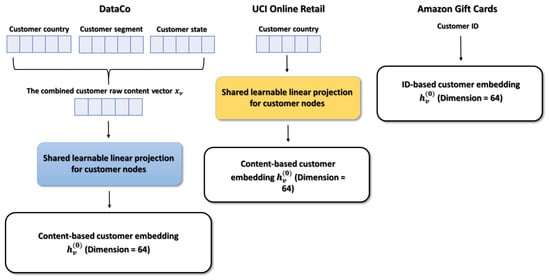
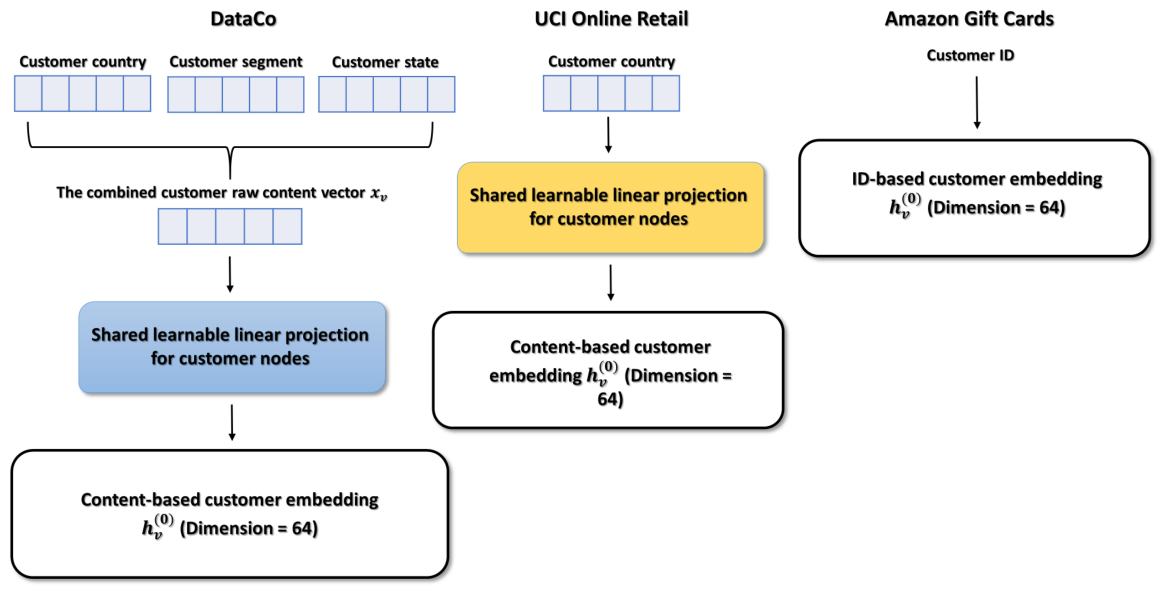
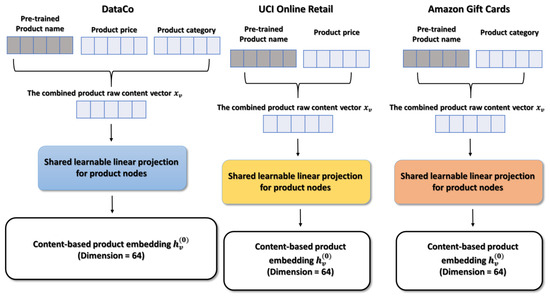
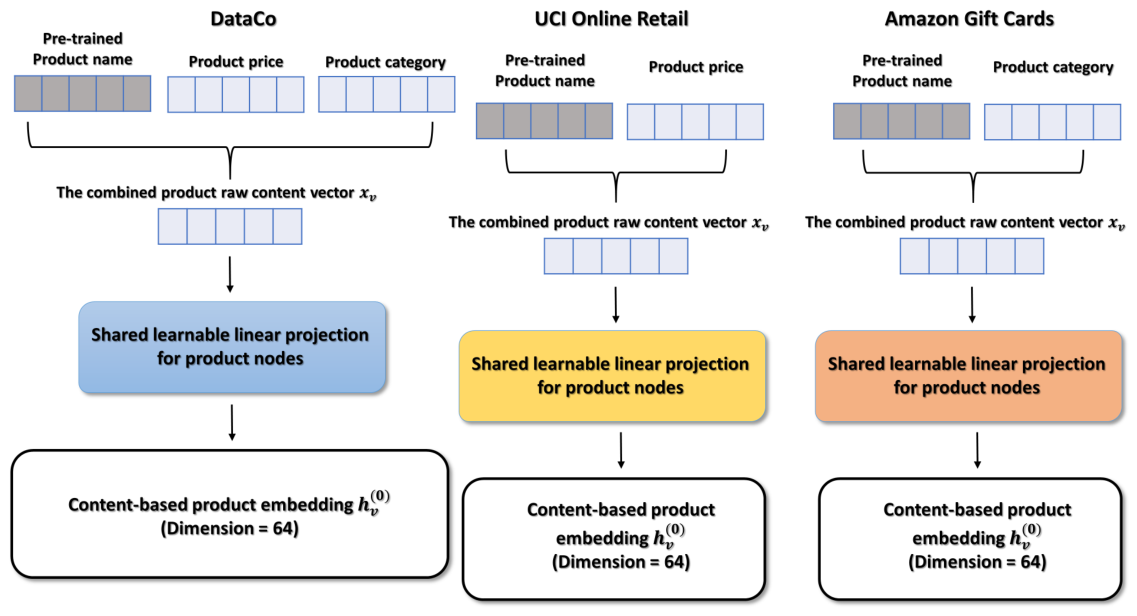
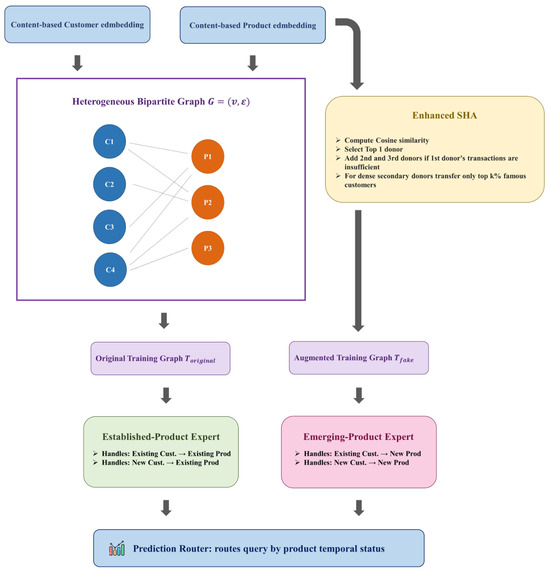
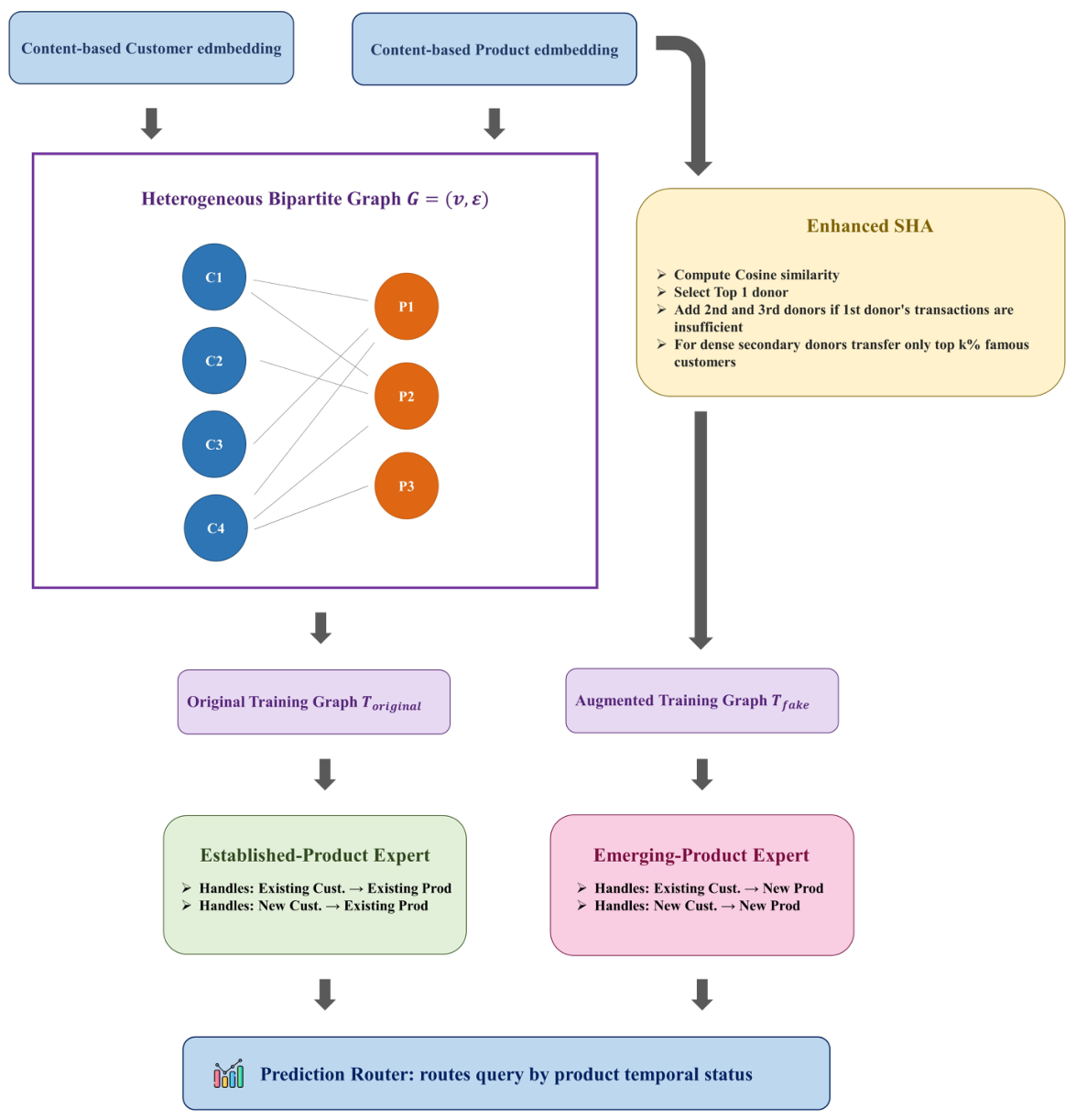
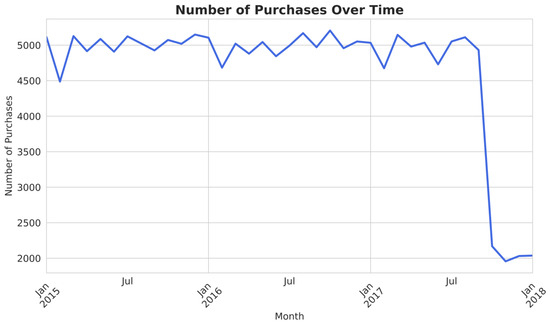
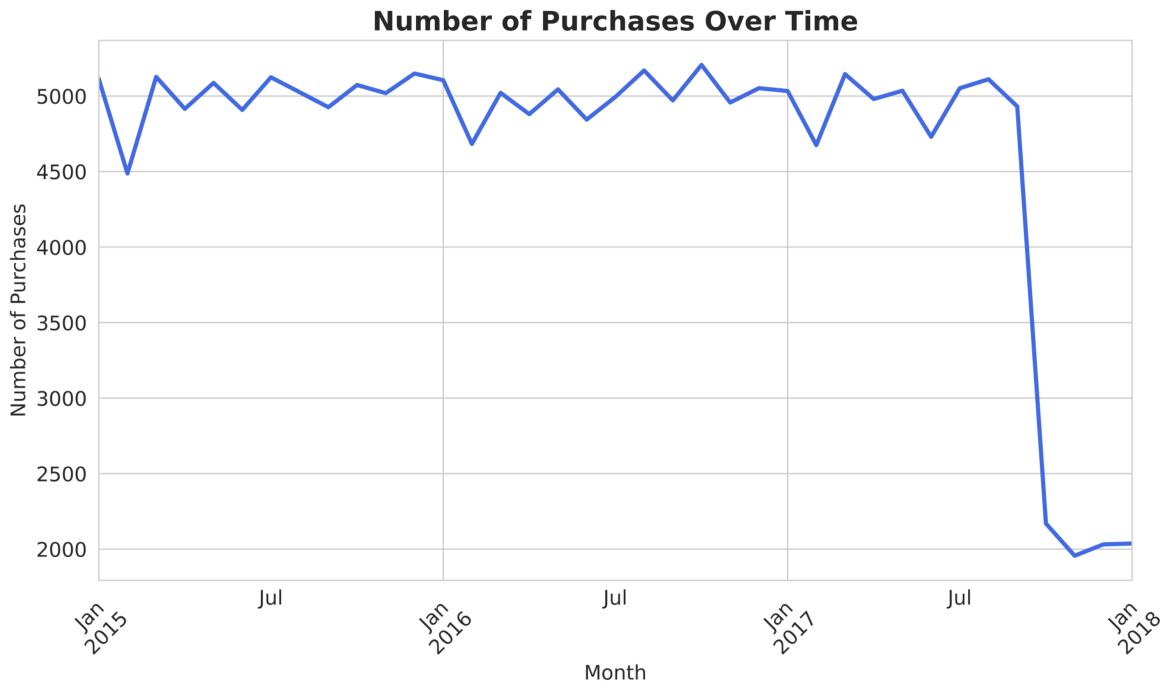
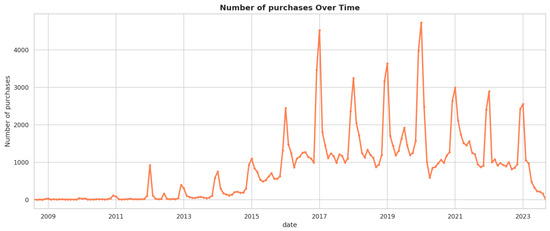
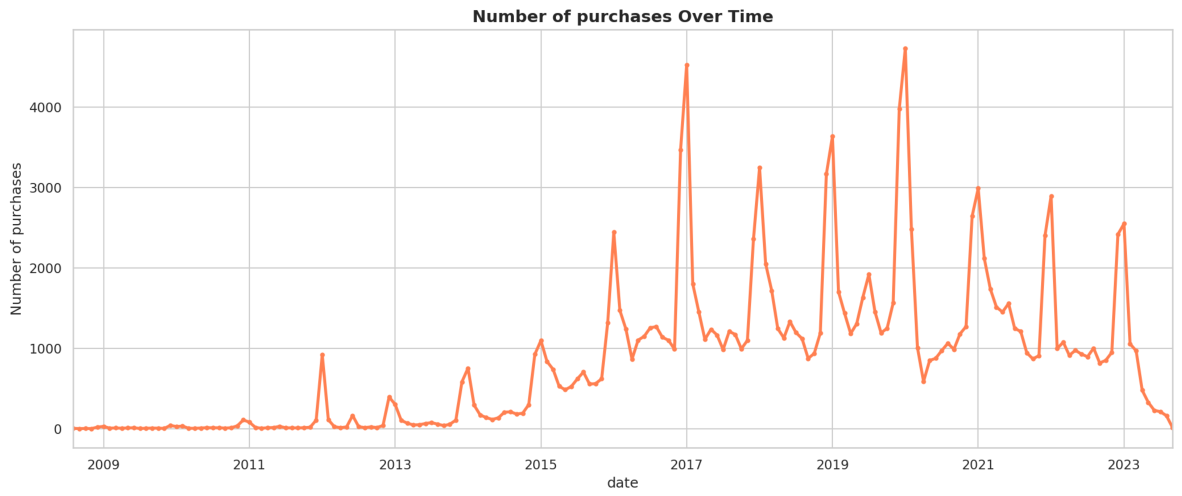
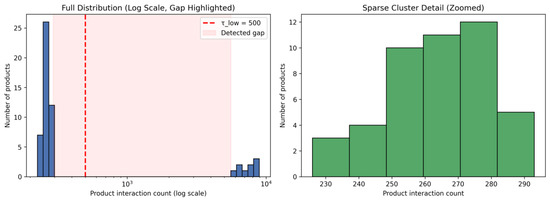
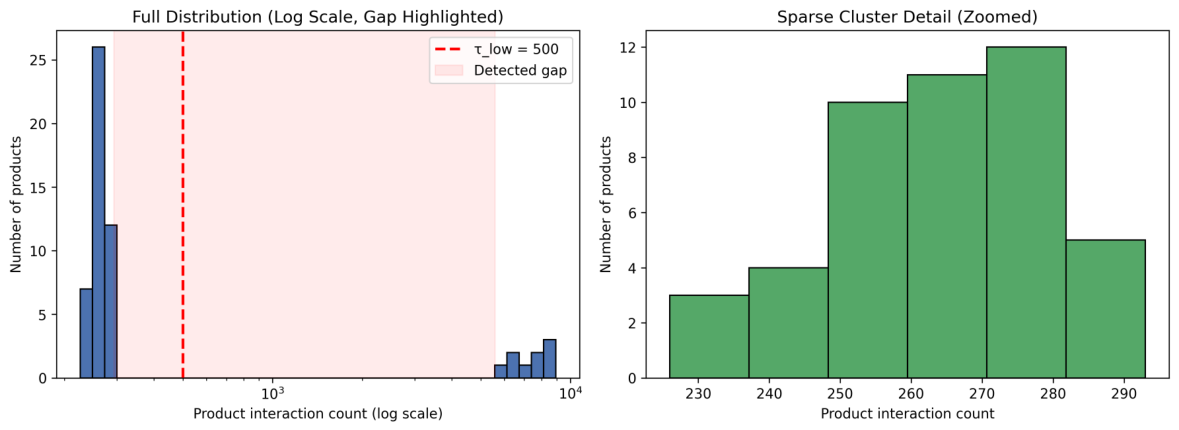
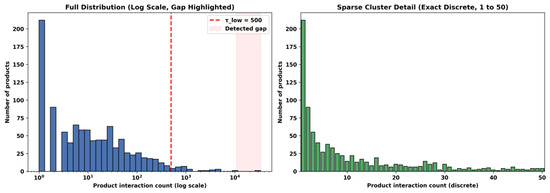
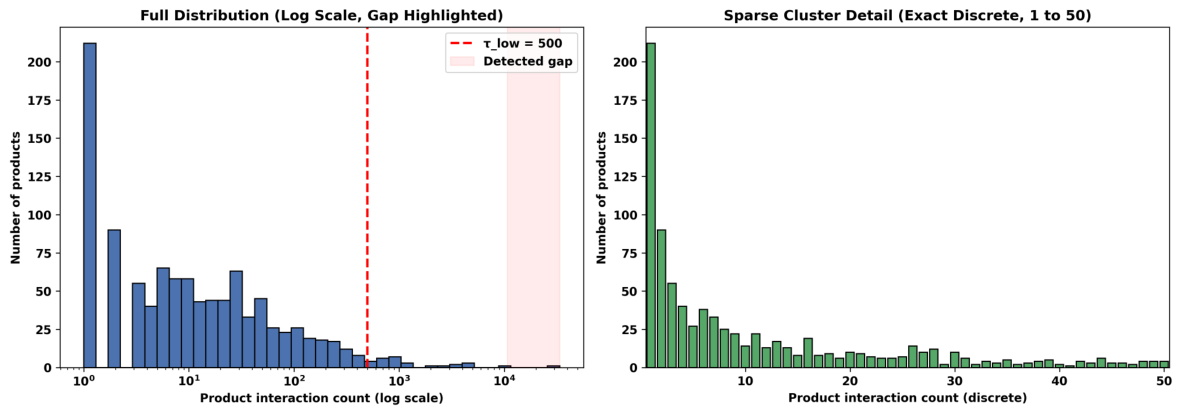
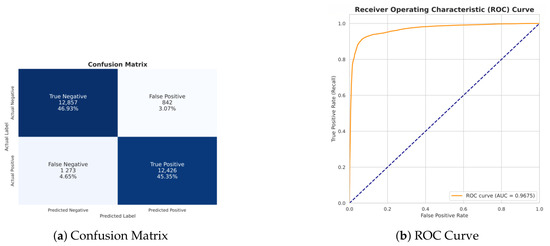
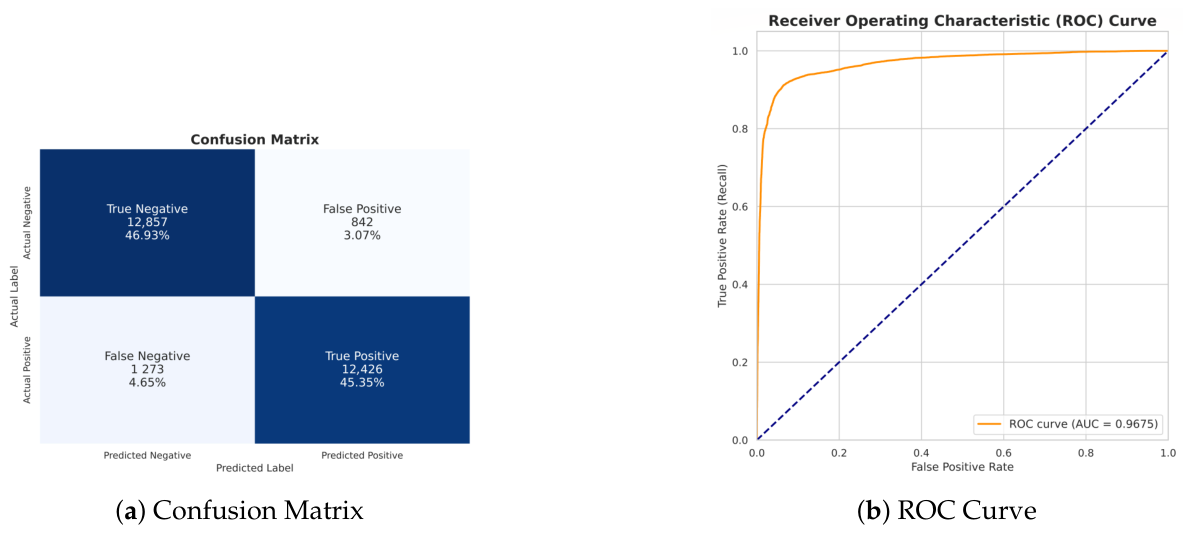
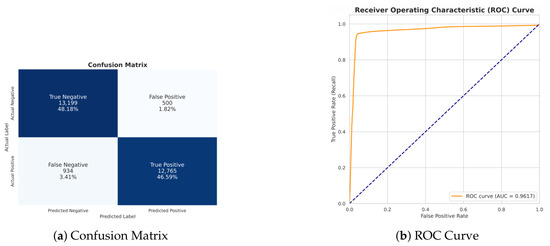
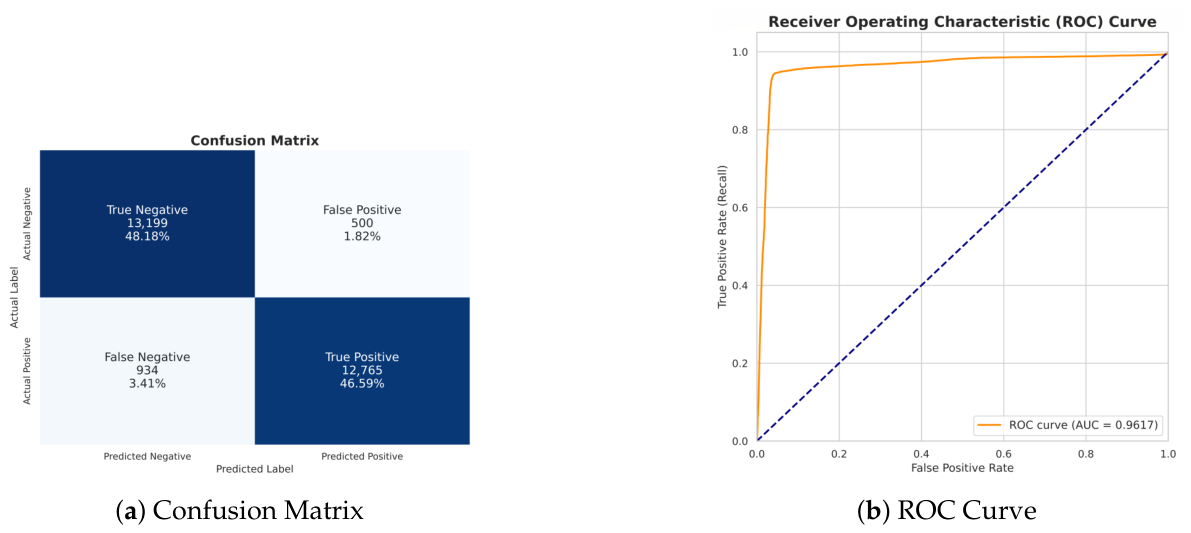
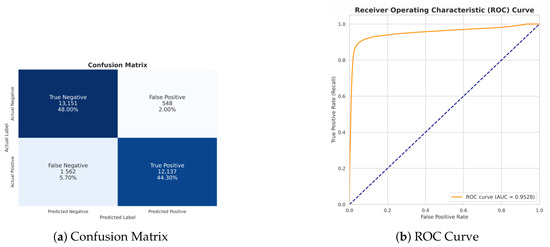
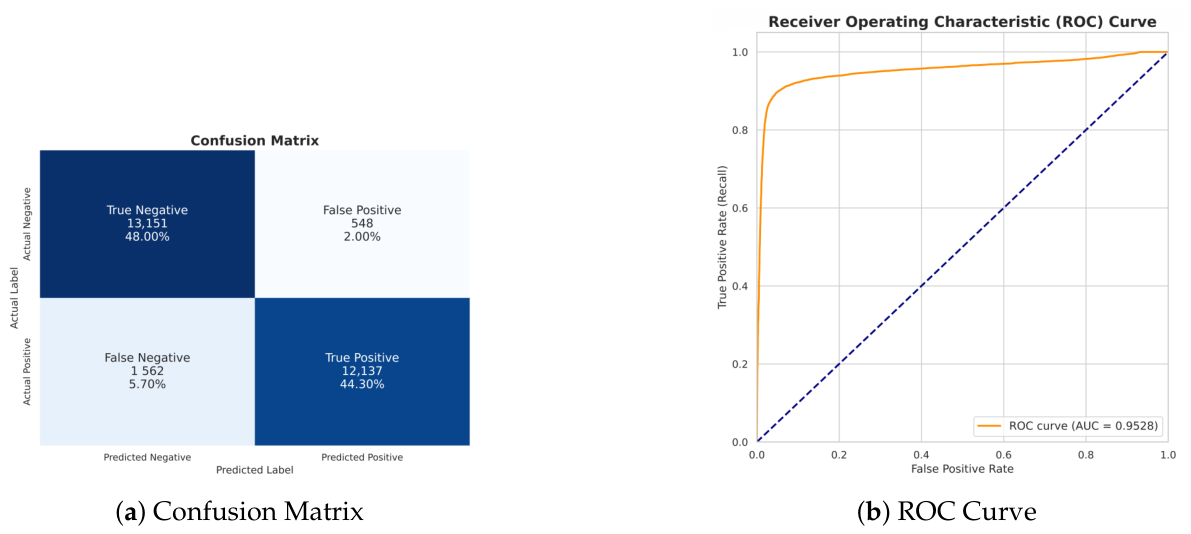

Disclaimer/Publisher’s Note: The statements, opinions and data contained in all publications are solely those of the individual author(s) and contributor(s) and not of MDPI and/or the editor(s). MDPI and/or the editor(s) disclaim responsibility for any injury to people or property resulting from any ideas, methods, instructions or products referred to in the content. |
© 2026 by the authors. Licensee MDPI, Basel, Switzerland. This article is an open access article distributed under the terms and conditions of the Creative Commons Attribution (CC BY) license.