


Abstract
Young adults are often treated as a single digital consumer segment, although adjacent age cohorts may differ in e-commerce use and attitudes toward circular consumption. This study compares respondents aged 18–24 and 25–34, and examines whether age cohort or sustainability orientation is more closely associated with e-commerce behaviors and circular product acceptance. The analysis uses a respondent-level dataset harmonized ex post from five separate convenience-sample questionnaire surveys (n = 482 young adults). Respondents were not linked across sources; each hypothesis was tested on the subsample with the relevant variables observed, and the sustainability and circular-acceptance tests draw on n = 179 respondents from two of the five sources. Analyses used Mann–Whitney U tests, Spearman correlations, Benjamini–Hochberg false discovery rate correction, robust ordinary least squares models, and selected ordinal logistic models. Respondents aged 25–34 reported more frequent online shopping, whereas respondents aged 18–24 showed more positive personalization attitudes only before controls were introduced. No meaningful age differences were found in sustainability orientation, ecological purchase willingness, or willingness to buy refurbished products, while sustainability orientation was consistently associated with both circular-acceptance outcomes. The Age-Differentiated Circular Acceptance in Retail E-commerce framework is proposed as a conceptual synthesis: age relates to selected digital routines, while sustainability orientation is a cross-cohort correlate of circular product acceptance. The findings suggest that retailers should prioritize sustainability orientation, product-condition transparency, and risk-reducing information over broad age-based segmentation.
1. Introduction
E-commerce is common in today’s consumer culture, particularly for younger adults who were raised using digital retail platforms. However, online shopping is much more than just a way to shop digitally. It involves digital habits, other customers’ reviews, personalized messages and communications, perceived risk, trust in websites and apps, and evaluations of products based on their potential sustainability. Digital commerce research has found that algorithms used by companies to recommend products, social commerce cues, and features available on digital commerce platforms influence how consumers determine relevance, credibility, and ultimately whether they will choose to purchase.
Although there is research on how young adults consume digital media, researchers tend to treat young adults as if they were all the same. While this method of categorizing consumers can provide useful results and insights into larger patterns and trends, treating all young adult consumers as being similar could mask important differences between two or more age groups. For example, individuals between the ages of 18–24 years old may still live in their parents’ home, rely upon others for financial support, and/or be responsible for taking care of family members. On the other hand, individuals between the ages of 25–34 may be living independently and financially supporting themselves. Younger adults may also vary in terms of how often they shop online. Furthermore, young adult consumers may perceive differently the benefits of online shopping. Online shopping benefits include ease of use, convenience, lower prices, and wider selection of products. Although older adults may also benefit from these advantages of shopping online, younger adults may perceive the advantages of shopping online as being even greater. Finally, younger adult consumers may also perceive greater risks when shopping online compared to older adult consumers. Risks associated with shopping online include fraud, identity theft, loss of personal identifiable information, and lack of accountability if something goes wrong with a purchase made over the internet. As such, it would be beneficial to conduct additional research to compare the similarities and differences between various young adult age cohorts in order to develop a greater understanding of how young adults engage in digital commerce behaviors.
Some aspects of e-commerce decision logic, such as reliance on perceived trustworthiness and perceived usefulness, can be expected to be broadly similar across young adult age cohorts, whereas other aspects are more likely to vary with income stability, household responsibilities, degree of independence and purchasing autonomy, and the degree of routine dependence on e-commerce.
This article seeks to investigate whether adjacent young adult cohorts exhibit different aspects of e-commerce decision logic. In doing so, this article does not advocate for a large-scale generational divide. Rather, it focuses specifically on age’s relationship to digital shopping behavior (i.e., the “what”) versus its relationship to digital shopping behavior based on value/circular consumption outcomes (i.e., the “why”). Specifically, this article examines the extent to which online shopping frequency, attitudes towards personalization, and willingness to evaluate products based on eco-friendliness/refurbishment status follow different logical mechanisms.
Personalization may reduce search costs and increase the perceived relevance of offers. In algorithmic commerce, recommendation quality and explanation quality can support trust in e-commerce recommender systems [1]. At the same time, personalization can increase privacy concerns when consumers perceive data collection and data use as invasive or opaque [2]. This trade-off is especially visible in AI-mediated commerce, where trust, usefulness, advertising influence, and control over data are intertwined in one shopping experience [3].
Online reviews and electronic word-of-mouth decrease uncertainty in digital purchasing environments. For refurbished or nearly-new products, this mechanism is particularly important because consumers assess product condition, previous use, warranty, seller credibility, and expected performance [4,5].
Finally, sustainability orientation is the third proposed mechanism examined in this article. Sustainability orientation captures the extent to which consumers take environmental benefits, waste reduction, and more efficient resource use into account when making purchasing decisions [6]. Refurbished products represent this issue directly. They may promote reduced waste and increased resource efficiency [5], but they also create perceived risks related to quality, warranty, return policies, and retailer reputation [4].
While the existing e-commerce and circular economy literature typically addresses each of the four separate variables examined here (age/personalization/trust/sustainability-oriented product acceptance), little is currently understood about when adjacent young adult cohorts matter versus when cross-cohort mechanisms (such as sustainability orientation) are more predictive of circular product acceptance.
To address this gap in knowledge, this article introduces the “Age-Differentiated Circular Acceptance in Retail E-commerce” (AD-CAR) framework. The framework expects that age will differentiate select digital shopping behaviors/routines, while circular product acceptance will depend more on cross-cohort factors such as sustainability orientation/trust/risk reduction. These expectations are examined empirically using a respondent-level dataset harmonized ex post from five separate convenience-sample questionnaire surveys conducted in Slovakia. The surveys were not designed as one instrument, respondents were not linked across sources, and each hypothesis is tested on the subsample of respondents for whom the relevant harmonized variables are observed (Section 3).
This article contributes to research in three ways. First, it provides a more nuanced segmentation approach for young adult e-commerce by showing that age differences appear selectively rather than generally. Second, it shifts the explanatory focus for circular product acceptance from demographic segmentation toward individual sustainability orientation, which was consistently associated with circular acceptance across cohorts. Third, it proposes AD-CAR as a compact conceptual framework, informed by these findings, that links digital retail routines, personalization, review-based trust, and circular product acceptance. The contribution is not that one young adult cohort is more sustainable or more digital than another; the contribution is identifying which aspects of e-commerce decision logic are age sensitive and which are more closely associated with sustainability orientation.
Figure 1 summarizes the conceptual framework described above. It separates age-sensitive digital routines from the layer in which sustainability orientation is associated with willingness to accept ecological or refurbished products, and it identifies personalization and review-based trust as context-dependent or exploratory elements rather than established causal paths. The figure is a conceptual representation of the argument developed in this article, not an empirically estimated model; the depicted relationships were examined separately (Section 4).
Figure 1.
Age-Differentiated Circular Acceptance in Retail e-commerce (AD-CAR) framework. Solid arrows denote the main empirical logic used in this article. Dashed arrows denote cautious, contextual, or exploratory paths. Direct age differences in sustainability orientation, ecological willingness, and refurbished-product willingness are treated as informative null findings rather than as causal paths. The figure is a conceptual representation of the author’s interpretation; the depicted relationships were examined in separate analyses and were not estimated jointly as an integrated model.
2. Literature Review and Hypothesis Development
The assumptions about the hypotheses are based on three related lines of study into e-commerce and consumer behavior. Studies on online shopping experience show that online shoppers are driven by convenience, interactivity, trust, loyalty, and buying routines in addition to demographics [7]. Studies on trust, perceived risk, and online purchase intention indicate that whether buyers view sellers, platforms, and product descriptions as credible affects buyers’ perceptions of online shopping [8]. Additionally, the studies on reviews online demonstrate that review information can decrease uncertainty and provide direction for the focus of buyer’s attention during the process of making purchasing decisions [9]. AD-CAR brings these lines of study together into one conceptual framework that treats age cohort as an external factor associated with specific routine digital behaviors, whereas sustainability orientation, trust, and risk reduction are proposed as more proximate correlates of circular adoption.
2.1. Young Adults and Selective E-Commerce Routines
Young adult consumers are engaged in online shopping [10], but their behavior is influenced by convenience, price searching, and access to product information [11], as well as perceived risk and delivery experience [12]. Impulse-related platform cues may further strengthen immediate purchase decisions [13]. Age alone is unlikely to determine digital consumption because online shopping behavior is usually linked to platform, motivational, and risk-related variables rather than demographics alone [7,14]. Moreover, platform-level features and social-commerce architectures create new forms of interaction and value generation, so digital routines need to be interpreted in platform-specific contexts rather than as demographic characteristics only [15]. Research on generational cohorts also suggests that different cohorts may share similar processes, including high-quality information, source credibility, personalized services, and shopping habits [16]. As a result, there may be differences in the types of routine behaviors linked to purchasing independence and/or reliance on e-commerce among young adults depending upon age. For example, respondents who are 25–34 years old may exhibit more routinized online shopping behaviors compared to respondents who are 18–24 years old, since they are more likely to manage independent households, recurring purchases, and delivery-based consumption.
Age differences are conceptualized through a stage-of-life perspective versus a deterministic cohort perspective. Thus, respondents aged 18–24 and 25–34 years old may have different levels of familiarity with online shopping; however, they can differ in terms of how frequently online shopping channels are used for recurring, household-related, or planned purchases. The distinction is not simply a question of which group is “more digital”. Rather, the question is whether online shopping frequency reflects established consumption routines in the older young adult cohort. This is the rationale for initially testing age differences in online shopping frequency instead of assuming broad age effects across all e-commerce attitudes.
H1.
Respondents aged 25–34 report higher online shopping frequency than respondents aged 18–24.
2.2. Personalization as a Benefit–Risk Exchange
Personalization is now widespread in e-commerce. Retailers use behavioral data and online advertising infrastructure to target offers more precisely [17]. Recommender systems and customized communication can reduce search costs and increase perceived relevance [18,19]. In algorithmic commerce, recommendation explanation quality and perceived procedural justice can influence trust [1]. Conversational AI can also blur the boundary between assisting consumers, advertising to them, and collecting data about them [3]. However, consumer responses to personalization have been ambivalent. While some consumers appreciate useful and non-intrusive personalization, others resist it if they perceive data collection as too invasive or opaque [18]. This tension was formalized in early work on the personalization–privacy trade-off [20] and the personalization–privacy paradox [2], and it repeatedly appears in subsequent research on privacy concerns and reactance [21]. Recent research on Gen Z personalization paradoxes also indicates that younger digital consumers may value personalization and privacy simultaneously, generating avoidant or annoyed responses when personalization is poorly implemented [22]. Here, personalization is examined as a possible cohort difference and interpreted as a benefit–risk trade-off rather than as a simple preference.
Therefore, for adjacent cohorts of young adults, the benefits of personalization are theoretically ambiguous. Younger respondents may be more experienced with algorithmic feed content, platform recommendations, and personalized advertisements, yet familiarity does not automatically translate into acceptance. If personalization is seen as relevant and accurate, it can contribute to convenience and relevance [19]. If it is seen as intrusive or lacking transparency, it can erode trust or generate avoidance [21,22]. Therefore, Hypothesis H2 is stated as a difference test rather than as a directional prediction that either cohort will universally favor personalization.
H2.
Respondents aged 18–24 and 25–34 differ in their attitude toward personalized online content.
2.3. Sustainability Orientation and Eco Purchase Willingness
Sustainable purchasing behavior is related to environmental concern, perceived usefulness of sustainable products, product attributes, trust in the product and its producer or retailer, price, and perceived risk [23]. Research on consumers in the circular economy further emphasizes attitudes toward circular economy, knowledge of circular practices, and the value assigned to circular alternatives [23,24]. In this study, sustainability orientation is treated as a proposed cross-cohort mechanism: it is expected to be positively associated with eco purchase willingness in both cohorts. Because the design is cross-sectional and correlational, this mechanism interpretation remains theoretical and is examined through associations.
H3.
Sustainability orientation is positively associated with ecological purchase willingness.
2.4. Sustainability Orientation and Refurbished/Circular Product Acceptance
Circular economy alternatives, including refurbished, remanufactured or upcycled products, offer opportunities to reduce waste and improve resource use [25,26]. Nevertheless, some consumers are reluctant to purchase circular products due to concerns about quality, warranty, and price [27], as well as other perceived risk factors [28]. Qualitative evidence has long shown that lack of awareness and unfavorable risk–benefit perceptions keep many consumers from even considering refurbished alternatives [29]. Many of these factors align well with those identified in the AD-CAR model. Specifically, sustainability orientation was hypothesized to be positively associated with acceptance of refurbished products, consistent with the idea that consumers weigh environmental benefits against perceived risks. Age-based differences in acceptance were viewed as incomplete explanations of circular acceptance behaviors.
Refurbished products typically represent a trade-off between environmental considerations and perceived product risk. Experimental evidence indicates that consumers tend to value remanufactured products less than new ones unless environmental information is provided [30]. While price discounts may encourage initial consideration of refurbished products among some consumers [5], price alone may be insufficient to overcome uncertainty related to signs of previous use [31], product quality [32], or warranty [33]. Similarly, as stated for the exploratory proposition EP1 in Section 2.6, review-based trust will likely play an essential role in converting openness to circular alternatives into willingness to make a purchase.
H4.
Sustainability orientation is positively associated with willingness to purchase refurbished or nearly-new products.
2.5. Boundary Age-Difference Tests
Although we cannot anticipate systematic differences in sustainability orientation, ecological purchase willingness, and refurbished-product willingness among young adults aged 18–24 versus young adults aged 25–34, prior research has shown that circular and green purchasing behavior depends on values, attitudes, and perceived value [23,24]. Perceived risk, trust in producers and products, product characteristics, and economic factors are also important [34]. Even if there is no statistically significant difference in our measures of sustainability orientation and circular willingness among the two groups, we will retain this hypothesis because finding no effect is still useful. It allows us to test whether age segmenting explains value-based consumption and circular behavior, or if other mechanisms explain the differences observed.
The results of these hypotheses serve as boundary tests for age segmentation. A possible explanatory framework exists if significant differences exist among sustainability orientation and circular willingness. If no significant differences occur, then the theoretical focus may shift from explaining differences due to age cohorts toward understanding how individuals reduce risk related to sustainable consumerism.
H5a.
Respondents aged 18–24 and 25–34 differ in sustainability orientation.
H5b.
Respondents aged 18–24 and 25–34 differ in ecological purchase willingness.
H6.
Respondents aged 18–24 and 25–34 differ in willingness to purchase refurbished or nearly-new products.
2.6. Reviews, Trust, and Risk Reduction
Online reviews help close the gap of informational asymmetry between sellers and buyers. Trust and perceived risk have been established as central determinants of online purchase intention since the foundational e-commerce trust models [35,36], and they remain stable determinants in recent syntheses [37,38]. In social commerce, this relationship is strengthened by community cues, seller trust, and electronic word-of-mouth [39,40]. Online reviews have been shown to influence purchase outcomes since early field evidence on review effects [41], and they also help guide buyer attention and decision-making [9].
Trust, specifically in the online environment, has been shown to positively impact purchase intentions across multiple meta-analyses examining social commerce behavior. Community cues and seller trust significantly contribute to this positive association [39]. However, empirically, reviewer-trust cannot be examined as a primary predictor of refurbished products due to a lack of overlap among these variables within observed respondent rows of the data.
The distinctions between refurbished/circular alternative products and their respective standards for new products exist. Circular alternatives, including refurbished and nearly-new alternatives, require consumers to assess product condition, seller warranty and return policies [27], seller reliability [4], and expected product performance [28]. Research on refurbished products also shows that contamination from previous use and quality guarantees can strongly influence consumer choice [31,42]. As such, reviews and trust provide a significant theoretical mechanism for reducing risk perceptions related to purchasing circular products.
Although reviews provide a means of assessing the credibility of sellers who sell refurbished products, they provide more than social proof. For example, reviews can serve as diagnostic assessments of product condition, prior usage history of the product, and post-purchase assurance related to the product being sold. Many consumers may have limited familiarity with refurbishing processes [27], product-condition evaluation [28], and warranties associated with refurbished products [31]. The role of review-based trust is therefore particularly important for circular alternatives. The AD-CAR model retains this pathway as a risk reduction layer and recommends that a unified future survey examine it directly. Because this pathway cannot be directly tested in the observed respondent rows, it is formulated as an exploratory proposition rather than a hypothesis.
EP1.
The relationship between review trust and refurbished-product willingness is theoretically relevant but exploratory.
3. Materials and Methods
3.1. Research Design and Data Source
This research employed a cross-sectional harmonized survey design. The analytical dataset was assembled ex post from five separate questionnaire surveys that were conducted in Slovakia between February and May 2026, and that were not designed as one instrument. Each survey used convenience sampling, the questionnaires were distributed and completed online as self-administered instruments, and respondents could not be linked across surveys. The source questionnaires were administered in Slovak; for the purposes of this article, all items and response categories were translated into English. In addition to transforming multiple portions of the survey questionnaires into an analytically similar format, this allowed for comparisons among consecutive young adult cohorts, as well as examinations of relationships among standardized attitudinal index variables. However, it will not permit causal inferences.
Further, the methodology is much more like post-harmonization analyses of secondary surveys rather than a single instrument primary survey. All conclusions will be made on the basis of this methodological limitation.
The analytical dataset consisted of respondent-level records from multiple questionnaire versions. Each row represented one respondent record from the harmonized survey source. Because no stable respondent identifier was available across questionnaire versions, respondents were not matched across different questionnaire versions. A source-provenance variable was retained to document the questionnaire origin of each record and to support quality control, variable-availability checks, and robustness assessment. This provenance variable was not treated as a substantive respondent segment.
The hypotheses were specified after the source questionnaires had been collected and after the availability of harmonized variables across sources was known, but before the pooled statistical analyses reported in Section 4 were conducted. The direction-neutral formulation of H2 and the boundary framing of H5a, H5b, and H6 reflect this sequence.
3.2. Harmonization Procedure
The source questionnaires did not use identical wording for each variable. Harmonized variables and thematic indices were created by mapping similar concepts from the different sets of questions. The scores of these variables represent analytical indices, not completely equal psychometric scales from the original questionnaire. A higher value represents a greater degree of that specific characteristic, such as being more willing, trusting, agreeing with the statement, or using it more frequently.
This process is an example of ex post survey data collection and pooling and variable comparison. Only those variables which describe conceptually comparative characteristics and may be translated to a single analytical form will be used together [43,44,45].
There is precedent for combining multiple country consumer survey data in marketing studies. Studies on cross-national willingness to pay across products [46] and consumer behavior have used cross-country harmonized payment diary data to examine differences in consumer payment choice [47]. This research takes cautionary steps: harmonized index scores are considered analytical indices, a source-provenance variable is retained for quality control, and the supplementary sensitivity analysis reported in Appendix B is used only for robustness assessment.
Harmonization followed an explicit inclusion rule. Items were mapped into a harmonized construct only when their wording, response direction, and substantive meaning supported a common analytical interpretation. Items were not harmonized when wording, scale, or construct meaning differed to the extent that a shared interpretation would not be defensible. Appendix A documents the harmonization protocol and variable comparability, while Appendix C summarizes source-questionnaire coverage.
The harmonized indices were specified so that predictor and outcome indicators share no items. The sustainability orientation index contains only positively worded attitude and perception items (seven items in one source, Cronbach’s alpha = 0.879; two items in the other source, alpha = 0.708), while ecological and refurbished-product willingness are measured by separate indicators. The item-level composition of all indices, including example item wordings and the indicators that rest on a single source item, is documented in Appendix A.
3.3. Analytical Sample
This article focuses on two adjacent young adult cohorts: 18–24 and 25–34. The cohorts were defined using the numeric age variable. The original “up to 24 years” response category was not used as an article-level group because it could include respondents younger than 18. The pooled harmonized dataset contained 696 respondent records. Age was missing for 9 records, and a further 205 records fell outside the article’s target age range of 18–34 years. The final analytical sample therefore consisted of 482 respondents, including 227 respondents aged 18–24 and 255 respondents aged 25–34. Table 1 summarizes the analytical sample.
Table 1.
Analytical sample by age group and gender.
The sample is analytical and assembled from available questionnaire data. It is not presented as representative of the Slovak or V4 young adult population. Because this study used a post hoc harmonized dataset, sample size was determined by the availability of eligible observed records rather than by an a priori power calculation. Minimum detectable effects were therefore computed post hoc: with a two-sided alpha of 0.05 and 80% power, the age-difference tests on the two-source subsample (n = 179) can detect effects of approximately |r| ≥ 0.21, and the personalization test (n = 174) similarly |r| ≥ 0.21. The observed age-difference effects for H5a, H5b, and H6 were far below this threshold (|r| ≤ 0.07). Smaller true differences cannot be ruled out; non-significant age differences in H5a, H5b, and H6 are therefore interpreted as informative boundary findings within the detectable-effect range rather than as proof of exact equivalence between cohorts.
3.4. Measures and Variable Availability
The main harmonized variables are online shopping frequency, personalization attitude, sustainability orientation, ecological purchase willingness, refurbished-product willingness, and review trust. Attitudinal constructs were measured with five-point Likert-type items; the harmonized attitudinal indices were computed as item averages and range from 1 to 5, with higher values indicating a stronger level of the underlying characteristic. Online shopping frequency was harmonized into five ordered frequency categories, coded from 0 (does not shop online) to 4 (shops online at least once a week). Availability differs across constructs and source questionnaires, which is a core limitation of the harmonized design. Table 2 reports variable availability by age group.
Table 2.
Availability of harmonized variables by age group and analytical role.
The harmonized variables do not all originate from the same subset of sources. Online shopping frequency is observed in four of the five sources (n = 375), personalization attitude in two sources (n = 174), and the sustainability, ecological, and refurbished-product measures co-occur in two sources (n = 179; n = 109, and n = 70 respondents, respectively). No hypothesis test therefore draws on all five sources simultaneously, and the association and boundary tests (H3–H6) are based on the two-source subsample. The source composition of each variable is documented in Appendix A and Appendix C.
Each harmonized variable was assigned a comparability level. The highest levels of conceptual and operational comparability are designated as “Rating A” in reference to relevant item sources. “Rating B” denotes acceptable comparability where the wording of an index may limit comparison with similar constructs from different data sources. “Rating C” is used when comparability is weak or partial, and should only be interpreted in an exploratory or theoretical context. Table 3 summarizes the comparability ratings.
Table 3.
Comparability ratings of harmonized variables and their role in this article.
3.5. Missing Data and Sensitivity Checks
The main analysis uses observed harmonized data. Missing values were not synthetically filled in the primary tests; each test used available cases for the relevant variables.
Missingness is generated in two ways. First, it exists for an assortment of items because while all questionnaires included most constructs, they did not include them all. Second, there are numerous instances where missing values exist because of item non-response. As such, the main analysis treats both conservatively by using only observed available cases. Key variable-availability information is reported in Table 2, and robustness documentation is provided in Appendix B.
The primary purpose of the supplementary sensitivity analysis was to assess robustness, not to serve as additional empirical evidence. The supplementary sensitivity analysis was used to assess result stability under missing-data assumptions rather than to replace the observed-data analysis [48].
3.6. Statistical Analysis
Age-group differences were tested using Mann–Whitney U tests with corresponding effect-size information and FDR corrections through the Benjamini–Hochberg procedure [49]. The association hypotheses (H3 and H4) were tested using Spearman correlation coefficients. All significance tests were two-sided and evaluated at α = 0.05. For the Mann–Whitney U tests, the effect size r was calculated as z/√N, and Cliff’s delta was computed as an additional ordinal effect-size estimate (reported in Appendix B). The Benjamini–Hochberg FDR correction was applied to the family of five age-difference tests: H1, H2, H5a, H5b, and H6. A variety of control check procedures have been conducted using both robust OLS models with HC3 standard errors and selected ordinal logistic models where gender or source file (questionnaire) has been controlled for [50,51]. Reliability was assessed as an item-provenance audit of the harmonized constructs within the analytical age sample. Cronbach’s alpha values of the multi-item index blocks used in the main analyses ranged from 0.654 to 0.879 (Appendix A); alpha values are interpreted with the usual caution for short analytical indices, because alpha depends strongly on the number of items [52,53]. Single-item indicators are used for selected outcomes. Reliability evidence was not used as a basis for creating substantive respondent segments. Appendix B provides additional robustness output to substantiate the interpretation of the primary tests. The analyses were conducted in Python 3.9.6. Mann–Whitney U tests, the Benjamini–Hochberg FDR correction, and nonparametric effect sizes were computed using reproducible routines based on pandas 2.3.3 and NumPy 2.0.2, with the relevant formulas implemented manually, and Spearman correlations were computed with SciPy 1.13.1. The robust OLS and ordered-logit checks were generated in a statsmodels 0.14.6 workflow.
This study uses a hierarchical structure of evidence. The first level consists of observed respondent-level harmonized data. The second level is derived from model checks with gender and/or source file controls. The third level consists of supplementary sensitivity evidence used to assess whether the findings maintain their directional consistency and interpretation. The fourth level is exploratory/theoretical, and covers conceptually relevant relationships that cannot be empirically evaluated in the observed respondent rows.
4. Results
4.1. Age-Group Differences
Mann–Whitney U tests with FDR correction indicated that respondents aged 25–34 reported a greater frequency of online shopping compared to respondents aged 18–24. The 18–24-year-old cohort demonstrated a higher attitudinal score towards personalization in the uncontrolled comparison; however, the strength of this result diminished when controls were applied (Table 4).
Table 4.
Age-group differences: Mann–Whitney U tests with Benjamini–Hochberg FDR correction.
There were no significant differences among cohorts based on age regarding their sustainability orientation, willingness to make purchases from an environmental standpoint, or willingness to buy refurbished products. Age therefore appears to shape specific digital shopping routines, whereas the present analyses showed no meaningful age-group differences in circular acceptance within the detectable-effect range (|r| ≥ 0.21); the absence of any independent age effect cannot be established from these data.
These results support a selective rather than general cohort interpretation. Age was most clearly related to online shopping frequency (H1), which is consistent with more routinized e-commerce use in the 25–34 cohort. The personalization difference (H2) weakened once source controls were introduced, and the null findings for H5a, H5b, and H6 indicate that sustainability orientation and circular purchase willingness do not require explanation through adjacent age segmentation.
4.2. Sustainability Orientation as a Cross-Cohort Correlate
Spearman correlation coefficients indicated that sustainability orientation had a moderate positive association with both ecological purchase willingness and refurbished-product willingness (Table 5).
Table 5.
Spearman correlations for the association hypotheses H3 and H4 (respondents aged 18–34).
These results are consistent with the mechanism-oriented part of AD-CAR: sustainability orientation was positively associated with circular acceptance in both cohorts and in both contributing sources, whereas age-cohort membership was not. Because the design is cross-sectional, the mechanism interpretation remains conceptual.
The associations with ecological purchase willingness (ρ = 0.427) and refurbished-product willingness (ρ = 0.416) are moderate and clearly stronger than the corresponding age-group effects (|r| ≤ 0.07). Circular acceptance is therefore more closely associated with sustainability orientation than with membership in the 18–24 or 25–34 cohort.
4.3. Robustness and Sensitivity Checks
Robust ordinary least squares and selected ordered logit checks supported the interpretation of H1. The age effect on online shopping frequency remained significant after controlling for gender and source questionnaire. The personalization age difference weakened after controls (b = −0.163; p = 0.296), so H2 is interpreted cautiously. Age differences in sustainability orientation, ecological willingness, and refurbished willingness remained non-significant. The association results (H3 and H4) also remained consistent: sustainability orientation was positively associated with both ecological and refurbished willingness after controls. The correlations underlying H3 and H4 were also positive and significant within each of the two contributing sources separately (Appendix B).
The diagnostic layer is particularly important because the dataset is not collected by a single unified questionnaire, but instead harmonized from multiple sources. Table 6 provides an overview of availability, missingness, and central tendencies for the key article variables. The table illustrates that online shopping frequency exhibits the largest observed range of values available for analysis, while those variables related to personalization, sustainability, and circular consumption exhibit lower availability, since they were only included within selected source-questionnaires.
Table 6.
Availability, missingness, and medians of key variables by age group.
The effect sizes point in the same direction as the significance tests. The relationship between age and online shopping frequency was small-to-moderate (r = 0.219), while the associations between sustainability orientation and ecological or circular willingness were larger (ρ = 0.427 for eco-willingness; ρ = 0.416 for circular willingness). This means that the central empirical pattern is not a broad division between age cohorts, but the link between sustainability orientation and willingness to consider ecological or circular products.
Our control models support this view. H1 through H4 were tested using multiple control models including robust OLS and ordered-logit models. These control models did little to diminish the significance of H1 and diminished the strength of H2 when controlling for gender and source. They did nothing to change the lack of significant difference found with H5a/H5b/H6 or H3/H4. Our robustness analysis is shown in Appendix B instead of being presented here to maintain focus on this article’s substantive findings.
The supplementary sensitivity analysis retained the observed age cohort structure and produced the same substantive pattern. The sensitivity results are treated only as stability evidence and not as additional primary evidence.
Table 7 separates primary observed findings from cautious findings and conceptual pathways that require future direct testing.
Table 7.
Evidentiary summary of hypotheses and exploratory paths.
4.4. Evidence Hierarchy
The hierarchy of evidence is clear. H1 is a primary empirical result supported through robustness checks. H3 and H4 are primary association results consistent with the proposed mechanism interpretation; they are empirically identifiable and remain stable in both control and sensitivity checks. H2 is retained as a cautious result because it weakens after controls. H5a, H5b, and H6 are informative negative results. EP1 remains exploratory because review trust and refurbished-product willingness cannot be identified in the same observed respondent rows.
4.5. Hypothesis Summary
The hypothesis pattern is straightforward. H1 was supported, indicating a selective age difference in online shopping frequency. H2 was supported only cautiously because the difference weakened after controls. H3 and H4 were supported and are consistent with the proposed cross-cohort correlate in AD-CAR: sustainability orientation was moderately associated with ecological and refurbished-product willingness. H5a, H5b, and H6 were not supported, and suggest a boundary for age-based segmentation within the detectable-effect range. EP1 remains theoretically relevant but exploratory, because review trust and refurbished-product willingness are not observed in the same respondent rows.
5. Discussion
5.1. Selective Age Differences in Young Adulthood
Overall, the findings do not support the notion that respondents aged 18–24 and 25–34 differ across all dimensions of online shopping behavior and circular consumption; the observed differences were selective. Respondents in the older cohort reported more frequent online shopping, while the higher personalization scores of the younger cohort appeared only before adjusting for possible confounding factors.
Our findings support a life-stage perspective, and previous research shows that young adults’ online shopping behavior is influenced by routines, convenience, and accessibility [10,11]. Perceived risk, platform experience, and impulse cues may further shape the intensity of online purchasing [12,13]. The findings also align with platform-focused research showing that consumer engagement and purchase behavior are influenced by platform design and information visibility [15]. Those who fall in the mid-twenties category may enjoy greater financial stability, independence from parents and/or roommates, and established household routine, which may contribute to increased frequency of online shopping without necessarily translating into more emphasis on sustainability or greater acceptance of refurbished products.
5.2. Personalization Requires Contextual Interpretation
In theory, the unadjusted personalization difference is important because younger adults may be more exposed to algorithmic recommendations, personalized advertising, and platform feeds. Once the control variable (source questionnaire) was controlled for, the impact of personalization became weaker. Therefore, personalization should be viewed as a source- and trust-sensitive digital attitude instead of being viewed as a distinct generational characteristic.
The substantive interpretation is therefore contextual. Behavioral advertising and personalization can provide practical benefits to consumers, especially more relevant offers and lower search costs [17]. These benefits emerge in the same space as privacy concerns, opaque data collection, and perceived intrusiveness [18].
For AD-CAR, this means that personalization is not suitable as a simple age marker. It is better understood as an attitude depending on how respondents interpret the exchange between convenience, trust, and control over data. Research on algorithmic trust and GenAI personalization supports this more cautious interpretation: personalized recommendations can strengthen trust and perceived usefulness, but only when consumers do not perceive personalization as privacy-invasive or as hidden advertising manipulation [1,3].
5.3. Sustainability Orientation Is More Strongly Associated with Circular Acceptance than Age
The clearest pattern in the data links sustainability orientation to willingness to consider ecological and refurbished alternatives, while age differences in these same outcomes were absent or negligible. For both cohorts, sustainability orientation carried more information about circular acceptance than cohort membership did. Two qualifications are important. First, these are cross-sectional associations; the analyses do not establish that sustainability orientation operates as a causal mechanism. Second, no formal comparison of competing integrated models was conducted, so the claim is comparative in terms of association strength rather than a demonstration of a superior explanatory mechanism. Within these limits, the age-difference tests had 80% power to detect effects of |r| ≥ 0.21, and the observed age effects were near zero (|r| ≤ 0.07), which supports treating the null findings as informative within that range.
This pattern qualifies how segmentation of young adults should be understood: age distinguishes mainly purchasing routine, whereas willingness to accept ecological or refurbished alternatives aligns with sustainability orientation.
The circular economy literature supports this interpretation. In sustainable and circular purchasing, attitudes, perceived value, product risks, and knowledge of circular alternatives play important roles [23,24]. For refurbished products, concrete decision cues are added: seller reputation [4], warranty and price [6], expected performance [33], and perceptions of previous use [5].
5.4. Reviews and Trust Remain Empirically Under-Observed
Previous research indicates that reviews, trust, and perceived risk are all part of how consumers make decisions online [8,37,54]. Synthesizing and meta-analytic studies further show that trust, distrust, and electronic word-of-mouth are consistently associated with purchase intention in online environments [38,39,40].
For refurbished products, this logic is even more important than for standard new products. Consumers need information about product condition, warranty, return rules, seller credibility, and expected performance [4,27,42]. Reviews can therefore function as a practical risk-reduction tool rather than only as a general social signal.
The current dataset, however, does not allow this pathway to be tested directly. Review-based trust and willingness to purchase refurbished products do not appear together in the same observed respondent rows. Therefore, EP1 is not a confirmed empirical pathway, but a well-grounded direction for future research.
This is not a marginal issue. Recent social commerce research shows that credibility and engagement are linked to trust-based processes [39,54]. A future unified questionnaire should therefore measure reviews, trust, perceived risk, product condition, and refurbished-product willingness in the same respondent row. Only such a design would allow researchers to distinguish whether review-based trust acts as a mediator, moderator, or independent predictor of circular acceptance.
5.5. Theoretical Implications: AD-CAR Framework
The primary contribution of this study is the distinction between demographic segmentation and value-based association in circular e-commerce. An age-based segmentation approach would suggest broad differences between adjacent young adult cohorts. The results instead show a selective age difference in digital shopping frequency, a source-sensitive personalization difference, and no meaningful age-based differences in sustainability orientation, ecological purchasing, or refurbished-product consideration.
This study therefore refines AD-CAR. While age remains relevant for certain digital routines, sustainability orientation emerged as the stronger correlate of circular acceptance. The null findings contribute by limiting the role of age and reducing the risk of over-extrapolating generational interpretations. This study shifts the question from “which cohort is most sustainable?” to “which factors are most closely associated with circular acceptance across cohorts?”
AD-CAR is proposed as an empirically informed conceptual synthesis rather than as a validated integrated model: its individual relationships were examined separately, the framework as a whole was not jointly tested, and its purpose is to specify where age segmentation is useful and where value-based interpretation is more appropriate in circular e-commerce decision logic.
The theoretical implication is that age should be treated as a boundary condition for digital retail routines rather than as a general explanation of circular product acceptance. As shown in Figure 1, AD-CAR separates three layers of e-commerce decision logic: an age-sensitive routine layer, a mechanism layer, and a circular-acceptance outcome layer. This distinction specifies where demographic segmentation is useful and where value-based interpretation is more appropriate. The framework builds on research into online experience and e-commerce decision-making [7,54]. It also connects the literature on trust [39], risk [8], and reviews [40] with the specific case of circular products [24]. Table 8 contrasts common segmentation assumptions with the corresponding AD-CAR refinements.
Table 8.
Common segmentation assumptions and AD-CAR refinements.
Empirically, the framework is refined by distinguishing between two levels of explanation: age differentiates selected digital shopping routines, whereas sustainability orientation is a cross-cohort correlate of ecological and refurbished-product acceptance.
Review-based trust remains a conceptual component of AD-CAR because refurbished-product decisions depend on risk-reducing information about condition, warranty, return policy, and seller credibility. In the current dataset, however, review trust and refurbished-product willingness could not be tested as a primary observed pathway because they did not coexist in the same respondent rows. A unified future survey should test this pathway directly.
5.6. Practical Implications
The results of this study provide several managerial implications for e-commerce and retail managers. There is no single operational “young adult” cohort. The 25–34 cohort may respond to convenience, delivery reliability, warranties, and routine purchasing processes more than other cohorts.
For personalization, the practical recommendation is cautious. Managers should not assume that younger consumers simply accept personalization because they are used to algorithmic content. Personalization can increase offer relevance, but its effect depends on trust, transparency, and perceived control over data [18]. In practice, recommender systems, personalized e-mails, or dynamic advertising should be accompanied by understandable choices, preference controls, and non-invasive contact frequency. If personalization feels like surveillance, its benefit may turn into resistance.
For refurbished and nearly-new products, environmental claims alone are insufficient. Consumers need reduced uncertainty: what exactly “refurbished” means, what condition the specific item is in, what warranty applies, what return rules apply, and who is responsible if the product does not meet expectations [4,27,28]. Practical communication should therefore include clear product-condition grades, item-specific photos, warranty length, information about testing, and a simple comparison with a new product.
Price expectations remain important, but they should not be the only sales tool. A discount may open interest, but with circular alternatives consumers also evaluate quality [32], signs of previous use [33], perceived value [34], and seller credibility [42]. For retailers, the offer of refurbished products should combine three elements: a clear economic advantage, evidence of technical reliability, and a sustainability benefit. Ecological arguments alone are unlikely to be sufficient if quality or warranty risk remains unresolved.
For refurbished and nearly-new products, retailers should make product condition, warranty length, return rules, and expected performance visible at the decision point, because these cues directly address the risk dimensions that distinguish circular alternatives from new products.
5.7. Limitations and Future Research
The current study uses a harmonized dataset collected through multi-source questionnaires rather than a single unified survey instrument. This approach allows similar consumer constructs to be integrated into a consistent analytical framework, but it has limitations compared with a purpose-built survey in which all respondents answer the same items. Some theoretically relevant relationships therefore cannot be evaluated with the available observed data. These limitations are addressed through the harmonization protocol and item comparability ratings (Appendix A), the robustness outputs (Appendix B), the questionnaire source overview (Appendix C), and the missingness documentation reported in this manuscript (Table 6). Supplementary sensitivity analyses are used only to assess the stability of the observed findings under missing-data assumptions. Reliability evidence is interpreted at the item-provenance level and not as full psychometric validation. In addition, the respondents were recruited through convenience sampling in a single country (Slovakia) and the design is cross-sectional; the findings should therefore be generalized beyond the analytical sample with caution, and do not support causal interpretation. Selected outcome indicators rest on one or a few source items, which limits psychometric depth.
In future studies, researchers may want to consider constructing an instrument that measures review trust, perceived risk, warranty, return policy, price discount expectations, product condition transparency, privacy concerns, personalization acceptance, sustainability orientation, and refurbished-product willingness in the same subject row. Using such a design will enable researchers to test mediating and moderating variables in a much more direct manner within the context of AD-CAR.
Future research should also test whether sustainability orientation mediates circular acceptance and whether review trust, perceived risk, product condition transparency, and warranty cues moderate the relationship between sustainability orientation and refurbished-product willingness.
6. Conclusions
This paper evaluated how cohorts of young adults who are close to each other (adjacent) may vary in terms of their e-commerce decision-making and acceptance of circular products. While there is no strong evidence supporting an overall generational perspective, the analysis revealed a narrow but consistent pattern of variation. Respondents aged 25–34 reported a higher online shopping frequency, and this difference remained stable after controls. Younger adults (aged 18–24) had higher personalization scores; however, when comparing across age groups controlling for both demographics and the sources of those data, this finding was diminished significantly. There were no significant differences by age in the degree of either sustainability-oriented behaviors, or the willingness to make purchases based on ecological or refurbished product considerations.
The main contribution is the AD-CAR framework, proposed as a conceptual synthesis that separates age-sensitive digital routines from cross-cohort correlates of circular acceptance. In the observed harmonized dataset, sustainability orientation was more strongly associated with ecological and refurbished-product willingness than age cohort itself. This shifts the interpretation from “which young adult cohort is more sustainable” to “which factors are associated with circular acceptance across adjacent cohorts”. The null findings are therefore part of the theoretical contribution: within the detectable-effect range of the present analyses, they suggest where age segmentation adds little information and where value-based interpretation becomes more appropriate.
As for implications for business practices related to e-commerce and retail, these findings indicate that using age-based segmentation can provide value for routine operations (e.g., shopping frequency); however, it should not serve as the sole basis for understanding consumers’ acceptance of circular products. To facilitate trust-related confidence in the buying process associated with refurbished/nearly new products, businesses will need to provide information about the product’s condition; clearly communicate warranty/return policies; provide clear descriptions of the products’ condition at the time of sale; and provide credibility around their commitment to sustainable environmental practices. Additionally, care needs to be taken when attempting to personalize experiences for customers due to the apparent sensitive nature of responses toward the use of personalization tools.
The findings should be read within the limits of a post hoc harmonized survey design. Certain theoretically relevant relationships could not be tested directly within individual respondent rows, but this limitation is addressed through explicit harmonization rules, documentation of variable availability, robustness checks, and the supplementary sensitivity analysis reported in Appendix B. Future research should use a single instrument that measures personalization, review usage, company trust, perceived risk, warranty expectations, product-condition transparency, sustainability orientation, and willingness to purchase refurbished products in the same respondent row. Such a design would allow more direct tests of mediation and moderation while preserving the main implication of this study: young adult consumers’ adoption of circular products is associated more closely with sustainability orientation and risk reduction than with adjacent age-cohort membership alone.
Funding
This research was funded by the Scientific Grant Agency of the Ministry of Education, Research, Development and Youth of the Slovak Republic and the Slovak Academy of Sciences (VEGA), grant number 1/0506/24, under the project “Research on aspects of the e-commerce process in the dimension of buying behavior and consumer preferences with an emphasis on the principles of circular economy”.
Institutional Review Board Statement
Ethical review and approval were not required for this study, as confirmed by the Ethics Committee of the Faculty of Management and Business, University of Presov. This study constituted a post hoc pooled analysis of data from previously conducted anonymous questionnaire surveys. The questionnaires collected no direct personal identifiers, individual responses could not be linked to identifiable participants, and no new recruitment, interaction, or intervention with participants occurred as part of the present study.
Informed Consent Statement
Informed consent was obtained from all participants. Before completing the questionnaire, participants were informed about the purpose of the study, the voluntary nature of participation, the anonymity of their responses, and the intended use of the data. Consent was implied by voluntarily proceeding to and submitting the questionnaire.
Data Availability Statement
The primary analytical dataset is an anonymized harmonized survey dataset assembled from partial questionnaire sources. The Appendix A, Appendix B and Appendix C include the harmonization protocol, questionnaire source overview, and robustness outputs. The observed harmonized dataset, detailed item mapping, additional variable-availability documentation, and further analysis outputs can be made available by the author upon reasonable request, subject to ethical, institutional, and consent-related restrictions. The supplementary sensitivity analysis reported in Appendix B is intended only for robustness assessment and should not be interpreted as primary empirical evidence.
Acknowledgments
During the preparation of this manuscript, the author used OpenAI ChatGPT GPT-5.5 (https://chatgpt.com; 1 July 2026) for language editing, stylistic refinement, and improving the clarity of selected passages. The author reviewed and edited all AI-assisted output and takes full responsibility for the content of this publication.
Conflicts of Interest
The author declares no conflicts of interest.
Abbreviations
The following abbreviations are used in this manuscript:
| AD-CAR | Age-Differentiated Circular Acceptance in Retail e-commerce |
| AI | Artificial intelligence |
| FDR | False discovery rate |
| HC3 | Heteroskedasticity-consistent standard errors, type 3 |
| OLS | Ordinary least squares |
Appendix A. Harmonization Protocol
Appendix A.1. Harmonization Rules
The original questionnaire files are not identified by their internal file names in this appendix. They are referred to as Dataset 1 to Dataset 5. These labels are used only to describe provenance and variable availability. They do not represent substantive respondent segments.
Items were harmonized only when they met three conditions:
(1) They measured the same substantive concept,
(2) Their response direction could be aligned so that higher values had the same interpretation,
(3) Their response format could be treated as a comparable ordinal or index-like measure.
Items were not harmonized when wording, scale structure or construct meaning differed too strongly. In those cases, the item was either excluded from the article-level analysis or retained only as contextual background.
Appendix A.2. Comparability Levels
Table A1 summarizes the comparability levels used for the harmonized variables.
Table A1.
Comparability levels of the harmonized variables.
Appendix A.3. Harmonized Analytical Variables
Table A2 lists the harmonized analytical variables, their comparability ratings and their roles in the article.
Table A2.
Harmonized analytical variables, comparability ratings and roles in the article.
Appendix A.4. Index Composition
The harmonized indices were specified so that predictor and outcome indicators share no items. The sustainability orientation index contains only positively worded attitude and perception items; negatively worded barrier items from the source questionnaires were not included. In Dataset 3 the index contains seven items (environmental awareness, importance of environmental protection, trust in sustainability-oriented e-shops, response to eco-labels and environmental information, perceived contribution of sustainable choices, and availability of sustainable products), Cronbach’s alpha = 0.879 (n = 70). In Dataset 4 it contains two items (perceived environmental consequences of consumption; willingness to accept an ecological delivery trade-off), alpha = 0.708 (n = 109). The ecological purchase willingness indicator (Dataset 3: three items, alpha = 0.809; Dataset 4: one item) and the refurbished-product willingness indicator (one item in each source) are measured separately from the sustainability index.
The mechanism and boundary tests (H3–H6) are estimated on the subsample in which the sustainability, ecological and refurbished-product measures co-occur (N = 179). This subsample originates from two of the five sources: Dataset 4 (n = 109; 58 respondents aged 18–24 and 51 aged 25–34) and Dataset 3 (n = 70; 29 aged 18–24 and 41 aged 25–34). Online shopping frequency is observed in four sources (N = 375) and personalization attitude in two sources (N = 174); no hypothesis test draws on all five sources simultaneously.
Appendix A.5. Example Items of the Harmonized Indices
Table A3 shows example item wordings (translated from Slovak) for each harmonized index, together with the number of contributing items per source. Single-item indicators are identified in the source column. The original questionnaires were administered in Slovak; complete original wordings are available from the author upon request.
Table A3.
Example items of the harmonized indices (English translation) and number of contributing items per source.
Appendix A.6. Reliability of the Item Blocks
Table A4 reports the reliability audit of the item blocks. Reliability was treated as an item-provenance check, not as proof that all harmonized variables are fully validated psychometric scales. Stronger item blocks were suitable for article-level interpretation as analytical indices. Weaker or partial item blocks were treated cautiously and were not used as primary empirical evidence. Alpha values are computed within the analytical age sample (18–34).
Table A4.
Reliability (Cronbach’s alpha) of the item blocks feeding the harmonized indices (young-adult sample).
A source-provenance variable was retained to document which anonymous questionnaire source each respondent record came from. It was used for quality control, variable-availability assessment and robustness checks. It was not interpreted as a substantive respondent segment. The harmonized variables should be interpreted as analytical indices created for a post hoc harmonized survey analysis. They should not be described as fully equivalent scales from a single unified questionnaire. The manuscript therefore interprets the results cautiously, with strongest emphasis on patterns that remain stable across robustness checks.
Appendix B. Robustness and Model-Check Outputs
This appendix reports the robustness and validation outputs referred to in Section 3.3, Section 3.5, Section 3.6 and Section 4.3: regression-based model checks (Table A5), a validation summary of the primary tests (Table A6), the full Mann–Whitney and Spearman details (Table A7 and Table A8), per-source and reduced-sample sensitivity checks (Table A9) and minimum detectable effects (Table A10). All regression models include gender and source questionnaire as controls; p_FDR denotes Benjamini–Hochberg-adjusted p values within the respective test family.
Table A5.
Robust OLS (HC3) and ordered logit model checks for the hypothesis tests.
Table A6.
Validation summary of the primary hypothesis tests.
Table A7.
Mann–Whitney U tests of age-group differences: full details.
Table A8.
Spearman correlations for the association hypotheses: full details.
Table A9.
Per-source and reduced-sample sensitivity checks for the hypothesis tests.
Table A10.
Minimum detectable effects at 80% power (two-sided α = 0.05).
Appendix C. Questionnaire Source Overview
The original questionnaires did not contain exactly the same item blocks. Some variables were available only in selected sources, which affects missingness and the ability to test some relationships directly. The manuscript therefore treats source provenance as a methodological control, not as a theoretical respondent segment.
Appendix C.1. General Source Coverage
Table A11 summarizes the thematic coverage of the five anonymous questionnaire sources and their role in the article.
Table A11.
General coverage and role of the questionnaire sources.
Appendix C.2. Source Composition of the Hypothesis Tests
The source structure explains why some theoretically relevant relationships cannot be tested directly in observed respondent rows. This is especially important for the review trust and refurbished-product willingness pathway. The manuscript therefore treats EP1 as an exploratory theoretical boundary rather than as a primary observed effect.
Source composition of the hypothesis tests: H1 (online shopping frequency) draws on Datasets 1, 3, 4 and 5 (N = 375); H2 (personalization attitude) on Datasets 1 and 2 (N = 174); H3, H4, H5a, H5b and H6 (sustainability, ecological and refurbished-product measures) on Datasets 3 and 4 (N = 179; n = 70 and n = 109 respectively); review trust is observed in Datasets 1 and 5 (N = 197). No hypothesis test draws on all five sources simultaneously, and EP1 is not testable because review trust and refurbished-product willingness do not co-occur in any observed respondent rows.
The source labels are retained to make variable availability and robustness checks transparent. They should not be read as market segments, demographic groups or theoretically meaningful respondent categories.
References
- Guo, R.; Wei, B.; Guo, X. Why process-based explanations foster algorithmic trust: A procedural justice account of e-commerce recommendations. J. Theor. Appl. Electron. Commer. Res. 2026, 21, 208. [Google Scholar] [CrossRef] [Scilit]
- Awad, N.F.; Krishnan, M.S. The personalization privacy paradox: An empirical evaluation of information transparency and the willingness to be profiled online for personalization. MIS Q. 2006, 30, 13–28. [Google Scholar] [CrossRef] [Scilit]
- Nusir, O.M.; Wel, C.A.C.; Ab Hamid, S.N. When AI conversations become advertising data: Algorithmic trust, privacy calculus, and purchase intention in GenAI-personalized social commerce. J. Theor. Appl. Electron. Commer. Res. 2026, 21, 197. [Google Scholar] [CrossRef] [Scilit]
- Agostini, L.; Bigliardi, B.; Filippelli, S.; Galati, F. Seller reputation, distribution and intention to purchase refurbished products. J. Clean. Prod. 2021, 316, 128296. [Google Scholar] [CrossRef] [Scilit]
- Chun, Y.-Y.; Matsumoto, M.; Chinen, K.; Endo, H.; Gan, S.-S.; Tahara, K. What will lead Asian consumers into circular consumption? An empirical study of purchasing refurbished smartphones in Japan and Indonesia. Sustain. Prod. Consum. 2022, 33, 158–167. [Google Scholar] [CrossRef] [Scilit]
- Kerber, J.C.; Fettermann, D.C.; Bouzon, M. Effects of green and circular products’ features on consumers’ choice of remanufactured smartphones. Bus. Strategy Environ. 2023, 33, 2331–2344. [Google Scholar] [CrossRef] [Scilit]
- Gulfraz, M.B.; Sufyan, M.; Mustak, M.; Salminen, J.; Srivastava, D.K. Understanding the impact of online customers’ shopping experience on online impulsive buying: A study on two leading E-commerce platforms. J. Retail. Consum. Serv. 2022, 68, 103000. [Google Scholar] [CrossRef] [Scilit]
- Lăzăroiu, G.; Neguriță, O.; Grecu, I.; Grecu, G.; Mitran, P.C. Consumers’ decision-making process on social commerce platforms: Online trust, perceived risk, and purchase intentions. Front. Psychol. 2020, 11, 890. [Google Scholar] [CrossRef] [Scilit] [PubMed]
- Chen, T.; Samaranayake, P.; Cen, X.; Qi, M.; Lan, Y.-C. The impact of online reviews on consumers’ purchasing decisions: Evidence from an eye-tracking study. Front. Psychol. 2022, 13, 865702. [Google Scholar] [CrossRef] [Scilit] [PubMed]
- Dang, V.T.; Wang, J.; Vu, T.T. An integrated model of the younger generation’s online shopping behavior based on empirical evidence gathered from an emerging economy. PLoS ONE 2020, 15, e0232213. [Google Scholar] [CrossRef] [Scilit] [PubMed]
- Ibrahim, N.; Husseini, F.; Aisyah, N.; Camelia, N.; Khazlyn, N.; Faiz, W.; Kahar, N. Online shopping behaviour in youth: A systematic review of the factors influencing online shopping in young adults. Int. J. Acad. Res. Bus. Soc. Sci. 2023, 13, 157–166. [Google Scholar] [CrossRef] [Scilit] [PubMed]
- Singh, K.; Basu, R. Online consumer shopping behaviour: A review and research agenda. Int. J. Consum. Stud. 2023, 47, 815–851. [Google Scholar] [CrossRef] [Scilit]
- Nyrhinen, J.; Sirola, A.; Koskelainen, T.; Munnukka, J.; Wilska, T.-A. Online antecedents for young consumers’ impulse buying behavior. Comput. Hum. Behav. 2024, 153, 108129. [Google Scholar] [CrossRef] [Scilit]
- Higueras-Castillo, E.; Liébana-Cabanillas, F.; Villarejo-Ramos, A.F. Intention to use e-commerce vs physical shopping. Difference between consumers in the post-COVID era. J. Bus. Res. 2023, 157, 113622. [Google Scholar] [CrossRef] [Scilit]
- Sun, M.; Chen, H.; Chen, H. Investigating the impact of action-based information cues on user purchase intention: A social learning perspective. J. Theor. Appl. Electron. Commer. Res. 2026, 21, 203. [Google Scholar] [CrossRef] [Scilit]
- Nwobodo, S.; Weissmann, M.A. Common traits in online shopping behavior: A study of different generational cohorts. Glob. Bus. Organ. Excell. 2023, 43, 46–60. [Google Scholar] [CrossRef] [Scilit]
- Aiolfi, S.; Bellini, S.; Pellegrini, D. Data-driven digital advertising: Benefits and risks of online behavioral advertising. Int. J. Retail. Distrib. Manag. 2021, 49, 1089–1110. [Google Scholar] [CrossRef] [Scilit]
- Chen, X.; Sun, J.; Liu, H. Balancing web personalization and consumer privacy concerns: Mechanisms of consumer trust and reactance. J. Consum. Behav. 2021, 21, 572–582. [Google Scholar] [CrossRef] [Scilit]
- Song, Y.W.; Lim, H.S.; Oh, J. “We think you may like this”: An investigation of electronic commerce personalization for privacy-conscious consumers. Psychol. Mark. 2021, 38, 1723–1740. [Google Scholar] [CrossRef] [Scilit]
- Chellappa, R.K.; Sin, R.G. Personalization versus privacy: An empirical examination of the online consumer’s dilemma. Inf. Technol. Manag. 2005, 6, 181–202. [Google Scholar] [CrossRef] [Scilit]
- Maseeh, H.I.; Jebarajakirthy, C.; Pentecost, R.; Arli, D.; Weaven, S.; Ashaduzzaman, M. Privacy concerns in e-commerce: A multilevel meta-analysis. Psychol. Mark. 2021, 38, 1779–1798. [Google Scholar] [CrossRef] [Scilit]
- McKee, K.M.; Dahl, A.J.; Peltier, J.W. Gen Z’s Personalization Paradoxes: A Privacy Calculus Examination of Digital Personalization and Brand Behaviors. J. Consum. Behav. 2023, 23, 405–422. [Google Scholar] [CrossRef] [Scilit]
- Szilagyi, A.; Cioca, L.; Bacali, L.; Lakatos, E.; Bîrgovan, A. Consumers in the circular economy: A path analysis of the underlying factors of purchasing behaviour. Int. J. Environ. Res. Public Health 2022, 19, 11333. [Google Scholar] [CrossRef] [Scilit] [PubMed]
- Vidal-Ayuso, F.; Akhmedova, A.; Jaca, C. The circular economy and consumer behaviour: Literature review and research directions. J. Clean. Prod. 2023, 418, 137824. [Google Scholar] [CrossRef] [Scilit]
- Cela, N.; Giorgione, V.; Fassio, F.; Torri, L. Impact of circular economy information on sensory acceptability, purchase intention and perceived value of upcycled foods by young consumers. Food Res. Int. 2024, 175, 113765. [Google Scholar] [CrossRef] [Scilit] [PubMed]
- Bigliardi, B.; Filippelli, S.; Quinto, I. Environmentally-conscious behaviours in the circular economy: An analysis of consumers’ green purchase intentions for refurbished smartphones. J. Clean. Prod. 2022, 378, 134379. [Google Scholar] [CrossRef] [Scilit]
- Barkhi, F.; Ahmadi, S.; Shokouhyar, S.; Filieri, R.; Ramezaninia, M. Key drivers and priorities of consumer decisions for refurbished electronics: A mix-method approach. Heliyon 2024, 10, e40977. [Google Scholar] [CrossRef] [Scilit] [PubMed]
- Alyahya, M.; Agag, G.; Aliedan, M.; Abdelmoety, Z.H. Understanding the factors affecting consumers’ behaviour when purchasing refurbished products: A chaordic perspective. J. Retail. Consum. Serv. 2023, 75, 103492. [Google Scholar] [CrossRef] [Scilit]
- van Weelden, E.; Mugge, R.; Bakker, C. Paving the way towards circular consumption: Exploring consumer acceptance of refurbished mobile phones in the Dutch market. J. Clean. Prod. 2016, 113, 743–754. [Google Scholar] [CrossRef] [Scilit]
- Michaud, C.; Llerena, D. Green consumer behaviour: An experimental analysis of willingness to pay for remanufactured products. Bus. Strategy Environ. 2011, 20, 408–420. [Google Scholar] [CrossRef] [Scilit]
- Wallner, T.S.; Magnier, L.; Mugge, R. Do consumers mind contamination by previous users? A choice-based conjoint analysis to explore strategies that improve consumers’ choice for refurbished products. Resour. Conserv. Recycl. 2022, 177, 105998. [Google Scholar] [CrossRef] [Scilit]
- Esmaeilian, B.; Saminathan, P.O.; Cade, W.; Behdad, S. Marketing strategies for refurbished products: Survey-based insights for probabilistic selling and technology level. Resour. Conserv. Recycl. 2021, 167, 105401. [Google Scholar] [CrossRef] [Scilit]
- Wallner, T.; Haslbeck, J.M.B.; Magnier, L.; Mugge, R. A network analysis of factors influencing the purchase intentions for refurbished electronics. Sustain. Prod. Consum. 2024, 46, 617–628. [Google Scholar] [CrossRef] [Scilit]
- Toth-Peter, A.; Cheema, S.; Torres de Oliveira, R.; Nguyen, T. Are retail consumers willing to pay for all circular products? A study on consumer perception of the circular economy in retail. Bus. Strategy Environ. 2025, 34, 6111–6134. [Google Scholar] [CrossRef] [Scilit]
- Gefen, D.; Karahanna, E.; Straub, D.W. Trust and TAM in online shopping: An integrated model. MIS Q. 2003, 27, 51–90. [Google Scholar] [CrossRef] [Scilit]
- Pavlou, P.A. Consumer acceptance of electronic commerce: Integrating trust and risk with the technology acceptance model. Int. J. Electron. Commer. 2003, 7, 101–134. [Google Scholar] [CrossRef] [Scilit]
- Handoyo, S. Purchasing in the digital age: A meta-analytical perspective on trust, risk, security, and e-WOM in e-commerce. Heliyon 2024, 10, e29714. [Google Scholar] [CrossRef] [Scilit] [PubMed]
- Ventre, I.; Kolbe, D. The impact of perceived usefulness of online reviews, trust and perceived risk on online purchase intention in emerging markets: A Mexican perspective. J. Int. Consum. Mark. 2020, 32, 287–299. [Google Scholar] [CrossRef] [Scilit]
- Wang, J.; Shahzad, F.; Ahmad, Z.; Abdullah, M.; Hassan, N.M. Trust and consumers’ purchase intention in a social commerce platform: A meta-analytic approach. SAGE Open 2022, 12, 21582440221091262. [Google Scholar] [CrossRef] [Scilit]
- Soleimani, M. Buyers’ trust and mistrust in e-commerce platforms: A synthesizing literature review. Inf. Syst. e-Bus. Manag. 2021, 20, 57–78. [Google Scholar] [CrossRef] [Scilit]
- Chevalier, J.A.; Mayzlin, D. The effect of word of mouth on sales: Online book reviews. J. Mark. Res. 2006, 43, 345–354. [Google Scholar] [CrossRef] [Scilit]
- Khan, S.A.R.; Tabish, M.; Yu, Z. The decision analysis of consumer purchasing for refurbished products. Waste Manag. Res. J. A Sustain. Circ. Econ. 2025, 43, 1577–1593. [Google Scholar] [CrossRef] [Scilit] [PubMed]
- Adhikari, K.; Patten, S.B.; Patel, A.B.; Premji, S.; Tough, S.; Letourneau, N.; Giesbrecht, G.; Metcalfe, A. Data harmonization and data pooling from cohort studies: A practical approach for data management. Int. J. Popul. Data Sci. 2021, 6, 1680. [Google Scholar] [CrossRef] [Scilit] [PubMed]
- Kołczyńska, M. Combining multiple survey sources: A reproducible workflow and toolbox for survey data harmonization. Methodol. Innov. 2022, 15, 62–72. [Google Scholar] [CrossRef] [Scilit]
- Singh, R.K.; Neuert, C.E.; Raykov, T. Assessing conceptual comparability of single-item survey instruments with a mixed-methods approach. Qual. Quant. 2024, 58, 3303–3329. [Google Scholar] [CrossRef] [Scilit]
- Steenkamp, J.-B.E.M.; van Heerde, H.J.; Geyskens, I. What makes consumers willing to pay a price premium for national brands over private labels? J. Mark. Res. 2010, 47, 1011–1024. [Google Scholar] [CrossRef] [Scilit]
- Bagnall, J.; Bounie, D.; Huynh, K.P.; Kosse, A.; Schmidt, T.; Schuh, S.; Stix, H. Consumer cash usage: A cross-country comparison with payment diary survey data. Int. J. Cent. Bank. 2016, 12, 1–61. Available online: https://www.econstor.eu/handle/10419/264784 (accessed on 10 July 2026).
- Carpenter, J.; Smuk, M. Missing data: A statistical framework for practice. Biom. J. 2021, 63, 915–947. [Google Scholar] [CrossRef] [Scilit] [PubMed]
- Benjamini, Y.; Hochberg, Y. Controlling the false discovery rate: A practical and powerful approach to multiple testing. J. R. Stat. Soc. Ser. B 1995, 57, 289–300. [Google Scholar] [CrossRef] [Scilit]
- MacKinnon, J.G.; White, H. Some heteroskedasticity-consistent covariance matrix estimators with improved finite sample properties. J. Econom. 1985, 29, 305–325. [Google Scholar] [CrossRef] [Scilit]
- McCullagh, P. Regression models for ordinal data. J. R. Stat. Soc. Ser. B 1980, 42, 109–142. [Google Scholar] [CrossRef] [Scilit]
- Cortina, J.M. What is coefficient alpha? An examination of theory and applications. J. Appl. Psychol. 1993, 78, 98–104. [Google Scholar] [CrossRef]
- Taber, K.S. The use of Cronbach’s alpha when developing and reporting research instruments in science education. Res. Sci. Educ. 2018, 48, 1273–1296. [Google Scholar] [CrossRef] [Scilit]
- Dabbous, A.; Barakat, K.A.; Sayegh, M.M. Social commerce success: Antecedents of purchase intention and the mediating role of trust. J. Internet Commer. 2020, 19, 262–297. [Google Scholar] [CrossRef] [Scilit]
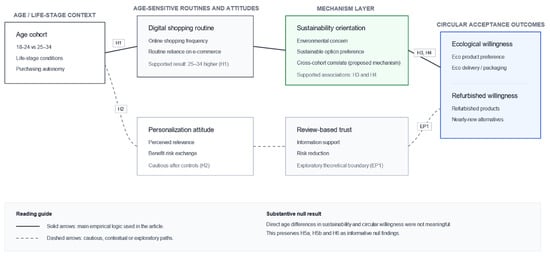
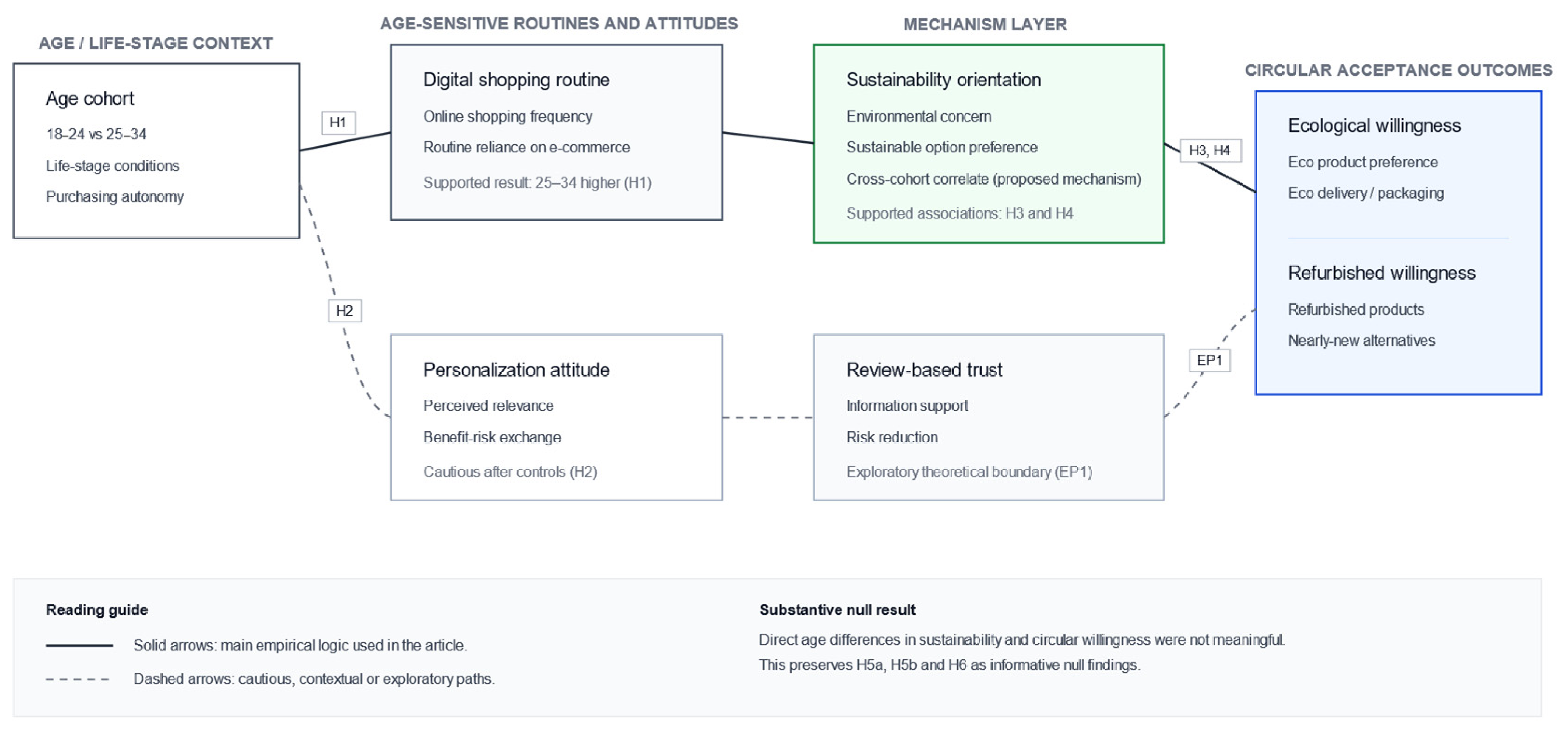

Disclaimer/Publisher’s Note: The statements, opinions and data contained in all publications are solely those of the individual author(s) and contributor(s) and not of MDPI and/or the editor(s). MDPI and/or the editor(s) disclaim responsibility for any injury to people or property resulting from any ideas, methods, instructions or products referred to in the content. |
© 2026 by the author. Licensee MDPI, Basel, Switzerland. This article is an open access article distributed under the terms and conditions of the Creative Commons Attribution (CC BY) license.