
Article

Word-of-Mouth Marketing in the Digital Age: Leveraging Short-Video Platforms for Rural Tourism Marketing

College of Fashion and Design, Donghua University, Shanghai 201620, China
*
Author to whom correspondence should be addressed.
These authors contributed equally to this work and should be regarded as co-first authors.
J. Theor. Appl. Electron. Commer. Res. 2026, 21(9), 286; https://doi.org/10.3390/jtaer21090286
Submission received: 1 July 2026 / Revised: 8 August 2026 / Accepted: 18 August 2026 / Published: 25 August 2026

Abstract

This study aims to identify the key destination-related factors associated with tourists’ revisit behavior in peri-urban rural areas within Chinese metropolitan regions in the context of short-video marketing, and to reveal the structural relationships and hierarchical characteristics among these factors. First, the LDA topic model was employed to conduct text mining on authentic tourist-generated comments posted on Douyin, through which the core factors related to revisit behavior were identified and conceptually standardized based on tourists’ expressions. Building on this process, 153 experts in relevant fields were invited to evaluate the direction and strength of the relationships among these factors. An integrated DEMATEL–ISM–MICMAC approach was then applied to analyze their causal attributes, hierarchical structure, and systemic roles. The results indicate that the identified factors do not operate independently but instead form a multilayered structure with clear hierarchical characteristics. Among them, rural visual imagery, escape-oriented experience, rural lifestyle experience, and rural industry integration occupy deeper structural levels and exert relatively strong structural influences on factors located at intermediate and surface levels. The findings further suggest that the sustained attractiveness of rural tourism destinations in metropolitan regions cannot rely solely on short-video exposure or isolated “internet-famous” attractions; rather, it requires coordinated alignment among digital communication content, rural industries, lifestyle experiences, and tourism supply. By integrating tourist-generated content, natural language processing, and expert-based structural assessment, this study extends research on short-video tourism marketing from a systems perspective and provides practical insights for peri-urban rural destinations in Chinese metropolitan regions seeking to optimize the structural configuration of tourism resources, products and services, and marketing communication.

1. Introduction

In recent years, with the rapid development of digital technology and the proliferation of mobile internet, short-video platforms such as TikTok and YouTube have rapidly emerged as crucial channels for information dissemination and content consumption [1]. Short videos, characterized by their intuitive, vivid, and easily shareable nature, have profoundly transformed the ways in which people acquire information and express themselves, while also significantly influencing marketing strategies across various industries [2]. As a vital component of the experience economy, the tourism industry naturally possesses strong visual and emotional attributes, making it particularly prominent in the short video revolution. Especially in the rural tourism sector, short-video marketing has not only become an important channel for attracting potential tourists and enhancing destination visibility, but has also gradually evolved into a significant force driving rural revitalization, facilitating urban–rural interaction, and supporting the development of rural tourism destinations [3].
In traditional tourism marketing models, information dissemination primarily relied on print advertisements [4], tourism promotion events [5], and word-of-mouth communication [6], which had limited efficiency and relatively narrow audience reach. The advent of short videos has substantially reduced spatial, temporal, and media constraints on tourism communication, enabling rural tourism resources to be presented to urban residents in more immersive and compelling ways. Through short videos, rural natural scenery, cultural characteristics, specialty cuisines, and folk activities are vividly showcased, greatly stimulating urban residents’ tourism interest and travel desires. Meanwhile, the algorithmic recommendation mechanisms and social attributes of short-video platforms enable high-quality content to gain rapid visibility and achieve large-scale diffusion, generating substantial attention and visitor flows. Many previously obscure peri-urban villages have gained widespread public attention through short videos and have subsequently developed into popular social-media tourism destinations that attract large numbers of visitors. However, once the initial novelty generated by online exposure fades, homogenized content and overly commercialized experiences may reduce tourists’ willingness to maintain sustained interest in the destination. Consequently, short-term increases in online attention and visitor numbers do not necessarily translate into repeated visitation or long-term destination competitiveness.
Traditional tourism marketing theories have largely focused on the formation and communication of destination image, emphasizing the use of marketing activities to establish attractive and distinctive cognitive and affective images in the minds of potential tourists. In its early development, short-video marketing represented a highly visual and interactive extension of this destination-image approach. However, the difficulty of converting short-term online attention into sustained tourist revisitation highlights the limitations of relying primarily on destination image construction and promotional exposure. Revisitation is likely to depend not only on expectations formed before an initial visit, but also on the extent to which the destination’s actual resources, products, services, and tourism experiences are able to support and reinforce those expectations. For peri-urban rural destinations within metropolitan regions, relatively short travel distances, brief decision-making cycles, and the high substitutability of comparable destinations make it difficult to establish long-term competitive advantages solely through the novelty generated by short-video exposure. Destinations therefore need to integrate online marketing with offline tourism supply by improving tourism resource development, activity design, service-facility provision, visitor reception and management, and product renewal, thereby enhancing the consistency between online destination representations and tourists’ actual on-site experiences.
Accordingly, whether short-video marketing can encourage tourist revisitation cannot be explained solely by communication content; it is also necessary to examine whether the destination supply system can accommodate, sustain, and convert traffic generated by digital platforms. Short videos can increase the market visibility of tourism resources, but whether resource attractiveness can be transformed into sustained demand also depends on supply-side conditions such as tourism product diversity, service quality, infrastructure, environmental management, the presentation of local cultural characteristics, and operational and organizational capabilities. When online content is disconnected from offline products, or when destinations suffer from product homogenization, inadequate facilities, unstable service quality, or excessive commercialization, short-video communication may even amplify the gap between tourists’ expectations and the actual tourism supply. Conversely, when destinations systematically configure tourism resources, service offerings, and operational practices in response to market demand generated through short-video communication, short-video marketing may evolve from a simple traffic-acquisition tool into an important means of encouraging repeated visitation and supporting the stable development of destinations.
The innovations of this study are primarily reflected in the following aspects. First, rather than limiting short-video marketing to information dissemination and destination exposure, this study situates it within the overall supply system of rural tourism destinations and examines the structural relationships among short-video communication, tourism resources, products and services, and destination operations and management, thereby extending the analytical scope of short-video tourism marketing research. Second, the study focuses specifically on peri-urban rural areas within metropolitan regions. Compared with long-distance tourism destinations, such areas are characterized by greater accessibility, higher travel frequency, shorter decision-making cycles, and more intense competition from comparable destinations. Consequently, tourists’ revisitation is associated not only with short-video communication but also with destinations’ capacities for product renewal, service provision, and resource integration. Finally, this study moves beyond the linear “communication–attention–visit” pathway and instead examines, from a destination supply perspective, the interactions among different marketing and supply factors and their combined relationships with tourists’ revisit intention. In doing so, it seeks to explain how rural tourism destinations can systematically configure key elements to convert short-video-generated traffic into more sustained visitor retention.
Against this background, the study addresses two core research questions. First, how do short-video marketing and related destination supply factors jointly influence tourists’ revisit intention? Second, to improve the sustained conversion of short-video-generated traffic, how should peri-urban rural tourism destinations within metropolitan regions optimize the structural configuration of key elements such as tourism resources, products and services, and operations and management? By addressing these questions, this study seeks to develop an explanatory framework centered on short-video marketing and destination supply factors, provide a new perspective for understanding the “revisit gap” in peri-urban rural tourism within metropolitan regions, and offer practical guidance for rural tourism destinations seeking to transform short-term online popularity into sustained market attractiveness.

2. Literature Review

2.1. Rural Tourism in the Peri-Urban Fringe of Metropolises

Rural tourism has become a key driver of rural revitalization and economic diversification worldwide, providing alternative livelihood options for agricultural communities and serving as an effective means of mitigating rural decline [7]. Within this broad domain, peri-urban rural tourism—located at the urban–rural boundary—constitutes a distinctive and increasingly important subfield. Its defining features include proximity to large metropolitan markets, convenient accessibility, and patterns of short-distance, high-frequency visitation, while simultaneously facing intense competition for land and resources triggered by urban expansion [8]. This hybrid space, or “peri-urban interface,” functions as a dynamic arena of interaction where urban leisure demand intersects with rural landscapes and traditional livelihoods, giving rise to a complex socio-ecological system [9]. Prior research indicates that peri-urban rural tourism not only stimulates local economic growth but also contributes to the preservation of traditional culture and landscapes [10]. For example, Dai’s study shows that the development of agritourism in the suburban areas of Beijing significantly increased residents’ income levels and improved rural infrastructure [11]. Similarly, Fong et al. highlight the role of rural tourism in strengthening social cohesion and encouraging community participation in peri-urban regions [12].
However, the rapid expansion of peri-urban rural tourism also brings a range of challenges. As visitor numbers surge, environmental pressures—such as waste management burdens and landscape degradation—have become increasingly salient [13]. In addition, the commercialization of rural culture and unequal distribution of tourism benefits may undermine the authenticity and sustainability of rural tourism [13]. Recent studies therefore call for more innovative destination marketing and visitor management strategies for peri-urban rural tourism, emphasizing the importance of digital technologies and social media in shaping tourists’ perceptions and behaviors [14]. In particular, the rise of short-video platforms has created new opportunities for rural destinations to enhance visibility, attract urban visitors, and build long-term visitor relationships—an issue of growing significance for understanding tourists’ revisit intentions in the digital era.

2.2. Short-Video Marketing and Rural Tourism

The rise of social media has fundamentally reshaped tourism marketing and consumer decision-making patterns. Platforms such as Instagram and Facebook, together with short-video applications that have gained prominence in recent years (e.g., TikTok), are shifting the locus of influence from marketer-generated content to user-generated content (UGC) and influencer marketing [15]. Owing to its distinctive features—vivid visual storytelling, strong emotional resonance, perceived authenticity, and viral diffusion potential—short-video marketing has become a highly influential marketing instrument [16]. Existing studies indicate that by creating a sense of “telepresence” and immersive experiences, short videos significantly shape prospective tourists’ pre-trip destination image formation and travel motivations [17].
Nevertheless, critical gaps remain at the intersection of these research streams. First, while increasing attention has been paid to the effects of short videos on initial travel intention, their role in fostering post-trip engagement and stimulating revisit intention remains underexplored. The tourist journey does not end upon departure; continued exposure to high-quality content can reactivate positive memories, cultivate emotional bonds, and maintain destination salience, thereby nurturing a desire to revisit. Second, current revisit-intention models have not adequately incorporated the specific dimensions of interaction associated with short-video marketing. Factors such as perceived content authenticity, entertainment value, informational richness, and social interaction may constitute novel psychological drivers shaping post-trip attitudes and behavioral intentions. Finally, this research gap is particularly pronounced in the context of peri-urban rural tourism. Given the substantial revisit potential embedded in nearby metropolitan markets, understanding how sustained digital marketing strategies via short videos can convert one-time visitors into loyal customers is of considerable practical and theoretical significance.

2.3. Tourists’ Revisit Intention

Tourists’ revisit intention is commonly regarded as a core dimension of destination loyalty and a key indicator for assessing a destination’s long-term competitiveness and sustainable development [18]. Most studies define it as a tourist’s subjective propensity or planned judgment to return to the same destination within a given period in the future; it is often examined together with willingness to recommend as part of the broader construct of behavioral intention [19,20]. In this sense, revisit intention reflects not only tourists’ overall evaluations of past experiences but also their expectations regarding the destination’s future value.
Early research was largely grounded in the classic “service quality–satisfaction–loyalty” paradigm, treating overall satisfaction as the central driver of revisit intention. Drawing on service quality and post-consumption evaluation theories, Baker et al. found that perceived service quality significantly strengthens revisit and recommendation behaviors by enhancing overall satisfaction [21]. In the context of cruise tourism, Petrick et al. further demonstrated that perceived value and satisfaction are key antecedents predicting repeat consumption intentions [22]. Subsequently, the rise of the experience economy and the affective turn prompted scholars to re-examine the mechanisms underlying revisit intention from the perspectives of experiential quality and emotional responses. In cultural heritage tourism, Chen et al. showed that experience quality not only directly increases perceived value but also enhances behavioral intentions through the combined effects of value and satisfaction [23]. Kim further identified destination attributes that contribute to memorable experiences, suggesting that strengthened positive memories and emotional attachment exert a more enduring and “sticky” influence on revisit intention [24]. With the proliferation of social media and online review platforms, electronic word-of-mouth (eWOM) has been recognized as a critical information source shaping tourists’ expectations and behaviors [25]. Online reviews, UGC images and videos, and social network discussions not only influence potential tourists’ initial destination choice but may also alter prior visitors’ revisit intentions by reinforcing or weakening existing memories and post hoc evaluations [26].

2.4. Electronic Word-of-Mouth and Information Communication Theory

Electronic word-of-mouth refers to the process through which consumers use Internet platforms to publish, obtain, and disseminate information about products, services, and consumption experiences. Compared with traditional word-of-mouth, electronic word-of-mouth transcends temporal, spatial, and acquaintance-based constraints and is characterized by a broad dissemination scope, rapid diffusion, prolonged information availability, and strong interactivity [27]. In tourism contexts, because tourism products are intangible, heterogeneous, and difficult to evaluate directly prior to consumption [25], tourists commonly rely on the experiences shared by others to reduce information uncertainty. Electronic word-of-mouth has therefore become an important source of information for tourists when searching for destination information, assessing travel-related risks, and making travel decisions. Information communication theory suggests that communication effectiveness depends not only on whether information reaches its audience but also on the combined effects of information sources, content quality, media formats, and audience participation. The persuasiveness of electronic word-of-mouth generally derives from the credibility of the information source, the relevance and completeness of the content, and social endorsement cues such as likes, comments, and shares from other users [28]. When information is perceived as authentic, specific, and highly relevant to individual needs, it possesses greater diagnostic value and is more likely to influence tourists’ perceptions and evaluations of a destination [29]. Conversely, overly commercialized, homogeneous, or clearly exaggerated information may reduce tourists’ trust and weaken communication effectiveness.
Short-video platforms have further transformed the form of electronic word-of-mouth. The combination of visual imagery, music, text, and scenario-based storytelling enables destinations’ natural landscapes, distinctive cuisine, cultural activities, and tourism offerings to be presented intuitively, thereby enhancing the vividness and immersive quality of information [30]. At the same time, algorithmic recommendation mechanisms enable content to be distributed more precisely according to users’ interests, while comments, sharing, and user imitation facilitate the continued diffusion of information through social networks. Consequently, short-video electronic word-of-mouth can not only increase the market visibility of destinations but also reduce information-search costs for potential tourists and shape their destination images and visitation expectations. However, electronic word-of-mouth primarily influences pre-trip information acquisition and expectation formation, and high levels of online attention do not necessarily translate into sustained revisit behavior. When the destination image presented in short videos differs substantially from the actual products, facilities, and services available at the destination, heightened expectations may instead result in an experiential discrepancy. Therefore, analyses of the tourism marketing effects of electronic word-of-mouth should consider not only dissemination reach, content attractiveness, and user interaction, but also whether online information is effectively supported by the destination’s offline supply system. On this basis, this study adopts electronic word-of-mouth and information communication theory as important theoretical foundations for explaining how short videos generate destination awareness, visitation expectations, and initial visit motivation.

3. Research Design and Methods

3.1. Research Methodology and Procedure

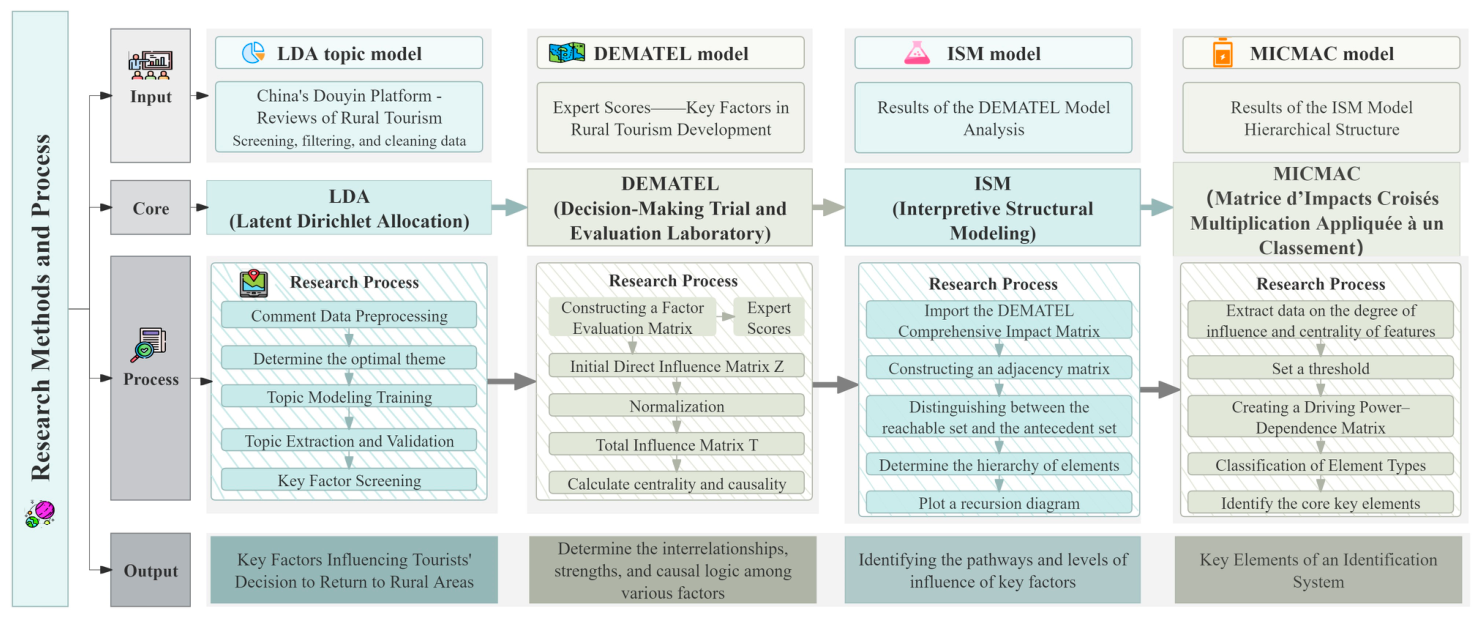
This study adopts a hybrid analytical framework of “textual discovery–expert judgment–structural identification,” sequentially integrating LDA topic modeling with DEMATEL, ISM, and MICMAC. First, authentic tourist-generated content from short-video platforms is used to identify destination attributes and experiential factors associated with rural tourism revisitation, thereby providing an empirical basis for factor identification at the level of tourist-generated content. Second, after topic interpretation, conceptual standardization, and indicator development, 153 experts from relevant fields evaluate the potential directions and strengths of influence among these factors. DEMATEL, ISM, and MICMAC are then employed to identify their interrelationships, hierarchical structure, and driving–dependence characteristics. Finally, relevant theories and existing empirical studies are used to interpret the model results and provide external theoretical reference. Accordingly, the primary purpose of this methodological framework is not to directly measure or explain tourists’ individual revisit intentions or the psychological mechanisms underlying them, but rather to identify factors associated with rural tourism revisitation and explore the potential structural relationships among these factors. The specific procedure is shown in Figure 1.
First, the LDA topic model is employed to conduct an exploratory analysis of user-generated content related to rural tourism revisitation on Douyin. Without imposing a predefined classification system, LDA can identify recurring semantic themes from large-scale unstructured text and is therefore suitable for detecting candidate topics that tourists and content creators consistently focus on, such as rural landscapes, accommodation, lifestyles, travel patterns, and tourism services. Accordingly, the algorithmically generated topics are not directly entered into the subsequent models. Instead, they are interpreted, screened, and conceptualized with reference to representative texts, relevant literature, and expert review. Only after being transformed into evaluation indicators with clearly defined meanings are they incorporated into the DEMATEL analysis.
Second, DEMATEL was applied to analyze the mutual influence relationships among the indicators. Unlike conventional correlation or regression analyses, which primarily examine statistical associations among variables, DEMATEL is suitable for complex systems characterized by interdependence among multiple factors. Based on expert judgments, it can identify both direct and indirect influences among factors and distinguish causal factors from effect factors. The use of expert judgment in this study does not imply that it is superior to tourist surveys; rather, it reflects the research objective of identifying the systemic structural relationships among destination marketing and supply factors rather than estimating path coefficients at the individual tourist level. Drawing on their experience in tourism planning, rural destination operations, and digital marketing, experts are able to systematically assess whether and to what extent one factor influences another, relationships that are difficult to capture solely through cross-sectional tourist surveys.
Building on the DEMATEL results, ISM was subsequently employed to construct a multilevel hierarchical structure. ISM transforms complex influence networks into relatively clear hierarchical relationships, thereby enabling the identification of fundamental driving factors at the deepest level, transmission factors at intermediate levels, and direct influence factors at the surface level. MICMAC was then used to classify the factors according to their driving power and dependence into driving, linkage, dependent, and autonomous factors, thereby further validating their structural roles within the overall system. In this methodological sequence, DEMATEL addresses how the factors influence one another, ISM explains how these influences form a hierarchy, and MICMAC identifies which factors exhibit stronger driving power or dependence within the system. The three methods therefore constitute a progressive analytical sequence.
Given the probabilistic nature of LDA topic modeling, different numbers of topics and combinations of keywords may affect topic interpretation. This study therefore determined the candidate number of topics by comparing topic coherence and calibrated topic meanings using representative texts and expert review, thereby reducing the risk that uncertainty in topic modeling would propagate into the subsequent structural analysis. Consequently, the subsequent models did not use unprocessed LDA topics, but rather an indicator system that had undergone semantic interpretation and content-validity review. Compared with methods such as SEM, fsQCA, and Bayesian networks, the methodological combination adopted in this study is more closely aligned with the research objectives. SEM is suitable for using large individual-level samples to test predefined latent variables and their path relationships; however, the present study focuses on discovering factors from unstructured text and exploring previously unspecified interdependencies and hierarchical structures among multiple factors. fsQCA is primarily designed to identify multiple configurational pathways through which combinations of conditions lead to a particular outcome, but it cannot fully represent hierarchical transmission relationships among factors. Bayesian networks enable probabilistic inference but generally require sufficiently rich data or clearly specified prior probabilities. By comparison, the LDA–DEMATEL–ISM–MICMAC combination is better suited to the exploratory objective of this study: discovering factors from text, identifying relationships among factors, revealing hierarchical structures, and determining key driving factors.

3.2. LDA Topic Modeling Analysis and Factor Extraction

3.2.1. Exploratory Topic Identification Based on LDA

To identify latent topics related to rural tourism revisit behavior in short-video user-generated content, this study selected Douyin and Xiaohongshu, two representative Chinese social media platforms, as data sources. Using “rural tourism” and “revisit” as the core search terms, publicly available content posted between 2020 and September 2025 was collected using Python 3.9. The use of data from two platforms was primarily motivated by the complementarity of their content ecosystems. Douyin relies predominantly on short videos and algorithmic recommendation, making it particularly suitable for capturing the rapid diffusion of visually oriented tourism content. Xiaohongshu, by contrast, combines short videos, image–text posts, and experience sharing, with greater emphasis on travel guides, experiential evaluations, and lifestyle expression. Integrating the two platforms into a unified exploratory corpus helps reduce potential topic-identification bias arising from the content ecology and recommendation mechanisms of any single platform.
The initial dataset comprised 595 raw text records, including 355 from Douyin and 240 from Xiaohongshu. The Douyin data primarily included video titles, textual descriptions, and publicly available interaction metrics such as numbers of likes, favorites, comments, and shares. The Xiaohongshu data mainly included post titles, body text, tags, and related publicly available interaction information. All data were obtained from publicly accessible platform content. No information capable of directly identifying individual users was collected during the research process, and any user-related information was anonymized during data processing and reporting.
Prior to LDA modeling, a standardized preprocessing procedure was applied to texts from both platforms. This procedure included identifying and removing duplicate texts, merging titles with body content, removing URLs and special characters, Chinese word segmentation, stop-word removal, filtering advertisements and irrelevant content, and eliminating low-frequency terms. Platform-specific formatting elements, including Douyin hashtags, Xiaohongshu topic markers, user-mention symbols, and platform-specific functional terms, were also uniformly removed to minimize interference from cross-platform formatting differences in topic identification. After preprocessing, 544 valid texts were retained, of which 541 ultimately satisfied the requirements for bag-of-words modeling, yielding a document–term corpus containing 1936 valid terms. The Latent Dirichlet Allocation model was implemented using the Gensim 4.3.3 library in Python. To enhance reproducibility, the random seed was fixed at 42, the number of training passes was set to 20, and the maximum number of iterations per pass was set to 400. A symmetric Dirichlet prior was specified for the document–topic distribution, with α = 50/K, while the prior parameter for the topic–term distribution was set to β = 0.01. Accordingly, for the final model with K = 19, α was 2.6316. These parameter settings were held constant across all candidate topic models to ensure comparability among solutions with different numbers of topics.
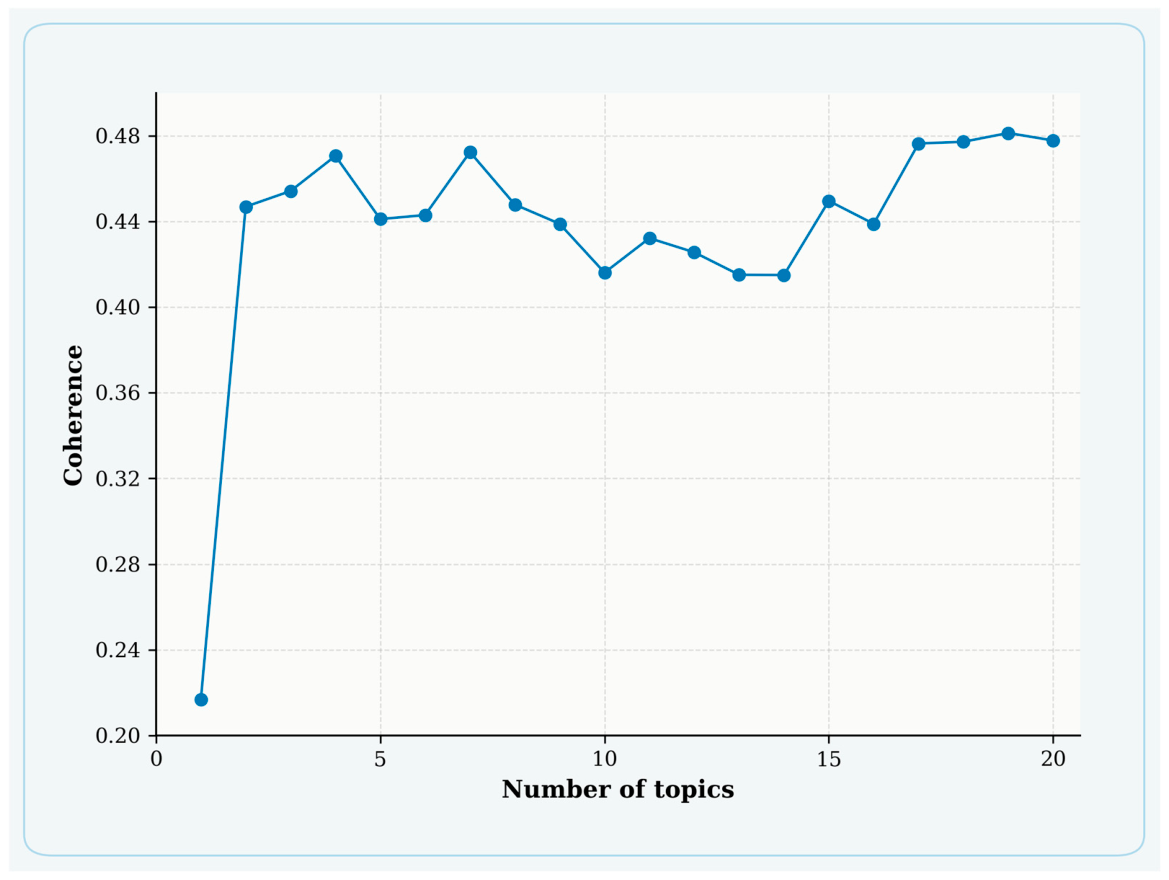
To determine an appropriate number of topics, LDA models with K ranging from 1 to 20 were estimated, and the Cv topic coherence metric was used to assess the semantic consistency among high-probability terms within each model. As shown in Figure 2, model coherence did not increase monotonically with the number of topics. The highest Cv coherence score, 0.4813, was obtained when K = 19, indicating comparatively strong semantic cohesion among the candidate solutions. However, the number of topics was not determined mechanically on the basis of a single coherence metric. The study further compared changes in high-weight keywords, representative texts, semantic overlap across topics, and topic interpretability among adjacent topic-number solutions, while variations in K were treated as a sensitivity analysis for topic-number selection. The comparison showed that models with fewer topics tended to merge rural tourism issues with distinct semantic meanings, whereas further increases in the number of topics resulted in the over-fragmentation of some semantically similar themes. Taking into account Cv coherence, inter-topic distinctiveness, consistency of representative texts, and semantic interpretability, K = 19 was ultimately selected as the primary model for exploratory topic identification using LDA.
Following the output of the LDA model, each topic was independently interpreted and provisionally labeled based on its high-weight keywords, representative texts, and specific contextual meanings. The topic labels and conceptual boundaries were then theoretically refined with reference to relevant literature on rural tourism, electronic word-of-mouth, destination attractiveness, and tourist behavior. For topics where discrepancies arose, the researchers re-examined the representative texts and reached consensus through discussion. Ultimately, 19 candidate topics with clearly distinguishable semantic meanings were identified, as presented in Table 1.
Because the LDA topics represent probabilistic semantic structures derived from word co-occurrence patterns in user-generated content across the two platforms, they are not equivalent to psychological constructs or latent variables validated through consumer surveys. Accordingly, the LDA outputs were not used directly as inputs for the DEMATEL analysis. Overall, the topics identified by LDA primarily covered five dimensions: natural landscapes, rural lifestyles, industrial development, regional culture, and leisure activities. Keywords such as “rice fields,” “idyllic retreat,” and “hidden gems” reflected the experiential value of rural tourism in terms of natural restoration and escape from everyday life; keywords such as “industry,” “culture–tourism integration,” and “rural revitalization” indicated the connections between rural tourism, local industrial development, and rural revitalization; and themes involving “self-driving,” “coffee,” and “camping” illustrated the diversification of contemporary rural tourism consumption settings and leisure practices. To further assess the robustness of the topic-modeling results, a sensitivity analysis was conducted. Under different random seeds, the Cv coherence scores ranged from 0.4668 to 0.4813. When β was set to 0.001, 0.05, and 0.10, the corresponding Cv values were 0.4809, 0.4774, and 0.4712, respectively, indicating that the model results remained generally stable across different parameter settings. It should be noted that topic coherence scores may still be affected by preprocessing choices, including word-segmentation methods, stop-word lists, and dictionary-filtering rules. Therefore, in this study, topic coherence was used primarily as a relative criterion for comparing alternative topic models under the same text-processing procedure rather than as an absolute standard for determining topic validity. On this basis, the subsequent analysis further subjected the probabilistic topics identified by LDA to conceptual standardization, calibration against relevant literature, and expert content review. The topics were thereby theorized and operationalized into expert evaluation factors with explicit conceptual boundaries, clear definitions, and assessable interrelationships before being incorporated into the DEMATEL, ISM, and MICMAC analyses. This procedure was designed to reduce the risk that uncertainty arising at the topic-modeling stage would propagate into the subsequent analysis of structural relationships.

3.2.2. Development of Expert Evaluation Indicators from LDA Topics

Because the LDA topics were derived from word co-occurrence structures in user-generated content across Douyin and Xiaohongshu, they essentially represent probabilistic semantic clusters rather than structural variables that can be directly incorporated into DEMATEL, ISM, and MICMAC analyses. Moreover, a single topic often combines content at different conceptual levels, including tourism resources, landscape characteristics, travel modes, experiential perceptions, and destination development. Therefore, the 19 candidate LDA topics were not directly used as factors for subsequent expert evaluation. Instead, a transformation procedure comprising cross-platform topic identification, semantic decomposition and consolidation, conceptual standardization, literature-based calibration, and expert review was employed to further refine the topics.
Specifically, the research team first reinterpreted the 19 candidate topics by examining the high-weight keywords, representative texts, and specific contexts associated with each topic, and then decomposed, merged, and abstracted them according to semantic consistency and conceptual level. Topics with highly similar semantic meanings were merged, whereas composite topics containing multiple tourism attributes were conceptually decomposed. Specific place names, generic expressions, and information lacking independent explanatory significance were removed. This process ultimately yielded 15 evaluation factors with clearly defined conceptual boundaries and suitability for expert assessment of interrelationships, including transport accessibility and self-driving travel, leisure appeal of ancient villages and towns, secluded rural retreat and escape appeal, mountainous and natural landscape appeal, and pastoral and agricultural landscape appeal, as presented in Table 2. These factors were subsequently subjected to expert evaluation, after which DEMATEL, ISM, and MICMAC were employed to analyze their influence strength, driving power, and dependence relationships.

3.3. Questionnaire Distribution and Collection

This study conducted an expert questionnaire survey from January to August 2026, using a combination of an online questionnaire platform and targeted invitations via email. In accordance with the expert selection criteria described above, the research team sent survey invitations to a total of 160 experts from universities and research institutions with backgrounds in rural tourism, tourism management, digital marketing, urban–rural planning, and related fields. Before the formal questionnaire was distributed, the research team explained on the opening page the purpose of the study, the sources and operational definitions of the 15 evaluation indicators, and explicitly stated that the expert evaluations were intended primarily to assess the mutual influence relationships among the factors rather than to directly measure tourists’ revisit intention at the individual level.
To ensure a relatively consistent understanding of the evaluation content among experts, all participants were provided with standardized indicator descriptions before formal scoring, including factor names, conceptual definitions, and evaluation rules. The experts completed the questionnaire independently on the basis of their professional knowledge and relevant research experience, assessing the direct influence relationships among the factors and their relative degrees of influence. During the completion process, the research team did not guide experts toward any specific direction of judgment, thereby minimizing the potential influence of researcher intervention on the evaluation results. For procedural questions raised by experts regarding indicator meanings or questionnaire completion, only standardized explanations were provided, without offering suggestions concerning specific ratings. After the questionnaires were collected, the data were examined for completeness and validity. The main screening criteria included whether all core evaluation items had been completed, whether obvious patterned responses were present, whether substantial amounts of data were missing, and whether any anomalous records were unsuitable for constructing the factor relationship matrix. Questionnaires with missing core evaluation information or responses that clearly failed to meet the completion requirements were excluded. Ultimately, 153 complete and valid expert questionnaires were obtained, corresponding to a valid response rate of 95.6%.
During data preparation, the evaluations provided by the 153 experts were first standardized and aggregated, and the consistency and stability of expert judgments were assessed. After confirming that the expert evaluations exhibited an acceptable level of consistency, the individual evaluation matrices were integrated to construct an overall direct influence matrix for subsequent analysis. This matrix served as the basis for the DEMATEL analysis, followed sequentially by ISM-based hierarchical structure identification and MICMAC driving power–dependence analysis. Through this procedure, individual expert judgments were transformed into collective evaluation results, thereby reducing potential bias arising from any single expert’s judgment and enhancing the robustness of the subsequent structural analyses.

3.4. Expert Selection, Scoring Procedure, and Consistency Assessment

3.4.1. Expert Selection and Scoring Procedure

To further evaluate the interrelationships among the 15 factors associated with rural tourism revisitation that were identified through LDA and subsequently conceptually standardized, this study employed expert judgment to obtain the relational data required for the DEMATEL, ISM, and MICMAC analyses. The purpose of the expert evaluation was not to directly substitute for tourists’ subjective judgments regarding revisit intention, but rather to draw on professionals with relevant research experience to identify the direction and strength of influence among different factors and their structural relationships.
The experts were primarily drawn from universities and research institutions, with research backgrounds in tourism management, rural tourism, digital marketing, urban–rural planning, landscape and environmental design, rural development, and related fields. To ensure that expert judgments were grounded in an appropriate level of professional expertise, participants were required to meet at least one of the following criteria: (1) teaching or research experience in tourism management, rural tourism, digital marketing, urban–rural planning, or related fields; (2) research experience in projects related to rural tourism, destination marketing, or rural development; (3) experience in relevant academic publications, research projects, or planning practice; or (4) familiarity with tourism communication and tourist behavior in short-video and social-media environments. Participants whose professional backgrounds were clearly unrelated to the research topic or who did not complete the evaluation task in full were excluded from the final sample.
A total of 160 experts who met the selection criteria were invited to participate in the evaluation, yielding 153 complete and valid questionnaires and a valid response rate of 95.6%. In terms of relevant research or professional experience, 41 experts had less than 5 years of experience, accounting for 26.8%; 44 had 5–10 years of experience, accounting for 28.8%; 46 had 11–15 years of experience, accounting for 30.1%; and 22 had more than 15 years of relevant research or professional experience, accounting for 14.4%. Overall, more than 70% of the experts had over 5 years of relevant experience, indicating that the expert sample possessed a relatively solid foundation of professional knowledge and practical understanding. In terms of geographical distribution, the 153 experts were affiliated with universities and research institutions across different regions of China. Although the sample was concentrated primarily in eastern China, it also included experts from central, western, and northeastern regions, with institutions located in the Yangtze River Delta, Beijing–Tianjin–Hebei region, Pearl River Delta, and selected central and western areas, thereby providing a degree of geographical diversity. Given that higher-education research resources and scholarly expertise related to rural tourism are relatively concentrated in eastern China, the expert sample also exhibited a certain degree of eastern regional concentration. Accordingly, this study does not treat the geographical composition of the expert sample as nationally representative in a population-sampling sense. Rather, experts with diverse regional research backgrounds were included to reduce, as far as possible, potential systematic bias in expert judgments arising from the knowledge structures or tourism development contexts of any single region.

3.4.2. Consistency Assessment and Aggregation of Group Judgments

Before the formal evaluation, the research team provided all experts with a standardized indicator-description document explaining the names and conceptual definitions of the 15 factors, the objects of evaluation, and the meaning of a “direct influence relationship.” For any two distinct factors Si and Sj, experts were required to independently determine whether factor Si directly influences factor Sj. A judgment of direct influence was coded as 1, whereas the absence of direct influence was coded as 0. Self-influence was not evaluated; that is, SiSi = 0 was specified. Because the influence relationships were directional, SiSj and SjSi were treated as two independent relationships and evaluated separately. All experts completed the questionnaire independently under the same indicator definitions and evaluation rules. No group discussions concerning specific factor relationships were organized during the study, nor were participants required to reach a unified judgment through deliberation. This procedure was intended to minimize the effects of conformity, authority, and group interaction on individual professional judgments. Accordingly, the group consensus used in this study was not derived from enforced agreement following discussion, but rather from statistical consistency assessment and aggregation of group judgments based on experts’ independent evaluations.
Before aggregating the group-level relationships, inter-rater agreement among the judgments of the 153 experts was first assessed. Because all experts made binary judgments—either “direct influence exists” or “direct influence does not exist”—for the same set of factor relationships, Fleiss’ kappa coefficient was used to evaluate agreement among multiple raters. The results yielded a Fleiss κ of 0.74, indicating a relatively high level of agreement among the experts. This suggests that the identification of the principal relationships among the 15 factors was generally stable across experts, thereby supporting the subsequent aggregation of group judgments.

4. Empirical Data Analysis

4.1. DEMATEL-Based Computation

4.1.1. Construction of a Comprehensive Impact Matrix

  • First, to address the small number of individual differences in expert judgments, this study did not intervene in the original data through post hoc discussion or manual adjustment. Instead, expert opinions were integrated using an objective statistical aggregation method. Let xij(k) denote the binary judgment made by the kth expert regarding whether factor Si directly influences factor Sj. The decision rule is defined as follows:
    x i j ( k ) = 1 ,   I f   t h e   k t h   e x p e r t   b e l i e v e s   t h a t   S i   h a s   a   d i r e c t   i n f l u e n c e   o n   S j 0 ,   I f   t h e   k t h   e x p e r t   b e l i e v e s   t h e r e   i s   n o   d i r e c t   i m p a c t
    where k = 1, 2, …, 153 denotes the expert number, and all judgments satisfy ij; that is, the self-influence of a factor is not considered.
  • Based on the independent binary judgments of the experts, the proportion of the 153 experts supporting any directed influence relationship SiSj was calculated to quantify the degree of group-level agreement regarding the relationship between the factors. The calculation is as follows:
    p i j = 1 153 k = 1 153 x i j ( k )
    where pij ranges from [0, 1]. A larger value indicates a higher proportion of experts who agree that Si directly influences Sj.
  • This study adopted the simple majority rule to aggregate expert judgments and identify stable influence relationships within the system. If more than half of the experts supported a direct influence of Si on Sj, the directed relationship was retained; otherwise, the two factors were considered not to have a stable direct influence relationship. On this basis, a 15-order group direct influence matrix Z = z i j 15 × 15 was constructed, with matrix elements determined according to the following rule:
    z i j = 1 ,   p i j > 0.50 0 ,   p i j 0.50 , i j
  • Meanwhile, to avoid interference from factor self-correlation, all factors were uniformly assumed to have no self-influence, and the diagonal elements of the matrix were set as follows: z i j = 0 .
Through the above statistical aggregation procedure, the discrete binary judgments of the 153 individual experts were transformed into a standardized and stable group direct influence relationship matrix among the 15 influencing factors. Compared with the judgment of a single expert, this method preserves the original characteristics of each expert’s independent assessment while simultaneously drawing on the statistical properties of a relatively large expert group to reduce the influence of individual subjective bias and improve the objectivity and accuracy of the factor relationship structure.
  • The resulting direct influence matrix Z reflects only first-order direct relationships among factors, whereas a core advantage of the DEMATEL model is its ability to simultaneously account for both direct effects and indirect transmission effects. Therefore, to satisfy the convergence requirements of the model computation, the initial direct influence matrix Z must be normalized. The matrix normalization coefficient is first calculated as follows:
    λ = 1 m a x m a x i j = 1 15 z i j , m a x j i = 1 15 z i j
  • The initial matrix is then transformed using the normalization coefficient to obtain the normalized direct influence matrix X:
    X = λ Z
  • After normalization, all elements of matrix X fall within the range of 0–1, effectively preventing matrix divergence and fully satisfying the computational conditions required for iterative convergence of the DEMATEL model. On the basis of the normalized matrix, the influence pathways among factors within the system can be decomposed progressively. Matrix X represents first-order direct effects among factors, X2 represents second-order indirect effects transmitted through a single intermediary, and X3, X4, and subsequent powers correspond to higher-order indirect effects. The cumulative sum of all direct and multilevel indirect effects within the system constitutes the total influence among factors and can be expressed as the following infinite series:
    T = X + X 2 + X 3 +
  • Under the condition of matrix convergence, the infinite-series expression can be transformed into a closed-form calculation to simplify the computational process:
    T = X I X 1
    where I denotes the 15-order identity matrix, and the resulting matrix T = t i j 15 × 15 is the final total influence matrix. The matrix element tij represents the total influence exerted by factor Si on factor Sj through both the direct path and all indirect transmission paths within the system. A larger value of tij indicates a stronger overall influence of Si on Sj.
In summary, this study sequentially conducted the consistency assessment of expert judgments, statistical aggregation of group opinions, normalization of the direct influence matrix, and cumulative calculation of direct and indirect effects, ultimately obtaining the total influence matrix T for the 15 factors associated with rural tourism revisitation. This total influence matrix provides the core foundational data for subsequent DEMATEL-based identification of causal attributes, ISM-based analysis of hierarchical structures, and MICMAC analysis of driving power and dependence.

4.1.2. Determination of the Total Influence Matrix T

According to the calculation formulas described above, the direct influence relationships derived from the aggregated expert judgments were normalized, and the direct effects and indirect effects of different orders among the factors were subsequently accumulated. This procedure ultimately yielded the total influence matrix T for the 15 factors associated with rural tourism revisitation, as presented in Table 3. The total influence matrix reflects not only the direct effects among the factors but also the indirect transmission effects generated through other factors within the system. Accordingly, the matrix element tij represents the total degree of influence exerted by factor Si on factor Sj. A larger value indicates a stronger overall effect of Si on Sj through direct and/or indirect pathways. The total influence matrix further provides the basis for calculating the influencing degree, influenced degree, centrality, and causality of each factor, as well as for the subsequent ISM-based hierarchical structure classification and MICMAC driving–dependence analysis.

4.1.3. Determination of Relevant Values and Construction of the Quadrant Map

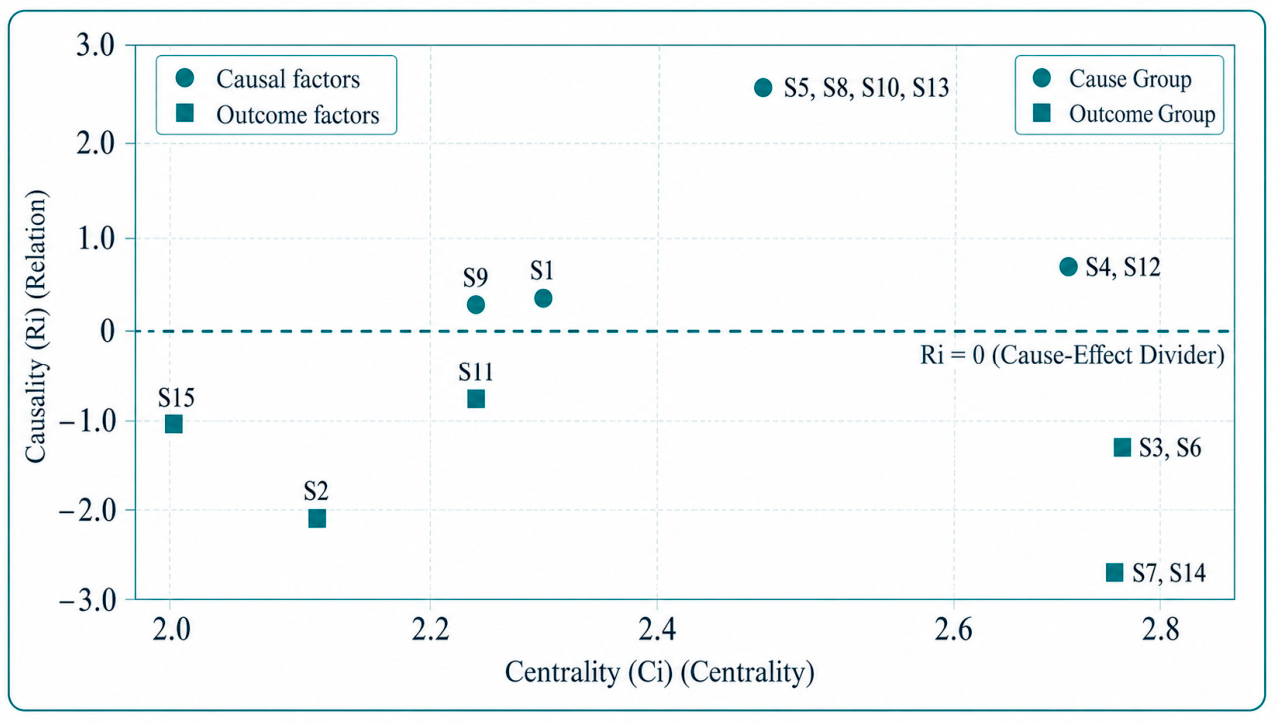
Based on the total influence matrix, this study further calculated the influence degree (Pi), influenced degree (Bi), centrality (Ci), and causality degree (Ri) of each influencing factor. The detailed results are presented in Table 4. Centrality (Ci = Pi + Bi) reflects a factor’s importance and magnitude of involvement within the system, whereas causality degree (Ri = PiBi) is used to determine the nature of a factor. If Ri is positive, the factor exerts a greater influence on other factors and is classified as a “cause factor”; if Ri is negative, the factor is more strongly influenced by other factors and is classified as a “result factor.”
To visually present the attributes and relative importance of each factor, this study constructed a causal quadrant map (Figure 3) using centrality (Ci) as the horizontal axis and causality (Ri) as the vertical axis. This map clearly allocates all factors into different quadrants, thereby enabling rapid identification of core causal factors that exhibit high centrality and play a driving role in the system (e.g., S5, S8, S10, S13), as well as critical effect factors that are highly susceptible to external influences (e.g., S7, S14). It thus provides a clear visual basis for subsequent analyses.

4.2. ISM Model Analysis

4.2.1. Computation of the Adjacency Matrix

In ISM (Interpretive Structural Modeling) analysis, the adjacency matrix is used to represent whether a direct influence path exists between factors within the system. As shown in Table 5, this study takes S1S15 as nodes and, based on the direct-influence identification results described above, assigns a value of 1 when a direct effect of Si on Sj exists, and 0 otherwise. The diagonal elements are set to 0 (self-influence is not considered), thereby yielding the adjacency matrix A = [aij].

4.2.2. Computation of the Reachability Matrix

Based on the adjacency matrix, the reachability matrix shown in Table 6 can be obtained through Boolean matrix operations. This matrix reflects all direct and indirect path relationships among the influencing factors in the system. In the matrix, a value of “1” indicates that one or more transmission paths exist from the row factor to the column factor, implying an influence relationship between the two; a value of “0” indicates that no influence path exists.

4.2.3. Computation of the Hierarchical Structure and Relationship Diagram

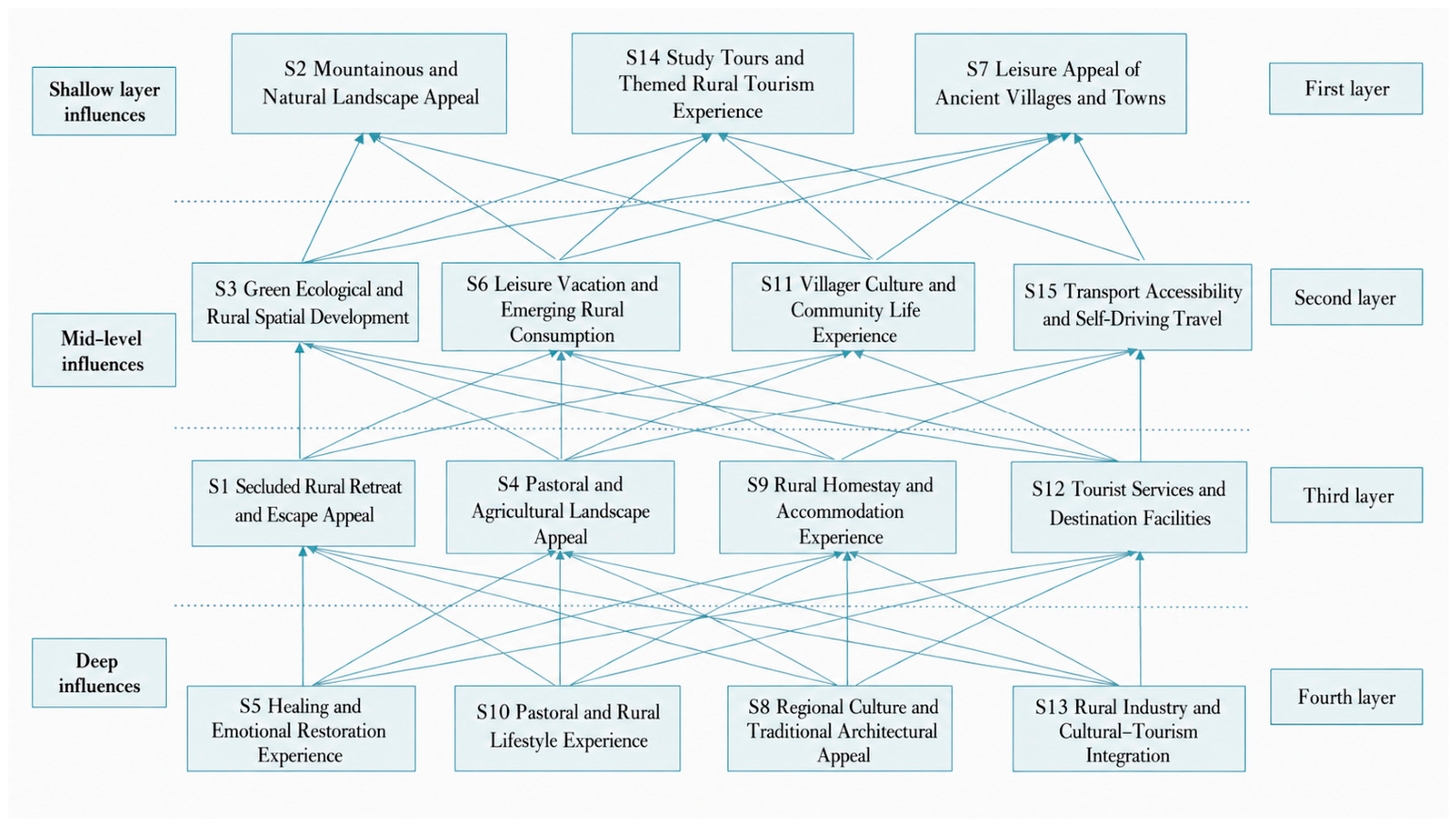
Based on the reachability matrix, this study further calculated the reachability set, antecedent set, and their intersection for each influencing factor, and subsequently conducted ISM hierarchical partitioning, as shown in Table 7. Specifically, when the reachability set of a factor is identical to the intersection of its reachability set and antecedent set, the factor can be identified as belonging to the highest level of the current system. The factors at this level are then removed from the matrix, and the same procedure is repeated for the remaining factors until all factors have been assigned to hierarchical levels. Ultimately, the 15 influencing factors were classified into four hierarchical levels, forming a structure in which deep-level driving factors progressively influence intermediate transmission factors and, subsequently, surface-level outcome factors, as illustrated in Figure 4. Level 1 comprises S2, S7, and S14. Their reachability sets contain only themselves, indicating that these factors occupy the uppermost level of the structural system and primarily represent direct outcomes or surface responses resulting from the effects of other factors. Level 2 comprises S3, S6, S11, and S15, which play an intermediate role by receiving influences from lower-level factors and further transmitting them to surface-level factors. Level 3 comprises S1, S4, S9, and S12, whose structural positions are closer to the transmission and supporting layers within the system and which exert relatively pronounced indirect effects on upper-level factors. Level 4 comprises S5, S8, S10, and S13, which are located at the deepest level of the hierarchical structure. These factors have relatively broad reachability but comparatively limited antecedent dependence, making them important deep-level drivers of changes in other factors. Accordingly, the ISM results indicate that the factors within the system do not operate independently; rather, they exhibit a relatively clear hierarchical influence mechanism characterized by “deep-level drivers–intermediate transmission–surface-level outcomes.”

4.3. MICMAC Analysis

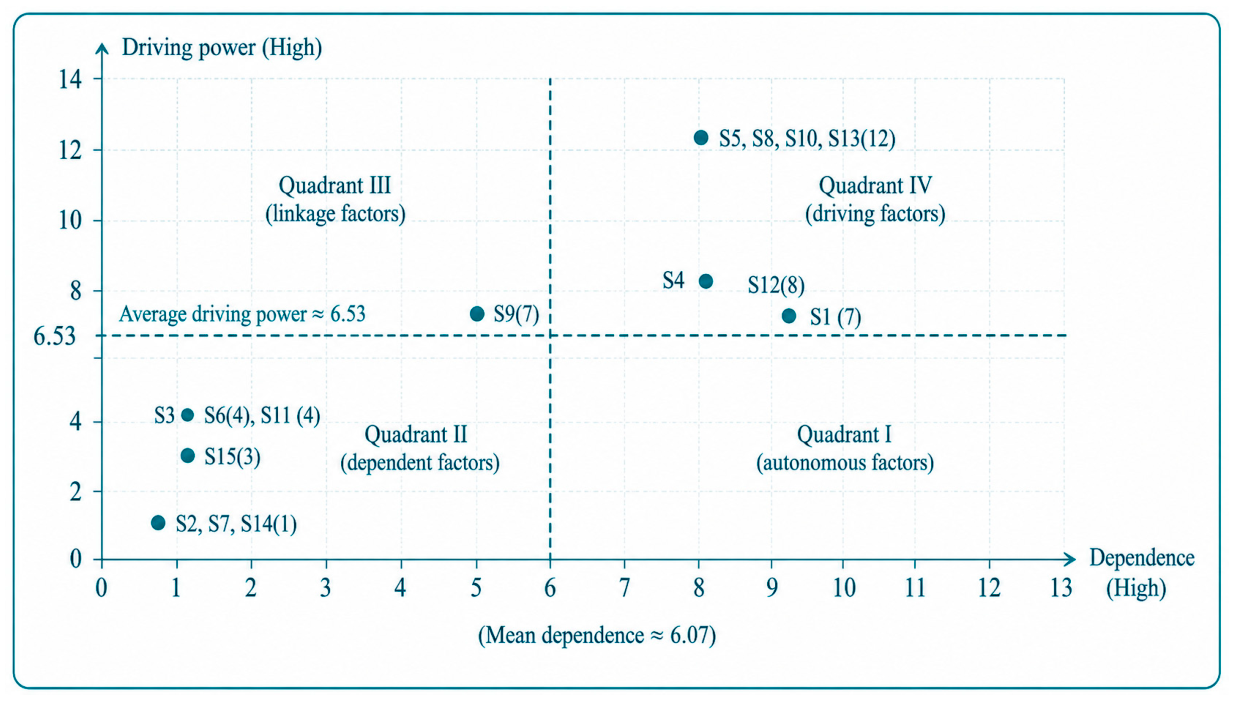
Using the MICMAC model, the 15 influencing factors were categorized into four clusters, as illustrated in Figure 5. Factors such as S5, S8, S10, and S13 fall into Quadrant IV (driving factors), exhibiting the dual characteristics of high driving power and high dependence. These represent the most interconnected and unstable core group within the system. S9 is located in Quadrant III (linkage factors), characterized by strong driving power but low dependence, and serves as one of the fundamental driving forces of the system. In contrast, the majority of factors, including S2, S7, and S14, are positioned in Quadrant II (dependent factors), displaying relatively low driving power and dependence, and thus exerting limited overall influence on the system. No factors are distributed in Quadrant I (autonomous factors).

5. Discussion and Conclusions

5.1. Discussion

This study integrates the LDA topic model with the DEMATEL–ISM–MICMAC approach to conduct a structured analysis of 15 factors influencing rural tourism revisitation in metropolitan regions within the context of short-video media. The primary contribution of this study lies not in reconfirming the importance of individual factors, but in revealing their hierarchical positions within the overall relational network and the potential pathways through which their effects may be transmitted. The ISM results show that S5, S8, S10, and S13 are located at the deepest level, indicating that relatively fundamental structural linkages may exist among short-video communication, tourists’ demand orientations, and the actual supply of destinations.
First, the deep-level position of S5 Healing and Emotional Restoration Experience indicates that the sustained motivation of metropolitan residents to revisit rural destinations may derive not only from “what they see,” but also from whether rural tourism enables them to escape urban stress, relax emotionally, recover psychologically, and reconnect with themselves. As demonstrated in the systematic review of 34 relevant studies by Qiu et al., nature-based tourism environments can promote tourists’ psychological restoration and well-being through mechanisms such as attention restoration, stress reduction, and positive emotions [31]. Recent studies focusing specifically on rural tourism provide further direct evidence. Based on visitors to Hongcun, Wang et al. found that perceived restorativeness in rural destinations can foster positive emotions and place attachment, which are further associated with revisit intention [32]. Zhu et al. similarly found that destination restorativeness in rural tourism can significantly enhance tourists’ hedonic and eudaimonic well-being, which in turn promotes destination loyalty [33]. Second, S8 Regional Culture and Traditional Architectural Appeal, S10 Pastoral and Rural Lifestyle Experience, and S13 Rural Industry and Cultural–Tourism Integration are all located at the fourth level, suggesting that cultural authenticity, everyday rural life, and the integration of industrial resources constitute important supply-side foundations for the sustained attractiveness of rural destinations. In their study of historic villages in Portugal, Kastenholz et al. argued that rural tourism experiences are derived not only from natural landscapes; their social, emotional, and symbolic dimensions also shape tourists’ perceptions of “rurality.” Tourists particularly value nature, history, traditions, and lifestyles that contrast with everyday urban life [34]. Paniccia and Baiocco further identified “rural lifestyle experience” and a “systemic approach” as important components of sustainable agritourism, indicating that genuinely sustainable rural tourism is not simply a collection of isolated attractions, but rather the outcome of the co-evolution of local modes of production, residents’ everyday lives, tourism enterprises, and regional resources [35].
Moreover, the four-level ISM structure demonstrates that the factors influencing rural tourism revisitation in metropolitan regions do not merely represent an accumulation of independent destination attributes; rather, they exhibit clear hierarchical interrelationships. Deep-level factors such as local culture, rural lifestyles, and industrial integration provide the underlying conditions for spatial environments, accommodation services, community experiences, and leisure products that tourists can directly perceive. These intermediate-level factors, in turn, further shape tourists’ perceptions of specific tourism settings and consumption experiences. From this perspective, the role of short videos in rural tourism cannot be understood solely in terms of increasing destination exposure. Short videos can rapidly amplify visual symbols such as traditional architecture, pastoral landscapes, rural lifestyles, and distinctive consumption experiences. However, only when such mediated content is supported by authentic offline resources, products, and services can destination attractiveness generated online be more likely to carry over into actual on-site experiences and subsequently develop into sustained tourism demand. Therefore, the development of rural tourism in metropolitan regions should not rely excessively on the creation of “internet-famous” attractions or the acquisition of temporary traffic. Instead, greater emphasis should be placed on establishing a more stable alignment between short-video content and the actual supply of destinations. This transformation also requires effective destination governance. Azimi et al., in their research on rural tourism destination governance, showed that policy fragmentation, divergent stakeholder objectives, and resource constraints may undermine the capacity for sustainable rural tourism development, whereas collaborative decision-making, strategic partnerships, and capacity building can improve destination governance performance [36]. In light of the present findings, whether attention generated through short videos can be transformed into sustained tourism demand depends not only on what a destination is able to “show,” but also on whether governments, communities, tourism enterprises, and other stakeholders can effectively integrate local culture, rural lifestyles, and industrial resources and subsequently transform them into stable, experienceable, and sustainable tourism offerings.
Based on this hierarchical structure, destination management should likewise avoid allocating limited resources evenly across all influencing factors. Instead, systematic optimization should follow the logic of “consolidating deep-level foundations—strengthening intermediate-level transformation—enriching surface-level experiences.” First, at the level of deep foundations, priority should be given to strengthening the integration of rural industries with culture and tourism. Fundamental resources, including local culture, traditional villages and towns, agricultural production, and rural lifestyles, should be integrated and transformed into marketable tourism products through accommodation, catering, leisure activities, and cultural experiences. In this way, rural tourism can move beyond simple landscape appreciation toward cultural and lifestyle experiences that offer sustained opportunities for participation. Second, at the intermediate transformation stage, greater emphasis should be placed on improving the capacity to convert deep-level resources into tourists’ actual experiences. Through the optimization of rural spaces, improvements in homestays and accommodation services, opportunities for participation in community life, and the creation of healing and emotionally restorative experiences, traditional architecture, pastoral lifestyles, local culture, and rural atmospheres presented in short videos can be authentically encountered by tourists during on-site visits, thereby reducing the gap between online destination images and offline experiences. Finally, with respect to surface-level experiences and consumption products, destination development should take into account the market characteristics of visitors from metropolitan regions, including short-distance travel, weekend-oriented trips, self-driving travel, and a relatively high likelihood of repeat visits. Continuous improvements should therefore be made to transport accessibility, tourist services, destination facilities, accommodation, and leisure consumption conditions. On this basis, diversified products such as leisure vacations, emerging forms of rural consumption, study tours, and themed tourism can be further developed. In this way, a systematic development pathway can gradually be established, extending from “local cultural and rural lifestyle resources—to industrial integration and product transformation—to spatial, service, and transport support—to diversified tourism consumption and experiences.” Such a pathway can enable the temporary attention generated by short videos to move beyond online traffic and be further transformed into stable destination attractiveness and potential demand for revisitation.

5.2. Conclusions, Limitations and Future Research

This study focuses on destination-related factors associated with tourists’ revisit behavior in metropolitan rural tourism within the short-video context. By integrating the Latent Dirichlet Allocation (LDA) topic model with the DEMATEL–ISM–MICMAC approach, the study identified and conceptually standardized 15 core factors from textual data collected from Douyin short videos. Based on the judgments of 153 experts in relevant fields, it further examined the influence relationships and hierarchical structure among these factors. The primary theoretical contribution of this study lies in extending the predominantly linear analytical frameworks in prior research, which have tended to explain tourists’ behavioral intentions through individual destination attributes, by introducing a systemic structural perspective. By combining short-video text mining with expert-based relational judgments, the study further reveals the potential interdependencies and hierarchical differences among destination attributes, indicating that the effects of short-video communication cannot be fully understood independently of destinations’ actual resources, tourism products, and service systems.
At the practical level, the findings suggest that rural destinations in metropolitan areas should not equate short-video marketing simply with increasing exposure or creating isolated “internet-famous” attractions. Instead, priority should be given to improving factors that occupy more fundamental positions within the overall structure. First, destinations should emphasize the protection and revitalization of foundational resources, including ancient villages and towns, traditional architecture, regional culture, agricultural production, and rural lifestyles. Rural industry and cultural–tourism integration should serve as a connecting mechanism to strengthen coordination among agriculture, culture, accommodation, food services, and leisure activities, thereby transforming local resources into tourism products capable of generating sustained experiential value. Second, greater attention should be paid to translating underlying resources into tangible tourist experiences. This can be achieved through green ecological development and rural spatial improvement, enhanced rural homestay and accommodation experiences, participation in community life, and opportunities for healing and emotional restoration, thereby strengthening the consistency between rural images presented online and tourists’ actual offline experiences. Finally, destinations should further improve transport accessibility, self-driving travel conditions, tourist services, and destination facilities, while developing diversified products such as leisure vacations, emerging forms of rural consumption, study tours, and themed rural tourism. Together, these measures can establish a systematic supply pathway extending from the integration of foundational resources to experiential transformation and, ultimately, the improvement of tourism and consumption products. This logic may also offer useful implications for peri-urban rural tourism in other highly urbanized regions. However, its specific application needs to account for differences in platform ecosystems, tourism market structures, and consumer behavior across countries and regions. Accordingly, the structural relationships identified in this study are more appropriately regarded as a starting point for cross-contextual comparison rather than as region-specific conclusions that can be replicated unconditionally.
This study nevertheless has several important limitations. First, the influencing factors were primarily derived from tourists’ authentic comments on short-video platforms and therefore capture destination attributes and experiential content that tourists themselves tend to emphasize during the factor-identification stage. However, the subsequent assessment of the directions of influence and structural relationships among these factors relied primarily on professional evaluations provided by 153 experts in relevant fields. Expert judgment is valuable for identifying complex associations and hierarchical positions among factors from a systemic perspective, but it remains a form of structural assessment grounded in professional knowledge and is not fully equivalent to tourists’ actual perceptions and individual-level behavioral decision-making. Second, the LDA analysis was based exclusively on Douyin. The platform’s user composition, content ecosystem, and recommendation algorithms may affect the topics identified, thereby limiting the generalizability of the findings to other short-video platforms. Third, the methodology employed in this study captures a static relational structure at a specific point in time and therefore cannot fully reflect dynamic adjustments resulting from changes in destination development stages, platform communication environments, and evolving tourist demand.
Future research should first validate the structural relationships proposed in this study using actual consumer samples. For example, large-scale tourist surveys and structural equation modeling could be employed to examine the specific pathways linking deep-level factors to revisit intention. These analyses could be further combined with actual revisit records, platform interaction behavior, or longitudinal tracking data to distinguish the extent to which structural relationships derived from expert judgments are consistent with, or differ from, consumers’ actual behavior. Second, future studies could extend the analysis to other platforms, such as TikTok, YouTube, and Xiaohongshu, as well as to metropolitan rural destinations in different countries and regions, thereby enabling cross-platform and cross-context comparisons. Finally, longitudinal research, experimental designs, or multi-stage data could be adopted to examine how the structure of influencing factors evolves over time, thereby further strengthening the behavioral validity, external validity, and causal explanatory power of the findings.

Author Contributions

Conceptualization, H.T. and J.L.; methodology, H.T.; software, H.T.; validation, H.T. and H.T.; formal analysis, H.T.; investigation, H.T.; resources, H.T.; data curation, H.T.; writing—original draft preparation, H.T.; writing—review and editing, H.T. and J.L.; visualization, X.P. and Y.Y.; supervision, H.T.; project administration, X.L.; funding acquisition, X.L. All authors have read and agreed to the published version of the manuscript.

Funding

This research was funded by 2025 Applied Arts Research Project: A Study on the System for the Inheritance, Revitalization, and Innovation of Rural Applied Arts from the Perspective of Cultural Genes (CNACS2025-A-II-1); 2025 China Professional Degree Thematic Case Project: A Study on the Reconstruction of Cultural Value and Industrialization Pathways for Traditional Villages (ZT-2510255005); 2026 “Light of Textiles” China National Textile and Apparel Council Higher Education Teaching Reform Research Project: “Three Drivers, Four Integrations, Five Promotions”—Innovation and Practice in the Training Model for Graduate Students in Art and Design Under the Modern Education Philosophy (2026BKJGLX148); the support provided by the Fundamental Research Funds for the Central Universities (CUSF-DH-T-2025012).

Institutional Review Board Statement

All methods in this study were carried out in accordance with relevant guidelines and regulations. The research protocol, including its objectives, survey instrument, and participant recruitment procedures, was reviewed and approved by the Institutional Ethics Committee of Donghua University (Approval No. RLSSZYJ202509010048) on 1 September 2025. Data collection was conducted through both online and face-to-face survey methods, with participants providing informed consent prior to participation. The committee confirmed that the study complied with institutional research ethics policies, national regulations, and the principles of the Declaration of Helsinki. No vulnerable populations were involved, and no personally identifiable or sensitive data were collected.

Informed Consent Statement

Informed consent was obtained from all participants prior to their participation in the study. For the online survey, an electronic consent procedure was embedded at the beginning of the questionnaire. Participants were presented with a detailed information page describing the study’s objectives, procedures, voluntary nature of participation, the right to withdraw at any stage without penalty, data confidentiality, and the academic-only purpose of data use. Only individuals who clicked “Agree and Continue” were able to proceed with the survey. For the face-to-face survey, written consent forms were provided and signed by participants after the researcher had clearly explained the study’s purpose, procedures, and data protection measures. In both modalities, participants were explicitly assured that their responses would remain anonymous and that no personally identifiable or sensitive information would be collected. The informed consent procedure and data collection were conducted between September 2025 and November 2025, and were fully approved by the Ethics Committee of Donghua University on 1 September 2025 as part of the reviewed protocol.

Data Availability Statement

The original contributions presented in the study are included in the article; further inquiries can be directed to the corresponding author.

Acknowledgments

This study is grateful to all the authors who participated in writing and collating the data.

Conflicts of Interest

The authors declare no conflicts of interest.

References

  1. Yu, L. The Influence of User-Generated Content on Information Dissemination Patterns in Social Media Platforms: A Case Study of TikTok. Financ. Econ. 2025, 1, 1–6. [Google Scholar] [CrossRef] [Scilit]
  2. Guerrero, K. An Analysis of TikTok’s Digital Marketing Capabilities and Its Effectiveness for Brands and Businesses Across Different Industries. Master’s Thesis, Lindenwood University, St. Charles, MO, USA, 2023. [Google Scholar]
  3. Liao, S.-S.; Lin, C.-Y.; Xie, X.-Z. Effects of Short-Form Video Application Users’ Guanxi on Intention to Visit Rural Tourism Destinations: The Moderating Role of Tourism Fatigue. J. Vacat. Mark. 2024, 30, 782–804. [Google Scholar] [CrossRef] [Scilit]
  4. Chiguvi, D. Effectiveness of Traditional and Digital Advertising Platforms for the Marketing of Tourism. Int. J. Res. Bus. Soc. Sci. 2022, 11, 1–12. [Google Scholar] [CrossRef] [Scilit]
  5. Soteriades, M.D.; Avgeli, V.A. Promoting Tourism Destinations: A Strategic Marketing Approach. Tour. Int. Interdiscip. J. 2007, 55, 335–345. [Google Scholar]
  6. Trusov, M.; Bucklin, R.E.; Pauwels, K. Effects of Word-of-Mouth versus Traditional Marketing: Findings from an Internet Social Networking Site. J. Mark. 2009, 73, 91–102. [Google Scholar] [CrossRef] [Scilit]
  7. Lane, B.; Kastenholz, E. Rural Tourism: The Evolution of Practice and Research Approaches—Towards a New Generation Concept? J. Sustain. Tour. 2015, 23, 1133–1156. [Google Scholar] [CrossRef] [Scilit]
  8. Liu, Y.; Li, J.; Yang, Y. Strategic Adjustment of Land Use Policy under the Economic Transformation. Land Use Policy 2018, 74, 5–14. [Google Scholar] [CrossRef] [Scilit]
  9. Bryant, C.R.; Russwurm, L.H.; McLellan, A.G. The City’s Countryside: Land and Its Management in the Rural-Urban Fringe; Longman: London, NY, USA, 1982; XII-249p, ISBN 978-0-582-30045-3. [Google Scholar]
  10. Wang, Y.; Chen, Y.; Zhang, W.; Chao, I.-C.; Li, H. The Impact of Rural Tourism on Rural Culture Evidence from China. Agriculture 2024, 14, 2116. [Google Scholar] [CrossRef] [Scilit]
  11. Dai, L.; Wan, L.; Xu, B.; Wu, B. How to Improve Rural Tourism Development in Chinese Suburban Villages? Empirical Findings from a Quantitative Analysis of Eight Rural Tourism Destinations in Beijing. Area 2017, 49, 156–165. [Google Scholar] [CrossRef] [Scilit]
  12. Varna University of Management. European Journal of Tourism Research: Volume 11, Year: 2015; Varna University of Management: Varna, Bulgaria, 2015. [Google Scholar]
  13. Baloch, Q.B.; Shah, S.N.; Iqbal, N.; Sheeraz, M.; Asadullah, M.; Mahar, S.; Khan, A.U. Impact of Tourism Development upon Environmental Sustainability: A Suggested Framework for Sustainable Ecotourism. Environ. Sci. Pollut. Res. 2023, 30, 5917–5930. [Google Scholar] [CrossRef] [Scilit] [PubMed]
  14. Wang, J.; He, M.-M.; Lee, S.-H.; Tsai, S.-C. Meaningful Multi-Stakeholder Participation via Social Media in Coastal Fishing Village Spatial Planning and Governance. Water 2025, 17, 1703. [Google Scholar] [CrossRef] [Scilit]
  15. Kaplan, A.M.; Haenlein, M. Users of the World, Unite! The Challenges and Opportunities of Social Media. Bus. Horiz. 2010, 53, 59–68. [Google Scholar] [CrossRef] [Scilit]
  16. Wei, M.; Li, Y.; Zhang, T.; Liu, X. How Values Are Co-Created by Tourists and TikTok That Are Conducive to Destination Promotion: Evidence from Chongqing. J. Vacat. Mark. 2025, 31, 457–478. [Google Scholar] [CrossRef] [Scilit]
  17. Wang, Y.; Yan, W.; Sun, J.; Zhou, M. The Influence of TikTok User-Generated Content Short Videos on Tourists’ Willingness to Engage in Rural Tourism: The Mediating Role of Destination Image Perception. J. Resour. Ecol. 2025, 16, 1185–1195. [Google Scholar] [CrossRef] [Scilit]
  18. Yoon, Y.; Uysal, M. An Examination of the Effects of Motivation and Satisfaction on Destination Loyalty: A Structural Model. Tour. Manag. 2005, 26, 45–56. [Google Scholar] [CrossRef] [Scilit]
  19. Zhang, H.; Fu, X.; Cai, L.A.; Lu, L. Destination Image and Tourist Loyalty: A Meta-Analysis. Tour. Manag. 2014, 40, 213–223. [Google Scholar] [CrossRef] [Scilit]
  20. Chi, C.G.-Q.; Qu, H. Examining the Structural Relationships of Destination Image, Tourist Satisfaction and Destination Loyalty: An Integrated Approach. Tour. Manag. 2008, 29, 624–636. [Google Scholar] [CrossRef] [Scilit]
  21. Baker, D.A.; Crompton, J.L. Quality, Satisfaction and Behavioral Intentions. Ann. Tour. Res. 2000, 27, 785–804. [Google Scholar] [CrossRef] [Scilit]
  22. Petrick, J.F. The Roles of Quality, Value, and Satisfaction in Predicting Cruise Passengers’ Behavioral Intentions. J. Travel Res. 2004, 42, 397–407. [Google Scholar] [CrossRef] [Scilit]
  23. Chen, C.-F.; Chen, F.-S. Experience Quality, Perceived Value, Satisfaction and Behavioral Intentions for Heritage Tourists. Tour. Manag. 2010, 31, 29–35. [Google Scholar] [CrossRef] [Scilit]
  24. Kim, J.-H. The Antecedents of Memorable Tourism Experiences: The Development of a Scale to Measure the Destination Attributes Associated with Memorable Experiences. Tour. Manag. 2014, 44, 34–45. [Google Scholar] [CrossRef] [Scilit]
  25. Litvin, S.W.; Goldsmith, R.E.; Pan, B. Electronic Word-of-Mouth in Hospitality and Tourism Management. Tour. Manag. 2008, 29, 458–468. [Google Scholar] [CrossRef] [Scilit]
  26. Jeong, M.; Shin, H.H. Tourists’ Experiences with Smart Tourism Technology at Smart Destinations and Their Behavior Intentions. J. Travel Res. 2020, 59, 1464–1477. [Google Scholar] [CrossRef] [Scilit]
  27. Hennig-Thurau, T.; Gwinner, K.P.; Walsh, G.; Gremler, D.D. Electronic Word-of-Mouth via Consumer-Opinion Platforms: What Motivates Consumers to Articulate Themselves on the Internet? J. Interact. Mark. 2004, 18, 38–52. [Google Scholar] [CrossRef] [Scilit]
  28. Ayeh, J.K.; Au, N.; Law, R. “Do We Believe in TripAdvisor?” Examining Credibility Perceptions and Online Travelers’ Attitude toward Using User-Generated Content. J. Travel Res. 2013, 52, 437–452. [Google Scholar] [CrossRef] [Scilit]
  29. Sparks, B.A.; Browning, V. The Impact of Online Reviews on Hotel Booking Intentions and Perception of Trust. Tour. Manag. 2011, 32, 1310–1323. [Google Scholar] [CrossRef] [Scilit]
  30. Gan, J.; Shi, S.; Filieri, R.; Leung, W.K.S. Short Video Marketing and Travel Intentions: The Interplay between Visual Perspective, Visual Content, and Narration Appeal. Tour. Manag. 2023, 99, 104795. [Google Scholar] [CrossRef] [Scilit]
  31. Qiu, M.; Sha, J.; Scott, N. Restoration of Visitors through Nature-Based Tourism: A Systematic Review, Conceptual Framework, and Future Research Directions. Int. J. Environ. Res. Public Health 2021, 18, 2299. [Google Scholar] [CrossRef] [Scilit] [PubMed]
  32. Wang, Y.; Xiong, M.; Miao, H.; Wang, Y.; Yang, X.; Zhou, J. Impact of Perceived Rural Destinations Restorativeness on Revisit Intentions: The Neglected Post-Travel Negative Emotions. J. Hosp. Tour. Manag. 2025, 62, 219–231. [Google Scholar] [CrossRef] [Scilit]
  33. Zhu, N.; Xu, H.; Zhang, X.; Chen, L. A Study on the Influence of Rural Tourism’s Perceived Destination Restorative Qualities on Loyalty Based on SOR Model. Front. Psychol. 2025, 16, 1529686. [Google Scholar] [CrossRef] [Scilit] [PubMed]
  34. Kastenholz, E.; Carneiro, M.J.; Peixeira Marques, C.; Lima, J. Understanding and Managing the Rural Tourism Experience—The Case of a Historical Village in Portugal. Tour. Manag. Perspect. 2012, 4, 207–214. [Google Scholar] [CrossRef] [Scilit]
  35. Paniccia, P.M.A.; Baiocco, S. Interpreting Sustainable Agritourism through Co-Evolution of Social Organizations. J. Sustain. Tour. 2020, 29, 87–105. [Google Scholar] [CrossRef] [Scilit]
  36. Azimi, A.; Khodadadi, M.; Moradi, E. Towards a Paradigm Model for Governance in Rural Tourism Destinations. J. Hosp. Tour. Insights 2026, 1–21, ahead of printing. [Google Scholar] [CrossRef] [Scilit]
Figure 1. Research Methods and Flowchart.
Jtaer 21 00286 g001
Figure 2. Confusion Consistency Chart.
Jtaer 21 00286 g002
Figure 3. Centrality–causality diagram.
Jtaer 21 00286 g003
Figure 4. ISM hierarchical structural model.
Jtaer 21 00286 g004
Figure 5. Classification of influencing factors by “driving power–dependence”.
Jtaer 21 00286 g005
Table 1. Results of Topic Concept Extraction for Traditional Villages.
TopicTopic NameTopic Keywords and Weights
Topic 1Scenic-Area Travel and Transportation summer (0.039094), tourist attraction (0.029635), admission ticket (0.026910), time (0.019765), minutes (0.019375), we (0.017887), departure (0.017733), take a ride (0.016566), same (0.016016), healing (0.015321)
Topic 2Leisure in Nearby Ancient Townsnanjing (0.052502), ancient town (0.040901), ancient village (0.018447), this (0.018068), Dali (0.017931), quiet (0.017662), village (0.015632), escape (0.014949), weekend (0.014941), finally (0.014256)
Topic 3Rural Self-Driving Travel and Ancient Villagesrural area (0.041923), place (0.029874), city (0.029492), self-driving (0.021443), countryside (0.019395), exactly (0.018313), requirement (0.015745), ancient village (0.015448), we (0.014995), still (0.014927)
Topic 4Mountain and Rural Lifebeautiful countryside (0.035716), Wuyuan (0.029531), mountains (0.029253), rural life (0.028419), definitely (0.027368), already (0.022340), mountain wilderness (0.021535), framework (0.017490), countryside (0.017272), deep mountains (0.017094)
Topic 5Rural Industrial Integrationindustry (0.028515), ecology (0.026562), resources (0.022525), rural revitalization (0.021459), development (0.021368), culture (0.019691), culture and tourism (0.018278), agriculture (0.017125), integration (0.015328), design (0.013551)
Topic 6Green Rural Developmentdevelopment (0.048231), countryside (0.035821), rural revitalization (0.025998), research (0.022204), sustainability (0.019806), how (0.018869), green (0.018403), art (0.017824), design (0.016799), improvement (0.016732)
Topic 7Exploration of Ancient Villages and Small Townscountryside (0.047148), China (0.034496), we (0.022331), need (0.017767), ancient village (0.017622), hidden gem (0.016666), small town (0.016552), like (0.015941), oneself (0.015855), enter (0.015758)
Topic 8Tourist Services and Red Tourismtourists (0.032956), services (0.021915), needs (0.020674), red tourism (0.020337), village (0.020104), destination (0.017456), research (0.015771), ancient village (0.015325), design (0.014237), local cuisine (0.010900)
Topic 9Natural Countryside and Study Tourscountryside (0.035836), world (0.033072), development (0.027585), rural area (0.020860), countryside (0.018793), nature (0.018653), beauty (0.018308), become (0.015953), study tour (0.015836), market (0.015311)
Topic 10Healing Through Rice Fields and Rural Homestaysrice fields (0.083003), homestay (0.059785), healing (0.026325), countryside (0.025727), National Day (0.016099), pleasant (0.015236), family (0.014654), heart-shaped (0.013013), therapeutic healing (0.012919), return to hometown (0.012750)
Topic 11Idyllic Retreat and Pastoral Lifecountryside (0.085107), these (0.030643), small mountain village (0.025557), idyllic retreat (0.024498), one (0.017760), every day (0.016243), happy (0.016134), rural wilderness (0.015670), one day (0.015223), pastoral life (0.014575)
Topic 12Pristine Seclusion Experienceseclusion (0.033131), pristine ecology (0.027862), history (0.026062), we (0.025986), know (0.024892), like this (0.023718), like (0.023242), enjoy (0.020470), China (0.019521), emotions (0.019359)
Topic 13Villager Culture and Rural Artvillagers (0.028956), culture (0.025657), village (0.024001), countryside (0.021617), art (0.017595), spirit (0.017158), nature (0.011901), activities (0.011235), become (0.010049), freedom (0.010024)
Topic 14Regional Ancient Towns and Villagesancient town (0.029886), located in (0.029620), place (0.028893), Yunnan (0.028288), Jiangxi (0.026228), art museum (0.017916), lesser-known (0.013760), village (0.013569), villagers (0.011934), known as (0.011929)
Topic 15Huizhou Architecture and HongcunHuizhou (0.029104), architecture (0.022405), Hongcun (0.018082), scenic area (0.013766), autumn (0.013646), compared with (0.013641), Huangshan (0.011108), dark-gray tiles (0.011047), follow (0.010938), Huizhou style (0.010422)
Topic 16Cultural-Tourism Integration in Ancient Villagesvillage (0.025061), countryside (0.024429), integration (0.023613), village (0.015768), in-depth (0.014018), ancient village (0.013296), China (0.013150), culture and tourism (0.012376), participation (0.012051), digital (0.011902)
Topic 17Rural Space and Tourism Casescountryside (0.127319), China (0.027702), space (0.026874), case (0.019566), parking lot (0.015700), success (0.014879), Fujian (0.013429), data (0.013336), international (0.012497), scenic area (0.012245)
Topic 18Songyang and the Hidden Landscapes of JiangnanSongyang (0.045863), experience (0.026470), hidden landscape (0.025408), Jiangnan (0.025113), geography (0.023122), ancient village (0.020378), recommendation (0.017510), rated as (0.017183), finally (0.016443), Chenjiapu (0.016405)
Topic 19Coffee, Camping, and Rural Leisuresuitable (0.026652), coffee (0.021850), Nanjing (0.018764), photography (0.017883), camping (0.016889), in the village (0.015246), village (0.014582), stunning photos (0.014560), self-driving (0.014055), reservoir (0.012970)
Table 2. Questionnaire factor design.
CodeSubject NamePrimary Source TopicsConceptual Explanations
S1Secluded Rural Retreat and Escape AppealTopics 11, 12, 18Refers to the appeal of secluded and escapist rural destinations characterized by pristine environments, low levels of commercialization, relative remoteness, and distance from mainstream tourist spaces.
S2Mountainous and Natural Landscape AppealTopics 4, 9, 18Refers to the scenic attractiveness generated by mountainous terrain, natural environments, rural landscapes, and ecological settings.
S3Green Ecological and Rural Spatial DevelopmentTopics 5, 6, 17Refers to the coordination among ecological conservation, green development, rural spatial planning and development, and the integration of tourism development with broader rural development.
S4Pastoral and Agricultural Landscape AppealTopics 9, 10, 11Refers to the visual and recreational attractiveness generated by rice fields, farmland, pastoral settings, and agricultural production landscapes.
S5Healing and Emotional Restoration ExperienceTopics 1, 10, 12Refers to the experiences of healing, relaxation, emotional regulation, and psychological restoration facilitated by rural environments.
S6Leisure Vacation and Emerging Rural ConsumptionTopics 2, 10, 19Refers to emerging forms of rural leisure and consumption, including weekend getaways, coffee experiences, camping, and photography.
S7Leisure Appeal of Ancient Villages and TownsTopics 2, 7, 14Refers to the sightseeing, exploratory, and leisure appeal inherent in traditional rural settlements such as ancient villages, ancient towns, and small towns.
S8Regional Culture and Traditional Architectural AppealTopics 13, 14, 15, 18Refers to the attractiveness derived from local culture, traditional villages, Huizhou-style architecture, regional characteristics, and historical and cultural resources.
S9Rural Homestay and Accommodation ExperienceTopics 10, 15Refers to the accommodation experience created by rural homestays, distinctive lodging facilities, and their integration with local architecture and rural environments.
S10Pastoral and Rural Lifestyle ExperienceTopics 4, 11, 13Refers to tourists’ experiences of rural daily life, countryside lifestyles, local production and everyday practices, and the rhythms of pastoral life.
S11Villager Culture and Community Life ExperienceTopics 13, 8Refers to tourists’ interactions with and experiences of villagers’ production and daily life, community culture, local activities, and the broader rural social environment.
S12Tourist Services and Destination FacilitiesTopics 8, 17Refers to the destination’s overall service capacity in terms of tourist services, parking, food and beverage provision, infrastructure, and visitor reception.
S13Rural Industry and Cultural–Tourism IntegrationTopics 5, 16Refers to the extent of resource integration and coordinated development among agriculture, culture, tourism, accommodation, and related service industries.
S14Study Tours and Themed Rural Tourism ExperienceTopics 8, 9Refers to rural tourism experiences characterized by educational, cultural, or thematic attributes, including study tours, red tourism, and other specialized tourism activities.
S15Transport Accessibility and Self-Driving TravelTopics 1, 3, 19Refers to the convenience of reaching rural destinations, the conditions supporting self-driving travel, and the transportation connectivity among tourist attractions.
Table 3. Total influence matrix T.
FactorS1S2S3S4S5S6S7S8S9S10S11S12S13S14S15
S10.0000.1880.2500.0000.0000.2500.1880.0000.0000.0000.2500.0000.0000.1880.000
S20.0000.0000.0000.0000.0000.0000.0000.0000.0000.0000.0000.0000.0000.0000.000
S30.0000.2500.0000.0000.0000.0000.2500.0000.0000.0000.0000.0000.0000.2500.000
S40.0000.1880.2500.0000.0000.2500.2500.0000.0000.0000.2500.0000.0000.2500.250
S50.2500.1720.2500.2500.0000.2500.2190.0000.2500.0000.1880.2500.0000.2190.188
S60.0000.2500.0000.0000.0000.0000.2500.0000.0000.0000.0000.0000.0000.2500.000
S70.0000.0000.0000.0000.0000.0000.0000.0000.0000.0000.0000.0000.0000.0000.000
S80.2500.1720.2500.2500.0000.2500.2190.0000.2500.0000.1880.2500.0000.2190.188
S90.0000.1250.2500.0000.0000.2500.1880.0000.0000.0000.0000.0000.0000.1880.250
S100.2500.1720.2500.2500.0000.2500.2190.0000.2500.0000.1880.2500.0000.2190.188
S110.0000.2500.0000.0000.0000.0000.2500.0000.0000.0000.0000.0000.0000.2500.000
S120.0000.1880.2500.0000.0000.2500.2500.0000.0000.0000.2500.0000.0000.2500.250
S130.2500.1720.2500.2500.0000.2500.2190.0000.2500.0000.1880.2500.0000.2190.188
S140.0000.0000.0000.0000.0000.0000.0000.0000.0000.0000.0000.0000.0000.0000.000
S150.0000.0000.0000.0000.0000.0000.2500.0000.0000.0000.0000.0000.0000.2500.000
Table 4. Weight values of influencing factors.
FactorInfluence Degree (Pi)Influenced Degree (Bi)Centrality (Ci)Causality (Ri)Category
S11.31251.00002.31250.3125Cause factor
S20.00002.12502.1250−2.1250Outcome factor
S30.75002.00002.7500−1.2500Outcome factor
S41.68751.00002.68750.6875Cause factor
S52.48440.00002.48442.4844Cause factor
S60.75002.00002.7500−1.2500Outcome factor
S70.00002.75002.7500−2.7500Outcome factor
S82.48440.00002.48442.4844Cause factor
S91.25001.00002.25000.2500Cause factor
S102.48440.00002.48442.4844Cause factor
S110.75001.50002.2500−0.7500Outcome factor
S121.68751.00002.68750.6875Cause factor
S132.48440.00002.48442.4844Cause factor
S140.00002.75002.7500−2.7500Outcome factor
S150.50001.50002.0000−1.0000Outcome factor
Table 5. Adjacency matrix.
FactorS1S2S3S4S5S6S7S8S9S10S11S12S13S14S15
S1001001000010000
S2000000000000000
S3010000100000010
S4001001000010001
S5100100001001000
S6010000100000010
S7000000000000000
S8100100001001000
S9001001000000001
S10100100001001000
S11010000100000010
S12001001000010001
S13100100001001000
S14000000000000000
S15000000100000010
Table 6. Reachability matrix.
FactorS1S2S3S4S5S6S7S8S9S10S11S12S13S14S15
S1111001100010010
S2010000000000000
S3011000100000010
S4011101100010011
S5111111101011011
S6010001100000010
S7000000100000000
S8111101111011011
S9011001101000011
S10111101101111011
S11010000100010010
S12011001100011011
S13111101101011111
S14000000000000010
S15000000100000011
Table 7. Reachability sets and antecedent sets.
FactorReachability SetAntecedent SetReachability Set ∩ Antecedent SetLevel
S1S1, S2, S3, S6, S7, S11, S14S1, S5, S8, S10, S13S13
S2S2S1, S2, S3, S4, S5, S6, S8, S9, S10, S11, S12, S13S21
S3S2, S3, S7, S14S1, S3, S4, S5, S8, S9, S10, S12, S13S32
S4S2, S3, S4, S6, S7, S11, S14, S15S4, S5, S8, S10, S13S43
S5S1, S2, S3, S4, S5, S6, S7, S9, S11, S12, S14, S15S5S54
S6S2, S6, S7, S14S1, S4, S5, S6, S8, S9, S10, S12, S13S62
S7S7S1, S3, S4, S5, S6, S7, S8, S9, S10, S11, S12, S13, S15S71
S8S1, S2, S3, S4, S6, S7, S8, S9, S11, S12, S14, S15S8S84
S9S2, S3, S6, S7, S9, S14, S15S5, S8, S9, S10, S13S93
S10S1, S2, S3, S4, S6, S7, S9, S11, S12, S14, S15S10S104
S11S2, S7, S11, S14S1, S4, S5, S8, S10, S11, S12, S13S112
S12S2, S3, S6, S7, S11, S12, S14, S15S5, S8, S10, S12, S13S123
S13S1, S2, S3, S4, S6, S7, S9, S11, S12, S13, S14, S15S13S134
S14S14S1, S3, S4, S5, S6, S8, S9, S10, S11, S12, S13, S14, S15S141
S15S7, S14, S15S4, S5, S8, S9, S10, S12, S13, S15S152
Disclaimer/Publisher’s Note: The statements, opinions and data contained in all publications are solely those of the individual author(s) and contributor(s) and not of MDPI and/or the editor(s). MDPI and/or the editor(s) disclaim responsibility for any injury to people or property resulting from any ideas, methods, instructions or products referred to in the content.