


Abstract
The widespread application of artificial intelligence (AI) in electronic commerce platforms has profoundly reshaped frontline employees’ service patterns, psychological experiences, and innovation behaviors. This is especially salient in electronic commerce, where AI systems have made human–AI collaboration a defining feature of frontline service work on digital platforms. Existing research has predominantly focused on either the positive or negative effects of AI, failing to fully explain how employees’ cognitive appraisals of AI technology influence their service innovation behavior through distinct psychological pathways. To address this research gap, this study integrates the transactional theory of stress and the conservation of resources theory into a dual-path model, investigating how challenge appraisal and hindrance appraisal of AI-related work uncertainty respectively are associated with service innovation behavior through two mediating pathways: work engagement and emotional exhaustion. Using partial least squares structural equation modeling (PLS-SEM) to analyze 317 valid responses collected from frontline employees on electronic commerce platforms in China, the results indicate that challenge appraisal is positively associated with service innovation behavior, with work engagement serving as a significant mediator; conversely, hindrance appraisal is negatively associated with service innovation behavior, with emotional exhaustion acting as a significant mediator. This study provides an integrated perspective on the differentiated pathways through which employees’ cognitive appraisals of AI-related work uncertainty are linked to innovation behavior, articulating a complete explanatory chain from cognitive appraisal to psychological resources to behavioral outcomes. The findings offer practical implications for employees, organizations, and governments to foster service innovation in human–AI collaborative environments in electronic commerce platforms.
1. Introduction
In recent years, the rapid advancement and integration of Artificial Intelligence (AI) into platforms have profoundly reshaped online service patterns [1]. These AI-enhanced work environments are characterized by the joint execution of tasks through employee-AI partnerships, where AI functions not merely as a tool but as a cognitive or operational partner [2]. This dynamic is particularly salient in electronic commerce platforms, where AI is widely adopted to enhance the customer experience and streamline operations, resulting in human–AI collaboration as a defining feature of frontline services. For instance, AI algorithms and AI chatbots have been implemented to deliver personalized product recommendations [3] and handle routine customer inquiries around the clock on most e-commerce platforms [4,5]. Recently, AI shopping assistants such as Amazon’s Rufus have further illustrated the growing role of AI in online customer service [6]. Obviously, AI is increasingly used to solve some routine daily tasks and augment frontline employees’ decision-making, which can bring operational efficiency and is also associated with significant psychological and behavioral responses for employees at the same time [7,8].
Since AI automates routine tasks, the employee’s role is evolving from a task executor to a high-value service provider who relies on emotional intelligence and creative problem-solving [3]. In this situation, employee service innovation behavior has emerged as a critical driver of organizational success. Service innovation behavior refers to the proactive actions taken by employees to generate and implement new ideas, processes, or solutions to enhance service quality and customer value [9]. In an era where AI handles many standardized and repetitive tasks, the human capacity for creativity, empathy, and adaptive problem-solving becomes the primary source of competitive differentiation [10]. Employees who engage in service innovation can identify unarticulated customer needs, personalize service encounters, and recover from service failures in ways that algorithms cannot [11]. For instance, when a customer initiates a return request online, an AI chatbot can quickly generate a return label by following standard protocols. However, AI is limited to processing explicit instructions and fails to detect subtle cues such as a hesitant tone, repeated mentions of sizing issues, or tentative questions about exchange procedures. In contrast, a trained frontline employee can recognize these verbal and nonverbal signals, perceive that the customer’s genuine need is actually an exchange rather than a refund, and proactively offer a tailored solution that turns a potential service failure into a trust-building opportunity. Consequently, understanding how to stimulate and sustain this vital behavior in the human–AI collaborative service environment remains an important question, and it is not just an academic pursuit but a strategic imperative for electronic commerce platforms.
While prior studies have examined service innovation behavior in human–AI collaborative environments, there are still some research gaps. First, existing empirical studies have primarily been conducted in traditional service industries [10,12,13]. However, as the frontier of AI commercialization, e-commerce platforms present a service setting with distinctly different characteristics—intelligent recommendation systems and AI-powered chatbots have been deeply embedded throughout the entire service process, from pre-sales to after-sales [14], with frontline employees collaborating with AI systems on an almost continuous basis. This high-frequency human–AI interaction gives rise to more complex and profound psychological experiences and behavioral changes [15]. But systematic research specifically targeting frontline employees’ service innovation behavior in e-commerce platforms remains relatively scarce. Second, relevant studies research a series of antecedents of service behavior from various theoretical perspectives, such as future orientation, proactive personality, work passion, AI usage, AI adoption and so on [16,17,18,19]. However, most of these studies have primarily focused on conventional individual and technological factors, while systematically overlooking the antecedent role of employees’ cognitive appraisal of AI technology. While appraisal of AI has widely been considered as a significant determinant of innovative behavior [1,10], the mechanisms through which it relates to innovative behavior have rarely been examined. Third, most current research has drawn on the transactional theory of stress to clarify the impacts of cognitive appraisal toward AI-related work uncertainty on innovative behavior [20,21]. However, the current theoretical framework fails to explain the influencing mechanism, and more theories need to be considered to reveal the underlying influencing path. The conservation of resources theory emphasizes the importance of resource acquisition and preservation in shaping individual responses to environmental demands [22,23]. Integrating this theory can offer a more nuanced understanding of how employees’ appraisal of AI-related work uncertainty is associated with their innovative behavior with the perspective of resource conservation [24,25]. Thus, the objective of this study is to uncover how appraisals toward AI-related work uncertainty are associated with frontline employees’ service innovation behavior in e-commence context through integrating the transactional theory of stress and the conservation of resources theory.
Based on the above analysis, we developed a theoretical research model and conducted an empirical study in the context of human–AI collaborative electronic commerce service environments in China. Our model integrates the transactional theory of stress [26] and the conservation of resources theory [22] to propose that employees’ cognitive appraisals of AI-related work uncertainty, including challenge and hindrance appraisal, are associated with their service innovation behavior through two distinct psychological pathways: one mediated by work engagement and the other by emotional exhaustion. We employed partial least squares structural equation modeling (PLS-SEM) to test the hypothesized relationships and conducted bootstrap analyses to examine the indirect effects. The results provide support for the dual-path framework, revealing that challenge appraisal is positively associated with service innovation behavior through enhanced work engagement, whereas hindrance appraisal exerts a negative association through increased emotional exhaustion. This study contributes to the literature by offering an integrated framework that delineates the differentiated pathways through which appraisals of AI-related work uncertainty impact employee outcomes. Furthermore, it uncovers the specific psychological mechanisms translating cognitive appraisals into behavioral outcomes within the context of human–AI collaborative services on e-commerce platforms.
2. Literature Review and Theoretical Foundation
2.1. Service Innovation Behavior in Human–AI Collaborative Contexts
Service innovation behavior refers to the proactive actions taken by frontline employees to generate, promote, and implement novel ideas, processes, or solutions that enhance service quality and customer value [9,27]. As a form of extra-role behavior, service innovation behavior goes beyond employees’ routine job responsibilities, emphasizing their proactive identification of service improvement opportunities and proposal of innovative solutions [28,29]. In the age of AI, the connotation of service innovation behavior has been further enriched and deepened. As AI technologies become extensively embedded in service processes, human–AI collaboration has emerged as a defining feature of frontline service work, and employees’ service innovation is no longer solely dependent on personal experience and intuition, but unfolds through continuous interaction with AI systems [10]. Specifically, AI takes over a large number of standardized and repetitive tasks, enabling employees to devote more cognitive and emotional resources to service innovation activities that require creative thinking and empathy [3].
Existing research has examined the antecedents of the relationship between AI and employee innovative behavior from multiple dimensions, including technological factors such as AI adoption and usage [30] and AI task substitution [12], individual factors such as proactive personality and work passion [18], and organizational contextual factors such as organizational support and leadership style [31]. However, these studies have largely treated AI-related external situations or individual traits as independent variables, while research that takes employees’ subjective cognitive appraisal of AI technology as an antecedent remains relatively scarce [32,33]. Meanwhile, most of these studies have adopted a single theoretical lens, such as stress-related theories (e.g., transactional theory of stress, challenge-hindrance framework) or technology acceptance and adoption theories (e.g., TAM, UTAUT), to explore how AI as a stressor influences employees’ psychological and behavioral responses through cognitive appraisal or stress perception, or to examine employees’ adoption intentions toward AI and their consequent behavioral outcomes [7]. Few studies have analyzed the mechanisms through which employees’ relevant behaviors are generated from the perspective of psychological resources [34]. Furthermore, through a review of the literature on service innovation behavior, we find that existing studies have primarily been conducted in traditional service industries, such as hospitality, tourism, and healthcare [10,12,35,36]. However, as the frontier of AI commercialization, e-commerce platforms present a service setting that differs significantly from other industries. In e-commerce, intelligent recommendation systems and AI-powered chatbots have been deeply embedded throughout the entire service process. Frontline employees collaborate with AI systems on an almost continuous basis, and this high-frequency human–AI interaction gives rise to more complex and profound psychological experiences and behavioral changes. Meanwhile, frontline employees’ service innovation behavior serves as a critical factor of customer experience enhancement and service value creation [9,18]. Nevertheless, systematic research specifically targeting this unique and important context remains scarce. A summary of the literature on service innovation behavior is presented in Table 1.
Table 1.
Literature summary on service innovation behavior.
2.2. Employees’ Cognitive Appraisals of AI
Cognitive appraisal refers to the process by which individuals evaluate the significance of environmental encounters for their well-being [38]. According to the transactional theory of stress, individuals’ cognitive appraisals of stressors can be categorized into two types: challenge appraisal and hindrance appraisal [26]. Challenge appraisal refers to the perception that environmental demands are beneficial for personal growth, skill enhancement, and goal attainment, whereas hindrance appraisal refers to the perception that environmental demands threaten one’s interests, impede work progress, or deplete psychological resources [39]. Extending this framework to the AI context, employees’ appraisals of AI-related work uncertainty can be understood along the same dimensions. Challenge appraisal toward AI-related work uncertainty is reflected in employees’ perception of AI-induced uncertainty as opportunities to enhance their capabilities, learn new skills, and improve work efficiency, with the belief that AI applications contribute to their career growth and goal achievement. Hindrance appraisal toward AI-related work uncertainty, in contrast, is reflected in employees’ perception of AI-induced uncertainty as a threat to job security and a reduction in work autonomy, with the concern that AI applications may disrupt normal work routines or devalue their professional expertise [1,35]. This distinction carries important theoretical implications for understanding employees’ differentiated behavioral responses in AI-collaborative work environments.
A review of the existing literature reveals that, in studies examining the relationship between AI and employee innovation, cognitive appraisal has been predominantly treated as a mediating mechanism. For instance, [1] examined how organizational AI adoption relates to employee job crafting through the mediating role of challenge and hindrance appraisals; [35] investigated the mediating effect of challenge-hindrance appraisals between STARA awareness and competitive productivity. Similarly, [37] explored how enterprise social media use relates to employee outcomes via technostress appraisals. This treatment of appraisal as a mediator is valuable for understanding how external stimuli are linked with outcomes, but it has left an important theoretical gap: employees’ subjective cognitive appraisals of AI-related work uncertainty have been largely overlooked as direct antecedents and there remains insufficient in-depth exploration at the mechanistic level regarding how different appraisals are associated with behavioral outcomes through specific psychological resource pathways.
2.3. Theoretical Foundation and Integrative Framework
The gaps identified above suggest that a single theoretical perspective is insufficient to fully explain how employees’ cognitive appraisals of AI-related work uncertainty relate to service innovation behavior. The transactional theory of stress (TTS) provides a robust foundation for understanding how individuals evaluate stressors and develop coping orientations at the cognitive level [26]. However, the explanatory power of TTS is largely confined to the appraisal and immediate response stages; it offers limited insight into how psychological resources evolve after appraisal and how such resource changes ultimately relate to behavioral directions. In other words, TTS tells us how employees perceive AI, but it does not sufficiently explain why such perceptions can consistently positively or negatively be associated with innovation behaviors that require substantial psychological resource investment. On the other hand, conservation of resources theory (COR) focuses on individuals’ efforts to obtain, maintain, and protect resources, emphasizing resource gain and resource loss as the core drivers of behavioral change [22,24]. However, COR pays less attention to the cognitive origins of resource changes and which appraisals are conceptually linked to resource gain or loss dynamics. Using either theory in isolation would either remain at the cognitive level without the bridging mechanism of resources, or attend to resource dynamics while neglecting their cognitive antecedents; neither of which can fully capture the complete process from appraisal to behavior.
To overcome this limitation, the present study integrates TTS and COR into a coherent theoretical framework in which the two theories form a natural sequential linkage: TTS provides the cognitive starting point, defining employees’ challenge or hindrance interpretations of AI-related work uncertainty; COR then takes over these cognitive evaluations and explains how different appraisals are conceptualized as reflecting resource gain and loss logics, ultimately relating to whether employees are willing and able to invest in service innovation. This integration is not a mere theoretical juxtaposition but is grounded in the inherent complementarity between the two theories. The concept of appraisal in TTS essentially involves individuals’ judgments about their own resources, and COR systematically defines the types and dynamics of resources [22,24]—thus the two theories already share conceptual intersection [26]. Through this integration, the model is able to clearly distinguish two parallel yet qualitatively different pathways: a resource gain pathway, in which challenge appraisal is positively associated with work engagement (reflecting a resource-rich state) and thereby relating to innovation; and a resource loss pathway, in which hindrance appraisal is negatively associated with emotional exhaustion (reflecting a resource-depleted state) and thereby negatively relating to innovation [40,41]. Thus, the integration of TTS and COR addresses the core question of “how and why appraisals of AI-related work uncertainty influence service innovation” and by distinguishing between gain and loss pathways, helps to identify the complex mechanisms that have been obscured in previous research.
3. Hypothesis Development
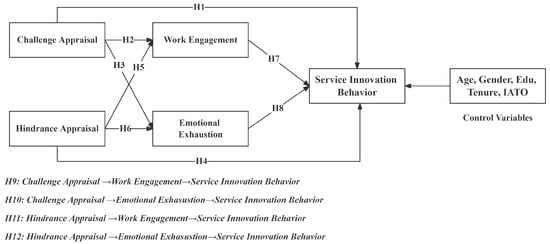
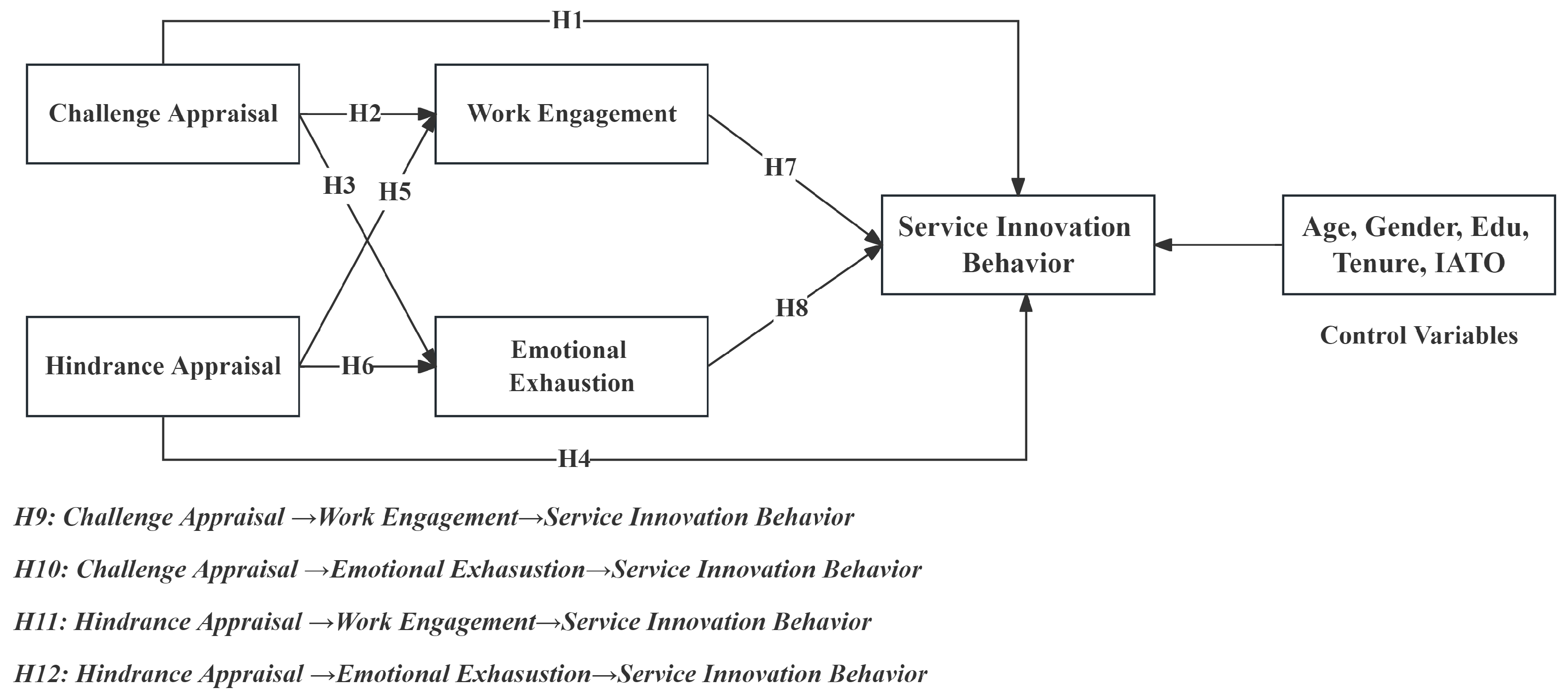
The research model is proposed in Figure 1. We propose that employees’ service innovation behavior is influenced by individuals’ challenge appraisal and hindrance appraisal, and we assume that these two types of appraisals exert their effects through distinct psychological pathways. Next, we examine the direct and indirect effects of these factors on service innovation behavior. Age, gender, education, tenure and IATO (involvement of AI technology in the occupation) are included as control variables.
Figure 1.
Conceptual model.
3.1. Direct Effect Hypotheses
The core premise of the transactional theory of stress is that individuals’ cognitive appraisals of stressors determine their subsequent coping efforts and behavioral outcomes [26]. When employees appraise AI-related work uncertainty as a challenge, they tend to adopt an approach-oriented motivational state [26]—that is, they psychologically approach rather than avoid the stressor. In service settings, this approach motivation translates into a greater propensity to experiment with novel service delivery methods and to generate creative ideas that enhance customer value. Such proactive exploration and creative activities constitute the essence of service innovation behavior [42,43]. Accordingly, we propose that challenge appraisal is directly and positively associated with employees’ service innovation behavior.
Work engagement refers to a persistent, pervasive positive affective-motivational state of fulfilment at work, characterized by vigor, dedication, and absorption [42]. When employees form a challenge appraisal of AI-related work uncertainty, they interpret AI-induced uncertainty as opportunities for personal growth and skill development [21]. According to TTS, this positive cognitive evaluation is associated with intrinsic motivation and work enthusiasm, making employees more willing to invest cognitive and emotional resources in their work roles. Emotional exhaustion, in contrast, is the feeling of being emotionally overextended and depleted of one’s emotional and physical resources [44], and it represents the core burnout dimension. When employees appraise AI-related work uncertainty as a challenge, positive emotional experiences are activated [45]. These positive emotions not only replenish psychological resources but also buffer the negative effects of work stress [46]. From the conservation of resources (COR) perspective, challenge appraisal is theoretically associated with the potential for resource gain, which may in turn be associated with the risk of sustained resource depletion and helping to prevent emotional exhaustion. Thus, we hypothesize:
H1.
Challenge appraisal of AI-related work uncertainty is positively associated with service innovation behavior.
H2.
Challenge appraisal of AI-related work uncertainty is positively associated with work engagement.
H3.
Challenge appraisal of AI-related work uncertainty is negatively associated with emotional exhaustion.
Conversely, hindrance appraisal leads employees to perceive AI as a threat to their job autonomy, security, and professional value [1,35]. This cognitive evaluation is theoretically linked to an avoidance-oriented motivation under TTS, prompting employees to adopt self-protective strategies that minimize contact with the stressor [26]. In service work, such an avoidant mindset suppresses proactive exploration and extra-role behaviors, making employees more likely to stick to routine procedures rather than engage in innovative attempts. COR theory further suggests that when individuals perceive threats to their resources, they shift into a defensive mode, allocating limited cognitive and emotional resources primarily to monitoring threats and maintaining the status quo [22,23], rather than investing in uncertain innovative activities. With respect to work engagement, hindrance appraisal is theoretically associated with reduced employees’ work vitality and focus because defensive thinking may limit them from deriving positive affective returns from their work [41]. Regarding emotional exhaustion, the continuous perception of threat requires employees to constantly mobilize psychological resources to cope, and this high-energy-consuming state, lacking effective resource replenishment, may in turn be associated with emotional resource depletion [24]. Therefore, we propose:
H4.
Hindrance appraisal of AI-related work uncertainty is negatively associated with service innovation behavior.
H5.
Hindrance appraisal of AI-related work uncertainty is negatively associated with work engagement.
H6.
Hindrance appraisal of AI-related work uncertainty is positively associated with emotional exhaustion.
Furthermore, prior research has well established that work engagement, as a positive motivational state, is positively associated with employees’ innovation and proactive behavior [18,47], whereas emotional exhaustion, as a core dimension of burnout, is associated with the depletion of employees’ cognitive and emotional resources, thereby being negatively associated with their innovative inclination [37,48]. We therefore hypothesize:
H7.
Work engagement is positively associated with service innovation behavior.
H8.
Emotional exhaustion is negatively associated with service innovation behavior.
3.2. Mediation Hypotheses
3.2.1. The Challenge Appraisal Path
Beyond the direct motivational pathway, challenge appraisal also influences behavior through individuals’ cognitive and affective mechanisms [38]. According to the COR, individuals are inherently motivated to obtain, maintain, and protect their valued resources [22]. When employees appraise AI-induced work uncertainty as a challenge, they tend to perceive the potential for resource gain or resource growth. This positive cognitive appraisal is positively associated with emotions [45] and intrinsic motivation [49], which may in turn promote work engagement [42]. When employees experience high levels of work engagement, they are more likely to direct these surplus resources into service innovation activities that require proactive exploration and creative thinking [50]. Thus, challenge appraisal of AI-related work uncertainty is positively associated with employees’ service innovation behavior through enhanced work engagement, which is theoretically conceptualized as a resource gain pathway. Accordingly, we propose:
H9.
Work engagement serves as a mediator in the relationship between challenge appraisal and service innovation behavior (i.e., challenge appraisal is positively associated with work engagement, which in turn is positively associated with service innovation behavior).
On the other hand, conservation of resources theory also suggests that individuals strive not only for resource gain but also to avoid resource loss [22]. Challenge appraisal plays a resource preservation function in this process [46]. When employees view AI-related work uncertainty as opportunities for growth and development, their psychological resources are preserved rather than being excessively consumed in coping with threats and anxiety [44]. Lower resource depletion may be associated with reduced physical and mental fatigue brought on by sustained work, which may in turn be associated with lower levels of emotional exhaustion [48]. The alleviation of emotional exhaustion, in turn, helps employees to maintain sufficient emotional and cognitive energy, which may make them more willing and able to participate in service innovation activities that require proactive exploration and creative thinking. Therefore, challenge appraisal of AI-related work uncertainty is also positively associated with employees’ service innovation behavior through reducing emotional exhaustion, which is theoretically conceptualized as a resource preservation pathway. Thus, we propose:
H10.
Emotional exhaustion serves as a mediator in the relationship between challenge appraisal and service innovation behavior (i.e., challenge appraisal is negatively associated with emotional exhaustion, which in turn is negatively associated with service innovation behavior).
3.2.2. The Hindrance Appraisal Path
Similar to challenge appraisal, hindrance appraisal is also posited to exert its influence through a dual-path mediating mechanism centered on resource dynamics. According to the conservation of resources theory, when individuals perceive threats to their valued resources, they adopt a defensive coping strategy aimed at minimizing further resource loss [46]. When employees appraise AI-related work uncertainty as threats and obstacles, they perceive a risk of resource depletion. This negative cognitive appraisal is theoretically linked to self-protective coping motivation and corresponds to negative emotional responses [26], which in turn relate to the sustained consumption of psychological resources. This defensive mindset is conceptually associated with reduced work vitality and focus, leading to reduced work engagement. From the perspective of conservation of resources theory, decreased work engagement reflects a state of resource scarcity, in which employees lack the surplus psychological resources necessary to invest in proactive behaviors [41]. Consequently, hindrance appraisal of AI-induced work uncertainty is negatively associated with employees’ service innovation behavior through reducing work engagement, which is theoretically conceptualized as a resource loss pathway [47]. Accordingly, we propose:
H11.
Work engagement serves as a mediator in the relationship between hindrance appraisal and service innovation behavior (i.e., hindrance appraisal is negatively associated with work engagement, which in turn is negatively associated with service innovation behavior).
Simultaneously, according to the conservation of resources theory, when individuals perceive threats, they continually invest psychological resources to maintain psychological equilibrium, and this sustained resource depletion tends to trigger emotional fatigue and energy depletion [22]. This pattern is consistent with the resource loss logic theorized in COR [24]. Emotional exhaustion, as a core dimension of burnout, is theoretically associated with reduced individuals’ cognitive flexibility and emotional energy, and is negatively associated with their inclination toward proactive exploration and creative endeavors at work [37]. Thus, hindrance appraisal of AI-related work uncertainty is negatively associated with employees’ service innovation behavior through increasing emotional exhaustion, which is theoretically conceptualized as an additional resource loss pathway. Therefore, we propose:
H12.
Emotional exhaustion serves as a mediator in the relationship between hindrance appraisal and service innovation behavior (i.e., hindrance appraisal is positively associated with emotional exhaustion, which in turn is negatively associated with service innovation behavior).
4. Methodology
4.1. Setting
This study targeted frontline employees working in e-commerce-related service roles who regularly interact with AI-enabled tools in their daily work. Data were collected through Credamo, a professional crowdsourcing data platform widely used in Chinese management research for its efficacy in gathering high-quality data from diverse industries and geographic regions [51]. The study was conducted between January and February 2025. Data were collected through Credamo, a professional crowdsourcing data platform. We specifically targeted employees from major Chinese e-commerce platforms where AI systems such as intelligent recommendation engines and AI chatbots are actively integrated into service delivery processes. The survey was administered with careful attention to ethical and procedural rigor. This study was conducted in accordance with the Declaration of Helsinki. All participants were informed about the purpose of the study, the voluntary nature of their participation, and their right to withdraw at any time. Informed consent was obtained electronically from all participants before they commenced the survey, and no personally identifiable information was collected to ensure complete anonymity.
To ensure the validity and clarity of the questionnaire in the Chinese context, we employed a forward-backward translation procedure. Two bilingual researchers independently translated the original English scales into Chinese, and a third researcher back-translated the Chinese version into English to verify semantic equivalence. Discrepancies were discussed and resolved through consensus. A pilot test with 30 frontline employees in e-commerce roles was then conducted to assess the clarity, accessibility, and cultural appropriateness of the items; minor wording adjustments were made based on their feedback before finalizing the questionnaire. The final questionnaire comprised 22 measurement items across five constructs, along with demographic questions (age, gender, education, tenure, and IATO), resulting in a total of 27 questions.
To minimize response bias and ensure data quality, we implemented a multi-stage screening and quality control procedure. First, a screening question—”Are you currently employed in an e-commerce service role where AI tools are used in your daily work?”—was placed at the beginning of the questionnaire; only those who answered “yes” were permitted to proceed. Second, we embedded two attention-check questions (e.g., “Please select ‘strongly agree’ for this item”) throughout the questionnaire to identify respondents who were not reading carefully. Third, we set a minimum completion time threshold; questionnaires completed in less than 60 s were considered invalid, as pilot testing indicated that careful completion required approximately 3–5 min. Fourth, we examined response patterns and excluded questionnaires with straight-lining responses (i.e., selecting the same option for all items) or exhibiting excessive missing data. Fifth, Credamo’s built-in quality control mechanisms were utilized, including IP address verification to prevent duplicate submissions and device fingerprinting to ensure unique respondents. Following these criteria, a total of 41 responses were excluded from the initial 358 collected, yielding 317 valid responses (effective response rate: 88.5%). Respondents were offered a small monetary incentive upon completion of the survey to encourage sincere participation.
The sample size for this study was determined through two primary methods. First, an a priori power analysis was conducted using G*Power 3.1 software. Following established conventions, the effect size f2 was set at 0.15 (medium effect), α at 0.05, and statistical power at 0.80 [52]. The analysis indicated a minimum sample size of 129. Additionally, following established practices in AI-behavior research demonstrating that approximately 300 responses are adequate for this nature and complexity [35], the final sample of 317 valid responses exceeds both requirements. To assess nonresponse bias, we compared early and late respondents on key demographic variables and core study constructs [53]. The results showed no significant differences between the two groups in gender, age, education, or tenure (all p > 0.05), nor in the core study variables, suggesting that nonresponse bias does not pose a major threat to our findings. The demographic characteristics of the sample are presented in Table 2.
Table 2.
Demographic information.
4.2. Measures
In this study, all constructs were derived from established scales in prior literature. The questionnaire was developed by the research team based on these established scales and was suitably adapted to align with the context of AI-enabled human–AI collaborative service environments in electronic commerce platforms. Challenge appraisal and hindrance appraisal were each measured using four items adapted from [54], with employees appraising the work uncertainty generated by the application of artificial intelligence in their work. Accordingly, the constructs are labeled throughout this manuscript as “challenge/hindrance appraisals of AI-related work uncertainty” to accurately reflect the operationalization. Work engagement was assessed using the three-item short version of the Utrecht Work Engagement Scale developed by [42]. Emotional exhaustion was measured using three items adapted from [55]. Service innovation behavior was evaluated using four items adapted from [27]. All items were rated on a five-point Likert scale ranging from 1 (strongly disagree) to 5 (strongly agree). The complete questionnaire, including all measurement items, is provided in Table A1 in Appendix A.
5. Data Analysis and Results
5.1. Data Analysis
This study employed Partial Least Squares Structural Equation Modeling (PLS-SEM) with SmartPLS 4.0 software to evaluate the theoretical model [56]. PLS-SEM was chosen for the following reasons. First, this study focuses on prediction-oriented model testing rather than precise covariance structure fitting [57]. Second, the theoretical model involves multiple parallel mediating pathways, where PLS-SEM offers significant advantages in handling such complex models [58]. Third, PLS-SEM imposes less stringent assumptions regarding sample distribution and normality, making it suitable for the exploratory analysis in this study [59]. The data analysis was conducted in two main stages. First, we performed the measurement model analysis to evaluate the internal reliability, convergent validity, and discriminant validity of all constructs. Subsequently, we evaluated the structural model to test the hypotheses.
5.2. Common Method Bias Test
Since some of the data in this study were collected through employee self-reports, common method bias (CMB) could be a potential concern [41]. We employed Harman’s single-factor test using the principal component analysis method within the factor analysis module of SPSS 27.0 on all measurement items of the self-rated variables [60]. The results revealed the presence of five factors with eigenvalues greater than 1, with the first factor accounting for 39.62% of the total variance, which is below the 50% threshold [61]. To further rule out common method bias, we also employed the unmeasured latent method factor approach: ULMC [62,63]. A common method factor was added to the measurement model, with all observed variables loaded onto both their respective theoretical constructs and this method factor. The results showed that the average method variance was 0.004, while the average substantive variance was 0.722, yielding a substantive-to-method variance ratio of 180:1. The inclusion of the method factor did not significantly improve model fit (ΔCFI < 0.01). These findings indicate that common method bias does not pose a serious threat to our results.
5.3. Measurement Model Assessment
We assessed the measurement model’s convergent and discriminant validity to ensure the reliability and validity of the constructs [57]. Convergent validity was assessed using factor loadings, composite reliability, and the average variance extracted (AVE) [64,65]. As shown in Table 3, the composite reliability (rho_c) values for all constructs surpass the threshold of 0.7, which indicates excellent internal consistency reliability [66]. Furthermore, the AVE values for all constructs ranged from 0.650 to 0.774, all meeting the standard of being greater than 0.5 [56,64]. These metrics collectively demonstrate that the measurement model possesses strong convergent validity.
Table 3.
Reliability.
To assess discriminant validity, we applied the Fornell-Larcker criterion [64]. As shown in Table 4, the square root of the AVE for each construct (bolded diagonal elements) was greater than its correlations with any other construct (off-diagonal elements), confirming that the constructs are empirically distinctive [67,68]. Second, we examined the cross-loadings. As shown in Table 5, each item loaded most strongly on its respective construct, with all cross-loadings substantially lower than the primary loadings, further supporting discriminant validity [69]. Third, we employed the HTMT criterion, which is considered a more robust approach for assessing discriminant validity [70,71]. The results, presented in Table 6, indicate that all HTMT values were substantially below the conservative threshold of 0.85, ranging from 0.329 to 0.766 [72]). The highest HTMT value was between WE and SIB (0.763), which is still well below the recommended cutoff [70]. These results provide strong evidence that discriminant validity is established among all constructs in this study.
Table 4.
Discriminant Validity Assessment.
Table 5.
Cross-Loadings.
Table 6.
Discriminant Validity (HTMT).
5.4. Hypothesis Testing
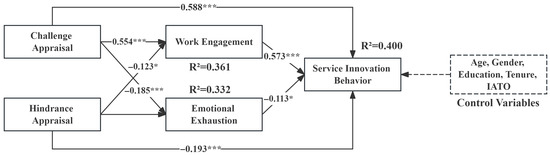
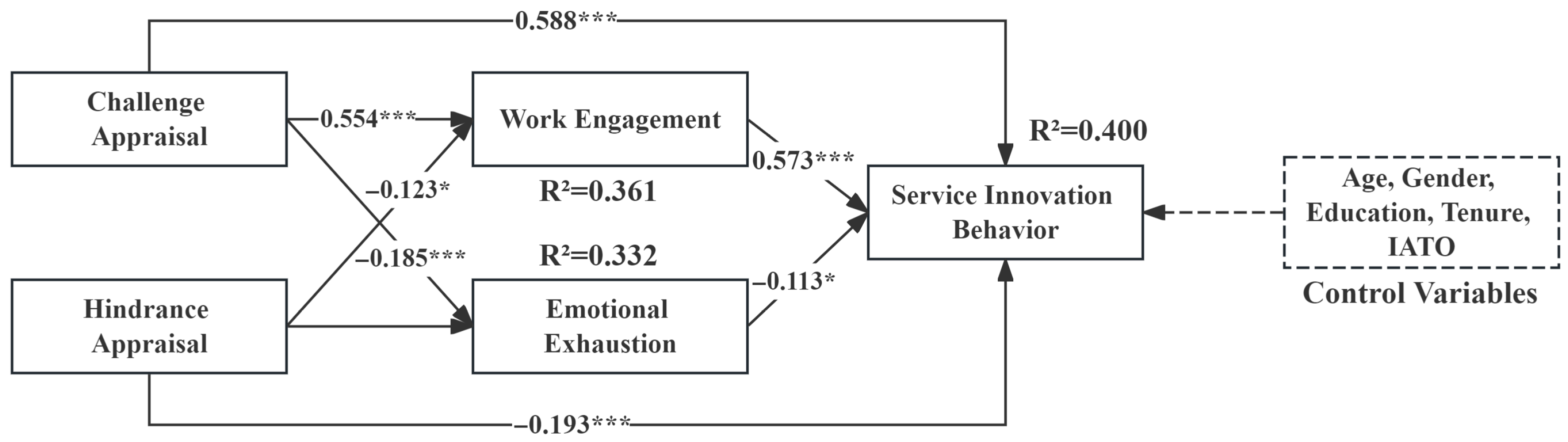
After validating the reliability and validity of the measurement model, we further evaluated the structural model to test the research hypotheses. As shown in Figure 2, the structural model explained a substantial proportion of the variance in the endogenous variables. Specifically, the model accounted for 36.1% of the variance in work engagement (R2 = 0.361), 33.2% of the variance in emotional exhaustion (R2 = 0.332), and 40.0% of the variance in service innovation behavior (R2 = 0.400). These R2 values indicate that the model possesses a moderate to strong explanatory power for employees’ service innovation behavior in human–AI collaborative service environments.
Figure 2.
Structural model results. Notes: *** p < 0.001, * p < 0.05; R2 values are presented within the corresponding constructs.
We assessed the model’s predictive relevance using the blindfolding procedure to obtain the Q2 values [73,74]. The Q2 values for work engagement, emotional exhaustion, and service innovation behavior were 0.220, 0.237, and 0.290, respectively—all well above zero, confirming the model’s adequate predictive relevance [56]. We further calculated the f2 values to evaluate the effect sizes. Following [75] guidelines, the effect sizes of work engagement, emotional exhaustion, and service innovation behavior were 0.416, 0.337, and 0.243, indicating medium and large effect sizes.
Regarding overall model fit, the SRMR (Standardized Root Mean Square Residual) value was 0.063, below the recommended threshold of 0.08 [76], and the NFI (Normed Fit Index) value was 0.873, approaching the acceptable level of 0.90 [77]. These fit indices suggest that the proposed model demonstrates acceptable fit to the data.
5.4.1. Direct Effect Testing
As shown in Table 7, all hypothesized direct effects were tested. The results showed that challenge appraisal of AI-induced work uncertainty had a positive association with service innovation behavior (β = 0.588, p < 0.001), thus supporting H1. Challenge appraisal of AI-induced work uncertainty also had a significant positive association with work engagement (β = 0.554, p < 0.001), supporting H2, and a significant negative association with emotional exhaustion (β = −0.185, p = 0.001), supporting H3.
Table 7.
Direct Effect Test Results.
Second, hindrance appraisal had a significant negative association with service innovation behavior (β = −0.193, p = 0.001), thereby supporting H4. The results further indicated a negative and statistically significant relationship between hindrance appraisal and work engagement (β = −0.123, p = 0.042), supporting H5, and a significant positive effect on emotional exhaustion (β = 0.495, p < 0.001), supporting H6.
Finally, work engagement had a significant positive association with service innovation behavior (β = 0.573, p < 0.001), supporting H7, while emotional exhaustion had a significant negative association with service innovation behavior (β = −0.113, p = 0.041), supporting H8.
5.4.2. Mediation Effect Testing
To test the mediation hypotheses, we employed the bootstrap procedure (5000 resamples) to examine the significance of the indirect effects [78]. Table 8 summarizes the results of the mediation analysis.
Table 8.
Results of the Mediating Effect Analysis.
The results showed that the indirect effect of challenge appraisal on service innovation behavior through work engagement was significant (indirect effect = 0.250, p < 0.001, 95% CI [0.124, 0.356]), indicating partial mediation; thus, H9 was supported. However, the indirect effect of challenge appraisal on service innovation behavior through emotional exhaustion was not significant (indirect effect = 0.020, p = 0.107, 95% CI [−0.005, 0.047]); thus, H10 was not supported.
Similarly, the indirect effect of hindrance appraisal on service innovation behavior through work engagement was not significant (indirect effect = −0.045, p = 0.058, 95% CI [−0.108, 0.002]); thus, H11 was not supported. The indirect effect of hindrance appraisal on service innovation behavior through emotional exhaustion was significant (indirect effect = −0.070, p < 0.05, 95% CI [−0.111, −0.005]), indicating partial mediation; thus, H12 was supported.
To further assess the magnitude of the mediated effects, we calculated the variance accounted for (VAF) for each mediation path. The VAF values indicated that H9 (CA → WE → SIB) accounted for 29.1% of the total effect, and H12 (HA → EE → SIB) accounted for 22.7%. Following the criteria of [56], the two significant mediation paths (H9 and H12) exhibited medium effect sizes.
5.4.3. Results and Discussion
Table 9 presents a comprehensive summary of the testing results for all 12 hypotheses in this study.
Table 9.
Summary of Hypothesis Testing Results.
The above direct effect results are generally consistent with the theoretical predictions of the challenge-hindrance stressor framework and provide empirical support for the applicability of this framework in the specific AI context. First, challenge appraisal of AI-related work uncertainty is positively associated with service innovation behavior, and hindrance appraisal of AI-related work uncertainty is negatively related to service innovation behavior. The results are consistent with previous research findings which suggest that employees’ positive perceptions of AI can translate into innovative behavior while negative perceptions of AI will inhibit innovative behavior [6,10,33]. Our study further extends this logic to the frontline employees on e-commerce platforms and confirms the applicability of this framework in e-commerce service contexts. Second, the results indicate that work engagement is positively associated with service innovation behavior, which is consistent with prior findings in the service industry and also supports the meta-analytic conclusion that work engagement is positively related to task and contextual performance [18,47]. Moreover, emotional exhaustion is negatively associated with service innovation behavior, echoing previous findings of the negative relationship between emotional exhaustion and job performance [48]. These results suggest the significant roles of work engagement and emotional exhaustion in service innovation in the human–AI collaboration contexts.
Regarding the mediation effects, the four mediation paths exhibit a clear asymmetric pattern: challenge appraisal is indirectly associated with service innovation behavior only through work engagement, while hindrance appraisal is indirectly associated with service innovation behavior only through emotional exhaustion. For challenge appraisal, the indirect path through work engagement (H9) is supported, which is consistent with the meta-analytic conclusion that challenge job demands influence employee outcomes through work engagement [26] and also aligns with the argument that work engagement facilitates proactive behavior [42]. From the perspective of conservation of resources theory, challenge appraisal makes employees perceive resource gain, thereby channeling psychological resources into innovative activities. However, the path through emotional exhaustion (H10) is not supported, indicating that the alleviating effect of challenge appraisal on emotional exhaustion does not significantly translate into innovation enhancement. This may be because there is a longer process of resource recovery between the reduction in emotional exhaustion and the stimulation of innovation, which is difficult to capture in cross-sectional data. In addition, frontline employees in the e-commerce industry generally experience high emotional labor demands, and even if emotional exhaustion is reduced to some extent, it may not be sufficient to substantially promote innovation. This finding suggests that the main mechanism through which challenge appraisal operates lies in activating positive motivation rather than merely reducing negative affect. For hindrance appraisal, the indirect path through emotional exhaustion (H12) is supported, which is consistent with previous research on emotional exhaustion as a mediator between stressors and performance [48,79]; hindrance appraisal makes employees continuously consume psychological resources, ultimately weakening their willingness to innovate. However, the path through work engagement (H11) is not supported, indicating that its inhibitory effect on service innovation behavior is primarily realized through affective resource depletion rather than motivational resource decline. This may be because when employees perceive AI-related uncertainty as threats, they primarily suffer an emotional strike. Such emotions rather than motivations play more critical roles in influencing innovation behavior. Overall, the mediating effects uncover the underlying mechanism of challenge appraisal and hindrance appraisal, enriching prior research which focuses only on direct effects and ignores the influence mechanism [26].
6. Implications
6.1. Theoretical Implications
This research makes several contributions to the existing literature. First, this study focuses on the unique and important service context of electronic commerce, systematically investigating the factor associated with frontline employees’ service innovation behavior. Although service innovation behavior has received extensive attention in traditional service industries such as hospitality, tourism, and healthcare, electronic commerce platforms, as the frontier of AI commercialization, present a service setting with distinctly different characteristics: intelligent recommendation engines and AI-powered chatbots have been deeply embedded throughout the entire service process from pre-sales to after-sales, with frontline employees collaborating with AI systems on an almost continuous basis. This high-frequency, high-intensity human–AI interaction is associated with psychological experiences and behavioral changes far more complex than those in other service industries. Nevertheless, systematic research specifically targeting frontline employees’ service innovation behavior in e-commerce remains relatively scarce. This study addresses this contextual gap, shedding light on the mechanisms underlying employee service innovation behavior in human–AI collaborative e-commerce environments, and providing needed empirical evidence for this field.
Second, we uncover the mechanism of the relationship between employee appraisals of AI-related work uncertainty and service innovation behavior. Prior studies have primarily treated cognitive appraisals as mediators that explain the relationship between AI technology factors and employee outcomes [1], with limited attention paid to how appraisals relate to innovative behavior. We posit challenge and hindrance appraisals as core predictors and identify their distinct pathways to service innovation behavior [21]. Specifically, challenge appraisal is positively associated with service innovation behavior through work engagement, while hindrance appraisal is negatively associated with service innovation behavior through emotional exhaustion. This dual-path framework provides a more complete picture of employees’ responses to AI-related work uncertainty in electronic commerce service settings [26].
Third, this study develops an integrated theoretical framework by combining the transactional theory of stress and the conservation of resources theory [22], offering a complete explanatory chain from cognitive appraisal to psychological resources to behavioral outcomes. More critically, the results suggest a significant asymmetry between the two mediating pathways. Specifically, our findings indicate that challenge appraisal is positively associated with innovation behavior mediated exclusively through work engagement, rather than emotional exhaustion. Conversely, hindrance appraisal exhibits a negative relationship with innovation behavior, which is solely mediated by emotional exhaustion instead of work engagement. This asymmetric pattern refines the challenge-hindrance stressor framework by uncovering a dual-pathway mechanism with distinct mediating roles. It indicates that the primary mechanism of challenge appraisal lies in activating positive motivational resources, whereas the core mechanism of hindrance appraisal lies in exacerbating the depletion of negative affective resources; the two appraisal types do not operate through opposite psychological states. This finding provides a more granular understanding of the boundary conditions under which motivational resources (work engagement) versus affective resources (emotional exhaustion) are mobilized. It also extends the transactional theory of stress by mapping specific cognitive appraisal types to distinct resource-allocation processes, offering a more nuanced stress-and-resources theoretical perspective for future research at the intersection of AI and innovation behavior.
6.2. Managerial Implications
We also offer some actionable viewpoints for frontline employees, e-commerce platforms and managers, and policymakers regarding service innovation enhances, AI implementation strategies, and psychological resource management in human–AI collaborative workplaces. First, from the employee’s perspective, we suggest that frontline employees should reframe their perceptions of AI-induced work uncertainty as a challenge rather than a hindrance. Our study shows that challenge appraisal significantly relates to employees’ work engagement and improves their service innovation behavior, but hindrance appraisal will be positively associated with employees’ emotional exhaustion, thereby reducing service innovation behavior. Thus, employees can benefit from cultivating a positive cognitive appraisal of AI-related work uncertainty. Individuals could actively seek learning opportunities to better understand AI tools, view AI as a collaborative partner that augments their capabilities rather than as a threat to job security, and continuously develop their skills to maintain a sense of control and self-worth in human–AI collaborative environments. Such cognitive reappraisal helps employees conserve psychological resources and sustain the motivation required to engage in innovative service delivery.
From a platform and manager perspective, this study highlights the critical role of management in shaping employees’ cognitive appraisals of AI-induced work uncertainty when implementing AI. Platforms and managers should not merely deploy AI systems; rather, they should invest in targeted interventions that foster challenge appraisals and mitigate hindrance appraisals. Specifically, platforms can achieve this goal by communicating transparently about the purposes and benefits of AI applications; providing adequate training and technical support to reduce uncertainty; and redesigning jobs to emphasize the complementary strengths of human employees and AI. Furthermore, managers should pay more attention to employees’ psychological states and foster a climate of “organizational care” that signals to employees that they are valued. Such care strengthens employees’ positive cognitive reframing during their interactions with AI, making it easier for them to perceive the meaning and value of their work and thus more effectively translating cognitive adjustments into proactive innovative behavior.
Lastly, governments and policymakers are suggested to take responsibility to facilitate a smooth and psychologically sustainable transition among employees. Governments can support electronic commerce platforms by funding AI literacy programs and workforce upskilling initiatives, thereby equipping employees with the competencies needed to work alongside intelligent technologies. Moreover, public policies should encourage the development of ethical, human-centric guidelines for AI applications that prioritize employee well-being alongside productivity goals. By promoting a societal discourse that positions AI as an assistive tool rather than a threat of displacement and by establishing social safety nets that address concerns about job transitions, governments can help shape an overall cognitive environment dominated by challenge appraisals, thereby stimulating innovation capacity in the service domain.
7. Conclusions and Future Research
This study developed and tested a dual-path model, grounded in the transactional theory of stress and the conservation of resources theory, to explain how employees’ challenge and hindrance appraisals of AI-related work uncertainty are associated with their service innovation behavior through the mediating roles of work engagement and emotional exhaustion. Based on PLS-SEM analysis of 317 valid responses from frontline employees on e-commerce platforms in China, the study draws the following main conclusions. Challenge appraisal is positively associated with service innovation behavior, while hindrance appraisal is negatively associated with service innovation behavior. Specifically, challenge appraisal is indirectly and positively associated with service innovation behavior only through work engagement (the resource-gain pathway), whereas hindrance appraisal is indirectly and negatively associated with service innovation behavior only through emotional exhaustion (the resource-loss pathway). At the theoretical level, this study integrates the transactional theory of stress and the conservation of resources theory to articulate a complete explanatory chain from cognitive appraisal to psychological resources to behavioral outcomes, and identifies the asymmetric mediation pattern of challenge and hindrance appraisals, thereby enriching the understanding of employees’ cognitive appraisal mechanisms in the AI context. At the practical level, the study recommends that frontline employees proactively cultivate challenge appraisals of AI, that e-commerce platforms and organizations foster a positive appraisal climate through transparent communication, adequate training, and organizational care, and that governments support employees’ smooth transition in the AI era by funding AI literacy programs and developing human-centric ethical guidelines for AI applications.
Since there are some limitations of this research, we propose several directions for future research. First, the data for this investigation were sourced from Chinese employees via one online crowdsourcing platform, and employees’ cognitive appraisals of AI-related work uncertainty may be shaped by cultural values. For instance, in cultures characterized by high collectivism or strong uncertainty avoidance, employees may be more prone to appraise AI-related work uncertainty as a hindrance rather than a challenge. Therefore, future research should conduct cross-cultural comparisons to examine the robustness and cross-national applicability of our proposed dual-path model. Second, this study treated AI applications as a generic stressor without distinguishing among the specific AI functionalities commonly deployed on e-commerce platforms. Since different types of AI may be associated with distinct patterns of cognitive appraisal and resource consumption, future research should incorporate more fine-grained AI characteristics and examine how different technical characteristics and parameters moderate or mediate employee challenge and hindrance appraisals. Third, although this study confirmed that common method bias does not pose a serious threat, some degree of common method bias may still exist because all variables were collected from employee self-reports. Therefore, future research is encouraged to adopt multi-source data collection strategies. For example, service innovation behavior could be evaluated with objective performance data such as the number of innovative suggestions adopted or customer feedback scores. Fourth, although this study identifies significant associations, its cross-sectional design limits our ability to infer causality; subsequent research should employ longitudinal or experimental approaches to confirm these causal conclusions.
Author Contributions
Conceptualization, X.M. and J.L.; methodology, X.M.; software, J.L.; validation, X.M. and J.L.; formal analysis, X.M.; investigation, J.L.; resources, X.M.; data curation, J.L.; writing—original draft preparation, J.L.; writing—review and editing, X.M.; visualization, X.M.; supervision, X.M.; project administration, X.M.; funding acquisition, X.M. All authors have read and agreed to the published version of the manuscript.
Funding
This study was funded by the National Natural Science Foundation of China (No. 72401211).
Institutional Review Board Statement
This study qualifies for exemption from ethical review and approval in accordance with the applicable national regulations and institutional policies, including but not limited to: The Ethical Review Measures for Biomedical Research Involving Humans (2016), Article 16, The Personal Information Protection Law (2021), Article 4, Relevant provisions of the Biosafety Law, the Data Security Law, and the GB/T 35273-2020 standard. This study utilizes fully anonymized, non-identifiable, and non-traceable data collected through a survey. No sensitive personal information was collected, and the research design poses no foreseeable risks to participants. Therefore, the study is exempt from the ethical review, in compliance with the aforementioned regulations. All research activities have been conducted in accordance with ethical standards for data security and participant privacy.
Informed Consent Statement
Informed consent was obtained from all subjects involved in the study.
Data Availability Statement
The data presented in this study are available on request from the corresponding author. The data are not publicly available due to privacy restrictions.
Conflicts of Interest
The author declares no conflicts of interest.
Appendix A
Table A1.
Questionnaire.
References
- Cheng, B.; Lin, H.; Kong, Y. Challenge or hindrance? How and when organizational artificial intelligence adoption influences employee job crafting. J. Bus. Res. 2023, 164, 113987. [Google Scholar] [CrossRef] [Scilit]
- Blaurock, M.; Büttgen, M.; Schepers, J. Designing Collaborative Intelligence Systems for Employee-AI Service Co-Production. J. Serv. Res. 2025, 28, 544–562. [Google Scholar] [CrossRef] [Scilit]
- Huang, M.-H.; Rust, R. Artificial Intelligence in Service. J. Serv. Res. 2018, 21, 109467051775245. [Google Scholar] [CrossRef] [Scilit]
- Mariani, M.M.; Hashemi, N.; Wirtz, J. Artificial intelligence empowered conversational agents: A systematic literature review and research agenda. J. Bus. Res. 2023, 161, 113838. [Google Scholar] [CrossRef] [Scilit]
- Maeiro, J.; Dias, Á.; Pereira, L. Cuteness vs. Usefulness: A Dual Perspective on Service Robot Acceptance in the Travel Industry. J. Theor. Appl. Electron. Commer. Res. 2025, 20, 48. [Google Scholar] [CrossRef] [Scilit]
- Zhao, D.; Tang, N.; Hai, S.; Zhao, L. Dual effects of AI-enabled job non-routinization on creativity: The moderating role of tacit knowledge awareness. J. Bus. Res. 2025, 198, 115482. [Google Scholar] [CrossRef] [Scilit]
- Zhang, S.; Guo, P.; Yuan, Y.; Ji, Y. Anxiety or engaged? Research on the impact of technostress on employees’ innovative behavior in the era of artificial intelligence. Acta Psychol. 2025, 259, 105442. [Google Scholar] [CrossRef] [Scilit] [PubMed]
- Ionașcu, A.E.; Bocanet, V.I.; Asaloș, N.; Lazăr, C.M.; Spătariu, E.C.; Barbu, C.A.; Nancu, D. Shifting Perceptions and Behaviors: The Impact of Digitalization on Banking Services. J. Theor. Appl. Electron. Commer. Res. 2025, 20, 295. [Google Scholar] [CrossRef] [Scilit]
- Li, M.; Hsu, C.H.C. A review of employee innovative behavior in services. Int. J. Contemp. Hosp. Manag. 2016, 28, 2820–2841. [Google Scholar] [CrossRef] [Scilit]
- Liang, X.; Guo, G.; Shu, L.; Gong, Q.; Luo, P. Investigating the double-edged sword effect of AI awareness on employee’s service innovative behavior. Tour. Manag. 2022, 92, 104564. [Google Scholar] [CrossRef] [Scilit]
- Xia, Y.; Ha, H.-Y. Descriptive Trajectories of How Service Innovation Shapes Customer Exit Intentions in Online Travel Agencies. J. Theor. Appl. Electron. Commer. Res. 2025, 20, 280. [Google Scholar] [CrossRef] [Scilit]
- Fan, J.; Zhang, L.; Li, N.; Man, S. How the perceived substitution of AI technology hinders nurses’ innovation behavior: The mediating role of AI anxiety and human-AI cooperation intention and the moderating role of organizational AI readiness. BMC Nurs. 2025, 24, 832. [Google Scholar] [CrossRef] [Scilit] [PubMed]
- Zhang, M.; Li, J.; Lin, Y. Navigating the artificial intelligence (AI) driven algorithmic paradox in hospitality: Unpacking the inverted U-shaped relationship between algorithmic management and employee service innovation. J. Hosp. Mark. Manag. 2025, 34, 905–923. [Google Scholar] [CrossRef] [Scilit]
- Lopez-Lopez, D.; Fondevila-Gascón, J.-F.; Torres-Peregrina, B.-M.; Marco-Simó, J.-M. Aligning stakeholders in AI-enabled customer service: Toward human-centric adoption in electronic marketplaces. Electron. Mark. 2026, 36, 42. [Google Scholar] [CrossRef] [Scilit]
- Hamedani, S.S.; Ee, T.Z.; Eranza, D.K.B.D.; Earn, T.K. AI customer service and hidden triggers of burnout: Evidence from Malaysia’s e-commerce sector. Int. J. Asian Soc. Sci. 2026, 16, 117–129. [Google Scholar] [CrossRef] [Scilit]
- Raub, S.; Liao, H. Doing the right thing without being told: Joint effects of initiative climate and general self-efficacy on employee proactive customer service performance. J. Appl. Psychol. 2012, 97, 651–667. [Google Scholar] [CrossRef] [Scilit] [PubMed]
- Amabile, T.M.; Hill, K.G.; Hennessey, B.A.; Tighe, E.M. The Work Preference Inventory: Assessing intrinsic and extrinsic motivational orientations. J. Personal. Soc. Psychol. Personal. Process. Individ. Differ. 1994, 66, 950–967. [Google Scholar] [CrossRef] [PubMed]
- Garg, S.; Dhar, R. Employee service innovative behavior: The roles of Leader-Member Exchange (LMX), work engagement, and job autonomy. Int. J. Manpow. 2017, 38, 242–258. [Google Scholar] [CrossRef] [Scilit]
- Gupta, R.; Rathore, B. Exploring the generative AI adoption in service industry: A mixed-method analysis. J. Retail. Consum. Serv. 2024, 81, 103997. [Google Scholar] [CrossRef] [Scilit]
- Folkman, S. Stress: Appraisal and Coping. In Encyclopedia of Behavioral Medicine; Gellman, M.D., Turner, J.R., Eds.; Springer: New York, NY, USA, 2013; pp. 1913–1915. [Google Scholar]
- Lepine, J.A.; Podsakoff, N.P.; Lepine, M.A. A meta-analytic test of the challenge stressor-hindrance stressor framework: An explanation for inconsistent relationships among stressors and performance. Acad. Manag. J. 2005, 48, 764–775. [Google Scholar] [CrossRef] [Scilit]
- Hobfoll, S.E. Conservation of resources: A new attempt at conceptualizing stress. Am. Psychol. 1989, 44, 513–524. [Google Scholar] [CrossRef] [PubMed]
- Hobfoll, S.E.; Halbesleben, J.; Neveu, J.-P.; Westman, M. Conservation of resources in the organizational context: The reality of resources and their consequences. Annu. Rev. Organ. Psychol. Organ. Behav. 2018, 5, 103–128. [Google Scholar] [CrossRef] [Scilit]
- Halbesleben, J.R.B.; Neveu, J.-P.; Paustian-Underdahl, S.C.; Westman, M. Getting to the “COR”: Understanding the role of resources in conservation of resources theory. J. Manag. 2014, 40, 1334–1364. [Google Scholar] [CrossRef] [Scilit]
- Wang, T.; Zhan, X.; Yu, W. The influence of AI awareness on employee’s psychological and behavioral outcomes and its theoretical explanation. Adv. Psychol. Sci. 2024, 32, 1195–1208. [Google Scholar] [CrossRef] [Scilit]
- Lazarus, R.S.; Folkman, S. Stress, Appraisal, and Coping; Springer: New York, NY, USA, 1984. [Google Scholar]
- Li, F.; Liu, B.; Lin, W.; Wei, X.; Xu, Z. How and when servant leadership promotes service innovation: A moderated mediation model. Tour. Manag. 2021, 86, 104358. [Google Scholar] [CrossRef] [Scilit]
- Janssen, O. Job demands, perceptions of effort-reward fairness and innovative work behaviour. J. Occup. Organ. Psychol. 2000, 73, 287–302. [Google Scholar] [CrossRef] [Scilit]
- De Jong, J.; Den Hartog, D. Measuring Innovative Work Behaviour. Creat. Innov. Manag. 2010, 19, 23–36. [Google Scholar] [CrossRef] [Scilit]
- Venkatesh, V.; Morris, M.G.; Davis, G.B.; Davis, F.D. User Acceptance of Information Technology: Toward a Unified View. MIS Q. 2003, 27, 425–478. [Google Scholar] [CrossRef] [Scilit]
- Wang, S.; Zhang, H. Generative AI in international hotel marketing: Impacts on employee creativity and performance. Int. J. Contemp. Hosp. Manag. 2025, 37, 2601–2626. [Google Scholar] [CrossRef] [Scilit]
- Zang, J.; Shao, Q.; Li, H. Challenge and hindrance: Yin and Yang paths of AI usage’s effects on Chinese employee innovative behaviour. Asia Pac. Bus. Rev. 2024, 1–27. [Google Scholar] [CrossRef] [Scilit]
- Liu, P.; Yuan, L.; Tan, Z. Proactive or Defensive? How AI Awareness Influences Employees’ Innovative Behavior and Knowledge Hiding. Asia Pac. J. Hum. Resour. 2025, 64, e70072. [Google Scholar] [CrossRef] [Scilit]
- Sun, C.; Zhao, X.; Guo, B.; Chen, N. Will Employee–AI Collaboration Enhance Employees’ Proactive Behavior? A Study Based on the Conservation of Resources Theory. Behav. Sci. 2025, 15, 648. [Google Scholar] [CrossRef] [Scilit] [PubMed]
- Ding, L. Employees’ challenge-hindrance appraisals toward STARA awareness and competitive productivity: A micro-level case. Int. J. Contemp. Hosp. Manag. 2021, 33, 2950–2969. [Google Scholar] [CrossRef] [Scilit]
- Fayyad, S.; Elsawy, O.; Wafik, G.M.; Abotaleb, S.A.; Ali Abdelrahman, S.A.; Abdel Moneim, A.; Omran, R.; Attia, S.; Mansour, M.A. Leaders’ STARA Competencies and Green Innovation: The Mediating Roles of Challenge and Hindrance Appraisals. Tour. Hosp. 2025, 6, 202. [Google Scholar] [CrossRef] [Scilit]
- Shi, S.; Zhao, H.; Li, H.; Zhang, M.; Leung, W.K. Investigating challenge and hindrance appraisals of enterprise social media use among hospitality employees: A technostress perspective. Tour. Manag. 2024, 100, 104814. [Google Scholar] [CrossRef] [Scilit]
- Lazarus, R.S. Emotion and Adaptation; Oxford University Press: New York, NY, USA, 1991. [Google Scholar]
- Cavanaugh, M.A.; Boswell, W.R.; Roehling, M.V.; Boudreau, J.W. An Empirical Examination of Self-Reported Work Stress among U.S. Managers. J. Appl. Psychol. 2000, 85, 65–74. [Google Scholar] [CrossRef] [Scilit] [PubMed]
- Crawford, E.R.; LePine, J.A.; Rich, B.L. Linking job demands and resources to employee engagement and burnout: A theoretical extension and meta-analytic test. J. Appl. Psychol. 2010, 95, 834–848. [Google Scholar] [CrossRef] [Scilit] [PubMed]
- Podsakoff, N.P.; LePine, J.A.; LePine, M.A. Differential challenge stressor-hindrance stressor relationships with job attitudes, turnover intentions, turnover, and withdrawal behavior: A meta-analysis. J. Appl. Psychol. 2007, 92, 438–454. [Google Scholar] [CrossRef] [Scilit] [PubMed]
- Schaufeli, W.B.; Bakker, A.B.; Salanova, M. The Measurement of Work Engagement With a Short Questionnaire: A Cross-National Study. Educ. Psychol. Meas. 2006, 66, 701–716. [Google Scholar] [CrossRef] [Scilit]
- Pederson, L.; Slowiak, J.M. Job Autonomy and Innovation in Healthcare and Human Services: Pathways Through Appraisal, Engagement, and Burnout. Healthcare 2026, 14, 437. [Google Scholar] [CrossRef] [Scilit] [PubMed]
- Maslach, C.; Jackson, S.E. The measurement of experienced burnout. J. Organ. Behav. 1981, 2, 99–113. [Google Scholar] [CrossRef] [Scilit]
- Fredrickson, B.L. The role of positive emotions in positive psychology: The broaden-and-build theory of positive emotions. Am. Psychol. 2001, 56, 218–226. [Google Scholar] [CrossRef] [PubMed]
- Hobfoll, S.E. Social and psychological resources and adaptation. Rev. Gen. Psychol. 2002, 6, 307–324. [Google Scholar] [CrossRef]
- Christian, M.S.; Garza, A.S.; Slaughter, J.E. Work engagement: A quantitative review and test of its relations with task and contextual performance. Pers. Psychol. 2011, 64, 89–136. [Google Scholar] [CrossRef] [Scilit]
- Wright, T.A.; Cropanzano, R. Emotional exhaustion as a predictor of job performance and voluntary turnover. J. Appl. Psychol. 1998, 83, 486–493. [Google Scholar] [CrossRef] [Scilit] [PubMed]
- Ryan, R.M.; Deci, E.L. Self-determination theory and the facilitation of intrinsic motivation, social development, and well-being. Am. Psychol. 2000, 55, 68–78. [Google Scholar] [CrossRef] [PubMed]
- Maria Stock, R.; Jong, A.d.; Zacharias, N.A. Frontline Employees’ Innovative Service Behavior as Key to Customer Loyalty: Insights into FLEs’ Resource Gain Spiral. J. Prod. Innov. Manag. 2017, 34, 223–245. [Google Scholar] [CrossRef] [Scilit]
- Huang, Y.; Gursoy, D. How does AI technology integration affect employees’ proactive service behaviors? A transactional theory of stress perspective. J. Retail. Consum. Serv. 2024, 77, 103700. [Google Scholar] [CrossRef] [Scilit]
- Faul, F.; Erdfelder, E.; Buchner, A.; Lang, A.-G. Statistical power analyses using G*Power 3.1: Tests for correlation and regression analyses. Behav. Res. Methods 2009, 41, 1149–1160. [Google Scholar] [CrossRef] [Scilit] [PubMed]
- Armstrong, J.S.; Overton, T.S. Estimating Nonresponse Bias in Mail Surveys. J. Mark. Res. 1977, 14, 396–402. [Google Scholar] [CrossRef] [Scilit]
- Boswell, W.R.; Olson-Buchanan, J.B.; LePine, M.A. Relations between stress and work outcomes: The role of felt challenge, job control, and psychological strain. J. Vocat. Behav. 2004, 64, 165–181. [Google Scholar] [CrossRef] [Scilit]
- Watkins, M.B.; Ren, R.; Umphress, E.E.; Boswell, W.R.; del Carmen Triana, M.; Zardkoohi, A. Compassion organizing: Employees’ satisfaction with corporate philanthropic disaster response and reduced job strain. J. Occup. Organ. Psychol. 2015, 88, 436–458. [Google Scholar] [CrossRef] [Scilit]
- Hair, J.F.; Risher, J.J.; Sarstedt, M.; Ringle, C.M. When to use and how to report the results of PLS-SEM. Eur. Bus. Rev. 2019, 31, 2–24. [Google Scholar] [CrossRef] [Scilit]
- Hair, J.F.; Hult, G.T.M.; Ringle, C.M.; Sarstedt, M. Primer on Partial Least Squares Structural Equation Modeling; Springer: Cham, Switzerland, 2014. [Google Scholar]
- Sarstedt, M.; Ringle, C.M.; Hair, J.F. Treating Unobserved Heterogeneity in PLS-SEM: A Multi-method Approach; Springer: Cham, Switzerland, 2017; pp. 197–217. [Google Scholar] [CrossRef] [Scilit]
- Ringle, C.M.; Sarstedt, M.; Straub, D.W. A Critical Look at the Use of PLS-SEM in MIS Quarterly. MIS Q. 2012, 36, iii–xiv. [Google Scholar] [CrossRef] [Scilit]
- Podsakoff, P.M.; Organ, D.W. Self-Reports in Organizational Research: Problems and Prospects. J. Manag. 2016, 12, 531–544. [Google Scholar] [CrossRef] [Scilit]
- Fuller, C.M.; Simmering, M.J.; Atinc, G.; Atinc, Y.; Babin, B.J. Common methods variance detection in business research. J. Bus. Res. 2016, 69, 3192–3198. [Google Scholar] [CrossRef] [Scilit]
- Podsakoff, P.M.; Mackenzie, S.B.; Lee, J.Y.; Podsakoff, N.P. Common method biases in behavioral research: A critical review of the literature and recommended remedies. J. Appl. Psychol. 2003, 88, 879–903. [Google Scholar] [CrossRef] [Scilit] [PubMed]
- Williams, L.J.; Cote, J.A.; Buckley, M.R. Lack of method variance in self-reported affect and perceptions at work: Reality or artifact? J. Appl. Psychol. 1989, 74, 462–468. [Google Scholar] [CrossRef]
- Fornell, C.; Larcker, D.F. Evaluating Structural Equation Models with Unobservable Variables and Measurement Error; American Marketing Association: Chicago, IL, USA, 1981. [Google Scholar] [CrossRef] [Scilit]
- Bagozzi, R.P.; Yi, Y. On the evaluation of structural equation models. J. Acad. Mark. Sci. 1988, 16, 74–94. [Google Scholar] [CrossRef]
- Nunally, J.C. Psychometric Theory, 2nd ed.; McGraw-Hill: New York, NY, USA, 1978. [Google Scholar]
- Chin, W.W. The partial least squares approach for structural equation modeling. In Modern Methods for Business Research; Psychology Press: London, UK, 1998; pp. 295–336. [Google Scholar]
- Gefen, D.; Straub, D.J. A Practical Guide to Factorial Validity Using PLS-Graph: Tutorial and Annotated Example. Commun. Assoc. Inf. Syst. 2005, 16, 91–109. [Google Scholar] [CrossRef] [Scilit]
- Fornell, C.; Bookstein, F.L. Two Structural Equation Models: LISREL and PLS Applied to Consumer Exit-Voice Theory. J. Mark. Res. 1982, 19, 440–452. [Google Scholar] [CrossRef] [Scilit]
- Henseler, J.; Ringle, C.M.; Sarstedt, M. A new criterion for assessing discriminant validity in variance-based structural equation modeling. J. Acad. Mark. Sci. 2015, 43, 115–135. [Google Scholar] [CrossRef] [Scilit]
- Voorhees, C.M.; Brady, M.K.; Calantone, R.; Ramirez, E. Discriminant validity testing in marketing: An analysis, causes for concern, and proposed remedies. J. Acad. Mark. Sci. 2016, 44, 119–134. [Google Scholar] [CrossRef] [Scilit]
- Gold, A.H.; Malhotra, A.; Segars, A.H. Knowledge management: An organizational capabilities perspective. J. Manag. Inf. Syst. 2001, 18, 185–214. [Google Scholar] [CrossRef] [Scilit]
- Stone, M. Cross-Validatory Choice and Assessment of Statistical Predictions. J. R. Stat. Soc. Ser. B 1974, 36, 111–147. [Google Scholar] [CrossRef] [Scilit]
- Geisser, S. The Predictive Sample Reuse Method with Application. J. Am. Stat. Assoc. 1975, 70, 320–328. [Google Scholar] [CrossRef]
- Cohen, J. Statistical Power Analysis for the Behavioral Sciences, 2nd ed.; Routledge: Abingdon, UK, 1988. [Google Scholar] [CrossRef] [Scilit]
- Hu, L.T.; Bentler, P.M. Cutoff criteria for fit indexes in covariance structure analysis: Conventional criteria versus new alternatives. Struct. Equ. Model. Multidiscip. J. 1999, 6, 1–55. [Google Scholar] [CrossRef] [Scilit]
- Bentler, P.M.; Bonett, D.G. Significance tests and goodness of fit in the analysis of covariance structures. Psychol. Bull. 1980, 88, 588–606. [Google Scholar] [CrossRef]
- Liu, Y.; Li, Y.; Song, K.; Chu, F. The two faces of Artificial Intelligence (AI): Analyzing how AI usage shapes employee behaviors in the hospitality industry. Int. J. Hosp. Manag. 2024, 122, 103875. [Google Scholar] [CrossRef] [Scilit]
- Lv, X.; Yang, Y.; Qin, D.; Cao, X.; Xu, H. Artificial intelligence service recovery: The role of empathic response in hospitality customers’ continuous usage intention. Comput. Hum. Behav. 2022, 126, 106993. [Google Scholar] [CrossRef] [Scilit]

Disclaimer/Publisher’s Note: The statements, opinions and data contained in all publications are solely those of the individual author(s) and contributor(s) and not of MDPI and/or the editor(s). MDPI and/or the editor(s) disclaim responsibility for any injury to people or property resulting from any ideas, methods, instructions or products referred to in the content. |
© 2026 by the authors. Licensee MDPI, Basel, Switzerland. This article is an open access article distributed under the terms and conditions of the Creative Commons Attribution (CC BY) license.