


Abstract
With the rapid advancement of digital technology, the self-service model has emerged, introducing a new work model known as digital shadow work (DSW). In this model, consumers perform tasks traditionally performed by employees, such as item scanning and self-checkout, without compensation. While this optimizes service processes and reduces business costs, it raises concerns about consumer rights, work value, and business sustainability. This study explores the psychological factors that affect consumer participation in DSW within self-service environments. Using a grounded theory approach and semi-structured interviews, the study reveals key psychological drivers under the dual-system framework. This study’s findings indicate that habitual behavior, impulsivity, time pressure, technological dependence, social identification, and delayed gratification significantly affect participation in DSW. Notably, the intuitive system (System 1) plays a dominant role in decision-making, leading consumers to make quick, automatic choices, often leaving them unaware of the work involved. By identifying these psychological factors, this research increases consumer awareness of DSW, promoting self-protection in self-service contexts. Additionally, understanding decision-making psychology provides essential insights for companies in non-face-to-face self-service technologies, supporting sustainable business practices.
1. Introduction
As self-service technologies (SSTs) have become institutionalized across retail, financial, and public service sectors, consumers are increasingly embedded in highly technology-mediated service processes and required to perform operational, verification, and process management tasks that had traditionally been performed by paid employees [1,2]. Subsequent research has further highlighted the expansion of such technology-mediated service practices in contemporary service environments [3,4]. This transformation has not only altered modes of service delivery but has also, at a more fundamental level, reshaped the allocation of work within contemporary service systems [5,6]. Recent studies further suggest that this shift reconfigures how service-related labor is distributed between firms and consumers [7]. From a sustainable business perspective, such a reconfiguration of service processes is often framed as an efficiency-enhancing strategy that reduces labor costs and resource consumption, thereby contributing to organizational sustainability goals. However, this shift simultaneously redistributes operational labor from firms to consumers, raising critical questions about the fairness and long-term sustainability of service systems. Within highly institutionalized self-service environments, a wide range of tasks involving explicit operational demands and labor are systematically transferred to consumers [8,9], yet are rarely defined or recognized as “work.” Instead, these tasks are naturalized as necessary components of service use. When performing such activities, consumers are typically positioned as service participants or technology users rather than as labor contributors. To capture this phenomenon, prior research has introduced the concept of digital shadow work (DSW), referring to the unpaid and unrecognized work that consumers must perform as a necessary part of service use within institutionalized service systems [10,11,12]. Recent studies have further examined DSW in technology-mediated service environments and have explored its implications for consumer participation and service experiences [13,14]. In contrast to broader digital labor research, which focuses on platform-mediated production relations, DSW emphasizes the redistribution of labor within service systems and the invisibility of such work in everyday service practices [12,15]. Related studies have further examined how such forms of work become embedded in routine service interactions [16,17].
Despite the growing prevalence of DSW at the experiential level, its institutionalized and concealed nature substantially weakens consumers’ reflection on their own work roles. Even as self-service processes become increasingly complex, consumers tend to comply with system instructions and perceive SSTs as efficient and convenient service options [18,19]. Subsequent studies further confirm similar patterns in technology-based service-adoption contexts [20,21]. This raises an important sustainability consideration. On the one hand, consumers’ participation in SSTs contributes to service efficiency, system scalability, and operational continuity, thereby supporting the economic dimension of sustainable service systems. On the other hand, such participation may involve increasing amounts of hidden labor performed without explicit recognition or compensation, raising concerns regarding fairness and the social dimension of sustainability. In many contexts, opportunities to refuse or exit institutionalized self-service pathways remain limited, while the labor embedded in service interactions is seldom recognized as a work contribution [3]. As a result, consumers persistently participate in labor-intensive service arrangements in the absence of clear awareness, giving rise to a structural tension characterized by the coexistence of unconscious participation and continuous burden.
In response to this phenomenon, recent research on DSW has made important progress in both conceptual clarification and measurement development [22]. Prior studies have identified key experiential dimensions, such as additional unpaid effort and fairness-related concerns [15,16]. Other work has developed measurement instruments to capture these perceptions [14,23]. However, existing research has largely focused on construct operationalization and outcome-oriented analyses linking DSW to psychological responses and service evaluations [24,25]. Additional studies further reinforce this outcome-oriented tendency [17,26]. Consequently, limited attention has been paid to how consumers gradually accept and internalize unpaid work requirements during everyday SSTs use.
In everyday service contexts, consumers are increasingly required to perform tasks that were previously undertaken by service employees. However, while prior studies have examined the concept and measurement of DSW and its relationships with psychological responses or service evaluation outcomes, the mechanisms through which consumers come to accept and repeatedly perform such unpaid tasks remain insufficiently explained. Existing research has primarily focused on measurement development [15] and outcome-based analyses [14], as well as outcome-oriented analyses linking DSW to consumer perceptions and evaluations. However, these approaches provide limited insight into the underlying decision-making processes that sustain continued participation in unpaid work in everyday service contexts. Moreover, the predominance of cross-sectional and variable-centered methodologies in SSTs and DSW research further constrains the ability to capture the cognitively generative mechanisms through which such participation is formed and maintained. As a result, the decision processes underlying the normalization of DSW remain relatively underexplored. Mainstream SSTs research has predominantly relied on cross-sectional surveys and variable-centered modeling approaches [19,27], which are well suited for examining attitudinal and behavioral outcomes. However, subsequent studies suggest that such approaches are less effective in capturing dynamic and routine service interactions [4,9]. Related research further highlights similar limitations in modeling technology use behaviors [28,29]. Similarly, although DSW research has achieved important progress in construct development, its analytical focus has not systematically examined consumers’ decision-formation processes, thereby limiting its ability to explain why DSW continues to be accepted and normalized within highly institutionalized self-service environments.
Against this backdrop, the present study does not seek to introduce a new analytical lens into an already mature SSTs literature. Rather, it argues that the emergence of the DSW concept itself necessitates a re-examination of how work transfer and responsibility allocation embedded in SSTs service models come to be continuously accepted and internalized by consumers. By focusing on the concrete decision-making pathways consumers experience during everyday SSTs use, this study advances a deep understanding of DSW, aiming to explain why and how consumers continue to undertake unpaid work in the absence of conscious awareness.
Methodologically, the study adopts a sequential mixed-methods design. First, grounded theory is employed to inductively identify key cognitive and decision-making mechanisms underlying consumers’ participation in DSW based on real-life self-service experiences. Subsequently, a quantitative analysis is conducted to examine the relationships and conditional effects among relevant psychological and contextual factors. Through iterative movement between theory building and empirical testing, this study does not take existing measurement instruments or predefined construct structures as its point of departure. Instead, it begins with situated self-service experiences to reveal how consumers gradually internalize continued compliance with unpaid tasks in everyday service interactions. In doing so, the study offers a mechanism-level refinement of adoption and use-centered assumptions in the SSTs literature and provides a more robust explanation of the psychological foundations of unpaid consumer labor in institutionalized self-service environments.
2. Theoretical Background
2.1. Self-Service Technologies (SSTs)
The concept of SSTs has redefined consumer roles in the service industry by shifting traditional service delivery tasks from employees to consumers [2]. For example, applications such as self-check-in/out systems, online shopping platforms, and self-service banking require consumers to perform tasks such as data entry, product scanning, and order confirmation. While this task transfer significantly improves service efficiency and corporate profitability, it often neglects consumers’ contributions of unpaid work [30,31]. The task allocation mechanism of SSTs creates implicit task transfer, transforming consumers from service recipients to service operators. However, due to role ambiguity, consumers are often unaware that they perform essential operational tasks for the business [32,33]. More recent studies further suggest that consumers may unconsciously assume responsibilities traditionally assigned to employees [7,24].
This unpaid work largely stems from consumers’ misperception of task value and work contribution, as they typically perceive these actions as essential service procedures rather than corporate-assigned operational tasks. Additionally, companies retain information control when designing SSTs platforms, while consumers are unaware of the internal mechanisms behind task allocation. This information asymmetry further intensifies consumers’ involvement in DSW [12,13]. Related research also highlights the role of system design in reinforcing such participation [15]. Consumers performing these tasks are often guided by interface designs such as task prompts and default options, exhibiting automated task execution behavior driven by system design.
Although the design of SST environments aims to enhance consumer autonomy and improve operational efficiency, the psychological processes underlying consumers’ unpaid participation and their routinized work behavior remain insufficiently understood. First, the SSTs literature has extensively examined the role of technology in improving service efficiency, convenience, and consumer adoption, providing a strong foundation for understanding technology-driven service transformation. However, this stream of research predominantly focuses on outcome-based variables such as satisfaction, adoption intention, and usage behavior, offering limited insight into how participation is formed and routinized in everyday service interactions. Second, research on DSW has advanced conceptual development and measurement construction, enriching the understanding of consumers’ unpaid work and its impact on attitudes and service evaluations. Nevertheless, existing studies remain largely outcome-oriented and pay limited attention to the cognitive processes that sustain continued engagement in unpaid work in the absence of explicit compensation. Third, from a methodological perspective, prior studies have predominantly relied on cross-sectional designs and variable-centered approaches. While these methods are effective in identifying relationships among variables, they are limited in explaining how participation becomes reinforced and internalized through repeated interactions in routine service contexts. Taken together, although prior research has advanced both SSTs and DSW scholarship, it remains insufficient to explain how consumers come to accept and sustain participation in unpaid work. This limitation highlights the need for a decision-focused approach that captures the cognitive processes and behavioral patterns underlying participation in DSW. Building on grounded theory [34], this study employs semi-structured interviews to explore how such participation becomes routinized and maintained in SSTs.
2.2. Digital Shadow Work (DSW)
Building on the concept introduced earlier, prior research on DSW originates from the notion of shadow work proposed by Illich (1981) [11], which emphasizes unpaid and often invisible activities embedded in institutional operations, with broad implications for work structures, social equity, and everyday practices. Subsequent developments, particularly by Lambert (2015) [10], have extended this concept into contemporary digital contexts, highlighting how consumers increasingly undertake service-related tasks within technology-mediated systems. Within this stream of research, DSW has been examined in various SSTs, particularly in early studies focusing on service interaction settings [12,35]. More recent research has further explored its implications for consumer behavior and service evaluation [16,36]. However, existing studies have largely focused on descriptive and outcome-oriented perspectives, offering limited insight into the underlying cognitive processes through which consumers come to accept and sustain participation in unpaid work within SSTs.
The evolution of DSW research has revealed a fundamental paradox: while consumers increasingly rely on SSTs for efficiency and convenience, they also take on unpaid work traditionally performed by service employees. However, this redistribution of labor often goes unnoticed, as the widespread adoption of SSTs gradually transfers operational burdens from businesses to consumers.
The COVID-19 pandemic further accelerated this transformation, driving extensive use of contactless SSTs [14,15]. Subsequent studies suggest that such changes have further embedded DSW into consumers’ everyday interactions [17,37]. Despite DSW’s growing influence on service ecosystems, existing research has made important contributions by documenting its psychological and emotional consequences, such as cognitive overload, frustration, and service dissatisfaction. These studies have helped establish DSW as a meaningful construct in technology-mediated service contexts. However, this stream of research has primarily adopted an outcome-oriented perspective, largely overlooking the underlying cognitive and behavioral processes that sustain continued participation. Consequently, limited attention has been paid to how such participation becomes normalized through everyday service interactions.
Consequently, although prior research has advanced conceptual clarification and measurement development, it remains insufficient in explaining how consumers come to accept and repeatedly engage in unpaid work within institutionalized self-service environments.
To address this research gap, the present study integrates decision science and behavioral psychology to systematically analyze the cognitive pathways and decision-making logic underlying DSW. Unlike prior studies relying on descriptive analysis and emotional attribution, this study emphasizes the psychological drivers of consumer behavior in self-service environments and explores how social cognition influences decision-making patterns.
By incorporating insights from behavioral psychology and consumer behavior theories, this study aims to develop an explanatory theoretical model that uncovers the formation and dynamic evolution of DSW. Rather than merely documenting emotional responses, it focuses on the cognitive structures underpinning voluntary participation in unpaid work, thereby deepening understanding of DSW as a socio-technical phenomenon. Table 1 presents a comparative analysis of key DSW studies in SSTs, highlighting differences in research methods, theoretical foundations, and core findings. This comparison further clarifies the unique contributions and theoretical advancements of the present study, reinforcing its academic significance and originality.
Table 1.
Key studies on DSW in SST contexts.
2.3. Grounded Theory
This study uses grounded theory [34] to build theoretical frameworks through data-driven analysis without predefined hypotheses. This approach effectively explores complex areas like SSTs and DSW, offering deeper insights into consumer decision-making under technological influence [38]. This perspective is further aligned with dual-system theory, which has been applied in information systems research to explain technology-related decision-making behaviors (e.g., [39]).
In SST contexts, consumers often unknowingly perform task transfers, such as self-checkout and order management, which are embedded in technological interfaces. These designs subtly guide consumers through service tasks, resulting in role ambiguity and information asymmetry, and transforming them from service recipients to service operators [15,40].
Since these dynamics are difficult to quantify with traditional methods, grounded theory’s open coding and iterative analysis are essential. This study conducts semi-structured interviews to explore decision-making patterns and psychological responses in the DSW context and focuses on identifying decision drivers [41]. By applying grounded theory, this research aims to develop a framework that explains consumer task interactions and reveals hidden work decision-making patterns within digital environments. The findings will support transparent and fair service system design through theoretical contributions and empirical insights.
3. Research Methods
3.1. Selection of Interview Respondents
This study investigates the psychological mechanisms underlying consumers’ participation in DSW within SSTs, with a particular focus on cognitive processes shaping participation decisions. To capture consumers’ lived experiences, semi-structured interviews were conducted using the interview protocol presented in Table 2, enabling analytical depth aligned with the research objectives.
Table 2.
Semi-structured interview protocol.
Importantly, this study explicitly focuses on young consumers as the primary research population, rather than aiming to represent the general population. This design choice is theoretically and contextually grounded. Young users are among the most active users of SSTs and digital services and are therefore more directly exposed to the redistribution of service responsibilities. Focusing on this high-exposure group enhances the observability of the underlying psychological mechanisms of DSW.
Consistent with grounded theory and mixed-methods research, this study adopts a theory-driven sampling strategy, prioritizing theoretical relevance and sensitivity to the phenomenon over statistical representativeness. Accordingly, the sample, which consists primarily of students, is appropriate for capturing the focal mechanisms under investigation.
At the same time, this study does not seek to generalize findings to the broader population, and the focus on young consumers represents a deliberate boundary condition of the research.
Participants were recruited among frequent SSTs users, and data collection proceeded iteratively following established qualitative research practices [34]. Data collection continued until theoretical saturation was achieved (n = 14), at which point no substantively new concepts, categories, or theoretical insights emerged from subsequent interviews. Interview protocols were developed in English and translated and back-translated to ensure conceptual equivalence. Interviews were conducted in either Chinese or English, enhancing linguistic clarity and cross-cultural validity.
The study adhered to established ethical standards for human subject research in the social sciences. As the study involved minimal risk, anonymous data collection, and adult participants, formal Institutional Review Board (IRB) approval was not required. All participants provided informed consent, and their privacy and confidentiality were fully protected throughout the research process. Participation was voluntary, and respondents were informed of the purpose of the study and their right to withdraw at any time. The final sample consisted of 14 Chinese graduate students enrolled in IS-related programs in South Korea, all of whom were regular SST users with substantial usage experience.
3.2. Data Analysis and Coding Procedures
Data were analyzed using grounded theory methods, following an iterative process of open coding, axial coding, and selective coding. Interview transcripts were organized and coded using Atlas.ti. During open coding, interview transcripts were examined line by line to identify concepts related to consumers’ psychological decision-making in SSTs. These concepts were grouped into preliminary categories that informed subsequent axial coding.
In the axial coding stage, relationships among categories were examined to identify patterns linking institutional conditions, technological features, and cognitive responses associated with participation in DSW. Building on insights from cognitive decision-making and dual-system perspectives, the analysis further refined these categories into an integrated decision-making structure. Through selective coding, core categories were synthesized into a theoretical model explaining consumers’ participation in DSW. This iterative process resulted in a grounded theoretical framework that provides a mechanism-oriented explanation of psychological decision-making underlying DSW in SSTs.
3.3. Findings
This study employed semi-structured interviews to examine the psychological factors shaping consumer decision-making in SSTs. Using Atlas.ti, 114 initial codes were aggregated into 28 higher-order categories and further integrated into nine core dimensions: habitual behavior, impulsivity, time pressure, technological dependence, contact avoidance, social identification, delayed gratification, peer influence, and DSW. Consumer decision-making emerged as the central theme underlying participation in unpaid work embedded in SST use.
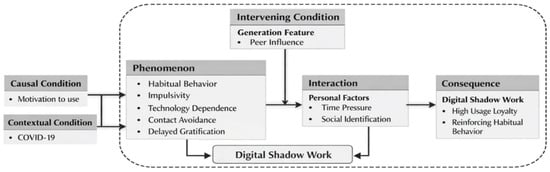
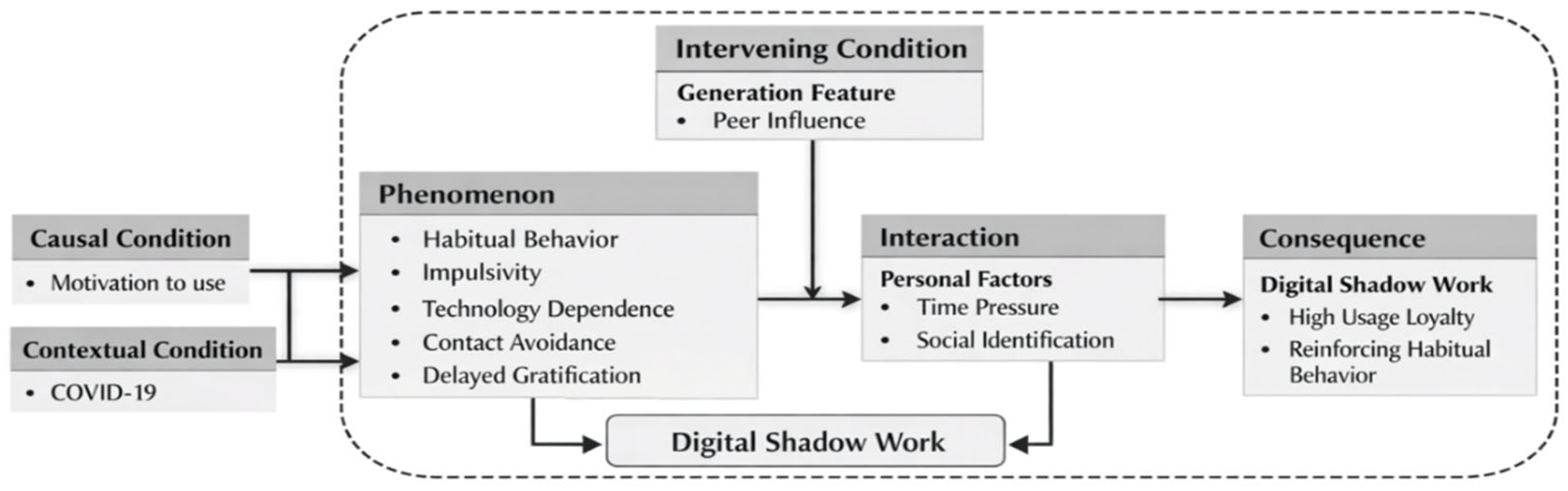
Habitual behavior reflected automated decision patterns developed through repeated SST use, characterized by routine and largely unconscious engagement that reduced cognitive effort (Figure 1). Impulsivity captured spontaneous participation in DSW driven by emotional responses and immediate convenience, while time pressure highlighted the role of perceived urgency in motivating SSTs selection. Technological dependence indicated psychological reliance on SSTs, whereas contact avoidance described a preference for minimizing social interaction through self-service. Social identification reflected a sense of belonging and social recognition associated with normalized SST use, and delayed gratification referred to consumers’ willingness to tolerate inconvenience or effort in anticipation of longer-term benefits. Peer influence further shaped decision-making by normalizing SST use through others’ behaviors and opinions. DSW was understood as uncompensated work embedded in SST use and commonly perceived as substituting for tasks previously performed by service employees, resulting in physical and psychological burdens. Several respondents noted that SST usage consumed personal time and, in some cases, intensified time pressure rather than alleviating it. These accounts suggest that, despite being framed as efficient and convenient, SSTs often embed additional responsibilities that remain largely unrecognized as work.
Figure 1.
Coding results. Note: Arrows indicate the relationships and directional flow among categories, and the dashed box represents the conceptual boundary of the digital shadow work process.
Overall, the findings identify a set of interrelated psychological drivers that shape consumer decision-making and sustain continued participation in unpaid work within SSTs. Figure 1 summarizes the coding results and illustrates the psychological foundations of DSW.
Building on the grounded theory findings summarized in Figure 1, this study conceptualizes DSW as a central outcome of consumers’ everyday decision-making in institutionalized SSTs. The qualitative analysis indicates that consumers’ continued participation in unpaid work is shaped by a set of interrelated psychological drivers, including habitual behavior, impulsivity, time pressure, technological dependence, contact avoidance, social identification, delayed gratification, and peer influence. Although these factors were identified inductively, their patterned co-occurrence points to a structured decision-making logic underlying DSW participation, rather than isolated behavioral tendencies.
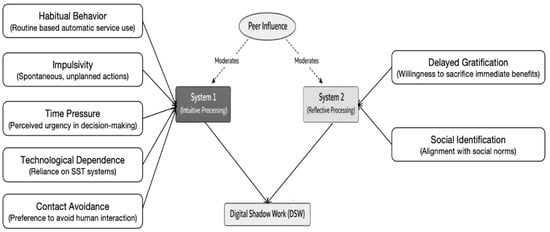
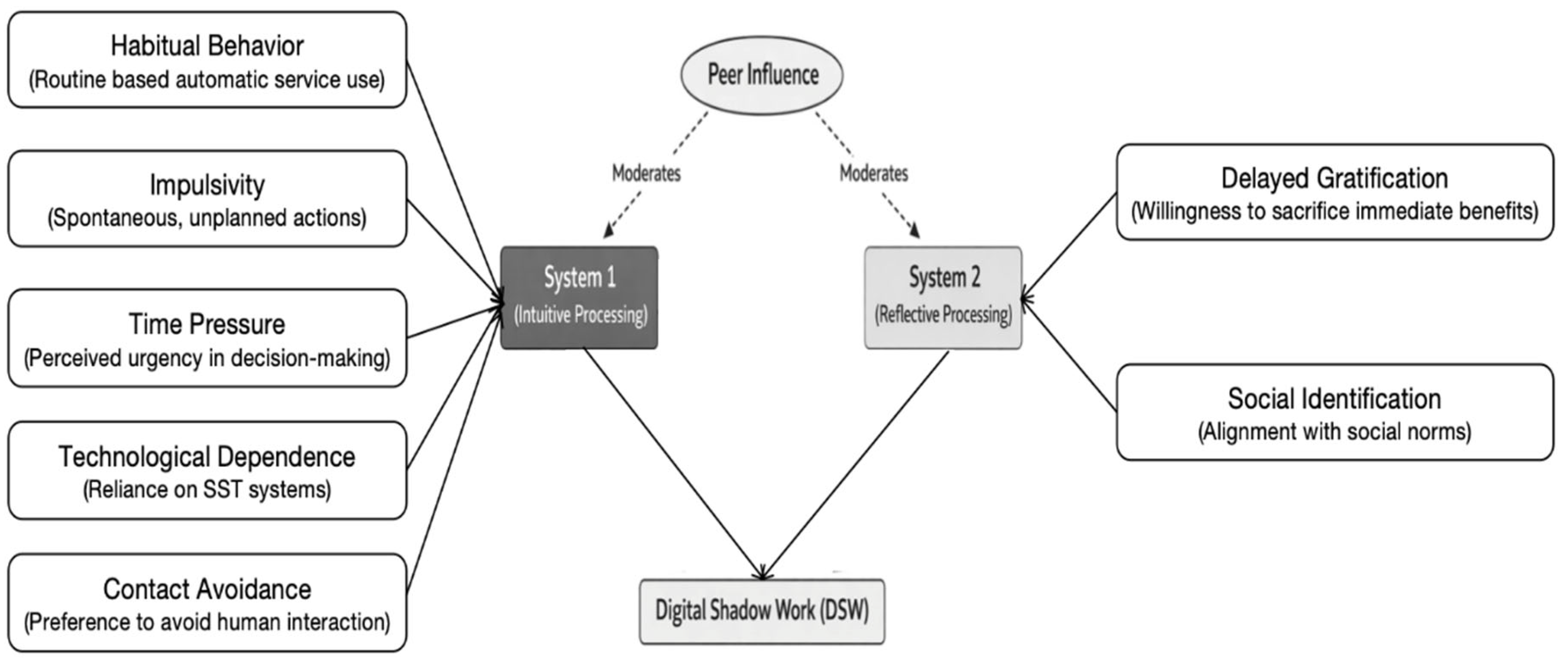
To theorize this logic, the identified drivers were organized using dual-system theory as an integrative lens. This framework distinguishes between intuitive and automatic cognitive processes (System 1) and reflective and deliberative processes (System 2). Habitual behavior, impulsivity, time pressure, technological dependence, and contact avoidance were conceptualized as primarily intuitive mechanisms, whereas delayed gratification and social identification were understood as reflective processes involving evaluative reasoning. Peer influence was treated as a contextual factor shaping how both intuitive and reflective processes translate into participation in DSW. This integration informed the conceptual model presented in Figure 2, which highlights the asymmetric roles of intuitive and reflective decision-making in sustaining consumers’ continued participation in unpaid DSW.
Figure 2.
Comprehensive model.
4. Confirmatory Study
4.1. Dual-System Theory
Dual-system theory, a cognitive psychology framework, suggests that human cognition and behavior are guided by two interacting systems, commonly referred to as System 1 and System 2 [39,42,43,44]. System 1 is typically characterized as fast, intuitive, and automatic, relying on habitual and experience-based responses to manage routine tasks. In this study, habitual behavior, impulsivity, time pressure, technological dependence, and contact avoidance are primarily conceptualized as reflecting System 1-dominant processes, as they involve relatively swift and low-effort cognitive responses. Prior research shows that habitual actions often occur without conscious reflection [40,45,46], impulsivity and time pressure favor intuitive processing [47,48], and technological dependence reflects automatic reactions to digital stimuli [49].
In contrast, System 2 is associated with relatively slower, more deliberate, and analytical processing, and is more likely to be involved in decision contexts requiring evaluation of long-term outcomes and social considerations. Delayed gratification, reflecting the ability to prioritize future rewards, represents a prototypical manifestation of System 2 processing [50]. Social identification, which involves behavioral adjustment based on social norms and anticipated evaluations by others, can also be understood as involving reflective cognitive processes, particularly when individuals consciously align their behavior with perceived social expectations [51]. Overall, System 2 emphasizes conscious control, long-term benefits, and socially informed evaluation, although its influence often operates alongside more automatic processes in routine contexts [52,53,54].
All constructs were measured using multi-item scales adapted from prior studies. Minor wording adjustments were made to ensure consistency with SSTs. Each item was assessed using a five-point Likert scale which ranges from one (strongly disagree) to five (strongly agree). The operational definitions, measurement items, and their sources for each construct are presented in Table 3, with each construct measured using three items.
Table 3.
Operational definitions.
4.2. Research Model and Hypotheses
Habitual behavior is defined as automated decision-making formed through frequent technology use in stable self-service environments, characterized by high automation and minimal conscious deliberation. Governed by System 1, habits are rapid, intuitive, and often unconscious [40,55,64,74]. Once established, habitual behaviors become default actions that reduce cognitive load and limit reliance on System 2’s resource-intensive processing. Prior research shows that habits shape consumer decision-making by reinforcing repeated choices and reducing information search [57,70,75,76]. Accordingly, this study proposes that habitual behavior increases consumers’ participation in DSW.
H1.
Habitual behavior positively influences participation in DSW.
Impulsivity is conceptualized within dual-system theory as decision-making driven by fast, intuitive, and automatic processes when using SSTs. Impulsive decisions are often emotionally driven and occur without extensive rational evaluation [48,60]. Prior studies indicate that impulsivity encourages spontaneous technology use and responsiveness to immediate gratification rather than long-term evaluation [20,29,61]. As such, impulsivity is expected to increase consumer participation in DSW.
H2.
Impulsivity positively influences consumer participation in DSW.
Within dual-system theory, time pressure functions as a trigger that shifts decision-making toward intuitive processing. Under conditions of urgency, individuals rely more heavily on System 1 and reduce deliberate analysis [41,52]. In self-service contexts, time pressure accelerates decision-making and increases reliance on rapid choices [50,58,59], thereby facilitating participation in DSW.
H3.
Time pressure positively affects participation in DSW.
Contact avoidance is understood as an automatic response aimed at minimizing social discomfort when interpersonal evaluation is unnecessary. Driven by System 1’s non-deliberative nature, contact avoidance leads consumers to favor self-service options over human interaction [77,78]. Prior research shows that such tendencies are associated with preferences for self-checkout and technology-mediated services [61,62].
H4.
Contact avoidance positively affects participation in DSW.
Technological dependence refers to habitual reliance on technology for rapid feedback and routine usage, reflecting System 1’s automatic and intuitive characteristics [49,53]. Consumers often respond instinctively to digital cues without conscious deliberation [79], which shapes decision-making and engagement with services [74,80,81].
H5.
Technological dependence positively affects participation in DSW.
Delayed gratification reflects consumers’ willingness to prioritize long-term benefits over immediate rewards and is associated with System 2’s conscious and analytical processing [68]. This orientation encourages thoughtful evaluation and sustained effort, particularly in adopting technologies that require learning in exchange for future benefits [69,82].
H6.
Delayed gratification positively affects participation in DSW.
Social identification refers to consumers’ perception of belonging to a social group and the alignment of behavior with group norms and social status. This process involves reflective evaluation of social consequences and identity-related outcomes, characteristic of System 2 processing [51,65,73,83]. Social identification has been shown to influence consumer choices through conformity to group expectations [56,84,85,86].
H7.
Social identification positively affects participation in DSW.
Dual-system theory posits that consumer decision-making is shaped jointly by System 1 and System 2. However, routine consumption decisions are often dominated by intuitive processing, particularly under conditions of stress or limited cognitive resources [46,87]. Heuristics and prior experience frequently guide decision-making, leading consumers to select satisfactory rather than optimal options [88,89].
H8.
System 1 has a greater effect on participation in DSW than System 2.
Peer influence refers to the impact of others’ attitudes and behaviors on individual consumption choices [51,71]. Social identity theory suggests that individuals imitate behaviors of those they identify with to maintain group membership [72], while normative influence encourages conformity to group expectations [52]. From a dual-system perspective, System 1 is particularly susceptible to peers’ habitual behaviors, whereas System 2 processes peer feedback more deliberatively [85].
H9.
High peer influence enhances the positive effect of System 1 on participation in DSW.
H10.
High peer influence diminishes the positive effect of System 2 on participation in DSW.
4.3. Respondents’ Demographic Characteristics
An online survey was conducted to examine consumers’ participation in DSW within SSTs. The target population consisted of consumers with prior experience using SSTs. Data were collected over a one-week period in November 2023 through an online questionnaire distributed via university networks and social media platforms. A convenience sampling technique was employed to recruit respondents who frequently use SSTs. The resulting sample primarily consisted of young consumers and students who were active users of SSTs, which is consistent with the study’s objective of examining decision-making patterns associated with DSW. All participants were informed of the research purpose and the intended use of the data prior to participation and provided informed consent. A total of 219 responses were collected. After excluding inconsistent responses (n = 5) and ineligible responses (n = 7), 207 valid questionnaires were retained for subsequent analysis. Although the sample was appropriate for the research purpose, the predominance of younger and student respondents may limit the generalizability of the findings to broader consumer populations. Therefore, the findings should be interpreted primarily within the context of active SST users. The demographic characteristics of the sample are presented in Table 4.
Table 4.
Sample profile.
The statistical analyses were conducted using SPSS 24.0, including reliability and validity assessment, multiple regression analysis, and moderation analysis.
4.4. Data Analysis and Results
Prior to hypothesis testing, the measurement properties of all constructs were evaluated in terms of reliability and validity. Reliability and convergent validity were evaluated using Cronbach’s alpha, composite reliability (CR), and average variance extracted (AVE). As shown in Table 5, the values of Cronbach’s alpha and CR for all constructs were above the recommended threshold of 0.70, while all AVE values exceeded 0.50. These results indicate adequate internal consistency and convergent validity.
Table 5.
Reliability and convergent validity.
Item reliability was further examined by inspecting standardized factor loadings. As shown in Table 6, all measurement items loaded strongly on their respective constructs, with loadings exceeding the commonly accepted threshold of 0.70, supporting indicator reliability.
Table 6.
Standardized factor loadings.
The heterotrait–monotrait ratio (HTMT) was used to examine discriminant validity among the constructs. As presented in Table 7, all HTMT values remained below the recommended cutoff value of 0.85, indicating satisfactory discriminant validity.
Table 7.
Discriminant validity (HTMT).
Before testing the proposed hypotheses, multicollinearity was examined to ensure the robustness of the regression analyses. Variance inflation factors (VIF) were calculated for all independent variables. As presented in Table 8, all VIF values were well below the conservative threshold of 3.3, indicating that multicollinearity was not a concern.
Table 8.
Variance inflation factors (VIF).
Following these diagnostics, multiple regression analyses were conducted to test Hypotheses H1–H7, with DSW as the dependent variable. The results indicate that all proposed predictors exert significant positive effects on DSW participation. Detailed regression analyses results are shown in Table 9.
Table 9.
Regression analysis.
Subsequently, predictors were aggregated into intuitive (System 1) and reflective (System 2) decision-making systems to test Hypothesis H8. Regression results show that both systems significantly influence DSW participation, with System 1 exhibiting a substantially stronger effect. The corresponding results are presented in Table 10.
Table 10.
Linear regression validation results.
Finally, moderation analyses were conducted to examine the moderating role of peer influence (H9–H10). As reported in Table 11, peer influence does not significantly strengthen the relationship between the intuitive decision system and DSW participation, but significantly weakens the relationship between the reflective decision system and DSW participation.
Table 11.
Linear regression results.
5. Discussion and Implications
5.1. Discussion
Building on the empirical results, this study advances the understanding of DSW by conceptualizing consumer participation as a cognitively normalized outcome of routine SST use, rather than as a series of isolated or fully deliberative choices. The findings indicate that participation in DSW is not driven by a single psychological factor or short-term situational trigger. Instead, it reflects a decision orientation shaped by the combined influence of multiple psychological mechanisms embedded in everyday interactions with SSTs.
This study further contributes to the literature by positioning itself at the intersection of shadow work research and dual-system theory in information systems [39], thereby explaining the cognitive mechanisms that sustain consumers’ participation in DSW within SSTs.
Overall, factors associated with low cognitive cost and intuitive decision-making including habitual behavior, impulsivity, time pressure, technological dependence, and contact avoidance exert stable and consistently significant effects on DSW participation. These results suggest that consumers’ engagement in unpaid self-service tasks is not primarily based on systematic evaluations of effort, fairness, or responsibility transfer. Rather, participation tends to emerge through experience-based and cognitively efficient decision patterns, in which familiarity, speed, and convenience guide choices during routine SST interactions. As a result, unpaid consumer effort becomes integrated into normal service use, reducing the likelihood that it is consciously recognized or critically assessed.
At the same time, delayed gratification and social identification also exhibit significant, though comparatively weaker, effects on DSW participation. This pattern indicates that participation in DSW cannot be understood as entirely automatic or unconscious. Under certain conditions, consumers may accept additional effort when they anticipate long-term benefits or when self-service behaviors align with their social identity. However, these reflective considerations operate within already established usage patterns and remain secondary within the overall decision-making structure, exerting weaker influence than intuitive decision factors.
System-level comparisons further clarify this asymmetry. Although both intuitive and reflective decision orientations significantly affect DSW participation, intuitive processing plays a more dominant role. This dominance helps explain why DSW is often less likely to be actively reflected upon or questioned in everyday self-service contexts, even as task complexity and consumer responsibility increase. Decisions to engage in unpaid work are thus primarily guided by fast, experience-based judgments rather than sustained rational deliberation.
Additional insights emerge from the moderation results. Peer influence does not strengthen intuitive decision patterns, suggesting that once a stable decision path is established, judgments regarding DSW participation become relatively insensitive to social cues. Intuitive decisions are typically formed through repeated experiences and habitual interactions with SSTs. Once such automatic usage patterns become established, consumers tend to rely on familiarity and cognitive efficiency rather than external social influence when deciding whether to engage with self-service technologies. This finding helps explain the non-significant effect of H9.
In contrast, peer influence weakens reflective decision orientations, indicating that shared expectations and observed behaviors may substitute for independent evaluation. When consumers observe that SST use is common among peers, the perceived need for careful deliberation about effort, fairness, or responsibility transfer may be reduced. In this sense, social influence may function as a heuristic cue that simplifies reflective evaluation rather than reinforcing it. This interpretation is consistent with dual-system theory, which suggests that external cues may reduce the cognitive effort associated with deliberate reasoning in routine decision contexts.
Taken together, these findings suggest that within SST usage contexts, consumers’ participation in DSW reflects a decision-making pattern dominated by low cognitive cost and experience-based processing, supplemented but not overridden by limited reflective consideration. Participation in unpaid work is neither fully imposed nor entirely the result of deliberate choice. Instead, it develops through routine interactions with self-service systems, where efficiency, familiarity, and socially normalized expectations shape consumer behavior more strongly than explicit evaluations of responsibility allocation.
From a sustainable business perspective, DSW in SSTs can be understood as a form of consumer participation that supports firm operations. By transferring certain operational tasks to consumers, such participation contributes to improved efficiency, service continuity, and the scalability of digital service systems. In this sense, consumers’ unpaid efforts are functionally embedded within contemporary service infrastructures, enabling firms to maintain and expand self-service operations. However, this functional perspective should not be interpreted uncritically. The increasing reliance on consumers’ unpaid efforts raises important concerns regarding fairness, recognition, and the long-term sustainability of service systems. As unpaid participation becomes normalized through repeated interactions, the boundary between voluntary engagement and structurally induced labor becomes increasingly blurred. Therefore, DSW should be understood not only as a source of operational value but also as a site of structural tension within digital service environments, where efficiency gains coexist with issues of hidden labor and responsibility redistribution.
The findings of this study should be interpreted in light of the characteristics of the sample. As the respondents were predominantly young consumers and students who were familiar with SSTs, the identified relationships may be particularly representative of digitally experienced users. Therefore, the relative importance of factors such as habitual behavior, technological dependence, and contact avoidance may differ across consumer groups with varying levels of technological familiarity. Future research should extend the investigation to broader and more heterogeneous populations to assess the applicability and generalizability of the proposed relationships across different demographic and technological contexts.
5.2. Implications
This study offers important implications for both theory and practice by advancing a decision-making-focused understanding of consumer participation in DSW. From a theoretical perspective, the findings extend the SSTs and service literature by demonstrating how the dominance of intuitive decision-making, combined with a constrained role of reflective cognition, contributes to the normalization of unpaid consumer work. By integrating DSW with dual-system decision frameworks, the study provides a more nuanced explanation of how responsibility transfer is sustained through routine self-service interactions rather than through fully conscious consumer choice.
From a managerial perspective, the results suggest that efficiency-oriented narratives alone may be insufficient for understanding and managing consumer participation in SSTs. Because engagement in DSW is largely shaped by automatic and habitual decision patterns, interventions based solely on rational choice assumptions may overlook how service design systematically guides consumer behavior. Organizations may therefore benefit from transparency-oriented design strategies that increase the visibility of effort requirements while acknowledging the role of habit formation and intuitive reliance. Such an approach can help balance operational efficiency with consumer well-being and support more sustainable self-service relationships.
Overall, these implications underscore the importance of reassessing the psychological foundations of consumer participation in self-service environments. As digital technologies continue to expand the scope of unpaid consumer work, understanding the cognitive decision-making patterns and structures associated with DSW participation becomes increasingly critical for both scholars and practitioners.
5.3. Limitations and Future Research
This study has several limitations that provide opportunities for future research. First, the empirical analysis was primarily based on a sample of Chinese international students residing in South Korea. Although this group represents active users of SSTs and is therefore well suited for examining the cognitive mechanisms underlying DSW, the relatively homogeneous nature of the sample may limit the generalizability of the findings. Future research is encouraged to employ larger and more diverse samples across different age groups, occupations, and cultural contexts to further validate the robustness and external validity of the findings. Second, this study does not distinguish among different types of SSTs. Technologies such as mobile payment systems, self-checkout kiosks, and online customer service platforms vary in interaction complexity and perceived responsibility. Future studies could adopt a more fine-grained approach by examining how specific SST configurations shape consumers’ intuitive and reflective decision processes related to DSW participation. Third, this study is based on cross-sectional data, which limits the ability to capture temporal dynamics and causal evolution in consumer decision-making processes. While the findings provide a mechanism-based and cognitively structured interpretation of DSW participation, they do not directly observe changes in decision-making over time. Future research is encouraged to adopt longitudinal or experimental designs to better examine how decision-making patterns evolve across repeated SSTs interactions.
6. Conclusions
This study contributes to the understanding of DSW by demonstrating that consumers’ participation in unpaid work within SSTs is best understood as a stable cognitive decision pattern rather than a series of isolated or fully deliberate choices. By shifting the analytical focus from adoption outcomes to decision-making structures, the study clarifies why unpaid work participation persists in everyday self-service use, even when consumers remain only weakly aware of responsibility transfer.
Across qualitative and quantitative analyses, the findings consistently indicate that intuitive, low-effort decision-making plays a dominant role in shaping participation in DSW, while reflective reasoning exerts a secondary and constrained influence. This asymmetric decision structure provides a parsimonious explanation for the persistence and relative invisibility of unpaid consumer work in routine SST interactions.
Furthermore, this study repositions DSW as a critical outcome of consumer decision-making in digital service systems and moves beyond purely voluntaristic interpretations of consumer participation. From a sustainable business perspective, DSW should be understood not only as unpaid labor but also as a form of consumer participation that functionally contributes to the efficiency, continuity, and scalability of digital service systems.
At the same time, this dual role underscores a fundamental tension inherent in contemporary SSTs, where the functional value generated through consumer participation coexists with concerns regarding fairness, recognition, and the increasing reliance on unpaid labor. As digital services continue to expand and embed greater responsibility within user interactions, recognizing this structural tension and its cognitive underpinnings remains essential for future research on self-service design, responsibility allocation, and sustainable service systems.
Author Contributions
Conceptualization, T.L. and J.K.; methodology, T.L. and J.K.; formal analysis, T.L.; investigation, T.L.; data curation, T.L.; writing original draft preparation, T.L.; writing review and editing, J.K.; supervision, J.K. All authors have read and agreed to the published version of the manuscript.
Funding
This research received no external funding.
Institutional Review Board Statement
This study does not require ethics committee or Institutional Review Board (IRB) approval in accordance with the applicable national legislation of the Republic of Korea and the institutional guidelines of Chonnam National University. The study involved voluntary participation, anonymous questionnaire responses, and interviews, and posed minimal risk to participants.
Informed Consent Statement
Informed consent was obtained from all subjects involved in the study.
Data Availability Statement
The data presented in this study are available from the corresponding author upon reasonable request. The data are not publicly available because they contain anonymous questionnaire and interview data collected from human participants.
Conflicts of Interest
The authors declare no conflict of interest.
References
- Bitner, M.J.; Zeithaml, V.A.; Gremler, D.D. Technology’s impact on the gaps model of service quality. In Handbook of Service Science; Springer: Boston, MA, USA, 2010; pp. 197–218. [Google Scholar]
- Meuter, M.L.; Ostrom, A.L.; Roundtree, R.I.; Bitner, M.J. Self-service technologies: Understanding customer satisfaction with technology-based service encounters. J. Mark. 2000, 64, 50–64. [Google Scholar]
- Holmqvist, J.; Wirtz, J.; Fritze, M.P. Luxury in the digital age: A multi-actor service encounter perspective. J. Bus. Res. 2020, 121, 747–756. [Google Scholar] [CrossRef] [Scilit]
- Galdolage, B.S. Are you a trend setter or a straggler? Social drivers and customer shift toward co-creating value with self-service technologies. Int. J. Emerg. Mark. 2022, 19, 2366–2384. [Google Scholar]
- Belanche, D.; Casaló, L.V.; Flavián, C. Frontline robots in tourism and hospitality: Service enhancement or customer alienation? J. Travel Tour. Mark. 2021, 38, 865–878. [Google Scholar]
- Hallikainen, H.; Luongo, M.; Dhir, A.; Laukkanen, T. Consequences of personalized product recommendations and price promotions in online grocery shopping. J. Retail. Consum. Serv. 2022, 69, 103088. [Google Scholar] [CrossRef] [Scilit]
- Irawan, T.T.; Hariani, S.; Hwee, T.S.; Malik, H.A.S.; Abdullah, N.A.H.N.; Fakhrorazi, A. Why Do Consumers Abandon the E-Carts? J. Theor. Appl. Electron. Commer. Res. 2025, 20, 57. [Google Scholar] [CrossRef] [Scilit]
- Duarte, P.; Silva, S.C.; Linardi, M.A.; Novais, B. Understanding the implementation of retail self-service check-out technologies using necessary condition analysis. Int. J. Retail. Distrib. Manag. 2022, 50, 140–163. [Google Scholar]
- Dolan, R.; Conduit, J.; Fahy, J. Social media engagement: A construct of positively and negatively valenced engagement behavior. In Customer Engagement; Springer: Cham, Switzerland, 2021; pp. 102–123. [Google Scholar]
- Lambert, C. Shadow Work: The Unpaid, Unseen Jobs That Fill Your Day; Catapult: Berkeley, CA, USA, 2015. [Google Scholar]
- Illich, I. Shadow Work; Marion Boyars: London, UK, 1981. [Google Scholar]
- Park, S.C. User behavior on changing the password from the shadow work view. J. Inf. Syst. 2019, 28, 93–107. [Google Scholar]
- Park, S.C.; Lee, W.K. Using grounded theory techniques for reviewing literature: Shadow work in digital environment. Knowl. Manag. Res. 2019, 20, 183–195. [Google Scholar]
- Liu, T.T.; Koh, J. How do consumers decide to engage in digital shadow work in self-service environment?: Grounded theory methodology research. Knowl. Manag. Res. 2024, 25, 89–109. [Google Scholar]
- Bu, S.Y.; Koh, J. Conceptualizing digital shadow work: Focused on mandatory and reward related issues. J. Inf. Syst. 2022, 31, 89–108. [Google Scholar]
- Liu, T.T.; Koh, J. The paradox of empowerment in the digital technology context: A shadow work perspective in self-service environments. Knowl. Manag. Res. 2025, 26, 27–45. [Google Scholar]
- Shi, H.; Koh, J. How does digital shadow work affect user emotion and behavior in self-service technologies use? Asia Pac. J. Inf. Syst. 2023, 33, 1–21. [Google Scholar] [CrossRef] [Scilit]
- Chakraborty, S.; Bhatt, V.; Chakravorty, T.; Chakraborty, K. Analysis of digital technologies as antecedent to care service transparency and orchestration. Technol. Soc. 2021, 65, 101568. [Google Scholar] [CrossRef] [Scilit]
- Kimes, S.E.; Collier, J.E. How customers view self-service technologies. MIT Sloan Manag. Rev. 2015, 57, 25–27. [Google Scholar]
- Kumar, H.; Srivastava, R. Exploring the role of augmented reality in online impulse behaviour. Int. J. Retail. Distrib. Manag. 2022, 50, 1281–1301. [Google Scholar] [CrossRef] [Scilit]
- Wang, L.; Bae, S. Encourage Online Consumers to Embrace Voice Shopping: Roles of Tasks, Technology, and Individual Characteristics. J. Theor. Appl. Electron. Commer. Res. 2025, 20, 293. [Google Scholar] [CrossRef] [Scilit]
- Park, S.C.; Lee, W.K.; Koh, J.; Ryoo, S.Y. Identifying shadow work mechanism in digital technology environments. Korean Manag. Rev. 2020, 49, 31–50. [Google Scholar] [CrossRef] [Scilit]
- Park, S.C.; Koh, J.; Ryoo, S.Y.; Lee, D.; Lee, W.K. Shadow work in self-service technologies usage: Scale development and validation. Technol. Forecast. Soc. Change 2025, 212, 123935. [Google Scholar]
- Lee, B.H.; Koh, J. An analysis of technology stress of call center employees: Focusing on digital shadow work and organizational citizenship behavior. Knowl. Manag. Res. 2022, 23, 21–41. [Google Scholar]
- Liu, T.T.; Koh, J. Linking benefit/cost, negative attitudes toward shadow work and consumer response behavior. J. Inf. Syst. 2021, 30, 79–103. [Google Scholar]
- Ji, D.S.; Koh, J. Kiosk Use among seniors: An empirical investigation of the effects of technostress and subjective norms on awareness of shadow work. Informatiz. Policy 2023, 30, 62–88. [Google Scholar]
- Redine, A.; Deshpande, S.; Jebarajakirthy, C.; Surachartkumtonkun, J. Impulse buying: A systematic literature review and future research directions. Int. J. Consum. Stud. 2023, 47, 30–41. [Google Scholar]
- Liu, C.; Hung, K. Improved or decreased? Customer experience with self-service technology versus human service in hotels in China. J. Hosp. Mark. Manag. 2022, 31, 176–204. [Google Scholar]
- Xu, H.; Zhang, K.Z.; Zhao, S.J. A dual systems model of online impulse buying. Ind. Manag. Data Syst. 2020, 120, 845–861. [Google Scholar] [CrossRef] [Scilit]
- Poushneh, A.; Vasquez-Parraga, A.Z. Emotional bonds with technology: The impact of customer readiness on upgrade intention, brand loyalty, and affective commitment through mediation impact of customer value. J. Theor. Appl. Electron. Commer. Res. 2019, 14, 90–105. [Google Scholar] [CrossRef] [Scilit]
- Scherer, A.; Wünderlich, N.V.; Von Wangenheim, F. The value of self-service. MIS Q. 2015, 39, 177–200. [Google Scholar]
- Bandoim, L. How Robots Are Helping Grocery Stores During the Coronavirus Outbreak. 2020. Available online: https://www.forbes.com/sites/lanabandoim/2020/03/30/how-robots-are-helping-grocery-stores-during-the-coronavirus-outbreak/ (accessed on 8 June 2026).
- Rieder, K.; Voß, G.G. The working customer–an emerging new type of consumer. Psychol. Everyday Act. 2010, 3, 2–10. [Google Scholar]
- Glaser, B.; Strauss, A. Discovery of Grounded Theory: Strategies for Qualitative Research; Routledge: New York, NY, USA, 2017. [Google Scholar]
- Ryoo, S.Y.; Park, S.C. Antecedents and consequences of digital shadow work in mobile shopping apps context. Sustainability 2021, 13, 76–97. [Google Scholar] [CrossRef] [Scilit]
- Park, S.C. The trajectory and stalemate of shadow work research: Toward the conceptualization of invisible labor. Inf. Syst. Rev. 2025, 27, 267–290. [Google Scholar] [CrossRef] [Scilit]
- Park, S.C.; Kim, J.U. Impacts of e-grocery consumers’ shadow work on mobile shopping avoidance and switching behavior. Inf. Syst. Rev. 2021, 23, 165–182. [Google Scholar] [CrossRef] [Scilit]
- Corbin, J.M.; Strauss, A. Grounded theory research: Procedures, canons, and evaluative criteria. Qual. Sociol. 1990, 13, 3–21. [Google Scholar] [CrossRef] [Scilit]
- Soror, A.A.; Hammer, B.I.; Steelman, Z.R.; Davis, F.D.; Limayem, M.M. Good habits gone bad: Explaining negative consequences associated with the use of mobile phones from a dual-systems perspective. Inf. Syst. J. 2015, 25, 403–427. [Google Scholar]
- Neal, D.T.; Wood, W.; Quinn, J.M. Habits A repeat performance. Curr. Dir. Psychol. Sci. 2006, 15, 198–202. [Google Scholar] [CrossRef] [Scilit]
- Kahneman, D. Thinking, Fast and Slow; Farrar, Straus & Giroux: New York, NY, USA, 2011. [Google Scholar]
- Arkes, H.R. A levels of processing interpretation of dual-system theories of judgment and decision making. Theory Psychol. 2016, 26, 459–475. [Google Scholar] [CrossRef] [Scilit]
- Dillard, J.P.; Peck, E. Persuasion and the structure of affect: Dual systems and discrete emotions as complementary models. Hum. Commun. Res. 2001, 27, 38–68. [Google Scholar] [CrossRef] [Scilit]
- Duval, T.S.; Silvia, P.J.; Lalwani, N. Self-awareness and causal attribution: A dual systems theory. In Self-Awareness and Causal Attribution; Springer: New York, NY, USA, 2012. [Google Scholar]
- Heather, N. The concept of akrasia as the foundation for a dual systems theory of addiction. Behav. Brain Res. 2020, 390, 112666. [Google Scholar] [CrossRef] [Scilit] [PubMed]
- Kahneman, D. A perspective on judgment and choice: Mapping bounded rationality. In Progress in Psychological Science Around the World. Volume 1: Neural, Cognitive and Developmental Issues; Psychology Press: New York, NY, USA, 2013; pp. 1–47. [Google Scholar]
- Kocher, M.G.; Sutter, M. Time is money: Time pressure, incentives and the quality of decision-making. J. Econ. Behav. Organ. 2006, 61, 375–392. [Google Scholar] [CrossRef] [Scilit]
- Shiv, B.; Fedorikhin, A. Heart and mind in conflict: The interplay of affect and cognition in consumer decision making. J. Consum. Res. 1999, 26, 278–292. [Google Scholar] [CrossRef] [Scilit]
- Eyal, N. Hooked: How to Build Habit-Forming Products; Penguin Group: New York, NY, USA, 2014. [Google Scholar]
- Mishra, A.; Mishra, H.; Nayakankuppam, D. The group-contagion effect: The influence of spatial groupings on perceived contagion and preferences. Psychol. Sci. 2009, 20, 867–870. [Google Scholar] [PubMed]
- Turner, J.C.; Brown, R.J.; Tajfel, H. Social comparison and group interest in ingroup favouritism. Eur. J. Soc. Psychol. 1979, 9, 187–204. [Google Scholar] [CrossRef] [Scilit]
- Evans, J.S.B.; Stanovich, K.E. Dual-process theories of higher cognition: Advancing the debate. Perspect. Psychol. Sci. 2013, 8, 223–241. [Google Scholar] [CrossRef] [Scilit] [PubMed]
- Saleem, S.; Feng, Y.; Luqman, A. Excessive SNS use at work, technological conflicts and employee performance: A social-cognitive-behavioral perspective. Technol. Soc. 2021, 65, 101584. [Google Scholar]
- Strack, F.; Deutsch, R. Reflective and impulsive determinants of social behavior. Personal. Soc. Psychol. Rev. 2004, 8, 220–247. [Google Scholar] [CrossRef] [Scilit]
- Verplanken, B.; Orbell, S. Attitudes, habits and behavior change. Annu. Rev. Psychol. 2022, 73, 327–352. [Google Scholar] [CrossRef] [Scilit] [PubMed]
- Anderson, I.A.; Wood, W. Social motivations’ limited influence on habitual behavior: Tests from social media engagement. Motiv. Sci. 2023, 9, 107. [Google Scholar] [CrossRef] [Scilit]
- Zou, Q.; Li, Q.; Li, R.; Huang, Y.; Tyson, G.; Xiao, J.; Jiang, Y. Iotbeholder: A privacy snooping attack on user habitual behaviors from smart home wi-fi traffic. Proc. ACM Interact. Mob. Wearable Ubiquitous Technol. 2023, 7, 1–26. [Google Scholar]
- Zhao, Z.; Du, X.; Liang, F.; Zhu, X. Effect of product type and time pressure on consumers’ online impulse buying intention. J. Contemp. Mark. Sci. 2019, 2, 137–154. [Google Scholar] [CrossRef] [Scilit]
- Lin, C.J.; Jia, H. Time pressure affects the risk preference and outcome evaluation. Int. J. Environ. Res. Public Health 2023, 20, 3205. [Google Scholar] [CrossRef] [Scilit] [PubMed]
- Liu, X.S.; Shi, Y.; Xue, N.I.; Shen, H. The impact of time pressure on impulsive buying: The moderating role of consumption type. Tour. Manag. 2022, 91, 104505. [Google Scholar] [CrossRef] [Scilit]
- Rebai, F.; Filieri, R. Technology dependence and technostress: The case of Hotel Bellora’s “Check Out Suite” project. In SAGE Business Cases; SAGE Publications: Thousand Oaks, CA, USA, 2023. [Google Scholar]
- Kesici, A.; Tunç, N.F. The development of the digital addiction scale for university students: Reliability and validity study. Univers. J. Educ. Res. 2018, 6, 91–98. [Google Scholar] [CrossRef] [Scilit]
- O’Day, E.B.; Heimberg, R.G. Social media use, social anxiety and loneliness: A systematic review. Comput. Hum. Behav. Rep. 2021, 3, 100070. [Google Scholar] [CrossRef] [Scilit]
- Zhu, J.; Cherubini, A.; Dune, C.; Navarro-Alarcon, D.; Alambeigi, F.; Berenson, D.; Ficuciello, F.; Harada, K.; Kober, J.; Li, X.; et al. Challenges and outlook in robotic manipulation of deformable objects. IEEE Robot. Autom. Mag. 2022, 29, 67–77. [Google Scholar] [CrossRef] [Scilit]
- Chen, S.C.; Lin, C.P. Understanding the effect of social media marketing activities: The mediation of social identification, perceived value, and satisfaction. Technol. Forecast. Soc. Change 2019, 140, 22–32. [Google Scholar] [CrossRef] [Scilit]
- Farivar, S.; Wang, F. Effective influencer marketing: A social identity perspective. J. Retail. Consum. Serv. 2022, 67, 103026. [Google Scholar] [CrossRef] [Scilit]
- Cruwys, T.; Haslam, S.A.; Steffens, N.K.; Haslam, C.; Reicher, S.D. Nothing Is so Impactful as Good Theory: Evidence for the Impact of the Social Identity Approach to Health on Policy and Practice. Soc. Sci. Med. 2025, 379, 118164. [Google Scholar] [CrossRef] [Scilit] [PubMed]
- Mischel, W.; Shoda, Y.; Rodriguez, M.L. Delay of gratification in children. Science 1989, 244, 933–938. [Google Scholar] [CrossRef] [Scilit] [PubMed]
- Hofmann, W.; Baumeister, R.F.; Förster, G.; Vohs, K.D. Everyday temptations: An experience sampling study of desire, conflict, and self-control. J. Pers. Soc. Psychol. 2012, 102, 1318–1335. [Google Scholar] [PubMed]
- Yanaoka, K.; Foster, R.; Michaelson, L.E.; Saito, S.; Munakata, Y. The power of cultural habits: The role of effortless control in delaying gratification. Curr. Opin. Psychol. 2024, 60, 101903. [Google Scholar] [CrossRef] [Scilit] [PubMed]
- Khare, A. Green apparel buying: Role of past behavior, knowledge and peer influence in the assessment of green apparel perceived benefits. J. Int. Consum. Mark. 2023, 35, 109–125. [Google Scholar]
- Meehan, Z.M.; Hubbard, J.A.; Moore, C.C.; Mlawer, F. Susceptibility to peer influence in adolescents: Associations between psychophysiology and behavior. Dev. Psychopathol. 2024, 36, 69–81. [Google Scholar] [PubMed]
- Lawrence, K. The mediating role of social internet use on the correlation of parental efficacy, peer influence and social functioning of adolescents in the current era. Curr. Res. Behav. Sci. 2021, 2, 100032. [Google Scholar] [CrossRef] [Scilit]
- Wilmer, H.H.; Chein, J.M. Mobile technology habits: Patterns of association among device usage, intertemporal preference, impulse control and reward sensitivity. Psychon. Bull. Rev. 2016, 23, 1607–1614. [Google Scholar] [CrossRef] [Scilit] [PubMed]
- Wood, W.; Neal, D.T. The habitual consumer. J. Consum. Psychol. 2009, 19, 579–592. [Google Scholar] [CrossRef] [Scilit]
- Zhang, C.; Vanschoren, J.; van Wissen, A.; Lakens, D.; de Ruyter, B.; IJsselsteijn, W.A. Theory-based habit modeling for enhancing behavior prediction in behavior change support systems. User Model. User-Adapt. Interact. 2022, 32, 389–415. [Google Scholar] [CrossRef] [Scilit] [PubMed]
- Gambrill, E.; Gibbs, L. Critical Thinking for Helping Professionals: A Skills-Based Workbook; Oxford University Press: New York, NY, USA, 2017. [Google Scholar]
- Phelps, J.; Nowak, G.; Ferrell, E. Privacy concerns and consumer willingness to provide personal information. J. Public Policy Mark. 2000, 19, 27–41. [Google Scholar] [CrossRef] [Scilit]
- Vohs, K.D.; Baumeister, R.F. Handbook of Self-Regulation: Research, Theory and Applications; Guilford Publications: New York, NY, USA, 2016. [Google Scholar]
- LaRose, R.; Eastin, M.S. Is online buying out of control? Electronic commerce and consumer self-regulation. J. Broadcast. Electron. Media 2002, 46, 549–564. [Google Scholar] [CrossRef] [Scilit]
- Stănculescu, E.; Griffiths, M.D. The association between problematic internet use and hedonic and eudaimonic well-being: A latent profiles analysis. Technol. Soc. 2024, 78, 102588. [Google Scholar] [CrossRef] [Scilit]
- Casey, B.J.; Somerville, L.H.; Gotlib, I.H.; Ayduk, O.; Franklin, N.T.; Askren, M.K.; Jonides, J.; Berman, M.G.; Wilson, N.L.; Teslovich, T.; et al. Behavioral and neural correlates of delay of gratification 40 years later. Proc. Natl. Acad. Sci. USA 2011, 108, 14998–15003. [Google Scholar] [CrossRef] [Scilit] [PubMed]
- Tyler, T.R.; Blader, S.L. The group engagement model: Procedural justice, social identity and cooperative behavior. Personal. Soc. Psychol. Rev. 2003, 7, 349–361. [Google Scholar] [CrossRef] [Scilit]
- Ahmed, O.; Siddiqua, S.J.N.; Alam, N.; Griffiths, M.D. The mediating role of problematic social media use in the relationship between social avoidance/distress and self-esteem. Technol. Soc. 2021, 64, 101485. [Google Scholar] [CrossRef] [Scilit]
- Cialdini, R.B.; Goldstein, N.J. Social influence: Compliance and conformity. Annu. Rev. Psychol. 2004, 55, 591–621. [Google Scholar] [CrossRef] [Scilit] [PubMed]
- Wilcox, K.; Kramer, T.; Sen, S. Indulgence or self-control: A dual process model of the effect of incidental pride on indulgent choice. J. Consum. Res. 2011, 38, 151–163. [Google Scholar] [CrossRef] [Scilit]
- Thaler, R.; Sunstein, C. Human frailty caused this crisis. Financ. Times, 11 November 2008.
- Gigerenzer, G.; Gaissmaier, W. Heuristic decision making. Annu. Rev. Psychol. 2011, 62, 451–482. [Google Scholar] [CrossRef] [Scilit] [PubMed]
- Simon, H.A. A behavioral model of rational choice. Q. J. Econ. 1955, 69, 99–118. [Google Scholar] [CrossRef] [Scilit]

Disclaimer/Publisher’s Note: The statements, opinions and data contained in all publications are solely those of the individual author(s) and contributor(s) and not of MDPI and/or the editor(s). MDPI and/or the editor(s) disclaim responsibility for any injury to people or property resulting from any ideas, methods, instructions or products referred to in the content. |
© 2026 by the authors. Licensee MDPI, Basel, Switzerland. This article is an open access article distributed under the terms and conditions of the Creative Commons Attribution (CC BY) license.