Article

Beyond Interaction Volume: Platform Visibility and Engagement Quality in Digital Game Consumption

1
School of Journalism and Communication, Shanghai International Studies University, Shanghai 201620, China
2
School of Business Administration, Southwestern University of Finance and Economics, Chengdu 611130, China
3
College of Art and Communication, China Jiliang University, Hangzhou 310018, China
*
Authors to whom correspondence should be addressed.
J. Theor. Appl. Electron. Commer. Res. 2026, 21(7), 205; https://doi.org/10.3390/jtaer21070205 (registering DOI)
Submission received: 27 May 2026 / Revised: 18 June 2026 / Accepted: 25 June 2026 / Published: 29 June 2026
(This article belongs to the Special Issue Emerging Technologies on Digital Platforms)

Abstract

Digital game consumption increasingly unfolds across video platforms, comment sections, and community discussions, where platform visibility, creator-mediated information, interaction metrics, and commercialization signals shape users’ expectations. In platform-mediated digital commerce, visible interaction may indicate information use, cultural resonance, payment concern, or consumption-related complaint rather than uniformly positive engagement. Using self-determination theory as a motivational lens within a platform-mediated consumer-behavior framework, this study examines whether platform content cues, public comment responses, and user perceptions provide convergent evidence on differentiated engagement meanings. The empirical setting is Bilibili content related to the Chinese wuxia role-playing game Where Winds Meet. The analysis combines 1164 public videos, 19,919 hot comments, and a content-exposure-anchored survey of 564 valid respondents. The results show differentiated patterns: functional information cues correspond to saving-oriented engagement and useful responses; cultural-aesthetic cues correspond to supportive interaction and cultural responses; and payment-mechanism and experience-problem cues correspond to payment concerns and complaints. The survey further shows that perceived information value, cultural/experiential connection, perceived monetization fairness, consumer autonomy in spending decisions, and perceived monetization risk are associated with continued engagement intention. These findings suggest that engagement quality should be interpreted through platform-mediated consumer relationships rather than interaction volume alone, while recognizing that hot-comment evidence reflects a platform-visible layer of user response rather than the full distribution of comments or player attitudes.

1. Introduction

Digital game consumption increasingly unfolds within platform-mediated commerce environments rather than inside the game client alone. Before, during, and after play, consumers encounter game-related information through social-video platforms, comment sections, creator content, livestream clips, community discussions, and visible interaction metrics. In these environments, users do more than watch promotional or entertainment content: they search for guides, evaluate game quality, compare experience problems, discuss payment rules, interpret cultural value, and assess whether monetization mechanisms are fair, transparent, and compatible with voluntary participation. As digital platforms reorganize cultural products into searchable, recommendable, measurable, and commercializable content units [1], game-related platform content becomes part of the consumer journey in digital entertainment commerce. Platform governance research further shows that platforms structure cultural participation through data interfaces, recommendation logics, and visibility mechanisms [2]. Bilibili game videos, hot comments, favorites, coins, and interaction counters should therefore be understood not only as media-participation traces but also as consumer-facing signals within platform-mediated digital game consumption [3].
This platform-mediated setting is especially important for digital games because the commercial relationship between users and games extends beyond initial access or a one-time purchase. Contemporary game consumption often involves repeated attention, creator-mediated information search, evaluation of cosmetic or functional payments, community interpretation, and continuing decisions about whether to follow, play, pay, or disengage. From a consumer-behavior perspective, users respond not only to the game product itself but also to platform content cues, visible interaction metrics, public comment responses, and commercialization signals. These cues can help consumers obtain useful information, reduce uncertainty, develop cultural or experiential attachment, evaluate payment-rule fairness, preserve autonomy in spending decisions, and assess perceived monetization risk. Customer-experience research emphasizes that consumers form evaluations across multiple touchpoints rather than through a single purchase or use event [4], while digital content marketing research suggests that platform content can shape engagement, trust, and value relationships [5]. Self-determination theory (SDT) further clarifies why information value, cultural/experiential connection, perceived monetization fairness, consumer autonomy, and perceived monetization risk may matter for continued engagement [6].
This setting raises a central measurement problem for digital commerce research: visible platform interaction cannot be assumed to indicate higher-quality or more favorable consumer engagement. In the Bilibili context, favorites, coins, and hot comments all indicate participation, but they do not express the same consumer relationship. Favorites may reflect information preservation and future reuse; coins may reflect creator support, aesthetic appreciation, community contribution, or platform-specific supportive norms; and hot comments may contain practical exchange, cultural resonance, payment concern, experience complaint, controversy, or risk expression. Customer-engagement research shows that participation behavior cannot be reduced to a single positive relational indicator [7]. Online word-of-mouth research likewise shows that user-generated content can transmit value identification while also amplifying dissatisfaction and risk information [8]. If engagement quality is judged only by interaction volume, consumer concern, commercialization controversy, and experience complaint may therefore be mistaken for positive engagement.
Where Winds Meet, a Chinese wuxia role-playing game, provides a suitable empirical context for examining this issue. Bilibili content related to the game includes guides, mystic arts, sects, equipment builds, character customization, completion routes, and beginner advice, all of which are closely connected to information acquisition and competence-oriented consumption. At the same time, many videos and comments emphasize wuxia, jianghu, Chinese-style aesthetics, narrative atmosphere, visual design, and cultural imagination, thereby turning game content into a shared cultural and experiential resource. The same platform environment also contains discussions of cosmetics, shops, monthly cards, paid top-ups, pricing, fairness, optimization, bugs, quitting, and discouragement from playing. This case therefore brings together information value, cultural/experiential connection, commercialization evaluation, and consumption-risk expression within a single platform-mediated digital commerce setting.
Existing research informs these issues, but the relevant strands remain only partly integrated. SDT-oriented game research explains continued investment in games and related communities through competence, autonomy, and relatedness [9]. Virtual-goods research shows that digital purchases may involve functional benefits, identity display, aesthetic expression, and social meaning [10]. Loot-box research links randomized paid rewards with problem-gambling risk [11], while predatory-monetization research indicates that some commercialization strategies may be perceived as unfair, misleading, or aggressive [12]. Game dark-pattern research identifies interfaces and rules that may steer player choices under limited transparency [13], and consent-interface research shows that interface presentation can alter user choices in digital environments [14]. Mobile-game dark-pattern research further connects engagement design with well-being and consumer pressure [15]. However, less attention has been paid to the joint analysis of social-video exposure, platform interaction traces, platform-prioritized comment responses, and perception-level survey evidence within a consumer-behavior framework for responsible digital commerce.
This article therefore examines digital game engagement quality as a platform-mediated consumer relationship rather than as interaction volume alone. Engagement quality is not treated as a single latent construct. Instead, it is used as an interpretive framework for distinguishing whether visible platform responses are more consistent with information usefulness, cultural/experiential connection, supportive interaction, payment concern, experience complaint, or continued engagement intention. This distinction matters because the same platform environment can simultaneously produce reusable information, cultural resonance, creator support, commercialization concern, and risk-related complaint. Responsible digital commerce in game-related platform environments is therefore not limited to the presence or absence of payment; it also concerns whether consumers can understand commercialization rules, retain autonomy in spending decisions, and continue participating without excessive perceived pressure.
Empirically, the study uses a two-source quantitative design. The first component analyzes publicly accessible Bilibili videos and platform-prioritized hot comments related to Where Winds Meet to examine how content cues are associated with favorites, coins, deep interaction, and semantically distinct hot-comment responses. The second component uses a content-exposure-anchored questionnaire to examine whether perceived information value, cultural/experiential connection, perceived monetization fairness, consumer autonomy in spending decisions, and perceived monetization risk are associated with continued engagement intention. The two components are complementary rather than individually matched. Platform traces show how users act and express themselves under visible platform conditions, but they do not directly reveal psychological need support, value interpretation, or risk perception. Questionnaire data measure these perceptions, but cannot reconstruct the visibility conditions of real platform environments. The article therefore integrates the two components through theoretical convergence rather than individual-level causal linkage.
This perspective is relevant to electronic commerce and platform governance because digital games are increasingly consumed through platformized attention, creator economies, visible metrics, and monetization interfaces. Bilibili game videos, hot comments, and interaction counters do not merely record user behavior; they also organize what becomes visible, searchable, reusable, discussable, and commercially meaningful. For game operators and platforms, high interaction may appear to signal successful engagement. However, for consumers, the same interaction environment may reflect useful information search, cultural attachment, spending hesitation, complaint, or perceived monetization risk. Distinguishing these meanings is essential for evaluating responsible platform commerce, especially in digital entertainment markets where engagement design, creator incentives, and commercialization rules are closely connected.
The article makes three contributions. First, it reframes platform engagement metrics as quality-differentiated consumer responses rather than uniform indicators of favorable engagement. This distinction helps separate information-saving behavior, platform-specific supportive signals, cultural or experiential resonance, payment concern, and experience complaint. Second, it combines video-level interaction traces, platform-prioritized hot-comment semantics, and perception-level survey evidence to examine engagement quality through theoretical convergence rather than individual-level matching. Third, it links digital game monetization to responsible digital commerce by showing how information value, cultural/experiential connection, perceived monetization fairness, consumer autonomy, and perceived monetization risk are associated with continued engagement intention. In doing so, the study connects SDT, platform-mediated consumer behavior, and consumer-protection concerns in digital game commerce. Methodologically, the design does not claim individual-level causal matching between platform exposure and survey responses. Instead, it asks whether platform-visible response patterns and perception-level associations converge around the same consumer-behavior logic: continued engagement is more sustainable when digital game consumption is useful, meaningful, commercially understandable, autonomy-preserving, and low in excessive perceived risk.

2. Theoretical Framework and Hypotheses: Consumer Value, Autonomy, and Risk in Platform-Mediated Digital Game Consumption

2.1. Theoretical Positioning: Self-Determination Theory, Platform Affordances, and Platform-Mediated Digital Game Consumption

Self-determination theory (SDT) explains why platform-mediated game content can support or weaken engagement without reducing it to interaction volume. Platformization research clarifies why Bilibili videos, favorites, coins, and hot comments should be treated as observable components of platform-mediated digital game consumption [1]. SDT explains how competence, relatedness, and autonomy shape motivated behavior [6]. This study translates these needs into information value, cultural/experiential connection, perceived monetization fairness, consumer autonomy, and perceived monetization risk. Platform-affordance and symbolic-consumption perspectives further explain why cultural–aesthetic cues can become shared topics, identity resources, and community meanings rather than direct measures of interpersonal relatedness. Recent JTAER research links information needs and channel usability to engagement in digital environments [16]. Another JTAER study treats online game reviews as eWOM evidence that reveals customer voice and advertising-related signals, supporting interpretation by meaning rather than by volume alone [17].
Engagement quality is not modeled here as a single latent construct. It is used instead as an interpretive framework for differentiating visible platform responses according to their consumer meanings: saving-oriented use, platform-specific supportive signals, cultural or experiential resonance, payment concern, experience complaint, and continued engagement intention.
This positioning requires a clear boundary between theoretical concepts and platform measures. Basic psychological need theory distinguishes need satisfaction from need frustration, helping separate positive participation from pressure, resistance, and risk perception [18]. Game HCI research cautions that SDT should be connected to concrete content conditions, behavioral traces, and experience processes [19]. The study therefore treats platform content cues as observable conditions, questionnaire constructs as perception-level measures, and continued engagement intention (SEI) as an outcome associated with autonomous, meaningful, and manageable participation. Game-play and well-being research also suggests that engagement should not be inferred from time or volume alone [20]. Table 1 summarizes this mapping.

2.2. Competence Support Path: Functional Information Cues and Saving-Oriented Engagement

Functional information cues are expected to generate information value because they reduce the cost of understanding game systems and player choices. Guides, tutorials, mystic arts, sects, equipment builds, character customization, and completion guides help users plan actions, solve tasks, or optimize play. SDT-oriented game research identifies competence support as a central source of game motivation [9]. A motivational model of video-game engagement also links player engagement to competence, autonomy, and relatedness [21]. Book-length game-design research further explains how game systems draw players in through need-relevant experiences [22]. Large-scale research on online-game motivations likewise identifies achievement, social, and immersion-related motives as important sources of play [23]. In the Bilibili setting, favorites and the additional deep-interaction indicator are therefore interpreted as traces of saving-oriented engagement rather than as evidence of general positive participation. Functional information content has value because it can be saved, reused, and discussed through useful hot-comment responses; the corresponding subjective perception is measured through perceived information value.

2.3. Cultural/Experiential Connection and Relatedness: Aesthetic Cues as Engagement Mechanisms

Cultural-aesthetic cues are expected to generate cultural/experiential connection by turning game content into a shared symbolic resource. Expressions of wuxia, jianghu, Chinese-style aesthetics, narrative, historical atmosphere, and visual design may offer emotional closeness, shared topics, aesthetic resonance, and community meaning. Research on World of Warcraft guilds shows how online-game communities develop organized social life around shared routines and group structures [24]. Related work on guild formation and decline shows that online-game communities can sustain participation through social organization but may also fragment over time [25]. Evidence on the social side of gaming further shows that online play can create both online and offline social support [26]. A broader mapping of World of Warcraft’s social landscape likewise highlights the importance of community contexts in game participation [27]. Social identity theory provides an additional basis for understanding how shared cultural categories can become meaningful group resources [28]. In this article, cultural/experiential connection is therefore distinguished from interpersonal relatedness: it refers to cultural closeness, shared topics, aesthetic resonance, and community meaning. Coin-giving is interpreted as a platform-specific supportive signal only when read together with cultural-response evidence, while cultural-response hot comments capture resonance with wuxia, Chinese-style aesthetics, visual design, and narrative atmosphere.

2.4. Autonomy, Fairness, and Risk: Payment Design as a Consumer-Governance Boundary

Payment design defines a consumer-governance boundary because commercialization rules can preserve or weaken consumer autonomy. In SDT, autonomy means that behavior feels voluntary, optional, and capable of being internalized [29]. Commercial mechanisms do not necessarily undermine autonomy when payment rules are clear, fair, rejectable, and compatible with non-paying play. Price-fairness research shows that consumers evaluate exchanges through rule explanations and procedural legitimacy, not only through price level [30]. Fairness-norm research shows that perceived entitlement constrains acceptable profit seeking [31]. Mental-accounting research further explains why reference points and perceived losses shape spending decisions [32].
Autonomy frustration arises when monetization mechanisms are interpreted as inducement, comparison pressure, scarcity pressure, or excessive burden. Loot-box research links randomized paid rewards with problem-gambling risk [11]. Drummond and Sauer argue that loot boxes share structural and psychological features with gambling-like mechanisms [33]. Predatory-monetization research describes some commercialization strategies as potentially unfair or aggressive [12]. Secondary analysis suggests that high-spending “whales” cannot simply be assumed to be wealthy consumers [34]. Brooks and Clark report associations between loot-box use, problematic gaming and gambling, and gambling-related cognitions [35]. Game dark-pattern research identifies design features that steer player choices under limited transparency [13]. Web dark-pattern research shows how defaults and information concealment guide consumer choices [36]. Mobile-game dark-pattern research connects engaging design with well-being and pressure concerns [15].
These studies support the links among payment-mechanism cues, experience-problem cues, payment concerns, experience complaints, and perceived monetization risk. The questionnaire analysis therefore estimates the cross-sectional statistical path “perceived monetization fairness -> consumer autonomy in spending decisions -> perceived monetization risk -> continued engagement intention (SEI).” Because the questionnaire is cross-sectional, this path is interpreted as an indirect association rather than as evidence of temporal causality.

2.5. Integrating Platform Traces, Hot-Comment Responses, and Survey Perceptions: An Evidentiary Convergence Logic

Platform traces and questionnaire data illuminate different levels of the same consumer-behavior logic. Platform video and hot-comment data capture behavior and discursive responses, but they cannot directly measure subjective needs. Text-as-data research therefore emphasizes that computational content analysis requires careful theoretical interpretation and measurement validation [37]. Computational social science also highlights the opportunities and limits of large-scale behavioral traces [38]. Social media research further cautions that platform data may be selective rather than representative of broader populations [39]. Later computational social science research similarly emphasizes data-generating processes, access conditions, and validity challenges [40]. Digital social-research methodology also underscores the need to connect digital traces with transparent measurement assumptions [41]. Questionnaire data provide the perception-level counterpart by measuring information value, cultural/experiential connection, perceived monetization fairness, consumer autonomy, perceived monetization risk, and SEI. Because self-reports may involve common-source bias, the survey reports common-method-bias diagnostics as recommended in prior methodological work [42]. The study also reports variance-based SEM diagnostics to assess the measurement model and structural paths [43]. Text-as-data research in economics reinforces the need to interpret textual measures through explicit modeling assumptions [44]. Communication-methods research on text analysis further supports transparent preprocessing and validation procedures [45]. The two sources are integrated through theoretical convergence rather than individual-level matching.
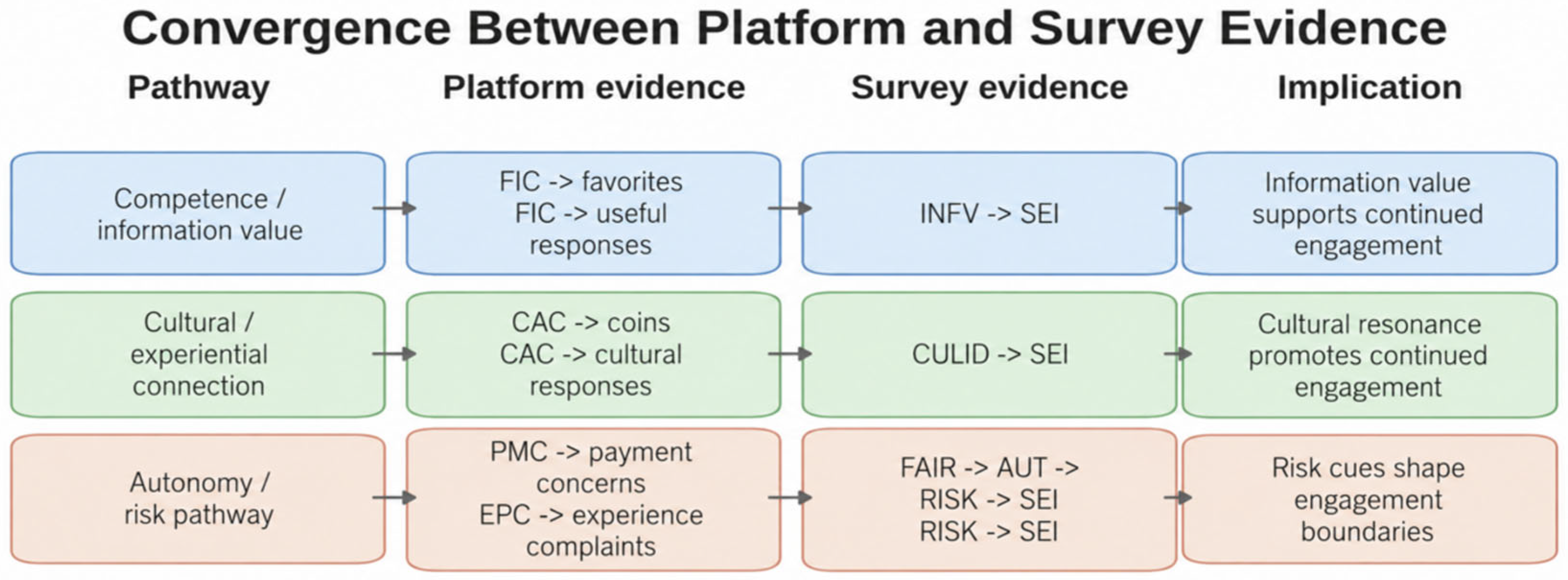
To align the platform and survey components without implying individual-level causality, the article specifies three convergence criteria. The competence/information path is convergent if FIC is associated with saving-oriented or useful responses and INFV is positively associated with SEI. The cultural/experiential path is convergent if CAC is associated with supportive or cultural responses and CULID is positively associated with SEI. The autonomy/risk path is convergent if PMC or EPC is associated with concern or complaint responses and the questionnaire paths linking FAIR, AUT, RISK, and SEI point in theoretically consistent directions.

2.6. Hypotheses and Convergence Criteria

Because the platform-scraped analysis does not directly measure psychological states, the hypotheses treat platform behavior and hot-comment results as observable responses consistent with need support, autonomy frustration, or risk expression. The theoretical argument asks three questions: whether information and cultural content correspond to need-supportive responses; whether payment and experience problems correspond to risk-type responses; and whether user perceptions are associated with continued engagement intention.
H1. 
Functional information cues and cultural-aesthetic cues are positively associated with platform responses consistent with basic psychological need support. Functional information cues are expected to be associated with favorites, deep interaction, and useful responses; cultural-aesthetic cues are expected to be associated with supportive interaction and cultural responses.
H2. 
Payment-mechanism cues and experience-problem cues are positively associated with negative hot-comment responses consistent with autonomy frustration and risk expression. Payment-mechanism cues are expected to be associated with payment concerns, and experience-problem cues are expected to be associated with experience complaints.
H3. 
User perceptions consistent with basic psychological need support are positively associated with continued engagement intention (SEI), whereas perceived monetization risk is negatively associated with SEI. Perceived monetization fairness is also expected to show a chain indirect association with SEI through consumer autonomy in spending decisions and perceived monetization risk, linking the platform-level evidence on payment concerns to the perception-level analysis.

3. Materials and Methods: A Multi-Level Digital Platform Analytics Design

3.1. Research Design and Sample Construction

The empirical design uses a multi-level digital platform analytics approach that combines observable platform traces, platform-prioritized textual responses, and survey-based consumer perceptions. The first empirical component uses Bilibili public videos and hot comments related to Where Winds Meet to examine how platform content cues correspond to favorites, coins, deep interaction, and semantically distinct hot-comment responses. The second component uses a content-exposure-anchored questionnaire to examine whether perceived information value, cultural/experiential connection, perceived monetization fairness, consumer autonomy in spending decisions, and perceived monetization risk are statistically associated with continued engagement intention. The two components are not matched at the individual level; they are integrated through theoretical convergence between observable platform patterns and perception-level associations.
The platform data were collected from publicly accessible Bilibili pages and the platform’s publicly visible hot-comment interface. Video metadata were crawled and organized from 12 to 13 May 2026, and hot-comment records covered the period up to 13 May 2026. The search keywords were “燕云十六声,” “燕云十六声手游,” “燕云十六声公测,” and “Where Winds Meet.” The hot-comment sample consists of publicly visible hot comments returned under Bilibili’s hot-comment sorting and display logic, rather than a complete chronological archive of all comments. This distinction is important because the study examines platform visibility and high-visibility responses, not all historical user comments or all user attitudes toward the game.
The video sample was deduplicated by BV number. Videos that were thematically irrelevant, duplicate reposts, missing core fields, or impossible to classify by theme were excluded. After cleaning and matching, the final platform model-entry sample contained 1164 video records and 19,919 valid hot comments covering all 1164 videos. Because search ranking, login status, access environment, deletion, pagination, sorting, and recommendation visibility may affect coverage, the conclusions apply only to publicly accessible videos and hot comments within this crawling window. Threshold robustness samples were also constructed for videos with at least 10 valid hot comments and at least 20 valid hot comments.
For reproducibility, the platform component followed a fixed search and cleaning protocol: Bilibili public pages and the publicly visible hot-comment interface were queried with the keywords “燕云十六声”, “燕云十六声手游”, “燕云十六声公测”, and “Where Winds Meet” during 12–13 May 2026; the comment scope was limited to hot comments visible under platform display logic rather than complete chronological comments; videos were deduplicated by BV number and comments by hot-comment ID; the final model-entry unit was the video-level record with aggregated hot-comment response counts; and the resulting scope is limited to publicly accessible videos and hot comments within this crawling window. Supplementary Section S3 documents documents the retrieval overview, workbook-level cleaning checks, dictionary revision process, coding reliability summary, variable dictionary, content-cue codebook, and comment-response codebook; Supplementary Section S1 reports reports the associated analytical and robustness tables. The initial structured keyword retrieval produced 1300 video records before broad deduplication and final relevance filtering, and the final model-entry sample contained 1164 anonymized video-level records and 19,919 valid hot-comment records. As summarized in Table 2, The appendix documentation does not redistribute raw comment text, direct platform identifiers, direct URLs, uploader names, hot-comment IDs, precise platform timestamps, or other direct or indirect identifiers.

3.2. Variables, Coding, and Platform Model Specifications

The platform-scraped content analysis operationalized four non-mutually exclusive content cues as independent variables: functional information cues (FICs), cultural-aesthetic cues (CACs), payment-mechanism cues (PMCs), and experience-problem cues (EPCs). The cues were coded from titles, descriptions, and tags; hot comments were coded as useful responses, cultural responses, payment concerns, or experience complaints. Content analysis methodology requires explicit definitions of units, categories, and coding rules to make interpretation reproducible [46].
The coding followed a procedure of formal AB sample calibration and full-sample rule-based extension. Two coders independently coded a video sample of n = 200 and a hot-comment sample of n = 750. After adjudication, the AB sample was locked, and the remaining records were coded according to the keywords, semantic objects, stance rules, exclusion rules, and context-sensitive screening principles in the coding manual. The full-sample extension was rule-based rather than a predictive black-box classifier: it applied the locked coding manual to the full corpus through keyword sets, semantic objects, stance rules, exclusion rules, and context-sensitive screening. Hayes and Krippendorff emphasize that coding reliability should be reported as a formal reliability measure rather than as informal agreement alone [47]. Cohen’s kappa was used to assess categorical agreement beyond chance [48], and the Landis and Koch benchmark was used only as an interpretive reference for agreement strength [49]. Supplementary Section S3 reports label-level reliability diagnostics, including label-specific kappa values, precision, recall, and F1 scores. To reduce false positives, weak or neutral words such as “how,” “money,” “buy,” and “card” did not trigger labels on their own; payment-related labels required both a payment object and a stance involving concern, pressure, unfairness, excessive expense, or inducement. Because payment concern was a low-frequency and semantically stricter category, its findings are interpreted as diagnostic risk signals rather than prevalence estimates.
The video behavioral outcomes were favorites, coins, and the additional composite indicator of deep interaction. Favorites are interpreted as closer to information saving and future reuse, whereas coins are interpreted as closer to creator support, content expression, or other platform-specific relational factors. Deep interaction equals favorites plus coins and is used only to capture behaviors stronger than viewing. It is neither treated as a latent construct nor equated with continued engagement intention. This separation matters because the same interaction volume may express different consumer relationships.
Favorites, coins, and deep interaction are nonnegative count variables with long-tailed and overdispersed distributions. Count-data regression treats overdispersion as a central reason to use negative binomial models rather than ordinary linear models on raw counts [50]. Negative binomial regression is also appropriate when the variance of count outcomes exceeds the mean [51]. Applied guidance on count-data models further supports negative binomial specifications for overdispersed count outcomes [52]. The main behavioral models therefore use negative binomial regression with the natural logarithm of views as an offset:
ln(μi) = α + β1FICi + β2CACi + β3PMCi + β4EPCi + γZi + ln(Viewsi).
Here, μi denotes the expected interaction count for video i, Zi is the vector of control variables, and ln(Viewsi) represents playback exposure. The offset specification asks whether a cue is associated with higher interaction intensity conditional on viewing exposure. It therefore estimates conditional interaction rates rather than total diffusion effects. Because views may themselves be shaped by platform visibility, title attractiveness, uploader influence, fan base, and version events, the offset model should not be interpreted as causal evidence that content cues generate exposure or interaction. Robustness analyses also treat ln(Viewsi) as an ordinary control variable and include timing, duration, title length, tags, video type, and version or phase information. Cross-sectional econometric models with controls can reduce some confounding concerns, but they cannot substitute for causal identification [53].
Hot-comment responses have a proportional structure: the number of hot comments of a given type is observed relative to the total number of valid hot comments for each video. The study therefore uses binomial proportion models for video-level hot-comment response shares. For video i and response type k, the model is specified as follows:
Cik ~ Binomial(Ti, pik).
logit(pik) = αk + β1kFICi + β2kCACi + β3kPMCi + β4kEPCi + δkZi.
For the hot-comment models, Cik denotes the number of hot comments of response type k for video i, Ti denotes the total number of valid hot comments for that video, and pik denotes the modeled response probability. Categorical dependent-variable models require interpretation through odds ratios and predicted probabilities rather than raw coefficient magnitudes [54]. The models therefore report odds ratios with robust standard errors. Because hot comments are nested within videos and generated under platform-prioritized visibility, these binomial proportion models are interpreted as video-level associations in visible response composition. They should not be read as independent comment-level causal models or as population-level attitude estimates. Categorical data analysis also requires clear event counts and denominators when proportions are modeled [55]. The results therefore report event counts, denominators, covered videos, and proportions, particularly for low-frequency payment concerns.

3.3. Survey Measures, Robustness Checks, and Cross-Component Integration

The questionnaire survey provides perception-level evidence corresponding to the platform-scraped analysis. It used a content-exposure-anchored instrument in which respondents recalled their most recent exposure to Where Winds Meet-related videos, posts, livestream clips, community discussions, or comment threads. The formal model-entry sample was obtained through a three-layer sample flow: 689 cases in the full sample, 600 cases after first-stage cleaning, and 564 cases after second-stage cleaning. Respondents who had not been exposed to relevant content and those whose total response time was less than 120 s did not enter the scale diagnostics or path model. Duplicate fields Q44/Q58 were verified as identical, and only one version was retained.
The survey measured perceived information value (INFV), cultural/experiential connection (CULID), perceived monetization fairness (FAIR), consumer autonomy in spending decisions (AUT), perceived monetization risk (RISK), and continued engagement intention (SEI) using reflective seven-point Likert constructs. The path model used standardized construct scores and bootstrap estimates for indirect associations. Reliability, validity, common-method-bias, control-variable, subgroup, behavioral-validity, latent SEM, and PLS-SEM diagnostics are reported in the results and Supplementary Materials.
Robustness checks were designed to clarify evidentiary boundaries rather than to expand the hypothesis set. For Study 1, ln(Views) was changed from an offset to an ordinary control variable, hot-comment response models were re-estimated in comment-threshold subsamples, and influential-view-count checks were conducted. For Study 2, the path model was re-estimated with demographic and platform-use controls, Bilibili-related subsamples were examined, and self-reported behaviors were used as additional validity checks. These analyses do not convert the design into a causal design; they test whether the core directions remain stable under alternative specifications.
The two empirical components are integrated through theoretical convergence rather than individual-level linkage. Platform traces identify observable associations between content cues and public responses in the Bilibili environment. Survey data then test whether user perceptions show theoretically consistent associations with continued engagement intention. This design fits the article’s central question because engagement quality cannot be inferred from interaction volume alone. It must be interpreted through the relationships among platform visibility, content cues, interaction types, comment meanings, perceived monetization fairness, consumer autonomy, perceived monetization risk, and continued engagement intention.

4. Platform-Scraped Content Analysis: Content Cues, Interaction Metrics, and Hot-Comment Responses

Section 4 examines how social-video content cues are associated with Bilibili interaction metrics and publicly visible hot-comment responses. It moves from sample structure and coding reliability to descriptive patterns, model results, and hypothesis-level synthesis. The aim is to identify which platform-visible responses correspond to information use, cultural support, payment concern, or experience complaint.

4.1. Sample Structure and Coding Reliability

The analytic units are videos and publicly visible hot comments. At the video level, records were cleaned and deduplicated by BV number before content-cue labels were attached; at the comment level, hot comments were deduplicated, empty records were removed, and valid comments were reaggregated by video ID. The final matched sample contains 1164 videos and 19,919 valid hot comments, so the behavioral and hot-comment models use the same platform base. Because the comments are platform-prioritized rather than a chronological archive, they are treated as high-visibility responses rather than as overall user-opinion proportions.
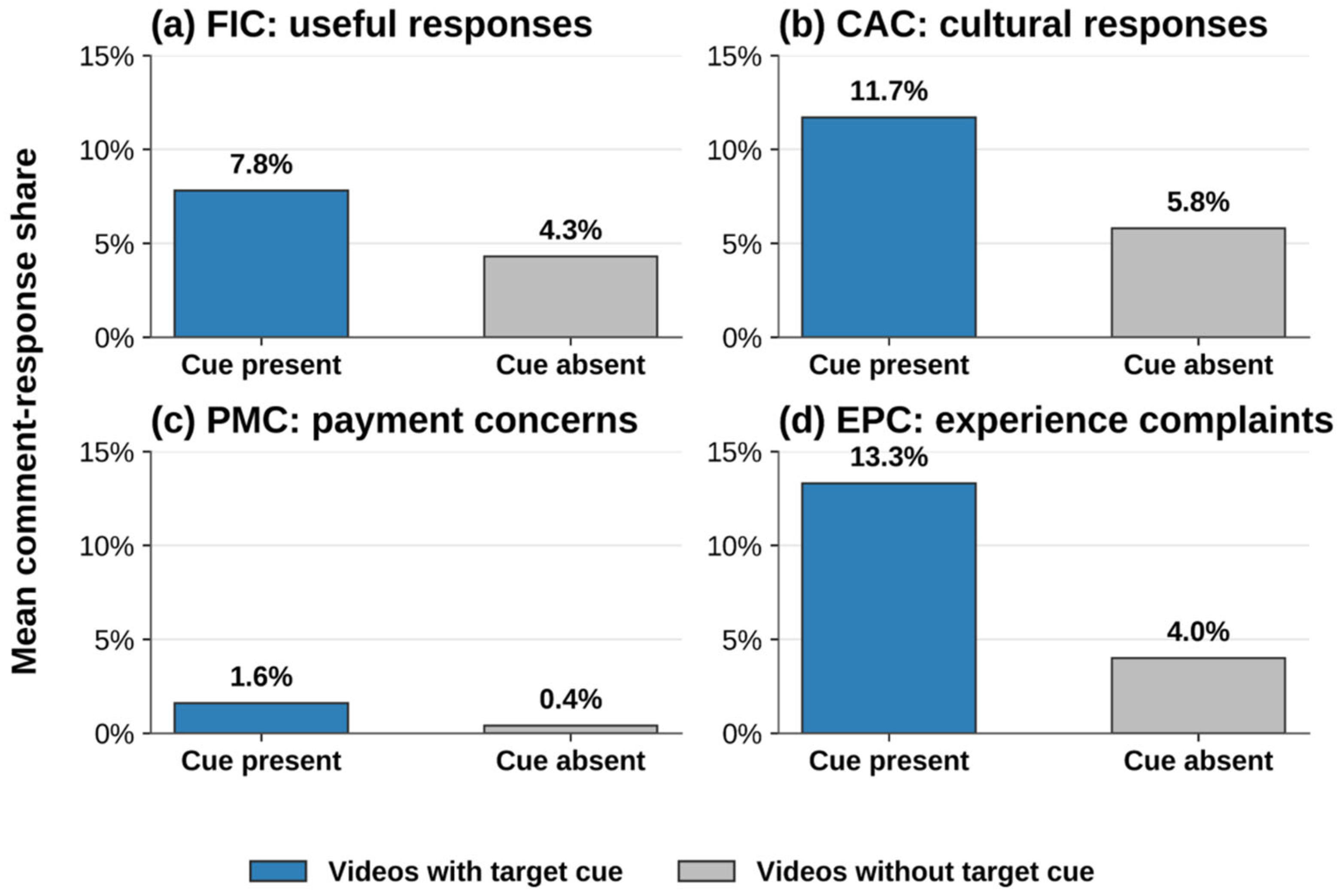
Detailed sample structure and final AB coding reliability are reported in Supplementary Section S3. In brief, the validation sample included 200 video records and 750 nonempty hot-comment records; the weighted average agreement rate was 96.13%, and the weighted average Cohen’s kappa was 0.822. Label-level kappa values ranged from 0.759 to 0.867. The video-level labels showed kappa values of 0.860 for FIC, 0.849 for CAC, 0.784 for PMC, and 0.801 for EPC; the comment-level labels showed kappa values of 0.867 for useful responses, 0.846 for cultural responses, 0.759 for payment concern, and 0.815 for experience complaint. The lower values for payment-related categories were expected because these labels are low-prevalence and semantically stricter; the payment-concern F1 score was 0.765 and is therefore interpreted with caution as a diagnostic risk signal rather than as a prevalence estimate. Building on this reliability evidence, the descriptive analysis separates two issues that are easily conflated: whether a content cue appears with higher interaction overall and whether that interaction carries a specific semantic or behavioral meaning. Figure 1 compares the proportions of target hot-comment responses between videos with and without the corresponding content cues.

4.2. Distribution of Content Cues, Hot-Comment Responses, and Platform Interaction

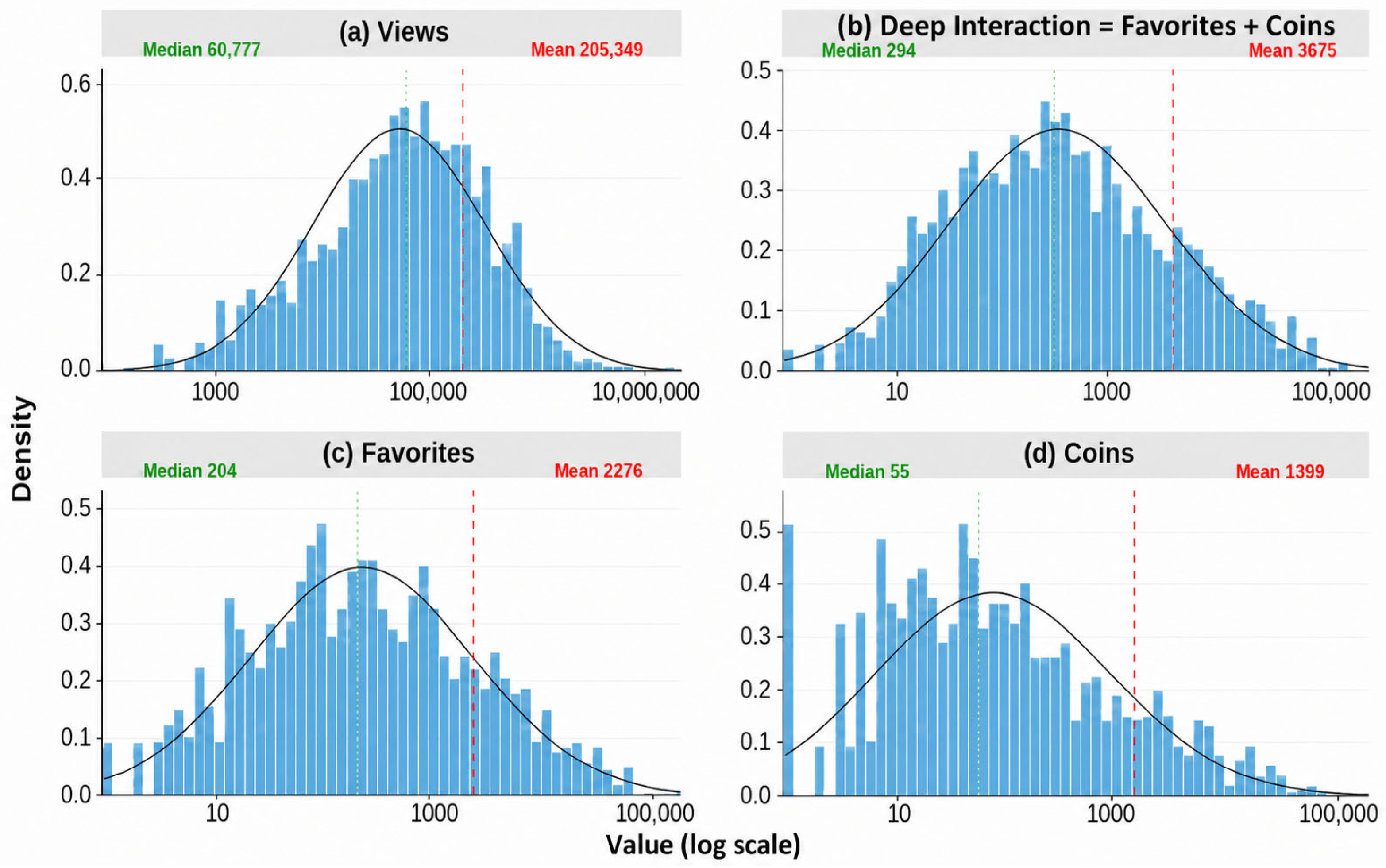
The descriptive comparisons show the expected cue-response pairings: functional information cues align with useful responses, cultural-aesthetic cues with cultural responses, payment-mechanism cues with payment concerns, and experience-problem cues with experience complaints. These patterns are not effect estimates, but they indicate that the response categories are substantively meaningful. Table 3 reports the long-tailed structure of Bilibili interaction metrics. Views average 205,349, whereas the median is 60,777 and the maximum reaches 15,649,488; similar gaps for favorites, coins, platform-displayed comments, and deep interaction show why raw counts may confuse content-related associations with visibility and exposure differences.
Deep interaction combines favorites and coins only to capture behaviors stronger than viewing. It is not a latent construct and should not be equated with continued engagement intention. Its diagnostic value lies in distinguishing saving-oriented behavior, supportive behavior, or their combination.
Figure 2 supports the use of count models for skewed platform interaction metrics. Views and interaction outcomes are highly skewed, with means consistently above medians. This distributional pattern justifies negative binomial models and the use of ln(views) as an offset for interaction intensity conditional on playback exposure.

4.3. Content-Cue Associations with Platform Interaction Metrics

Table 4 reports incidence rate ratios from negative binomial models with ln(views) as an offset. An IRR above 1 indicates that, under comparable viewing exposure and controls, videos with the relevant cue are associated with a higher expected outcome rate.
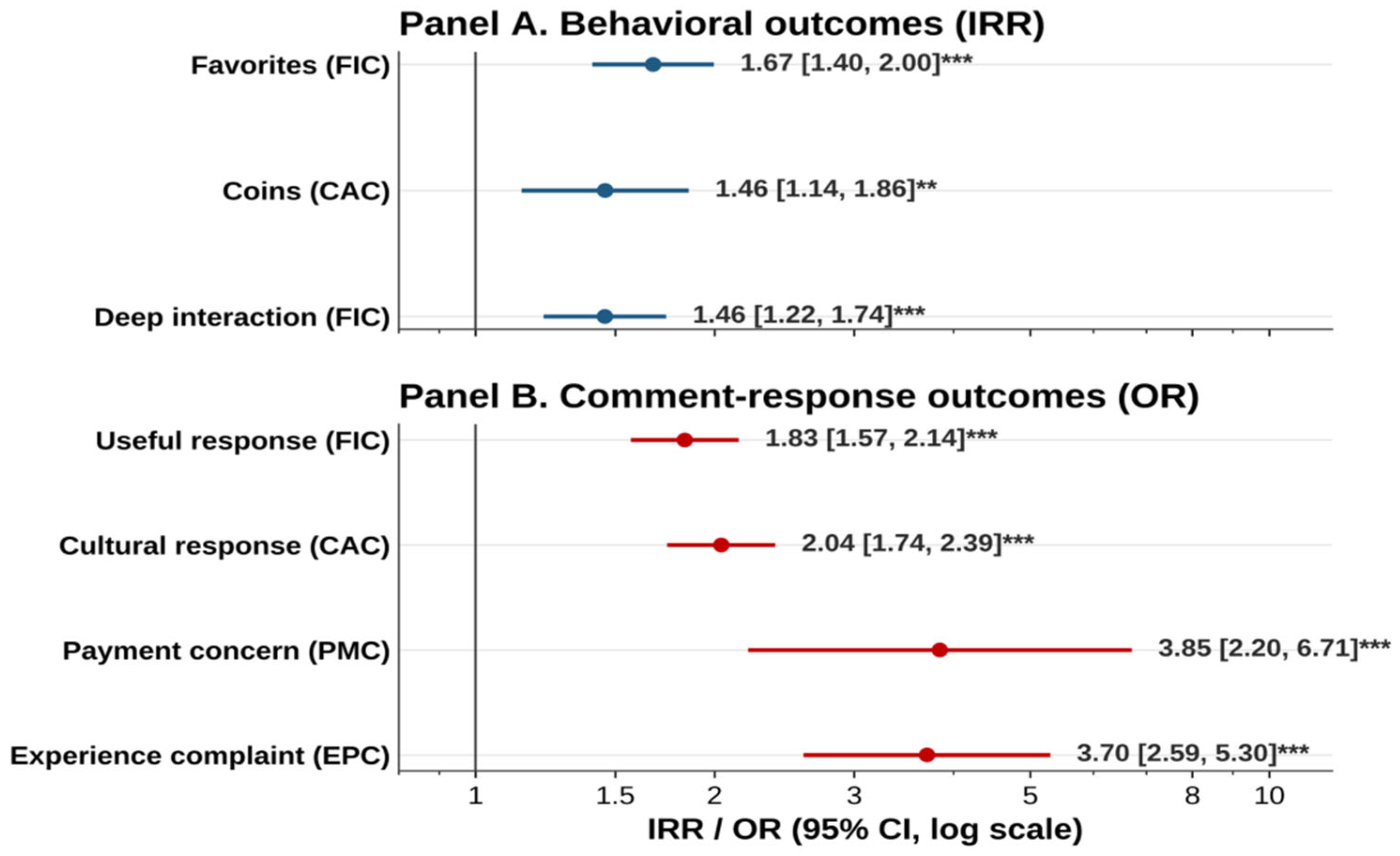
Functional information cues are associated with a higher favorite rate (IRR = 1.673, p < 0.001), suggesting saving-oriented interaction under comparable exposure. They are also associated with the additional deep-interaction indicator (IRR = 1.455, p < 0.001), but not with coins (IRR = 1.070, p = 0.581), indicating that functional content is more consistent with saving and reuse than with symbolic or supportive gifting. Cultural-aesthetic cues show the opposite emphasis: they are significantly associated with coins (IRR = 1.456, p = 0.002), while their association with favorites is not statistically significant (IRR = 1.126, p = 0.175). Because coins may reflect creator support, platform norms, or aesthetic appreciation, this result is interpreted together with the cultural-response model in Section 4.4.

4.4. Hot-Comment Responses: Usefulness, Culture, Risk, and Complaint

The hot-comment response models examine whether comment semantics correspond to the behavioral patterns above. Instead of treating comment volume as uniformly positive engagement, the analysis distinguishes useful responses, cultural responses, payment concerns, and experience complaints, because hot comments may express informational use and cultural resonance as well as dissatisfaction, perceived pressure, or consumption risk. Table 5 reports odds ratios together with event denominators: the odds ratios indicate whether a cue is associated with a higher likelihood of a response type, while event counts and proportions show how visible that response is in the corpus. Because labels are non-mutually exclusive, the figures should be read as response counts rather than as mutually exclusive comment classes.
The useful-response and cultural-response models are consistent with the two positive engagement paths. Useful responses account for 1084 valid hot comments (5.4%) across 618 videos, and videos with FIC show a higher likelihood of this response type (OR = 1.834, p < 0.001). Cultural responses account for 1793 valid hot comments (9.0%) across 672 videos, and videos with CAC show a higher likelihood of such responses (OR = 2.039, p < 0.001), with response language organized around wuxia, Chinese-style aesthetics, narrative atmosphere, and shared cultural meaning.
The risk-related models are consistent with H2 but require caution. Payment concerns are rare, accounting for 97 valid hot comments (0.5%) across 85 videos, yet PMC is associated with a higher relative likelihood of this response (OR = 3.846, p < 0.001). This OR should be interpreted together with the low base rate: the result indicates that PMC videos are more likely to attract visible payment-concern responses, but it does not imply that payment concern is widespread among all users or all comments. Experience complaints are more common, with 902 comments (4.5%) across 464 videos, and EPC is associated with them (OR = 3.703, p < 0.001).

4.5. Evidence Synthesis for the Platform-Scraped Content Analysis

Figure 3 synthesizes the behavioral and hot-comment evidence while keeping model types distinct. Panel A reports IRRs from negative binomial behavior models, whereas Panel B reports ORs from hot-comment response models. These measures should not be compared as magnitudes; their value lies in showing whether the associations point in the expected direction and whether the confidence intervals exclude 1.
The core pattern is differentiated. Functional information cues are associated with favorites, deep interaction, and useful responses; cultural-aesthetic cues are associated with coins and cultural responses; and risk-related cues are associated with negative semantic responses, namely PMC with payment concerns and EPC with experience complaints. Table S21 in the Supplementary Materials reports the hypothesis-level summary: the evidence is consistent with H1 through saving-oriented behavior, useful responses, supportive interaction, and cultural responses, while H2 is supported through the positive associations of PMC and EPC with payment concerns and experience complaints. The evidence is convergent within the platform-scraped content analysis, but remains platform-level and associational.
Taken together, Section 4 shows that high interaction is not sufficient evidence of engagement quality. The same platform environment contains saving-oriented use, supportive cultural expression, payment concern, and experience complaint. Section 5 addresses the corresponding perceptual question by testing whether user-perception variables are associated with continued engagement intention.

5. Questionnaire Survey: Perceived Value, Autonomy, Risk, and Continued Engagement Intention

Section 5 examines the questionnaire evidence linking perception-level constructs to continued engagement intention. The survey remains analytically distinct from the platform-scraped evidence: it does not reconstruct individual exposure histories from Bilibili, but tests whether user perceptions show theoretically consistent associations with the patterns observed in the platform evidence. This provides the perception side of the convergence logic. Section 4 linked information and cultural cues to saving, support, and semantic responses, and linked payment or experience cues to concern and complaint. Because platform traces cannot directly measure information value, cultural/experiential connection, perceived monetization fairness, autonomy, or risk, the survey tests these constructs at the user-perception level and prevents visible interaction metrics from being treated as direct psychological evidence.

5.1. Questionnaire Data, Measurement Diagnostics, and Path Model

The survey used a content-exposure-anchored design. Respondents aged 18 or above recalled recent encounters with Where Winds Meet-related videos, graphic posts, livestream clips, community discussions, or comments and then evaluated the game and its commercialization environment. The core scales measured perceived information value (INFV), cultural/experiential connection (CULID), perceived monetization fairness (FAIR), consumer autonomy in spending decisions (AUT), perceived monetization risk (RISK), and continued engagement intention (SEI). SEI is treated as a proximal indicator of longer-term following and participation intention.
All six constructs were treated as reflective constructs. Kline’s SEM guidance supports evaluating measurement quality before interpreting structural paths [56]. The HTMT criterion was included as a discriminant-validity diagnostic for variance-based SEM [57]. The Fornell–Larcker criterion was reported as a conventional check of convergent and discriminant validity for reflective measures [58]. Harman’s single-factor diagnostic was reported only as a preliminary common-method-bias check, not as definitive evidence that common-method bias is absent [59]. Detailed discriminant-validity and common-method-bias diagnostics are reported in Supplementary Section S1. This reporting choice keeps the main text focused on the path estimates while retaining the diagnostics needed for review. The path model uses standardized construct scores and bootstrap confidence intervals; all paths are interpreted as cross-sectional associations.
The chain indirect association was assessed using bootstrap confidence intervals and is interpreted as a cross-sectional association rather than causal evidence. The model estimates whether perceived monetization fairness is associated with higher consumer autonomy and, through lower perceived monetization risk, with higher continued engagement intention. This specification tests theoretical consistency rather than causal ordering.

5.2. Survey Sample and Model-Entry Flow

The survey model-entry flow is reported in Table S25 in the Supplementary Materials. The original questionnaire produced 689 records; after 89 records were removed according to survey-platform and prespecified quality rules, 600 responses remained. The second screening excluded 32 respondents without actual exposure to Where Winds Meet-related content and 4 responses completed in less than 120 s, leaving 564 model-entry cases. Although Bilibili was the most common most recent exposure platform and 465 respondents had watched related content on Bilibili, the survey is interpreted as perception-level evidence rather than as a Bilibili-only respondent sample.

5.3. Measurement Reliability, Discriminant Validity, and Method Bias

Table 6 reports the reliability and convergent-validity results for the six reflective constructs. The reflective scales met the reporting thresholds for the path model. Cronbach’s alpha ranged from 0.825 to 0.862, Composite Reliability from 0.884 to 0.901, AVE from 0.644 to 0.693, and standardized loadings from 0.781 to 0.850. The Fornell–Larcker criterion was satisfied, the maximum HTMT value was 0.431, and Harman’s single-factor diagnostic showed that the first factor explained 20.8% of the variance. These checks indicate no severe reliability, discriminant-validity, or common-method-bias concern.

5.4. Perception-Level Path Model and Indirect Association

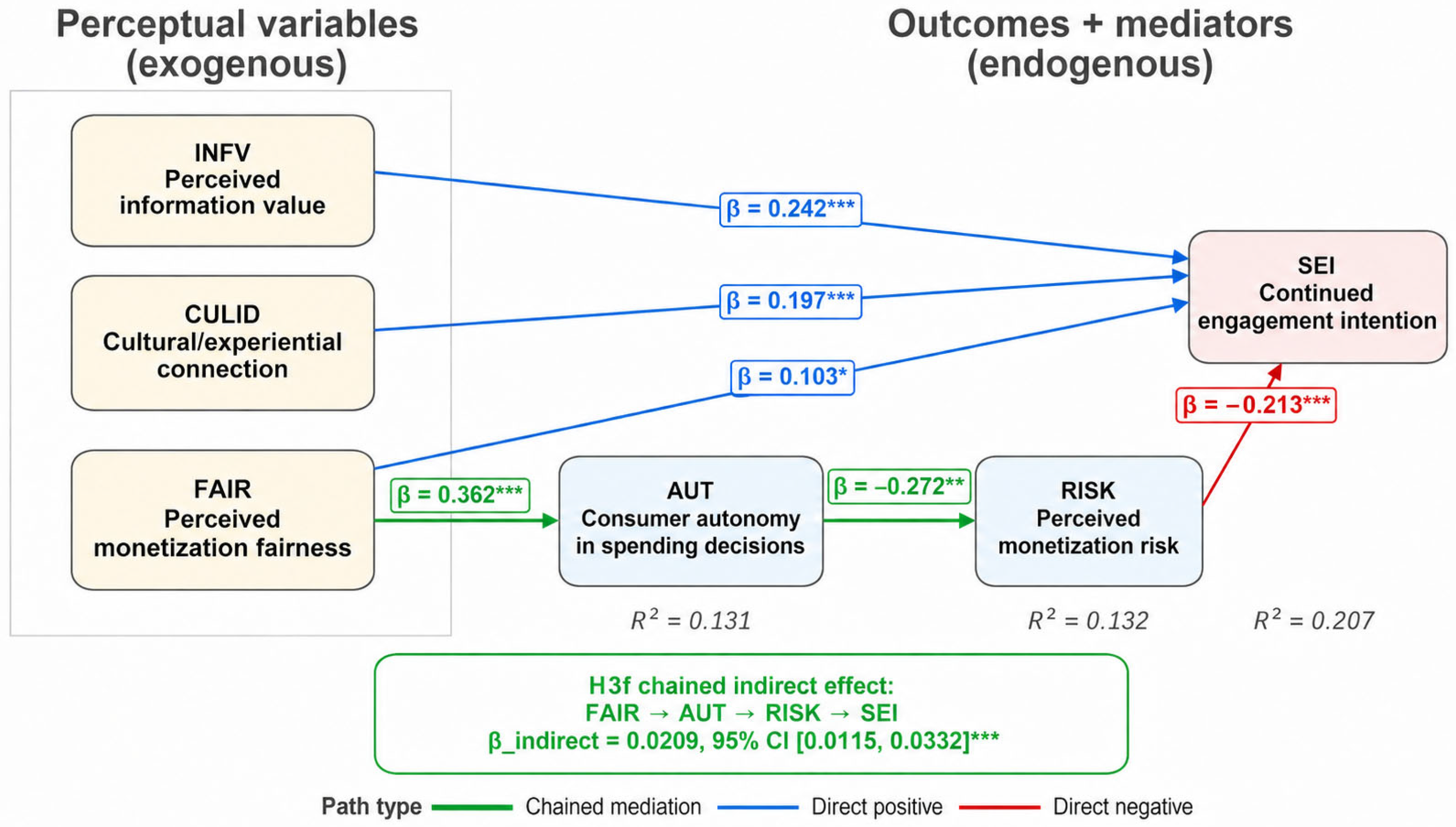
Table 7 reports the core H3 paths. FAIR was positively associated with AUT (β = 0.362, p < 0.001), and AUT was negatively associated with RISK (β = −0.272, p < 0.001). In the SEI equation, INFV (β = 0.242, p < 0.001) and CULID (β = 0.197, p < 0.001) were positive, whereas RISK was negative (β = −0.213, p < 0.001). R-squared values were 0.131 for AUT, 0.132 for RISK, and 0.207 for SEI, with a maximum VIF of 1.238.
Figure 4 visualizes the standardized-score path model. It shows the positive direct associations from INFV, CULID, and FAIR to SEI, the positive FAIR -> AUT path, and the negative AUT -> RISK and RISK -> SEI paths. The diagram is based on OLS standardized aggregate-score paths in Table 7 (N = 564); blue lines mark positive direct paths, red lines mark negative direct paths, and green lines mark the focal chained indirect association.
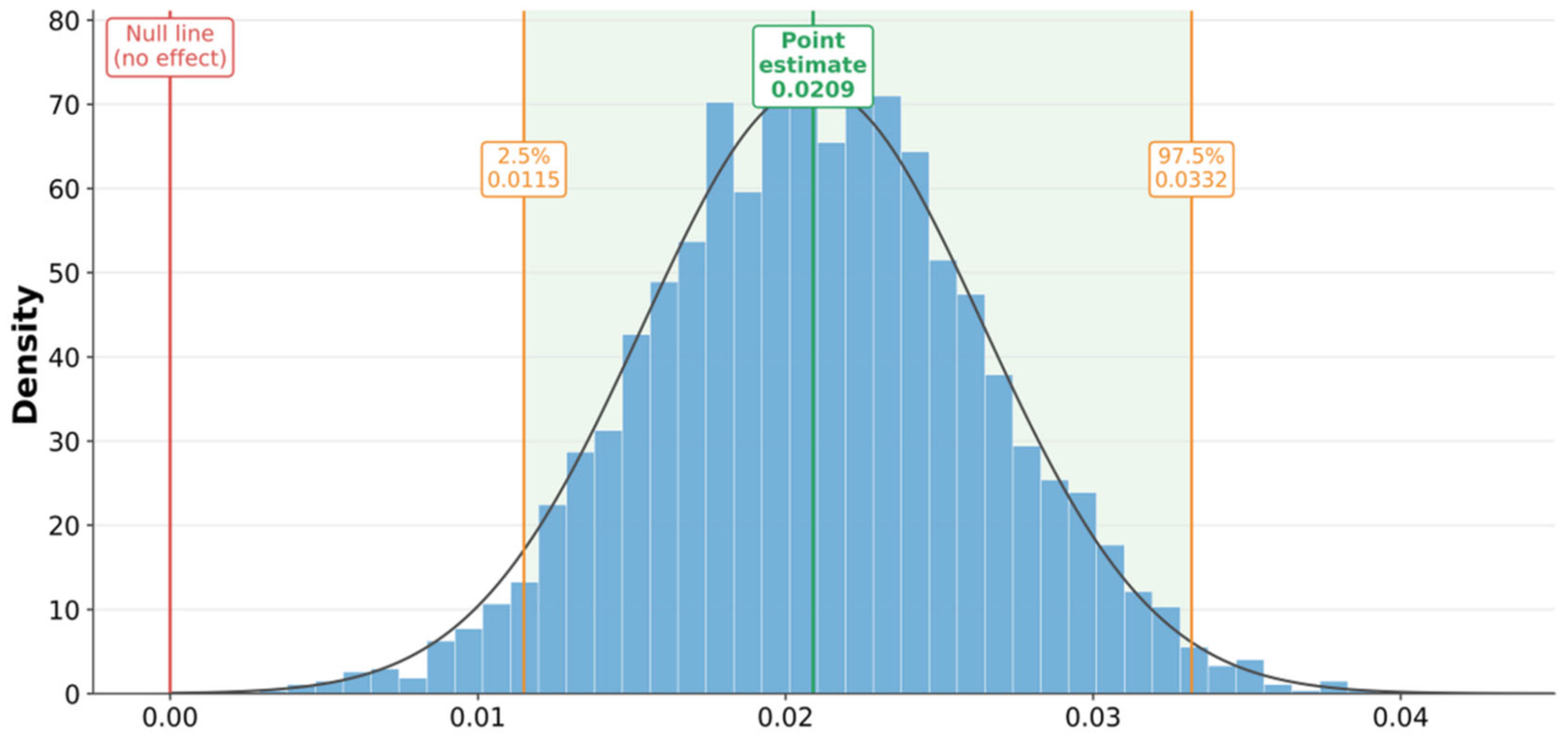
Figure 5 focuses on the bootstrap evidence for the H3f chain. The indirect association FAIR -> AUT -> RISK -> SEI had a point estimate of 0.0209, and the 95% bootstrap percentile confidence interval was [0.0115, 0.0332]. Because the interval excludes 0, the chained indirect association is statistically supported, although it remains cross-sectional.

5.5. Robustness and Behavioral Checks

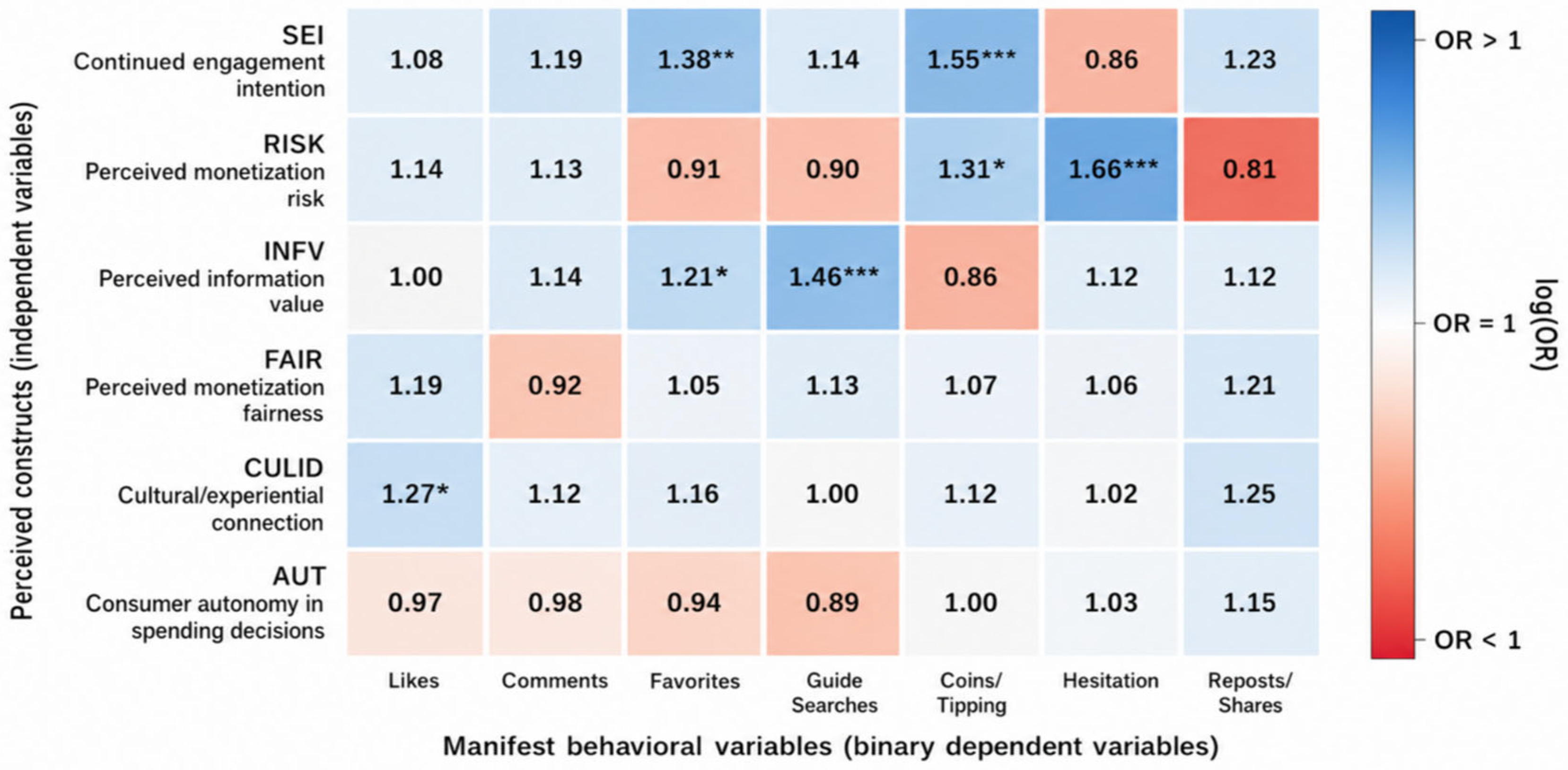
The subgroup and behavioral checks are treated as robustness evidence rather than as additional hypothesis tests. The control-variable model included gender, age, identity, whether the most recent exposure platform was Bilibili, exposure frequency, payment experience, interest in wuxia/Chinese-style aesthetics, actual experience level, and understanding of payment mechanisms; the core directions remained stable. In both Bilibili-related subsamples—the latest-exposure Bilibili subsample (N = 216) and the ever-viewed-on-Bilibili subsample (N = 465)—the key associations involving INFV, CULID, FAIR, AUT, RISK, and SEI remained directionally consistent. Self-reported behavior checks showed a similar pattern: INFV was associated with guide search and favorites, CULID with liking, SEI with favorites and coins/tipping, and RISK with hesitation about following or playing. RISK was also positively associated with coins/tipping, suggesting that perceived risk may coexist with involvement or controversial attention rather than leading only to exit. Figure 6 visualizes these additional logistic associations.
Taken together, the survey evidence is consistent with H3 at the perception level. Perceived information value and cultural/experiential connection are positively associated with continued engagement intention. Perceived monetization fairness is linked to continued engagement intention through consumer autonomy and perceived monetization risk, while perceived risk is negatively associated with SEI. These results complement the platform evidence but remain cross-sectional, self-reported, and associational.

6. Discussion: From Platform Interaction to Consumer Engagement Quality

6.1. Main Findings: Associations, Measurement, and Evidentiary Boundaries

The two empirical components provide convergent evidence that platform interaction metrics should be interpreted as differentiated engagement meanings rather than as interaction volume alone. The platform-scraped analysis distinguishes response patterns by showing that functional, cultural-aesthetic, payment-mechanism, and experience-problem cues are associated with different behavioral and hot-comment responses. The survey then shows that perceived information value, cultural/experiential connection, monetization fairness, autonomy, and risk are associated with SEI in theoretically consistent directions. Taken together, the evidence reframes continued engagement as a platform-mediated digital game consumption relationship rather than as a direct function of interaction intensity. Such a relationship is stronger when users obtain reusable information, attach cultural or experiential meaning to participation, understand commercialization rules as fair and transparent, retain autonomy in spending decisions, and keep perceived monetization risk manageable. By contrast, high visibility or high interaction can coexist with complaint, controversy, or commercialization-related concern. Figure 7 summarizes the evidentiary convergence between platform-level response patterns and survey-level perception associations.

6.2. Dialog with Self-Determination Theory and Platform-Mediated Game Consumption Research

Platform-mediated game consumption should not be evaluated only through engagement intensity or monetization performance. Continued engagement also depends on whether users perceive the platform environment as informative, culturally meaningful, transparent, autonomy-preserving, and low in excessive pressure. Research on adolescent well-being shows that digital-technology use should not be reduced to exposure volume alone [60]. Evidence on screen-time limits for young children likewise cautions against treating time-based indicators as simple proxies for psychological outcomes [61]. Studies of video-game play time further suggest that time spent playing is not necessarily a direct determinant of well-being [62]. Meta-analytic evidence on action games also shows that digital-game outcomes depend on the type and quality of engagement rather than exposure quantity alone [63]. Extending that logic, this article applies SDT to platform-mediated game-content consumption by treating competence, cultural/experiential connection, and autonomy as conditions for continued engagement. Functional information cues mark content conditions that may make participation more reusable and less costly; cultural-aesthetic cues mark shared symbolic resources through which engagement may acquire meaning; and payment mechanisms or experience problems mark platform-visible conditions under which users may express risk or pressure.
The same interpretation clarifies the role of platformization and commercialization. Platformization reorganizes cultural products into searchable, recommendable, measurable, and commercializable content units [1]. Research on the platformization of the web further shows how web data become structured for platform logics and platform-ready circulation [64]. Guides, clips, hot comments, and interactions may therefore become visible and measurable traces, but these traces are not automatically evidence of positive engagement quality. In platform-mediated game-content consumption, quantifiable interaction must be interpreted through content cues, response types, and user perceptions. Commercialization remains a key boundary condition: payment-mechanism and experience-problem cues are associated with payment-concern and experience-complaint hot comments, consistent with research on predatory monetization and dark patterns [65]. Because payment concerns are rare in the valid hot-comment sample, they should be read as low-frequency but diagnostically meaningful risk signals, not as prevalence estimates for overall user attitudes.

6.3. Reinterpreting Platform Interaction as Differentiated Engagement Quality

Platform interaction metrics acquire meaning only in relation to specific actions and comment responses. Favorites are closer to information saving and reuse, while coins are interpreted as platform-specific supportive signals that may reflect creator support, content expression, or community contribution. Hot comments are more ambivalent: they may contain practical exchange and cultural resonance, but also concern, complaint, and risk expression. Online review research indicates that comment texts can transmit quality information and amplify negative experience [66]. This article therefore distinguishes useful responses, cultural responses, payment concerns, and experience complaints rather than treating comment count as a positive participation indicator. The same caution applies to the additional indicator of deep interaction. It is operationalized as favorites plus coins to capture saving or supportive behaviors stronger than viewing, not to construct an independent psychological variable or replace separate analyses of favorites, coins, hot comments, and SEI [67].

6.4. Implications for Platform Governance and Responsible Digital Commerce

The responsible-commerce implication of the study is not that all monetization reduces engagement, nor that all high interaction is commercially healthy. Rather, the findings suggest that platformized game commerce should be evaluated by whether consumers can obtain useful information, understand payment rules, retain voluntary spending autonomy, and recognize risk without being pushed into opaque or pressure-based participation. Platforms and content producers should improve the preservability and searchability of functional information content while keeping cultural-aesthetic content connected to actual experience quality. Guides, tutorials, character customization materials, equipment builds, and completion guides have reuse value when supported by collections, indexes, tags, timestamps, and version-update notes. Uses and gratifications research suggests that media use often involves information, entertainment, and social interaction needs [68], and in this article functional information most directly corresponds to information acquisition and competence support. Cultural-aesthetic content--wuxia, Chinese-style aesthetics, narrative, visual design, and jianghu atmosphere--can form shared topics and cultural/experiential connection, but it cannot substitute for reliable gameplay, optimization, or transparent commercialization rules.
The findings also inform responsible digital commerce in game-related platform environments. Digital games are platform-mediated consumption systems shaped by interfaces, visibility environments, visible metrics, creator economies, and commercialization rules. Favorites, coins, and hot comments may contribute to continued engagement loops, but they do not necessarily indicate engagement quality: high interaction may reflect information reuse and cultural support, but it may also coexist with payment concern, experience complaint, and perceived risk. Payment mechanisms and experience problems should therefore be treated as boundary conditions for consumer autonomy and perceived monetization risk. In practice, platforms and operators should improve the visibility and searchability of useful information, make payment rules easier to understand, reduce scarcity- or pressure-based inducement, and treat risk expressions in comment areas as early signals of relationship strain rather than as mere negative feedback. Research on price fairness reinforces the importance of rule understandability and procedural legitimacy in consumer evaluations [69]. Privacy economics similarly highlights the importance of informed choice in digital market environments [70]. Research on intelligent software agents and human users further underscores the need to protect autonomy in digital influence environments [71].

6.5. Limitations and Future Research

The study’s limitations define the boundaries of interpretation. First, the Bilibili sample comes from a specific crawling window and is neither a full-platform census nor a random sample. The 19,919 hot comments were returned by the platform’s display logic and are not equivalent to all historical comments or player attitudes. Second, the views offset estimates interaction intensity given exposure, but it cannot identify the full effect of content cues on viewing diffusion. Because views may be shaped by recommendation, title attractiveness, uploader influence, and version events, the results are not causal. Third, although H2 is supported, payment concerns are low-frequency directional risk expressions. Fourth, the survey is cross-sectional and self-reported; diagnostics meet reportable standards but cannot establish causality or rule out all common-method bias.
Additional limitations concern omitted variables, coding error, sample composition, duplicate fields, and the scope of SEI. Controls and additional models cannot remove omitted-variable bias from uploader ability, fan base, or production quality. Although content cues and hot-comment responses were calibrated using formal AB coding samples, full-sample coding remains a rule-based computational extension and may miss sarcasm, memes, spam, missing replies, or context-dependent expressions. The survey sample is dominated by young users, male users, and student groups, and not all respondents’ most recent exposure platform was Bilibili. Although Bilibili-related checks support the main conclusions, the findings should not be generalized directly to all players or all digital game consumers. Q44/Q58 are duplicate fields; one was retained. SEI captures longer-term following and participation intention, so it is a proximal indicator rather than a complete measure of engagement quality.
Future research can broaden the platform context, add temporal designs, and improve exposure-level identification. Cross-game or cross-platform samples could compare open-world games, MMOs, premium games, and live-service games. Time-series or event-study designs around beta tests, version updates, commercialization controversies, or optimization events could distinguish controversy-driven visibility from stable continued engagement. User-level data or exposure experiments would further clarify how platform content exposure is associated with consumer autonomy, perceived monetization risk, and continued engagement intention.

7. Conclusions

This article examines whether high platform interaction can be interpreted as evidence of engagement quality in platform-mediated digital game consumption. Using Bilibili videos and publicly visible hot comments related to Where Winds Meet, it analyzes how content cues are associated with platform responses and how user perceptions are associated with continued engagement intention (SEI). Continued engagement is understood as a platform-mediated consumption relationship in which users can keep participating when information is useful, cultural/experiential meaning is available, commercialization rules are relatively transparent, and consumption pressure remains controllable.
The findings show convergent patterns across two analytical levels. Platform traces reveal differentiated responses rather than a single engagement effect: functional information cues are associated with saving- and reuse-oriented responses, cultural-aesthetic cues with supportive and cultural responses, and payment- or experience-problem cues with risk-related hot-comment expressions. The survey evidence is consistent with this interpretation: perceived information value and cultural/experiential connection are positively associated with SEI, while perceived monetization fairness is indirectly associated with SEI through consumer autonomy in spending decisions and perceived monetization risk. These findings should be read as associational and convergent evidence, not as evidence of temporal causality.
The article’s main contribution is to distinguish interaction volume, platform participation, and engagement quality. Favorites, coins, and hot comments all belong to platform interaction, but they express different consumer relationships: favorites are closer to information preservation and future reuse; coins are interpreted as platform-specific supportive signals that may reflect support for content production, aesthetic expression, or community contribution; and hot comments may contain practical exchange, cultural resonance, payment concerns, and experience complaints. Theoretically and practically, the study connects SDT with platform-mediated consumer behavior and responsible digital commerce. Competence support, cultural/experiential connection, and consumer autonomy function as relationship conditions under which digital participation can remain useful, meaningful, voluntary, and relatively low in perceived pressure. Platforms, content producers, and game operators should therefore attend to the consumer relationship behind interaction metrics.
The conclusions remain bounded by the study design. The platform-scraped content analysis is based on public Bilibili data and hot comments within a specific crawling window, and the model results reveal associations rather than causal effects. The questionnaire survey is based on cross-sectional self-report data; even with control-variable and Bilibili-related subsample checks, its findings should be interpreted as statistical associations. Future research can use cross-game, cross-platform, or time-series designs to examine how platform visibility, content cues, consumer autonomy, and risk boundaries shape continued engagement in digital game consumption.


Supplementary Materials

The following supporting information can be downloaded at https://www.mdpi.com/article/10.3390/jtaer21070205/s1.

Author Contributions

Conceptualization, K.L., Z.X. and H.C.; methodology, K.L., Z.X. and H.C.; validation, K.L., Z.X. and H.C.; formal analysis, K.L.; investigation, K.L.; resources, K.L., Z.X. and H.C.; data curation, K.L.; writing—original draft preparation, K.L.; writing—review and editing, K.L., Z.X. and H.C.; visualization, K.L.; supervision, Z.X. and H.C. All authors have read and agreed to the published version of the manuscript.

Funding

This research was funded by the Youth Project of Humanities and Social Sciences of the Ministry of Education of China, grant number 24YJC760009.

Institutional Review Board Statement

Ethical review and approval were waived for this study because the questionnaire component was anonymous, involved adult respondents, collected no personally identifiable information, and posed minimal risk. The platform-data component used only publicly accessible Bilibili video metadata and publicly visible hot comments. The manuscript and Supplementary Materials report aggregated results only and contain no direct or indirect personal identifiers.

Informed Consent Statement

Informed consent was obtained from all subjects involved in the study.

Data Availability Statement

The data supporting the findings of this study were derived from publicly accessible Bilibili video metadata and hot comments, together with an anonymous questionnaire survey. De-identified data, aggregated coding results, and analysis scripts are available from the corresponding author upon reasonable request. Raw comment text and platform- or respondent-level identifiers are not publicly available due to privacy and platform-use restrictions. Further methodological documentation is provided in Supplementary Section S3.

Conflicts of Interest

The authors declare no conflicts of interest. The funders had no role in the design of the study; in the collection, analyses, or interpretation of data; in the writing of the manuscript; or in the decision to publish the results.

Abbreviations

Abbr.Definition
AUTconsumer autonomy in spending decisions
AVEaverage variance extracted
CACcultural-aesthetic cues
CFAconfirmatory factor analysis
CFIcomparative fit index
CIconfidence interval
CMBcommon-method bias
CRcomposite reliability
CULIDcultural/experiential connection
EPCexperience-problem cues
FAIRperceived monetization fairness
FICfunctional information cues
HTMTheterotrait–monotrait ratio
INFVperceived information value
IRRincidence rate ratio
NBnegative binomial
ORodds ratio
PLS-SEMpartial least squares structural equation modeling
PMCpayment-mechanism cues
RISKperceived monetization risk
RMSEAroot mean square error of approximation
SDTself-determination theory
SEIcontinued engagement intention
SEMstructural equation modeling
SRMRstandardized root mean square residual
TLITucker–Lewis index
VIFvariance inflation factor

References

  1. Nieborg, D.B.; Poell, T. The platformization of cultural production: Theorizing the contingent cultural commodity. New Media Soc. 2018, 20, 4275–4292. [Google Scholar] [CrossRef]
  2. van Dijck, J.; Poell, T.; de Waal, M. The Platform Society: Public Values in a Connective World; Oxford University Press: Oxford, UK, 2018. [Google Scholar]
  3. Poell, T.; Nieborg, D.; Duffy, B.E. Platforms and Cultural Production; Polity Press: Cambridge, UK, 2021. [Google Scholar]
  4. Lemon, K.N.; Verhoef, P.C. Understanding customer experience throughout the customer journey. J. Mark. 2016, 80, 69–96. [Google Scholar] [CrossRef]
  5. Hollebeek, L.D.; Macky, K. Digital content marketing’s role in fostering consumer engagement, trust, and value: Framework, fundamental propositions, and implications. J. Interact. Mark. 2019, 45, 27–41. [Google Scholar] [CrossRef]
  6. Ryan, R.M.; Deci, E.L. Self-determination theory and the facilitation of intrinsic motivation, social development, and well-being. Am. Psychol. 2000, 55, 68–78. [Google Scholar] [CrossRef] [PubMed]
  7. Brodie, R.J.; Hollebeek, L.D.; Juric, B.; Ilic, A. Customer engagement: Conceptual domain, fundamental propositions, and implications for research. J. Serv. Res. 2011, 14, 252–271. [Google Scholar] [CrossRef]
  8. Hennig-Thurau, T.; Gwinner, K.P.; Walsh, G.; Gremler, D.D. Electronic word-of-mouth via consumer-opinion platforms: What motivates consumers to articulate themselves on the Internet? J. Interact. Mark. 2004, 18, 38–52. [Google Scholar] [CrossRef]
  9. Ryan, R.M.; Rigby, C.S.; Przybylski, A. The motivational pull of video games: A self-determination theory approach. Motiv. Emot. 2006, 30, 344–360. [Google Scholar] [CrossRef]
  10. Hamari, J.; Keronen, L. Why do people buy virtual goods: A meta-analysis. Comput. Hum. Behav. 2017, 71, 59–69. [Google Scholar] [CrossRef]
  11. Zendle, D.; Cairns, P. Video game loot boxes are linked to problem gambling: Results of a large-scale survey. PLoS ONE 2018, 13, e0206767. [Google Scholar] [CrossRef] [PubMed]
  12. King, D.L.; Delfabbro, P.H. Predatory monetization schemes in video games and internet gaming disorder. Addiction 2018, 113, 1967–1969. [Google Scholar] [CrossRef] [PubMed]
  13. Zagal, J.P.; Björk, S.; Lewis, C. Dark patterns in the design of games. In Proceedings of the 8th International Conference on the Foundations of Digital Games (FDG 2013), Crete, Greece, 14–17 May 2013; pp. 39–46. [Google Scholar]
  14. Nouwens, M.; Liccardi, I.; Veale, M.; Karger, D.; Kagal, L. Dark patterns after the GDPR: Scraping consent pop-ups and demonstrating their influence. In Proceedings of the 2020 CHI Conference on Human Factors in Computing Systems, Honolulu, HI, USA, 25–30 April 2020; pp. 1–13. [Google Scholar] [CrossRef]
  15. Aagaard, J.; Knudsen, M.E.C.; Bækgaard, P.; Doherty, K. A Game of Dark Patterns: Designing Healthy, Highly-Engaging Mobile Games. In Proceedings of the CHI Conference on Human Factors in Computing Systems Extended Abstracts (CHI EA ‘22), New Orleans, LA, USA, 29 April–5 May 2022; Association for Computing Machinery: New York, NY, USA, 2022; pp. 1–8. [Google Scholar] [CrossRef]
  16. Asante, I.O.; Jiang, Y.; Luo, X. Leveraging Online Omnichannel Commerce to Enhance Consumer Engagement in the Digital Transformation Era. J. Theor. Appl. Electron. Commer. Res. 2025, 20, 2. [Google Scholar] [CrossRef]
  17. Nalluri, V.; Wang, Y.-Y.; Jeng, W.-D.; Chen, L.-S. Extracting Advertising Elements and the Voice of Customers in Online Game Reviews. J. Theor. Appl. Electron. Commer. Res. 2025, 20, 321. [Google Scholar] [CrossRef]
  18. Vansteenkiste, M.; Ryan, R.M.; Soenens, B. Basic psychological need theory: Advancements, critical themes, and future directions. Motiv. Emot. 2020, 44, 1–31. [Google Scholar] [CrossRef]
  19. Tyack, A.; Mekler, E.D. Self-Determination Theory and HCI Games Research: Unfulfilled Promises and Unquestioned Paradigms. ACM Trans. Comput.-Hum. Interact. 2024, 31, 40. [Google Scholar] [CrossRef]
  20. Johannes, N.; Vuorre, M.; Przybylski, A.K. Video game play is positively correlated with well-being. R. Soc. Open Sci. 2021, 8, 202049. [Google Scholar] [CrossRef] [PubMed]
  21. Przybylski, A.K.; Rigby, C.S.; Ryan, R.M. A motivational model of video game engagement. Rev. Gen. Psychol. 2010, 14, 154–166. [Google Scholar] [CrossRef]
  22. Rigby, S.; Ryan, R.M. Glued to Games: How Video Games Draw Us in and Hold Us Spellbound; Praeger: Santa Barbara, CA, USA, 2011. [Google Scholar]
  23. Yee, N. Motivations for play in online games. Cyber Psychol. Behav. 2006, 9, 772–775. [Google Scholar] [CrossRef] [PubMed]
  24. Williams, D.; Ducheneaut, N.; Xiong, L.; Zhang, Y.; Yee, N.; Nickell, E. From tree house to barracks: The social life of guilds in World of Warcraft. Games Cult. 2006, 1, 338–361. [Google Scholar] [CrossRef]
  25. Ducheneaut, N.; Yee, N.; Nickell, E.; Moore, R.J. The life and death of online gaming communities: A look at guilds in World of Warcraft. In Proceedings of the SIGCHI Conference on Human Factors in Computing Systems, Washington, DC, USA, 29 April 2007; pp. 839–848. [Google Scholar] [CrossRef]
  26. Trepte, S.; Reinecke, L.; Juechems, K. The social side of gaming: How playing online computer games creates online and offline social support. Comput. Hum. Behav. 2012, 28, 832–839. [Google Scholar] [CrossRef]
  27. Schiano, D.J.; Nardi, B.; Debeauvais, T.; Ducheneaut, N.; Yee, N. A new look at World of Warcraft’s social landscape. In Proceedings of the 6th International Conference on Foundations of Digital Games, Bordeaux, France, 29 June–1 July 2011; pp. 174–179. [Google Scholar] [CrossRef]
  28. Tajfel, H.; Turner, J.C. An integrative theory of intergroup conflict. In The Social Psychology of Intergroup Relations; Austin, W.G., Worchel, S., Eds.; Brooks/Cole: Monterey, CA, USA, 1979; pp. 33–47. [Google Scholar]
  29. Deci, E.L.; Ryan, R.M. The ‘what’ and ‘why’ of goal pursuits: Human needs and the self-determination of behavior. Psychol. Inq. 2000, 11, 227–268. [Google Scholar] [CrossRef]
  30. Xia, L.; Monroe, K.B.; Cox, J.L. The price is unfair! A conceptual framework of price fairness perceptions. J. Mark. 2004, 68, 1–15. [Google Scholar] [CrossRef]
  31. Kahneman, D.; Knetsch, J.L.; Thaler, R.H. Fairness as a constraint on profit seeking: Entitlements in the market. Am. Econ. Rev. 1986, 76, 728–741. [Google Scholar]
  32. Thaler, R. Mental accounting and consumer choice. Mark. Sci. 1985, 4, 199–214. [Google Scholar] [CrossRef]
  33. Drummond, A.; Sauer, J.D. Video game loot boxes are psychologically akin to gambling. Nat. Hum. Behav. 2018, 2, 530–532. [Google Scholar] [CrossRef] [PubMed]
  34. Close, J.; Spicer, S.G.; Nicklin, L.L.; Uther, M.; Lloyd, J.; Lloyd, H. Secondary analysis of loot box data: Are high-spending ‘whales’ wealthy gamers or problem gamblers? Addict. Behav. 2021, 117, 106851. [Google Scholar] [CrossRef] [PubMed]
  35. Brooks, G.A.; Clark, L. Associations between loot box use, problematic gaming and gambling, and gambling-related cognitions. Addict. Behav. 2019, 96, 26–34. [Google Scholar] [CrossRef] [PubMed]
  36. Mathur, A.; Acar, G.; Friedman, M.J.; Lucherini, E.; Mayer, J.; Chetty, M.; Narayanan, A. Dark patterns at scale: Findings from a crawl of 11K shopping websites. Proc. ACM Hum.-Comput. Interact. 2019, 3, 81. [Google Scholar] [CrossRef]
  37. Grimmer, J.; Stewart, B.M. Text as data: The promise and pitfalls of automatic content analysis methods for political texts. Polit. Anal. 2013, 21, 267–297. [Google Scholar] [CrossRef]
  38. Lazer, D.M.J.; Pentland, A.; Adamic, L.; Aral, S.; Barabási, A.L.; Brewer, D.; Christakis, N.; Contractor, N.; Fowler, J.; Gutmann, M.; et al. Computational social science. Science 2009, 323, 721–723. [Google Scholar] [CrossRef] [PubMed]
  39. Ruths, D.; Pfeffer, J. Social media for large studies of behavior. Science 2014, 346, 1063–1064. [Google Scholar] [CrossRef] [PubMed]
  40. Lazer, D.M.J.; Pentland, A.; Watts, D.J.; Aral, S.; Athey, S.; Contractor, N.; Freelon, D.; Gonzalez-Bailon, S.; King, G.; Margetts, H.; et al. Computational social science: Obstacles and opportunities. Science 2020, 369, 1060–1062. [Google Scholar] [CrossRef] [PubMed]
  41. Salganik, M.J. Bit by Bit: Social Research in the Digital Age; Princeton University Press: Princeton, NJ, USA, 2018. [Google Scholar]
  42. Podsakoff, P.M.; MacKenzie, S.B.; Podsakoff, N.P. Sources of method bias in social science research and recommendations on how to control it. Annu. Rev. Psychol. 2012, 63, 539–569. [Google Scholar] [CrossRef] [PubMed]
  43. Hair, J.F.; Hult, G.T.M.; Ringle, C.M.; Sarstedt, M.; Danks, N.P.; Ray, S. Partial Least Squares Structural Equation Modeling (PLS-SEM) Using R; Springer: Cham, Switzerland, 2021. [Google Scholar] [CrossRef]
  44. Gentzkow, M.; Kelly, B.; Taddy, M. Text as data. J. Econ. Lit. 2019, 57, 535–574. [Google Scholar] [CrossRef]
  45. Welbers, K.; Van Atteveldt, W.; Benoit, K. Text analysis in R. Commun. Methods Meas. 2017, 11, 245–265. [Google Scholar] [CrossRef]
  46. Krippendorff, K. Content Analysis: An Introduction to Its Methodology, 4th ed.; Sage: Thousand Oaks, CA, USA, 2018. [Google Scholar]
  47. Hayes, A.F.; Krippendorff, K. Answering the call for a standard reliability measure for coding data. Commun. Methods Meas. 2007, 1, 77–89. [Google Scholar] [CrossRef]
  48. Cohen, J. A coefficient of agreement for nominal scales. Educ. Psychol. Meas. 1960, 20, 37–46. [Google Scholar] [CrossRef]
  49. Landis, J.R.; Koch, G.G. The measurement of observer agreement for categorical data. Biometrics 1977, 33, 159–174. [Google Scholar] [CrossRef]
  50. Cameron, A.C.; Trivedi, P.K. Regression Analysis of Count Data, 2nd ed.; Cambridge University Press: Cambridge, UK, 2013. [Google Scholar]
  51. Hilbe, J.M. Negative Binomial Regression, 2nd ed.; Cambridge University Press: Cambridge, UK, 2011. [Google Scholar]
  52. Zeileis, A.; Kleiber, C.; Jackman, S. Regression models for count data in R. J. Stat. Softw. 2008, 27, 1–25. [Google Scholar] [CrossRef]
  53. Wooldridge, J.M. Econometric Analysis of Cross Section and Panel Data, 2nd ed.; MIT Press: Cambridge, MA, USA, 2010. [Google Scholar]
  54. Long, J.S.; Freese, J. Regression Models for Categorical Dependent Variables Using Stata, 3rd ed.; Stata Press: College Station, TX, USA, 2014. [Google Scholar]
  55. Agresti, A. Categorical Data Analysis, 3rd ed.; Wiley: Hoboken, NJ, USA, 2013. [Google Scholar]
  56. Kline, R.B. Principles and Practice of Structural Equation Modeling, 4th ed.; Guilford Press: New York, NY, USA, 2016. [Google Scholar]
  57. Henseler, J.; Ringle, C.M.; Sarstedt, M. A new criterion for assessing discriminant validity in variance-based structural equation modeling. J. Acad. Mark. Sci. 2015, 43, 115–135. [Google Scholar] [CrossRef]
  58. Fornell, C.; Larcker, D.F. Evaluating structural equation models with unobservable variables and measurement error. J. Mark. Res. 1981, 18, 39–50. [Google Scholar] [CrossRef]
  59. Podsakoff, P.M.; MacKenzie, S.B.; Lee, J.Y.; Podsakoff, N.P. Common method biases in behavioral research: A critical review of the literature and recommended remedies. J. Appl. Psychol. 2003, 88, 879–903. [Google Scholar] [CrossRef] [PubMed]
  60. Orben, A.; Przybylski, A.K. The association between adolescent well-being and digital technology use. Nat. Hum. Behav. 2019, 3, 173–182. [Google Scholar] [CrossRef] [PubMed]
  61. Przybylski, A.K.; Weinstein, N. Digital screen time limits and young children’s psychological well-being: Evidence from a population-based study. Child Dev. 2019, 90, e56–e65. [Google Scholar] [CrossRef] [PubMed]
  62. Vuorre, M.; Johannes, N.; Magnusson, K.; Przybylski, A.K. Time spent playing video games is unlikely to impact well-being. R. Soc. Open Sci. 2022, 9, 220411. [Google Scholar] [CrossRef] [PubMed]
  63. Bediou, B.; Adams, D.M.; Mayer, R.E.; Tipton, E.; Green, C.S.; Bavelier, D. Meta-analysis of action video game impact on perceptual, attentional, and cognitive skills. Psychol. Bull. 2018, 144, 77–110. [Google Scholar] [CrossRef] [PubMed]
  64. Helmond, A. The platformization of the web: Making web data platform ready. Soc. Media Soc. 2015, 1, 1–11. [Google Scholar] [CrossRef]
  65. Petrovskaya, E.; Zendle, D. Predatory monetisation? A categorisation of unfair, misleading and aggressive monetisation techniques in digital games from the player perspective. J. Bus. Ethics 2022, 181, 1065–1081. [Google Scholar] [CrossRef]
  66. Chevalier, J.A.; Mayzlin, D. The effect of word of mouth on sales: Online book reviews. J. Mark. Res. 2006, 43, 345–354. [Google Scholar] [CrossRef]
  67. Hollebeek, L.D.; Glynn, M.S.; Brodie, R.J. Consumer brand engagement in social media: Conceptualization, scale development and validation. J. Interact. Mark. 2014, 28, 149–165. [Google Scholar] [CrossRef]
  68. Katz, E.; Blumler, J.G.; Gurevitch, M. Uses and gratifications research. Public Opin. Q. 1973, 37, 509–523. [Google Scholar] [CrossRef]
  69. Bolton, L.E.; Warlop, L.; Alba, J.W. Consumer perceptions of price (un)fairness. J. Consum. Res. 2003, 29, 474–491. [Google Scholar] [CrossRef] [PubMed]
  70. Acquisti, A.; Taylor, C.; Wagman, L. The economics of privacy. J. Econ. Lit. 2016, 54, 442–492. [Google Scholar] [CrossRef]
  71. Burr, C.; Cristianini, N.; Ladyman, J. An analysis of the interaction between intelligent software agents and human users. Minds Mach. 2018, 28, 735–774. [Google Scholar] [CrossRef] [PubMed]
Figure 1. Descriptive comparison of target hot-comment response proportions across videos with and without each content cue: (a) functional information cues (FICs) and useful responses; (b) cultural-aesthetic cues (CACs) and cultural responses; (c) payment-mechanism cues (PMCs) and payment concerns; (d) experience-problem cues (EPCs) and experience complaints. Note: Bars report mean hot-comment response shares for videos with versus without the corresponding cue.
Jtaer 21 00205 g001
Figure 2. Long-tailed distribution of platform interaction metrics on the log10 scale: (a) views; (b) deep interaction (=favorites + coins); (c) favorites; (d) coins. Note: Log10 scaling is used to visualize long-tailed distributions; the red dashed line indicates the mean and the green dotted line indicates the median.
Jtaer 21 00205 g002
Figure 3. Core platform-scraped content-analysis estimates for content cues, interaction metrics, and hot-comment responses. Error bars indicate 95% confidence intervals (CIs), and the vertical reference line indicates the null value of 1. Note: (Panel A) reports incidence rate ratios (IRRs) from negative binomial models for behavioral outcomes, whereas (Panel B) reports odds ratios (ORs) from logistic models for hot-comment responses. FIC = functional information cues; CAC = cultural-aesthetic cues; PMC = payment-mechanism cues; EPC = experience-problem cues. ** p < 0.01; *** p < 0.001.
Jtaer 21 00205 g003
Figure 4. Questionnaire survey path model based on standardized construct scores. Note: Blue arrows indicate positive direct associations, red arrows indicate negative direct associations, and green arrows indicate the focal chained indirect association. Coefficients are standardized path estimates; * p < 0.05; ** p < 0.01, *** p < 0.001.
Jtaer 21 00205 g004
Figure 5. Bootstrap sampling distribution of the H3f chained indirect association. Note: The red vertical line marks the null value of 0, the orange vertical lines mark the 2.5% and 97.5% bootstrap percentile bounds, and the green vertical line marks the point estimate.
Jtaer 21 00205 g005
Figure 6. Logistic OR heatmap of perceived constructs and self-reported manifest behaviors. Note: Cell values are odds ratios (ORs) with significance markers, and cell colors encode log(OR). INFV = perceived information value; CULID = cultural/experiential connection; FAIR = perceived monetization fairness; AUT = consumer autonomy in spending decisions; RISK = perceived monetization risk; SEI = continued engagement intention. Blue cells indicate OR > 1 and red cells indicate OR < 1. * p < 0.05; ** p < 0.01; *** p < 0.001.
Jtaer 21 00205 g006
Figure 7. Convergence between platform and survey evidence. Note: Blue, green, and orange rows summarize the information-value, cultural/experiential, and autonomy/risk pathways, respectively. Abbreviations follow Table 1.
Jtaer 21 00205 g007
Table 1. Mapping self-determination theory to platform content cues and survey perception variables.
Theoretical DimensionPlatform Content CuesSurvey Perception VariablesInterpretive Boundary
Competence supportFunctional information cues (FICs)Perceived information value (INFV)Provides reusable information and competence support; platform data cannot directly prove an improvement in competence.
Relatedness and cultural/experiential connectionCultural-aesthetic cues (CACs)Cultural/experiential connection (CULID)Includes cultural closeness, shared topics, and community meaning; not equivalent to interpersonal relatedness alone.
Autonomy supportFair and transparent commercialization rulesPerceived monetization fairness (FAIR);
consumer autonomy in spending decisions (AUT)
Perceived monetization fairness is a condition for autonomy support, while consumer autonomy in spending decisions is the direct manifestation of autonomy need satisfaction.
Autonomy frustrationPayment-mechanism cues (PMCs); experience-problem cues (EPCS)Perceived monetization risk (RISK)Reflects perceptions of induced consumption, monetization pressure, and control.
Note: Content cues are observable conditions, not direct psychological-need measures. Abbreviations: FICs = functional information cues; CACs = cultural-aesthetic cues; PMCs = payment-mechanism cues; EPCs = experience-problem cues; INFV = perceived information value; CULID = cultural/experiential connection; FAIR = perceived monetization fairness; AUT = consumer autonomy; RISK = perceived monetization risk.
Table 2. Platform-scraped content-analysis sample flow and model entry.
Data-Processing CriterionSample Size
Final matched video sample (Video Data deduplicated by video ID)1164
Publicly visible hot-comment records crawled (after deleting placeholder rows)20,028
Unique publicly visible hot-comment records after deduplication by hot-comment ID19,920
Valid hot comments after deleting empty text19,919
Videos covered by valid hot comments1164
Videos entering the main hot-comment model (≥1 valid hot comment)1164
Hot-comment threshold robustness sample (≥10 valid hot comments)1102
Hot-comment threshold robustness sample (≥20 valid hot comments)383
Note: The model-entry sample includes deduplicated videos and valid publicly visible hot comments after cleaning; threshold samples are used for robustness checks.
Table 3. Descriptive statistics and percentiles of platform interaction metrics.
VariableNMeanP25MedianP75P95Maximum
Views1164205,34917,29960,777191,704764,52315,649,488
Favorites1164227642204105110,792174,335
Coins1164139912553476136184,894
Platform-displayed comments116467293271676251143,651
Deep interaction1164367557294157418,144359,229
Note: N = 1164. Means and percentiles are rounded. Deep interaction = favorites + coins.
Table 4. Core results of the platform interaction models.
AssociationModelNEstimate95% CIp ValueEvidence
FIC -> favoritesNB model with ln(views) offset1164IRR = 1.673[1.403, 1.996]<0.001Supports H1; saving-oriented engagement
FIC -> deep interactionNB model with ln(views) offset1164IRR = 1.455[1.218, 1.738]<0.001Supports H1; additional composite indicator
FIC -> coinsNB model with ln(views) offset1164IRR = 1.070[0.842, 1.358]0.581Not significant
CAC -> coinsNB model with ln(views) offset1164IRR = 1.456[1.142, 1.856]0.002Supportive interaction; interpret with cultural responses
CAC -> favoritesNB model with ln(views) offset1164IRR = 1.126[0.949, 1.337]0.175Additional path; not a core criterion
Note: NB = negative binomial; IRR = incidence rate ratio. Main models use ln(views) as an offset and include the controls described in Section 3.2. FIC = functional information cues; CAC = cultural-aesthetic cues. Deep interaction = favorites + coins.
Table 5. Core results of the hot-comment response models and event denominators.
Response TypeAssociationEvents/TotalProportionCovered VideosOR95% CIp Value
Useful responsesFIC -> useful responses1084/19,9195.4%618OR = 1.834[1.568, 2.145]<0.001
Cultural responsesCAC -> cultural responses1793/19,9199.0%672OR = 2.039[1.743, 2.385]<0.001
Payment concernsPMC -> payment concerns97/19,9190.5%85OR = 3.846[2.204, 6.713]<0.001
Experience complaintsEPC -> experience complaints902/19,9194.5%464OR = 3.703[2.589, 5.298]<0.001
Note: Comment categories are non-mutually exclusive; the denominator is 19,919 valid hot comments. OR = odds ratio. FIC = functional information cues; CAC = cultural-aesthetic cues; PMC = payment-mechanism cues; EPC = experience-problem cues.
Table 6. Reliability and convergent-validity summary.
ConstructItemsLoading RangeCronbach’s AlphaCRAVE
INFV40.801–0.8500.8500.8990.690
CULID50.781–0.8310.8620.9010.644
FAIR40.797–0.8410.8340.8890.668
AUT40.808–0.8450.8440.8950.681
RISK40.803–0.8200.8250.8840.656
SEI40.812–0.8460.8520.9000.693
Note: CR = Composite Reliability; AVE = average variance extracted. INFV = perceived information value; CULID = cultural/experiential connection; FAIR = perceived monetization fairness; AUT = consumer autonomy in spending decisions; RISK = perceived monetization risk; SEI = continued engagement intention.
Table 7. H3 path-model results.
HypothesisPathBeta95% CIpConclusion
H3aINFV -> SEI0.242[0.168, 0.316]<0.001Supported
H3bCULID -> SEI0.197[0.123, 0.272]<0.001Supported
H3cFAIR -> AUT0.362[0.285, 0.439]<0.001Supported
H3dAUT -> RISK−0.272[−0.354, −0.189]<0.001Supported
H3eRISK -> SEI−0.213[−0.292, −0.133]<0.001Supported
Note: Standardized coefficients are reported. The path model uses standardized construct scores, and additional paths are reported in Table S7 in the Supplementary Materials. INFV = perceived information value; CULID = cultural/experiential connection; FAIR = perceived monetization fairness; AUT = consumer autonomy in spending decisions; RISK = perceived monetization risk; SEI = continued engagement intention.
Disclaimer/Publisher’s Note: The statements, opinions and data contained in all publications are solely those of the individual author(s) and contributor(s) and not of MDPI and/or the editor(s). MDPI and/or the editor(s) disclaim responsibility for any injury to people or property resulting from any ideas, methods, instructions or products referred to in the content.