


Abstract
Social interaction plays an increasingly important role in facilitating consumption, and many e-commerce platforms have incorporated peer information into product interface design. Given the limited attention paid to action-based information cues, this study proposes repeat purchase action as an information cue and examines its impact on user purchase intention. Drawing on social learning theory, we developed a research model and conducted two online experiments on Credamo, a professional online survey platform in China. The research model was empirically tested using bootstrapping-based mediation analysis. The results showed that both purchase action and repeat purchase action significantly increased user purchase intention. In addition, the impact of repeat purchase action on purchase intention was mediated by trust expectation, whereas purchase action did not elicit users’ trust expectation. These findings add to the literature on information cues in e-commerce and extend the theoretical explanatory power of social learning theory. This study also provides managerial implications for e-commerce platforms and sellers in implementing effective product interface information design and selection strategies.
1. Introduction
In recent decades, social interaction has received increasing attention and has become increasingly embedded in blogs, social networking services, e-commerce, virtual communities, and a variety of other online settings where users exchange views and opinions about products [1,2]. Word-of-mouth (WOM) recommendations or comments from friends and communities enable users to learn about products and form overall opinions about products, thereby reducing information asymmetry between buyers and sellers in e-commerce and facilitating transactions. Considering the importance of social elements, many e-commerce platforms incorporate peer-generated information as part of website development and design. These platforms provide large-scale social information cues that signal product quality and increase the credibility of the product being sold. These information cues are usually classified into opinion-based information cues and action-based information cues. Opinion-based information cues often take the form of product reviews, which promote WOM communication and user conversion by presenting the post-purchase opinions of other users [3]. In contrast, action-based information cues encourage users to follow previous users’ purchase choices based on information about prior purchase quantities. Prior literature has characterized action-based information cues as information about the number of products purchased by previous users and suggested that “actions speak louder than voices” [4]. In other words, providing users with a product’s prior purchase count is more effective at stimulating purchases than providing product reviews.
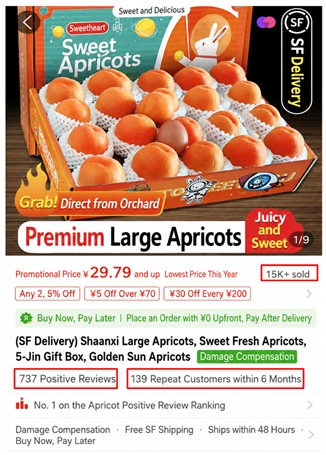
As the industry has developed, some platforms have begun to further refine action-based information cues. As shown in Appendix A, the platform displays information on the product interface about the “repeat customers” who have purchased the product more than once. Compared with simply informing users about the quantity of previous purchases, repeat purchase information can offer additional cues about the outcomes of prior purchase experiences. Users who make repeat purchases are generally more satisfied with the overall characteristics of the purchased product and perceive it as providing the desired value [5]. Therefore, repeat purchase information not only indicates that the product has been purchased by previous users but also reflects positive feedback on the product. This endorsement from previous users can reduce uncertainty and perceived risk in the e-commerce environment, thereby enhancing trust in sellers and products and assisting users in their decision-making process [6].
Although repeat purchase information offers valuable advantages as an action-based information cue, it is not yet widely used in e-commerce sales practices. Many platforms still rely on purchase quantity information as a standardized cue in product sales, without fully understanding the impact of repeat purchase information on sales performance. Moreover, individuals have limited cognitive resources, and excessive information can overwhelm decision-making processes, resulting in decreased decision quality, longer decision times, and potential errors [7,8]. Information overload and redundancy may arise and disrupt users’ decision-making if multiple action-based information cues are incorporated into the purchase process. Therefore, research is needed to address this challenge and provide an empirical understanding of the importance of action-based information cues and how they influence user purchase decisions.
Despite a large body of literature focusing on the effectiveness of product reviews as a form of WOM in influencing user behavior [9,10,11], several studies have examined purchase action and demonstrated its superiority over opinion-based information cues. These studies commonly regard purchase action as a form of observational learning and explain it through the lens of social learning theory. According to this theory, individual behavior is shaped by observing the actions of others [12]. Earlier research largely adopted social learning theory to explain herd behavior observed in online purchasing [13,14,15]. Subsequent studies drew on insights from consumer behavior research on how consumers are influenced by the adoption decisions of previous consumers, extending these insights to the realm of e-commerce and proposing a close association between consumers’ purchasing behavior and their observation of prior purchases. For example, Wang and Yu [3] contend that in the field of social commerce, consumers’ acquisition of existing purchase information can be seen as a form of observing others’ actions in social interactions. Such observation increases purchase intention and can lead to actual purchase behavior. Li and Wu [16] examined daily-deal vouchers and showed that cumulative voucher sales can act as an observational learning cue, as buyers who are uncertain about deal value may infer higher value from deals purchased by a greater number of prior consumers. Thus, as a form of observational learning, purchase action contains less information than WOM but explicitly reveals the decisions of others and is therefore perceived as more credible than WOM [4,17]. Additionally, another important component of social learning theory concerns the reinforcement of behaviors shaped by observing others’ actions [12]. Observational learning can be reinforced by the positive or negative consequences that result from the observed actions of others. In the case of repeat purchase action, users may notice that previous purchases have yielded favorable outcomes, thereby reinforcing users’ purchase motivation. However, current explanations of user purchasing behavior in e-commerce focus mainly on users’ observational learning from others’ purchase actions and pay less attention to reinforcement learning triggered by repeat purchase action cues.
In this study, we address this gap by identifying a new action-based information cue called repeat purchase action. Drawing on social learning theory, we can gain a deeper understanding of the significance of information cues provided by market participants. When individuals encounter new tasks, they seek input from others, thus reducing the need for complex cognitive processing in decision-making [12]. This helps explain how purchase action information from previous users affects users’ purchase decisions. Building on this logic and prior research on purchase action [3,17,18], we distinguish purchase action as an observational learning cue from repeat purchase action as a reinforcement-related cue. In doing so, this study extends prior e-commerce research by examining how previous users’ publicly observable repeat purchase actions influence user purchase intention and by comparing the relative effects of different action-based information cues.
Considering prior studies that highlight trust as a crucial factor influencing purchasing behavior in the e-commerce context [19,20], particularly when examining the role of information cues, we also incorporate this trust-related perspective into the study. We propose trust expectation toward the product to reflect users’ perceptions during the learning process and to explain how the two action-based information cues influence user purchase intention through their mental processes. This study focuses on users’ purchasing decisions before product use, when they can only infer the product’s quality and fit with their preferences based on available information cues. Therefore, trust expectation represents a belief in the product, rather than a general willingness to trust, which aligns with the concept of individual perceptions in social learning theory. Furthermore, trust expectation may be more suitable for describing users’ online purchasing processes. Users often meticulously select products before making a decision, forming expectations about different products and selecting the one that best aligns with their expectations.
Overall, this paper addresses the following research questions:
1. How do the two action-based information cues, purchase action and repeat purchase action, influence user purchase intention?
2. What are the underlying mechanisms through which these two action-based information cues affect user purchase intention?
3. Which type of action-based information cue has a stronger impact on user purchase intention?
To address these questions raised from the literature, we develop a theoretical model based on social learning theory. Using data from online experiments, the current study contributes to the e-commerce literature by exploring previously unexamined information cues and to social learning theory by extending its explanatory power. The rest of this paper is organized as follows: Section 2 presents the theoretical foundation, and Section 3 develops the hypotheses and presents the research model. Section 4 describes the experimental procedure and reports the main results. Section 5 presents an additional experiment that further examines the advantage of repeat purchase action. Section 6 discusses the findings, implications, limitations, and future research directions.
2. Theoretical Foundation
Broadly, we situate our work in the context of electronic commerce, focusing on users’ trust beliefs and their impact on user purchase intention. Trust, which has been widely studied in online purchasing research, effectively helps users reduce fears and concerns about potential disadvantages in the marketplace and promotes purchasing behavior [21,22]. To establish a high level of trust expectation among users, businesses carefully provide and present information cues to users.
Within this broad context, our specific goal is to explore how information cues influence users’ trust expectation, thus driving their behavioral intention. In particular, this study focuses on a specific category of cues, namely action-based information cues, which reflect whether and how often users buy a product in an online marketplace. By using social learning theory, our study intends to investigate the path mechanisms and conditions of the relationship between action-based information cues and purchase intention. To this end, our work builds the theoretical foundation by drawing upon prior literature in three main areas: (1) social learning, (2) information cues, and (3) trust expectation.
2.1. Social Learning Theory
Social learning theory, proposed by Bandura [12], explains how learning occurs in the context of social interaction. The underlying concept concerns acquiring new abilities through observing the actions of others. According to Bandura [12], people learn to guide their own behavior by observing how others act in social encounters. Social learning theory adopts a broad perspective involving three intertwined and interacting components: behaviors, personal internal cognitive structures, and environments. E-commerce research has primarily used social learning theory to explain how social interaction-related information cues influence users’ purchase behavior.
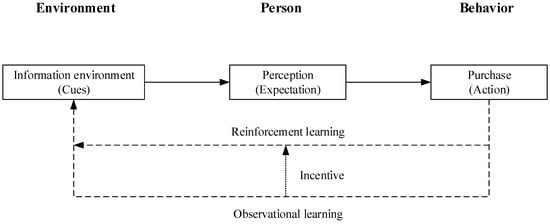
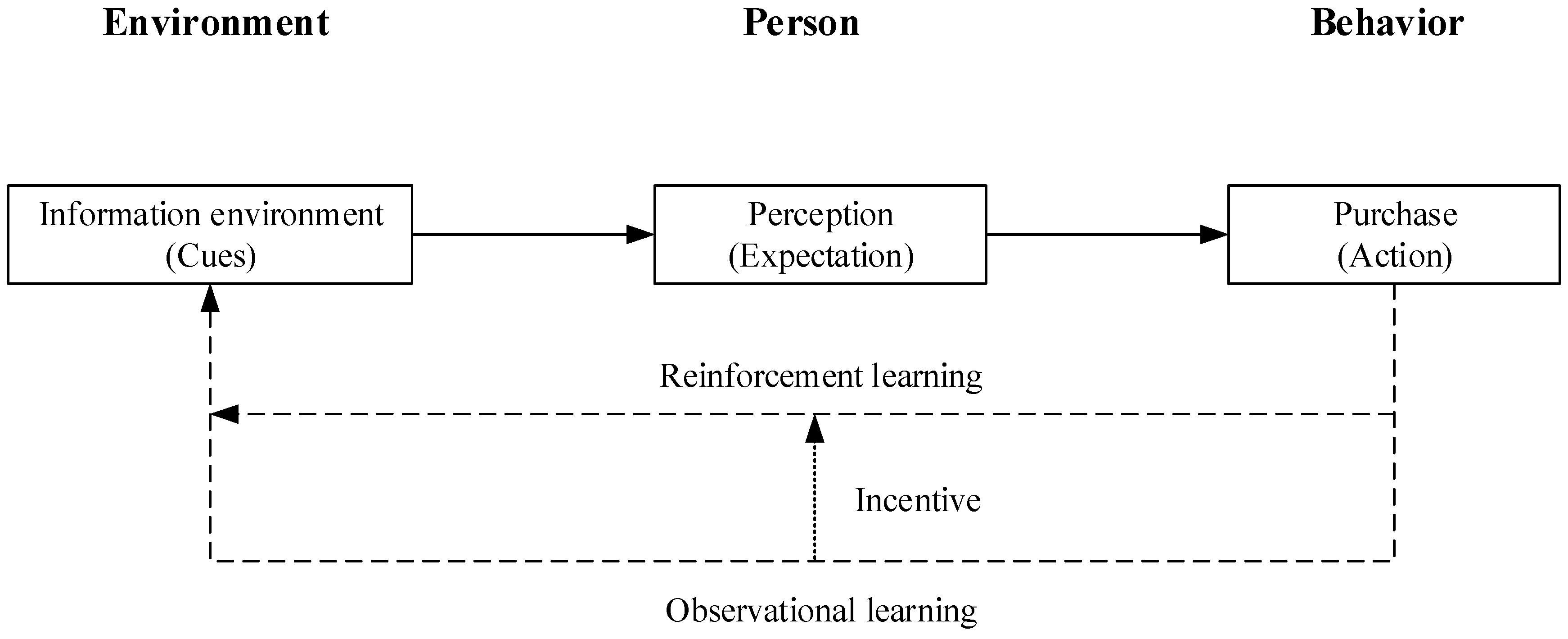
As Figure 1 shows, existing information cues shape users’ purchasing environment, assisting users in evaluating products and forming expectations about product quality and preference fit. Based on these expectations, users make purchasing decisions and complete their purchases. After consumers complete a purchase, their purchase behavior becomes an observable cue for subsequent consumers and updates the online shopping environment by adding behavioral information. When subsequent consumers use these visible actions to infer product value, they engage in observational learning in the sense of social learning theory. Prior e-commerce and social commerce research have similarly treated observable user actions, such as prior purchase counts, as action-based information cues that help consumers make purchase decisions [3,23]. When information is limited, observing other users’ purchase actions can weaken users’ reliance on their own prior judgments (i.e., private information), ultimately leading to an information cascade [24]. As a result, consumers may follow the choices of others and exhibit a herding effect. Information cues that present users’ purchase action not only enhance users’ purchase motivation through quantitative signals but also have advantages in terms of information credibility [17]. This suggests that users’ expectations about the product increase when they see that more prior consumers have purchased it. A common example is that users do extensive research to choose a restaurant but end up choosing a crowded one.
Figure 1.
The process of social learning in electronic commerce.
Furthermore, reinforcement plays an important role in the social learning process. When observers see others receive rewards, praise, or other positive outcomes for performing certain behaviors, their own tendency to perform similar behaviors may also be reinforced [25]. While observational learning reflects users’ purchase actions at the purchase stage, it does not reveal what happens after the product is purchased. Thus, it is difficult to infer the product quality and preference fit from previous users’ purchase actions, indicating that trust in the product still relies on inference. If the observational learning process is supplemented with post-purchase feedback from previous users, the credibility of the information is likely to increase substantially. Building on this logic, this study proposes repeat purchase action as an extension of action-based information cues. Users are likely to continue buying when their expectations about the product are confirmed after use [26,27]. Revealing the number of repeat purchases indicates that previous buyers’ experiences met their expectations and that they were satisfied enough to buy again. This positive outcome signal can reinforce subsequent consumers’ purchase intention. For example, when browsing a product page on an e-commerce platform, a user who finds that many previous buyers have repurchased the product may infer that these buyers’ post-purchase experiences met their expectations, thereby reinforcing the user’s own purchase intention. In the following section, this study examines how purchase action and repeat purchase action differentially influence user trust expectation and purchase intention.
2.2. Information Cues in Electronic Commerce
Information technology has made it easier for traditional commerce to operate online by removing time and space barriers between buyers and sellers, but it has also weakened customers’ direct connection with products. The resulting information asymmetry is a critical challenge that impairs product sales and business growth. As a result, in an e-commerce context, sellers generally use information cues or signals to assist consumers in understanding and evaluating products [28]. From the perspective of signaling theory, information cues are able to compensate for the disparity in the amount of information received by multiple parties in an online marketplace transaction, supporting vendors in providing users with information about product quality and fit with customer preferences [29].
For several decades, diverse information cues have emerged with the transformation of e-commerce (see Table 1). In the early stage of e-commerce, information cues were primarily divided into two categories, website-related cues and product-related cues. The website or platform-related information cues include technological characteristics and design features. Technological characteristics mainly concern how a website or platform can be developed to provide users with more information, such as software reliability, delivery date credibility [30], online reputation systems [31], information quality and system quality [32], and other factors. In addition, some cues focus on the design of interface information. For example, incorporating trust-assuring messages into an online store’s interface design can enhance user trust and increase purchase intention [33]. Another category of information cues concerns product characteristics. Product-specific descriptions, such as warranty information and product specifications, can enhance user perceptions of product quality and performance [34]. Moreover, price, distinctiveness, and other product characteristics are also important factors that determine user purchases [35].
As online connectivity and social interaction have driven the evolution of e-commerce into various business models such as social commerce and live-streaming commerce, information cues have also become connected to social elements and are broadly classified into two types: opinion-based information cues, which reflect users’ subjective evaluations of products (e.g., reviews and ratings), and action-based information cues, which reflect users’ observable purchasing behaviors (e.g., purchase counts) [17]. Word-of-mouth is considered one of the most influential factors affecting users’ product purchase decisions, with reviews, likes, shares, ratings, and so on identified as typical social signals [10,23]. A considerable number of studies show that these social information cues are significantly associated with product sales [36,37]. Taking reviews as an example, Clemons et al. [38] find that strongly positive reviews can influence product sales growth, while Chen et al. [39] indicate that the quality of reviews is also related to sales. Moreover, Mudambi and Schuff [40] adopt review helpfulness as a measure of review quality and reveal that it is impacted by review extremity, review depth, and product category. In particular, Li et al. [41] focus on a specific type of review, repeat purchase reviews, in which users share their rebuying experiences. These reviews are viewed through the lens of observational learning, as the repeat purchase information provided can aid in analyzing word-of-mouth, thereby increasing users’ perceived value and purchase intention.
In addition to the aforementioned opinion-based information cues, action-based information cues have also been examined and shown to significantly drive user purchases. Chen, Wang and Xie [17] describe information about other users’ purchase behavior as observational learning, referring to the total number of existing user actions—essentially the total number of prior purchases. Cheung, Xiao and Liu [4] and Wang and Yu [3] identify these action-based information cues as the number of purchases by prior users and find that they are more likely to drive purchases than opinion-based information cues, such as reviews and likes. So far, the literature has remained at the observational learning stage, while overlooking the extension from purchase action to repeat purchase action. In other words, cues that reinforce action-based information are omitted.
Table 1.
Review of information cues on electronic commerce research.
2.3. Trust Expectation
In e-commerce, the concept of trust is commonly used. In earlier research, trust was mainly used to describe how users regarded the reliability of sellers or third-party organizations [53]. Because users cannot physically experience the online environment, they are regularly concerned about whether the purchasing process is secure [54]. Thus, the development of trust indicates that users have confidence to take on the risk and uncertainty associated with transactions with a seller or third-party organization. For instance, the degree of perceived financial risk relies on the user’s ability to return a product after buying it, which influences their level of confidence in the product sales process [55].
Information cues offer a means of coping with information asymmetry in online purchases to increase user trust; however, it is challenging for customers to obtain comprehensive knowledge of the market [28]. They can only determine whether a product is worth purchasing based on information cues and then form an expectation in their minds. The inferential process enables customers to develop expectations for the product, helping them assess whether the product’s quality and fit with their preferences meet their needs. In prior research, trust is typically studied after consumers have already identified a specific seller with whom they intend to transact. Under such circumstances, consumers evaluate the extent to which purchasing a particular product from that seller is trustworthy. In contrast, in the trust formation process described in this study, consumers have not yet decided which seller to purchase from and therefore do not possess a clearly defined trust relationship with any particular seller. Consequently, this study approaches trust as an expected evaluation. Following the general definition of trust proposed by Chai and Kim [56], users’ willingness to engage in purchase behavior is based on the expectation that other parties will perform specific actions that are important to users, even when users cannot monitor or control those parties. The purpose of user participation in e-commerce is to purchase products. Users develop a desire for a product in an environment where information cues are presented, expecting it to be as described online. This expectation leads them to make a purchase, as shown in Figure 1.
Following the above logic on trust, Hong [57] proposes the concept of trust expectation, which is defined as “the extent to which a consumer expects a future merchant to be capable of successfully addressing the risk elements associated with the purchase of a product.” Thus, trust expectation describes the merchant’s trustworthiness in dealing with anticipated threats in the online environment. In e-commerce settings, however, users tend to focus directly on the products they are considering during the purchase process. On the one hand, they are concerned about whether the product can accurately perform the functions described online while also demonstrating excellent quality in actual use. On the other hand, users expect the product to be consistent with their own preferences, thereby avoiding a mismatch during product use. Based on Hong [57]’s research, we can also derive a three-stage process through which users choose a product. Initially, users identify product goals and select the overall product scope and category before committing to a purchase. Then, they assess products through information cues, shaping expectations about the product in their minds. Ultimately, they opt for a product that best aligns with their trust expectation. As such, we use trust expectation to reflect users’ internal perceptual shifts and define it as the extent to which a user expects a product being considered to have high quality and preference fit as described online.
3. Hypothesis Development
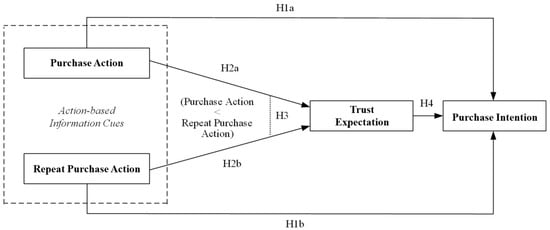
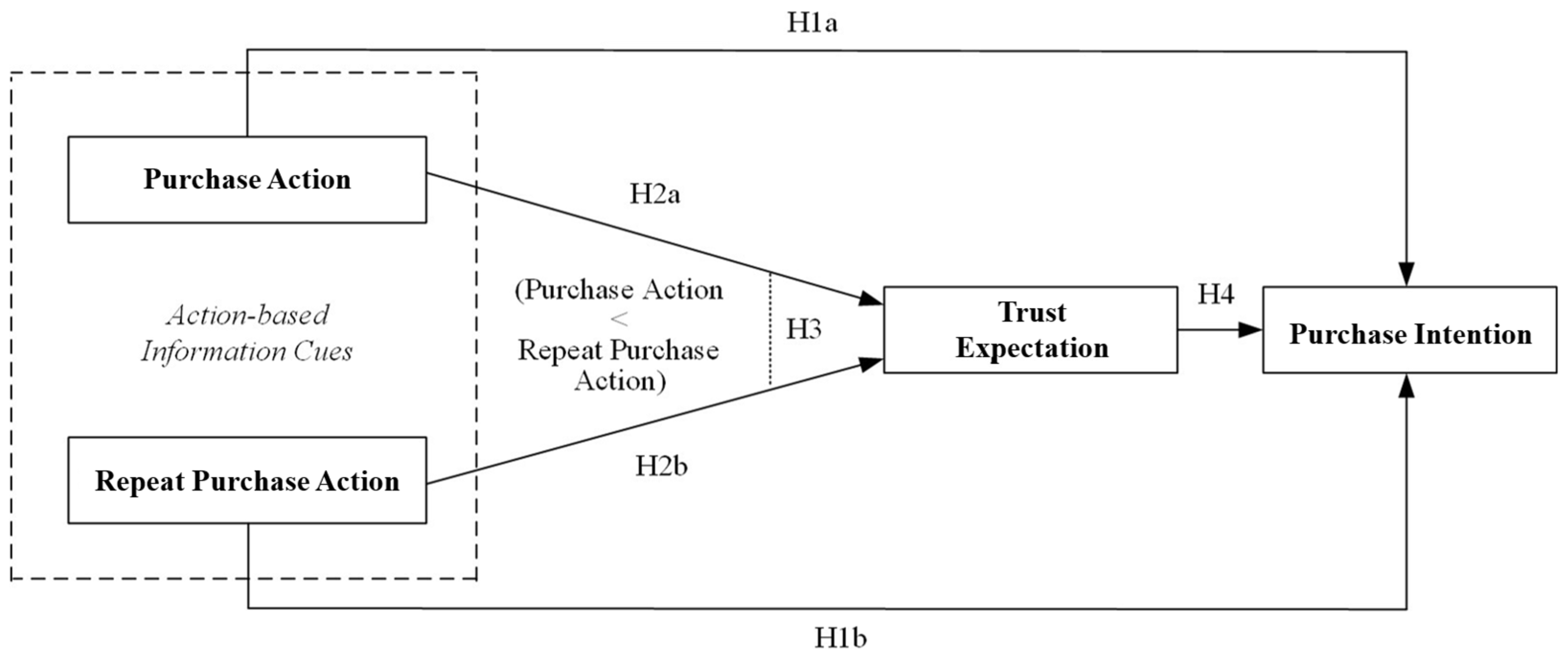
Figure 2 depicts the research model for this study. We posit that action-based information cues, including purchase action and repeat purchase action, have significant impacts on user purchase intention, and that these impacts are mediated by trust expectation. Furthermore, based on social learning theory, it is expected that repeat purchase action is more effective in building trust expectation than purchase action.
Figure 2.
Research model.
3.1. The Impact of Information Cues
There is abundant evidence from earlier studies that an individual’s behavior is influenced by the actions of other individuals or groups [24,58]. For example, the availability of voting information is related to subsequent voter decisions in political elections [59]. At the organizational level, Swanson and Ramiller [60] show that IT-related innovation behavior can be influenced by other actors in the broader innovation community.
In the context of e-commerce, users may be affected by the herding effect, change their preferences, and thus follow the purchase choices of other users in the marketplace [61]. This suggests that users tend to infer product-related information from others’ behavior because they have incomplete information. Chen, Wang and Xie [17] consider observing other users’ purchase actions as observational learning and note their ability to promote product sales. In addition, Cheung, Xiao and Liu [4] clearly state that prior purchase action (i.e., the number of products added to the buy-lists of a member’s reference persons) functions as a social information cue in social commerce. Indeed, observing other users’ actions can supplement product knowledge, change the perception of risk and uncertainty in the transactional environment, and provide clues for more accurate purchase decisions. This process facilitates information processing and may reduce cognitive dissonance by allowing users to observe other users’ actual purchases to increase their confidence in purchasing the product. Therefore, two types of action-based information cues, purchase action and repeat purchase action, are expected to increase users’ purchase intention:
Hypothesis 1a.
Purchase action will positively influence user purchase intention.
Hypothesis 1b.
Repeat purchase action will positively influence user purchase intention.
Viewing the social learning process in e-commerce, two action-based information cues alter the online transaction environment and influence users’ perceptions. Research indicates that the initial transaction environment consists of product-related information posted by sellers as well as comments made by other users. Despite having access to product-related information, users may find it less helpful or less trustworthy because sellers would show products based on their interests [45], and fake online reviews exist [62]. On the one hand, action-based information cues assist users in inferring product quality and building a stronger belief that the product can meet their needs. On the other hand, they can help users assess whether product attributes, such as flavor, size, and material, match most users’ preferences during actual usage, which improves perceived product fit. As a result, users can form a holistic perception of the product, increasing their confidence in selecting it. Empirical investigation also shows that users adjust their expectations as they acquire new information [63]. In this regard, we propose the following hypotheses:
Hypothesis 2a.
Purchase action will positively influence user trust expectation.
Hypothesis 2b.
Repeat purchase action will positively influence user trust expectation.
3.2. Observational Learning Versus Reinforcement Learning
As mentioned earlier, action-based information cues provide a strong signal of product quality and preference fit that encourages customers to imitate the purchase behavior of their predecessors. Previous literature argues that actions speak louder than words and investigates the relative impact of observational learning and reviews on user purchase decisions, while the effects of different types of action-based information cues remain unclear [64]. According to social learning theory, people acquire much of their knowledge by observing others. That is, people observe the actions of others and then engage in specific behaviors to avoid errors [65]. Furthermore, reinforcement learning occurs when the outcomes of others’ actions are seen during observational learning [66]. For instance, Cheung, Liu and Lee [64] find that in social shopping communities, observing other users’ posting behavior enhances their information contribution behavior (i.e., posting), and this posting behavior is reinforced when they receive feedback in the form of comments on their posts. Similarly, users develop expectations about products and make purchase decisions by observing the purchase actions of others. If information about others’ repeat purchases is revealed, users may become aware that previous purchases yielded positive outcomes. In accordance with expectation confirmation theory, only users whose expectations are confirmed experience high satisfaction and engage in continued purchase behavior. Therefore, when users receive positive feedback about a product from others, their expectations of that product will be reinforced. We formulate the following hypothesis:
Hypothesis 3.
Repeat purchase action will exert a stronger influence on user trust expectation than purchase action.
3.3. The Impact of Trust Expectation
Social learning theory posits that individuals’ expectations shape the development of their behavior. Users tend to combine information about product quality and preference fit to generate a perception of the product that drives their purchase behavior. For example, Zeithaml [67] proposes the value-intention model, which suggests that users initially perceive the quality and price of the product, and then form an overall assessment of product value, leading to purchase behavior. In the e-commerce purchase process, users expect to obtain the optimal product. They choose the product that appears most credible based on information cues and expect it to perform effectively in practice. We propose that the higher the level of trust expectation for a product, the more likely the user is to purchase it.
Hypothesis 4.
Trust expectation will positively influence user purchase intention.
4. Methodology
4.1. Pretest
This study aims to investigate the impact of action-based information cues on user purchase intention with trust expectation as the mediator. Previous research has used cosmetic products and digital cameras as experimental stimuli [4,17]. We suspected that participants’ age and gender distribution might vary due to the use of cosmetic products, while digital cameras were no longer appropriate, given the present state of e-commerce. Following the approach of Chen, Wang and Xie [17], snack food was chosen as the experimental stimulus for the empirical study. First, as one of the most commonly consumed and widely accessible product categories in daily life, snack food is familiar to most people and attracts broad interest. Second, most snack food products are relatively inexpensive. People are thus likely to be motivated to purchase them by information cues. Third, snack food is an experience product with a high degree of uncertainty that can only be evaluated accurately after purchase and experience. Information cues are crucial in influencing users’ decision-making. Therefore, information about previous purchases and repeat purchases could be effective in influencing users’ purchase decisions.
Before examining the effectiveness of purchase action and repeat purchase action as information cues, a separate analysis was conducted to identify the number of actions appropriate for online shopping. We considered that the number of actions should reach users’ purchase threshold to reduce individual differences. Thus, we conducted a pretest on Credamo (www.credamo.com), a professional questionnaire crowdsourcing platform in China. It functions like Amazon Mechanical Turk and has supported many studies published in top journals. We collected data through the platform’s respondent panel, which consists of hundreds of thousands of users with diverse demographic characteristics, including gender, age, and educational background. The platform allowed researchers to recruit participants according to specific sampling criteria. Given that our target population comprised consumers of e-commerce platforms, we did not impose any demographic restrictions on participant selection. Instead, the survey was distributed randomly across the members of the panel until the desired sample size was achieved.
We first informed participants that this study was conducted in collaboration with McMix, a professional e-commerce platform that sells snack food. To improve user engagement, the platform aimed to test how page design might improve the user experience in practice. Participants were then given the following statement: “Imagine you are searching for and buying a product (Note: At the beginning of the experiment, we tried to present a specific product by showing them a picture of an Indonesian food product (i.e., Maitos, a tortilla chip brand). In the pretest, the result indicated that the impact of product familiarity was not important (F(1, 58) = 0.25, p = 0.62). However, the results of the main experiment were unsatisfactory. We speculated that this may be caused by variations in user preferences for particular products. As a result, we did not restrict it to a single product, but rather to a broad category of snack food. One is that most users will buy frequently on a daily basis, and the other is that snack food possesses a high degree of uncertainty, thus requiring users to rely on information cues from previous users for evaluation.) on the McMix platform. After you click on the search button, you discover that the price of the product is basically the same in each store, but the number of purchases/repeat purchases varies.” A total of 64 participants took part in the pretest and received $0.30. After reading the background, they were required to answer two questions designed to measure the quantities of two actions: “How many purchasers/repeat purchasers in the store could let you choose to buy this product? Please write down the number (Unit: person).”
Table 2 presents the descriptive statistics for our pretest. We considered these criteria together. The mean was used as a reference to obtain an overall quantitative benchmark. Because the standard deviations were large, we considered the medians and 75th percentiles together with the means. For purchase action, the 75th percentile was 9500, indicating that this purchase volume would motivate most participants to buy. We therefore set the number at 10,000. For repeat purchase action, the 75th percentile was 1000, and the mean was 1500, suggesting that a repeat-purchase volume of around 1500 could provide an effective signal. We set the repeat-purchase number at 2000 to provide a salient cue while preserving the realistic expectation that repeat purchases are normally fewer than total purchases.
Table 2.
The descriptive statistics.
4.2. Experimental Design of Study 1
Similar to the pretest, we designed an online experiment on the Credamo platform to study which of the two action-based information cues, namely purchase action (the number of previous purchasers) and repeat purchase action (the number of previous repeat purchasers), would more strongly increase user purchase intention. In the experiment, participants read a short introduction about McMix, after which they were asked to imagine the following scenario: “This weekend, you intend to relax at home by watching a famous drama, but you feel like you will be unable to do it without snacks. At that point, you remember and access the McMix platform mentioned by your colleague, where you search for the casual snacks you wish to buy, and the following information appears.” Then, participants were randomly assigned to one of three experimental groups and were presented with the following statements (see Appendix B):
No Information (Control—C): “High quality, low price, irresistible deliciousness. Come and buy it now!”
Information about purchase action (Treatment 1—T1): “High quality, low price, irresistible deliciousness—over 10,000 customers have already ordered this product. Come and buy it now!”
Information about repeat purchase action (Treatment 2—T2): “High quality, low price, irresistible deliciousness—over 2000 customers have already made multiple repeat purchases. Come and buy it now!”
Afterward, participants were asked to rate their likelihood of purchase (1 = Not likely at all, 10 = Very likely). They were also asked to respond to questions regarding trust expectation. The measurement of trust expectation was based on Hong [57], who considers trust in online merchants as an expectation of users. In this study, trust expectation is defined as the extent to which a user expects a product being considered to have perfect quality and preference fit as described online. Consistent with our definition, 6 items were used to measure this variable, including items related to product quality and preference fit [68]. The statements were as follows “the product would look the same in real life from how it looks on the website description”, “the product would function as well as it was introduced on the website”, “the product would perform as I expected it to perform”, “the product would match my requirements”, “the product would match my tastes”, and “the product would match my preferences”. We tested the reliability and validity of the measurement scales, and the results indicated that trust expectation was well measured (average variance extracted > 0.5, composite reliability > 0.7, Cronbach’s alpha > 0.7, factor loadings > 0.7, and factor loadings for all items ranged from 0.76 to 0.81) [69].
In total, 227 valid responses were collected. Among them, 58.6% were female, 55.5% were 25–34 years old, more than 70% held a bachelor’s degree or above, 64.8% earned more than 5000 RMB, over 60% had used the platform for less than three years, and 64% purchased fewer than 5 times per month. The descriptive statistics are shown in Table 3. The differences in demographic variables among the groups were not significant, indicating successful random assignment of participants.
Table 3.
Descriptive statistics for the main study.
4.3. Results of Study 1
To examine our hypotheses and the relationships among constructs, mediation analysis was performed using the PROCESS macro (version 3.0) in IBM SPSS Statistics 26 [70]. We used PROCESS Model 4 with 5000 bootstrap samples to assess the significance of the path model and obtain p-values.
As shown in Table 4, the estimated coefficients for Treatment 1 and Treatment 2 on purchase intention were 0.34 (p = 0.04) and 0.51 (p = 0.00), providing evidence to support H1a and H1b. In addition, the significant coefficient for Treatment 2 on trust expectation (b = 0.29, p = 0.02) indicated that repeat purchase action increased users’ trust expectation, supporting H2b. However, the coefficient for Treatment 1 on trust expectation was 0.04 (p = 0.78), showing that purchase action did not have a significant impact on trust expectation. Thus, our results did not support H2a. Moreover, we found that trust expectation significantly influenced user purchase intention (b = 1.21, p = 0.00), supporting H4.
Table 4.
Estimation results for the linear regression model (N = 227).
We further compared the effects of the two action-based information cues on trust expectation when Treatment 1 was used as the baseline. The results indicated that repeat purchase action increased trust expectation more than purchase action (b = 0.25, p = 0.05), supporting H3.
We also tested the indirect effects of the action-based information cues on purchase intention as presented in Table 5. The results showed a significant indirect effect of repeat purchase action on purchase intention through trust expectation (the 90% confidence interval did not include 0), but the indirect effect of purchase action on purchase intention was nonsignificant (the 90% confidence interval included 0). Moreover, the indirect effect of repeat purchase action on purchase intention was stronger than that of purchase action when Treatment 1 was used as the baseline. These findings provided further confirmation of our hypotheses.
Table 5.
Indirect effects of action-based information cues on purchase intention.
5. Effectiveness Test
5.1. Experiment 2: Advantage of Repeat Purchase Action
Although our findings provided evidence that repeat purchase action enhances users’ trust expectation, this effect may not apply directly to purchase action. We speculated that repeat purchase action contains specific signals that reinforce users’ confidence in making purchases, a characteristic not present in purchase action. Following this rationale, we tested the underlying logical relationship in our hypothesis framework using additional variables and analyzed the differences between the two action-based information cues.
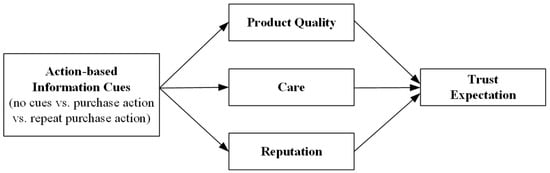
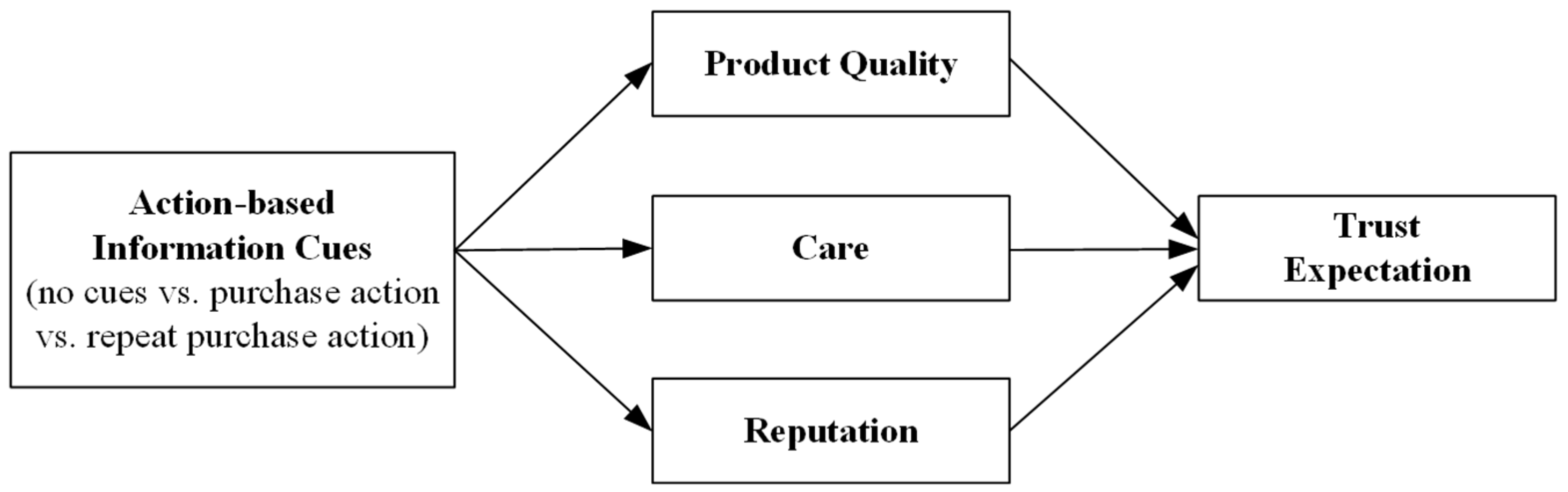
Generally, loyal customers tend to buy products from a specific platform or seller more frequently and consistently [71]. Repeat purchase action is intrinsically connected to customer loyalty. Thus, we reviewed the literature on customer loyalty to identify factors that could influence users’ continued purchase behavior. In the context of e-commerce, Srinivasan et al. [72] identified eight potential factors influencing loyalty and classified them as the “8Cs.” Pan et al. [73], from another perspective, investigated customer-related and product-related factors. Specifically, Toufaily et al. [74] systematically organized these variables influencing customer loyalty into five main categories: customer characteristics, environmental characteristics, product/service attributes, company/retailer characteristics, and website characteristics. Due to the comparative nature of our research scenario, which focuses on comparing two types of action-based information cues, we selected relevant variables from both the product and seller perspectives for testing and explanation. Specifically, the advantage of repeat purchase action might stem from users’ inference that prior purchasers were probably satisfied with their purchases based on information about repeat purchase action. This satisfaction could take two forms: first, in terms of the product itself, users may view it as being of high quality during the post-purchase usage phase [75]. Second, the seller may have provided exceptional service support throughout the post-sale process, continuously enhancing users’ post-purchase journey, resulting in a favorable overall view of the seller. Users may perceive the seller’s care and reputation more favorably [72]. As a result, Experiment 2 was conducted following the framework illustrated in Figure 3.
Figure 3.
Research model for potential effect.
5.2. Experimental Design of Study 2
Following the previous experimental design, we evenly allocated Credamo participants across the control group, Treatment 1, and Treatment 2. The experimental procedure remained unchanged. The difference was that after participants read the statements, they were asked to respond to questions regarding their perceptions of the product and seller. We collected a total of 157 responses, and after excluding participants who failed the attention-check questions (e.g., those who were explicitly instructed to select “1” but failed to do so) or provided incomplete responses, we retained 144 valid responses.
The measurement of product quality was derived from Wells, Valacich and Hess [32] and included 3 items: “I perceive the product offered to be durable”, “The product appears to me to be well crafted”, and “I perceive the product offered to be of high quality”. Care was measured using 5 items from Srinivasan, Anderson and Ponnavolu [72], and the statements were “I have not experienced problems with billing after purchasing the product”, “The goods that I purchased were delivered on time”, “I feel that the seller is responsive to any problems that I encounter”, “The after-sale quality is customer friendly”, and “I believe that the seller takes good care of its customers”. Reputation was evaluated by asking participants about their attitudes toward the seller’s reputation, as suggested by Pan et al. [76]. All items were assessed using a seven-point Likert scale, ranging from 1 (“strongly disagree”) to 7 (“strongly agree”). Furthermore, we established the reliability and validity of these variables (average variance extracted > 0.5, composite reliability > 0.8, Cronbach’s alpha > 0.7, all factor loadings > 0.7, and factor loadings for all items ranged from 0.72 to 0.87) [69].
5.3. Results of Study 2
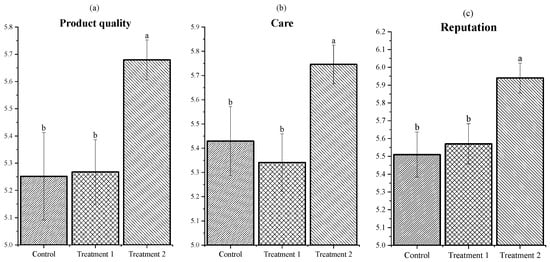
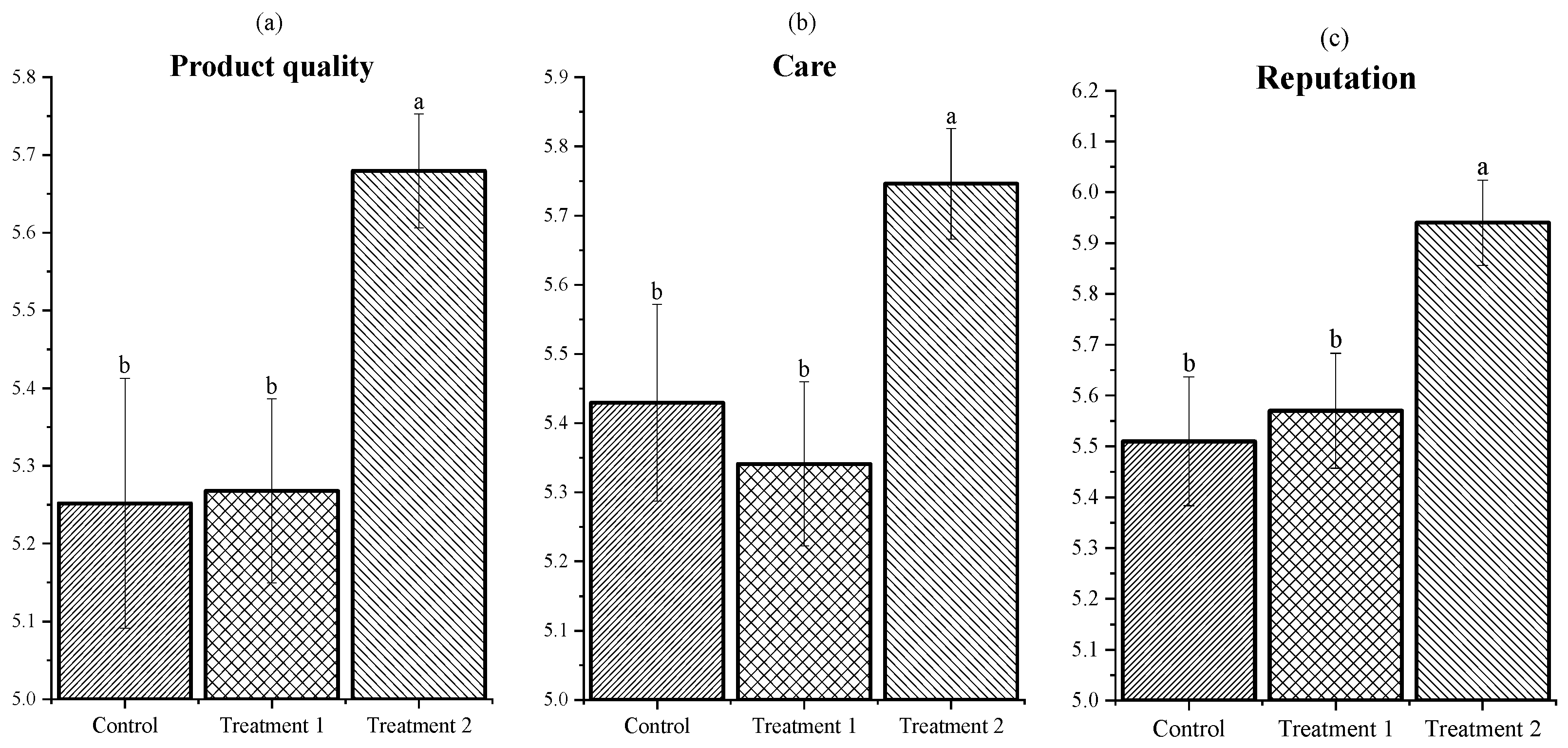
We employed one-way ANOVA in SPSS to examine the differences in the effects of the two action-based information cues on users’ perceptions of product- and seller-related factors, as shown in Figure 4. Compared to purchase action, repeat purchase action led users to perceive higher product quality (F(2,141) = 4.45, p < 0.05). Users perceived greater care from the seller when repeat purchase action was provided (F(2,141) = 3.79, p < 0.05). Moreover, users perceived the seller’s reputation more positively under repeat purchase action than under purchase action (F(2,141) = 4.87, p < 0.01).
Figure 4.
The effect of action-based information cues on potential factors: (a) product quality; (b) care; (c) reputation. Error bars represent standard errors. Different lowercase letters above the bars indicate significant differences between groups; bars sharing the same letter are not significantly different.
We also conducted a mediation analysis using PROCESS to further explore the impacts of these variables. Our findings indicated that product quality (b = 0.10, LLCI = 0.03, ULCI = 0.18), care (b = 0.13, LLCI = 0.04, ULCI = 0.24), and reputation (b = 0.10, LLCI = 0.02, ULCI = 0.18) all acted as significant mediators in the relationship between repeat purchase action and trust expectation, compared with purchase action. These results indicated that repeat purchase action had a clear advantage in reinforcing users’ favorable perceptions of both the product and the seller, an effect not achieved through purchase action.
6. Discussion
Building on previous research on the role of purchase action, this paper proposes repeat purchase action as a key factor in enhancing user trust expectation and purchase intention in e-commerce. We then developed a theoretical model grounded in social learning theory to investigate the impact of these two types of action-based information cues on purchase intention through the mediation of trust expectation. Using data obtained from online experiments on the Credamo platform, we conducted a mediation analysis using PROCESS and obtained empirical evidence.
This study shows that both types of action-based information cues can enhance users’ purchase intention. The finding that purchase action has an impact on purchase intention is consistent with findings from earlier studies. Purchase action provides public signals that weaken users’ reliance on their own private information, leading to an information cascade. Thus, purchase action reflects users’ observational learning process [17]. Whether a person chooses to follow the actions of others depends heavily on the strength of the observed behavioral signal. For example, some restaurants hire people to line up outside their stores. This creates an environment that suggests a high level of purchase activity, which drives users to alter their beliefs and ultimately opt to make a purchase [77]. In addition, this study finds that repeat purchase action can also enhance user purchase intention. Repeat purchase action builds on observational learning by informing users not only about prior purchase decisions but also about implied post-purchase outcomes, thereby helping users infer product quality and preference fit.
The above findings demonstrate the effectiveness of observational learning and reinforcement learning in shaping individual purchase behavior. This study confirms that the effect of repeat purchase action on purchase intention is mediated by trust expectation. The results point to a strong effect of repeat purchase action on users’ trust expectation, suggesting that the reinforcement signal conveyed by repeat purchase action provides stronger cues about product quality and preference fit. Our results also reveal how purchase action and repeat purchase action operate through different learning mechanisms. Compared with purchase action information, repeat purchase action information enhances users’ trust expectation toward the product, thereby increasing purchase intention. This is largely because repeat purchase action implies post-purchase outcomes, offering additional information cues that help users form a holistic perception of the product.
However, the purchase action fails to elicit users’ trust expectation. A potential explanation for the nonsignificant result is that users engaging in observational learning simply follow the actions of others. This process increases the influence of public observational information while weakening users’ reliance on their own private information in their overall assessment of the product, thereby limiting their ability to judge the product and form trust expectation before purchase. The findings from Experiment 2 provide evidence for this speculation. Purchase action failed to help users improve their confidence in judging product quality and the seller’s after-sales service; however, repeat purchase action did help users do so. This further supports the advantage of repeat purchase action, as suggested in Hypothesis 3.
As discussed above, one possible reason why purchase action increases purchase intention but fails to elicit trust expectation is that consumers tend to follow others through a herding mechanism rather than actively process and evaluate information. This observation leads us to speculate that trust expectation may be more readily formed in contexts where information evaluation is less demanding. For example, in the case of search goods, consumers face relatively low levels of information uncertainty. Under such circumstances, observing the purchase behavior of other consumers may be sufficient to quickly generate trust expectation [78]. Similarly, for low-involvement products characterized by simple decision-making processes, habitual purchasing, and limited information processing, trust expectation may be internalized through habit or brand loyalty and therefore does not need to be re-established with each purchase. In these situations, information conveyed through others’ purchase action can readily trigger the formation of trust expectation [79]. In contrast, we also speculate that purchase volume may be driven by online promotional campaigns [80] or new product launches [81]. Although these activities may boost sales volume, they do not necessarily provide reliable information about product quality or the seller’s post-sale performance. Future research could examine the boundary conditions of this effect.
6.1. Implications
This paper provides several valuable theoretical contributions to the literature. First, this study adds to the body of knowledge about information cues in e-commerce. We provide strong empirical support for existing findings regarding the impact of purchase action on user purchase intention. More importantly, our study advances research on action-based information cues. Whereas previous literature has focused on identifying action-based information cues in terms of previous users’ purchase action and exploring their differences from opinion-based cues (i.e., word-of-mouth), we go a step further by offering an early attempt to introduce repeat purchase action as a distinct action-based information cue and examine its impact on purchase intention, as well as its differences from purchase action.
Second, this study offers a more in-depth perspective on how social learning theory is applied in an e-commerce context. On the one hand, we extend the learning process of user purchase in e-commerce. Numerous studies have noted the part that users’ observational learning plays in their online purchases, but few researchers have gone further to examine the role that reinforcement plays in the learning process. Our study examines both observational and reinforcement learning mechanisms within social learning theory, comparing and contrasting their roles in promoting online transactions. On the other hand, we refine the user learning process in the context of e-commerce, thereby enhancing the theoretical explanatory power of this theory.
Finally, we identify the mechanism through which action-based information cues influence user purchase intention. Trust expectation captures the perceptions and expectations that users form during the social learning process. Drawing on Hong [57]’s understanding of trust expectation regarding sellers, we propose trust expectation for products, which reflects the psychological process triggered by changes in the information environment during the product purchase process. The findings of this study add to our understanding of trust expectation and provide insight into the pathways through which action-based information cues operate.
The significance of this research for practitioners is clear. With the widespread integration of social elements in e-commerce, social information cues have become a means for users to make purchase decisions. Understanding how social information cues influence user purchase decisions is crucial for companies that use previous users’ purchase action information to promote their products and services. Our research findings can help formulate guidelines and create more effective online marketing strategies. Since both purchase action and repeat purchase action can increase users’ purchase intention, e-commerce platforms or websites may consider retaining the display functions of both types of action-based information cues, while sellers may choose their information display strategy according to their own sales scenarios when developing and designing product interfaces. Our findings can therefore assist e-commerce platforms in developing systems for organizing and designing sales interfaces more efficiently.
In the online transaction environment, information asymmetry exists between buyers and sellers, and buyers cannot accurately obtain information about products, leading to uncertainty regarding product quality and preference fit. Faced with high product uncertainty, users may perceive more risk in the purchase process, leading to lower trust expectation toward the product. Our research findings suggest a more effective approach to addressing this issue by leveraging action-based information cues. This approach can assist sellers in adopting appropriate strategies to enhance users’ confidence in the product. The study reveals that users may have difficulty developing trust expectation toward products by observing previous users’ purchase action, and this process may require reinforcement from positive post-purchase outcomes. Repeat purchase action suggests that many users acknowledge, through their actual buying behavior, that their previous purchases met their expectations. Sellers can therefore indirectly convey previous users’ overall evaluation of the product through repeat purchase action information. Additionally, users may experience information overload when faced with excessive information, and sometimes excessive information cues in product interfaces can disrupt user judgments. Therefore, in such cases, sellers may consider displaying only previous users’ repeat purchase action information as a way to reinforce users’ trust in the product and select appropriate interface development strategies accordingly.
6.2. Limitations and Future Research
This study also has some limitations. First, we used scenario-based experiments to measure the impact of purchase action and repeat purchase action on users. Even though we conducted the experiment using the name of the McMix platform and added the scenario description to create as realistic an environment for participants as possible, participants may still have perceived the setting as somewhat removed from a real shopping environment. Therefore, to make the experimental scenarios more realistic and thereby better analyze and validate the research model presented in this paper, future research could use field experiments or natural experiments. Second, our sample and data were obtained from a Chinese crowdsourcing platform. Future studies could examine samples from different countries and regions to collect more diverse data. Third, in light of the role of information cues in reducing information asymmetry, this paper conducted an experiment with snack food, a product category with high uncertainty regarding quality and preference fit. Whether the same effect exists for other product categories, such as clothing and cosmetics, can also be examined in future studies. Finally, we propose trust expectation as a potential mechanism to describe user perceptions in accordance with the learning process of social learning theory. It would be interesting to investigate other factors that may be influenced by information cues and may capture users’ psychological mechanisms. Future research may also attempt to identify and measure additional suitable mediating variables using quantitative methods.
Author Contributions
Conceptualization, H.C. (Hao Chen); methodology, H.C. (Hao Chen); formal analysis, M.S.; investigation, H.C. (Hao Chen); visualization, M.S.; supervision, H.C. (Haitao Chen); project administration, H.C. (Haitao Chen); writing—original draft preparation, H.C. (Hao Chen); writing—review and editing, M.S., H.C. (Haitao Chen) and H.C. (Hao Chen). All authors have read and agreed to the published version of the manuscript.
Funding
This work is supported by the National Natural Science Foundation of China [Grant 72504102] and the Fundamental Research Funds for the Central Universities of China [Grants CCNU26ZZ091 and JC2026TS-014].
Institutional Review Board Statement
Ethical review and approval were waived for this study because it used anonymous and voluntary online scenario-based experiments. No personally identifiable or sensitive information was collected, and the study did not intentionally target vulnerable populations. Participants completed only ordinary online survey tasks, with no foreseeable risks beyond those normally associated with survey participation. The study was conducted in accordance with the ethical principles of the Declaration of Helsinki.
Informed Consent Statement
Informed consent was obtained from all subjects involved in the study.
Data Availability Statement
Data are available from the corresponding author upon reasonable request.
Conflicts of Interest
The authors declare no conflicts of interest.
Appendix A. A Sample of Information Cues in Product Interface
Appendix B. Experimental Materials
Table A1.
Textual and visual materials.



References
- Choi, J.; Lee, H.J.; Kim, H.-W. Examining the effects of personalized app recommender systems on purchase intention: A self and social-interaction perspective. J. Electron. Commer. Res. 2017, 18, 73–102. [Google Scholar] [CrossRef] [Scilit]
- Xiong, Y.; Cheng, Z.; Liang, E.; Wu, Y. Accumulation mechanism of opinion leaders’ social interaction ties in virtual communities: Empirical evidence from China. Comput. Hum. Behav. 2018, 82, 81–93. [Google Scholar] [CrossRef] [Scilit]
- Wang, Y.; Yu, C. Social interaction-based consumer decision-making model in social commerce: The role of word of mouth and observational learning. Int. J. Inf. Manag. 2017, 37, 179–189. [Google Scholar] [CrossRef] [Scilit]
- Cheung, C.M.K.; Xiao, B.S.; Liu, I.L.B. Do actions speak louder than voices? The signaling role of social information cues in influencing consumer purchase decisions. Decis. Support Syst. 2014, 65, 50–58. [Google Scholar] [CrossRef] [Scilit]
- Lin, J.; Li, T.; Guo, J. Factors influencing consumers’ continuous purchase intention on fresh food e-commerce platforms: An organic foods-centric empirical investigation. Electron. Commer. Res. Appl. 2021, 50, 101103. [Google Scholar] [CrossRef] [Scilit]
- Zhao, J.-D.; Huang, J.-S.; Su, S. The effects of trust on consumers’ continuous purchase intentions in C2C social commerce: A trust transfer perspective. J. Retail. Consum. Serv. 2019, 50, 42–49. [Google Scholar] [CrossRef] [Scilit]
- Park, D.-H.; Lee, J. eWOM overload and its effect on consumer behavioral intention depending on consumer involvement. Electron. Commer. Res. Appl. 2008, 7, 386–398. [Google Scholar] [CrossRef] [Scilit]
- Liang, H.; Fu, K.-w. Information Overload, Similarity, and Redundancy: Unsubscribing Information Sources on Twitter. J. Comput. Mediat. Commun. 2017, 22, 1–17. [Google Scholar] [CrossRef] [Scilit]
- Anderson, E.T.; Simester, D.I. Reviews without a Purchase: Low Ratings, Loyal Customers, and Deception. J. Mark. Res. 2014, 51, 249–269. [Google Scholar] [CrossRef] [Scilit]
- Fang, J.; Liu, L.; Hossin, M.A.; Wen, C.; Xia, G. Market Competition as a Moderator of the Effect of Social Signals on Viewership in Video-Sharing Platforms. Inf. Process. Manag. 2023, 60, 103329. [Google Scholar] [CrossRef] [Scilit]
- Kim, S.J.; Maslowska, E.; Malthouse, E.C. Understanding the effects of different review features on purchase probability. Int. J. Advert. 2018, 37, 29–53. [Google Scholar] [CrossRef] [Scilit]
- Bandura, A. Social Learning Theory; Prentice Hall: Englewood Cliffs, NJ, USA, 1977. [Google Scholar]
- Chen, A.; Lu, Y.; Wang, B. Customers’ purchase decision-making process in social commerce: A social learning perspective. Int. J. Inf. Manag. 2017, 37, 627–638. [Google Scholar] [CrossRef] [Scilit]
- Riaz, M.U.; Guang, L.X.; Zafar, M.; Shahzad, F.; Shahbaz, M.; Lateef, M. Consumers’ purchase intention and decision-making process through social networking sites: A social commerce construct. Behav. Inf. Technol. 2021, 40, 99–115. [Google Scholar] [CrossRef] [Scilit]
- Yu, Y.; Liu, B.Q.; Hao, J.-X.; Wang, C. Complicating or simplifying? Investigating the mixed impacts of online product information on consumers’ purchase decisions. Internet Res. 2020, 30, 263–287. [Google Scholar] [CrossRef] [Scilit]
- Li, X.; Wu, L. Measuring Effects of Observational Learning and Social-Network Word-of-Mouth (WOM) on the Sales of Daily-Deal Vouchers. In Proceedings of the 2013 46th Hawaii International Conference on System Sciences, Maui, HI, USA, 7–10 January 2013; pp. 2908–2917. [Google Scholar]
- Chen, Y.; Wang, Q.; Xie, J. Online Social Interactions: A Natural Experiment on Word of Mouth versus Observational Learning. J. Mark. Res. 2011, 48, 238–254. [Google Scholar] [CrossRef] [Scilit]
- Liu, Y.; Sutanto, J. Buyers’ purchasing time and herd behavior on deal-of-the-day group-buying websites. Electron. Mark. 2012, 22, 83–93. [Google Scholar] [CrossRef] [Scilit]
- Palvia, P. The role of trust in e-commerce relational exchange: A unified model. Inf. Manag. 2009, 46, 213–220. [Google Scholar] [CrossRef] [Scilit]
- Oliveira, T.; Alhinho, M.; Rita, P.; Dhillon, G. Modelling and testing consumer trust dimensions in e-commerce. Comput. Hum. Behav. 2017, 71, 153–164. [Google Scholar] [CrossRef] [Scilit]
- Kim, C.; Tao, W.; Shin, N.; Kim, K.-S. An empirical study of customers’ perceptions of security and trust in e-payment systems. Electron. Commer. Res. Appl. 2010, 9, 84–95. [Google Scholar] [CrossRef] [Scilit]
- McCole, P.; Ramsey, E.; Williams, J. Trust considerations on attitudes towards online purchasing: The moderating effect of privacy and security concerns. J. Bus. Res. 2010, 63, 1018–1024. [Google Scholar] [CrossRef] [Scilit]
- Zafar, A.U.; Qiu, J.; Li, Y.; Wang, J.; Shahzad, M. The impact of social media celebrities’ posts and contextual interactions on impulse buying in social commerce. Comput. Hum. Behav. 2021, 115, 106178. [Google Scholar] [CrossRef] [Scilit]
- Bikhchandani, S.; Hirshleifer, D.; Welch, I. A theory of fads, fashion, custom, and cultural change as informational cascades. J. Political Econ. 1992, 100, 992–1026. [Google Scholar] [CrossRef] [Scilit]
- Bandura, A. Social-learning theory of identificatory processes. In Handbook of Socialization Theory and Research; Rand McNally: Chicago, IL, USA, 1969; Volume 43. [Google Scholar]
- Oliver, R.L. A Cognitive Model of the Antecedents and Consequences of Satisfaction Decisions. J. Mark. Res. 1980, 17, 460–469. [Google Scholar] [CrossRef] [Scilit]
- Bhattacherjee, A. Understanding Information Systems Continuance: An Expectation-Confirmation Model. MIS Q. 2001, 25, 351–370. [Google Scholar] [CrossRef] [Scilit]
- Pavlou, P.A.; Liang, H.; Xue, Y. Understanding and Mitigating Uncertainty in Online Exchange Relationships: A Principal-Agent Perspective. MIS Q. 2007, 31, 105–136. [Google Scholar] [CrossRef] [Scilit]
- Boulding, W.; Kirmani, A. A Consumer-Side Experimental Examination of Signaling Theory: Do Consumers Perceive Warranties as Signals of Quality? J. Consum. Res. 1993, 20, 111–123. [Google Scholar] [CrossRef] [Scilit] [PubMed]
- John, A.H. Software Preannouncements and Their Impact on Customers’ Perceptions and Vendor Reputation. J. Manag. Inf. Syst. 2000, 17, 115–139. [Google Scholar] [CrossRef] [Scilit]
- Gregg, D.G.; Scott, J.E. The Role of Reputation Systems in Reducing On-Line Auction Fraud. Int. J. Electron. Commer. 2006, 10, 95–120. [Google Scholar] [CrossRef] [Scilit]
- Wells, J.D.; Valacich, J.S.; Hess, T.J. What Signal Are You Sending? How Website Quality Influences Perceptions of Product Quality and Purchase Intentions. MIS Q. 2011, 35, 373–396. [Google Scholar] [CrossRef] [Scilit]
- Kim, D.; Benbasat, I. The Effects of Trust-Assuring Arguments on Consumer Trust in Internet Stores: Application of Toulmin’s Model of Argumentation. Inf. Syst. Res. 2006, 17, 286–300. [Google Scholar] [CrossRef] [Scilit]
- Richardson, P.S.; Dick, A.S.; Jain, A.K. Extrinsic and Intrinsic Cue Effects on Perceptions of Store Brand Quality. J. Mark. 1994, 58, 28–36. [Google Scholar] [CrossRef] [Scilit]
- Bao, Y.; Bao, Y.; Sheng, S. Motivating purchase of private brands: Effects of store image, product signatureness, and quality variation. J. Bus. Res. 2011, 64, 220–226. [Google Scholar] [CrossRef] [Scilit]
- Bhattacharyya, S.; Bose, I. S-commerce: Influence of Facebook likes on purchases and recommendations on a linked e-commerce site. Decis. Support Syst. 2020, 138, 113383. [Google Scholar] [CrossRef] [Scilit]
- Flanagin, A.J.; Metzger, M.J.; Pure, R.; Markov, A.; Hartsell, E. Mitigating risk in ecommerce transactions: Perceptions of information credibility and the role of user-generated ratings in product quality and purchase intention. Electron. Commer. Res. 2014, 14, 1–23. [Google Scholar] [CrossRef] [Scilit]
- Clemons, E.K.; Gao, G.G.; Hitt, L.M. When online reviews meet hyperdifferentiation: A study of the craft beer industry. J. Manag. Inf. Syst. 2006, 23, 149–171. [Google Scholar] [CrossRef] [Scilit]
- Chen, P.-Y.; Dhanasobhon, S.; Smith, M.D. All Reviews Are Not Created Equal: The Disaggregate Impact of Reviews and Reviewers at Amazon.Com; Social Science Research Network: Rochester, NY, USA, 2008; p. 31. [Google Scholar]
- Mudambi, S.M.; Schuff, D. What Makes a Helpful Online Review? A Study of Customer Reviews on Amazon.Com. Manag. Inf. Syst. Q. 2010, 34, 185–200. [Google Scholar] [CrossRef] [Scilit]
- Li, S.; Chen, J.; Chen, Y. The effect of repeat purchase information in electronic word-of-mouth (eWOM) on purchase intention. J. Consum. Behav. 2023, 22, 1493–1508. [Google Scholar] [CrossRef] [Scilit]
- Fogg, B.J.; Marshall, J.; Laraki, O.; Osipovich, A.; Varma, C.; Fang, N.; Paul, J.; Rangnekar, A.; Shon, J.; Swani, P.; et al. What makes Web sites credible? A report on a large quantitative study. In Proceedings of the SIGCHI Conference on Human Factors in Computing Systems, Seattle, WA, USA, 31 March–5 April 2001; pp. 61–68. [Google Scholar]
- Gregg, D.G.; Walczak, S. Dressing Your Online Auction Business for Success: An Experiment Comparing Two eBay Businesses. MIS Q. 2008, 32, 653–670. [Google Scholar] [CrossRef] [Scilit]
- Kim, D.; Benbasat, I. Trust-Assuring Arguments in B2C E-commerce: Impact of Content, Source, and Price on Trust. J. Manag. Inf. Syst. 2009, 26, 175–206. [Google Scholar] [CrossRef] [Scilit]
- Dimoka, A.; Hong, Y.; Pavlou, P.A. On Product Uncertainty in Online Markets: Theory and Evidence. MIS Q. 2012, 36, 395–426. [Google Scholar] [CrossRef] [Scilit]
- Davis, A.; Khazanchi, D. An Empirical Study of Online Word of Mouth as a Predictor for Multi-product Category e-Commerce Sales. Electron. Mark. 2008, 18, 130–141. [Google Scholar] [CrossRef] [Scilit]
- Liu, Y. Word of Mouth for Movies: Its Dynamics and Impact on Box Office Revenue. J. Mark. 2006, 70, 74–89. [Google Scholar] [CrossRef] [Scilit]
- Maslowska, E.; Malthouse, E.C.; Viswanathan, V. Do customer reviews drive purchase decisions? The moderating roles of review exposure and price. Decis. Support Syst. 2017, 98, 1–9. [Google Scholar] [CrossRef] [Scilit]
- Coursaris, C.K.; Osch, W.V.; Balogh, B.A. Do Facebook Likes Lead to Shares or Sales? Exploring the Empirical Links between Social Media Content, Brand Equity, Purchase Intention, and Engagement. In Proceedings of the 2016 49th Hawaii International Conference on System Sciences (HICSS), Koloa, HI, USA, 5–8 January 2016; pp. 3546–3555. [Google Scholar]
- Naylor, R.W.; Lamberton, C.P.; West, P.M. Beyond the “Like” Button: The Impact of Mere Virtual Presence on Brand Evaluations and Purchase Intentions in Social Media Settings. J. Mark. 2012, 76, 105–120. [Google Scholar] [CrossRef] [Scilit]
- Leong, L.-Y.; Jaafar, N.I.; Ainin, S. The effects of Facebook browsing and usage intensity on impulse purchase in f-commerce. Comput. Hum. Behav. 2018, 78, 160–173. [Google Scholar] [CrossRef] [Scilit]
- Xia, H.; Pan, X.; An, W.; Zhang, Z. Can Online Rating Reflect Authentic Customer Purchase Feelings? Understanding How Customer Dissatisfaction Relates to Negative Reviews. J. Comput. Inf. Syst. 2021, 61, 314–327. [Google Scholar] [CrossRef] [Scilit]
- Flavián, C.; Guinalíu, M.; Gurrea, R. The role played by perceived usability, satisfaction and consumer trust on website loyalty. Inf. Manag. 2006, 43, 1–14. [Google Scholar] [CrossRef] [Scilit]
- Paul, A.P. Consumer Acceptance of Electronic Commerce: Integrating Trust and Risk with the Technology Acceptance Model. Int. J. Electron. Commer. 2003, 7, 101–134. [Google Scholar] [CrossRef] [Scilit]
- Bearden, W.O.; Shimp, T.A. The Use of Extrinsic Cues to Facilitate Product Adoption. J. Mark. Res. 1982, 19, 229–239. [Google Scholar] [CrossRef] [Scilit]
- Chai, S.; Kim, M. What makes bloggers share knowledge? An investigation on the role of trust. Int. J. Inf. Manag. 2010, 30, 408–415. [Google Scholar] [CrossRef] [Scilit]
- Hong, I.B. Understanding the consumer’s online merchant selection process: The roles of product involvement, perceived risk, and trust expectation. Int. J. Inf. Manag. 2015, 35, 322–336. [Google Scholar] [CrossRef] [Scilit]
- Shiller, R.J. The Subprime Solution; Princeton University Press: Princeton, NJ, USA, 2013. [Google Scholar]
- Battaglini, M. Sequential voting with abstention. Games Econ. Behav. 2005, 51, 445–463. [Google Scholar] [CrossRef] [Scilit]
- Swanson, E.B.; Ramiller, N.C. Innovating Mindfully with Information Technology. MIS Q. 2004, 28, 553–583. [Google Scholar] [CrossRef] [Scilit]
- Chen, Y.-F. Herd behavior in purchasing books online. Comput. Hum. Behav. 2008, 24, 1977–1992. [Google Scholar] [CrossRef] [Scilit]
- He, S.; Hollenbeck, B.; Proserpio, D. The Market for Fake Reviews. Mark. Sci. 2022, 41, 896–921. [Google Scholar] [CrossRef] [Scilit]
- Bhattacherjee, A. An empirical analysis of the antecedents of electronic commerce service continuance. Decis. Support Syst. 2001, 32, 201–214. [Google Scholar] [CrossRef] [Scilit]
- Cheung, C.M.K.; Liu, I.L.B.; Lee, M.K.O. How online social interactions influence customer information contribution behavior in online social shopping communities: A social learning theory perspective. J. Assoc. Inf. Sci. Technol. 2015, 66, 2511–2521. [Google Scholar] [CrossRef] [Scilit]
- Bandura, A. Self-Efficacy: The Exercise of Control; W H Freeman/Times Books/Henry Holt & Co.: New York, NY, USA, 1997. [Google Scholar]
- Bandura, A. Social Cognitive Theory of Mass Communication. Media Psychol. 2001, 3, 265–299. [Google Scholar] [CrossRef] [Scilit] [PubMed]
- Zeithaml, V.A. Consumer Perceptions of Price, Quality, and Value: A Means-End Model and Synthesis of Evidence. J. Mark. 1988, 52, 2–22. [Google Scholar] [CrossRef] [Scilit] [PubMed]
- Hong, Y.; Pavlou, P.A. Product Fit Uncertainty in Online Markets: Nature, Effects, and Antecedents. Inf. Syst. Res. 2014, 25, 328–344. [Google Scholar] [CrossRef] [Scilit]
- Hair, J.; Anderson, R.; Tatham, R.L.; Black, W. Multivariate Data Analysis, 5th ed.; Prentice Hall: Upper Saddle River, NJ, USA, 1998. [Google Scholar]
- Hayes, A.F. Introduction to Mediation, Moderation, and Conditional Process Analysis: A Regression-Based Approach, 2nd ed.; Guilford Publications: New York, NY, USA, 2018. [Google Scholar]
- Liu, Y. The Long-Term Impact of Loyalty Programs on Consumer Purchase Behavior and Loyalty. J. Mark. 2007, 71, 19–35. [Google Scholar] [CrossRef] [Scilit]
- Srinivasan, S.S.; Anderson, R.; Ponnavolu, K. Customer loyalty in e-commerce: An exploration of its antecedents and consequences. J. Retail. 2002, 78, 41–50. [Google Scholar] [CrossRef] [Scilit]
- Pan, Y.; Sheng, S.; Xie, F.T. Antecedents of customer loyalty: An empirical synthesis and reexamination. J. Retail. Consum. Serv. 2012, 19, 150–158. [Google Scholar] [CrossRef] [Scilit]
- Toufaily, E.; Ricard, L.; Perrien, J. Customer loyalty to a commercial website: Descriptive meta-analysis of the empirical literature and proposal of an integrative model. J. Bus. Res. 2013, 66, 1436–1447. [Google Scholar] [CrossRef] [Scilit]
- Chiou, J.-S. The antecedents of consumers’ loyalty toward Internet Service Providers. Inf. Manag. 2004, 41, 685–695. [Google Scholar] [CrossRef] [Scilit]
- Pan, M.C.; Kuo, C.Y.; Pan, C.T.; Tu, W. Antecedent of purchase intention: Online seller reputation, product category and surcharge. Internet Res. 2013, 23, 507–522. [Google Scholar] [CrossRef] [Scilit]
- CGTN. A Roaring Trade? Chinese Eateries Allegedly Hire People to Queue up Outside. Available online: https://news.cgtn.com/news/3d516a4d7849444e/share_p.html (accessed on 23 June 2026).
- Bock, G.-W.; Lee, J.; Kuan, H.-H.; Kim, J.-H. The progression of online trust in the multi-channel retailer context and the role of product uncertainty. Decis. Support Syst. 2012, 53, 97–107. [Google Scholar] [CrossRef] [Scilit]
- Choi, Y.K. Characters’ persuasion effects in advergaming. Internet Res. 2019, 29, 367–380. [Google Scholar] [CrossRef] [Scilit]
- Pauwels, K.; Hanssens, D.M.; Siddarth, S. The Long-Term Effects of Price Promotions on Category Incidence, Brand Choice, and Purchase Quantity. J. Mark. Res. 2002, 39, 421–439. [Google Scholar] [CrossRef] [Scilit]
- Ho, T.-H.; Li, S.; Park, S.-E.; Shen, Z.-J.M. Customer Influence Value and Purchase Acceleration in New Product Diffusion. Mark. Sci. 2012, 31, 236–256. [Google Scholar] [CrossRef] [Scilit]

Disclaimer/Publisher’s Note: The statements, opinions and data contained in all publications are solely those of the individual author(s) and contributor(s) and not of MDPI and/or the editor(s). MDPI and/or the editor(s) disclaim responsibility for any injury to people or property resulting from any ideas, methods, instructions or products referred to in the content. |
© 2026 by the authors. Licensee MDPI, Basel, Switzerland. This article is an open access article distributed under the terms and conditions of the Creative Commons Attribution (CC BY) license.