


Abstract
This study examines how live-streaming cues influence impulsive purchase intention in fresh-fruit e-commerce, where consumers face substantial quality uncertainty and limited opportunities for pre-purchase inspection. Drawing on the Stimulus–Organism–Response (S-O-R) framework, we examine five stimuli—anchor professionalism, anchor interactivity, visual attractiveness, price discount, and scarcity—and test whether perceived value (cognitive) and positive emotions (affective) operate as parallel mediators. Based on survey data from 353 Chinese consumers, the results show that anchor professionalism, anchor interactivity, price discount, and scarcity are positively associated with impulsive purchase intention both directly and indirectly through perceived value and positive emotions, whereas visual presentation follows a different pattern. Contrary to the common assumption that vividness primarily triggers emotional impulse, visual attractiveness does not exhibit a robust direct effect on purchase intention; instead, its influence is transmitted dominantly through cognitive perceived value rather than affective positive emotions. This finding suggests that, in high-uncertainty perishable categories, vivid presentation is more consequential when it helps consumers evaluate product value than when it merely stimulates affective reactions. The study offers targeted implications for S-O-R theory and provides practical guidance for platform design and promotional disclosure in real-time e-commerce.
1. Introduction
Live-streaming commerce has become a major digital retailing format that reshapes consumer search, evaluation, and purchasing in real-time interactive settings [1]. Its influence is especially visible in fresh-produce retailing, where vivid demonstrations, instant anchor interaction, and time-limited promotions compress decision time and often stimulate unplanned purchases. In traditional offline retail, fresh fruits are typically classified as search goods, as consumers can directly evaluate their quality through visual, tactile, and olfactory inspections. However, the live-streaming e-commerce environment fundamentally transforms them into experience goods and, to a certain extent, even imbues them with the attributes of credence goods. Under such conditions, credibility-building cues and in-session affect become especially consequential for impulse formation [2,3,4]. Impulse buying refers to relatively spontaneous and unplanned purchasing driven by an immediate urge with limited deliberation [5]. Although such behavior may improve short-term conversion, it may also result in regret, dissatisfaction, and returns when expectations are not met, particularly in perishable-product categories [6,7,8].
Prior research has examined impulse buying extensively in both traditional and digital retailing contexts. Foundational studies emphasize store atmospherics, promotional tactics, and personal traits as major drivers of impulsive consumption [9]. More recent work in live-streaming commerce has shifted attention toward digital cues such as anchor interactivity, visual presentation, scarcity, and price promotions [1,6,10,11,12,13,14,15]. Some studies also suggest that anchor professionalism and interactivity tend to exert relatively stable effects on consumer trust, whereas the role of visual attractiveness may vary across contexts [3,4,16,17]. However, existing research has predominantly focused on standardized general merchandise or apparel, leaving a critical theoretical gap regarding how these mechanisms operate in the fresh agricultural sector—a domain characterized by high perishability, stringent food quality and safety concerns, and a heavy reliance on visual attractiveness [18].
The unique characteristics of fresh agricultural products fundamentally alter cue diagnosticity. In apparel live-streaming, visual attractiveness and scarcity primarily serve as esthetic triggers and urgency drivers [4]. Conversely, in the fresh-fruit e-commerce sector, visual cues such as color and plumpness must function as high-stakes proxies for freshness and food safety [19]. Because consumers are deprived of physical inspection, their impulsive purchasing behaviors carry substantial health and financial risks. Furthermore, due to the rapid perishability of fresh produce, aggressive price promotions and scarcity cues might paradoxically trigger quality suspicions rather than a pure sense of urgency. Consequently, it is highly critical to examine how strategic cue design can simultaneously drive sales conversion and leverage cognitive value to mitigate the negative outcomes induced by blind impulsivity.
Consequently, examining service and promotional marketing cues in isolation is insufficient for this sector. There is an urgent need to evaluate them collectively to understand how consumers weigh visual attractiveness against food safety risks. To address this gap, this study applies the Stimulus–Organism–Response (S-O-R) framework to investigate how these multi-dimensional cues jointly shape impulsive purchase intention in fresh-fruit live-streaming, specifically exploring whether high-risk visual and promotional stimuli must first be internalized into rational cognitive assessments before generating positive emotional urges [20]. Within this framework, this study simultaneously examines the synergistic effects of social cues and structural marketing cues, conceptualizing anchor professionalism, anchor interactivity, visual attractiveness, price discount, and scarcity as external stimuli; perceived value and positive emotions as parallel organismic states; and impulsive purchase intention as the behavioral response. The framework is particularly suitable for fresh-fruit live-streaming commerce, where real-time interaction, visual presentation, and promotional pressure are combined in a high-uncertainty shopping environment. Based on this design, we examine how anchor-related and promotional cues jointly influence impulsive purchase intention and whether these effects are transmitted through cognitive and affective mechanisms.
This study provides substantial theoretical and practical significance for the live-streaming e-commerce literature, particularly in the fresh agricultural sector. Theoretically, this research extends the applicability of the S-O-R paradigm by shifting the focus from standardized commodities to perishable, high-uncertainty products. First, it challenges the conventional assumption that visual attractiveness acts primarily as a direct affective trigger for impulsive buying. Instead, we reveal a context-specific theoretical boundary: in the presence of food safety and perishability risks, visual cues function as critical diagnostic proxies that must be internalized through rational perceived value rather than merely evoking emotional arousal. Second, by integrating anchor-related service cues with promotional stimuli, this study uncovers the complex interplay required to mitigate the promotion paradox in fresh produce—where isolated scarcity or discount cues might otherwise trigger quality suspicions without the trust-building presence of anchor professionalism.
Practically, the findings offer actionable guidelines for fresh-produce retailers and platforms grappling with the industry’s notoriously high return rates and spoilage costs. Rather than blindly stimulating immediate emotional urges through aggressive countdowns and heavy filters, merchants must strategically design live-streaming cues to build robust perceived value. By balancing transparent visual demonstrations of freshness with professional anchor interactions, practitioners can cultivate high-quality impulsive purchases—decisions that convert rapidly during the stream but are anchored in genuine trust, thereby reducing post-purchase regret and sustaining long-term consumer relationships.
The remainder of this paper is organized as follows. Section 2 develops the theoretical background and hypotheses. Section 3 presents the research method and empirical results. Section 4 discusses the findings and their implications. Section 5 concludes the paper with design implications, limitations, and future research directions.
2. Literature Review and Hypotheses
2.1. Theoretical Foundation and Research Positioning
Live-stream e-commerce (LSE) is a real-time retail interface that combines product demonstration, social interaction, and time-sensitive promotion within a single purchase episode. In such settings, consumers are exposed to multiple external cues simultaneously, including streamer communication, visual presentation, social signals, and promotional stimuli, all of which may shape in-session judgments and downstream behavioral outcomes. To explain how these cues translate into impulsive purchase intention, this study draws on the Stimulus–Organism–Response (S-O-R) framework, which has been widely applied in retailing and consumer behavior research to explain how environmental stimuli activate internal cognitive and affective states that subsequently shape behavioral responses [1,6,12,20].
Recent studies have extended the S-O-R framework to live-streaming commerce. For example, Gao et al. show that virtual streamer characteristics can influence purchase intention through social presence [12]; Luo et al. identify customer engagement as an important organismic state linking deal proneness to impulsive buying [1]; and Qu et al. highlight the role of scarcity cues in stimulating anticipated emotions and impulse behavior [6]. Building on these studies, the present research integrates anchor-related service cues and promotional stimuli into a unified S-O-R model and responds to calls for more comprehensive examinations of multi-dimensional stimuli in perishable-product live-streaming [17].
The S-O-R framework is uniquely suited for fresh-fruit live-streaming commerce, as prior literature in high-uncertainty e-commerce demonstrates that environmental stimuli (S) are exceptionally powerful in driving psychological states (O) when consumers encounter high perceived risks. Fresh fruit is a highly perishable and quality-sensitive category in which consumers face severe information asymmetry regarding freshness, ripeness, and taste before delivery [18]. Under these conditions, live-streaming cues do not merely serve as emotional triggers; they function as critical informational inputs that consumers systematically process to mitigate quality uncertainty and evaluate product quality [21]. This structural mapping conforms to the dual-process mechanism within the S-O-R paradigm, which posits that environmental cues simultaneously activate consumers’ cognitive appraisals (reflected here as perceived value) and affective reactions (reflected as positive emotions) during real-time decision-making. Accordingly, this study conceptualizes anchor professionalism, anchor interactivity, visual attractiveness, price discount, and scarcity as external stimuli; perceived value and positive emotions as parallel organismic states; and impulsive purchase intention as the behavioral response. This theoretical positioning provides a robust, evidence-backed explanation of how multi-dimensional live-streaming cues shape impulse formation in a high-uncertainty, perishable-product context.
2.2. Development of Hypotheses
2.2.1. Stimuli and Impulse Purchase Intention
Live-streaming commerce constitutes a high-stimulus retail environment in which consumers are exposed to dense and concurrent cues, including anchor communication, real-time interaction, vivid visual displays, and promotional signals such as discounts and scarcity. From the S-O-R perspective, such cues may directly stimulate impulsive purchase intention by compressing deliberation time, increasing approach motivation, and fostering an “act-now” mindset at the moment of exposure [5,8,20,22]. These effects may be particularly strong in fresh-fruit live-streaming, where perishability and sensory variability increase quality uncertainty and make consumers more dependent on in-stream cues as decision heuristics [2,3].
Anchor professionalism reflects expertise, credibility, and authoritative product knowledge. In a perishable category such as fresh fruit, a professional anchor can explain origin, grading standards, ripeness, storage, and cold-chain handling in ways that substitute for direct inspection. Such competence-based signals reduce diagnostic uncertainty and support faster decision-making [3,16,23]. Anchor interactivity, including Q&A sessions, real-time responses, polls, and product demonstrations, can shift decision mode toward faster, less deliberative purchases. This is because interactive communication heightens social presence and para-social engagement, which in turn increases immersion and reduces consumers’ tendency to delay decisions, as noted by Na et al. [10]. Furthermore, interactivity may elicit flow-like states characterized by intense concentration and enjoyment, which weaken self-regulation and promote spontaneous purchase impulses [24]. When viewers co-create the shopping experience through questions about fruit varieties or ripeness, they become psychologically in the episode, making immediate purchase more likely.
Visual attractiveness in live-streaming goes beyond esthetic appeal; it reflects vividness and clarity of product presentation, including high-resolution close-ups, cut-open demonstrations, and texture/juiciness display that enable quasi-sensory evaluation. Mechanistically, vivid and concrete visual presentations strengthen mental imagery and sensory anticipation, increase emotional engagement, and accelerate approach tendencies, thereby facilitating impulsive responses [12]. Vividness theory further suggests that imagery-rich information is processed more vividly and can prompt faster action by making the product feel more “real” and immediately desirable [13,25]. In the fresh-fruit context, where taste and freshness are central yet difficult to verify prior to delivery, consumers rely heavily on in-stream visual cues to infer product quality and to imagine consumption; such quasi-sensory evaluation can reduce hesitation and intensify “wanting,” making impulsive purchase intention more likely [12]. Accordingly, anchor-related cues are expected to exert direct effects on impulsive purchase intention in a high-uncertainty perishable-product context.
Mechanistically, anchor professionalism functions as an expertise and credibility cue that reduces perceived information ambiguity and increases decision confidence, which lowers psychological friction and makes immediate purchase more acceptable. In fresh-fruit live-streaming, consumers face heightened uncertainty about freshness, ripeness, and taste, and the perceived cost of a “wrong” choice is salient. Professional explanations and demonstrations can substitute for offline inspection, encouraging consumers to act quickly rather than postpone the decision. Therefore, we propose that anchor professionalism positively influences impulsive purchase intention.
Hypothesis 1a.
Anchor professionalism positively influences impulsive purchase intention.
Anchor interactivity reflects the extent to which anchors respond to viewers, answer questions, and engage in real-time communication. Interactive exchanges may heighten social presence and immersion, reduce postponement, and create action-oriented moments in which consumers feel ready to buy immediately [10,24]. In fresh-fruit live-streaming, real-time clarification of sweetness, ripeness, storage, and delivery timing may further reduce hesitation. Therefore, we propose the following:
Hypothesis 1b.
Anchor interactivity positively influences impulsive purchase intention.
Visual attractiveness refers to the vividness and clarity of product presentation, including close-up displays, cut-open demonstrations, and cues related to texture and juiciness. In fresh-fruit live-streaming, such a presentation may facilitate quasi-sensory evaluation and strengthen mental imagery when consumers cannot physically inspect the product in advance [12,13,25]. Accordingly, visual attractiveness may increase impulsive purchase intention.
Hypothesis 1c.
Visual attractiveness positively influences impulsive purchase intention.
Price discounts are high-salience promotional cues that reduce perceived monetary sacrifice and increase transaction attractiveness. In fresh-fruit live-streaming, discounts may shorten deliberation by making a purchase appear more worthwhile despite uncertainty in quality or post-purchase satisfaction [14,26]. Therefore, we propose the following:
Hypothesis 2a.
Price discount positively influences impulsive purchase intention.
Scarcity cues signal that time or stock is limited, thereby creating urgency and fear of missing out. In fresh-fruit live-streaming, scarcity messages may be especially effective because freshness and seasonal availability are inherently time-sensitive, making consumers more likely to prioritize immediate purchase over further comparison [27]. Therefore, we propose the following:
Hypothesis 2b.
Scarcity positively influences impulsive purchase intention.
While these hypotheses describe direct links from stimuli to impulsive purchase intention, they do not explain the internal process through which anchor-related and promotional cues shape this outcome. In the S-O-R terms, such effects are expected to operate through consumers’ internal organismic states. Two states are particularly relevant in live-stream shopping: consumers’ cognitive appraisal of the offer, reflected in perceived value, and their affective reactions during the viewing and purchasing episode, reflected in positive emotions. Accordingly, the next section develops the theoretical rationale for treating perceived value and positive emotions as two proximal mechanisms that transmit the influence of live-stream stimuli into impulsive purchase intention.
2.2.2. Stimuli and Organismic States: Perceived Value and Positive Emotions
Consumer behavior research commonly treats impulse-related outcomes as the product of both cognitive evaluations and affective reactions. Consistent with the S-O-R perspective, this study conceptualizes perceived value as consumers’ cognitive appraisal of benefits relative to costs and positive emotions as favorable affective states such as excitement, enjoyment, and pleasure experienced during live-streaming [20]. This dual-organism perspective is particularly relevant in fresh-fruit live-streaming, where perishability, quality variability, and sensory uncertainty make consumers responsive to cues that shape both value appraisal and favorable affect [2,3]. Moreover, perceived value in food purchases includes both utilitarian and hedonic components, as consumers evaluate not only functional benefits such as quality and safety but also experiential benefits such as taste and enjoyment [28,29].
Professional anchors provide credible and diagnostic product information that can reduce uncertainty and improve quality inference, thereby strengthening perceived value [3,8]. In fresh-fruit live-streaming, such explanations can substitute for direct inspection and make the purchase appear more worthwhile. Therefore, we propose the following:
Hypothesis 3a.
Anchor professionalism positively influences perceived value.
Anchor interactivity may enhance perceived value by improving information relevance and decision usefulness. Real-time responses allow consumers to obtain personalized and diagnostic information about the product, thereby reducing ambiguity and improving benefit–cost appraisal [10]. Therefore, we propose the following:
Hypothesis 3b.
Anchor interactivity positively influences perceived value.
Visual attractiveness may enhance perceived value by enabling quasi-sensory assessment of freshness-related attributes such as color, texture, and juiciness. In online fresh-fruit purchasing, where tactile inspection is impossible, visually rich presentation can serve as a substitute for direct product evaluation and improve consumers’ confidence in expected benefits [12]. Therefore, we propose the following:
Hypothesis 3c.
Visual attractiveness positively influences perceived value.
Anchor professionalism may also foster positive emotions by increasing reassurance and confidence. When credible expertise reduces perceived uncertainty and strengthens trust, consumers may experience relief, comfort, and excitement about making a good purchase decision [12,16,21]. Therefore, we propose the following:
Hypothesis 4a.
Anchor professionalism positively influences positive emotions.
Anchor interactivity may strengthen positive emotions by increasing social presence, enjoyment, and perceived companionship. Real-time communication and viewer participation can make consumers feel more engaged and emotionally involved in the shopping episode [10,30]. Therefore, we propose the following:
Hypothesis 4b.
Anchor interactivity positively influences positive emotions.
Visual attractiveness may stimulate sensory imagination and anticipatory pleasure, thereby enhancing positive emotions such as enjoyment and excitement [30,31]. However, in a high-uncertainty fresh-fruit context, the emotional effect of visual presentation may depend on whether consumers also perceive such visuals as informative and diagnostic. Therefore, we propose the following:
Hypothesis 4c.
Visual attractiveness positively influences positive emotions.
2.2.3. Perceived Value, Positive Emotions, and Impulse Purchase Intention
Promotional cues in live-streaming e-commerce may reshape consumers’ internal states through both cognitive appraisal and affective arousal. In fresh-fruit live-streaming, these effects may be amplified because the product is perishable and difficult to fully assess before delivery, increasing consumers’ reliance on in-stream promotional signals [15,26].
Price discount can enhance perceived value by lowering perceived sacrifice and increasing deal attractiveness, thereby making the offer appear more advantageous [14,21]. In the fresh-fruit context, discounts may also reduce the perceived downside of purchasing under uncertainty. Therefore, we propose the following:
Hypothesis 5a.
Price discount positively influences perceived value.
Scarcity cues may increase perceived value by adding opportunity value and emphasizing limited availability. In fresh-fruit live-streaming, scarcity may be interpreted not only as a stock constraint but also as a signal of timeliness and desirability. Therefore, we propose the following:
Hypothesis 5b.
Scarcity positively influences perceived value.
Price discount may also trigger positive emotions by creating a sense of excitement and “smart shopper” gratification [14]. In fresh-fruit live-streaming, discounts may intensify the pleasure associated with anticipated consumption by making the purchase feel both enjoyable and economically attractive. Therefore, we propose the following:
Hypothesis 6a.
Price discount positively influences positive emotions.
Scarcity cues may generate time–pressure-driven arousal and increase in-the-moment excitement by emphasizing that the opportunity may soon disappear [26]. This effect may be especially salient in fresh-fruit live-streaming because timeliness and freshness are naturally linked. Therefore, we propose the following:
Hypothesis 6b.
Scarcity positively influences positive emotions.
Impulsive purchase intention is likely to be shaped by both cognitive justification and affective urge. Perceived value can legitimize immediate purchase by making the offer appear worthwhile despite limited deliberation, whereas positive emotions can intensify approach tendencies and weaken self-control [8,27,32]. In fresh-fruit live-streaming, both value appraisal and favorable affect may therefore support impulsive purchase intention. Accordingly, we propose the following:
Hypothesis 7a.
Perceived value positively influences impulsive purchase intention.
Hypothesis 7b.
Positive emotions positively influence impulsive purchase intention.
2.2.4. The Mediating Roles of Perceived Value and Positive Emotions
Within the S-O-R framework, external stimuli influence behavioral responses partly through internal organismic states [20]. In live-streaming commerce, anchor-related cues and promotional signals may first shape consumers’ cognitive appraisals and affective reactions, which then translate into impulsive purchase intention. This dual-route logic is consistent with prior research indicating that both value-based appraisal and in-the-moment excitement can serve as proximal drivers of impulsive buying [3,4].
This logic is particularly plausible in fresh-fruit live-streaming commerce. Because consumers must evaluate a highly perishable product under time pressure and without direct inspection, live-streaming cues may influence impulse formation not only by making the offer seem attractive, but also by helping consumers infer expected value and by eliciting favorable emotions. Perceived value and positive emotions, therefore, represent two parallel organismic mechanisms through which live-streaming cues may affect impulsive purchase intention.
Accordingly, we propose the following:
Hypothesis 8a.
Perceived value mediates the effects of live-streaming cues on impulsive purchase intention.
Hypothesis 8b.
Positive emotions mediate the effects of live-streaming cues on impulsive purchase intention.
2.3. Research Model
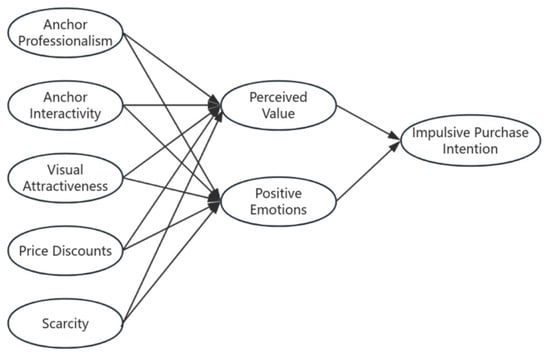
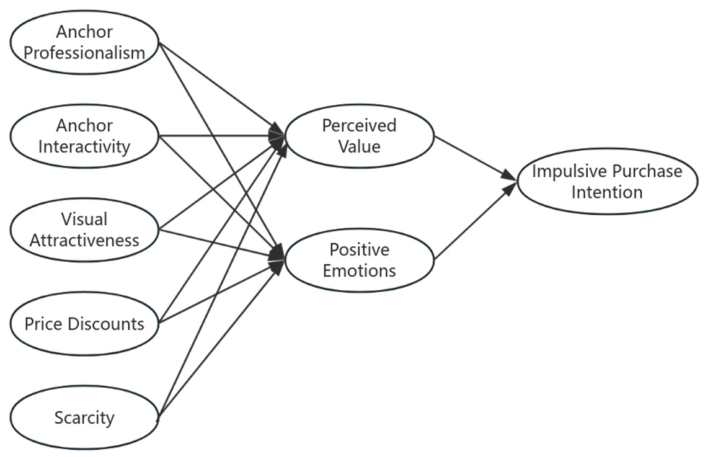
Focusing on fresh-fruit live-streaming commerce, we develop a Stimulus–Organism–Response model grounded in prior research on impulsive purchase intention. Specifically, anchor service cues, including professionalism, interactivity, and visual attractiveness, and promotional stimuli, specifically price discount and scarcity, are specified as the key environmental stimuli; perceived value and positive emotions are modeled as the parallel organismic states; and impulsive purchase intention constitutes the targeted behavioral response. As shown in Figure 1, the research model includes five stimulus variables—Anchor Professionalism, Anchor Interactivity, Visual Attractiveness, Price Discounts, and Scarcity—two organismic states, namely Perceived Value and Positive Emotions, and one response variable, Impulsive Purchase Intention.
Figure 1.
Conceptual model.
2.4. Research Methodology
We collected data through an online questionnaire designed around the constructs and hypotheses described above. The questionnaire consisted of three parts: first, a brief introduction describing the study purpose along with assurances of anonymity and data protection; second, the collection of respondent demographics, including gender, age, and education; and third, multi-item measures of the focal constructs. All items were rated on a five-point Likert scale ranging from 1, indicating strongly disagree, to 5, indicating strongly agree. Each construct was measured with at least three items adapted from prior studies and refined to fit the fresh-fruit live-streaming context. The interactivity construct captures the perceived interactive atmosphere of the live-streaming session, including both the anchor’s responsiveness and the viewer’s participation in real-time exchanges.
We measured eight key constructs using established scales from prior research, as summarized in Table 1, with minor wording adjustments to fit the fresh-fruit live-streaming context. To mitigate potential common-method bias in self-reported survey data [33], we applied both procedural and statistical remedies. Procedurally, we randomized item order across constructs, separated measurements of stimuli (e.g., anchor professionalism) from the response construct of impulsive purchase intention, used neutral and non-evaluative wording where possible, and emphasized anonymity to reduce evaluation apprehension. Statistically, Harman’s single-factor test indicated that the first unrotated factor accounted for 32.17% of the total variance, below the conventional 40% threshold. In addition, a common latent factor (CLF) check in confirmatory factor analysis showed that adding a CLF did not materially improve model fit (with CLF: χ2/df = 1.38, GFI = 0.930, CFI = 0.970, RMSEA = 0.032; without CLF: χ2/df = 1.43, GFI = 0.926, CFI = 0.972, RMSEA = 0.035). Because single diagnostics can be insensitive to common-method variance, we triangulate multiple procedural and statistical remedies when assessing this risk. Taken together, these checks reduce (but cannot fully eliminate) concerns about common-method variance; therefore, we interpret the estimated relationships as conditional associations consistent with the proposed mechanisms.
Data were collected through the online survey platform Wenjuanxing and disseminated via social media channels (e.g., WeChat Moments, WeChat groups, and QQ groups) between November 2022 and January 2023. Before accessing the main questionnaire, respondents completed two screening items confirming (i) that they had watched fresh-fruit live-streaming commerce and (ii) that they had purchased fresh fruit in a live-streaming session; only eligible respondents were allowed to proceed. This procedure yielded 385 initial submissions. To enhance transparency and replicability, we applied pre-specified data-quality rules that are common in HCI and online behavioral survey research. All screening thresholds were specified a priori based on common practice in online survey quality control. Specifically, we removed questionnaires completed in less than 60 s and excluded responses exhibiting inattentive responding, operationalized as non-differentiated or highly patterned answering (e.g., selecting the same scale point for more than 80% of Likert items or producing repetitive response strings). Where feasible, the survey platform’s built-in settings were used to discourage repeated submissions; additionally, we screened for near-identical response strings. The focal construct items were set as required fields in the online questionnaire, so missingness on the main measures was negligible; any remaining missing demographic fields were retained as missing and only affected the corresponding descriptive summaries. After implementing these criteria, the final analytical sample consisted of 353 valid responses.
Appendix A Table A1 summarizes the sample profile. The most common purchasing frequency was three to five times per month, accounting for 32.58% of respondents. A majority of participants reported that they primarily watched live-streams on short-video platforms, notably Douyin and Kuaishou, rather than on traditional e-commerce platforms such as Taobao, JD.com, or Pinduoduo, and this group represented 61.76% of the sample. The sample was predominantly female, with women comprising 66.57% of respondents. Age was concentrated in the 20–40 range, with 27.48% aged 20–30 and 35.41% aged 30–40. In addition to gender, age, and education, we recorded occupation, monthly income, viewing platform, and monthly live-streaming purchase frequency to characterize the sample (Appendix A Table A1).
To clarify external validity, we benchmarked the sample’s gender and age composition against national internet-user demographics reported by the China Internet Network Information Center in its December 2024 statistical report, as also reported in Appendix A Table A1 [33,34,35]. Compared with the overall internet-user population, our respondents included a higher proportion of females and were more concentrated in the 20–40 age group, which is consistent with the study’s focus on active live-streaming shoppers in a fresh-fruit context. Accordingly, generalization beyond this focal user group should be made with caution. Before evaluating the measurement properties, descriptive statistics of the measurement variables were examined. As shown in Table 2, the mean values range from 3.214 to 3.320, and the skewness and kurtosis values fall within acceptable ranges, indicating that the data are approximately normally distributed.
The study uses a cross-sectional, self-reported survey design and estimates the proposed relationships using structural equation modeling with bootstrap mediation. We interpret the estimated paths as conditional associations consistent with the theorized mechanisms rather than definitive causal effects. To support replicability, the questionnaire items, codebook, and key SEM outputs (e.g., AMOS model file and bootstrap reports) are available from the authors upon reasonable request, subject to privacy constraints.
Table 1.
Variable measurement items.
Table 2.
Descriptive statistics of measurement variables.
3. Method and Results
This section reports the measurement-model assessment, structural-model results, and mediation analysis. We first establish reliability and construct validity, as detailed in Table 3, Table 4, Table 5 and Table 6, then evaluate model fit and hypothesis paths based on Table 7 and Table 8 and Figure 2, model inspection results, and finally test indirect effects using the bootstrap mediation procedure, with results presented in Table 9.
Table 3.
Variables: KMO and Bartlett’s test.
Table 4.
Reliability analysis.
Table 5.
Confirmatory factor analysis results.
Table 6.
Correlations and square roots of AVE.
Table 7.
Structural model fit indices.
Table 8.
Structural model path coefficients.
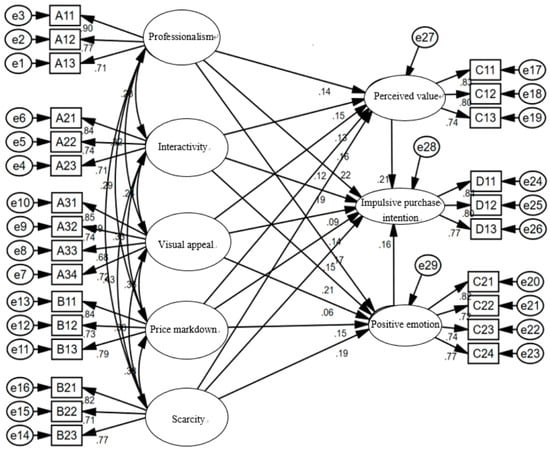
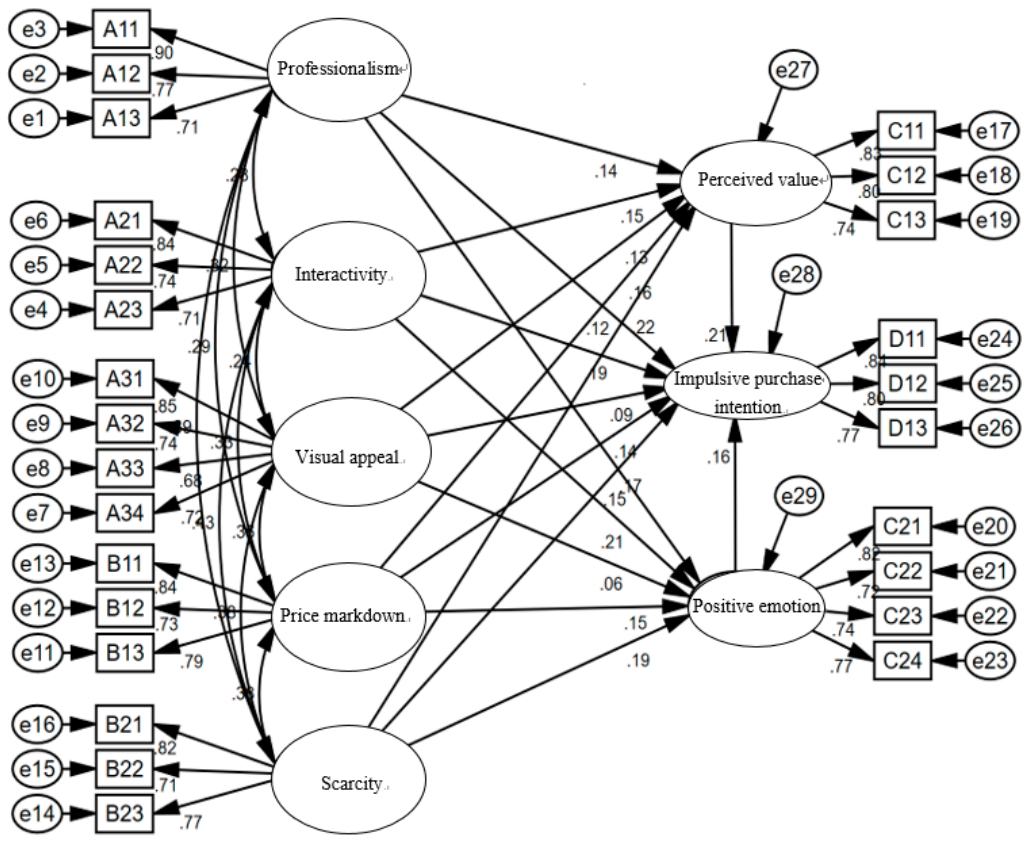
Figure 2.
Model inspection results.
Table 9.
Bootstrap mediation tests.
3.1. Reliability and Validity Analysis
We evaluated the measurement model in terms of internal consistency, convergent validity, and discriminant validity. The results indicate satisfactory measurement quality. Cronbach’s α values for the eight constructs range from 0.801 to 0.845, suggesting acceptable internal consistency, and the corrected item–total correlations range from 0.605 to 0.778, all exceeding the commonly used threshold of 0.50 (Table 4).
The data are also suitable for factor analysis. The KMO value is 0.871, and Bartlett’s test of sphericity is significant (χ2 = 4361.977, df = 325, p < 0.001), supporting the adequacy of the correlation matrix (Table 3). Confirmatory factor analysis further supports convergent validity. All standardized factor loadings are statistically significant and range from 0.678 to 0.900, while composite reliability values range from 0.810 to 0.848 and average variance extracted values from 0.562 to 0.650 (Table 5).
Discriminant validity is supported by the Fornell–Larcker criterion. As reported in Table 6, the square roots of the AVE values, ranging from 0.750 to 0.806, all exceed the corresponding inter-construct correlations, which range from 0.222 to 0.458. Taken together, these results indicate that the measurement model demonstrates satisfactory reliability and validity for subsequent hypothesis testing.
For transparency and replication, Appendix A Table A2 provides a compact summary of measurement quality, including item counts, standardized loading ranges, Cronbach’s α, composite reliability, and AVE. As additional robustness checks, HTMT ratios remain below common cutoffs (max HTMT < 0.85), and VIF values are well below conventional thresholds (max VIF < 3.3), suggesting no serious discriminant validity or multicollinearity concerns.
3.2. Structural Equation Model Test
We estimated the structural model using AMOS with maximum likelihood estimation and first assessed its overall fit, as reported in Table 7. Structural model fit indices: the model demonstrates an overall acceptable fit based on the combination of commonly reported fit indices (χ2/df = 1.431, GFI = 0.926, CFI = 0.972, RMSEA = 0.035, NFI = 0.914). Taken together, these indices suggest that the proposed S-O-R model provides an adequate basis for hypothesis testing.
The structural results provide broad support for the proposed model (Table 8). Anchor professionalism, anchor interactivity, price discount, and scarcity are all positively associated with impulsive purchase intention. In addition, perceived value and positive emotions both show significant positive effects on impulsive purchase intention, consistent with the view that impulse formation in live-streaming commerce is jointly shaped by cognitive appraisal and affective arousal. A notable exception concerns visual attractiveness. Although visual attractiveness is positively associated with perceived value, it does not exhibit a statistically significant direct effect on impulsive purchase intention, nor does it significantly predict positive emotions. These results indicate that, in fresh-fruit live-streaming, vivid presentation contributes to impulse formation mainly by improving consumers’ value appraisal under quality uncertainty rather than by serving as an independent emotional trigger. It is worth noting that while individual squared multiple correlations (R2) for the intermediate organismic states are not tabulated due to specific software estimation routines, the overall explanatory power and predictive validity of the proposed structural framework are comprehensively established through its global fit adequacy and nomological validity. As demonstrated in Table 7, the proposed S-O-R parallel mediation model yields an exceptional overall data fit (χ2/df = 1.431, GFI = 0.926$, CFI = 0.972, RMSEA = 0.035), safely outperforming all standard international thresholds. In covariance-based structural equation modeling, achieving such tight global alignment mathematically guarantees that the model-implied covariance matrix reproduces the empirical data with minimal residual variance. Operating alongside the widespread statistical significance of almost all hypothesized pathways (Table 8), this macroscopic fitness formally validates the robust explanatory capacity and conceptual relevance of our framework under conditions of high-quality uncertainty.
3.3. Mediation Effect Test
The mediation analysis reveals a particularly important pattern for visual attractiveness. As reported in Table 8, the direct path from visual attractiveness to impulsive purchase intention is not statistically significant, and the path from visual attractiveness to positive emotions is also not significant. However, the bootstrap results in Table 9 show that visual attractiveness exerts significant indirect effects on impulsive purchase intention through internal organismic states. Specifically, the indirect effect via perceived value is significant (0.027, 95% CI [0.002, 0.071]), and the indirect effect via positive emotions is also significant but smaller in magnitude (0.021, 95% CI [0.001, 0.061]).
Overall, the results are consistent with an indirect-only pattern. In fresh-fruit live-streaming commerce, visually rich presentation appears to matter primarily when it improves evaluability and helps consumers infer product value under uncertainty, rather than when it functions as a standalone trigger of impulse buying. For transparency and reproducibility, the questionnaire items, codebook, and SEM output files (e.g., the AMOS model and bootstrap reports) are available from the authors upon reasonable request.
4. Discussion
Using the S-O-R framework, this study identifies two complementary psychological routes through which live-streaming cues are associated with impulsive purchase intention in fresh-fruit commerce. Anchor professionalism, anchor interactivity, price discount, and scarcity are positively associated with perceived value and positive emotions, and these organismic states, in turn, increase impulsive purchase intention. The findings indicate that live-streaming cues shape impulsive buying not only by heightening momentary affect but also by strengthening consumers’ judgments that the purchase is worthwhile under conditions of uncertainty. Although the simultaneous significance of both mediators firmly supports a parallel-process architecture, a closer inspection of the empirical point estimates in Table 9 provides a more nuanced understanding regarding the relative strengths of these two underlying mechanisms. Across all five investigated live-streaming stimuli, the indirect effects operating through the cognitive pathway (perceived value) consistently exhibit higher numerical magnitudes than those channeled through the affective pathway (positive emotions). Specifically, the cognitive versus affective indirect effects map onto a patterned disparity across anchor professionalism (0.028 vs. 0.022), interactivity (0.032 vs. 0.025), visual attractiveness (0.027 vs. 0.021), price discount (0.032 vs. 0.025), and scarcity cues (0.045 vs. 0.035). While we do not infer a formal, statistically distinguishable divergence in route strength via a structural contrast test, this descriptive dominance of the cognitive route aligns profoundly with the food-retailing context. Because fresh fruits carry inherent quality risks and severe pre-purchase information asymmetry, external digital cues must perform a heavier diagnostic load. Consequently, the internalization of environmental stimuli into a rational value appraisal acts as a slightly more prominent conduit for driving impulsive intentions than immediate emotional arousal alone, refining our parallel-process account from a generic duality to a context-specific hierarchy.
One notable result concerns visual attractiveness. Its direct effect on impulsive purchase intention is not robust, and its influence appears to operate mainly through perceived value rather than through positive emotions. This result refines existing understandings of the role of vividness in live-streaming commerce. In a perishable and quality-sensitive category such as fresh fruit, vivid presentation matters less as a direct trigger of impulse and more as a cue that improves evaluability, reduces ambiguity, and helps consumers infer expected value. In other words, visual richness becomes behaviorally consequential when it functions as diagnostic support rather than as mere sensory stimulation.
Furthermore, an essential contingency to consider is how these underlying live-streaming mechanisms manifest across distinct digital platform architectures, a reflection highly pertinent given our analytical sample’s concentration on short-video platforms like Douyin and Kuaishou (61.76%) relative to traditional e-commerce marketplaces such as Taobao and JD.com (38.24%). On short-video platforms, consumers typically engage in algorithmic, discovery-based browsing where the consumption experience is inherently content-driven and entertainment-oriented. Within these immersive ecosystems, synchronous interactive cues and vivid sensory displays are heavily leveraged to capture transient attention, meaning that affective paths and in-session positive emotions may carry heightened initial weight in triggering spontaneous purchase impulses. Conversely, traditional e-commerce platforms primarily cater to intent-driven shoppers characterized by a higher baseline of rational product search and deliberate evaluation. Within such utility-oriented interfaces, anchor-mediated expertise and structural marketing cues must perform a heavier functional load, shifting the center of gravity toward rigorous cognitive perceived value verification to mitigate the severe quality uncertainty of fresh produce. Consequently, while our parallel model validates both routes, the relative salience of cognitive justification versus affective arousal is bound to be contingent upon the platform’s architectural focus, balancing discovery-based impulse with transaction-based trust.
Theoretically, the study contributes in three ways. First, it supports a parallel-process account of impulsive purchase intention in digital commerce, showing that cognitive appraisal and affective arousal jointly matter in time-pressured shopping environments, rather than treating impulse formation as purely affect-driven. Second, it highlights the importance of product uncertainty in shaping impulse mechanisms: when quality cannot be physically verified, consumers rely more heavily on platform- and anchor-mediated cues to form purchase judgments. Third, it clarifies a boundary condition for visual attractiveness by showing that vividness may have weak or inconsistent direct effects unless it also improves perceived value.
From a practical perspective, the findings indicate that effective live-streaming design should not rely solely on attention capture. Instead, platforms, sellers, and anchors should strengthen cues that improve evaluability, support credible value inference, and maintain a transparent promotional environment. In high-uncertainty perishable-product settings, the quality of conversion depends not only on how strongly users are stimulated, but also on whether real-time cues help them make better-calibrated purchase judgments. Section 5.2 translates these findings into implications for platform design and promotional governance in live-streaming commerce.
5. Conclusions
5.1. Research Conclusions
Grounded in the S-O-R framework, this study examines how anchor-related service cues and promotional stimuli are associated with impulsive purchase intention in fresh-fruit live-streaming. Using survey data from 353 consumers in China and structural equation modeling with bootstrap mediation, we derive the following granular conclusions regarding each specific live-streaming cue and its underlying psychological mechanisms. As a crucial competence-based signal, anchor professionalism directly drives impulsive purchase intention. It also functions as a vital informational substitute for physical inspection, significantly enhancing consumers’ cognitive perceived value and fostering affective reassurance and positive emotions. Demonstrating the strongest direct impact on impulsive purchase intention, anchor interactivity acts as the primary tool to reduce post-purchase hesitation. Real-time communication and customer participation strongly elevate positive emotions by amplifying social presence, while simultaneously updating perceived value through tailored problem-solving. Acting as a highly salient promotional stimulus, price discounts compress consumers’ deliberation windows by diminishing perceived financial sacrifice. They positively influence cognitive perceived value and evoke “smart-shopper” positive emotions, ultimately maintaining a robust direct association with impulsive buying intention. In the perishable fresh-fruit context, scarcity cues exhibit the most substantial positive impact on cognitive perceived value among all external stimuli. They emphasize timeliness and organic availability, which strongly arouse immediate emotional excitement and directly escalate the urgency to purchase. Distinct from other stimuli, visual attractiveness does not possess a statistically significant direct association with impulsive purchase intention or positive emotions. In high-uncertainty food settings, vividness matters primarily because its influence is transmitted indirectly and dominantly through cognitive perceived value, helping viewers diagnose quality, rather than acting as a standalone affective trigger. Collectively, these findings highlight that perceived value and positive emotions act as parallel organismic drivers that jointly transmit the effects of multi-dimensional stimuli. By integrating both service and marketing cues within a unified model, this study provides a more nuanced, category-specific explanation of how real-time cues can be balanced to optimize conversion quality under quality uncertainty.
5.2. Implications for Platform Design and Promotional Governance in Live-Streaming Commerce
Building on the empirical findings, this study offers several implications for platform design and promotional governance in fresh-fruit live-streaming commerce. The results indicate that effective live-streaming design should extend beyond attention capture alone. Instead, platforms, sellers, and anchors should strengthen cues that improve consumers’ evaluability of the offer, support credible value inference, and maintain a transparent promotional environment. In high-uncertainty product settings, conversion quality depends not only on engagement intensity but also on whether real-time cues help users make better-calibrated judgments.
- (1)
- Prioritize diagnostic information over pure vividness in the live-streaming interface: A practical way to do this is to surface structured, verifiable information as part of the default viewing experience—such as standardized product cards that specify variety/grade/specification, origin and traceability links, and expected delivery windows—while pinning a Q&A/FAQ layer that answers recurring questions about quality variability, ripeness, storage, and what to expect upon arrival. When diagnostic cues are salient and easy to verify, consumers can form perceived value with less ambiguity and greater confidence, which is consistent with the empirical finding that value-based appraisal is central to impulsive purchase intention in this context. The main risk is that “more information” becomes selective information: overloaded screens, cherry-picked highlights, or persuasive vividness that substitutes for evidence. Guardrails therefore matter: keep templates concise, foreground the key uncertainties (e.g., ripeness range, size dispersion, cold-chain constraints), and require evidence-backed claims where feasible (e.g., grade certificates, origin verification, cold-chain timestamps) so that vivid presentation cannot masquerade as certainty.
- (2)
- Make discount and scarcity claims transparent, verifiable, and reviewable at the point of purchase: Rather than banning promotions, platforms can govern price discount and scarcity through disclosure rules that users can check—by showing reference prices alongside discounts, presenting stock/time limits with audit trails, and prohibiting vague urgency phrases that cannot be verified—while adding a light-touch “speed bump” immediately before checkout that briefly surfaces the constraints users most often regret overlooking (delivery window, refund rules, and quality criteria). This combination preserves the immediacy that makes live-streaming engaging, while reducing excessively time-compressed responses by restoring a minimal deliberation window and grounding purchase decisions more firmly in evaluability and perceived value rather than pure urgency. The key failure mode is over-restriction: conversion may drop, or urgency may migrate to informal channels (e.g., off-platform messaging) where it becomes less governable. To avoid that, disclosure governance should be coupled with monitoring (e.g., systematic checks of discount/stock claims), complaint-triggered enforcement, and periodic policy reviews that explicitly balance consumer protection and market efficiency.
- (3)
- Translate anchor quality into structured expertise and responsive clarification rather than theatrical persuasion: For anchor professionalism and anchor interactivity to function as trustworthy cues rather than theatrical persuasion, anchors should be trained to provide domain-specific explanations (taste, ripeness, storage, usage) and to respond via consistent clarification routines—such as “what to expect” checklists, side-by-side comparisons across varieties, and explicit statements of logistics constraints—supported by platform tools that elevate consumer questions and verified product facts in real time. When implemented well, these practices can enhance interpretability and decision confidence, thereby strengthening perceived value, while also providing reassurance and social presence that support positive emotions, without relying excessively on urgency cues. The risks are familiar in live-streaming: overly scripted delivery can feel inauthentic, and high responsiveness can drift into overclaiming. Guardrails should therefore include periodic audits, feedback loops based on complaints and returns, and clear “do-not-claim” boundaries (e.g., no exaggerated freshness or health claims, no guarantees that conflict with fulfillment uncertainty), which protect trust while preserving interaction quality.
- (4)
- Embed post-purchase safeguards that improve transaction quality and reduce downstream regret: Because fresh fruit is fulfillment-dependent, safeguards should be integrated directly into the purchase flow and after-sales journey: display clear quality grading standards, support photo-based receiving checks, provide fast complaint/refund pathways, and make service-level commitments for delivery and cold-chain handling explicit where relevant. These mechanisms reduce the perceived downside and the likelihood that an impulse-triggered purchase collapses into dissatisfaction, allowing engagement to be sustained through better conversion quality over time. The trade-off is cost and moral hazard—overly generous pathways can shift costs to sellers or invite opportunistic refunds. Effective guardrails include shared-responsibility rules across platform–retailer–anchor, proportionate evidence requirements, and transparent dispute-resolution procedures. Implementation should also be evaluated with simple indicators that can be audited over time, such as product-card and pinned Q&A engagement (click-through and dwell time), the share of extremely short-time purchases, and downstream outcomes including refund/complaint rates and post-purchase satisfaction.
Taken together, these implications point to a shift from attention-first tactics toward interactions grounded more firmly in value-relevant evidence. Such an approach can preserve the engagement advantages of live-streaming while improving conversion quality and supporting healthier choice environments in high-stimulus purchasing interfaces. Across the four items, a transferable set of design regularities emerges for time-pressured digital commerce: prioritize diagnostic cues over mere vividness, make promotional claims transparent and verifiable, use structured interaction to increase interpretability and decision confidence, and embed safeguards that preserve autonomy and reduce downstream regret. These regularities are not limited to fresh-fruit live-streaming; they generalize to other real-time commerce and social shopping settings where consumers must decide quickly under uncertainty.
5.3. Limitations and Future Research
First, while the cross-sectional and self-reported design constrains definitive causal inference, a distinct temporal limitation resides in our data collection timeframe, which was constrained to the window between November 2022 and January 2023. Given the extraordinary velocity and dynamic evolution characterizing China’s live-streaming e-commerce landscape, platform algorithms, interface designs, and industry regulatory frameworks have significantly matured since this observational period. Although we maintain that the foundational socio-psychological architecture of our S-O-R model—specifically the parallel balancing of cognitive appraisal and affective arousal—remains structurally robust, the precise empirical magnitudes of the path coefficients may capture a specific socio-economic baseline that experiences temporal drift as consumer literacy and market saturation advance. Consequently, future research would benefit immensely from deploying longitudinal tracking mechanisms or cross-period replication data to explicitly evaluate the temporal stability of these cue–response relationships within an ongoingly consolidating digital ecosystem. Beyond these temporal boundaries, future empirical designs could also combine field experiments. Second, the sample is drawn from a single national and platform ecosystem, meaning that cultural or regulatory differences may moderate cue diagnostic and time pressure effects; cross-cultural replications and multi-platform comparisons are therefore needed. Concurrently, a distinct demographic limitation arises from the fact that our sample is heavily female (66.57%) and heavily concentrated within the 20–40 age bracket (62.89%). Although this specific profile tightly mirrors the primary and most active purchasing cohort driving real-time fresh-produce e-commerce in China, it inevitably circumscribes the external validity of our conceptual model. Consumers outside this focal segment—such as male shoppers or older age groups—might exhibit fundamentally different risk thresholds, food safety heuristics, and cognitive appraisal mechanisms when interacting with anchor service cues or promotional stimuli. Consequently, caution must be exercised when generalizing these S-O-R dynamics to the broader internet-user population, and future research should intentionally capture a more demographically heterogeneous pool to rigorously validate the boundary conditions of our framework. Third, while we focused on state-like organismic mechanisms, specifically perceived value and positive emotions, we did not model individual differences that are psychologically relevant to impulsivity, such as trait impulsiveness, self-control, or susceptibility to social influence, which may condition the relative strength of appraisal versus affect pathways. Finally, perishable-product categories differ in their degree of sensory uncertainty and risk exposure; future work can systematically compare perishables with durables to test the conditions under which vividness primarily serves cognitive appraisal by enhancing diagnostic versus affective response through imagery and anticipatory pleasure. Future research that addresses these limitations can further clarify how real-time digital stimuli interact with cognitive and affective processes in shaping impulsive action.
Author Contributions
J.H.: Writing—review and editing, writing—original draft, visualization, validation, software, methodology, investigation, conceptualization. C.F.: Writing—original draft, visualization, validation, software. L.Z.: Writing—original draft, methodology. All authors have read and agreed to the published version of the manuscript.
Funding
This work was partially supported by the Priority Academic Program Development of Jiangsu Higher Education Institutions (PAPD) and the Philosophy and Social Science Laboratories of Jiangsu Higher Education Institutions—Intelligent Laboratory for Big Food Security Governance and Policy, Nanjing Agricultural University.
Institutional Review Board Statement
The study was conducted in accordance with the Declaration of Helsinki, and approved by the Ethics Committee of Nanjing Agricultural University Science and Technology (protocol code: 2022-012 and date of approval: 2 November 2022).
Informed Consent Statement
Participation was voluntary. All respondents were informed about the study purpose, the approximate time required, and their right to withdraw at any time without penalty. Informed consent was obtained electronically prior to completing the survey.
Data Availability Statement
The survey data contain information that could compromise participant privacy and were collected under conditions that do not permit public sharing. Therefore, the raw data are not publicly available. The de-identified research materials, including the questionnaire items, variable codebook, and analysis scripts and output, can be provided by the corresponding author upon reasonable request.
Acknowledgments
The authors would like to express their sincere gratitude to all respondents who participated in the survey and supported this study. The authors have reviewed and edited the output and take full responsibility for the content of this publication. Generative AI tools were employed in the preparation of this manuscript only for linguistic refinement, including grammar checking, sentence structure optimization, and English language polishing. The AI did not contribute to the design of the study, collection or analysis of data, generation of core ideas, results, or conclusions. All scientific content and final decisions regarding the manuscript were made by the authors.
Conflicts of Interest
The authors declare no conflicts of interest.
Appendix A
Table A1.
Sample profile and benchmark comparison.
Table A2.
Measurement model quality summary.
References
- Luo, X.; Cheah, J.H.; Hollebeek, L.D.; Lim, X.J. Boosting Customers’ Impulsive Buying Tendency in Live-streaming Commerce: The Role of Customer Engagement and Deal Pproneness. J. Retail. Consum. Serv. 2024, 77, 103644. [Google Scholar] [CrossRef] [Scilit]
- Guo, H.; Sun, X.; Pan, C.; Xu, S.; Yan, N. The Sustainability of Fresh Agricultural Produce Live Broadcast Development: Influence on Consumer Purchase Intentions Based on Live Broadcast Characteristics. Sustainability 2022, 14, 7159. [Google Scholar] [CrossRef] [Scilit]
- Li, L.; Chen, X.; Zhu, P. How Do E-Commerce Anchors’ Characteristics Influence Consumers’ Impulse Buying? An Emotional Contagion Perspective. J. Retail. Consum. Serv. 2024, 76, 103587. [Google Scholar] [CrossRef] [Scilit]
- Hu, H.H.; Ma, F. Human-Like Bots Are Not Humans: The Weakness of Sensory Language for Virtual Streamers in Livestream Commerce. J. Retail. Consum. Serv. 2023, 75, 103541. [Google Scholar] [CrossRef] [Scilit]
- Rook, D.W. The Buying Impulse. J. Consum. Res. 1987, 14, 189–199. [Google Scholar] [CrossRef] [Scilit] [PubMed]
- Qu, Y.; Khan, J.; Su, Y.; Tong, J.; Zhao, S. Impulse Buying Tendency in Live-Stream Commerce: The Role of Viewing Frequency and Anticipated Emotions Influencing Scarcity-Induced Purchase Decision. J. Retail. Consum. Serv. 2023, 75, 103534. [Google Scholar] [CrossRef] [Scilit]
- Duan, Y.; Song, J. The adoption of live streaming channel considering impulse buying and product returns. Int. J. Prod. Econ. 2024, 274, 109295. [Google Scholar] [CrossRef] [Scilit]
- Zhou, Y.S.; Tang, S.; Xiao, J. Research on Consumers’ Purchase Intention on E-Commerce Livestreaming Platforms-Based on the Perspective of Social Presence. Contemp. Econ. Manag. 2021, 43, 40–47. [Google Scholar] [CrossRef]
- Beatty, S.E.; Ferrell, M.E. Impulse Buying: Modeling Its Precursors. J. Retail. 1998, 74, 161–167. [Google Scholar] [CrossRef] [Scilit]
- Na, R.; Hu, A.; Zeng, Q.; Ge, R.; Hao, R. Unveiling the Relationship Between Virtual Streamer Characteristics and Consumer Purchase Intention in Live Streaming Commerce: Insights from Source Credibility Perspective. Electron. Mark. 2025, 35, 68. [Google Scholar] [CrossRef] [Scilit]
- Li, S.; Zhang, Y.; Tang, Y.; Zhao, W.; Yu, Z. Impact Mechanisms of Consumer Impulse Buying in Accumulative Social Live Shopping: Considering Para-Social Relationship Moderating Role. J. Theor. Appl. Electron. Commer. Res. 2025, 20, 66. [Google Scholar] [CrossRef] [Scilit]
- Gao, W.; Jiang, N.; Guo, Q. How Do Virtual Streamers Affect Purchase Intention in the Live Streaming Context? A Presence Perspective. J. Retail. Consum. Serv. 2023, 73, 103356. [Google Scholar] [CrossRef] [Scilit]
- Jiang, Z.; Benbasat, I. Research Note—Investigating the Influence of the Functional Mechanisms of Online Product Presentations. Inf. Syst. Res. 2007, 18, 454–470. [Google Scholar] [CrossRef] [Scilit]
- Wu, Y.; Xin, L.; Li, D.; Yu, J.; Guo, J. How Does Scarcity Promotion Lead to Impulse Purchase in the Online Market? A Field Experiment. Inf. Manag. 2021, 58, 103283. [Google Scholar] [CrossRef] [Scilit]
- Cialdini, R.B.; Goldstein, N.J. Social Influence: Compliance and Conformity. Annu. Rev. Psychol. 2004, 55, 591–621. [Google Scholar] [CrossRef] [Scilit] [PubMed]
- Ohanian, R. Construction and Validation of a Scale to Measure Celebrity Endorsers’ Perceived Expertise, Trustworthiness, and Attractiveness. J. Advert. 1990, 19, 39–52. [Google Scholar] [CrossRef] [Scilit]
- Zheng, S.; Chen, J.; Liao, J.; Hu, H.L. What Motivates Users’ Viewing and Purchasing Behavior Motivations in Live Streaming: A Stream-Streamer-Viewer Perspective. J. Retail. Consum. Serv. 2023, 72, 103240. [Google Scholar] [CrossRef] [Scilit]
- Duong, C.D.; Tran, T.B.; Pham, V.Q.; Le, L.T.N.; Nguyen, H.T.T. Integrating blockchain and livestreaming: A pathway to strengthening product trust and purchase intentions in online agri-food market. Br. Food J. 2026, 128, 353–370. [Google Scholar]
- Harmancioglu, N.; Zachary Finney, R.; Joseph, M. Impulse Purchases of New Products: An Empirical Analysis. J. Prod. Brand Manag. 2009, 18, 27–37. [Google Scholar] [CrossRef] [Scilit]
- Mehrabian, A.; Russell, J.A. An Approach to Environmental Psychology; MIT Press: Cambridge, MA, USA, 1974. [Google Scholar]
- Peña-García, N.; Gil-Saura, I.; Rodríguez-Orejuela, A.; Siqueira-Junior, J.R. Purchase Intention and Purchase Behavior Online: A Cross-Cultural Approach. Heliyon 2020, 6, e04284. [Google Scholar] [CrossRef] [Scilit] [PubMed]
- Hovland, C.I.; Weiss, W. The Influence of Source Credibility on Communication Effectiveness. Public Opin. Q. 1951, 15, 635–650. [Google Scholar] [CrossRef] [Scilit] [PubMed]
- Rook, D.W.; Hoch, S.J. Consuming Impulses. Adv. Consum. Res. 1985, 12, 23–27. [Google Scholar]
- Mollen, A.; Wilson, H. Engagement, Telepresence and Interactivity in Online Consumer Experience: Reconciling Scholastic and Managerial Perspectives. J. Bus. Res. 2010, 63, 919–925. [Google Scholar] [CrossRef] [Scilit]
- Franklin, E. Dynamic Alignment Through Imagery; Human Kinetics: Champaign, IL, USA, 2022. [Google Scholar]
- Thaler, R. Mental Accounting and Consumer Choice. Mark. Sci. 1985, 4, 199–214. [Google Scholar] [CrossRef] [Scilit]
- Cialdini, R.B. Influence: Science and Practice; Pearson Education: Boston, MA, USA, 2009. [Google Scholar]
- Zeithaml, V.A. Consumer Perceptions of Price, Quality, and Value: A Means-End Model and Synthesis of Evidence. J. Mark. 1988, 52, 2–22. [Google Scholar] [CrossRef] [Scilit]
- Holbrook, M.B. Consumer Value: A Framework for Analysis and Research; Routledge: Oxfordshire, UK, 1999. [Google Scholar] [CrossRef] [Scilit]
- Quartier, K. The Big Book of Retail Design: Everything You Need to Know about Designing a Store; Lannoo Meulenhoff-Belgium: Tielt, Belgium, 2023. [Google Scholar]
- Aljukhadar, M.; Bériault Poirier, A.; Senecal, S. Imagery Makes Social Media Captivating! Aesthetic Value in a Consumer-As-Value-Maximizer Framework. J. Res. Interact. Mark. 2020, 14, 285–303. [Google Scholar] [CrossRef] [Scilit]
- Wu, X.; Lai, I.K.W.; Chen, J. How Hotel VR Photography Previews Enhance Customers’ Immediate Booking Intention Through Mental Imagery and Perceived Value. J. Hosp. Tour. Technol. 2025, 16, 409–428. [Google Scholar] [CrossRef] [Scilit]
- Baumeister, R.F. Yielding to Temptation: Self-Control Failure, Impulsive Purchasing, and Consumer Behavior. J. Consum. Res. 2002, 28, 670–676. [Google Scholar] [CrossRef] [Scilit] [PubMed]
- Podsakoff, P.M.; MacKenzie, S.B.; Lee, J.Y.; Podsakoff, N.P. Common Method Biases in Behavioral Research: A Critical Review of the Literature and Recommended Remedies. J. Appl. Psychol. 2003, 88, 879–903. [Google Scholar] [CrossRef] [Scilit] [PubMed]
- China Internet Network Information Center (CNNIC). The 55th Statistical Report on China’s Internet Development; China Internet Network Information Center: Beijing, China, 2025. [Google Scholar]
- Liu, Y.; Li, Q.; Yin, M. A Study on the Impact of Online Live-Streaming Shopping Characteristics on Consumer Purchasing Behaviour. Soft Sci. 2020, 34, 108–114. [Google Scholar] [CrossRef]
- Sánchez-Fernández, R.; Iniesta-Bonillo, M.Á. The Concept of Perceived Value: A Systematic Review of the Research. Mark. Theory 2007, 7, 427–451. [Google Scholar] [CrossRef] [Scilit]

Disclaimer/Publisher’s Note: The statements, opinions and data contained in all publications are solely those of the individual author(s) and contributor(s) and not of MDPI and/or the editor(s). MDPI and/or the editor(s) disclaim responsibility for any injury to people or property resulting from any ideas, methods, instructions or products referred to in the content. |
© 2026 by the authors. Licensee MDPI, Basel, Switzerland. This article is an open access article distributed under the terms and conditions of the Creative Commons Attribution (CC BY) license.