Skip to Content
  • Article
  • Open Access

29 May 2026

Don’t Just Say Sorry—Say It Right: How Semantic Congruence and Credibility Cues Turn Negative Reviews into Potential Guests’ Booking Intentions

,
,
and
1
School of Economics and Management, Harbin Institute of Technology, Shenzhen 518055, China
2
INSEEC (BBA) Business School, OMNES Education Group, 75015 Paris, France
*
Author to whom correspondence should be addressed.

Abstract

Negative online reviews play a critical role in shaping consumer decision-making in the hospitality sector. Drawing on cue utilization theory and signaling theory, this study examines how different types of negative reviews and host responses affect potential guests’ booking intentions, as well as the underlying mechanisms and boundary conditions. Across three scenario experiments, the proposed framework was tested. Study 1 reveals a significant interaction between the type of negative reviews (informational vs. social) and host response strategies (problem-focused vs. emotion-focused), highlighting that aligning response strategies with review types is critical for effective negative review management. Study 2 demonstrates that perceptions of host competence and attitude mediate these effects, indicating that potential guests make decisions through psychological inference. Study 3 finds that platform-endorsed credibility signals, such as host badges (Superhost vs. non-Superhost), significantly moderate these relationships. When hosts are Superhosts, informational negative reviews paired with problem-focused responses further enhance competence perceptions and booking intentions; for non-Superhosts, social negative reviews paired with emotion-focused responses improve attitude perceptions and booking intentions. The findings advance theoretical understanding of how signaling mechanisms shape consumer behavior in home-sharing hospitality platforms, and offer practical guidance for hosts and platforms to manage online reputations strategically and effectively.

1. Introduction

In the tourism and hospitality industry, online reviews, as an essential form of electronic word-of-mouth, play a critical role in shaping consumers’ decision journeys [1,2,3]. This is particularly evident in home-sharing accommodation (HSA), where service experiences are highly emphasized, and reviews have a significant influence on booking intentions [4,5,6]. Diverse yet inconsistent services and information asymmetry are particularly prominent in the industry [7]. Potential guests increasingly rely on reviews, where informational cues and signals can reduce their uncertainty [8,9], as individual HSA listings often lack strong brand affiliation. Prior consumer survey research indicates that 97% of potential guests inspect reviews before making a booking decision, and 85% specifically pay attention to negative reviews [10]. Compared to positive, potential guests tend to be more sensitive to negative reviews, where even a smaller number can draw disproportionate attention, significantly influencing guests’ decisions [6,11]. Due to its unique value proposition and service interaction model, HSA offers diverse and personalized experiences, but also increases the likelihood of service failures, leading to a higher prevalence of negative reviews [12]. Thus, adopting targeted response strategies to mitigate the negative effects of reviews and enhance potential guests’ booking intentions has become a pressing issue [13].
However, negative reviews on HSA platforms are not homogeneous. In practice, guests express dissatisfaction with different aspects of their stay. Some negative reviews primarily focus on informational aspects; for example, guests report that “the listing did not match the actual condition,” or “the description was misleading.” In contrast, some negative reviews focus on social aspects, such as “the host was unresponsive” and “communication was frustrating”. Accordingly, we distinguish between informational and social negative reviews. This distinction is important because potential guests interpret these two types of reviews differently, thereby forming different expectations regarding appropriate host response strategies, which in turn ultimately influence their booking intentions.
Hosts’ responses to negative reviews serve as an important form of online service recovery [14]. The transparency policy of HSA platforms allows potential guests to see and evaluate how hosts respond to negative reviews; thus, host responses may provide additional diagnostic cues and credibility signals beyond the original reviews [15]. The existing literature on the effectiveness of response strategies yields mixed findings. Some studies suggest that response strategies can have positive effects, such as improving review ratings [16], increasing review helpfulness [17], and enhancing performance [18]. Conversely, some others report adverse outcomes, such as a reduction in booking intentions [19] and willingness to buy [20]. This study identifies three possible reasons for these inconsistent findings. First, existing studies primarily focused on the independent effects of response strategies [21], while neglecting the potential interaction effects between negative reviews and responses. Second, studies focused primarily on whether a response was provided, overlooking how to respond effectively to mitigate their negative impact. Third, few studies have examined the integration of the cue utilization theory (CUT) and signaling theory (SNT) through which guests can better understand the possible clues and signals in negative reviews and their responses.
As Darani et al. [22] suggested, the effectiveness of a response lies not in whether a service provider responds, but in how they respond. Similarly, Floriano [23] argues that service providers should tailor their responses according to the specific content of the review types. Continuing this research stream, the study focuses on understanding and exploring how the semantic congruence of negative reviews and host responses affect potential guests’ booking intentions. Here, using the CUT and SNT can provide a profound understanding of guests’ and hosts’ perceptions about the cues and signals retrieved from the negative reviews and their responses. Accordingly, this paper aims to address the following research questions:
RQ1: How do different types of negative reviews and host response content interact to influence potential guests’ booking intentions? The combination of different types of negative reviews and response content exert varying impacts on booking intentions. Investigating the interaction of these cues can help reveal how potential guests process and integrate such signals, thereby providing hosts with targeted guidance to optimize their response strategies, repair their reputations, and enhance booking intentions.
RQ2: Do perceived attitude and perceived competence serve as underlying mechanisms in the abovementioned relationship? In HSA, the host directly represents the service providers, so how potential guests perceive their attitudes and competencies substantially influences their booking decision. Negative reviews and host responses serve as key sources of cues for host image. This study examines whether potential guests’ perceptions of the host’s attitude and competence mediate the relationship between informational cues and booking intentions. Such an investigation may significantly contribute to understanding the psychological mechanisms underlying potential guests’ decision-making, deepening our insights into guest behavior in the HSA sector.
RQ3: Do host badges moderate the relationship between negative reviews and host responses, as well as potential guests’ booking intentions? As a symbol of credibility awarded by the HSA platforms, host badges influence how potential guests interpret review and response content. Exploring the moderating role of badges can advance our understanding of online reputation management mechanisms, while providing practical guidance for service providers in designing and managing badge systems to effectively steer user judgments and facilitate booking decisions.
This study thus applies an integrated framework of CUT and SNT theories to investigate the mechanism by which the semantic congruence of different types of negative reviews and host responses affect potential guests’ booking intentions in the HSA industry. Through three scenario-based experiments, this study empirically examines these effects, contributing to the integration of CUT and SNT and providing practical guidance for service providers in developing effective response strategies. The potential theoretical contributions of this study include: (1) examining negative reviews and host responses from a semantic perspective and developing an integrated framework to explain how different review and response types influence booking intentions, thereby extending existing theoretical perspectives; (2) identifying the mechanisms through which different types of negative reviews and responses affect booking intentions, thereby enhancing understanding of how textual content shapes consumer decision-making; (3) identifying boundary conditions based on host badge types and highlighting the role of gamified platform features in the HSA context. From this perspective, the study examines how host badge types moderate the mediating effects (i.e., mediated moderation model) of perceived attitude and competence on booking intentions [24], thereby enriching the existing literature on gamification.

2. Theoretical Background

2.1. Consumer Negative Reviews and Host Response Paradigm

In tourism and HSA services, negative reviews refer to user-generated evaluations that express dissatisfaction with service experiences and highlight perceived service failures [25,26]. Compared with traditional media, user-generated content is generally perceived by potential consumers as more credible and influential. Negative reviews are often interpreted as high-risk signals that may undermine service providers’ image, reputation, performance, and revenue [27]. This highlights the importance of host responses as a form of remedial communication. Therefore, responding effectively to negative reviews is crucial. As a core form of host-generated content, such responses have a significant impact on potential guests’ booking intentions. However, the effectiveness of different response strategies remains debated in the literature [28]. Some studies suggest that managerial responses can increase subsequent reviews and encourage positive evaluations [29]. Highly targeted responses are more likely to enhance overall business ratings [30]. In addition, response characteristics (e.g., quantity, speed, and length) can stimulate potential guest engagement [31].
Moreover, some scholars have focused on personalized response strategies and found that response alignment with the content of negative reviews—rather than with the writers’ identities—is more effective in promoting booking intentions [15]. However, inappropriate response strategies may backfire, and instead of alleviating negative emotions, an improper response may worsen the situation and undermine the perceived credibility of the platform [32]. For instance, Liu et al. [28] further noted that standardized responses often fail to generate positive outcomes.
Although prior studies have examined the impact of negative reviews and responses on tourist/guest behavior from a service recovery perspective [33], responses are still largely treated as managerial or marketing tools, lacking an integrated theoretical framework and empirical validation from the perspective of potential consumers. Accordingly, this study integrates CUT and SNT to provide a more comprehensive understanding of response mechanisms, as existing studies have not fully examined how and to what extent the content of host responses influences potential guests’ booking intentions. The prior literature further suggests that the effect of responses depends not only on whether a response is provided, but more importantly, on its content characteristics and quality [22,34]. Accordingly, this study aims to fill this research gap by systematically examining the interactive effects between the semantic congruence of consumer negative reviews and host responses, and further exploring the underlying mechanisms shaping potential guests’ booking intentions.

2.2. Cue Utilization Theory

CUT, a decision-making framework that explains how consumers evaluate service quality using different types of informational cues (i.e., internal and external), is closely related to the phenomenon of information asymmetry [35]. In general market settings, buyers typically possess limited information compared to sellers, resulting in an information asymmetry between the two. Using this asymmetry, sellers apply informational cues (as signals) to shape buyers’ evaluations of service quality and value [36]. Consumers typically rely on multiple informational cues to reduce uncertainty and perceived risk [37]. The cues can be classified into internal (i.e., cues that are directly related to the inherent physical attributes of the product/service and represent inherent and relatively stable characteristics) and external cues (i.e., cues that pertain to peripheral information, easily modifiable or adjustable) [38]. Consumers typically rely on both types of cues when evaluating a product/service. The literature indicates that external cues can influence consumer evaluations by enhancing or diminishing the diagnostic value of internal cues. For instance, Sun et al. [39] found that the cuteness and unexpectedness of a gift (i.e., external cues) moderated the effect of perceived gift value (i.e., internal cue) on recipients’ word-of-mouth intentions. Using social media, when potential customers are unfamiliar with a particular product, service, and/or brand, they tend to rely on online cues (i.e., information in the form of reviews posted by other users/consumers) to determine the reliability and trustworthiness [40]. In the hospitality sector, potential guests are often unfamiliar with specific hotels and/or HSA listings. Consequently, guests rely on other users’ reviews and hosts’ responses to support decision-making. The study of Chen et al. [41] examined the differential impacts of internal (i.e., review features/ signals) and external cues (i.e., response features) on review helpfulness. The current study, therefore, draws on CUT to examine how negative reviews and host responses jointly impact potential guests’ booking intentions. In this context, negative reviews function as internal cues, while host responses serve as external cues.

2.3. Signaling Theory

SNT further strengthens the theoretical framework of this study. The theory investigates the impact of negative reviews and host responses on potential guests’ booking intentions. According to SNT, one party (i.e., the service provider) transmits signals to another party (i.e., the guests), who then interprets these signals to reduce uncertainty in decision-making [42]. Since consumers often lack sufficient information about a service before making a purchase, they tend to rely on various signals to reduce uncertainty regarding the quality judgment [9]. Compared to traditional services, HSA listings exhibit greater information asymmetry due to their diversity and non-standardized services, making guests more reliant on service providers’ signals to guide their decisions. In this context, host responses constitute important sources of signals for potential guests. Negative reviews directly reflect guests’ real dissatisfaction and service failures, while host responses, as complementary information signals to the reviews, facilitate evaluations of listings and host service attitudes. Studies show that in experiential consumption, consumers often rely on intangible signals and cues such as brand reputation, consumers’ reviews, and managerial responses to assess the credibility of a hotel or HSA listing [28,43]. Thus, this study considers both users’ negative reviews and hosts’ responses as necessary signals influencing potential guests’ booking decisions.
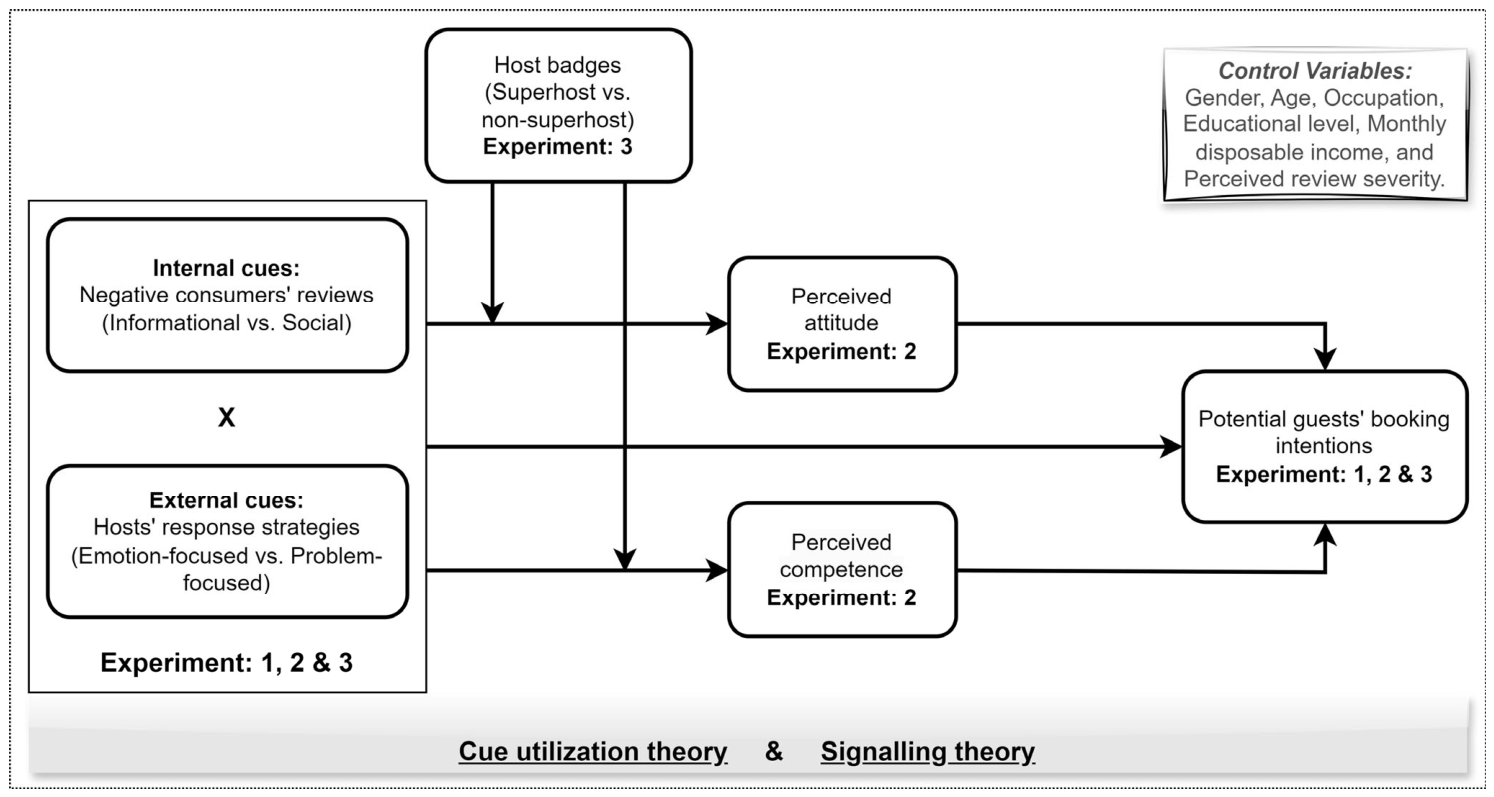
By integrating the CUT and SNT theories and drawing on the relevant literature, the current study treats negative reviews as intrinsic cues (i.e., informational vs. social) and host responses as extrinsic cues (i.e., problem-focused vs. emotion-focused) and signals, where potential guests’ perceived competence and perceived attitude may play mediating roles. In contrast, host badge types (i.e., as quality signals) may serve as moderators. To comprehensively examine the interaction effects of negative reviews and host responses on potential guests’ booking intentions, as well as the associated mediating and moderating effects, a comprehensive research framework is proposed (See Figure 1).
Figure 1. Comprehensive research framework. (Source: Authors’ work).

3. Hypothesis Development

3.1. The Interaction Effects of Negative Reviews and Host Responses on Potential Guests’ Booking Intentions

Negative reviews and host responses play a crucial role in shaping potential guests’ decision-making. Prior research has examined the effects of negative reviews and host responses on consumer buying behavior; however, few studies have examined their joint effects from a semantic congruence perspective [44]. According to the congruence perspective, individuals tend to evaluate information more positively when different informational elements are semantically aligned. Semantic congruence enhances perceived appropriateness, processing fluency, and credibility, thereby reducing uncertainty in decision-making contexts. When host responses match the primary concern expressed in negative reviews, potential guests are more likely to perceive the responses as diagnostic and effective.
In HSA service failure contexts, host response strategies are generally categorized as problem-focused or emotion-focused. Problem-focused responses emphasize concrete actions to directly resolve issues by identifying problems and proposing feasible solutions [45]. When reading informational negative reviews, potential guests are primarily concerned with whether the host can resolve the issues. Accordingly, problem-focused responses are more likely to enhance booking intentions in the presence of informational negative reviews. In contrast, emotion-focused responses aim to alleviate emotional distress through communication and support rather than directly addressing specific issues. When potential guests read social negative reviews, they are more concerned about whether the host expresses care and empathy toward guests who have experienced service failures. Therefore, emotion-focused responses are more likely to enhance booking intentions in the context of social negative reviews. Based on the above arguments, the following hypotheses are proposed.
H1. 
Negative reviews and host responses have a significant interaction effect on potential guests’ booking intentions.
H1a. 
For informational negative reviews, problem-focused responses will lead to higher booking intentions than emotion-focused responses.
H1b. 
For social negative reviews, emotion-focused responses will lead to higher booking intentions than problem-focused responses.

3.2. The Mediating Role of Perceived Competence and Perceived Attitude in the Interaction Effects

In consumer behavior research, perceived competence refers to an individual’s judgment of whether others possess the behavioral capability to achieve specific goals. It is an assessment of others’ skills, abilities, knowledge, and efficiency. In HSA services, perceived competence refers to potential guests’ subjective evaluation of the host’s problem-solving ability, formed after reading the negative review and the host’s response. Problem-focused responses emphasize that the host takes concrete actions to address the issue directly, focusing on analyzing the specific problem and providing practical and feasible solutions to improve service quality [45]. Since the proposed solutions in problem-focused responses demonstrate the host’s ability to resolve issues, it can be inferred that such responses to informational negative reviews enhance potential guests’ perceptions of the host’s competence, thereby increasing their booking intentions.
In the HSA context, perceived attitude refers to potential guests’ subjective evaluation of the host’s attitude, based on the content of the host’s response after reading the negative review. The positive impact of perceived consumer attitudes on purchase intentions is evident in the marketing literature. In response to social negative reviews, hosts’ emotion-focused responses signal warmth, empathy, and interpersonal concern [46], which help potential guests form favorable evaluations of the host’s attitude and reduce concerns about future interpersonal interactions. As a result, such responses are more likely to enhance potential guests’ booking intentions. This suggests that perceived attitude mediates the interaction effect between social negative reviews and emotion-focused responses on booking intentions. Accordingly, the following hypotheses are proposed:
H2. 
Perceived competence and perceived attitude mediate the interaction effect between negative reviews and host responses.
H2a. 
In the influence of informational negative reviews and problem-focused responses on potential guests’ booking intentions, perceived competence plays a mediating role.
H2b. 
In the influence of social negative reviews and emotion-focused responses on potential guests’ booking intentions, perceived attitude plays a mediating role.

3.3. The Moderating Role of Host Badge Type

In HSA, to differentiate among various types of hosts, the platforms evaluate hosts’ operational data based on a gamified incentive system and categorize host badge types into Superhost and non-Superhost (See Figure 2).
Figure 2. Host badge types. (Source: Authors’ work.) Note: “实名认证” refers to “Real-name verification”; “超棒房东” refers to the “Superhost” badge on the platform; and “一致好评·服务优质·响应及时” is a platform tagline meaning “consistently positive reviews · high-quality service · timely response”.
Superhosts are generally perceived as more experienced and competent [47], whereas non-Superhosts are considered to be in the early stage of service development. According to signaling theory, such credibility signals shape how potential guests interpret host responses to negative reviews. Specifically, Superhosts are more likely to be evaluated based on their problem-solving capability, whereas non-Superhosts are more likely to be evaluated based on interpersonal warmth and emotional responsiveness. Accordingly, host badge type is expected to moderate the interaction effect between negative reviews and host response strategies. Based on the above arguments, the study proposes the following hypotheses.
H3. 
Host badge type (Superhost vs. non-Superhost) moderates the interaction effect between negative reviews and host response strategies.
H3a. 
When the host holds a non-Superhost badge, social negative reviews accompanied by emotion-focused responses will lead potential guests to form a higher perceived attitude toward the host, thereby enhancing their booking intentions.
H3b. 
When the host holds a Superhost badge, informational negative reviews accompanied by problem-focused responses will lead potential guests to form a higher perceived competence toward the host, thereby enhancing their booking intentions.

4. Study 1

4.1. Experimental Design

Study 1 employed a 2 (informational vs. social negative reviews) × 2 (problem-focused vs. emotion-focused responses) between-subjects design to examine the interaction effects of negative review type and host response strategy on potential guests’ booking intentions.

4.2. Pre-Experiment

The pre-experiment aimed to select appropriate scenarios and develop the corresponding experimental materials. The scenarios were developed based on real negative reviews and host responses collected from Xiaozhu, a Chinese home-sharing platform.
Drawing on the conceptual definitions of problem-focused and emotion-focused responses, the experimental scenarios were developed accordingly. To control for potential confounding factors, the length of the scenario texts was kept as consistent as possible across conditions [48]. To ensure clarity and realism, the scenarios were evaluated by experts in marketing management and five postgraduate students with prior home-sharing experience. Revisions were made based on their feedback regarding appropriateness, readability, and clarity. The final scenario descriptions are shown in Table 1.
Table 1. Pre-experiment scenario materials of study 1.

4.3. Formal Experiment

A total of 300 participants were recruited via Sojump.com, each receiving a reward of 4 RMB. After excluding seven invalid responses (e.g., duplicate submissions or incorrect attention check answers), 293 valid responses were retained. The four experimental conditions were roughly balanced: informational negative review–problem-focused response (n = 74), social negative review–problem-focused response (n = 72), informational negative review–emotion-focused response (n = 72), and social negative review–emotion-focused response (n = 75). The sample (n = 293) was approximately gender-balanced (51.5% male) and primarily consisted of young adults aged 18–26. All participants were students, and most reported a monthly disposable income of 1001–3000 RMB. To further ensure the adequacy of the sample size, a post hoc power analysis was conducted using G*Power 3.1. Based on the observed effect sizes in the main analyses, the statistical power for detecting the interaction and simple effects exceeded 0.95 (α = 0.05), indicating that the sample size used in this study is sufficient to support the robustness of the results. Demographics are summarized in Table 2.
Table 2. Demographics of Study 1.
Participants were first informed about anonymity and confidentiality. They then received a brief introduction to home-sharing platforms, negative reviews, and host responses, followed by demographic questions and negative review severity. Each participant was randomly assigned to one of the four experimental conditions. After reading the assigned scenario, participants completed manipulation checks to identify the type of negative review (0 = social, 1 = informational) and host response (0 = emotion-focused, 1 = problem-focused). Finally, participants completed a scale measuring booking intention (see Appendix A), where all items were rated on a 7-point Likert scale [49,50].

4.4. Results and Discussions

4.4.1. Manipulation Check

Manipulation checks were conducted using one-way ANOVAs. For negative review types, participants in the informational negative review group rated the review as more informational (M informational = 5.540, SD = 0.696) than those in the social negative review group (M social = 3.400, SD = 0.808), F (1, 292) = 589.421, p < 0.001. Conversely, participants in the social negative review group rated the review as more social (M social = 5.270, SD = 1.229) than those in the informational group (M informational = 3.380, SD = 0.856), F (1, 292) = 232.548, p < 0.001. Regarding host responses, participants in the emotion-focused response group rated their response as more emotion-focused (M emotion-focused = 5.220, SD = 0.826) than those in the problem-focused group (M problem-focused = 2.370, SD = 0.761), F (1, 292) = 945.967, p < 0.001. Participants in the problem-focused response group rated the response as more problem-focused (M problem-focused = 5.730, SD = 0.912) than those in the emotion-focused group (M emotion-focused = 2.840, SD = 0.912), F (1, 292) = 789.089, p < 0.001.
In addition, one-way ANOVAs were conducted to assess the perceived realism and immersion of the scenarios. For negative reviews, no significant differences were found between the two conditions in realism (M social = 6.210, SD = 0.769; M informational = 6.320, SD = 0.548; F (1, 292) = 1.966, p = 0.162) or immersion (M social = 6.020, SD = 0.745; M informational = 5.990, SD = 1.220; F (1, 292) = 0.084, p = 0.773). Similarly, for host response recovery, no significant differences were observed between emotion-focused and problem-focused responses in realism (M emotion = 6.300, SD = 0.677; M problem = 6.220, SD = 0.661; F (1, 292) = 1.009, p = 0.316) or immersion (M emotion = 6.060, SD = 1.061; M problem = 5.950, SD = 0.953; F (1, 292) = 0.969, p = 0.326). Perceived review severity was also examined and showed no significant differences across conditions (M social = 4.820, SD = 1.141; M informational = 4.880, SD = 1.337; F (1, 292) = 0.215, p = 0.644), measured using the item “I believe the scenario described in the negative review is severe.” These results confirm that the manipulations were successful.

4.4.2. Reliability and Validity Tests

Before testing the research hypotheses, the reliability and validity of the measurement scales were assessed. Reliability analysis was conducted using SPSS 23.0, and internal consistency was evaluated using Cronbach’s α, Cronbach’s α after item deletion, and corrected item–total correlations (CITC). Validity was assessed through confirmatory factor analysis (CFA) using AMOS 23.0. Standardized factor loadings, composite reliability (CR), average variance extracted (AVE), standard errors (SEs), and critical ratios (C. Ratio) were used as evaluation criteria.
The results show that the Cronbach’s α value for booking intention is 0.961, exceeding the recommended threshold of 0.70 [51]. Deleting any item does not significantly improve Cronbach’s α, and all CITC values are above 0.50, indicating good internal consistency. In terms of validity, all standardized factor loadings exceed 0.70, and all critical ratios are significant and above 2, while standard errors are below 0.20. Moreover, composite reliability (CR) and average variance extracted (AVE) values are both above 0.70, indicating good convergent validity. Overall, the booking intention scale demonstrates satisfactory reliability and validity (see Table 3).
Table 3. Reliability and validity analysis results of the measurement scales in Study 1.

4.4.3. Main Effect and Interaction Effect Tests

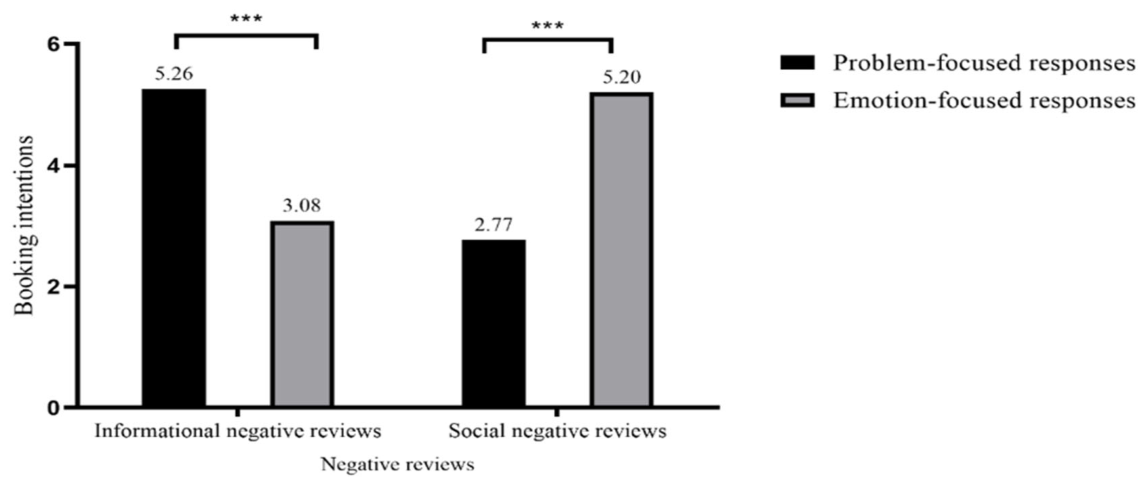
A two-way ANOVA was conducted using SPSS 23.0 to examine the interaction effect of negative review type and host response type (independent variables) on potential guests’ booking intentions (dependent variable), with demographic characteristics and perceived negative review severity included as control variables. The results revealed a significant interaction effect (F (1, 292) = 313.094, p < 0.001, ηp2 = 0.517), supporting H1. Further simple effect analyses revealed a significant difference between emotion-focused and problem-focused responses for informational negative reviews (F (1, 292) = 136.653, p < 0.001, ηp2 = 0.319). Specifically, the problem-focused response (M = 5.257, SD = 0.131) had a greater positive impact on booking intention than the emotion-focused response (M = 3.081, SD = 0.131), supporting H1a. For social negative reviews, a significant difference was also found between the two types of responses (F (1, 292) = 176.994, p < 0.001, ηp2 = 0.377). In this case, the emotion-focused response (M = 5.201, SD = 0.128) had a greater positive impact on booking intention than the problem-focused response (M = 2.765, SD = 0.131), supporting H1b (see Figure 3).
Figure 3. Interaction effects of negative reviews and host responses on potential guests’ booking. (Source: Authors’ work.) Note: *** p < 0.001.
In addition, to further examine whether the congruence effect was symmetric across informational and social complaint conditions, an asymmetry index (AI) was computed based on the absolute values of the simple effects to capture differences in effect strength. The results showed a small negative asymmetry index (AI = 2.436), indicating that the congruence effect under social negative reviews conditions was slightly stronger than that under informational negative reviews conditions.

4.4.4. Discussions

The results of Study 1 demonstrate that the effectiveness of host responses depends on their semantic congruence with the type of negative review. Problem-focused responses are more effective for informational complaints, whereas emotion-focused responses are more effective for social complaints. Importantly, the asymmetry index further indicates that this congruence effect is stronger under social complaint conditions than under informational complaint conditions, suggesting that users place greater diagnostic weight on social cues in decision-making. These findings suggest that response effectiveness relies not merely on responding, but on matching the nature of the complaint, highlighting that “saying it right” is more important than simply apologizing. Study 2 further examines the psychological mechanisms underlying this interaction effect by investigating the mediating roles of perceived competence and perceived attitude.

5. Study 2

5.1. Experimental Design

Study 2 employed a 2 (negative review type: informational vs. social) × 2 (host response type: problem-focused vs. emotion-focused) between-subjects design. This study aimed to examine the mediating roles of perceived competence and perceived attitude in the relationship between negative reviews, host responses, and booking intentions.

5.2. Pre-Experiment

The pre-experiment aimed to refine the scenarios and develop the corresponding materials (see Table 4). A review of user comments on Chinese home-sharing platforms showed that many reviews contain both positive and negative information rather than being purely negative. To enhance generalizability, the scenarios from Study 1 were revised to incorporate mixed review content.
Table 4. Pre-experiment scenario materials of Study 2.
The scenarios were developed based on the conceptual definitions of problem-focused and emotion-focused responses. To control for potential confounding factors, the length of the scenario texts was kept as consistent as possible across conditions. Domain experts evaluated the scenarios in terms of appropriateness, readability, and clarity.

5.3. Formal Experiment

The formal experiment for Study 2 recruited 400 participants offline using posters and flyers. Participants were recruited individually, and no grouping or classroom-based structure was involved in the data collection process. After excluding 40 invalid responses (e.g., duplicate submissions or failed attention checks), 360 valid responses were retained. Each participant received a gift worth 5 RMB. Participants were assigned to four conditions: social negative review–emotion-focused response (n = 92), social negative review–problem-focused response (n = 88), informational negative review–emotion-focused response (n = 91), and informational negative review–problem-focused response (n = 89). The sample (n = 360) consisted of 188 male and 172 female participants aged between 18 and 38 years, with the majority aged 23–30. All participants were students, primarily holding Bachelor’s or Master’s degrees, with monthly disposable incomes mostly between 1000 and 7000 RMB. A post hoc power analysis using G*Power 3.1 indicated that the statistical power exceeded 0.95 (α = 0.05), confirming the adequacy of the sample size (n = 360) in this study. Demographics are summarized in Table 5.
Table 5. Demographics of Study 2.
Participants were randomly assigned to one of four experimental conditions. The experiment was conducted simultaneously in separate classrooms with the assistance of four researchers. Participants first received instructions emphasizing anonymity. A two-page presentation was then shown: the first page introduced HSA platforms, negative reviews, and host responses, while the second presented the experimental scenario. Participants were asked to imagine themselves as potential guests and evaluate the review and response. Manipulation checks were conducted before participants completed the questionnaire measuring perceived competence [52], perceived attitude [53], and booking intentions [49], all rated on a 7-point Likert scale.

5.4. Results and Discussions

5.4.1. Manipulation Check

One-way ANOVA results showed that participants in the informational negative review condition rated the review as more informational (M informational = 5.530, SD = 0.712; M social = 3.38, SD = 0.792; F (1, 359) = 733.058, p < 0.001). Similarly, participants in the social negative review condition rated the review as more social (M social = 5.350, SD = 1.147; M informational = 3.340, SD = 0.904; F (1, 359) = 332.097, p < 0.001). For host response manipulation, participants in the emotion-focused response condition rated it significantly higher on emotional orientation (M emotion-focused = 5.170, SD = 0.913; M problem-focused = 2.840, SD = 0.820; F (1, 359) = 649.478, p < 0.001), while participants in the problem-focused response condition rated it significantly higher on problem-solving orientation (M problem-focused = 5.310, SD = 1.192; M emotion-focused = 3.020, SD = 0.818; F (1, 359) = 453.852, p < 0.001).
In addition, one-way ANOVAs were conducted to assess the perceived realism and immersion of the scenarios. For negative reviews, no significant differences were found between the two conditions in realism (M social = 5.970, SD = 0.873; M informational = 6.060, SD = 0.768; F (1, 359) = 1.054, p = 0.305) or immersion (M social = 5.840, SD = 1.516; M informational = 6.000, SD = 0.754; F (1, 359) = 0.529, p = 0.468). For host response recovery, no significant differences were observed between emotion-focused and problem-focused responses in realism (M emotion = 6.020, SD = 0.867; M problem = 6.010, SD = 0.775; F (1, 359) = 0.015, p = 0.902) or immersion (M emotion = 5.840, SD = 1.085; M problem = 5.880, SD = 0.937; F (1, 359) = 0.138, p = 0.710). Perceived review severity was also examined and showed no significant differences across conditions (M social = 4.970, SD = 1.038; M informational = 5.030, SD = 1.187; F (1, 359) = 0.273, p = 0.601). The manipulation was successful.

5.4.2. Reliability and Validity Test

Before testing the hypotheses, the reliability and validity of the measurement scales for perceived attitude, perceived competence, and booking intention were assessed. Reliability analysis was conducted using SPSS 23.0, and internal consistency was evaluated using Cronbach’s α, Cronbach’s α after item deletion, and corrected item–total correlations (CITC). Confirmatory factor analysis (CFA) was performed using AMOS 23.0 for the three constructs, and validity was assessed based on standardized factor loadings, composite reliability (CR), average variance extracted (AVE), standard errors (SEs), and critical ratios (C. Ratio).
The reliability results indicate that all constructs exhibit good internal consistency, with Cronbach’s α values exceeding the recommended threshold of 0.70. Specifically, Cronbach’s α values for attitude perception, competence perception, and booking intention are 0.943, 0.942, and 0.967, respectively. In addition, deleting any item does not significantly improve Cronbach’s α, and all CITC values are above 0.50, indicating satisfactory internal consistency. Regarding validity, all standardized factor loadings exceed 0.70. The minimum critical ratio (C. Ratio) is 27.669, which is well above the threshold of 2, and all standard errors (SEs) are below 0.20. Moreover, composite reliability (CR) values are above 0.70, and average variance extracted (AVE) values exceed 0.60, indicating good convergent validity. The detailed results are presented in Table 6.
Table 6. Reliability and validity analysis results of the measurement scales in Study 2.
Discriminant validity was further assessed by comparing the square root of AVE values with the correlations between constructs, following established guidelines in the literature [54]. The results show that the square root of AVE values for attitude perception, competence perception, and booking intention were all greater than the correlations among constructs, indicating satisfactory discriminant validity. The results are reported in Table 7. Overall, the measurement scales used in this study demonstrate good reliability, convergent validity, and discriminant validity.
Table 7. Discriminant validity analysis results of the measurement scales in Study 2.

5.4.3. Main Effect Test

A two-way ANOVA was conducted using SPSS 23.0, with negative review type and host response type as independent variables and booking intention as the dependent variable. Demographic variables and perceived negative review severity were included as control variables. All reported analyses were conducted with 95% confidence intervals. Results showed a significant interaction effect between review type and response type on booking intention (F (1,359) = 195.527, p < 0.001, ηp2 = 0.353), supporting H1.
Simple effect analysis further revealed that, in the informational negative review condition, problem-focused responses led to higher booking intentions (M problem-focused = 5.019, SD = 0.146; M emotion-focused= 3.067, SD = 0.143; F (1, 359) = 106.371, p < 0.001, ηp2 = 0.229). In the social negative review condition, emotion-focused responses led to higher booking intentions (M emotion-focused = 4.971, SD = 0.141; M problem-focused = 2.885, SD = 0.145; F (1,359) = 89.904, p < 0.001, ηp2 = 0.200). Thus, H1a and H1b were also supported.
To further examine the relative strength of the congruence effects, an asymmetry index was computed based on the absolute values of the simple effects. The results further indicated that the congruence effect under social negative review conditions was slightly stronger than that under informational negative review conditions. This pattern is consistent with the findings of Study 1, thereby providing further evidence for the robustness of the observed congruence effect across studies.

5.4.4. Mediation Effect Test

To further test the mediating roles of competence and attitude perceptions, a moderated mediation model (PROCESS Model 8) was used with 5000 bootstrap samples under a 95% confidence interval using the bias-corrected percentile method [55]. Negative review type was specified as the independent variable, and host response type as the moderator. Competence and attitude perceptions served as mediators, and booking intention was the dependent variable.
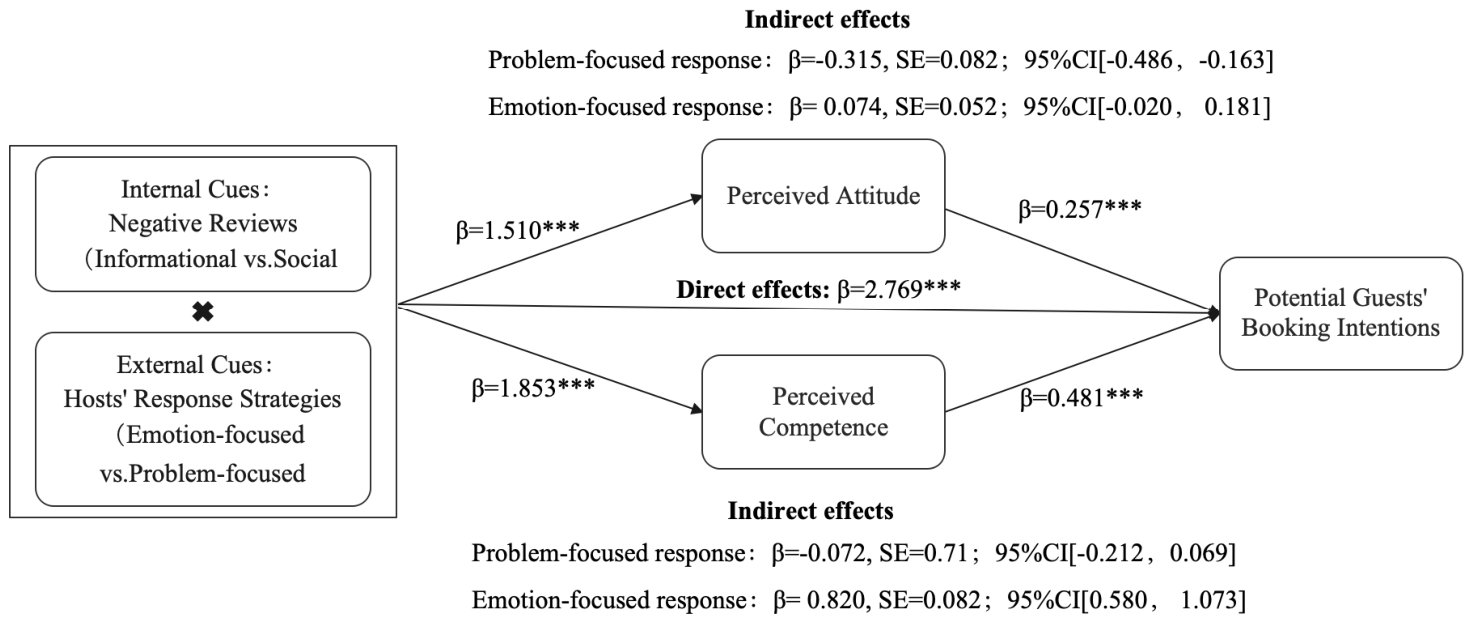
Results revealed that the interaction between negative reviews and host response had a significant effect on both perceived attitude (β = 1.510, SE = 0.296, t = 5.102, p < 0.001, 95% CI: [0.928, 2.091]) and perceived competence (β = 1.853, SE = 0.264, t = 7.027, p < 0.001, 95% CI: [1.334, 2.371]). Both attitude (β = 0.257, SE = 0.046, t = 5.577, p < 0.001, 95% CI: [0.167, 0.348]) and competence perception (β = 0.481, SE = 0.052, t = 9.300, p < 0.001, 95% CI: [0.379, 0.583]) significantly influenced potential booking intentions. Additionally, the interaction effect of review and response type on booking intention was significant (β = 2.769, SE = 0.279, t = 9.910, p < 0.001), supporting H2.
Furthermore, under the problem-focused response condition, the conditional indirect effect via competence perception was significant (β = 0.820, SE = 0.127; 95% CI: [0.580, 1.073]), but not under the emotion-focused response condition (β = −0.072, SE = 0.071; 95% CI: [−0.212, 0.069]). Conversely, under the emotion-focused response condition, the conditional indirect effect via attitude perception was significant (β = −0.315, SE = 0.082; 95% CI: [−0.486, −0.163]), but not under the problem-focused response condition (β = 0.074, SE = 0.052; 95% CI: [−0.020, 0.181]). The negative sign observed in the conditional indirect effect for attitude perception (β = −0.310) reflects the contrast coding of the negative reviews and response type variable (social negative reviews = 0 vs. informational negative reviews = 1; emotion-focused = 0 vs. problem-focused = 1) rather than indicating an opposite theoretical relationship. Specifically, it results from comparing the emotion-focused response condition against the problem-focused response condition in the coding scheme. Therefore, H2a and H2b were supported. The specific results of the mediation effect are shown in Figure 4.
Figure 4. Mediating effects of competence perception and attitude perception. (Source: Authors’ work.) Note: *** p < 0.001.

5.4.5. Robustness Analysis

To examine whether the experimental results were influenced by class-level clustering, a robustness analysis was conducted by incorporating the experimental administration session (four independent classroom-based sessions) as a fixed factor in a general linear model. The results indicate that the interaction effect between negative review type and host response type remains statistically significant after controlling for session effects (p < 0.05). The pattern and magnitude of the estimates are consistent with those reported in the main analysis. Overall, these findings suggest that the observed effects are robust and are not driven by differences across experimental class sessions.
In addition, to assess the sensitivity of the results to alternative model specifications, further robustness checks were conducted. Specifically, we re-estimated the main models (1) excluding perceived negative review severity as a control variable, and (2) using alternative operationalizations of review severity. The results remained substantively unchanged across specifications, with the interaction effects and mediation patterns consistently significant. These findings suggest that the observed effects are robust to reasonable variations in model specification and are not driven by specific choices in covariate inclusion or variable operationalization.

5.4.6. Discussions

The findings of Study 2 confirm the interaction effect identified in Study 1 and reveal its underlying psychological mechanism. Consistent with semantic congruence, the results show that matching between negative review type and response strategy influences both booking intentions and perceptions of host attributes. Informational reviews paired with problem-focused responses enhance perceived competence, whereas social reviews paired with emotion-focused responses increase perceived attitude, which in turn drives booking intentions. These effects can be explained by cue utilization theory, which suggests that individuals rely on diagnostic cues to infer less observable attributes; congruent responses therefore serve as stronger signals of competence or attitude. Study 3 further examines the boundary condition of this effect by introducing platform-endorsed credibility cues.

6. Study 3

6.1. Experimental Design

Study 3 employed a 2 (negative review type: informational vs. social) × 2 (response strategy type: problem-focused vs. emotion-focused) × 2 (badge type: Superhost vs. non-Superhost) between-subjects experimental design. Study 3 examined whether host badge type (Superhost vs. non-Superhost) moderates the interaction between negative reviews and response strategies.

6.2. Pre-Experiment

The pre-experiment for Study 3 aimed to refine the scenarios and develop the corresponding materials (see Table 8). The materials introduced an additional manipulation of host badge type (Superhost vs. non-Superhost) and revised the review–response scenarios to enhance external validity.
Table 8. Pre-experiment scenario materials of Study 3.
Based on the conceptual definitions of negative reviews, response strategies, and Superhost status, the scenarios were designed to reflect realistic guest experiences. The scenarios were evaluated by marketing experts and refined based on their feedback to ensure clarity and realism.

6.3. Formal Experiment

Data were collected through both online and offline surveys, yielding a total of 456 responses. Participants first completed demographic questions and a measure of perceived negative review severity, followed by manipulation check items and measures of perceived competence [56], perceived attitude [53], and booking intentions [49]. After excluding 46 invalid responses (e.g., incomplete or failed attention checks), 410 valid responses remained. The sample was approximately gender-balanced (203 male, 207 female) and predominantly young adults aged 18–30. Participants were mostly students or employed in enterprises. Monthly disposable income varied, with most participants earning 1001–3000 RMB. A post hoc power analysis using G*Power 3.1 indicated that the statistical power exceeded 0.95 (α = 0.05), confirming the adequacy of the sample size (N = 410) in Study 3. Demographics are summarized in Table 9.
Table 9. Demographics of Study 3.
The manipulations of negative review type, response strategy, and badge type were implemented by asking manipulation check questions. For the negative review manipulation, participants were asked “Based on the above scenario, to what extent do you agree with the following statements?” with two items: (i) the scenario describes an informational negative review and (ii) the scenario describes a social negative review. For the host response manipulation, participants were asked the same question, with two items: (i) the host’s response is problem-focused, and (ii) the host’s response is emotion-focused. Badge manipulation was assessed by asking: “To what extent did you notice a Superhost badge on the host’s profile?” Higher scores (closer to 7) indicated stronger recognition of the host as a Superhost.

6.4. Results and Discussions

6.4.1. Manipulation Checks

For the negative review manipulation, participants in the informational condition reported higher levels of informational negativity (M informational = 5.260, SD = 1.015) compared to the social group (M social = 3.380, SD = 0.798), F (1, 408) = 436.117, p < 0.001. Conversely, participants in the social negative review group gave significantly higher ratings for social negativity (M social = 5.470, SD = 1.172) compared to the informational group (M informational = 3.630, SD = 1.164), F (1, 408) = 254.266, p < 0.001. In addition, the perceived realism and immersion of the negative review scenarios were assessed. The results indicated no significant differences between the two conditions in perceived realism (M social = 6.120, SD = 0.931; M informational = 6.210, SD = 0.676; F (1, 408) = 1.175, p = 0.279) or immersion (M social = 6.170, SD = 0.865; M informational = 6.190, SD = 0.948; F (1, 408) = 0.050, p = 0.823). Perceived review severity was also examined and showed no significant differences across conditions (M social = 5.040, SD = 1.016; M informational = 4.860, SD = 1.250; F (1, 408) = 2.527, p = 0.113). Thus, the manipulation of the negative review type was successful.
For the response strategy manipulation, participants in the emotion-focused group gave significantly higher ratings for emotion-focused responses (M emotion-focused = 5.600, SD = 1.272) than those in the problem-focused group (M problem-focused = 3.430, SD = 1.082), F (1, 408) = 346.098, p < 0.001. Similarly, participants in the problem-focused group gave significantly higher ratings for problem-focused responses (M problem-focused = 5.570, SD = 1.197) than those in the emotion-focused group (M emotion-focused = 3.460, SD = 1.141), F (1, 408) = 333.229, p < 0.001. In addition, the perceived realism and immersion of the response recovery scenarios were assessed. The results indicated no significant differences between the two conditions in perceived realism (M emotion = 6.110, SD = 0.876; M problem = 6.220, SD = 0.749; F (1, 408) = 1.708, p = 0.192) or immersion (M emotion = 6.110, SD = 1.010; M problem = 6.240, SD = 0.778; F (1, 408) = 1.979, p = 0.160). Thus, the response strategy manipulation was successful.
In Study 3, the “Superhost” badge was operationalized as a visual platform status cue displayed on the host profile. The manipulation was designed to isolate the effect of platform-endorsed reputation status while holding all other profile information constant across conditions. Specifically, the host name, accommodation description, profile layout, review content, response content, and other interface elements were identical in both conditions. The only difference between conditions was the presence or absence of the Superhost badge. In the Superhost condition, the badge was clearly shown next to the host’s name within the profile interface to signal enhanced host status. The badge appeared in the same location and visual format commonly used on major HSA platforms, thereby increasing the realism and ecological validity of the manipulation. Accordingly, participants in this condition viewed a host profile that explicitly included the Superhost label. In the non-Superhost condition, no such badge or status indicator was presented, and participants viewed a host profile without any additional performance-related cues. The Superhost label was not visible to participants in this condition. No alternative reputation markers, ranking cues, or experience-related indicators were displayed, thereby minimizing potential confounding effects associated with host tenure or platform performance signals. To verify the effectiveness of the manipulation, participants were asked to indicate the extent to which the host could be considered a “Superhost.” The results showed that participants in the Superhost condition gave significantly higher ratings for Superhost recognition (M Superhost = 5.58, SD = 1.047) than those in the non-Superhost condition (M non-Superhost = 3.14, SD = 1.051), F (1, 408) = 552.736, p < 0.001. In addition, the perceived realism and immersion of the host badge scenarios were assessed. The results indicated no significant differences between the two conditions in perceived realism (M non-Superhost = 6.130, SD = 0.837; M Superhost = 6.190, SD = 0.799; F (1, 408) = 0.470, p = 0.493) or immersion (M non-Superhost = 6.120, SD = 0.947; M Superhost = 6.230, SD = 0.861; F (1, 408) = 1.617, p = 0.204). These results confirm the successful manipulation of the badge condition.

6.4.2. Reliability and Validity Test

Reliability and validity of the measurement scales were assessed using SPSS 23.0 and AMOS 23.0. Specifically, reliability was tested using SPSS 23.0 through Cronbach’s α, Cronbach’s α if an item was deleted, and corrected item–total correlations (CITC). Confirmatory factor analysis (CFA) was conducted using AMOS 23.0 to assess validity. The evaluation criteria included standardized factor loadings, composite reliability (CR), average variance extracted (AVE), standard errors (SEs), and critical ratios (C.ratio). The results are presented in Table 10.
Table 10. Reliability and validity analysis results of the measurement scales in Study 3.
The results indicate that the measurement scales for perceived attitude, perceived competence, and booking intention demonstrate satisfactory reliability and validity. Specifically, Cronbach’s α values are 0.926, 0.869, and 0.952, respectively, all exceeding the recommended threshold of 0.70 [51]. In addition, deleting any item does not significantly increase Cronbach’s α, and all CITC values are above 0.50, indicating good internal consistency. Regarding validity, all standardized factor loadings exceed 0.70, all critical ratios are significantly greater than 2, and all standard errors are below 0.20. Furthermore, composite reliability (CR) values are above 0.70, and average variance extracted (AVE) values are above 0.60, indicating good convergent validity. Overall, the measurement scales demonstrate satisfactory reliability and validity.
Discriminant validity was further assessed by comparing the square root of AVE values with the correlations between constructs. The results show that the square root of AVE values for attitude perception, competence perception, and booking intention are all greater than the correlations among constructs, indicating good discriminant validity. The detailed results are presented in Table 11. Overall, the measurement scales used in this study exhibit satisfactory levels of reliability and validity.
Table 11. Discriminant validity analysis results of the measurement scales in Study 3.

6.4.3. Test of Moderated Mediation Effects

Using SPSS 23.0 and Hayes’ PROCESS macro, Model 12 was applied to test the moderated mediation effects. Bootstrapping with 5000 resamples and 95% confidence intervals was applied. Results showed that the moderated mediation model was significant for perceived competence of the host (β = 0.311, SE = 0.124, 95% CI = [0.089, 0.576]) and perceived attitude of the host (β = −0.527, SE = 0.189, 95% CI = [−0.928, −0.175]). Thus, H3 was supported. Specifically,
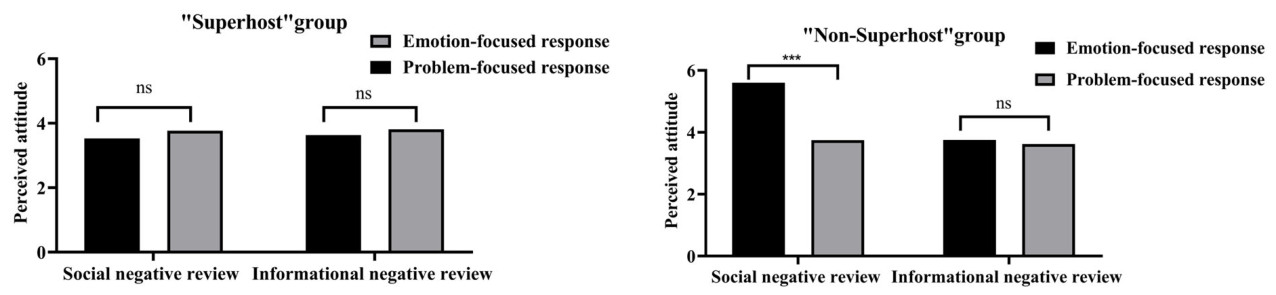
Perceived attitude: In the non-Superhost group, the indirect effect was significant for the social negative review condition (β = −0.539, SE = 0.119, 95% CI = [−0.782, −0.313]), but not significant for the informational condition (β = −0.066, SE = 0.075, 95% CI = [−0.219, 0.135]). In the Superhost group, the indirect effects were not significant for either the social (β = −0.042, SE = 0.093, 95% CI = [−0.232, 0.135]) or informational conditions (β = −0.096, SE = 0.100, 95% CI = [−0.301, 0.096]). Thus, H3a was supported (See Figure 5).
Figure 5. Interaction effects of negative reviews, response strategy, and badge type on perceived attitude. (Source: Authors’ work.) Note: *** p < 0.001.
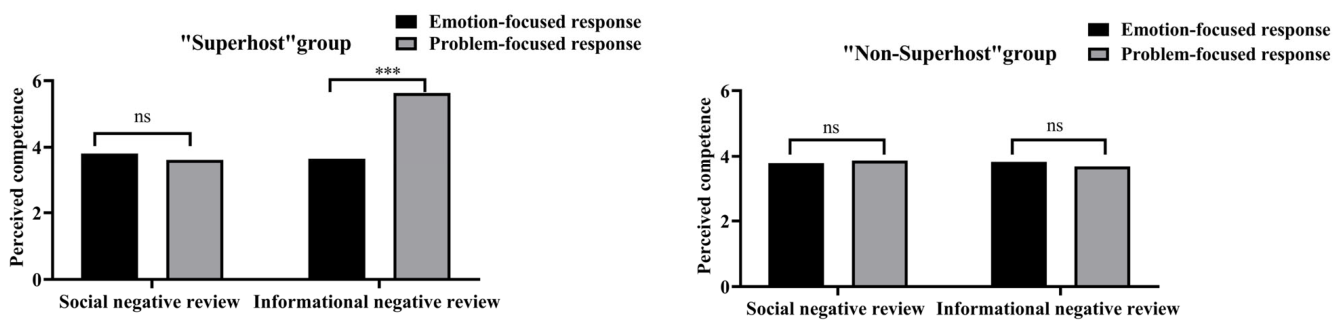
Perceived competence: In the Superhost group, the indirect effect on participants in the informational negative review condition was significant (β = 0.400, SE = 0.121, 95% CI = [0.160, 0.637]), but not significant in the social negative review condition (β = 0.040, SE = 0.048, 95% CI = [−0.046, 0.144]). In the non-Superhost group, the indirect effects were not significant for either the informational (β = −0.010, SE = 0.055, 95% CI = [−0.126, 0.098]) or social negative review conditions (β = 0.039, SE = 0.058, 95% CI = [−0.059, 0.170]). Thus, H3b was supported (See Figure 6).
Figure 6. Interaction effects of negative reviews, response strategy, and badge type on perceived competence. (Source: Authors’ work.) Note: *** p < 0.001.

6.4.4. Discussions

Study 3 extends Studies 1 and 2 by identifying platform-endorsed credibility signals as a key boundary condition. The results show that host badge status (Superhost vs. non-Superhost) significantly moderates the effect of review–response congruence on booking intentions through perceived competence and attitude. The Superhost badge can be conceptualized as a platform-generated status cue that signals host credibility, thereby shaping how users interpret and weight review–response information. For Superhosts, informational reviews paired with problem-focused responses enhance perceived competence and booking intentions, whereas this effect is not observed among non-Superhosts. By contrast, for non-Superhosts, emotion-focused responses in social complaint contexts improve perceived attitude and booking intentions, an effect that diminishes for Superhosts. Overall, these findings suggest that platform-generated credibility cues reshape how host responses are interpreted. The effectiveness of response strategies is jointly determined by review type, response strategy, and perceived host credibility.

7. Discussions and Conclusions

7.1. General Discussions

Based on the integration of cue utilization theory (CUT) and signaling theory (SNT), we conducted three studies to examine the impact of negative reviews and host responses on potential guests’ booking intentions in the context of HSA platforms. First, the results demonstrate a significant interaction between the type of negative reviews (informational vs. social) and the type of host responses (problem-focused vs. emotion-focused), highlighting the importance of matching response strategies to review types. Specifically, problem-focused responses increase booking intentions for informational negative reviews, whereas emotion-focused responses lead to higher booking intentions for social negative reviews. Second, perceptions of the host’s competence and attitude were found to mediate these effects, revealing the underlying psychological mechanism. For informational negative reviews, problem-focused responses enhance competence perceptions, while for social negative reviews, emotion-focused responses improve attitude perceptions, indicating that potential guests make decisions through psychological inference rather than by directly evaluating the content of reviews or responses. Third, the type of host badge (i.e., Superhost vs. non-Superhost) significantly moderates these effects, establishing the boundary conditions. When the host is a Superhost, informational negative reviews paired with problem-focused responses further increase competence perceptions and booking intentions. Conversely, for non-Superhosts, social negative reviews paired with emotion-focused responses enhance attitude perceptions and booking intentions. This finding underscores the role of platform-endorsed credibility signals in shaping both the interpretation and effectiveness of response strategies. Beyond the hospitality context, our findings are also consistent with research on LLM alignment and generative AI systems, which suggests that users rely on credibility and framing cues when processing information under uncertainty. From this broader perspective, host badges and managerial responses can be interpreted as credibility signals that shape consumer judgment in digital environments.
Taken together, the results of the three studies reveal a multi-layered decision-making process, in which potential guests integrate review content, response strategies, and platform signals to form perceptions of host competence and attitude, ultimately guiding their booking intentions. This framework highlights the combined importance of strategic matching, psychological mediation, and platform cues, offering systematic insights for reputation management and digital service recovery in home-sharing accommodation platforms.

7.2. Theoretical Contributions

This study provides several important theoretical contributions to the literature on guest behavior, service recovery, and image management in the HSA context.
First, this research addresses the limited integration of cue utilization theory (CUT) and signaling theory (SNT) by developing and validating an integrated framework. Existing studies have rarely examined how cues function as signals in shaping consumer judgments. By introducing a structured typology that distinguishes between informational and social negative reviews, as well as problem-focused and emotion-focused responses, this study demonstrates that the effectiveness of host responses depends on their alignment with the nature of service failure. The findings show that guests interpret review content as cues and transform them into evaluative signals, which subsequently guide their perceptions and behavioral intentions. This contribution extends CUT by clarifying how internal cues, such as review content, and external cues, such as response strategies, are jointly processed in forming booking decisions. At the same time, it enriches SNT by illustrating how signals are interpreted through interactions between guests and hosts.
Second, this study further advances theoretical understanding by identifying the psychological mechanisms underlying the effectiveness of review–response congruence. Specifically, perceived competence and perceived attitude are confirmed as two distinct mediating pathways linking response strategies to booking intentions. When responses to informational complaints emphasize problem solving and operational improvements, they strengthen perceptions of competence. In contrast, responses to social complaints that express empathy and sincerity enhance perceptions of attitude. These findings provide a more nuanced explanation of how different types of signals activate different cognitive evaluations, thereby enhancing the explanatory power of both CUT and SNT in hospitality contexts.
Third, this research also contributes by incorporating boundary conditions into the integrated framework. The findings demonstrate that platform-endorsed credibility signals, particularly host badges, significantly shape how response strategies are interpreted. For Superhosts, guests place greater emphasis on competence-related signals, making problem-focused responses more effective in addressing informational complaints. For non-Superhosts, guests rely more on affective evaluations, making emotion-focused responses more effective in addressing social complaints. This result extends SNT by showing how platform-generated signals function as higher-level cues that influence consumer expectations and recalibrate their interpretation of host behavior.
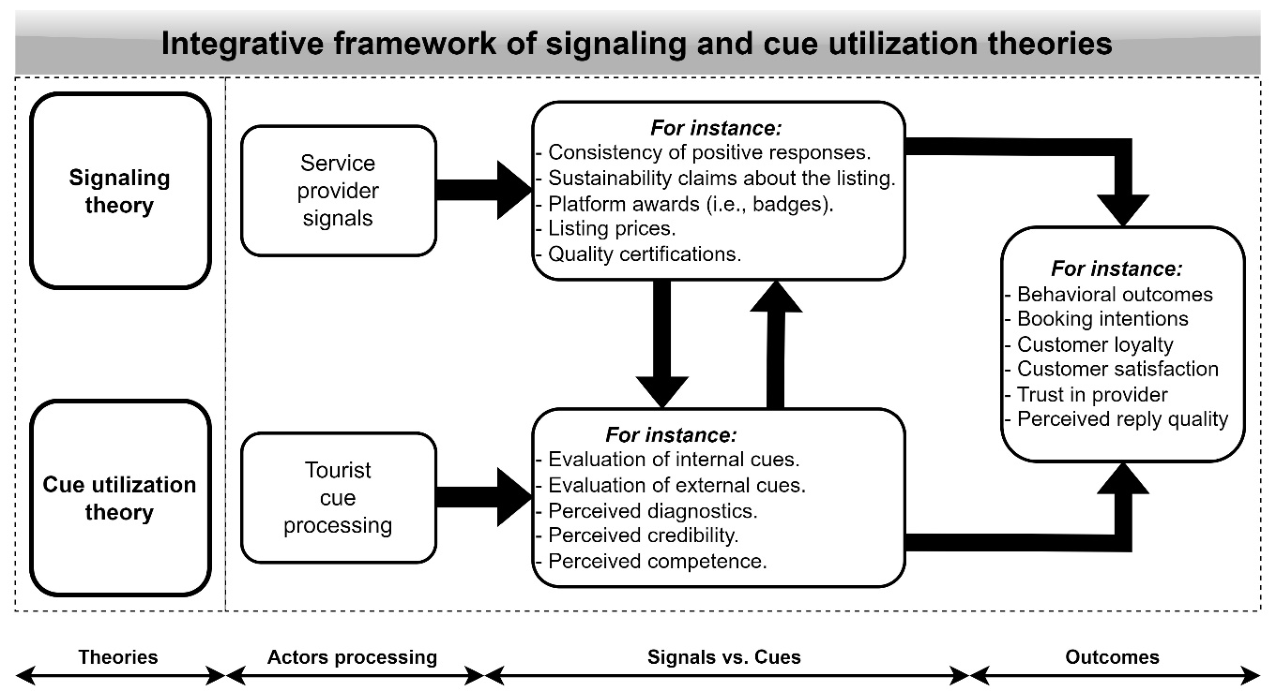
Finally, this study highlights the importance of a holistic and dynamic perspective in understanding guest decision-making. By integrating review content, host responses, and platform signals within a unified framework, the research demonstrates that booking intentions are shaped by the combined effects of cue perception, signal interpretation, and interactive communication. In addition, the findings resonate with the co-creation perspective, suggesting that effective interaction between guests and hosts can enhance perceived value and foster positive evaluations. This integrated approach not only advances theoretical development in experiential marketing and HSA service management but also provides a comprehensive lens for examining how digital service interactions influence consumer decision-making (see Figure 7).
Figure 7. Integrative framework of signaling and cue utilization theories. (Source: Authors’ work).

7.3. Practical Implications

This study provides practical and actionable insights for HSA platform operators and hosts seeking to optimize their response strategies to negative reviews, thereby enhancing potential guests’ booking intentions. In current HSA platform practices, hosts often rely on standardized or generic response strategies, such as uniform apologies or template-based replies, regardless of the specific nature of the complaint. While such approaches may improve efficiency, they often fail to effectively address guests’ concerns or influence booking decisions. Building on this gap, our findings suggest that effective response management requires a more diagnostic and adaptive decision-making approach, in which response strategies are tailored to the content and context of negative reviews. Accordingly, we offer the following practical implications.
First, hosts should align their response strategies with the type of service failure reflected in the review, rather than relying on one-size-fits-all replies. In practice, many hosts tend to respond to all negative reviews in a similar manner, which may weaken the effectiveness of their communication. However, our findings indicate that responses are more effective when they are matched to the nature of the complaint. Specifically, for informational complaints, hosts should adopt problem-focused responses that emphasize corrective actions, process improvements, and transparency. In contrast, for social complaints, hosts should employ emotion-focused responses that convey empathy, sincerity, and a commitment to improving service. Such alignment enhances the perceived relevance and authenticity of responses, thereby increasing their persuasive effectiveness. To facilitate this alignment, platforms should train hosts to classify complaint types and match appropriate response strategies, and offer response-assistance tools that identify complaint types and guide hosts toward compatible response templates. Specifically, platforms may consider implementing AI-assisted decision-support systems that automatically classify complaint types and recommend semantically aligned response templates.
Consistent with prior research [57], interface ordering and presentation structure significantly shape users’ interpretation of review–response pairs in hotel evaluation contexts. Specifically, when review information is structured in a way that makes diagnostic cues (e.g., complaint–response alignment) more salient, users are more likely to perceive higher coherence and credibility in host responses. Accordingly, HSA platforms should optimize interface design by presenting review–response information in a more structured and sequential manner, thereby helping users more easily recognize the congruence between complaint type and host response strategy.
Second, hosts should go beyond simply addressing complaints and instead design responses to influence specific psychological perceptions. In many real-world cases, responses focus primarily on surface-level issue resolution, overlooking their role in shaping guests’ deeper evaluations of the host. Our findings suggest that responses should be strategically framed to signal either competence or attitude, depending on the situation. When responding to informational issues, response content should emphasize competence cues to signal professionalism and reliability. When responding to social issues, responses should highlight attitude and sincerity to convey care and responsiveness. Importantly, HSA platforms can support this process by integrating AI-assisted response tools that automatically detect complaint types and nudge hosts toward appropriate response templates or language styles. Such systems can provide real-time suggestions on tone, content, and structure, helping hosts produce more targeted and persuasive responses while maintaining efficiency.
Third, response strategies should also be adapted according to the host’s reputation status (e.g., Superhost vs. non-Superhost), as real-world decision-making on platforms is often shaped by such credibility cues. While many hosts apply similar response styles regardless of their status, our findings indicate that effectiveness varies depending on perceived credibility. For Superhosts, who already possess established trust, responses should reinforce perceptions of competence, particularly when addressing informational complaints, by providing detailed and solution-oriented explanations. In contrast, non-Superhosts can build trust through emotion-focused responses, especially in social complaint contexts, by demonstrating empathy and sincerity to compensate for lower perceived competence. These findings suggest that response strategies should not only match review type but also align with the host’s credibility level.
Moreover, prior research suggests that authority and credibility signals may systematically shape users’ judgments in online decision environments [58]. Similar to badge systems, such signals may lead users to overweight symbolic credibility cues while underweighting substantive content quality. To mitigate such biases, platforms should ensure that badge criteria are transparent and regularly evaluated, while also providing clear descriptions of badge meanings to users. In addition, platforms should periodically update evaluation standards to maintain their relevance and effectiveness over time. Such measures can help reduce potential bias against newer or less-established hosts and mitigate the diminishing effectiveness of reputation signals. More broadly, as credibility signals function as key governance mechanisms in digital platform ecosystems, platform operators should carefully balance signaling efficiency with fairness considerations. Enhancing transparency, procedural fairness, and adaptability of badge systems is therefore essential to ensure that reputation mechanisms remain both credible and inclusive.

7.4. Research Limitations and Future Research Directions

Despite the rigorous experimental design, this study does contain certain limitations. First, the model does not account for cultural differences that may influence the relationships explored. Future research could incorporate cultural factors as moderating variables to better understand the complex mechanisms behind how negative reviews and host responses affect potential guests’ booking decisions under different cultural settings. Second, although review severity was controlled through pretesting to ensure comparability across experimental conditions, the study did not incorporate multiple item-sampled stimuli within each condition, nor did it systematically include relevant individual-level covariates such as prior home-sharing accommodation (HSA) experience, platform familiarity, and general trust. Future studies could adopt more robust designs by including these elements to enhance the generalizability and robustness of the findings.
Third, although the scenario-based experimental method followed rigorous design procedures, the reliance on scenario-based stimuli and student samples may limit the external validity and generalizability of the findings. Specifically, the simulated accommodation context may not fully capture the complexity of real booking experiences, while student participants may differ from actual home-sharing users in terms of travel experience, consumption power, and decision-making patterns. Future studies could address this limitation by employing field experiments or more diverse non-student samples to enhance ecological validity and strengthen the robustness of the findings. In addition, although the Superhost badge was operationalized as a platform-certified credibility signal, such status cues may also implicitly activate related perceptions, including host trustworthiness, experience, and tenure. Future research could further disentangle these closely related dimensions by incorporating additional control measures, more fine-grained manipulations, and comparisons between New Host and Experienced Host conditions. Fourth, although this study provides meaningful insights into the effects of semantic congruence in host responses, the findings were derived primarily from scenario-based experimental settings. Future research could further extend the practical applicability of this work by employing field experiments or A/B testing designs in real platform environments. For example, future studies may examine whether interface designs that pair complaint types with suggested response styles, or those that display additional behavioral indicators (e.g., resolution speed, demonstrated empathy, or service responsiveness), can further enhance users’ perceptions and booking decisions beyond static badge cues.


Author Contributions

Conceptualization, W.W. and M.Z.N.; writing—original draft, W.W.; writing—review and editing, W.W., M.Z.N. and M.B.M.; visualization, M.Z.N. and M.B.M.; supervision, J.R. and M.Z.N.; project administration, J.R. All authors have read and agreed to the published version of the manuscript.

Funding

This research was funded by China Association of Higher Education (Grant No. 25CJ0205), titled “2025 Higher Education Scientific Research Planning Project.”.

Institutional Review Board Statement

The study was conducted in accordance with the Declaration of Helsinki, and approved by the Harbin Institute of Technology (Shenzhen)’s Academic Committee (protocol code 20240520001 and date of approval 20 May 2024).

Data Availability Statement

The data presented in this study are available on request from the corresponding author.

Conflicts of Interest

The authors declare no conflicts of interest.

Appendix A

Appendix A.1. Constructs and Their Scales with Sources

Booking intention [49]
  • I am highly interested in booking this homestay.
  • I would consider booking this homestay.
  • I would choose this homestay if given the opportunity.
  • I have a positive attitude toward booking this homestay.
Perceived competence [59]
  • I think the host is competent.
  • I think the host is efficient.
  • I think the host is professional.
Perceived attitude [60]
  • I think the host is friendly.
  • I have a favorable impression of the host.
  • I have a positive evaluation of the host.

References

  1. Van Vaerenbergh, Y.; Arijs, D. Online consumer reviews affect the attractiveness of tourism and hospitality organizations as an employer. Tour. Manag. 2025, 111, 105255. [Google Scholar] [CrossRef]
  2. Hung, H.; Lee, N.; Hu, Y. Unlocking service provider excellence: Expanding the touchpoints, context, qualities framework. J. Serv. Res. 2025, 28, 336–354. [Google Scholar] [CrossRef]
  3. Lee, H.; Wang, J.; Moreno-Brito, Y.; Shen, Y.; Kim, H. Linguistic insights into customer satisfaction: An exploratory analysis of online reviews for gaming destination resorts in Las Vegas. J. Hosp. Tour. Technol. 2025, 16, 73–90. [Google Scholar] [CrossRef]
  4. Kim, D.; Park, S.-P.; Yi, S. Relevant and rich interactivity under uncertainty: Guest reviews, host responses, and guest purchase intention on Airbnb. Telemat. Inform. 2021, 65, 101708. [Google Scholar] [CrossRef]
  5. Sahadev, S.; Seiler, A.; Scarf, P. The impact of review sentiments on occupancy: Evidence for signalling theory from peer-to-peer accommodation. J. Vacat. Mark. 2025, 31, 351–365. [Google Scholar] [CrossRef]
  6. Jia, S.; Chi, O.; Chi, C. Unpacking the impact of AI vs. human-generated review summary on hotel booking intentions. Int. J. Hosp. Manag. 2025, 126, 104030. [Google Scholar]
  7. Elshaer, I.A.; Azazz, A.M.S.; Fayyad, S.; Aljoghaiman, A.; Fathy, E.A.; Fouad, A.M. From asymmetry to satisfaction: The dynamic role of perceived value and trust to boost customer satisfaction in the tourism industry. Tour. Hosp. 2025, 6, 68. [Google Scholar] [CrossRef]
  8. Connelly, B.L.; Certo, S.T.; Ireland, R.D.; Reutzel, C.R. Signaling theory: A review and assessment. J. Manag. 2011, 37, 39–67. [Google Scholar] [CrossRef]
  9. Zhu, Q.; Wang, Y.; Xu, X.; Sarkis, J. How loud is consumer voice in product deletion decisions? Retail analytic insights. J. Retail. Consum. Serv. 2025, 82, 104110. [Google Scholar] [CrossRef]
  10. PowerReviews. The Ever-Growing Power of Reviews. 2018. Available online: https://www.powerreviews.com/blog/the-ever-growing-power-of-reviews/ (accessed on 26 October 2025).
  11. Aggarwal, P.; Larrick, R.P. When consumers care about being treated fairly: The interaction of relationship norms and fairness norms. J. Consum. Psychol. 2012, 22, 114–127. [Google Scholar] [CrossRef]
  12. Sthapit, E.; Bjork, P. Sources of distrust: Airbnb guests’ perspectives. Tour. Manag. Perspect. 2019, 31, 245–253. [Google Scholar] [CrossRef]
  13. Tran, D.; Nguyen, K.; Huynh, D. In search for productivity in hotel management responses to online reviews: Which and where to respond? J. Vacat. Mark. 2025, 13567667251314492. [Google Scholar] [CrossRef]
  14. Zhang, S.; Su, L.; Zhuang, W.; Babin, B.J. How to respond to negative online reviews: Language style matters. J. Serv. Theory Pract. 2024, 34, 598–620. [Google Scholar] [CrossRef]
  15. Wang, B.; Jia, T. The power of personalization: Hosts how to promote guest bookings by personalized responses. Int. J. Hosp. Manag. 2024, 120, 103766. [Google Scholar] [CrossRef]
  16. Ren, X.; Wang, L.; Luo, X. How customized managerial responses influence subsequent consumer ratings: The language style matching perspective. Decis. Support Syst. 2024, 180, 114188. [Google Scholar] [CrossRef]
  17. Jiang, Z.; Chen, R. To vote or not to vote? The impact of gratitude expression on helpfulness voting in peer-to-peer accommodation reviews. Tour. Manag. 2025, 108, 105094. [Google Scholar] [CrossRef]
  18. Salehi-Esfahani, S.; Torres, E.; Hua, N. Responding to negative reviews? The interplay of management response strategy and service failure type. J. Hosp. Mark. Manag. 2023, 32, 29–49. [Google Scholar] [CrossRef]
  19. Mauri, A.G.; Minazzi, R. Web reviews influence on expectations and purchasing intentions of hotel potential customers. Int. J. Hosp. Manag. 2013, 34, 99–107. [Google Scholar] [CrossRef]
  20. Bhandari, M.; Rodgers, S. What does the brand say? Effects of brand feedback to negative eWOM on brand trust and purchase intentions. Int. J. Advert. 2018, 37, 125–141. [Google Scholar] [CrossRef]
  21. Park, S.-Y.; Allen, J.P. Responding to online reviews: Problem solving and engagement in hotels. Cornell Hosp. Q. 2013, 54, 64–73. [Google Scholar] [CrossRef]
  22. Darani, M.M.; Mirahmad, H.; Raoofpanah, I.; Singh, S.; Groening, C. Managerial responses to online communication: The role of mimicry in affecting third-party observers’ purchase intentions. J. Bus. Res. 2023, 166, 113979. [Google Scholar] [CrossRef]
  23. Floriano, M.D.P. Effects of online managerial responses on observing customers: The impact of failure severity and complainant communication ability. J. Res. Interact. Mark. 2025, 19, 1203–1222. [Google Scholar] [CrossRef]
  24. Nazifi, A.; Roschk, H.; Marder, B.; Leclercq, T. Spinning the wheel: The effectiveness of gamification in service recovery. J. Serv. Res. 2025, 28, 469–487. [Google Scholar] [CrossRef]
  25. Chevalier, J.A.; Dover, Y.; Mayzlin, D. Channels of impact: User reviews when quality Is dynamic and managers respond. Mark. Sci. 2018, 37, 688–709. [Google Scholar] [CrossRef]
  26. Sim, Y.; Lee, S.K.; Sutherland, I. The impact of latent topic valence of online reviews on purchase intention for the accommodation industry. Tour. Manag. Perspect. 2021, 40, 100903. [Google Scholar] [CrossRef]
  27. Ding, X.; Gao, B.; Liu, S. Understanding the interplay between online reviews and growth of independent and branded hotels. Decis. Support Syst. 2022, 152, 113649. [Google Scholar] [CrossRef]
  28. Liu, S.; Wang, N.; Gao, B.; Gallivan, M. To be similar or to be different? The effect of hotel managers’ rote response on subsequent reviews. Tour. Manag. 2021, 86, 104346. [Google Scholar] [CrossRef]
  29. Proserpio, D.; Zervas, G. Online reputation management: Estimating the impact of management responses on consumer reviews. Mark. Sci. 2017, 36, 645–665. [Google Scholar] [CrossRef]
  30. Wang, Y.; Chaudhry, A. When and how managers’ responses to online reviews affect subsequent reviews. J. Mark. Res. 2018, 55, 163–177. [Google Scholar] [CrossRef]
  31. Sheng, J.; Amankwah-Amoah, J.; Wang, X.; Khan, Z. Managerial responses to online reviews: A text analytics approach. Br. J. Manag. 2019, 30, 315–327. [Google Scholar] [CrossRef]
  32. Matzat, U.; Snijders, C. Rebuilding trust in online shops on consumer review sites: Sellers’ responses to user-generated complaints. J. Comput.-Mediat. Commun. 2012, 18, 62–79. [Google Scholar] [CrossRef]
  33. Casado-Diaz, A.B.; Andreu, L.; Beckmann, S.C.; Miller, C. Negative online reviews and webcare strategies in social media: Effects on hotel attitude and booking intentions. Curr. Issues Tour. 2020, 23, 418–422. [Google Scholar] [CrossRef]
  34. Cummings, K.; Herhausen, D.; Roggeveen, A.; Grewal, D. Countering virtual brand sabotage: The power of informative responses. J. Serv. Res. 2025, 28, 451–468. [Google Scholar] [CrossRef]
  35. Blankertz, D.F. Book review: Risk taking and information handling in consumer behavior. J. Mark. Res. 1969, 6, 110–111. [Google Scholar] [CrossRef]
  36. Kirmani, A.; Rao, A.R. No pain, no gain: A critical review of the literature on signaling unobservable product quality. J. Mark. 2000, 64, 66–79. [Google Scholar] [CrossRef]
  37. Wang, Q.; Meng, L.; Liu, M.; Wang, Q.; Ma, Q. How do social-based cues influence consumers’ online purchase decisions? An event-related potential study. Electron. Commer. Res. 2016, 16, 1–26. [Google Scholar] [CrossRef]
  38. Szybillo, G.J.; Jacoby, J. Intrinsic versus extrinsic cues as determinants of perceived product quality. J. Appl. Psychol. 1974, 59, 74–78. [Google Scholar] [CrossRef]
  39. Sun, J.; Nazlan, N.H.; Leung, X.Y.; Bai, B. “A cute surprise”: Examining the influence of meeting giveaways on word-of-mouth intention. J. Hosp. Tour. Manag. 2020, 45, 456–463. [Google Scholar] [CrossRef]
  40. Amblee, N.; Bui, T. Harnessing the influence of social proof in online shopping: The effect of electronic word of mouth on sales of digital microproducts. Int. J. Electron. Commer. 2011, 16, 91–113. [Google Scholar] [CrossRef]
  41. Chen, Y.; Jin, W.; Hu, Y.; Zhou, S.; Yang, S. Does managerial response moderate the relationship between online review characteristics and review helpfulness? Curr. Issues Tour. 2022, 25, 2679–2694. [Google Scholar] [CrossRef]
  42. Li, J.; Tang, J.; Jiang, L.; Yen, D.C.; Liu, X. Economic success of physicians in the online consultation market: A signaling theory perspective. Int. J. Electron. Commer. 2019, 23, 244–271. [Google Scholar] [CrossRef]
  43. Kraemer, T.; Weiger, W.H.; Heidenreich, S. Do all stars shine the same? Investigating the nonlinear effects of user and critic reviews on video game sales. J. Bus. Res. 2025, 188, 115034. [Google Scholar] [CrossRef]
  44. Li, C.; Deng, L.; Deng, Q.; Law, R. How consumers react to online reviews and managerial responses from marked source channels on an accommodation-sharing platform? Tour. Manag. Perspect. 2025, 55, 101336. [Google Scholar]
  45. Han, D.; Duhachek, A.; Agrawal, N. Coping and construal level matching drives health message effectiveness via response efficacy or self-efficacy enhancement. J. Consum. Res. 2016, 43, 429–447. [Google Scholar] [CrossRef]
  46. Hill Cummings, K.; Yule, J.A. Tailoring service recovery messages to consumers’ affective states. Eur. J. Mark. 2020, 54, 1675–1702. [Google Scholar] [CrossRef]
  47. Liang, S.; Schuckert, M.; Law, R.; Chen, C.-C. Be a “superhost”: The importance of badge systems for peer-to-peer rental accommodations. Tour. Manag. 2017, 60, 454–465. [Google Scholar] [CrossRef]
  48. Schindler, R.M.; Bickart, B. Perceived helpfulness of online consumer reviews: The role of message content and style. J. Consum. Behav. 2012, 11, 234–243. [Google Scholar] [CrossRef]
  49. Xu, X.; Schrier, T. Hierarchical effects of website aesthetics on customers’ intention to book on hospitality sharing economy platforms. Electron. Commer. Res. Appl. 2019, 35, 100856. [Google Scholar] [CrossRef]
  50. Wang, W.; Tong, Y.; Mou, J. Artificial intelligence agents or human agents? Impact of online customer service agents on crowdfunding performance. Decis. Support Syst. 2026, 200, 114562. [Google Scholar] [CrossRef]
  51. Churchill, G.A. A paradigm for developing better measures of marketing constructs. J. Mark. Res. 1979, 16, 64–73. [Google Scholar] [CrossRef]
  52. Kong, D.; Park, S.; Peng, J. Appraising and reacting to perceive: Leader competence and warmth as critical contingencis. Acad. Manag. J. 2023, 66, 402–431. [Google Scholar] [CrossRef]
  53. Schaller, S. Mental health risks of pandemic-related media communication: The mediating roles of distinct types of perceived threat. Risk Anal. 2025, 45, 3201–3217. [Google Scholar] [CrossRef]
  54. Fornell, C.; Westbrook, R.A. The vicious circle of consumer compliants. J. Mark. 1984, 48, 68–78. [Google Scholar] [CrossRef]
  55. Hayes, A.F. An index and test of linear moderated mediation. Multivar. Behav. Res. 2015, 50, 1–22. [Google Scholar] [CrossRef]
  56. Wang, Y.; Qiao, D.; Chui, E. Student engagement matters: A self-determination perspective on Chinese MSW students’ perceived competence after practice learning. Br. J. Soc. Work 2018, 48, 787–807. [Google Scholar] [CrossRef]
  57. Ouyang, Y.; Gao, S.; Wang, R.; Zhu, H.; Shao, Y.; Gu, X.; Li, Q. CommSense: Facilitating Bias-Aware and Reflective Navigation of Online Comments for Rational Judgment. In Proceedings of the 2026 CHI Conference on Human Factors in Computing Systems, Barcelona, Spain, 13–17 April 2026. [Google Scholar]
  58. Li, Y.; Zhang, P.; Hou, P.; Tu, K.; Zhang, G.; Qu, S.; Chen, W.; Chen, Y.; Gu, N.; Lu, T. Power Echoes: Investigating Moderation Biases in Online Power-Asymmetric Conflicts. In Proceedings of the 2026 CHI Conference on Human Factors in Computing Systems, Barcelona, Spain, 13–17 April 2026. [Google Scholar]
  59. Wang, Z.; Mao, H.; Li, Y.J.; Liu, F. Smile big or not? effects of smile intensity on perceptions of warmth and competence. J. Consum. Res. 2017, 43, 787–805. [Google Scholar] [CrossRef]
  60. Schaller, T.K.; Malhotra, N.K. Affective and cognitive components of attitudes in high-stakes decisions: An application of the theory of planned behavior to hormone replacement therapy use. Psychol. Mark. 2015, 32, 678–695. [Google Scholar] [CrossRef]
Disclaimer/Publisher’s Note: The statements, opinions and data contained in all publications are solely those of the individual author(s) and contributor(s) and not of MDPI and/or the editor(s). MDPI and/or the editor(s) disclaim responsibility for any injury to people or property resulting from any ideas, methods, instructions or products referred to in the content.

Article Metrics

Citations

Article Access Statistics

Article metric data becomes available approximately 24 hours after publication online.