


Abstract
In interactive digital commerce environments, negative electronic word-of-mouth (NeWOM)—particularly negative online reviews—profoundly shapes consumer perceptions and brand relationships. Yet, the underlying mechanisms through which NeWOMinfluences consumer conformity behavior remain underexplored from a qualitative, process-oriented perspective. This study adopts a grounded theory approach to analyze 1405 authentic negative smartphone reviews from a leading Chinese e-commerce platform. Through systematic open, axial, and selective coding, we develop a processual model that reveals how NeWOM triggers two interconnected yet distinct psychological mechanisms: the formation of generalized negative brand schema, driven by service/product failures and the internalization of psychological expectations, driven by unmet brand expectations and poor service attitudes. These mechanisms jointly shape consumer conformity behavior—the tendency to align one’s judgments and actions with perceived peer consensus reflected in negative reviews. Importantly, enterprises’ responsive improvements based on negative feedback operate as a feedback loop that can sustain or restore consumer–brand congruence. By reconceptualizing NeWOM as a dynamic, dialogic trigger within interactive marketing systems, this study extends electronic commerce theory and provides context-sensitive insight into how consumer conformity emerges and evolves in digital marketplaces.
1. Introduction
The global retail and consumer engagement landscape has been fundamentally transformed over the past two decades, driven by technological advancement, evolving socioeconomic factors, and post-pandemic behavioral shifts. In pivotal markets such as China, this transformation is characterized by the rapid development of digital commerce infrastructure, fueled by rising disposable income and dynamic changes in consumption patterns. Distinct from the one-way communication of traditional media, the digital ecosystem is defined by interactivity, real-time engagement, and user-centricity. The mass adoption of mobile devices, the dominance of social media platforms, and the sophistication of search algorithms have collectively democratized information access and fostered a powerful user-generated content ecosystem. This ecosystem has shifted the locus of product evaluation and brand perception from firm-controlled marketing channels to peer-driven platforms, redefining the primary pathways of consumer information acquisition and trust formation in the digital age [1].
Within this interactive digital context, word-of-mouth (WOM) has been transposed and amplified into digital word-of-mouth (DWOM). Information—particularly evaluative content such as online product reviews—now disseminates with unprecedented speed and scale, endowing individual consumer opinions with a potentially vast collective audience. Of particular managerial and theoretical relevance is negative electronic word-of-mouth (NeWOM), which has been shown to rapidly shape potential consumers’ perceptions of a firm’s offerings. The scalability and persistence of online networks mean that a single negative review can transcend geographical and demographic boundaries, accumulating visibility and influence that far surpass traditional offline WOM. Consequently, DWOM has evolved from a complementary information source into a powerful independent force that critically influences purchase intentions, brand preferences, and, ultimately, the alignment between consumers and brands [2].
Despite the recognized power of NeWOM, existing research has predominantly employed quantitative, variance-based methods (e.g., surveys, experiments) to estimate the average effects of negative reviews on purchase intentions or brand attitudes. What these studies have not done is unpack the processual mechanisms—the “how” and “why”—through which consumers psychologically interpret, internalize, and respond to negative consensus in their own words and across a large corpus of authentic reviews. In particular, the literature lacks qualitative models that trace how different types of complaints (e.g., product failures vs. value violations) trigger distinct psychological pathways toward consumer conformity. Grounded theory is uniquely suited to fill this gap because it allows categories and mechanisms to emerge inductively from naturalistic textual data rather than imposing a priori constructs [3,4]. Therefore, this study asks: How does negative electronic word-of-mouth psychologically unfold to influence consumer conformity behavior in interactive marketing environments?
To address this question, we employ a grounded theory methodology [4,5] on a large corpus of 1405 authentic negative reviews from Jingdong (JD.com), a leading Chinese 3C e-commerce platform. The result is a substantive process model that reveals two core psychological themes—generalized negative brand association and internalization of psychological expectations—through which NeWOM drives consumer conformity. Importantly, the model also identifies enterprises’ responsive improvements as a critical feedback loop that can sustain congruence behaviors. This study advances interactive marketing theory by reconceptualizing NeWOM as a dynamic, dialogic trigger rather than static information, and provides actionable strategies for online reputation management and interactive service recovery.
2. Theoretical Background
Before proceeding, it is important to clarify the distinction between two related but distinct concepts used throughout this study. Consumer conformity refers to the tendency of an individual to align their judgments, preferences, or purchase decisions with the perceived consensus expressed in online reviews. It is a behavioral tendency that can be temporary and context-dependent. Consumer congruence, by contrast, refers to the long-term alignment between a consumer’s self-concept and brand image [6]. Conformity may lead to reduced congruence (when a consumer avoids a brand due to negative consensus) or, conversely, responsive brand actions may restore congruence over time. Throughout this paper, we use “conformity” to describe the immediate behavioral adjustment in response to NeWOM, and “congruence” to describe the broader relational state between consumer and brand.
Digital word-of-mouth (DWOM) serves as a critical heuristic for navigating online marketplace uncertainty [7]. Unlike ephemeral offline WOM, DWOM is persistent, scalable, and algorithmically mediated, with trust shaped by source credibility, argument quality, and platform reliability [8]. Consumers assess perceived usefulness—informational, emotional, and social utility [9]. Review characteristics depend on creation context (e.g., mobile reviews are more emotional yet briefer) [10]. DWOM, often perceived as more authentic than firm content, strongly influences brand attitudes, purchase intentions, and loyalty, especially for experience goods [11]. This effect varies across cultures; in emerging markets and social commerce, satisfaction and trust are key mediators [12]. Recent work has extended credibility research to artificial intelligence influencers [13], while emotional attachment to digital endorsers has been shown to mediate behavioral intentions [14]. Self-influencer congruence and parasocial identification further strengthen endorsement effectiveness [15], and cross-platform differences in review helpfulness moderate consumer responses [16].
The negativity bias—greater weight given to negative information—is well-established [17]. Negative information is processed more thoroughly, remembered longer, and weighted more heavily. Online, this bias amplifies: negative DWOM spreads faster and wider than positive, posing a reputational threat [18]. Platform type moderates this effect: negative reviews on third-party sites impact purchase intention more strongly than on brand-owned channels [19]. Negative DWOM increases perceived risk and brand-switching intentions, and is often seen as more diagnostic [20]. Disseminating negative DWOM links to intense dissatisfaction and trust breakdown. A morphological review of 282 NWOM/NeWOM studies confirms that qualitative, processual dimensions remain underexplored [21]. Experimental evidence shows that apology, explanation, and corrective action together—not individually—improve purchase intention after negative reviews [22]. Advertising can mitigate negative WOM effects under high cognitive involvement.
Recent studies have further advanced our understanding of NeWOM mechanisms through diverse theoretical lenses. Zinko et al. [22]. experimentally demonstrated that a combination of apology, explanation, and corrective action—rather than any single element—is required to improve purchase intention after negative reviews. This finding highlights the importance of enterprise responsiveness, a theme that emerged inductively from our qualitative data as a critical feedback loop. Ribeiro and Kalro [23] conducted a morphological analysis of 282 NWOM/NeWOM studies and found that the majority adopted quantitative, variance-based approaches, leaving the processual and narrative dimensions of NWOM influence underexplored—a gap that our grounded theory analysis directly addresses. Yaseen et al. [24] identified advertising as a contextual moderator that can mitigate the negative impact of NWOM on consumer attitudes under different cognitive involvement conditions, which parallels our identification of pre-purchase psychological expectations as a moderating condition. Collectively, these recent contributions suggest that while the direct effects of NeWOM are well-documented, the qualitative processes through which consumers interpret, internalize, and respond to negative reviews remain less understood.
Consumer conformity behavior refers to the tendency of individuals to align their judgments, preferences, or actions with those of a reference group—in this case, the perceived consensus expressed through online reviews. Conformity is a well-established construct in social psychology [25], driven by two primary motivations: informational social influence (the desire to make correct decisions by following others’ cues, especially under uncertainty) and normative social influence (the desire to gain social approval or avoid disapproval by fitting in with a group) [26]. In the context of NeWOM, both mechanisms are activated. Informational influence operates when consumers believe that aggregated negative reviews reveal genuine product deficiencies that they would otherwise miss. Normative influence operates when consumers internalize the collective negative sentiment as a social norm, feeling that deviating from that consensus would be unwise or embarrassing. Kelman [27] further distinguished three processes of attitude change—compliance, identification, and internalization—which map onto these influence types. Compliance involves public conformity without private acceptance; identification occurs when an individual adopts attitudes to maintain a satisfying relationship with a referent (such as a trusted reviewer); internalization happens when external information becomes integrated into one’s own value system. In the digital review environment, consumers may move from compliance (avoiding a brand due to social pressure) to identification (following a specific influential reviewer) to full internalization (genuinely believing the brand is untrustworthy).
Within interactive marketing, conformity behavior is closely related to the broader concept of consumer congruence, defined as the alignment between a consumer’s self-concept and brand image [6]. Congruence is a psychological response based on cognition and emotion, synthesized as a state of increasing trust and satisfaction toward enterprises through interactive experiences. Aaker [28] distinguishes two dimensions: functional congruence, which refers to the degree to which a brand’s performance matches consumers’ expectations and needs, and symbolic congruence, which refers to the alignment of brand personality, values, and associations with consumers’ self-concept, lifestyle, and social identity. NeWOM can undermine both dimensions: functional failures (e.g., product defects, poor logistics) erode functional congruence, while perceived unfairness or disrespect (e.g., rapid price drops, poor service attitude) erode symbolic congruence. In digital environments, platform-based stimuli such as community design, content quality, and opportunities for interaction are critical antecedents to fostering engagement and congruent behaviors [29]. Studies in virtual brand communities show that perceived social support and a shared sense of identity significantly promote consumer–brand fit and advocacy [30,31]. However, these studies typically focus on positive engagement and loyalty. Much less is known about how negative social information—such as a preponderance of critical reviews—disrupts congruence and drives conformity away from a brand.
To understand this disruptive process, we turn to interactive marketing theory, which emerged in the mid-1990s as a response to the growing capabilities of digital technologies to enable bidirectional, real-time, and personalized exchanges between consumers and firms [32]. Unlike traditional mass marketing, which relies on one-way broadcast communication, interactive marketing conceives of the consumer as an active participant in value co-creation. Key tenets include: consumers are not passive recipients but co-producers of meaning; interactions occur within technologically mediated environments that shape the nature and outcomes of exchange; trust and relationship quality are built through iterative, dialogic processes rather than one-off transactions. In the two decades since its formalization, interactive marketing theory has been extended to encompass social media, user-generated content, and online brand communities [33]. Within this extended framework, online reviews are not static pieces of information but dynamic, participatory events co-created by reviewers, platform algorithms, and subsequent readers. When a consumer reads a negative review, they are not merely receiving information; they are engaging in a form of observational participation—witnessing a public exchange between a dissatisfied customer and (potentially) the brand. The brand’s response (or silence) becomes part of the interactive event. This perspective has profound implications: the persuasive power of NeWOM is not solely a function of the review’s content but also of the interactive context in which it is embedded, including platform affordances (e.g., review helpfulness voting, reply threads) and the perceived responsiveness of the brand. Despite its relevance, interactive marketing theory has rarely been applied to understand the process through which NeWOM influences consumer conformity. Most empirical studies drawing on this theory focus on engagement metrics, loyalty, or co-creation behaviors in positive or neutral settings.
Integrating interactive marketing theory with consumer conformity and congruence theory yields a comprehensive explanatory framework. Interactive marketing theory emphasizes the context—platform-mediated, dialogic, dynamic—in which negative reviews are produced and consumed. Consumer conformity and congruence theory provides the psychological mechanisms—informational/normative influence, identification/internalization, self-congruity revision—through which NeWOM produces behavioral outcomes. Together, they suggest that NeWOM’s influence is neither direct nor uniform; it is mediated by consumers’ pre-purchase expectations, moderated by brand responsiveness, and conditional on the type of failure (functional vs. symbolic) highlighted in the reviews. However, existing empirical research has largely tested this integrated logic using quantitative, variance-based methods (e.g., surveys, experiments, regression analysis). These methods are well-suited to estimating the average strength of relationships but are less effective at uncovering the processual narrative—the sequence of psychological events, the qualitative distinctions between different types of negative information, and the emergent role of brand responses as part of an ongoing interaction. As a result, the literature remains fragmented: we know that NeWOM reduces purchase intentions and brand trust, but we have a much weaker understanding of how this happens from the consumer’s perspective, in their own words, across hundreds of authentic reviews.
This gap justifies the adoption of a grounded theory methodology. Grounded theory is specifically designed for exploring processual, context-embedded phenomena where existing theory is under-specified. Rather than imposing a priori categories or testing pre-formulated hypotheses, grounded theory allows categories and mechanisms to emerge inductively from the data. This is particularly appropriate for NeWOM research because negative reviews themselves are naturalistic, narrative-rich texts that contain consumers’ own accounts of their psychological journeys. By systematically coding 1405 authentic negative reviews, we can identify the categories of complaints that consumers themselves deem important, trace how those categories cluster into themes, and discover the moderating and feedback loops that quantitative studies have missed. The resulting process model is therefore grounded in the lived experience of consumers rather than derived solely from prior theory—while simultaneously being interpretable through the theoretical lenses of interactive marketing and conformity. In summary, the integrated theoretical framework guiding this study recognizes NeWOM as a dynamic, interactive event; distinguishes between functional and symbolic congruence as distinct outcomes; identifies informational and normative social influence as the psychological drivers of conformity; proposes that NeWOM operates through two core themes—the formation of generalized negative brand associations (cognitive, information-driven)—that is, repeated exposure to similar complaints leads consumers to associate the brand with a fixed set of deficiencies, regardless of whether their own experience would replicate those issues—and the internalization of psychological expectations (affective, value-driven); and positions pre-purchase expectations as a key moderator and enterprise responsive improvements as a critical feedback loop. This framework serves as a sensitizing device [34]—a set of concepts and relationships that orient the grounded theory analysis without determining its outcomes—and the analysis that follows may confirm, refine, or challenge its elements.
3. Methodology
3.1. Data Collection
The study is set in China’s smartphone e-commerce market. Jingdong (JD.com) is a preeminent digital 3C (computer, communication, consumer electronics) e-commerce platform characterized by high brand concentration in the smartphone segment. In the contemporary digital landscape, consumers have developed heightened discernment toward positive online reviews, which are often suspected of being corporate self-promotion or deceptive marketing. Conversely, negative reviews tend to hold greater epistemic authority, as consumers implicitly assume that organizations would not voluntarily engage in reputation-damaging behavior. Therefore, negative reviews on JD.com provide a rich and authentic data source for understanding NeWOM mechanisms.
A systematic sampling strategy was adopted. We selected the four leading smartphone brands on JD.com—denoted as P, Y, H, and M—ranked by the total volume of customer feedback. For each brand, all negative reviews (defined as consumer ratings of 1 or 2 stars on a 5-star scale) posted between 1 January 2022 and 31 December 2022 were extracted using the platform’s publicly accessible review interface. To ensure data authenticity and relevance, a multi-stage cleansing protocol was applied: (1) removal of reviews that did not refer to the purchased smartphone model (e.g., comments about other products or general platform complaints); (2) exclusion of positive-sentiment texts disguised with negative or neutral wording (e.g., “Not bad at all” with a 1-star rating); (3) deduplication of identical or near-identical entries generated by automated scripts or user re-posting; and (4) elimination of default or boilerplate evaluations (e.g., “Good product” without substantive content). After cleansing, 1405 validated negative reviews were retained. The final distribution per brand was: Brand P = 347, Brand Y = 335, Brand H = 329, Brand M = 394.
3.2. Grounded Theory Design
Given the exploratory nature of our research question—aiming to uncover the underlying mechanism rather than test predetermined hypotheses—a qualitative, theory-building approach is appropriate. We employed the grounded theory methodology to inductively analyze the textual data of negative online reviews. Grounded theory, with its systematic procedures for inducing concepts from data, is uniquely suited to develop a process model of complex consumer psychosocial phenomena in novel digital contexts [35].
3.3. Coding Procedures
The analysis followed the iterative, three-stage coding process characteristic of grounded theory methodology.
Open coding. Each negative review was read line-by-line and broken down into discrete incidents, actions, or evaluations. We employed a combination of in vivo coding (using the consumer’s own words, such as “price dropped fast” or “screen scratches out of the box”) and conceptual coding (assigning abstract labels like “logistics failure” or “expectation violation”). Through constant comparative analysis—comparing each new incident with previously coded incidents—we grouped similar concepts into preliminary categories. For example, complaints about “slow delivery”, “damaged packaging”, and “lost items” were all grouped under a provisional category of “logistics problems”. This phase produced 28 initial categories (a1–a28) derived from the raw data.
Axial coding. We moved from describing categories to explaining their interrelationships. Each category was examined in terms of its causal conditions (what led to the complaint?), context (under what circumstances did it occur?), and consequences (what effect did it have on the consumer’s attitude or behavior?). By systematically comparing categories, we identified patterns of association. For instance, “poor logistics” (a1) and “unprofessional customer service” (a6) were found to share similar antecedents and similar outcomes (e.g., frustration, distrust), and were therefore consolidated into a higher-order subcategory called “service professionalism” (A1). Through axial coding, the 28 initial categories were refined into 10 subcategories (A1–A10), each representing a coherent theme at a more abstract level.
To make the analytical logic more transparent, we specify how the dimensions of causal conditions, context, and consequences were identified. Causal conditions were inferred from the semantic relationships within the review texts: for example, “price dropped fast” was coded as a trigger (cause) of “brand expectation violation,” not as a consequence. Context was identified by examining the co-occurrence of categories: complaints about “slow delivery” and “damaged packaging” frequently appeared together in the same reviews, suggesting a shared contextual background of merchant logistics capability. Consequences were inferred from the psychological outcomes explicitly stated or strongly implied by reviewers: phrases such as “I will never buy this brand again” or “I feel cheated” indicated consequences of distrust and brand abandonment. These inferences were made iteratively by two researchers, with disagreements resolved through discussion. This systematic approach ensures that the axial coding phase moves beyond mere description to explanatory relationships.
Selective coding. We identified the core category that integrated all other categories into a unified theoretical model. The core category was determined by its centrality—it appeared repeatedly across different types of complaints, was connected to most other categories, and had clear explanatory power for the phenomenon of interest. The core category that emerged was consumer conformity as a dynamic, socially reinforced adjustment process. Around this core, we systematically related the 10 subcategories, further grouping them into six core categories (AA1–AA6) that represent the primary dimensions of consumer dissatisfaction and their psychological consequences.
Coding team and inter-coder reliability. The coding team consisted of four researchers. In the open coding phase, two researchers independently coded a random sample of 200 reviews (approximately 14% of the dataset). Disagreements (which occurred in about 8% of the coded segments) were resolved through discussion, and the reconciled coding scheme was then applied by a single researcher to the remaining reviews. In the axial and selective coding phases, two researchers independently reviewed the aggregated categories and their relationships; disagreements on category labels or hierarchical placement (fewer than 5% of decisions) were resolved by consulting a third researcher. This process ensured that the final coding framework was both reliable and traceable. Table 1 presents the resulting framework, and an audit trail of coding decisions is available from the corresponding author.

Table 1.
Tertiary Coding Framework: From Initial Concepts to Core Categories.
The iterative coding process continued until theoretical saturation was achieved, meaning that no new properties, dimensions, or relationships emerged from additional data. To formally test saturation, we collected a new set of 50 negative reviews posted on JD.com after 19 April 2023 (i.e., outside the original sampling window) and subjected them to the same open coding procedure. No new categories or attributes were identified, confirming that the coding framework had reached saturation.
To ensure rigor, we adhered to several established practices. Two independent researchers reviewed a random sample of 200 reviews and confirmed the coding scheme, achieving an inter-coder agreement of 92%. All coding decisions, memos, and category definitions were documented in a research log to maintain an audit trail. Table 1 and Table 2 (presented in Section 3) provide illustrative examples of raw consumer statements mapped to each level of coding, allowing readers to trace the analytical path from raw data to theoretical claims. Constant comparative analysis was applied throughout the iterative process to ensure that the emerging theory remained grounded in the data.
Table 2.
Examples of Tertiary Coding Process.
4. Findings
4.1. Coding Results
The iterative, three-stage coding process of grounded theory yielded a structured set of categories that explain the primary sources and psychological underpinnings of consumer dissatisfaction in the smartphone domain. The final analytical framework consists of six core categories (AA1–AA6) derived from 28 initial concepts (a1–a28) and 10 subcategories (A1–A10), which synthesize the various dimensions of negative experiences reported by consumers. These core categories, the tertiary coding framework, along with their constituent sub-categories and the initial concepts from which they were derived, are synthesized in Table 1.
To enhance the transparency and trustworthiness of the qualitative analysis, Table 2 provides illustrative examples of raw consumer statements mapped to the different levels of coding, demonstrating how specific reviewer complaints were conceptualized and categorized within the developed framework.
4.2. The Processual Model: How NeWOM Drives Consumer Conformity
Through selective coding, we identified a core category: consumer conformity as a dynamic, socially reinforced adjustment process. The relationships among the six core categories form a processual model (Figure 1) that explains how negative electronic word-of-mouth influences consumer congruence behavior. The model comprises two core psychological themes, a moderating condition, and a feedback loop.
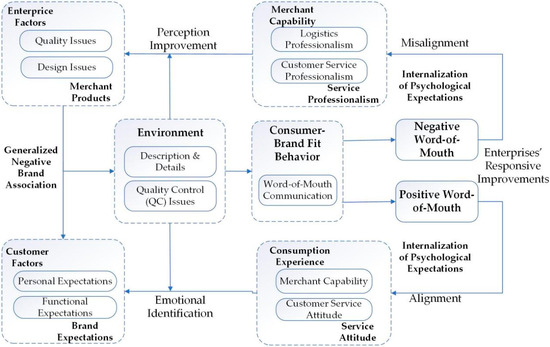
Figure 1.
A Processual Model of NeWOM Influence on Consumer Conformity and Congruence Note. The model depicts two psychological themes through which negative electronic word-of-mouth (NeWOM) affects consumer behavior. The left pathway (AA1 + AA2 → Generalized Negative Brand Association) represents cognitive, information-driven conformity based on tangible service/product failures. The right pathway (AA5 + AA6 → Internalization of Psychological Expectations) represents affective, value-driven conformity based on perceived violations of brand expectations and service attitude. Consumers’ pre-purchase expectations moderate both pathways (stronger effects when expectations are high). Enterprises’ responsive improvements act as a feedback loop that can interrupt or reverse both themes, potentially restoring congruence. AA1 = Service Professionalism; AA2 = Merchant Products; AA5 = Brand Expectations; AA6 = Service Attitude. See Table 1 for category definitions. Arrows denote directional relationships in the process model including a feedback loop.
Theme 1: Generalized Negative Brand Association
The first theme originates from tangible, experience-based failures related to service professionalism (AA1) and merchant products (AA2). When consumers encounter negative reviews describing poor logistics, damaged packaging, missing items, or product quality issues (e.g., heating, poor screen, lagging performance), they do not process these complaints in isolation. Instead, repeated exposure to similar complaints across multiple reviews crystallizes into a generalized negative brand association. This cognitive shortcut leads consumers to associate the brand with a fixed set of deficiencies, regardless of whether their own experience would replicate those issues. Once formed, this generalized negative association strongly drives consumer conformity behavior—prospective buyers align their expectations and purchase decisions with the perceived consensus of the reviewing community, often abandoning the brand or switching to alternatives. This theme is primarily informational in nature, as consumers rely on aggregated negative evidence to reduce decision uncertainty.
Theme 2: Internalization of Psychological Expectations
The second theme is more affective and value-laden, originating from brand expectations (AA5) and service attitude (AA6). Complaints about rapid price drops, disappointing features, poor signal, slow charging, and unprofessional or indifferent customer service attitudes do not merely indicate functional failures—they signal a violation of the psychological contract between the consumer and the brand. When consumers read that a brand’s product failed to meet advertised expectations or that the brand’s attitude toward customers is dismissive (e.g., poor giveaway benefits, rude service), they internalize a sense of psychological dissonance. This internalization is deeper than impression formation: it involves an emotional and value-based realignment. Consumers begin to question the brand’s integrity, fairness, and respect for customers. This internalized dissonance then translates into conformity behavior not merely as risk avoidance but as a normative rejection of the brand. Consumers conform to the negative consensus because they come to share the moral or emotional stance expressed by other reviewers.
To clarify the boundaries between the two themes, Table 3 contrasts their antecedents, psychological nature, dominant influence type, and behavioral outcomes. Representative quotes for each theme are also provided below.
Table 3.
Contrasting the Two Psychological Themes of NeWOM Influence.
4.2.1. The Moderating Role of Pre-Purchase Psychological Expectations
An important moderating condition identified in our data is consumers’ pre-purchase psychological expectations. Consumers who approach a purchase with high expectations (e.g., based on brand reputation, advertising, or prior positive experiences) are more vulnerable to both themes. A single negative review that contradicts high expectations can trigger disproportionate disappointment and rapid conformity to negative consensus. Conversely, consumers with low or realistic expectations may discount some negative reviews or interpret them as isolated incidents. This moderating effect explains why identical negative reviews can produce different conformity outcomes across different consumer segments.
4.2.2. The Feedback Loop: Enterprises’ Responsive Improvements
Crucially, the model is not static. Enterprises’ responsive improvements—actions taken by brands to address the issues raised in negative reviews—operate as a feedback loop that can sustain or restore consumer congruence behavior. When a brand publicly acknowledges a problem (e.g., logistics delays, quality defects, price drop concerns) and implements visible corrective actions (e.g., improved packaging, extended price protection, firmware updates), this responsiveness can interrupt the internalization of negative expectations. Observational consumers who see that a brand “listens and improves” may revise their generalized negative brand associations, leading to sustained or even enhanced congruence. However, absent or generic responses reinforce both themes, accelerating conformity away from the brand.
4.3. Comparative Insights Across Brands
The distribution of core categories varied across brands, providing empirical support for the context-sensitivity of the model. Table 4 summarizes the overall coding frequencies and percentages across all brands, showing that ‘Brand expectations’ (AA5) and ‘Merchant products’ (AA2) together accounted for over 75% of all negative feedback.
Table 4.
Summary of Tertiary Codes by Brand.
Brand-level comparisons reveal notable contrasts:
- Brand Y was dominated by ‘Merchant products’ (54.93%) complaints, indicating that Mechanism 1 (stereotypical impression) is the primary driver of conformity for this brand.
- Brands P and M showed high concentrations in ‘Brand expectations’ (54.18% and 54.06%, respectively), driven largely by rapid price drop complaints. For these brands, Mechanism 2 (internalization of psychological expectations) is more salient.
- Brand H exhibited a more balanced profile, with both mechanisms at play.
These brand differences confirm that the processual influence of NeWOM is not uniform. Managers must identify which theme dominates for their brand based on the prevailing complaint categories, as this diagnosis directly informs appropriate response strategies—for example, operational fixes for Theme 1 versus fairness- and communication-based fixes for Theme 2. Detailed brand-level coding frequencies and percentages are provided in Appendix A, Table A1, Table A2, Table A3 and Table A4.
5. Discussion
5.1. Two Recurring Psychological Themes in Consumer Responses to NeWOM
Our analysis suggests that consumer responses to NeWOM coalesce around two recurring psychological themes. While these themes resonate with existing concepts in the literature (e.g., informational vs. normative influence), our grounded approach reveals how they are articulated in consumers’ own words within the specific context of smartphone reviews on a Chinese e-commerce platform.
The first theme—generalized negative brand association—is cognitive, heuristic-driven, and based on aggregated evidence of tangible failures. It resembles an “availability cascade” in which repeated exposure to similar complaints creates a durable, generalized negative brand schema. This theme aligns with informational social influence and explains why consumers who have never directly experienced a problem may still conform to negative consensus.
Mapping the model to theoretical constructs. Before discussing the implications further, it is useful to explicitly map the components of our processual model (Figure 1) to established theoretical constructs from the literature. The left pathway (AA1 + AA2 → generalized negative brand association) corresponds to informational social influence: consumers rely on aggregated negative reviews as diagnostic evidence to reduce purchase uncertainty, leading to conformity as risk avoidance. This pathway also resonates with the negativity bias [12], as repeated exposure to negative product information creates a generalized cognitive schema. The right pathway (AA5 + AA6 → internalization of psychological expectations) aligns with normative social influence [25] and psychological contract theory [35]: consumers perceive a violation of fairness or respect, which triggers value-based rejection of the brand. This pathway further relates to symbolic congruence [6], as the perceived mismatch between brand conduct and consumer values undermines self-brand alignment. The moderating role of pre-purchase expectations is consistent with expectation disconfirmation theory [36], where higher prior expectations increase the likelihood and magnitude of negative disconfirmation. Finally, enterprises’ responsive improvements as a feedback loop extend interactive marketing theory [32,33] by demonstrating that brand responses are not exogenous but endogenous to the system, capable of reshaping both cognitive impressions and affective evaluations. This mapping clarifies how our inductive findings connect to, and extend, existing theoretical domains.
The second theme—internalization of psychological expectations—is affective, value-laden, and rooted in perceived violations of fairness, integrity, and respect. It goes beyond risk avoidance to encompass moral and emotional rejection. This theme reflects normative social influence and psychological contract theory. When consumers internalize the belief that a brand is unfair (e.g., price drops shortly after purchase) or disrespectful (e.g., poor service attitude), they conform not because they fear making a wrong choice, but because they no longer identify with the brand.
These interpretations, however, are derived from qualitative data and should be viewed as propositions for future testing rather than definitive conclusions.
5.2. Interactive Marketing as a Dynamic System: The Feedback Loop of Responsive Improvement
A second major insight from our data is the identification of enterprises’ responsive improvements as a critical feedback loop within the interactive marketing system. Most NeWOM research treats corporate response as an exogenous variable tested in experimental settings. Our processual model, grounded in real-world review data, suggests that responsive improvement is endogenous to the system: it can either reinforce or interrupt the two themes. When brands respond with specific, visible, and timely corrective actions, they can reduce generalized negative brand associations and re-calibrate internalized expectations. This finding extends interactive marketing theory by suggesting that consumer–brand congruence is not a fixed outcome but a dynamic equilibrium that firms may actively manage through dialogic engagement.
5.3. The Moderating Role of Pre-Purchase Expectations
Our finding that consumers’ pre-purchase psychological expectations moderate the influence of NeWOM adds nuance to existing theories of expectation disconfirmation [36]. In the digital context, expectations are not only shaped by marketing communications but also by the visible consensus of peer reviews. High expectations create a “vulnerability window” in which even a small number of negative reviews can trigger disproportionate conformity. This suggests that brands should not only manage product quality but also actively calibrate consumer expectations through transparent pre-purchase communication.
5.4. From Conformity to Congruence: A Dynamic Process
Finally, the model reconceptualizes consumer conformity not as a static outcome but as a dynamic process that can evolve toward or away from congruence. Conformity driven by informational influence (Theme 1) may be temporary and reversible if corrective information emerges. Conformity driven by normative internalization (Theme 2) is more durable and resistant to change. However, even deep internalization may be reversible through sustained, authentic responsive improvements—a finding that offers hope for brand recovery strategies. These observations, however, are interpretive in nature and would benefit from empirical testing in future research.
6. Conclusions
6.1. Theoretical Implications
This grounded theory study of 1405 negative online reviews offers a preliminary, context-sensitive framework for understanding how negative electronic word-of-mouth influences consumer conformity behavior in interactive marketing environments. The framework suggests two core psychological themes—generalized negative brand association (driven by service and product failures) and internalization of psychological expectations (driven by unmet brand expectations and poor service attitudes)—that jointly shape whether consumers align with or diverge from a brand. Critically, enterprises’ responsive improvements emerge from the data as a potentially important feedback loop that may sustain or restore consumer–brand congruence. By reconceptualizing NeWOM as a dynamic, dialogic trigger within interactive marketing systems, this study contributes to electronic commerce theory and suggests actionable strategies for online reputation management.
This study contributes to electronic commerce and interactive marketing theory in three ways, albeit with the caveat that the findings are interpretive and context-specific.
First, it develops a processual, mechanism-based understanding of NeWOM influence on consumer conformity behavior. By distinguishing between generalized negative brand association and psychological expectation internalization, the framework moves beyond valence-based approaches to suggest how negative reviews produce their effects, not merely that they do. This responds to recent calls for more process-oriented research in digital word-of-mouth [37].
Second, the study integrates NeWOM themes with interactive marketing theory by identifying enterprises’ responsive improvements as an endogenous feedback loop. Negative reviews are reconceptualized as participatory events within a dialogic system, where brand responses shape the trajectory of consumer conformity. This reframes consumer congruence as a dynamic, co-created outcome rather than a pre-existing consumer trait.
Third, by examining these themes in the context of a leading Chinese e-commerce platform with brand-comparative analysis, the study provides context-sensitive insights for emerging markets. The finding that different brands face different dominant themes (e.g., product quality vs. price fairness) challenges one-size-fits-all managerial prescriptions and highlights the importance of brand-specific NeWOM diagnostics.
Finally, we acknowledge that the two psychological themes identified in this study—generalized negative brand associations and internalized expectation violations—are not claimed to be exhaustive or universally novel. Rather, they represent a grounded typology of how NeWOM influence is articulated by consumers in this specific context. Future research may refine, expand, or challenge this typology using other methods and settings.
6.2. Implications for Practitioners
The processual model offers actionable guidance for managers facing negative electronic word-of-mouth: diagnose the dominant theme; analyze the category distribution of negative reviews. If complaints concentrate on logistics, product quality, or description accuracy (Theme 1), focus on operational improvements and publicizing corrective actions. If complaints concentrate on price drops, unmet feature expectations, or service attitude (Theme 2), focus on expectation calibration, fairness policies, and empathy in service interactions.
Respond interactively and visibly. Generic, delayed, or absent responses reinforce both themes. Public replies that acknowledge specific issues, explain corrective steps, and express genuine concern can interrupt generalized negative brand association and begin to repair internalized expectations.
Use online brand communities for pre-purchase expectation calibration. Engage potential buyers in transparent discussions about product trade-offs, pricing policies, and development roadmaps. Lowering unrealistic expectations pre-purchase reduces the vulnerability to negative reviews.
Monitor and close the feedback loop. Responsive improvements must be communicated back to the review ecosystem. When a problem is fixed (e.g., improved packaging, extended price protection), post updates where negative reviews originally appeared. This transforms negative feedback from a threat into evidence of brand responsiveness.
6.3. Limitations and Future Research
While providing depth and contextual insight, this study acknowledges certain boundaries that suggest productive directions for future inquiry. The findings are grounded in data from a specific product category within a single cultural and platform context, which may limit the direct generalizability of the proposed model to other markets or industries. Additionally, while the grounded theory methodology provides rich, contextual depth and is ideal for model development, the findings are based on textual data from a specific context. Future research could employ experimental designs to quantitatively test the causal relationships suggested in our processual model, such as manipulating the type of service failure and the brand’s interactive response to measure their distinct effects on trust and congruence. Large-scale text mining of reviews across multiple platforms could be used to assess the general prevalence of the categories we identified.
Future research should pursue both validation and extension of this framework. Large-scale quantitative studies across diverse sectors and cultures are needed to statistically test the proposed framework and quantify the relative strength of each theme. Longitudinal research designs, potentially combining survey data with digital trace data, would be invaluable for tracing the causal impact of specific corporate response strategies on subsequent consumer behavior and review ecology. Finally, experimental investigations could isolate the effects of different interactive engagement styles—such as empathetic versus procedural responses, or facilitative versus branded community management—on key outcomes including perceived justice, trust repair, and, ultimately, the restoration of consumer–brand congruence following a negative service incident.
Author Contributions
Conceptualization, Y.T. and Y.Z.; methodology, Y.T.; Coding, S.L.; validation, Y.T., H.T. and Y.G.; formal analysis, S.L.; investigation, Y.T.; resources, Y.G.; data curation, S.L.; writing—original draft preparation, Y.T.; writing—review and editing, Y.T., Y.Z., Y.G., S.L. and H.T.; visualization, Y.T.; supervision, Y.Z.; project administration, Y.T.; funding acquisition, Y.T. and H.T. All authors have read and agreed to the published version of the manuscript.
Funding
This research was funded by Hunan Provincial Philosophy and Social Science Planning Fund Project of China, grant number 23JD039 (Ying Tan), and the National Social Science Fund of China, grant number 25AJY032 (Hongtao Tang). The APC was funded by Ying Tan.
Institutional Review Board Statement
Not applicable.
Informed Consent Statement
Not applicable.
Data Availability Statement
The data that support the findings of this study are available from JD.com, a publicly accessible e-commerce platform. Restrictions apply to the availability of these data, which were used under the platform’s terms of service for this study. The raw review texts are not publicly shared by the authors due to these third-party restrictions. Anonymized coding tables and analytical outputs are available from the corresponding author upon reasonable request.
Conflicts of Interest
The authors declare no conflicts of interest. The funders had no role in the design of the study; in the collection, analyses, or interpretation of data; in the writing of the manuscript; or in the decision to publish the results.
Appendix A. Brand-Level Detailed Coding Frequencies
This appendix provides the complete coding frequencies and percentages for each of the four smartphone brands analyzed in the study. Table A1, Table A2, Table A3 and Table A4 present brand-specific coding results.
Table A1.
H Brand Codes.
Table A2.
Y Brand Codes.
Brand Y’s profile was distinctly dominated by ‘Merchant Products’ (54.93%), with the sub-category ‘A3 Quality Issues’ constituting over half of its total negative feedback. Conversely, its proportion of codes related to ‘a21 rapid price reduction’ (6.87%) was the lowest among all four brands.
Table A3.
P Brand Codes.
Table A4.
M Brand Codes.
References
- Rodrigues, F.; Oliveira, T.; Lopes, E. The role of digital marketing in online shopping: A bibliometric analysis for decoding consumer behavior. J. Theor. Appl. Electron. Commer. Res. 2025, 20, 25. [Google Scholar] [CrossRef]
- Tran, V.D.; Nguyen, T.L.; Pham, H.C. The triple helix of digital engagement: Unifying technology acceptance, trust signaling, and social contagion in Generation Z’s social commerce repurchase decisions. J. Theor. Appl. Electron. Commer. Res. 2025, 20, 145. [Google Scholar] [CrossRef]
- Charmaz, K. Constructing Grounded Theory: A Practical Guide Through Qualitative Analysis; Sage: London, UK, 2006. [Google Scholar]
- Corbin, J.; Strauss, A. Basics of Qualitative Research: Techniques and Procedures for Developing Grounded Theory, 4th ed.; Sage: Thousand Oaks, CA, USA, 2015. [Google Scholar]
- Corbin, J.; Strauss, A. Grounded theory research: Procedures, canons, and evaluative criteria. Qual. Sociol. 1990, 13, 3–21. [Google Scholar] [CrossRef]
- Sirgy, M.J. Self-concept in consumer behavior: A critical review. J. Consum. Res. 1982, 9, 287–300. [Google Scholar] [CrossRef]
- Cheung, C.M.K.; Thadani, D.R. The impact of electronic word-of-mouth communication: A literature analysis and integrative model. Decis. Support Syst. 2012, 54, 461–470. [Google Scholar] [CrossRef]
- Mudambi, S.M.; Schuff, D. What makes a helpful online review? A study of customer reviews on Amazon.com. MIS Q. 2010, 34, 185–200. [Google Scholar] [CrossRef]
- Li, C.; Mo, T.; Huo, W.; Zhu, L. The effect of mobile reviewing on review helpfulness: The moderation of review solicitation and reviewer popularity. Psychol. Mark. 2024, 41, 2942–2959. [Google Scholar] [CrossRef]
- Trusov, M.; Bucklin, R.E.; Pauwels, K. Effects of word-of-mouth versus traditional marketing: Findings from an internet social networking site. J. Mark. 2009, 73, 90–102. [Google Scholar] [CrossRef]
- Abbas, H.A.; Rouibah, K.; Al-Qirim, N. Does eWoM matter in s-commerce? A comparatives study between Kuwait and United Arab Emirates. Glob. Knowl. Mem. Commun. 2025, 74, 140–162. [Google Scholar] [CrossRef]
- Baumeister, R.F.; Bratslavsky, E.; Finkenauer, C.; Vohs, K.D. Bad is stronger than good. Rev. Gen. Psychol. 2001, 5, 323–370. [Google Scholar] [CrossRef]
- Jayasingh, S.; Sivakumar, A.; Vanathaiyan, A.A. Artificial Intelligence Influencers’ Credibility Effect on Consumer Engagement and Purchase Intention. J. Theor. Appl. Electron. Commer. Res. 2025, 20, 17. [Google Scholar] [CrossRef]
- Sánchez-Fernández, R.; Jiménez-Castillo, D. How Social Media Influencers Affect Behavioural Intentions towards Recommended Brands: The Role of Emotional Attachment and Information Value. J. Theor. Appl. Electron. Commer. Res. 2021, 16, 1849–1868. [Google Scholar] [CrossRef]
- Shan, Y.; Chen, K.J.; Lin, J.S. When Social Media Influencers Endorse Brands: The Effects of Self-Influencer Congruence, Parasocial Identification, and Perceived Endorser Motives. J. Theor. Appl. Electron. Commer. Res. 2022, 17, 1055–1073. [Google Scholar] [CrossRef]
- Ahn, Y.; Lee, J. The Impact of Online Reviews on Consumers’ Purchase Intentions: Examining the Social Influence of Online Reviews, Group Similarity, and Self-Construal. J. Theor. Appl. Electron. Commer. Res. 2024, 19, 1060–1078. [Google Scholar] [CrossRef]
- Berger, J.; Milkman, K.L. What makes online content viral? J. Mark. Res. 2012, 49, 192–205. [Google Scholar] [CrossRef]
- Kumar, S.; Rajaguru, R.; Yang, L. Investigating how brand image and attitude mediate consumer susceptibility to eWOM and purchase intention: Comparing enterprise-owned vs. third-party online review websites using multigroup analysis. J. Retail. Consum. Serv. 2024, 81, 104051. [Google Scholar] [CrossRef]
- Chevalier, J.A.; Mayzlin, D. The effect of word of mouth on sales: Online book reviews. J. Mark. Res. 2006, 43, 345–354. [Google Scholar] [CrossRef]
- Sparks, B.A.; Browning, V. The impact of online reviews on hotel booking intentions and perception of trust. Tour. Manag. 2011, 32, 1310–1323. [Google Scholar] [CrossRef]
- Ribeiro, D.A.; Kalro, A.D. Four Decades of Negative Word-of-Mouth and Negative Electronic Word-of-Mouth: A Morphological Analysis. Int. J. Consum. Stud. 2023, 47, 2528–2552. [Google Scholar] [CrossRef]
- Zinko, R.; Patrick, A.; Furner, C.P.; Gaines, S.; Kim, M.D.; Negri, M.; Orellana, E.; Torres, S.; Villarreal, C. Responding to negative electronic word of mouth to improve purchase intention. J. Theor. Appl. Electron. Commer. Res. 2021, 16, 1945–1959. [Google Scholar] [CrossRef]
- Yaseen, S.; Boonchutima, S.; Mazahir, I. Impact of Negative Word of Mouth on Consumers’ Attitude. Moderating Role of Advertising under Cognitive Involvement Conditions. Cogent Soc. Sci. 2025, 11, 2526800. [Google Scholar] [CrossRef]
- Asch, S.E. Effects of group pressure upon the modification and distortion of judgments. In Groups, Leadership and Men; Guetzkow, H., Ed.; Carnegie Press: Pittsburgh, PA, USA, 1951; pp. 177–190. [Google Scholar]
- Deutsch, M.; Gerard, H.B. A study of normative and informational social influences upon individual judgment. J. Abnorm. Soc. Psychol. 1955, 51, 629–636. [Google Scholar] [CrossRef]
- Kelman, H.C. Compliance, identification, and internalization: Three processes of attitude change. J. Confl. Resolut. 1958, 2, 51–60. [Google Scholar] [CrossRef]
- Aaker, D.A. Building Strong Brands; Free Press: New York, NY, USA, 1996. [Google Scholar]
- Carlson, J.; Rahman, M.M.; Taylor, A.; Voola, R. Feel the VIBE: Examining value-in-the-brand-page-experience and its impact on satisfaction and customer engagement behaviours in mobile social media. J. Retail. Consum. Serv. 2019, 46, 149–162. [Google Scholar] [CrossRef]
- Wirtz, J.; den Ambtman, A.; Bloemer, J.; Horváth, C.; Ramaseshan, B.; van de Klundert, J.; Canli, Z.G.; Kandampully, J. Managing brands and customer engagement in online brand communities. J. Serv. Manag. 2013, 24, 223–244. [Google Scholar] [CrossRef]
- Li, X.; Yang, C.; Wang, S. Research on the Impact of Intercustomer Social Support on Customer Engagement Behaviors in Virtual Brand Communities. Behav. Sci. 2023, 13, 31. [Google Scholar] [CrossRef] [PubMed]
- Deighton, J. The future of interactive marketing. Harv. Bus. Rev. 1996, 74, 151–160. [Google Scholar]
- Deighton, J.; Kornfeld, L. Interactivity’s unanticipated consequences for marketers and marketing. J. Interact. Mark. 2009, 23, 4–10. [Google Scholar] [CrossRef]
- Labrecque, L.I.; vor dem Esche, J.; Mathwick, C.; Novak, T.P.; Hofacker, C.F. Consumer power: Evolution in the digital age. J. Interact. Mark. 2013, 27, 257–269. [Google Scholar] [CrossRef]
- Rousseau, D.M. Psychological and implied contracts in organizations. Empl. Responsib. Rights J. 1989, 2, 121–139. [Google Scholar] [CrossRef]
- Bowen, G.A. Grounded theory and sensitizing concepts. Int. J. Qual. Methods 2006, 5, 12–23. [Google Scholar] [CrossRef]
- Oliver, R.L. A cognitive model of the antecedents and consequences of satisfaction decisions. J. Mark. Res. 1980, 17, 460–469. [Google Scholar] [CrossRef]
- King, R.A.; Racherla, P.; Bush, V.D. What we know and don’t know about online word-of-mouth: A review and synthesis of the literature. J. Interact. Mark. 2014, 28, 167–183. [Google Scholar] [CrossRef]
Disclaimer/Publisher’s Note: The statements, opinions and data contained in all publications are solely those of the individual author(s) and contributor(s) and not of MDPI and/or the editor(s). MDPI and/or the editor(s) disclaim responsibility for any injury to people or property resulting from any ideas, methods, instructions or products referred to in the content. |
© 2026 by the authors. Licensee MDPI, Basel, Switzerland. This article is an open access article distributed under the terms and conditions of the Creative Commons Attribution (CC BY) license.