Article

Media Sentiment, Institutional Barriers and Digital Service Trade


1
School of International Trade and Economics, University of International Business and Economics, Beijing 100029, China
2
Business School, Beijing Normal University, Beijing 100875, China
*
Author to whom correspondence should be addressed.
J. Theor. Appl. Electron. Commer. Res. 2026, 21(6), 161; https://doi.org/10.3390/jtaer21060161 (registering DOI)
Submission received: 15 January 2026 / Revised: 5 May 2026 / Accepted: 21 May 2026 / Published: 23 May 2026

Abstract

Using a global panel of bilateral digitally delivered services exports for 192 economies from 2006 to 2022, together with large-scale international news data, this study examines the impact of international media sentiment on digital service exports, with particular attention to the institutional-barrier channel. To address the temporal aggregation mismatch between high-frequency media sentiment and annual trade flows, as well as potential endogeneity concerns, we employ a Mixed Two-Stage Least Squares (M2SLS) approach. The results show that more favorable international media sentiment has a positive and statistically significant effect on digital service exports. This finding remains robust across a range of measurement checks, placebo tests, alternative instrument constructions, subsample analyses, and Bayesian estimation. Further analysis supports an institutional-barrier interpretation by showing that favorable media sentiment is associated with lower bilateral digital service trade policy heterogeneity. The impact is stronger in trust- and reputation-intensive service sectors and in cultural contexts where reputational signals are more salient, while it weakens or reverses in technical service sectors and in highly secular-rational and institutionally asymmetric trading relationships.

1. Introduction

Digital service trade has expanded rapidly over the past two decades and now accounts for a substantial share of cross-border economic activities. Digital service exports increased from USD 1.03 trillion in 2005 to USD 4.25 trillion in 2023, with their share of commercial services trade rising from 39.03% in 2005 to a historical peak of 61.77% in 2020 (authors’ calculations based on the WTO digitally delivered services trade dataset). Compared with goods trade, digital service trade often involves remote and intangible delivery, making trust and institutional credibility particularly important in cross-border transactions [1,2].
Recent developments indicate that digital service markets are sensitive to external information environments and reputational shocks. High-profile media controversies related to digital content [3] and financial services [4] have been associated with abrupt shifts in cross-border demand and heightened regulatory scrutiny, highlighting the vulnerability of digital service exports to fluctuations in public sentiment. Negative media narratives may erode confidence in service quality or institutional reliability [5], reduce foreign demand [6], and even prompt regulatory responses [7]. Together, existing evidence raises the question of whether international media sentiment has a systematic impact on digital service trade.
At the same time, the nature of trade barriers has evolved. While traditional protectionism relied primarily on explicit instruments such as tariffs and quotas, barriers in the digital economy are often less visible, operating through regulatory divergence, data governance restrictions, and reputational concerns. In this context, information-based mechanisms, particularly international media narratives, may function as de facto constraints on market access [8]. Insights from agenda-setting and framing theories suggest that media coverage influences how foreign actors interpret economic risks and policy legitimacy [9], which can shape market responses and policy environments [10,11]. Yet despite growing recognition of these “soft” constraints, their role in shaping international trade flows remains insufficiently explored.
Existing research has examined the determinants of digital service trade from the perspectives of digital infrastructure, spatial distance [12], and digital trade regulations [13,14]. Meanwhile, a growing body of work has explored how public opinion or international sentiment affects consumer demand [15], corporate investment [16], and policy responsiveness [17]. However, relatively little empirical work connects these strands in the context of digital service trade. In particular, the role of international media sentiment in bilateral digital service exports, its possible institutional-barrier channel, and its sectoral and cultural boundary conditions remain insufficiently understood.
To address these gaps, we develop a theoretical argument that draws on information asymmetry, signaling theory, and institutional theory. We view international media sentiment as part of the international information environment, where it operates as an informational and reputational signal that shapes perceptions of exporters and their institutional environment [18,19]. These perceptions may affect digital service trade by influencing buyers’ confidence in cross-border transactions and by altering the policy environment in which digital trade takes place. The strength and direction of this mechanism may vary across service sectors and cultural contexts because services differ in their reliance on trust and societies differ in how they respond to external evaluation.
Based on this theoretical argument, this paper addresses two related research questions. First, does international media sentiment exert a measurable influence on bilateral digital service exports? Second, does the digital trade policy environment constitute a possible channel through which media sentiment affects bilateral digital service exports? We also examine whether the sentiment–trade relationship exhibits systematic heterogeneity across service sectors and cultural contexts. By moving beyond conventional measures of institutional distance [20] and cultural similarity [21], this study offers a novel perspective on how value-based cultural dimensions and sectoral trust characteristics condition the impact of international media sentiment on digital service trade.
Empirically, we combine annual bilateral digital service trade data for 192 economies from 2006 to 2022 with high-frequency international media sentiment data constructed from over 500 million news articles. A key methodological challenge arises from the mismatch in data frequency—media sentiment is observed daily, whereas trade flows are measured annually—as well as from potential endogeneity concerns, since sentiment may respond to underlying bilateral economic conditions. To address these issues, we employ a Mixed Two-Stage Least Squares (M2SLS) framework [22], which instruments daily bilateral media sentiment using sentiment from institutionally similar country pairs and aggregates fitted values to the annual level. The second stage is estimated using a Poisson Pseudo-Maximum Likelihood (PPML) gravity specification, which accommodates zero trade flows and provides robust estimation in the presence of heteroskedasticity [23].
Our analysis reveals several stylized facts. On average, more favorable international media sentiment has a positive effect on bilateral digital service exports. Beyond this aggregate relationship, the effect displays substantial heterogeneity. It is strongest in trust- and reputation-intensive service sectors, such as financial and professional services, and considerably weaker in technical and infrastructure-oriented services. Moreover, the influence of media sentiment is conditional on cultural environments: positive effects are concentrated in country pairs characterized by high self-expression values, particularly when sentiment originates from more self-expressive exporters, while the effect weakens or even reverses in highly secular-rational and institutionally asymmetric country pairs.
This study contributes to the literature in three main ways. First, it develops a theoretical logic for understanding international media sentiment as an informational and reputational signal in digital service trade. Rather than treating media sentiment merely as a measure of public mood or a demand-side shock, we conceptualize it as an observable reputational signal embedded in the international information environment, especially under conditions of information asymmetry. This perspective helps explain why external information environments may matter for cross-border digital services by shaping perceived credibility, transaction risks, and policy-related frictions. By introducing international media sentiment into the analysis of bilateral digital service exports, the study extends existing research beyond conventional determinants such as digital infrastructure, spatial distance, and formal regulatory barriers.
Second, it provides mechanism-consistent evidence that media sentiment affects digital service trade partly through institutional barriers. By linking more favorable media sentiment to lower bilateral digital service trade policy heterogeneity, the analysis shows how external information environments may influence not only market perceptions but also regulatory conditions and policy-related transaction costs. In doing so, the study connects reputational signaling with institutional theory in the context of digital trade and complements existing work that focuses primarily on information transmission or demand-preference effects of media sentiment [11].
Third, it clarifies the scope conditions under which media sentiment matters for digital service trade. The effect is not uniform across markets: it is stronger in trust- and reputation-intensive service sectors and in cultural contexts where public expression, reputation, and external evaluation are more salient. While recent studies have begun to highlight the relevance of cultural values in international trade [24], few have examined how these values condition the sensitivity of digital service exports to external information environments and reputational signals. By showing that sectoral characteristics and cultural value orientations condition the trade effect of media sentiment, this study refines our understanding of when informational and reputational mechanisms are likely to shape cross-border digital service transactions.
The remainder of the paper is organized as follows: Section 2 reviews the related literature and develops the theoretical hypotheses. Section 3 describes the data and empirical strategy. Section 4 and Section 5 present the main results and heterogeneity analyses. Section 6 concludes.

2. Literature Review and Theoretical Hypotheses

2.1. Literature Review

The literature most relevant to this study falls broadly into three strands. The first strand concerns the definition, measurement, and conventional determinants of digital service trade. Although neither academic research nor international organizations have established a fully unified conceptual framework for digital service trade, there is growing convergence around the view that the cross-border delivery of services through information and communication technology (ICT) networks constitutes its core component. In this regard, UNCTAD [25] defines digital service trade as “all trade in services delivered cross-border through ICT networks”, a conceptualization that has been widely adopted in empirical studies and referenced by international institutions such as the World Trade Organization (WTO) and the Organization for Economic Co-operation and Development (OECD). Given considerations of data availability, cross-country comparability, and sectoral consistency, this study adopts the UNCTAD classification of digitally delivered services, also referred to as potentially ICT-enabled services [25].
Building on this definition, existing studies on the determinants of digital service trade have focused primarily on digital infrastructure, geographic distance [12,26], and digital trade governance regimes [13,14]. Digital technologies reduce communication costs, standardize service processes, and expand the tradability of services that were previously non-tradable or locally bound [27]. Regulatory frameworks also play an important role. Studies have shown that restrictive data governance regimes exert a negative effect on imports of data-intensive services [28]. This finding is consistent with the broader trade-cost literature, which emphasizes that trade frictions include not only tariffs and transport costs but also information, contract-enforcement, legal, and regulatory costs [29]. Recent work using the OECD’s Digital Services Trade Restrictiveness Heterogeneity Indices (DSTRH) further shows that bilateral regulatory divergence in data flows and market access constitutes an important source of policy-related friction in digital services trade [30]. However, this strand of literature has paid relatively limited attention to informal or reputational constraints, especially international media sentiment, as a possible determinant of digital service exports.
The second strand of literature examines the economic and political effects of media sentiment. In the news-based sentiment literature, media sentiment is commonly operationalized as the evaluative tone of news coverage rather than as a direct measure of individual-level attitudes. Tetlock [31], for example, constructs a measure of media pessimism from financial news and shows that media pessimism predicts downward pressure on market prices. Fraiberger et al. [1] extend this approach to an international setting by using large-scale Reuters news articles to construct news sentiment measures across countries. Importantly, they distinguish between local news sentiment and global news sentiment and show that these two types of sentiment have different effects on international equity returns. These studies suggest that media sentiment can be measured from the evaluative tone of news coverage, while its effects may differ across news sources, geographic scopes, and market contexts.
As information and communication technologies continue to evolve, media narratives have become increasingly important in shaping public discourse. Existing studies show that media sentiment and public opinion can affect international economic exchanges [15], foreign policy outcomes [10], corporate investment behavior [16], and electoral outcomes [32]. Prior research further suggests that the influence of news-based sentiment unfolds over time: media coverage can shape consumer expectations [33], while agenda-setting dynamics connect media attention with public opinion and policy responses [34]. In the context of international trade, public opinion and media narratives can shape preferences toward trading partners. For example, individuals tend to prefer trade with allied nations, largely due to negative perceptions and security concerns associated with rival countries [35]. Elite political discourse disseminated through media channels can shift public attitudes toward trade policy [11]. These findings suggest that media narratives are not merely reflections of public opinion; they can shape the informational environment in which economic and policy decisions are made.
The third strand concerns the interface between institutional barriers in digital trade and reputational signaling. Traditional trade barriers are increasingly complemented by less visible forms of friction in the digital economy, including regulatory divergence, market-access uncertainty, and reputational concerns [18,36,37]. In digital service markets, these frictions may be particularly consequential because transactions are intangible, remotely delivered, and difficult to verify before consumption [38,39]. Under such conditions, external information and reputational signals may influence how market participants and regulators assess service credibility and transaction risk [8,18]. Insights from agenda-setting and framing theories further suggest that media coverage can affect how foreign actors interpret economic risks, institutional reliability, and policy legitimacy [9,11,40]. Yet the role of international media sentiment in linking reputational signals to institutional barriers in digital service trade remains insufficiently examined.
Taken together, existing studies provide important insights into digital service trade, regulatory barriers, and the broader economic role of media sentiment. However, these strands have largely developed separately. Research on digital service trade has focused mainly on infrastructure, distance, and formal regulatory barriers, while research on media sentiment has examined consumer behavior, public opinion, investment, and policy responsiveness. Relatively little is known about whether international media sentiment systematically affects bilateral digital service exports, whether this effect operates through digital trade policy heterogeneity, and whether it varies across sectors and cultural contexts. This study addresses these gaps by integrating media-based reputational signaling into the analysis of digital service trade.

2.2. Theoretical Hypotheses

Building on the literature reviewed above, we develop a set of hypotheses that link international media sentiment to digital service exports through reputational and institutional mechanisms. The core argument is that media sentiment can function as an observable reputational signal in cross-border digital service markets. This signal may affect trade directly by shaping buyers’ confidence in foreign service providers and indirectly by influencing digital trade policy heterogeneity. Its effect is also expected to vary across sectors and cultural contexts because the salience of reputational signals depends on service characteristics and on how societies interpret external narratives.
In this theoretical framework, we focus specifically on bilateral international news-media sentiment. This concept differs from domestic media sentiment, which reflects media tone within a country, and from global media sentiment, which captures worldwide news tone at an aggregate level. It also differs from social media sentiment and individual-level public opinion because it is derived from professional news coverage rather than user-generated content or survey responses. In our context, bilateral international media sentiment refers to the tone of news narratives involving an exporter–importer country pair. This bilateral structure is important because digital service transactions are cross-border by nature and because the same exporter may face different reputational environments across importing markets.

2.2.1. International Media Sentiment as a Reputational Signal

The first implication of this framework concerns the baseline trade effect of media sentiment. News media do more than transmit factual information; by selecting which issues to emphasize and how to present them, they shape the tone of information available to foreign actors. Media sentiment transmitted through news channels can therefore shape market perceptions and influence economic decisions by affecting how overseas audiences interpret information about trading partners.
This mechanism is particularly relevant in digital service markets. Because digital services are often intangible, technologically complex, and difficult to verify ex ante, information asymmetry is particularly pronounced. Foreign buyers, platforms, and regulators may therefore rely on external informational cues when evaluating service quality, data security, and institutional trustworthiness. By influencing perceived credibility, international media sentiment can affect demand for cross-border digital services. A more favorable media sentiment environment may reduce information search costs, foster trust, and increase willingness to engage in cross-border service transactions, whereas negative sentiment may undermine credibility and suppress demand [41]. From this perspective, media sentiment functions as an informational and reputational signal in markets where direct verification is costly, rather than as a direct measure of individual-level attitudes. We therefore expect more favorable international media sentiment to increase bilateral digital service exports.
Hypothesis 1.
More favorable international media sentiment is expected to increase bilateral digital service exports, whereas negative sentiment is expected to inhibit export growth.

2.2.2. Institutional Barriers as a Policy Channel

Beyond its direct influence on market perceptions, international media sentiment may also operate through the policy environment. Drawing on agenda-setting theory, media coverage does not merely reflect underlying conditions but actively frames national images and salient risks associated with trading partners [40,42]. Prior studies further suggest that public opinion can indirectly affect trade by exerting pressure on governments to adjust policy stances [10,15].
This mechanism is particularly relevant in digital service trade, where issues such as data security, privacy protection, cross-border data flows, and platform governance are politically sensitive and subject to regulatory discretion. From an institutional perspective, policymakers are concerned with maintaining political legitimacy and responding to domestic public opinion [43]. When media sentiment toward a partner economy deteriorates, governments may face heightened pressure to adopt precautionary or defensive regulatory measures, such as data localization requirements, stricter compliance standards, or divergent market-access rules, thereby increasing regulatory heterogeneity [44].
Conversely, a favorable sentiment environment may ease reputational concerns, facilitating regulatory alignment and lowering policy-related transaction costs. Evidence from diverse institutional contexts supports the view that such policy responses constitute an important channel through which external perceptions influence economic outcomes [45,46]. Accordingly, we propose the following mechanism-oriented hypothesis:
Hypothesis 2.
More favorable international media sentiment is expected to be associated with lower bilateral digital service trade policy heterogeneity, thereby providing a possible institutional-barrier channel through which media sentiment affects digital service exports.

2.2.3. Sectoral Heterogeneity: Signal Value and Service Characteristics

The sensitivity of digital service trade to media sentiment is unlikely to be uniform across sectors. Within the theoretical logic developed above, the value of media sentiment as a reputational signal depends on the degree of information asymmetry surrounding a transaction. From a signaling perspective, external signals are particularly valuable when market participants cannot fully assess transaction risk before exchange [39].
Digital services differ substantially in this respect. Following UNCTAD [25] and EBOPS [47], we distinguish between trust- and reputation-intensive sectors, such as financial services and other business services, and more technical or infrastructure-oriented sectors, such as telecommunications, computer, and information services.
In trust-intensive sectors, service quality, data security, and contractual reliability are difficult to verify prior to consumption [38], rendering reputational signals particularly valuable. In these sectors, international media sentiment may serve as an important heuristic for assessing country-level risk and institutional reliability, amplifying its trade effects. By contrast, in technically standardized and infrastructure-based services, demand is driven primarily by functional characteristics such as performance and cost, which limits the role of media-driven reputational considerations. This leads to the following hypothesis:
Hypothesis 3.
The positive effect of international media sentiment on digital service exports is stronger in trust- and reputation-intensive service sectors than in technically standardized or infrastructure-oriented sectors.

2.2.4. Cultural Values and Signal Interpretation

Finally, the trade impact of international media sentiment may also depend on the cultural value systems of trading partners. If media sentiment functions as a reputational signal, its economic relevance depends not only on the content of the signal itself, but also on how the signal is interpreted by market participants and policymakers. Cultural value theory suggests that societies differ systematically in the way they interpret external information about reputation and legitimacy. Drawing on modernization theory, Inglehart and Baker [48] distinguish two major value dimensions: Survival–Self-Expression and Traditional–Secular-Rational values. These dimensions provide a useful basis for examining whether the sentiment–trade relationship varies across cultural contexts.
With respect to the Survival–Self-Expression dimension, societies with high self-expression values tend to place greater weight on individual autonomy and subjective well-being [49]. In such contexts, public discourse and reputational evaluations may carry greater weight, making external media narratives more salient. Media sentiment may therefore be more influential because it provides a public and internationally visible signal of credibility and legitimacy. By contrast, in survival-oriented societies, economic behavior is driven more strongly by necessity and cost considerations, which may reduce the marginal role of media-based reputational signals. Accordingly, we expect the positive effect of media sentiment to be stronger in country pairs characterized by higher self-expression values.
Directional cultural asymmetry may further shape this effect because exporters and importers play different roles in the transmission and reception of reputational signals. When the bilateral self-expression environment is generally high, a positive exporter–importer self-expression gap may strengthen the effect of media sentiment: the exporter’s media and reputational signals are likely to be more visible and more easily interpreted as credibility-related information, while the importer remains sufficiently responsive to public evaluation and external reputation. However, when the overall self-expression environment is low, the same directional gap may not produce a strong positive effect because importers may place greater weight on material necessity, cost, and functional attributes. Thus, the trade-enhancing role of exporter-side self-expression is expected to be strongest when the country pair as a whole is embedded in a relatively self-expressive cultural environment.
The Traditional–Secular-Rational dimension implies a more ambiguous role for media sentiment. Highly secular-rational societies rely heavily on formal rules and contractual enforcement. This may weaken the influence of media sentiment because market participants and policymakers place greater weight on formal institutions and regulatory predictability than on informal reputational cues.
Directional asymmetry along this dimension may further complicate the effect. When one side of the country pair is more secular-rational than the other, the two sides may differ in how they evaluate credibility and transaction risk. The more secular-rational side is likely to place greater weight on formal rules and regulatory predictability, while the less secular-rational side may rely less on such formal criteria. In this setting, positive media sentiment may be a weaker common signal for reducing uncertainty between trading partners. If favorable narratives are perceived as inconsistent with formal institutional conditions, they may even increase caution among actors who rely heavily on rules and procedures. As a result, the trade-promoting effect of media sentiment may weaken and, in some cases, even turn negative. Therefore, we expect media sentiment to have a weaker and less consistently positive effect in highly secular-rational and culturally asymmetric country pairs.
Hypothesis 4a.
The positive effect of international media sentiment on digital service exports is stronger in country pairs with higher average self-expression values, particularly when the exporter is more self-expressive than the importer.
Hypothesis 4b.
The effect of international media sentiment on digital service exports is weaker and less consistently positive in country pairs with high average secular-rational values, particularly when the two countries differ substantially in their secular-rational values.

3. Data and Methodology

3.1. Data Sources and Variable Construction

This study draws on detailed data on bilateral digital service exports, international media sentiment, trade barriers, cultural value orientations, and standard gravity-model controls. The data sources and the construction of these variables are described below.

3.1.1. Dependent Variable: Digital Service Exports

The trade data of digital services are sourced from the OECD-WTO Balanced Trade in Services Database (BaTIS), which reports bilateral trade flows for 202 economies based on the EBOPS 2010 classification aligned with the BPM6 framework. Following the UNCTAD definition of digitally deliverable services [25], and consistent with existing literature [50], we extract six EBOPS subcategories that constitute the core of cross-border digital service activities: insurance and pension services (Pen); telecommunications, computer, and information services (Tel); financial services (Finan); personal, cultural, and recreational services (Pers); charges for the use of intellectual property n.i.e., (IP); and other business services (Other).
To ensure the reliability and economic interpretability of the bilateral trade data, we exclude observations associated with tax havens, offshore financial centers, and structurally distorted trade routes that primarily reflect profit-shifting and accounting practices rather than genuine economic transactions (see Appendix A for a detailed description of the data-cleaning procedure). The resulting sample comprises 192 economies over the period 2006–2022. Detailed country coverage is reported in Appendix A Table A1.

3.1.2. Explanatory Variable: International Media Sentiment

International media sentiment data are obtained from the Global Database of Events, Language, and Tone (GDELT) Global Knowledge Graph Version 2.0. GDELT is a real-time global media monitoring platform that collects and codes news content across countries and languages. According to the GDELT Project, it monitors print, broadcast, and web news media from across the world in over 100 languages and updates its data every 15 min. Its Global Knowledge Graph provides structured information on the actors, locations, themes, emotions, and events reported in global news coverage.
In the GDELT dataset, each real-world event is identified by clustering one or more news articles reporting on the same occurrence. Each news article is then coded using a standardized schema that identifies the main international actors (countries) involved, the geographic location of the event, and the nature of the event. A key feature of the database is the use of natural language processing (NLP) to assign a “Tone” to each article. According to the GDELT Global Knowledge Graph codebook, Tone is the average tone of a document as a whole and is calculated as the Positive Score minus the Negative Score, where the Positive Score and Negative Score represent the percentages of words in the article with positive and negative emotional connotations, respectively. The tone score ranges from −100 (extremely negative) to +100 (extremely positive), with 0 indicating neutrality and most values concentrated between −10 and +10. A tone score close to 0 may indicate either low emotional content or a balance between positive and negative expressions. In this study, higher values indicate a more favorable bilateral media environment, while lower values indicate a more negative one. The daily sentiment index for each country pair is computed using a weighted average as follows:
A v g T o n e t d i j = e d a y A v g T o n e i j e × N u m A r t i c l e s i j e T o t a l _ N u m A r t i c l e s i j d
where A v g T o n e t d i j denotes the bilateral media sentiment index for country pair (i, j) on day d in year t. A v g T o n e i j e captures the event-level average sentiment tone for news event e involving country i and j. It is computed by averaging the article-level tone scores of all news articles reporting on the same event within the first 15 min after its initial recording. The number of articles contributing to this event-level measure, which is denoted by N u m A r t i c l e s i j e , serves as a proxy for the event’s relative importance. At the daily level, T o t a l _ N u m A r t i c l e s i j d records the total number of news articles involving country pair (i, j) on day d. Duplicate and republished articles are identified and excluded from the calculation. Accordingly, the constructed variable should be interpreted as a news-based bilateral sentiment measure rather than as individual-level foreign public opinion or overall country reputation.

3.1.3. Mechanism Variable: Digital Service Trade Barriers

This study employs the OECD Digital Services Trade Restrictiveness Heterogeneity Indices (DSTRH) as the primary policy variable to proxy digital trade barriers. The DSTRH is derived from the OECD Digital STRI Regulatory Database and is constructed through a granular bilateral, pairwise comparison of regulatory responses across 44 countries over the period since 2014, capturing the extent of regulatory divergence in digital services trade.
The index ranges from zero to one, where zero indicates regulatory homogeneity and one represents maximum regulatory heterogeneity [36,51]. As such, the DSTRH captures regulatory frictions arising from cross-country divergence rather than the absolute level of restrictiveness in any single market. To ensure consistency with the time coverage of the dependent variable, we employ bilateral DSTRH data for the period 2014–2022 in the empirical analysis.

3.1.4. Cultural Value Orientations

Data on cultural value orientations are drawn from the World Values Survey (WVS), using the official WVS integrated data file released by Inglehart et al. [52]. The WVS is a widely used database in research on cultural values [53] that provides nationally representative individual-level survey data from nearly 100 countries, covering approximately 90 percent of the world’s population [54]. Based on the framework established by Inglehart and Baker [48], the WVS documents systematic cross-country variation in two core value dimensions: (1) traditional versus secular-rational values and (2) survival versus self-expression values. The traditional versus secular-rational dimension captures societal attitudes toward authority, religion, and established norms, while the survival versus self-expression dimension reflects the extent to which societies prioritize economic and physical security over autonomy and subjective well-being.
For the purposes of this study, we employ national-level scores for both dimensions. Specifically, we draw on data from Wave 5 (2005–2009), Wave 6 (2010–2014), and Wave 7 (2017–2022), which overlap with the main observation window of our analysis. These scores are constructed as country-level averages of individual survey responses within each wave [55], thereby capturing prevailing cultural orientations at the national level rather than individual attitudes. Both value dimensions range from −2.5 to 2.5, with higher values indicating stronger secular-rational and self-expression orientations, respectively. Given that cultural values are widely regarded as slow-moving traits, values for inter-survey years are proxied using observations from the most recent preceding wave [56].

3.1.5. Other Control Variables

Control variables follow the gravity literature [57,58,59], which has also been widely applied to the analysis of cross-border service trade [60,61,62]. They include the logarithms of GDP (ln GDP) and population (ln Popu) for both the exporting and importing countries. In addition, we control for a set of bilateral characteristics reflecting institutional, geographic, and historical frictions, including WTO membership, geographic contiguity (Contig), common language (Comlang_off), colonial ties (Colony and Comcol), and the logarithm of population-weighted bilateral distance (Dist). These factors remain relevant for service trade insofar as they capture information frictions, institutional compatibility, and transaction costs across countries. Variable definitions and summary statistics are reported in Table 1 and Table 2, respectively.

3.2. Empirical Approach

To estimate the relationship between international media sentiment and digital service exports, we begin by considering a standard gravity-type specification as follows:
D i g i t k t i j = β 0 + β 1 A v g T o n e t i j + l γ l x t i j + μ i + λ j + θ k t + ε i j k t
where D i g i t k t i j denotes digital service exports from country i to country j in sector k and year t. A v g T o n e t i j denotes the annual bilateral media sentiment index for country pair (i,j), computed as a weighted average of daily media sentiment, with weights given by the number of news events reported on each day. x t i j is a vector of standard gravity controls. μ i and λ j are exporter and importer fixed effects, respectively, capturing time-invariant country-specific characteristics. θ k t represents the service-sector–year fixed effects, which control for common shocks and trends specific to each service sector in a given year. Following Santos Silva and Tenreyro [23], we estimate the model using Poisson Pseudo-Maximum Likelihood (PPML), which accommodates zero trade flows and yields consistent estimates in the presence of heteroskedasticity.
While Equation (2) provides a natural baseline specification, it faces two challenges in our empirical setting. First, media sentiment is observed at the daily level, whereas bilateral digital service exports are measured annually. Simply averaging raw daily sentiment before identification may dilute meaningful within-year changes and fail to distinguish sustained media signals from short-lived news shocks. This aggregation may weaken the empirical link between sentiment and annual trade outcomes and increase the risk of attenuation bias when the high-frequency media sentiment contains substantial measurement error [63]. Second, international media sentiment may be endogenous to trade flows: export performance can itself shape media coverage and tone, while unobserved global or bilateral shocks may jointly influence sentiment and trade outcomes. As a result, even gravity specifications with rich fixed effects may fail to eliminate endogenous variation in sentiment measures, leading to biased estimates.
To address these challenges, we adopt the mixed two-stage least squares (M2SLS) framework developed by Fu et al. [22]. This approach links high-frequency media sentiment data to annual bilateral trade outcomes through a two-stage procedure. In the first stage, daily bilateral media sentiment is projected onto external instruments and high-dimensional fixed effects. The fitted daily values are then aggregated to the annual level and used in the second-stage model. The advantage of this procedure is not that it fully preserves within-year dynamics, since the trade outcome is still observed annually. Rather, it ensures that the annual sentiment variable used in the second stage is constructed from the fitted component of daily sentiment, rather than from raw daily tone that may contain endogenous fluctuations and transitory news noise.

3.2.1. First Stage: Estimation of Daily Bilateral Media Sentiment

In the first stage, we instrument daily bilateral media sentiment with sentiment from institutionally similar country pairs, aiming to isolate variation that is predictive of the focal pair’s media sentiment but less likely to be driven by its bilateral trade flows. Institutional proximity is quantified using six dimensions from the World Bank’s Worldwide Governance Indicators (WGI)—Voice and Accountability, Political Stability and Absence of Violence/Terrorism, Government Effectiveness, Regulatory Quality, Rule of Law, and Control of Corruption—and computed using the Euclidean distance metric:
I D i j = g = 1 6 ( I i g I j g ) 2
where I i ( j ) g represents the value of indicator g for country i or j. For each country pair (i,j), we identify the ten country pairs (x,y) with the closest institutional profiles.
The first-stage specification is given by
A v g T o n e t d i j = λ 1 + λ 2 A v g T o n e t d x y ¯ + ω i j + κ c t m i + κ c t m j + ε t d i j  
where A v g T o n e t d x y ¯ denotes the average international media sentiment index across the selected ten institutionally similar country pairs. Country-pair fixed effects ω i j are included to absorb time-invariant bilateral characteristics, including geographic, historical, and institutional factors. Exporter- and importer-side continent × year × month fixed effects, κ c t m i and κ c t m j , are included to control for region-specific shocks and seasonal patterns that may jointly affect media sentiment and trade flows.
The identifying intuition underlying this instrument is that international media tend to apply similar narrative frames when covering country pairs with comparable institutional configurations, even when these pairs are not directly linked through trade. As argued by Galtung and Ruge [64], the selection and framing of foreign news are guided by structured criteria, including political and cultural similarity. When two country pairs (e.g., i–j and x–y) exhibit similar relational structures, they are more likely to be interpreted through comparable frames and categorized as similar types of international interaction. Consequently, sentiment observed for institutionally similar country pairs can provide predictive variation for the bilateral media sentiment of the focal country pair.

3.2.2. Second Stage: Estimation of Digital Service Exports

In the second stage, we estimate a PPML model of bilateral digital service exports, regressing annual exports from country i to country j on the predicted annual media sentiment aggregated from the first stage, A v g T o n e _ f i t t e d t i j . The second stage specification is
D i g i t k t i j = β 0 + β 1 A v g T o n e _ f i t t e d t i j + l γ l x t i j + μ i + λ j + θ k t + ε i j k t
where Equation (5) includes the same set of standard bilateral controls as well as exporter, importer, and service-sector–year fixed effects as in the baseline gravity specification. This structure helps absorb exporter- and importer-specific heterogeneity, sector-specific shocks, and conventional bilateral trade frictions that may jointly affect media sentiment and digital service exports. In this sense, the second stage complements the first-stage fixed-effect structure by reducing the likelihood that the estimated effect reflects common macroeconomic, sectoral, or gravity-related confounders rather than the bilateral media sentiment channel. Because bilateral digital service exports are observed annually, the second-stage coefficient should be interpreted as the effect of the annualized, plausibly exogenous component of the bilateral media sentiment environment, rather than as an immediate response to individual news events.
As shown by Dhrymes and Lleras-Muney [65], the M2SLS estimator is consistent and asymptotically normal provided that the grouping process is independent of the structural error term. In our application, aggregation follows the natural calendar year, a fixed and exogenous time partition that is unrelated to bilateral trade shocks or unobserved determinants of trade, thereby satisfying this condition. Standard errors are computed using three-way clustering at the exporter, importer, and service-sector–year levels to account for correlation in the error term across countries and within sector-specific time shocks.
The validity of this strategy relies on two assumptions. First, the instrument must satisfy the relevance condition. In our setting, this condition is motivated by the media-framing logic discussed above and is evaluated empirically through the first-stage estimates reported in Section 4. Second, the instrument must satisfy the exclusion restriction: conditional on the controls and fixed effects, sentiment from institutionally similar pairs should affect bilateral digital service exports only through its predictive component for the focal pair’s media sentiment, rather than through other channels that directly affect trade flows.
We acknowledge that this exclusion restriction may be threatened if institutionally similar country pairs are exposed to common geopolitical shocks, similar development trends, regional events, or structural characteristics that also influence digital service trade. The two-stage specification helps mitigate these concerns by combining first-stage controls for bilateral and regional media dynamics with a second-stage gravity framework that absorbs major trade-side confounders. These design features reduce the possibility that the instrument mainly reflects common shocks or structural similarities rather than predictive variation in the focal pair’s bilateral sentiment. We further assess the sensitivity of the results to remaining identification concerns in Section 4.3.

4. Empirical Analysis

4.1. Descriptive Statistics

The descriptive statistics in Table 2 indicate pronounced heterogeneity in both digital service trade flows and international media sentiment across bilateral country pairs. Bilateral digital service exports (Digit), measured in million USD, have a mean value of 8.289 but exhibit an extremely large standard deviation of 123.573, pointing to a highly right-skewed distribution. The median value is only 0.012, and a substantial share of observations are zero, while the maximum exceeds 29,800 million USD. This pattern reflects the uneven global distribution of digital service export capacity. International media sentiment (AvgTone) also shows substantial cross-pair variation. The mean sentiment score is 1.204 with a standard deviation of 4.151, and the distribution spans a wide range from −35 to 41.67. Such dispersion suggests that bilateral country pairs are exposed to markedly different international information environments, providing meaningful variation for identifying the trade effects of media sentiment.

4.2. Baseline Results

Table 3 reports the results from the baseline PPML and M2SLS estimations. Column (1) presents the PPML estimates of Equation (2), showing a statistically significant positive relationship between international media sentiment and digital service exports.
Column (2) reports the first-stage result from Equation (4). The coefficient on sentiment from institutionally similar country pairs is positive and statistically significant, indicating that the instrument has strong predictive power for bilateral media sentiment. The Kleibergen-Paap Wald rk F-statistic is 2957.428, well above conventional weak-instrument thresholds, suggesting that weak instrument concerns are unlikely in our setting.
The second-stage results are displayed in Columns (3)–(6). Across all specifications, the estimated effect of international media sentiment remains positive and statistically significant. As progressively richer sets of control variables and fixed effects are introduced, the magnitude of the coefficient declines. Column (5) serves as our main gravity specification because it retains standard bilateral controls and facilitates economic interpretation. Column (6) provides a stricter specification by including country-pair fixed effects, which absorb all time-invariant bilateral heterogeneity. The coefficient remains positive and statistically significant, and its magnitude is very close to that in Column (5). This similarity suggests that the estimated relationship is unlikely to be driven by time-invariant bilateral characteristics or standard gravity-related confounders.
Based on Column (5), a 0.5 point increase in the sentiment score is associated with an approximately 22.9% ( c o m p u t e d   a s   e 0.412 × 0.5 1 ) increase in bilateral digital service exports. Compared with the raw PPML estimate in Column (1), the M2SLS estimates are larger in magnitude, which is consistent with attenuation bias arising from measurement error in raw annual sentiment and endogeneity in the baseline PPML specifications.

4.3. Robustness Checks

4.3.1. Measurement Robustness of Media Sentiment

Several measurement issues may arise when using GDELT-based media sentiment. First, country pairs differ substantially in media visibility, so the estimated effect of sentiment may partly capture differences in news volume rather than tone. Second, sparsely reported country pairs may exert undue influence on the baseline estimate. Third, unusually salient events may generate extreme sentiment values that disproportionately affect the annual sentiment measure. To assess whether these measurement issues influence our baseline estimates, we conduct a set of robustness checks that separately address media attention, low-coverage observations, and extreme sentiment values.
We first control directly for bilateral media attention by adding the total number of news articles involving each country pair to the baseline second-stage specification. This test separates news tone from news volume. As reported in Column (1) of Table 4, media coverage intensity is positively associated with digital service exports, suggesting that more visible country pairs tend to trade more in digital services. Importantly, however, the coefficient on fitted media sentiment remains positive and statistically significant at the 1% level after controlling for news volume. The estimated coefficient is 0.373, close to the baseline estimate of 0.412. This result indicates that the estimated sentiment effect is not simply capturing bilateral media exposure.
We next examine whether the results are driven by country pairs with limited media coverage. In the full sample, more than 25% of country-pair-year observations have zero bilateral news coverage. We first exclude all zero-coverage observations. This restriction removes observations without observable media interaction. As shown in Column (2) of Table 4, the coefficient on fitted media sentiment remains positive and statistically significant at the 1% level, with a magnitude of 0.406. We then conduct a stricter test within the positive-coverage sample by excluding the bottom 1%, 5%, and 10% of the non-zero news coverage distribution. This procedure removes country pairs that receive some media coverage but remain sparsely reported. As reported in Columns (1)–(3) of Table A2, the coefficient on fitted media sentiment remains highly stable across increasingly restrictive thresholds, declining only slightly from 0.406 to 0.395, and remains significant at the 1% level. These results suggest that the baseline finding is not driven by zero-coverage observations or sparsely covered country pairs.
Finally, we assess whether extreme sentiment observations disproportionately shape the results. Highly salient geopolitical events, diplomatic crises, or temporary media spikes may generate unusually positive or negative tone scores. To address this possibility, we remove daily observations in the top and bottom 1% of the GDELT distribution before estimating the first-stage equation. We then re-estimate the first stage using the trimmed daily sentiment sample, aggregate the fitted daily sentiment values to the annual level, and re-estimate the second-stage gravity model. As reported in Column (3) of Table 4, the coefficient on fitted media sentiment remains positive and statistically significant at the 1% level, with a magnitude of 0.598. This finding indicates that the baseline relationship is not disproportionately shaped by short-term extreme sentiment episodes or temporary event clustering in the daily media data.
These measurement checks show that the baseline finding is unlikely to be driven by media visibility, sparse reporting, or extreme daily news episodes. They support our interpretation of media sentiment as a media-based proxy for the observable international information environment and reputational signals surrounding bilateral relations, rather than as a measure of media attention, individual-level foreign public opinion, or general country image.

4.3.2. Sensitivity to Omitted Variables

Omitted variable bias may arise if unobserved factors jointly affect international media sentiment and digital service exports, thereby confounding the estimated relationship. To mitigate this concern, our baseline specifications incorporate exporter and importer fixed effects, service-sector–year fixed effects, and standard bilateral gravity controls, capturing unobserved country heterogeneity, sectoral shocks, and key geographic and institutional determinants of trade.
To further assess sensitivity to omitted variables, we implement the Impact Threshold for a Confounding Variable (ITCV) proposed by Frank [66], which quantifies the minimum product of correlations an unobserved confounder must have with both the explanatory variable and the outcome to overturn the estimated effect.
As shown in Table 5, the estimated ITCV equals 0.032, which exceeds the absolute value of the observed correlations (reported in the “Impact” column) between any included control variable and both international media sentiment and digital service exports. This implies that an omitted variable would need to be more strongly correlated with both the key explanatory variable and the outcome than any controls currently included in the model in order to fully account for the estimated effect.
While the ITCV is formally derived under a linear regression framework [66], we interpret it here as a diagnostic sensitivity analysis rather than a formal identification test under PPML. This practice is consistent with the applied empirical literature, where ITCV-based measures are commonly used as robustness diagnostics even when the primary estimation relies on nonlinear or likelihood-based models [67]. The ITCV results suggest that the estimated positive effect is not easily overturned by omitted variables with correlations comparable to those of the observed controls.

4.3.3. Placebo Tests and Temporal Robustness

To further assess whether the baseline estimates are driven by spurious temporal patterns, unobserved common shocks, or the overall distribution of media sentiment rather than the actual bilateral matching between sentiment and trade flows, we conduct a set of placebo and temporal-ordering tests.
First, we conduct a forward-looking falsification test by introducing one-year-ahead fitted media sentiment, A v g T o n e _ f i t t e d t + 1 i j , into the second-stage gravity equation. This test helps assess whether future media sentiment contains predictive power for current digital service exports, which would be expected if the baseline estimate were driven by persistent omitted trends, anticipatory effects, or other time-varying confounders. As shown in Column (1) of Table 6, the coefficient on future fitted sentiment is statistically insignificant. Column (2) further includes both contemporaneous and future fitted sentiment. The contemporaneous coefficient remains positive and statistically significant at the 1% level, with an estimated coefficient of 0.571, whereas future fitted sentiment remains insignificant. This evidence helps mitigate concerns that the baseline estimate is driven by forward-looking effects or unobserved trends common to sentiment and trade.
Second, we introduce one-year-lagged fitted media sentiment, A v g T o n e _ f i t t e d t 1 i j , to examine whether the estimated effect reflects persistence in pre-existing bilateral sentiment or reputational conditions. The results in Columns (3) and (4) point to a contemporaneous rather than a lagged relationship. When lagged fitted sentiment is included alone, its coefficient is statistically insignificant. After adding contemporaneous fitted sentiment, the contemporaneous sentiment coefficient remains positive and significant at the 1% level, with an estimated coefficient of 0.353, while the lagged coefficient remains statistically insignificant despite its positive sign. This suggests that the estimated trade response is primarily associated with the current bilateral media environment rather than with reputational conditions carried over from the previous year.
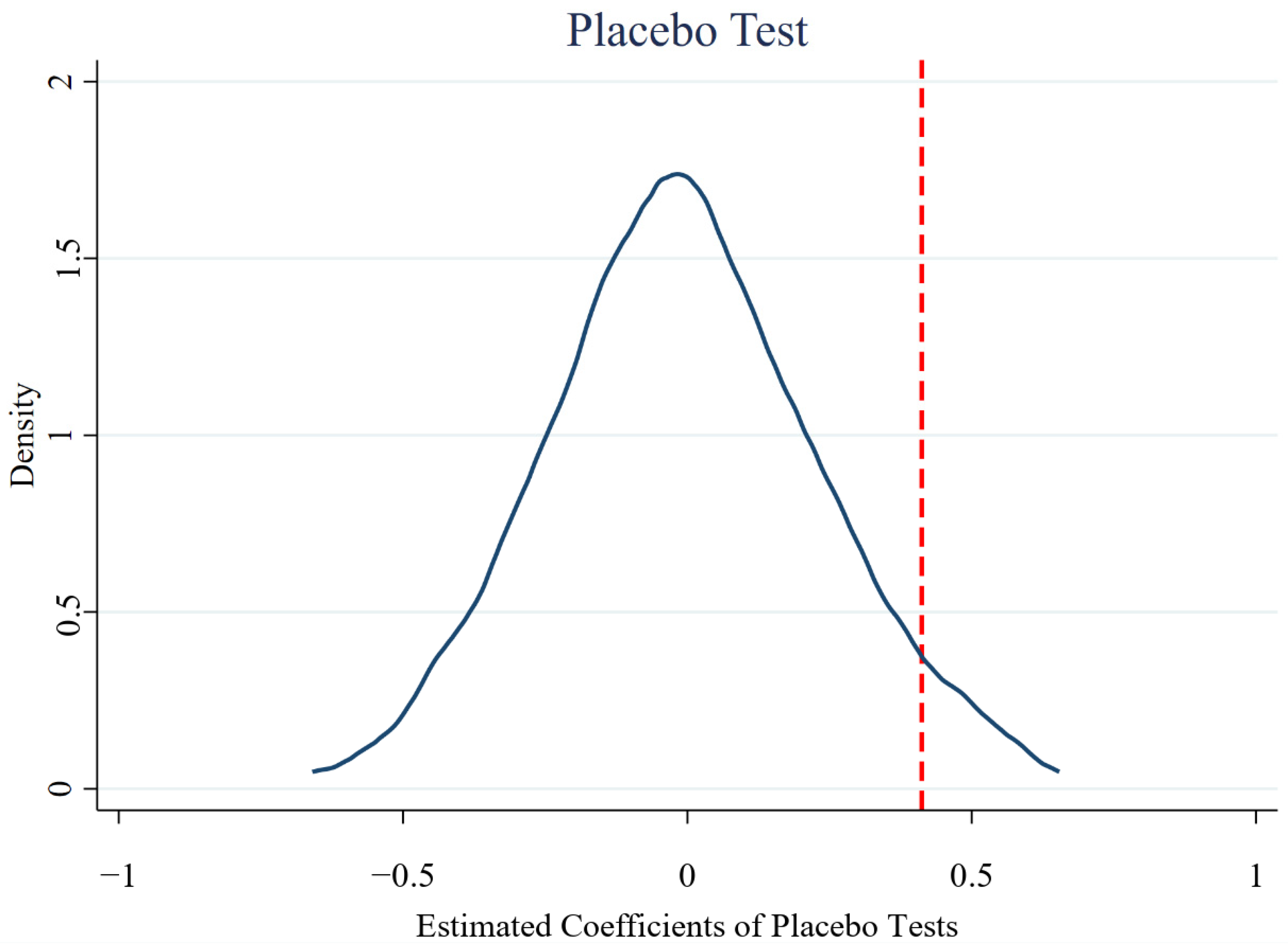
Third, we implement a randomized matching placebo test to assess whether the estimated effect relies on the actual bilateral correspondence between media sentiment and trade flows. Specifically, within each year, we randomly assign fitted media sentiment values to country pairs while keeping the trade outcome and all other covariates unchanged. This procedure breaks the observed country-pair-level link between fitted sentiment measure and bilateral trade flows, while preserving the year-specific distribution of fitted sentiment. We then re-estimate the baseline second-stage specification using the randomly assigned placebo sentiment variable and repeat this procedure 500 times.
Figure 1 reports the empirical distribution of the placebo coefficients from the 500 randomization exercises. The distribution is tightly centered around zero, indicating that fitted sentiment loses systematic explanatory power once the actual bilateral matching structure is removed. The baseline coefficient of 0.412, shown by the vertical dashed line, lies in the right tail of the placebo distribution. The corresponding p-value is close to zero, implying that it is highly unlikely to obtain an estimate of comparable magnitude when fitted sentiment is randomly assigned across country pairs within the same year. This result suggests that the baseline effect depends on the actual bilateral matching between media sentiment and trade flows, rather than on the annual distribution of fitted sentiment or random statistical noise.
These tests support the interpretation that the baseline estimate reflects the contemporaneous bilateral correspondence between media sentiment and digital service exports. The results are unlikely to be explained by future sentiment, persistence in lagged sentiment, aggregate sentiment fluctuations, or random bilateral matching.

4.3.4. Alternative Proximity Thresholds

To assess the sensitivity of our results to the choice of proximity thresholds used in constructing the instrumental variable, we vary the size of the reference group of institutionally similar country pairs. Specifically, we consider alternative thresholds by including the top 6 and top 20 most similar pairs in the calculation of the fitted media sentiment.
Table 7 reports the corresponding two-stage estimation results. Using a narrower reference group (top 6 most similar pairs) yields a smaller but still statistically significant coefficient, whereas the broader reference group (top 20) produces estimates closer to the baseline. This pattern is consistent with a trade-off between instrument relevance and noise: narrowly defined similarity may limit variation, while broader definitions better capture common media framing. The positive and significant effect across all thresholds indicates that the results are not driven by an arbitrary choice of the institutional-proximity cutoff, supporting the robustness of the instrumental variable construction.

4.3.5. Excluding the COVID-19 Period

To address concerns that the baseline results may be driven by structural shocks associated with the COVID-19 pandemic, we re-estimate the M2SLS model using a subsample that excludes observations from 2020 onward. Column (1) of Table 8 reports the corresponding estimates. Restricting the sample to the pre-pandemic period (year < 2020), the coefficient on the fitted media sentiment index remains positive and statistically significant at the 1% level, with a magnitude of 0.519. This suggests that the baseline estimates are not driven by pandemic-specific dynamics but reflect a more general relationship between media sentiment and digital service exports.

4.3.6. Bayesian Gravity Model

As an additional robustness check, we estimate a Bayesian gravity model. This approach relies on a fundamentally different inferential framework and does not depend on large-sample approximations or clustered standard errors. The Bayesian estimates reported in Column (2) of Table 8 show a positive and statistically significant effect of international media sentiment, consistent with the baseline PPML and M2SLS results. The consistency between frequentist and Bayesian estimates further supports the robustness of our findings.

4.4. Mechanism Analysis: Bilateral Digital Trade Policy Heterogeneity as an Institutional Barrier

Prior research has demonstrated that the traditional three-step mediation framework of Baron and Kenny [68] does not identify causal indirect effects and may introduce bias [69,70]. Accordingly, we follow recent empirical practice [71] and provide mechanism-consistent evidence by examining whether international media sentiment is associated with digital trade policy heterogeneity (DSTRH; see Section 3.1.3).
However, as discussed in Section 3.1.3, because DSTRH is available only for a restricted set of countries and years, the mechanism analysis relies on a smaller sample than the baseline trade regressions. This raises a potential concern that the mechanism results may be affected by sample selection arising from DSTRH availability.
To address this concern, we first re-estimate the baseline second-stage gravity model using only observations for which DSTRH is non-missing. As reported in Column (1) of Table 9, the coefficient on fitted media sentiment remains positive and statistically significant. This result indicates that the main sentiment–trade relationship continues to hold within the DSTRH-available sample, alleviating concerns that the mechanism analysis relies on a substantially different subsample.
We then examine whether fitted media sentiment is associated with bilateral digital trade policy heterogeneity. The mechanism specification is given by Equation (6):
D S T R H t i j = β 0 + β 1 A v g T o n e _ f i t t e d t i j + l γ l x t i j + μ i + λ j + θ t + ε i j t
Column (2) of Table 9 shows a negative and statistically significant association between fitted international media sentiment and regulatory divergence in digital services trade, suggesting that more favorable media sentiment is linked to lower heterogeneity in digital service trade restrictions. This finding aligns with the literature showing that international media narratives can shape policy environments by influencing policymakers’ concerns over external reputation and legitimacy [72]. Accordingly, a more favorable media environment may correspond to a lower tendency toward precautionary or divergent regulatory responses, potentially contributing to greater regulatory alignment between trading partners.
Existing work further suggests that the policy impact of media narratives depends on underlying cultural values, which shape how external reputation and symbolic evaluations are internalized by policymakers [73]. Motivated by this insight, we examine whether the relationship between international media sentiment and regulatory heterogeneity varies across countries with different cultural value profiles.
Columns (3) and (4) of Table 9 show that the negative association between media sentiment and regulatory heterogeneity is statistically significant among country pairs with lower secular-rational values. This suggests that more traditional societies may place greater weight on reputational considerations, rendering their policy frameworks more responsive to international media narratives. Columns (5) and (6) further indicate that the effect is concentrated in societies with higher self-expression values, where public discourse may make reputation signals more visible in the policy process.
To further examine whether the mechanism evidence is sensitive to the choice of institutional-barrier measure, we construct an alternative proxy based on the absolute bilateral gap in country-level Digital Services Trade Restrictiveness Index (DSTRI) scores. Specifically, the bilateral DSTRI gap is defined as | D S T R I i t D S T R I j t |, capturing the extent to which the exporter and importer differ in their overall digital services trade restrictiveness. Although this measure is less granular than the official pairwise DSTRH index, it provides a complementary indicator of bilateral regulatory mismatch and allows us to assess whether the mechanism evidence is specific to the DSTRH measure.
Table 10 reports the results using the bilateral DSTRI gap as the dependent variable. Column (1) shows that fitted media sentiment is negatively associated with the bilateral DSTRI gap, and the coefficient is statistically significant at the 10% level. This finding is broadly consistent with the DSTRH-based mechanism evidence. The cultural subsample results in Columns (2)–(5) also exhibit a similar pattern. The negative association is stronger and statistically significant among country pairs with lower secular-rational values. For self-expression values, the association is negative and significant in both subsamples, but substantially larger among high self-expression country pairs. These patterns provide additional support for the interpretation that media sentiment is more closely linked to regulatory alignment in contexts where reputational signals are more salient.
While we do not directly estimate the effect of regulatory heterogeneity on digital services trade, existing studies consistently document a negative relationship between regulatory barriers and cross-border services trade. Nordås and Rouzet [36] show that services trade restrictiveness reduces trade flows, while Fiorini and Hoekman [74] provide evidence that services trade barriers raise trade costs and that lower sector-specific restrictiveness is associated with better access to key services, including ICT services. Taken together, our findings and the existing literature provide mechanism-consistent evidence that international media sentiment may be linked to digital service exports partly through the digital trade policy environment.

5. Heterogeneity Analysis

5.1. Sectoral Heterogeneity of the Media Sentiment Effect

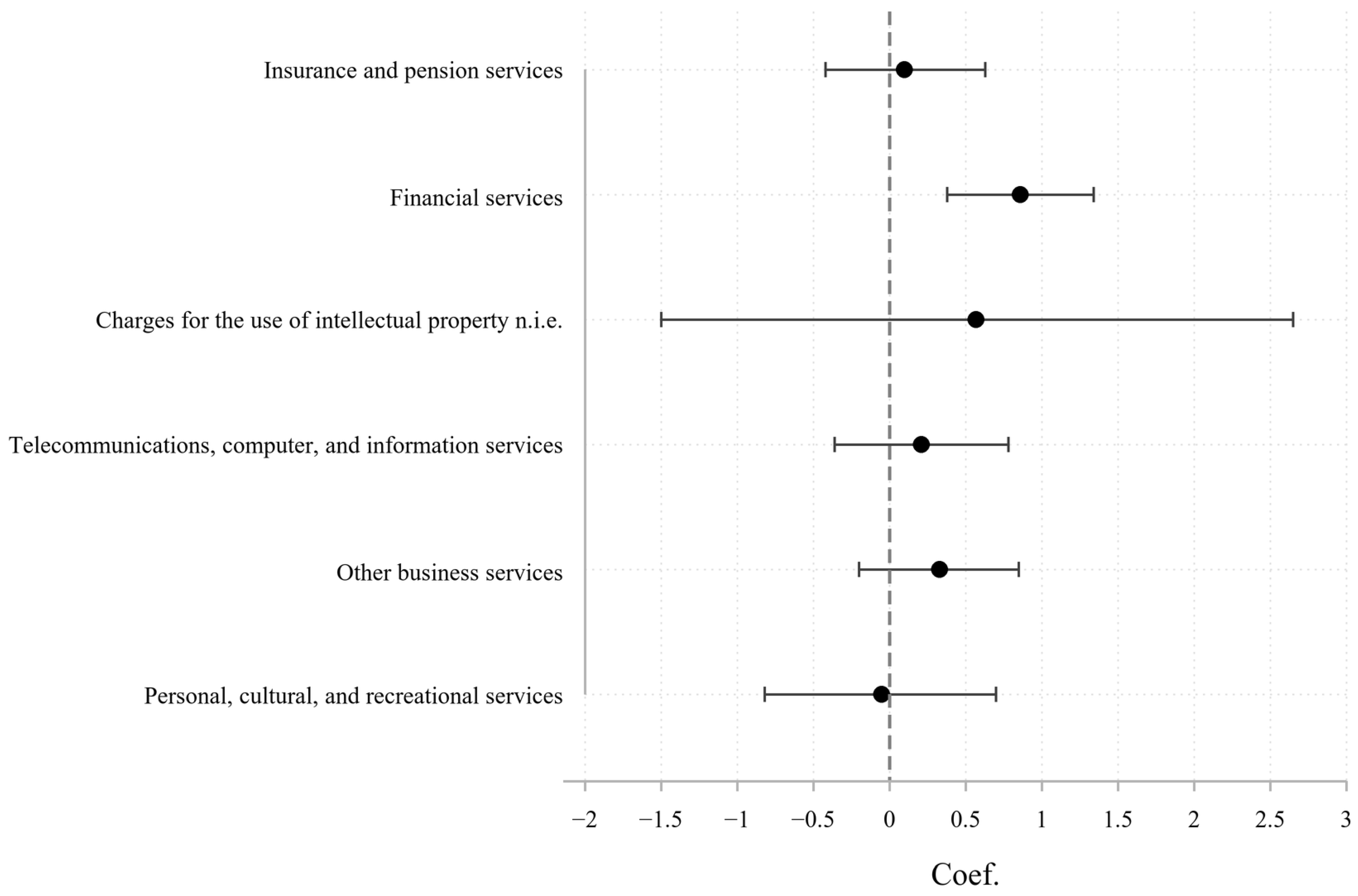
Figure 2 illustrates the heterogeneous effects of international media sentiment across sub-sectors of digital services trade (detailed estimates in Table A3). The results indicate substantial sectoral variation. The effect is most pronounced in financial services, where the estimated coefficient is positive and statistically significant. This pattern is consistent with the trust-intensive nature of financial services, in which cross-border transactions rely heavily on reputation, credibility, and confidence, all of which are plausibly shaped by international media narratives.
Other business services also exhibit a positive association with media sentiment, albeit with weaker statistical significance. This category includes consulting and professional services, which similarly depend on country reputation and perceived institutional quality, rendering them more sensitive to shifts in external sentiment.
In contrast, the estimated effect for telecommunications, computer, and information services is small and statistically insignificant. These services are more closely tied to technical performance and cost considerations, suggesting that functional characteristics may dominate reputational factors in shaping trade decisions.
The estimates for charges for the use of intellectual property are relatively large in magnitude but imprecisely estimated, as reflected in wide confidence intervals. This imprecision is primarily driven by the limited number of observations, which increases estimation uncertainty despite the sizable point estimate. It may also reflect underlying heterogeneity in IP transactions, which range from standardized licensing agreements to highly brand- or reputation-sensitive assets.
The sectoral pattern is consistent with Hypothesis 3 and helps clarify the reputational-signal mechanism developed in Section 2.2.3. If media sentiment mainly captured broad bilateral goodwill or aggregate demand conditions, its effect would be expected to appear more uniformly across digital service categories. Instead, the stronger estimates in financial and professional services, together with the weaker response in telecommunications, computer, and information services, suggest that media sentiment is most relevant when buyers and regulators rely on reputational cues to assess service credibility and transaction risk.

5.2. Heterogeneity by Cultural Value Orientation in the Media Sentiment Effect

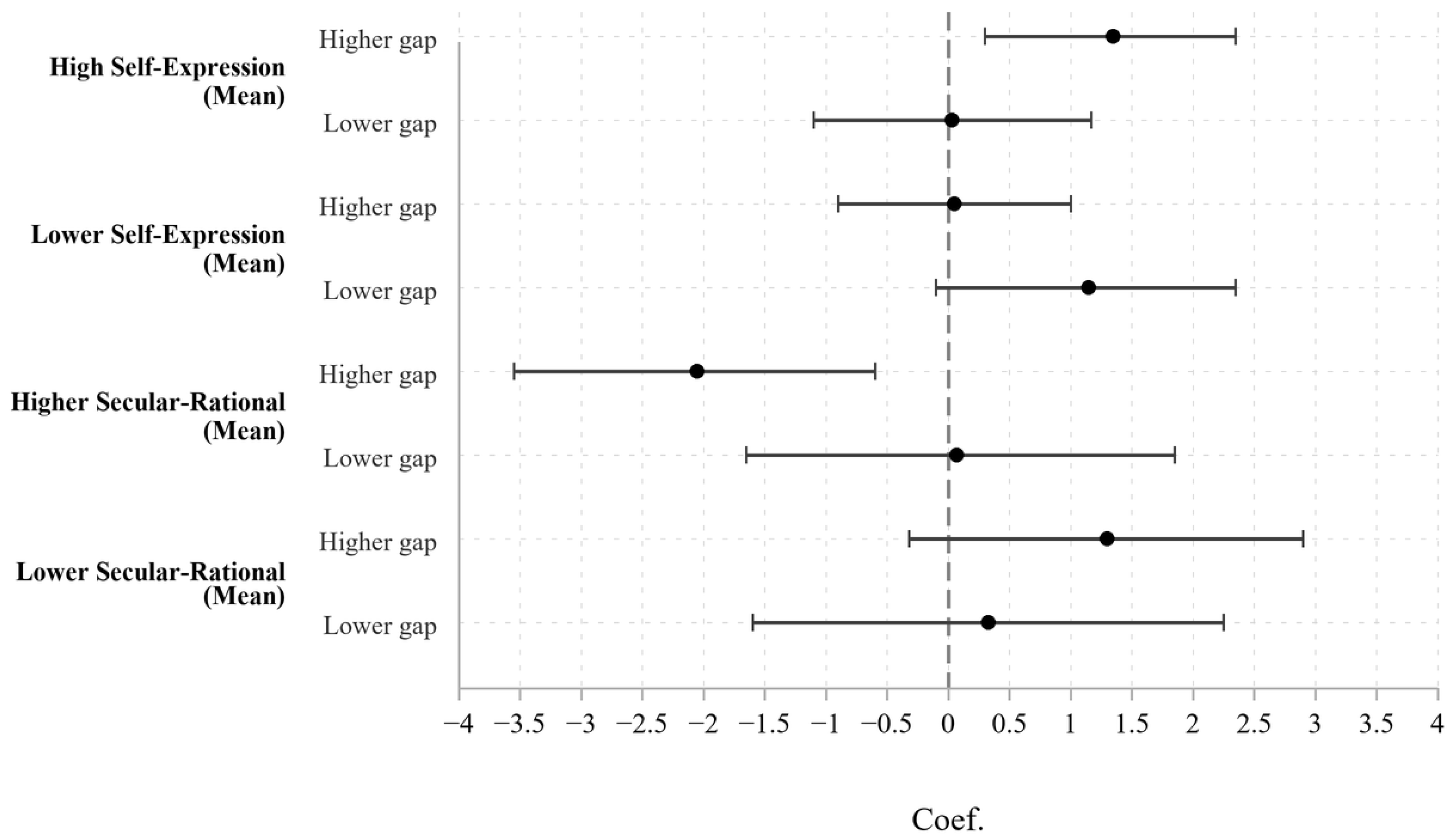
In this section, we examine whether the effect of international media sentiment varies with cultural environments using cross-country differences in cultural values from the WVS. For each country pair, we construct two complementary indicators for both self-expression values and secular-rational values: (i) the bilateral mean, capturing the overall cultural environment shared by the trading partners, and (ii) the bilateral gap, defined as the exporter’s value score minus that of the importer, capturing directional asymmetry in cultural orientation.
We first split the sample by the median of the bilateral mean and then further divide each subsample by the median of the bilateral gap (higher gap vs. lower gap). This two-dimensional stratification allows us to assess not only whether cultural environments matter on average, but also whether directional cultural asymmetry conditions the role of media sentiment in shaping digital service exports. Results are displayed in Figure 3, with the corresponding regression estimates reported in Table A4 in Appendix B.

5.2.1. Heterogeneity by Self-Expression Values

The results for self-expression values exhibit a clear and directional pattern. A statistically significant positive effect of international media sentiment on digital service exports emerges only when the bilateral mean of self-expression values is high and the exporter exhibits substantially higher self-expression values than the importer. The importance of a high self-expression environment is consistent with the mechanism analysis, where media sentiment is more strongly associated with digital trade policy heterogeneity in high self-expression societies. The additional role of exporter–importer asymmetry revealed here highlights a directional condition that operates at the trade-outcome level, beyond what is captured in the policy mechanism analysis.
In such settings, exporters from highly expressive societies may operate in media environments where public discourse and external reputation are more salient. For partners with relatively lower self-expression values, these media narratives may provide an external benchmark for evaluating credibility and trust. This pattern is consistent with Hypothesis 4a, suggesting that self-expression values amplify the trade relevance of reputational signals.

5.2.2. Heterogeneity by Secular-Rational Values

The results for secular-rational values reveal a more nuanced pattern. When the bilateral mean of secular-rational values is high, media sentiment generally plays a limited role, consistent with the idea that highly secular-rational environments place greater emphasis on contractual enforcement and regulatory predictability than on media-based reputational signals.
Notably, when secular-rational values are high and asymmetric, especially when the exporter is substantially more secular-rational than the importer, the estimated effect of international media sentiment on digital service exports becomes significantly negative. One plausible explanation is that, in highly secular-rational and asymmetric relationships, media sentiment may be less informative than formal institutional indicators. Exporters from more rationalized institutional environments may place greater weight on legal certainty, regulatory transparency, and contractual enforcement. If the importer’s institutional environment is less aligned with these expectations, favorable media narratives may not translate into stronger trade responses and may even coincide with unresolved regulatory or institutional frictions. Therefore, the negative estimate should be interpreted cautiously as evidence of conditional heterogeneity rather than as proof that positive media sentiment directly discourages exports. This pattern is consistent with Hypothesis 4b, suggesting that secular-rational values and institutional asymmetry may weaken, or even reverse, the trade relevance of media-based reputational signals.
These findings are consistent with the signal-interpretation logic developed in Section 2.2.4 and show that cultural values define important boundary conditions for the proposed reputational-signal mechanism. Media sentiment becomes economically relevant when cultural environments make reputational signals more salient, but its trade relevance weakens when formal rules and regulatory predictability dominate media-based cues.

6. Conclusions

This study shows that international media sentiment is not merely a background feature of the global information environment, but also an important factor associated with digital service exports. More favorable international media sentiment is estimated to have a positive and statistically significant effect on bilateral digital service exports under the maintained M2SLS assumptions, suggesting that external narratives can shape cross-border digital transactions by altering reputational perceptions and policy-related frictions.
The findings provide three more specific conclusions. First, the role of media sentiment varies across service sectors. The effect is strongest in trust- and reputation-intensive sectors, such as financial services, and is insignificant in more technical and infrastructure-based services, where functional considerations dominate reputational signals.
Second, the influence of media sentiment is highly conditional on cultural context. Using cross-country measures of cultural values, we find that sentiment effects are concentrated in environments where reputational signals are more salient and interpretable. In particular, positive effects arise when exporters originate from highly self-expressive societies and trade with less self-expressive partners, whereas the role of media sentiment weakens or turns negative in highly secular-rational and culturally asymmetric country pairs.
Third, the mechanism evidence points to an institutional-barrier channel. Favorable media sentiment is associated with lower bilateral digital service trade policy heterogeneity, suggesting that external narratives may be linked to regulatory alignment and policy-related transaction costs, beyond their role in shaping market perceptions. While this channel does not exhaust all pathways linking media sentiment to trade, it points to an important institutional dimension linking information environments to digital service trade outcomes.
Taken together, the findings indicate that international media sentiment is not a universal facilitator of digital trade. Its estimated effect depends critically on sectoral characteristics and the cultural configuration of trading partners. For firms and platforms engaged in cross-border digital services, this implies that monitoring external media environments may be particularly valuable in reputation-intensive sectors and culturally sensitive markets. For policymakers, the results highlight that digital market access may be shaped not only by formal regulation, but also by the informational environment surrounding bilateral economic relations.
This study has several limitations that point to promising directions for future research. First, although this study distinguishes bilateral international media sentiment from domestic sentiment, individual-level public opinion, social media sentiment, and media attention, our empirical measure does not further decompose international media sentiment by news topic. For example, economic, political, technological, security-related, and cultural news narratives may affect digital service trade through different mechanisms. Future research could construct topic-specific sentiment measures to identify which forms of international media narratives are most relevant for digital service exports. Second, due to data availability, we are unable to directly observe public opinion or perception indices in importing countries. While we partially address this limitation through value-based heterogeneity analyses, future work could incorporate direct survey-based or platform-level measures of foreign perceptions to more precisely trace the opinion channel. Third, the mechanism analysis is constrained by the coverage of available policy data. While the baseline analysis covers 192 economies over 2006–2022, the digital trade policy heterogeneity measure is available for a more limited set of countries and years. Although we address this issue by using an alternative mechanism variable and by re-estimating the baseline model on the mechanism-analysis subsample, the institutional-channel findings should be interpreted with this sample restriction in mind. Future research could revisit this channel as more comprehensive measures of digital trade policy frictions become available. Finally, although the M2SLS framework helps bridge high-frequency sentiment data with annual trade outcomes, the analysis remains constrained by annual trade observations. Access to higher-frequency services trade data would allow future studies to explore short-term dynamics and temporal patterns of media sentiment effects more directly.

Author Contributions

Conceptualization, F.G.; Methodology, F.G. and H.K.; Software, F.G. and H.K.; Validation, F.G. and H.K.; Formal analysis, F.G. and H.K.; Investigation, F.G. and H.K.; Resources, F.G. and H.K.; Data curation, F.G. and H.K.; Writing—original draft, F.G.; Writing—review & editing, F.G. and H.K.; Visualization, F.G. and H.K.; Supervision, Haiyang Kong; Project administration, H.K.; Funding acquisition, H.K. All authors have read and agreed to the published version of the manuscript.

Funding

This research was funded by National Social Science Fund Major Project, grant number 25&ZD101.

Institutional Review Board Statement

Not applicable.

Informed Consent Statement

Not applicable.

Data Availability Statement

Publicly available datasets were analyzed in this study. The processed data supporting the findings of this article are available from the authors upon reasonable request.

Conflicts of Interest

The authors declare no conflict of interest.

Appendix A. Selection of Exporting and Importing Countries

We assemble a global dataset covering 192 economies and the vast majority of bilateral digital services export flows. Given the prevalence of tax-driven distortions in international services trade, we apply a two-step data-cleaning procedure to remove observations that do not correspond to genuine economic transactions.
First, exclusion of tax havens and offshore financial centers. Digital services trade is particularly susceptible to profit-shifting and tax avoidance practices, whereby multinational corporations channel revenues through low-tax jurisdictions [75]. Such transactions largely reflect accounting arrangements rather than market-based economic exchanges driven by demand conditions or media sentiment [76]. Accordingly, we exclude economies widely recognized as tax havens or offshore financial centers, including Luxembourg (LUX), Cyprus (CYP), Malta (MLT), Hong Kong (HKG), and Macao (MAC).
Second, exclusion of phantom trade routes. We examine the distribution of bilateral trade flows and identify idiosyncratic observations with disproportionate influence on the baseline estimates. We then remove a limited subset of bilateral country-pair observations (35 in total) characterized by phantom trade flows. These excluded pairs, such as USA–Ireland (IRL), Netherlands (NLD)–Bermuda (BMU), and UK–Cayman Islands (CYM), are typical of complex profit-shifting structures (e.g., the “Double Irish with a Dutch Sandwich”). We therefore exclude them from the baseline analysis. Their trade volumes are highly concentrated and largely unresponsive to external sentiment shocks, distinguishing them from standard commercial transactions. The list of exporting and importing economies is reported in Appendix A Table A1.
Table A1. Countries for Digital Service Imports and Exports.
Exporting CountriesImporting Countries
GBR, NLD, BEL, FRA, PAN, JPN, USA, BRB, AUS, IND, CHE, ESP, IRL, BGR, SWE, DNK, BMU, SGP, ITA, ARG, KOR, CZE, FIN, CYM, NOR, CAN, ALB, RUS, SVK, NZL, AUT, MAR, PRT, GNQ, UKR, BRA, ISR, PHL, BLR, ARE, POL, LVA, MLI, EST, LBN, ZAF, TJK, COL, CHN, GHA, MEX, CRI, AGO, COG, AFG, TUR, LTU, HUN, THA, GRC, BHR, MUS, ZMB, LBY, KEN, LBR, SUR, CHL, MDG, SDN, GAB, PER, MKD, HRV, STP, GTM, CIV, SAU, IRQ, UZB, EGY, MWI, LKA, PNG, ATG, DOM, DZA, TZA, NGA, SYC, KWT, MDV, JOR, KGZ, SEN, KNA, LCA, BGD, SLE, UGA, AZE, URY, SLV, CMR, KAZ, BLZ, ARM, VEN, NER, QAT, SYR, NPL, MOZ, BHS, ERI, KHM, PRY, TTO, JAM, TUN, GEO, ISL, IRN, MNG, BFA, MDA, MMR, GUY, CPV, TCD, ECU, BEN, TKM, ZWE, BOL, VCT, MRT, GNB, TGO, BDI, GRD, NIC, HND, DJI, OMN, FJI, DMA, BWA, GMB, ABW, CAF, RWA, LAO, BTN, COM, LSO, WSM, TON, BRN, SWZ, VUT, SLB, HTI, TUV, KIR, PRK, ROU, COD, TCA, NCL, BES, SVN, GIN, SOM, CUB, SRB, YEM, MYS, ETH, AIA, FRO, DEU, XKX, PAK, PYF, MNE, TWN, TLS, IDN, VNM, BIH, MSRNLD, USA, FRA, CHE, BEL, RUS, THA, ESP, GBR, NZL, IRL, CHN, CZE, SGP, FIN, SWE, DNK, ARE, GRD, JPN, ITA, NOR, SVK, BRB, POL, AUS, BMU, IND, KOR, AUT, GUY, PRT, SAU, BLR, CYM, AGO, UKR, VEN, BRA, CAN, ISR, NGA, KAZ, HRV, EST, HUN, ARG, LVA, MEX, CMR, ZAF, GAB, PAN, GRC, LTU, QAT, IRQ, MUS, JAM, TUR, CHL, BEN, EGY, AFG, MKD, COG, COL, MAR, PER, BGR, BHS, KWT, LBN, TUN, PNG, DZA, OMN, BHR, GHA, AZE, GNQ, ECU, BGD, MOZ, SUR, KEN, DOM, PHL, ZMB, ABW, URY, BRN, IRN, TJK, MWI, UZB, ISL, GTM, UGA, TTO, CRI, BWA, BLZ, MMR, TKM, LBR, SWZ, SLV, LKA, SDN, SYC, JOR, BFA, LBY, HND, ARM, TZA, FJI, ATG, TGO, KGZ, ZWE, GEO, MDG, DMA, BOL, BTN, KNA, ALB, DJI, CPV, SOM, SEN, SLE, MDA, LCA, MLI, NPL, CIV, VCT, STP, SYR, MDV, MRT, PRY, WSM, NER, TCD, NIC, LAO, RWA, SLB, KHM, MNG, VUT, GMB, COM, GNB, LSO, ERI, TON, BDI, CAF, HTI, KIR, TUV, PRK, VNM, CUB, NCL, YEM, GIN, BES, ROU, TLS, IDN, ETH, PYF, PAK, DEU, XKX, TCA, BIH, MNE, COD, SVN, SRB, FRO, AIA, MSR, TWN, MYS

Appendix B

Table A2. Robustness to Excluding Sparse News Observations.
(1)
Drop Bottom 1%
(2)
Drop Bottom 5%
(3)
Drop Bottom 10%
AvgTone_fitted0.406 ***0.405 ***0.395 ***
(3.240)(3.232)(3.180)
lnGDP_ex0.962 ***0.961 ***0.961 ***
(4.498)(4.496)(4.484)
lnGDP_im0.780 ***0.780 ***0.782 ***
(5.090)(5.074)(5.089)
lnPopu_ex−0.192−0.188−0.183
(−0.510)(−0.502)(−0.486)
lnPopu_im0.2730.2710.272
(0.801)(0.796)(0.796)
One_wto−0.273−0.280−0.275
(−1.089)(−1.115)(−1.067)
Both_wto−0.526 **−0.535 **−0.529 *
(−1.976)(−2.007)(−1.941)
Dist−0.562 ***−0.562 ***−0.561 ***
(−12.648)(−12.646)(−12.641)
Contig0.254 ***0.255 ***0.256 ***
(2.727)(2.734)(2.750)
Comlang_off0.372 ***0.372 ***0.371 ***
(7.572)(7.531)(7.470)
Colony0.132 *0.132 *0.132 *
(1.782)(1.785)(1.787)
Comcol0.0940.0950.099
(1.178)(1.185)(1.227)
Constant−39.525 ***−39.538 ***−39.702 ***
(−4.108)(−4.101)(−4.085)
EE FEYesYesYes
IE FEYesYesYes
k × Yr FEYesYesYes
Obs1,383,3761,337,2701,261,813
r-squared0.8850.8840.883
Note: *, **, and *** denote significance at the 10%, 5%, and 1% levels, respectively. EE FE and IE FE indicate Exporter and Importer fixed effects, respectively. Values in parentheses represent t-statistics. Standard errors are clustered three ways at the exporter, importer, and service-sector–year levels. Standard errors for two-stage estimations are adjusted using 100 block-bootstrap iterations.
Table A3. Sectoral Heterogeneity.
(1)
SF
(2)
SG
(3)
SH
(4)
SI
(5)
SJ
(6)
SK
AvgTone_fitted0.1030.863 ***0.5720.2070.326−0.062
(0.382)(3.549)(0.544)(0.715)(1.229)(−0.161)
lnGDP_ex0.248 *0.409 *0.943 ***1.022 ***1.046 ***0.703 ***
(1.800)(1.829)(3.551)(6.050)(10.057)(3.159)
lnGDP_im0.372 ***0.765 ***1.001 ***0.819 ***0.747 ***1.225 ***
(3.937)(4.066)(4.427)(3.896)(4.003)(3.469)
lnPopu_ex0.5650.091−1.735−0.640−0.0680.043
(1.534)(0.151)(−1.529)(−1.096)(−0.207)(0.047)
lnPopu_im0.596 **0.333−0.1390.3670.1070.420
(2.169)(0.783)(−0.255)(1.131)(0.270)(1.077)
One_wto0.672 *0.455 *0.216−0.609 **−0.489 **−0.282
(1.822)(1.772)(0.360)(−2.019)(−2.240)(−0.845)
Both_wto0.5120.201−0.130−0.702 **−0.760 ***−0.628 *
(1.230)(0.820)(−0.208)(−2.149)(−2.988)(−1.765)
Dist−0.724 ***−0.564 ***−0.341 ***−0.684 ***−0.547 ***−0.674 ***
(−8.273)(−7.579)(−3.928)(−11.973)(−13.831)(−10.299)
Contig0.369 **0.613 ***−0.0960.1100.287 ***0.428 ***
(2.036)(3.121)(−0.468)(0.756)(3.542)(3.585)
Comlang_off0.370 ***0.196 ***0.378 **0.253 ***0.479 ***0.461 ***
(3.284)(2.673)(2.473)(3.059)(8.637)(3.832)
Colony0.240 **0.0610.0570.232 **0.1040.451 ***
(2.056)(0.491)(0.259)(2.412)(1.188)(4.507)
Comcol−0.3140.121−0.490 **0.030−0.002−0.348 *
(−1.442)(0.834)(−2.571)(0.331)(−0.015)(−1.801)
Constant−27.461 ***−30.354 *−12.877−34.990 ***−39.479 ***−52.361 **
(−2.689)(−1.841)(−0.517)(−2.810)(−3.821)(−2.269)
EE FEYes Yes Yes Yes Yes Yes
IE FEYes Yes Yes Yes Yes Yes
Yr FEYes Yes Yes Yes Yes Yes
Obs361,374349,753270,379391,446374,948277,871
R-squared0.8870.9380.9250.9320.9470.862
Note: *, **, and *** denote significance at the 10%, 5%, and 1% levels, respectively. EE FE and IE FE indicate Exporter and Importer fixed effects, respectively. Values in parentheses represent t-statistics. Standard errors are clustered three ways at the exporter, importer, and year levels. Standard errors for two-stage estimations are adjusted using 100 block-bootstrap iterations. Abbreviations denote service categories: SF (Insurance and pension services); SG (Financial services); SH (Intellectual property charges, n.i.e.,); SI (Telecom, computer, and information services); SJ (Other business services); SK (Personal, cultural, and recreational services).
Table A4. Heterogeneity Analysis by Cultural Value Orientation.
(1)(2)(3)(4)(5)(6)(7)(8)
High Self_meanLow Self_meanHigh Sec_meanLow Sec_mean
High_GapLow_GapHigh_GapLow_GapHigh_GapLow_GapHigh_GapLow_Gap
AvgTone_fitted1.337 **0.0400.0421.138 *−2.065 ***0.0751.2930.315
(2.537)(0.069)(0.087)(1.822)(−2.742)(0.083)(1.587)(0.312)
lnGDP_ex0.7040.978 ***1.115 ***0.510 ***0.0731.413 ***0.494 **1.391 ***
(1.547)(7.463)(9.019)(4.075)(0.227)(4.500)(2.044)(4.646)
lnGDP_im0.527 ***0.1660.718 ***0.863 ***1.034 ***0.433 *0.912 ***−0.133
(4.288)(0.469)(7.841)(5.404)(3.974)(1.767)(4.567)(−0.519)
lnPopu_ex−1.059−0.558−0.917 *0.219−0.2730.1241.763 ***−3.432 ***
(−1.129)(−1.255)(−1.672)(0.639)(−0.288)(0.182)(2.929)(−4.193)
lnPopu_im−0.4921.3530.2931.269 **3.044 ***0.098−1.711 **3.034 ***
(−1.337)(1.487)(1.369)(2.111)(4.949)(0.171)(−2.438)(5.961)
One_wto0.554 ***0.277 ***−0.1010.228 *0.664 ***0.606 ***0.303−0.074
(6.177)(2.593)(−0.992)(1.952)(7.041)(7.884)(0.986)(−0.381)
Both_wto--−0.244 *0.090--0.442−0.109
--(−1.841)(0.525)--(1.248)(−0.406)
Dist−0.724 ***−0.775 ***−0.769 ***−0.709 ***−1.064 ***−0.909 ***−1.086 ***−1.253 ***
(−37.433)(−34.177)(−30.105)(−27.412)(−33.362)(−25.114)(−23.789)(−24.947)
Contig0.478 ***0.327 ***0.013−0.125 *0.065−0.0150.375 ***0.452 ***
(7.435)(4.668)(0.244)(−1.656)(1.038)(−0.230)(3.972)(3.404)
Comlang_off0.370 ***0.541 ***0.504 ***0.482 ***0.251 ***0.473 ***0.655 ***−0.120
(7.763)(11.676)(7.282)(6.217)(4.679)(8.122)(6.235)(−0.990)
Colony0.246 ***0.171 ***0.828 ***1.180 ***0.160−0.1540.274 **0.540 ***
(4.579)(2.953)(8.911)(11.562)(1.111)(−0.916)(2.130)(3.830)
Comcol0.446 ***0.430 ***0.122 *0.143 **0.321 **0.0870.548 ***−0.118
(2.672)(3.292)(1.942)(1.962)(2.034)(0.630)(3.181)(−0.846)
Constant4.476−34.011 **−29.311 ***−56.471 ***−66.509 ***−43.945 ***−26.295−13.167
(0.296)(−2.138)(−2.666)(−4.439)(−3.039)(−2.687)(−1.604)(−0.856)
EE FEYes Yes Yes Yes Yes Yes Yes Yes
IE FEYes Yes Yes Yes Yes Yes Yes Yes
Yr FEYes Yes Yes Yes Yes Yes Yes Yes
Obs37,43534,52035,57532,21430,16731,68029,13827,203
R-squared0.8890.9000.8250.8110.9380.8890.9220.878
Note: *, **, and *** denote significance at the 10%, 5%, and 1% levels, respectively. EE FE and IE FE indicate Exporter and Importer fixed effects, respectively. Values in parentheses represent t-statistics. Standard errors are clustered three ways at the exporter, importer, and year levels. Standard errors for two-stage estimations are adjusted using 100 block-bootstrap iterations.

References

  1. Fraiberger, S.P.; Lee, D.; Puy, D.; Ranciere, R. Media sentiment and international asset prices. J. Int. Econ. 2021, 133, 103526. [Google Scholar] [CrossRef]
  2. Natanael, Y. Beyond borders and tangibility: Understanding trade restrictions, institutional quality and digital services trade. Int. J. Dev. Issues 2025, 24, 396–415. [Google Scholar] [CrossRef]
  3. Chalk, A. Infinity Ward Says Modern Warfare Isn’t Political. PC Gamer, 9 August 2019. Available online: https://www.pcgamer.com/infinity-ward-says-modern-warfare-isnt-political/ (accessed on 26 September 2024).
  4. Fitch Ratings. Credit Suisse Takeover Will Profoundly Change Swiss Bank Sector; Fitch Ratings: New York, NY, USA, 2023; Available online: https://www.fitchratings.com/research/banks/credit-suisse-takeover-will-profoundly-change-swiss-bank-sector-28-03-2023 (accessed on 26 September 2024).
  5. Ha, E.Y.; Lee, H. Projecting service quality: The effects of social media reviews on service perception. Int. J. Hosp. Manag. 2018, 69, 132–141. [Google Scholar] [CrossRef]
  6. Yu, M.; Liu, F.; Lee, J.; Soutar, G. The influence of negative publicity on brand equity: Attribution, image, attitude and purchase intention. J. Product. Brand Manag. 2018, 27, 440–451. [Google Scholar] [CrossRef]
  7. Hail, L.; Tahoun, A.; Wang, C. Corporate scandals and regulation. J. Account. Res. 2018, 56, 617–671. [Google Scholar] [CrossRef]
  8. Hawn, O. How media coverage of corporate social responsibility and irresponsibility influences cross-border acquisitions. Strateg. Manag. J. 2021, 42, 58–83. [Google Scholar] [CrossRef]
  9. McCombs, M.E.; Shaw, D.L. The agenda-setting function of mass media. Public Opin. Q. 1972, 36, 176–187. [Google Scholar] [CrossRef]
  10. Barnett, G.A.; Xu, W.W.; Chu, J.; Jiang, K.; Huh, C.; Park, J.Y.; Park, H.W. Measuring international relations in social media conversations. Gov. Inf. Q. 2017, 34, 37–44. [Google Scholar] [CrossRef]
  11. Essig, J.; Xu, P.; Garand, J.C.; Keser, C. The “Trump” effect: Political elite and support for free trade in America. Am. Politics Res. 2021, 49, 328–342. [Google Scholar] [CrossRef]
  12. Ma, S.; Guo, J.; Zhang, H. Policy analysis and development evaluation of digital trade: An international comparison. China World Econ. 2019, 27, 49–75. [Google Scholar] [CrossRef]
  13. Potluri, S.R.; Sridhar, V.; Rao, S. Effects of data localization on digital trade: An agent-based modeling approach. Telecommun. Policy 2020, 44, 102022. [Google Scholar] [CrossRef]
  14. Gupta, S.; Ghosh, P.; Sridhar, V. Impact of data trade restrictions on IT services export: A cross-country analysis. Telecommun. Policy 2022, 46, 102403. [Google Scholar] [CrossRef]
  15. Wang, C.L.; Li, D.; Barnes, B.R.; Ahn, J. Country image, product image and consumer purchase intention: Evidence from an emerging economy. Int. Bus. Rev. 2012, 21, 1041–1051. [Google Scholar] [CrossRef]
  16. Hsu, Y.T.; Hua, M.; Liu, H.; Wang, Q. News sentiment and investment efficiency: Evidence from China. Eur. Financ. Manag. 2024, 30, 1587–1617. [Google Scholar] [CrossRef]
  17. Sigillo, A.E.; Sicafuse, L.L. The Influence of media and community sentiment on policy decision-making. In Handbook of Community Sentiment; Springer: New York, NY, USA, 2015; pp. 29–42. [Google Scholar]
  18. Chang, P.L.; Fujii, T.; Jin, W. Good names beget favors: The impact of country image on trade flows and welfare. Manag. Sci. 2022, 68, 7555–7596. [Google Scholar] [CrossRef]
  19. Feng, Q.; Guo, F.; Bi, Y. Media sentiment as a soft barrier: Evidence on the extensive and intensive margins of international services trade. Financ. Res. Lett. 2026, 99, 109909. [Google Scholar] [CrossRef]
  20. Büthe, T.; Milner, H.V. The politics of foreign direct investment into developing countries: Increasing FDI through international trade agreements? Am. J. Political Sci. 2008, 52, 741–762. [Google Scholar] [CrossRef]
  21. Guiso, L.; Sapienza, P.; Zingales, L. Cultural biases in economic exchange? Q. J. Econ. 2009, 124, 1095–1131. [Google Scholar] [CrossRef]
  22. Fu, S.; Viard, V.B.; Zhang, P. Trans-boundary air pollution spillovers: Physical transport and economic costs by distance. J. Dev. Econ. 2022, 155, 102808. [Google Scholar] [CrossRef]
  23. Santos Silva, J.M.C.; Tenreyro, S. The log of gravity. Rev. Econ. Stat. 2006, 88, 641–658. [Google Scholar] [CrossRef]
  24. Takara, Y. Do cultural differences affect the trade of cultural goods? A study in trade of music. J. Cult. Econ. 2018, 42, 393–417. [Google Scholar] [CrossRef]
  25. United Nations Conference on Trade and Development. International Trade in ICT Services and ICT-Enabled Services: Proposed Indicators from the Partnership on Measuring ICT for Development. October 2015. Available online: https://unctad.org/system/files/official-document/tn_unctad_ict4d03_en.pdf (accessed on 2 December 2025).
  26. Li, J.; Wang, F. A study on the competitiveness and influencing factors of the digital service trade. Sustainability 2024, 16, 3116. [Google Scholar] [CrossRef]
  27. Huo, D.; Gu, W.; Guo, D.; Tang, A. The service trade with AI and energy efficiency: Multiplier effect of the digital economy in a green city by using quantum computation based on QUBO modeling. Energy Econ. 2024, 140, 107976. [Google Scholar] [CrossRef]
  28. Mitchell, A.D.; Mishra, N. Regulating cross-border data flows in a data-driven world: How WTO law can contribute. J. Int. Econ. Law. 2019, 22, 389–416. [Google Scholar] [CrossRef]
  29. Anderson, J.E.; Van Wincoop, E. Trade costs. J. Econ. Lit. 2004, 42, 691–751. [Google Scholar] [CrossRef]
  30. Chen, W.; Wang, Y.; Wu, D.; Yin, X. Can the establishment of a personal data protection system promote corporate innovation? Res. Policy 2024, 53, 105080. [Google Scholar] [CrossRef]
  31. Tetlock, P.C. Giving content to investor sentiment: The role of media in the stock market. J. Financ. 2007, 62, 1139–1168. [Google Scholar] [CrossRef]
  32. DellaVigna, S.; Kaplan, E. The Fox News effect: Media bias and voting. Q. J. Econ. 2007, 122, 1187–1234. [Google Scholar] [CrossRef]
  33. Doms, M.E.; Morin, N.J. Consumer Sentiment, the Economy, and the News Media; FRB of San Francisco Working Paper, No. 2004-09; FRB of San Francisco: San Francisco, CA, USA, 2004. [Google Scholar]
  34. Soroka, S.N. Issue attributes and agenda-setting by media, the public, and policymakers in Canada. Int. J. Public Opin. Res. 2002, 14, 264–285. [Google Scholar] [CrossRef]
  35. Carnegie, A.; Gaikwad, N. Public opinion on geopolitics and trade: Theory and evidence. World Politics 2022, 74, 167–204. [Google Scholar] [CrossRef]
  36. Nordås, H.K.; Rouzet, D. The impact of services trade restrictiveness on trade flows. World Econ. 2017, 40, 1155–1183. [Google Scholar] [CrossRef]
  37. Ferencz, J. The OECD Digital Services Trade Restrictiveness Index; OECD Trade Policy Papers. No. 221; OECD Publishing: Paris, France, 2019. [Google Scholar]
  38. Stiglitz, J.E. The contributions of the economics of information to twentieth century economics. Q. J. Econ. 2000, 115, 1441–1478. [Google Scholar] [CrossRef]
  39. Tadelis, S. Reputation and feedback systems in online platform markets. Annu. Rev. Econ. 2016, 8, 321–340. [Google Scholar] [CrossRef]
  40. Kleppe, I.A.; Mossberg, L.; Grønhaug, K. Country images in news media. Beta 2014, 28, 20–40. [Google Scholar] [CrossRef]
  41. Antonetti, P.; Manika, D.; Katsikeas, C. Why consumer animosity reduces product quality perceptions: The role of extreme emotions in international crises. Int. Bus. Rev. 2019, 28, 739–753. [Google Scholar] [CrossRef]
  42. Chen, H.; Zhu, Z.; Qi, F.; Ye, Y.; Liu, Z.; Sun, M.; Jin, J. Country image in COVID-19 pandemic: A case study of China. IEEE Trans. Big Data 2020, 7, 81–92. [Google Scholar] [CrossRef]
  43. Jacobs, L.R.; Page, B.I. Who influences US foreign policy? Am. Political Sci. Rev. 2005, 99, 107–123. [Google Scholar] [CrossRef]
  44. North, D.C. Institutions, Institutional Change and Economic Performance; Cambridge University Press: Cambridge, UK, 1990. [Google Scholar]
  45. Sahoo, P.; Dash, R.K. India’s surge in modern services exports: Empirics for policy. J. Policy Model. 2014, 36, 1082–1100. [Google Scholar] [CrossRef]
  46. Blank, S.; Egger, P.H.; Merlo, V.; Wamser, G. A structural quantitative analysis of services trade de-liberalization. J. Int. Econ. 2022, 137, 103605. [Google Scholar] [CrossRef]
  47. United Nations; European Commission; International Monetary Fund; Organisation for Economic Co-operation and Development; United Nations Conference on Trade and Development; World Tourism Organization; World Trade Organization. Manual on Statistics of International Trade in Services 2010; ST/ESA/M.86/Rev.1; United Nations: New York, NY, USA, 2012; Annex I; pp. 145–148. Available online: https://unstats.un.org/unsd/publication/seriesm/seriesm_86rev1e.pdf (accessed on 5 May 2026).
  48. Inglehart, R.; Baker, W.E. Modernization, cultural change, and the persistence of traditional values. Am. Sociol. Rev. 2000, 65, 19–51. [Google Scholar] [CrossRef]
  49. Inglehart, R. Culture Shift in Advanced Industrial Society; Princeton University Press: Princeton, NJ, USA, 2018. [Google Scholar]
  50. Yi, Z.; Wei, L.; Huang, X. Does information-and-communication-technology market openness promote digital service exports? Sustainability 2022, 14, 4901. [Google Scholar] [CrossRef]
  51. Nordås, H.K. Services Trade Restrictiveness Index (STRI): The Trade Effect of Regulatory Differences; OECD Trade Policy Papers, No. 189; OECD Publishing: Paris, France, 2016. [Google Scholar]
  52. Inglehart, R.; Haerpfer, C.; Moreno, A.; Welzel, C.; Kizilova, K.; Diez-Medrano, J.; Lagos, M.; Norris, P.; Ponarin, E.; Puranen, B. (Eds.) World Values Survey: All Rounds—Country-Pooled Datafile; Dataset Version 3.0.0; JD Systems Institute: Madrid, Spain; WVSA Secretariat: Vienna, Austria, 2022. [Google Scholar] [CrossRef]
  53. El Husseiny, I.A.; Al Samman, A.; Mansour, S.; Ibrahim, F. How do cultural values affect economic growth? An empirical evidence from world values survey (1994–2021). Rev. Econ. Political Sci. 2025, 10, 414–441. [Google Scholar] [CrossRef]
  54. World Values Survey. What We Do. Available online: https://www.worldvaluessurvey.org/WVSContents.jsp (accessed on 22 December 2025).
  55. Inglehart, R.; Welzel, C. Modernization, Cultural Change, and Democracy: The Human Development Sequence; Cambridge University Press: Cambridge, UK, 2005. [Google Scholar]
  56. Dimitrova, B.V.; Rosenbloom, B.; Andras, T.L. The impact of national cultural values on retail structure. Int. Mark. Rev. 2016, 33, 894–920. [Google Scholar] [CrossRef]
  57. Wilson, F.D. Ethnic niching and metropolitan labor markets. Soc. Sci. Res. 2003, 32, 429–466. [Google Scholar] [CrossRef]
  58. Rose, A.K. Do we really know that the WTO increases trade? Am. Econ. Rev. 2004, 94, 98–114. [Google Scholar] [CrossRef]
  59. Goldstein, J.L.; Rivers, D.; Tomz, M. Institutions in international relations: Understanding the effects of the GATT and the WTO on world trade. Int. Organ. 2007, 61, 37–67. [Google Scholar] [CrossRef]
  60. Kimura, F.; Lee, H.H. The gravity equation in international trade in services. Rev. World Econ. 2006, 142, 92–121. [Google Scholar] [CrossRef]
  61. Song, C.X.; Qiao, C.X.; Lee, C.C. Application of gravity model to explain the effects of diplomatic relations on China’s service trade. Appl. Econ. Lett. 2022, 29, 431–436. [Google Scholar] [CrossRef]
  62. Bose, S. Service sectors and trade through a digital medium: A modified gravity approach. Appl. Econ. Lett. 2024, 33, 185–188. [Google Scholar] [CrossRef]
  63. Breitung, J.; Swanson, N.R. Temporal aggregation and spurious instantaneous causality in multiple time series models. J. Time Ser. Anal. 2002, 23, 651–665. [Google Scholar] [CrossRef]
  64. Galtung, J.; Ruge, M.H. The structure of foreign news: The presentation of the Congo, Cuba and Cyprus crises in four Norwegian newspapers. J. Peace Res. 1965, 2, 64–90. [Google Scholar] [CrossRef]
  65. Dhrymes, P.J.; Lleras-Muney, A. Estimation of models with grouped and ungrouped data by means of “2sls”. J. Econom. 2006, 133, 1–29. [Google Scholar] [CrossRef]
  66. Frank, K.A. Impact of a confounding variable on a regression coefficient. Sociol. Methods Res. 2000, 29, 147–194. [Google Scholar] [CrossRef]
  67. Call, A.C.; Martin, G.S.; Sharp, N.Y.; Wilde, J.H. Whistleblowers and outcomes of financial misrepresentation enforcement actions. J. Account. Res. 2018, 56, 123–171. [Google Scholar] [CrossRef]
  68. Baron, R.M.; Kenny, D.A. The moderator–mediator variable distinction in social psychological research: Conceptual, strategic, and statistical considerations. J. Personal. Soc. Psychol. 1986, 51, 1173–1182. [Google Scholar] [CrossRef]
  69. Robins, J.M.; Greenland, S. Identifiability and exchangeability for direct and indirect effects. Epidemiology 1992, 3, 143–155. [Google Scholar] [CrossRef] [PubMed]
  70. Celli, V. Causal mediation analysis in economics: Objectives, assumptions, models. J. Econ. Surv. 2022, 36, 214–234. [Google Scholar] [CrossRef]
  71. Yang, L.; Yang, W.; Nan, L.; Gu, Y. The Impact of Digital Trade on the Export Competitiveness of Enterprises—An Empirical Analysis Based on Listed Companies in the Yangtze River Economic Belt. Systems 2024, 12, 580. [Google Scholar] [CrossRef]
  72. Baum, M.A.; Potter, P.B. War and Democratic Constraint: How the Public Influences Foreign Policy; Princeton University Press: Princeton, NJ, USA, 2015. [Google Scholar]
  73. Anderson, D.; Jones, M. Narratives as tools for influencing policy change. Policy Politics 2018, 46, 217–234. [Google Scholar] [CrossRef]
  74. Fiorini, M.; Hoekman, B. Services trade policy and sustainable development. World Dev. 2018, 112, 1–12. [Google Scholar] [CrossRef]
  75. Noonan, C.; Plekhanova, V. Taxation of digital services under trade agreements. J. Int. Econ. Law. 2020, 23, 1015–1039. [Google Scholar] [CrossRef]
  76. Tørsløv, T.; Wier, L.; Zucman, G. The missing profits of nations. Rev. Econ. Stud. 2023, 90, 1499–1534. [Google Scholar] [CrossRef]
Figure 1. Empirical Distribution of Placebo Estimates. Note: This figure plots the kernel density distribution of estimated coefficients from 500 randomized matching placebo tests. In each iteration, fitted media sentiment is randomly shuffled across country pairs within the same year, and the baseline second-stage PPML gravity specification is re-estimated using the randomly assigned placebo sentiment variable. The solid line represents the empirical distribution of the placebo coefficients, which is centered around zero. The vertical dashed line indicates the actual baseline coefficient estimate, 0.412.
Jtaer 21 00161 g001
Figure 2. Heterogeneity Analysis by Digital Service Sectors. Note: The figure reports coefficient estimates with 95% confidence intervals, based on the M2SLS specification reported in Table 3, Column (5). Standard errors are three-way clustered at the exporter, importer, and service-sector–year levels.
Jtaer 21 00161 g002
Figure 3. Heterogeneity Analysis by Cultural Values. Note: The figure reports coefficient estimates with 95% confidence intervals, based on the M2SLS specification reported in Table 3, Column (5). Standard errors are three-way clustered at the exporter, importer, and service-sector–year levels.
Jtaer 21 00161 g003
Table 1. Definitions and Descriptions of Variables.
Variable TypeVariable NameVariable SymbolSpecification of Variables
Dependent variableBilateral digital service exportsDigitBilateral digital service exports from country i to j in sector k in year t
Core independent variableInternational media sentimentAvgToneBilateral media sentiment index for country pair (i, j) on day d in year t
Mechanism variableDigital STRI Heterogeneity IndicesDSTRHOECD Digital STRI Heterogeneity Indices
Cultural Heterogeneity IndicatorsSecular-rational value differenceSec_gapDifference in secular-rational value scores between countries i and j, defined as the exporter’s secular-rational value score minus that of the importer
Secular-rational value meanSec_meanBilateral mean of secular-rational value scores between countries i and j
Self-expression value differenceSelf_gapDifference in self-expression value scores between countries i and j, defined as the exporter’s self-expression value score minus that of the importer
Self-expression value meanSelf_meanBilateral mean of self-expression value scores between country i and j
Control variableGross Domestic ProductlnGDPLogarithm of GDP of the importer/exporter
PopulationlnPopuLogarithm of population of the importer/exporter
Both WTO participantsBoth_wtoEqual to 1 if both the exporter i and the importer j are members of the WTO in year t, and 0 otherwise
One WTO participantOne_wtoEqual to 1 if only one of the exporter i and the importer j is a member of the WTO in year t, and 0 otherwise
Common languageComlangEqual to 1 if countries i and j share a common official or major language
ContiguityContigEqual to 1 if countries i and j share a land border
Colony relationshipColonyEqual to 1 if country i was ever a colony of country j
Common colonizerComcolEqual to 1 if countries i and j were colonized by the same third country after 1945
Weighted bilateral distanceDistLogarithm of the population-weighted great-circle distance between the principal agglomerations of countries i and j
Table 2. Descriptive Statistics.
VariablesObservationsMeanStdMinMedianMax
Digit (million USD)2,827,0718.289123.5730.0000.01229,869.672
AvgTone3.633 × 1061.2044.151−351.41541.67
DSTRH151,0380.2070.0960.0000.2020.631
self_mean194,570−0.0420.417−0.935−0.1261.566
self_gap194,5700.0360.856−2.6160.0342.616
sec_mean122,8820.9050.0130.8250.9090.915
sec_gap122,8820.0010.025−0.0910.0000.091
ln_gdp2,702,16925.1202.29617.15225.14531.090
ln_popu2,759,69715.7672.1249.21316.04921.072
one_wto2,559,5770.3070.4610.0000.0001.000
both_wto2,559,5770.6560.4750.0001.0001.000
contig2,654,0080.0160.1250.0000.0001.000
comlang_off2,654,0080.1550.3620.0000.0001.000
colony2,654,0080.0110.1060.0000.0001.000
comcol2,654,0080.1140.3180.0000.0001.000
Dist2,628,6878.7830.7564.5468.9529.892
Table 3. Baseline Estimates of The Impact of Media Sentiment on Digital Trade.
(1)(2)(3)(4)(5)(6)
Digit A v g T o n e t d i j DigitDigitDigitDigit
A v g T o n e t i j 0.005 ***
(0.002)
A v g T o n e t d x y ¯ 0.050 ***
(181.811)
AvgTone_fitted 0.610 *6.190 ***0.412 ***0.377 ***
(1.857)(3.168)(3.411)(3.278)
lnGDP_ex0.963 *** 1.673 ***0.955 ***0.997 ***
(4.514) (10.872)(4.447)(4.774)
lnGDP_im0.776 *** 1.466 ***0.775 ***0.776 ***
(5.039) (18.810)(5.096)(5.203)
lnPopu_ex−0.203 −0.861 ***−0.193−0.087
(−0.540) (−5.003)(−0.512)(−0.232)
lnPopu_im0.269 −0.780 ***0.2680.236
(0.783) (−9.117)(0.785)(0.690)
One_wto−0.279 0.854 ***−0.202−0.139 ***
(−1.125) (3.056)(−0.806)(−3.425)
Both_wto−0.537 ** 1.520 ***−0.453 *−0.411 ***
(−2.046) (3.580)(−1.709)(−4.823)
Dist0.254 ** −0.509 **0.251 ***
(2.538) (−2.355)(2.639)
Contig0.373 *** 0.965 ***0.376 ***
(7.709) (8.435)(7.733)
Comlang_off0.131 * 0.243 *0.132 *
(1.775) (1.915)(1.762)
Colony0.092 −0.0090.090
(1.186) (−0.025)(1.162)
Comcol−0.561 *** −0.675 ***−0.564 ***
(−12.508) (−8.324)(−12.603)
_cons−39.126 ***0.889 ***5.758 ***−51.004 ***−39.161 ***−46.134 ***
(−4.029)(1248.324)(1083.295)(−25.283)(−4.079)(−4.845)
EE × IE FE Yes Yes
c × m × Yr FE Yes
EE FEYes Yes Yes
IE FEYes Yes Yes
k × Yr FEYes Yes YesYes
Obs2,212,6862,855,9032,366,9632,025,7712,025,7712,025,771
KP F-stat-2957.428----
R-squared0.8920.4190.8760.6950.8930.893
Note: *, **, and *** denote significance at the 10%, 5%, and 1% levels, respectively. EE FE and IE FE indicate Exporter and Importer fixed effects, respectively. Values in parentheses represent t-statistics. Standard errors are clustered three ways at the exporter, importer, and service-sector–year levels. Standard errors for two-stage estimations are adjusted using 100 block-bootstrap iterations.
Table 4. Measurement Robustness of Media Sentiment.
(1)
Control for News
Volume
(2)
Exclude Zero-Coverage Observations
(3)
Trim Top/Bottom 1% Daily Tone
AvgTone_fitted0.373 ***0.406 ***0.598 ***
(2.938)(3.251)(4.624)
TotalNumArticle0.112 ***
(4.807)
lnGDP_ex0.965 ***0.962 ***0.967 ***
(4.613)(4.497)(4.474)
lnGDP_im0.778 ***0.780 ***0.787 ***
(5.261)(5.091)(5.173)
lnPopu_ex−0.071−0.192−0.189
(−0.196)(−0.511)(−0.501)
lnPopu_im0.3880.2720.277
(1.217)(0.798)(0.823)
One_wto−0.185−0.273−0.204
(−0.736)(−1.095)(−0.817)
Both_wto−0.441−0.527 **−0.451 *
(−1.629)(−1.984)(−1.691)
Dist−0.476 ***−0.562 ***−0.564 ***
(−10.876)(−12.649)(−12.546)
Contig0.228 **0.254 ***0.252 ***
(2.349)(2.726)(2.627)
Comlang_off0.356 ***0.372 ***0.377 ***
(8.012)(7.576)(7.646)
Colony0.0640.132 *0.132 *
(0.967)(1.782)(1.742)
Comcol0.0390.0940.091
(0.545)(1.181)(1.147)
Constant−45.448 ***−39.507 ***−40.052 ***
(−4.786)(−4.108)(−4.191)
EE FEYesYesYes
IE FEYesYesYes
k × Yr FEYesYesYes
Obs2,025,7711,395,0821,986,279
r-squared0.8940.8850.893
Note: Column (1) adds the total number of bilateral news articles as an additional control. Column (2) excludes country-pair-year observations with zero bilateral news coverage. In Column (3), daily observations in the top and bottom 1% of the GDELT distribution are excluded before the first-stage estimation; fitted daily sentiment is then aggregated to the annual level for the second-stage PPML estimation. *, **, and *** denote significance at the 10%, 5%, and 1% levels, respectively. EE FE and IE FE indicate exporter and importer fixed effects, respectively. Values in parentheses represent t-statistics. Standard errors are clustered three ways at the exporter, importer, and service-sector–year levels. Standard errors for two-stage estimations are adjusted using 100 block-bootstrap iterations.
Table 5. Influence Threshold Test for Confounding Variables.
Variables CoefficientStd. Err.t-ValueITCVImpact
AvgTone_fitted0.4120.1213.4110.032
lnGDP_ex0.9550.2154.447 −0.0069
lnGDP_im0.7750.1525.096 −0.0067
lnPopu_ex−0.1930.378−0.512 −0.0017
lnPopu_im0.2680.3410.785 −0.0018
One_wto−0.2020.250−0.806 0.009
Both_wto−0.4530.265−1.709 −0.0021
Contig0.2510.0952.639 −0.0026
Comlang_off0.3760.0497.733 0
Colony0.1320.0751.762 0
Comcol0.0900.0781.162 0
Dist−39.1619.601−4.079 −0.0001
Table 6. Placebo Tests and Temporal Robustness.
(1)(2)(3)(4)
AvgTone_fitted 0.571 *** 0.353 ***
(4.038) (3.508)
Future_AvgTone_fitted0.2040.167
(1.287)(1.036)
Lagged_AvgTone_fitted 0.2180.204
(1.112)(1.021)
lnGDP_ex0.897 ***0.898 ***0.941 ***0.940 ***
(3.693)(3.702)(4.124)(4.112)
lnGDP_im0.877 ***0.880 ***0.764 ***0.763 ***
(5.356)(5.361)(4.770)(4.712)
lnPopu_ex−0.105−0.098−0.137−0.130
(−0.230)(−0.213)(−0.354)(−0.337)
lnPopu_im0.3410.3420.2370.233
(1.050)(1.063)(0.551)(0.546)
One_wto−0.182−0.182−0.236−0.266
(−0.749)(−0.744)(−0.886)(−1.023)
Both_wto−0.368−0.366−0.507 *−0.536 **
(−1.437)(−1.415)(−1.845)(−1.996)
Dist−0.567 ***−0.566 ***−0.566 ***−0.563 ***
(−12.222)(−12.201)(−12.790)(−12.830)
Contig0.241 ***0.241 ***0.252 ***0.255 ***
(2.753)(2.749)(2.606)(2.647)
Comlang_off0.377 ***0.377 ***0.373 ***0.370 ***
(7.462)(7.456)(7.578)(7.524)
Colony0.147 *0.147 *0.129 *0.130 *
(1.930)(1.924)(1.713)(1.733)
Comcol0.1010.1000.0800.090
(1.304)(1.296)(1.011)(1.159)
Constant−43.172 ***−43.516 ***−38.824 ***−38.855 ***
(−3.860)(−3.901)(−3.740)(−3.732)
EE FEYesYesYesYes
IE FEYesYesYesYes
k × Yr FEYesYesYesYes
Obs1,899,0981,899,0981,917,8721,916,415
r-squared0.8930.8930.8930.893
Note: *, **, and *** denote significance at the 10%, 5%, and 1% levels, respectively. EE FE and IE FE indicate Exporter and Importer fixed effects, respectively. Values in parentheses represent t-statistics. Standard errors are clustered three ways at the exporter, importer, and service-sector–year levels. Standard errors for two-stage estimations are adjusted using 100 block-bootstrap iterations.
Table 7. Alternative Proximity Thresholds.
Top 6 Most Similar CountriesTop 20 Most Similar Countries
A v g T o n e t d i j D i g i t i j t A v g T o n e t d i j D i g i t i j t
A v g T o n e t d x y ¯ 0.133 *** 0.164 ***
(93.288) (101.978)
AvgTone_fitted 0.107 * 0.531 **
(0.063) (0.206)
lnGDP_ex 0.071 0.049
(0.047) (0.042)
lnGDP_im 0.042 * 0.069 **
(0.023) (0.027)
lnPopu_ex −0.208 −0.203
(0.154) (0.137)
lnPopu_im −0.130 ** −0.019
(0.061) (0.082)
One_wto −0.074 ** −0.063 *
(0.035) (0.033)
Both_wto −0.067 −0.056
(0.042) (0.040)
Dist −0.193 *** −0.203 ***
(0.029) (0.029)
Contig 0.221 *** 0.240 ***
(0.069) (0.069)
Comlang_off −0.019 −0.004
(0.022) (0.021)
Colony 0.286 *** 0.330 ***
(0.093) (0.081)
Comcol 0.092 *** 0.095 ***
(0.029) (0.028)
Constant1.185 ***−39.100 ***1.225 ***−39.119 ***
(570.657)(−4.067)(518.650)(−4.062)
EE × IE FEYes Yes
c × m × Yr FEYes Yes
EE FE Yes Yes
IE FE Yes Yes
k × Yr FE Yes Yes
Obs1,448,4622,025,7711,327,1742,025,771
KP F-stat5108.600 1854.440
R-squared0.4380.8930.4430.893
Note: *, **, and *** denote significance at the 10%, 5%, and 1% levels, respectively. EE FE and IE FE indicate Exporter and Importer fixed effects, respectively. Values in parentheses in columns (1) and (3) report t-statistics, while those in columns (2) and (4) report standard errors. Standard errors are clustered three ways at the exporter, importer, and service-sector–year levels. Standard errors for two-stage estimations are adjusted using 100 block-bootstrap iterations.
Table 8. Additional Robustness Tests.
(1)
Keep
Year < 2020
(2)
Bayesian
Model
AvgTone_fitted0.519 ***0.016 **
(3.812)(2.254)
lnGDP_ex0.814 ***0.138 ***
(3.343)(7.707)
lnGDP_im0.881 ***0.274 ***
(4.940)(17.199)
lnPopu_ex−0.066−0.276 ***
(−0.136)(−7.723)
lnPopu_im0.344−0.098 ***
(1.147)(−3.650)
One_wto−0.106−0.840 ***
(−0.418)(−18.841)
Both_wto−0.258−0.949 ***
(−0.979)(−20.242)
Dist0.231 ***−0.425 ***
(2.739)(−149.473)
Contig0.380 ***0.453 ***
(7.168)(42.425)
Comlang_off0.156 **0.283 ***
(2.025)(42.542)
Colony0.0900.325 ***
(1.151)(30.480)
Comcol−0.575 ***0.288 ***
(−12.011)(31.672)
Constant−41.793 ***1.089
(−3.857)(1.235)
EE FEYesYes
IE FEYesYes
k × Yr FEYesYes
Obs1,649,3542,025,771
r-squared0.8920.545
Note: *, **, and *** denote significance at the 10%, 5%, and 1% levels, respectively. EE FE and IE FE indicate Exporter and Importer fixed effects, respectively. Values in parentheses represent t-statistics. Standard errors are clustered three ways at the exporter, importer, and service-sector–year levels. Standard errors for two-stage estimations are adjusted using 100 block-bootstrap iterations.
Table 9. Mechanism Analysis: DSTRH Sample and Digital Trade Policy Heterogeneity.
(1)
Digit
(2)
DSTRH
(3)
DSTRH
(4)
DSTRH
(5)
DSTRH
(6)
DSTRH
DSTRH Sample Low Sec_meanHigh Sec_meanLow Self_meanHigh Self_mean
AvgTone_fitted0.108 ***−0.014 **−0.022 **−0.018−0.007−0.200 ***
(2.632)(−2.030)(−2.098)(−0.730)(−0.698)(−4.121)
lnGDP_ex1.127 ***0.011 ***−0.005−0.018 ***−0.010 ***−0.017
(4.313)(5.522)(−1.186)(−2.599)(−2.931)(−0.848)
lnGDP_im0.450 ***0.011 ***0.009 ***0.050 ***0.015 ***−0.001
(2.693)(5.522)(2.962)(7.373)(5.553)(−0.050)
lnPopu_ex1.103−0.062 ***0.017 *0.0180.041 ***−0.232 **
(1.411)(−13.976)(1.868)(1.051)(4.929)(−2.214)
lnPopu_im0.949−0.062 ***−0.066 ***−0.012−0.053 ***−0.466 ***
(1.321)(−13.976)(−9.575)(−0.743)(−8.262)(−12.364)
One_wto0.399 ***0.022 ***−0.066 ***-−0.056 ***−0.123 ***
(4.592)(8.881)(−11.335)-(−9.006)(−14.905)
Both_wto-0.097 ***----
-(55.514)----
Dist−0.662 ***0.002 **0.001−0.0010.007 ***−0.025 ***
(−13.795)(2.427)(0.868)(−0.222)(7.490)(−4.045)
Contig0.532 ***0.013 ***0.0010.032 ***0.005 ***−0.115 ***
(5.662)(30.296)(1.571)(17.555)(6.164)(−11.021)
Comlang_off0.448 ***−0.010 ***0.008 ***−0.009 ***0.006 ***0.025 ***
(5.316)(−14.145)(7.842)(−3.470)(6.401)(2.910)
Colony0.028−0.017 ***−0.010 ***-−0.018 ***0.004
(0.351)(−19.766)(−4.613)-(−8.563)(0.353)
Comcol0.1060.018 ***0.015 ***0.012 ***0.015 ***0.016 ***
(0.504)(95.727)(40.808)(11.127)(42.867)(3.788)
Constant−69.034 ***1.426 ***0.775 ***−0.877 *0.15312.797 ***
(−2.820)(11.685)(3.550)(−1.948)(0.783)(5.743)
EE FEYes Yes Yes Yes Yes Yes
IE FEYes Yes Yes Yes Yes Yes
k × Yr FEYesNoNoNoNoNo
Yr FENo Yes Yes Yes Yes Yes
Obs88,807112,26696,83415,432107,8324434
R-squared0.8850.6420.7130.7370.7190.733
Note: *, **, and *** denote significance at the 10%, 5%, and 1% levels, respectively. EE FE and IE FE indicate Exporter and Importer fixed effects, respectively. Values in parentheses represent t-statistics. Standard errors are clustered three ways at the exporter, importer, and service-sector–year levels in Column (1), and at the exporter, importer, and year levels in Columns (2)–(6). Standard errors for two-stage estimations are adjusted using 100 block-bootstrap iterations.
Table 10. Mechanism Robustness: Bilateral DSTRI Gap.
(1)
DSTRI Gap
(2)
DSTRI Gap
(3)
DSTRI Gap
(4)
DSTRI Gap
(5)
DSTRI Gap
Low Sec_meanHigh Sec_meanLow Self_meanHigh Self_mean
AvgTone_fitted−0.081 *−0.093 ***0.060−0.070 ***−0.380 ***
(−1.703)(−7.966)(0.984)(−6.027)(−3.968)
lnGDP_ex0.0380.030 ***0.151 ***0.037 ***0.152 ***
(1.069)(6.538)(5.812)(8.009)(4.295)
lnGDP_im0.0310.028 ***0.087 ***0.033 ***−0.193 ***
(0.728)(7.917)(3.986)(9.402)(−4.802)
lnPopu_ex0.0040.029 ***−0.194 ***0.017−0.452 **
(0.054)(2.656)(−3.361)(1.539)(−2.152)
lnPopu_im−0.313 **−0.272 ***−0.472 ***−0.302 ***−1.087 ***
(−2.201)(−32.159)(−7.524)(−35.899)(−7.811)
One_wto−0.116−0.117 *** −0.105 ***−0.231 ***
(−1.298)(−14.578) (−12.919)(−6.821)
Dist0.0040.006 ***−0.016 ***0.005 ***−0.047 ***
(0.794)(15.357)(−5.752)(13.280)(−6.613)
Contig0.0000.007 ***−0.119 ***0.011 ***−0.082 ***
(0.015)(4.319)(−17.876)(6.800)(−6.253)
Comlang_off−0.006−0.006 ***−0.169 ***−0.005 ***−0.126 ***
(−0.914)(−7.123)(−10.896)(−6.047)(−6.515)
Colony0.007−0.0020.171 ***0.006 ***0.020
(1.006)(−1.634)(27.046)(5.184)(0.980)
Comcol−0.009−0.011 *** −0.011 ***−0.068 *
(−0.838)(−3.599) (−3.657)(−1.854)
Constant3.3542.557 ***4.954 ***2.947 ***28.833 ***
(1.322)(11.080)(2.899)(12.812)(5.280)
EE FEYes Yes Yes Yes Yes
IE FEYes Yes Yes Yes Yes
Yr FEYes Yes Yes Yes Yes
Obs106,812100,6686144105,0781734
R-squared0.6740.7070.2940.6830.811
Note: The dependent variable is the absolute bilateral gap in country-level Digital Services Trade Restrictiveness Index (DSTRI) scores, defined as | D S T R I i t D S T R I j t |. *, **, and *** denote significance at the 10%, 5%, and 1% levels, respectively. EE FE and IE FE indicate Exporter and Importer fixed effects, respectively. Values in parentheses represent t-statistics. Standard errors are clustered three ways at the exporter, importer, and year levels. Standard errors for two-stage estimations are adjusted using 100 block-bootstrap iterations.
Disclaimer/Publisher’s Note: The statements, opinions and data contained in all publications are solely those of the individual author(s) and contributor(s) and not of MDPI and/or the editor(s). MDPI and/or the editor(s) disclaim responsibility for any injury to people or property resulting from any ideas, methods, instructions or products referred to in the content.