


Abstract
In hospitality contexts where customer experience is a key source of competitive advantage, its role in fostering brand evangelism remains insufficiently understood. Despite growing interest in customer experience, the existing literature has largely overlooked the cognitive dimension, particularly outcome expectations, and its role in linking tourist experiences to brand evangelism on social media. This study examines how customer experience influences brand evangelism through the mediating role of outcome expectations in the hospitality context. Data were collected from 452 tourists in Koh Samui, Thailand, and PLS-SEM was applied. The results indicate that customer experience, conceptualized through the dimensions of education, entertainment, esthetics, and escapism, has a significant positive effect on both self-centered and community-related outcome expectations. These outcome expectations act as key drivers of brand evangelism, reflected in customers’ willingness to share positive experiences on social media and actively promote the brand. These findings suggest that outcome expectations act as a key cognitive mechanism transforming experience into brand evangelism, particularly in digital environments where social visibility and sharing intensify consumer engagement with the brand.
1. Introduction
Customer experience is gaining momentum in the business and tourism literature, as it generates value for customers and, as a result, competitiveness for firms. Specifically, recent tourism literature considers experience as the essence of tourism [1]. According to Pine and Gilmore [2], engaging experience in business can create value and ultimately increase business competitiveness. Moreover, Wu et al. [3] state that in the service industry, experiences have impeccable capacities of transformation. Experience is essential for customers as they are more likely to spend their money based on how much they enjoy their experience, or whether their experienced utility is increased [4]. Kabadayi et al. [5] added that customers search to consume experiences rather than products and services, which forces service providers to search for alternative value offers.
The relevance of customer experience has increased in this new paradigm. Consumer experience can be understood as a subjective state of awareness that encompasses various symbolic interpretations, hedonic reactions, and esthetic evaluations [6]. Furthermore, it comprises the cognitive, emotional, and behavioral responses that consumers generate through their interactions with a company [7]. Many studies have examined the relationship between customer experience and brand satisfaction by focusing primarily on emotional aspects. In particular, delivering a positive experience can create an effective connection between a brand and its customers, which may enhance customer satisfaction [8,9,10]. Recently, research in this area has increasingly shifted its attention to digital environments, including the role of emerging technologies such as artificial intelligence and metaverse-based experiences in shaping customer experience [11,12].
However, although the recent literature has emphasized experience as a source of value and highlighted its hedonic and social effects [13], the connection between experiential value and cognitive functions still requires greater attention. Establishing an affective and social bond with customers does not imply that they disregard the cognitive sides. In fact, companies tend to achieve stronger competitiveness when they successfully integrate both cognitive and affective benefits into their products or services [14]. This indicates that while many studies focus on the affective aspects of building customer satisfaction and brand loyalty, the cognitive dimension should also be taken into account in the development of brand evangelism.
Outcome expectations refer to individuals’ beliefs about the anticipated consequences of their actions [15,16,17], and in digital contexts, these expectations drive content generation on social media. They can be classified into two types: self-centered expectations, motivated by personal benefits, and community-related expectations, driven by the desire to share knowledge for the benefit of others.
While recent digital advances such as AI, AR, VR, and the metaverse represent increasingly relevant contexts, this study deliberately focuses on social media. There are a notable lack of studies in the literature on the impact of tourists’ experiences on psychological themes, particularly regarding outcome expectations [18], especially when new technologies serve as electronic word-of-mouth sharing tools. Although some authors stress the power of technology and big data in offering unique experiences to tourists [19], and the literature recognizes the significant impact of technology on customer expectations [20], few studies have analyzed how experience influences customers’ psychological processes affecting content generation on social media, and by extension, brand evangelism. Brand evangelism is understood as the active behavior of spreading positive feelings, sharing experiences, making positive referrals, and defending the brand [21,22,23].
This study was conducted within the hospitality industry in Koh Samui, Thailand. In today’s digital society, it is particularly valuable to examine customers’ outcome expectations, especially as they increasingly act as content generators. Specifically, this study investigates the relationships among customer experience, outcome expectations, and brand evangelism. Experience during hotel stays is expected to generate both self-centered expectations and community-related expectations. These two constructs are also expected to influence brand evangelism by encouraging positive brand referrals and active participation on social media platforms.
Finally, this study advances the hospitality literature by demonstrating that customer experience influences brand evangelism not only through affective responses but also through cognitive mechanisms, particularly outcome expectations, offering a more integrated explanation of advocacy behaviors in digital environments. These findings further provide valuable insights for stakeholders, highlighting how customer experience can be strategically designed to foster brand evangelism through both personal and community-driven motivations.
2. Literature Review
2.1. Customer Experience
2.1.1. Concept of Customer Experience
Customer experience has been defined in various ways in the literature, as its meaning often depends on the specific context in which it occurs. In the hospitality industry, customer experience is commonly understood as the overall set of experiences customers have with service providers during a particular service encounter [24]. Similarly, in the retail sector, the concept refers to customers’ subjective and internal responses resulting from both direct and indirect interactions with products and retail organizations [25]. Extending this perspective to the digital environment, customer experience is described as the cognitive, emotional, and behavioral responses of consumers that emerge from their interactions with a company through digital channels such as websites, social media, and mobile applications [26].
The literature on customer experience has evolved significantly, from foundational works such as Holbrook and Hirschman’s “Experiential View” [27] and Pine and Gilmore’s “Experience Economy” [2,28], to more recent studies highlighting the role of digital technologies and multiple consumer interactions [29]. Key contributions include Pine and Gilmore [28], who argue that businesses should compete to deliver personalized and immersive experiences rather than products and services alone; Lemon and Verhoef [29] expanded the concept of customer experience beyond single interactions, recognizing that consumers engage with a product or brand across multiple physical and virtual touchpoints throughout their journey. More recently, Warner and Wäger [30] demonstrated how digital transformation can enhance customer experience through more effective business management, while Kotler [31] highlighted the growing importance of experience in the emerging Marketing 6.0 era, which emphasizes seamless, integrated experiences across multiple touchpoints [32].
Moreover, the new technological approach, with the development of artificial intelligence, Augmented and Virtual Reality, and the 3D internet or metaverse, is also transforming the customer landscape. Hence, the use of these technologies, and specially recent AI tools such as chatbots, dynamic pricing, voice search, and visual search, are related to customer experience design, influencing customer decisions [33]; personalized recommendations from AI (added to the more classical recommendations from social networks) are transforming consumers’ information acquisition, product screening, decision-making processes, and in general, customer experiences in online shopping, and then affecting the intentions of customers [26], their attitudes, and their behavior with brands, especially regarding e-commerce [34].
While organizations often focus on creating multisensory customer experiences [28], customer experience should be viewed more broadly as involving the interaction between organizational actions and customer responses, as well as the functional, motivational, and emotional benefits derived from these interactions [35]. Even though previous studies offer diverse ways of conceptualizing customer experience [29,36], or guest experience [25,37], research focusing specifically on experience remains relatively limited [38], as many studies tend to concentrate more on service quality attributes [3,5,39]. To clarify the distinction between experience and service, Sipe and Testa [40] and Pine and Gilmore [2] proposed three distinctions of experience and service. First, standardization is in opposition to uniqueness. Experience focuses on creating uniqueness, while service is designed to be standardized. Second, the level of customer participation is essential to understanding the difference between experience and service. Creating an experience requires a high level of participation, rather than service. Third, the purpose of an experience is to create memories, while that of service is to satisfy needs.
2.1.2. Antecedents of Customer Experience in Hospitality Context: Entertainment, Education, Esthetics, and Escapism
In their pioneering study on the experience economy, Pine and Gilmore [2] proposed four realms of experiential value. These realms are based on two dimensions: the level of customers’ participation (active or passive) and the degree of connection customers have with an event or performance, which ranges from an absorptive to an immersive experience. The four realms consist of entertainment, education, esthetics and escapism [2,4,41,42].
Entertainment experiences (the desire to enjoy) represent experiences where guests are passive observers, participating with their full attention. The entertainment aspect illustrates guests’ passive intake of an experience in an observer role, focused on creating enjoyment and emotional involvement [2]. Research consistently connects entertainment with guest satisfaction and perceived value in various hospitality settings [4,43], showing that technology-enhanced entertainment—including augmented reality and interactive installations—significantly heightens engagement and enhances perceived value [16,44].
Education (the desire to learn) balances active participation and absorption based on experience. The educational domain, situated between engagement and assimilation [2], reflects visitors’ eagerness to gain new knowledge or abilities during a service interaction. It has been recognized as an important predictor of satisfaction [43], destination loyalty [45], and perceived authenticity [46], establishing it as a strong precursor of guest satisfaction and intention to revisit.
Esthetic experience (the desire to be in a certain place), the last realm, refers to when people are immersed in an event through passive activity. The esthetic aspect reflects visitors’ wish for passive engagement in the ambiance and sensory characteristics of an environment [2]. Grounded in environmental psychology, the servicescape influences emotional reactions and behavioral intentions [47,48], and it has been demonstrated to forecast guest delight—a concept that exceeds satisfaction in fostering loyalty [49].
Escapist experience (the desire to go and do something), on the other hand, lies between active participation and immersion. The escapism aspect is characterized by engaged involvement and profound immersion in a different reality [2] and is strongly linked to flow and mental disengagement from daily habits [50]. It serves as an important predictor of perceived value, satisfaction [4,41], and intention to revisit [51], while also mediating the connection between immersive experience design and memorable tourism experiences [52]. Together, these four dimensions form fundamental factors influencing the quality of guest experience in hospitality and tourism environments.
According to empirical research by Hwang and Seo [44], these four dimensions of customer experience positively influence individuals’ perceptions of well-being, which, in turn, affect outcome-related variables. This perspective, therefore, highlights the importance of considering the psychological outcomes that emerge after individuals consume experiences [44]. In this regard, Hsu et al. [53] suggest that individuals’ expected outcomes from their actions can be reflected in two forms: self-centered expectations and community-related expectations.
2.2. Outcome Expectations
The social cognitive theory (SCT) is used to explain the behavior of using technology [43], elaborating further on the reasons for behavioral change by focusing on human cognition in the context of social learning, which has been studied since the 1970s by Bandura. This paradigm offers a significant framework for identifying the connection between external factors (such as the technical environment), customer experiences and personal factors that affect customer behavior [54]. It is claimed that individuals observe the actions of others to learn both behaviors and cognitive strategies without any direct reinforcement. Bandura [43] explained that there are two main constructs of social cognitive theory: perceived self-efficacy and outcome expectancies. Self-efficacy refers to beliefs about one’s own ability or capacity to conduct an action successfully [15,43]. People believe that they can execute the action required to resolve a problem, and they feel more persuaded and more committed to do it [16]. Self-efficacy refers to how individuals think and act differently [15,43].
Regarding outcome expectations, there are beliefs about the expected consequences of one’s action [15,16], or “a person’s assessment of the likelihood of an outcome to occur when they perform a behavior” [17] (p. 758). Individuals anticipate the outcomes of future actions and choose the action that tends to generate the desired outcomes [45]. Outcome expectations are composed of three dimensions: physical, social, and self-evaluative outcome expectations. These refer to different anticipations after a change in behavior [15]. Therefore, these two constructs, self-efficacy and outcome expectations, are direct predictors of behavior and significantly contribute to adapting and maintaining new behaviors [16].
As a result of technological advances, social media has become one of the elements used in daily life. The interest in studying what causes information to be shared via social media is increasing; however, there are still insufficient studies related to the tourism sector [46], especially when it is related to personal and environmental perspectives [53]. While outcome expectations serve as incentives or disincentives [15], social media acts as a tool to allow people to share information or knowledge [46,55,56]. When studying the reasons for using social media, outcome expectations should be considered. Although there are several authors in the tourism field, categorizing outcome expectations based on knowledge sharing, the origin of these categorizations is similar to Bandura’s classification.
For example, Narangajavana et al. [57] explained that the two main reasons for using social media are classified. First, concerning oneself, for example, the individual would like to socialize and establish relationships. This reason tends to be more self-centered. Second, concerning others, the individual would like to share content for the benefit of others, which is likely to pertain more to community-related expectations. In a similar way, Munar and Jacobsen [47] also categorized the motivation of sharing online content into three groups: individual action and personal cognition, self-centered motivations, and community-related motivations.
Based on the above information and general consensus about the categories of outcome expectations, this study will explore two types of outcome expectations: self-centered expectations and community-related expectations.
2.2.1. Self-Centered Expectations in Sharing Contents on Social Media
Self-centered expectations refer to private or personal expectations, which Hsu et al. [53] describe as personal outcome expectations. These expectations can be understood as anticipated personal benefits that individuals expect to obtain from engaging in a particular activity. It can be argued that such expectations are closely related to intrinsic interests, as individuals are often motivated by outcomes that satisfy their personal needs or preferences. Since individuals differ in their motivations, self-centered outcome expectations may vary considerably. Some individuals may seek pleasure and entertainment, while others may prioritize efficiency and effectiveness, particularly in terms of saving time and costs [47]. Similarly, Sheldon [48] suggests that people often value experiences related to sharing and contributing more than the accumulation of money or material possessions. In this regard, personal outcome expectations may function as positive antecedents that motivate individuals’ behavior [58]. The empirical findings from Hsu et al. [53] further indicate that personal outcome expectations significantly influence knowledge-sharing behavior, whereas community-related outcome expectations do not show the same level of impact.
Regarding the use of social media as a contemporary means of communication in the tourism sector, several studies support its benefits and its effect on behavior. Narangajavana et al. [46] mentioned that social media allows users to interact and exchange information. It influences tourist behavior, especially when searching for information, sharing information or experiences, and the way individuals perceive and post/share online reviews or opinions [59]. Moreover, it permits users to discuss or review their interests or doubts with other users, as well as supporting personal commentaries, or even travel experiences [60]. Therefore, tourists are quite particular when sharing information or tourist content via social media in that individuals expect to receive some benefits or to achieve their desire or feeling; as Hsu et al. [53] said, individuals share their knowledge exclusively when it is in their personal interest. Examples include increasing their self-esteem, receiving better recognition, being proud of themselves, belonging to one society, making more friends, keeping relationships with others, or having a desire to simply share their experience.
2.2.2. Community-Related Expectations in Sharing Contents on Social Media
Based on the social cognitive theory, individuals’ actions also result from their surroundings [43]. This indicates that the environment affects human behavior. What people expect can become the motivation for an action, including online actions [53]. According to the previous literature related to social cognitive theory, community-related expectations refer to anticipation of a social response after doing an action [16,43,53]. Several authors agree that community opinions have a significant influence on the content other users share [56,61]; however, the study by Hsu et al. [53] offers a different perspective. For example, Munar and Jacobsen [47] commented that if sharing information has some benefits for oneself, it might be useful for communities.
Social cognitive theory is not the only theory that clarifies behavior that can be affected by communities: social influence theory offers a similar explanation. Social influence theory concerns how an individual is influenced by the particular behaviors of others to follow forms of community behavior [49]. People adopt a particular behavior from people who are important to them or so-called social influence groups in order to preserve a relationship with their groups [49]. Social influence groups are formed of people who are habitually familiarized with group members or others in establishing their behavior [50]. Regarding social media channels, they are used as places where people who have similar interests gather to maintain their relationships and to share and receive interesting content among users [46], so that before sharing any content, a person who posts or transmits content may expect to receive some responses. These expectations become motivation for sharing content.
2.2.3. The Relationship Between Customer Experience and Outcome Expectations
Many studies explore the relationship between customer experience and other outcome variables such as overall perceived quality [41], satisfaction [35], well-being perception [51], loyalty (measured by recommendation), or word of mouth and revisit intention [62]. Moreover, Chang [4] observed other typologies and experiential values associated with specific tourism such as casinos, farm tourism, food tourism or even boutique hotels. However, there are a lack of studies that can analyze psychological themes such as the impact of tourists’ experiences on consciousness, as pointed out by Sheldon [48], or studies focused on the relationship between customer experience and outcome expectations [18], specifically when the outcome expectations are related to sharing electronic reviews word of mouth (eWOM).
On the other hand, some studies have identified antecedents of customer expectations, considering, for instance, prior experience as an antecedent of service expectations [63]. However, consumers’ expectations in the hospitality sector have not been tackled widely in the literature to date. It refers to specific variables, including outcome expectations, which is a new construct in the hospitality and tourism literature. There are some relevant studies such as the paper by Yuen et al. [52] that have analyzed the influence of outcome expectations on cruise consumers’ intention to use cruise services after the pandemic; Fan and Hsu [64] analyzed the influence of outcome expectations on motivation for tourists’ intentions to cruise; Chuang et al. [65] analyzed outcome expectation as an indicator of predicting hospitality graduates’ retention in the industry. However, we could not find any studies that analyze the antecedents of outcome expectations in the tourism literature, or more specifically, the antecedents of outcome expectations of writing user-generated content on the internet.
Nevertheless, by focusing on service outcome expectations, [66] it is confirmed that consumer experience and imagery processing affect satisfaction and consumer expectations. Hence, customers gain more realistic expectations with higher levels of imagery processing; in the same sense, customers with previous exposure to service have memories and create outcome expectations for future actions. It is confirmed that self-centered and community-related motivations have great potential to influence the overall evaluation of a tourism experience [67].
If outcome expectation is the likelihood that certain behaviors will produce a resulting outcome, then if you have experienced one situation (because your knowledge, skills and dispositions about this situation have been improved through this experience), it should increase the likelihood that when you write about that situation, you and the community will probably expect more positive outcomes from your behavior (increased self-outcome expectations). This likelihood is true for self-outcome expectations and community outcome expectations.
H1.1.
Customer experience has a positive and direct effect on self-centered expectations.
H1.2.
Customer experience has a positive and direct effect on community-related expectations.
2.3. Brand Evangelism
Brand experience is pivotal in the customer experience literature, as evidenced by the highly cited work of Brakus et al. [68]. Building on related concepts such as positive word of mouth and brand advocacy, which explain the relationship between consumers and brands, the concept of brand evangelism goes a step further. Brand evangelism is considered a prominent concept in the literature based on the consumer–brand relationships (Marticotte et al. [69]. Regarding a traditional perspective, the literature has emphasized word-of-mouth communications [70] as well as the importance of positive and oppositional brand referrals [23,71]. For example, brand evangelism has been defined as an active and dedicated form through which consumers spread optimistic feelings and opinions and encourage others to engage with the brand [21]. Other researchers describe it as a strong embrace with brands, predominantly in the act of sharing brand experiences and transmitting positive brand referrals, defending negative feedback about brands, and purchasing a brand’s products to express their passion for that brand [23,53]. This concept has attracted increasing scholarly attention in recent years, yet a unified definition remains absent in the marketing literature [72].
The recent literature has increasingly emphasized the importance of examining brand evangelism within social media brand communities. [73,74]. It is considered essential in virtual communities because it reflects consumers’ strong support for a brand and their deep emotional connection with it [71]. In this context, scholars identify brand evangelists as some of the most influential brand communicators [72]. Thus, these consumers, often referred to as brand fanatics, demonstrate high levels of enthusiasm toward their chosen brand and actively share this enthusiasm with others [22].
Moreover, technological capabilities within social media environments facilitate consumers to become actively engaged and committed, supporting diverse forms of interaction and collaboration within brand communities. Over time, such interactions have fostered the development of various forms of evangelistic tendencies [72]. In this context, consumers who exhibit brand evangelism develop strong emotional and psychological commitments to the brand [75]. These commitments may translate into multiple behaviors, including sharing positive opinions and experiences both online and offline [73], acting as brand representatives, engaging deeply with the brand, developing a sense of unity, opposing competitors, and purchasing products [53,76]. Among these, the most dominant behaviors observed in different studies are positive brand referral, oppositional brand referral intentions, and purchase intentions [23].
As brand evangelism is manifested through active and voluntary advocacy across social media and other platforms [77], customer experience is identified as a significant antecedent in fostering advocacy behaviors [78,79,80,81]. Furthermore, Sohaib et al. [82] argue that both social media communication and customer experience jointly contribute to the formation of brand evangelism, particularly in digital environments where consumer interactions are highly visible and interactive. This formation can be reflected through positive brand referrals and active participation in social media, especially within online brand communities. With regard to brand referrals, this refers to the sharing of positive word-of-mouth experiences about a brand, including the consideration of the brand as a first choice [70,73,83]. In respect of social media participation, this involves remaining active in posting reviews and sharing information about the brand on social media, thereby convincing others and promoting the focal brand [23,72].
Although emotional ties between consumers and brands are considered essential for fostering brand evangelism, with factors such as customer satisfaction and loyalty identified as key drivers of this phenomenon, the existing literature remains limited and fragmented, lacking a clear consensus on what consistently leads to brand evangelism [78]. Moreover, many studies overlook underlying cognitive mechanisms, such as outcome expectations, that help explain how and why this relationship develops, particularly in the context of online brand evangelism [72]. Given this gap, the present study focuses on the relationships between two elements of outcome expectations (self-centered and community-related expectations) and two key effects of brand evangelism (positive brand referrals and active participation on social media).
2.3.1. Subsubsection Effects of Self-Centered Outcome Expectations on Brand Evangelism via Social Media
According to Doss [84], different variables are attributed to brand evangelism; however, there are only three main concepts that influence brand evangelism, which are consumer–brand identification, brand salience, and opinion leadership. Riivits-Arkonsuo et al. [75] emphasized that consumer–brand identification and brand evangelism are based on social identity theory. The social identity theory facilitates an understanding of the connection between individuals’ motivation and brands, which explains why individuals will position themselves as members of a brand collective through cognitive categorization processes [76]. Based on consumers’ point of view, brands reflect consumers’ identity [84]. Thus, consumers recognize a sense of unity with the brand and tend to work for the benefits of the brand as if it were for themselves. In addition, since intrinsic interests of individuals drive self-centered outcome expectations [58], and evangelists consider themselves as one with a brand, or believe that the brand reflects their identity [76], it motivates an individual’s behavior. Moreover, drawing on the perspective of Bandura [15], brand trust can be conceptualized in terms of both efficacy expectations and outcome expectations, as individuals may anticipate the consequences of certain actions even when they are not able to carry out those actions themselves [85].
Similarly, brand evangelists tend to show a strong interest in providing positive brand referrals after experiencing a product or service, often engaging in actions that involve sharing favorable opinions through social media. According to Harrigan et al. [73], many evangelical consumers use social media as a tool to express their brand referrals, as it is a fashionable platform for sharing consumers’ product/service experience. Additionally, sharing positive brand referrals also reflects assessment of the self and self-image congruency [83]. Based on the above information, the following hypotheses are proposed:
H2.1.
Self-centered outcome expectations have a direct and positive influence on positive brand referrals.
H2.2.
Self-centered outcome expectations have a direct and positive influence on the use of or active participation in social media.
2.3.2. Effect of Community-Related Outcome Expectations on Brand Evangelism via Social Media
The value generated by brand evangelism is not limited to how a brand reflects customers’ identities; instead, the value extends to include companies and other consumers [76] as one’s behavior can be influenced by the behavior or opinions of others in order to follow a community, especially when these people are in social influence groups [49]. As a result, the behaviors and opinions expressed by brand evangelists can provide valuable information and guidance for both companies and other consumers. In this context, Doss [84] highlights opinion leadership as one of the three core dimensions of brand evangelism. Furthermore, the study by Thanh Ha and Thanh Thu [83] confirms that consumers with positive experiences are more likely to act as opinion leaders and engage in self-expression, while those who express their identities through consumption are more likely to assume opinion leadership roles.
In relation to social media, different reviewers aim to publish their opinions in order to contribute to a better society and prevent some problems that may occur with others [57]. It is demonstrated that personal factors are just as influential as positive social outcome expectations for the sharing of information [86]. Furthermore, influencers are considered to be effective marketing tools to enforce consumer–brand relationships [87]. Recently, people have been more engaged in what influencers post or express on social media, as influencers are more passionate, authentic, and likely to be relatable people. The hypotheses are drawn below [88].
H3.1.
Community-related outcome expectations have a direct and positive influence on positive brand referrals.
H3.2.
Community-related outcome expectations have a direct and positive influence on the use of or active participation on social media.
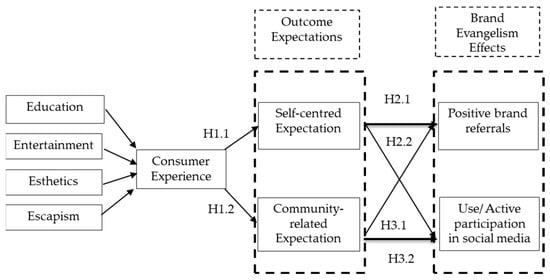
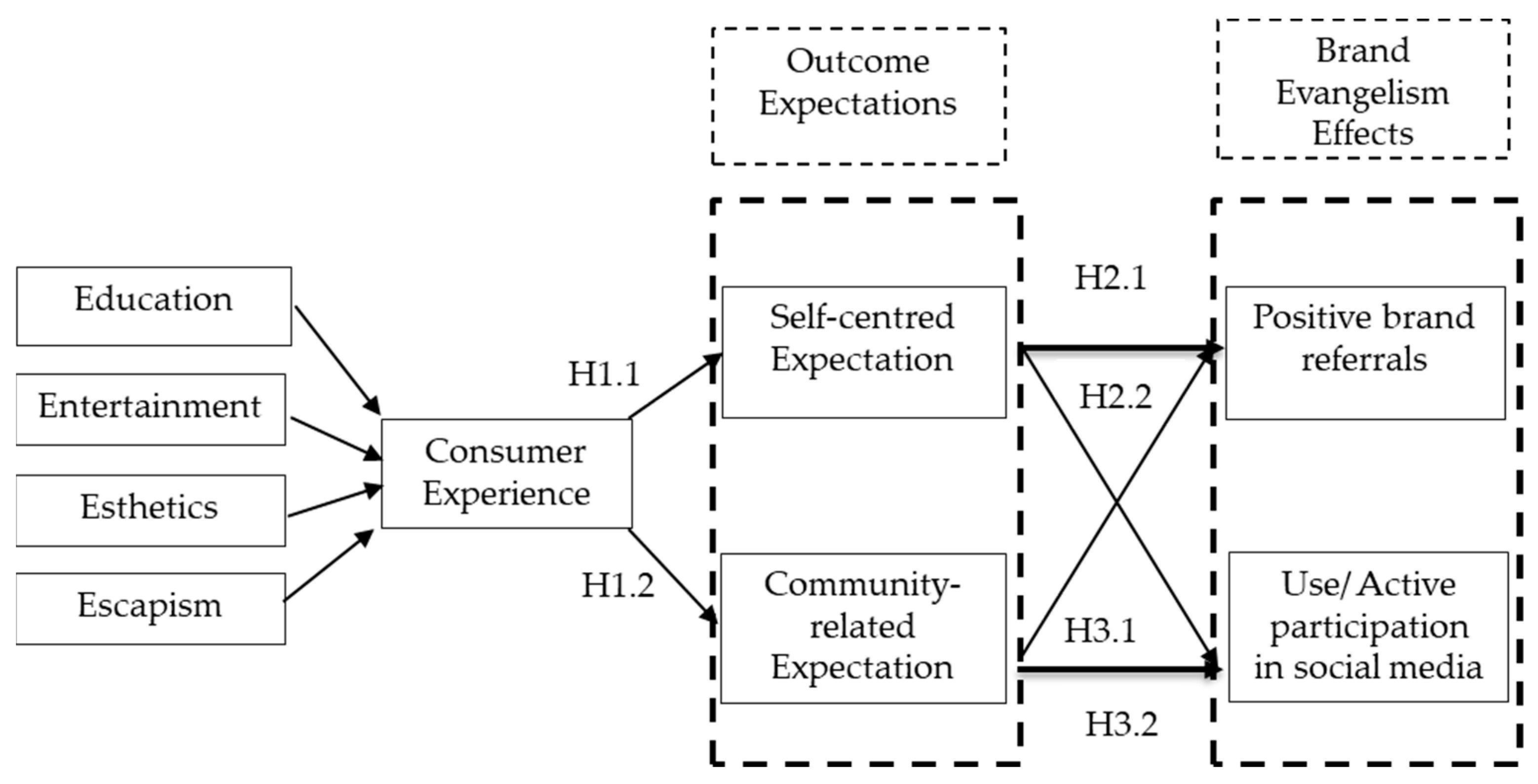
Based on the above justification, the model of the study was designed, as shown in Figure 1.
Figure 1.
The proposed theoretical model.
3. Methodology
3.1. Data Collection and Sampling Design
A survey questionnaire was conducted with a series of questions related to customer experience, outcome expectations, and brand evangelism effects. To measure the variables of this study, a five-point Likert scale questionnaire was designed (for example, 1 = absolutely disagree and 5 = absolutely agree), with additional yes/no questions and multiple-choice questions. All items were measured on a five-point Likert scale and operationalized as composites [89]. Prior to the main data collection, a pilot study was conducted with hotel guests in Nakhon Si Thammarat (Thailand) to assess the clarity, wording, and overall structure of the questionnaire. Based on the feedback obtained, minor revisions were introduced to improve the wording and comprehension of several items, thereby enhancing their consistency with the study constructs and ensuring content validity. These adjustments did not modify the underlying theoretical structure of the measurement scales but improved their readability and suitability for the target population.
The target population of the study is international tourists who stay in 3–5-star hotels in Samui, Thailand. A total of 452 cases were collected and validated to test the research hypotheses. All respondents finished their experiences of staying in the hotels. As Samui is a tourist destination in Thailand, most of the respondents were foreigners. However, to avoid the biased culture of respondents and ensure the representation of different groups, the continents of respondents were controlled.
3.2. Measurement Scales
Four items for each element of customer experience were adapted from Hosany and Witham [41] and Ali et al. [42] with a total of sixteen items, four items for self-centered expectations and two items for community-related expectations adapted from Munar and Jacobsen [47], five items for active participation in social media applied by Koh and Kim [56] and Casalo et al. [61], and another five items for positive brand referrals adapted from Becerra and Badrinarayanan [23] (see the scales in Appendix A).
3.3. Analysis Method
Partial least squares structural equation modeling (PLS-SEM) is a technique for studying complex interrelationships between constructs and indicators [90]. It is able to work appropriately for a sample size in selected contexts, including when models consist of many constructs with several items [91]. Furthermore, the objective of this study is to examine relationships between customer experience, outcome expectations and brand evangelism so that PLS-SEM is applied to investigate whether the research hypotheses are rejected or confirmed.
4. Results
4.1. Measurement Instrument
Table 1 shows the profile of the sample, comprising 452 respondents, predominantly male (56.4%), young adults aged 21–30 (40.9%), and those holding a bachelor’s degree (77.4%). In terms of geographical origin, the majority came from Europe (46.9%), followed by non-Thai Asian (17.9%) and American (14.6%) countries.
Table 1.
Profile of samples.
The relationship between the different constructs and their indicators was analyzed in this research using a composite process. Customer experience was considered a Mode B second-order composite (formative), while expectation outcomes and brand evangelism effects were considered Mode A composites (reflective) [92].
For the reflective constructs (Mode A), the evaluation of the measurement model involved the analysis of individual item reliability, composite reliability, analysis of mean extracted variance, and discriminant validity. The results (see Table 2) indicate that all items, except two of them (PBR4 and PBR5), are reliable, presenting standardized loads higher than 0.70. Additionally, it is observed that the composite reliability indexes of the 4 variables analyzed (self-centered expectation, community-related expectation, positive brand referrals and active participation on social media) were higher than 0.7. This meets the reliability requirement of the construct [93]. In addition, the values of the AVE were above the minimum threshold of 0.5, which ensures convergent validity [94]. Finally, it should be noted that the discriminant validity was also met, since all the variables analyzed presented HTMT values below 0.85 [95] (see Table 3).
Table 2.
Reliability and convergent validity.
Table 3.
Discriminant validity.
In our model, customer experience is a formative composite (Mode B) and therefore the above criteria do not apply. Formative composites require checking that there are no multicollinearity problems, so it is necessary to evaluate the Variance Inflation Factor (VIF). As observed in Table 4, none of the values of the VIF are above 3.3 [96], and are not identified as multicollinearity problems. Additionally, Table 4 shows the values of the weights of the indicator, their sign and significance, which demonstrates the relative importance of each of the dimensions of the composite.
Table 4.
Customer experience dimensions.
4.2. Structural Model
Once the reliability and validity of the measuring instrument were analyzed, the structural model was evaluated. The aim was to check compliance with the proposed causal relationships. Table 5 shows the standardized path coefficients (β), the associated t-values, the weights, and the predictive capacity (value) (R2) and relevance (Q2) of the structural model. We affirm that the model presents a good fit, with an SRMR value of 0.075, which is lower than the value of 0.08 recommended by Henseler et al. [97] (see Table 5 and Figure 2).
Table 5.
Structural model.
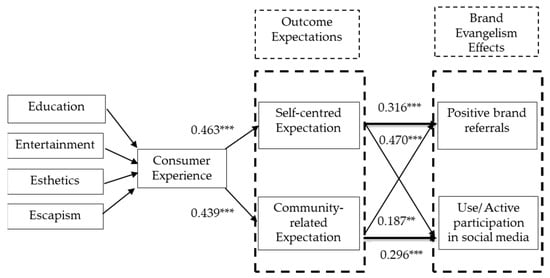
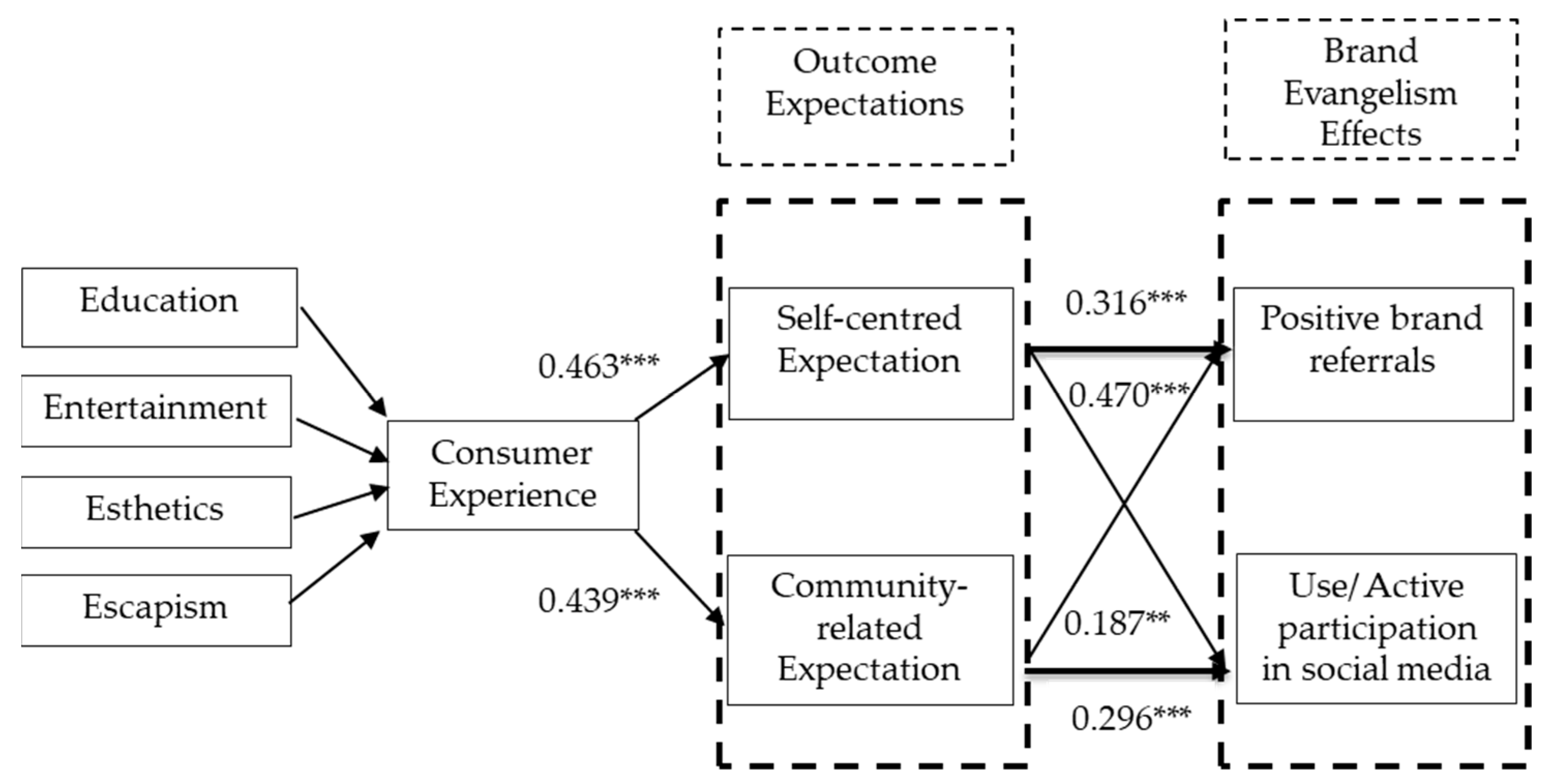
Figure 2.
Structural model results. Note: ** p < 0.05; *** p < 0.01.
All the standardized path coefficients show positive values and are significant, which confirms the hypotheses raised in this research. In general, the results indicate that a good experience derived from a stay in a tourist accommodation has a positive influence on the personal outcomes expectations of tourists when sharing this experience in different forums, chats or websites (β = 0.463), as well as on tourists’ expectations of being able to help others, through social networks, to properly choose the contracted accommodation (β = 0.439). This expectation also leads to intensified active participation of tourists in social media (β = 0.470 and β = 0.296 respectively) and talking positively about the tourist accommodation in which they have been staying (β = 0.316 and β = 0.187 respectively).
The experience of the tourist in tourist accommodation is configured in the present research as a formative composite, where each one of its dimensions contributes to its formation. It should be noted that all the dimensions analyzed (education, entertainment, esthetics and escapism) contribute to the tourist experience in a positive and significant way (weight = 0.262, weight = 0.401, weight = 0.312 and weight = 0.262 respectively). From the four dimensions analyzed, it is entertainment (weight = 0.401) and esthetics (weight = 0.312) that have the greatest impact on the tourist experience.
The proposed model explains 21.4% of the variance in self-centered expectations (R2), 19.3% of the variance in community-related expectations (R2), 20.9% of the variance in positive brand referrals (R2), and 48.3% of the variance in active participation (R2). All the values obtained are adequate, exceeding the minimum 10% recommended by Falk and Miller [98]. This predictive capacity (R2) is proven by the analysis of the predictive relevance of the model (Q2) [96], which also offers good results, since all the variables analyzed take values higher than zero [99].
5. Discussion
Outcome expectations are conceived as beliefs about the expected consequences of one’s action, and can be measured using two variables: self-centered expectation and community-related expectations.
Self-centered expectation is conceived as the personal outcome expectations of tourists when sharing an experience in different forums, chats or websites. The results indicate that good customer experience through designer sensibility has a positive influence on self-centered expectation, confirming hypothesis H1.1. Although all dimensions are significant, the most determinative questions are those concerning intrinsic interests, to make their experiences more recognized and useful for the viewer (see Table 2). The link between outcome expectations and brand evangelism effects can also be observed. Hence, our results confirm that self-centered outcome expectations have an influence on brand evangelism in both positive brand referrals and active participation in social media, confirming hypotheses H2.1 and H2.2 respectively. It is evident that self-centered outcome expectations are significant factors motivating consumers’ or tourists’ behaviors [58], especially when associated with brand evangelism. The reasons for this may be due to a feeling of kinship with the brand as it reflects an individual’s identity, and a strong commitment to the brand [76]. This creates strong ties between the consumers and brands, which consumers protect by producing positive brand referrals and refuting negative feedback for the brand [22]. Moreover, positive brand referrals can be done via social media apps such as Facebook, YouTube, Instagram, and Twitter. However, Twitter seems to be more influential than the others (see Table 2).
Regarding community-related expectations, this variable is conceived as tourists’ expectations of being able to help others, through social networks, to properly choose the contracted accommodation. Our results indicate that good customer experience as a designer sensibility has a positive influence on community-related expectations, confirming hypothesis H1.2. The results of all dimensions are significant (see Table 2). This phenomenon is supported by the findings of Munar and Jacobsen [47] and Oliveira et al. [49], who claimed that sharing information is beneficial to oneself and also to communities. For example, it may help or prevent others from using bad products or services or making poor decisions. Furthermore, expecting others to get some advantage from an opinion can encourage brand evangelism, as confirmed by the results. There are significant effects on both positive brand referrals and active participation in social media, as well as the self-centered outcome expectation (see Table 5), confirming Hypotheses 3.1 and 3.2. This reflects that tourists who expect others to get positive benefits from their opinions tend to dedicate themselves to spreading positive thoughts, favorable opinions, or good feelings via social media in order to encourage others to support the brand.
6. Conclusions
This research has important theoretical and practical contributions by providing new insights into how customer expectations and experiences generate value, foster brand evangelism, and firm success. Theoretically, this study advances understanding within the hospitality context by explaining how customer experiences evolve into strong brand-supportive behaviors. While prior research has predominantly emphasized the affective or hedonic dimensions of customer experience in generating satisfaction and loyalty [8,9,55], the present findings demonstrate that cognitive mechanisms also play an important role in explaining the emergence of brand evangelism. In doing so, this study moves beyond emotion-centric perspectives and supports a more integrated cognitive–affective framework. By combining customer experience, outcome expectations, and brand evangelism within a single framework, this research offers a more holistic explanation of how experiential issues influence tourists’ psychological processes and their subsequent behavioral responses in the digital environment.
In this study, customer experience is conceptualized as the positive experience derived from a stay in tourist accommodation, as well as the skills, perceptions, and dispositions developed through that experience. The study evaluates the four experiential dimensions proposed by Pine and Gilmore [2], and Chang [4]: education, entertainment, esthetics and escapism. These findings are consistent with previous studies showing that the four dimensions contribute positively and significantly to the formation of customer experience. These findings are consistent with prior research on experiential value, and extend it by demonstrating their influence on digital behaviors such as content creation and eWOM, which are key drivers of brand evangelism.
The study further demonstrates that these outcome expectations play a significant role in fostering brand evangelism. Self-centered expectations positively influence both positive brand referrals and active participation in social media, suggesting that tourists who perceive personal benefits from sharing their experiences are more likely to advocate for a brand and disseminate positive information. Similarly, community-related expectations significantly influence the dimensions of brand evangelism, indicating that tourists are also motivated by the perceived value of contributing knowledge and experiences to a broader community.
These findings extend the application of outcome expectations, as discussed by Hsu et al. [22], confirming that anticipated outcomes from sharing experiences can be categorized into personal benefits and community-oriented benefits, both of which significantly encourage brand evangelism behaviors.
From a managerial perspective, the findings indicate that brand evangelism is not merely a consequence of outstanding experiences, but rather of experiences that effectively activate both self-centered and community-related outcome expectations. Accordingly, hospitality managers should adopt a strategic approach to designing interactions that enhance consumers’ perceived personal value while simultaneously enabling them to contribute to others’ decision-making. This requires the implementation of explicit mechanisms that encourage sharing, active staff involvement in facilitating experience narration, and systematic recognition of user-generated content across digital platforms. From the consumer perspective, brand advocacy is grounded in identity expression and the perceived value of social contribution. When these expectations are fulfilled, consumers are more likely to engage in positive referrals and social media participation. Conversely, if such expectations remain unmet, experiences are likely to remain at an individual level, limiting the development of sustained brand evangelism.
This study has limitations related to sample characteristics, sector specificity, and geographical context. Future research should examine the psychological mechanisms underlying outcome expectations and brand evangelism, such as identity expression, intrinsic motivation, and social influence in digital environments. Cross-cultural and longitudinal research designs are also encouraged to assess the robustness of these relationships over time and across contexts.
Author Contributions
Conceptualization, Y.N.-K., S.S.-B. and Y.N.; methodology, S.S.-B.; software, S.S.-B.; validation, S.S.-B.; formal analysis, S.S.-B. and Y.N.-K.; investigation, Y.N.-K., S.S.-B. and F.J.G.-S.; resources, Y.N.-K. and F.J.G.-S.; data curation, S.S.-B. and Y.N.; writing—original draft preparation, Y.N.-K. and S.S.-B.; writing—review and editing, Y.N.-K., Y.N. and F.J.G.-S.; visualization, S.S.-B.; supervision, F.J.G.-S. and S.S.-B.; project administration, Y.N.; funding acquisition, Y.N., S.S.-B. and F.J.G.-S. All authors have read and agreed to the published version of the manuscript.
Funding
This work is supported by WALAILAK UNIVERSITY under the international research collaboration scheme, contract number WU-CIA-06707/2025, UNIVERSITAT POLITÈCNICA DE VALÈNCIA, and UNIVERSITAT DE VALÈNCIA (CIAICO/2024/143).
Institutional Review Board Statement
The study posed no physical, psychological, social, or financial risks to any of the participants involved. All research activities were survey-based in nature, designed with full regard for participant welfare. No experimental interventions, treatments, or invasive procedures of any kind were conducted. The study design was reviewed and confirmed to be of minimal-to-no risk prior to commencement. Data collection was conducted entirely anonymously. No personally identifiable information was solicited, recorded, or stored at any stage of the research process. Participants were under no obligation to disclose their identity, and no mechanism existed by which responses could be traced back to any individual. The non-invasive nature of the data collection ensured full respect for participants’ privacy, dignity, and autonomy throughout the study. As a member of the academic staff at Walailak University, the researcher is bound by and has fully complied with the University’s Regulations on Human Research and Experimentation B.E. 2563(2020), as well as the Researcher Code of Conduct prescribed under Article 5 thereof. All research activities were conducted within the ethical and regulatory framework established by the University.
Informed Consent Statement
Informed consent was obtained from all subjects involved in the study.
Data Availability Statement
The data presented in this study are available on request from the author.
Acknowledgments
The authors would like to thank Walailak University, the Universitat de València, and the Universitat Politècnica de València. The authors also thank the anonymous reviewers for their valuable comments and feedback.
Conflicts of Interest
The authors declare no conflicts of interest.
Appendix A. Measurement of Variables
| Measurement Scales | Authors |
| Customer Experience (CE) | |
| Education Experience | Hosany and Witham [41]; Ali et al. [68] |
| The experience has made me more knowledgeable | |
| I learned a lot during my experience | |
| It stimulated my curiosity to learn new things | |
| It was a real learning experience | |
| Entertainment Experience | |
| Activities at the hotel were amusing to watch and perform | |
| Activities at the hotel were captivating to watch and perform | |
| Activities at the hotel were entertaining to watch and perform | |
| Activities at the resort were fun to watch and perform | |
| Esthetics Experience | |
| I felt a real sense of harmony | |
| Just being here was very pleasant | |
| The setting was very attractive | |
| The setting really showed attention to design detail | |
| Escapism Experience | |
| I felt I played a different character here | |
| I felt like I was living in a different time or place | |
| The experience here let me imagine being someone else | |
| I totally forgot about my daily routine | |
| Self-Centered Expectation (SCE) | |
| I want to contribute to websites that are useful to me | Munar and Jacobsen [38] |
| I want my experiences be more recognized | |
| I want to maintain social connections and friendships | |
| I like to share my impressions through the Internet | |
| Community-Related Expectation (CRE) | |
| I want to help others with my opinions, photos or videos | Munar and Jacobsen [38] |
| I want to prevent people from using bad products or making wrong decisions | |
| Positive Brand Referrals (PBR) | |
| I would say positive things about this hotel to other people | Becerra and Badrinarayanan [57] |
| I would continue using this hotel’s services in the next few years | |
| I would consider this brand my first choice to buy services | |
| Active Participation (AP) | |
| I wrote/will write review on Facebook | Koh and Kim [56]; Casaló et al. [61] |
| I uploaded/will upload pictures/videos on Facebook | |
| I uploaded/will upload videos on YouTube | |
| I uploaded/will upload pictures on Instagram | |
| I used/will use Twitter to tell about my stay at the hotel |
References
- Zha, D.; Marvi, R.; Foroudi, P. Embracing the paradox of customer experiences in the hospitality and tourism industry. Int. J. Manag. Rev. 2024, 26, 163–186. [Google Scholar] [CrossRef] [Scilit]
- Pine, B.J.; Gilmore, J.H. The Experience Economy: Work Is Theatre & Every Business a Stage; Harvard Business Press: Boston, MA, USA, 1999. [Google Scholar]
- Wu, L.; Fan, A.; Hou, Y.; Wei, W. Unlocking the transformative power of hospitality and tourism experiences: Towards theoretical syntheses and research agenda. J. Hosp. Tour. Res. 2024, 48, 1316–1334. [Google Scholar] [CrossRef] [Scilit]
- Chang, S. Experience economy in hospitality and tourism: Gain and loss values for service and experience. Tour. Manag. 2018, 64, 55–63. [Google Scholar] [CrossRef] [Scilit]
- Kabadayi, S.; Ali, F.; Choi, H.; Joosten, H.; Lu, C. Smart service experience in hospitality and tourism services: A conceptualization and future research agenda. J. Serv. Manag. 2019, 30, 326–348. [Google Scholar] [CrossRef] [Scilit]
- Pires, P.B.; Prisco, M.; Delgado, C.; Santos, J.D. A conceptual approach to understanding the customer experience in e-commerce: An empirical study. J. Theor. Appl. Electron. Commer. Res. 2024, 19, 1943–1983. [Google Scholar] [CrossRef] [Scilit]
- Kacprzak, A.; Hensel, P. Exploring online customer experience: A systematic literature review and research agenda. Int. J. Consum. Stud. 2023, 47, 2583–2608. [Google Scholar] [CrossRef] [Scilit]
- Orden-Mejia, M.; Moreno-Manzo, J. Examining consumer experience in a gourmet food hall: Impacts on satisfaction and behavioural intentions. Int. J. Gastron. Food Sci. 2024, 35, 100890. [Google Scholar] [CrossRef] [Scilit]
- Suharto, S.; Yuliansyah, Y. The influence of customer relationship management and customer experience on customer satisfaction. Integr. J. Bus. Econ. 2023, 7, 389. [Google Scholar] [CrossRef] [Scilit]
- Asrilsyak, S. The influence of customer experience and product quality on customer satisfaction through buying decisions for Eiger Outdoor Gear products in Pekanbaru City. J. Appl. Bus. Adm. 2024, 8, 324–339. [Google Scholar] [CrossRef] [Scilit]
- Buhalis, D.; Lin, M.S.; Leung, D. Metaverse as a driver for customer experience and value co-creation: Implications for hospitality and tourism management and marketing. Int. J. Contemp. Hosp. Manag. 2023, 35, 701–716. [Google Scholar] [CrossRef] [Scilit]
- Nwachukwu, D.; Affen, M.P. Artificial intelligence marketing practices: The way forward to better customer experience management in Africa (systematic literature review). Int. Acad. J. Manag. Mark. Entrep. Stud. 2023, 9, 44–62. [Google Scholar]
- Liu-Thompkins, Y.; Khoshghadam, L.; Shoushtari, A.A.; Zal, S. What drives retailer loyalty? A meta-analysis of the role of cognitive, affective, and social factors across five decades. J. Retail. 2022, 98, 92–110. [Google Scholar] [CrossRef] [Scilit]
- de Amorim, I.P.; Guerreiro, J.; Eloy, S.; Loureiro, S.M.C. How augmented reality media richness influences consumer behaviour. Int. J. Consum. Stud. 2022, 46, 2351–2366. [Google Scholar] [CrossRef] [Scilit]
- Bandura, A. Self-Efficacy: The Exercise of Control; Freeman: New York, NY, USA, 1997. [Google Scholar]
- Luszczynska, A.; Schwarzer, R. Social cognitive theory. Predict. Health Behav. 2005, 2, 127–169. [Google Scholar]
- Lo, S.H.; Chang, A.M.; Chau, J.P. Stroke self-management support improves survivors’ self-efficacy and outcome expectation of self-management behaviors. Stroke 2018, 49, 758–760. [Google Scholar] [CrossRef] [Scilit]
- Pourabedin, Z.; Migin, M. Hotel experience and positive electronic word of mouth (e-WOM). Int. Bus. Manag. 2015, 9, 596–600. [Google Scholar] [CrossRef]
- Sharma, G.D.; Taheri, B.; Gupta, M.; Chopra, R. Over 33 years of the hospitality research: A bibliometric review of the international journal of contemporary hospitality management. Int. J. Contemp. Hosp. Manag. 2023, 35, 2564–2589. [Google Scholar] [CrossRef] [Scilit]
- Özen, İ.A.; Katlav, E.Ö. Aspect-based sentiment analysis on online customer reviews: A case study of technology-supported hotels. J. Hosp. Tour. Technol. 2023, 14, 102–120. [Google Scholar] [CrossRef] [Scilit]
- Matzler, K.; Pichler, E.A.; Hemetsberger, A. Who is spreading the word? The positive influence of extraversion on consumer passion and brand evangelism. In Proceedings of the American Marketing Association Winter Educators’ Conference, San Diego, CA, USA, 16–19 February 2007; American Marketing Association: Chicago, IL, USA; Volume 18, pp. 25–32.
- Hsu, L.C. Investigating the brand evangelism effect of community fans on social networking sites: Perspectives on value congruity. Online Inf. Rev. 2019, 43, 842–866. [Google Scholar] [CrossRef] [Scilit]
- Becerra, E.P.; Badrinarayanan, V. The influence of brand trust and brand identification on brand evangelism. J. Prod. Brand Manag. 2013, 22, 371–383. [Google Scholar] [CrossRef] [Scilit]
- Ford, R.; Sturman, M.; Heaton, C. Managing Quality Service in Hospitality: How Organizations Achieve Excellence in the Guest Experience; Nelson Education: Toronto, ON, Canada, 2011. [Google Scholar]
- Zhang, T.; Hua, N.; Heo, J.; Wang, Y.; Pizam, A. Experience design of lifestyle communities: The future of hospitality and tourism. Int. J. Contemp. Hosp. Manag. 2024, 36, 4258–4277. [Google Scholar] [CrossRef] [Scilit]
- Yin, J.; Qiu, X.; Wang, Y. The impact of AI-personalized recommendations on clicking intentions: Evidence from Chinese e-commerce. J. Theor. Appl. Electron. Commer. Res. 2025, 20, 21. [Google Scholar] [CrossRef] [Scilit]
- Holbrook, M.B.; Hirschman, E.C. The experiential aspects of consumption: Consumer fantasies, feelings, and fun. J. Consum. Res. 1982, 9, 132–140. [Google Scholar] [CrossRef] [Scilit]
- Pine, B.J.; Gilmore, J.H. Welcome to the experience economy. Harv. Bus. Rev. 1998, 76, 97–105. [Google Scholar]
- Lemon, K.N.; Verhoef, P.C. Understanding customer experience throughout the customer journey. J. Mark. 2016, 80, 69–96. [Google Scholar] [CrossRef] [Scilit]
- Warner, K.S.R.; Wäger, M. Building dynamic capabilities for digital transformation: An ongoing process of strategic renewal. Long Range Plan. 2019, 52, 326–349. [Google Scholar] [CrossRef] [Scilit]
- Kotler, P.; Kartajaya, H.; Setiawan, I. Marketing 6.0: The Future Is Immersive; Wiley & Sons: Hoboken, NJ, USA, 2023. [Google Scholar]
- Vetrivel, S.C.; Gomathi, T.; Sowmiya, K.C.; Sabareeshwari, V. Customer-centric excellence in the Marketing 6.0 era: Industry 6.0. In Advanced Businesses in Industry 6.0; IGI Global: Hershey, PA, USA, 2024; pp. 192–219. [Google Scholar]
- Mousa, M.M.; Rashed, A.S.; Akaileh, M.; Zamil, A.M.; Ahmed, H.A.; Abdelghani, A.A. Artificial intelligence marketing technologies and consumer purchasing decisions: The moderating role of virtual customer experience and implications for sustainable consumption in telecommunications service environments. Sustainability 2026, 18, 2674. [Google Scholar] [CrossRef] [Scilit]
- Kala, D.; Chaubey, D.S. Decoding direct-to-consumer brand purchase behaviour among young consumers: Role of fear of missing out and AI-enabled recommendations. Int. Rev. Retail Distrib. Consum. Res. 2026, 1–26. [Google Scholar] [CrossRef] [Scilit]
- Lee, M.; Lee, S.A.; Koh, Y. Multisensory experience for enhancing hotel guest experience: Empirical evidence from big data analytics. Int. J. Contemp. Hosp. Manag. 2019, 11, 4313–4337. [Google Scholar] [CrossRef] [Scilit]
- Verhoef, P.C.; Lemon, K.N.; Parasuraman, A.; Roggeveen, A.; Tsiros, M.; Schlesinger, L.A. Customer experience creation: Determinants, dynamics and management strategies. J. Retail. 2009, 85, 31–41. [Google Scholar] [CrossRef] [Scilit]
- Medina-Hernandez, V.C.; Marine-Roig, E.; Ferrer-Rosell, B. Attributes influencing guests’ experiences: A comparison of nonprofit and for-profit peer-to-peer accommodation platforms. Inf. Technol. Tour. 2024, 26, 255–291. [Google Scholar] [CrossRef] [Scilit]
- Veloso, M.; Gomez-Suarez, M. Customer experience in the hotel industry: A systematic literature review and research agenda. Int. J. Contemp. Hosp. Manag. 2023, 35, 3006–3028. [Google Scholar] [CrossRef] [Scilit]
- Fernandes, T.; Cruz, M. Dimensions and outcomes of experience quality in tourism: The case of port wine cellars. J. Retail. Consum. Serv. 2016, 31, 371–379. [Google Scholar] [CrossRef] [Scilit]
- Sipe, L.; Testa, M. From satisfied to memorable: An empirical study of service and experience dimensions on guest outcomes in the hospitality industry. J. Hosp. Mark. Manag. 2017, 27, 178–195. [Google Scholar] [CrossRef] [Scilit]
- Hosany, S.; Witham, M. Dimensions of cruisers’ experiences, satisfaction, and intention to recommend. J. Travel Res. 2010, 49, 351–364. [Google Scholar] [CrossRef] [Scilit]
- Ali, F.; Hussain, K.; Ragavan, N.A. Memorable customer experience: Examining the effects of customers experience on memories and loyalty in Malaysian resort hotels. Procedia Soc. Behav. Sci. 2014, 144, 273–279. [Google Scholar] [CrossRef] [Scilit]
- Bandura, A. Self-efficacy: Toward a unifying theory of behavioral change. Psychol. Rev. 1977, 84, 191. [Google Scholar] [CrossRef]
- Hwang, J.; Seo, S. A critical review of research on customer experience management: Theoretical, methodological and cultural perspectives. Int. J. Contemp. Hosp. Manag. 2016, 28, 2218–2246. [Google Scholar] [CrossRef] [Scilit]
- Lu, J.; Mao, Z.; Wang, M.; Hu, L. Goodbye maps, hello apps? Exploring the influential determinants of travel app adoption. Curr. Issues Tour. 2015, 18, 1059–1079. [Google Scholar] [CrossRef] [Scilit]
- Narangajavana Kaosiri, Y.; Callarisa Fiol, L.J.; Moliner Tena, M.Á.; Rodríguez Artola, R.M.; Sánchez García, J. User-generated content sources in social media: A new approach to explore tourist satisfaction. J. Travel Res. 2019, 58, 253–265. [Google Scholar] [CrossRef] [Scilit]
- Munar, A.M.; Jacobsen, J.K.S. Motivations for sharing tourism experiences through social media. Tour. Manag. 2014, 43, 46–54. [Google Scholar] [CrossRef] [Scilit]
- Sheldon, P.J. Designing tourism experiences for inner transformation. Ann. Tour. Res. 2020, 83, 102935. [Google Scholar] [CrossRef] [Scilit]
- Oliveira, T.; Araujo, B.; Tam, C. Dataset for understanding why people share their travel experiences on social media: Structural equation model analysis. Data Brief 2020, 30, 105447. [Google Scholar] [CrossRef] [Scilit]
- Bearden, W.O.; Etzel, M.J. Reference group influence on product and brand purchase decisions. J. Consum. Res. 1982, 9, 183–194. [Google Scholar] [CrossRef] [Scilit]
- Hwang, J.; Lee, J. A strategy for enhancing senior tourists’ well-being perception: Focusing on the experience economy. J. Travel Tour. Mark. 2019, 36, 314–329. [Google Scholar] [CrossRef] [Scilit]
- Yuen, K.F.; Cao, Y.; Bai, X.; Wang, X. The psychology of cruise service usage post COVID-19: Health management and policy implications. Mar. Policy 2021, 130, 104586. [Google Scholar] [CrossRef] [Scilit]
- Hsu, M.H.; Ju, T.L.; Yen, C.H.; Chang, C.M. Knowledge sharing behavior in virtual communities: The relationship between trust, self-efficacy, and outcome expectations. Int. J. Hum. Comput. Stud. 2007, 65, 153–169. [Google Scholar] [CrossRef] [Scilit]
- Phan, L.G.N.; Tri, D.Q.; Dang, S.H.; Nguyen, L.T. Hooked on livestreaming: What drives customer repurchase intention in e-commerce? J. Creat. Commun. 2026, 21, 99–118. [Google Scholar] [CrossRef] [Scilit]
- Alshahrani, H.; Pennington, D. Researchers’ outcome expectations for sharing knowledge on social media. Glob. Knowl. Mem. Commun. 2021, 70, 377–398. [Google Scholar] [CrossRef] [Scilit]
- Koh, J.; Kim, Y.G. Knowledge sharing in virtual communities: An e-business perspective. Expert Syst. Appl. 2004, 26, 155–166. [Google Scholar] [CrossRef] [Scilit]
- Narangajavana, Y.; Fiol, L.J.C.; Tena, M.Á.M.; Artola, R.M.R.; García, J.S. The influence of social media in creating expectations: An empirical study for a tourist destination. Ann. Tour. Res. 2017, 65, 60–70. [Google Scholar] [CrossRef] [Scilit]
- Lin, H.Y.; Hsu, M.H. Using social cognitive theory to investigate green consumer behavior. Bus. Strategy Environ. 2015, 24, 326–343. [Google Scholar] [CrossRef] [Scilit]
- Sotiriadis, M.D. Sharing tourism experiences in social media: A literature review and a set of suggested business strategies. Int. J. Contemp. Hosp. Manag. 2017, 29, 179–225. [Google Scholar] [CrossRef] [Scilit]
- Luo, Q.; Zhong, D. Using social network analysis to explain communication characteristics of travel-related electronic word-of-mouth on social networking sites. Tour. Manag. 2015, 48, 274–282. [Google Scholar] [CrossRef] [Scilit]
- Casaló, L.V.; Flavián, C.; Guinalíu, M. Antecedents and consequences of consumer participation in online communities: The case of the travel sector. Int. J. Electron. Commer. 2011, 15, 137–167. [Google Scholar] [CrossRef] [Scilit]
- Merli, R.; Preziosi, M.; Acampora, A.; Ali, F. Why should hotels go green? Insights from guests’ experience in green hotels. Int. J. Hosp. Manag. 2019, 81, 169–179. [Google Scholar] [CrossRef] [Scilit]
- Zeithaml, V.A.; Berry, L.L.; Parasuraman, A. The nature and determinants of customer expectations of service. J. Acad. Mark. Sci. 1993, 21, 1–12. [Google Scholar] [CrossRef] [Scilit]
- Fan, D.X.; Hsu, C.H. Potential mainland Chinese cruise travelers’ expectations, motivations, and intentions. J. Travel Tour. Mark. 2014, 31, 522–535. [Google Scholar] [CrossRef] [Scilit]
- Chuang, N.K.; Goh, B.K.; Stout, B.L.; Dellmann-Jenkins, M. Hospitality undergraduate students’ career choices and factors influencing commitment to the profession. J. Hosp. Tour. Educ. 2007, 19, 28–37. [Google Scholar] [CrossRef] [Scilit]
- MacInnis, D.J.; Price, L.L. An exploratory study of the effects of imagery processing and consumer experience on expectations and satisfaction. Adv. Consum. Res. 1990, 17, 41. [Google Scholar]
- Liu, B.; Moyle, B.; Kralj, A. When and how sharing tourism experiences on social media backfires: TMSP model of sharing driven outcomes. J. Hosp. Tour. Manag. 2022, 53, 155–159. [Google Scholar] [CrossRef] [Scilit]
- Brakus, J.J.; Schmitt, B.H.; Zarantonello, L. Brand experience: What is it? How is it measured? Does it affect loyalty? J. Mark. 2009, 73, 52–68. [Google Scholar] [CrossRef] [Scilit]
- Marticotte, F.; Arcand, M.; Baudry, D. The impact of brand evangelism on oppositional referrals towards a rival brand. J. Prod. Brand Manag. 2016, 25, 538–549. [Google Scholar] [CrossRef] [Scilit]
- Panda, T.K.; Kumar, A.; Jakhar, S.; Luthra, S.; Garza-Reyes, J.A.; Kazancoglu, I.; Nayak, S.S. Social and environmental sustainability model on consumers’ altruism, green purchase intention, green brand loyalty and evangelism. J. Clean. Prod. 2020, 243, 118575. [Google Scholar] [CrossRef] [Scilit]
- Rungruangjit, W.; Chankoson, T.; Charoenpornpanichkul, K. Understanding Different Types of Followers’ Engagement and the Transformation of Millennial Followers into Cosmetic Brand Evangelists. Behav. Sci. 2023, 13, 270. [Google Scholar] [CrossRef] [Scilit]
- Bhandari, M.P.; Bhattarai, C.; Mulholland, G. Online brand community engagement and brand evangelism: The role of age, gender and membership number. J. Prod. Brand Manag. 2024, 33, 301–313. [Google Scholar] [CrossRef] [Scilit]
- Harrigan, P.; Roy, S.K.; Chen, T. Do value cocreation and engagement drive brand evangelism? Mark. Intell. Plan. 2021, 39, 345–360. [Google Scholar] [CrossRef] [Scilit]
- Sharma, P.; Sadh, A.; Billore, A.; Motiani, M. Investigating brand community engagement and evangelistic tendencies on social media. J. Prod. Brand Manag. 2022, 31, 16–28. [Google Scholar] [CrossRef] [Scilit]
- Riivits-Arkonsuo, I.; Kaljund, K.; Leppiman, A. Consumer journey from first experience to brand evangelism. Res. Econ. Bus. Cent. East. Eur. 2014, 6, 8–19. [Google Scholar]
- Rather, R.A.; Hollebeek, L.D. Exploring and validating social identification and social exchange-based drivers of hospitality customer loyalty. Int. J. Contemp. Hosp. Manag. 2019, 31, 1432–1451. [Google Scholar] [CrossRef] [Scilit]
- Ibrahim, B.; Hazzam, J.; Ali Qalati, S.; Aljarah, A.; Dobson, P. Building a tribe on Instagram: How user-generated and firm-created content can drive brand evangelism and fidelity. J. Mark. Commun. 2025, 31, 905–924. [Google Scholar] [CrossRef] [Scilit]
- Cavadas, R.J.O.M.D.S.; Moreira, A.C. Brand evangelism: A review and research agenda. Int. J. Consum. Stud. 2025, 49, e70064. [Google Scholar] [CrossRef] [Scilit]
- Suban, S.A. Brand advocacy: A bibliometric analysis from 2007 to 2024. Int. Hosp. Rev. 2025, 49, e70064. [Google Scholar] [CrossRef] [Scilit]
- Selmi, N.; Soliman, M.; Dliya’ul Haq, M.; Mesana, J.C.B. Unlocking the drivers of brand evangelism in the hospitality sector: A mediated-moderated model of emotional brand bonding and surprise. Tour. Hosp. Res. 2025, 14673584251356831. [Google Scholar] [CrossRef] [Scilit]
- Ahmadi, A.; Ataei, A. Emotional attachment: A bridge between brand reputation and brand advocacy. Asia Pac. J. Bus. Adm. 2024, 16, 1–20. [Google Scholar] [CrossRef] [Scilit]
- Sohaib, M.; Wang, Y.; Iqbal, K.; Han, H. Nature-based solutions, mental health, well-being, price fairness, attitude, loyalty, and evangelism for green brands in the hotel context. Int. J. Hosp. Manag. 2022, 101, 103126. [Google Scholar] [CrossRef] [Scilit]
- Thanh Ha, L.T.; Thu, V.T. Motivations of guests contributing sWOM on social media: A case in Vietnam. J. Asian Bus. Econ. Stud. 2020, 29, 146–162. [Google Scholar] [CrossRef] [Scilit]
- Doss, S.K. Spreading the good word: Toward an understanding of brand evangelism. J. Manag. Mark. Res. 2014, 14, 1. [Google Scholar]
- Sannassee, R.V.; Seetanah, B. The influence of trust on repeat tourism: The Mauritian case study. J. Hosp. Mark. Manag. 2015, 24, 770–789. [Google Scholar] [CrossRef] [Scilit]
- Kim, D.; Jang, S.S.; Adler, H. What drives cafe customers to spread eWOM? Int. J. Contemp. Hosp. Manag. 2015, 27, 261–282. [Google Scholar] [CrossRef] [Scilit]
- Cheung, M.L.; Leung, W.K.; Yang, M.X.; Koay, K.Y.; Chang, M.K. Exploring the nexus of social media influencers and consumer brand engagement. Asia Pac. J. Mark. Logist. 2022, 34, 2370–2385. [Google Scholar] [CrossRef] [Scilit]
- Holiday, S.; Hayes, J.L.; Park, H.; Lyu, Y.; Zhou, Y. A multimodal emotion perspective on social media influencer marketing: The effectiveness of influencer emotions, network size, and branding on consumer brand engagement using facial expression and linguistic analysis. J. Interact. Mark. 2023, 58, 414–439. [Google Scholar] [CrossRef] [Scilit]
- Henseler, J. Bridging design and behavioral research with variance-based structural equation modelling. J. Advert. 2017, 46, 178–192. [Google Scholar] [CrossRef] [Scilit]
- Becker, J.M.; Cheah, J.H.; Gholamzade, R.; Ringle, C.M.; Sarstedt, M. PLS-SEM’s most wanted guidance. Int. J. Contemp. Hosp. Manag. 2023, 35, 321–346. [Google Scholar] [CrossRef] [Scilit]
- Hair, J.F.; Risher, J.J.; Sarstedt, M.; Ringle, C.M. When to use and how to report the results of PLS-SEM. Eur. Bus. Rev. 2019, 31, 2–24. [Google Scholar] [CrossRef] [Scilit]
- Rigdon, E.E. Choosing PLS path modeling as analytical method in European management research: A realist perspective. Eur. Manag. J. 2016, 34, 598–605. [Google Scholar] [CrossRef] [Scilit]
- Nunnally, J.; Bernstein, I. Psychometric Theory; McGraw-Hill: New York, NY, USA, 1994. [Google Scholar]
- Fornell, C.; Larcker, D.F. Evaluating structural equation models with unobservable variables and measurement error. J. Mark. Res. 1981, 18, 39–50. [Google Scholar] [CrossRef] [Scilit]
- Henseler, J.; Ringle, C.M.; Sarstedt, M. A new criterion for assessing discriminant validity in variance-based structural equation modeling. J. Acad. Mark. Sci. 2015, 43, 115–135. [Google Scholar] [CrossRef] [Scilit]
- Hair, J.F.; Hult, G.T.M.; Ringle, C.M.; Sarstedt, M.; Thiele, K.O. Mirror, mirror on the wall: A comparative evaluation of composite-based structural equation modeling methods. J. Acad. Mark. Sci. 2017, 45, 616–632. [Google Scholar] [CrossRef] [Scilit]
- Henseler, J.; Hubona, G.; Ray, P.A. Using PLS path modeling in new technology research: Updated guidelines. Ind. Manag. Data Syst. 2016, 116, 2–20. [Google Scholar] [CrossRef] [Scilit]
- Falk, R.; Miller, N. A Primer for Soft Modeling; University of Akron Press: Akron, OH, USA, 1992. [Google Scholar]
- Chin, W.W. The partial least squares approach to structural equation modelling. In Modern Methods for Business Research; Marcoulides, G.A., Ed.; Lawrence Erlbaum Associates: Mahwah, NJ, USA, 1998; pp. 295–336. [Google Scholar]

Disclaimer/Publisher’s Note: The statements, opinions and data contained in all publications are solely those of the individual author(s) and contributor(s) and not of MDPI and/or the editor(s). MDPI and/or the editor(s) disclaim responsibility for any injury to people or property resulting from any ideas, methods, instructions or products referred to in the content. |
© 2026 by the authors. Licensee MDPI, Basel, Switzerland. This article is an open access article distributed under the terms and conditions of the Creative Commons Attribution (CC BY) license.