


Abstract
Stablecoins are increasingly viewed as interoperable settlement layers within electronic commerce, yet the mechanisms through which they become activated as payment instruments remain underexplored. Extending the Unified Theory of Acceptance and Use of Technology (UTAUT) with platform interoperability and regulatory perception, this study develops a sequential adoption-to-activation framework in which technological evaluation, ecosystem compatibility, and institutional legitimacy jointly shape adoption intention and behavioral activation likelihood (BAL). Survey data from 400 digitally experienced Korean consumers with prior experience in digital payments and/or crypto-asset–related transaction environments were analyzed using hierarchical regression with HC3 robust standard errors and bias-corrected bootstrapped mediation testing. The findings show that platform interoperability exerts the strongest influence on adoption intention and also has a significant direct effect on BAL, while social influence exhibits both direct and indirect effects. By contrast, facilitating conditions and regulatory perception operate primarily through adoption intention, and performance expectancy and effort expectancy show no significant direct or mediated effects once ecosystem-level and institutional determinants are incorporated. These results identify a boundary condition of UTAUT in ecosystem-integrated payment environments: in digitally mature multi-sided commerce ecosystems, ecosystem compatibility and institutional legitimacy can operate as structurally prior conditions of activation, suggesting that stablecoin payment activation is better understood as a sequential process shaped by platform-level coordination than as a conventional intention-to-use decision centered on marginal functional gains.
1. Introduction
1.1. The Expansion of Digital Commerce and the Evolution of Payment Infrastructures
The expansion of electronic commerce has intensified demand for payment infrastructures that are fast, scalable, and interoperable across platform-based transaction environments [1,2]. In multi-sided digital platforms, payment systems do more than execute transactions: they also coordinate interactions among consumers, merchants, and service providers [3]. Although conventional payment systems—such as card networks, bank transfers, and mobile wallets—have enabled the growth of digital commerce, they still face friction in terms of cross-border settlement, currency conversion, and platform-level compatibility [4]. These constraints have increased interest in blockchain-based payment technologies that support programmable and potentially cross-platform settlement. Among these technologies, stablecoins have emerged as candidate payment instruments because they combine blockchain transferability with relative price stability [5,6]. Recent research on crypto payment adoption by online retailers and on stablecoins in retail operations further suggests that the commercial relevance of blockchain-based payment instruments depends not only on their technical design, but also on their fit with transaction environments and platform-level operations [7,8].
1.2. Stablecoins as Emerging Payment Instruments in Electronic Commerce
Stablecoins have mainly been studied from macro-financial and regulatory perspectives, including reserve design, systemic risk, and monetary implications [5,9]. By contrast, their role as payment infrastructures within electronic commerce ecosystems remains underexplored. In platform-based commerce, payment adoption depends not only on usability, but also on interoperability, ecosystem integration, and network effects [3,10]. Payment instruments must function across merchants, platforms, and transaction settings while maintaining sufficient institutional legitimacy to reduce perceived risk [11]. This makes stablecoin adoption in e-commerce analytically different from general crypto-asset adoption. Recent research has also begun to examine stablecoins in transaction-oriented contexts, including cross-border remittances and retail operations, but these studies still provide limited evidence on how stablecoin payments become activated within platform-mediated commerce systems [8,12,13,14]. Accordingly, this study treats stablecoins not merely as financial instruments, but as payment infrastructures whose activation depends on ecosystem compatibility and institutional assurance.
1.3. The Korean Digital Commerce Ecosystem
South Korea provides an empirically appropriate setting for examining stablecoin-based payment activation, because it combines advanced digital payment adoption, strong platform ecosystems, and broad consumer participation in online marketplaces. In such an environment, stablecoins may plausibly operate as programmable settlement layers embedded in platform-based commerce systems. However, technological feasibility alone does not ensure activation. Users must also perceive sufficient trust, regulatory legitimacy, and interoperability across transaction environments. For this reason, Korea is used in this study as a digitally mature but context-specific empirical setting. The proposed framework may be conceptually relevant to other platform-based commerce environments, but the present empirical results should be interpreted within the Korean context rather than assumed to generalize automatically across countries.
Against this background, this study conceptualizes stablecoin payment adoption in electronic commerce as an activation process embedded in platform-based transactions rather than as a standalone technological choice. Extending UTAUT, it incorporates platform interoperability and regulatory perception as ecosystem-level and institutional determinants of payment activation. Using survey data from digitally experienced consumers and hierarchical regression with HC3 robust standard errors and bootstrapped mediation analysis, the study examines how these determinants shape adoption intention and behavioral activation likelihood. In doing so, it explains how stablecoin payments may become operational in digitally mature commerce ecosystems and clarifies the boundary conditions of technology adoption models in such settings.
1.4. Research Objectives
This study investigates the determinants of adoption intention (AI) and behavioral activation likelihood (BAL) for stablecoin payments in electronic commerce environments. Drawing on UTAUT [15,16], it extends the framework by incorporating platform interoperability and regulatory perception as determinants that reflect ecosystem compatibility and institutional assurance in digital payment settings. Specifically, the study examines (1) how the antecedent variables influence AI, (2) whether AI mediates their relationship with BAL, and (3) how much incremental explanatory power AI adds to the prediction of transaction-oriented behavioral propensity within platform ecosystems.
Importantly, the analysis is based on digitally experienced Korean consumers with prior experience in digital payments and/or crypto-asset–related transaction environments, allowing the proposed activation framework to be evaluated by respondents with relevant transactional familiarity rather than by individuals relying solely on hypothetical expectations. This enables a clearer distinction between adoption intention, which reflects motivational readiness to use stablecoin payments, and behavioral activation likelihood, which reflects a context-bound propensity to enact payment behavior in electronic commerce under defined institutional conditions. In this sense, AI captures intention formation, whereas BAL captures transaction-proximate behavioral readiness grounded in prior digital payment experience.
1.5. Limitations of Existing Research
Existing stablecoin research has focused primarily on USD-pegged tokens and has largely emphasized reserve composition, stabilization mechanisms, and financial stability implications [5,6,9]. Although this literature provides important macro-financial insights, it says relatively little about how stablecoins may function as payment instruments within electronic commerce ecosystems. At the same time, the broader digital payment literature has mainly examined mobile payments, online banking, and platform-based wallets through technology acceptance frameworks [1,17]. These studies help explain consumer adoption in e-commerce settings, but they do not fully capture blockchain-native payment infrastructures that combine transferability, programmability, and platform-level interoperability. Recent stablecoin studies have begun to address adoption, continuance, and retail-use contexts, yet empirical work remains limited on how ecosystem compatibility and institutional assurance jointly shape stablecoin payment activation in digital marketplaces [8,12,13,18]. This gap motivates an extended behavioral framework that situates stablecoin adoption within electronic commerce ecosystems rather than treating it solely as a financial or technological phenomenon.
1.6. Research Questions
To address these gaps, this study is guided by the following research questions:
RQ1: What technological, social, and institutional factors influence adoption intention toward stablecoin payments in platform-based electronic commerce?
RQ2: How does adoption intention mediate the relationship between these determinants and behavioral activation likelihood in electronic commerce environments?
RQ3: What technological, social, and institutional determinants directly influence the behavioral activation likelihood of stablecoin payments in platform-based electronic commerce?
RQ4: Do the structural relationships among determinants, adoption intention, and behavioral activation likelihood remain robust when demographic characteristics are incorporated as control variables in the empirical analysis?
This study conceptualizes stablecoin adoption as a digital commerce activation process in which technological perceptions, ecosystem signals, and institutional legitimacy jointly shape transaction-oriented readiness. Rather than treating adoption as an isolated individual choice, the framework assumes that this process unfolds within multi-sided platform environments characterized by compatibility conditions and network effects. For analytical clarity, the research questions are translated into three hypothesis blocks. RQ1 is addressed through H1–H6 on the determinants of adoption intention, RQ3 through H7–H12 on direct effects on behavioral activation likelihood, and RQ2 through H13–H18 on the mediating role of adoption intention. RQ4 is examined through robustness analysis using demographic controls and group-difference tests rather than separate hypothesis statements. This mapping links the conceptual inquiry directly to the empirical testing strategy.
1.7. Academic and Policy Contributions
This study makes three contributions to the literature on digital payments and electronic commerce. Its central contribution is to reframe stablecoin adoption as an activation problem rather than as a conventional intention-only adoption decision. This reframing shifts analytical attention from isolated user evaluation to the coordination of ecosystem compatibility, institutional legitimacy, and transaction-proximate readiness. It also extends conventional intention–behavior models by introducing an intermediate readiness stage and by showing that payment activation may arise through both intention-mediated and structurally direct pathways.
First, it conceptualizes stablecoins as commerce-embedded settlement layers rather than merely as crypto-assets or standalone technologies, thereby extending e-commerce payment research beyond conventional wallet- and card-based systems [1,17]. Second, by distinguishing adoption intention from behavioral activation likelihood, it proposes a sequential view of payment activation in which motivational commitment and activation-proximate readiness are analytically separated. In doing so, the study identifies a boundary condition of UTAUT in ecosystem-integrated payment contexts by theorizing platform interoperability and regulatory perception as structurally prior conditions rather than merely as parallel predictors [3,10]. Third, it empirically demonstrates that adoption intention mediates part of the relationship between structural determinants and behavioral activation likelihood, while ecosystem-level factors—especially platform interoperability—retain a prominent role in explaining payment activation.
Practically, the findings offer implications for platform operators, payment service providers, and regulators seeking to design interoperable, trusted, and transaction-ready digital payment infrastructures. Together, these contributions help explain how stablecoin payments may become operational within electronic commerce ecosystems rather than remaining confined to speculative or exchange-based usage contexts [12,13,19].
2. Theoretical Background
2.1. Stablecoins as Digital Payment Infrastructure in Electronic Commerce
Electronic commerce ecosystems rely on payment infrastructures that support secure, scalable, and interoperable transactions across digital marketplaces [2,17]. In multi-sided platform environments, payment systems function not merely as transactional tools, but as coordination mechanisms linking consumers, merchants, and service providers [1,3]. The continued digitalization of commerce has increased demand for settlement arrangements that are faster, more programmable, and more adaptable across transaction settings [1,2]. Although conventional payment networks remain effective, they still involve cross-border frictions, intermediated clearing structures, and platform-level compatibility constraints that may limit efficiency in digitally integrated commerce environments [4,20]. Against this background, blockchain-based payment technologies have attracted attention as possible alternatives capable of supporting automated and potentially cross-platform settlement [21,22].
Stablecoins represent a subset of blockchain-based digital assets designed to maintain value stability through fiat-linked or reserve-backed mechanisms [5]. Compared with highly volatile crypto-assets, they are more plausibly positioned for transaction-oriented use [5,6]. Their architecture can support conditional payments, automated settlement, and integration across multiple digital services, which makes them relevant to electronic commerce environments. Recent work in retail operations also suggests that the commercial usefulness of stablecoin-based arrangements depends not only on technical design, but also on how they fit with platform-level transaction processes and merchant-side operations [8].
However, programmability and blockchain-based design alone do not make stablecoins viable e-commerce payment infrastructures. Their practical activation depends on whether they can operate within interconnected digital systems spanning platforms, gateways, wallets, and governance arrangements. Interoperability therefore functions as a structural activation condition, whereas institutional legitimacy provides the risk-reduction mechanism necessary for merchant and consumer acceptance [11]. Accordingly, stablecoins are best conceptualized here as platform-embedded digital payment infrastructures within multi-sided commerce ecosystems rather than as isolated financial instruments.
2.2. Stablecoins and Platform Interoperability
The stablecoin market has historically been dominated by USD-denominated tokens that have been used mainly within cryptocurrency trading and related digital-asset environments [6]. Their integration into mainstream electronic commerce, however, remains limited. For payment activation in platform-based commerce, broad merchant acceptance and cross-platform usability matter at least as much as the underlying digital asset design. In this respect, stablecoins denominated in domestic currencies may plausibly offer localized settlement advantages, particularly in marketplace environments shaped by regional payment conditions.
Platform economics highlights the importance of compatibility, network effects, and interoperability in multi-sided markets [3,10,23]. In electronic commerce environments, payment instruments generate greater value when they can be used consistently across platforms, merchants, and service contexts. Adoption is therefore linked not only to perceived usefulness, but also to perceived ecosystem breadth and transaction continuity [24]. In this study, platform interoperability refers to the perceived extent to which a payment instrument can function across multiple online marketplaces and digital service environments. Recent work on distributed system interoperability and retail digital payments further supports the view that interoperability is not merely a technical property, but also an adoption-relevant condition shaping user and merchant acceptance [19,25,26,27,28,29].
This perspective is especially relevant to stablecoin payments. If users perceive stablecoins as interoperable settlement layers rather than isolated instruments confined to exchanges, their activation in electronic commerce becomes more plausible. At the same time, interoperability alone is insufficient. Because payment instruments involve asset transfer and transactional risk, users also require institutional safeguards, legal clarity, and consumer protection. Accordingly, stablecoin activation in electronic commerce is expected to depend on the joint presence of ecosystem compatibility and institutional legitimacy rather than on technical capability alone.
2.3. Technology Acceptance and Payment Activation in Digital Commerce
Technology acceptance research provides a useful foundation for explaining digital payment adoption in electronic commerce. TAM and UTAUT identify core behavioral determinants such as perceived usefulness or performance expectancy, perceived ease of use or effort expectancy, social influence, and facilitating conditions [15,16]. In online transaction environments, these constructs help explain how users evaluate payment systems in terms of efficiency, usability, and surrounding support conditions [1,17].
At the same time, stablecoin-based payment infrastructures differ from conventional digital payment systems. They involve asset transfer, wallet-based interaction, regulatory exposure, and settlement processes that may extend across platforms and digital service environments [22,30]. For this reason, standard technology acceptance variables alone may not fully capture the conditions under which stablecoin payments become activated in electronic commerce. In platform-based transaction settings, users may also respond to broader ecosystem signals, including interoperability across services and confidence in institutional safeguards.
Accordingly, this study extends UTAUT by incorporating platform interoperability and regulatory perception as ecosystem-level and institutional conditions that shape when technological evaluations become behaviorally consequential. This extension links technological evaluation to adoption intention and activation-proximate readiness, consistent with prior work distinguishing initial acceptance, use, and continuance in digital payment contexts [12,31,32,33,34]. Section 2.7 develops the implications of this extension for UTAUT’s boundary conditions.
2.4. Performance and Effort Expectancy in Digital Commerce Payments
Performance expectancy refers to the extent to which users believe that a payment technology improves transaction-related outcomes [15,16]. In electronic commerce environments, these outcomes typically include settlement speed, cost efficiency, cross-border usability, and smoother integration with marketplace transactions [1,17]. Prior digital payment research generally shows that perceived usefulness supports adoption intention when users expect a payment system to reduce friction and improve transaction reliability [35,36].
Effort expectancy refers to the perceived ease associated with learning and using a payment technology [15]. In principle, payment systems that are easier to understand and operate should be more readily accepted. However, in digitally mature commerce environments—where users are already familiar with mobile wallets, online banking, and platform-based payment routines—the marginal influence of ease-of-use perceptions may weaken. Under such conditions, users may place greater weight on broader ecosystem compatibility and transaction security than on operational simplicity alone. In this study, performance expectancy and effort expectancy are therefore treated as core cognitive evaluations, while recognizing that their relative salience may decline when ecosystem-level and institutional conditions become more consequential.
2.5. Social Influence and Network Effects in Platform Ecosystems
Social influence refers to the extent to which individuals perceive that important others encourage or expect them to use a technology [15]. In digital payment research, this construct traditionally captures normative pressure arising from family, peers, or other socially relevant actors. In electronic commerce environments, however, social influence extends beyond interpersonal recommendation. It also includes visible adoption signals from merchants, platforms, industry actors, and widely used service environments [3,24].
Platform theory suggests that payment diffusion in multi-sided markets is shaped by indirect network externalities [3,10]. As more users and merchants adopt a payment method, its perceived value and practical usefulness can increase [37]. In this setting, social influence operates not only through direct persuasion, but also through ecosystem visibility. Signals such as merchant acceptance, platform endorsement, and widespread user familiarity may reduce uncertainty and strengthen behavioral readiness in online transaction environments [17,38].
This logic is especially relevant to blockchain-based payment systems. Because stablecoin payments may initially appear unfamiliar or institutionally uncertain, visible endorsement by recognized platforms, merchants, or trusted actors can help reduce perceived ambiguity. Social influence is therefore conceptualized in this study as both a normative mechanism and a network-based diffusion signal within platform-based electronic commerce.
2.6. Facilitating Conditions and Institutional Legitimacy
Facilitating conditions refer to users’ perceptions of the technical and organizational support available for using a technology [15]. In digital commerce environments, this includes infrastructure readiness, wallet availability, merchant compatibility, transaction security, and customer support arrangements [1,35]. These factors shape whether users perceive a payment method as practically usable within real transaction settings rather than merely attractive in principle.
For stablecoin-based payments, however, technical readiness alone is not sufficient. Because such payments involve asset transfer, custody-related concerns, and exposure to regulatory conditions, users may also require assurance that the payment environment is institutionally protected. In this study, regulatory perception captures that institutional dimension. It refers to users’ perceptions of legal clarity, supervisory oversight, and consumer protection mechanisms relevant to stablecoin-based payments [11]. In this sense, regulatory perception functions less as a purely legal awareness variable and more as an institutional assurance mechanism that reduces perceived transaction risk.
Accordingly, facilitating conditions and regulatory perception are treated here as complementary infrastructural determinants within the digital commerce activation framework. Facilitating conditions reflect whether the payment system appears operationally usable, whereas regulatory perception reflects whether it appears institutionally legitimate and sufficiently protected for transaction-oriented use.
2.7. Theoretical Integration: Boundary Conditions of UTAUT in Platform-Embedded Payment Contexts
UTAUT was originally formulated to explain individual-level acceptance of a standalone information system within an organizational context, under the assumption that the technology functions as a discrete object of evaluation [15,16]. In such settings, performance expectancy and effort expectancy naturally dominate because the user’s decision is bounded by the functional properties of a single system.
Such payment instruments do not fully conform to this standalone-object assumption because their value depends not only on intrinsic features but also on the density and reach of the platform network in which they operate [3,10]. A payment instrument with broader merchant and platform acceptance may provide greater practical value than a technically stronger but operationally confined alternative, while its usability also depends on institutional legitimacy in ways that conventional enterprise software does not [9,11].
Two explanatory mechanisms help clarify why UTAUT’s predictive hierarchy may reorder in this context. One plausible mechanism is a ceiling-effect dynamic: in digitally mature payment environments such as South Korea, users already experience near-instantaneous settlement, low cognitive cost, and broad interface familiarity across incumbent payment systems. Under these conditions, variance in perceived performance and effort across new payment instruments may compress, reducing the discriminatory power of PE and EE. This does not invalidate UTAUT; rather, it suggests a boundary condition in which these constructs remain theoretically relevant but lose empirical salience when the baseline utility of the surrounding payment infrastructure is already high.
A second explanatory mechanism involves a structural shift in the locus of evaluative uncertainty from the individual–technology interface to the platform–institution layer. Users no longer ask primarily whether the technology is useful and easy, but whether the payment layer integrates with the ecosystem they already use and whether it is institutionally credible. This shift helps explain why platform interoperability and regulatory perception should be understood not as mere additions to UTAUT, but as structurally prior conditions that determine when individual-level cognitive evaluations become behaviorally consequential.
Accordingly, this study identifies a boundary condition of UTAUT in digitally mature, multi-sided, and institutionally evolving payment environments. In such settings, ecosystem-level and institutional constructs may operate as prior conditions rather than merely as parallel predictors. This does not reconceptualize UTAUT wholesale; it specifies a conditional shift in explanatory emphasis from standalone functional evaluation toward ecosystem coordination and institutional credibility.
3. Research Model and Hypotheses
3.1. Research Model: An E-Commerce Activation Framework
To explain the adoption intention (AI) and behavioral activation likelihood (BAL) of stablecoin payments in electronic commerce, this study proposes an e-commerce activation framework grounded in the Unified Theory of Acceptance and Use of Technology (UTAUT) [15,16] and informed by platform ecosystem theory [3,10]. In digital marketplace environments, payment instruments function not only as transactional tools, but also as embedded coordination mechanisms within multi-sided platforms [3]. Accordingly, stablecoin payment activation is modeled here as a sequential, multi-determinant process shaped by cognitive evaluation, ecosystem conditions, and institutional assurance.
The proposed framework integrates three analytical domains. The Transactional Efficiency Domain includes performance expectancy (PE) and effort expectancy (EE), which capture users’ evaluations of efficiency gains and operational ease in payment use [15,35]. The Platform Ecosystem Domain includes social influence (SI) and platform interoperability (PI), reflecting network visibility, merchant- and platform-level signals, and cross-platform usability in electronic commerce environments [3,10,37]. The Institutional Infrastructure Domain includes facilitating conditions (FC) and regulatory perception (RP), which represent operational readiness and institutional assurance relevant to stablecoin-based payments [15,35].
In this study, domains denote higher-level theoretical categories, whereas determinants refer to the specific constructs included within each domain.
Within this framework, adoption intention (AI) serves as the intention-formation construct linking antecedents to downstream activation, while behavioral activation likelihood (BAL) captures context-conditioned behavioral readiness under defined institutional conditions. By modeling both direct and intention-mediated pathways, the framework distinguishes whether stablecoin payment activation follows a purely intention-driven process or a dual-path structure in which ecosystem-level and institutional determinants exert direct structural effects alongside the intention pathway. In this way, the model treats stablecoins as ecosystem-coordinated payment instruments rather than as standalone technological options. Figure 1 presents the proposed research model.
Figure 1.
Proposed research model of stablecoin payment activation in electronic commerce. Note: The model specifies three analytical domains—transactional efficiency, platform ecosystem, and institutional infrastructure—each comprising determinant constructs. Adoption intention (AI) and behavioral activation likelihood (BAL) represent sequential activation phases. Both direct and intention-mediated pathways are hypothesized.
3.2. Operational Definitions of Constructs
All constructs were operationalized using multi-item scales measured on a five-point Likert scale (1 = strongly disagree; 5 = strongly agree). The measurement items were adapted from prior technology acceptance and digital payment studies [15,16,35] and contextualized to reflect stablecoin payments as multi-platform digital payment instruments operating within electronic commerce ecosystems.
Core Cognitive Determinants in Digital Commerce
Performance expectancy (PE) refers to the extent to which users perceive that stablecoin-based payments improve transaction efficiency in electronic commerce environments [15,16]. In this study, PE captures perceived gains in settlement speed, cost reduction, cross-border usability, and checkout-related efficiency within online marketplaces [1,17]. PE is therefore treated as a cognitive evaluation of transaction-related usefulness in digital commerce settings.
Effort expectancy (EE) refers to the perceived ease associated with learning and using stablecoin-based payments in online transaction routines [15]. In this study, EE captures operational simplicity, clarity of wallet-related use, and ease of integration into electronic commerce payment processes. Consistent with the preceding theoretical discussion, EE is treated as a core cognitive evaluation whose relative salience may decline in digitally mature payment environments.
Platform Ecosystem Determinants
Social influence (SI) represents perceived normative and informational signals encouraging payment activation in platform-based commerce environments [15]. In this study, SI includes peer usage, merchant acceptance, platform endorsement, and broader ecosystem diffusion signals relevant to electronic commerce transactions [3,24]. SI is therefore treated as both a social and network-based activation signal in platform-mediated payment settings.
Platform interoperability (PI) refers to the perceived ability of stablecoin payments to function seamlessly across multiple electronic commerce platforms and related service environments [10,24]. In this study, PI captures perceived cross-platform usability, merchant acceptance breadth, and integration across digital commerce services [37]. PI is therefore conceptualized as an ecosystem-level structural compatibility condition rather than as a purely individual cognitive evaluation.
Institutional Infrastructure Determinants
Facilitating conditions (FC) reflect users’ perceptions of the technical and organizational support available for stablecoin payment integration within electronic commerce platforms [15,35]. In this study, FC refers to wallet infrastructure readiness, merchant compatibility, transaction security arrangements, and customer support availability. FC is therefore treated as an indicator of perceived operational usability in platform-based payment settings.
Regulatory perception (RP) is conceptualized in this study as perceived institutional legitimacy, capturing users’ evaluations of legal clarity, supervisory oversight, and consumer protection mechanisms governing stablecoin-based payments [9,11]. Rather than reflecting simple awareness of regulation, RP is treated as an institutional assurance mechanism that reduces perceived transaction risk and signals governance alignment within the marketplace environment.
Mediator and Outcome Constructs
Adoption intention (AI) captures users’ motivational readiness to use stablecoin-based payments and serves as the immediate intention-formation construct in the proposed activation framework [15,16]. In this study, AI functions as the transitional mechanism linking technological evaluations, ecosystem conditions, and institutional assurance to downstream activation.
Behavioral activation likelihood (BAL) refers to a context-bound and transaction-proximate readiness to enact stablecoin payment behavior within electronic commerce under defined institutional conditions. The distinction between adoption intention (AI) and BAL in this study is grounded in prior intention–behavior research, which differentiates motivational intention from more proximal forms of behavioral expectation, readiness, and enactment [39,40,41]. BAL does not denote observed payment behavior. Because KRW-pegged stablecoins have not yet been deployed as a mainstream domestic payment regime, the present study cannot observe realized use directly. Instead, BAL is modeled as a pre-behavioral enactment readiness construct positioned between general intention and realized behavior. Unlike AI, which captures willingness or planned adoption of stablecoin payments as a future option, BAL captures respondents’ conditional readiness to operationalize that option across concrete transaction situations on the basis of prior stablecoin-related experience and a standardized institutional scenario [39,41,42]. In this sense, AI reflects intention formation, whereas BAL reflects activation-proximate readiness under specified commerce and governance conditions. BAL therefore occupies an intermediate conceptual position between abstract intention and observed behavior, corresponding to the point at which intention–behavior gap research has identified slippage, delay, or adoption failure [40,41].
Conceptually, the distinction is therefore not merely one of wording but of analytical level. AI captures a relatively general and forward-looking motivational commitment to adopt, whereas BAL captures a more situationally specified, transaction-proximate readiness to enact that commitment under concrete institutional and transactional conditions. Taken together, the two constructs represent distinct stages within the proposed activation framework, with BAL clarifying the intermediate readiness point at which slippage or delay may occur between abstract intention and realized behavior.
3.3. Hypotheses
The following hypotheses are structured to directly operationalize the research questions outlined in Section 1.6, thereby ensuring alignment between conceptual inquiry and empirical testing. Consistent with the sequential adoption-to-activation framework, the hypotheses are organized into three analytical blocks: (1) determinants of adoption intention (RQ1), (2) direct effects on behavioral activation likelihood (RQ3), and (3) mediation effects capturing the intention–activation transition mechanism (RQ2).
3.3.1. Determinants of Adoption Intention in Electronic Commerce
In electronic commerce environments, adoption intention is shaped by cognitive evaluations of usefulness, ease of use, ecosystem signals, and enabling conditions [15,16,35].
H1.
Performance expectancy positively influences adoption intention toward stablecoin-based payments in electronic commerce platforms. Performance expectancy reflects perceived improvements in transaction efficiency, settlement speed, and cost reduction in online marketplaces [1,17].
H2.
Effort expectancy positively influences adoption intention in digital marketplace environments. Effort expectancy captures the perceived ease of integrating stablecoin payments into existing checkout and wallet systems [15].
H3.
Social influence positively influences adoption intention in platform-based commerce ecosystems. Merchant participation, peer usage, and platform endorsement reduce uncertainty and strengthen behavioral readiness in digital marketplaces.
H4.
Facilitating conditions positively influence adoption intention in electronic commerce environments. Facilitating conditions reflect perceived technical readiness and ecosystem support for stablecoin integration [15,35].
H5.
Regulatory perception positively influences adoption intention by enhancing institutional legitimacy in digital marketplaces. Institutional trust and regulatory clarity reduce financial risk perceptions associated with blockchain-based payments [9,11].
H6.
Platform interoperability positively influences adoption intention in electronic commerce ecosystems. Interoperability expands perceived ecosystem value by enabling cross-platform compatibility and reducing switching costs [24,37].
3.3.2. Direct Effects on Behavioral Activation Likelihood
While intention mediates technology adoption in traditional UTAUT frameworks [15,16], platform-based commerce systems may also exhibit partial direct effects on behavioral activation likelihood after adoption intention is accounted for, because network visibility, ecosystem compatibility, and related structural conditions may influence activation beyond intention formation [3,37].
H7.
Performance expectancy positively influences behavioral activation likelihood for stablecoin-based payments in electronic commerce.
H8.
Effort expectancy positively influences behavioral activation likelihood in platform-based digital marketplace transactions.
H9.
Social influence positively influences behavioral activation likelihood in platform-based commerce ecosystems.
H10.
Facilitating conditions positively influence behavioral activation likelihood in electronic commerce payment environments.
H11.
Regulatory perception positively influences behavioral activation likelihood by strengthening confidence in institutional safeguards.
H12.
Platform interoperability positively influences behavioral activation likelihood across digital commerce platforms.
3.3.3. Mediation: The Intention–Activation Mechanism
Consistent with technology acceptance theory, adoption intention mediates the relationship between perception-based determinants and behavioral activation likelihood [15,16]. In the context of electronic commerce payments, adoption intention functions as an intention-to-enactment bridge that translates technological evaluations, ecosystem conditions, and institutional assurance into transaction-proximate behavioral readiness:
H13–H18.
Adoption intention mediates the relationships between the antecedent constructs and behavioral activation likelihood in electronic commerce environments, with separate mediation hypotheses specified for performance expectancy (H13), effort expectancy (H14), social influence (H15), facilitating conditions (H16), platform interoperability (H17), and regulatory perception (H18).
This mediation structure enables examination of whether stablecoin payment activation in electronic commerce follows a purely intention-driven pathway or a dual-path activation model shaped by platform compatibility and institutional legitimacy.
4. Methodology
4.1. Research Design
A quantitative research design was employed to identify the determinants of adoption intention (AI) and behavioral activation likelihood (BAL) for stablecoin payments within the proposed adoption-to-activation framework. The model is grounded in the Unified Theory of Acceptance and Use of Technology (UTAUT) and extends it by incorporating regulatory perception (RP) and platform interoperability (PI) to reflect the ecosystem-embedded and infrastructure-level characteristics of stablecoin payments [3,10]. By explicitly modeling the transition from adoption intention to behavioral activation likelihood, the design extends prior technology acceptance research that often treated intention as the terminal outcome variable [36].
The empirical specification examines three types of relationships: (1) the paths from antecedent constructs (PE, EE, SI, FC, RP, PI) to AI, (2) the path from AI to BAL, and (3) the direct and indirect effects of antecedents on BAL. In this study, stablecoin payment activation is modeled within the sequential adoption-to-activation framework linking structural determinants to behavioral activation likelihood. In the first stage, adoption intention is estimated as a function of technological, ecosystem-level, and institutional determinants. In the second stage, behavioral activation likelihood is estimated as a function of adoption intention and the same set of antecedents. This sequential specification allows direct examination of how structural conditions shape both intention formation and downstream behavioral activation.
The empirical analysis adopts a regression-based approach using ordinary least squares (OLS). OLS was selected because it allows transparent estimation of direct, indirect, and incremental explanatory effects within a hierarchical model structure. It also supports comparison of intention formation and behavioral activation across multiple model specifications. The nested specification enables evaluation of explanatory power across model stages: Model 1 estimates determinants of AI; Model 2 estimates direct determinants of BAL; Model 3 introduces AI to assess mediation and incremental explanatory contribution (ΔR2); and Model 4 incorporates demographic controls (gender, age, income, education, and investment experience) to test structural robustness. Incremental explanatory contribution was evaluated using changes in R2 (ΔR2), and effect sizes were calculated using Cohen’s f2. Multicollinearity diagnostics (VIF < 5) indicated acceptable collinearity levels.
Mediation effects were assessed using bias-corrected bootstrapping with 5000 resamples to estimate indirect effects and 95% confidence intervals, with Sobel tests reported for directional consistency. Bootstrapping improves inferential reliability by relaxing normality assumptions for indirect effects. Although OLS cannot fully eliminate potential endogeneity between AI and BAL, robust diagnostics and nested model comparisons increase confidence in the stability of the proposed activation mechanism.
4.2. Measurement and Survey Design
All constructs were operationalized using multi-item scales adapted from validated technology acceptance and digital payment studies [15,16], with contextual refinement to reflect stablecoins as interoperable settlement instruments within electronic commerce ecosystems. All items were measured on five-point Likert scales (1 = strongly disagree; 5 = strongly agree). Composite scores were computed as construct means for subsequent regression analysis. Detailed variable coding is provided in Appendix C.
Items q10–q17 were included as background or contextual measures of stablecoin understanding but were not incorporated into the focal regression models.
Core UTAUT Constructs: Performance expectancy (PE) captures the perceived instrumental value of stablecoin-based payments, including improvements in transaction efficiency, cost reduction, settlement speed, and usability within digital marketplaces [15,16,17]. In this context, PE reflects outcome-oriented evaluations of transactional efficiency. Effort expectancy (EE) measures perceived cognitive and operational burden associated with learning and integrating stablecoins into existing payment routines [15,16]. Given the maturity of digital financial ecosystems, EE primarily reflects learning complexity rather than interface usability alone. Social influence (SI) assesses perceived normative and informational pressures arising from peers, merchants, media narratives, and platform signaling within multi-sided commerce environments. SI captures diffusion-based adoption cues embedded in platform ecosystems. Facilitating conditions (FC) represent perceived structural enablers of activation, including wallet availability, platform compatibility, technical reliability, and ecosystem readiness [15]. FC reflects the perceived feasibility of integrating stablecoins into existing commerce infrastructures.
Extended Institutional and Ecosystem Constructs: To capture the commerce-ecosystem characteristics of stablecoin payments, two theoretically grounded extensions were incorporated. Regulatory perception (RP) captures perceived institutional legitimacy derived from legal clarity, supervisory oversight, reserve transparency, and consumer protection mechanisms [9,11]. Conceptualized as governance-based assurance rather than interpersonal trust, RP primarily functions as an intention-forming mechanism that reduces perceived transactional risk within the proposed adoption model. Platform interoperability (PI) measures perceived cross-platform compatibility and ecosystem breadth across marketplaces and digital financial services [10,19,25,37]. Unlike PE, which reflects functional efficiency, PI represents structural scalability and ecosystem-level integration, capturing perceptions that stablecoins operate seamlessly across electronic commerce environments.
Mediator and Outcome Variables: Adoption intention (AI) was measured using multi-item scales assessing willingness and planned use of stablecoin-based payments in future electronic commerce transactions [15,16]. Behavioral activation likelihood (BAL) was measured using multi-item scales capturing context-specific enactment likelihood toward stablecoin-based payments across electronic-commerce–centered and closely adjacent transaction settings, including online purchases, platform-mediated transfers, cross-border payment situations, and repeated use under defined redemption conditions. Although both constructs were measured through self-reported items, their item referents were designed to reduce conceptual overlap. AI items refer to generalized willingness and planned adoption of stablecoin payments as a future payment option, whereas BAL items refer to conditional enactment likelihood across defined transaction scenarios; this difference in item referents was designed to reduce conceptual overlap and preserve the distinction between distal intention and proximal readiness. For example, a respondent may express adoption intention by agreeing that stablecoin payments would be a useful future option for online purchases, whereas BAL refers to whether that respondent would actually be ready to select a stablecoin at checkout, use it for a platform-mediated transfer, or repeat such use under stable redemption conditions. In this sense, AI captures general motivational commitment, whereas BAL captures transaction-proximate enactment readiness under defined commerce conditions. A conceptual comparison of AI and BAL item framing is provided in Table A1. The standardized survey scenario used to anchor respondents’ evaluations is provided in Appendix B.
Although several BAL items refer to transaction contexts adjacent to online purchasing, these scenarios were retained not to broaden the study beyond electronic commerce, but to reflect the operational reality that payment activation in platform economies often unfolds across closely linked purchasing, transfer, and settlement situations within a common digital commerce environment.
Procedural Controls for Common Method Bias: Because data were collected via self-reported surveys, procedural remedies were implemented to mitigate common method bias. Respondent anonymity was assured to reduce social desirability bias. Independent and dependent variables were presented in separate questionnaire sections to create psychological separation. Measurement items were randomized to reduce consistency motifs, and neutral wording with clarity checks minimized acquiescence and ambiguity effects. These procedures strengthen internal validity and reduce the likelihood that the observed relationships are artifacts of shared measurement sources.
4.3. Reliability and Validity
The robustness of the measurement model was evaluated through internal consistency, convergent validity, overall model fit, and discriminant validity diagnostics. Internal consistency and convergent validity were assessed using Cronbach’s alpha (α), composite reliability (CR), and average variance extracted (AVE). As shown in Table 1, all constructs exceeded recommended thresholds (α = 0.866–0.930; CR = 0.868–0.931; AVE = 0.570–0.732), indicating satisfactory reliability and convergent validity across constructs.
Table 1.
Internal consistency and convergent validity statistics.
In addition, a confirmatory factor analysis (CFA) was conducted to assess the overall fit of the eight-factor measurement model. The model demonstrated an acceptable fit to the data: χ2(712) = 1542.90, CFI = 0.937, TLI = 0.931, RMSEA = 0.054, and SRMR = 0.038. Standardized factor loadings ranged from 0.672 to 0.902, further supporting convergent validity.
Discriminant validity was evaluated using the Fornell–Larcker criterion and the heterotrait–monotrait (HTMT) ratio. Although adoption intention (AI) and behavioral activation likelihood (BAL) exhibited a relatively high correlation (r = 0.875), multiple diagnostics support their empirical distinctiveness. Although the AI–BAL pair did not strictly satisfy the Fornell–Larcker criterion (square roots of AVE: 0.850 and 0.856 vs. r = 0.875)—a common outcome when constructs are theoretically proximate—discriminant validity was supported by the more diagnostic HTMT criterion. As shown in Table 2, the AI–BAL HTMT ratio was 0.942, below the 0.95 threshold recommended for conceptually related constructs. Discriminant validity was further supported by the significantly better fit of the two-factor CFA model (see Table A2). Specifically, the one-factor model showed χ2 = 161.32 (df = 35), CFI = 0.966, TLI = 0.957, RMSEA = 0.095, and SRMR = 0.026, whereas the two-factor model showed χ2 = 73.92 (df = 34), CFI = 0.989, TLI = 0.986, RMSEA = 0.054, and SRMR = 0.018. The χ2 difference test further indicated that the two-factor model fit the data significantly better than the one-factor model (Δχ2(1) = 87.40, p < 0.001). The detailed fit comparison is reported in Table A2 in Appendix A. These results provide further evidence that AI and BAL are empirically distinguishable despite their strong conceptual proximity.
Table 2.
Heterotrait–monotrait (HTMT) ratios.
Taken together, these diagnostics indicate that AI and BAL are theoretically proximate yet empirically distinguishable: AI captures intention formation, whereas BAL captures activation-proximate readiness, so their strong correlation is interpreted as sequential linkage rather than construct redundancy. Given the strong conceptual proximity between certain constructs within the proposed intention–readiness model—particularly adoption intention (AI) and behavioral activation likelihood (BAL)—additional diagnostic procedures were also conducted to assess the potential influence of common method bias. The interpretive limitations associated with the high AI–BAL correlation are further discussed in Section 6.4.
4.4. Common Method Bias Assessment
Because the data were collected using self-reported survey instruments from a single source and given the conceptual relatedness of certain constructs within the proposed adoption model, potential common method bias (CMB) was assessed using both statistical and procedural approaches. Harman’s single-factor test was conducted using an exploratory factor analysis including all measurement items without rotation, following common procedures for assessing common method bias [43]. Multiple factors with eigenvalues greater than 1 emerged, and the first unrotated factor accounted for 38.7% of total variance, below the commonly referenced 50% threshold. This suggests that the variance structure is not dominated by a single latent factor. In addition, full collinearity variance inflation factor (VIF) diagnostics were performed to evaluate both multicollinearity and potential common method variance. All constructs exhibited VIF values below the recommended threshold of 3.3, with the highest value equal to 2.46. Construct-level VIF values ranged from 1.42 to 2.46, remaining well below the conservative threshold of 3.3, indicating that neither multicollinearity nor common method variance substantially inflates the regression estimates. These statistical results are consistent with procedural remedies implemented during survey design, including anonymity assurance, psychological separation of constructs, and randomized item ordering. Although adoption intention (AI) and behavioral activation likelihood (BAL) are strongly associated as sequential constructs within the model, the combined evidence from discriminant validity diagnostics and CMB assessments indicates that the observed relationships are unlikely to be artifacts of same-source measurement or common method variance. Accordingly, the subsequent structural analysis proceeds with acceptable methodological rigor.
4.5. Data Collection and Sample
Data for this study were collected through a structured online survey administered to digitally experienced Korean consumers with prior experience in digital payments and/or crypto-asset–related transaction environments. The full survey questionnaire is provided in the Supplementary Materials. To ensure a common evaluation context, the survey introduction presented respondents with a standardized institutional scenario for KRW-pegged stablecoin payments in Korea, including regulatory supervision, one-to-one redemption, and consumer protection mechanisms. This scenario was used to anchor respondents’ evaluations in a regulated commerce setting rather than to imply that a fully implemented domestic framework already exists.
In addition, many respondents reported prior exposure to stablecoin-related use contexts, such as transactions involving USDT or USDC through cryptocurrency exchanges or digital wallet platforms. This prior exposure helped anchor respondents’ evaluations in recognizable transaction settings, even though the empirical design does not require all participants to have directly used stablecoins as payment instruments in domestic commerce. The sampling strategy was adopted because stablecoin payment activation presupposes a minimum level of digital financial familiarity.
Accordingly, participation was limited to respondents with prior experience in digital payments and/or crypto-asset–related transaction environments so that the survey responses would reflect informed evaluations of potential stablecoin payment activation in electronic commerce environments. While the empirical setting is specific to Korea, the sample composition is appropriate for examining stablecoin payment activation in a digitally mature and institutionally specified commerce context.
4.6. Analytical Strategy
This study employs a hierarchical ordinary least squares (OLS) regression framework with heteroskedasticity-robust (HC3) standard errors to examine the sequential payment activation mechanism linking antecedent perceptions, adoption intention (AI), and behavioral activation likelihood (BAL) within electronic commerce environments. This approach is consistent with recent electronic commerce research where regression-based modeling is applied to examine adoption-to-activation mechanisms and mediation pathways in digital payment contexts. The hierarchical structure allows direct evaluation of incremental explanatory power, which represents a central analytical objective of the present study.
4.6.1. Rationale for Hierarchical OLS
This study adopted hierarchical OLS regression with HC3 robust standard errors and bootstrapped mediation analysis, rather than SEM, because the primary inferential objective is stepwise explanatory decomposition rather than holistic latent model fit. Specifically, the analysis is designed to determine whether adoption intention adds incremental explanatory power beyond baseline determinants, whether selected antecedents retain direct effects after AI is introduced, and how much explanatory gain is attributable to this transition (ΔR2; Cohen’s f2). These questions are most directly examined through nested-model comparison. In addition, the empirical analysis relies on construct composites derived from measures that already demonstrated satisfactory reliability, convergent validity, and discriminant validity. Under these conditions, hierarchical OLS permits parsimonious comparison of direct, indirect, and incremental effects across model stages, while HC3 robust standard errors address heteroskedasticity and bias-corrected bootstrapping evaluates indirect effects without imposing normality assumptions.
The central inferential question is therefore not whether a full latent covariance structure achieves the best global fit, but whether adoption intention contributes interpretable incremental variance and whether antecedent effects change systematically once that transition is modeled. For this purpose, hierarchical OLS provides the more directly interpretable inferential framework. This does not imply that SEM is inappropriate for latent-variable research in general. Rather, after measurement adequacy has been established, SEM is treated here as a potentially complementary robustness strategy, whereas the present study follows the stronger-justification route because its central claim concerns comparative explanation across nested models rather than covariance-based optimization of a full latent structure.
4.6.2. Model Specification
Four hierarchical models were estimated.
Model 1 (Intention Model): Adoption intention regressed on six antecedents (PE, EE, SI, FC, PI, and RP).
Model 2 (Baseline Activation Model): Behavioral activation likelihood regressed on the six antecedents.
Model 3 (Mediation Model): Behavioral activation likelihood regressed on the six antecedents plus adoption intention.
Model 4 (Robustness Model): Model 3 extended with demographic control variables (gender, age, income, education, and investment experience).
Incremental explanatory power was assessed using changes in R2 (ΔR2), and effect size was calculated using Cohen’s f2 to evaluate the substantive magnitude of mediation effects. The increase in R2 from Model 2 to Model 3 was interpreted as the incremental explanatory contribution of adoption intention to behavioral activation likelihood.
4.6.3. Mediation Testing Procedure
Mediation was assessed using a dual-validation approach.
- Bootstrapping (Primary Inference): Indirect effects were estimated using 5000 bias-corrected bootstrap resamples. An indirect effect was considered statistically significant when the 95% confidence interval did not include zero. Bootstrapping was selected because it does not assume normality of indirect effect distributions and provides more reliable inference than traditional parametric tests.
- Sobel Test (Secondary Confirmation): For comparability with classical mediation frameworks, Sobel Z-statistics were additionally computed. A Z-value exceeding |1.96| was considered statistically significant at the 5% level. However, consistent with contemporary mediation standards, bootstrapped confidence intervals served as the primary inference criterion.
4.6.4. Mediation Classification Criteria
Mediation types were determined based on the statistical significance of both indirect and direct effects within the hierarchical regression framework. Indirect effects were evaluated using bias-corrected bootstrapped confidence intervals (5000 resamples), which served as the primary inference criterion in accordance with contemporary mediation analysis standards.
A mediation relationship was classified according to the following rules:
- Full mediation was established when the indirect effect was statistically significant and the direct effect became non-significant after inclusion of the mediator (adoption intention).
- Partial mediation was identified when both the indirect effect and the direct effect remained statistically significant in the full model.
- No mediation was concluded when the bootstrapped confidence interval for the indirect effect included zero.
Importantly, a non-significant direct effect alone does not imply full mediation. Full mediation requires a statistically significant indirect pathway confirmed through bootstrapping. This clarification prevents misclassification in cases where both direct and indirect effects are non-significant. This classification scheme allows differentiation between purely intention-driven activation pathways and dual-path effects in which antecedent variables exert both direct and intention-mediated influences on behavioral activation likelihood. Within the electronic commerce payment activation framework, such distinctions clarify whether ecosystem-level determinants operate primarily through intention formation or also exert direct structural influence on behavioral activation. By combining hierarchical regression with bootstrapped indirect effect estimation, the study provides a transparent and robust evaluation of mediation patterns consistent with contemporary standards in behavioral and digital commerce research.
4.6.5. Robustness Checks and Model Diagnostics
To ensure the reliability and structural stability of the empirical findings, several robustness and diagnostic procedures were conducted.
First, multicollinearity was assessed using variance inflation factors (VIF). All VIF values were below the conservative threshold of 5.0, indicating that multicollinearity is unlikely to bias coefficient estimates or inflate standard errors.
Second, heteroskedasticity-robust (HC3) standard errors were applied across all regression models to address potential heteroskedasticity and to enhance the accuracy and consistency of statistical inference.
Third, demographic control variables—including gender, age, income, education, and investment experience—were incorporated into Model 4 to examine whether the observed activation pathways were sensitive to respondent characteristics.
The inclusion of these controls did not materially alter the magnitude or statistical significance of key predictors, especially adoption intention, social influence, and platform interoperability. This stability indicates that the core activation mechanism is not driven by demographic heterogeneity.
Finally, coefficient consistency across hierarchical models was examined to assess structural robustness. The direction, relative magnitude, and statistical significance patterns of primary predictors remained stable as additional variables were introduced. The substantial incremental explanatory contribution of adoption intention further reinforces the credibility of the proposed payment activation mechanism.
4.6.6. Analytical Interpretation of the Adoption-to-Activation Model
The hierarchical regression design enables examination of layered causal integration within the electronic commerce payment activation framework.
Model 2 establishes baseline technological, ecosystem, and institutional effects.
Model 3 quantifies the integrative role of adoption intention.
The magnitude of ΔR2 and large f2 values indicates the centrality of intention formation in translating platform compatibility and institutional legitimacy into behavioral activation likelihood.
Mediation classification differentiates intention-based pathways from direct ecosystem-driven activation effects.
Thus, the analytical strategy is consistent with the study’s platform-based activation framework and provides empirical support for a layered electronic commerce payment activation structure.
5. Empirical Results
5.1. Sample Characteristics
The general characteristics of the sample are summarized in Table 3. The final sample consisted of 400 respondents (100%). Gender was evenly distributed (male = 200, 50.0%; female = 200, 50.0%), ensuring demographic balance and minimizing gender-related sampling bias. Age was equally stratified across five cohorts (20s, 30s, 40s, 50s, and ≥60), each representing 20.0% (n = 80), which enables meaningful cohort-level comparisons while avoiding age concentration effects.
Table 3.
Sociodemographic characteristics of the respondents (n = 400).
Educational attainment was relatively high. A majority of respondents held a bachelor’s degree (60.5%, n = 242), followed by high school or below (14.3%, n = 57), graduate degree or above (13.0%, n = 52), and associate degree (12.3%, n = 49). This distribution indicates a digitally literate population suitable for evaluating perceptions of emerging financial technologies.
With respect to cryptocurrency investment experience, 45.5% (n = 182) reported no prior investment exposure, while 23.8% (n = 95) had invested less than KRW 1 million. Moderate exposure (KRW 1–5 million) accounted for 14.0% (n = 56), and higher-exposure groups combined (KRW 5–20 million and ≥KRW 20 million) comprised 16.8% (n = 67). This heterogeneity in digital asset familiarity allows the analysis to capture variance in technological experience and risk exposure. Monthly income distribution was broad (<KRW 3 million: 40.8%, n = 163; KRW 3–5 million: 34.0%, n = 136; ≥KRW 5 million: 25.3%, n = 101), providing adequate socioeconomic dispersion for examining adoption intention and behavioral activation likelihood.
Overall, the dataset demonstrates demographic balance and substantial heterogeneity across education, income, and digital financial exposure. Such structural diversity supports robust multivariate regression estimation and strengthens the internal adequacy of the empirical analysis within the present sample.
5.2. Descriptive Statistics of the Main Variables
Descriptive statistics and preliminary distributional diagnostics were examined to assess the suitability of the main variables for hierarchical OLS regression analysis. Table 4 presents the means and standard deviations of all constructs. Behavioral activation likelihood exhibited a mean of 3.22, indicating a moderate level of payment activation propensity among respondents. Among the antecedent variables, platform interoperability (PI) recorded the highest mean (M = 3.45, SD = 0.74), followed by facilitating conditions (FC: M = 3.33, SD = 0.70), social influence (SI: M = 3.27, SD = 0.76), and performance expectancy (PE: M = 3.26, SD = 0.83). Regulatory perception (RP) averaged 3.06 (SD = 0.87), while effort expectancy (EE) showed the lowest mean (M = 3.01, SD = 0.75). This ordering indicates that platform interoperability and facilitating conditions recorded higher mean values than effort expectancy in the present sample.
Table 4.
Descriptive statistics of the study variables (n = 400).
Preliminary distributional checks indicated sufficient dispersion and no severe departures from normality for OLS estimation. Overall, the descriptive results support the adequacy of the dataset for subsequent multivariate analysis.
5.3. Differences in Behavioral Activation Likelihood by Demographic Characteristics
Independent-samples t-tests and one-way ANOVA were conducted to examine whether behavioral activation likelihood (BAL) differed across demographic groups (Table 5). A statistically significant gender difference was observed, with male respondents reporting higher BAL (M = 3.33, SD = 0.89) than female respondents (M = 3.11, SD = 0.87; t = −2.48, p < 0.05). Age differences were not statistically significant (F = 1.28), despite minor variations across cohorts (highest mean in the 40s group and lowest in the 30s group).
Table 5.
Differences in behavioral activation likelihood according to sociodemographic characteristics.
Educational attainment significantly influenced BAL (F = 5.34, p < 0.01). Respondents with postgraduate education exhibited the highest mean BAL (M = 3.41), followed by bachelor’s degree holders (M = 3.29), whereas associate degree holders reported the lowest level (M = 2.80). This result indicates that BAL differed across education groups in the present sample.
Crypto-asset investment experience demonstrated the strongest group differences (F = 9.11, p < 0.001). Behavioral activation likelihood increased monotonically with investment exposure, with the KRW 5–20 million group reporting the highest mean (M = 3.78), while respondents with no investment experience reported the lowest (M = 3.03). This pattern indicates that BAL varied systematically by prior digital-asset investment exposure in the present sample. Monthly income also showed significant variation (F = 4.86, p < 0.01), with higher-income respondents exhibiting greater behavioral activation likelihood.
Overall, gender, education, crypto-asset investment exposure, and income showed statistically significant group differences in behavioral activation likelihood, whereas age did not. Accordingly, these demographic variables were incorporated as control variables in the hierarchical regression robustness models to isolate structural effects of the theoretical constructs.
5.4. Correlation Analysis and Multicollinearity Diagnostics
Beyond the descriptive statistics reported in Table 4, Pearson correlation coefficients and multicollinearity diagnostics were examined to assess the coherence of the inter-construct relationships and the suitability of the variables for hierarchical regression analysis. As reported in Table 6, the strongest bivariate association was observed between adoption intention (AI) and behavioral activation likelihood (BAL) (r = 0.875, p < 0.001), indicating a strong linkage between intention formation and downstream behavioral activation, consistent with the proposed sequential model. Among the antecedent variables, platform interoperability (r = 0.741, p < 0.001) exhibited the highest correlation with BAL, followed by social influence (r = 0.707, p < 0.001) and facilitating conditions (r = 0.666, p < 0.001). Performance expectancy (r = 0.613, p < 0.001), effort expectancy (r = 0.573, p < 0.001), and regulatory perception (r = 0.518, p < 0.001) also showed statistically significant positive associations with behavioral activation likelihood. These correlations are directionally consistent with the hypothesized relationships derived from the extended UTAUT framework.
Table 6.
Correlation analysis among the study variables.
Importantly, none of the inter-construct correlations exceeded the conventional threshold of 0.90, suggesting the absence of severe multicollinearity at the bivariate level. To further assess multicollinearity in the multivariate context, variance inflation factors (VIFs) were examined in the regression models. All VIF values remained below 5.0, indicating acceptable tolerance levels and confirming that multicollinearity does not threaten the stability or interpretability of the regression estimates. Taken together, the correlation structure indicates statistically coherent associations among constructs while satisfying the assumptions required for hierarchical regression and mediation analysis.
5.5. Hierarchical OLS Regression Results
Hierarchical OLS regression models with HC3 heteroskedasticity-robust standard errors were estimated to examine the proposed payment activation mechanism. Unstandardized coefficients (B) and robust standard errors (SE) are reported in Table 7.
Table 7.
Hierarchical OLS regression results (HC3 robust standard errors).
Model 1: Determinants of Adoption Intention (AI)
Adoption intention was regressed on performance expectancy (PE), effort expectancy (EE), social influence (SI), facilitating conditions (FC), platform interoperability (PI), and regulatory perception (RP). Platform interoperability exhibited the strongest positive association with AI (B = 0.359, SE = 0.061, p < 0.001), followed by social influence (B = 0.303, SE = 0.069, p < 0.001). Facilitating conditions also showed a statistically significant effect (B = 0.164, SE = 0.071, p < 0.05). Regulatory perception exerted a weaker but statistically significant effect (B = 0.092, SE = 0.040, p < 0.05), whereas performance expectancy was positive but not statistically significant (B = 0.097, SE = 0.057). Effort expectancy was not statistically significant. Model 1 explained 66.3% of the variance in adoption intention (R2 = 0.663, Adjusted R2 = 0.658, F = 128.0, p < 0.001), indicating substantial explanatory power.
Model 2: Determinants of Behavioral Activation Likelihood (BAL)
Behavioral activation likelihood was first regressed on the six antecedent variables. This baseline model explained 63.7% of the variance in behavioral activation likelihood (R2 = 0.637, Adjusted R2 = 0.632, F = 130.3, p < 0.001), indicating statistically significant direct effects prior to inclusion of adoption intention.
Model 3: Mediation Test (AI Included)
When adoption intention was added to the behavioral activation likelihood equation, model fit substantially improved (R2 = 0.789; ΔR2 = 0.152; Adjusted R2 = 0.785). Adoption intention showed a strong positive association with behavioral activation likelihood (B = 0.695, SE = 0.051, p < 0.001).
Among antecedents, platform interoperability (B = 0.179, SE = 0.059, p < 0.001) and social influence (B = 0.116, SE = 0.054, p < 0.05) retained statistically significant direct effects. In contrast, performance expectancy, facilitating conditions, and regulatory perception became statistically non-significant after inclusion of adoption intention. Effort expectancy remained non-significant across models.
The incremental explanatory contribution of adoption intention was evaluated using Cohen’s f2, calculated as follows:
The resulting effect size (f2 = 0.720) indicates a very large substantive contribution. This result indicates that adoption intention provides substantial incremental explanatory power in predicting behavioral activation likelihood beyond technological, ecosystem-level, and institutional determinants. The magnitude of this effect supports the central structural role of intention as a readiness-forming mediator in the proposed model.
Model 4: Robustness with Control Variables
Including demographic control variables (gender, age, income, education, and investment experience) did not materially alter the magnitude or statistical significance of adoption intention, social influence, or platform interoperability. Control variables were statistically non-significant, and R2 increased only marginally (R2 = 0.793; ΔR2 = 0.004), supporting the structural stability of the intention–behavior activation mechanism.
Mediation classification based on the combined evaluation of direct effects in Model 3 and bootstrapped indirect effects is reported in Section 5.6.
5.6. Mediation Analysis (Bootstrapping and Sobel Confirmation)
To rigorously examine the mediating role of Adoption Intention (AI), indirect effects were tested using bias-corrected bootstrapping (5000 resamples) and further confirmed using the Sobel test. Consistent with contemporary mediation standards in behavioral and electronic commerce research, bootstrapped confidence intervals serve as the primary inferential criterion, while Sobel statistics are reported solely for robustness confirmation.
Bootstrapping is preferred because it does not assume normality of the sampling distribution of indirect effects and provides more reliable inference in medium-sized samples. Indirect effects are considered statistically significant when the 95% bias-corrected confidence interval does not include zero.
Bootstrapped Indirect Effects
Table 8 presents the estimated indirect effects, bias-corrected confidence intervals, and Sobel statistics.
Table 8.
Bootstrapped indirect effects and Sobel test results (n = 400).
Interpretation of Mediation Effects
The bootstrapping results indicate statistically significant indirect effects for social influence (SI), facilitating conditions (FC), regulatory perception (RP), and platform interoperability (PI), as their bias-corrected confidence intervals do not include zero. The estimated indirect effects are 0.2103 for SI, 0.1137 for FC, 0.2494 for PI, and 0.0642 for RP, and their corresponding bias-corrected confidence intervals do not include zero. These findings indicate that adoption intention significantly mediates the relationships between these constructs and behavioral activation likelihood.
In contrast, performance expectancy (PE) and effort expectancy (EE) do not demonstrate statistically significant mediation effects. Their bootstrapped confidence intervals include zero (PE: −0.0059 to 0.1575; EE: −0.0224 to 0.1055), indicating that the mediation pathway through adoption intention is not supported for these variables.
Although the Sobel test also reports statistical significance for performance expectancy (PE), the corresponding bootstrapped confidence interval includes zero. Because bootstrapping does not rely on the normality assumption and is widely regarded as more robust for mediation inference, mediation classification is primarily based on the bootstrapped confidence intervals.
Mediation Classification
Based on the joint consideration of indirect effects (bootstrapping) and direct effects in the full regression model (Model 3), mediation patterns are classified as follows:
- Full Mediation: facilitating conditions (FC), regulatory perception (RP)
(indirect effect significant; direct effect non-significant);
- Partial Mediation: social influence (SI), platform interoperability (PI)
(both indirect and direct effects significant);
- No mediation: performance expectancy (PE), effort expectancy (EE)
(indirect effect non-significant).
These mediation patterns indicate that facilitating conditions and regulatory perception are linked to behavioral activation likelihood primarily through adoption intention, whereas social influence and platform interoperability exhibit both direct and intention-mediated effects on behavioral activation likelihood. Substantive interpretation of these mediation patterns is provided in Section 6.
5.7. Summary of Empirical Findings
Table 9 summarizes the empirical support for the proposed hypotheses based on the hierarchical regression and bootstrapped mediation analyses reported in Section 5.5 and Section 5.6.
Table 9.
Hypothesis support summary.
As shown in the table, platform interoperability and social influence exhibited both direct and indirect effects on behavioral activation likelihood (BAL), whereas facilitating conditions and regulatory perception demonstrated significant indirect effects through adoption intention only. Performance expectancy and effort expectancy did not demonstrate statistically significant mediation effects.
The classification of mediation types is derived strictly from the statistical significance of direct and indirect effects as defined in Section 4.6.4. No additional theoretical interpretation is provided in this section, as substantive implications are discussed in Section 6.
Figure 2 visualizes the empirically supported sequential activation structure derived from the hierarchical regression and mediation analyses. Platform interoperability and social influence exhibit both direct and intention-mediated associations with behavioral activation likelihood, whereas facilitating conditions and regulatory perception operate primarily through adoption intention. Performance expectancy and effort expectancy do not demonstrate significant structural effects once ecosystem and institutional determinants are incorporated. The resulting configuration indicates a dual-path activation mechanism in which ecosystem compatibility and institutional legitimacy jointly shape electronic commerce payment activation.
Figure 2.
Empirical results of the sequential adoption-to-activation model. Notes: Unstandardized coefficients (B) are reported with HC3-robust standard errors in parentheses. The model presents the estimated paths across the three analytical domains and the sequential adoption-to-activation structure. Solid lines indicate statistically significant paths; dashed lines indicate non-significant paths. *** p < 0.001; * p < 0.05. Phase 1 (Adoption Intention) corresponds to Model 1, and Phase 2 (Behavioral Activation Likelihood) corresponds to Model 3 in Table 7.
6. Discussion
6.1. Empirical Interpretation
The findings reveal a layered, intention-mediated activation pattern governing KRW-pegged stablecoin payment adoption in platform-based electronic commerce environments. Platform interoperability exerts the strongest influence on adoption intention and retains a significant direct effect on behavioral activation likelihood (BAL), indicating that ecosystem compatibility functions as a structural activation condition in multi-sided markets. Adoption intention contributes substantial incremental explanatory power (ΔR2 = 0.152; f2 = 0.720), confirming its integrative role as the central mediating pathway in the adoption model. Although adoption intention and BAL are strongly correlated, the discriminant-validity and common-method-bias diagnostics reported earlier support their empirical distinctiveness; accordingly, the incremental contribution of intention is interpreted as structural staging rather than measurement redundancy.
Mediation analysis further reveals differentiated activation pathways. Institutional determinants—facilitating conditions and regulatory perception—operate primarily through intention formation, suggesting that governance mechanisms function mainly as legitimacy-based prerequisites rather than direct behavioral catalysts. By contrast, network-embedded determinants—especially platform interoperability, and to a lesser extent social influence—exert both direct and intention-mediated effects, indicating that ecosystem compatibility shapes activation through both commitment formation and more immediate enactment conditions. These empirical patterns are consistent with the mediation results reported in Section 5.6, where facilitating conditions and regulatory perception show full mediation, whereas social influence and platform interoperability show partial mediation.
These findings are consistent with the hypothesis tests reported in Table 9. Hypotheses H6 and H12, which predicted the effects of platform interoperability on adoption intention and behavioral activation likelihood, were both supported, indicating that platform interoperability operates through both intention formation and direct activation. By contrast, H7 and H8, which predicted direct effects of performance expectancy and effort expectancy on BAL, were not supported, consistent with the boundary-condition argument that conventional functional evaluations may lose salience in digitally mature payment environments.
One of the most notable findings is the non-significance of performance expectancy (PE) and effort expectancy (EE) once platform interoperability (PI) and regulatory perception (RP) are incorporated into the model. This pattern should not be interpreted as evidence that functional usefulness has become irrelevant. Rather, it suggests that in digitally mature payment ecosystems, utilitarian evaluations may operate as baseline expectations that no longer strongly discriminate among candidate payment instruments once higher-order ecosystem and governance conditions become salient. Part of what might otherwise be interpreted as usefulness may also be absorbed by ecosystem-level constructs—especially PI—because the operational value of a payment instrument in platform commerce depends not simply on isolated functionality but on whether it can operate across merchants, wallets, and service environments [3,10,19,24,37]. This helps explain why PE and EE become non-significant once ecosystem-level and institutional determinants are introduced.
By contrast, PI exerts both direct and indirect effects because it operates at two analytical levels simultaneously. Interoperability matters not only because it expands expected ecosystem value, but also because it reduces immediate enactment frictions at the point where payment choice becomes operational. Its direct effect on BAL is consistent with the logic of network externalities: when interoperability is perceived to be high, the payment instrument appears immediately usable across currently available merchants, platforms, and gateways, thereby reducing situational frictions in enactment [10]. Its indirect effect through adoption intention is consistent with two-sided market logic: users form stronger intentions when they expect interoperability to expand ecosystem reach and future transaction value as participation broadens across counterparties [3]. In this sense, interoperability affects activation both as an immediate affordance and as an expectation-based signal of ecosystem scalability.
A related pattern appears in the case of social influence, which also retains both direct and indirect effects. This suggests that, in platform-based payment environments, visible diffusion signals affect activation not only through deliberate intention formation but also through more immediate perceptions of platform acceptance, ecosystem visibility, and expected usability [3,17,24,37,38]. Taken together, these empirical patterns indicate that, in digitally mature electronic commerce environments, ecosystem compatibility and institutional legitimacy reshape how payment activation unfolds, reducing the relative salience of marginal functional convenience in the movement from intention to transaction-ready use.
6.2. Theoretical Contributions
Building on the activation perspective introduced earlier, the present findings clarify its construct-level, theoretical, and empirical implications by showing that stablecoin payment activation is better understood as an intention-mediated, ecosystem-conditioned coordination process rather than as a conventional intention-only decision.
At the construct level, the study refines behavioral activation likelihood (BAL) as a readiness-stage construct that occupies a theoretical position distinct from adjacent concepts in the intention–behavior literature. Unlike behavioral intention, which captures relatively general motivational commitment, and unlike observed use, BAL reflects a pre-behavioral, context-conditioned readiness to enact payment behavior under concrete transactional and institutional conditions. This positioning clarifies where slippage may occur between abstract commitment and situationally conditioned readiness.
At the theoretical level, this readiness-based extension of UTAUT identifies a boundary condition of the theory. In digitally mature, multi-sided, and institutionally evolving contexts, the predictive hierarchy of traditional cognitive determinants may reorder, such that ecosystem-level and institutional determinants function as structurally prior conditions rather than merely as parallel predictors. The contribution is therefore not a wholesale replacement of UTAUT, but a clarification of the conditions under which its explanatory emphasis shifts from standalone functional evaluation toward ecosystem coordination and institutional credibility.
At the empirical level, the differentiated mediation structure demonstrates that payment activation follows a dual-path mechanism rather than a single intention-driven pathway. Institutional legitimacy operates primarily through intention formation as a governance-based assurance mechanism, whereas platform interoperability operates through both direct and indirect pathways, shaping both expected ecosystem value and activation-proximate readiness. Taken together, these findings show that legitimacy-based and compatibility-driven mechanisms play distinct but complementary roles in making digital payment adoption behaviorally actionable.
6.3. Policy and Managerial Implications
Ecosystem interoperability represents the primary structural activation lever. Because it exerts both direct and indirect effects, policies promoting cross-platform compatibility, standardized integration, and merchant acceptance breadth are likely to accelerate activation more effectively than incremental usability refinements alone [3,10].
Institutional legitimacy operates differently. Regulatory clarity, supervisory oversight, and consumer protection mechanisms primarily enhance activation through intention formation [9,11]. Governance does not directly stimulate behavioral activation; it stabilizes expectations and reduces perceived transactional risk. Predictable and transparent regulatory frameworks thus constitute necessary foundations for sustainable ecosystem activation.
Effective activation strategies require dual alignment: compatibility-driven ecosystem integration and governance-based institutional assurance. Structural coordination between these dimensions determines the scalability of blockchain-native payment infrastructures in electronic commerce.
The findings suggest that stablecoin payment activation requires more than issuer-level reserve regulation. Regulators may also need to consider platform-level interoperability, redemption assurance, consumer protection disclosure, and merchant-side integration standards. For platform operators and payment service providers, activation is likely to depend on whether stablecoin payments can be embedded into familiar checkout, wallet, and settlement routines, rather than being offered as a standalone crypto-asset function.
6.4. Limitations and Future Research
Several boundary conditions qualify these findings.
Because KRW-pegged stablecoins have not yet been implemented in mainstream commerce, a standardized institutional introduction scenario was employed. BAL therefore reflects structured activation propensity rather than realized transaction frequency. Longitudinal or transaction-level data following institutional rollout would enable more precise examination of whether governance-based legitimacy continues to operate primarily through intention once network integration matures.
Although respondents possess prior stablecoin transaction experience, the analysis relies on self-reported measures. A specific measurement limitation concerns the operationalization of behavioral activation likelihood (BAL). Although BAL is theoretically conceptualized as a transaction-proximate behavioral readiness grounded in prior experience and evaluated under a defined institutional scenario, in the present study it is still measured through self-reported Likert items rather than observed transaction behavior. The high correlation between AI and BAL (r = 0.875) reflects theoretical proximity within the proposed intention–readiness model, but it also suggests the need for interpretive caution when inferring an intention–readiness–enactment sequence from cross-sectional self-reports. Future research should incorporate behavioral trace data—such as actual transaction logs, click-through behavior at checkout, or time-to-completion in experimental payment flows—to triangulate more directly the boundary between intention, readiness, and enacted behavior. Diagnostic tests indicate no critical common method bias; nevertheless, integration of behavioral trace data would strengthen causal inference and clarify how interoperability translates into sustained payment activation over time.
Furthermore, the sample was constructed using a quota design for gender and age and was limited to consumers with prior digital-payment or crypto-asset–related experience. While this design supports balanced within-sample comparisons and enables informed evaluations of stablecoin payment activation, it does not represent the broader Korean population. Future research should employ probability-based sampling and include consumers without prior crypto-asset exposure to test the external validity and generalizability of the proposed framework.
Finally, the study is situated in a digitally mature Korean commerce context characterized by high platform penetration and relatively strong institutional trust. Although the conceptual framework focuses on structural conditions—such as ecosystem interoperability and institutional legitimacy—that may also be relevant in other platform-based commerce settings, the present empirical findings should not be generalized automatically beyond the Korean context. Cross-national comparative studies are needed to assess whether the relative salience of these determinants varies under different governance regimes, payment infrastructures, and ecosystem structures.
Future research should examine how platform governance moderates the interplay between interoperability conditions and institutional assurance mechanisms.
7. Conclusions
This study conceptualizes stablecoin payment activation in electronic commerce as an ecosystem-integrated coordination process rather than as a standalone technological decision [3,10]. The findings suggest that payment activation is better understood as a coordinated, multi-determinant process in which ecosystem alignment, regulatory assurance, and adoption intention jointly shape whether stablecoin-based payments become operational in platform-based commerce environments. Empirically, platform interoperability emerged as the most influential structural determinant, while institutional legitimacy operated primarily through intention formation, indicating that compatibility-driven and governance-based mechanisms play distinct but complementary roles in activation. Taken together, the results indicate a boundary condition of UTAUT [15,16] in digitally mature, multi-sided commerce contexts, where ecosystem-level and institutional conditions may become more salient than marginal functional convenience in explaining payment activation. The theoretical implication is therefore not that UTAUT is displaced, but that its explanatory hierarchy may reorder under digitally mature, multi-sided commerce conditions in which ecosystem compatibility and institutional legitimacy operate as prior filters of behavioral activation.
Practically, these findings suggest that the future scalability of stablecoin payments is likely to depend less on incremental improvements in functional convenience than on the coordinated development of interoperable, trusted, and transaction-ready digital payment infrastructures. Platform operators, payment service providers, and regulators should therefore prioritize cross-platform integration, institutional transparency, and governance arrangements that reduce perceived transaction risk while expanding ecosystem usability. Because the empirical analysis was conducted in a digitally mature Korean commerce context under a defined institutional scenario, the findings should be interpreted as context-sensitive rather than automatically generalizable across national settings. Future research should examine whether the same sequential adoption-to-readiness logic holds under different governance regimes, payment infrastructures, and levels of ecosystem maturity.
Supplementary Materials
The following supporting information can be downloaded at: https://www.mdpi.com/article/10.3390/jtaer21050143/s1. The supplementary materials associated with this study include the survey questionnaire used in the empirical analysis. The questionnaire is provided to support transparency and reproducibility of the research design.
Author Contributions
This study was conducted through close collaboration among the authors, each of whom made substantial contributions to the reported work. Conceptualization of the study and the overall research framework was jointly undertaken by K.J. and S.K. Methodology development and model design were also collaboratively performed by both authors. K.J. was primarily responsible for data collection, formal data analysis, and preparation of the original draft of the manuscript. S.K. contributed to review and editing of the manuscript, with particular emphasis on refining the analytical structure and ensuring conceptual coherence. All authors have read and agreed to the published version of the manuscript.
Funding
This research did not receive any external funding. No funding body was involved in the design of the study, data collection, analysis, interpretation of results, manuscript preparation, or the decision to publish.
Data Availability Statement
The survey questionnaire is provided as Supplementary Material accompanying the manuscript. The datasets generated and analyzed during the current study are available from the corresponding author upon reasonable request. Due to confidentiality and privacy considerations, the dataset is not publicly available. An anonymized version of the dataset may be shared for academic verification purposes, subject to the corresponding author’s review and applicable confidentiality safeguards.
Conflicts of Interest
The authors declare no conflicts of interest. The authors further confirm that no funders were involved in the design of the study; in the collection, analysis, or interpretation of data; in the writing of the manuscript; or in the decision to publish the results.
Appendix A. Measurement Items
All constructs were measured using five-point Likert scales (1 = strongly disagree, 5 = strongly agree). The items below reproduce the administered questionnaire wording used in the survey instrument.
Performance Expectancy (PE)
PE1 Stablecoin payments improve transaction speed in payment and remittance activities.
PE2 Stablecoin payments help reduce transaction costs such as fees and currency conversion.
PE3 Stablecoin payments simplify settlement and transaction processes.
PE4 Stablecoin payments provide better performance than existing payment methods.
PE5 Stablecoin payments reduce waiting time across transaction stages.
Effort Expectancy (EE)
EE1 Learning how to use stablecoin payment services is easy.
EE2 Stablecoin payment interfaces are intuitive and easy to understand.
EE3 I can solve problems related to stablecoin usage on my own.
EE4 Stablecoin payments require little additional learning.
EE5 Stablecoin payment procedures are simple and straightforward.
Social Influence (SI)
SI1 Recommendations from people important to me influence my stablecoin usage.
SI2 Encouragement from governments, financial institutions, merchants, or platforms influences my stablecoin usage.
SI3 People who influence me positively evaluate stablecoin usage.
SI4 Social environments such as workplaces or communities influence stablecoin usage.
SI5 Increasing social and industry adoption influences my stablecoin usage.
Facilitating Conditions (FC)
FC1 The technical environment for stablecoin payment services is adequately prepared.
FC2 Stablecoin payments are integrated with banking systems, mobile payments, and merchant platforms.
FC3 Customer support and problem resolution channels are available for stablecoin payments.
FC4 Stablecoin systems operate reliably without technical disruptions.
FC5 Stablecoin wallets provide secure asset management functions.
Platform Interoperability (PI)
PI1 Stablecoin payments can be used across multiple online platforms.
PI2 Stablecoins are compatible with various digital marketplaces.
PI3 Stablecoin payments can be used in different digital services.
PI4 Stablecoins can function consistently across multiple transaction environments.
PI5 Stablecoins support cross-platform digital commerce transactions.
Regulatory Perception (RP)
RP1 Stablecoin activities are appropriately governed by regulatory principles such as redemption and reserve requirements.
RP2 Core regulatory requirements are important for user protection.
RP3 Institutional safeguards exist to protect stablecoin users in case of incidents.
RP4 Regulatory supervision contributes to user protection.
RP5 Future regulatory developments will improve the stability of stablecoin usage.
Adoption Intention (AI)
AI1 I intend to use stablecoin payments in electronic commerce.
AI2 Stablecoins represent a valuable payment option compared to existing payment methods.
AI3 I am willing to prepare for using stablecoin payments.
AI4 Stablecoins are likely to become part of my long-term financial activities.
AI5 Stablecoins are likely to become a meaningful payment instrument in my financial life.
Behavioral Activation Likelihood (BAL)
BAL1 I am likely to use stablecoins for everyday payments such as online shopping.
BAL2 I am likely to use stablecoins regularly for payments or remittances.
BAL3 I am likely to consider stablecoins for cross-border transactions.
BAL4 I am likely to select stablecoins across various payment situations.
BAL5 I am likely to use stablecoins repeatedly if redemption procedures are stable.
Table A1.
Conceptual Comparison of AI and BAL Measurement Items.
Table A2.
Confirmatory factor analysis comparison of one-factor and two-factor models for AI and BAL.
Appendix B. Translated and Adapted Survey Introduction for Manuscript Presentation
Respondents were provided with the following survey introduction and institutional description before answering the questionnaire. The text below is presented as a translated and adapted version of the survey introduction for manuscript presentation. It is intended to convey the institutional scenario communicated to respondents rather than reproduce a legally operative policy text.
- Dear Participant,
Thank you very much for taking the time to participate in this survey.
This survey aims to investigate how domestic financial consumers perceive and evaluate the potential use of stablecoins (e.g., KRW Stablecoin, USDT, USDC, etc.) in digital payment contexts. Please respond to the questions based on your experiences and perceptions regarding digital payments such as electronic commerce payments and money transfers. This survey is part of a doctoral dissertation research project. All responses will be treated anonymously, and the information you provide will be used solely for academic statistical analysis in accordance with Article 33 (Confidentiality Protection) of the Statistics Act. Stablecoins are digital currencies whose value is pegged 1:1 to real-world fiat currencies (e.g., US Dollar, Korean Won). They can be used as stable payment instruments for various financial activities such as online payments in electronic commerce, money transfers, and asset transfers. Relevant legislation concerning stablecoins has been proposed and publicly discussed; when responding to this survey, please consider a standardized institutional scenario in which regulatory supervision, one-to-one redemption, reserve asset backing, and disclosure requirements are ensured.
- Statistics Act
- Chapter 5: Obligations and Protection of Statistical Respondents
- Article 33 (Confidentiality Protection)
- Information obtained during the statistical compilation process that relates to the confidential matters of individuals, corporations, or organizations shall be protected.
- Confidential data collected for statistical purposes shall not be used for any purpose other than statistical compilation.
- Thank you again for your participation in this survey.
- December 2025
- Supervisor: Prof. Sunmi Kim
- Researcher: Kiyoung Jung
- Ph.D. Candidate, Department of Fintech & Blockchain
- Dongguk University. E-mail: kyjung@shinkim.com
- Note: The Appendix B scenario should be interpreted as reflecting electronic-commerce-centered payment activation that extends to closely adjacent digital transaction settings, rather than as a measure of all possible stablecoin use contexts. This clarification is intended to preserve the electronic-commerce focus of the study while acknowledging that platform-based payment activation may extend across closely related transfer and settlement contexts.
Appendix C. Measurement Items and Variable Coding
- Demographic Variables: q1, q2_1, q3, q4, q5_1, q5_2, q5_3, q5_4, q5_5, q6, q7, q8, q8_7, q9
- Gender: q1 (1 = Male, 2 = Female)
- Age: q2_1
- Income: q9
- (1 = Less than KRW 3 million,
- 2 = KRW 3–5 million,
- 3 = KRW 5–7 million,
- 4 = KRW 7–10 million,
- 5 = KRW 10 million or more)
- Education: q6
- (1 = High school graduate,
- 2 = Junior college enrolled/graduated,
- 3 = University enrolled/graduated,
- 4 = Graduate school or higher)
- Cryptocurrency Investment Amount (exp_level): q7
- (1 = No experience,
- 2 = Less than KRW 1 million,
- 3 = KRW 1–5 million,
- 4 = KRW 5–20 million,
- 5 = KRW 20 million or more)
- Stablecoin Understanding Measurement:
- q10, q11, q12, q13, q14, q15, q16, q17
- Performance Expectancy (PE):
- q18, q19, q20, q21, q22
- Effort Expectancy (EE):
- q23, q24, q25, q26, q27
- Social Influence (SI):
- q28, q29, q30, q31, q32
- Facilitating Conditions (FC):
- q33, q34, q35, q36, q37
- Platform Interoperability (PI):
- q43, q44, q45, q46, q47
- Regulatory Perception (RP):
- q58, q59, q60, q61, q62
- Adoption Intention (AI):
- q48, q49, q50, q51, q52
- Behavioral Activation Likelihood (BAL):
- q53, q54, q55, q56, q57
References
- Dahlberg, T.; Guo, J.; Ondrus, J. A critical review of mobile payment research. Electron. Commer. Res. Appl. 2015, 14, 265–284. [Google Scholar] [CrossRef] [Scilit]
- Gomber, P.; Koch, J.-A.; Siering, M. Digital finance and FinTech: Current research and future research directions. J. Bus. Econ. 2017, 87, 537–580. [Google Scholar] [CrossRef] [Scilit]
- Rochet, J.-C.; Tirole, J. Platform competition in two-sided markets. J. Eur. Econ. Assoc. 2003, 1, 990–1029. [Google Scholar] [CrossRef] [Scilit]
- Bank for International Settlements (BIS). Sound Practices: Implications of FinTech Developments for Banks and Bank Supervisors; Basel Committee on Banking Supervision; BIS: Basel, Switzerland, 2020. [Google Scholar]
- Bank for International Settlements (BIS). Considerations for the Use of Stablecoin Arrangements in Cross-Border Payments; CPMI Papers No. 220; BIS: Basel, Switzerland, 2023; Available online: https://www.bis.org/cpmi/publ/d220.htm (accessed on 13 April 2026).
- Bullmann, D.; Klemm, J.; Pinna, A. In Search for Stability in Crypto-Assets: Are Stablecoins the Solution? ECB Occasional Paper No. 230; European Central Bank: Frankfurt, Germany, 2019. [Google Scholar]
- Lyons, R.; Viswanath-Natraj, G. What keeps stablecoins stable? J. Int. Money Financ. 2023, 131, 102777. [Google Scholar] [CrossRef] [Scilit]
- Jonker, N. What drives the adoption of crypto-payments by online retailers? Electron. Commer. Res. Appl. 2019, 35, 100848. [Google Scholar] [CrossRef] [Scilit]
- Zhang, K.; Choi, T.-M.; Chung, S.-H.; Dai, Y.; Wen, X. Blockchain adoption in retail operations: Stablecoins and traceability. Eur. J. Oper. Res. 2024, 315, 147–160. [Google Scholar] [CrossRef] [Scilit]
- Gorton, G.B.; Zhang, J.Y. Taming Wildcat Stablecoins. Univ. Chic. Law Rev. 2023, 90, 909–972. [Google Scholar] [CrossRef] [Scilit]
- Katz, M.L.; Shapiro, C. Network externalities, competition, and compatibility. Am. Econ. Rev. 1985, 75, 424–440. [Google Scholar]
- Bank for International Settlements (BIS). Annual Economic Report 2022; BIS: Basel, Switzerland, 2022. [Google Scholar]
- Ante, L. From adoption to continuance: Stablecoins in cross-border remittances and the role of digital and financial literacy. Telemat. Inform. 2025, 97, 102230. [Google Scholar] [CrossRef] [Scilit]
- Dionysopoulos, L.; Urquhart, A. 10 years of stablecoins: Their impact, what we know, and future research directions. Econ. Lett. 2024, 244, 111939. [Google Scholar] [CrossRef] [Scilit]
- Ante, L.; Fiedler, I.; Willruth, J.M.; Steinmetz, F. A systematic literature review of empirical research on stablecoins. FinTech 2023, 2, 34–47. [Google Scholar] [CrossRef] [Scilit]
- Copestake, A.; Kirti, D.; Martinez Peria, M.S. Growing Retail Digital Payments: The Value of Interoperability; IMF FinTech Note 2025/004; International Monetary Fund: Washington, DC, USA, 2025. [Google Scholar] [CrossRef] [Scilit]
- Venkatesh, V.; Morris, M.G.; Davis, G.B.; Davis, F.D. User acceptance of information technology: Toward a unified view. MIS Q. 2003, 27, 425–478. [Google Scholar] [CrossRef] [Scilit]
- Venkatesh, V.; Thong, J.Y.L.; Xu, X. Consumer acceptance and use of information technology: Extending the unified theory of acceptance and use of technology. MIS Q. 2012, 36, 157–178. [Google Scholar] [CrossRef] [Scilit]
- Oliveira, T.; Thomas, M.; Baptista, G.; Campos, F. Mobile payment: Understanding the determinants of customer adoption and intention to recommend the technology. Comput. Hum. Behav. 2016, 61, 404–414. [Google Scholar] [CrossRef] [Scilit]
- Ahmed, R.; Aldasoro, I. Stablecoins and Safe Asset Prices; BIS Working Paper No. 1270; Bank for International Settlements: Basel, Switzerland, 2025; Available online: https://www.bis.org/publ/work1270.htm (accessed on 13 April 2026).
- Catalini, C.; Gans, J.S. Some simple economics of the blockchain. Commun. ACM 2020, 63, 80–90. [Google Scholar] [CrossRef] [Scilit]
- Schär, F. Decentralized finance: On blockchain- and smart contract-based financial markets. Fed. Reserve Bank St. Louis Rev. 2021, 103, 153–174. [Google Scholar] [CrossRef] [Scilit]
- Li, D.; Han, D.; Weng, T.-H.; Zheng, Z.; Li, H.; Li, K.-C. On stablecoin: Ecosystem, architecture, mechanism and applicability as payment method. Comput. Stand. Interfaces 2024, 87, 103747. [Google Scholar] [CrossRef] [Scilit]
- Zhou, Z.; Zhang, L.; Van Alstyne, M. How users drive value in two-sided markets: Platform designs that matter. MIS Q. 2024, 48, 1–30. [Google Scholar] [CrossRef] [Scilit]
- Eisenmann, T.; Parker, G.; Van Alstyne, M. Platform envelopment. Strateg. Manag. J. 2011, 32, 1270–1285. [Google Scholar] [CrossRef] [Scilit]
- Bokolo, A.J. Exploring interoperability of distributed ledger and decentralized technology adoption in virtual enterprises. Inf. Syst. e-Bus. Manag. 2022, 20, 685–718. [Google Scholar] [CrossRef] [Scilit]
- Belchior, R.; Vasconcelos, A.; Guerreiro, S.; Correia, M. A survey on blockchain interoperability: Past, present, and future trends. ACM Comput. Surv. 2021, 54, 168. [Google Scholar] [CrossRef] [Scilit]
- Qin, R.; Ding, W.; Li, J.; Guan, S.; Wang, G.; Wang, F.-Y. Exploring blockchains interoperability: A systematic survey. ACM Comput. Surv. 2023, 55, 261. [Google Scholar] [CrossRef] [Scilit]
- Mohanty, D.; Anand, D.; Aljahdali, H.M.; Villar, S.G. Blockchain interoperability: Towards a sustainable payment system. Sustainability 2022, 14, 913. [Google Scholar] [CrossRef] [Scilit]
- Chiu, J.; Wong, T.-N. Payments on digital platforms: Resiliency, interoperability and welfare. J. Econ. Dyn. Control 2022, 142, 104173. [Google Scholar] [CrossRef] [Scilit]
- Jain, V.; Jain, N. From cash to clicks: A systematic review of digital payment adoption using the ADO framework. J. Manag. Organ. 2024, 32, 277–291. [Google Scholar] [CrossRef] [Scilit]
- Migliore, G.; Wagner, R.; Cechella, F.S.; Liébana-Cabanillas, F. Antecedents to the adoption of mobile payment in China and Italy: An integration of UTAUT2 and innovation resistance theory. Inf. Syst. Front. 2022, 24, 2099–2122. [Google Scholar] [CrossRef] [Scilit]
- Ong, M.H.A.; Yusri, M.Y.; Ibrahim, N.S. Use and behavioural intention using digital payment systems among rural residents: Extending the UTAUT-2 model. Technol. Soc. 2023, 74, 102305. [Google Scholar] [CrossRef] [Scilit]
- Tang, J.-W.; Tsai, P.-H. Exploring critical determinants influencing businesses’ continuous usage of mobile payment in post-pandemic era: Based on the UTAUT2 perspective. Technol. Soc. 2024, 77, 102554. [Google Scholar] [CrossRef] [Scilit]
- Kim, C.; Mirusmonov, M.; Lee, I. An empirical examination of factors influencing the intention to use mobile payment. Comput. Hum. Behav. 2010, 26, 310–322. [Google Scholar] [CrossRef] [Scilit]
- Mallat, N. Exploring consumer adoption of mobile payments—A qualitative study. J. Strateg. Inf. Syst. 2007, 16, 413–432. [Google Scholar] [CrossRef] [Scilit]
- Erjavec, J.; Manfreda, A. Online shopping adoption during COVID-19 and social isolation: Extending the UTAUT model with herd behavior. J. Retail. Consum. Serv. 2022, 65, 102867. [Google Scholar] [CrossRef] [Scilit]
- Rysman, M. The economics of two-sided markets. J. Econ. Perspect. 2009, 23, 125–143. [Google Scholar] [CrossRef] [Scilit]
- Warshaw, P.R.; Davis, F.D. Disentangling behavioral intention and behavioral expectation. J. Exp. Soc. Psychol. 1985, 21, 213–228. [Google Scholar] [CrossRef] [Scilit]
- Sheeran, P. Intention–behavior relations: A conceptual and empirical review. Eur. Rev. Soc. Psychol. 2002, 12, 1–36. [Google Scholar] [CrossRef] [Scilit]
- Bagozzi, R.P.; Warshaw, P.R. Trying to consume. J. Consum. Res. 1990, 17, 127–140. [Google Scholar] [CrossRef] [Scilit]
- Parasuraman, A. Technology readiness index (TRI): A multiple-item scale to measure readiness to embrace new technologies. J. Serv. Res. 2000, 2, 307–320. [Google Scholar] [CrossRef] [Scilit]
- Podsakoff, P.M.; MacKenzie, S.B.; Lee, J.-Y.; Podsakoff, N.P. Common method biases in behavioral research: A critical review of the literature and recommended remedies. J. Appl. Psychol. 2003, 88, 879–903. [Google Scholar] [CrossRef] [Scilit] [PubMed]
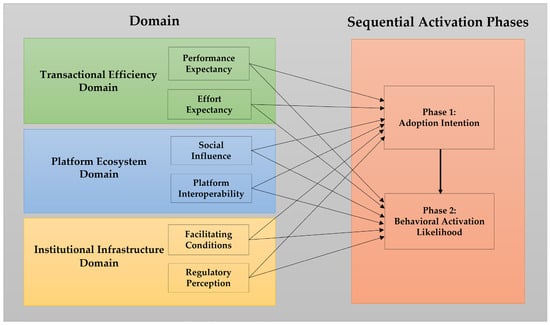
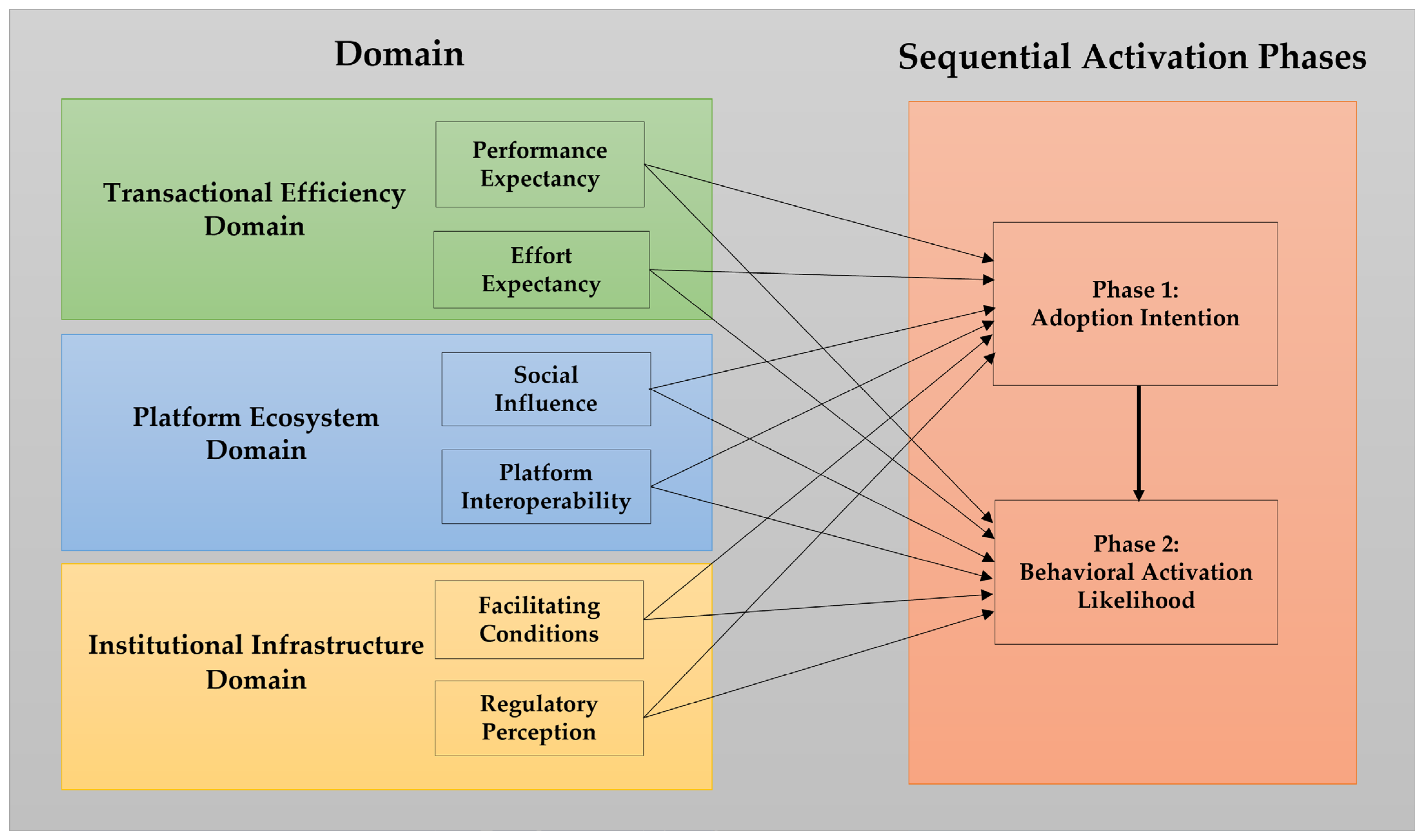
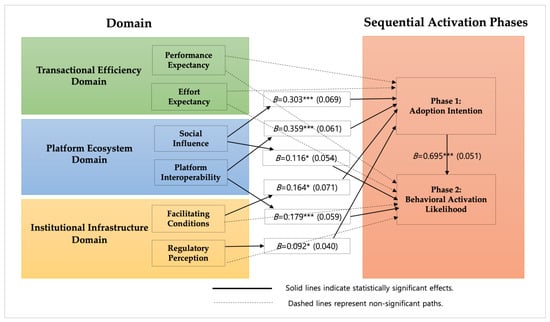
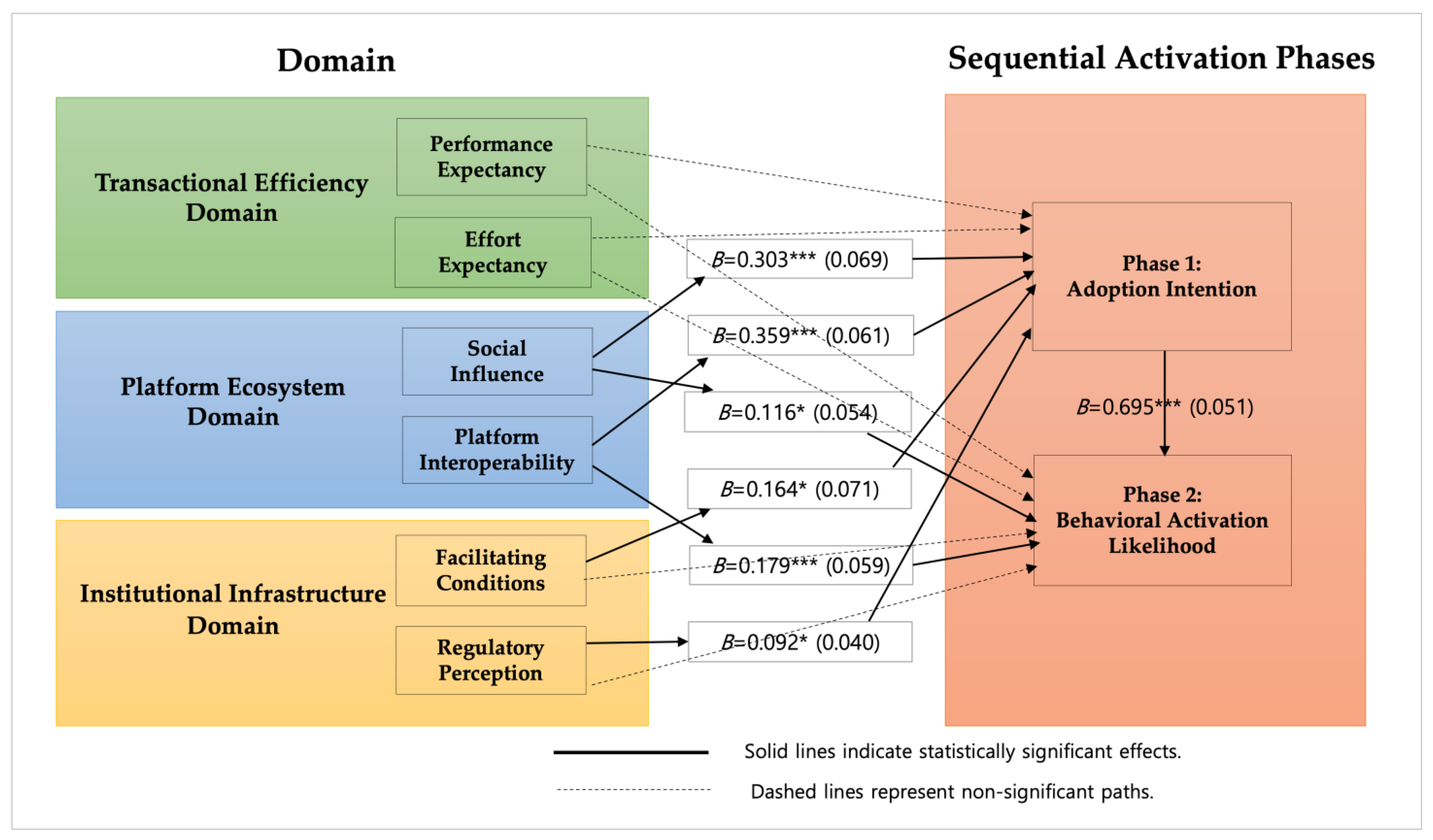

Disclaimer/Publisher’s Note: The statements, opinions and data contained in all publications are solely those of the individual author(s) and contributor(s) and not of MDPI and/or the editor(s). MDPI and/or the editor(s) disclaim responsibility for any injury to people or property resulting from any ideas, methods, instructions or products referred to in the content. |
© 2026 by the authors. Licensee MDPI, Basel, Switzerland. This article is an open access article distributed under the terms and conditions of the Creative Commons Attribution (CC BY) license.