


Abstract
Online customization has become a prominent strategic approach for delivering personalized value. However, prior research has largely examined isolated relationships such as trust and purchase intention, customization and value, or value and loyalty. This study situates the issue within the broader context of digital co-creation and aims to provide an integrated explanation of how trust in an e-vendor and participation in e-customization shape multiple dimensions of customized product value and subsequent repeat purchase intention. Using survey data from 312 customers with prior online customization experience, the proposed relationships were tested through structural equation modeling. The results suggest that trust in an e-vendor increases participation in customization, which in turn enhances utilitarian value, uniqueness value, and self-expressiveness value. These value components positively influence repeat purchase intention, and several mediation effects have emerged. Specifically, participation partly mediates the effect of trust on all three value dimensions, while uniqueness value and self-expressiveness value partly mediate the effect of participation on repeat purchase intention. Overall, the findings provide empirical evidence for a trust–participation–value pathway and highlight the importance of both functional and symbolic value outcomes in sustaining customer engagement in online customization environments.
1. Introduction
The advent of Web 2.0 and AI-driven customization and advanced recommendation systems which highlight collaboration, participation, and openness have led today’s astute consumers to participate in the process of tailoring their products [1,2]. Customers increasingly demonstrate a willingness to pay more for personalized offerings, particularly when facilitated by intuitive online platforms [3]. This evolution reflects a shift from traditional mass customization toward more sophisticated strategies in today’s competitive digitalized market environment [4].
The need for tailoring such products arises from customers’ desire to be unique and enhance their self-concept. Customers take advantage of their operant resources (e.g., specialized skills, knowledge, and energy) and utilize the tools and configurations provided by companies’ websites and/or mobile applications to generate new designs. Such customers can share their operant resources in online platforms to have a positive influence on the decisions of other customers [5]. However, privacy concerns, intangibility, lack of face-to-face communication, and unpredictable situations associated with the internet infrastructure may generate barriers towards online transactions and e-customization [6]. To handle these barriers and establish an online environment where customers engage in co-creation of products and value, their trust in e-vendors is imperative [1]. This is critical because customers’ trust in e-vendors motivates them to customize products online [1,7].
In addition, customers’ participation in e-customization can foster their perceptions of customized product value [3]. That is, customers’ participation in e-customization can enhance their perceptions of utilitarian, uniqueness, and self-expressiveness values. Utilitarian value refers to “the possibility for the consumer to possess the product which is the closest to what they want” [8] (p. 31). Customers obtain uniqueness value when they own a product that exhibits their individuality via uniqueness attributes [8]. Such customers receive self-expressiveness value when they design a product, which represents who they are and reflects their self-concept [8].
The extant literature provides evidence that customers are satisfied with online transactions and display repeat purchase intention or continued use intention when they perceive that their expectations about utilitarian value, uniqueness value, or self-expressiveness value are met [9,10,11]. These findings suggest that customized product value plays a critical role in forming post-purchase behavioral intentions in online contexts.
Building on this body of work, prior research on online customization can be traced back to broader theoretical foundations of customer value, self-concept, and customer participation. Early studies in consumer behavior conceptualized value not only in functional terms but also as symbolic and self-expressive, emphasizing that consumers use products to communicate identity and reinforce self-concept [12,13,14]. Subsequent research further demonstrated that products offering differentiation and personal relevance generated stronger value perceptions, particularly when consumers were actively involved in shaping product attributes and outcomes [8,15,16].
Parallel to this stream, research on customer participation and value co-creation highlighted the active role of customers in the value creation process. Prahalad and Ramaswamy [17] have argued that customer participation constitutes a central mechanism through which value is created and enhanced, rather than a mere input to production [18,19]. This view was later reinforced by service-dominant logic (SDL), which posits that value emerges through interactions between firms and customers and is realized in use rather than embedded in products [20]. Within online customization contexts, participation allows customers to integrate their preferences, skills, and creative efforts into product design, thereby shaping both functional and symbolic value outcomes.
As digital environments became increasingly prevalent, trust emerged as a foundational condition for customer participation in online interactions. Early e-commerce research demonstrated that trust reduced perceived risk and uncertainty, encouraging consumers to engage in online transactions and interactive processes [21,22]. Extending this logic, subsequent studies suggest that trust in an e-vendor functions as an enabling condition for online customization by reducing uncertainty, thereby increasing customers’ willingness to share personal information, invest effort, and actively participate in customization processes [23,24,25]. Collectively, this stream of research converges on the view that trust and customer participation jointly underpin value creation in digital and customization-based settings, as value emerges through customers’ active involvement in the co-creation process [19,20].
Despite these valuable theoretical and empirical insights, the existing literature on online customization has largely evolved along fragmented lines. A substantial body of prior studies shows that online customization enhances consumers’ purchase-related intentions by improving perceived usefulness, enjoyment, or overall value in online contexts [21,22,26,27]. While these studies provide strong evidence for the importance of trust and perceived value, they predominantly model trust as a direct antecedent of purchase or repurchase intention, rather than as a relational condition that enables customers’ active participation in the value creation process.
Related research on customization and co-creation emphasizes customer participation as a key driver of perceived value and experiential outcomes, demonstrating that participation enhances functional benefits, perceived fit, and symbolic outcomes such as self-expression and distinctiveness [8,16,28,29]. However, customer participation is most often treated as an independent antecedent of value or behavioral outcomes, rather than as a mechanism that is enabled by prior relational conditions such as trust. Consequently, empirical explanations of how and why customers decide to engage in e-customization, particularly in digital environments characterized by uncertainty and risk perception, remain limited.
Although customized product value has long been recognized as a multidimensional construct, prior studies typically focus on individual value dimensions or examine them in isolation. Research has linked utilitarian value, uniqueness value, or self-expressiveness value separately to purchase-related outcomes [27,30,31], despite early conceptualizations emphasizing customized product value as a multidimensional construct [8]. Nevertheless, empirical evidence remains scarce on how these value dimensions simultaneously emerge as outcomes of participation in e-customization and concurrently translate into repeat purchase intention within a single explanatory model.
Importantly, existing studies have rarely adopted a process-oriented perspective that integrates trust, participation, and multiple value dimensions within a single framework. This fragmentation is also reflected in recent bibliometric and review studies, which document the dispersed nature of research on online customization, co-creation, and perceived customer value and emphasize the lack of process-oriented explanations of how value is formed in digital environments [32,33]. These studies suggest that while numerous empirical findings exist on isolated relationships, integrative and sequential models explaining value creation remain scarce.
In this vein, customer participation has predominantly been conceptualized as an independent antecedent of value or behavioral outcomes, rather than as an explanatory mechanism that itself requires theoretical grounding. The question of why customers decide to participate—particularly in online environments characterized by uncertainty, risk and information asymmetry—has rarely been modeled explicitly. Yet, prior research demonstrates that the complexity and design of customization processes systematically shape consumers’ trust perceptions, perceived value, and engagement levels [34], implying that participation does not emerge spontaneously but is contingent upon specific relational and contextual conditions.
While trust, participation, and customized product value have each been shown to influence consumer behavior in online settings, they have largely been examined through isolated dyadic relationships (e.g., trust–purchase intention, participation–value, or value–repurchase intention). As a result, the mechanism through which trust in an e-vendor activates customer participation, participation generates multiple dimensions of customized product value, and these value outcomes collectively drive repeat purchasing behavior remains underexplored.
By responding to recent calls for more holistic and process-oriented investigations into digital co-creation and customization outcomes [35,36], this study advances the literature by proposing and empirically testing an integrative trust–participation–value–repeat purchase intention framework in online customization contexts. By conceptualizing customer participation as a key mechanism through which trust is translated into value creation, and by capturing customized product value through concurrent utilitarian, uniqueness, and self-expressiveness dimensions, the proposed model offers a process-oriented explanation of how value is formed and subsequently converted into repeat purchasing behavior.
The objectives of this paper are to: (a) examine the effects of trust in e-vendor and participation in e-customization on utilitarian value, uniqueness value, and self-expressiveness value; (b) assess the impacts of these value components on repeat purchase intention; (c) examine the mediating role of participation in e-customization in the connection between trust in e-vendor and the abovementioned value components; and (d) examine the mediating roles of utilitarian value, uniqueness value, and self-expressiveness value in the connection between participation in e-customization and repeat purchase intention.
The remainder of this paper is organized as follows. The next section of this study presents the theoretical background, research model and hypotheses. This is followed by a description of the methodology and findings of the empirical analysis. The paper concludes with a discussion of the findings, theoretical and managerial implications, and directions for future research.
2. Theoretical Background, Research Model and Hypotheses
2.1. Theoretical Background
This study is grounded in the service-dominant logic (SDL), which conceptualizes value as co-created through interactions between firms and customers rather than embedded in products or delivered unilaterally [20]. From this perspective, customers are active resource integrators who contribute via operant resources such as knowledge, skills, preferences, and effort to the value creation process. Accordingly, customer participation constitutes a theoretically central mechanism through which value emerges. In online customization contexts, value is therefore contingent upon customers’ active involvement in configuring and shaping product attributes, rather than being a direct outcome of customization features alone.
Building on this logic, prior research conceptualizes customized product value as a multidimensional construct encompassing utilitarian, uniqueness, and self-expressiveness dimensions [8]. Utilitarian value reflects the functional alignment between the customized product and consumers’ preferences. Uniqueness value is rooted in consumers’ motivation to differentiate themselves through distinctive product attributes, consistent with need-for-uniqueness theory, which posits that individuals seek differentiation through consumption choices [37]. Self-expressiveness value reflects the symbolic meaning attached to customized products, aligning with psychological ownership theory, which suggests that individuals derive value when objects are perceived as extensions of the self and experienced as “mine” [38]. Together, these perspectives indicate that customization enables customers to transform products into personally meaningful outcomes, but only when they actively participate in the creation process.
Insights from consumer psychology further reinforce the role of participation as a value-generating mechanism. Research on consumer choice demonstrates that perceived control and self-determined choice enhance consumers’ evaluations, psychological attachment, and satisfaction with outcomes [39]. Customization contexts provide opportunities for consumers to control product outcomes, thereby strengthening perceived fit, identity congruence, and value perceptions. However, these benefits depend on consumers’ willingness to engage meaningfully in the process, underscoring that participation is a necessary condition for the emergence of multiple value dimensions.
In digital environments characterized by uncertainty, information asymmetry, and perceived risk, trust plays a critical enabling role in facilitating such participation. Past writings consistently demonstrate that trust reduces perceived risk and functions as a psychological enabler, encouraging engagement in online interactions that require information disclosure and effort investment [21,22,40]. Extending this logic to customization contexts, trust in an e-vendor functions as a relational condition that enables customers to participate by alleviating concerns associated with privacy, uncertainty, and potential misuse of personal inputs. Empirical evidence further suggests that customization can fail to generate value when consumers perceive a lack of control or transparency, whereas trust-enhancing environments foster voluntary engagement and active participation [41]. In this sense, participation represents the behavioral manifestation of trust in online customization settings.
Importantly, value derived from customization is not uniform across contexts. Research on web-based customization demonstrates that consumers’ interpretations of customized outcomes are shaped by how they construe the self in relation to products and others, implying that different value dimensions may become salient across cultural and contextual settings [42]. Related work emphasizes that perceived agency, transparency, and user control in digital systems shape how consumers evaluate customization experiences and derive value from them [43,44]. These insights underscore the importance of conceptualizing customized product value as multidimensional and context-sensitive, without assuming the universal dominance of any single value dimension.
Taken together, these theoretical perspectives support the mechanism in which trust enables customer participation, participation gives rise to multiple dimensions of customized product value, and these value outcomes subsequently shape repeat purchase intention. Grounded in SDL and complementary psychological theories, the present study adopts a process-oriented framework that integrates trust, participation, and multidimensional value creation to explain behavioral continuity in online customization contexts.
2.2. Research Model
In today’s market environment, customization leads prosumers to design their products based on a number of criteria (e.g., aesthetics, functionality, uniqueness) [45,46]. Consistent with SDL [20], value in customization contexts does not reside in the product itself but emerges through customers’ active participation in co-creation processes. Through participation, customers integrate their preferences, creativity, and effort into product design, thereby shaping both functional and symbolic value outcomes. This is achieved through their participation in the co-creation of products and value [20,47]. By participating in this process, customers are motivated to see themselves different from others [12] and tend to own products that fit their self-concept [13,47]. These customers also seek to obtain functional benefits from customized products.
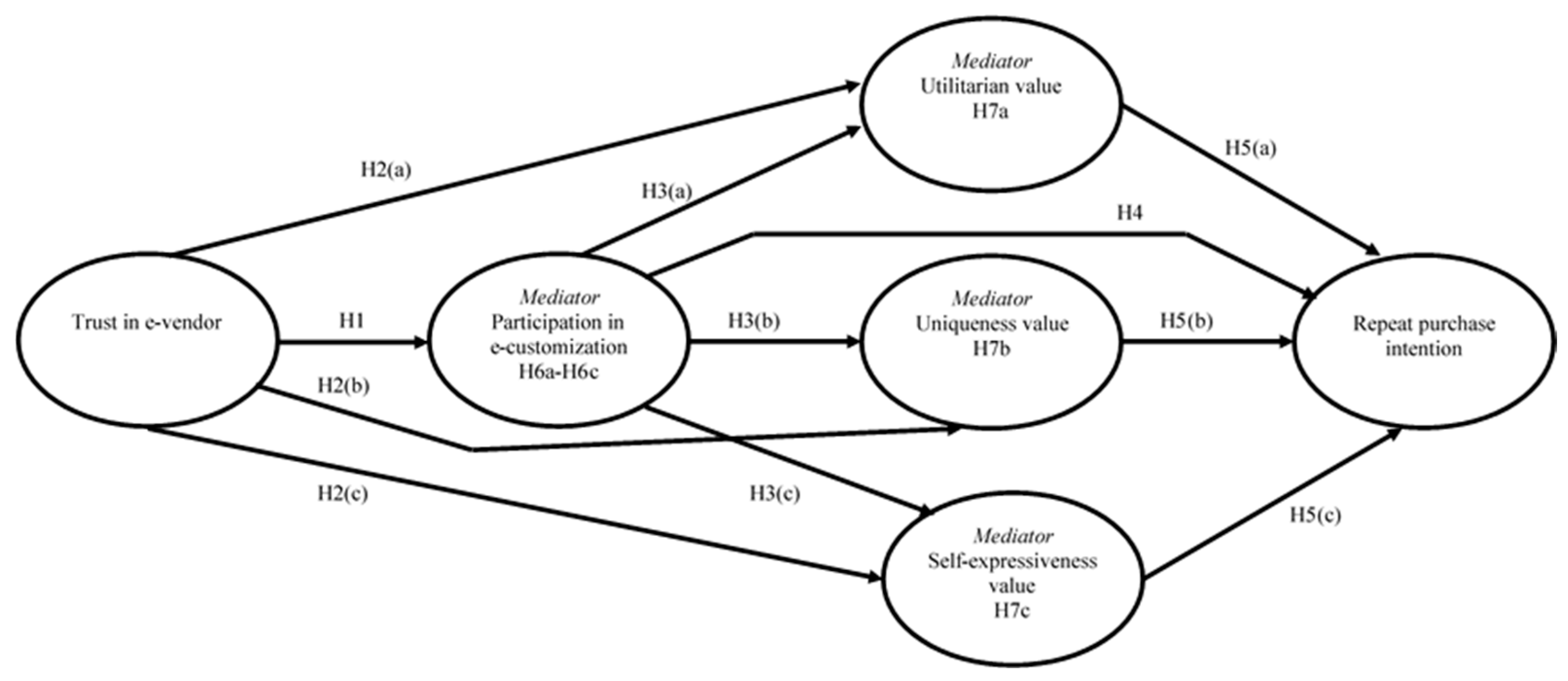
Figure 1 delineates the research model that consists of the direct and mediating effects. The model contends that customers’ trust in e-vendors activates their participation in e-customization and enhances utilitarian, uniqueness, and self-expressiveness values. Their participation in e-customization mediates the effect of trust in e-vendors on customized product value. Our model posits that customers’ participation in e-customization fosters their favorable perceptions of utilitarian, uniqueness, and self-expressiveness values and triggers their repeat purchase intentions. These value components also increase customers’ repeat purchase intentions. According to our model, each of the abovementioned customized product value components mediates the effect of participation in e-customization on repeat purchase intention.
Figure 1.
Research Model.
2.3. Hypotheses
- Direct effects
E-customization enables customers to tailor products through online configuration tools, which fit their different needs. Customers may customize unique and self-designed products, which enable them to obtain the desired value and reflect their identities [45,47,48]. Therefore, e-customization has gained popularity in today’s competitive marketplace because it improves consumers’ experience by involving them [49].
Trust is an important factor that influences customers’ intention to use technology [50], and, in turn, propensity to partake in e-customization. On one hand, customers pay utmost attention to their privacy due to the knowledge sharing process and unauthorized access [35]. On the other hand, customers expect the e-vendor to keep its promises and obligations and provide fitted customized offerings [51]. Under these conditions, trust is a crucial factor that helps the e-vendor to enhance customers’ participation in e-customization. It shapes whether users will try and use customization features by altering perceived risk and controllability. In short, building trust encourages customers to actively take action in the process and leads to higher participation in e-customization [52,53]. Hence, the following hypothesis is advanced:
H1:
Customers’ trust in e-vendors positively influences their participation in e-customization.
Offering secure personal privacy to customers, providing visualization, authenticity, and responsiveness, and keeping promises is a sign of trustworthiness and honesty [54]. This makes customers develop trust in e-vendors. Customers perceiving that there is a trusting and quality connection with the company expect to obtain utilitarian, uniqueness, and self-expressiveness values. More specifically, in a digitalized market environment where customers develop trust in e-vendors, they want to possess the expected utility as a result of purchasing the customized product via active participation [52,55]. Such customers also expect to possess customized products, which reflect their individuality through uniqueness and highlight their self-concept [28]. Therefore, the following hypotheses are postulated:
H2:
Customers’ trust in e-vendors positively influences (a) utilitarian value, (b) uniqueness value, and (c) self-expressiveness value.
Customers’ participation in e-customization is related to customized product value. Broadly speaking, customers engage in co-creation of products and value [20,56]. These customers are likely to have emotional ties based on the functional and aesthetic features of the company’s webpage [57]. This is not surprising because during the participation process, customers spend effort and time, enjoy the steps in e-customization, and have a strong feeling of emotional satisfaction ‘I designed it myself’ [3,58]. Under these circumstances, the process satisfies customers’ utilitarian needs and makes them demand concrete benefits via customized products [59]. Further, customers obtain the chance to have one-of-a-kind customized products with better fit and unique style [36,48], and express themselves by shaping the products in the way they want [60]. This prompts the hypotheses that:
H3:
Customers’ participation in e-customization positively influences (a) utilitarian value, (b) uniqueness value, and (c) self-expressiveness value.
When customers find that the e-customization process is more interactive, collaborative, and entertaining, they are more inclined to exhibit repeat purchase. Such customers’ favorable perceptions about the process enhance their willingness to repurchase [46,61]. In addition, customers’ involvement in the process enables them to co-create value by fostering deeper connections to psychological ownership of customized products [20,62]. This collaborative process encourages them to pay premium for personalization [63]. Not surprisingly, customers exhibit satisfaction as a result of control over the process, which is likely to engender positive feelings of repeat purchase [29,63]. Therefore, the following hypothesis is advanced:
H4:
Customers’ participation in e-customization positively influences their repeat purchase intentions.
Utilitarian value, uniqueness value, or self-expressiveness value is a predictor of repeat purchase intention [29,64,65]. Evidence borrowed from the extant literature supports such premises as Idemen and Elmadag’s [30] work indicates that self-expressiveness value promotes purchase intentions. Özbek’s [31] research documented that utilitarian value triggered positive attitudes towards online apparel customization among Turkish consumers. In the meantime, a study of customizing shoes and cereals illustrated that consumers bought products for not only their tangible utilities, but also for the symbolic meaning associated with their images and need for uniqueness [66]. In view of this, this research proposes that customers display willingness to pay premium price for value-added customized products and exhibit repeat purchase intention when they find that these products meet their expectations based on utilitarian, uniqueness, or self-expressiveness value. Accordingly, the following hypotheses are postulated:
H5a:
Utilitarian value positively influences customers’ repeat purchase intentions.
H5b:
Uniqueness value positively influences customers’ repeat purchase intentions.
H5c:
Self-expressiveness value positively influences customers’ repeat purchase intentions.
- Mediating effects
Customers pay great attention to the issues of privacy and promises given by the e-vendor and seek to receive customized offerings based on their expectations [51]. In an online environment where privacy is maintained, promises are kept, and customized products are provided, customers are more inclined to participate in e-customization. Such customers obtain utilitarian, uniqueness, and self-expressiveness values as a result of their participation in e-customization [3,59,60]. In short, when there is trustworthiness in the e-customization process, customers are likely to obtain customized product value, which responds to their expectations of utilitarian, uniqueness, and self-expressiveness values. This leads to the conclusion that the effect of trust on customized product value is mediated by customers’ participation in e-vendors. Accordingly, the following hypotheses are advanced:
H6:
Customers’ participation in e-customization mediates the effect of trust in e-vendors on (a) utilitarian value, (b) uniqueness value, and (c) self-expressiveness value.
When customers participate in the e-customization process, they actively contribute to the process via their preferences, effort, and creativity to product design, thereby engaging in the co-creation of both products and value [58]. However, participation alone does not automatically translate into repeat purchase intention. Past research indicates that participation influences purchase-related outcomes only insofar as it generates meaningful psychological and value-based consequences for consumers [67]. In customization contexts, active participation enables customers to receive the customized product value, which represents them (self-expressiveness value), creates distinctiveness (uniqueness value), and provides functional benefits (utilitarian value). These value perceptions constitute the primary mechanisms through which customization experiences shape post-purchase behavioral intentions, as customers are more likely to repurchase when participation results in the aforementioned value outcomes [29,68]. Accordingly, customized product value can be conceptualized as a mediating mechanism that explains how participation in e-customization translates into repeat purchase intention. In view of this, the following hypotheses are proposed:
H7a:
Utilitarian value mediates the effect of customers’ participation in e-customization on repeat purchase intention.
H7b:
Uniqueness value mediates the effect of customers’ participation in e-customization on repeat purchase intention.
H7c:
Self-expressiveness value mediates the effect of customers’ participation in e-customization on repeat purchase intention.
3. Method
3.1. Participants and Data Collection
Data were collected through an online survey administered in Türkiye using a purposive sampling strategy targeting individuals with prior experiences in online product customization. Such experience-based sampling is consistent with prior customization research, where meaningful evaluation of participation and customized product value requires respondents with firsthand customization experience [15,19]. To ensure that only eligible participants completed the questionnaire, respondents were first asked a screening question (“Have you ever customized a product online?”), and only those answering “yes” were allowed to proceed. Although purposive sampling may involve a degree of self-selection, it is widely regarded as appropriate for experience-based research contexts. Moreover, recruiting participants through multiple independent channels helps mitigate overreliance on a single self-selected pool [69].
Participants were recruited through three channels commonly used in large-scale online survey research: (1) direct invitations to customers previously identified as customization users (n = 32), (2) online outreach via social media pages of companies offering customization options (n = 249), and (3) an invitation distributed to members of a professional online community (n = 44). Similar multi-source recruitment strategies, particularly social media, have been widely adopted in digital commerce studies to reach users with specific experience profiles [70,71]. In total, 325 responses were received, of which 13 were excluded due to patterned responding, resulting in 312 usable cases for analysis. The final sample size exceeds recommended minimum thresholds for structural equation modeling and is consistent with sample sizes found in prior customization and e-commerce research [18,48]. Participation was voluntary, anonymity was assured, and respondents provided informed consent before beginning the survey.
In addition, respondents were not restricted to a single product category when reporting their online customization experiences. Participants indicated having customized products across multiple categories, including apparel, accessories, footwear, personalized gifts, as well as symbolic and identity-relevant products such as books, calendars and invitations. This heterogeneity suggests that respondents’ experiences with online customization were not confined to one specific product type but rather reflect broader patterns of online customization behavior. Accordingly, the proposed model is specified at a process level, focusing on trust, participation, and value creation mechanisms that are not inherently category specific.
The sample consisted of participants with diverse demographic characteristics. In terms of gender, respondents were relatively balanced, with a slight predominance of female participants. The majority of respondents were between young and middle adulthood, indicating an active segment of online customization users. Regarding education, most participants held at least an undergraduate degree, reflecting a relatively educated customer group with sufficient digital literacy to engage in online customization processes.
3.2. Measurement
Items used to operationalize the constructs were adopted or adapted from different sources. More specifically, trust in e-vendors was assessed with six items [21,22]. Sample items are “This e-vendor is trustworthy and honest” and “This e-vendor cares about customers”. Participation in e-customization was gauged with five items [18,19,23]. Sample items are “Willingness to customize” and “Level of creativity”. Participants used a five-point scale (“5 = very high” to “1 = very low”) to respond to the items in participation in e-customization. Participation in e-customization was operationalized as the extent of customers’ active involvement and contribution during the customization process, capturing effort investment, engagement intensity, and creative input. Consistent with prior research, creativity-related items reflect customers’ depth of participation and idea contribution rather than creative ability as an outcome [19,23].
Utilitarian value, uniqueness value, and self-expressiveness value each consisted of four items [8]. Example items for utilitarian value are “I was able to design a product I really wanted”, and “I was able to create a product that was closest to what I wanted”. Sample items for uniqueness value is “At least I will be the only one to have this product” and “Having this product will let me be different from everyone else”. Example items for self-expressiveness value are “This product really represents who I am” and “This product completely reflects who I am”. Repeat purchase intention was measured with five items [27,72]. Example items are “I am willing to spend to a little more money to buy customized products” and “I plan to buy customized products in the future”.
Participants utilized a five-point scale (“5 = strongly agree” to “1 = strongly disagree”) to respond to the items in trust in e-vendor, utilitarian value, uniqueness value, self-expressiveness value, and repeat purchase intention. The items in the questionnaire were originally prepared in English and then translated into Turkish based on the guidelines of the back-translation method. The instrument was subjected to content validity where three academicians in the field of marketing checked the questionnaire carefully regarding readability and understandability of the items. No amendments were deemed necessary.
4. Results
4.1. Measurement Model
Covariance matrix obtained in LISREL was utilized to test the measurement model and assess the associations in the structural model [73]. The findings based on confirmatory factor analysis highlighted that the overall fit of the model (χ2(628.25)/df(335) = 1.875) was acceptable and fit indices such as comparative fit index (CFI) = 0.95, parsimony normed fit index (PNFI) = 0.80, root mean square error of approximation (RMSEA) = 0.053, and standardized root mean square residual (SRMR) = 0.037 were within acceptable ranges. The confirmatory factor analysis results demonstrated that all the loadings exceeded 0.50 and were significant. The average variance extracted (AVE) for all latent constructs also exceeded 0.50. These findings are presented in Table 1. Hence, convergent validity was verified [74].
Table 1.
Summary Statistics and Correlations of Observed Variables and Average Variance Extracted and Reliability Scores.
Table 1 also consists of the findings regarding summary statistics and correlations for the observed variables as well as AVEs and composite reliability and coefficient alpha scores. All the measures exceeded the threshold 0.60 for composite reliability, while they were greater than the cut-off value of 0.70 for coefficient alpha [75,76]. In short, the measures were reliable.
Discriminant validity was checked based on Fornell and Larcker’s [74] criterion. The AVE for some variables did not exceed the shared variance for the variable with every other variable. Therefore, discriminant validity was re-rechecked using the χ2 test. The findings in Table 2 reveal that the χ2 for each pair of the variables was significant. We also computed the Heterotrait–Monotrait (HTMT) ratios. When variables are conceptually very similar such as uniqueness value and self-expressiveness value, an HTMT value below 0.90 would denote that discriminant validity is corroborated [77]. However, when variables are conceptually more distinct, 0.85, which is a more conservative benchmark, should be reported [77]. In this study, all the HTMT values were below 0.90 (Table 3). In short, discriminant validity was verified [78].
Table 2.
Discriminant Validity Based on the Chi-Square Difference Test.
Table 3.
Heterotrait–Monotrait Ratios.
4.2. Common Method Variance Check
This study checked common method variance in two ways. First, an exploratory factor analysis using principal components was employed. The findings surfacing from the unrotated factor analysis produced the first factor, which explained only 14.22 of the total variance. This is much below 50 percent [79]. Second, the study added an unmeasured latent method factor to the measurement model [80]. The fit statistics of the measurement model with the method factor (χ2(512.51)/df(308) = 1.664, CFI = 0.94, PNFI = 0.73, RMSEA = 0.046, SRMR = 0.043) did not give rise to any substantial differences with the measurement model without the method factor. In addition, the PNFI value without the method factor was >than the one with the method factor. In short, common method variance was negligible in the study [81].
4.3. Structural Model
The skewness value for trust in e-vendor (−0.638), participation in e-customization (−0.592), utilitarian value (−1.234), uniqueness value (−0.647), self-expressiveness value (−0.861), and repeat purchase intention (−0.870) was lower than 3.00. It seemed that data had normal distribution [82].
To assess the linkages among the study variables, our study used one-tailed test (t > 1.65, p < 0.05; and t > 2.33, p < 0.01). The structural model fit the data well (χ2(639.58)/df(339) = 1.887, CFI = 0.95, PNFI = 0.81, RMSEA = 0.053, SRMR = 0.038). The results from structural equation modeling demonstrated that consumer trust was positively linked to participation in e-customization (H1, γ11 = 0.84, t = 9.32), utilitarian value (H2a, γ21 = 0.74, t = 7.80), uniqueness value (H2b, γ31 = 0.60, t = 5.88), and self-expressiveness value (H2c, γ41 = 0.60, t = 5.52). Hence, hypotheses 1, 2a, 2b, and 2c were supported. Participation in e-customization portrayed a positive linkage with utilitarian value (H3a, β21 = 0.16, t = 1.72), uniqueness value (H3b, β31 = 0.29, t = 2.87), self-expressiveness value (H3c, β41 = 0.20, t = 1.87), and repeat purchase intention (H4, β51 = 0.25, t = 2.89). The empirical data provided support for hypotheses 3a, 3b, 3c, and 4. The results further revealed that utilitarian value (H5a, β52 = 0.11, t = 1.69), uniqueness value (H5b, β53 = 0.37, t = 4.47), and self-expressiveness value (H5c, β54 = 0.30, t = 4.92) depicted a positive association with repeat purchase intention. Therefore, hypotheses H5a, H5b, and H5c were supported.
The Sobel test results highlighted that participation in e-customization partly mediated the impact of trust in e-vendor and utilitarian value (H6a, indirect effect = 0.13, z = 1.75), uniqueness value (H6b, indirect effect = 0.24, z = 2.77), and self-expressiveness value (H6c, indirect effect = 0.17, z = 1.79). Accordingly, hypotheses 6a-6c were confirmed. The Sobel test results also indicated that uniqueness value (H7b, indirect effect = 0.11, z = 2.46) and self-expressiveness value (H7c, indirect effect = 0.06, z = 1.71) partly mediated the linkage between participation in e-customization and repeat purchase intention. In short, there was empirical support for hypothesis 7b and 7c. However, the empirical data did not lend any credence to utilitarian value as a mediator of the influence of participation in e-customization on repeat purchase intention (H7a, indirect effect = 0.02, z = 1.09). The variance explained by participation in e-customization, utilitarian value, uniqueness value, self-expressiveness value, and repeat purchase intention was 70 percent, 77 percent, 74 percent, 59 percent, and 84 percent, respectively. Table 4 delineates the summary of the hypotheses, which are supported or are not supported.
Table 4.
Summary of the Hypotheses Test Findings.
5. Discussion
5.1. General Findings
This paper set out to develop and test a research model that explains the antecedents and consequences of customized product value in online customization settings. Specifically, the model examined participation in e-customization as a mediator between trust in an e-vendor and three value components—utilitarian value, uniqueness value, and self-expressiveness value—and, in turn, assessed these value components as mediators linking participation in e-customization to repeat purchase intention. Overall, the empirical findings provide strong support for the viability of the proposed framework. Of the 17 hypotheses tested, 16 were supported by the data, indicating that the relationships proposed in the model are largely consistent with consumer responses to online customization experiences.
The findings indicate that customers’ trust in an e-vendor plays a critical role in shaping both their participation in e-customization and their perceptions of utilitarian value, uniqueness value, and self-expressiveness value. When customers believe that an e-vendor protects their privacy, ensures secure technological infrastructure, offers products that fit their needs, and consistently fulfills its promises [35,51,52], they are more willing to engage actively in the customization process. Participation, in turn, enables customers to achieve the functional benefits, uniqueness, and self-concept they expect from customized products, thereby enhancing their evaluations of utilitarian, uniqueness, and self-expressiveness values. From the SDL perspective, these findings reinforce the view that value emerges through customers’ active participation and use experiences, while identity-based and psychological ownership mechanisms explain how participation translates into symbolic and self-related value outcomes [20,38].
The findings further suggest that three components of customized product value as well as participation in e-customization enhance customers’ repeat purchase intentions. Such customers are more inclined to repurchase customized products due to the fact that their expectations relating to functional benefits, uniqueness, and self-concept were met. These findings regarding the linkage between customized product value and repeat purchase intention corroborate the evidence given by other studies [29,65,68].
The abovementioned findings highlight the mediating role of participation in e-customization and customized product value. Specifically, customers’ participation in e-customization partly mediates the impact of their trust in e-vendors on utilitarian value, uniqueness value, and self-expressiveness value. Uniqueness value and self-expressiveness value partly mediate the effect of customers’ participation in customization.
An important nuance emerging from the findings concerns the non-significant mediating role of utilitarian value in the relationship between participation in e-customization and repeat purchase intention (H7a). This result suggests that although participation fosters customers’ perceptions of functional fit, such utilitarian benefits alone may be insufficient to motivate repeat purchasing in customization contexts. Prior research indicates that functional value tends to operate as a baseline expectation in online shopping, particularly when customization tools are widely accessible and standardized, thereby limiting its differentiating power [15,27]. In contrast, symbolic value dimensions such as uniqueness and self-expressiveness provide consumers with identity-relevant and emotionally meaningful outcomes that extend beyond basic functional performance. From an SDL perspective, this finding reinforces the view that value is phenomenologically determined and context-dependent, with experiential and self-related benefits playing a more central role in driving behavioral continuity than utilitarian efficiency alone.
From a theoretical standpoint, these findings strongly support the SDL perspective, where value is not embedded in the customized product itself but emerges through customers’ active participation and use experiences [20]. Trust in the e-vendor functions as a critical enabling condition that allows customers to engage in this value co-creation process. Without sufficient trust, participation and thus value formation remain constrained. Moreover, the stronger mediating roles of uniqueness and self-expressiveness values highlight the importance of symbolic and identity-based mechanisms in customization contexts. These findings are consistent with psychological ownership and self-concept theories [14,38], suggesting that repeat purchase intention is driven less by functional optimization and more by the extent to which customized products become extensions of the self.
By exploring the factors that influence utilitarian value, uniqueness value, and self-expressiveness value and the impacts of these value components simultaneously on repeat purchase intentions, this study addresses previously unexamined gaps in the literature and contributes to a more holistic understanding of value formation and behavioral outcomes in online customization contexts. A key strength of the proposed model lies in its process-oriented structure, which simultaneously captures relational antecedents (trust), behavioral mechanisms (participation), and multidimensional value outcomes within a single framework. Unlike prior customization research that predominantly focuses on isolated dyadic relationships, the model integrates these constructs into an explanatory mechanism, thereby providing a more holistic understanding of how value is formed in online co-creation environments. Another strength of the model is its multidimensional conceptualization of customized product value, allowing functional and symbolic value dimensions to be examined concurrently rather than independently. This enables a more nuanced interpretation of consumer behavior by revealing that identity-related value outcomes may play a stronger role than purely utilitarian benefits in driving repeat purchase intention. Furthermore, by positioning participation as a process-based mechanism rather than a simple antecedent, the model advances theoretical integration across trust, co-creation, and consumer value literature and offers a framework that can be extended to diverse digital customization contexts.
5.2. Theoretical and Practical Implications
The findings of this study offer both theoretical and practical implications. From a theoretical perspective, this study contributes to the pertinent literature in three important ways. First, it extends SDL by empirically demonstrating that trust functions as an enabling condition that transforms customer participation into multidimensional value creation within online customization contexts. Second, the findings advance research on customized product value by showing that uniqueness and self-expressiveness—rather than purely utilitarian benefits—play a more central role in driving repeat purchase intention, thereby supporting psychological ownership and self-concept perspectives. Third, by conceptualizing participation as a process-based mechanism linking trust to value formation, the study moves beyond fragmented dyadic relationships and offers a more integrated explanation of value creation in digital co-creation environments.
From a practical standpoint, several managerial implications emerge. First and foremost, trust in e-vendors is a foundational driver of both participation in customization and perceptions of customized product value. This underscores the necessity of cultivating a trustworthy digital environment that minimizes perceived risk and increases customers’ willingness to invest time, effort, and personal information in the customization process. Managers should therefore prioritize robust data protection practices, transparent privacy policies, and secure technological infrastructures. Concrete actions—such as displaying recognized security certificates, providing clear explanations of how customer data are used, implementing multi-layer encryption, and ensuring reliable platform performance—can strengthen customers’ perceptions of vendor integrity and competence.
Beyond security, trust is also reinforced through consistent operational reliability. Firms must deliver on all promises related to the customization experience, including product quality, delivery accuracy, and the faithfulness of custom configurations. Fulfilling these expectations not only reduces uncertainty but also enhances customers’ confidence in their ability to achieve the desired outcome through customization. In a digital marketplace where word-of-mouth spreads rapidly and reputational damage can occur instantly, maintaining high levels of transparency, consistency, and accountability becomes essential for sustaining customer engagement and loyalty.
Second, and more strategically, firms should recognize that the strategic value of customization lies not merely in enabling functional fit but in facilitating identity expression and perceived uniqueness. Customization interfaces that emphasize creative freedom, visibility of personalized outcomes, and symbolic differentiation may therefore be more effective in fostering long-term customer relationships than those focused primarily on efficiency or convenience. Beyond general interface improvements, managers may introduce design-history tracking, personalized creator badges, or shareable customization galleries that reinforce psychological ownership and uniqueness perceptions. In addition, real-time privacy indicators and transparent data-use cues embedded within the customization interface can strengthen trust at the moment of participation, thereby increasing customers’ willingness to invest effort and disclose preferences. These design-oriented measures translate participation into psychologically meaningful value, which our findings suggest is a stronger driver of repeat purchase than purely functional optimization.
Third, managers should ensure that customers can clearly obtain utilitarian, uniqueness, and self-expressiveness values through their participation in the customization process. When customers experience functional benefits, feel that the product reflects their individuality, and perceive that the final outcome aligns with their self-concept, they are more inclined to share these positive experiences publicly via tweets, posts, reviews, or user-generated videos. Such organic, customer-driven communication acts as powerful social proof, amplifying the visibility of the co-creation value process and signaling credibility to prospective buyers who may be hesitant or inexperienced with customization. E-vendors can further leverage this effect by curating and disseminating customer testimonials or customization showcase videos on social media provided that explicit customer consent is obtained. This practice not only reinforces trust but also encourages prospective prosumers to initiate or repeat purchases.
Finally, firms should continuously invest in modern, intuitive, and user-friendly configuration tools. Advanced interface features such as real-time 3D previews, drag-and-drop customization, guided recommendations, and mobile-friendly configurators can significantly enhance customers’ ability to design products that match their aesthetic preferences and functional needs. A seamless customization environment reduces cognitive effort, increases perceived value, and strengthens the overall co-creation experience. By enabling customers to effortlessly create products that feel meaningful and personally expressive, companies can more effectively deliver the value outcomes that drive satisfaction and repeat purchase intention.
5.3. Limitations and Future Research
Several limitations of the present study should be acknowledged, as they provide fruitful directions for future research. First, the study relied on cross-sectional data, which restricted the ability to draw definitive causal inferences. Although the proposed relationships are theoretically grounded and empirically supported, future research would benefit from longitudinal or experimental designs that can more rigorously establish temporal precedence and causality. Second, although purposive sampling was necessary to ensure participants’ prior experiences with online customization, and multiple recruitment channels were used to mitigate potential self-selection bias, such bias cannot be entirely ruled out. Future research may therefore employ experimental or longitudinal designs to further address potential self-selection effects and examine the stability of participation–value–outcome relationships over time.
Third, prior experience with online customization may play an important role in shaping how prosumers evaluate and respond to customized product value. For example, the influence of uniqueness value on repeat purchase intention may differ between highly experienced and inexperienced users. Incorporating prior experience as a moderating variable could therefore enhance the explanatory power of future models and provide deeper insight into the current literature. Fourth, while the data were collected in Türkiye, this study does not aim to provide population-level generalizations. Rather, it focuses on examining process-oriented relationships between trust, participation, and value creation, which are theoretically grounded and not inherently context-specific. Nevertheless, future research could test the proposed model across different cultural and institutional contexts to further assess its boundary conditions.
Finally, although the study captures online customization experiences across multiple product categories, category-specific differences were not explicitly examined. Nevertheless, we recognize category-specific variation as an important direction for future research, as customization processes and value perceptions may differ depending on product involvement, complexity, or symbolic relevance. In closing, at a time of changing digitalized market environment where prosumers are highly involved in the co-creation value process, the issues we highlighted above should remain as a research priority.
Author Contributions
Conceptualization, E.Y. and S.N.; methodology, E.Y. and O.M.K.; software, O.M.K.; validation, O.M.K.; formal analysis, E.Y. and O.M.K.; investigation, E.Y. and S.N.; resources, E.Y.; data curation, E.Y.; writing—original draft preparation, E.Y. and O.M.K.; writing—review and editing, E.Y., O.M.K. and S.N.; visualization, E.Y.; supervision, O.M.K. All authors have read and agreed to the published version of the manuscript.
Funding
This research received no external funding.
Institutional Review Board Statement
This study was approved by the Institutional Review Board at Sakarya University, Türkiye, E-61923333-050.99-546481, on 24 December 2025.
Informed Consent Statement
Informed consent was obtained from all subjects involved in the study.
Data Availability Statement
The data presented in this study are available from the corresponding author upon request.
Conflicts of Interest
The authors declare no conflicts of interest.
References
- Teepapal, T. AI-driven personalization: Unraveling consumer perceptions in social media engagement. Comput. Hum. Behav. 2025, 165, 108549. [Google Scholar] [CrossRef] [Scilit]
- Gomes, M.A.; Meisen, P.; Meisen, T. Efficient personalization in e-commerce: Leveraging universal customer representations with embeddings. J. Theor. Appl. Electron. Commer. Res. 2025, 20, 12. [Google Scholar] [CrossRef] [Scilit]
- Ettis, S.A.; Sellami, A. “I’ll do it for myself”: Enhancing customer value through online product customization experience. J. Retail. Consum. Serv. 2025, 82, 104143. [Google Scholar] [CrossRef] [Scilit]
- Jost, P.J. Market expansion and the scope of mass customization. Mark. Lett. 2024, 35, 73–94. [Google Scholar] [CrossRef] [Scilit]
- Van Nguyen, L.T.; Conduit, J.; Lu, V.N.; Hill, S.R. Collective empowerment in online communities: Conceptualization, scale refinement, and validation. J. Mark. Theory Pract. 2020, 28, 301–317. [Google Scholar] [CrossRef] [Scilit]
- Hilafu, H.; Letizia, P.; Roma, P. Product customization and returns: The moderating role of national culture. Prod. Oper. Manag. 2025, 34, 886–903. [Google Scholar] [CrossRef] [Scilit]
- Oliveira, N.; Cunha, J.; Carvalho, H. Online footwear customization: Experts’ overview. In Textiles, Identity and Innovation: In Touch, 1st ed.; Montagna, G., Carvalho, C., Eds.; CRC Press: Lisbon, Portugal, 2020; pp. 473–480. [Google Scholar]
- Merle, A.; Chandon, J.L.; Roux, E. Understanding the perceived value of mass customization: The distinction between product value and experiential value of co-design. Rech. Appl. Mark. Engl. Ed. 2008, 23, 27–50. [Google Scholar] [CrossRef] [Scilit]
- Feng, C.; Martínez-Lopez, F.J.; Li, Y.; Campo-Fernandez, J. Personalize it, no return: Nudging online consumers toward product personalization with herd instinct and regret nudges. Electron. Commer. Res. Appl. 2025, 73, 101525. [Google Scholar] [CrossRef] [Scilit]
- Tawira, L.; Ivanov, A. Leveraging personalization and customization affordances of virtual try-on apps for a new model in apparel m-shopping. Asia Pac. J. Mark. Logist. 2023, 35, 451–471. [Google Scholar] [CrossRef] [Scilit]
- Kim, S.J.; Kim, K.H.; Choi, J. The role of design innovation in understanding purchase behavior of augmented products. J. Bus. Res. 2019, 99, 354–362. [Google Scholar] [CrossRef] [Scilit]
- Snyder, C.R. Product scarcity by need for uniqueness interaction: A consumer catch-22 carousel? Basic Appl. Soc. Psychol. 1992, 13, 9–24. [Google Scholar] [CrossRef] [Scilit]
- Sirgy, M.J. Self-concept in consumer behavior: A critical review. J. Consum. Res. 1982, 9, 287–300. [Google Scholar] [CrossRef] [Scilit]
- Belk, R.W. Extended self in consumer behavior. J. Consum. Res. 1988, 15, 139–168. [Google Scholar] [CrossRef] [Scilit]
- Franke, N.; Schreier, M. Why customers value self-designed products: The importance of process effort and enjoyment. J. Prod. Innov. Manag. 2010, 27, 1020–1103. [Google Scholar] [CrossRef] [Scilit]
- Franke, N.; Schreier, M.; Kaiser, U. The “i designed it myself” effect in mass customization. Manag. Sci. 2009, 56, 125–140. [Google Scholar] [CrossRef] [Scilit]
- Prahalad, C.K.; Ramaswamy, V. Co-creation experiences: The next practice in value creation. J. Interact. Mark. 2004, 18, 5–14. [Google Scholar] [CrossRef] [Scilit]
- Chan, K.W.; Yim, C.K.B.; Lam, S.S.K. Is customer participation in value creation a double-edged sword? Evidence from professional financial services across cultures. J. Mark. 2010, 74, 48–64. [Google Scholar] [CrossRef] [Scilit]
- Fang, E.; Palmatier, R.W.; Evans, K.R. Influence of customer participation on creating and sharing of new product value. J. Acad. Mark. Sci. 2008, 36, 322–336. [Google Scholar] [CrossRef] [Scilit]
- Vargo, S.L.; Lusch, R.F. Institutions and axioms: An extension and update of service-dominant logic. J. Acad. Mark. Sci. 2016, 44, 5–23. [Google Scholar] [CrossRef] [Scilit]
- Chen, Y.-H.; Barnes, S. Initial trust and online buyer behavior. Inf. Manag. Data Syst. 2007, 107, 21–36. [Google Scholar] [CrossRef] [Scilit]
- Gefen, D.; Karahanna, E.; Straub, D.W. Trust and TAM in online shopping: An integrated model. MIS Q. 2003, 27, 51–90. [Google Scholar] [CrossRef] [Scilit]
- Moorman, C. Organizational market information process: Cultural antecedents and new product outcomes. J. Mark. Res. 1995, 32, 318–335. [Google Scholar] [CrossRef] [Scilit]
- Cho, H.; Fiorito, S.S. Acceptance of online customization for apparel shopping. Int. J. Retail Distrib. Manag. 2009, 37, 389–407. [Google Scholar] [CrossRef] [Scilit]
- Thirumalai, S.; Sinha, K.K. Customization of the online purchase process in electronic retailing and customer satisfaction: An online field study. J. Oper. Manag. 2011, 29, 477–487. [Google Scholar] [CrossRef] [Scilit]
- Cuong, D.T. The influence of utilitarian value, hedonic value, and online review on satisfaction, trust, and repurchasing intention in e-commerce platforms. Innov. Mark. 2025, 21, 105–118. [Google Scholar] [CrossRef] [Scilit]
- Chiu, C.M.; Wang, E.T.G.; Fang, Y.H.; Huang, H.Y. Understanding customers’ repeat purchase intentions in B2C e-commerce: The roles of utilitarian value, hedonic value and perceived risk. Inf. Syst. J. 2014, 24, 85–114. [Google Scholar] [CrossRef] [Scilit]
- Lei, S.; Wang, X.; Peng, L.; Guo, Y. “I” seek differentiation and “we” seek assimilation: The impact of self-expressive customization on consumers’ willingness to pay a premium. J. Prod. Brand Manag. 2021, 30, 691–706. [Google Scholar] [CrossRef] [Scilit]
- Kim, H.Y.; Lee, Y. The effect of online customization on consumers’ happiness and purchase intention and the mediating roles of autonomy, competence, and pride of authorship. Int. J. Hum.-Comput. Interact. 2020, 36, 403–413. [Google Scholar] [CrossRef] [Scilit]
- Idemen, E.; Elmadag, A.B. Beyond looks: How designer cues win over customers through social value, self-expression, and design involvement. J. Glob. Sch. Mark. Sci. 2024, 34, 186–206. [Google Scholar] [CrossRef] [Scilit]
- Özbek, A. Analysis of Turkish consumers’ customized clothing purchase intention. Text. Appar. 2025, 35, 64–75. [Google Scholar] [CrossRef]
- Rubiyanti, N.; Faiz, M.; Pradana, M. A bibliometric analysis of research trends on customization to improve consumer relationships. PaperASIA 2025, 41, 91–100. [Google Scholar] [CrossRef] [Scilit]
- Xu, Y. Customer customization: Literature review and future prospects. Highlights Bus. Econ. Manag. 2024, 39, 1036–1042. [Google Scholar] [CrossRef] [Scilit]
- Matzler, K.; Stieger, D.; Füller, J. Consumer confusion in internet-based mass customization: Testing a network of antecedents and consequences. J. Consum. Policy 2011, 34, 231–247. [Google Scholar] [CrossRef] [Scilit]
- Raji, M.A.; Olodo, H.B.; Oke, T.T.; Addy, W.A.; Ofodile, O.C.; Oyewole, A.T. E-commerce and consumer behavior: A review of AI-powered personalization and market trends. GSC Adv. Res. Rev. 2024, 18, 066–077. [Google Scholar] [CrossRef] [Scilit]
- De Bellis, E.; Hildebrand, C.; Ito, K.; Herrmann, A.; Schmitt, B. Personalizing the customization: A matching theory of mass customization interfaces and cultural information processing. J. Mark. Res. 2019, 56, 1050–1065. [Google Scholar] [CrossRef] [Scilit]
- Tian, K.T.; Bearden, W.O.; Hunter, G.L. Consumers’ need for uniqueness: Scale development and validation. J. Consum. Res. 2001, 28, 50–66. [Google Scholar] [CrossRef] [Scilit]
- Pierce, J.L.; Kostova, T.; Dirks, K.T. Toward a theory of psychological ownership in organizations. Acad. Manag. Rev. 2001, 26, 298–310. [Google Scholar] [CrossRef] [Scilit]
- Botti, S.; Iyengar, S.S. The dark side of choice: When choice impairs social welfare. J. Public Policy Mark. 2006, 25, 24–38. [Google Scholar] [CrossRef] [Scilit]
- Park, J.K.; Han, H.J.; Park, J.H. Psychological antecedents and risk on attitudes toward e-customization. J. Bus. Res. 2013, 66, 2552–2559. [Google Scholar] [CrossRef] [Scilit]
- Aguirre, E.; Mahr, D.; Grewal, D.; de Ruyter, K.; Wetzels, M. Unraveling the personalization paradox: The effect of information collection and trust-building strategies on online advertisement effectiveness. J. Retail. 2015, 91, 34–49. [Google Scholar] [CrossRef] [Scilit]
- Li, C.; Kalyanaraman, S. “I, me, mine” or “us, we, ours?”: The influence of cultural psychology on web-based customization. Media Psychol. 2013, 6, 272–294. [Google Scholar] [CrossRef] [Scilit]
- Hutmacher, F.; Appel, M. The psychology of personalization in digital environments: From motivation to well-being—A theoretical integration. Rev. Gen. Psychol. 2022, 27, 26–40. [Google Scholar] [CrossRef] [Scilit]
- Marathe, S.; Sundar, S.S. What drives customization? Control or identity? In Proceedings of the SIGCHI Conference on Human Factors in Computing Systems, Vancouver, BC, Canada, 7—12 May 2011; ACM: New York, NY, USA, 2011. [Google Scholar] [CrossRef] [Scilit]
- Krause, F.; Görgen, J.; De Bellis, E.; Franke, N.; Burghartz, P.; Klanner, I.-M.; Häubl, G. One-of-a-kind products: Leveraging strict uniqueness in mass customization. Int. J. Res. Mark. 2023, 40, 823–840. [Google Scholar] [CrossRef] [Scilit]
- Pallant, J.; Sands, S.; Karpen, I. Product customization: A profile of consumer demand. J. Retail. Consum. Serv. 2020, 54, 102030. [Google Scholar] [CrossRef] [Scilit]
- Zaggl, M.A.; Linzmajer, M.; Walsh, G.; Reinhardt, R.; Pottbacker, J. Success of mass customization toolkits: Product design typicality as boundary condition. J. Bus. Res. 2025, 200, 115669. [Google Scholar] [CrossRef] [Scilit]
- Cheung, M.L.; Pires, G.D.; Rosenberg, P.J.; De Oliveira, M.J. Driving consumer-brand engagement and co-creation by brand interactivity. Mark. Intell. Plan. 2020, 38, 523–541. [Google Scholar] [CrossRef] [Scilit]
- Li, X.; Si, W.; Chan, K.W. Virtual agents that flatter you: Moderating effects of self-esteem and customization target in e-customization services. Psychol. Mark. 2024, 41, 344–363. [Google Scholar] [CrossRef] [Scilit]
- Zhang, K.; Luo, J.; Huang, Q.; Zhang, K.; Du, J. The Effect of perceived interactivity on continuance intention to use ai conversational agents: A two-stage hybrid PLS-ANN approach. J. Theor. Appl. Electron. Commer. Res. 2025, 20, 255. [Google Scholar] [CrossRef] [Scilit]
- Özdemir, M.; Van Goethem, S.; De Buysscher, X.; Delrue, V.; Verburgh, A.; Van Gastel, A.; Verlinden, J. Towards understanding customer co-creation experience for mass customization. In Advances in Usability, User Experience, Wearable and Assistive Technology, 1st ed.; Ahram, T., Falcao, C., Eds.; Springer Nature: Basel, Switzerland, 2020; pp. 143–149. [Google Scholar]
- Chan-Olmsted, S.; Chen, H.; Kim, H.J. In smartness we trust: Consumer experience, smart device personalization and privacy balance. J. Consum. Mark. 2024, 41, 597–609. [Google Scholar] [CrossRef] [Scilit]
- Wang, X.; Tajvidi, M.; Lin, X.; Hajli, N. Towards an ethical and trustworthy social commerce community for brand value co-creation: A trust-commitment perspective. J. Bus. Ethics 2020, 167, 137–152. [Google Scholar] [CrossRef] [Scilit]
- Wongkitrungrueng, A.; Assarut, N. The role of live streaming in building consumer trust and engagement with social commerce sellers. J. Bus. Res. 2020, 117, 543–556. [Google Scholar] [CrossRef] [Scilit]
- Matthews, D.; Rothenberg, L.; Gopalakrishnan, S. The impact of mass customization on fashion-innovative students: An assessment of need for uniqueness, self-identity, and perceived performance risk. Int. J. Fash. Des. 2019, 12, 293–300. [Google Scholar] [CrossRef] [Scilit]
- Bouchriha, Z.; Farid, S.; Ouiddad, S. Enhancing value co-creation behaviors through customer engagement in the Moroccan hotel context: Effects on satisfaction and brand image. J. Qual. Assur. Hosp. Tour. 2024, 25, 1581–1606. [Google Scholar] [CrossRef] [Scilit]
- Yang, K.; Kim, H.M.; Zimmerman, J. Emotional branding on fashion brand websites: Harnessing the Pleasure-Arousal-Dominance (P-A-D) model. J. Fash. Mark. Manag. 2020, 24, 555–570. [Google Scholar] [CrossRef] [Scilit]
- Wang, Z.; Dai, M.; Sun, X.; Zhou, M. A higher satisfaction product customization method for different customer groups. Multimed. Tools Appl. 2024, 83, 36571–36601. [Google Scholar] [CrossRef] [Scilit]
- Powell, C.; Zhu, E.; Xiong, Y.; Yang, S. A data-driven approach to predicting consumer preferences for product customization. Adv. Eng. Inform. 2024, 59, 102321. [Google Scholar] [CrossRef] [Scilit]
- Maier, L.; Baccarella, C.V. The psychological and behavioral consequences of customer empowerment in new product development: Situational framework, review, and research agenda. J. Prod. Innov. Manag. 2025, 42, 220–252. [Google Scholar] [CrossRef] [Scilit]
- Lambillotte, L.; Magrofuoco, N.; Poncin, I.; Vanderdonckt, J. Enhancing playful customer experience with personalization. J. Retail. Consum. Serv. 2022, 68, 103017. [Google Scholar] [CrossRef] [Scilit]
- Lv, X.; Yuan, Z.; Luo, J.; Fu, X.; Shen, H.; Ai, J.; Shen, Y. Purchase and protect: Dual effects of tourist souvenir customization. J. Travel Res. 2025, 64, 1843–1863. [Google Scholar] [CrossRef] [Scilit]
- Yang, Y.; Yang, Y.; Shafi, M. Co-creation and consumers’ willingness to pay premium: Effect of involvement and satisfaction with co-creation process. J. Knowl. Econ. 2024, 15, 10151–10173. [Google Scholar] [CrossRef] [Scilit]
- Padual, S.R.M.; Ong, A.K.S.; German, J.D.; Gumasing, M.J.J. The need for individualization: An open innovation perspective on the case for customized products. Acta Psychol. 2024, 249, 104473. [Google Scholar] [CrossRef] [Scilit] [PubMed]
- Seo, S.; Lang, C. Psychogenic antecedents and apparel customization: Moderating effects of gender. Fash. Text. 2019, 6, 19. [Google Scholar] [CrossRef] [Scilit]
- Petruzzellis, L.; Winer, R.S. The decision to customize and its effect on brand experience. Psychol. Mark. 2023, 40, 516–530. [Google Scholar] [CrossRef] [Scilit]
- Jiang, Z.; Chan, J.; Tan, B.C.Y.; Chua, W.S. Effects of interactivity on website involvement and purchase intention. J. Assoc. Inf. Syst. 2010, 11, 34–59. [Google Scholar] [CrossRef] [Scilit]
- Chen-Yu, J.H.; Yang, J.H. Consumer characteristics as predictors of purchase intentions and willingness to pay a premium for men’s mass-customized apparel. J. Glob. Fash. Mark. 2020, 11, 154–170. [Google Scholar] [CrossRef] [Scilit]
- Hiratsuka, T. The volunteer participation paradox: Ethical tensions between self-selection and targeted sampling. Res. Methods Appl. Linguist. 2025, 4, 100206. [Google Scholar] [CrossRef] [Scilit]
- Beam, E.A. Social media as a recruitment and data collection tool: Experimental evidence on the relative effectiveness of web surveys and chatbots. J. Dev. Econ. 2023, 162, 103069. [Google Scholar] [CrossRef] [Scilit]
- Arndt, A.D.; Ford, J.B.; Babin, B.J.; Luong, V. Collecting samples from online services: How to use screeners to improve data quality. Int. J. Res. Mark. 2022, 39, 117–133. [Google Scholar] [CrossRef] [Scilit]
- Wen, L.Y.M.; Li, S.H. A study on the relationship amidst health consciousness, ecological affect, and purchase intention of green product. Int. J. Organ. Innov. 2013, 5, 124–137. [Google Scholar]
- Jöreskog, K.; Sörbom, D. LISREL 8: User’s Reference Guide; Scientific Software International: Chicago, IL, USA, 1996. [Google Scholar]
- Fornell, C.; Larcker, D.F. Evaluating structural equation models with unobservable variables and measurement error. J. Mark. Res. 1981, 18, 39–50. [Google Scholar] [CrossRef] [Scilit]
- Bagozzi, R.P.; Yi, Y. On the evaluation of structural equation models. J. Acad. Mark. Sci. 1988, 16, 74–94. [Google Scholar] [CrossRef]
- O’Leary-Kelly, S.W.; Vokurka, R.J. The empirical assessment of construct validity. J. Oper. Manag. 1998, 16, 387–405. [Google Scholar] [CrossRef] [Scilit]
- Henseler, J.; Ringle, C.M.; Sarstedt, M. A new criterion for assessing discriminant validity in variance-based structural equation modeling. J. Acad. Mark. Sci. 2015, 43, 115–135. [Google Scholar] [CrossRef] [Scilit]
- Anderson, J.C.; Gerbing, D.W. Structural equation modeling in practice: A review and recommended two-step approach. Psychol. Bull. 1988, 103, 411–423. [Google Scholar] [CrossRef]
- Mishra, A.S. Antecedents of consumers’ engagement with brand-related content on social media. Mark. Intell. Plan. 2019, 37, 386–400. [Google Scholar] [CrossRef] [Scilit]
- Xie, Y.; Zheng, X. How corporate learning orientation enhances industrial brand equity. The roles of firm capabilities and sizes. J. Bus. Ind. Mark. 2020, 35, 231–243. [Google Scholar] [CrossRef] [Scilit]
- Podsakoff, P.M.; MacKenzie, S.B.; Podsakoff, N.P. Sources of method bias in social science research and recommendations on how to control it. Annu. Rev. Psychol. 2012, 63, 539–569. [Google Scholar] [CrossRef] [Scilit]
- Kline, R.B. Principles and Practice of Structural Equation Modeling, 3rd ed.; The Guilford Press: New York, NY, USA, 2011. [Google Scholar]

Disclaimer/Publisher’s Note: The statements, opinions and data contained in all publications are solely those of the individual author(s) and contributor(s) and not of MDPI and/or the editor(s). MDPI and/or the editor(s) disclaim responsibility for any injury to people or property resulting from any ideas, methods, instructions or products referred to in the content. |
© 2026 by the authors. Licensee MDPI, Basel, Switzerland. This article is an open access article distributed under the terms and conditions of the Creative Commons Attribution (CC BY) license.