


Abstract
This study examines customers’ continuance intention in metaverse services by integrating technological, content, and social-relational dimensions and assessing the role of immersiveness. Six focal antecedents are considered, namely, technological sophistication, security, content creativity, content richness, social interaction, and social presence. Survey data from 231 metaverse users in China show that technological sophistication, content creativity, social interaction, and social presence are positively associated with immersiveness, whereas security and content richness are not. In addition, continuance intention is positively associated with technological sophistication, security, content richness, social interaction, and immersiveness. Despite the absence of clear indirect effects via immersiveness, the results suggest that continuance intention reflects not only immersive experience but also post-adoption evaluations of assurance and usefulness. As metaverse services move toward broader adoption and commercialization, these findings distinguish experience-building drivers from retention-relevant factors and offer implications for service development, content strategy, and community experience design.
1. Introduction
Progress in digital infrastructure and multimedia technologies has enabled continuously connected experiences at scale that firms can design and orchestrate and that users can co-create. Advances in generative artificial intelligence (AI), extended reality, cloud/edge computing, high-bandwidth networks, and end-user devices further support adaptive content, responsive interaction, and persistent virtual environments. In this context, the metaverse can be understood as an ecosystem of immersive, interactive environments and networked infrastructures spanning entertainment, retail, virtual events, and destination-like experiences [1], while also enabling new revenue streams and business models for operators and participating firms [2]. Users engage via avatars, synchronous communication, and multimodal interaction, and may purchase virtual goods or access paid experiences through platform-mediated marketplaces through which value is captured and realized [3]. In practice, many users experience the metaverse less as a bounded application than as an ongoing setting for co-presence and recurring routines. Because value depends on repeated visits and cumulative experiences, explaining continuance is central for metaverse stakeholders.
Prior metaverse and information systems (IS) research highlights technological conditions, content and experience design, and social-relational conditions as key correlates of user outcomes (e.g., [4,5,6]). Recent work has expanded across domains, such as gaming and entertainment, education and training, tourism, retail/branding, and work collaboration (e.g., [7]). Unlike conventional e-commerce, continuance in persistent, socially co-present virtual spaces depends not only on assurance and utility evaluations but also on immersive and social-relational experiences. However, prior findings remain fragmented, and few studies examine these dimensions jointly. This study develops a conceptual model in which technological, content, and social-relational conditions shape immersiveness and, in turn, continuance intention, motivated by three considerations. First, technological conditions capture both enabling capability and protection. While platform technological capability is widely viewed as foundational for immersive participation, it remains unclear whether security adds incremental explanatory value for immersiveness in settings characterized by extensive data and privacy-related information collection and sensitive transactions [8,9,10]. Second, content conditions determine what users can do and what motivates return. As metaverse participation spans commerce, branded events, community spaces, and event-like settings, content creativity and content richness are salient design considerations, yet their relationships with immersiveness and continuance intention remain underspecified. Third, social-relational conditions shape co-experience, belonging, and commitment in immersive settings. Beyond interaction frequency, interaction quality and social presence may strengthen attachment and create relational lock-in that supports continued participation. Because immersiveness is widely viewed as a core experiential outcome in the metaverse, cumulative evidence remains limited on the relative roles of these dimensions and on whether immersiveness mediates their effects on continuance intention. In response, this study addresses two research questions (RQs):
RQ1:
Which technological, content-related, and social-relational factors affect user immersiveness and continuance intention in the metaverse?
RQ2:
Does immersiveness mediate the relationship between these factors and continuance intention?
In this study, the three dimensions are operationalized as six focal factors: technological sophistication, security, content creativity, content richness, social interaction, and social presence. Using survey data from 231 metaverse users in China, the analysis examines how these factors relate to immersiveness and continuance intention. The results indicate that immersiveness is positively associated with technological sophistication, content creativity, social interaction, and social presence, whereas security and content richness show no incremental association with this experiential outcome. Continuance intention, by contrast, is positively associated with technological sophistication, security, content richness, and social interaction, and is also positively related to immersiveness. However, mediation via immersiveness is not supported, suggesting that, in this model, continuance intention is explained primarily by direct effects of several factors rather than an experience-mediated pathway, which highlights the prominence of assurance- and usefulness-related evaluations in post-adoption decisions. As metaverse platforms move toward broader adoption and commercialization, this study clarifies how technological, content, and social-relational factors map onto distinct pathways to immersive experience and continuance intention, enriching metaverse post-adoption research. The findings also offer practical implications for service development, content strategy, and community experience design.
2. Background and Hypotheses
2.1. A Review of Research on the Metaverse and Immersive Engagement
This paper builds on established definitions of the metaverse in prior work [2,11] and conceptualizes it as a massively scaled and interoperable network of real-time rendered 3D virtual worlds that enables synchronous and persistent participation, a felt sense of presence, and continuity of identity and transaction data. Accordingly, the metaverse constitutes a persistent, interactive three-dimensional virtual environment supported by networked infrastructures and end-user devices. In such settings, engagement concerns not only initial entry but also sustained involvement over time. For users, value is often experiential—interacting with others and participating in ongoing activities—whereas for platform operators and participating firms, value is also economic [12], as participation can translate into transactions such as purchasing virtual goods and accessing paid experiences. Accordingly, continuance intention is a central post-adoption outcome because it captures users’ willingness to keep participating after initial use [13]. In China, for example, services such as Baidu’s XiRang have hosted large-scale interactive events and supported culture-and-tourism showcases and other public or organizational exhibitions [14].
In particular, immersiveness is a core experiential mechanism supporting sustained participation. It is typically characterized by a subjective sense of presence (i.e., a felt sense of being “there”) in a mediated environment—experiencing oneself as situated within the virtual setting rather than observing it from the outside.
Immersiveness in metaverse services rests on interdependent technological, content, and social-relational conditions. Technological capability (e.g., high-fidelity rendering and low-latency interaction supported by immersive devices and interfaces) reduces disruptions and sustains attentional focus. Metaverse services may also incorporate generative AI—building on recent advances in generative AI and natural language processing—to support avatar creation and customization, scene and world construction with greater realism, more responsive user interaction, and multimodal understanding of text and audio, strengthening personalization, assistance, and content production [15]. Experience content provides concrete reasons to remain engaged, ranging from interactive tasks to event-based activities, including commerce-oriented experiences and destination-like environments. Social-relational conditions shape co-presence and relationship formation in shared virtual spaces, strengthening participation quality. In sum, immersiveness is jointly enabled by technological capability, experience content, and social-relational features that support co-presence—an interdependence examined in this study.
Research on the metaverse spans diverse domains, including gaming and virtual worlds, commerce and retail [16], education and training [17], tourism and destination-like experiences [4,18], and platform-mediated social and entertainment settings [19]. Prior work on e-commerce and virtual exhibitions suggests that interface interactivity, vividness, and authenticity strengthen presence and, in turn, continuance intention [4,5,6,19,20,21,22,23]. In this study, immersiveness is conceptualized as a broader experiential state captured by presence-related experience. More broadly, technological qualities shape continuance-related outcomes through experience attributes such as sensory realism, responsiveness, and coherence, while social dynamics can further intensify immersion through co-experience and mutual responsiveness. At the same time, immersive interaction can generate and fuse large volumes of multimodal, often sensitive data in real time, making security and privacy integral to metaverse participation and raising challenges that conventional safeguards may not fully address [10]. Yet despite their salience, few studies examine security and privacy empirically alongside immersiveness, and existing work often treats technological, content, and social-relational drivers in isolation. This fragmentation motivates an integrated view of how these dimensions jointly shape immersiveness and continuance intention. Table 1 summarizes representative studies and their focal drivers, informing the integrated model and hypotheses developed next.

Table 1.
Key studies on metaverse experience and behavioral intentions.
2.2. Theoretical Foundations
Metaverse immersive engagement can be viewed as an outcome of how technological conditions, content experiences, and social relationships combine in practice—across commerce-linked experiences, event-style activities, and community-based interactions that services are continuously operated and updated. To organize these interdependent drivers, this study primarily draws on the DeLone and McLean IS Success Model, which links quality to satisfaction and continued use [24,25]. In metaverse settings, its quality dimensions map onto system capability, experience content quality, and service-like delivery features. Complementing this IS-success foundation, the Technology Acceptance Model (TAM) clarifies how perceived ease of use and perceived usefulness shape adoption-related beliefs and continuance under varying levels of interaction friction [26].
Metaverse participation, however, is often sustained by experiential states and intrinsic engagement rather than utility alone. Consistent with the Expectation–Confirmation Model, continuance intention reflects post-adoption judgments formed as experiences confirm (or disconfirm) expectations over time [13]. In this study, immersiveness captures the core experiential mechanism and is reflected in presence and flow during participation: presence reflects perceived realism and immediacy of the mediated environment, whereas flow captures sustained absorption within that environment [27,28]. Two complementary perspectives further clarify risk and social mechanisms. Protection Motivation Theory (PMT) explains how risk appraisal can constrain participation when identity and transactions are involved [29,30], and social presence research highlights how co-experience and connection shape user responses in shared virtual spaces [31,32].
More specifically, sustained engagement depends first on whether platforms enable continuous, seamless interaction, reflecting service capability and users’ perceived interaction costs. Smoother interaction reduces effort and cognitive load, allowing attention to remain on the activity rather than on managing the system [26]. Yet continuity is not purely technical. When participation involves identity and transactions, risk appraisal becomes salient [8,9,10], and users may restrict engagement if perceived risks exceed available safeguards [29,30]. Security (i.e., users’ protection regarding identity, privacy, and transactions) and transparent controls can therefore support continued participation by strengthening confidence under uncertainty.
Sustained engagement also depends on whether experiences remain engaging over time. Flow theory suggests that absorption is enabled by clear interaction, responsive feedback, and control [27,28], while the IS Success Model implies that relevance, richness, and coherence shape satisfaction and continuance [25]. In metaverse settings, meaningful, vivid, and interactive content can strengthen presence and sustain flow, supported by ongoing content iteration (e.g., event programming, creator tools, and timely updates). Cognitive absorption research aligns with this mechanism by linking deep involvement with technology-use beliefs and intentions [33]. Finally, social dynamics can stabilize participation by sustaining shared meaning and community attachment and by keeping interaction responsive and consequential [31,32]. Bringing these points together, technological sophistication and security reduce friction and risk, content creativity and content richness sustain experiential attractiveness, and social interaction and social presence strengthen co-experience and attachment. These conditions jointly increase immersiveness and, in turn, continuance intention.
2.3. Hypotheses Development
Drawing on the theoretical lenses outlined above, the following discussion develops hypotheses linking metaverse service conditions to users’ immersiveness and continuance intention. The arguments are organized around three interdependent sets of antecedents—technological, content, and social-relational factors—and the expected relationships with the two focal outcomes are specified.
2.3.1. Technological Sophistication
Technological sophistication refers to users’ assessment that a metaverse service employs advanced and innovative technologies in ways that translate into a smooth and comfortable experience. In immersive services, this assessment is typically tied to real-time rendering quality, low-latency interaction, and cross-device support (e.g., mobile devices, personal computers, and virtual reality (VR) headsets), all of which depend on robust hardware–software integration and stable real-time performance [10,34]. In this study, technological sophistication is reflected in whether the service is perceived as using advanced technologies, integrating innovative technologies, and enabling enjoyable use.
Building on the foundations above, technological sophistication captures system capability and system quality in metaverse services—particularly responsiveness, stability, and integration—which are central to both immersive experience formation and post-adoption evaluation [24,25]. When interaction remains smooth and coherent, users can allocate attention to the activity rather than to interface management, supporting immersiveness; over time, stable performance also strengthens continuance by reducing friction and sustaining perceived payoff [26]. Accordingly, VR research suggests that adverse symptoms such as cybersickness can interrupt engagement and dampen enjoyment, whereas comfort and presence support adoption-related outcomes [35,36]. Therefore, the following hypotheses are proposed:
H1a:
Technological sophistication positively affects immersiveness in the metaverse.
H1b:
Technological sophistication positively affects continuance intention in the metaverse.
2.3.2. Security
Security and privacy protection have long been central concerns in information-systems research because they shape users’ trust, risk beliefs, and willingness to engage with digital services, particularly when personal data and transactions are involved [8]. These concerns become more salient in metaverse settings, where users not only communicate and socialize but also manage identities, exchange digital assets, and purchase virtual goods or paid experiences. Accordingly, security extends beyond technical safeguards to a broader sense that participation is safe, predictable, and controllable. PMT further suggests that behavioral intention under uncertainty depends on threat appraisal and coping appraisal [29,30]. When users appraise threats such as privacy loss, account compromise, or financial fraud as likely or severe and view available safeguards as insufficient, they are less willing to continue engaging with the service. Conversely, when security protections and platform governance mechanisms are viewed as credible and effective, coping appraisals strengthen and feelings of vulnerability decline, supporting post-adoption trust and continuance intention in digital services [8,9,29,30].
A further expectation is that, in immersive environments, security can shape the experience itself. When users remain concerned about potential risks, attention may move from exploration and interaction toward vigilance and self-protection, weakening presence-related experience and reducing immersiveness. By contrast, credible safeguards and transparent controls can reduce such concerns and enable fuller engagement in metaverse activities. Accordingly, it is proposed that:
H2a:
Security positively affects immersiveness in the metaverse.
H2b:
Security positively affects continuance intention in the metaverse.
2.3.3. Content Creativity
Content creativity captures the extent to which a metaverse platform enables users to generate novelty by creating and recombining experience elements (e.g., avatars, spaces, and activities). Concretely, such creativity affordances are reflected in whether users can freely customize self-representative avatars, personalize interfaces, and access diverse tools to produce and share user-generated content (e.g., short videos or vlogs) within and beyond the platform, as illustrated in ZEPETO [4]. Avatar design—especially when avatars are perceived as similar to the user—can make these creative activities more self-relevant and engaging [37,38], and self-related processes such as heightened self-awareness may further translate this self-relevance into stronger immersion [39]. Beyond the avatar layer, co-creation affordances and user-generated variation can keep experiences personally meaningful and continually renewed, supporting ongoing engagement [40]. Overall, creativity affordances can increase self-relevance through avatar-based expression and sustain novelty through ongoing co-creation, which together enhance immersiveness. Because immersive/flow experiences are associated with satisfaction and continued use in metaverse/VR contexts, content creativity is expected to strengthen continuance both directly and indirectly via immersiveness [5,12,41]. Based on this rationale, the following hypothesis is formulated:
H3a:
Content creativity positively affects immersiveness in the metaverse.
H3b:
Content creativity positively affects continuance intention in the metaverse.
2.3.4. Content Richness
Content richness refers to the depth, variety, and complexity of experiences and activity options available within a metaverse platform. As metaverse applications expand across service and consumption domains, platforms increasingly support heterogeneous activities and repeated participation rather than discrete, single-purpose experiences [42,43]. In this trajectory, richness is reflected not only in the number of content types offered but also in the breadth of meaningful activities users can repeatedly engage in (e.g., virtual concerts, community meetups, branded events, and commerce-related interactions such as browsing virtual storefronts or trying on digital items). Richer content portfolios can increase the value of participation by offering diverse activity options, giving users multiple reasons to return, and reducing repetition across visits. At the experiential level, richer environments also provide denser situational cues and more diverse activity pathways, which can sustain attention and facilitate a more continuous sense of being embedded in the virtual setting. Consistent with this logic, evidence from metaverse commerce settings suggests that richer media and environmental cues are associated with stronger presence-related experience and enjoyment—central experiential pathways for user engagement [44]. Accordingly, richer metaverse environments are expected to deepen immersiveness by supporting more varied and engaging experiences, and to strengthen continuance intention by sustaining value across repeated visits [44,45,46]. This reasoning leads to the following hypothesis:
H4a:
Content richness positively affects immersiveness in the metaverse.
H4b:
Content richness positively affects continuance intention in the metaverse.
2.3.5. Social Interaction
Social interaction captures the extent to which a metaverse service enables users to exchange information and socioemotional resources through ongoing communication and shared activities. Prior research on virtual worlds and online communities suggests that interaction is not only instrumental (e.g., coordinating tasks and sharing information) but also relational, involving emotional exchange, recognition, and a sense of acceptance within the community [47,48,49]. These relational qualities are particularly consequential in immersive settings because they shape whether the environment is socially responsive to users’ actions and whether encounters with others carry interpersonal meaning rather than remaining superficial or scripted [21].
Building on this logic, foundational work on social support and sense of community suggests that opportunities for communication, sharing, and collaboration can increase involvement and strengthen users’ willingness to return [50,51]. Evidence from social VR also indicates that social presence and self-presence are associated with higher perceived social support in avatar-mediated environments [52]. Accordingly, social interaction is more likely to deepen immersiveness and continuance when the service supports socioemotional exchange and information sharing and enables diverse, synchronous interaction modes across multiple channels, making participation feel consequential and socially responsive. In line with this argument, the following hypothesis is stated:
H5a:
Social interaction positively affects immersiveness in the metaverse.
H5b:
Social interaction positively affects continuance intention in the metaverse.
2.3.6. Social Presence
Social presence refers to the extent to which mediated interaction is experienced as interpersonal and socially real, such that others are experienced as genuine social actors and communication feels immediate rather than remote [31,53]. Whereas social interaction concerns what users exchange and do together, social presence captures whether those exchanges are experienced as authentic co-presence. In metaverse services, this experience is reflected in whether users feel recognized as real persons by others, whether other participants feel human rather than machine-generated, and whether communication approximates face-to-face exchange through synchronous interaction and socially diagnostic cues such as timing, voice, gesture, and responsive feedback [21]. Social presence also extends beyond dyadic encounters to a broader sense of community belonging, as repeated socially real interactions can create continuity, shared norms, and attachment to a group [51]. In metaverse settings, stronger social presence should enhance immersiveness by making the environment feel like a shared social space rather than a solitary interface, and it should also increase continuance intention because socially meaningful participation becomes a sustained reason to return [22]. Therefore, the following hypothesis is proposed:
H6a:
Social presence positively affects immersiveness in the metaverse.
H6b:
Social presence positively affects continuance intention in the metaverse.
2.3.7. Immersiveness
Immersiveness is widely recognized as a central experiential state in the metaverse because it captures how strongly users feel absorbed in, and engaged with, the virtual environment. Beyond momentary enjoyment, it reflects sustained involvement across spatial, cognitive, emotional, and social facets. When immersiveness is high, users allocate more attention and effort, remain engaged longer, and are more likely to return—patterns that have been linked to satisfaction and continuance-related outcomes in virtual world/VR contexts [4,49].
Consistent with classic work on mediated experience, immersiveness in this study is treated as a user-perceived state that is facilitated by immersive system properties but ultimately depends on whether the environment is experienced as coherent, credible, and compelling [54,55,56]. Operationally, this state is reflected in whether the experience feels “real-world like” and natural, including realistic and seamless cues, a strong sense of involvement, minimal external interference or distraction, and a continuous, uninterrupted sense of being engaged in the virtual setting [56,57]. These facets imply that immersive experiences are most sustaining when users can remain focused without disruptive breaks and perceive the environment as both believable and responsive.
Building on this view, immersiveness is expected to be positively related to continuance intention and to function as a key experiential pathway through which favorable platform evaluations translate into continued use. Specifically, evaluations of technological sophistication, security, content creativity, content richness, social interaction, and social presence should be more likely to translate into continuance intention when they jointly support a more immersive experience. Thus, it is proposed that:
H7:
Immersiveness positively affects continuance intention in the metaverse.
H8a–H8f:
Immersiveness plays a mediating role between technological sophistication, security, content creativity, content richness, social interaction, and social presence and continuance intention in the metaverse.
2.4. Research Model
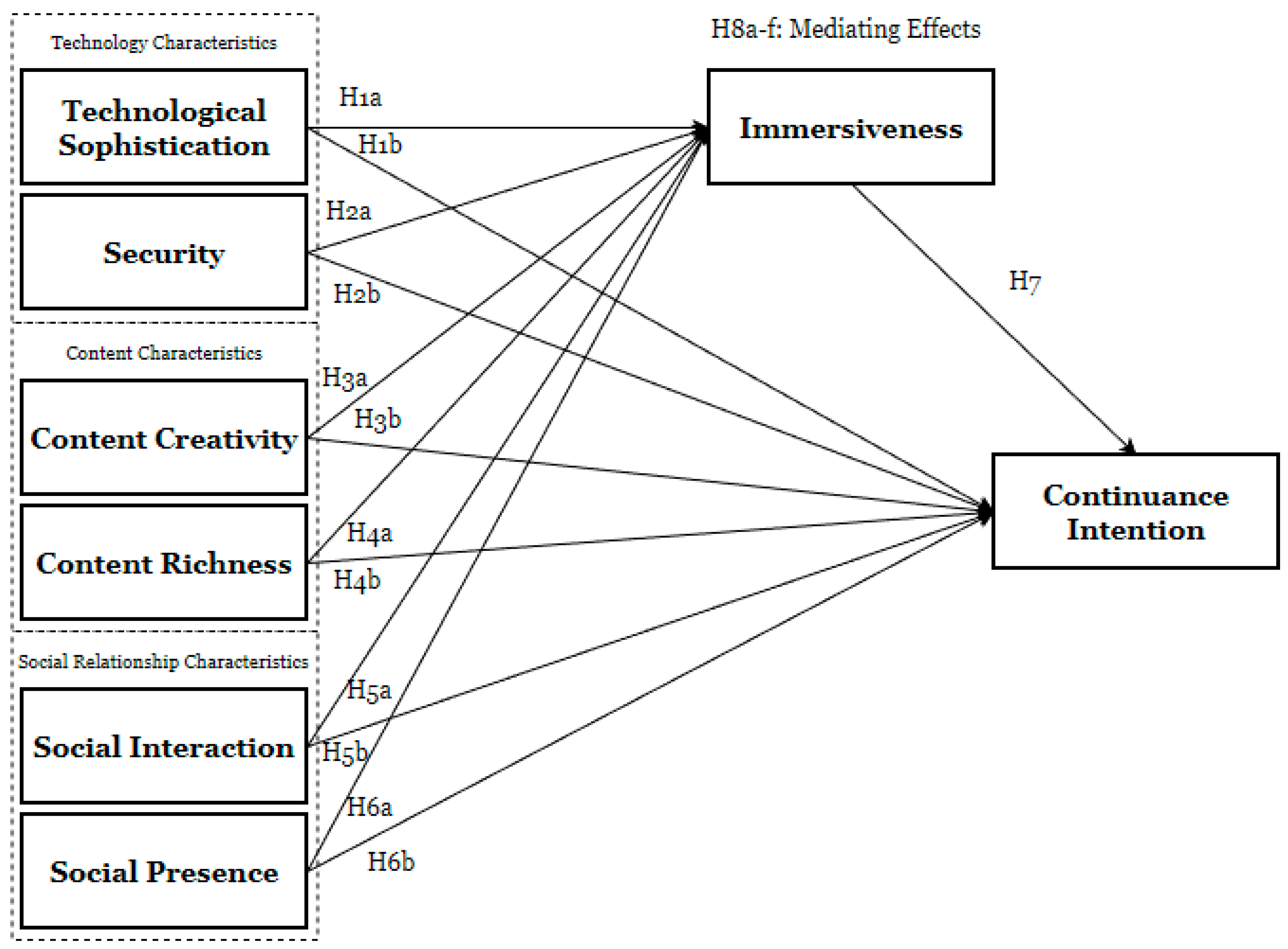
Figure 1 presents the research model derived from the above hypotheses, linking technology, content, and social relationship factors to continuance intention, with immersiveness included in the model.
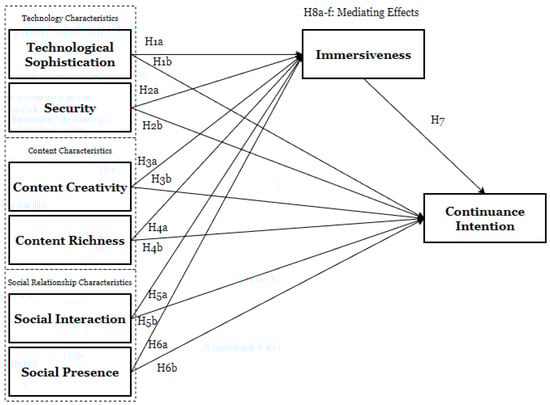
Figure 1.
Research model.
3. Empirical Study
3.1. Method
3.1.1. Measurement
In this study, data were collected through a structured online survey questionnaire, which is appropriate for capturing users’ perceptions and self-reported metaverse experiences across multiple constructs in a standardized manner. The questionnaire consisted of three sections. The first section provided a brief study introduction and informed participants of confidentiality and anonymity protections, voluntary participation, and their right to withdraw at any time. The second section measured the study constructs using established measurement items, with minor wording refinements for the metaverse context. All items were rated on a five-point Likert scale (1 = strongly disagree, 5 = strongly agree), with higher scores indicating stronger agreement with the statement. The third section collected demographic information.
The survey instrument was developed based on established IS and related perspectives on technology use and immersive experience, and item wording was refined to fit the metaverse context. Technological sophistication captured users’ assessment that a metaverse service employs advanced and innovative technologies that support smooth and comfortable use [24,25,26,35,36]. Security captured perceived protection of financial transactions and personal data, drawing on research on online trust and perceived risk and metaverse work on secure identity and payment processes [9,58,59]. Content creativity was measured with items developed for this study to capture users’ latitude to create or shape metaverse experiences through creation and customization options. Content richness was measured with items developed for this study to capture the breadth of activity domains and content types, as well as perceived frequency of content updates. Social interaction captured information sharing and socioemotional exchange enabled by the service, drawing on online community and social support research [47,50,51]. Social presence assessed whether others are experienced as socially real and communication feels immediate, based on classic social presence theory and avatar-mediated interaction research [31,32,53]. Immersiveness captured absorptive involvement and experiential realism, grounded in foundational work on mediated experience, immersion, and presence [54,55,56,57]. Continuance intention was measured using established IS continuance logic [13]. Table 2 summarizes construct definitions, measurement items, and sources, along with the metaverse-specific wording used in this study.
Table 2.
Operational definitions of the variables.
3.1.2. Data Collection
In this study, data were collected from Chinese metaverse users via an online survey. China provides an appropriate market context because multiple metaverse-related platforms and immersive virtual-world applications are widely accessible, allowing respondents to report direct and contextually grounded usage experiences. Examples include Baidu’s XiRang, NetEase’s Yaotai, and Tencent’s QQ-based metaverse initiatives. Participant recruitment and survey administration were conducted through Wenjuanxing (www.wjx.com), a third-party survey vendor and one of the largest online survey providers in China. Using its panel-based sampling service, respondents with prior metaverse usage were screened and the questionnaire was administered in a standardized online format, enabling timely recruitment and broad coverage across respondents.
At the start of the survey, participants received a short study introduction stating that participation was voluntary and anonymous, that responses would be kept confidential, and that the survey was for academic purposes only. Respondents were also informed that there were no “right” or “wrong” answers and were encouraged to report their experiences honestly. The questionnaire was designed to take approximately 5–10 min. To strengthen response quality and reduce potential response bias, neutral item wording was used and clear instructions were provided to minimize evaluation apprehension and socially desirable responding [60,61].
The survey was open for nine days (26 May–3 June 2024) and yielded 235 responses. After excluding incomplete questionnaires and responses indicating inattentive or insincere answering, 231 valid questionnaires were retained for analysis. An a priori G*Power (v3.1) analysis (multiple regression F-test; f2 = 0.15, α = 0.05, power = 0.95, 7 predictors) indicated a minimum sample size of 153. The final sample size of 231 exceeded this requirement. Demographic characteristics are summarized in Table 3. The sample included 136 males (58.9%) and 95 females (41.1%). Most respondents (70.6%) were aged 20–29, which is broadly consistent with the age profile commonly observed among users of emerging digital and immersive services. In addition, 66.7% of respondents were company employees, and most respondents were college graduates (n = 168, 72.7%).
Table 3.
Demographic information about participants.
3.1.3. Reliability and Validity
The measurement properties were examined in SPSS 27 using standard reliability and validity procedures. Internal consistency was assessed with Cronbach’s alpha [62], and all constructs exceeded 0.60. Exploratory factor analysis was then conducted to examine the factor structure (Table 4), using Promax (oblique) rotation to allow correlations among latent factors. Sampling adequacy and factorability were supported by a Kaiser–Meyer–Olkin value above 0.80 [63] and a significant Bartlett’s test of sphericity [64]. Item screening followed the recommended criteria [65]. Items were retained when their primary loading exceeded 0.50. For potentially cross-loading items, secondary loadings above 0.38 and a primary–secondary loading gap of less than 0.15 were treated as exclusion criteria; items failing these criteria were removed. To preserve content validity, the wording and conceptual relevance of flagged items were also reviewed, and items were removed only when doing so did not narrow the construct domain. Based on these diagnostics, one to two items per construct were dropped due to weak loadings or limited discriminability. Table 5 reports the means, standard deviations, and Pearson correlations among the eight study variables. No correlation exceeded 0.80, and variance inflation factors (VIFs) ranged from 1.348 to 1.704, suggesting that multicollinearity is unlikely to be a major concern [66].
Table 4.
Exploratory factor analysis.
Table 5.
Correlation analysis.
3.1.4. Common Method Bias
Because the study relies on a single, self-reported survey, common method bias (CMB) is a potential concern. This issue was addressed through both procedural remedies and statistical diagnostics. As described in Section 3.1.2, procedural remedies included emphasizing anonymity and confidentiality, clarifying the academic purpose, and reducing evaluation pressure by stating that there were no correct answers and that honest reporting was important; item wording was kept neutral to limit socially desirable responding.
For statistical diagnostics, Harman’s single-factor test [67] was conducted using exploratory factor analysis with principal axis factoring and no rotation. The first unrotated factor accounted for 30.633% of the total variance, which is below the commonly used 50% benchmark. In addition, collinearity diagnostics (reported above) do not suggest that common method variance is a major concern. Taken together, the procedural remedies and diagnostic tests suggest that common method bias is unlikely to materially influence the estimated relationships [60,61].
3.2. Hypothesis Test
To evaluate the hypotheses, a series of multiple regression models was estimated to test the proposed relationships. This approach is suitable because the instrument combines established measures with metaverse-context items developed for this study and yields transparent coefficient estimates, enabling assessment of the direction and relative strength of the hypothesized effects. Prior to estimation, standard ordinary least squares diagnostics were examined. As shown in Table 6, VIFs were low, indicating no material multicollinearity. Residuals-versus-fitted plots did not reveal a pronounced funnel-shaped dispersion, indicating no material violation of the constant-variance assumption. All models yielded significant omnibus F-tests (p < 0.001), indicating that the predictors jointly explained variance in the dependent variables. Model fit ranged from moderate to substantial across specifications (R2 = 0.263–0.589; adjusted R2 = 0.259–0.578).
Table 6.
Hypotheses testing results.
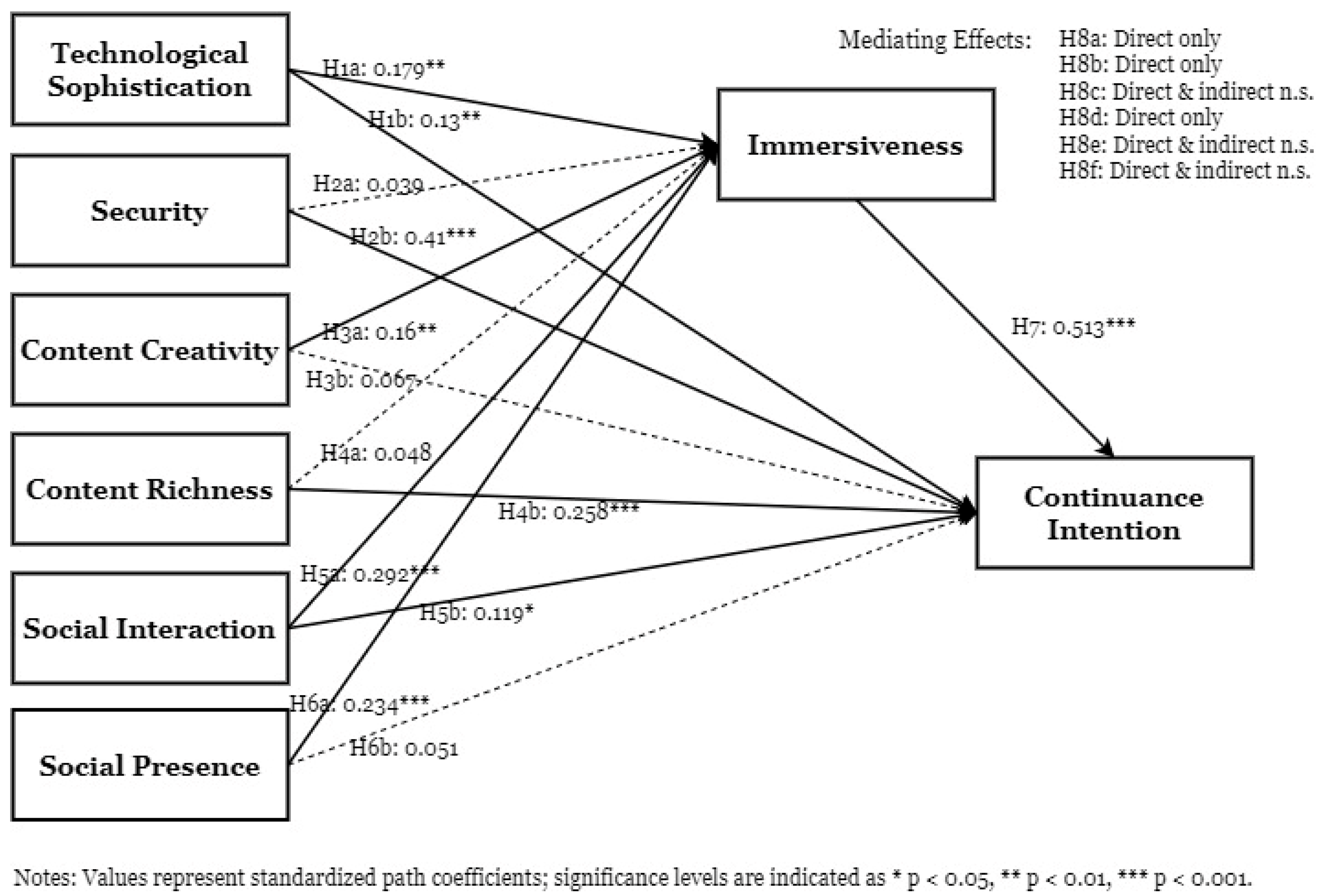
When immersiveness was the dependent variable, the model explained 48.3% of the variance. At α = 0.05, the results support H1a, H3a, H5a, and H6a: technological sophistication (β = 0.179; B = 0.225, 95% confidence interval (CI) [0.087, 0.363]), content creativity (β = 0.160; B = 0.180, 95% CI [0.052, 0.307]), social interaction (β = 0.292; B = 0.309, 95% CI [0.178, 0.441]), and social presence (β = 0.234; B = 0.240, 95% CI [0.120, 0.360]) were positively associated with immersiveness. By contrast, at α = 0.05, the results do not support H2a or H4a; security (β = 0.039; B = 0.041, 95% CI [−0.083, 0.165]) and content richness (β = 0.048; B = 0.058, 95% CI [−0.081, 0.198]) were not statistically significant.
For the link between immersiveness and continuance intention, the results support H7: immersiveness was positively related to continuance intention (β = 0.513; B = 0.488, 95% CI [0.381, 0.594]). This model explained 26.3% of the variance in continuance intention (R2 = 0.263, adj. R2 = 0.259; F = 81.60, p < 0.001).
When continuance intention was regressed on the six antecedents, the model accounted for 58.9% of the variance. At α = 0.05, the results support H1b, H2b, H4b, and H5b: technological sophistication (β = 0.130; B = 0.155, 95% CI [0.038, 0.272]), security (β = 0.410; B = 0.404, 95% CI [0.299, 0.509]), content richness (β = 0.258; B = 0.298, 95% CI [0.180, 0.417]), and social interaction (β = 0.119; B = 0.120, 95% CI [0.009, 0.232]) were positively associated with continuance intention. By contrast, at α = 0.05, the results do not support H3b or H6b; content creativity (β = 0.067; B = 0.072, 95% CI [−0.037, 0.180]) and social presence (β = 0.051; B = 0.050, 95% CI [−0.052, 0.152]) were not statistically significant. Table 6 reports the full set of estimates and hypothesis decisions.
3.3. Mediating Effect
Mediation analysis was conducted using Hayes’ PROCESS macro for SPSS (Model 4) with a regression-based approach [68]. For each antecedent, a simple mediation model was estimated with the focal antecedent as the independent variable, immersiveness as the mediator, and continuance intention as the outcome, while including the remaining antecedents as covariates to isolate the unique indirect effect. Indirect effects were evaluated using 5000 bootstrap samples and 95% bootstrap CIs [69]. An indirect effect was considered supported when its CI excluded zero.
As summarized in Table 7, unexpectedly, the bootstrapped indirect effects via immersiveness were not supported. The indirect effects of technological sophistication, security, content creativity, content richness, social interaction, and social presence on continuance intention all had 95% bootstrap CIs that included zero; therefore, H8a–H8f were not supported. By contrast, the direct effects of technological sophistication, security, and content richness remained significant, whereas the direct effects of content creativity, social interaction, and social presence were not. Interpreted counterfactually, this pattern suggests that, although immersiveness is positively related to continuance intention, continued participation may be more closely tied to direct post-adoption evaluations—especially assurance and usefulness evaluations—than to an immersiveness-mediated pathway. Table 7 reports the direct and indirect effect estimates and the corresponding CIs.
Table 7.
Mediating effect results.
For ease of interpretation, Figure 2 synthesizes the regression results and mediation tests reported above and displays standardized path coefficients with significance levels to facilitate comparison of relationships across the model.
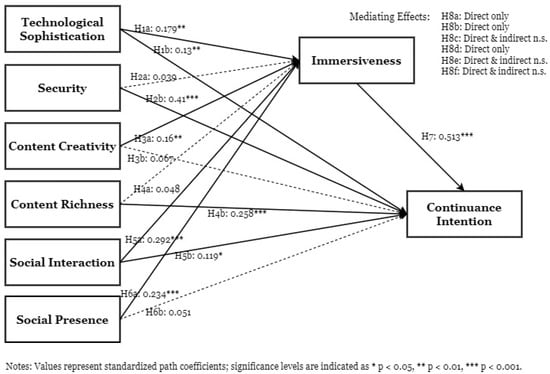
Figure 2.
Summary of the key findings.
4. Discussion and Conclusions
4.1. Summary and Theoretical Implications
This study examined how technological, content, and social-relational conditions shape immersiveness and continuance intention in the metaverse. The results indicate that immersiveness is driven by technological sophistication, content creativity, social interaction, and social presence, whereas security and content richness show no incremental association with immersiveness. Continuance intention is directly linked to technological sophistication, security, content richness, and social interaction. Together, these patterns suggest that sustained use reflects both immersiveness and post-adoption evaluations of assurance and usefulness. Overall, as expected, technological sophistication and social interaction underpin both outcomes, underscoring the importance of low access and interaction costs and relational engagement. At the same time, neither security nor content richness is significantly associated with immersiveness in this sample. One plausible explanation is that security functions as a baseline assurance for continued participation: it may not intensify users’ sense of presence, yet it may reduce feelings of vulnerability and be more strongly associated with continuance intention than with immersiveness. Recent studies likewise suggest that trust- and assurance-related beliefs and attitudes are reliably associated with post-adoption outcomes, such as continuance intention and willingness to use metaverse services [45,70]. Along similar lines, content richness may be valued primarily as a reason to return, capturing option value and ongoing utility, whereas immersiveness is more sensitive to episode-level qualities such as seamlessness and felt presence. Evidence from metaverse user research suggests a value-based mechanism: experience-related factors are positively associated with perceived value, which, in turn, is associated with continuance intention [46]. Related work from a digital fashion product context also suggests that content creation may not always translate into experiential states such as flow in metaverse experiences [71]. In this sense, the findings differentiate enabling conditions for continuance from experiential drivers of immersiveness, implying two partially distinct post-adoption logics—experience-based immersion versus assurance- and utility-based evaluation.
Contrary to expectations, mediation analyses provided no clear evidence of indirect effects from the antecedents to continuance intention via immersiveness. Nevertheless, immersiveness remained positively associated with continuance intention, and several antecedents (technological sophistication, content creativity, social interaction, and social presence) were significantly associated with immersiveness. Taken together, these patterns are consistent with an experiential channel through which technological, content, and social-relational features can contribute to sustained use, even though incremental indirect effects are not apparent when the antecedents are considered jointly. In related work, authentic experiences have been shown to activate users’ mental imagery, which strengthens presence and supports immersive metaverse experience [72]. By contrast, security and content richness appear to relate to continuance more directly through assurance and usefulness evaluations. Overall, the findings underscore that immersive experience alone may not fully account for retention; post-adoption value evaluations, together with social drivers such as sociability and interaction-related benefits, remain salient for continuance intention [6]. This direct-effect pattern suggests that assurance- and utility-oriented evaluations may translate into continuance without necessarily passing through immersive experiential states. In this sense, the pattern warrants further qualitative research to deepen understanding of the non-mediation pattern, particularly for security and content richness.
In summary, this study enriches metaverse post-adoption research in three ways. Specifically, it clarifies how prior perspectives (e.g., TAM, the IS success model, flow and presence perspectives, and PMT) align with distinct pathways to immersiveness and continuance. First, by organizing key antecedents into technological, content, and social-relational dimensions, the study synthesizes core insights from prior metaverse research (e.g., [4,5,6,19,20,21,22,23]) into a single model and tests them jointly, showing that the same predictors can relate differently to immersiveness and continuance rather than operating through a single mechanism. Second, the findings point to multiple pathways to continuance intention. As metaverse applications expand into commercial and enterprise settings and increasingly involve marketplace transactions and identity-linked participation, retention-relevant factors such as security and content richness become especially salient. In particular, the results underscore the importance of security for continuance intention in metaverse services, informing ongoing discussions of security and privacy, trust, and protection in these environments [8,9,10]. At the same time, the findings suggest a distinction between antecedents that primarily shape immersiveness and those that relate more directly to continuance via assurance and usefulness evaluations [6,45,46,70]. Third, the study deepens the social-relational account by showing that interaction and social presence are robust experiential drivers, yet they differ in their direct associations with continuance intention.
4.2. Practical Implications
Building on the empirical patterns reported above, this study offers practice-relevant insights for the design and governance of metaverse experiences. First, developers and designers may focus on baseline technical capability and seamless access across devices (e.g., mobile devices, personal computers, and VR headsets), including compatibility, stability, low latency, and streamlined onboarding, as these factors are associated with higher immersiveness and continuance. As metaverse services incorporate more generative AI functionality, it is useful to view performance engineering as a foundation for deploying AI-enabled features at scale. In practice, AI-assisted rendering and asset generation are more likely to reinforce presence when they are integrated with stable performance and low-latency interaction. Reducing friction and streamlining interaction flows may therefore support both immediate experience quality and longer-term retention, consistent with evidence from metaverse gaming [73]. Baseline capability may be particularly salient in business-oriented deployments [23,74].
Second, content strategy may benefit from emphasizing not only volume, but also actionable activities and repeatable value, especially as immersive technologies reshape service experiences and task-oriented use expands [75]. In practice, this can involve curating activity-rich ecosystems—commerce-linked experiences, events, learning or collaboration scenarios, and creator-led spaces—that help users accomplish concrete goals while sustaining community vitality. Generative AI may support activity design through rapid scene and asset generation, personalization, and co-creation features, which can reduce creation and participation costs for both creators and users. When applied to avatars, environments, and interaction scripts, AI-enabled creation may also enrich social cues and scenario coherence, thereby supporting social presence during shared activities. At the same time, AI-enabled content typically benefits from guidance, curation, and quality control, so that novelty is more likely to become repeatable value rather than remaining one-off exploration.
Third, social design can move beyond interaction frequency to strengthen the quality and safety of co-experience. Shared tasks and spaces, real-time communication cues, and community mechanisms that encourage respectful exchange can enhance social presence and deepen immersiveness. Generative AI may further support social presence through real-time translation, conversational facilitation, and scalable moderation [14], although these functions work best when accompanied by transparent controls that help address manipulation concerns and support trust. Social interaction also shows a direct association with continuance intention, suggesting that relational value—emotional exchange, sharing, recognition, and belonging—can be treated as a practical lever for retention rather than an ancillary feature [22]. Designing for relationship continuity—persistent identity and reputation systems, lightweight social onboarding, and structures that encourage repeated interaction—may help turn episodic encounters into more durable ties.
Fourth, a key point is that security, privacy, and community-safety governance often function as baseline requirements for retention in immersive, data-intensive environments such as the metaverse. In this study, security shows a significant direct association with continuance intention. Given the expanded scope of behavioral and biometric data in metaverse environments, privacy governance also intersects with broader concerns about data extraction and “surveillance capitalism” [76]. As AI capabilities evolve, regulations such as the EU AI Act (Regulation (EU) 2024/1689) [77] highlight the growing role of public governance and make institutional constraints an important input to responsible metaverse strategy [2]. Although security shows no incremental association with immersiveness in the model, effective safeguards can reduce feelings of vulnerability and support continuance. Developers may therefore adopt privacy-by-design practices (e.g., transparent consent, account protection, and community-safety enforcement), while public actors can reinforce baseline protections through clearer guidance and compliance expectations [8,9,10,15]. Targeted user education (e.g., privacy controls, account hygiene, and threat awareness) can further complement technical measures. Overall, long-term sustainability depends on repeatable engagement loops, such as steady content flows, low-friction access, and credible social interactions that encourage return visits. Business models therefore need mechanisms that build long-term usage value through sustained participation, beyond immersiveness alone. Sustained viability also requires managing churn drivers such as security, governance, and negative experiences.
4.3. Limitations and Future Research
Several limitations should be noted, particularly regarding the research design and data. First, the study relies on self-reported, cross-sectional survey data, which constrains causal inference and may inflate associations due to common method bias. Causal inference could be strengthened by adopting longitudinal designs, experience sampling, metaverse usage trace data, or field experiments. Such approaches would help disentangle initial drivers from post-adoption determinants and track how immersiveness and continuance evolve.
Second, sample composition may limit generalizability. The data were collected from metaverse users in China via an online panel, and the sample skews young: respondents aged 20–29 account for 163 participants (70.6%). While this distribution is consistent with the demographic profile of many early metaverse adopters, it suggests that the mechanisms observed here may be most representative of younger users’ experiences and decision criteria. Subsequent studies would benefit from more age-diverse samples and subgroup analyses to assess whether the proposed relationships vary across demographic segments and usage motivations. Moreover, given the metaverse’s global reach, cultural norms and regulatory environments surrounding social interaction and privacy vary across regions. Accordingly, more diverse samples across cultures and regions are needed to examine whether the model operates similarly under different cultural, economic, and regulatory contexts (e.g., Western versus East Asian settings). Future studies can use multi-group analyses and measurement invariance tests to clarify how the proposed relationships vary across contexts.
Third, the model focuses on a targeted set of antecedents within the technology–content–social-relational triad. A meaningful avenue is to broaden the explanatory scope by incorporating additional metaverse-specific determinants (e.g., avatar realism, interoperability and economic affordances, negative experiences such as harassment, and well-being outcomes) (see [34]). Another promising direction is to model AI-related antecedents more explicitly. As noted in the Practical Implications, advances in AI are expanding what metaverse platforms can offer; subsequent research could examine AI-enabled features as distinct predictors or boundary conditions shaping immersiveness and continuance. The framework may also be extended by examining multidimensional perceived value as a proximal driver of continuance—particularly social-relational value (e.g., belonging, recognition, and supportive ties), alongside utilitarian and hedonic value components. The current data provide limited evidence for indirect effects via immersiveness. This motivates examining whether the immersiveness–continuance link varies with users’ usage goals and prior experience, providing a more fine-grained account of when immersiveness translates into sustained use. In practice, effects may differ across metaverse service types (e.g., education, work, tourism, and gaming), where goals and interaction patterns are not equivalent; cross-service comparative designs across service categories could help identify such heterogeneity. Methodologically, the analysis relies primarily on net-effect modeling, which may not fully capture the possibility that continuance intention arises from multiple, equally effective combinations of conditions [78]. Configurational approaches such as fsQCA offer a complementary lens for examining equifinality and causal asymmetry in these relationships [79,80].
Author Contributions
Conceptualization, S.-E.C.; Methodology, C.X. and S.-E.C.; Validation, J.-Q.F., C.X. and S.-E.C.; Formal analysis, J.-Q.F. and C.X.; Investigation, J.-Q.F.; Data curation, J.-Q.F., C.X. and S.-E.C.; Writing—original draft, J.-Q.F. and C.X.; Writing—review & editing, J.-Q.F. and C.X.; Supervision, S.-E.C.; Project administration, S.-E.C. All authors have read and agreed to the published version of the manuscript.
Funding
This research received no external funding.
Institutional Review Board Statement
The content and methodologies of this study, and in accordance with the Bioethics and Safety Act and Enforcement Decree of the Bioethics Act in South Korea, this type of research does not typically require ethical approval.
Informed Consent Statement
Informed consent was obtained from all subjects involved in the study.
Data Availability Statement
The authors will make the raw data available upon request.
Acknowledgments
This paper is an edited version of the first author’s master’s thesis from Gyeongsang National University, 2025.
Conflicts of Interest
The authors declare no conflicts of interest.
References
- Dwivedi, Y.K.; Hughes, L.; Wang, Y.; Alalwan, A.A.; Ahn, S.J.; Balakrishnan, J.; Barta, S.; Belk, R.; Buhalis, D.; Dutot, V.; et al. Metaverse marketing: How the metaverse will shape the future of consumer research and practice. Psychol. Mark. 2023, 40, 750–776. [Google Scholar] [CrossRef]
- Marabelli, M.; Newell, S. Responsibly strategizing with the metaverse: Business implications and DEI opportunities and challenges. J. Strateg. Inf. Syst. 2023, 32, 101774. [Google Scholar] [CrossRef]
- Krüger, K.; Weking, J.; Fielt, E.; Böttcher, T.; Kowalkiewicz, M.; Krcmar, H. Value drivers for metaverse business models: A complementor perspective. J. Manag. Inf. Syst. 2025, 42, 143–173. [Google Scholar] [CrossRef]
- Yoon, S.; Nam, Y. Metaverse engagement and Korea travel intentions: Understanding affordances, presence, and place attachment among Brazilian ZEPETO users. J. Destin. Mark. Manag. 2024, 31, 100865. [Google Scholar] [CrossRef]
- Roh, T.; Xiao, S.; Park, B.I. What makes metaverse users immersed in the flow state in an emerging market? An applica-tion of affordance theory and ISSM. J. Retail. Consum. Serv. 2024, 81, 104012. [Google Scholar] [CrossRef]
- Tao, M.; Khan, J.; Abbass, A.; Mehmood, K. Metaverse characteristics: The role of consumer experience shaping consumer behavior in the metaverse. J. Theor. Appl. Electron. Commer. Res. 2025, 20, 166. [Google Scholar] [CrossRef]
- Koohang, A.; Nord, J.H.; Ooi, K.-B.; Tan, G.W.-H.; Al-Emran, M.; Aw, E.C.X.; Baabdullah, A.M.; Buhalis, D.; Cham, T.-H.; Dennis, C.; et al. Shaping the metaverse into reality: A holistic multidisciplinary understanding of opportunities, challenges, and avenues for future investigation. J. Comput. Inf. Syst. 2023, 63, 735–765. [Google Scholar] [CrossRef]
- Di Pietro, R.; Cresci, S. Metaverse: Security and privacy issues. In Proceedings of the 2021 Third IEEE International Conference on Trust, Privacy and Security in Intelligent Systems and Applications (TPS-ISA), Atlanta, GA, USA, 13–15 December 2021; IEEE: Piscataway, NJ, USA, 2021; pp. 281–288. [Google Scholar] [CrossRef]
- Dwivedi, Y.K.; Hughes, L.; Baabdullah, A.M.; Ribeiro-Navarrete, S.; Giannakis, M.; Al-Debei, M.M.; Dennehy, D.; Metri, B.; Buhalis, D.; Cheung, C.M.K.; et al. Metaverse beyond the hype: Multidisciplinary perspectives on emerging challenges, opportunities, and agenda for research, practice and policy. Int. J. Inf. Manag. 2022, 66, 102542. [Google Scholar] [CrossRef]
- Wang, Y.; Su, Z.; Zhang, N.; Xing, R.; Liu, D.; Luan, T.H.; Shen, X. A survey on metaverse: Fundamentals, security, and privacy. IEEE Commun. Surv. Tutor. 2023, 25, 319–352. [Google Scholar] [CrossRef]
- Ball, M. Framework for the Metaverse. MatthewBall.co. 29 June 2021. Available online: https://www.matthewball.co/all/forwardtothemetaverseprimer (accessed on 14 January 2026).
- Yang, Q.; Zhao, Y.; Huang, H.; Xiong, Z.; Kang, J.; Zheng, Z. Fusing blockchain and AI with metaverse: A survey. IEEE Open J. Comput. Soc. 2022, 3, 122–136. [Google Scholar] [CrossRef]
- Bhattacherjee, A. Understanding information systems continuance: An expectation-confirmation model. MIS Q. 2001, 25, 351–370. [Google Scholar] [CrossRef]
- Xiang, N. Baidu Wants Its XiRang Platform to Be the Enabler of the Metaverse. Forbes. 2022. Available online: https://www.forbes.com/sites/ninaxiang/2022/05/12/baidu-wants-its-xirang-platform-to-be-the-enabler-of-the-metaverse/ (accessed on 10 January 2026).
- Soliman, M.M.; Ahmed, E.; Darwish, A.; Hassanien, A.E. Artificial intelligence powered metaverse: Analysis, challenges and future perspectives. Artif. Intell. Rev. 2024, 57, 36. [Google Scholar] [CrossRef]
- Yoo, K.; Welden, R.; Hewett, K.; Haenlein, M. The merchants of meta: A research agenda to understand the future of retailing in the metaverse. J. Retail. 2023, 99, 173–192. [Google Scholar] [CrossRef]
- Zhang, X.; Chen, Y.; Hu, L.; Wang, Y. The metaverse in education: Definition, framework, features, potential applications, challenges, and future research topics. Front. Psychol. 2022, 13, 1016300. [Google Scholar] [CrossRef]
- Gursoy, D.; Malodia, S.; Dhir, A. The metaverse in the hospitality and tourism industry: An overview of current trends and future research directions. J. Hosp. Mark. Manag. 2022, 31, 527–534. [Google Scholar] [CrossRef]
- Basu, B.; Kar, A.K.; Sen, S. Antecedents of user experience in the immersive metaverse ecosystem: Insights from mining user reviews. Commun. Assoc. Inf. Syst. 2024, 55, 13. [Google Scholar] [CrossRef]
- Soni, S.; Arora, P.; Kasilingam, D.; Jain, V. Digital daydreams: Exploring consumer motivations for engaging with the metaverse. J. Retail. Consum. Serv. 2025, 85, 104294. [Google Scholar] [CrossRef]
- Oh, H.J.; Kim, J.; Chang, J.J.; Park, N.; Lee, S. Social benefits of living in the metaverse: The relationships among social presence, supportive interaction, social self-efficacy, and feelings of loneliness. Comput. Hum. Behav. 2023, 139, 107498. [Google Scholar] [CrossRef]
- Ghali, Z.; Rather, R.A.; Khan, I. Investigating metaverse marketing-enabled consumers’ social presence, attachment, engagement and (re)visit intentions. J. Retail. Consum. Serv. 2024, 77, 103671. [Google Scholar] [CrossRef]
- Chi, M.; Ren, S.; Xu, Y.; Chen, Y.; Wu, Y. Critical success factors for metaverse implementation in the service industry: A hybrid ISM–DEMATEL approach. J. Retail. Consum. Serv. 2025, 87, 104424. [Google Scholar] [CrossRef]
- DeLone, W.H.; McLean, E.R. Information systems success: The quest for the dependent variable. Inf. Syst. Res. 1992, 3, 60–95. [Google Scholar] [CrossRef]
- DeLone, W.H.; McLean, E.R. The DeLone and McLean model of information systems success: A ten-year update. J. Manag. Inf. Syst. 2003, 19, 9–30. [Google Scholar] [CrossRef]
- Davis, F.D. Perceived usefulness, perceived ease of use, and user acceptance of information technology. MIS Q. 1989, 13, 319–340. [Google Scholar] [CrossRef]
- Csikszentmihalyi, M. Flow: The Psychology of Optimal Experience; Harper & Row: New York, NY, USA, 1990. [Google Scholar]
- Hoffman, D.L.; Novak, T.P. Marketing in hypermedia computer-mediated environments: Conceptual foundations. J. Mark. 1996, 60, 50–68. [Google Scholar] [CrossRef]
- Rogers, R.W. A protection motivation theory of fear appeals and attitude change. J. Psychol. 1975, 91, 93–114. [Google Scholar] [CrossRef]
- Rogers, R.W. Cognitive and physiological processes in fear appeals and attitude change: A revised theory of protection motivation. In Social Psychophysiology: A Sourcebook; Cacioppo, J.T., Petty, R.E., Eds.; Guilford Press: New York, NY, USA, 1983; pp. 153–176. [Google Scholar]
- Short, J.; Williams, E.; Christie, B. The Social Psychology of Telecommunications; Wiley: New York, NY, USA, 1976. [Google Scholar]
- Mennecke, B.E.; Triplett, J.L.; Hassall, L.M.; Jordán-Conde, Z. Embodied social presence theory. In Proceedings of the 43rd Hawaii International Conference on System Sciences (HICSS-43), Koloa, HI, USA, 5–8 January 2010; IEEE: Piscataway, NJ, USA, 2010; pp. 1–10. [Google Scholar] [CrossRef]
- Agarwal, R.; Karahanna, E. Time flies when you’re having fun: Cognitive absorption and beliefs about information technology usage. MIS Q. 2000, 24, 665–694. [Google Scholar] [CrossRef]
- Dincelli, E.; Yayla, A. Immersive virtual reality in the age of the Metaverse: A hybrid-narrative review based on the technology affordance perspective. J. Strateg. Inf. Syst. 2022, 31, 101717. [Google Scholar] [CrossRef]
- Jang, Y.; Park, E. An adoption model for virtual reality games: The roles of presence and enjoyment. Telemat. Inform. 2019, 42, 101239. [Google Scholar] [CrossRef]
- Yildirim, C. Cybersickness during VR gaming undermines game enjoyment: A mediation model. Displays 2019, 59, 35–43. [Google Scholar] [CrossRef]
- Zhu, R.; Yi, C. Avatar design in metaverse: The effect of avatar–user similarity in procedural and creative tasks. Internet Res. 2024, 34, 39–57. [Google Scholar] [CrossRef]
- Freeman, G.; Maloney, D. Body, avatar, and me: The presentation and perception of self in social virtual reality. Proc. ACM Hum.-Comput. Interact. 2021, 4, 239. [Google Scholar] [CrossRef]
- Hooi, R.; Cho, H. Being immersed: Avatar similarity and self-awareness. In Proceedings of the 24th Australian Computer-Human Interaction Conference (OzCHI ‘12), Melbourne, Australia, 26–30 November 2012; ACM: New York, NY, USA, 2012; pp. 232–240. [Google Scholar] [CrossRef]
- Kohler, T.; Füller, J.; Matzler, K.; Stieger, D.; Füller, J. Co-creation in virtual worlds: The design of the user experience. MIS Q. 2011, 35, 773–788. [Google Scholar] [CrossRef]
- Jo, H.; Park, D.-H. Affordance, usefulness, enjoyment, and aesthetics in sustaining virtual reality engagement. Sci. Rep. 2023, 13, 15097. [Google Scholar] [CrossRef] [PubMed]
- Jung, T.; Cho, J.; Han, D.-I.D.; Ahn, S.J.G.; Gupta, M.; Das, G.; Heo, C.Y.; Loureiro, S.M.C.; Sigala, M.; Trunfio, M.; et al. Metaverse for service industries: Future applications, opportunities, challenges and research directions. Comput. Hum. Behav. 2024, 151, 108039. [Google Scholar] [CrossRef]
- Lowry, P.B.; Boh, W.F.; Petter, S.; Leimeister, J.M. Long live the metaverse: Identifying the potential for market disruption and future research. J. Manag. Inf. Syst. 2025, 42, 3–38. [Google Scholar] [CrossRef]
- Yoon, N.; Lee, H. Exploring media richness in the metaverse shopping platform: The role of rendering quality and avatar realism. J. Korean Soc. Cloth. Text. 2024, 48, 1024–1038. [Google Scholar] [CrossRef]
- Shin, D.; Jo, H. Adoption and continuance in the metaverse. Electronics 2024, 13, 3917. [Google Scholar] [CrossRef]
- Jung, J.-H.; Shin, J.-I. Effects of metaverse experience factors (4Es) on perceived value and intention to continue use. J. Korea Soc. Comput. Inf. 2023, 28, 187–194. [Google Scholar] [CrossRef]
- Cole, H.; Griffiths, M.D. Social interactions in massively multiplayer online role-playing gamers. Cyberpsychol. Behav. 2007, 10, 575–583. [Google Scholar] [CrossRef]
- Oh, H.J.; Ozkaya, E.; LaRose, R. How does online social networking enhance life satisfaction? The relationships among online supportive interaction, affect, perceived social support, sense of community, and life satisfaction. Comput. Hum. Behav. 2014, 30, 69–78. [Google Scholar] [CrossRef]
- Zhou, Z.; Fang, Y.; Vogel, D.R.; Jin, X.-L.; Zhang, X. Attracted to or locked in? Predicting continuance intention in social virtual world services. J. Manag. Inf. Syst. 2012, 29, 273–306. [Google Scholar] [CrossRef]
- House, J.S. Work Stress and Social Support; Addison-Wesley: Reading, MA, USA, 1981. [Google Scholar]
- McMillan, D.W.; Chavis, D.M. Sense of community: A definition and theory. J. Community Psychol. 1986, 14, 6–23. [Google Scholar] [CrossRef]
- van Brakel, V.; Barreda-Ángeles, M.; Hartmann, T. Feelings of presence and perceived social support in social virtual reality platforms. Comput. Hum. Behav. 2023, 139, 107523. [Google Scholar] [CrossRef]
- Biocca, F.; Harms, C.; Burgoon, J.K. Toward a more robust theory and measure of social presence: Review and suggested criteria. Presence Teleoper. Virtual Environ. 2003, 12, 456–480. [Google Scholar] [CrossRef]
- Steuer, J. Defining virtual reality: Dimensions determining telepresence. J. Commun. 1992, 42, 73–93. [Google Scholar] [CrossRef]
- Slater, M.; Wilbur, S. A framework for immersive virtual environments (FIVE): Speculations on the role of presence in virtual environments. Presence Teleoper. Virtual Environ. 1997, 6, 603–616. [Google Scholar] [CrossRef]
- Lombard, M.; Ditton, T. At the heart of it all: The concept of presence. J. Comput.-Mediat. Commun. 1997, 3, JCMC321. [Google Scholar] [CrossRef]
- Witmer, B.G.; Singer, M.J. Measuring presence in virtual environments: A presence questionnaire. Presence Teleoper. Virtual Environ. 1998, 7, 225–240. [Google Scholar] [CrossRef]
- McKnight, D.H.; Choudhury, V.; Kacmar, C. The impact of initial consumer trust on intentions to transact with a web site: A trust building model. J. Strateg. Inf. Syst. 2002, 11, 297–323. [Google Scholar] [CrossRef]
- Pavlou, P.A. Consumer acceptance of electronic commerce: Integrating trust and risk with the technology acceptance model. Int. J. Electron. Commer. 2003, 7, 101–134. [Google Scholar] [CrossRef]
- Podsakoff, P.M.; MacKenzie, S.B.; Lee, J.-Y.; Podsakoff, N.P. Common method biases in behavioral research: A critical review of the literature and recommended remedies. J. Appl. Psychol. 2003, 88, 879–903. [Google Scholar] [CrossRef] [PubMed]
- Podsakoff, P.M.; Podsakoff, N.P.; Williams, L.J.; Huang, C.; Yang, J. Common method bias: It’s bad, it’s complex, it’s widespread, and it’s not easy to fix. Annu. Rev. Organ. Psychol. Organ. Behav. 2024, 11, 17–61. [Google Scholar] [CrossRef]
- Cronbach, L.J. Coefficient alpha and the internal structure of tests. Psychometrika 1951, 16, 297–334. [Google Scholar] [CrossRef]
- Kaiser, H.F. An index of factorial simplicity. Psychometrika 1974, 39, 31–36. [Google Scholar] [CrossRef]
- Bartlett, M.S. Tests of significance in factor analysis. Br. J. Stat. Psychol. 1950, 3, 77–85. [Google Scholar] [CrossRef]
- Howard, M.C. A systematic literature review of exploratory factor analyses in management. J. Bus. Res. 2023, 164, 113969. [Google Scholar] [CrossRef]
- O’Brien, R.M. A caution regarding rules of thumb for variance inflation factors. Qual. Quant. 2007, 41, 673–690. [Google Scholar] [CrossRef]
- Harman, H.H. Modern Factor Analysis, 3rd ed.; University of Chicago Press: Chicago, IL, USA, 1976. [Google Scholar]
- Hayes, A.F. Introduction to Mediation, Moderation, and Conditional Process Analysis: A Regression-Based Approach, 2nd ed.; Guilford Press: New York, NY, USA, 2018. [Google Scholar]
- Preacher, K.J.; Hayes, A.F. Asymptotic and resampling strategies for assessing and comparing indirect effects in multiple mediator models. Behav. Res. Methods 2008, 40, 879–891. [Google Scholar] [CrossRef]
- Chakraborty, D.; Mehta, P.; Khorana, S. Metaverse technologies in hospitality: Using the theory of consumption values to reveal consumer attitudes and trust factors. Int. J. Contemp. Hosp. Manag. 2025, 37, 1276–1308. [Google Scholar] [CrossRef]
- Park, Y.; Ko, E.; Do, B. The perceived value of digital fashion product and purchase intention: The mediating role of the flow experience in metaverse platforms. Asia Pac. J. Mark. Logist. 2023, 35, 2645–2665. [Google Scholar] [CrossRef]
- Chang, J.Y.S.; Cheah, J.-H.; Lim, X.J.; Lim, W.M.; Luo, X. Authentic experience in the metaverse: A situated cognition perspective of metaverse food festivals. Int. J. Contemp. Hosp. Manag. 2025, 37, 2961–2979. [Google Scholar] [CrossRef]
- Jo, H.; Lee, J.K. A comprehensive analysis of presence, seamlessness, and player responses in metaverse gaming. Comput. Hum. Behav. 2024, 159, 108345. [Google Scholar] [CrossRef]
- Kumar, H.; Sharma, V.K. Creating an immersive environment of metaverse for businesses. Australas. J. Inf. Syst. 2024, 28. [Google Scholar] [CrossRef]
- Sama, R.R.; Pande, T.; Sharma, K.; Das, K. Plugged into the future: How immersive technologies are changing service experiences? J. Serv. Theory Pract. 2025, 35, 776–804. [Google Scholar] [CrossRef]
- Zuboff, S. The Age of Surveillance Capitalism: The Fight for a Human Future at the New Frontier of Power; PublicAffairs: New York, NY, USA, 2019. [Google Scholar]
- Regulation (EU) 2024/1689 Laying Down Harmonised Rules on Artificial Intelligence (Artificial Intelligence Act). EUR-Lex. Available online: https://eur-lex.europa.eu/eli/reg/2024/1689/oj (accessed on 10 January 2026).
- Woodside, A.G. Embrace•perform•model: Complexity theory, contrarian case analysis, and multiple realities. J. Bus. Res. 2014, 67, 2495–2503. [Google Scholar] [CrossRef]
- Ragin, C.C. Fuzzy-Set Social Science; University of Chicago Press: Chicago, IL, USA, 2000. [Google Scholar]
- Fiss, P.C. Building better causal theories: A fuzzy set approach to typologies in organization research. Acad. Manag. J. 2011, 54, 393–420. [Google Scholar] [CrossRef]
Disclaimer/Publisher’s Note: The statements, opinions and data contained in all publications are solely those of the individual author(s) and contributor(s) and not of MDPI and/or the editor(s). MDPI and/or the editor(s) disclaim responsibility for any injury to people or property resulting from any ideas, methods, instructions or products referred to in the content. |
© 2026 by the authors. Licensee MDPI, Basel, Switzerland. This article is an open access article distributed under the terms and conditions of the Creative Commons Attribution (CC BY) license.