


Abstract
This study examines how different types of experienced harm influence trust in sellers and platforms in secondhand, platform-mediated markets. Drawing on attribution theory, we distinguish between fulfillment harm and integrity harm and investigate how these two forms of harm differentially affect seller trust and platform trust. Using data from the Consumer Market Evaluation Index on secondhand marketplaces, we find that both fulfillment and integrity harm are negatively associated with seller trust and platform trust compared to no-harm experiences. When both types of harm occur together, trust deterioration becomes more pronounced. Importantly, fulfillment harm is primarily associated with lower seller trust, whereas integrity harm is more strongly related to platform trust. These findings indicate that trust redistribution depends on attributional evaluations regarding causal locus and controllability. This study contributes to the existing literature by demonstrating how attribution processes allocate trust among multiple market actors and by revealing how different types of failures are attributed to these market actors. Moreover, the findings provide practical guidance for platform governance and seller behavior by highlighting the importance of targeted safeguards in sustaining trust in platform-mediated marketplaces.
1. Introduction
Unlike traditional markets where consumers physically visit stores and obtain products immediately, online marketplaces lack face-to-face interaction [1]. Customers often perceive higher risk and uncertainty in transactions, which can influence purchase intentions and requires trust-building signals (such as detailed descriptions, return policies, or reputation systems) to mitigate this uncertainty [2]. Specifically, trust is a central evaluative mechanism through which consumers interpret and respond to exchange outcomes under conditions of uncertainty in digital markets [3,4].
Due to inherent uncertainty arising from online transactions, prior research has mostly centered on ex ante perceived risk, examining how anticipated risk influences intention to purchase and initial satisfaction [5,6,7,8]. Perceived risk has been found to negatively affect online purchase intention and is associated with trust constructs, since buyers cannot inspect products or interact face-to-face, which heightens uncertainty in digital contexts [9,10,11].
As online marketplaces have become more widely used, consumers’ actual transaction experiences have also played an increasingly important role in shaping satisfaction and loyalty—key drivers of firm performance and market survival [12,13]. Accordingly, a substantial body of research has examined how actual post-purchase experiences shape customer satisfaction and loyalty [14,15,16], and a smaller body of work has examined trust as an outcome of post-purchase experiences [17]. However, research that theorizes trust as a multi-target construct and examines attribution-based trust allocation across multiple actors in platform-mediated markets remains extremely limited. This gap is consequential because negative experiences trigger attributional judgments that alter the distribution of trust between sellers and platforms, influencing repurchase intentions and word-of-mouth in ways that can weaken marketplace relationships [12,13].
We therefore examine how experienced harm, rather than ex-ante risk, is associated with transaction outcomes, specifically trust, in secondhand online markets. We distinguish two forms of experienced harm, fulfillment harm and integrity harm, and draw on attribution theory to examine how each type of harm, both individually and jointly, is associated with trust in each market actor, the seller and the platform. Because responsibility in secondhand markets is often ambiguous and weakly institutionalized, this context offers a unique setting for examining how consumers attribute experienced harm across actors.
These attributional judgments have important implications for how trust is redistributed following a transaction failure. In platform-mediated marketplaces, sellers and platforms perform distinct but interdependent roles, so negative experiences raise a fundamental question that existing research has not fully addressed: who is blamed when harm occurs, and how does that blame reshape trust in the marketplace?
The data used in this study were drawn from the Consumer Market Evaluation Index on secondhand marketplaces collected in 2024. This large-scale survey data is administered periodically by the Korea Consumer Agency to assess consumer experiences in various markets. The 2024 wave, which includes responses from 1000 consumers, is the first to include detailed information on secondhand online marketplaces. Secondhand marketplaces provide a theoretically revealing context for examining attribution processes because transactions involve both non-professional individual sellers and platform-level governance mechanisms, creating multiple potential targets of trust and blame [18,19,20]. As a result, consumers face greater uncertainty regarding which actor should be held responsible when transaction failures occur. This ambiguity amplifies the role of attributional reasoning, making secondhand platforms a particularly useful setting for examining how trust deterioration develops following experienced harm.
This study contributes to the literature on trust in electronic commerce in three ways.
First, it provides a new perspective on trust dynamics in multi-actor digital markets by applying attribution theory to secondhand marketplaces. Second, by distinguishing between fulfillment and integrity harm, it demonstrates how different types of failures are attributed to different market actors, thereby redistributing trust between sellers and platforms. In addition, it extends prior research by showing how realized transaction failures, rather than anticipated risk, influence trust in platform-mediated exchange.
2. Theory and Hypotheses
2.1. Research Gap
Prior research in e-commerce has predominantly focused on ex-ante perceived risk, examining how anticipated uncertainty or risk influences consumers’ purchase intentions and initial trust evaluations prior to transaction completion [5,6,7,8]. In this stream of literature, risk is conceptualized as a pre-purchase assessment that determines consumers’ willingness to engage in online transactions under inherent uncertainty.
Alongside this stream of research, scholars have increasingly examined post-transaction experiences, documenting their effects on customer satisfaction, loyalty, and trust [14,15,16,17]. This literature has shown that realized negative experiences, service breakdowns, and transaction failures reduce repurchase intentions and weaken firm performance [14]. Together, these studies have provided important insights into how harm shapes post-purchase evaluations and behavioral outcomes.
However, existing research has largely conceptualized trust as a single-target outcome, treating harmful experiences as undifferentiated negative events that uniformly erode trust. As a result, limited attention has been paid to how consumers allocate responsibility and redistribute trust across multiple market actors in platform-mediated environments. In particular, prior studies have not theorized trust as a multi-target construct shaped by attributional processes that differentiate between sellers and platforms as distinct objects of trust and blame.
This gap is theoretically consequential because platform-mediated marketplaces are inherently multi-actor systems in which transaction outcomes are jointly produced by individual sellers and platform-level governance mechanisms [18,19,20]. When harm occurs, consumers do not simply revise overall trust. Rather, they engage in attributional reasoning that assigns responsibility and redistributes trust across market actors [21,22]. Yet, this attribution-based trust allocation process remains underdeveloped in the existing literature.
To address this gap, we apply attribution theory to investigate how different types of harm systematically influence trust toward sellers and platforms, thereby shedding light on responsibility allocation in multi-actor online marketplaces.
2.2. Attribution Theory in Platform-Mediated Marketplace Contexts
Attribution theory provides a foundational framework for organizing how trust is allocated following negative experiences [21,22]. When the outcomes fall short of expectations, consumers engage in causal reasoning in regard to why the failure occurred and who should be held responsible using the attribution processes [23,24].
In particular, this theory structures these evaluations along three dimensions: locus (internal versus external to the actor), controllability (volitional, i.e., subject to personal control), and stability (enduring versus unstable) [22,24]. First, locus determines which actor is responsible for a negative outcome. Second, controllability shapes judgments about which actor could have prevented the harm, with stronger negative feedback or blame assigned to more preventable outcomes. Third, stability affects the extent of blame or trust erosion due to failure, with enduring failures causing greater erosion than episodic ones. Together, these attributional dimensions generate systematic patterns of responsibility and structure post-purchase satisfaction and trust toward different market actors [23,24].
This attribution logic becomes more salient in platform-mediated e-commerce where multiple actors play distinct roles: individual sellers execute the transactions, whereas platforms create and govern the online marketplace by setting rules and guidelines, providing safeguards, and monitoring behavior of various actors [25]. In this multi-actor context, attributional reasoning not only guides how consumers interpret failures but also structures how responsibility is distributed and how trust is reallocated between sellers and platforms [22,23,24,26,27]. In making these judgments, consumers primarily rely on causal locus and controllability, which directly inform the allocation of responsibility between sellers and platforms. By contrast, stability plays a limited role in trust allocation in e-marketplaces in our study. Although stability is conceptually relevant for trust persistence and long-term trust erosion, it is not central to cross-actor trust allocation, which is the core analytical focus of this study.
2.3. Harm Types as Attribution Triggers
Based on attribution theory, this study distinguishes two distinct types of experienced harm that systematically vary with causal locus and perceived controllability: fulfillment harm and integrity harm.
Fulfillment harm refers to the realization of failures in transactional execution, such as non-delivery, delayed delivery, service outages, refund delays, and return or service problems. These forms of harm correspond to well-established dimensions of performance and time risk in e-commerce, but are observed here as ex-post outcomes rather than ex-ante expectations [5,6]. As individual sellers are directly responsible for order fulfillment and post-transaction handling, fulfillment harm is considered both seller-located and controllable by sellers, which makes sellers more likely targets of blame [22,23,24].
Integrity harm, in contrast, captures the realization of risks related to fraud, product authenticity, counterfeit goods, and the misuse of personal or payment data. These harms map onto prior conceptualizations of fraud, privacy, and opportunism risk in online marketplaces, but here represent actual violations that undermine the trustworthiness of the marketplace as a whole rather than the performance of a single transaction [10,25]. Because platforms are responsible for seller screening, monitoring, and rule enforcement, integrity violations are perceived as being largely under platform control and are therefore attributed primarily to the platform rather than to individual sellers [10,20,26]. Even when the immediate cause is seller misconduct, consumers may attribute integrity violations primarily to the platform because the platform is expected to prevent such misconduct through governance mechanisms. Accordingly, integrity harm serves as a systematic attributional cue that allocates blame and trust deterioration more toward the platform than toward individual sellers.
In doing so, this study views a type of harm as the systematic trigger for different attribution processes that attribute responsibility and blame to different market actors, whereas it considers fulfillment and integrity harm as separate types.
2.4. Main Effects of Experienced Harm on Seller and Platform Trust
As discussed above, experienced harms violate consumers’ expectations of reliable and secure exchange, which are central to relationship continuation in market exchange [12,13,28,29]. Such violations activate attributional processes through which consumers re-evaluate and reallocate trust across market actors. We therefore theorize that both fulfillment harm and integrity harm are negatively associated with trust toward sellers and platforms, in comparison to transactions in which no harm occurs.
H1a.
Compared to no harm, fulfillment-only harm is associated with lower seller trust.
H1b.
Compared to no harm, integrity-only harm is associated with lower seller trust.
H2a.
Compared to no harm, fulfillment-only harm is associated with lower platform trust.
H2b.
Compared to no harm, integrity-only harm is associated with lower platform trust.
When consumers experience both types of harm, attribution processes may increase. Exposure to both fulfillment and integrity harm increases the number of perceived failures and responsible actors, leading to cumulative blame and further deterioration of trust [22,24].
H3.
Joint exposure to both fulfillment and integrity harm is associated with a greater reduction in seller trust and platform trust than exposure to either type of harm alone.
2.5. Differential Allocation of Trust Between Sellers and Platforms
Beyond overall trust deterioration, attribution theory predicts that different types of harm will systematically structure how trust is allocated between sellers and platforms. Because fulfillment harm is both seller-located and perceived as controllable by sellers, it is expected to concentrate responsibility attribution on sellers rather than on the platform, resulting in a stronger reduction in seller trust relative to platform trust.
H4.
Compared to no harm, fulfillment-only harm is associated with a larger decline in seller trust than in platform trust.
Conversely, integrity harm relates to platform-level governance, monitoring, and enforcement mechanisms. Such harm primarily calls into question the platform’s ability to ensure safe and legitimate exchange, and is therefore expected to concentrate trust deterioration at the platform level rather than at the seller level.
H5.
Compared to no harm, integrity-only harm is associated with a larger decline in platform trust than in seller trust.
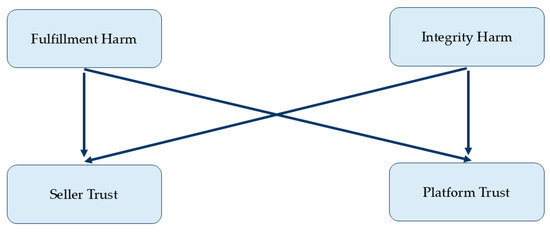
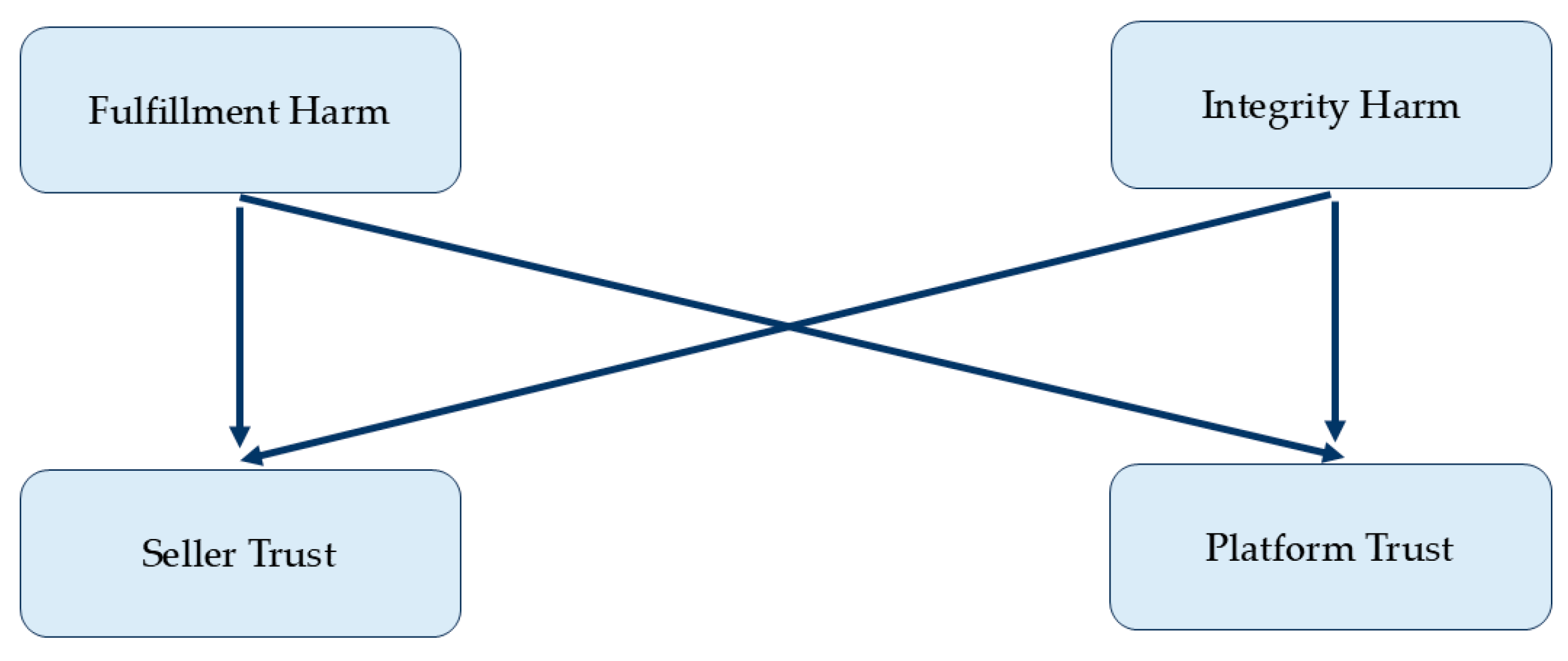
Figure 1 illustrates the conceptual framework of the study, depicting the hypothesized relationships among fulfillment harm, integrity harm, and trust outcomes. The arrows indicate theorized associations between the constructs and serve to summarize the analytical structure of the model, rather than to suggest causal identification.
Figure 1.
Conceptual Framework.
3. Methods
3.1. Data and Sample
The data for this study were obtained from the 2024 Consumer Market Evaluation Index on secondhand marketplaces. The Korea Consumer Agency, a Korean government agency, conducts this large-scale survey periodically to inform policy development and monitor firm behavior, thereby enhancing consumer rights and promoting a safer purchasing environment. In 2024, the agency for the first time included transactions conducted through secondhand online marketplaces. Respondents were asked to report their most recent transaction experiences in secondhand online marketplaces, including whether they encountered various types of problems or harms during the transaction and their subsequent trust evaluations of both the seller and the platform involved. The original survey items were administered in Korean. Translated versions of the key survey items used in this study are provided in the Appendix A. Because the dataset is publicly available upon request from the agency and is fully deidentified, institutional review board approval was not required.
3.2. Measures
3.2.1. Trust
In the survey, respondents were asked to report their overall level of trust in the seller and in the platform based on their transaction experience, including any harm they encountered. Each trust measure ranges from 1 to 5, with higher values indicating greater perceived trustworthiness of the respective actor. To enable comparisons across outcomes and harm types, trust measures were standardized and expressed as z-scores.
Here, trust evaluations represent respondents’ overall assessments of the reliability and integrity of each actor involved in the transaction. Measuring trust at the actor level is particularly important in platform-mediated marketplaces, where consumers form distinct trust judgments toward individual sellers and toward the platform [10,30,31]. This approach is consistent with prior research emphasizing that trust in electronic commerce is not monolithic but target-specific, depending on the role of each actor in the transaction [10].
3.2.2. Experienced Harm
To measure experienced harm, survey participants self-reported whether they encountered problems during their transactions. While respondents reported various types of harmful experiences, we categorized these experiences into two types of harm, fulfillment harm and integrity harm, as theorized in the previous section.
Fulfillment harm is a dummy variable coded as 1 when consumers report failures in transaction execution, including non-delivery, delayed delivery, service interruptions, refund problems, and difficulties related to returns, complaints, or customer service, and 0 otherwise. Conversely, integrity harm is coded as 1 when consumers experience harms related to product authenticity, fraud, counterfeit goods, or misuse of personal or payment information. Even when respondents experience the same type of harm multiple times, the corresponding dummy variable remains coded as 1. When respondents report no harm, both the fulfillment and integrity harm dummies are coded as 0.
This coding method is based on the interpretation of harm as an event, rather than its occurrence or severity. By focusing on whether a given type of harm occurred, the analysis captures the presence of attribution-relevant cues that trigger responsibility judgments. While severity and frequency may shape the magnitude of consumers’ reactions, attribution theory emphasizes that the occurrence of a negative outcome is sufficient to trigger causal reasoning processes that guide responsibility attribution and trust allocation [22,23]. That said, we conducted robustness checks using harm severity proxied by the number of reported harm items within each harm category, as shown in Table A1 in Appendix B. The substantive patterns of results remain unchanged under this alternative operationalization.
3.2.3. Control Variables
The analyses controlled for key demographic characteristics, including gender, age, income, and education. Gender was coded as a dummy variable that is equal to 1 if the respondent is female and 0 if male. Age variable ranged from 1 to 6, with higher values indicating older age groups. Income was measured based on monthly household income using a six-category ordinal scale, where higher values indicate higher income levels. Education was measured as a five-category ordinal variable, with higher values indicating higher levels of educational attainment.
Including these demographic controls allows the analysis to isolate the effects of experienced harm from broader individual differences in trust propensity and risk attitudes. Prior studies in electronic commerce have shown that demographic characteristics are systematically associated with trust formation and evaluation [4,7,10], making it important to account for these factors when examining trust responses to negative transaction outcomes.
3.3. Model Specification
Ordinary least squares (OLS) regression models were estimated to examine the relationship between experienced harm and trust in sellers and platforms. Ordinary least squares estimation is appropriate given the continuous nature of the trust measures and the focus on estimating average differences in trust across harm types. This approach allows us to have straightforward interpretation of coefficients and facilitates the calculation of adjusted mean trust levels.
To directly test the hypotheses developed in Section 2, experienced harm was operationalized using two binary indicators for fulfillment harm and integrity harm, along with their interaction, with no-harm transactions serving as the reference category. Here, the interaction term captures the joint exposure to both harm types.
Separate models were estimated for seller trust and platform trust. To directly assess differential trust allocation between sellers and platforms, an additional model examined the difference between seller trust and platform trust (Seller Trust_i − Platform Trust_i) as the dependent variable. All models included demographic control variables (gender, age, income, and education). Robust standard errors were reported for all models.
Based on the estimated models, adjusted mean trust levels were calculated for each harm type by holding control variables constant. These adjusted means were used to compare trust deterioration across sellers and platforms and to visualize differences in trust allocation across harm types.
The empirical models are specified as follows:
- Model 1
- Model 2
- Model 3
4. Results
4.1. Descriptive Statistics
Table 1 presents descriptive statistics for the main variables based on a survey of 1000 respondents. On a five-point scale, respondents reported moderate levels of trust in both sellers (M = 3.14, SD = 0.64) and platforms (M = 3.18, SD = 0.67). Approximately 21.5 percent of respondents experienced at least one form of fulfillment harm during their most recent secondhand transaction, and 19.2 percent experienced integrity-related harm, indicating that harmful transaction outcomes are common in secondhand, platform-mediated markets.
Table 1.
Descriptive Statistics.
The sample is relatively balanced in gender, with 47.8% of respondents identifying as female. Respondents span a broad range of age groups (M = 3.49 on a six-category scale), indicating participation from both younger and older users of secondhand marketplaces. The average monthly household income falls around the middle of the six-category scale (M = 3.38), and the average education level is also moderate (M = 3.40 on a five-category scale), suggesting that the sample reflects a socioeconomically diverse population of online marketplace users. Correlations among the study variables are reported in Table A2 in Appendix C.
4.2. Main Effects of Experienced Harm on Seller and Platform Trust
The OLS regression results for seller trust and platform trust are shown in Table 2.
Table 2.
Associations Between Fulfillment and Integrity Harm and Seller and Platform Trust.
In Model 1, fulfillment-only harm is associated with lower seller trust relative to no-harm transactions, supporting H1a. In contrast, integrity-only harm is not significantly related to seller trust, so H1b is not supported. This suggests that while problems in transaction execution trigger trust reallocation toward individual sellers, integrity-related problems on their own do not. One possible explanation is that consumers tend to place greater responsibility for these problems on the platform rather than on individual sellers, which softens the impact of integrity harm on seller trust.
Turning to platform trust, as shown in Model 2, fulfillment-only harm is not significantly associated with platform trust, providing no support for H2a. In contrast, integrity-only harm is associated with a significant decline in platform trust relative to no-harm transactions, supporting H2b. This suggests that consumers view fraud, counterfeit goods, and misuse of information as failures of platform governance, but do not attribute responsibility to the platform when only fulfillment issues occur.
As theorized, joint exposure to both fulfillment and integrity harm is associated with the strongest trust deterioration for both sellers and platforms. The joint harm coefficients (Both) in both models, Models 1 and 2, are large and statistically significant, strongly supporting H3. The presence of multiple types of harm significantly deteriorates consumers’ trust in both the seller and platform.
With respect to the control variables, gender, income, and education are not significantly associated with either seller trust or platform trust. Age, however, is positively associated with both trust outcomes, indicating that older respondents tend to report higher levels of trust than younger respondents.
Together, these results show that experienced harm does not uniformly structure trust across actors. Rather, different types of harm induce consumers to redistribute trust for each actor selectively, based on which actor is perceived as having caused or failed to prevent the damages.
4.3. Differential Allocation of Trust Between Sellers and Platforms
To directly assess how different types of harm are associated with the relative allocation of trust between sellers and platforms, we estimated a regression model in which the dependent variable is the difference between seller trust and platform trust (Model 3). A positive coefficient indicates that platform trust deteriorates more than the seller trust (Seller trust − Platform trust > 0), whereas when the coefficient is negative, seller trust deteriorates more than platform trust (Seller trust − Platform trust < 0). It is noteworthy that Model 3 does not aim to capture absolute trust levels but is designed to measure relative trust allocation between sellers and platforms. The trust-difference specification therefore captures attributional shifts in responsibility across actors rather than overall trust magnitude.
In Model 3, where the dependent variable is Seller Trust − Platform Trust, the coefficient on fulfillment-only harm is negative. This indicates that consumers’ trust in individual sellers deteriorates more than their trust in the platform when fulfillment problems occur. Although this effect is not statistically significant, the direction of the effect is consistent with H4, which proposes that consumers place more blame on sellers when transaction-execution failures occur.
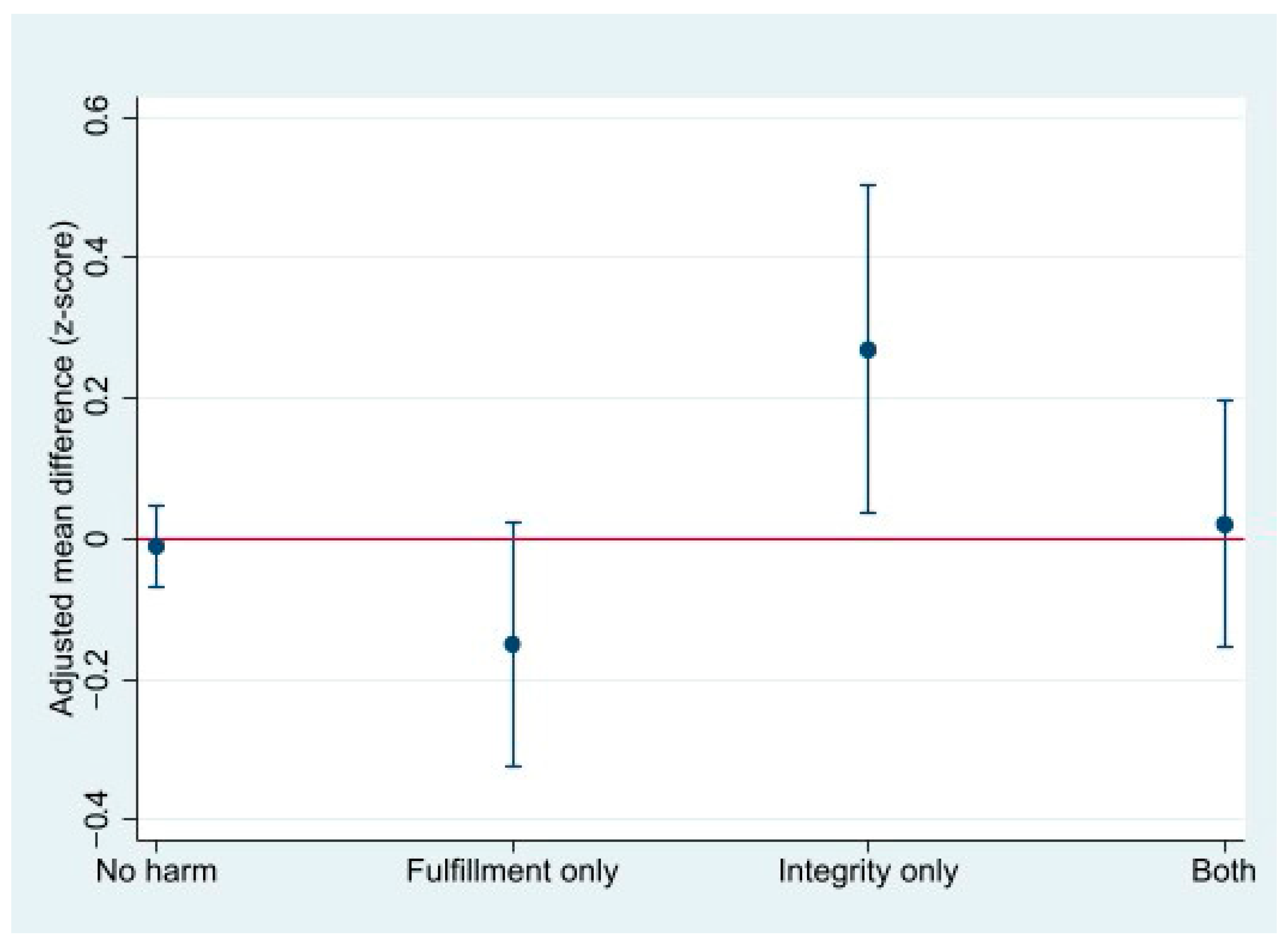
The coefficient on integrity-only harm is positive and statistically significant (p = 0.023), indicating that integrity violations lead to greater deterioration of platform trust than seller trust. This result supports H5 and is consistent with the attributional expectation that consumers hold platforms primarily responsible for preventing fraud and maintaining marketplace integrity.
Joint exposure to both types of harm does not significantly affect the seller–platform trust difference, suggesting that when multiple failures occur, trust is broadly damaged rather than systematically reassigned to one actor. The coefficient on gender is positive and statistically significant, suggesting that female respondents exhibit a larger difference between seller trust and platform trust than male respondents. No other control variables are significantly related to the trust difference between sellers and platforms.
4.4. Adjusted Mean Trust Levels
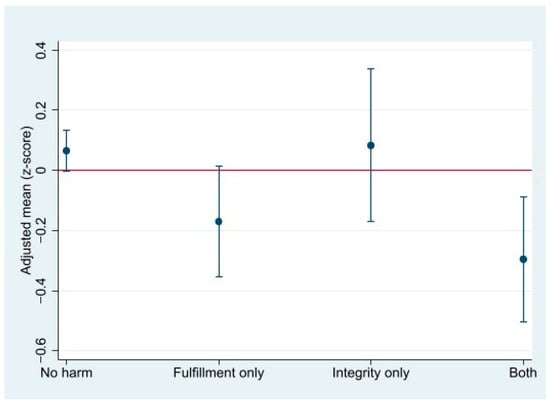
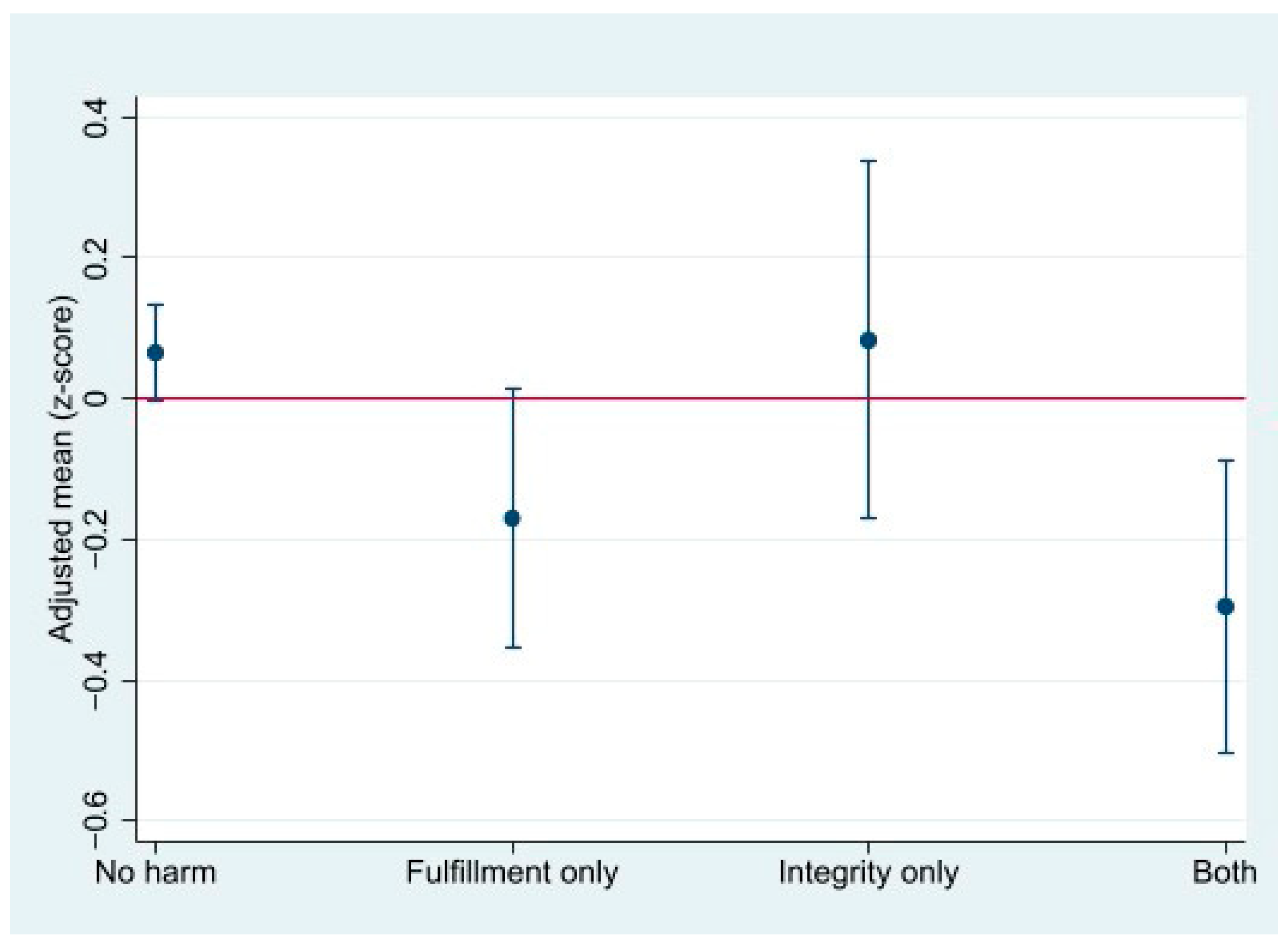
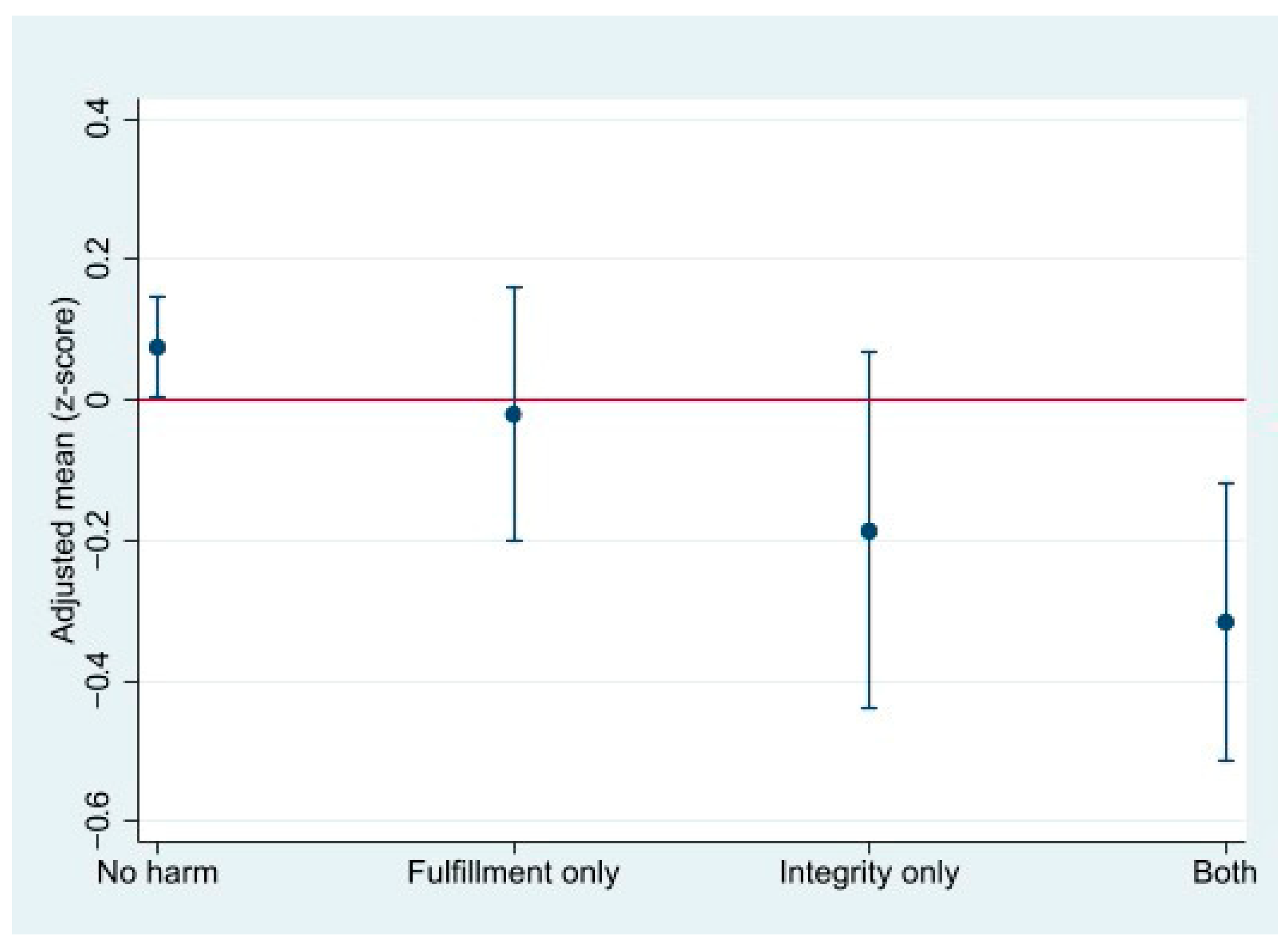
Adjusted mean trust levels for all four harm categories, controlling for various control variables, are shown in Figure 2, Figure 3 and Figure 4. Seller trust deterioration is primarily observed under fulfillment-only and joint harm conditions (Figure 2), whereas trust deterioration at the platform level is evident under integrity-only and joint harm conditions (Figure 3). The difference between seller and platform trust varies across harm types, with integrity harm producing a systematic disadvantage for platforms relative to sellers (Figure 4).
Figure 2.
Seller Trust by Harm Type. Notes: Trust measures are standardized (z-scores). Points represent adjusted means estimated from the regression models; bars indicate 95% confidence intervals. Sample sizes by group are as follows: no harm (n = 720), fulfillment only (n = 88), integrity only (n = 65), and both harms (n = 127).
Figure 3.
Platform Trust by Harm Type. Notes: Trust measures are standardized (z-scores). Points represent adjusted means estimated from the regression models; bars indicate 95% confidence intervals. Sample sizes by group are as follows: no harm (n = 720), fulfillment only (n = 88), integrity only (n = 65), and both harms (n = 127).
Figure 4.
Seller − Platform Trust by Harm Type. Notes: Trust measures are standardized (z-scores). Points represent adjusted means estimated from the regression models; bars indicate 95% confidence intervals. Sample sizes by group are as follows: no harm (n = 720), fulfillment only (n = 88), integrity only (n = 65), and both harms (n = 127).
5. Discussion
This study analyzes how different types of experienced harm structure trust in sellers and platforms in secondhand, platform-mediated marketplaces. Drawing on attribution theory, we distinguish between fulfillment harm and integrity harm, and analyze how these two forms of harm are differentially associated with seller and platform trust. The findings suggest that experienced harm does not uniformly deteriorate trust. Instead, trust deterioration systematically depends on how consumers attribute responsibility for negative outcomes. Specifically, fulfillment harm is mainly related to the deterioration of seller trust, whereas integrity harm disproportionately deteriorates platform trust. When both harm elements occur together, trust deterioration intensifies for both actors. These results highlight post-transaction attribution processes in trust reallocation. Customers evaluate which actor should have prevented the failure and redistribute their trust accordingly.
It is important to note that although some integrity harm items (such as defective or misdescribed products) may seem to reflect problems caused by individual sellers, in secondhand platform markets these incidents are often understood as failures of platform oversight. Platforms present themselves as responsible for ensuring product authenticity, safety, and accurate listings through mechanisms such as seller screening, reporting systems, and dispute resolution. As a result, consumers tend to view these problems not simply as seller mistakes, but as indications that the platform did not adequately maintain marketplace integrity. From an attributional perspective, fulfillment harm captures breakdowns in how a transaction is carried out after a seller is already allowed to operate, whereas integrity harm captures failures in the platform’s ability to prevent problematic transactions from occurring in the first place.
This study contributes to the literature and practice in the following ways. First, this study builds on attribution theory to explain a complex marketplace with multiple actors. Although attribution theory in consumer research has traditionally been used to structure how consumers evaluate outcomes after a purchase, much less has been paid to how responsibility and blame are distributed among multiple market actors, often treating trust as a single-target outcome. By focusing on causal locus and controllability, this study shows the systematic reorientation of trust between sellers and platforms through attribution processes. In this way, it highlights the value of attribution theory for understanding trust dynamics in platform-mediated exchanges.
Second, this study expands research on consumer harm by conceptualizing fulfillment harm and integrity harm as distinct constructs, instead of treating negative experiences as monolithic. This distinction demonstrates that different categories of harm can trigger qualitatively different attribution processes. Fulfillment issues are largely associated with sellers, whereas integrity issues are primarily a concern of platform governance. By introducing this typology, the study provides a clearer way to see how different kinds of negative experiences affect trust redistribution in platform-mediated markets.
In addition, this research adds to the e-commerce trust literature by focusing more on actual experienced harm. Earlier studies have emphasized consumers’ pre-transaction evaluations, including uncertainty and anticipated loss, thereby enhancing our understanding of adoption of e-commerce and purchase intention. While recent studies have examined and provided insight into consumers’ evaluations following real transaction, few have examined trust as a post-transaction outcome [17]. By examining realized harm, this research highlights attributional processes that occur after negative outcomes have materialized. In this way, it extends trust research to the post-transaction phase.
Last but not least, this study offers important practical implications. For platform operators, the results indicate that protecting consumers through integrity-related safeguards is especially important, since this type of harm incurs more severe deterioration of platform trust. This means that efforts such as screening sellers, detecting fraud, and handling disputes effectively are not just about preventing harms or losses but about maintaining institutional trust. For individual sellers in secondhand marketplaces, the findings show a strong association between fulfillment failures and declines in seller trust. This highlights the importance of dependable delivery, clear communication, and attentive follow-up after a transaction for keeping buyers’ trust in peer-to-peer exchanges.
This study has several limitations that suggest directions for future research. First, the generalizability of the findings may be limited. Because the analysis focuses on secondhand C2C platforms, where responsibility between sellers and platforms is not clearly formalized, attribution processes are likely to play a particularly important role. In other platform-mediated marketplaces where responsibility is more clearly defined, however, the same patterns may not hold. In addition, the results may not extend to B2C platforms in which the platform itself sells products, since the boundary between seller and platform is less distinct in those cases. Future research could examine whether different platform governance and fulfillment arrangements lead to different patterns of attribution and trust than those observed in the C2C context studied here.
Second, the data reflect trust reallocation measured at a single point in time. In other words, the current study relies on cross-sectional data from a single year, in which respondents evaluated their experienced harm and trust toward sellers and platforms in a single survey. As a result, the findings capture associations rather than causal relationships. However, trust may not only be an outcome of experienced harm but may also shape how consumers perceive, interpret, and report harmful experiences. For instance, consumers with lower baseline trust may be more likely to label adverse outcomes as harm and to recall and report such experiences. Therefore, the observed associations should be interpreted cautiously, and future longitudinal research is needed to disentangle the dynamic, reciprocal relationship between trust and harm perception. With longer-term datasets, future research can also examine whether trust is restored or remains eroded following a harmful experience.
Third, in this study, experienced harm is measured using binary indicators that capture whether a particular type of harm occurred, rather than how severe or frequent it was. Attribution theory suggests that the mere occurrence of a negative outcome is enough to trigger causal reasoning and responsibility attribution [22,23]. Still, more serious or repeated harms are likely to generate stronger and possibly different effects on trust. Although we conducted robustness checks using harm severity and found the results substantively unchanged, future research could build on our approach by incorporating measures of harm severity, frequency, or additional types of harm to better understand how these dimensions influence attribution and trust reallocation.
Fourth, although fulfillment and integrity harms may differ in perceived severity, the present study does not conceptualize these harm types as points on a severity continuum. Future research could adopt qualitative approaches, such as in-depth interviews or experimental vignette studies, to explore how consumers cognitively interpret different types of harm and how they construct severity and responsibility attributions across sellers and platforms.
Fifth, key transaction-level variables such as item price and seller ratings are not available in the dataset. Because these factors are likely to influence consumer trust formation, future research should incorporate such controls to further refine the analysis of trust reallocation toward different actors.
Finally, future research could examine how the responses of sellers and platforms to experienced harm affect trust over time. When harm occurs, consumers often contact either the seller or the platform to seek recovery. How these actors handle complaints, compensation, or dispute resolution is likely to play an important role in whether trust is rebuilt or further weakened. Studying these recovery efforts could shed light on how trust is restored and how such interventions influence attribution processes following harmful experiences.
6. Conclusions
As platform-mediated markets continue to expand, understanding how consumers assign responsibility when transactions go wrong becomes increasingly important. Our findings indicate that trust deterioration depends on how consumers interpret why harm occurred and who they believe should have prevented it. By highlighting the role of attribution in digital marketplaces, this research provides a more nuanced understanding of how experienced harm is translated into patterns of consumer trust toward sellers and platforms. At the same time, the findings point to the importance of interpretive processes and potential causal ambiguity in trust dynamics, suggesting that attributional trust allocation should be understood as an interpretive process rather than a purely one-way causal mechanism.
Funding
This research received no external funding.
Institutional Review Board Statement
Not applicable. This study uses publicly available, secondary data from the Korea Consumer Agency that are fully de-identified and contain no personal identifiers; therefore, institutional review board approval was not required.
Informed Consent Statement
Not applicable.
Data Availability Statement
This paper is written using the ‘2024 Consumer Market Evaluation Index’ by the Korea Consumer Agency (KCA). Access to the data can be requested from the Korea Consumer Agency.
Acknowledgments
The authors used generative AI tools for language editing and clarity improvement only. The AI tools did not generate or alter the study’s data, analysis, results, or scientific content. The authors take full responsibility for the integrity of the work.
Conflicts of Interest
The author declares no conflicts of interest.
Appendix A. Survey Items (Translated from Korean)
This appendix reports the English translations of the key survey items used to construct the main variables in the analysis. The original survey was administered in Korean as part of the 2024 Consumer Market Evaluation Index on secondhand marketplaces conducted by the Korea Consumer Agency.
Appendix A.1. Trust Measures
- Seller Trust
“Overall, how much do you trust the seller involved in this transaction?”
- Platform Trust
“Overall, how much do you trust the platform through which this transaction was conducted?”
Response scale:
1 = Not at all trustworthy
2 = Slightly trustworthy
3 = Moderately trustworthy
4 = Trustworthy
5 = Very trustworthy
Appendix A.2. Fulfillment Harm Items
Respondents were asked whether they experienced any of the following problems related to delivery, service provision, cancellation, returns, or after-sales support in their most recent secondhand marketplace transaction. Fulfillment harm was coded as 1 if the respondent reported at least one of the following problems, and 0 otherwise.
- Delivery and Service Provision Problems
- The product or service delivered was incomplete or not delivered at all.
- The product or service was delivered much later than what the seller had promised.
- The service was unexpectedly discontinued or interrupted.
- I received a product or service that I did not request.
- Cancellation and Return Problems
- 5.
- I was unable to exercise my right to cancel the contract or return the product.
- 6.
- I had to cancel the contract or order for unexpected reasons.
- 7.
- Returning the product was difficult or problematic.
- 8.
- The refund for a returned product or canceled service was delayed or incomplete.
- Complaint Handling, Compensation, and Warranty Problems
- 9.
- I experienced problems with after-sales service, customer service, or complaint handling.
- 10.
- Warranty or quality assurance was not properly provided (e.g., unexpected charges after repair or replacement, delays, or inefficient service).
- 11.
- Compensation for loss, damage, or injury was inadequate or not provided at all.
Each item was coded as 1 = Yes and 0 = No.
Appendix A.3. Integrity Harm Items
Respondents were asked whether they experienced any of the following problems related to fraud, deception, counterfeit goods, or product integrity in their most recent secondhand marketplace transaction. Integrity harm was coded as 1 if the respondent reported at least one of the following problems, and 0 otherwise.
- Fraud, Deception, and Counterfeiting
- My payment information or personal information was misused, leaked, or stolen.
- The seller or service provider was fake or fraudulent.
- I received counterfeit goods or a fake service.
- Product and Service Integrity Problems
- 4.
- The product or service had defects or did not function properly.
- 5.
- The product or service caused damage.
- 6.
- The product or service differed from the seller’s description (e.g., color, size, model, version, or specifications were different).
- 7.
- The product or service differed from what was described at the time of order.
- 8.
- The product or service was unsafe (e.g., dangerous packaging or inadequate safety labels or instructions).
Each item was coded as 1 = Yes and 0 = No.
Appendix B. Robustness Checks
To address concerns regarding the binary operationalization of harm, we conducted robustness analyses using harm severity proxied by the number of reported items within each harm category. The results remain substantively unchanged. Fulfillment severity continues to be primarily associated with deterioration of seller trust, whereas integrity severity disproportionately affects platform trust. This indicates that the observed attributional patterns are not artifacts of binary coding but reflect stable attribution structures across alternative operationalizations of harm.
Table A1.
Robustness Checks using Harm Severity Measures.
Appendix C. Correlation Matrix
Table A2.
Correlation among the Study Variables.
References
- Dimoka, A.; Hong, Y.; Pavlou, P.A. On product uncertainty in online markets: Theory and evidence. MIS Q. 2012, 36, 395–426. [Google Scholar] [CrossRef] [Scilit]
- Al-Adwan, A.S.; Yaseen, H. Boosting online purchase intention in high-uncertainty environments: The role of retailer-based signals in e-commerce. Businesses 2022, 2, 243–260. [Google Scholar]
- Luhmann, N. Trust and Power; Wiley: New York, NY, USA, 1979. [Google Scholar]
- Gefen, D.; Karahanna, E.; Straub, D.W. Trust and TAM in online shopping: An integrated model. MIS Q. 2003, 27, 51–90. [Google Scholar] [CrossRef] [Scilit]
- Featherman, M.S.; Pavlou, P.A. Predicting e-services adoption: A perceived risk facets perspective. Int. J. Hum. Comput. Stud. 2003, 59, 451–474. [Google Scholar] [CrossRef] [Scilit]
- Pires, G.; Stanton, J.; Eckford, A. Influences on the perceived risk of purchasing online. J. Consum. Behav. 2004, 4, 118–131. [Google Scholar] [CrossRef] [Scilit]
- Kim, D.J.; Ferrin, D.L.; Rao, H.R. A trust-based consumer decision-making model in electronic commerce. Decis. Support Syst. 2008, 44, 544–564. [Google Scholar] [CrossRef] [Scilit]
- Hipólito, J.; Teixeira, A.A.; da Silva, M.M. Consumer trust and perceived risk in e-commerce: A systematic review. J. Retail. Consum. Serv. 2025, 74, 103384. [Google Scholar]
- Jarvenpaa, S.L.; Tractinsky, N.; Vitale, M. Consumer trust in an internet store. J. Comput. Mediat. Commun. 1999, 5, JCMC521. [Google Scholar] [CrossRef] [Scilit]
- Pavlou, P.A.; Gefen, D. Building effective online marketplaces with institution-based trust. Inf. Syst. Res. 2004, 15, 37–59. [Google Scholar] [CrossRef] [Scilit]
- Phamthi, V.A.; Nagy, Á.; Ngo, T.M. The influence of perceived risk on purchase intention in e-commerce. Int. J. Consum. Stud. 2024, 48, e12988. [Google Scholar] [CrossRef] [Scilit]
- Anderson, E.W.; Sullivan, M.W. The antecedents and consequences of customer satisfaction for firms. Mark. Sci. 1993, 12, 125–143. [Google Scholar] [CrossRef] [Scilit]
- Oliver, R.L. Whence consumer loyalty? J. Mark. 1999, 63, 33–44. [Google Scholar] [CrossRef] [Scilit]
- Bhattacherjee, A. Understanding information systems continuance: An expectation-confirmation model. MIS Q. 2001, 25, 351–370. [Google Scholar] [CrossRef] [Scilit]
- Koufaris, M. Applying the Technology Acceptance Model and Flow Theory to online consumer behavior. Inf. Syst. Res. 2002, 13, 205–223. [Google Scholar] [CrossRef] [Scilit]
- Cao, Y.; Ajjan, H.; Hong, P. Post-purchase shipping and customer service experiences in online shopping and their impact on customer satisfaction: An empirical study with comparison. Asia Pac. J. Mark. Logist. 2018, 30, 916–934. [Google Scholar] [CrossRef] [Scilit]
- Ma, S.; Gao, S.; Chen, Y. Post-purchase trust in e-commerce: A theoretical framework and a text mining-based assessment method. Int. J. Hum. Comput. Interact. 2022, 38, 1038–1056. [Google Scholar] [CrossRef] [Scilit]
- Ert, E.; Fleischer, A.; Magen, N. Trust and reputation in the sharing economy. Tour. Manag. 2016, 55, 62–73. [Google Scholar] [CrossRef] [Scilit]
- Hawlitschek, F.; Teubner, T.; Gimpel, H. Understanding the sharing economy. Electron. Commer. Res. Appl. 2016, 17, 66–78. [Google Scholar]
- Parker, G.G.; Van Alstyne, M.W.; Choudary, S.P. Platform Revolution; W.W. Norton & Company: New York, NY, USA, 2016. [Google Scholar]
- Heider, F. The Psychology of Interpersonal Relations; Wiley: New York, NY, USA, 1958. [Google Scholar]
- Weiner, B. An attributional theory of achievement motivation and emotion. Psychol. Rev. 1985, 92, 548–573. [Google Scholar] [CrossRef]
- Folkes, V.S. Consumer reactions to product failure: An attributional approach. J. Consum. Res. 1984, 10, 398–409. [Google Scholar] [CrossRef] [Scilit]
- Weiner, B. Intrapersonal and interpersonal theories of motivation from an attributional perspective. Educ. Psychol. Rev. 2000, 12, 1–14. [Google Scholar] [CrossRef] [Scilit]
- Pavlou, P.A. Consumer acceptance of electronic commerce. Int. J. Electron. Commer. 2003, 7, 101–134. [Google Scholar] [CrossRef] [Scilit]
- Klein, J.; Dawar, N. Corporate social responsibility and consumers’ attributions. J. Mark. 2004, 68, 203–217. [Google Scholar]
- Tsarenko, Y.; Tojib, D. A transactional model of service failure and recovery. J. Serv. Mark. 2011, 25, 99–112. [Google Scholar] [CrossRef] [Scilit]
- Tax, S.S.; Brown, S.W.; Chandrashekaran, M. Customer evaluations of service complaint experiences. J. Mark. 1998, 62, 60–76. [Google Scholar] [CrossRef] [Scilit]
- Maxham, J.G.; Netemeyer, R.G. A longitudinal study of complaining customers. J. Mark. 2002, 66, 57–71. [Google Scholar] [CrossRef] [Scilit]
- Ba, S.; Pavlou, P.A. Evidence of the effect of trust building technology in electronic markets. MIS Q. 2002, 26, 243–268. [Google Scholar] [CrossRef] [Scilit]
- McKnight, D.H.; Choudhury, V.; Kacmar, C. Developing and validating trust measures for e-commerce. Inf. Syst. Res. 2002, 13, 334–359. [Google Scholar] [CrossRef] [Scilit]

Disclaimer/Publisher’s Note: The statements, opinions and data contained in all publications are solely those of the individual author(s) and contributor(s) and not of MDPI and/or the editor(s). MDPI and/or the editor(s) disclaim responsibility for any injury to people or property resulting from any ideas, methods, instructions or products referred to in the content. |
© 2026 by the author. Licensee MDPI, Basel, Switzerland. This article is an open access article distributed under the terms and conditions of the Creative Commons Attribution (CC BY) license.