
Examining Consumers’ Continuance Intention to Use P2P Mobile Payment Systems: An Extended TPB Approach


Abstract
1. Introduction
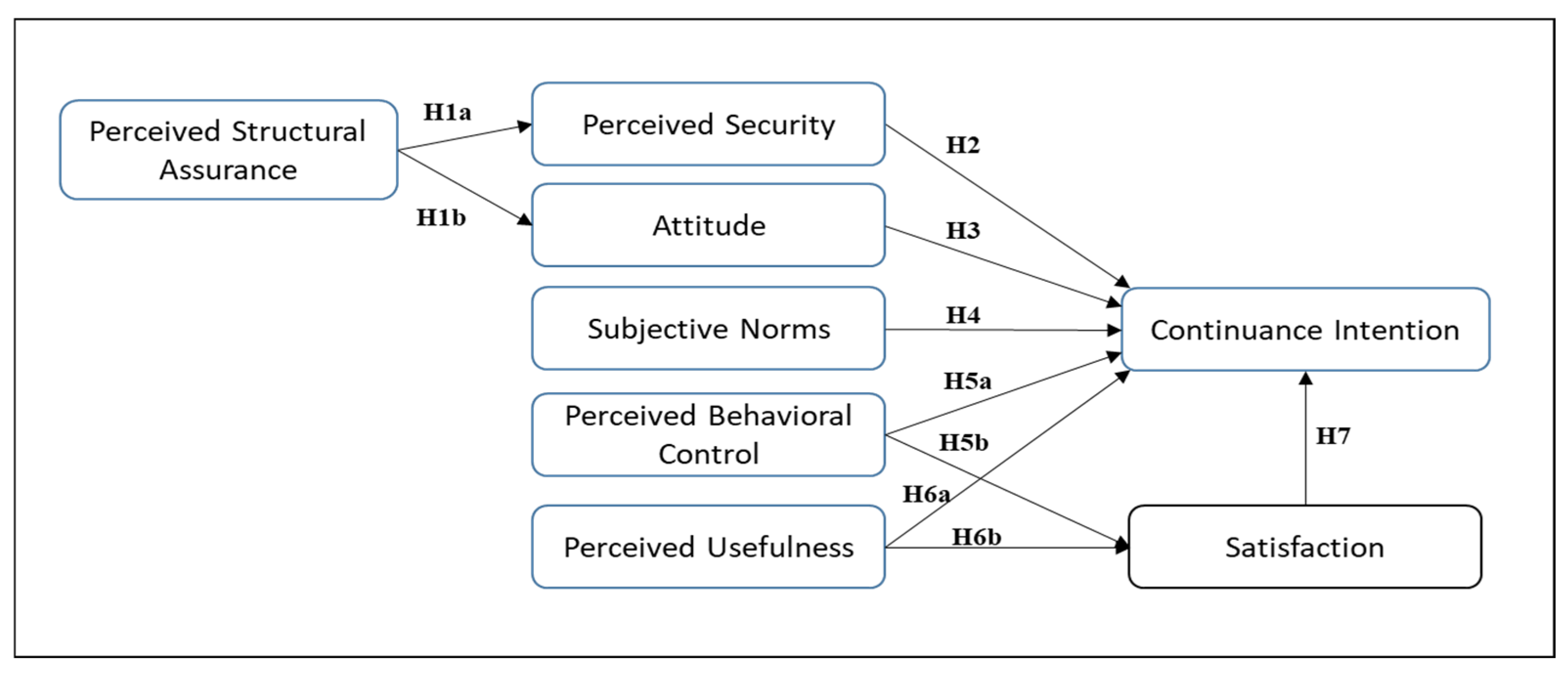
- What factors affect Jordanian consumers’ continuance intention to use the CliQ P2P mobile payment system?
- How does perceived structural assurance shape consumers’ attitudes and perceptions of security when using the CliQ P2P mobile payment system?
2. Literature Review and Related Work
3. Theoretical Framework and Hypotheses Development
4. Methodology
4.1. Data and Measurement
4.2. Participants and Data Collection Procedure
5. Results
5.1. The Measurement Model Evaluation
5.2. The Structural Model Evaluation
6. Discussion
7. Conclusions
7.1. Theoretical Contributions
7.2. Managerial Implications
7.3. Limitations and Future Research
Author Contributions
Funding
Institutional Review Board Statement
Informed Consent Statement
Data Availability Statement
Acknowledgments
Conflicts of Interest
Abbreviations
| TPB | Theory of Planned Behavior |
| P2P | Peer-to-Peer |
| JoPACC | Jordan Payments and Clearing Company |
| PLS-SEM | Partial Least Squares Structural Equation Modeling |
References
- Hew, J.-J. Hall of Fame for Mobile Commerce and Its Applications: A Bibliometric Evaluation of a Decade and a Half (2000–2015). Telemat. Inform. 2017, 34, 43–66. [Google Scholar] [CrossRef]
- Tamilmani, K.; Rana, N.P.; Dwivedi, Y.K. Consumer Acceptance and Use of Information Technology: A Meta-Analytic Evaluation of UTAUT2. Inf. Syst. Front. 2021, 23, 987–1005. [Google Scholar] [CrossRef]
- Li, L.; Freeman, G.; Knijnenburg, B. Beyond Just Money Transactions: How Digital P2P Payments (Re)Shape Existing Offline Interpersonal Relationships. Proc. ACM Hum. Comput. Interact. 2024, 8, 1–36. [Google Scholar] [CrossRef]
- Amoroso, D.L.; Ackaradejruangsri, P. Going Cashless in Japan: Using Exchange Benefit and Cost Approach to Study Continuance Intention of Mobile Wallet. Technol. Soc. 2024, 78, 102529. [Google Scholar] [CrossRef]
- Alkadi, R.S.; Abed, S.S. Consumer Acceptance of Fintech App Payment Services: A Systematic Literature Review and Future Research Agenda. J. Theor. Appl. Electron. Commer. Res. 2023, 18, 1838–1860. [Google Scholar] [CrossRef]
- Al-Okaily, M.; Alalwan, A.A.; Al-Fraihat, D.; Alkhwaldi, A.F.; Rehman, S.U.; Al-Okaily, A. Investigating Antecedents of Mobile Payment Systems’ Decision-Making: A Mediated Model. Glob. Knowl. Mem. Commun. 2024, 73, 45–66. [Google Scholar] [CrossRef]
- Alkhwaldi, A.F.; Al-Qudah, A.A.; Al-Hattami, H.M.; Al-Okaily, M.; Al-Adwan, A.S.; Abu-Salih, B. Uncertainty Avoidance and Acceptance of the Digital Payment Systems: A Partial Least Squares-Structural Equation Modeling (PLS-SEM) Approach. Glob. Knowl. Mem. Commun. 2024, 73, 1119–1139. [Google Scholar] [CrossRef]
- Huang, L.; Ghosh, A.P.; Li, R.; Ince, E.C. Pay Me with Venmo: Effect of Service Providers’ Decisions to Adopt P2P Payment Methods on Consumer Evaluations. J. Assoc. Consum. Res. 2020, 5, 271–281. [Google Scholar] [CrossRef]
- Belanche, D.; Guinalíu, M.; Albás, P. Customer Adoption of P2p Mobile Payment Systems: The Role of Perceived Risk. Telemat. Inform. 2022, 72, 101851. [Google Scholar] [CrossRef]
- Irimia-Diéguez, A.; Liébana-Cabanillas, F.; Blanco-Oliver, A.; Lara-Rubio, J. What Drives Consumers to Use P2P Payment Systems? An Analytical Approach Based on the Stimulus–Organism–Response (S-O-R) Model. Eur. J. Manag. Bus. Econ. 2025, 34, 149–173. [Google Scholar] [CrossRef]
- Pham, D.C.; Nguyen, T. Understanding Peer-to-Peer Mobile Payment Continuance Intention: A Privacy Calculus Perspective. Int. J. Electron. Bus. 2025, 20, 210–243. [Google Scholar] [CrossRef]
- JOPACC. About JOPACC. Available online: https://www.jopacc.com/who-we-are/about-jopacc (accessed on 1 February 2025).
- Pal, A.; Herath, T.; De’, R.; Rao, H.R. Is the Convenience Worth the Risk? An Investigation of Mobile Payment Usage. Inf. Syst. Front. 2021, 23, 941–961. [Google Scholar] [CrossRef]
- Dimitrova, I. Barrier-Breakers’ Influence on Full-Adoption of Digital Payment Methods. Internet Res. 2024, 34, 139–159. [Google Scholar] [CrossRef]
- Mai, X.T.; Nguyen, T. Switching Behaviors in Peer-to-Peer Mobile Payment Applications: The Role of Sociability. J. Syst. Inf. Technol. 2024, 26, 1–30. [Google Scholar] [CrossRef]
- Islam, S.M.; Ferrer, M.A. Unlocking the Cashless Shift: Retailers’ Adoption of Digital Payment Systems in Emerging Markets. J. Theor. Appl. Electron. Commer. Res. 2025, 20, 359. [Google Scholar] [CrossRef]
- Kalinic, Z.; Marinkovic, V.; Molinillo, S.; Liébana-Cabanillas, F. A Multi-Analytical Approach to Peer-to-Peer Mobile Payment Acceptance Prediction. J. Retail. Consum. Serv. 2019, 49, 143–153. [Google Scholar] [CrossRef]
- Lara-Rubio, J.; Villarejo-Ramos, A.F.; Liébana-Cabanillas, F. Explanatory and Predictive Model of the Adoption of P2P Payment Systems. Behav. Inf. Technol. 2021, 40, 528–541. [Google Scholar] [CrossRef]
- Salah, O.H.; Ayyash, M.M. Understanding User Adoption of Mobile Wallet: Extended TAM with Knowledge Sharing, Perceived Value, Perceived Privacy Awareness and Control, Perceived Security. VINE J. Inf. Knowl. Manag. Syst. 2024, 55, 1223–1250. [Google Scholar] [CrossRef]
- Sumiyana, N.A.; Agustiningsih, W. Users’ Trust, Spirit, Flow, and Intention to Reuse e-Mobile Payments: Explained by a Combination of the Attribution and Adaptive Structuration Theories. Int. J. Bus. Inf. Syst. 2024, 45, 228–253. [Google Scholar] [CrossRef]
- Mu, H.-L.; Lee, Y.-C. Examining the Influencing Factors of Third-Party Mobile Payment Adoption: A Comparative Study of Alipay and WeChat Pay. J. Inf. Syst. 2017, 26, 247–284. [Google Scholar] [CrossRef]
- Acker, A.; Murthy, D. What Is Venmo? A Descriptive Analysis of Social Features in the Mobile Payment Platform. Telemat. Inform. 2020, 52, 101429. [Google Scholar] [CrossRef]
- Kurniasari, F.; Abd Hamid, N. The Effect of Perceived Usefulness, Perceived Ease of Use, Trust, Attitude and Satisfaction into Continuance of Intention in Using Alipay. Manag. Account. Rev. 2020, 19, 132–150. [Google Scholar]
- Khare, M.; Oak, R. You Are What You Pay: A Case Study in Venmo. Int. J. Adv. Sci. Technol. 2021, 30, 318–324. [Google Scholar]
- Pratama, J. Analysis of Factors Affecting Trust on the Use of FinTech (P2P Lending) in Indonesia. J. Sisfokom (Sist. Inf. Dan Komput.) 2021, 10, 79–85. [Google Scholar] [CrossRef]
- Dias, S.; Nigalye, A.; Mahajan, J. Adoption Factors of P2P Lending in India. In Proceedings of the International Conference on Technology and Innovation Management (ICTIM 2022); Atlantis Press: Dordrecht, The Netherlands, 2022; pp. 129–144. [Google Scholar]
- Sahli Sassi, A.; Hammami, H.; Ben Lallouna Hafsia, H. Perceived Risk, Structural Assurance and Trust in Mobile Payments. J. Telecommun. Digit. Econ. 2022, 10, 41–56. [Google Scholar] [CrossRef]
- Savitha, B.; Hawaldar, I.T.; Kumar, K.N. Continuance Intentions to Use FinTech Peer-to-Peer Payments Apps in India. Heliyon 2022, 8, e11654. [Google Scholar] [CrossRef]
- Widyanto, H.A.; Syahrivar, J.; Genoveva, G.; Chairy, C. Intention to Use Peer-to-Peer (P2P) Lending: The Roles of Perceived Structural Assurance and Perceived Critical Mass. Organ. Mark. Emerg. Econ. 2022, 13, 183–208. [Google Scholar] [CrossRef]
- Putri, G.A.; Widagdo, A.K.; Setiawan, D. Analysis of Financial Technology Acceptance of Peer to Peer Lending (P2P Lending) Using Extended Technology Acceptance Model (TAM). J. Open Innov. Technol. Mark. Complex. 2023, 9, 100027. [Google Scholar] [CrossRef]
- Li, X.; Zhu, X.; Lu, Y.; Shi, D.; Deng, W. Understanding the Continuous Usage of Mobile Payment Integrated into Social Media Platform: The Case of WeChat Pay. Electron. Commer. Res. Appl. 2023, 60, 101275. [Google Scholar] [CrossRef]
- Antonio, B.-O.; Juan, L.-R.; Ana, I.-D.; Francisco, L.-C. Examining User Behavior with Machine Learning for Effective Mobile Peer-to-Peer Payment Adoption. Financ. Innov. 2024, 10, 94. [Google Scholar] [CrossRef]
- de Blanes Sebastián, M.G.; Antonovica, A.; Sarmiento Guede, J.R. What Are the Leading Factors for Using Spanish Peer-to-Peer Mobile Payment Platform Bizum? The Applied Analysis of the UTAUT2 Model. Technol. Forecast. Soc. Change 2023, 187, 122235. [Google Scholar] [CrossRef]
- Jiang, B.; Zhou, J. FinTech and Crime: Evidence from Banks’ Partnering with Zelle. Appl. Econ. 2025, 1–10. [Google Scholar] [CrossRef]
- Maniyar, V. Bank-Led Innovation: The Expansion of the Zelle Network in the US—Key Drivers, Market Impact and Future Outlook. J. Paym. Strategy Syst. 2025, 19, 114. [Google Scholar] [CrossRef]
- Zhong, Y.; Moon, H.-C. Investigating Customer Behavior of Using Contactless Payment in China: A Comparative Study of Facial Recognition Payment and Mobile QR-Code Payment. Sustainability 2022, 14, 7150. [Google Scholar] [CrossRef]
- Mombeuil, C.; Uhde, H. Relative Convenience, Relative Advantage, Perceived Security, Perceived Privacy, and Continuous Use Intention of China’s WeChat Pay: A Mixed-Method Two-Phase Design Study. J. Retail. Consum. Serv. 2021, 59, 102384. [Google Scholar] [CrossRef]
- Choi, H.; Park, J.; Kim, J.; Jung, Y. Consumer Preferences of Attributes of Mobile Payment Services in South Korea. Telemat. Inform. 2020, 51, 101397. [Google Scholar] [CrossRef]
- Kleivene, L.E. P2P Mobile Payments: Investigating the Factors of Adoption Among Students in Germany. In Omnichannel Branding; Springer Fachmedien: Wiesbaden, Germany, 2018; pp. 45–67. [Google Scholar]
- Mathieson, K. Predicting User Intentions: Comparing the Technology Acceptance Model with the Theory of Planned Behavior. Inf. Syst. Res. 1991, 2, 173–191. [Google Scholar] [CrossRef]
- Bosnjak, M.; Ajzen, I.; Schmidt, P. The Theory of Planned Behavior: Selected Recent Advances and Applications. Eur. J. Psychol. 2020, 16, 352–356. [Google Scholar] [CrossRef]
- Armitage, C.J.; Conner, M. The Theory of Planned Behaviour: Assessment of Predictive Validity and ’perceived Control. Br. J. Soc. Psychol. 1999, 38, 35–54. [Google Scholar] [CrossRef]
- Venkatesh, V.; Davis, F.; Morris, M. Dead or Alive? The Development, Trajectory and Future of Technology Adoption Research. J. Assoc. Inf. Syst. 2007, 8, 267–286. [Google Scholar] [CrossRef]
- Sun, S.; Law, R.; Schuckert, M.; Hyun, S.S. Impacts of Mobile Payment-related Attributes on Consumers’ Repurchase Intention. Int. J. Tour. Res. 2022, 24, 44–57. [Google Scholar] [CrossRef]
- Dhanya, M.; Rejikumar, G.; Joy, A. A Study on the Extension of TAM Model with TPB in the Adoption of Mobile Payment Applications. Int. J. Bus. Inf. Syst. 2024, 47, 190–201. [Google Scholar] [CrossRef]
- Verma, S.; Chaurasia, S.S.; Bhattacharyya, S.S. The Effect of Government Regulations on Continuance Intention of In-Store Proximity Mobile Payment Services. Int. J. Bank Mark. 2019, 38, 34–62. [Google Scholar] [CrossRef]
- Ajzen, I. The Theory of Planned Behavior. Organ. Behav. Hum. Decis. Process. 1991, 50, 179–211. [Google Scholar] [CrossRef]
- Gong, X.; Cheung, C.; Zhang, K.; Lee, M. Battles of Mobile Payment Networks: The Impacts of Network Structures, Technology Complementarities and Institutional Mechanisms on Consumer Loyalty. Inf. Syst. J. 2022, 32, 696–728. [Google Scholar] [CrossRef]
- Gorshkov, V. Cashless Payment in Emerging Markets: The Case of Russia. Asia Glob. Econ. 2022, 2, 100033. [Google Scholar] [CrossRef]
- Mansfield, C.L. It Takes a Thief… and a Bank: Protecting Consumers from Fraud and Scams on P2P Payment Platforms. Univ. Mich. J. Law Reform 2023, 57, 351–416. [Google Scholar]
- Flavián, C.; Guinaliu, M.; Lu, Y. Mobile Payments Adoption—Introducing Mindfulness to Better Understand Consumer Behavior. Int. J. Bank Mark. 2020, 38, 1575–1599. [Google Scholar] [CrossRef]
- Alkhwaldi, A.F.; Abu-AlSondos, I.A.; Shehadeh, M.; Ajouz, M.; Abdulmuhsin, A.A. Investigating User Acceptance of AI-Driven Fintech Services Through the Lens of the UTAUT Model. In Innovation, Technologies, and Business Management (ICTIM); Springer: Cham, Switzerland, 2025; pp. 305–315. [Google Scholar]
- Venkatesh, V.; Morris, M.G.; Davis, G.B.; Davis, F.D. User Acceptance of Information Technology: Toward a Unified View. MIS Q. 2003, 27, 425. [Google Scholar] [CrossRef]
- Al-Saedi, K.; Al-Emran, M.; Ramayah, T.; Abusham, E. Developing a General Extended UTAUT Model for M-Payment Adoption. Technol. Soc. 2020, 62, 101293. [Google Scholar] [CrossRef]
- Davis, F.D. Perceived Usefulness, Perceived Ease of Use, and User Acceptance of Information Technology. MIS Q. 1989, 13, 319. [Google Scholar] [CrossRef]
- Venkatesh, V.; Thong, J.Y.L.; Xu, X. Consumer Acceptance and Use of Information Technology: Extending the Unified Theory of Acceptance and Use of Technology. MIS Q. 2012, 36, 157. [Google Scholar] [CrossRef]
- Kar, A.K. What Affects Usage Satisfaction in Mobile Payments? Modelling User Generated Content to Develop the “Digital Service Usage Satisfaction Model”. Inf. Syst. Front. 2021, 23, 1341–1361. [Google Scholar] [CrossRef] [PubMed]
- Karjaluoto, H.; Shaikh, A.A.; Saarijärvi, H.; Saraniemi, S. How Perceived Value Drives the Use of Mobile Financial Services Apps. Int. J. Inf. Manag. 2019, 47, 252–261. [Google Scholar] [CrossRef]
- Taylor, S.; Todd, P.A. Understanding Information Technology Usage: A Test of Competing Models. Inf. Syst. Res. 1995, 6, 144–176. [Google Scholar] [CrossRef]
- Mishra, A.; Shukla, A.; Rana, N.P.; Currie, W.L.; Dwivedi, Y.K. Re-Examining Post-Acceptance Model of Information Systems Continuance: A Revised Theoretical Model Using MASEM Approach. Int. J. Inf. Manag. 2023, 68, 102571. [Google Scholar] [CrossRef]
- Darko, E.M.; Kleib, M.; Olson, J. Social Media Use for Research Participant Recruitment: Integrative Literature Review. J. Med. Internet Res. 2022, 24, e38015. [Google Scholar] [CrossRef]
- Jones, K.; Wilson-Keates, B.; Melrose, S. Using Social Media to Recruit Research Participants: A Literature Review. Nurse Res. 2024, 32, 28–34. [Google Scholar] [CrossRef]
- Casler, K.; Bickel, L.; Hackett, E. Separate but Equal? A Comparison of Participants and Data Gathered via Amazon’s MTurk, Social Media, and Face-to-Face Behavioral Testing. Comput. Hum. Behav. 2013, 29, 2156–2160. [Google Scholar] [CrossRef]
- Hair, J.F.; Hult, G.T.M.; Ringle, C.M.; Sarstedt, M.; Danks, N.P.; Ray, S. Partial Least Squares Structural Equation Modeling (PLS-SEM) Using R; Springer International Publishing: Cham, Switzerland, 2021; ISBN 978-3-030-80518-0. [Google Scholar]
- Hair, J.F., Jr.; Matthews, L.M.; Matthews, R.L.; Sarstedt, M. PLS-SEM or CB-SEM: Updated Guidelines on Which Method to Use. Int. J. Multivar. Data Anal. 2017, 1, 107. [Google Scholar] [CrossRef]
- Usakli, A.; Rasoolimanesh, S.M. Which SEM to Use and What to Report? A Comparison of CB-SEM and PLS-SEM. In Cutting Edge Research Methods in Hospitality and Tourism; Emerald Publishing Limited: Leeds, UK, 2023; pp. 5–28. [Google Scholar]
- Chin, W.; Cheah, J.-H.; Liu, Y.; Ting, H.; Lim, X.-J.; Cham, T.H. Demystifying the Role of Causal-Predictive Modeling Using Partial Least Squares Structural Equation Modeling in Information Systems Research. Ind. Manag. Data Syst. 2020, 120, 2161–2209. [Google Scholar] [CrossRef]
- Hair, J.F. Multivariate Data Analysis; Prentice Hall: Hoboken, NJ, USA, 2009. [Google Scholar]
- Fornell, C.; Larcker, D.F. Evaluating Structural Equation Models with Unobservable Variables and Measurement Error. J. Mark. Res. 1981, 18, 39–50. [Google Scholar] [CrossRef]
- de Luna, I.R.; Liébana-Cabanillas, F.; Sánchez-Fernández, J.; Muñoz-Leiva, F. Mobile Payment Is Not All the Same: The Adoption of Mobile Payment Systems Depending on the Technology Applied. Technol. Forecast. Soc. Change 2019, 146, 931–944. [Google Scholar] [CrossRef]
- Kelman, H. Further Thoughts on the Processes of Compliance, Identification, and Internalization. In Social Power and Political Influence; Routledge: Abingdon, UK, 2017. [Google Scholar]
- Limayem, M.; Cheung, C.; Chan, G. Explaining Information Systems Adoption and Post-Adoption: Toward an Integrative Model. In Proceedings of the ICIS 2003, Seattle, WA, USA, 14–17 December 2003. [Google Scholar]
- Bhattacherjee, A. Understanding Information Systems Continuance: An Expectation-Confirmation Model1. MIS Q. 2001, 25, 351–370. [Google Scholar] [CrossRef]



| Reference | Context | Theory | Key Findings |
|---|---|---|---|
| [6] | Jordan | Extended UTAUT2 | The findings of this study illustrated that social influence, trust, and performance expectancy were the key predictors of consumers’ decision to adopt mobile payment systems. The findings also demonstrated an important role of security and privacy in affecting consumers’ trust. |
| [7] | Jordan | Extended UTAUT2 | The findings of this study illustrated that social influence, uncertainty avoidance, and performance expectancy were the key predictors of Jordanian consumers’ intention to use digital payment systems. |
| [9] | Spain | Extended TPB | The findings of this study illustrated a significant effect of consumers’ attitude and perceived behavioral control on their intention to use and recommend the Bizum P2P mobile payment system. However, the effect of perceived risk was insignificant, while perceived security had a significant moderating effect. |
| [10] | Spain | Stimulus–Organism–Response (S-O-R) model | The proposed research model arranged the variables into environmental factors, consumers’ emotions and cognition factors, and a response factor. The data analysis results showed support for all the proposed hypotheses. Furthermore, the findings reported that perceived usefulness was the major predictor of consumers’ intentions to use. |
| [17] | Spain | Behavioral model | Based on a literature review, the study proposed a research model to investigate the effect of seven variables on consumers’ intention to use the Bizum P2P mobile payment system. The findings indicated that perceived usefulness and subjective norms were the major predictors of consumers’ intentions to use, risk had a significant negative effect, and there was no statistically significant effect for perceived innovativeness. |
| [18] | Spain | Mixed-method approach | Based on a literature review, the study identified nine variables that presumably influence consumers’ intention to use P2P mobile payment systems. These variables were then verified through qualitative interviews. The logistic regression results indicated that six of these variables had a significant effect on consumers’ intention to use (i.e., ease of use, personal innovativeness, perceived usefulness, perceived enjoyment, subjective norms, and perceived risk). Moreover, the neural network analysis confirmed these findings and provided more in-depth details. |
| [21] | China | TRA, TPB | The study intended to compare the factors that influence Chinese consumers’ intentions to use WeChat and AliPay. Following a literature review, the study proposed a research model that included six variables. The findings indicated that consumers’ trust and perceived usefulness had a significant effect on use intention for both mobile payment services. The findings also indicated that compatibility had a stronger effect on perceived usefulness for AliPay users. Meanwhile, ubiquity had a stronger effect on perceived usefulness for WeChat Pay users. |
| [22] | USA | Descriptive data analysis approach | The findings of this study illustrated that personal payments were more common than commercial ones and the social features of the Venmo P2P mobile payment system positively influenced consumers’ adoption. |
| [23] | China | Extended TAM | The findings of this study illustrated that trust and perceived ease of use had a significant effect on consumers’ attitude, which positively affected consumers’ satisfaction. In addition, satisfaction had a strong effect on consumers’ continuance intention to use Alipay. However, the effect of perceived usefulness was insignificant. |
| [24] | USA | Qualitative interviews | The findings of this study illustrated that the Venmo P2P mobile payment system can reveal sensitive user information and personal characteristics, which raised consumers’ security and privacy concerns and affected their intention to use this system. |
| [25] | Indonesia | Quantitative research | The findings of this study illustrated that perceived structural assurance had the strongest effect on consumers’ trust in using P2P lending services. Moreover, the study reported a significant effect for ease of use and brand image. However, the service provider’s integrity effect on trust was insignificant. |
| [26] | India | TAM | The findings of this study illustrated that perceived usefulness significantly affected consumers’ behavioral intention to use P2P lending services. However, the effect of perceived ease of use was insignificant. |
| [27] | Tunisia | Quantitative research | The findings of this study illustrated that consumers’ trust is a crucial factor in their decision to adopt mobile payments. In addition, the data analysis results provided partial support for the effect of perceived risk and perceived structural assurance on trust. |
| [28] | India | Expectation-confirmation model | The findings of this study illustrated that perceived usefulness, social influence, perceived trust, and confirmation positively affected consumers’ continuance intention to use P2P mobile services. |
| [29] | Indonesia | Extended TAM | The findings of this study illustrated that perceived structural assurance and perceived ease of borrowing had a significant effect on perceived usefulness. However, these two variables had no direct significant effect on consumers’ continuance intention. The findings indicated that only perceived usefulness had a direct significant effect on consumers’ continuance intention. |
| [30] | Indonesia | Extended TAM | The findings of this study illustrated that perceived ease of use had a significant effect on consumers’ intention to use P2P lending services. However, the effect of perceived usefulness was insignificant. |
| [31] | China | Stimulus–Organism–Response (S-O-R) model | The findings of this study illustrated that social-influence- and platform-related factors had a significant effect on WeChat’s perceived value, which had a significant effect on consumers’ continuance intention. |
| [32] | Spain | Machine learning prediction | Based on a literature review, the study identified seven variables that presumably influence consumers’ intention to use P2P mobile payment systems. The findings illustrated that perceived usefulness, trust, and subjective norms were the key drivers of consumers’ adoption of the Bizum P2P mobile payment system. |
| Construct | Adapted from |
|---|---|
| Perceived usefulness | [17,53,55] |
| Perceived structural assurance | [25,29] |
| Satisfaction | [17,28] |
| Security | [4,9] |
| Category | Frequency | Percentage | |
|---|---|---|---|
| Respondents’ Age | 18–30 | 47 | 23 |
| 31–40 | 105 | 51 | |
| 41–50 | 46 | 23 | |
| Above 50 | 6 | 3 | |
| Respondent’s Sex | Male | 127 | 62 |
| Female | 77 | 38 | |
| Location | The Capital | 50 | 25 |
| Major City | 91 | 44 | |
| Rural Area | 63 | 31 | |
| Education | High School | 13 | 6 |
| Diploma | 14 | 7 | |
| Bachelor’s Degree | 155 | 76 | |
| Higher-Education Degree | 22 | 11 | |
| Income | <500 | 86 | 42 |
| 501–1000 | 48 | 24 | |
| 1001–1500 | 9 | 4 | |
| 1501–2000 | 10 | 5 | |
| Prefer Not To Disclose | 51 | 25 |
| Cronbach’s Alpha | Composite Reliability (rho_a) | Composite Reliability (rho_c) | Average Variance Extracted (AVE) | |
|---|---|---|---|---|
| Perceived Structural Assurance (PSA) | 0.905 | 0.913 | 0.933 | 0.788 |
| Perceived Security (PSC) | 0.858 | 0.863 | 0.904 | 0.701 |
| Attitude (ATT) | 0.924 | 0.932 | 0.952 | 0.868 |
| Subjective Norms (SN) | 0.907 | 0.910 | 0.936 | 0.786 |
| Perceived Behavioral Control (PBC) | 0.905 | 0.910 | 0.934 | 0.779 |
| Perceived Usefulness (PU) | 0.878 | 0.894 | 0.916 | 0.734 |
| Satisfaction (SAT) | 0.929 | 0.929 | 0.949 | 0.824 |
| Cont. Intention (CIU) | 0.922 | 0.922 | 0.950 | 0.865 |
| 1 | 2 | 3 | 4 | 5 | 6 | 7 | 8 | |
|---|---|---|---|---|---|---|---|---|
| PSA | 0.882 | |||||||
| PSC | 0.185 | 0.837 | ||||||
| ATT | 0.671 | 0.221 | 0.932 | |||||
| SN | 0.525 | 0.254 | 0.650 | 0.887 | ||||
| PBC | 0.577 | 0.175 | 0.762 | 0.670 | 0.883 | |||
| PU | 0.607 | 0.199 | 0.781 | 0.645 | 0.779 | 0.857 | ||
| SAT | 0.708 | 0.150 | 0.774 | 0.578 | 0.750 | 0.723 | 0.908 | |
| CUI | 0.623 | 0.269 | 0.847 | 0.587 | 0.760 | 0.781 | 0.766 | 0.930 |
| 1 | 2 | 3 | 4 | 5 | 6 | 7 | 8 | |
|---|---|---|---|---|---|---|---|---|
| PSA | . | . | . | . | . | . | . | . |
| PSC | 0.207 | . | . | . | . | . | . | . |
| ATT | 0.728 | 0.241 | . | . | . | . | . | . |
| SN | 0.577 | 0.282 | 0.710 | . | . | . | . | . |
| PBC | 0.638 | 0.196 | 0.828 | 0.739 | . | . | . | . |
| PU | 0.671 | 0.220 | 0.759 | 0.727 | 0.823 | . | . | . |
| ST | 0.773 | 0.165 | 0.833 | 0.629 | 0.815 | 0.798 | . | |
| BI | 0.679 | 0.299 | 0.712 | 0.643 | 0.829 | 0.816 | 0.827 | . |
| Hypothesis | T Statistics | β | p-Values | Result |
|---|---|---|---|---|
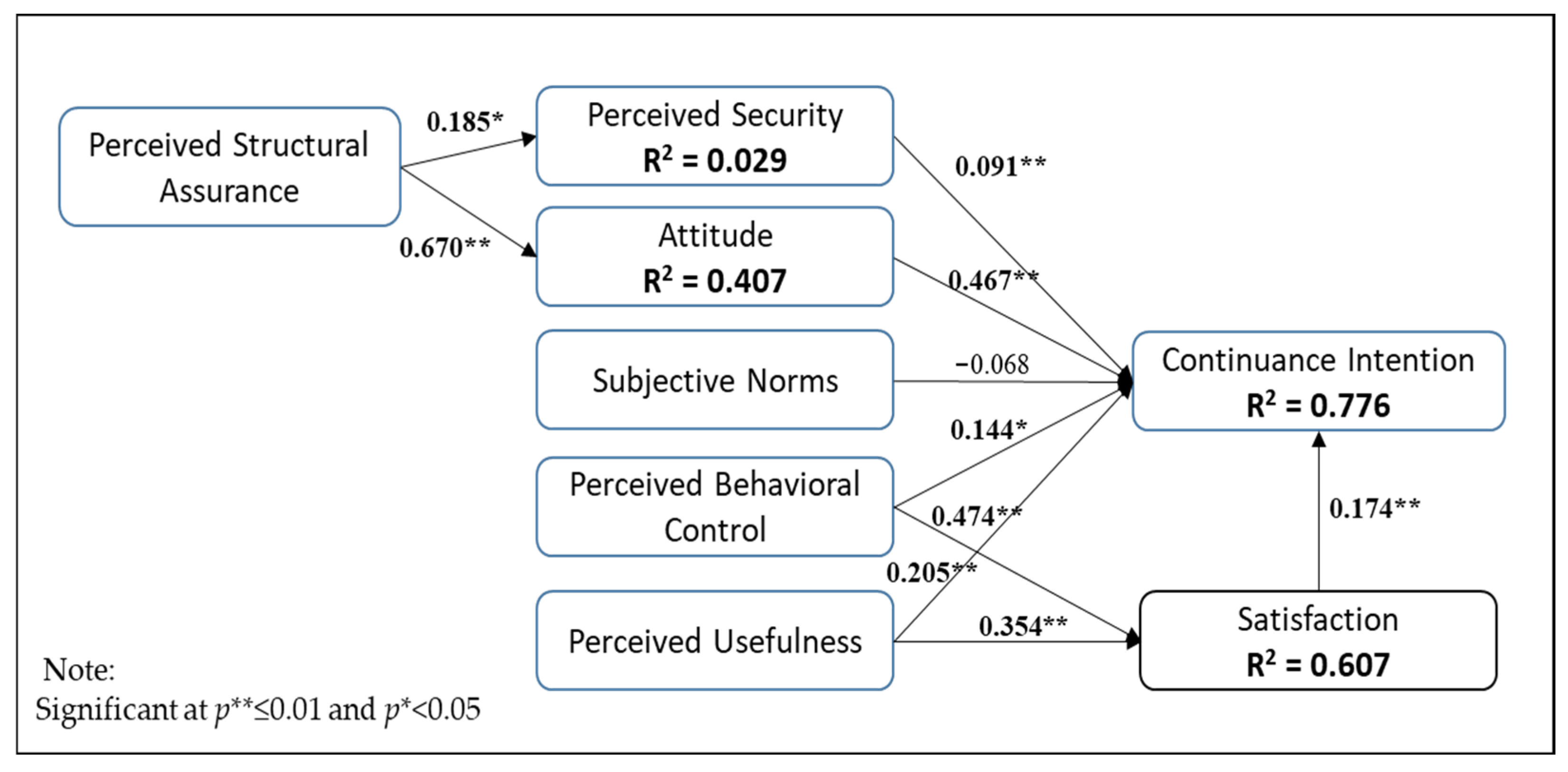
| H1a: PSA → PS | 1.974 | 0.185 | 0.025 * | Supported |
| H1b: PSA → ATT | 13.140 | 0.670 | 0.000 ** | Supported |
| H2: PS → CIU | 2.835 | 0.091 | 0.003 ** | Supported |
| H3: ATT → CIU | 4.600 | 0.467 | 0.000 ** | Supported |
| H4: SN → CIU | −1.427 | −0.068 | 0.922 | Not Supported |
| H5a: PBC → CIU | 1.706 | 0.144 | 0.045 * | Supported |
| H5b: PBC → ST | 5.426 | 0.474 | 0.000 ** | Supported |
| H6a: PU → CIU | 2.385 | 0.205 | 0.009 ** | Supported |
| H6b: PU → ST | 3.729 | 0.354 | 0.000 ** | Supported |
| H7: ST → CIU | 2.704 | 0.174 | 0.004 ** | Supported |
Disclaimer/Publisher’s Note: The statements, opinions and data contained in all publications are solely those of the individual author(s) and contributor(s) and not of MDPI and/or the editor(s). MDPI and/or the editor(s) disclaim responsibility for any injury to people or property resulting from any ideas, methods, instructions or products referred to in the content. |
© 2026 by the authors. Licensee MDPI, Basel, Switzerland. This article is an open access article distributed under the terms and conditions of the Creative Commons Attribution (CC BY) license.
Share and Cite
Alsharo, M.; Khwaileh, J.; Al-Essa, M. Examining Consumers’ Continuance Intention to Use P2P Mobile Payment Systems: An Extended TPB Approach. J. Theor. Appl. Electron. Commer. Res. 2026, 21, 61. https://doi.org/10.3390/jtaer21020061
Alsharo M, Khwaileh J, Al-Essa M. Examining Consumers’ Continuance Intention to Use P2P Mobile Payment Systems: An Extended TPB Approach. Journal of Theoretical and Applied Electronic Commerce Research. 2026; 21(2):61. https://doi.org/10.3390/jtaer21020061
Chicago/Turabian StyleAlsharo, Mohammad, Jumana Khwaileh, and Malik Al-Essa. 2026. "Examining Consumers’ Continuance Intention to Use P2P Mobile Payment Systems: An Extended TPB Approach" Journal of Theoretical and Applied Electronic Commerce Research 21, no. 2: 61. https://doi.org/10.3390/jtaer21020061
APA StyleAlsharo, M., Khwaileh, J., & Al-Essa, M. (2026). Examining Consumers’ Continuance Intention to Use P2P Mobile Payment Systems: An Extended TPB Approach. Journal of Theoretical and Applied Electronic Commerce Research, 21(2), 61. https://doi.org/10.3390/jtaer21020061