


Abstract
Artificial intelligence (AI) now participates in analysing, selecting, reformulating and producing online review communication. Tourism and hospitality research examines these uses through overlapping concepts, leaving uncertainty about their relationship to human experience and electronic word of mouth (eWOM). This review combines bibliometric mapping of 142 publications in English indexed in Scopus at the search date, thematic coding of 54 papers and close comparison of an analytical core of 20 sources. The bibliometric results locate generative systems within research on eWOM, review analytics, service technologies and recommendations. The focused synthesis identifies five distinct roles for AI in review communication. These roles differ in experiential provenance and control over message formulation and presentation. The framework locates them within synthetic word of mouth (Synthetic WOM) and proposes a pathway linking provenance cues, consumer appraisal and outcomes. It also identifies practical priorities for platforms and tourism firms: clear disclosure of AI involvement, source identification and access to supporting reviews. Reviewed studies support individual relationships within this pathway; the complete sequence remains for empirical testing. Platform studies also report changes in subsequent review contribution. The framework uses these findings to propose a longer-term feedback connection to the review corpus.
1. Introduction
Online reviews are integral to the functioning of tourism and hospitality markets. They carry individual service experiences into a public setting, influence how travellers compare alternatives and give firms an accessible record of customer evaluations [1]. Their role extends beyond information exchange. Reviews shape expectations before purchase, contribute to reputation and affect how service performance is interpreted after consumption. They occupy an important position in services marketing, linking customer experience, digital communication and market response. As word of mouth (WOM) continues to evolve through digital platforms and artificial intelligence, the origin and circulation of consumer information become increasingly important [2].
Generative AI expands the role of digital platforms in this process. Platforms and tourism firms can use it to organise customer information, produce language addressed to consumers and support interactions throughout the service journey. Marketing research shows that these capabilities are reshaping how firms communicate with customers, create content and deliver services. They also affect consumer behaviour and marketing strategy [3,4]. In tourism, AI-generated promotional messages have also been shown to shape consumer engagement and attitudes toward destinations and hotels [5]. The implications are especially relevant to tourism and hospitality, where travellers depend heavily on digital information when choosing services that will be experienced at a later time [6,7].
Research on generative AI in tourism now covers consumer adoption, managerial applications and the effects of AI based services on tourism and hospitality consumers [8,9]. This emerging literature demonstrates the breadth of the technology’s potential, although the consequences for eWOM remain spread across several areas of inquiry. Studies of online reviews, recommendation systems, conversational interfaces and generated content often examine related forms of communication while using different concepts and units of analysis. This fragmentation makes it difficult to understand how the established eWOM literature connects with the growing body of research on generative AI.
The central problem lies in the variety of activities grouped under the label of AI-generated content. AI can analyse existing consumer information, augment human expression and create or distribute language outputs [3,4,10]. These activities establish different relationships between consumption experience and the message presented to other consumers. A classification based mainly on technological production can conceal those differences and limit comparison across studies examining credibility, usefulness, authenticity and behavioural response. For services marketing, the distinction matters because the persuasive value of customer communication is closely connected to the experience supporting the message and to the way that message reaches the market.
Conceptual research has introduced algorithmic word of mouth, AI word of mouth and Synthetic WOM to describe the growing involvement of AI in consumption-related communication [10,11,12]. The emergence of these concepts marks an important development in WOM research. These frameworks focus respectively on the nonhuman communicator, consumer–AI interaction, generative recommendations or AI participation across the WOM system [10,11,12,13]. Their different units of analysis leave the relationship between experiential evidence and control over message formulation and presentation only partly specified. The present review addresses this gap by comparing experiential provenance and communicative agency within a common analytical structure.
This study examines the intersection of AI, eWOM, tourism and hospitality. It connects eWOM information adoption and source credibility with AI-mediated communication and services marketing, where review communication links prior service experience with market expectations and response [1,6,14,15,16,17,18,19]. These gaps lead to three research questions:
RQ1. How is research on AI and eWOM in tourism and hospitality intellectually and thematically structured?
RQ2. What mechanisms and outcomes are associated with AI involvement in review-based communication?
RQ3. How can AI roles in review-based eWOM be conceptually distinguished?
A systematic review combining bibliometric mapping with focused thematic synthesis is used to address these questions. The study contributes by developing a common basis for distinguishing AI roles in review-based communication according to the evidence supporting an evaluation and the allocation of control over message formulation and presentation, and by connecting these distinctions with consumer appraisal and subsequent review contribution. At its centre lies a services marketing issue: how persuasive communication changes as digital systems assume a larger role in shaping the messages through which customer experience enters the market.
2. Literature Review
2.1. Human eWOM in Online Review Environments
Established definitions of electronic word of mouth encompass positive or negative statements made by potential, actual or former customers and, more broadly, consumer generated communication concerning consumption through digital media [1,14]. The present study focuses on online reviews in tourism and hospitality, where evaluations attributed to consumers provide information about hotels, restaurants and destinations. Reviews help travellers assess unfamiliar services before purchase, when service quality remains uncertain and cannot be evaluated directly [6]. Their influence on market outcomes varies across platforms, products and performance measures, reflecting the decision environment created by each platform [15].
The persuasive value of online reviews depends on several related judgements. Helpfulness reflects the diagnostic value of a review for a particular decision, with information quality, ratings and ranking cues guiding adoption [16]. Research on online opinion adoption also identifies relevance and comprehensiveness as important components of argument quality influencing adoption [17]. Trustworthiness concerns whether the account appears dependable. Specificity, balance, valence and linguistic style contribute to such assessments because consumers rarely have independent access to the event described [7]. Online credibility assessments also draw on social information and cognitive heuristics when systematic evaluation is difficult or time-consuming [18]. These judgements connect the credibility of the message with the presumed identity, experience and motivation of its author.
Williams et al. [10] examine the creation and distribution of WOM by nonhuman systems, while Mladenović et al. [12] consider recommendations induced by generative AI in tourism and hospitality. These developments alter the relationship between the evaluation, the actor formulating the message and the platform presenting it. The assessment of review credibility therefore extends to communicative agency and provenance, including the source of the evaluation and the evidence supporting it.
2.2. AI in Online Review Environments
Williams et al. [10] describe AI systems that can detect patterns in existing content, summarise eWOM and create or distribute new language outputs. Hancock et al. [19] distinguish communication that is transmitted through technology from communication in which an intelligent agent modifies, augments or generates a message on behalf of a communicator. These activities occupy different positions in the communication process. Analysis produces information about reviews, whereas selection and presentation influence the evidence available to consumers. The technological capability may be similar, but its communicative role changes according to who receives the output and how it enters consumer judgement.
Research on automated media places algorithms within both the production and consumption of media content [20]. Platform design already affects the visibility and diagnostic value of eWOM through rankings, ratings and other informational cues [16,21]. Automated distribution extends this influence by allowing systems to select and personalise the information presented to individual users [10]. The platform consequently participates in the communication process even when the underlying reviews were written by consumers. Its influence lies in the control of exposure, prominence and sequence.
Conceptual research now places AI across several parts of the WOM process. Tassiello et al. [11] focus on communication between consumers and socially enabled AI, while Mladenović et al. [12] examine generative AI recommendations in tourism and hospitality. Haenlein et al. [13] extend this view across the creation, mediation, evaluation and use of consumption-related communication. These perspectives establish several sites of AI involvement, from the processing of review evidence to the production and evaluation of new messages. Their application within tourism review research requires attention to the particular role performed by AI in each study.
2.3. Generative AI and Changing Communicative Roles
Human reviews may supply the experiences and evaluations, but the wording, emphasis and structure of the message presented to the consumer can be produced by the system. Consumer evidence can remain present even when its communicative form has changed. Human–machine communication research examines AI applications as communicators and the ways users interpret them in that role [22]. AI can also communicate directly with consumers through technologies designed to display social and conversational qualities [11]. The position occupied by AI in the communication process affects who determines the purpose, wording and publication of the message. Generative AI can separate the evidence supporting an evaluation from the actors responsible for formulating and presenting it. Similar outputs may draw on different evidential sources and involve different divisions of control among consumers, platforms and models. Hancock et al. [19] provide the broader communication basis for examining AI involvement in message production, while Haenlein et al. [13] locate AI participation across consumption-related communication. Comparing these forms therefore requires attention to the experiential basis of the evaluation and to the distribution of communicative control.
2.4. Existing Concepts and Unresolved Boundaries
Several concepts describe AI involvement in WOM from different analytical positions. Williams et al. [10] define algorithmic word of mouth, or aWOM, as communication created and shared by automated or nonhuman AI tools. Tassiello et al. [11] develop aiWOM around the communicative relationship between consumers and AI technologies with social features. Mladenović et al. [12] provide an early tourism focused conceptualisation of Synthetic WOM through recommendations induced by generative AI. Haenlein et al. [13] define Synthetic WOM more broadly as consumption-related communication in which AI participates in creating, mediating, evaluating or acting on a message. Their framework places AI across source, message, channel and receiver and introduces the degree of syntheticity as the perceived extent of machine-driven involvement.
Related studies employ further terms for specific parts of the same research area. The word-of-machine effect concerns consumer responses to human and AI recommendations across utilitarian and hedonic contexts [23]. Generative AI WOM has been used for AI-generated recommendations whose adoption and trust effects vary across product types [24]. In rural tourism, the aiWOM measure comprises AI-mediated, AI-generated and AI-personalised WOM [25]. Broader bibliometric research maps publication patterns and emerging themes across generative AI and eWOM without concentrating on the specific roles played by AI in tourism review communication [26]. These approaches address source preference, recommendation adoption, perceived machine involvement and field development at different analytical levels.
Table 1 compares the focal unit and principal dimensions of the four concepts most directly related to the framework. They address different parts of AI involvement: automated production and distribution, consumer interaction with AI, generative AI use in tourism WOM, and AI participation across the wider WOM system. The remaining analytical question concerns the relationship between the evidence supporting an evaluation and the actors controlling its formulation and presentation. This relationship is important in review communication because human experience may remain the evidential basis when AI assumes a larger role in shaping the message. It also establishes the unit of classification used in this study: the communicative act, located by the evidence supporting its evaluation, the actor formulating the message and the actor controlling its presentation.
Table 1.
Comparison of existing concepts and the analytical contribution of the present study.
Online communication can distribute perceived source attribution across the original sender, the technology and other users [27]. Questions of provenance therefore extend established eWOM research on source credibility, information diagnosticity and opinion adoption [7,16,17,18]. In this study, disclosure, source identification and traceability are treated as provenance cues. Disclosure records whether AI involvement is stated. Source identification records whether the originator or the supporting review corpus can be identified. Traceability records whether a generated statement can be connected to the human reviews supporting it. These cues describe the message, interface and access to evidence.
Provenance appraisal refers to the consumer’s judgement of whether the evaluation is grounded in genuine consumer experience. It is represented by perceived authenticity and source certainty. Information appraisal concerns the believability and decision value of the presented content and is represented by credibility, helpfulness and usefulness. Trust refers to willingness to rely on a specified object, such as the message, reviewer, platform or AI system. Traceability is therefore treated as a cue, credibility as an information judgement and trust as a reliance response. This separation allows related constructs to be examined without treating them as interchangeable.
The present study examines this relationship through two dimensions. Experiential provenance identifies the evidence supporting the evaluation. Communicative agency identifies who formulates the message and who controls its presentation. Combining these dimensions supports comparison among five AI roles in tourism review communication and connects them with provenance appraisal, information appraisal and later review contribution. The following section explains how the relevant literature was identified, mapped and analysed.
3. Materials and Methods
3.1. Research Design and Search Strategy
The study adopts a two-stage review design that combines bibliometric mapping with a focused thematic synthesis [28,29]. The first stage maps the wider body of research in which artificial intelligence intersects with electronic word of mouth, online reviews and recommendations in tourism and hospitality. The second concentrates on studies that place AI within review communication or help define the boundary between the analysis or verification of review content and consumer facing mediation, assistance or generation. Keeping these stages separate was important because the broad literature contains many computational studies of human generated reviews that map the development of the field, while the focused synthesis retains studies that contribute directly to the analysis of communicative roles or the boundary between review processing and consumer communication. The review was reported in accordance with the PRISMA 2020 guidelines [30]. The review proceeded without prospective registration or a formal protocol.
Scopus was selected because its cross-disciplinary coverage spans tourism, hospitality, marketing, information systems and computer science, while its export format provides the citation data, abstracts, keywords and cited references required for screening and science mapping. Scopus served as the single database of record so that publications entering the bibliometric and thematic stages shared a consistent metadata and citation structure. This design provided one internally consistent citation network and retained conference papers indexed by Scopus. For the thematic synthesis, database retrieval was supplemented by terminology sensitivity testing and bidirectional citation tracing. The original search was conducted on 22 August 2026 in the title, abstract and keyword fields. No restriction was imposed on publication year, subject area, journal or source title because the topic crosses several research domains and includes a recent generative AI literature. The search string was:
TITLE-ABS-KEY ((“electronic word of mouth” OR “electronic word-of-mouth” OR eWOM OR “online review*” OR “online recommendation*” OR “user-generated review*” OR “consumer review*”) AND (“artificial intelligence” OR “generative AI” OR “generative artificial intelligence” OR ChatGPT OR “large language model*” OR LLM* OR “AI-generated” OR “AI generated” OR “AI-mediated” OR “AI mediated”) AND (touris* OR hospitality OR hotel* OR destination* OR travel*)).
The initial search returned 195 records. Limiting the results to articles, conference papers and reviews reduced the set to 173, and the English language filter produced a raw corpus of 172 publications. Conference papers were retained because work on large language models and information systems often appears first in major conference proceedings; excluding them would have removed part of the emerging research frontier. The Scopus export included full bibliographic and citation information, abstracts, author and indexed keywords, and cited references. It contained 120 articles, 50 conference papers and 2 reviews. Checks based on titles, DOIs and Scopus EIDs identified no exact duplicates. The original 172-record export was preserved unchanged as an audit file.
To test the coverage of terminology that has emerged around AI and WOM, a supplementary Scopus search was conducted on 14 October 2026. It combined expressions for algorithmic, artificial intelligence, synthetic and AI-generated word of mouth with AI and tourism context terms. The exact query was:
TITLE-ABS-KEY ((“algorithmic word of mouth” OR “algorithmic word-of-mouth” OR “AI word of mouth” OR “AI word-of-mouth” OR “artificial intelligence word of mouth” OR “artificial intelligence word-of-mouth” OR “synthetic word of mouth” OR “synthetic word-of-mouth” OR “AI-generated word of mouth” OR “AI-generated word-of-mouth” OR “online word of mouth” OR “online word-of-mouth” OR aWOM OR aiWOM) AND (“artificial intelligence” OR “generative AI” OR “generative artificial intelligence” OR ChatGPT OR “large language model*” OR algorithm* OR synthetic) AND (touris* OR hospitality OR hotel* OR destination* OR travel*)).
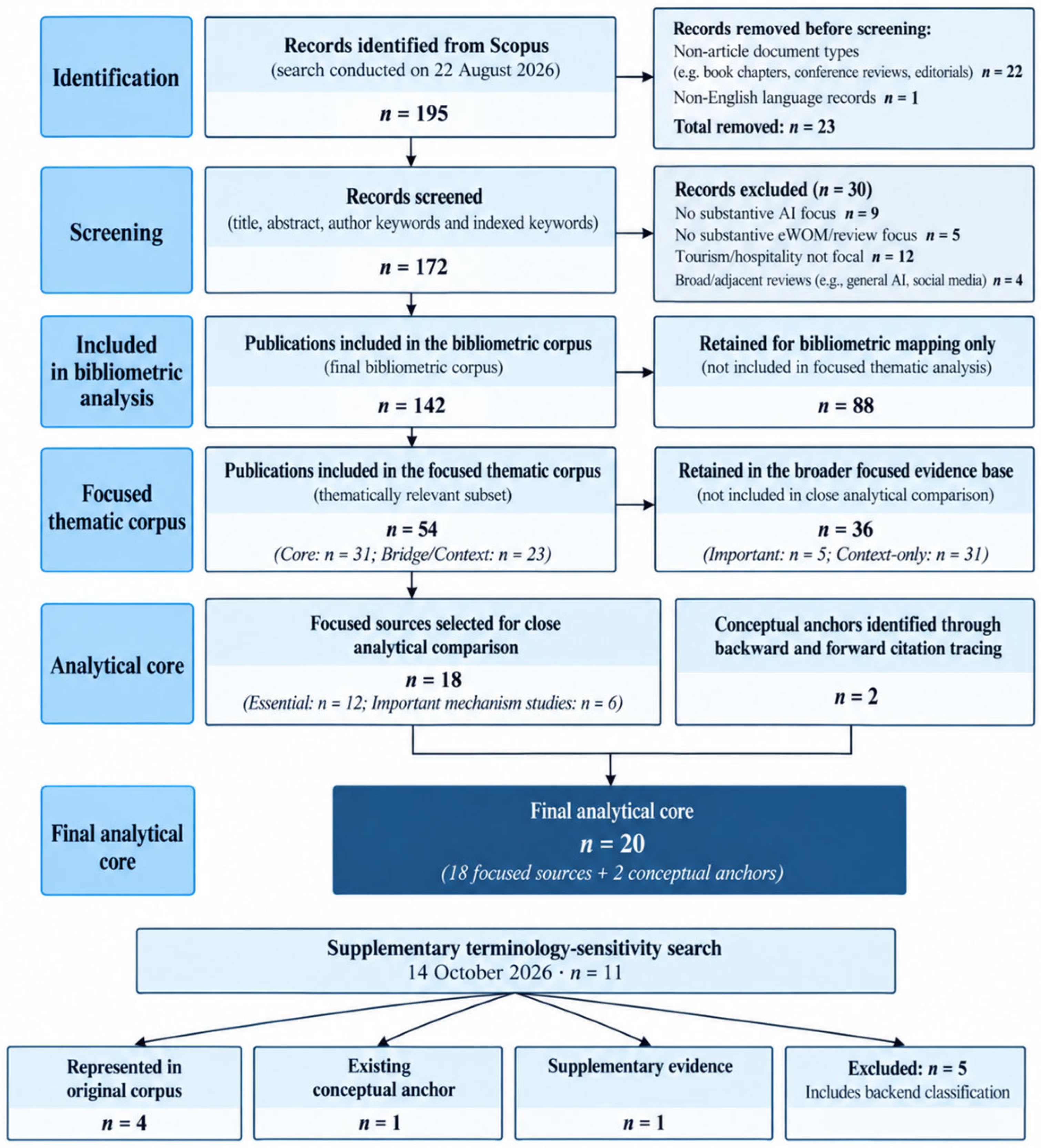
The supplementary search returned 11 records. Four were already represented in the original corpus, and Mladenović et al. [12] was already included as a conceptual anchor. Le et al. [25] met the focused synthesis criteria and was examined as supplementary evidence in the construct boundary analysis. The other five records comprised two proceedings-container records indexed as conference reviews, two studies in which AI lacked a substantive role in tourism review communication and one study limited to backend sentiment classification. The bibliometric corpus and focused coding matrix retain the records produced by the original search, while the sensitivity search contributes supplementary evidence to the construct boundary analysis. Figure 1 reports this terminology sensitivity search as a separate flow. Supplementary Table S13 identifies all 11 records and their disposition, including the five exclusions from supplementary focused evidence. The 20-source analytical core remains unchanged.
3.2. Screening and Construction of the Analytical Corpora
The 172 records were screened individually using their titles, abstracts, author keywords and indexed keywords. A publication was retained in the broad corpus when tourism or hospitality formed a substantive context, eWOM, online reviews, customer feedback or recommendation was part of the research problem, and AI or computational intelligence was studied or applied in a substantive way. Records were excluded when AI appeared only as an incidental term or future implication, when reviews or eWOM were peripheral to the study, when tourism or hospitality served merely as an illustrative dataset alongside unrelated domains, or when a broad review treated AI and eWOM as separate adjacent topics. Thirty records failed these criteria: nine lacked a substantive AI component, five lacked a substantive eWOM or review component, twelve did not have tourism or hospitality as their focal context, and four were broad adjacent reviews outside the intersection examined here. This process produced a final bibliometric corpus of 142 publications. The study identification, screening and corpus construction process is presented in Figure 1.
Figure 1.
Adapted PRISMA 2020 flow diagram for study identification, corpus construction and selection of the analytical core. The lower flow shows the separate terminology-sensitivity search of 14 October 2026. The study by Le et al. [25] contributes supplementary construct-boundary evidence outside the 142-publication bibliometric corpus, 54-paper focused corpus and 20-source analytical core. Record-level decisions are reported in Supplementary Table S13.
A focused thematic corpus was then constructed within the 142-paper set. Studies entered the Core layer when AI or algorithms detected or verified AI-generated or manipulated review content; generated, co-produced, transformed, summarised, selected or responded to review or recommendation communication; produced recommendations; or were directly evaluated by consumers as the source or mediator of such communication. Studies entered the Bridge/Context layer when they contributed to the explanation of trust, persuasion, feedback, authenticity or eWOM outcomes but did not clearly position AI as the WOM source, message producer or mediator. The focused corpus comprised 54 papers, of which 31 were classified as Core and 23 as Bridge/Context. The 142-paper file was used for the final bibliometric analysis, while the 54-paper file supported the thematic and conceptual stages. The raw 172-record file is retained only for audit and methodological history. Each level served a distinct analytical purpose: the 172 records preserved the screened search output, the 142 publications supported bibliometric mapping, the 54 papers supported structured thematic coding, and the 20 sources supported close conceptual comparison. Progression between levels followed substantive relevance to the intersection of AI and eWOM, the role of AI in review communication and the evidential contribution required for each analytical task.
3.3. Bibliometric Analysis
The bibliometric analysis was conducted in VOSviewer 1.6.21 [31] and covered keyword co-occurrence, bibliographic coupling and co-citation. These techniques were selected for different purposes: the keyword co-occurrence was used to identify the thematic vocabulary of the field, bibliographic coupling to locate current research fronts through shared references, and co-citation to identify the sources that form its intellectual base [29]. Overlay visualisations based on publication year were also produced to examine temporal shifts in research attention across the field.
Before the final analysis, diagnostic keyword maps were generated from the 172-record corpus. An all-keywords analysis identified 1197 terms, of which 50 met a minimum occurrence threshold of five. The resulting list contained extensive indexing noise and generic technical labels, so author keywords were used instead. In the preliminary author-keyword run, 625 terms were identified; a threshold of five retained only 19, whereas a threshold of three retained 45 and gave sufficient detail for a corpus of this size. These preliminary maps informed the final settings but were not retained as study figures.
A thesaurus was used to consolidate genuine spelling variants and synonyms. The terms ‘ai’ and ‘artificial intelligence (ai)’ were replaced by ‘artificial intelligence’; ‘e-wom’ and ‘electronic word-of-mouth’ by ‘eWOM’; ‘online review’ by ‘online reviews’; ‘generative artificial intelligence’ by ‘generative AI’; ‘large language model’ and ‘llm’ by ‘large language models’; and ‘hotel’ by ‘hotels’. The JEL code M31 was removed from the keyword set. Methodological terms such as sentiment analysis, machine learning, text mining, topic modelling, BERT and natural language processing were retained. These terms capture the field’s earlier computational development and remain visible in the maps.
The final author-keyword analysis was rerun on the 142-paper corpus using co-occurrence, full counting, a minimum occurrence threshold of three and the cleaned thesaurus. The corpus contained 518 author keywords, of which 29 met the threshold. The same network was used for the overlay visualisation, with average publication year as the score. Bibliographic coupling was conducted at the document level with a minimum citation threshold of zero. This decision prevented recent publications from being excluded simply because they had not yet accumulated citations. All 142 papers were eligible, and 131 formed the largest connected component displayed in the network. Node size was based on total link strength, and publication year was used in the corresponding overlay.
Co-citation analysis was conducted on cited references using full counting. The 142 publications contained 6770 cited references. A trial threshold of seven citations retained only six references and was too restrictive, so the final threshold was set at four citations. Forty-four references met this threshold and 41 formed the connected network. Node size was based on citation frequency. The map and network files were retained so that cluster membership, coordinates, citation counts and link strengths remained available for interpretation. The final bibliometric package consists of five figures: the author-keyword network, the author-keyword overlay, the bibliographic-coupling network, the bibliographic-coupling overlay and the co-citation network.
All three networks used association-strength normalisation. The VOS clustering settings were a resolution of 1.00, a minimum cluster size of one, merging of small clusters, 10 random starts, 10 iterations, randomness of 0.01 and a fixed random seed of 0. The default layout settings were retained: attraction was 2 for all maps, while repulsion was 0 for keyword co-occurrence and 1 for bibliographic coupling and co-citation. Layout optimisation used one random start and a maximum of 1000 iterations.
Cluster interpretation drew on the complete membership of each cluster, the items with the highest occurrence, citation or total link strength, recurring terms in titles and keywords, and patterns of within-cluster and cross-cluster links. Threshold sensitivity was examined by reconstructing the networks with four keyword occurrences, one document citation for bibliographic coupling and five cited-reference citations for co-citation, while retaining the same normalisation and clustering settings. The same broad thematic domains remained visible across the three comparisons. Exact cluster membership and, for two networks, the number of clusters changed at the adjacent thresholds, so the results are interpreted as broad areas of emphasis. Supplementary Table S9 reports the full comparison.
3.4. Focused Thematic Coding
The 54 focused papers were coded in a structured workbook using the title, abstract and author keywords available in the Scopus records. The initial coding recorded only information stated explicitly in these fields. When a theory, construct, method, source condition or outcome was absent, it was coded as “not explicit”. This produced an evidence matrix that guided the subsequent selection and closer examination of the most relevant studies.
For each paper, the matrix recorded its screening layer and thematic role; the principal AI technology and form of WOM; the source architecture, including human, AI and hybrid forms; the role performed by AI in the communication process; and the stage of the tourism or service journey. It also captured message attributes such as valence, readability, personalisation, transparency, disclosure, originality and information quality; consumer perceptions including trust, credibility, authenticity, helpfulness, usefulness, risk, uncanniness and information overload; and outcomes such as destination or hotel choice, booking intention, purchasing, browsing, sales, review contribution, satisfaction, loyalty, revisit and eWOM behaviour. Explicitly reported theories and methods, relevance to Synthetic WOM and the need for closer verification were recorded separately. A comparison across files confirmed that all 54 coding rows matched the focused corpus in title, year, abstract and author keywords. The author completed the initial screening and coding using the same definitions and decision rules across all records. The academic expert then reviewed the complete 54-study coding matrix, the definitions of the Core and Bridge/Context layers, the Essential, Important and Context-only priority rules, and the study-level category assigned to each paper. The review focused on consistent application of the coding framework, especially cases near the boundaries between review processing, mediation, AI-assisted consumer expression, organisational communication and AI-originated evaluation. Any disagreement about a category was resolved by comparing the relevant Scopus record with the coding definitions and, for analytical-core sources, the source material described in Section 3.5. The agreed decision was recorded in the final workbook. The coding design comprised one author-coded matrix followed by a structured expert audit of all 54 records; no inter-coder reliability coefficient was calculated. Supplementary Tables S3, S5 and S6 report the study-level classifications, coding framework and difficult cases. The title, abstract and keyword coding established the thematic profile and priority of the 54 studies. Detailed claims concerning methods, constructs and findings were checked against the source material described for the analytical core in Section 3.5. The matrix covering the 54 studies therefore served as the thematic mapping and prioritisation stage. The analytical core supplied the evidence for construct definitions, mechanisms and detailed findings in Section 5.
The analysis then compared the studies according to three elements: the experiential source supporting the claim, the actor responsible for formulating the message and the actor controlling its selection and presentation. These elements were examined alongside the role performed by AI and the provenance information available to consumers. The categories were revised through repeated comparison of studies that placed AI at different points in the communication process. This procedure provided the basis for the construct boundaries reported in Section 5.4.
The unit of classification was a bounded AI function and its resulting output at one stage of the review workflow. Applications containing several functions received stage-level codes. When several functions produced one consumer facing artefact, the primary role followed the function immediately responsible for that artefact, while upstream processing, retrieval or selection remained secondary codes. A later output, such as a consumer review produced with writing assistance, formed a separate unit. Communicative purpose and publication control were recorded to separate consumer review communication from promotional communication controlled by a firm and informed by review evidence. Experiential content and experiential provenance were coded as separate dimensions.
3.5. Selection and Verification of the Analytical Core
Each focused paper was re-ranked according to the evidence required for construct definition. Essential papers were those needed to clarify experiential source, message production, mediation, autonomy, co-production, disclosure, transformation or the boundary between eWOM, aWOM, generative AI-mediated eWOM and Synthetic WOM. Important papers were retained when they supplied mechanism evidence on trust, credibility, authenticity, helpfulness, usefulness, persuasion or consumer and platform outcomes. The remainder stayed available as Context-only papers. These priority categories determined the depth of examination, while Core and Bridge/Context recorded each paper’s screening position.
The initial ranking produced 12 Essential and 11 Important papers. The 11 Important papers were then compared using three criteria: direct relevance to tourism or hospitality communication, examination of a recurring mechanism or outcome identified in the initial coding, and the addition of evidence that was distinct from the contribution of the Essential studies. Six papers met these criteria: Chan et al. [32], Remountakis et al. [33], Cheng et al. [34], Li and Bang [35], Li et al. [36], and Singh and Mittal [37]. Their distinct contributions concerned review contribution and reciprocity; organisation controlled personalised persuasion; substitution and learning following review summaries; review-writing motives and changes in user-generated content; source disclosure, originality and travel intention; and the relationship among authenticity, helpfulness and purchase intention. The analytical core therefore drew on six of the 11 Important papers. The other five retained their Important classification within the broader evidence base because they supplied general human-eWOM background, general GenAI travel-planning evidence without a direct review-communication focus, organisational response evidence adjacent to consumer WOM, a review-summary contribution mechanism already represented by selected studies, or evidence in which eWOM appeared as an outcome of general GenAI stressors. Supplementary Table S4 reports the study-level decision and rationale for all 11 Important papers. Together, Supplementary Tables S3 and S4 report the classification of all 54 focused studies and the study-level rationale for selecting six of the 11 Important papers for the analytical core. The remaining 36 focused papers continued to inform the thematic mapping of the 54-paper corpus. Close analytical synthesis used 18 corpus studies, while two separately traced conceptual anchors supported construct positioning.
A targeted robustness check revisited the five Important studies outside the analytical core. Their reported findings were compared with the synthesis for conflicting outcome directions, additional moderators and qualifications to construct boundaries. The check used the published abstracts and the existing screening records; Supplementary Table S15 identifies the material assessed and the implication of each study. These studies remained in the wider evidence base, with the 20-source analytical core unchanged.
Targeted backward and forward citation tracing was conducted in Scopus on 14 October 2026. Mladenović et al. [12], retrieved by the terminology sensitivity search, served as the initial seed paper. Tassiello et al. [11] was identified from its reference list; both papers were then used as seeds for backward reference screening and forward citation searches. The forward searches returned 20 records for Mladenović et al. and 24 for Tassiello et al., with four records appearing in both sets. Titles, abstracts and keywords were screened using the criteria applied to the focused synthesis. Candidate tourism studies had to treat tourism or hospitality as a substantive context, place AI within review or recommendation communication or clarify its boundary, and contribute evidence relevant to constructs, mechanisms or outcomes. General marketing and communication papers were eligible as conceptual anchors when they defined a directly relevant WOM construct. Records already present in the 142-paper or 54-paper corpora retained their existing classification. Publications outside the sectoral scope or published after 22 August 2026 were used for theoretical comparison. This procedure established Mladenović et al. [12] and Tassiello et al. [11] as the two conceptual anchors. The final analytical core comprised 20 sources: 12 Essential studies, six mechanism studies and two construct anchors.
Full texts were examined for 19 of the 20 sources in the analytical core: 11 Essential studies, all six mechanism studies and both conceptual anchors. Evidence for Wang, Tong and Dong [38] comprised the complete PACIS proceedings abstract and bibliographic record. The synthesis records the context, AI function, field-experiment design and outcomes reported in that abstract. Sample characteristics, assignment procedures, measures, statistical analyses and effect sizes were recorded as unreported. Supplementary Table S2 documents the material assessed and analytical use of every core source. This distinction in evidence level was maintained throughout the synthesis, and claims from Wang, Tong and Dong [38] were confined to information stated in the proceedings abstract.
Construct definitions and boundaries were developed through comparison of the 12 Essential studies. The six mechanism studies extended the analysis to trust, authenticity, helpfulness, persuasion, consumer response and review contribution. The two citation-traced anchors located the resulting distinctions in relation to aWOM, aiWOM and Synthetic WOM. Each source was compared through a common set of questions: whose experience supported the claim, who formulated the message, who controlled its presentation, what provenance information was available, which mechanism was examined and which consumer, organisational or platform outcome was reported. Cross-study comparison was then used to identify recurring patterns, boundary cases and differences in communicative agency. The 54-paper matrix provided the broader thematic context, while the 20-source analytical core supported the closer conceptual comparison.
Le et al. [25], identified by terminology sensitivity testing, was examined through its Scopus bibliographic record, abstract and available indexed metadata as supplementary evidence in the construct boundary analysis (Supplementary Table S14). The abstract identifies AI-mediated, AI-generated and AI-personalised WOM as the three components of its aiWOM measure; its use here is limited to comparing these construct boundaries. Longoni and Cian [23], Ma et al. [24] and Tao et al. [26] informed comparison with adjacent concepts and broader reviews. Haenlein et al. [13], published after 22 August 2026, supported the broader positioning of Synthetic WOM. These publications were recorded separately from the bibliometric corpus, focused coding matrix and 20-source analytical core.
3.6. Evidence Appraisal Across Research Designs
The evidence was appraised in relation to the analytical use assigned to each source. Each source in the analytical core was classified as direct empirical evidence, application or system evidence, review synthesis, conceptual proposition or abstract based empirical evidence. The appraisal considered direct relevance to the construct, mechanism or outcome; transparency of context, sample or dataset and analytical procedure; alignment between design and inference, including identification assumptions where applicable; consistency between the reported analysis and finding; and limitations stated or evident in the source and the scope of generalisation supported. This design-sensitive, claim-specific appraisal informed the use of each source in the synthesis; the criteria were not numerically scored. It differs from a standardised risk-of-bias assessment, which applies a formal domain-based instrument to potential bias within a defined class of empirical studies. No such instrument was used.
The threshold for using a source to support an empirical finding required a clearly reported context, data or sample, method and relevant outcome. Experimental, natural-experimental and quasi-experimental studies can support causal inference where the design, identification strategy and reported analyses, including robustness checks where available, warrant it. Causal interpretation remains bounded by the source’s assumptions and limitations. Replication across experiments can increase confidence in a mechanism, subject to the quality, measures and scope of the studies. Single experiments, qualitative studies and technical evaluations supported conclusions bounded by their design and setting. Integrative reviews supported patterns reported across their source literature. Conceptual papers supported definitions, propositions and construct positioning. The study by Wang, Tong and Dong [38] contributed only the design and findings stated in its complete proceedings abstract; all other methodological details were recorded as unreported. Supplementary Table S7 presents the evidence profile, limitations and evidential status of all 20 sources in the analytical core.
4. Bibliometric Results
4.1. Overview of the Bibliometric Networks
The three bibliometric analyses provide complementary views of the literature. Keyword co-occurrence identifies the vocabulary through which the field is organised, bibliographic coupling identifies publications that share references, and co-citation identifies sources repeatedly cited together within the corpus. Table 2 reports the final network statistics and the principal settings used to produce the maps. All analyses are based exclusively on the final corpus of 142 publications.
Table 2.
Summary of the final VOSviewer analyses.
Figure 2.
Author-keyword co-occurrence network for the final bibliometric corpus (N = 142). Author keywords occurring at least three times are displayed. Node size represents occurrences, line thickness represents co-occurrence strength and colours identify VOSviewer clusters.
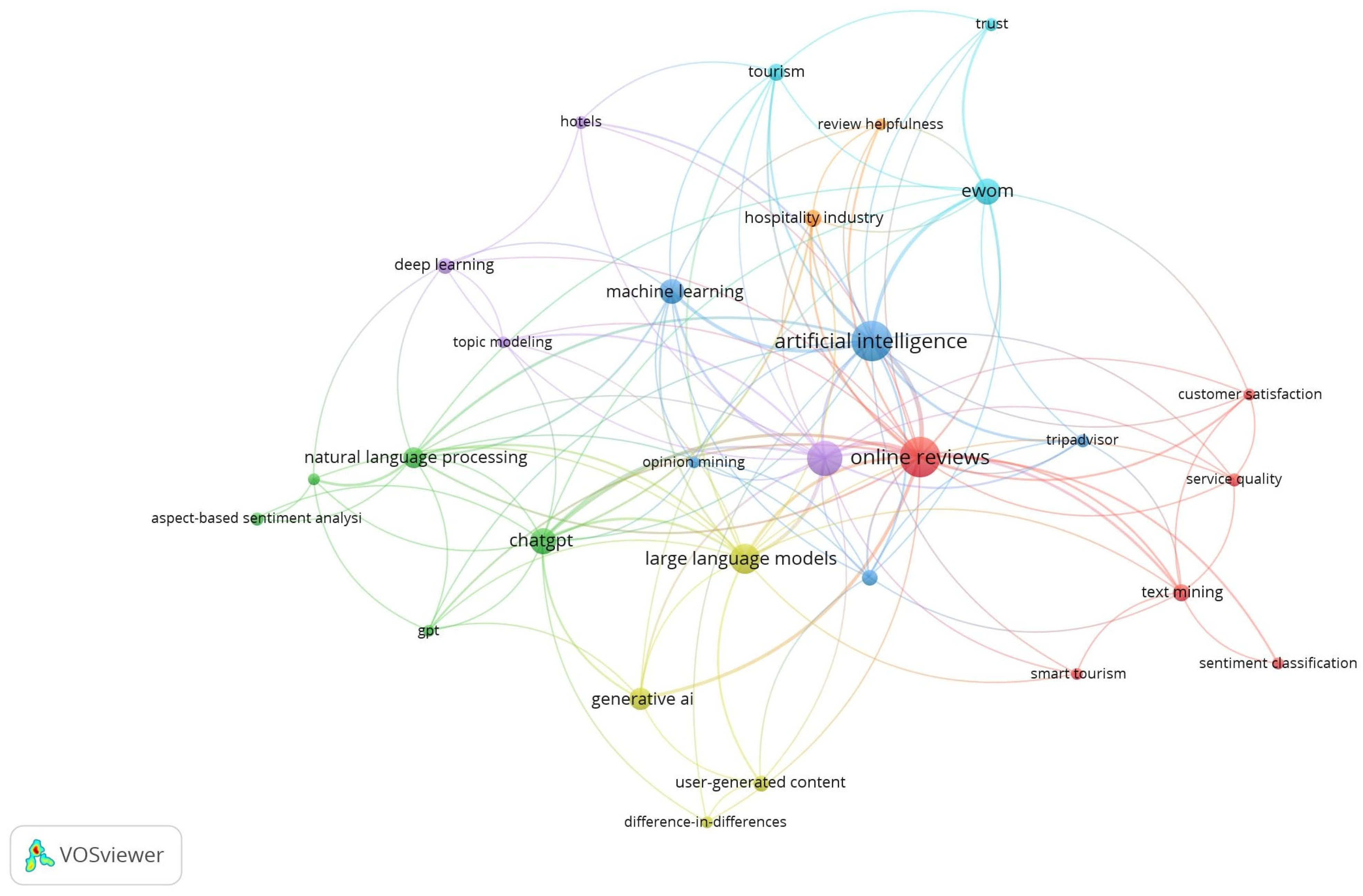
Figure 3.
Overlay visualisation of author keywords by average publication year. The network and occurrence threshold are the same as in Figure 2. Node size represents occurrences and colour follows the average-publication-year scale shown in the figure.
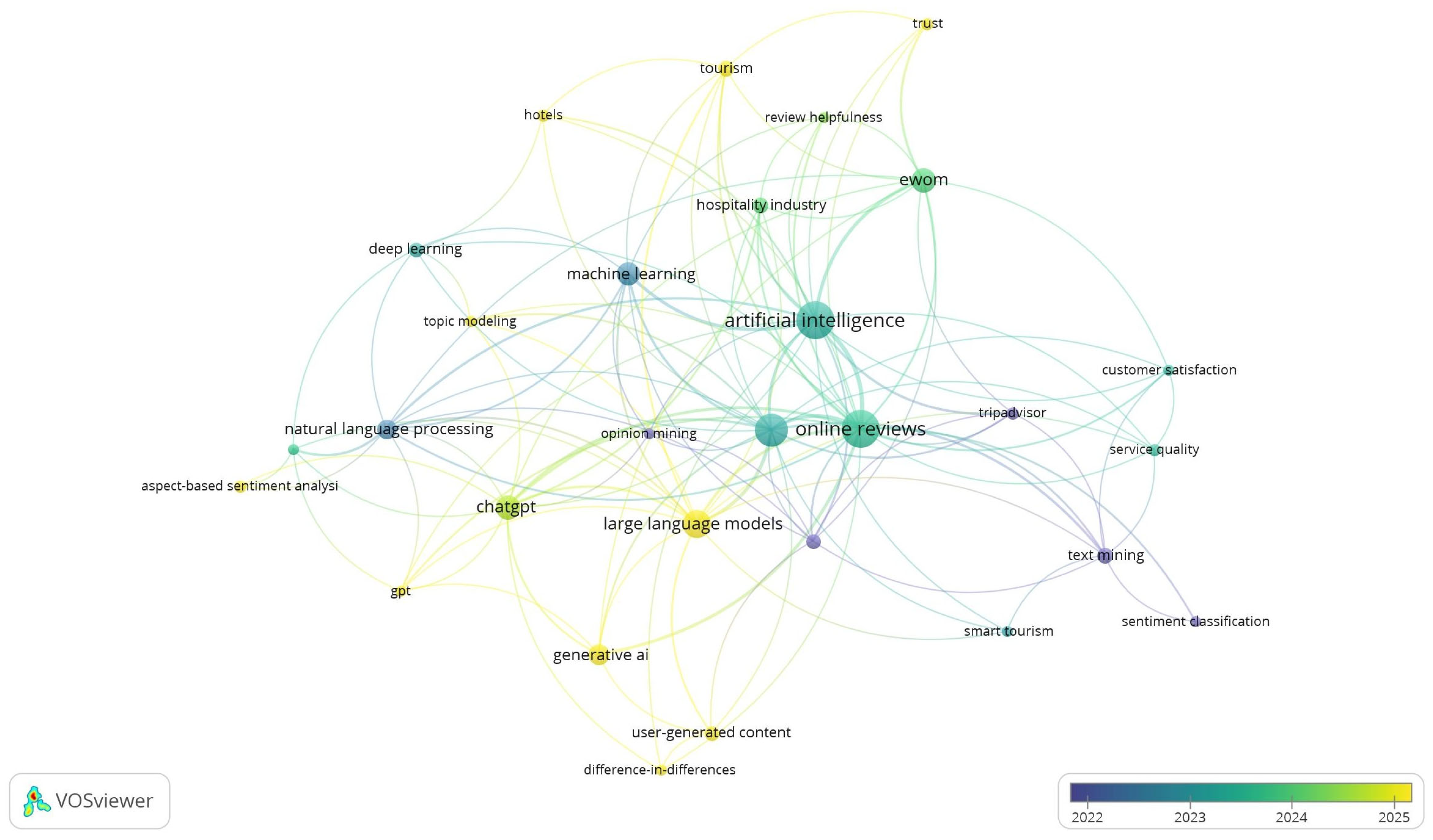
Figure 4.
Bibliographic-coupling network of the largest connected component (131 of 142 publications; minimum citation threshold = 0). Node size represents total link strength; line thickness represents bibliographic-coupling strength; and colours identify VOSviewer clusters.
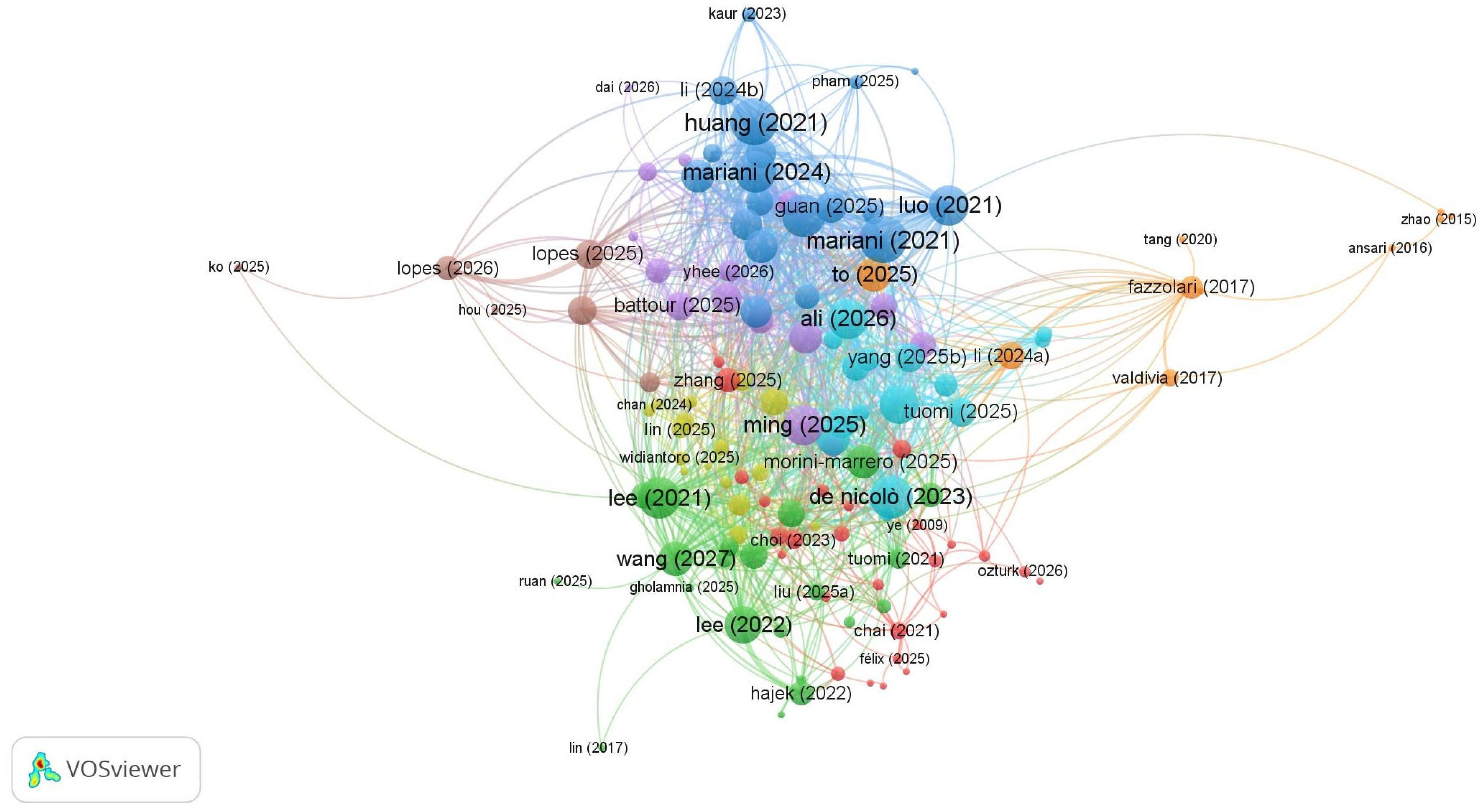
Figure 5.
Bibliographic-coupling overlay by average publication year. The network is the same as in Figure 4. Node size represents total link strength, and colour follows the average-publication-year scale shown in the figure.
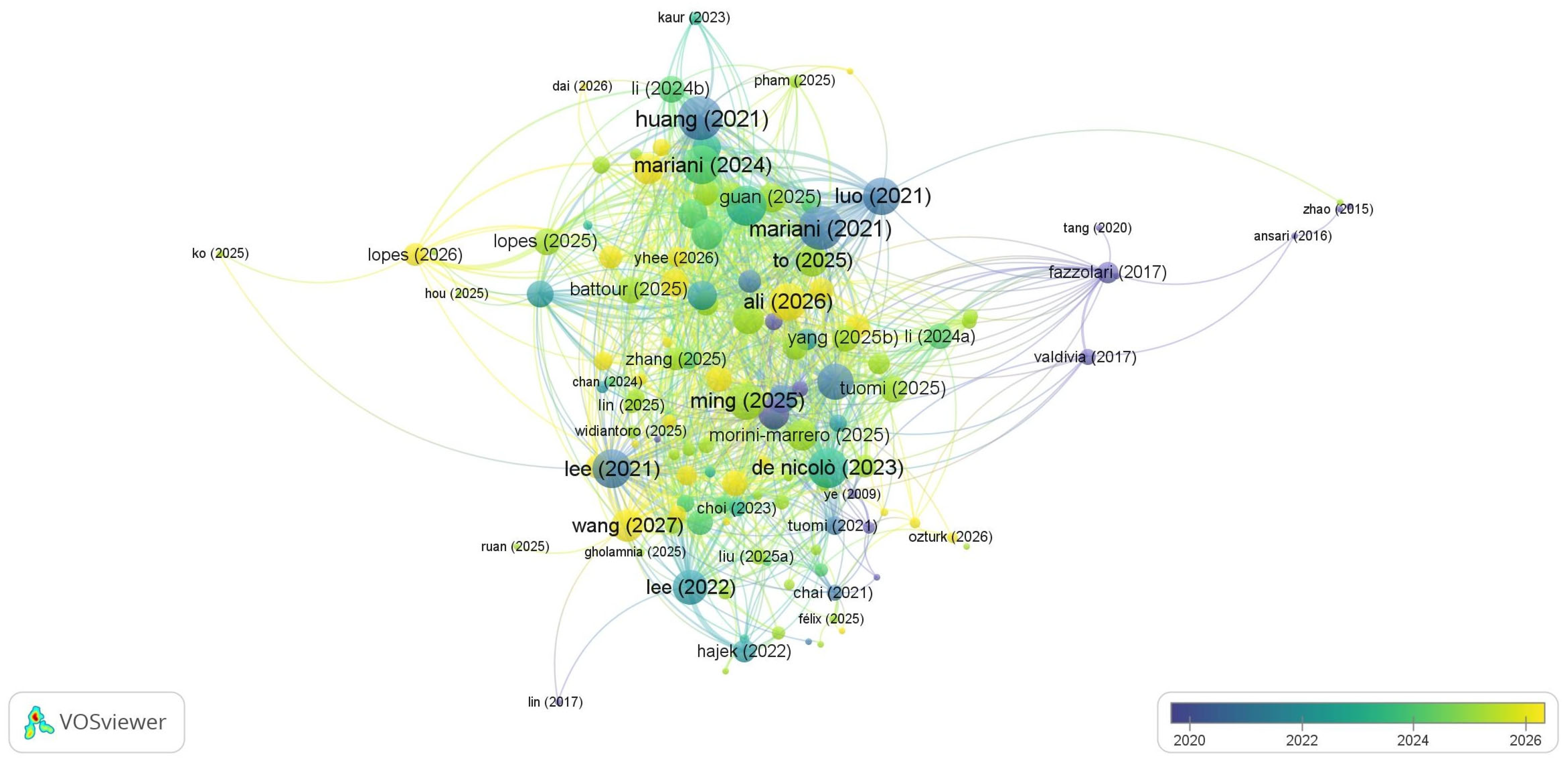
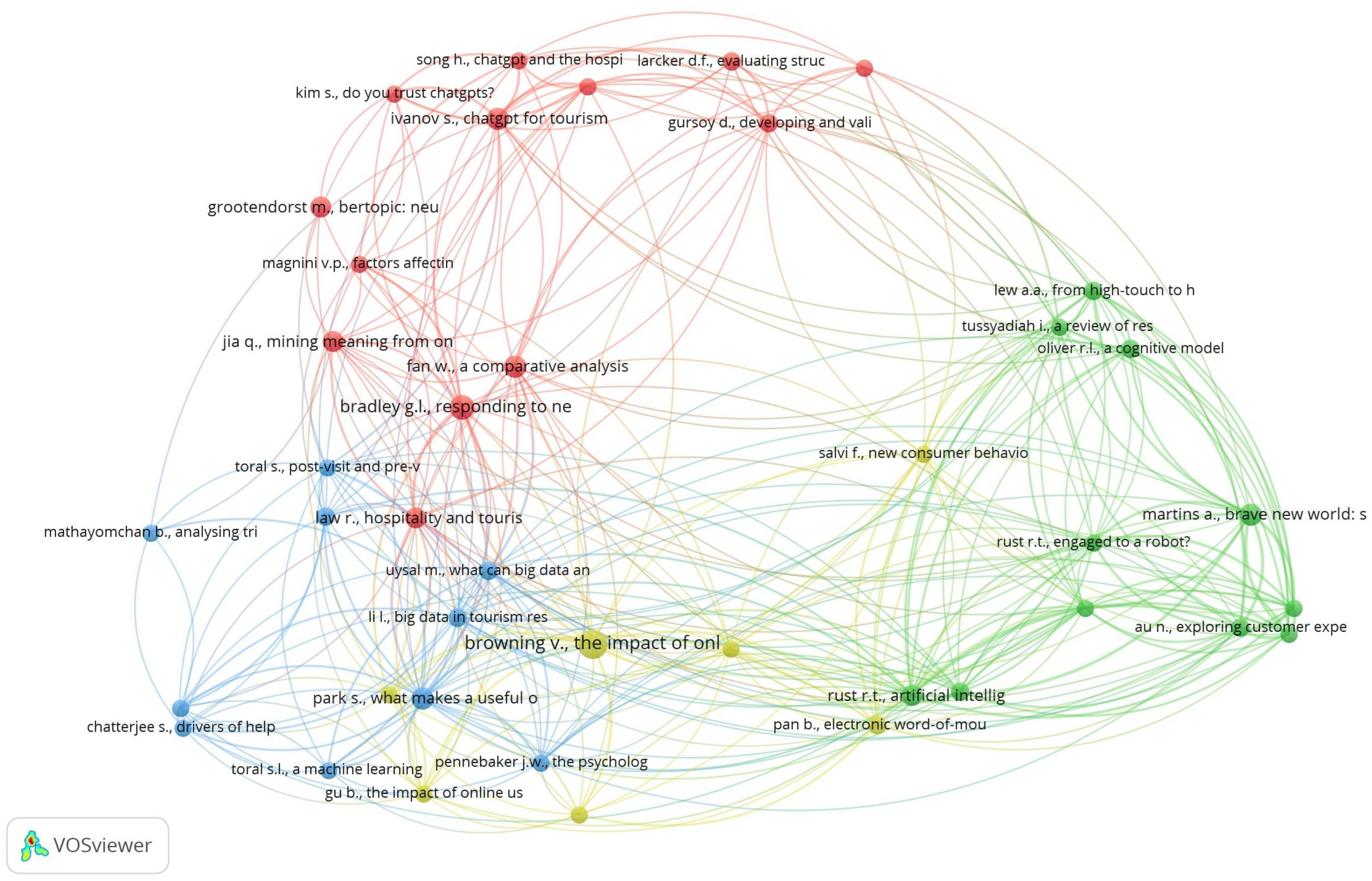
Figure 6.
Co-citation network of cited references (41 connected references; minimum citation threshold = 4). Node size represents citations, line thickness represents co-citation strength, and colours identify VOSviewer clusters.
4.2. Thematic Structure and Temporal Development
The author-keyword network contained 29 terms organised into seven closely connected clusters (Figure 2). Online reviews and artificial intelligence were the most frequent keywords, with 33 occurrences each. They were followed by sentiment analysis (26), large language models (19), eWOM (15), ChatGPT (14), machine learning (13) and generative AI (11). Online reviews occupied the centre of the network and linked computational terms to tourism, hospitality and consumer-response concepts. Artificial intelligence and machine learning formed a second central axis, while eWOM connected the network to trust, review helpfulness and tourism.
The seven clusters overlap substantially. Three broader areas are visible within the network. The first concerns computational review analysis and includes sentiment analysis, text mining, natural language processing, deep learning, topic modelling and sentiment classification. The second connects online reviews and eWOM with service quality, customer satisfaction, review helpfulness, hospitality and tourism. The third brings together ChatGPT, GPT, large language models, generative AI and user-generated content. The proximity of these terms situates emerging generative AI research within the established literature on online reviews and eWOM.
The overlay visualisation reports the average publication year associated with each keyword (Figure 3). Text mining, sentiment classification and topic modelling had lower average publication years, whereas ChatGPT, GPT, large language models, generative AI, trust and user-generated content had higher averages. Artificial intelligence, machine learning, online reviews and eWOM occupied intermediate positions. The distribution shows a change in emphasis within a connected research field, as computational review analysis remains present while consumer applications of generative AI-related topics receive more recent attention. Read with the network structure, the overlay shows that the newer terminology remains connected to the established review domain. The analytical focus is expanding beyond the extraction of patterns from consumer reviews to include how AI shapes the communication and use of review information.
4.3. Bibliographic Coupling and Contemporary Research Fronts
The bibliographic-coupling analysis retained all 142 publications, of which 131 formed the largest connected component. The network contained eight clusters, 1224 links and a total link strength of 1950 (Figure 4). Its dense central area indicates that many publications share parts of their reference bases despite differences in technology, context and application. Documents with higher total link strength occupied the dense central area. More specialised studies appeared near its peripheral branches.
The extensive cross links make the eight clusters better understood as connected areas of emphasis. The network includes work on review analytics and recommendation, AI-enabled tourism and hospitality services, consumer evaluation and trust, and the use of large language models and generative AI. These areas draw on overlapping references and occupy neighbouring positions within the network.
The coupling overlay places publication year on the same network of shared references (Figure 5). The overlay places recent generative AI studies within a shared reference environment that also includes review analytics, recommendation and service technology. The dispersion of recent generative AI publications across the coupled network indicates several points of entry into existing research. The publications connect with review analytics, recommendation, consumer evaluation and service technology, positioning generative AI as a research front distributed across the adjacent literatures. Complete membership of the eight bibliographic-coupling clusters, with publication details and network metrics, is reported in Supplementary Table S10.
4.4. Co-Citation Structure and Intellectual Foundations
The co-citation analysis identified 6770 cited references. Forty-four met the minimum threshold of four citations and 41 formed the connected network. These references were organised into four clusters, with 336 links and a total link strength of 477 (Figure 6). The network identifies bodies of knowledge that are repeatedly cited together by publications in the corpus. Table 3 summarises the working interpretation of the four clusters. The working labels in Table 3 reflect the dominant subjects represented across the full membership of each cluster, with the representative references selected by citation frequency and total link strength. Complete membership of the four co-citation clusters is reported in Supplementary Table S11.
Table 3.
Interpretation of the four co-citation clusters.
The co-citation structure shows that publications in the corpus draw on hospitality review management, service technology, computational review analytics and established eWOM research. The 336 links record the co-citation relationships among the 41 connected references and show that sources from different clusters frequently contribute to the same publications. Cluster numbering records network membership only. Links between clusters show how these foundations are combined in the corpus. eWOM research supplies questions about value, trust and market effects; computational review research supplies methods for extracting and evaluating review information; and service technology research supplies the interaction context in which AI participates. Their convergence provides the intellectual base for studying AI as part of review communication.
4.5. Bibliometric Synthesis
The analyses identify four overlapping areas within the field: established research on eWOM effects and commercial value, computational review analytics, AI-enabled services and recommendation, and emerging research on large language models and generative AI. The keyword overlay assigns higher average publication years to generative AI terminology. Bibliographic coupling places recent publications across connected research fronts, while co-citation links these fronts to shared foundations in eWOM, review analytics and service technology.
The bibliometric evidence describes a field whose emphasis is broadening as AI becomes involved in the information presented to consumers. The maps establish its thematic structure and intellectual connections at field level. Distinctions among review processing, mediation, generative transformation and AI-originated claims require comparison of the content of individual studies. The following section conducts this focused thematic synthesis.
5. Focused Thematic Results
The focused corpus of 54 papers provided the broader thematic context for examining how AI enters review-based communication in tourism and hospitality. It comprised 31 Core studies that placed AI directly within the communication process and 23 Bridge/Context studies that informed the wider discussion of trust, persuasion, authenticity, feedback and consumer response. From this corpus, 12 Essential and six mechanism studies supplied the evidence required for closer conceptual comparison. The addition of the two citation-traced construct anchors produced the final analytical core of 20 sources used in the following synthesis. Le et al. [25], identified through terminology sensitivity testing, provides supplementary evidence for the construct comparison in Section 5.4. The synthesis keeps empirical findings, propositions derived from reviews and conceptual propositions analytically separate; Supplementary Table S7 links each source to its evidential role, principal findings or propositions and design limitations.
5.1. The Changing Role of AI in eWOM
The construct-defining studies assign AI different roles in review-based communication. These roles differ according to the evidence supporting the message and the control exercised over its formulation and presentation. The comparison distinguishes algorithmic processing, algorithmic mediation, generative mediation, assistance with consumer expression and AI-originated evaluative communication. In algorithmically processed eWOM, AI analyses, classifies or verifies human reviews without producing the message received by the consumer. Multimodal detection of generated review content illustrates this analytical role and extends review verification across textual and visual material [39].
Algorithmically mediated eWOM arises when a system influences which human review evidence consumers encounter and how that evidence is retrieved, ordered or presented. Recommender interfaces and conversational systems can guide users through large review collections and alter the prominence of particular information while the underlying evaluations remain human generated [40].
Generative AI-mediated eWOM involves the production of a new consumer facing message from human review evidence. Hotel review summaries, review-based comparisons and conversational explanations condense or reorganise multiple consumer accounts into summaries, comparisons or recommendations. These applications influence information search, perceived information quality, browsing and choice while retaining human reviews as their evidential basis [38,41,42,43]. The browsing findings from Wang, Tong and Dong [38] are provisional because only the proceedings abstract was assessed.
AI-assisted consumer eWOM follows a parallel human provenance route. GenAI supports the formulation of a review, while the traveller continues to supply the experience and evaluation. Evidence from TripAdvisor indicates that access to ChatGPT can reduce writing effort and influence review volume, length and linguistic characteristics [44]. AI-originated evaluative communication represents a different evidential case. Studies using generated restaurant reviews demonstrate that AI can produce evaluations resembling conventional consumer reviews without an identifiable human experience supporting each evaluation [45,46].
5.2. Authenticity, Credibility and Consumer Response
Consumer responses to AI related review communication depend on both the perceived origin of the message and the quality of the information it provides. Perceived AI authorship can reduce usefulness, trustworthiness and authenticity even when the visible review remains unchanged. Consumers also associate credibility with experiential detail, balanced information, natural language and clear information about AI involvement [47,48].
Consumers have limited ability to distinguish generated reviews from human reviews. Confidence in identifying the source may remain high even when classification accuracy is weak. Valence also affects these judgements, with negative reviews sometimes receiving stronger assessments of realism, trustworthiness and authenticity across authorship conditions [45,46].
Transparency influences evaluation in conjunction with message and user characteristics. Information about the origin of a generated summary and the human reviews supporting it can improve helpfulness, while readability, valence and consumer perceptions of AI shape the strength of this effect. Provenance and information quality therefore contribute separate elements to consumer appraisal [43,47,48]. Supplementary Table S12 consolidates the experiential source, message producer, presentation control, representative evidence and analytical boundary of the five roles.
5.3. Mechanisms and Review Ecosystem Effects
Generative recommendation and summary tools have been associated with subsequent changes in the production of human reviews. Across the selected platform studies, their introduction was associated with lower review contribution and changes in review length, specificity, language and rating composition [32,34,35]. These measured outcomes concern review production following the introduction of AI interfaces. Their longer-term effects on the diversity, representativeness and quality of the review corpus remain open empirical questions.
The targeted check identified a contrasting result in Hao et al.’s study of review-contribution asymmetry: AI-generated summaries increased review volume overall. Helpfulness attached to negative reviews weakened this increase, whereas helpfulness attached to positive reviews strengthened it only for non-luxury hotels (Supplementary Table S15, ID 15). These conditions concern the valence of the reviews receiving helpfulness signals, rather than summary valence. The reported contrast qualifies any general claim that AI-generated summaries reduce subsequent review contribution; the framework’s feedback connection accommodates different directions of change.
The purpose and control of a generated message also shape its relationship to WOM. Review information can be incorporated into personalised hotel upselling messages controlled by the firm, while disclosed AI authorship in tourism marketing can affect originality, anticipation and travel intention. Consumer evidence may inform these messages, but their persuasive purpose and publication remain under organisational control [33,36].
Source attribution and transparency were associated with authenticity, usefulness, helpfulness and trust across experimental and qualitative studies [43,47,48]. Access to supporting human reviews supported checking and decision control in the qualitative evidence [41]. Review provision, readability and content quality were associated with perceived chatbot or summary quality and with consumer responses [38,40,43]. The studies therefore report relationships among system cues, user appraisals and outcomes while using different constructs and designs. The findings of Wang, Tong and Dong [38], including purchasing, browsing and hotel-sales outcomes, are provisional and based only on the proceedings abstract. Setting this source aside removes the direct field evidence for those outcomes in the synthesis (Supplementary Table S8). It does not change the definition of generative AI-mediated eWOM or the five-role classification, which remain supported by the other construct-defining sources [40,41,42,43,44,45,46], nor the findings on appraisal and subsequent review contribution supported by other studies [32,34,35,43,44,47,48].
The other four studies in the targeted check qualify the interpretation of appraisal and outcomes through receiver susceptibility, trust and information retrieval skills, authenticity and uncanniness in managerial responses, and destination image in negative eWOM following GenAI use (Supplementary Table S15). These qualifications concern particular communication settings and relationships. They do not require a change to the five AI roles, and reduced information overload does not necessarily imply easier decision-making.
5.4. AI Roles and Construct Boundaries Emerging from the Synthesis
The five roles identified above are distinguished through experiential provenance and communicative agency. Human eWOM provides the comparison baseline because the consumer supplies both the evaluation and its formulation. Experiential provenance identifies the evidence supporting the evaluation. Communicative agency identifies who formulates the message and who controls its presentation. The unit of classification is a bounded AI function and its resulting output at one stage of the review workflow. Applications containing several functions receive stage-level codes.
For example, a platform that analyses and retrieves human reviews generates a summary and later offers writing assistance to a traveller. The summary constitutes one unit: generative AI-mediated eWOM is its primary role, while processing and retrieval are recorded as supporting roles. The later consumer review constitutes a second unit and is classified as AI-assisted consumer eWOM because the traveller supplies the experience and evaluation. One application can therefore receive several stage-level codes while each output retains one primary role.
The five roles are located within Synthetic WOM, the broader field of AI participation in consumption-related communication [13]. Within this field, they identify where the evaluation originates and how control over its formulation and presentation is distributed in tourism review communication.
Le et al. [25] distinguish AI-mediated, AI-generated and AI-personalised WOM in rural tourism. Their scale supports differentiation among forms of AI involvement. The present framework extends the comparison to the experiential basis of the evaluation and the allocation of control over its formulation and presentation.
Generated summaries and comparisons grounded in identifiable human reviews are classified as generative AI-mediated eWOM because the evaluative evidence originates from traceable consumer accounts. AI-assisted consumer eWOM applies when the consumer supplies the experience and evaluation while AI supports formulation. AI-originated evaluative communication applies when the system formulates the evaluation and no identifiable human review evidence serves as its basis [41,42,44,45,46].
Experiential content and experiential provenance are separate dimensions. Experiential content concerns whether the text describes an encounter. Experiential provenance concerns whether an actual experience holder supports the evaluation. A brief human review may contain little experiential detail while retaining human provenance. A generated first-person review may imitate experiential detail while lacking an experience holder. Classification follows the production conditions and evidential basis reported in the study.
No identifiable human review evidence records the observable provenance of an evaluation. It applies when the output cannot be traced to declared or inspectable human reviews that support the evaluation. This wording separates missing traceability from verified absence of an experience holder. When provenance is unspecified, the case remains indeterminate. AI-originated evaluative communication is assigned when the study establishes a system-produced evaluation whose basis contains no identifiable human review evidence.
Review grounded content remains within AI-mediated eWOM when it represents or reformulates consumer evaluations as peer evidence for other consumers. When a tourism firm defines the persuasive objective, target, offer and publication, the output is classified as promotional communication controlled by the firm and informed by eWOM. Review evidence functions as an input to organisational persuasion, while the resulting message falls outside the WOM categories in the five-role classification. Remountakis et al. [33] illustrates this boundary.
Figure 7 separates provenance cues from the judgements made by consumers. Disclosure, source identification and traceability describe what the interface reveals and whether a generated statement can be connected to supporting human reviews. Provenance appraisal concerns perceived authenticity and source certainty. Information appraisal concerns credibility, helpfulness and usefulness. In this framework, credibility refers to the perceived believability of the content, while helpfulness and usefulness refer to its value for the decision.
Figure 7.
An integrative framework of AI-mediated persuasion and Synthetic WOM.
The ordering draws on source attribution and online credibility research, which distinguish judgements about the source from judgements about the message [18,27], and on information adoption research, which connects credibility and usefulness with subsequent adoption [16,17].
Trust and reliance are placed after the two appraisals because they concern whether a consumer is prepared to depend on the message, reviewer, platform or AI system. The object of trust must therefore be specified in empirical applications. This ordering prevents traceability, authenticity, credibility and trust from being used as labels for the same judgement.
The reviewed studies support several individual relationships, including effects of source attribution and transparency on authenticity, usefulness and helpfulness [43,47,48], effects of information presentation on perceived quality and reuse intention [40,43], and associations between generated review interfaces and purchase, browsing or later review contribution [32,34,35,38,44]. The complete sequence from provenance cues through both appraisals to reliance and behaviour has yet to be tested within one design. Dashed arrows in Figure 7 therefore represent the proposed appraisal pathway. The solid arrow links the introduction or availability of AI interfaces directly to subsequent review contribution, separately from the proposed appraisal pathway. Supplementary Table S8 distinguishes empirically reported relationships from relationships proposed through conceptual integration and records the supporting studies and limits of inference. The listed boundary conditions apply to particular relationships reported in the reviewed studies and remain candidates for further testing [34,35,36,43,47]. The purchase and browsing findings attributed to [38] remain provisional because they are available only in the proceedings abstract.
Connectors from Part A lead consumer facing forms into the appraisal pathway. Dashed horizontal arrows represent proposed appraisal relationships, and dashed vertical arrows indicate potential boundary conditions. The solid arrow represents reported changes in human review contribution following the introduction or availability of AI interfaces; it begins at a separate interface node, outside the proposed appraisal and reliance pathway. The dashed return path represents the proposed longer-term feedback to the human review evidence available for future communication.
6. Discussion
The bibliometric structure brings together established eWOM research, computational review analytics and service technology, while recent studies place AI within the communication process itself. The findings indicate that a central change in tourism eWOM concerns the distribution of control over consumer information. AI may remain behind the communication as an analytical tool, shape the evidence presented by a platform, reformulate human reviews or produce an evaluation itself. These roles carry different implications even when the resulting output resembles an ordinary review or recommendation. The relevant unit of analysis therefore extends beyond the visible text to include the evidence supporting the claim and the actors controlling its formulation and presentation.
In established services marketing, customer reviews function as market signals of prior service encounters, especially when prospective consumers cannot inspect service quality before purchase [1,6,14,15]. The framework extends this view by separating the experience supporting an evaluation from control over its formulation and presentation. When AI selects, condenses or rewrites these accounts, the experiential evidence can remain human while control over its communicative form moves to the platform or model. A human and AI division based only on the apparent author therefore captures only part of the process. The origin of the evaluation, the formulation of the message and the control of its presentation may belong to different actors. Tourism platforms consequently participate in the construction of the information environment through which service expectations and choices are formed. Table 4 links each research question to the evidence used, the principal finding and the contribution derived from the synthesis.
Table 4.
Alignment of research questions, methods, findings and contributions.
6.1. Theoretical Implications
Existing concepts organise AI involvement around automated content production and distribution, consumer interaction with AI, generative AI use in tourism WOM, and participation across source, message, channel and receiver [10,11,12,13]. Table 1 shows that these concepts use different focal units. The present classification connects them by examining the evidence supporting an evaluation and the location of control over message formulation and presentation. This makes it possible to distinguish five roles within tourism review communication and to link their boundaries with consumer appraisal and changes in the review ecosystem. The contribution lies in bringing experiential provenance, communicative agency and ecosystem feedback into a single framework for AI-mediated persuasion in tourism and hospitality. The resulting contribution is a common decision structure for comparing applications that use similar technologies but assign different roles to consumers, platforms, firms and AI systems.
The framework links eWOM research on experience-based evaluation and opinion adoption [6,14,15,16,17,18], AI-mediated communication research on system intervention in message production [19], and automated media research on platform control of exposure and distribution [20]. Experiential provenance and communicative agency provide common dimensions for examining these processes within the same communicative act.
AI-assisted consumer expression shows why experiential source and text production need to be examined separately. Assistance with wording can influence how an experience is described while the traveller continues to supply the experience and evaluation [44]. This creates an analytical distinction between experiential provenance and textual authorship that a simple distinction between human and AI authorship cannot capture. It allows a consumer account written with AI support to be distinguished from a generated summary based on multiple consumer accounts and from an evaluative statement produced by a model.
Separating cues, appraisals and reliance clarifies constructs that appear together in studies of generated review communication. Traceability describes access to supporting evidence. Authenticity concerns whether the evaluation appears grounded in genuine experience. Credibility concerns the believability of the information. Trust concerns willingness to rely on a specified message, source, platform or system. The constructs may influence one another, but each refers to a different analytical object.
The corpus provides empirical evidence for parts of this process, including source attribution effects, information presentation effects and links between perceived quality or helpfulness and consumer intentions [40,43,47,48]. Evidence for the complete directional sequence is distributed across separate studies. The framework connects these supported partial relationships in a pathway for empirical testing across different AI roles.
Platform studies report changes in the quantity and content of reviews after the introduction of generated summaries or recommendations [32,34,35]. This evidence supports the connection between AI interfaces and subsequent review contribution. The next step in the framework, from altered contribution to changes in the evidence available to future consumers and systems, is a proposition for longitudinal testing. Its inclusion extends inquiry from immediate persuasion to the continuing operation of the review platform and the production of market knowledge derived from customer experience.
6.2. Implications for Tourism Platforms, Businesses and Consumers
The practical implications concern tourism platforms, tourism businesses and consumers and follow two levels of evidence. Findings reported in the reviewed studies support attention to provenance information, access to underlying reviews and monitoring of review contribution. The framework also identifies design questions that tourism platforms and businesses can evaluate in their own settings.
For summaries and conversational interfaces grounded in human reviews, studies link transparency, readability and access to supporting evidence with helpfulness, authenticity, usefulness and decision control [41,43,47,48]. Platforms can identify the role performed by AI, describe the review base and allow users to inspect the underlying reviews. The effects of these practices can then be evaluated for each interface and decision context.
For consumers, interfaces can make AI involvement visible, identify the evidence supporting a summary or recommendation and preserve direct access to individual reviews. These features allow users to distinguish review-based information from firm-controlled promotion and decide how much reliance to place on each form of communication.
Platform studies also report changes in review volume, specificity, linguistic characteristics and rating composition after the introduction of generative tools [32,34,35]. This evidence supports routine monitoring of these characteristics. Longitudinal analysis is required to establish whether the reported changes alter the range of customer experiences represented over time.
When tourism businesses use reviews to generate upselling or recommendation messages, the organisation controls the purpose, target and publication of the communication [33]. The framework classifies these outputs as promotional communication informed by eWOM. Their organisational source and commercial purpose should be clear to consumers, and future studies can compare alternative forms of disclosure. Evidence concerning source fit, originality and perceived algorithm adaptivity also supports evaluating generated communication for experiential relevance and consumer response alongside fluency and personalisation [23,24,36].
These implications can be implemented through a governance process applied to each platform feature presented to consumers. Before launch, the platform can record the experiential source, message producer and presentation controller, then decide what disclosure, source identification and access to supporting reviews the interface should provide. After launch, indicators examined in the reviewed studies can be monitored at two levels: authenticity, credibility, helpfulness, usefulness and reliance for consumers, and review volume, specificity, rating composition and language for the review corpus [32,34,35,41,43,47,48]. This process supports comparison among alternative designs and identifies trade-offs between immediate decision support and the continuing quality of the review corpus.
6.3. Limitations and Future Research
The review draws on English language publications indexed in Scopus at the specified search date and concentrates on tourism and hospitality. These choices provide a coherent evidence base and define its coverage. The terminology sensitivity search identified Le et al. [25] as supplementary evidence for the construct boundary analysis. Publications identified through citation tracing and final theoretical positioning were assessed separately as conceptual anchors or external comparators. Haenlein et al. [13], published after the search date, informed the broader positioning of Synthetic WOM. Coverage is therefore bounded by Scopus indexing and the search date. This boundary is most relevant to recent conference proceedings and publications indexed elsewhere. The bibliometric networks therefore represent the structure of the indexed corpus. Emerging conference papers, work indexed in other databases and research using unfamiliar terminology may alter the apparent prominence of themes or reveal additional boundary cases.
The initial coding of the 54 papers used titles, abstracts and keywords. The analytical core was subsequently examined in greater depth as described in Section 3.5, with comparison limited to constructs and procedures stated in the available material. The synthesis integrates field and natural experiments, controlled experiments, qualitative research, applications, conceptual papers and prior reviews. Empirical findings were retained at the level supported by each design, while conceptual and review sources informed construct definition and mechanism integration, as reported in Supplementary Table S7. The classification of AI roles involved interpretive judgement during category development, and the proposed relationships require direct empirical testing.
The abstract level coding provided a broad map of the 54-paper corpus, while construct and relationship claims were developed from the analytical core. Mechanisms and contradictory findings reported only in the full texts of papers outside that core may be underrepresented. The heterogeneity of study designs also prevents direct comparison of effect magnitudes across the evidence base. The framework accordingly identifies distinctions and relationships for cumulative testing, while their prevalence, causal ordering and stability across tourism sectors remain to be established.
The author conducted the initial screening and coding, followed by expert review of the complete 54 study matrix. Independent replication can test the reliability of the classification by applying the decision rules to corpora assembled from additional databases, languages and service sectors. This validation is the immediate priority before tests of the appraisal pathway and longer-term ecosystem effects.
Future experiments can manipulate disclosure, source identification and traceability separately. They can then test whether these cues influence perceived authenticity and source certainty, whether provenance appraisal shapes credibility, helpfulness and usefulness, and whether these judgements lead to trust or reliance and tourism choice. Each study should identify the object of trust and test boundary conditions at the relationship where they are expected to operate. Valence, readability, user experience, decision stage, hotel status and perceived algorithm adaptivity provide candidates drawn from the reviewed studies [34,35,36,43,47].
Field research can examine the longer-term relationship between generated communication and review contribution. Consumer search and purchase behaviour can be studied alongside subsequent changes in review participation and content. Such designs could test whether the use of generated summaries changes the range of experiences represented on the platform and the quality of the material available to later AI systems [32,34,35,38].
Drawing on the supported partial relationships and the conceptual connections in Figure 7 and Supplementary Table S8, three propositions provide a focused agenda for empirical testing:
P1. In generative AI-mediated eWOM, greater traceability to identifiable supporting reviews will increase perceived authenticity and source certainty.
P2. Provenance appraisal will influence consumer reliance indirectly through credibility, helpfulness and usefulness.
P3. Changes in review contribution following the introduction of generated summaries or recommendations will alter, over time, the diversity and informational quality of the review evidence available for subsequent consumer and AI use.
Further work can apply the framework to visual, multimodal and conversational communication. These formats allow evidence, formulation and presentation to be distributed differently across consumers, organisations, platforms and AI systems. Comparative research across hotels, restaurants, destinations and other experiential services could assess how well experiential provenance and communicative agency travel across service contexts and whether the proposed boundaries remain useful as AI assumes a larger role in consumer decision-making [39,40].
7. Conclusions
This review synthesises AI involvement in tourism and hospitality eWOM through experiential provenance and communicative agency. These dimensions distinguish five roles according to the evidence supporting an evaluation and the actors controlling its formulation and presentation. The resulting framework gives research on aWOM, aiWOM and Synthetic WOM a common basis for comparison and separates communication grounded in human review evidence from AI-originated evaluative communication.
The available evidence supports individual relationships involving authenticity, credibility, helpfulness, usefulness, search, purchase behaviour and subsequent review contribution under specific conditions. The framework organises these findings into relationships for empirical testing. Its complete appraisal sequence remains a conceptual synthesis, and the longer-term effects of altered review contribution on the diversity and quality of the review corpus remain open empirical questions. The framework provides a focused basis for studying AI-mediated persuasion and the continuing production of customer-based market knowledge in tourism and services marketing. Future work should establish classification reliability, test the ordering of the appraisal pathway and examine ecosystem effects through longitudinal platform evidence. The purchasing, browsing and hotel-sales findings drawn from [38] remain provisional, pending assessment beyond the proceedings abstract.
Supplementary Materials
The following supporting information can be downloaded at: https://www.mdpi.com/article/10.3390/jtaer21110409/s1, The completed PRISMA 2020 checklist is provided as Supplementary File S1. Supplementary File S2 contains Table S2 on the material assessed for each analytical-core source, Table S3 on the classification and decision rationale for the 54 focused studies, Table S4 on the selection of the six Important mechanism studies, Table S5 on the coding framework, Table S6 on difficult coding cases, Table S7 on the evidence profile and evidential status of the 20 analytical-core sources, Table S8 on the evidential basis of the appraisal relationships, Table S9 on VOSviewer settings and threshold sensitivity, Table S10 on bibliographic-coupling cluster membership and Table S11 on co-citation cluster membership. Finally, Supplementary Table S12 presents the empirical and conceptual foundations of the five AI roles. Table S13 documents the 11 supplementary terminology-search records and their disposition, and Table S14 reports the material assessed and evidential role of Le et al. [25]. Table S15 reports the targeted robustness check of the five non-selected Important studies.
Funding
This research received no external funding.
Institutional Review Board Statement
Not applicable.
Informed Consent Statement
Not applicable.
Data Availability Statement
The bibliographic data analysed in this study were retrieved from Scopus using the search strategy and search date reported in the manuscript. The original Scopus export cannot be publicly redistributed due to database licencing restrictions. The author-generated screening records, analytical datasets, thematic coding matrix, thesaurus, and VOSviewer outputs are available from the author upon reasonable request.
Acknowledgments
The author gratefully acknowledges Jason Papathanasiou for his valuable methodological feedback and review of the thematic coding procedure and final category structure. During the preparation of this manuscript, the author used ChatGPT (OpenAI, GPT-5.6) to assist with manuscript readability, language editing, structural refinement and to assist with the visual rendering of the conceptual framework and the PRISMA 2020 flow diagram based on the author’s methodology and data. The author reviewed, verified, and edited all AI-assisted output and takes full responsibility for the content of this publication.
Conflicts of Interest
The author declares no conflicts of interest.
References
- Babić Rosario, A.; de Valck, K.; Sotgiu, F. Conceptualizing the electronic word-of-mouth process: What we know and need to know about eWOM creation, exposure, and evaluation. J. Acad. Mark. Sci. 2020, 48, 422–448. [Google Scholar] [CrossRef] [Scilit]
- Pauwels, K.; Aksehirli, Z. Free and paid word-of-mouth from physical to digital, AI and beyond. J. Acad. Mark. Sci. 2026. online first. [Google Scholar] [CrossRef] [Scilit]
- Grewal, D.; Satornino, C.B.; Davenport, T.; Guha, A. How generative AI is shaping the future of marketing. J. Acad. Mark. Sci. 2025, 53, 702–722. [Google Scholar] [CrossRef] [Scilit]
- Cillo, P.; Rubera, G. Generative AI in innovation and marketing processes: A roadmap of research opportunities. J. Acad. Mark. Sci. 2025, 53, 684–701. [Google Scholar] [CrossRef] [Scilit]
- Koçak, B.B. How AI-generated messages impact consumer behavior in the tourism industry. J. Theor. Appl. Electron. Commer. Res. 2026, 21, 67. [Google Scholar] [CrossRef] [Scilit]
- Litvin, S.W.; Goldsmith, R.E.; Pan, B. Electronic word-of-mouth in hospitality and tourism management. Tour. Manag. 2008, 29, 458–468. [Google Scholar] [CrossRef] [Scilit]
- Filieri, R. What makes an online consumer review trustworthy? Ann. Tour. Res. 2016, 58, 46–64. [Google Scholar] [CrossRef] [Scilit]
- Li, H.; Xi, J.; Hsu, C.H.C.; Yu, B.X.B.; Zheng, X. Generative artificial intelligence in tourism management: An integrative review and roadmap for future research. Tour. Manag. 2025, 110, 105179. [Google Scholar] [CrossRef] [Scilit]
- Zhang, M.; Yi, F.; Gursoy, D. The effects of generative artificial intelligence on consumers in hospitality and tourism: A systematic review and future research directions. Int. J. Hosp. Manag. 2026, 133, 104452. [Google Scholar] [CrossRef] [Scilit]
- Williams, N.L.; Ferdinand, N.; Bustard, J. From WOM to aWOM—The evolution of unpaid influence: A perspective article. Tour. Rev. 2020, 75, 314–318. [Google Scholar] [CrossRef] [Scilit]
- Tassiello, V.; Amatulli, C.; Tillotson, J.S.; Laker, B. aiWOM: Artificial Intelligence Word-of-Mouth. Conceptualizing consumer-to-AI communication. Int. J. Hum.-Comput. Interact. 2025, 41, 4248–4260. [Google Scholar] [CrossRef] [Scilit]
- Mladenović, D.; Beheshti, M.; Kolar, T.; Ismagilova, E.; Dwivedi, Y.K. Synthetic WOM? The emergence of generative artificial intelligence-induced recommendations. J. Comput. Inf. Syst. 2024, 1–18. [Google Scholar] [CrossRef] [Scilit]
- Haenlein, M.; Kannan, P.K.; Muller, E.; Wahid, R. Introducing the special issue on influencer marketing with extension into synthetic word of mouth: How AI shapes the future of influencer marketing. J. Acad. Mark. Sci. 2026, 54, 989–1005. [Google Scholar] [CrossRef] [Scilit]
- Hennig-Thurau, T.; Gwinner, K.P.; Walsh, G.; Gremler, D.D. Electronic word-of-mouth via consumer-opinion platforms: What motivates consumers to articulate themselves on the Internet? J. Interact. Mark. 2004, 18, 38–52. [Google Scholar] [CrossRef] [Scilit]
- Babić Rosario, A.; Sotgiu, F.; de Valck, K.; Bijmolt, T.H.A. The effect of electronic word of mouth on sales: A meta-analytic review of platform, product, and metric factors. J. Mark. Res. 2016, 53, 297–318. [Google Scholar] [CrossRef] [Scilit]
- Filieri, R. What makes online reviews helpful? A diagnosticity-adoption framework to explain informational and normative influences in e-WOM. J. Bus. Res. 2015, 68, 1261–1270. [Google Scholar] [CrossRef] [Scilit]
- Cheung, C.M.K.; Lee, M.K.O.; Rabjohn, N. The impact of electronic word-of-mouth: The adoption of online opinions in online customer communities. Internet Res. 2008, 18, 229–247. [Google Scholar] [CrossRef] [Scilit]
- Metzger, M.J.; Flanagin, A.J.; Medders, R.B. Social and heuristic approaches to credibility evaluation online. J. Commun. 2010, 60, 413–439. [Google Scholar] [CrossRef] [Scilit]
- Hancock, J.T.; Naaman, M.; Levy, K. AI-mediated communication: Definition, research agenda, and ethical considerations. J. Comput.-Mediat. Commun. 2020, 25, 89–100. [Google Scholar] [CrossRef] [Scilit]
- Napoli, P.M. Automated media: An institutional theory perspective on algorithmic media production and consumption. Commun. Theory 2014, 24, 340–360. [Google Scholar] [CrossRef] [Scilit]
- Alzate, M.; Arce-Urriza, M.; Cebollada, J. Online reviews and product sales: The role of review visibility. J. Theor. Appl. Electron. Commer. Res. 2021, 16, 638–669. [Google Scholar] [CrossRef] [Scilit]
- Guzman, A.L.; Lewis, S.C. Artificial intelligence and communication: A human–machine communication research agenda. New Media Soc. 2020, 22, 70–86. [Google Scholar] [CrossRef] [Scilit]
- Longoni, C.; Cian, L. Artificial intelligence in utilitarian vs. hedonic contexts: The “word-of-machine” effect. J. Mark. 2022, 86, 91–108. [Google Scholar] [CrossRef] [Scilit]
- Ma, J.; Zhang, D.; Chen, C.; Du, H.S. Matching generative AI word-of-mouth with product type: Impact on consumer adoption and trust. J. Retail. Consum. Serv. 2026, 89, 104615. [Google Scholar] [CrossRef] [Scilit]
- Le, H.T.P.M.; Phan, M.T.N.; Le, T.D.M.; Ha, T.M. Harnessing AI-driven word of mouth: Construction, validation, and impact on AI distinctiveness and visit intention in rural tourism. J. Travel Tour. Mark. 2026, 43, 655–674. [Google Scholar] [CrossRef] [Scilit]
- Tao, X.; Zeng, J.; Shahzad, M.F.; Asif, M.; Butt, S. Exploring the intersection of generative AI and eWOM: A bibliometric perspective on emerging research directions. SAGE Open 2026, 16, 21582440261423988. [Google Scholar] [CrossRef] [Scilit]
- Sundar, S.S.; Nass, C. Conceptualizing sources in online news. J. Commun. 2001, 51, 52–72. [Google Scholar] [CrossRef]
- Snyder, H. Literature review as a research methodology: An overview and guidelines. J. Bus. Res. 2019, 104, 333–339. [Google Scholar] [CrossRef] [Scilit]
- Zupic, I.; Čater, T. Bibliometric methods in management and organization. Organ. Res. Methods 2015, 18, 429–472. [Google Scholar] [CrossRef] [Scilit]
- Page, M.J.; McKenzie, J.E.; Bossuyt, P.M.; Boutron, I.; Hoffmann, T.C.; Mulrow, C.D.; Shamseer, L.; Tetzlaff, J.M.; Akl, E.A.; Brennan, S.E.; et al. The PRISMA 2020 statement: An updated guideline for reporting systematic reviews. BMJ 2021, 372, n71. [Google Scholar] [CrossRef] [Scilit] [PubMed]
- van Eck, N.J.; Waltman, L. Software survey: VOSviewer, a computer program for bibliometric mapping. Scientometrics 2010, 84, 523–538. [Google Scholar] [CrossRef] [Scilit] [PubMed]
- Chan, F.Y.; Gao, C.; Leung, A.C.M.; Fang, Y.; Ye, Q. ChatGPT-empowered product recommendation and online word-of-mouth: Evidence from online travel agency. In Proceedings of the 45th International Conference on Information Systems (ICIS 2024), Bangkok, Thailand, 15–18 December 2024; p. 27. [Google Scholar]
- Remountakis, M.; Kotis, K.; Kourtzis, B.; Tsekouras, G.E. Using ChatGPT and persuasive technology for personalized recommendation messages in hotel upselling. Information 2023, 14, 504. [Google Scholar] [CrossRef] [Scilit]
- Cheng, Y.; Gao, B.; Zhang, R.A.; Li, X. The effect of review summary: Evidence from a natural experiment. In Proceedings of the 58th Hawaii International Conference on System Sciences (HICSS 2025), Waikoloa Village, HI, USA, 7–10 January 2025; pp. 3847–3856. [Google Scholar] [CrossRef] [Scilit]
- Li, Z.; Bang, Y. How does artificial intelligence-generated content reshape user-generated content? An empirical study from TripAdvisor. Decis. Support Syst. 2026, 203, 114623. [Google Scholar] [CrossRef] [Scilit]
- Li, C.; Cao, Q.; Hua, S.; Tao, C.-W. When AI takes the wheel: The effectiveness of AI versus human-generated content in tourism marketing. J. Vacat. Mark. 2025. online first. [Google Scholar] [CrossRef] [Scilit]
- Singh, S.; Mittal, A. Online review authenticity and helpfulness: An integrative literature review and research agenda for consumer purchase intention in hospitality. J. Hosp. Tour. Insights 2026, 9, 2775–2793. [Google Scholar] [CrossRef] [Scilit]
- Wang, S.; Tong, J.; Dong, J.Q. When generative artificial intelligence meets human reviews: Effects on consumer behavior and hotel sales. In Proceedings of the 29th Pacific Asia Conference on Information Systems (PACIS 2025), Kuala Lumpur, Malaysia, 5–9 July 2025; p. 16. [Google Scholar]
- Li, J.; Zheng, W.; Guo, X. Detecting multi-modal GAI-manipulated tourism review. Tour. Manag. 2025, 111, 105220. [Google Scholar] [CrossRef] [Scilit]
- Kim, J.; Jang, J. Information presentation strategies for recommender-chatbots. Asia Pac. J. Inf. Syst. 2026, 36, 266–291. [Google Scholar] [CrossRef] [Scilit]
- Cai, Y.; Shang, Y.; Cheng, M. Do AI summaries tell the whole story? A qualitative study of AI-generated hotel review summaries. Curr. Issues Tour. 2026, 1–6. [Google Scholar] [CrossRef] [Scilit]
- Cosentino, C.; Gündüz Cüre, M.; Marozzo, F.; Öztürk Birim, Ş. From reviews to results: Generative AI for review-driven product and service comparisons. In Discovery Science; Džeroski, S., Levatić, J., Pio, G., Simidjievski, N., Eds.; Springer Nature: Cham, Switzerland, 2025; pp. 78–93. [Google Scholar] [CrossRef] [Scilit]
- Yhee, Y.; Koo, C. Seeing AI as human or machine? Effects of transparency, valence, and readability on review summary helpfulness. Tour. Manag. 2026, 113, 105305. [Google Scholar] [CrossRef] [Scilit]
- Gu, W.K.M.; Spann, M. The impact of generative artificial intelligence on consumer reviews: Insights from a quasi-experiment. Int. J. Res. Mark. 2026; in press. [CrossRef] [Scilit]
- Tuomi, A. Deepfake consumer reviews in tourism: Preliminary findings. Ann. Tour. Res. Empir. Insights 2021, 2, 100027. [Google Scholar] [CrossRef] [Scilit]
- Tuomi, A.; Zainal Abidin, H.; Tuominen, P.; Passos Ascenção, M. Convincingness of AI-generated restaurant reviews. In Information and Communication Technologies in Tourism 2025; Nixon, L., Tuomi, A., O’Connor, P., Eds.; Springer: Cham, Switzerland, 2025; pp. 437–448. [Google Scholar] [CrossRef] [Scilit]
- Amos, C.; Zhang, L. Consumer reactions to perceived undisclosed ChatGPT usage in an online review context. Telemat. Inform. 2024, 93, 102163. [Google Scholar] [CrossRef] [Scilit]
- Sâsâeac, Ș.-M.; Bertea, P.E.; Jelea, A.R.; Manolică, A.; Roman, C.T. eWOM vs. aWOM: AI powered word of mouth and its impact on consumer decision making in tourism. Sci. Ann. Econ. Bus. 2025, 72, 489–517. [Google Scholar] [CrossRef] [Scilit]
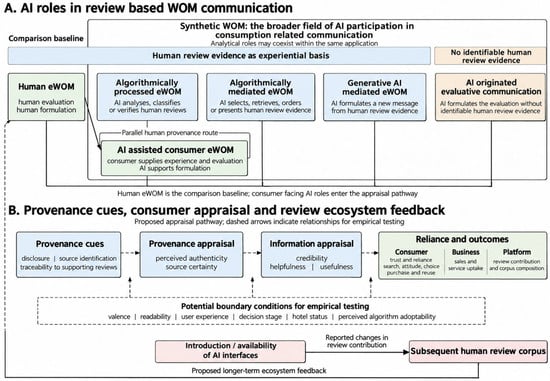
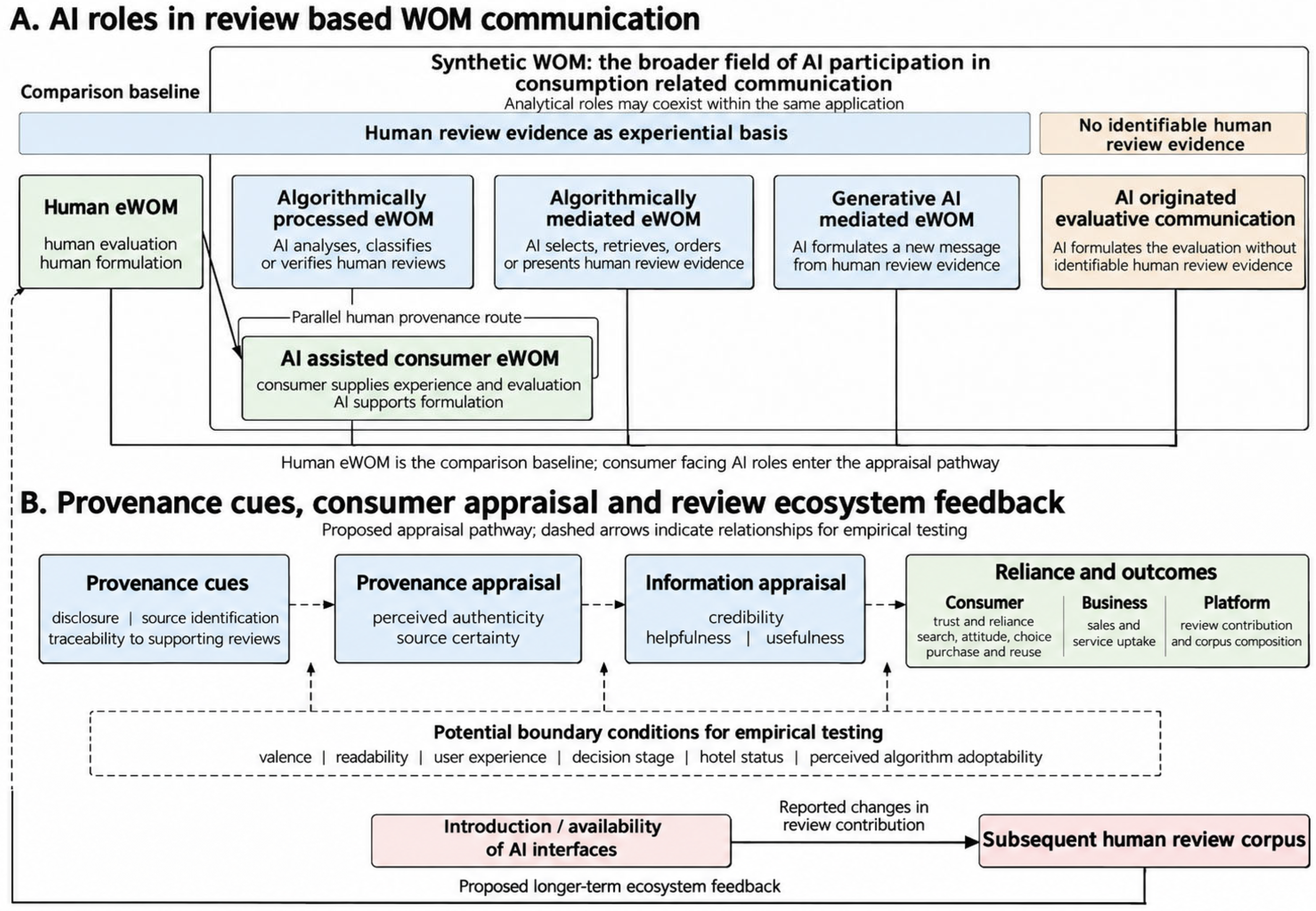

Disclaimer/Publisher’s Note: The statements, opinions and data contained in all publications are solely those of the individual author(s) and contributor(s) and not of MDPI and/or the editor(s). MDPI and/or the editor(s) disclaim responsibility for any injury to people or property resulting from any ideas, methods, instructions or products referred to in the content. |
© 2026 by the author. Licensee MDPI, Basel, Switzerland. This article is an open access article distributed under the terms and conditions of the Creative Commons Attribution (CC BY) license.