


Abstract
As entertainment-based virtual idols increasingly become brand endorsers, understanding how consumers’ prior familiarity with their original content relates to advertising responses has become important. This study examines the relationships among content familiarity, physical attractiveness, identification, brand–model congruence, and ad attitude, and their connections with purchase intention toward McDonald’s products and positive WOM intention toward the advertised products. A survey was conducted with 240 South Korean university students using advertising for the K-pop Demon Hunters–McDonald’s collaboration featuring HUNTR/X and Saja Boys. Structural equation modeling showed that content familiarity was positively associated with identification, but its direct paths to brand–model congruence and ad attitude were nonsignificant. Physical attractiveness was positively associated with identification, brand–model congruence, and ad attitude, while identification was positively associated with both brand–model congruence and ad attitude. Brand–model congruence was positively associated with ad attitude, but its direct paths to both behavioral intentions were nonsignificant; ad attitude was positively associated with both intentions. Bootstrap analyses identified significant positive specific indirect effects of content familiarity on ad attitude through identification and through the sequential identification–brand–model congruence pathway, but not through brand–model congruence alone. All three corresponding indirect effects of physical attractiveness were positive and significant. Identification was also indirectly associated with ad attitude through brand–model congruence, which had significant indirect effects on both behavioral intentions through ad attitude. These findings highlight identification as a psychological link between prior content familiarity and advertising evaluations. They provide a contextual extension of established endorsement relationships to entertainment-origin virtual idols in a single commercial pairing. Ad attitude plays an important role in linking perceived congruence to purchase and positive WOM intentions.
1. Introduction
Advances in computer-generated imagery and AI-enabled content production, together with the growth of virtual entertainment, have expanded the use of digitally created characters in marketing communication [1]. Virtual influencers, in particular, have attracted increasing attention as non-human endorsers capable of performing promotional and social roles similar to those of human influencers. Existing research has examined virtual influencers in relation to anthropomorphism, authenticity, attractiveness, credibility, parasocial relationships, and endorsement effectiveness [2]. However, virtual entities used in advertising are increasingly diverse, and their identities and relationships with audiences can be established in different ways.
Virtual idols represent a distinctive form of digitally constructed endorser. Like virtual influencers, virtual idols can participate in promotional activities and brand collaborations, while their public roles and symbolic appeal also resemble those of human idols and celebrities [3]. Some virtual idols further originate as fictional characters in films, animation, games, or other entertainment content before appearing in advertising. Audiences may therefore become familiar with these characters and accumulate knowledge and associations concerning them before encountering them as commercial endorsers. Research on virtual entertainers similarly shows that digitally represented entertainment figures can develop distinctive personas and audience communities while participating in sponsorships, collaborations, and other commercial activities [4].
This characteristic raises a question about how prior entertainment experience becomes relevant to the evaluation of virtual idols as brand endorsers. Media-character research explains how audiences understand and share fictional characters’ perspectives, goals, and emotions [5,6], while endorsement research links identification with an endorser to advertising effectiveness [7]. Research on virtual idols has also examined parasocial interaction in relation to brand attitudes and purchase intention [3]. Building on these accounts, the present study examines how prior familiarity with an entertainment property relates to commercial evaluations, both directly and through identification with its fictional performers during advertising exposure. It further considers how this identification relates to judgments of the performers’ compatibility with the advertised brand. The theoretical question concerns how knowledge acquired through entertainment becomes relevant to a particular commercial pairing, with identification and perceived congruence specifying psychological engagement and commercial compatibility within this process.
Content familiarity and physical attractiveness may be particularly important antecedents in this process. Familiarity with entertainment content may provide access to character-related knowledge that facilitates identification [5], although property-level familiarity is distinct from knowledge of individual characters. Prior familiarity may also provide richer associations through which consumers evaluate the character, the brand collaboration, and the advertisement. Physical attractiveness, meanwhile, represents a salient source characteristic of digitally created endorsers whose visual appearance constitutes an important component of their identity. Previous studies have demonstrated that attractiveness can shape identification, endorsement evaluations, and consumer responses in influencer and virtual-idol contexts [3,7,8]. Together, these antecedents represent prior familiarity with the entertainment property and evaluations of the virtual idols’ physical appearance during advertising exposure. Identification captures character understanding and perspective taking, while brand–model congruence concerns the perceived compatibility between the performers and the advertised brand.
Endorsement research has long demonstrated the importance of such compatibility for advertising effectiveness [9,10]. Research on virtual influencers has also examined different forms of congruence in relation to advertising responses. Kim and Park [8], for example, examined product–endorser fit in virtual-influencer advertising, while Cho and Jun [11] investigated ideal self-image and issue congruence in virtual-influencer public service advertising. The relevance of congruence to advertising responses also raises the question of how consumers form these compatibility judgments. The present study therefore examines how content familiarity, physical attractiveness, and identification relate to perceived compatibility between virtual idols and a brand, and how these judgments connect with ad attitude and behavioral intentions.
For virtual idols with established identities, identification may play an important role in this process. Stronger identification may be associated with greater salience of the virtual idol’s identity, image, and associated meanings and with consumers’ evaluations of whether the idol represents an appropriate match for a brand. Brand–model congruence may therefore be understood not only as an antecedent of advertising effectiveness but also as an evaluation associated with consumers’ perceptions of and psychological engagement with the virtual idol. Examining identification and brand–model congruence together can thus provide an integrated account of advertising responses to virtual idols in a particular commercial pairing.
The collaboration between K-pop Demon Hunters and McDonald’s provides a relevant context for examining these relationships. The case combines fictional idol-group identities established through entertainment with their appearance in a branded fan-signing and meal-promotion setting. It therefore offers a context for examining how engagement with entertainment-origin performers relates to evaluations of their commercial pairing. Using this context, the present study examines the associations of prior content familiarity and perceived physical attractiveness with identification, brand–model congruence, and ad attitude, and their connections with purchase intention toward McDonald’s products and positive WOM intention toward the advertised products.
This study provides a contextual extension of established endorsement relationships to entertainment-origin virtual idols. First, it connects the correlates of perceived brand–model congruence with its relevance to advertising responses by examining how physical attractiveness and identification relate to congruence, and how congruence is indirectly associated with purchase and WOM intentions through ad attitude. Second, it examines identification during advertising exposure as character understanding and perspective taking in relation to prior content experience and evaluations of fictional performers in a commercial role. Third, it refines expectations concerning familiarity and congruence by distinguishing prior knowledge from its evaluative relevance and by considering direct and indirect associations separately. These contributions clarify how entertainment-based knowledge, identification, and perceived brand–model congruence relate to responses to virtual idols as brand endorsers.
2. Theoretical Background and Hypotheses
2.1. Virtual Idols as Advertising Endorsers
Virtual endorsers encompass a diverse range of digitally constructed personas. Virtual influencers, for example, are generally understood as digital personas created through computer-generated imagery and/or AI that produce content and engage audiences on social media and other digital platforms [1]. Existing research has examined virtual influencers in relation to anthropomorphism, authenticity, credibility, attractiveness, parasocial relationships, and congruence [2]. However, virtual entities differ in how their identities are created, how they engage audiences, and how they participate in commercial activities. Tan and Greene [4], for example, distinguish virtual entertainers from the human-like virtual influencers commonly examined in marketing research and show that virtual entertainers can develop distinctive personas through entertainment activities while participating in sponsorships, collaborations, merchandising, and other commercial activities.
Yu et al. [3] define virtual idols through three elements: digital existence, anthropomorphic appearance, and engagement in idol activities. HUNTR/X and Saja Boys are examined here as entertainment-origin fictional virtual-idol groups. They have digitally represented human-like appearances, identifiable group and member identities, and performer roles expressed through singing and choreography in the original entertainment content. Their idol identities also appear in the campaign’s fan-signing scenario and group-specific meal presentations. Classification therefore rests on their represented performer roles and activities, rather than animation or popularity alone.
Public reception further illustrates why these groups warrant attention as fictional idols. YouTube documented fan-created song covers, dance trends, and artwork around K-pop Demon Hunters, reflecting engagement with its fictional performers beyond the film [12]. Such participation resembles established forms of idol fandom. In research on human idols, Lazore’s [13] analysis of BTS explains how transmedia storytelling and the Bangtan Universe create opportunities for audience interpretation and participation. K-pop Demon Hunters brings idol-group identities and participatory fandom into a setting in which the performers are fictional digital characters.
This study therefore focuses on fictional virtual-idol performers moving from entertainment into advertising. The terms used here describe related aspects of these performers: “fictional character” identifies their origin in narrative entertainment, “virtual idol” identifies their digital performer identity and engagement in idol activities [3], and “virtual influencer” emphasizes content creation, audience engagement, and social influence through digital platforms [1]. These categories can overlap, as illustrated by idol-oriented archetypes within the virtual-entertainer literature [4]. Character licensing, merchandising, and entertainment–brand co-promotion describe the commercial arrangement through which the performers appear. Within this setting, the present study examines how familiarity with their source entertainment property and evaluations of their advertising appearance relate to perceived commercial fit and ad attitude.
Meaning-transfer theory provides the organizing perspective for this question. McCracken [14] explains endorsement as a process through which culturally constituted meanings associated with an endorser become available to a product through advertising. For entertainment-origin virtual idols, content familiarity supplies previously acquired knowledge and associations, while physical attractiveness provides a visual basis for evaluating the represented performers. Processing fluency explains how prior familiarity can facilitate recognition and interpretation [15]; identification concerns engagement with the characters’ perspectives [5]; and schema congruity and the match-up perspective explain judgments about their compatibility with the brand [9,10,16]. Together, these perspectives organize the proposed paths from prior content experience and visual evaluation to identification, perceived brand–model congruence, and ad attitude.
Content familiarity and physical attractiveness are specified as two separately justified antecedents. Content familiarity captures prior experience with the entertainment property from which the idols’ identities originate. Physical attractiveness captures evaluations of their designed visual appearance, a central characteristic through which virtual idols are presented to audiences [3,4]. Their inclusion addresses two important inputs to virtual-idol advertising responses: consumers’ existing knowledge of the content and their evaluation of the endorsers’ appearance.
The proposed model begins with prior familiarity with the entertainment property and evaluations of the virtual idols’ physical appearance. Familiarity is expected to be associated with the accessibility of character-related knowledge during advertising exposure, providing a basis for understanding and sharing the idols’ perspectives. Identification is expected to be associated with judgments of the idols’ compatibility with the advertised brand and evaluations of the advertisement. Perceived congruence is also proposed to relate to ad attitude, while congruence and ad attitude are hypothesized to relate to purchase and WOM intentions. Physical attractiveness is additionally hypothesized to relate to identification, congruence, and ad attitude, and the model also tests direct paths from content familiarity to congruence and ad attitude. This model organizes the hypotheses around how prior knowledge and source evaluations connect with character understanding and perspective taking, commercial fit, and advertising responses.
2.2. Content Familiarity and Physical Attractiveness as Antecedents
Source-attractiveness research identifies familiarity and attractiveness among the characteristics relevant to message effectiveness [17]. Research on athlete endorsement has also examined familiarity alongside multiple dimensions of endorser appeal within the same advertising-response models [18]. Drawing on this perspective, the present study examines content familiarity and physical attractiveness as antecedents representing prior entertainment experience and evaluations of the idols’ designed appearance, respectively.
2.2.1. Content Familiarity
Familiarity generally refers to the knowledge and experience consumers accumulate through prior encounters with a target [19]. In the present study, content familiarity refers to consumers’ knowledge of and experience with K-pop Demon Hunters as an entertainment property. It is conceptually distinct from familiarity with particular characters, familiarity with the advertising campaign, and involvement in fandom activities. These forms of prior engagement may overlap, but knowledge of the entertainment property does not necessarily imply detailed knowledge of each character or strong emotional attachment. Nevertheless, content familiarity can provide contextual knowledge and associations that consumers draw upon when characters from that property appear in advertising. Within the meaning-transfer perspective, such knowledge provides a basis for interpreting the meanings that established entertainment figures bring to their commercial roles [14].
Content familiarity is expected to be positively associated with identification with the virtual idols. Identification involves adopting a character’s perspective and sharing the character’s thoughts and feelings [5,20]. Cohen [5] proposed that greater exposure to a character can make it easier for viewers to imagine being that character. Although this proposition concerns character familiarity, it provides a theoretical basis for considering how broader entertainment experience may facilitate perspective taking. Knowledge of the original content can supply information about the situations, relationships, and motivations that give meaning to the characters’ behavior.
When these characters subsequently appear as endorsers, viewers may use this contextual knowledge to interpret their actions and emotional expressions in the advertisement. Because their commercial appearances draw on identities established in the original content, prior content experience may help viewers approach the advertising situation from the characters’ perspectives and share their feelings. Content familiarity is therefore expected to be positively associated with the character understanding and perspective taking involved in identification with the advertised virtual idols.
H1.
Content familiarity will be positively associated with identification with the virtual idol.
Content familiarity may also be positively associated with brand–model congruence. Schema-congruity research explains how consumers process new information in relation to existing knowledge structures [16]. Applied to entertainment-based endorsement, prior content knowledge can make relevant images and symbolic associations more accessible when consumers evaluate a character’s connection with a brand. Meaning-transfer theory likewise emphasizes that endorsement draws on meanings already associated with the endorser [14]. Familiarity with the original content may thus help consumers recognize the meanings incorporated into a commercial collaboration and understand the basis of the pairing.
Research on marketing alliances provides support for the proposed relationship between familiarity and perceived compatibility. In a hotel co-branding context, Lin [21] examined brand familiarity as an antecedent of perceived brand fit. More directly, Rezaee Vessal et al. [22] found that greater cause familiarity was associated with more favorable evaluations of cause–brand fit. These studies suggest that familiarity with an alliance partner can contribute to evaluations of its compatibility with a commercial brand. Extending this reasoning to entertainment-based collaborations, familiarity with an entertainment property may provide consumers with contextual knowledge for interpreting its characters’ association with the advertised brand. Such knowledge may help consumers recognize meaningful connections between the characters’ established images and their commercial role, supporting perceptions of brand–model congruence.
In the present context, the collaboration connects the virtual idols’ established performer identities and K-pop imagery with a branded fan experience. Consumers familiar with K-pop Demon Hunters may more readily recognize how these content-related meanings are incorporated into the idols’ commercial appearance. This knowledge can make the connection between the entertainment property and the promoted experience more intelligible, providing a basis for perceiving the idols as appropriate representatives of the collaboration. Where a collaboration draws on recognizable meanings from the original content, greater familiarity is therefore expected to be positively associated with perceived brand–model congruence.
H2.
Content familiarity will be positively associated with brand–model congruence.
Content familiarity may further be associated with a favorable ad attitude through processing fluency. Processing fluency concerns the ease with which information is recognized and interpreted. Research demonstrates that facilitating perceptual or conceptual processing can promote favorable evaluations, with the positive experience of fluent processing contributing to these judgments [15]. A meta-analysis also supports a positive relationship between brand familiarity and attitude formation, while showing that its strength varies across advertising, product, and brand contexts [23].
Related evidence connects entertainment experience with subsequent advertising responses. More frequent viewing of a television program was associated with more favorable perceptions of its characters, which in turn contributed to favorable responses to the actors as endorsers and to their advertisements [24]. Although this relationship involved character evaluations, it demonstrates how experience with entertainment content can inform responses when associated figures enter an advertising context.
Extending the processing-fluency account to the present setting, consumers familiar with K-pop Demon Hunters may find the advertisement’s content-related imagery and references easier to recognize and interpret. Existing knowledge can help them connect these elements into a coherent advertising presentation, reducing the effort required to understand their meaning. The resulting ease of processing may itself provide a positive basis for evaluating the advertisement. Accordingly, content familiarity is expected to be associated with a more favorable ad attitude.
H3.
Content familiarity will be positively associated with ad attitude.
2.2.2. Physical Attractiveness
Physical attractiveness has long been regarded as an important source characteristic in advertising and endorsement research. It refers to the extent to which an endorser’s physical appearance is perceived as visually appealing or attractive. Previous studies have shown that physically attractive endorsers can generate favorable consumer responses and enhance endorsement effectiveness [9,25,26]. Physical attractiveness is particularly relevant to virtual idols because their appearance is deliberately designed as part of the idol persona. Yu et al. [3] found that physical attractiveness positively influenced parasocial interaction with virtual idols, which in turn positively influenced brand attitudes and purchase intentions. Research on virtual-influencer endorsement likewise identifies attractiveness as an important source characteristic shaping consumer responses [8]. These findings support examining visual appeal alongside psychological engagement in virtual-idol advertising.
Physical attractiveness is expected to be positively associated with identification with the virtual idol. Research on media characters suggests that character attributes, including physical attractiveness, can contribute to audiences’ psychological involvement with mediated figures [5]. More directly, Le and Hancer [27] found that the physical attractiveness of YouTube travel vloggers positively influenced viewers’ identification with them. Schouten et al. [7] similarly reported positive associations between endorser attractiveness and identification in influencer endorsement contexts. Taken together, these findings suggest that consumers are more likely to identify with virtual idols whom they perceive as physically attractive.
H4.
Physical attractiveness will be positively associated with identification with the virtual idol.
Physical attractiveness is also expected to be positively associated with perceived brand–model congruence. The source attractiveness model explains endorsement effectiveness in terms of source appeal, including physical appearance, likability, familiarity, and perceived similarity [28,29]. Associative learning theory provides a framework for connecting these source evaluations to the advertised brand–model relationship. Till and Busler [26] explain that endorsers and brands are represented within associative networks in memory, that evaluations form part of their association sets, and that repeated presentation together can connect these sets. Appearance evaluations may therefore constitute part of the endorser-related information consumers use when interpreting the advertised pairing.
Fleck et al. [28] and Torres et al. [29] explain that overall endorser attractiveness, reflecting a favorable affective evaluation of the endorser, can positively influence the cognitive evaluation of endorser–brand congruence. Their research also indicates that endorser attractiveness and perceived congruence each contribute to endorsement effectiveness. These findings support treating attractiveness and congruence as distinct but related evaluations, with attractiveness contributing to the formation of perceived congruence.
Direct empirical evidence supports this relationship. Till and Busler [26] found that physically attractive endorsers received higher fit and appropriateness ratings for both cologne and a pen. This finding suggests that physical attractiveness can contribute to perceived fit even when the endorsed product is unrelated to physical appearance. Fink et al. [30] identified attractiveness as a positive antecedent of perceived athlete–event fit. Torres et al. [29] similarly reported a positive path from overall influencer attractiveness, including physical attractiveness, to influencer–brand congruence.
In the present campaign, Korean-inspired Ramyeon McShaker Fries and limited-edition photocards prominently featuring the virtual idol groups HUNTR/X and the Saja Boys connect McDonald’s products with K-pop cultural imagery and a fan-oriented consumption experience [31]. These designed pairing cues provide a context for consumers’ subjective judgments of congruence. Because the idols’ visual images form part of the promoted experience, favorable appearance evaluations may be associated with greater perceived suitability of the idols as representatives of McDonald’s within this collaboration. Consumers who perceive the idols as more physically attractive are therefore expected to perceive greater brand–model congruence.
H5.
Physical attractiveness will be positively associated with brand–model congruence.
Physical attractiveness may further be directly associated with ad attitude. Source-attractiveness research has consistently shown that attractive endorsers can enhance consumers’ evaluations of advertising. Kahle and Homer [25] demonstrated that the physical attractiveness of a celebrity endorser influenced advertising-related attitudes, while Kamins [9] found that physically attractive celebrity endorsers produced more favorable advertising evaluations, particularly when their image was appropriate for the endorsed product. Similar findings have been reported in influencer advertising. Schouten et al. [7] found that perceived endorser attractiveness was positively associated with ad attitude across influencer endorsement contexts. Therefore, consumers who perceive a virtual idol as more physically attractive are expected to evaluate an advertisement featuring that idol more favorably.
H6.
Physical attractiveness will be positively associated with ad attitude.
2.3. Identification as a Psychological Mechanism
Identification concerns audience members’ psychological engagement with a character’s perspective, goals, and emotions [5]. Drawing on Tal-Or and Cohen [20], the present study focuses on identification as character understanding and perspective taking during advertising exposure. These processes include understanding the characters, interpreting events from their perspective, sharing their feelings, and understanding their thoughts and motives.
Idol fandom makes psychological engagement with performers particularly relevant to endorsement. Yu et al. [3] demonstrated that engagement with virtual idols through parasocial interaction positively influenced brand attitudes and purchase intentions. The present study focuses on identification during advertising exposure to examine how viewers’ character understanding and perspective taking with the fictional idols help explain their responses when those idols appear as endorsers.
Identification is expected to be positively associated with perceived brand–model congruence. Silva and Veríssimo [32] found that fans’ team identification positively influenced perceived sponsor–team congruence and attitudes toward sponsors, and that congruence positively influenced sponsor attitudes. Bizen and Tsuji [33] likewise found that employees’ identification with a sponsored athlete had a significant positive effect on perceived sponsor fit. George and Ranjith [34] also reported a positive effect of team identification on team–sponsor fit. These findings support the proposed direction from identification with an endorsed or sponsored entity to judgments of its compatibility with a commercial partner.
Applied to virtual-idol endorsement, taking the characters’ perspectives may help viewers interpret their actions in the advertisement and understand their role in presenting the brand’s products. This engagement provides a basis for evaluating whether the commercial pairing is consistent with the idol personas. The proposed structural model therefore specifies identification before perceived brand–model congruence on theoretical grounds informed by prior sponsorship research.
H7.
Identification with the virtual idol will be positively associated with brand–model congruence.
Identification during advertising exposure is expected to be associated with a favorable ad attitude. Viewers’ understanding and sharing of the virtual idols’ perspectives in the advertisement can provide a basis for evaluating that advertisement. Cohen [5] suggested that identification can enhance persuasive effects by increasing audiences’ involvement with mediated content. More directly, Schouten et al. [7] found positive associations between identification with endorsers and ad attitude across endorsement contexts and showed that identification contributed to differences in advertising effectiveness. Carlson et al. [35] similarly demonstrated that stronger consumer–endorser identification enhanced endorsement effectiveness across different endorser–brand pairings.
In the present study, identification concerns character understanding and perspective taking during advertising exposure. Stronger identification with the virtual idols in this setting is therefore expected to be associated with a more favorable ad attitude.
H8.
Identification with the virtual idol will be positively associated with ad attitude.
2.4. Brand–Model Congruence and Advertising Effectiveness
In endorsement research, congruence, fit, and match-up refer to the same underlying concept of compatibility between an endorser and an endorsed brand or product [10,11]. Accordingly, expressions such as brand–model congruence, endorser–brand fit, and product–endorser fit represent different labels used by researchers to describe this common compatibility concept. The match-up hypothesis further proposes that endorsement effectiveness increases when the endorser’s characteristics are compatible with those of the endorsed brand or product [9,10].
Brand–model congruence refers to the extent to which the image, characteristics, and meanings associated with a virtual idol are compatible with those associated with the advertised brand. In the present study, this compatibility is understood as consumers’ overall perception of the virtual idol–brand pairing. This perspective is consistent with meaning-transfer theory, which suggests that endorsers possess symbolic meanings derived from their identities and images and that these meanings can be transferred to brands through endorsement [14]. Brand–model congruence is particularly relevant to virtual idols because their identities and symbolic meanings may already be established through entertainment content. When these meanings correspond with those of a brand, consumers are more likely to regard the collaboration as coherent and as a natural extension of the virtual idol’s established identity.
One important variable associated with brand–model congruence is ad attitude. Prior endorsement research indicates that a well-matched endorser-brand pairing can improve advertising evaluations. Paul and Bhakar [36], for example, found that endorser-brand image congruence positively influenced ad attitude. Lee et al. [37] similarly showed that Instagram native advertisements featuring good fit between micro-celebrities and products generated more favorable ad attitudes. Phua et al. [38] also found that high product-celebrity image congruence produced more favorable attitudes toward celebrity-endorsed Instagram advertisements. Accordingly, a virtual idol-brand collaboration exhibiting greater congruence should be perceived as more coherent and appropriate and be associated with a more favorable ad attitude.
H9.
Brand–model congruence will be positively associated with ad attitude.
Brand–model congruence may also be positively associated with purchase intention. A compatible pairing may be associated with perceptions of a more understandable and persuasive endorsement and greater willingness among consumers to respond behaviorally to the advertised brand. Pradhan et al. [39] found that celebrity-brand personality congruence positively influenced consumers’ purchase intention. Lee and Koo [40] likewise demonstrated that athlete endorser-product congruence played an important role in determining purchase intention. Phua et al. [38] further showed that greater product-celebrity image congruence increased consumers’ behavioral intentions toward the endorsed product. Together, these findings indicate that congruence can strengthen consumers’ intentions to act favorably toward an endorsed offering. Thus, when a virtual idol’s established image and characteristics are compatible with those of the advertised brand, consumers should perceive the endorsement as more appropriate and persuasive and report greater willingness to purchase products from the advertised brand.
H10.
Brand–model congruence will be positively associated with purchase intention.
Brand–model congruence is also expected to be positively associated with WOM intention. In the present study, WOM intention refers to consumers’ willingness to say positive things about the McDonald’s products featured in the advertisement, recommend them, and encourage others to try them. This definition follows the recommendation-oriented approach to WOM used by Maduku et al. [41].
Previous studies provide evidence that endorser–product congruence can encourage favorable consumer communication. Lee et al. [37] found that a good fit between Instagram micro-celebrities and endorsed products increased eWOM intentions toward the advertising post, including intentions to share and recommend it. Similarly, Phua et al. [38] found that higher product–celebrity image congruence increased consumers’ intentions to spread eWOM in response to celebrity-endorsed e-cigarette advertisements on Instagram.
Building on these findings, the present study proposes that perceived compatibility between virtual idols and the advertised brand may be associated with positive recommendations of the featured menu items. A collaboration that is consistent with the idols’ established images may be associated with perceptions of the promoted offerings as more appropriate and meaningful within the collaboration, providing consumers with a favorable basis for recommending them to others. Accordingly, the following hypothesis is proposed:
H11.
Brand–model congruence will be positively associated with WOM intention.
2.5. Ad Attitude and Behavioral Intentions
Ad attitude refers to consumers’ overall favorable or unfavorable evaluation of an advertisement and is widely recognized as a central indicator of advertising effectiveness. Favorable ad attitude may be associated with subsequent responses to the advertised brand and stronger behavioral intentions among consumers. MacKenzie et al. [42] demonstrated that ad attitude plays an important mediating role in the process through which advertising influences brand attitudes and purchase intentions. Brown and Stayman [43], in their meta-analysis, likewise showed that ad attitude is significantly associated with behavioral intentions. More recent research has confirmed this relationship in digital advertising contexts. Lee et al. [44] found that advertising attitude contributed to purchase intention in smartphone advertising, while Chen et al. [45] identified advertising attitude as an important predictor of purchase intention in social media advertising.
Accordingly, consumers who evaluate an advertisement featuring a virtual idol more favorably should exhibit stronger intentions to purchase products from the advertised brand.
H12.
Ad attitude will be positively associated with purchase intention.
Ad attitude is also expected to be positively associated with WOM intention. Previous research shows that favorable advertising evaluations can encourage consumers to communicate advertising messages to others. Huang et al. [46] found that attitude toward viral video advertisements was a major predictor of video sharing. Ketelaar et al. [47] similarly showed that positive attitudes toward advertisements predicted actual pass-on behavior in social network advertising campaigns. Mora and Vila [48] found that favorable attitudes toward a cause-related viral advertisement increased consumers’ intentions to share the advertising video. Shehu et al. [49] further demonstrated that consumers’ overall liking of online video advertisements contributed to their intentions to share them.
Building on these findings, the present study proposes that favorable advertising evaluations may also be associated with positive recommendations of the advertised offerings. A favorable evaluation of the virtual idol advertisement may be associated with positive impressions of the featured menu items and an evaluative basis for speaking favorably about them. Consumers who develop more favorable ad attitudes are therefore expected to express stronger intentions to recommend these items and encourage others to try them. Accordingly, the following hypothesis is proposed:
H13.
Ad attitude will be positively associated with WOM intention.
Based on the preceding hypotheses, Figure 1 presents the proposed research model.
Figure 1.
Research model. Note: Panel (a) shows the 13 hypothesized paths; panel (b) shows the five control paths from McDonald’s familiarity. ID = Identification; BMC = Brand–model congruence; AA = Ad attitude; PI = Purchase intention; WOM = word-of-mouth intention. Constructs repeated in panel (b) are the same constructs shown in panel (a). Measurement indicators and covariances among exogenous constructs are omitted for clarity. Solid arrows in panel (a) denote hypothesized paths; dashed arrows in panel (b) denote control paths.
3. Materials and Methods
3.1. Participants and Procedure
This study examined the McDonald’s collaboration campaign featuring HUNTR/X and Saja Boys, the fictional virtual-idol groups from K-pop Demon Hunters. Data were collected from 3 to 8 April 2026 during scheduled teaching time in three courses related to cultural content taught by the researcher at one university in South Korea. The design was a single-session observational survey with standardized advertising exposure. Content familiarity and McDonald’s familiarity were measured before exposure; the other constructs were measured immediately afterward.
University students were selected because young consumers constitute a particularly relevant audience for McDonald’s. Recent consumer data from South Korea indicate that consumers in their 20s and 30s accounted for 51.2% of estimated card spending at McDonald’s [50]. McDonald’s also showed substantial growth in estimated spending among Gen Z consumers [51], and Korean Gen Z consumers associated the brand particularly with a 20s image [52]. Internationally, McDonald’s ranked first among quick-service restaurant brands in purchase intention among U.S. Gen Z consumers [53]. Participants were recruited from the researcher’s three courses at a four-year university in South Korea. Of the 260 students informed about the survey, 240 consented and completed it, representing 92.3% of those invited. The remaining 20 students had no recorded consent and did not participate in the survey. No additional completed responses were excluded. All 240 analyzed responses contained answers to every measurement item; so, no missing-value imputation was required. The young convenience sample was relevant to the study context, but the market indicators above do not establish population representativeness. The final sample consisted of 240 students, including 74 men (30.8%) and 166 women (69.2%). Participants ranged in age from 18 to 32 years (M = 20.34, SD = 2.13), and 98.8% were aged 25 or younger.
The researcher personally supervised data collection in all three courses using the same instructions, advertising stimulus, and procedural sequence. Given this in-person, supervised setting, no separate attention-check items were included in the questionnaire. Before participation, respondents received an electronic consent form describing the study purpose and procedures, potential risks and benefits, privacy protections, and their right to withdraw at any time. Only those who consented participated. Responses were anonymous, and no personally identifiable or sensitive information was collected. Participation was voluntary and no monetary or other incentives were provided. The information sheet explicitly stated that choosing whether to participate would not affect students’ grades. The anonymous responses could not be linked to the three courses. Participants first answered demographic questions and questions about their existing familiarity with McDonald’s and K-pop Demon Hunters. For the familiarity questions, they were instructed to report their usual, preexisting views. All participants then viewed the same advertising material once on a large classroom screen. Immediately afterward, they completed the remaining online questionnaire on their own computers or mobile devices.
The stimulus comprised five official advertisements released on YouTube for the collaboration. To present the campaign materials together, the five clips were joined into one continuous video while preserving the content of each clip. The total running time was 1 min and 50 s. The audio was in English, with Korean subtitles displayed using YouTube’s automatic translation function. No stimulus pretest was conducted.
One clip showed the two virtual-idol groups at a joint fan-signing event presenting the Saja Boys Breakfast Meal and the HUNTR/X Meal. Two clips featured each group separately introducing its respective meal, while the remaining two clips presented images of meal sets and promotional materials featuring the groups’ photos, accompanied by voice-over narration. The two groups received approximately balanced coverage. The McDonald’s and K-pop Demon Hunters logos appeared together. Spoken prompts invited viewers to try the promotional meals at McDonald’s restaurants, without a separate written call to action. The characters briefly hummed the phrase “my little soda pop,” and the McDonald’s sonic jingle appeared at the end.
Netflix and McDonald’s jointly announced the collaboration through their official websites and social media on 25 March 2026 (Korea Standard Time); sales of the promotional meals began at U.S. McDonald’s restaurants on 31 March [31]. At the time of the survey, the campaign was being run in the United States and had not been locally launched in South Korea. The advertisements did not specify that the meals were available only in the United States, and participants received no separate information about their availability in the United States or lack of availability in South Korea. Prior viewing of the advertisements was considered unlikely and was not measured or controlled. Nevertheless, Korean news coverage could have created awareness of the collaboration, and participants who deliberately searched for the U.S. advertisements online could have viewed them before the survey.
The questionnaire repeatedly informed participants that the focal characters, referred to as “the virtual idols,” collectively denoted HUNTR/X and Saja Boys. The joint campaign presented both groups and their respective meals under the McDonald’s and K-pop Demon Hunters logos. Accordingly, the evaluation target was the groups’ overall presentation within the campaign, rather than the characteristics of a particular group or individual member. No separate ratings of the two groups were collected.
3.2. Measures
All constructs were measured using multi-item scales adapted from previously validated measures, with wording modified as necessary to fit the context of the K-pop Demon Hunters–McDonald’s collaboration. Content familiarity with K-pop Demon Hunters and McDonald’s familiarity were each measured using three items adapted from Kent and Allen [19]. Physical attractiveness was measured using the three items retained and validated by Lee and Watkins [54], with the referent adapted to the virtual idols. Identification was measured using five items adapted from Tal-Or and Cohen [20] to assess character understanding and perspective taking during advertising exposure. The five items were analyzed as a single identification construct. Four items concerned understanding the characters’ perspectives, thoughts, and behavior, while one explicitly assessed sharing their emotions. Brand–model congruence was assessed using four items adapted from Choi and Rifon [55]. Ad attitude was measured using four items adapted from Holbrook and Batra [56], and purchase intention toward McDonald’s products generally using three items adapted from Stafford et al. [57]. WOM intention toward the McDonald’s products featured in the advertisement was measured using three items adapted from Maduku et al. [41]. McDonald’s familiarity was included as a control variable to account for consumers’ preexisting knowledge of and experience with the advertised brand. All items were rated on seven-point Likert scales ranging from 1 (strongly disagree) to 7 (strongly agree). The questionnaire was administered in Korean. Table A1 provides the Korean items alongside their English versions and sources.
3.3. Data Analysis
The data were analyzed using SPSS 18.0 and AMOS 20.0. SPSS was used to calculate descriptive statistics, Cronbach’s alpha coefficients, and Pearson correlations among the study variables. AMOS was used to conduct confirmatory factor analysis (CFA) and structural equation modeling (SEM).
CFA was first conducted to evaluate the measurement model. Convergent validity was assessed using standardized factor loadings, composite reliability (CR), and average variance extracted (AVE), while discriminant validity was evaluated using the Fornell–Larcker criterion [58] and the heterotrait–monotrait ratio of correlations (HTMT) [59]. Model respecification was guided by modification indices together with the conceptual and wording similarity of items and was limited to residual covariances between items measuring the same construct. The final eight-factor measurement model was also compared with a single-factor CFA model in which all 28 items loaded on one factor. The same three residual covariances (ID4–ID5, BMC3–BMC4, and AA1–AA2) were freely estimated in both models. A limited supplementary correlational sensitivity analysis following Lindell and Whitney [60] was also conducted using Pearson correlations among the eight construct scores. The smallest positive correlation was used as a proxy for a common method component, and the analysis was repeated using the second-smallest positive correlation. Adjusted correlations were evaluated using two-tailed partial-correlation t tests with 237 degrees of freedom (N = 240).
SEM was subsequently conducted to test the hypothesized relationships among content familiarity, physical attractiveness, identification, brand–model congruence, ad attitude, purchase intention, and WOM intention. McDonald’s familiarity was included as a control variable predicting identification, brand–model congruence, ad attitude, purchase intention, and WOM intention. Prior brand knowledge and experience may influence endorsement evaluations and intentions to purchase or recommend products [61,62]. Model parameters were estimated using maximum likelihood estimation, treating the seven-point items as approximately continuous. Model fit was evaluated using χ2, χ2/df, the comparative fit index (CFI), Tucker–Lewis index (TLI), incremental fit index (IFI), and root mean square error of approximation (RMSEA), supplemented by 90% confidence intervals for RMSEA and the standardized root mean square residual (SRMR).
Direct-path significance was assessed using maximum-likelihood critical-ratio tests. Indirect effects implied by the structural model were examined using 5000 bootstrap resamples with bias-corrected 95% confidence intervals. Specific indirect effects were calculated as coefficient products using AMOS user-defined estimands. Confidence intervals were obtained for unstandardized and standardized indirect effects. In the sensitivity comparisons (Table A2), direct and indirect associations were evaluated using standardized estimates and their 95% BC intervals; intervals excluding zero indicated statistical significance.
Distributional and residual diagnostics, collinearity checks, and fixed-sample power analysis of the global exact-fit test at N = 240 [63] were conducted (Table A3). Supplementary comparisons examined measurement models combining pairs of identification, brand–model congruence, and ad attitude, and structural models reversing the identification–congruence or congruence–ad-attitude direction (Table A4). A further model added direct paths from content familiarity, physical attractiveness, and identification to both intentions. Sensitivity analyses removed the three residual covariances from the final model and assessed the eight distance-flagged observations through separate single-case exclusions and joint exclusion. The final model and the four sensitivity specifications used 5000 case-bootstrap resamples each to obtain standardized 95% bias-corrected intervals (Table A2).
4. Results
4.1. Measurement Model
An eight-factor CFA was conducted to assess the measurement properties of the study constructs. The initial measurement model demonstrated an acceptable fit to the data: χ2(322) = 766.445, p < 0.001, χ2/df = 2.380, CFI = 0.935, TLI = 0.924, IFI = 0.936, and RMSEA = 0.076, 90% CI [0.069, 0.083].
Inspection of the modification indices and item content indicated residual associations between items with closely overlapping wording and meaning. Accordingly, residual covariances were specified between the identification items (ID4 and ID5) assessing understanding of the virtual idols’ thoughts and behavioral motivations, between the brand–model congruence items (BMC3 and BMC4) assessing relatedness and match, and between the ad attitude items (AA1 and AA2) expressing favorable and positive evaluations of the advertisement. All residual covariances were specified within constructs; none was specified between different constructs. In the initial CFA, the corresponding modification indices were 23.073, 53.472, and 32.431, respectively; all three residual covariances in the final CFA were significant at p < 0.001 (Table A5, Panel B).
The revised measurement model demonstrated an improved fit: χ2(319) = 637.233, p < 0.001, χ2/df = 1.998, CFI = 0.954, TLI = 0.945, IFI = 0.954, RMSEA = 0.065, 90% CI [0.057, 0.072], and SRMR = 0.054. The revised model was therefore retained as the final measurement model. Standardized residual covariances ranged from −2.350 to 3.177; four of the 378 unique off-diagonal residuals exceeded |2.58| (Table A3, Panel A). The largest was for CF1–ID1 (3.177).
As shown in Table A5, Panel A, standardized factor loadings ranged from 0.585 to 0.972. All freely estimated unstandardized loadings were significant at p < 0.001. Composite reliability values reported in Table 1 ranged from 0.865 to 0.970, and AVE values ranged from 0.664 to 0.915. All CR values exceeded 0.70, and all AVE values exceeded 0.50, providing support for convergent validity.
Table 1.
Descriptive Statistics, Reliability, and Convergent Validity.
Discriminant validity was evaluated using the Fornell–Larcker criterion and HTMT. As shown in Table 2, the square root of the AVE for each construct exceeded its correlations with all other constructs, providing support for discriminant validity. HTMT values ranged from approximately 0.065 to 0.704 and were all below 0.85 [59]. The full HTMT matrix is reported in Table 3. Models combining identification with congruence, identification with ad attitude, or congruence with ad attitude fitted less well than the eight-factor model (χ2(326) = 1128.882, 1007.349, and 973.075; CFI = 0.883, 0.901, and 0.906, respectively; Table A4).
Table 2.
Construct Correlations and the Fornell–Larcker Criterion.
Table 3.
Heterotrait–Monotrait Ratios (HTMT).
Potential common method bias was further assessed using a single-factor CFA in which all measurement items were loaded onto one latent factor. The same three residual covariances as in the final eight-factor CFA were freely estimated in this model. The single-factor model demonstrated a substantially poorer fit, χ2(347) = 3903.881, χ2/df = 11.250, CFI = 0.483, TLI = 0.437, IFI = 0.486, and RMSEA = 0.207, than the final eight-factor measurement model. These results indicate that a single common factor did not adequately account for the observed measurement structure.
A limited supplementary correlational sensitivity analysis was conducted using the smallest positive correlation among the eight construct scores as the method-correlation proxy (r_M = 0.060, McDonald’s familiarity–physical attractiveness). All 13 correlations between the variable pairs corresponding to the hypothesized paths remained significant after adjustment (adjusted r = 0.231–0.637, all p < 0.001). Repeating the analysis with the second-smallest positive correlation (r_M = 0.072, content familiarity–purchase intention) yielded the same significance result (adjusted r = 0.221–0.632, all p < 0.001).
4.2. Structural Model and Hypothesis Testing
The final structural model yielded χ2(326) = 662.268, p < 0.001, χ2/df = 2.031, CFI = 0.951, TLI = 0.943, IFI = 0.952, RMSEA = 0.066, 90% CI [0.058, 0.073], and SRMR = 0.060. Figure 2 and Table 4 present the structural estimates. R2 was 0.383 for ID, 0.423 for BMC, 0.669 for AA, 0.339 for PI, and 0.461 for WOM.
Figure 2.
Results of the final structural model. Note: Values are standardized path coefficients. In panel (a), solid arrows indicate significant hypothesized paths and dashed arrows indicate nonsignificant hypothesized paths. Panel (b) shows the control paths separately. Significance symbols refer to the maximum-likelihood critical-ratio tests: * p < 0.05, ** p < 0.01, *** p < 0.001. R2 is shown within endogenous constructs. Dashed arrows in panel (b) distinguish the control paths and do not indicate significance.
Table 4.
Structural Path Estimates and Hypothesis Tests.
The alternative models reversing identification–congruence or congruence–ad-attitude were statistically equivalent to the final model (χ2(326) = 662.268 in each case; Table A4). Adding six direct paths from content familiarity, physical attractiveness, and identification to the two intentions yielded χ2(320) = 660.668 (conventional ML Δχ2(6) = 1.600, p = 0.953; Table A2); all six added paths had 95% BC intervals including zero.
Multivariate kurtosis was 135.289 (critical ratio = 25.567), indicating departure from multivariate normality. Bootstrap confidence intervals based on 5000 resamples therefore supplemented conventional maximum-likelihood inference. Mahalanobis-distance screening identified eight potential multivariate outliers at the 0.001 threshold; all 240 observations were retained in the primary analysis. Under separate single-case exclusions, the largest absolute change in a standardized structural coefficient was 0.035. Jointly excluding the eight observations (N = 232) preserved the significance pattern of the nine principal standardized indirect associations. (Table A2). For the final model, Table 5 summarizes these nine principal standardized indirect associations, and Table A6 provides the complete decomposition of model-implied specific indirect effects.
Table 5.
Indirect Effects and Bootstrap Confidence Intervals.
Standardized residual diagnostics identified nine of 378 unique off-diagonal residuals exceeding |2.58| (Table A3, Panel A). The largest residual remained CF1–WOM1 after excluding the eight flagged observations (3.538).
Across the five endogenous equations, VIF values ranged from 1.010 to 1.776, providing no indication of severe multicollinearity among the observed predictor scores. Detailed collinearity diagnostics are reported in Table A3, Panel B.
At N = 240, the fixed-sample power analysis indicated that the final measurement and structural models would have power of 0.803 and 0.811, respectively, to reject exact fit if the population RMSEA were 0.03. Thus, under the assumptions of the analysis, the sample provided approximately 80% power to detect a global departure from exact fit of this magnitude. Sensitivity was lower for a smaller departure corresponding to RMSEA = 0.02, with power of 0.322 and 0.327, respectively. Detailed power-analysis results are reported in Table A3, Panel C.
Next, the direct paths in the structural model were examined to assess the proposed hypotheses. Content familiarity had a significant positive path to identification (H1: β = 0.427, p < 0.001), but its paths to brand–model congruence and ad attitude were nonsignificant. Accordingly, H1 was supported, whereas H2 and H3 were not supported.
Physical attractiveness had significant positive paths to identification (H4: β = 0.266, p < 0.001), brand–model congruence (H5: β = 0.507, p < 0.001), and ad attitude (H6: β = 0.299, p < 0.001). Identification also had significant positive paths to brand–model congruence (H7: β = 0.312, p < 0.001) and ad attitude (H8: β = 0.343, p < 0.001). Thus, H4 through H8 were supported.
Brand–model congruence had a significant positive path to ad attitude (H9: β = 0.347, p < 0.001), but its direct paths to purchase intention and WOM intention were nonsignificant. Ad attitude had significant positive paths to purchase intention (H12: β = 0.246, p = 0.002) and WOM intention (H13: β = 0.541, p < 0.001). Overall, 9 of the 13 hypotheses were supported.
Regarding the control variable, McDonald’s familiarity had significant positive paths to identification (β = 0.146, p = 0.014), purchase intention (β = 0.458, p < 0.001), and WOM intention (β = 0.131, p = 0.014), but not to brand–model congruence or ad attitude. Standardized total indirect and total effects, with their bootstrap confidence intervals, are reported in Table A7.
Removing the three residual covariances from the final model reduced fit (χ2(329) = 792.580, CFI = 0.933, RMSEA = 0.077). The congruence–WOM coefficient changed from 0.149 to 0.165, while its 95% BC interval included zero in both specifications (final: [−0.031, 0.316]; without residual covariances: [−0.019, 0.336]). The interval patterns for the nine principal standardized indirect associations in Table 5 were unchanged (Table A2).
4.3. Indirect Effects
Table 5 reports nine exploratory specific indirect associations using 5000 usable bootstrap resamples; no samples were discarded because of singular covariance matrices or failure to obtain a solution. Content familiarity had significant positive indirect effects on ad attitude through identification (B = 0.118, β = 0.147, standardized 95% BC CI [0.078, 0.240]) and sequentially through identification and brand–model congruence (B = 0.037, β = 0.046, CI [0.020, 0.096]). Its indirect effect through brand–model congruence alone was nonsignificant.
All three specific indirect effects of physical attractiveness on ad attitude were positive and significant: through identification (B = 0.083, β = 0.091, standardized 95% BC CI [0.040, 0.163]), through brand–model congruence (B = 0.160, β = 0.176, CI [0.103, 0.274]), and sequentially through both constructs (B = 0.026, β = 0.029, CI [0.012, 0.062]). Identification also had a significant indirect effect on ad attitude through brand–model congruence (B = 0.121, β = 0.109, CI [0.053, 0.189]). Brand–model congruence had significant indirect effects through ad attitude on purchase intention (B = 0.098, β = 0.085, CI [0.027, 0.174]) and WOM intention (B = 0.174, β = 0.188, CI [0.112, 0.299]).
The total indirect effects of content familiarity and physical attractiveness on ad attitude remained significant (β = 0.151, 95% BC CI [0.053, 0.260], and β = 0.297, CI [0.198, 0.413], respectively). Of the nine specific indirect effects examined, eight were statistically significant. Only the indirect effect of content familiarity on ad attitude through brand–model congruence was nonsignificant.
5. Conclusions
5.1. Summary of Key Findings
This study examined advertising responses to entertainment-originated virtual idols in the K-pop Demon Hunters–McDonald’s collaboration. It assessed associations of content familiarity and physical attractiveness with identification, brand–model congruence, and ad attitude, together with their connections to purchase intention and WOM intention.
Content familiarity was positively associated with identification, while its direct paths to brand–model congruence and ad attitude were nonsignificant. Physical attractiveness was positively associated with identification, brand–model congruence, and ad attitude. Identification was positively associated with both brand–model congruence and ad attitude. The specific indirect effects of content familiarity on ad attitude were significant through identification and through the sequential identification–brand–model congruence pathway, whereas the route through brand–model congruence alone was nonsignificant. All three corresponding indirect effects of physical attractiveness were significant. Brand–model congruence had significant indirect effects on both behavioral intentions through ad attitude, but its direct paths to both intentions were nonsignificant after controlling for McDonald’s familiarity.
5.2. Theoretical Implications
This study offers a contextual extension of endorsement research to entertainment-origin virtual idols.
First, this study extends the congruence literature by examining the correlates of perceived brand–model congruence alongside its associations with advertising responses to entertainment-origin virtual idols. Previous virtual-influencer research has examined product–endorser fit as a condition shaping the effectiveness of endorser attractiveness [8]. The present study develops this perspective by examining how consumers’ evaluations of and engagement with virtual idols are associated with perceived fit, and how this judgment connects with advertising responses. Physical attractiveness and identification were positively associated with brand–model congruence, which was positively associated with ad attitude. These findings connect the evaluation of fictional performers with the evaluation of their commercial pairing, providing an integrated account of how established entertainment personas become relevant to brand endorsement.
The attractiveness–congruence relationship is consistent with research showing that favorable affective evaluations of endorsers can inform cognitive judgments of endorser–brand compatibility [28,29]. In virtual-idol collaborations, the performers’ visual imagery forms part of the entertainment appeal incorporated into the promoted consumption experience. Favorable appearance evaluations may therefore be associated with consumers’ perceptions that the idols are suitable representatives of the brand. This interpretation accommodates the affective halo discussed by Fleck et al. [28], through which appreciation of an endorser can influence perceived congruence. At the same time, attractiveness and congruence each remained positively associated with ad attitude in the structural model. Congruence also had significant indirect relationships with purchase and WOM intentions through ad attitude. Together, these findings position congruence as a judgment connecting consumers’ responses to the idols with their evaluation of the advertisement and their behavioral intentions. The contribution lies in connecting the correlates of perceived commercial fit with its relevance to advertising responses in an entertainment-origin virtual-idol pairing.
Second, the findings extend identification research by connecting prior entertainment experience with the evaluation of a fictional performer’s commercial role. Media research conceptualizes identification as taking a character’s perspective and sharing the character’s thoughts and emotions [5], while endorsement research has linked identification with advertising effectiveness [7]. The present study brings these perspectives together by examining character understanding and perspective taking during advertising exposure alongside familiarity with the entertainment content from which the virtual idols originate. Both content familiarity and physical attractiveness were positively associated with identification, and identification was positively associated with ad attitude. These findings suggest that prior content knowledge and visual evaluations are relevant to advertising responses through viewers’ psychological engagement with the fictional performers.
The relationship between identification and congruence further specifies the commercial relevance of this engagement. Sponsorship research has shown that identification with a sports team can contribute to perceived compatibility between the team and its sponsor [32]. The present findings extend the examination of this relationship to perspective taking with fictional idols. Identification was associated with ad attitude both directly and indirectly through brand–model congruence, and the sequential pathway from content familiarity through identification and congruence to ad attitude was significant. A plausible interpretation is that viewers who understand and share the idols’ thoughts and feelings can more readily interpret their participation in the advertisement and evaluate their association with the brand. These associations connect character understanding and perspective taking with evaluations of a particular commercial pairing within the broader meaning-transfer perspective [14].
Finally, this study extends familiarity research by examining content familiarity alongside identification and perceived brand–model congruence in relation to ad attitude. Previous research has associated brand familiarity with favorable attitude formation [23] and linked cause familiarity with favorable evaluations of cause–brand fit [22]. In the present model, however, the direct relationships of content familiarity with brand–model congruence and ad attitude were nonsignificant. One explanation is that greater familiarity is associated with more knowledge available for interpreting the idols without that knowledge necessarily being favorable or relevant to a particular brand relationship. Meaning-transfer theory emphasizes the cultural meanings associated with an endorser and their connection with the endorsed product [14]. From this perspective, knowing more about an entertainment property does not necessarily imply that its characters’ meanings correspond more closely with the advertised brand. The positive indirect associations through identification and through the identification–congruence pathway suggest that character understanding and perceived brand–model congruence help explain how prior content knowledge relates to ad attitude.
The findings further suggest that ad attitude helps explain how brand–model congruence relates to behavioral intentions in virtual-idol advertising. Although the direct paths from congruence to purchase and WOM intentions were nonsignificant, its indirect effects through ad attitude were significant for both outcomes. Conceptually, congruence reflects whether consumers perceive the idol and brand as a suitable match, whereas ad attitude captures their overall favorable or unfavorable evaluation of the advertisement. The results suggest that perceived compatibility may be associated with this broader advertising evaluation, through which it is associated with willingness to purchase or recommend. This interpretation is consistent with Bergkvist et al. [64], who found that attitude toward an endorsement mediated the relationship between celebrity–brand fit and brand attitude. The present study extends this evaluative perspective to entertainment-origin virtual idols by estimating indirect associations between perceived fit and purchase and WOM intentions through ad attitude. Its theoretical contribution is to clarify the role of advertising evaluation in connecting the perceived suitability of an entertainment persona as a brand endorser with consumers’ behavioral intentions.
5.3. Practical Implications
The findings provide several practical implications for brands and content companies considering entertainment-origin virtual idols as advertising endorsers, particularly when evaluating prospective collaborations and advertising executions.
First, marketers can assess physical attractiveness and brand–model congruence together when evaluating a proposed collaboration. Physical attractiveness was positively associated with perceived congruence, and both attractiveness and congruence were positively associated with ad attitude. Audience pretests can therefore examine how visually appealing consumers find the idols and how appropriate they perceive the idols to be as representatives of the brand. These assessments provide complementary information about the appeal of the performers and the perceived suitability of the commercial pairing, helping brands and content companies evaluate collaborations from the intended audience’s perspective.
Second, the findings suggest including identification in the evaluation of advertisements featuring established fictional idols. Content familiarity was associated with ad attitude through pathways involving identification, while identification was positively associated with both congruence and ad attitude. Creative pretests can therefore assess whether viewers understand and share the idols’ perspectives and emotions during advertising exposure. Evaluating these responses alongside prior content familiarity can help practitioners understand how audiences engage with the idols in their commercial appearance. This is particularly relevant when an advertisement draws on character identities established through entertainment content.
Third, campaign evaluation should include ad attitude alongside perceived congruence and behavioral intentions. Congruence had significant indirect relationships with both purchase intention and WOM intention through ad attitude. These findings support evaluating consumers’ responses to the advertisement as a whole when assessing a virtual-idol collaboration. Pretests can collect feedback on the perceived suitability of the pairing and overall advertising evaluations, alongside general purchasing interest and recommendations of the advertised offerings. Examining these responses together provides a more detailed assessment of how audiences receive the proposed campaign.
5.4. Limitations and Directions for Future Research
First, this study used official campaign advertisements and a young consumer sample relevant to the brand context. The researcher personally supervised all three sessions using the same instructions, stimulus, and procedural sequence. Nevertheless, examining one entertainment–brand collaboration with students from one South Korean university limits generalizability across campaigns and populations. The stimulus was not pretested. At the time of data collection, the campaign was running in the United States and had not been locally launched in South Korea; so, prior advertisement viewing among participants was considered unlikely. However, participants could have learned about the collaboration through Korean news coverage or deliberately searched for and viewed the U.S. advertisements online. Prior awareness and viewing were not measured or controlled. Because the anonymous responses could not be linked to courses, course-specific sample sizes and course-adjusted analyses were unavailable. Shared classroom exposure may have introduced dependence; standardized administration does not establish independent responses, and the individual-level bootstrap does not account for this dependence. Future studies should examine more diverse campaigns and samples, pretest stimuli, assess prior campaign exposure, and account for possible session-level dependence.
Second, content familiarity and McDonald’s familiarity were measured before advertising exposure, and participation was voluntary and anonymous. These procedures separated the measurement of prior familiarity from post-exposure evaluations. However, the remaining constructs were self-reported together immediately after exposure, preventing the establishment of causal relationships or temporal ordering among these evaluations. Common method bias cannot be fully excluded by the single-factor CFA or the post hoc correlational sensitivity analysis. The correlational adjustment used the smallest substantive correlations as proxies for method variance, relying on assumptions about the magnitude and uniformity of method effects that cannot be verified here. Adjusted zero-order correlations do not establish the robustness of conditional structural paths or indirect associations to common method effects.
Halo effects and generalized favorable responses may also contribute to the observed relationships. Although the measurement analyses supported distinguishing physical attractiveness from brand–model congruence, they do not identify the evaluative or associative processes underlying their relationship. The congruence measure assessed overall perceived compatibility and did not distinguish specific dimensions of fit. Statistically equivalent directional models leave the ordering unresolved, and the indirect associations depend on the specified paths. The confidence intervals for the nonsignificant direct paths leave uncertainty about their magnitudes and do not establish their absence or exclusive mediation through ad attitude. Accordingly, the supplementary indirect analyses remain exploratory and do not establish causal or complete mediation. Experimental and longitudinal studies should examine the proposed sequence and distinguish it from alternative explanations.
Third, identification was assessed using Tal-Or and Cohen’s [20] established five-item measure, consistent with this study’s focus on character understanding and perspective taking during advertising exposure. This operationalization nevertheless does not encompass the full range of identification processes. Four items concern character understanding or perspective taking, and one explicitly concerns shared emotions. The measure combines these responses in a single identification construct, limiting conclusions about its cognitive and affective aspects. The content familiarity–identification association may partly reflect better comprehension of already familiar characters. Future research should examine these cognitive and affective aspects separately and assess identification more fully [6]. Regarding the evaluation target, the questionnaire repeatedly explained that “the virtual idols” collectively referred to HUNTR/X and Saja Boys. Respondents may nevertheless have understood, liked, or identified with the two groups differently. The present data cannot establish a common psychological response to both groups or identify how group-specific impressions were combined. Future studies should collect both collective and separate group or character evaluations to examine these differences.
Fourth, the Korean questionnaire was adapted from established measures with reference to relevant prior research and Korean-language studies, and the measurement analyses supported reliability and convergent and discriminant validity. The measurement specifications were informed by the same sample and require independent validation. The questionnaire also underwent no external expert review, formal back-translation, or cognitive pretesting. Future research should independently validate the measurement specifications and further assess the contextual suitability and cross-language equivalence of the items.
Fifth, multivariate normality was not supported, and localized covariance discrepancies remained. Acceptable approximate fit and bootstrap intervals do not resolve these specification concerns. The fixed-sample power analysis addressed global exact fit rather than individual paths or indirect effects. Future studies should address local misfit, use estimation methods appropriate to the data distribution, and plan sample sizes for the focal direct and indirect associations.
Finally, purchase intention concerned McDonald’s products generally, whereas WOM intention concerned the products shown in the advertisement. The latter had not been launched in South Korea. Neither the advertisement nor the survey specified the geographic availability of the products. Participants therefore reported purchase and recommendation intentions after advertising exposure without availability information; these responses do not establish actual purchasing or access to the advertised products. The two outcomes should be interpreted according to their different targets rather than as interchangeable indicators of campaign effectiveness. The substantial relationship between McDonald’s familiarity and general purchase intention also leaves open the relevance of preexisting brand preferences, which were not directly measured. Ad attitude was selected as the central evaluative construct, and brand attitude was not included as a separate pathway. Controlling for brand familiarity does not account for broader brand evaluations; future models should examine ad attitude and brand attitude together. Future research could also incorporate fandom involvement, fan-community participation, and parasocial relationships to examine additional forms of prior engagement.
Funding
This research was supported by a Kangnam University Research Grant (2026).
Institutional Review Board Statement
Under Article 15(2) of the Bioethics and Safety Act of the Republic of Korea and Article 13(1)(ii) of its Enforcement Rule, Institutional Review Board review and approval were not required for this study because it involved a voluntary and anonymous survey, collected no personally identifiable or sensitive personal information, and posed no more than minimal risk to participants. The study was conducted in accordance with the Declaration of Helsinki.
Informed Consent Statement
Informed consent was obtained from all subjects involved in this study.
Data Availability Statement
The data presented in this study are available from the corresponding author upon reasonable request. The dataset is not publicly available because participants responded to an anonymous online survey and the informed-consent materials provided at the time of data collection did not include public disclosure of the dataset.
Acknowledgments
During the preparation of this manuscript, the author used ChatGPT (OpenAI, version 5.6) solely for language editing and proofreading. The conceptual development, study design, data analysis, interpretation of results, and substantive writing were performed entirely by the author. The author reviewed and edited all AI-assisted output and takes full responsibility for the content of this publication.
Conflicts of Interest
The author declares no conflicts of interest.
Appendix A. Additional Measurement and Structural Results
Table A1.
Measurement Items and Sources.
Table A2.
Model Fit and Coefficient Estimates in Sensitivity Analyses.
Table A3.
Supplementary Model Diagnostics and Power Analysis.
Table A4.
Alternative Measurement and Directional Models.
Table A5.
Item-Level Measurement Estimates and Residual Covariances.
Table A6.
Complete Decomposition of Model-Implied Specific Indirect Effects.
Table A7.
Standardized Total Indirect and Total Effects.
References
- Audrezet, A.; Koles, B.; Moulard, J.G.; Ameen, N.; McKenna, B. Virtual influencers: Definition and future research directions. J. Bus. Res. 2025, 200, 115647. [Google Scholar] [CrossRef] [Scilit]
- Sharma, N.; Kumar, A. The past, present, and future of virtual influencer marketing. Int. J. Consum. Stud. 2026, 50, e70194. [Google Scholar] [CrossRef] [Scilit]
- Yu, Y.; Bannasilp, A.; Kwong, S.C.M. Virtual idols’ influence on consumer’s brand attitude and purchase intention: A perspective of para-social interaction. Electron. Commer. Res. Appl. 2025, 74, 101546. [Google Scholar] [CrossRef] [Scilit]
- Tan, Y.H.; Greene, B.R. Can a 2D shark girl be an influencer? Uncovering prevailing archetypes in the virtual entertainer industry. J. Bus. Res. 2025, 186, 114951. [Google Scholar] [CrossRef] [Scilit]
- Cohen, J. Defining identification: A theoretical look at the identification of audiences with media characters. Mass Commun. Soc. 2001, 4, 245–264. [Google Scholar] [CrossRef] [Scilit] [PubMed]
- Tal-Or, N. The effect of ethnicity and number of co-viewers on affective and cognitive identification with media characters. Journal. Mass Commun. Q. 2020, 97, 663–682. [Google Scholar] [CrossRef] [Scilit]
- Schouten, A.P.; Janssen, L.; Verspaget, M. Celebrity vs. influencer endorsements in advertising: The role of identification, credibility, and product-endorser fit. Int. J. Advert. 2020, 39, 258–281. [Google Scholar] [CrossRef] [Scilit]
- Kim, H.; Park, M. Virtual influencers’ attractiveness effect on purchase intention: A moderated mediation model of the product–endorser fit with the brand. Comput. Hum. Behav. 2023, 143, 107703. [Google Scholar] [CrossRef] [Scilit]
- Kamins, M.A. An investigation into the “match-up” hypothesis in celebrity advertising: When beauty may be only skin deep. J. Advert. 1990, 19, 4–13. [Google Scholar] [CrossRef] [Scilit]
- Kamins, M.A.; Gupta, K. Congruence between spokesperson and product type: A matchup hypothesis perspective. Psychol. Mark. 1994, 11, 569–586. [Google Scholar] [CrossRef] [Scilit]
- Cho, J.H.; Jun, J.W. Not always positive: Unpacking the ideal self-image and issue congruence effects of virtual influencers in public service advertising. Int. J. Hum.-Comput. Interact. 2026, 42, 10016–10030. [Google Scholar] [CrossRef] [Scilit]
- The YouTube Team. Trending Now: AI ASMR, KPop Demon Hunters, The Savannah Bananas, & more. 15 August 2025. Available online: https://blog.youtube/culture-and-trends/trending-now-august-2025/ (accessed on 18 September 2026).
- Lazore, C. Success story: How storytelling contributes to BTS’s brand. Asia Mark. J. 2021, 22, 47–62. [Google Scholar] [CrossRef] [Scilit]
- McCracken, G. Who is the celebrity endorser? Cultural foundations of the endorsement process. J. Consum. Res. 1989, 16, 310–321. [Google Scholar] [CrossRef] [Scilit] [PubMed]
- Lee, A.Y.; Labroo, A.A. The effect of conceptual and perceptual fluency on brand evaluation. J. Mark. Res. 2004, 41, 151–165. [Google Scholar] [CrossRef] [Scilit]
- Meyers-Levy, J.; Tybout, A.M. Schema congruity as a basis for product evaluation. J. Consum. Res. 1989, 16, 39–54. [Google Scholar] [CrossRef] [Scilit]
- Ohanian, R. Construction and validation of a scale to measure celebrity endorsers’ perceived expertise, trustworthiness, and attractiveness. J. Advert. 1990, 19, 39–52. [Google Scholar] [CrossRef] [Scilit]
- Frank, B.; Mitsumoto, S. An extended source attractiveness model: The advertising effectiveness of distinct athlete endorser attractiveness types and its contextual variation. Eur. Sport Manag. Q. 2023, 23, 1091–1114. [Google Scholar] [CrossRef] [Scilit]
- Kent, R.J.; Allen, C.T. Competitive interference effects in consumer memory for advertising: The role of brand familiarity. J. Mark. 1994, 58, 97–105. [Google Scholar] [CrossRef] [Scilit]
- Tal-Or, N.; Cohen, J. Understanding audience involvement: Conceptualizing and manipulating identification and transportation. Poetics 2010, 38, 402–418. [Google Scholar] [CrossRef] [Scilit]
- Lin, Y.-C. Evaluation of co-branded hotels in the Taiwanese market: The role of brand familiarity and brand fit. Int. J. Contemp. Hosp. Manag. 2013, 25, 346–364. [Google Scholar] [CrossRef] [Scilit]
- Rezaee Vessal, S.; Partouche, J.; Khelladi, I.; Castellano, S.; Orhan, M.; Sorio, R. When cause familiarity leads to positive attitudes toward brands in a cause–brand alliance: A cross-cultural study during the COVID-19 pandemic. Int. Mark. Rev. 2023, 40, 1245–1262. [Google Scholar] [CrossRef] [Scilit]
- Ladeira, W.J.; Santiago, J.K.; de Oliveira Santini, F.; Costa Pinto, D. Impact of brand familiarity on attitude formation: Insights and generalizations from a meta-analysis. J. Prod. Brand Manag. 2022, 31, 1168–1179. [Google Scholar] [CrossRef] [Scilit]
- Krakowiak, K.M.; Poniatowski, K. I’m not a doctor, but I play one on TV: The effects of context and character perceptions on advertising effectiveness. Int. J. Commun. 2014, 8, 2469–2487. [Google Scholar]
- Kahle, L.R.; Homer, P.M. Physical attractiveness of the celebrity endorser: A social adaptation perspective. J. Consum. Res. 1985, 11, 954–961. [Google Scholar] [CrossRef] [Scilit] [PubMed]
- Till, B.D.; Busler, M. The match-up hypothesis: Physical attractiveness, expertise, and the role of fit on brand attitude, purchase intent and brand beliefs. J. Advert. 2000, 29, 1–13. [Google Scholar] [CrossRef] [Scilit]
- Le, L.H.; Hancer, M. Using social learning theory in examining YouTube viewers’ desire to imitate travel vloggers. J. Hosp. Tour. Technol. 2021, 12, 512–532. [Google Scholar] [CrossRef] [Scilit]
- Fleck, N.; Korchia, M.; Le Roy, I. Celebrities in advertising: Looking for congruence or likability? Psychol. Mark. 2012, 29, 651–662. [Google Scholar] [CrossRef] [Scilit]
- Torres, P.; Augusto, M.; Matos, M. Antecedents and outcomes of digital influencer endorsement: An exploratory study. Psychol. Mark. 2019, 36, 1267–1276. [Google Scholar] [CrossRef] [Scilit]
- Fink, J.S.; Cunningham, G.B.; Kensicki, L.J. Using athletes as endorsers to sell women’s sport: Attractiveness vs. expertise. J. Sport Manag. 2004, 18, 350–367. [Google Scholar] [CrossRef] [Scilit]
- McDonald’s. McDonald’s and Netflix Call on Fans to Pick a Side with Two New “KPop Demon Hunters”-Inspired Meals. 24 March 2026. Available online: https://corporate.mcdonalds.com/corpmcd/our-stories/article/kpop-demon-hunters.html (accessed on 25 September 2026).
- Silva, A.; Veríssimo, J.M.C. From fans to buyers: Antecedents of sponsor’s products purchase intention. Int. J. Sports Mark. Spons. 2020, 21, 449–466. [Google Scholar] [CrossRef] [Scilit]
- Bizen, Y.; Tsuji, Y. The effect of athlete endorsement on employees’ organizational identification: A case study utilizing an Olympic athlete. Int. J. Sports Mark. Spons. 2024, 25, 1185–1202. [Google Scholar] [CrossRef] [Scilit]
- George, J.H.; Ranjith, V.K. Exploring the impact of Qatar’s soft power sponsorship in the Indian Premier League: A social identity perspective. Sport Bus. Manag. Int. J. 2024, 14, 557–577. [Google Scholar] [CrossRef] [Scilit]
- Carlson, B.D.; Donavan, D.T.; Deitz, G.D.; Bauer, B.C.; Lala, V. A customer-focused approach to improve celebrity endorser effectiveness. J. Bus. Res. 2020, 109, 221–235. [Google Scholar] [CrossRef] [Scilit]
- Paul, J.; Bhakar, S. Does celebrity image congruence influences brand attitude and purchase intention? J. Promot. Manag. 2018, 24, 153–177. [Google Scholar] [CrossRef] [Scilit]
- Lee, S.S.; Chen, H.; Lee, Y.-H. How endorser-product congruity and self-expressiveness affect Instagram micro-celebrities’ native advertising effectiveness. J. Prod. Brand Manag. 2022, 31, 149–162. [Google Scholar] [CrossRef] [Scilit]
- Phua, J.; Lin, J.-S.E.; Lim, D.J. Understanding consumer engagement with celebrity-endorsed e-cigarette advertising on Instagram. Comput. Hum. Behav. 2018, 84, 93–102. [Google Scholar] [CrossRef] [Scilit]
- Pradhan, D.; Duraipandian, I.; Sethi, D. Celebrity endorsement: How celebrity–brand–user personality congruence affects brand attitude and purchase intention. J. Mark. Commun. 2016, 22, 456–473. [Google Scholar] [CrossRef] [Scilit]
- Lee, Y.; Koo, J. Athlete endorsement, attitudes, and purchase intention: The interaction effect between athlete endorser-product congruence and endorser credibility. J. Sport Manag. 2015, 29, 523–538. [Google Scholar] [CrossRef] [Scilit]
- Maduku, D.K.; Mpinganjira, M.; Rana, N.P.; Thusi, P.; Ledikwe, A.; Mkhize, N.H.-B. Assessing customer passion, commitment, and word-of-mouth intentions in digital assistant usage: The moderating role of technology anxiety. J. Retail. Consum. Serv. 2023, 71, 103208. [Google Scholar] [CrossRef] [Scilit]
- MacKenzie, S.B.; Lutz, R.J.; Belch, G.E. The role of attitude toward the ad as a mediator of advertising effectiveness: A test of competing explanations. J. Mark. Res. 1986, 23, 130–143. [Google Scholar] [CrossRef] [Scilit]
- Brown, S.P.; Stayman, D.M. Antecedents and consequences of attitude toward the ad: A meta-analysis. J. Consum. Res. 1992, 19, 34–51. [Google Scholar] [CrossRef] [Scilit] [PubMed]
- Lee, E.-B.; Lee, S.-G.; Yang, C.-G. The influences of advertisement attitude and brand attitude on purchase intention of smartphone advertising. Ind. Manag. Data Syst. 2017, 117, 1011–1036. [Google Scholar] [CrossRef] [Scilit]
- Chen, W.-K.; Ling, C.-J.; Chen, C.-W. What affects users to click social media ads and purchase intention? The roles of advertising value, emotional appeal and credibility. Asia Pac. J. Mark. Logist. 2023, 35, 1900–1916. [Google Scholar] [CrossRef] [Scilit]
- Huang, J.; Su, S.; Zhou, L.; Liu, X. Attitude toward the viral ad: Expanding traditional advertising models to interactive advertising. J. Interact. Mark. 2013, 27, 36–46. [Google Scholar] [CrossRef] [Scilit]
- Ketelaar, P.E.; Janssen, L.; Vergeer, M.; van Reijmersdal, E.A.; Crutzen, R.; van ‘t Riet, J. The success of viral ads: Social and attitudinal predictors of consumer pass-on behavior on social network sites. J. Bus. Res. 2016, 69, 2603–2613. [Google Scholar] [CrossRef] [Scilit]
- Mora, E.; Vila, N. Developing successful cause-related marketing campaigns through social-networks: The moderating role of users’ age. Total Qual. Manag. Bus. Excell. 2020, 31, 373–388. [Google Scholar] [CrossRef] [Scilit]
- Shehu, E.; Bijmolt, T.H.A.; Clement, M. Effects of likeability dynamics on consumers’ intention to share online video advertisements. J. Interact. Mark. 2016, 35, 27–43. [Google Scholar] [CrossRef] [Scilit]
- Park, Y. Consumers in their 20s and 30s ate more hamburgers, while those in their 40s and 50s ate more chicken. Maeil Business Newspaper, 5 August 2026. Available online: https://www.mk.co.kr/article/12117481 (accessed on 20 August 2026).
- WiseApp·Retail. 2026 Gen Z Consumer Trends Outlook. 11 May 2026. Available online: https://www.wiseapp.co.kr/insight/detail/988/gen-z-consumer-trends-forecast-2026 (accessed on 20 August 2026).
- Kim, H. McDonald’s is in Its 20s, While Lotteria Is in Its Teens? Brand Age Perceptions Among Generation Z. 12 March 2026. Available online: https://www.careet.net/1861 (accessed on 20 August 2026).
- Fernandes, J. How Gen Z Eats Out: Restaurants, Dining Habits, and Food Values. 19 August 2025. Available online: https://yougov.com/en-us/articles/52792-how-gen-z-eats-out-top-restaurants-dining-habits-and-food-values (accessed on 20 August 2026).
- Lee, J.E.; Watkins, B. YouTube vloggers’ influence on consumer luxury brand perceptions and intentions. J. Bus. Res. 2016, 69, 5753–5760. [Google Scholar] [CrossRef] [Scilit]
- Choi, S.M.; Rifon, N.J. It is a match: The impact of congruence between celebrity image and consumer ideal self on endorsement effectiveness. Psychol. Mark. 2012, 29, 639–650. [Google Scholar] [CrossRef] [Scilit]
- Holbrook, M.B.; Batra, R. Assessing the role of emotions as mediators of consumer responses to advertising. J. Consum. Res. 1987, 14, 404–420. [Google Scholar] [CrossRef] [Scilit] [PubMed]
- Stafford, M.R.; Stafford, T.F.; Chowdhury, J. Predispositions toward green issues: The potential efficacy of advertising appeals. J. Curr. Issues Res. Advert. 1996, 18, 67–79. [Google Scholar] [CrossRef] [Scilit]
- Fornell, C.; Larcker, D.F. Evaluating structural equation models with unobservable variables and measurement error. J. Mark. Res. 1981, 18, 39–50. [Google Scholar] [CrossRef] [Scilit]
- Henseler, J.; Ringle, C.M.; Sarstedt, M. A new criterion for assessing discriminant validity in variance-based structural equation modeling. J. Acad. Mark. Sci. 2015, 43, 115–135. [Google Scholar] [CrossRef] [Scilit]
- Lindell, M.K.; Whitney, D.J. Accounting for common method variance in cross-sectional research designs. J. Appl. Psychol. 2001, 86, 114–121. [Google Scholar] [CrossRef] [Scilit] [PubMed]
- Michel, G.; Torelli, C.J.; Fleck, N.; Hubert, B. Self-brand values congruity and incongruity: Their impacts on self-expansion and consumers’ responses to brands. J. Bus. Res. 2022, 142, 301–316. [Google Scholar] [CrossRef] [Scilit]
- Ojiaku, O.C.; Nwaizugbo, I.C.; Osarenkhoe, A. Role of brand familiarity on the influence of electronic word-of-mouth and customers’ behavioral intentions. Int. J. Innov. Technol. Manag. 2024, 21, 2450049. [Google Scholar] [CrossRef] [Scilit]
- Moshagen, M.; Bader, M. semPower: General power analysis for structural equation models. Behav. Res. Methods 2024, 56, 2901–2922. [Google Scholar] [CrossRef] [Scilit] [PubMed]
- Bergkvist, L.; Hjalmarson, H.; Mägi, A.W. A new model of how celebrity endorsements work: Attitude toward the endorsement as a mediator of celebrity source and endorsement effects. Int. J. Advert. 2016, 35, 171–184. [Google Scholar] [CrossRef] [Scilit]
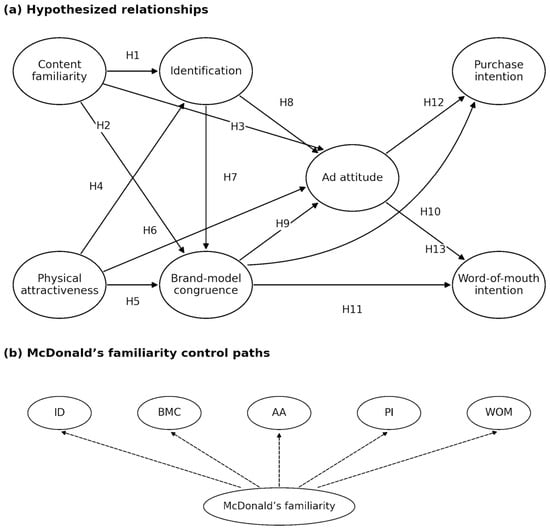
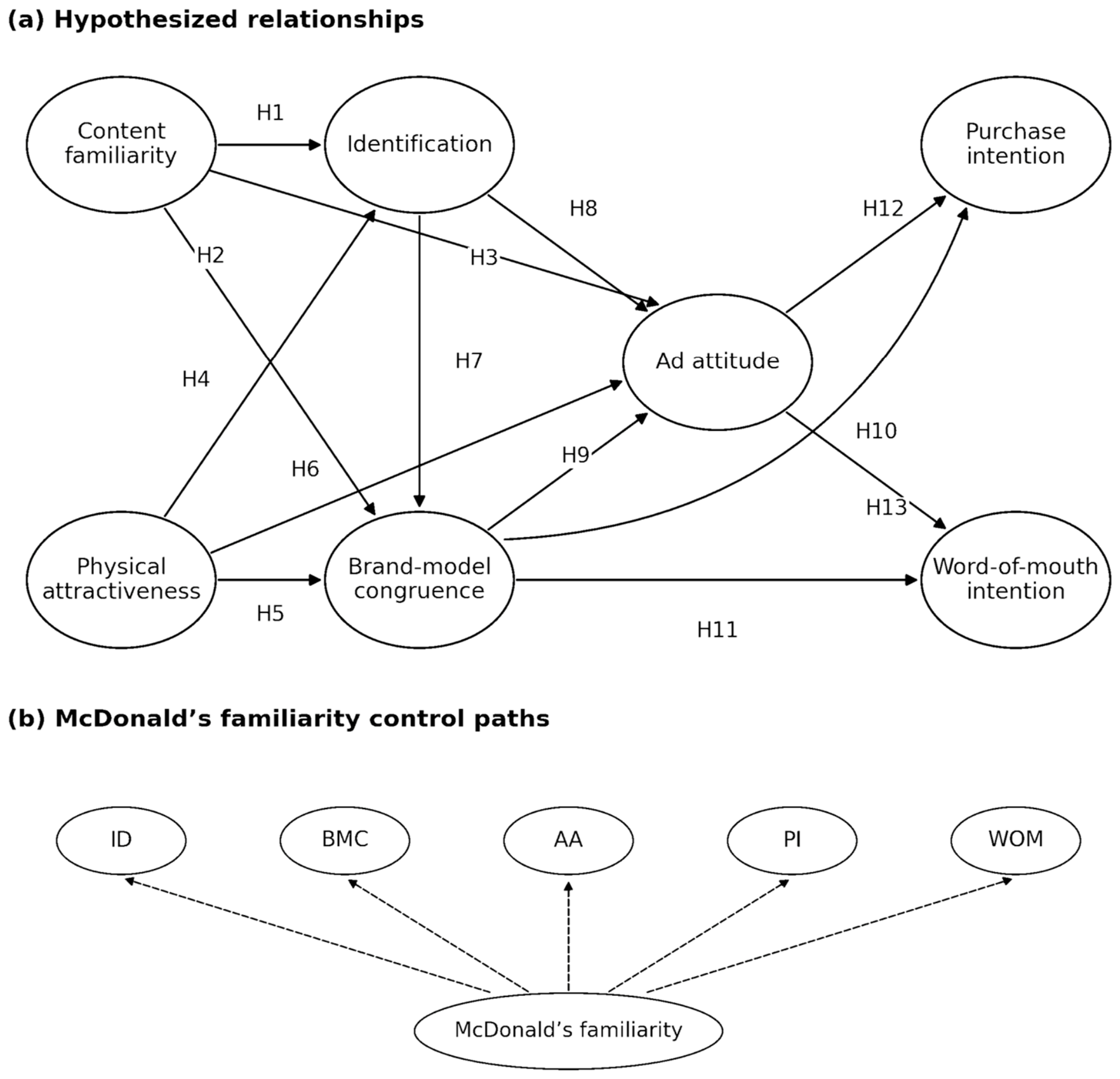
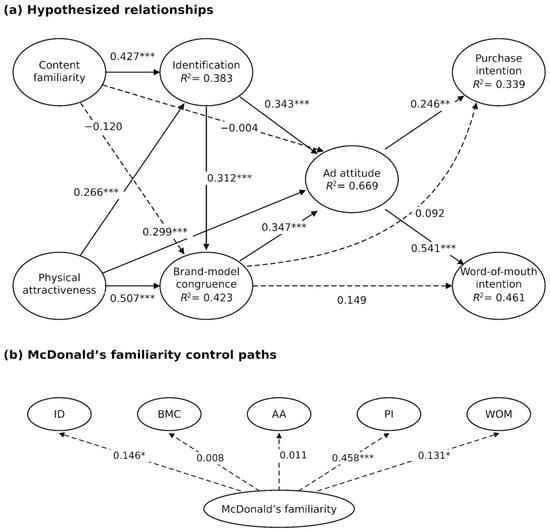
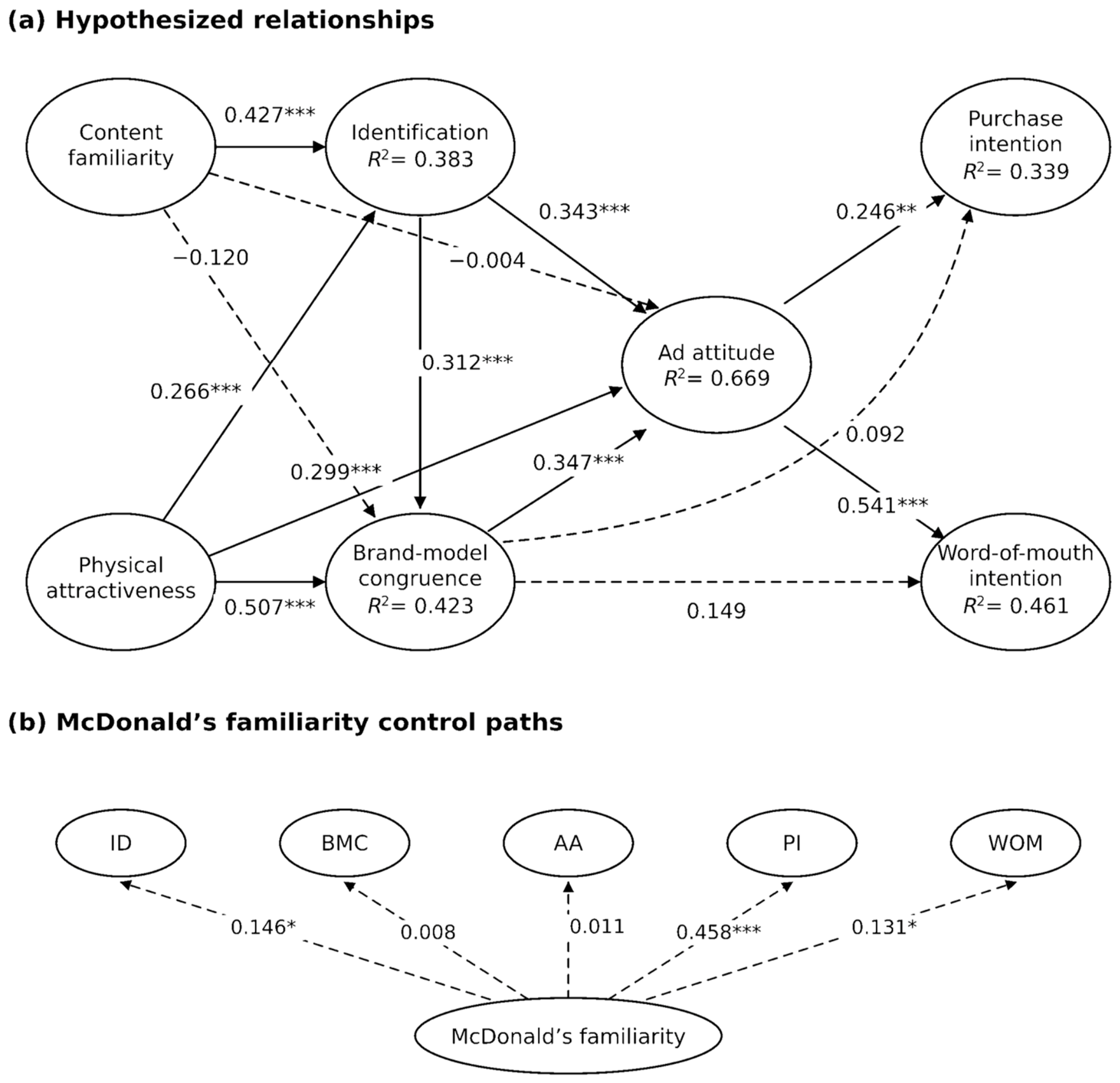

Disclaimer/Publisher’s Note: The statements, opinions and data contained in all publications are solely those of the individual author(s) and contributor(s) and not of MDPI and/or the editor(s). MDPI and/or the editor(s) disclaim responsibility for any injury to people or property resulting from any ideas, methods, instructions or products referred to in the content. |
© 2026 by the author. Licensee MDPI, Basel, Switzerland. This article is an open access article distributed under the terms and conditions of the Creative Commons Attribution (CC BY) license.