


Abstract
High churn rates and the inherent anonymity of digital marketplaces make customer retention a complex strategic imperative. To understand the psychological mechanics associated with consumer continuance intention, this research examines the interplay of multidimensional values (utilitarian, hedonic, and social) and perceived risk through the lens of the Stimulus–Organism–Response (S-O-R) paradigm. Responses gathered from a purposively recruited sample of 270 active e-commerce shoppers in Indonesia were evaluated using Partial Least Squares Structural Equation Modeling (PLS-SEM). The analysis reveals a complex partial mediation structure. While utilitarian value and perceived risk operate strictly through internal psychological states, hedonic and social values exhibit significant direct and indirect effects on retention intention. Both relational trust and transactional satisfaction emerge as paramount predictors of retention intention. By mapping the sequential and direct associations of marketing stimuli with continuance intention, this study broadens the applicability of the S-O-R framework in emerging digital economies. The findings suggest that platform strategies prioritizing experiential engagement—such as gamification—and visible risk mitigation policies may offer valuable approaches for supporting long-term consumer relationships.
1. Introduction
Driven by continuous digital transformation, contemporary marketing practices have structurally evolved from traditional, unilateral communication channels into highly interactive, real-time digital ecosystems [1]. This proliferation is particularly pronounced across emerging markets in Southeast Asia, where internet penetration and mobile commerce have structurally altered retail landscapes. In Indonesia, the macroeconomic indicators reflect a massive digital migration; the digital economy reached an estimated Gross Merchandise Value (GMV) of USD 82 billion in 2023, with projections forecasting continued exponential expansion [2]. Supported by an internet penetration rate encompassing over 79.5% of the total population [3], Indonesia has established itself as a primary digital economic powerhouse. This landscape is characterized by a highly active, technologically engaged consumer base that increasingly relies on digital marketplaces for both high-involvement purchases and daily consumer goods.
Beneath the surface of this rapid expansion, however, the strategic imperatives for e-commerce enterprises have experienced a critical pivot. In an increasingly hyper-competitive digital arena, the traditional marketing emphasis on acquiring new users has been superseded by the imperative to sustain existing consumer relationships and minimize churn rates [4]. Cultivating continuance intention—defined as the consumer’s psychological commitment to maintain relationship continuation and transaction intensity—is recognized as a fundamental determinant of long-term profitability, particularly given the economic reality that customer acquisition costs vastly outweigh retention expenditures [4,5]. However, securing enduring loyalty within virtual environments presents multifaceted challenges. The inherently intangible and remote nature of digital commerce creates significant information asymmetry, which in turn elevates perceived risk among buyers [6]. Psychological barriers, ranging from data vulnerability and financial fraud concerns to uncertainties regarding product quality, can systematically degrade relational bonds and hinder long-term continuance intentions. Consequently, deciphering the underlying mechanisms capable of mitigating these perceived risks and fostering sustained retention intentions remains a critical priority for both marketing literature and industry practitioners.
To systematically unpack these behavioral complexities, this research anchors its theoretical foundation in the Stimulus–Organism–Response (S-O-R) paradigm originally conceptualized by Mehrabian and Russell [7]. While traditional applications of S-O-R often operationalize stimuli as physical atmospheric cues, the digital commerce context necessitates a broader conceptualization. In this study, multidimensional customer values—encompassing utilitarian, hedonic, and social dimensions—alongside perceived risk are conceptualized as the environmental stimuli (S). This positioning is theoretically justified because consumer perceptions of value and risk in e-commerce are inherently derived from their interactions with external platform cues, such as interface usability, visual merchandising, peer reviews, and visible security architectures [8,9]. These externally generated stimuli subsequently shape the internal, organismic states (O) of the buyer, specifically their cognitive and affective evaluations manifested as customer satisfaction and consumer trust [10,11]. Ultimately, these internal psychological states are hypothesized to predict the behavioral response (R), operationalized in this context as the customer’s retention intention. Investigating the social dimension as a stimulus holds particular relevance in Indonesia, where deeply ingrained collectivist cultural norms frequently emphasize reliance on social validation and peer consensus during purchase decision-making [9,12].
Despite a wealth of extant literature investigating online consumer behavior, critical research gaps persist, particularly regarding the hierarchical associations between these variables in emerging digital markets. First, scholarly debate continues over the relative influence of utilitarian rationality versus hedonic experientiality as the primary predictor of satisfaction in contemporary, visually immersive e-commerce platforms [9,13]. Second, transactional retail studies frequently sideline social value, erroneously confining its relevance strictly to social commerce domains, thus overlooking its potential influence as a baseline stimulus in standard marketplace settings [14,15]. Finally, the persistence of the “satisfaction paradox”—where elevated satisfaction frequently fails to translate into continued patronage—highlights the necessity of exploring multiple mediating mechanisms [10]. Trust is increasingly theorized as a critical complementary conduit, acting as the relational catalyst required to transition transactional satisfaction into durable continuance intentions [11,16].
Addressing these theoretical voids, the current study presents a comprehensive structural evaluation of both value-driven facilitators and risk-based inhibitors through a complex partial mediation mechanism. By analyzing a purposively recruited sample of active e-commerce users, this research investigates how trust functions alongside satisfaction as a mediating variable, simultaneously examining its potential to mitigate the negative associations of perceived risk while transmitting the positive associations of multidimensional values. Ultimately, this research aims to empirically validate a structural model delineating the antecedents of customer retention intention among Indonesian digital consumers. The ensuing findings are anticipated to enrich contemporary marketing literature by mapping the sequential associations of S-O-R variables in digital settings, while delivering objective, empirically supported insights for industry practitioners striving to architect trust-anchored retention strategies.
2. Literature Review and Hypothesis Development
2.1. Theoretical Underpinnings: The S-O-R Framework in Digital Commerce
This research is theoretically anchored in the Stimulus–Organism–Response (S-O-R) paradigm introduced by Mehrabian and Russell [7]. The foundational premise of this framework dictates that external environmental cues act as a Stimulus (S), which systematically affects an individual’s internal cognitive and affective states, categorized as the Organism (O). These internal transformations subsequently drive an observable behavioral Response (R) [7]. While traditional applications of the S-O-R model within physical retail often conceptualize stimuli as atmospheric cues (e.g., lighting, store layout), the digital commerce environment necessitates a cognitively driven conceptualization.
Recent literature highlights the enduring robustness of the S-O-R model in evaluating complex digital behaviors, demonstrating its efficacy in mapping how virtual environments shape long-term consumer loyalty [17,18]. In alignment with the study’s primary objective to decode retention mechanics, multidimensional customer values (utilitarian, hedonic, and social) and perceived risk function as the primary environmental stimuli (S). This positioning is theoretically justified because, in a faceless digital marketplace, the consumer’s perception of value and risk represents their direct cognitive evaluation of the platform’s external features—such as interface usability, visual merchandising, peer reviews, and security infrastructure [8,9].
These externally evaluated stimuli do not directly dictate behavior; rather, they are processed by the consumer to form internal organismic states (O). Here, the organism is exclusively conceptualized as customer satisfaction and consumer trust, representing the holistic affective and cognitive internal states forged after processing the platform’s stimuli [10,11]. Finally, these internal states predict the behavioral response (R), which is operationalized in this study as customer retention intention—the psychological commitment to sustain future transactional behaviors.
2.2. Multidimensional Value, Perceived Risk, and Hypotheses
Customer value is recognized as a multidimensional construct, historically defined as the cognitive trade-off between perceived benefits and the associated sacrifices required to obtain them [8]. This study operationalizes value through three distinct lenses: utilitarian (functional efficiency), hedonic (emotional gratification), and social (self-image enhancement) [14,19].
Utilitarian value centers on instrumental and cognitive benefits, primarily evaluating time efficiency, monetary savings, and functional convenience. Contemporary empirical evidence demonstrates that when consumers perceive high functional utility and ease of platform navigation, their baseline satisfaction and engagement increase significantly [20].
This functional reliability subsequently fosters a foundational sense of trust in the vendor’s competence, which is essential for encouraging future patronage [9,13]. Viewed specifically through the lens of the S-O-R model, utilitarian value functions as a cognitive environmental stimulus (S) that shapes the internal organismic states (O) of satisfaction and trust, which subsequently govern the behavioral response (R) of retention intention. Accordingly, the following hypotheses are proposed:
H1.
Utilitarian Value is positively associated with Customer Satisfaction.
H2.
Utilitarian Value is positively associated with Consumer Trust.
H3.
Utilitarian Value is positively associated with Customer Retention Intention.
In contrast to pure functional utility, hedonic value is intrinsically linked to the experiential and recreational pleasure derived from the shopping process itself [21]. A highly engaging, visually stimulating, and entertaining digital interface cultivates emotional attachment, significantly elevating affective satisfaction [22]. Furthermore, empirical evidence demonstrates that hedonic value directly shapes behavioral outcomes, as consumers seeking continuous emotional gratification exhibit a direct behavioral disposition to stay with the platform [20]. Mapped directly to the S-O-R paradigm, hedonic value serves as an affective environmental stimulus (S) that permeates the consumer’s internal psychological state (O), effectively triggering a positive behavioral response (R) towards continued platform patronage. This experiential resonance establishes both immediate behavioral impulses and long-term continuance intentions [9,21].
H4.
Hedonic Value is positively associated with Customer Satisfaction.
H5.
Hedonic Value is positively associated with Consumer Trust.
H6.
Hedonic Value is positively associated with Customer Retention Intention.
Social value represents the perceived utility derived from an alternative’s ability to enhance one’s social self-concept or secure peer approval [15,19]. Within collectivist cultural landscapes such as Indonesia, social validation operates as a critical environmental stimulus driving consumption [12]. Recent investigations confirm that digital platforms facilitating social sharing or providing products that elevate a user’s social standing deliver profound psychological satisfaction, directly driving customer retention intention and building social commerce trust [23].
Within the S-O-R framework, social validation operates as a powerful external normative stimulus (S). When processed by the consumer, it elevates internal cognitive and relational evaluations (O), thereby driving the ultimate behavioral response (R) of platform retention. Crucially, empirical evaluations confirm that social value exerts a direct, significant influence on continuance commitment, as peer consensus and social capital directly drive customer retention intention [14,15].
H7.
Social Value is positively associated with Customer Satisfaction.
H8.
Social Value is positively associated with Consumer Trust.
H9.
Social Value is positively associated with Customer Retention Intention.
Conversely, perceived risk represents the antithesis of value, manifesting as the psychological uncertainty regarding potential negative consequences (e.g., data breaches, financial fraud, or product non-delivery) [6,24]. Elevated risk acts as a destructive external stimulus that drastically degrades satisfaction by imposing a heavy cognitive burden on the consumer.
A comprehensive meta-analysis of digital commerce trust confirms that unresolved perceived vulnerabilities directly paralyze the formation of trust, ultimately prompting consumers to abandon the platform to mitigate potential losses [25]. Consistent with the S-O-R model, perceived risk acts as a negative, aversive stimulus (S) derived from the digital environment. This stimulus systematically degrades the internal organismic states (O) of trust and satisfaction, ultimately paralyzing the behavioral response (R) of retention.
H10.
Perceived Risk is negatively associated with Customer Satisfaction.
H11.
Perceived Risk is negatively associated with Consumer Trust.
H12.
Perceived Risk is negatively associated with Customer Retention Intention.
2.3. The Mediating Roles of Satisfaction and Trust
Beyond the influence of external stimuli, the internal organismic variables (satisfaction and trust) exhibit a structured, hierarchical relationship. Satisfaction with past transactions serves as the foundational experiential data required for a consumer to evaluate a vendor’s integrity [26]. Without an accumulation of baseline transactional satisfaction, enduring relational trust cannot materialize [11].
H13.
Customer Satisfaction is positively associated with Consumer Trust.
Satisfaction operates as a mandatory precursor to retention. According to the cognitive-affective model, accumulated satisfaction cultivates a positive attitude that translates directly into behavioral loyalty and continuance intention [10,11].
H14.
Customer Satisfaction is positively associated with Customer Retention Intention.
In the highly uncertain, faceless environment of digital commerce, trust operates as a vital mediating mechanism. Rooted in the Commitment-Trust Theory [11], enduring relational commitment is exclusively achieved when anchored by robust trust [27,28]. By mitigating social complexity and perceived vulnerabilities, trust provides the psychological safety necessary for consumers to sustain long-term digital relationships, making it a critical predictor of behavioral continuity [5,16,25]. Within the S-O-R theoretical structure, satisfaction and trust constitute the core psychological organism (O). They act as the indispensable mediating conduits that internalize external marketing stimuli (S) into the enduring behavioral response (R) of customer retention.
H15.
Consumer Trust is positively associated with Customer Retention Intention.
3. Materials and Methods
3.1. Research Framework and Structural Model
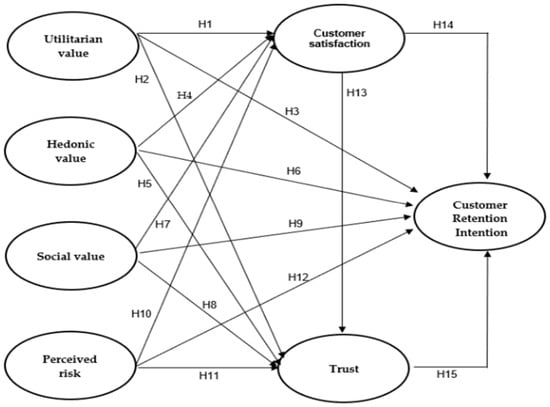
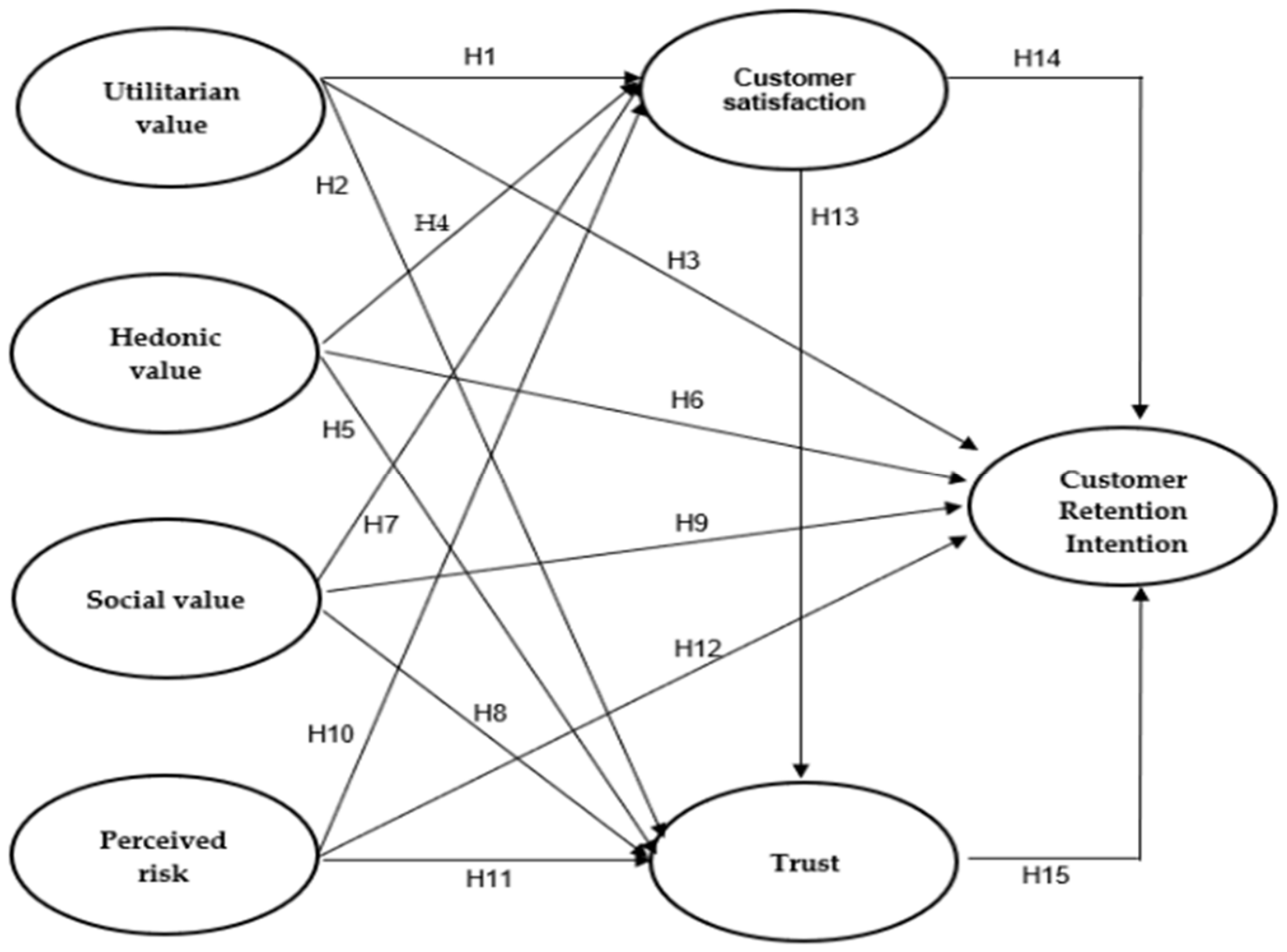
To empirically investigate the multifaceted antecedents of customer continuance intention within the digital economy, this study systematically operationalizes the Stimulus–Organism–Response (S-O-R) theoretical paradigm into a complex, measurable structural equation model [14]. Within this architectural framework, multidimensional values (comprising utilitarian, hedonic, and social dimensions) alongside perceived risk operate as exogenous environmental stimuli. These externally evaluated stimuli are hypothesized to exert a substantial influence on the endogenous mediating variables, which are conceptualized as the internal organismic states of customer satisfaction and consumer trust. Ultimately, these intermediate psychological states are hypothesized to predict the final behavioral response, strictly measured as customer retention intention. The comprehensive structural linkages, including the direct pathways from the exogenous stimuli and the dual-mediation pathways operating through the organismic states, are visually delineated in Figure 1.
Figure 1.
Conceptual research model based on the S-O-R framework.
3.2. Research Design, Data Collection, and Ethics
This investigation employs a quantitative, explanatory research design firmly rooted in the positivist research paradigm, viewing digital consumption reality as a measurable, objective phenomenon [29,30]. A cross-sectional survey methodology was utilized to capture a precise snapshot of contemporary consumer behavioral patterns. This approach is highly appropriate given the rapid evolutionary pace, dynamic platform features, and fluid consumer preferences characteristic of the Indonesian e-commerce industry [30]. Primary data collection was executed via a structured, self-administered online questionnaire hosted on the Google Forms platform. This digital distribution strategy was deliberately selected for its cost-efficiency, its suitability for technologically native demographics, and its capacity to achieve broad geographic penetration without spatial constraints. The survey links were systematically disseminated through major social media channels and active digital communities over a three-month period, spanning from November 2025 to January 2026.
Regarding strict compliance with ethical research standards, in accordance with national legislation in Indonesia (Law Number 11 of 2019 on the National System of Science and Technology, specifically Article 85 which mandates formal ethical clearance primarily for high-risk and dangerous research) and the institutional guidelines of State Polytechnic of Malang, formal ethical review and approval by an Institutional Review Board were officially waived. This study relies entirely on an anonymous, non-interventional consumer survey that poses absolutely no risks, privacy breaches, or physical/psychological harm to participants. Nevertheless, uncompromising adherence to the ethical principles outlined in the Declaration of Helsinki was maintained. Digital informed consent was explicitly obtained from all adult respondents on the introductory page of the survey prior to their participation, and all collected data were treated with absolute confidentiality.
3.3. Population, Sampling Strategy, and Participant Profile
The primary target population comprises individual consumers actively engaged in the Indonesian e-commerce ecosystem. Given the functionally infinite and undocumented exact parameters of the national internet user base, a non-probability purposive sampling technique was deployed to select respondents possessing specific experiential qualifications [31]. The rigorous inclusion criteria required respondents to be: (a) Indonesian citizens currently domiciled in Indonesia; (b) at least 18 years of age, ensuring legal adult capacity for independent financial decisions and bypassing the requirement for guardian consent; (c) active account holders on primary e-commerce platforms (such as Shopee, TikTok Shop, Tokopedia, or Lazada); and (d) individuals who have completed a minimum of two digital purchase transactions within the preceding six months. This specific transactional frequency criterion guarantees that participants possess adequate interaction depth to accurately evaluate platform risks, relational trust, and post-purchase satisfaction [24].
To scientifically justify the sample size and ensure robust statistical power, an a priori power analysis was conducted using GPower 3.1 software [32]. Based on the structural model’s complexity, the maximum number of structural predictors directed at a single endogenous construct (i.e., Customer Satisfaction) is four. Anticipating a medium effect size (f2 = 0.15), an alpha level of 0.05, and a highly stringent desired statistical power of 0.95, the absolute minimum required sample size was calculated at 129 respondents. The data collection phase successfully captured 300 raw responses. Following a stringent data cleaning protocol designed to eliminate incomplete submissions and inconsistent response patterns (such as straight-lining), exactly 270 valid data points were retained. This final sample of 270 individuals significantly exceeds the rigorous GPower threshold, ensuring exceptional statistical power for the subsequent structural evaluations.
It is critically important to note that this sample represents a purposively recruited cohort of highly active and educated digital consumers, rather than a randomized probability sample representing the entire Indonesian populace. The demographic composition indicates a relatively balanced gender distribution, comprising 44.4% males and 55.6% females. The cohort is predominantly driven by technologically savvy individuals, with the 30–45 age bracket (Millennials) accounting for 66.3%, followed by the 18–29 cohort (Generation Z) at 20.4%. Furthermore, 81.5% of the respondents hold a bachelor’s degree, ensuring a high level of functional literacy in comprehending the nuances of the survey instrument. Shopping intensity within the sample is remarkably high, with 73.3% executing online transactions more than three times per month across various heterogeneous product categories, adding substantial external validity regarding the general, highly active e-commerce experience.
3.4. Measurement Instrument and Adaptation
The survey instrument utilized a 5-point Likert scale ranging from 1 (“Strongly Disagree”) to 5 (“Strongly Agree”). This specific scale resolution was strategically selected to minimize respondent cognitive fatigue and frustration while maintaining adequate measurement variance for structural modeling [31]. Because the original measurement scales were adopted from prominent English-language academic sources, a rigorous forward–backward translation procedure was implemented by bilingual academic experts. This meticulous process ensures semantic equivalence, cultural resonance, and contextual accuracy in Bahasa Indonesia [30]. Prior to the full-scale deployment, a pilot test involving 30 eligible respondents was conducted to conclusively ascertain face validity and eliminate any linguistic or conceptual ambiguities.
The final instrument comprises 27 meticulously selected indicators measuring the seven latent constructs. To mitigate respondent cognitive fatigue while preserving structural measurement validity, specific endogenous constructs such as customer satisfaction and retention intention were measured using targeted two-item scales. The exact wording of the items, detailed construct definitions, and the rigorously adapted measurement sources are systematically detailed in Table 1.
Table 1.
Construct Definitions and Full Measurement Items.
Extant methodological literature strongly supports that two-item scales exhibiting high inter-item reliability are highly effective and empirically adequate for capturing narrowly defined, concrete behavioral intentions without sacrificing structural integrity [32].
3.5. Data Analysis Strategy
Given the structural complexity of the research model—which incorporates serial and multiple mediating variables—and the primary research objective of predicting target constructs while advancing theoretical development, Partial Least Squares Structural Equation Modeling (PLS-SEM) processed via WarpPLS 6.0 software was selected as the designated analytical technique [32]. WarpPLS was distinctly favored for its superior efficacy in evaluating complex structural models containing non-linear relationships, multi-segment mediation paths, and full collinearity assessments [32,33].
The analytical procedure was systematically executed through two distinct evaluation stages. First, the Measurement Model (Outer Model) was rigorously evaluated to conclusively establish instrument reliability and validity. Convergent validity was assessed via item-level Outer Loadings and Average Variance Extracted (AVE). Discriminant validity was evaluated using the Heterotrait-Monotrait Ratio (HTMT) as the primary, highly conservative modern criterion, complemented by the traditional Fornell–Larcker matrix [34,35].
Second, upon validating the measurement criteria, the Structural Model (Inner Model) was comprehensively assessed. This phase commenced with a Full Collinearity Assessment utilizing the Variance Inflation Factor (VIF) to categorically rule out common method bias and multicollinearity issues. Subsequently, the model’s predictive relevance (Q2) and explanatory power (R2) were examined, alongside specific effect sizes (f2). Finally, structural hypotheses were formally tested via a bias-corrected bootstrapping procedure utilizing 5000 subsamples. This robust resampling technique calculated the exact statistical significance, specifically generating the necessary t-values, p-values, and confidence intervals for both the direct and the specific indirect (mediating) pathways.
4. Results
4.1. Respondent Profile and Data Quality
The data collection period spanning three months yielded 300 initial responses. Following a rigorous data screening protocol to eliminate incomplete responses and unengaged response patterns (e.g., straight-lining), 270 valid responses were retained for structural analysis. The demographic composition indicates a robust representation of highly active digital consumers. The sample comprises 120 males (44.4%) and 150 females (55.6%). Age distribution is concentrated among Millennials (30–45 years old) at 66.3%, followed by Generation Z (18–29 years old) at 20.4%. Shopping intensity validates the experiential depth of the respondents, with 73.3% executing digital transactions more than three times per month. Furthermore, 81.5% of the respondents hold a bachelor’s degree, ensuring high comprehension of the survey instrument.
4.2. Common Method Bias (CMB) Assessment
Because the empirical data were collected cross-sectionally using a single, self-administered survey instrument, Common Method Bias (CMB) poses a potential threat to structural validity. To assess and rigorously control for CMB, a Full Collinearity Assessment was executed, which is specifically recommended for variance-based SEM like WarpPLS [33]. In this procedure, all latent variables are regressed against a common random variable to generate construct-level Variance Inflation Factor (VIF) values. The analysis reveals that the Full Collinearity VIF values for all constructs are as follows: Utilitarian Value = 1.401, Hedonic Value = 2.374, Social Value = 2.090, Perceived Risk = 1.496, Customer Satisfaction = 2.794, Consumer Trust = 2.634, and Customer Retention Intention = 2.371. Because all values are strictly below the conservative threshold of 3.3 [33], it is empirically concluded that the model is free from severe common method bias, permitting robust structural evaluation.
4.3. Measurement Model Assessment (Outer Model)
The measurement model was systematically evaluated to ascertain internal consistency, convergent validity, and discriminant validity. Internal consistency reliability is confirmed, as the Cronbach’s Alpha and Composite Reliability (CR) for all latent constructs exceed the recommended 0.70 threshold. Convergent validity is evaluated using item-level Outer Loadings and the Average Variance Extracted (AVE). As detailed in Table 2, the vast majority of outer loadings surpass 0.70. While the AVE for Hedonic Value (0.474) falls marginally below 0.50, Fornell and Larcker [30] stipulate that convergent validity remains statistically adequate if the construct’s CR is robustly above 0.60. Given that the CR for Hedonic Value is exceptionally strong (0.837) and the construct inherently captures multidimensional psychological facets (e.g., adventure and gratification shopping), convergent validity is confirmed for the entire model.
Table 2.
Measurement model: loadings, reliability, and convergent validity.
Discriminant validity was established using the Fornell–Larcker criterion, which dictates that the square root of a construct’s AVE must be greater than its highest correlation with any other latent variable [30]. As presented in Table 3, the diagonal values (representing the square roots of AVEs) are universally higher than the off-diagonal correlation coefficients across all constructs, unequivocally demonstrating that all latent variables are empirically distinct.
Table 3.
Discriminant validity (Fornell–Larcker Criterion).
Furthermore, the Heterotrait–Monotrait Ratio (HTMT) values across all latent constructs were thoroughly examined. All HTMT values were strictly below the conservative threshold of 0.90, unequivocally confirming robust discriminant validity across the measurement model.
4.4. Structural Model Assessment (Inner Model)
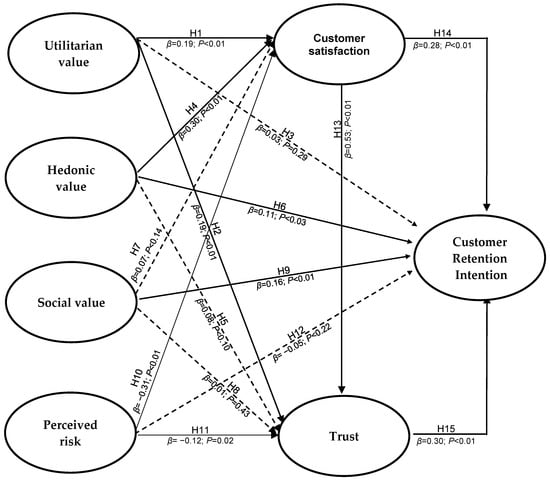
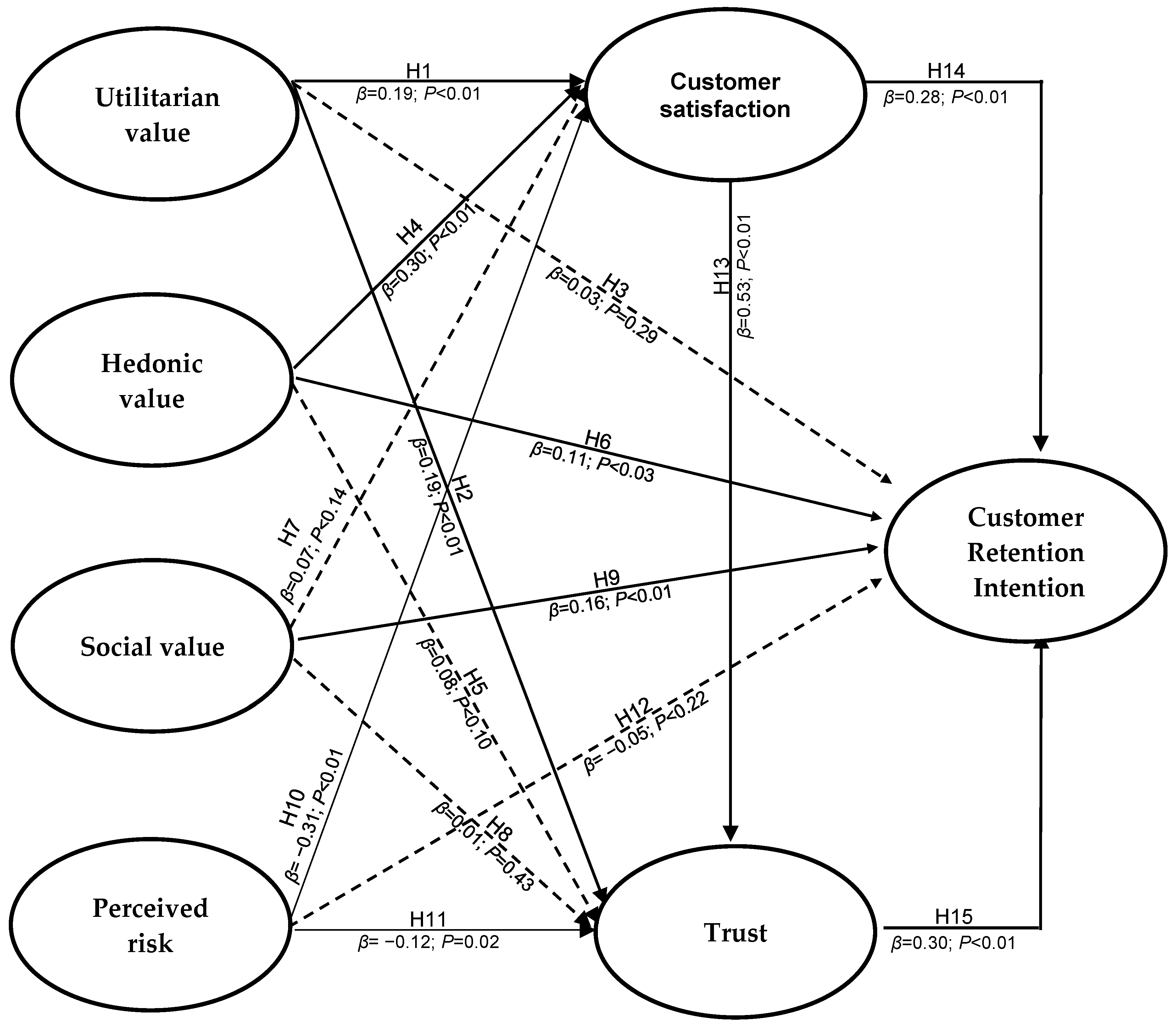
Upon validating the measurement framework, the structural model was evaluated for its overall fit, explanatory power (R2) and predictive relevance (Q2) using WarpPLS. The complete structural pathways, path coefficients (β), statistical significance, and variance explained (R2) for each endogenous construct are comprehensively illustrated in Figure 2. The model exhibits excellent empirical fit indices: Average Path Coefficient (APC) = 0.182 (p < 0.001), Average R-squared (ARS) = 0.559 (p < 0.001), and Tenenhaus GoF = 0.621, which significantly exceeds the baseline 0.36 threshold for a “large” model fit. Additional quality indices, including Sympson’s Paradox Ratio (SPR = 1.000) and R-squared Contribution Ratio (RSCR = 1.000), confirm absolute structural validity.
Figure 2.
Path diagram model. Note: Solid lines indicate significant influence; dashed lines indicate insignificant influence.
As visually outlined in Figure 2, the structural components demonstrate robust explanatory power. The model explains 47.6% of the variance in Customer Satisfaction (Adjusted R2 = 0.468), 60.5% in Consumer Trust (Adjusted R2 = 0.597), and 59.7% in Customer Retention Intention (Adjusted R2 = 0.588). Furthermore, the Stone–Geisser’s predictive relevance (Q2) values for Customer Satisfaction (0.478), Consumer Trust (0.606), and Customer Retention Intention (0.599) are all substantially greater than zero, confirming that the structural model possesses strong out-of-sample predictive validity.
4.5. Hypotheses Testing (Direct Effects)
To formally test the structural hypotheses and evaluate statistical significance, path coefficients (β), standard errors (SE), effect sizes (f2), and corresponding p-values were generated. The summarized direct pathway results are presented in Table 4.
Table 4.
Hypotheses testing (direct pathways).
The evaluation of direct paths reveals a nuanced interplay of stimuli. Utilitarian Value and Perceived Risk influence both Customer Satisfaction and Consumer Trust but have no direct effect on Customer Retention Intention. Conversely, Hedonic Value and Social Value present significant direct associations with Customer Retention Intention (p = 0.032 and p = 0.004, respectively). Most importantly, the internal organismic states—Customer Satisfaction and Consumer Trust—exhibit powerful and highly significant direct effects on Customer Retention Intention (p < 0.001).
4.6. Mediation Analysis (Specific Indirect Effects)
To empirically address the mediation mechanisms requested by reviewers, specific indirect effects encompassing 2-segment and 3-segment (serial mediation) pathways were rigorously extracted. The statistical significance of these mediating pathways is presented in Table 5.
Table 5.
Specific indirect effects (mediation analysis).
The mediation analysis demonstrates that while direct effects exist for certain variables, the indirect pathways routed sequentially through Customer Satisfaction and Consumer Trust are highly prominent. Specifically, Hedonic Value and Perceived Risk are successfully mediated by Customer Satisfaction to form Consumer Trust. Furthermore, the serial mediation path originating from Hedonic Value through both Customer Satisfaction and Consumer Trust to reach Customer Retention Intention is statistically significant (p = 0.048). This empirically substantiates a complex, partially mediated structural framework underlying consumer continuance behavior in the digital ecosystem.
5. Discussion
This section interprets the structural evaluation results of the fifteen hypotheses tested within the S-O-R framework, detailing the direct associations and the mediating mechanisms that govern customer retention intention.
5.1. Theoretical Implications
Addressing the functional dimensions of the digital ecosystem (H1, H2, and H3), the structural analysis indicates that utilitarian value significantly enhances customer satisfaction (H1, β = 0.192, p < 0.001) and consumer trust (H2, β = 0.193, p < 0.001), but fails to exert a direct influence on customer retention intention (H3, β = 0.033, p = 0.294). Interpreted through the S-O-R paradigm, functional platform features—such as time efficiency and monetary savings—act as foundational cognitive stimuli (S). However, these external cues do not automatically translate into behavioral continuity (R); they must be internalized into positive organismic states (O) to take effect. This finding corroborates the literature by Chiu et al. [13] and Gan and Wang [9], confirming that while utilitarian efficiency is a prerequisite for baseline satisfaction, it is insufficient as a standalone behavioral driver in modern e-commerce without mediating relational conduits [36].
Evaluating the experiential dimension, the results support H4 and H6, demonstrating that hedonic value strongly influences customer satisfaction (H4, β = 0.300, p < 0.001) and directly drives customer retention intention (H6, β = 0.111, p = 0.032), although it does not significantly impact consumer trust (H5, β = 0.077, p = 0.101). Within the S-O-R framework, hedonic value operates as a potent affective stimulus (S). The significant direct path to retention (R) suggests that experiential gratification can bypass complex cognitive evaluations, triggering immediate behavioral continuity. However, the rejection of H5 indicates that emotional stimulation does not inherently build cognitive reliability (O). These outcomes support the assertions of Arnold and Reynolds [21] and Molinillo et al. [22], emphasizing that visually stimulating interfaces create profound affective loyalty, differentiating experiential value from purely transactional trust-building mechanics [37].
The analysis of social value reveals a unique structural pattern: H7 and H8 are not supported (p = 0.140 and p = 0.434, respectively), indicating no significant effect on satisfaction or trust. Conversely, H9 is strongly supported (β = 0.160, p = 0.004), proving a direct association with retention intention. Through the S-O-R lens, social validation functions as an external normative stimulus (S). In collectivist contexts, this normative stimulus bypasses internal affective and cognitive organismic processing (O), directly dictating behavioral compliance (R). Consumers maintain platform relationships to secure peer approval regardless of internal satisfaction levels. This directly supports and extends the findings of Alshibly [15] and Rintamäki et al. [14], illustrating that social value is a powerful independent driver of continuance behavior, operating distinctly from conventional cognitive mediators.
Regarding perceived risk, the findings support H10 and H11, showing significant negative impacts on both customer satisfaction (β = −0.310, p < 0.001) and consumer trust (β = −0.119, p = 0.024). However, H12 is not supported (p = 0.219), indicating no direct effect on retention. Contextualized within the S-O-R model, perceived risk acts as an aversive environmental stimulus (S) that imposes a heavy cognitive tax, systematically degrading the internal organismic states (O). The lack of a direct path to retention (R) proves that risk must first dismantle internal trust and satisfaction before behavioral abandonment occurs. This mechanism validates the theoretical perspectives of Pires et al. [6] and Boksberger et al. [24], confirming that the destructive capability of risk operates strictly through the erosion of psychological safety.
Finally, the structural relationships between the internal organismic variables and the behavioral response strongly support H13, H14, and H15. Customer satisfaction significantly fosters consumer trust (H13, β = 0.533, p < 0.001), and both satisfaction (H14, β = 0.282, p < 0.001) and trust (H15, β = 0.301, p < 0.001) emerge as paramount predictors of retention intention. In the S-O-R theoretical structure, satisfaction (affective) and trust (cognitive) constitute the core psychological organism (O). The validation of these hypotheses confirms that these states act as indispensable mediating conduits, internalizing external marketing stimuli (S) into the enduring behavioral response (R). The sequential flow from satisfaction to trust further validates the Commitment-Trust Theory [11] and Oliver’s cognitive–affective model [10], unequivocally demonstrating that transactional satisfaction must mature into relational trust to secure long-term digital loyalty.
5.2. Managerial Implications
Building upon the empirical findings, this study offers actionable strategies for e-commerce practitioners and platform strategists:
- Architecting Immersive and Social Shopping Environments: Management must curate recreational shopping spaces by integrating gamification elements, interactive live-streaming features, and community rewards to elevate hedonic and social value.
- Institutionalized Risk Mitigation: Given the severe negative impact of perceived risk on satisfaction and trust, platforms must enforce visible security safeguards, such as certified secure payment gateways, clear privacy protections, and frictionless return policies.
- Trust-Anchor Service Operations: Because consumer trust and satisfaction serve as the strongest predictors of retention intention, customer service teams must prioritize prompt, empathetic, and fair resolutions to build unshakeable brand credibility.
6. Conclusions and Future Research
6.1. Conclusions
This research concludes that customer retention within the Indonesian e-commerce ecosystem is governed by a complex partial mediation mechanism driven by the S-O-R paradigm. While Utilitarian Value and Perceived Risk rely entirely on the internal psychological conduits of Customer Satisfaction and Consumer Trust to shape Customer Retention Intention, Hedonic Value and Social Value demonstrate both direct and indirect influences on continuance intentions. Overall, Consumer Trust and Customer Satisfaction emerge as the paramount determinants of behavioral loyalty, demonstrating that platform integrity and emotional engagement are foundational for long-term commercial sustainability.
6.2. Limitations and Future Research Directions
Despite its empirical contributions, certain limitations should be addressed in future studies. First, the cross-sectional research design limits causal inferences over extended periods; future research should employ longitudinal methodologies to track trust evolution. Second, aggregating all e-commerce transactions into a single dataset masks category-specific variations; subsequent studies should conduct comparative analyses across high-involvement and low-involvement product categories. Finally, incorporating demographic moderators such as generational cohorts or income brackets would provide deeper granularity into consumer behavior.
Author Contributions
Conceptualization, T.Y.E. and L.D.; methodology, T.Y.E.; software, T.Y.E.; validation, T.Y.E. and L.D.; formal analysis, T.Y.E.; investigation, T.Y.E.; resources, T.Y.E. and L.D.; data curation, T.Y.E.; writing—original draft preparation, T.Y.E.; writing—review and editing, T.Y.E. and L.D.; visualization, T.Y.E.; supervision, L.D.; project administration, T.Y.E.; funding acquisition, T.Y.E. and L.D. All authors have read and agreed to the published version of the manuscript.
Funding
This research received no external funding.
Institutional Review Board Statement
In accordance with national legislation in Indonesia (Law Number 11 of 2019 on the National System of Science and Technology, specifically Article 85 which mandates formal ethical clearance primarily for high-risk and dangerous research) and the institutional guidelines of State Polytechnic of Malang, formal ethical review and approval by an Institutional Review Board were officially waived for this study because it involved an anonymous, non-interventional consumer survey posing no risks, privacy breaches, or physical/psychological harm to participants.
Informed Consent Statement
Informed consent was obtained from all subjects involved in the study.
Data Availability Statement
The data presented in this study are available on request from the corresponding author.
Conflicts of Interest
The authors declare that there are no conflicts of interest associated with this study, and it was conducted independently of any commercial or financial influences.
References
- Turban, E.; Outland, J.; King, D.; Lee, J.K.; Liang, T.-P.; Turban, D.C. Electronic Commerce 2018: A Managerial and Social Networks Perspective; Springer Texts in Business and Economics; Springer International Publishing: Cham, Switzerland, 2018. [Google Scholar]
- Google; Temasek; Bain & Company. E-Conomy SEA 2023 Report: Reaching New Heights; Bain & Company: Boston, MA, USA, 2023. [Google Scholar]
- Asosiasi Penyelenggara Jasa Internet Indonesia (APJII). Laporan Survei Penetrasi & Profil Perilaku Pengguna Internet Indonesia 2023–2024; APJII: Jakarta, Indonesia, 2024. [Google Scholar]
- Kotler, P.; Keller, K.L. Marketing Management, 12th ed.; Pearson Prentice Hall: Upper Saddle River, NJ, USA, 2006. [Google Scholar]
- Trasorras, R.; Weinstein, A.; Abratt, R. Value, Satisfaction, Loyalty and Retention in Professional Services. Mark. Intell. Plan. 2009, 27, 615–632. [Google Scholar] [CrossRef] [Scilit]
- Pires, G.; Stanton, J.; Eckford, A. Influences on the Perceived Risk of Purchasing Online. J. Consum. Behav. 2004, 4, 118–131. [Google Scholar] [CrossRef] [Scilit]
- Mehrabian, A.; Russell, J.A. An Approach to Environmental Psychology; The MIT Press: Cambridge, MA, USA, 1974; 266p. [Google Scholar]
- Zeithaml, V.A. Consumer Perceptions of Price, Quality, and Value: A Means-End Model and Synthesis of Evidence. J. Mark. 1988, 52, 2–22. [Google Scholar] [CrossRef] [Scilit]
- Gan, C.; Wang, W. The Influence of Perceived Value on Purchase Intention in Social Commerce Context. Internet Res. 2017, 27, 772–785. [Google Scholar] [CrossRef] [Scilit]
- Oliver, R.L. A Cognitive Model of the Antecedents and Consequences of Satisfaction Decisions. J. Mark. Res. 1980, 17, 460–469. [Google Scholar] [CrossRef] [Scilit]
- Morgan, R.M.; Hunt, S.D. The Commitment-Trust Theory of Relationship Marketing. J. Mark. 1994, 58, 20–38. [Google Scholar] [CrossRef] [Scilit]
- Sheth, J.N.; Mittal, B. Customer Behavior: A Managerial Perspective, 2nd ed.; Thomson/South-Western: Mason, OH, USA, 2004. [Google Scholar]
- Chiu, C.-M.; Hsu, M.-H.; Lai, H.; Chang, C.-M. Re-Examining the Influence of Trust on Online Repeat Purchase Intention: The Moderating Role of Habit and Its Antecedents. Decis. Support Syst. 2012, 53, 835–845. [Google Scholar] [CrossRef] [Scilit]
- Rintamäki, T.; Kanto, A.; Kuusela, H.; Spence, M.T. Decomposing the Value of Department Store Shopping into Utilitarian, Hedonic and Social Dimensions: Evidence from Finland. Int. J. Retail Distrib. Manag. 2006, 34, 6–24. [Google Scholar] [CrossRef] [Scilit]
- Alshibly, H.H. Customer Perceived Value in Social Commerce: An Exploration of Its Antecedents and Consequences. J. Manag. Res. 2014, 7, 17. [Google Scholar] [CrossRef] [Scilit]
- Gefen, D. E-Commerce: The Role of Familiarity and Trust. Omega 2000, 28, 725–737. [Google Scholar] [CrossRef] [Scilit]
- Zhu, L.; Li, H.; Wang, F.-K.; He, W.; Tian, Z. How Online Reviews Affect Purchase Intention: A New Model Based on the Stimulus-Organism-Response (S-O-R) Framework. Aslib J. Inf. Manag. 2020, 72, 463–488. [Google Scholar] [CrossRef] [Scilit]
- Amin, M.; Ryu, K.; Cobanoglu, C.; Nizam, A. Determinants of Online Hotel Booking Intentions: Website Quality, Social Presence, Affective Commitment, and e-Trust. J. Hosp. Mark. Manag. 2021, 30, 845–870. [Google Scholar] [CrossRef] [Scilit]
- Sweeney, J.C.; Soutar, G.N. Consumer Perceived Value: The Development of a Multiple Item Scale. J. Retail. 2001, 77, 203–220. [Google Scholar] [CrossRef] [Scilit]
- Pang, H. Identifying Associations between Mobile Social Media Users’ Perceived Values, Attitude, Satisfaction, and eWOM Engagement: The Moderating Role of Affective Factors. Telemat. Inform. 2021, 59, 101561. [Google Scholar] [CrossRef] [Scilit]
- Arnold, M.J.; Reynolds, K.E. Hedonic Shopping Motivations. J. Retail. 2003, 79, 77–95. [Google Scholar] [CrossRef] [Scilit]
- Molinillo, S.; Gómez-Ortiz, B.; Pérez-Aranda, J.; Navarro-García, A. Building Customer Loyalty: The Effect of Experiential State, the Value of Shopping, and Trust and Perceived Value of Service on Online Clothes Shopping. Cloth. Text. Res. J. 2017, 35, 156–171. [Google Scholar] [CrossRef] [Scilit]
- Lin, X.; Wang, X.; Hajli, N. Building E-Commerce Satisfaction and Boosting Sales: The Role of Social Commerce Trust and Its Antecedents. Int. J. Electron. Commer. 2019, 23, 328–363. [Google Scholar] [CrossRef] [Scilit]
- Boksberger, P.E.; Bieger, T.; Laesser, C. Multidimensional Analysis of Perceived Risk in Commercial Air Travel. J. Air Transp. Manag. 2007, 13, 90–96. [Google Scholar] [CrossRef] [Scilit]
- Sarkar, S.; Chauhan, S.; Khare, A. A Meta-Analysis of Antecedents and Consequences of Trust in Mobile Commerce. Int. J. Inf. Manag. 2020, 50, 286–301. [Google Scholar] [CrossRef] [Scilit]
- Ravald, A.; Grönroos, C. The Value Concept and Relationship Marketing. Eur. J. Mark. 1996, 30, 19–30. [Google Scholar] [CrossRef] [Scilit]
- Yousafzai, S.Y.; Pallister, J.G.; Foxall, G.R. A Proposed Model of E-Trust for Electronic Banking. Technovation 2003, 23, 847–860. [Google Scholar] [CrossRef] [Scilit]
- Kim, M.-J.; Chung, N.; Lee, C.-K. The Effect of Perceived Trust on Electronic Commerce: Shopping Online for Tourism Products and Services in South Korea. Tour. Manag. 2011, 32, 256–265. [Google Scholar] [CrossRef] [Scilit]
- Creswell, J.W. Research Design: Qualitative, Quantitative, and Mixed Methods Approaches, 4th ed.; SAGE Publications: Thousand Oaks, CA, USA, 2014. [Google Scholar]
- Sekaran, U.; Bougie, R. Research Methods for Business: A Skill-Building Approach, 7th ed.; Wiley: Chichester, UK, 2016. [Google Scholar]
- Malhotra, N.K. Marketing Research: An Applied Orientation, 6th ed.; Pearson: Boston, MA, USA, 2010. [Google Scholar]
- Hair, J.F.; Hult, G.T.M.; Ringle, C.M.; Sarstedt, M. A Primer on Partial Least Squares Structural Equation Modeling (PLS-SEM), 2nd ed.; Sage: Los Angeles, CA, USA, 2017. [Google Scholar]
- Kock, N. Common Method Bias in PLS-SEM: A Full Collinearity Assessment Approach. Int. J. e-Collab. 2015, 11, 1–10. [Google Scholar] [CrossRef] [Scilit]
- Henseler, J.; Ringle, C.M.; Sarstedt, M. A New Criterion for Assessing Discriminant Validity in Variance-Based Structural Equation Modeling. J. Acad. Mark. Sci. 2015, 43, 115–135. [Google Scholar] [CrossRef] [Scilit]
- Fornell, C.; Larcker, D.F. Evaluating Structural Equation Models with Unobservable Variables and Measurement Error. J. Mark. Res. 1981, 18, 39–50. [Google Scholar] [CrossRef] [Scilit]
- Chopdar, P.K.; Balakrishnan, J. Consumers Response towards Mobile Commerce Applications: S-O-R Approach. Int. J. Inf. Manag. 2020, 53, 102106. [Google Scholar] [CrossRef] [Scilit]
- McLean, G.; Osei-Frimpong, K. Examining Satisfaction with the Experience during a Live Chat Service Encounter-Implications for Website Providers. Comput. Hum. Behav. 2017, 76, 494–508. [Google Scholar] [CrossRef] [Scilit]

Disclaimer/Publisher’s Note: The statements, opinions and data contained in all publications are solely those of the individual author(s) and contributor(s) and not of MDPI and/or the editor(s). MDPI and/or the editor(s) disclaim responsibility for any injury to people or property resulting from any ideas, methods, instructions or products referred to in the content. |
© 2026 by the authors. Licensee MDPI, Basel, Switzerland. This article is an open access article distributed under the terms and conditions of the Creative Commons Attribution (CC BY) license.