


Abstract
This study examines the determinants of continuance intention among Midjourney users within the information systems continuance research tradition, viewed through a human–AI interaction lens. Drawing on Expectation-Confirmation Theory and Self-Efficacy Theory, we develop a sequential dual mediation model in which AI self-efficacy and consumer satisfaction jointly mediate the effects of platform service characteristics (creativity, accuracy, reliability, accessibility, and personalization) and individual characteristics (personal innovativeness, AI privacy concerns, and AI digital literacy) on continuance intention. Survey data from 400 adult users were analyzed using structural equation modeling with bootstrapped confidence intervals. With the exception of AI privacy concerns—whose influence on continuance intention operated only through the sequential pathway via AI self-efficacy and consumer satisfaction, while its single mediation path through satisfaction alone was not significant—all antecedents exerted significant indirect effects on continuance intention. Reliability exerted the strongest effect on AI self-efficacy, whereas accessibility and personalization exerted the strongest effects on consumer satisfaction. AI self-efficacy functions as a cognitive antecedent of satisfaction rather than a direct predictor of continuance intention. These findings contribute to information systems continuance research by empirically validating a sequential cognitive–affective mechanism underlying sustained human–AI engagement in generative AI environments.
1. Introduction
Generative AI platforms such as Midjourney have become widely adopted tools for creative work, enabling users to produce high-quality images through iterative text-based prompting across domains, including content creation, design, education, and marketing [1,2]. As these platforms attract a growing base of regular users, understanding what sustains continued engagement has become an increasingly important issue for both researchers and practitioners. In particular, image-generating AI platforms position generative AI not merely as a productivity tool, but as a collaborative creative agent accessible to both professional and general users [3].
The continued participation of users has long been treated as an important outcome in research on digital platforms, and prior studies have examined its determinants from a range of theoretical perspectives. Research on transactional virtual communities has shown that sustained participation is shaped by both extrinsic and intrinsic motivations, with self-efficacy further influencing users’ willingness to continue participating [4]. Studies of online innovation communities have further demonstrated that the responses users receive from the community shape their continued participation, with these effects varying across different types of members [5]. More recent work has situated platform participation within its social-interaction context, showing that peer effects and social comparison can influence participation in online professional settings such as online medical teams [6]. Continuance intention in generative AI image platforms can be understood as a specific instance of this broader phenomenon. However, the mechanisms underlying continuance intention may differ from those emphasized in community-based settings. In generative AI image platforms, continued use may depend more directly on how users evaluate AI-generated visual outputs against their own creative intentions and on the psychological resources—particularly AI self-efficacy—that they bring to human–AI collaboration.
Despite this rapid expansion of generative AI platforms, existing research has remained largely technology-centric, with primary attention directed toward model architecture, algorithmic performance, and functional applications, while the psychological and experiential mechanisms that sustain user engagement have received comparatively limited scrutiny [7,8]. In particular, although prior studies have acknowledged the importance of service attributes such as creativity, accuracy, reliability, accessibility, and personalization, limited attention has been paid to the cognitive and affective processes through which these attributes shape continuance intention. This gap underscores the need for an integrated analytical framework that simultaneously accounts for technological attributes and user psychological processes within generative AI environments.
Attention to the image-generation domain specifically is warranted on both theoretical and practical grounds. Generative AI represents a new class of artificial intelligence systems capable of producing novel content, including text, images, and other forms of digital artifacts, through large-scale learning and human interaction [9,10]. However, generative AI applications differ substantially depending on their output modality. While text-based generative services are primarily evaluated according to informational criteria such as accuracy, coherence, and usefulness, image-generation systems require users to evaluate visual outputs against subjective creative intentions and aesthetic expectations [10,11]. Moreover, image-generation tools are increasingly embedded in subscription-based commercial workflows in which sustained rather than trial use determines their value.
Generative AI image platforms differ from conventional image-editing software because they rely on text-based prompts to generate visual content through human–AI collaboration rather than manual graphical manipulation. Yin et al. [12] describe Midjourney as a text-to-image generative AI system in which users iteratively construct prompts, evaluate generated images, and refine subsequent instructions until satisfactory outcomes are achieved. Rather than replacing human creativity, Midjourney supports a collaborative creative process in which users actively guide and optimize AI-generated outputs through continuous interaction [12]. Because prompt engineering plays a central role in this process, the quality and specificity of prompts substantially influence the quality of generated images [12]. Consequently, effective use of Midjourney depends not only on the technical capability of the AI system but also on users’ ability to formulate, adjust, and optimize prompts during continuous human–AI interaction. Therefore, users’ beliefs about their capability to effectively operate and control generative AI systems represent an important cognitive factor influencing their evaluation experiences. From the perspective of self-efficacy theory, individuals’ perceived capability affects their engagement, persistence, and interpretation of performance outcomes [13]. Previous research on computer self-efficacy has further demonstrated that users’ confidence in their ability to use technological systems plays an important role in shaping technology-related attitudes and behaviors [14].
Although continuance intention has been extensively examined in information systems research, particularly through the expectation-confirmation perspective [15], research on generative AI continuance remains at an early stage. Existing studies have primarily focused on conversational AI or general AI service adoption, while limited attention has been paid to whether similar cognitive and affective mechanisms explain sustained engagement with image-generation platforms. Recent studies on AI image-generation services have begun to examine factors such as creativity, output quality, satisfaction, and continuance intention [16,17,18]. Among various image-generation platforms, Midjourney provides a theoretically suitable research context because its core user experience is based on iterative prompt-based interaction, in which users continuously adjust instructions, evaluate generated images, and refine outputs to achieve desired visual outcomes. Unlike tools that emphasize simple automated image creation, Midjourney requires active user involvement in interpreting and controlling AI-generated results, making it an appropriate context for examining how users’ cognitive beliefs influence satisfaction formation and continued usage behavior. However, users’ perceived capability to effectively interact with AI systems has not been sufficiently incorporated into existing continuance models. This limitation highlights the need to investigate AI self-efficacy as a cognitive mechanism underlying continued use of generative AI image platforms.
Within the information systems literature, continuance intention has been established as a key construct explaining sustained usage behavior after initial adoption [15,19]. Expectation-Confirmation Theory (ECT) posits that users’ continuance decisions are primarily shaped by satisfaction derived from the confirmation of prior expectations during system use [15]. Subsequent affective evaluations generated through usage experience further reinforce behavioral intentions [20]. Complementing this perspective, Self-Efficacy Theory emphasizes that individuals’ beliefs in their capability to perform specific behaviors are critical determinants of both cognitive engagement and affective evaluation [13]. Together, these perspectives suggest that continuance intention in generative AI contexts can be understood as the outcome of a structured cognitive–affective evaluation process that unfolds through iterative human–AI interaction.
This process is further conditioned by important individual-level differences. Personal innovativeness reflects an individual’s propensity to voluntarily explore and experiment with new technologies [21], while AI privacy concerns may weaken trust and reduce engagement intentions [22]. Additionally, AI digital literacy—defined as the capacity to understand, interpret, and effectively utilize AI technologies—has been identified as a key determinant of self-efficacy formation and positive user experience [3,23]. These findings suggest that continuance intention is shaped by the combined influence of platform-level service characteristics and individual psychological attributes, mediated through cognitive and affective pathways.
Building on these observations, the present study proposes and empirically tests a sequential dual-mediation model in which AI self-efficacy and consumer satisfaction jointly mediate the relationships between antecedent variables and continuance intention, using data from 400 adult users of Midjourney. Specifically, this study integrates ECT, self-efficacy theory, and a human–AI interaction framework to offer a process-oriented, hypothesis-driven explanation of how users sustain engagement with generative AI systems.
This study makes two contributions to information systems continuance research. First, it develops and validates a sequential dual mediation model in which AI self-efficacy and consumer satisfaction jointly transmit the effects of platform service characteristics and individual characteristics to continuance intention, thereby specifying the cognitive–affective mechanism that prior single-mediator frameworks leave implicit. Second, it extends recent work on generative AI continuance—most directly Yong and Koo [16], who examine the effects of accuracy and creativity on continuance intention among Midjourney users—by testing a broader, theoretically organized antecedent set spanning technology-related (creativity, accuracy, reliability), platform-related (accessibility, personalization), and user-related (personal innovativeness, AI privacy concerns, AI digital literacy) factors, and by empirically decomposing the single and sequential mediation pathways through which these antecedents operate.
2. Theoretical Background and Hypotheses
2.1. Overview of Generative AI
Generative AI refers to a class of artificial intelligence technologies capable of producing diverse forms of content—including text, images, audio, and code—by learning from large-scale datasets [1,2]. Unlike conventional AI systems, which are primarily oriented toward analysis and prediction, generative AI extends into the domain of creative production, enabling value co-creation through continuous human–machine interaction [3,7]. Its adoption has expanded rapidly across industries such as design, education, and marketing, positioning generative AI as a socio-technical system of growing social and economic significance [3].
From a technical standpoint, generative AI systems are typically implemented through deep learning architectures such as Generative Adversarial Networks (GANs), Transformers, and Diffusion Models [8,24]. Beyond their technical foundations, however, these systems are characterized by iterative human–AI interaction, in which users continuously refine prompts and evaluate outputs. Through this process, users actively engage in meaning-making, suggesting that generative AI functions not merely as a passive tool, but as an interactive computational agent that participates in the creative process [19].
Prior research has demonstrated that the use of generative AI enhances creative self-efficacy and idea generation quality, while also improving efficiency during the ideation phase [25,26]. Despite these benefits, the rapid diffusion of generative AI also raises ethical and social concerns, including algorithmic bias and the potential misuse of generated content [27,28]. These issues underscore the need to understand generative AI not only in terms of technological capability, but also through the lens of user perception, cognitive evaluation, and interaction experience.
2.2. Characteristics of Midjourney
Midjourney is a generative AI platform that produces high-resolution images from text-based prompts, allowing users to iteratively generate, modify, and refine visual outputs [12]. This iterative interaction structure provides immediate visual feedback and facilitates continuous co-creation between users and AI, positioning Midjourney not merely as an automated system, but as a collaborative creative agent within the broader context of human–AI interaction. Launched in 2022, the platform initially operated exclusively through a Discord-based bot interface; in August 2024, it opened its standalone web interface (midjourney.com) to all users, so that image generation no longer requires Discord [29]. At the time of data collection (June 2025), both access modes were available, and the platform retained its community-embedded, prompt-centric workflow and a predominantly subscription-based access model without a meaningful free tier.
In this study, Midjourney’s characteristics are conceptualized as user-perceived service attributes during platform interaction, encompassing five dimensions: creativity, accuracy, reliability, accessibility, and personalization.
Creativity refers to the platform’s capacity to facilitate idea expansion and generate novel visual outputs through unexpected combinations and representations [23,30,31,32]. Outputs of this kind are evaluated against what users themselves anticipated, and perceptions of creativity are correspondingly high when generated images exceed those anticipations. Users who perceive the platform as creative are more likely to develop confidence in their ability to use the system effectively, thereby enhancing AI self-efficacy. The stimulation derived from creative outputs may also contribute to positive affective evaluations, reinforcing consumer satisfaction and, consequently, continuance intention [16,33]. Accordingly:
H1a.
Creativity will have a positive effect on AI self-efficacy.
H1b.
Creativity will have a positive effect on consumer satisfaction.
Accuracy refers to the extent to which generated outputs align with users’ intentions and the semantic content of their prompts, representing a core indicator of performance quality in generative AI systems [8]. When outputs consistently reflect user intent, users are more likely to develop confidence in the system’s operation, thereby reinforcing AI self-efficacy. Accurate outputs thus constitute confirmation at the semantic level—generated images are judged against the content the user intended to convey—and such confirmation leads to higher satisfaction and a greater likelihood of continued use [16].
Accordingly:
H2a.
Accuracy will have a positive effect on AI self-efficacy.
H2b.
Accuracy will have a positive effect on consumer satisfaction.
Reliability refers to the perceived consistency, predictability, and trustworthiness of generated outputs. Reliability judgments also incorporate the correspondence between generated outputs and the purpose for which the user turned to the platform. In the context of generative AI, reliability helps establish cognitive trust, which subsequently influences user satisfaction and continuance intention [19]. A reliable platform reduces perceived uncertainty during interaction, thereby supporting the development of AI self-efficacy and enabling more confident and sustained use. Accordingly:
H3a.
Reliability will have a positive effect on AI self-efficacy.
H3b.
Reliability will have a positive effect on consumer satisfaction.
Accessibility refers to the ease with which users can engage with the platform across different temporal, spatial, or device-related conditions [34]. High accessibility reduces cognitive barriers to engagement, lowers the effort required for system use, and supports the development of AI self-efficacy. Enhanced accessibility also creates more opportunities for satisfying user experiences, thereby contributing to continuance intention [35]. Accordingly:
H4a.
Accessibility will have a positive effect on AI self-efficacy.
H4b.
Accessibility will have a positive effect on consumer satisfaction.
Personalization refers to the extent to which the platform adapts generated outputs to users’ preferences, purposes, and contextual needs, thereby enhancing perceived control, immersion, and satisfaction [36]. Personalization is therefore assessed relative to the user’s own requirements and preferences rather than against an external standard. When users perceive that the platform responds effectively to their individual needs, they are more likely to feel confident in achieving desired outcomes, reinforcing both AI self-efficacy and overall satisfaction. Accordingly:
H5a.
Personalization will have a positive effect on AI self-efficacy.
H5b.
Personalization will have a positive effect on consumer satisfaction.
2.3. Individual Characteristics
User experience and continuance behavior in generative AI environments are shaped not solely by platform-level attributes, but also by individuals’ psychological and cognitive characteristics. In human–AI interaction contexts, users do not passively receive AI-generated outputs; rather, they actively interpret, evaluate, and respond to them. This suggests that individual differences play a critical role in shaping both cognitive and affective responses during interaction [19]. Accordingly, this study conceptualizes individual characteristics along three dimensions: personal innovativeness, AI privacy concerns, and AI digital literacy.
Personal innovativeness is defined as an individual’s willingness to explore and adopt new technologies and has been widely recognized as a key determinant of proactive technology use and learning behavior [21]. In generative AI environments characterized by iterative experimentation and prompt refinement, innovative users are more likely to engage actively with the system and explore its capabilities. Such engagement may strengthen AI self-efficacy and contribute to more positive use experiences. Prior research has shown that highly innovative users are more likely to develop confidence in new technological systems and report greater satisfaction with their use [37,38]. Accordingly:
H6a.
Personal innovativeness will have a positive effect on AI self-efficacy.
H6b.
Personal innovativeness will have a positive effect on consumer satisfaction.
AI privacy concerns refer to users’ apprehensions regarding the collection, storage, and potential misuse of personal data in AI-based services [22]. In generative AI environments, privacy concerns may undermine users’ confidence in their ability to interact safely and effectively with the platform, thereby weakening AI self-efficacy. Such concerns may also engender negative affective evaluations, reducing overall satisfaction and discouraging continued use [22]. Accordingly:
H7a.
AI privacy concerns will have a negative effect on AI self-efficacy.
H7b.
AI privacy concerns will have a negative effect on consumer satisfaction.
AI digital literacy is defined as the capacity to understand, critically evaluate, and effectively use AI technologies across diverse contexts [3,23,39]. Users with higher levels of AI digital literacy are better equipped to interpret AI-generated outputs, navigate platform interfaces, and refine prompts to achieve desired outcomes, thereby strengthening AI self-efficacy [9]. Higher levels of literacy also enable users to derive greater value from platform interactions, fostering more positive affective evaluations and higher satisfaction [40]. Accordingly:
H8a.
AI digital literacy will have a positive effect on AI self-efficacy.
H8b.
AI digital literacy will have a positive effect on consumer satisfaction.
2.4. Theoretical Framework: ECT, Self-Efficacy, and Sequential Dual Mediation
Prior research on post-adoption behavior has converged on satisfaction as the proximal determinant of continuance intention, but has positioned cognitive competence beliefs less consistently. Within the IS continuance tradition, Bhattacherjee [15] established satisfaction as the central mediator through which post-usage evaluations translate into continued use, and recent work on generative image platforms has largely retained this structure. Yu et al. [17] integrated ECM with TAM, UTAUT, and flow theory across 443 AI painting users, modeling confirmation, perceived usefulness, ease of use, enjoyment, effort expectancy, social influence, and flow as antecedents of satisfaction and continuance intention. Xu et al. [18] combined ECM and TAM with 532 Chinese users, centering emotional experience, perceived trust, and perceived intelligence; and Fan and Jiang [41] applied the ECM-ISC model to 398 designers. Across this stream, antecedents are drawn predominantly from perceived-attribute and affective constructs, and users’ beliefs about their own capability to direct the system are not among them. Yu et al. [17] further reported that personal innovativeness significantly predicted confirmation while having no significant effect on satisfaction, suggesting that individual characteristics may reach affective evaluation only indirectly.
A separate line of work reverses this emphasis. Compeau et al. [42], testing Social Cognitive Theory on longitudinal data from 394 end users over a one-year interval, treated computer self-efficacy as an antecedent of users’ affective reactions rather than as a parallel predictor of use. Here, however, the downstream evaluative state is typically operationalized as affect or attitude rather than as satisfaction. The two streams thus address complementary segments of the same process, and the sequential ordering implied by Social Cognitive Theory—a competence belief preceding an affective evaluation, which in turn shapes continuance—has been assumed in parts but, to our knowledge, has not been examined as a single pathway within a generative image platform. Yong and Koo [16] examined the influence of accuracy and creativity on continuance intention in Midjourney, establishing a useful precedent for this platform; the present study retains both attributes, extends the antecedent set, and specifies the mechanism through which these effects are transmitted.
The present study integrates Expectation-Confirmation Theory (ECT) [15] and Self-Efficacy Theory [13,14] within a human–AI interaction framework to explain continuance intention in generative AI environments. ECT posits that post-adoption satisfaction depends on the extent to which users’ initial expectations are confirmed through actual use experience, and that satisfaction subsequently influences continuance intention [15,43]. Self-Efficacy Theory further suggests that individuals’ beliefs in their capability to perform specific behaviors shape both cognitive engagement and affective evaluation [13].
In post-adoption settings, ECT holds that continued use is driven by satisfaction arising from the correspondence between what a system delivers and what its user sought from it [15]. In generative image production, this correspondence is not registered as a single global judgment. Users assess whether outputs carry the semantic content they specified, serve the purpose for which they were sought, match individual preference, and surpass what they had envisioned. The platform-characteristic constructs examined here capture these judgments, and they bear on continuance intention through both a cognitive route (AI self-efficacy) and an affective route (consumer satisfaction), paralleling the dual influence of confirmation in the ECT-IS model. Individual characteristics enter the model alongside them from self-efficacy theory.
Building on these frameworks, this study conceptualizes AI self-efficacy as a cognitive mechanism that precedes the affective evaluation reflected in consumer satisfaction. Specifically, users who develop greater confidence in their ability to interact effectively with generative AI systems are more likely to derive satisfaction from those interactions, thereby strengthening continuance intention. Bandura identifies four sources of efficacy information: enactive mastery experience, vicarious experience, verbal persuasion, and physiological or affective states [13]. Mastery experience is the most influential of these, and in generative AI use it accrues through repeated prompting episodes whose outcomes users construe as successful; accuracy, reliability, personalization, and creativity therefore govern the conditions under which efficacy beliefs form. Personal innovativeness carries mastery experience forward from prior encounters with unfamiliar technologies. AI digital literacy, developed through documentation, instruction, and community guidance, conveys efficacy-relevant information through the persuasory channel. AI privacy concerns bear on the affective channel, generating apprehension during use that attenuates efficacy beliefs. This sequential cognitive–affective ordering follows the cognition–affect–conation logic underlying expectation–confirmation research, in which cognitive appraisals precede affective evaluation and behavioral intention [15,43].
The specification of AI self-efficacy as a cognitive antecedent of satisfaction, rather than the reverse, rests on two theoretical grounds. First, in social cognitive theory, self-efficacy constitutes a cognitive appraisal of one’s capability, formed through enactive mastery experiences and performance feedback [13,14]; it therefore operates upstream of affective evaluation. Second, expectation–confirmation research itself specifies a cognition-to-affect sequence in which cognitive evaluations precede satisfaction as an affective response [15,43]. Within this logic, users’ confidence in their ability to operate a generative AI system functions as a cognitive resource that conditions how interaction outcomes are appraised, and these appraisals in turn shape the affective evaluation captured by satisfaction. The possibility of reverse or reciprocal relations between these constructs under a cross-sectional design is addressed in Section 5.4.
Accordingly, the following hypotheses are proposed regarding the mediating roles of AI self-efficacy and consumer satisfaction:
H9.
AI self-efficacy will have a positive effect on consumer satisfaction.
H10.
Consumer satisfaction will have a positive effect on continuance intention.
H11.
Consumer satisfaction will mediate the relationship between platform service characteristics and continuance intention.
H12.
Consumer satisfaction will mediate the relationship between individual characteristics and continuance intention.
H13.
AI self-efficacy and consumer satisfaction will sequentially mediate the relationships between all antecedent variables and continuance intention.
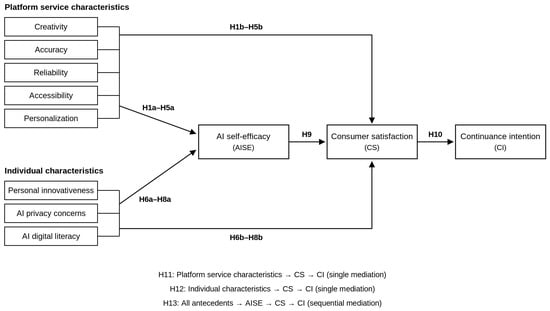
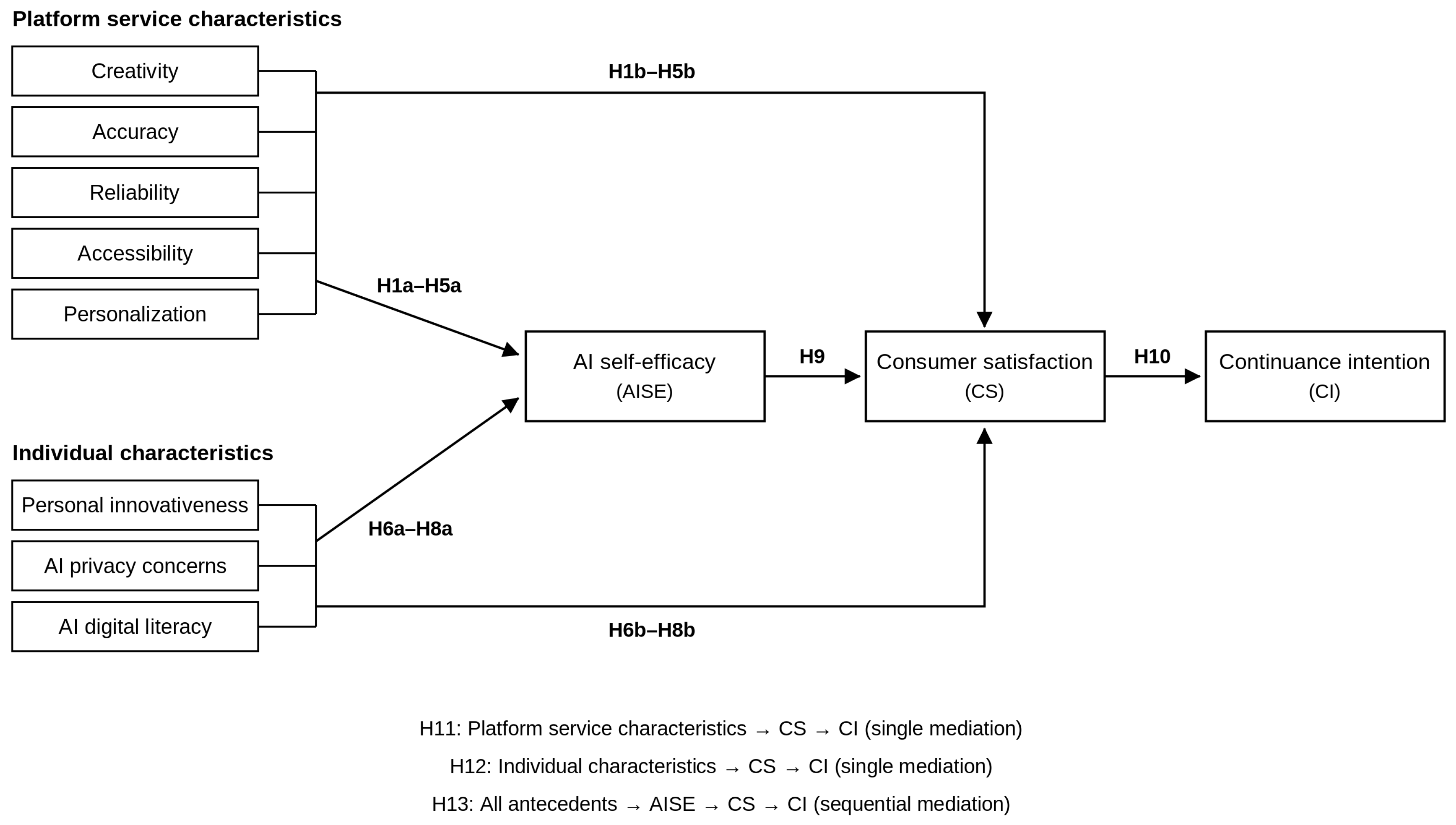
The full conceptual model, encompassing all hypothesized relationships, is illustrated in Figure 1.
Figure 1.
Hypothesized sequential dual-mediation model.
3. Materials and Methods
3.1. Research Model
Building on the theoretical framework presented above, this study proposes a research model to empirically examine the effects of platform service characteristics and individual characteristics on continuance intention among Midjourney users. The model includes the effects of platform service characteristics (creativity, accuracy, reliability, accessibility, and personalization) and individual characteristics (personal innovativeness, AI privacy concerns, and AI digital literacy) on AI self-efficacy, consumer satisfaction, and continuance intention. It also incorporates the sequential dual mediating effects of AI self-efficacy and consumer satisfaction in the relationships between these antecedent variables and continuance intention.
The proposed hypotheses (H1–H13) represent the structural pathways among independent variables, mediating variables, and the dependent variable, as derived from the preceding theoretical review. The research model is presented in Figure 1, with each arrow representing a specific hypothesized path. Solid arrows indicate direct hypothesized paths, whereas the sequential mediation structure (H13) captures the cognitive–affective mechanism through which antecedent variables are expected to influence continuance intention.
3.2. Participants, Data Collection, and Analytical Methods
The present study examined how platform service characteristics and individual characteristics influence continuance intention among Midjourney users through the sequential mediation of AI self-efficacy and consumer satisfaction. To this end, a non-probability purposive sampling strategy was adopted, as no sampling frame exists for Midjourney users in mainland China. Data were collected between 6 June and 11 June, 2025 through Wenjuanxing (问卷星), an online survey platform. The questionnaire link was distributed through AIGC-focused WeChat groups, and members of the researchers’ personal networks were asked to forward the link to other eligible users, yielding a combined purposive–snowball design. No incentive was offered. Participation was voluntary and anonymous, informed consent was obtained electronically on the opening page, and no personally identifiable information was collected (see Institutional Review Board Statement).
Eligibility was established through three mandatory screening questions presented before the main questionnaire: respondents were required to (i) be aged 18 years or older; (ii) confirm prior hands-on use of Midjourney for image generation; and (iii) report having used Midjourney at least once in the preceding three months. Respondents failing any criterion were routed to the exit page. A minimum experience threshold was imposed because the constructs under investigation require respondents to evaluate concrete service characteristics. In the final sample, 48.0% of respondents used Midjourney at least once per week, 28.5% two to three times per month, and 23.5% less frequently.
A total of 400 completed and eligible questionnaires were obtained. Because the questionnaire was distributed through an open link, the number of individuals exposed to the invitation is unknown and a response rate cannot be computed. The platform enforced completion of every item, so the dataset contained no missing values. Completion times were additionally examined for implausibly rapid responding; no cases fell below a plausible completion threshold, and all 400 responses were retained for analysis.
Midjourney is not officially accessible in mainland China and is typically accessed via virtual private network (VPN) connections or third-party relay services. Respondents therefore represent a self-selected subgroup characterized by relatively high levels of technology proficiency, AI digital literacy, and personal innovativeness, and by a non-trivial prior commitment to the platform rather than trial or incidental use. This sampling characteristic limits generalizability to casual or novice generative AI users, a constraint addressed in Section 5.4, while ensuring that respondents possess sufficient hands-on experience to evaluate the platform’s service characteristics. Mainland China represents one of the largest markets for AI-assisted content production.
Midjourney was selected over natively accessible domestic platforms such as ERNIE-ViLG, Tongyi Wanxiang, and Jimeng on two grounds. First, its longer operating history and larger accumulated body of prior research allow the present measurement items to be adapted from validated instruments and the findings to be benchmarked against prior work, including [16]; equivalent instrumentation is not yet available for the domestic platforms. Second, several domestic platforms underwent substantial interface, model, and pricing revisions during the data-collection period, whereas Midjourney’s prompt-and-iterate workflow remained comparatively stable. Because the platforms differ in access economics, pricing, and interface conventions, transferability of the present findings is treated as a boundary condition in Section 5.4.
All constructs were measured reflectively using three items each, adapted from previously validated scales. Platform service characteristics (creativity, accuracy, reliability, accessibility, and personalization) were adapted from [16,30,35]; individual characteristics (personal innovativeness, AI privacy concerns, and AI digital literacy) from [38,40,44]; AI self-efficacy from [45]; consumer satisfaction from [46]; and continuance intention from [40,47]. All items used a five-point Likert scale (1 = strongly disagree, 5 = strongly agree); the complete measurement items are provided in Table 1, Table 2 and Table 3.
Table 1.
Survey items for Midjourney service characteristics.
Table 2.
Survey items for individual characteristics.
Table 3.
Survey items for AI self-efficacy, consumer satisfaction, and continuance intention.
Adaptation proceeded in three stages. First, the original English items were translated into Chinese by the first author and back-translated into English, and the back-translated version was compared item by item against the source wording. Second, discrepancies identified in this comparison were adjudicated by the second author, a faculty member specializing in media and communication, and resolved through discussion. Third, generic referents in the source scales were replaced with Midjourney-specific referents (e.g., “the system responds quickly to my requests” was rewritten as “Midjourney returns generated images within an acceptable waiting time”); adaptations were confined to referent substitution and contextual specification. Items for creativity, accuracy, reliability, and personalization anchor their referent to the images generated by Midjourney rather than to the surrounding application environment, whereas the accessibility items refer to access across devices and locations. Prior to distribution, the finalized questionnaire was reviewed by five Midjourney users, who completed it and reported any items they found ambiguous. This review verified item clarity only; no psychometric analysis was undertaken at this stage. Minor wording revisions were made on the basis of their feedback, and these five responses were not included in the final dataset.
Data analysis was conducted using SPSS 27.0 and AMOS 26.0. Prior to hypothesis testing, the distributional assumptions underlying maximum likelihood estimation were examined: univariate skewness ranged from −0.887 to 0.652 and kurtosis from −0.938 to 1.062. Descriptive statistics and Pearson correlation analyses were performed to examine variable distributions and inter-construct relationships, and internal consistency reliability was assessed using Cronbach’s α. All eleven constructs were specified as first-order reflective latent variables, each indicated by three observed items, and the measurement model was estimated via confirmatory factor analysis in AMOS 26.0, with all eleven latent constructs permitted to covary freely. No modification indices were applied and no error covariances were freely estimated; the measurement model reported is the initially specified model. Discriminant validity was assessed using the heterotrait–monotrait ratio of correlations (HTMT; see Section 4.2.2). Structural equation modeling was then employed to test the proposed hypotheses, with the eight platform service and individual characteristic constructs specified as exogenous variables, AI self-efficacy and consumer satisfaction as sequential mediators, and continuance intention as the endogenous outcome. Two structural models were estimated. The primary model specified the hypothesized paths (H1a–H10), with the effect of AI self-efficacy on continuance intention transmitted entirely through consumer satisfaction. A supplementary model added a direct path from AI self-efficacy to continuance intention in order to test whether this effect is fully or partially mediated, and was used for this test only. Unless otherwise stated, all reported structural estimates, indirect effects, and explained variance are from the primary model. Direct effects (H1a–H10) were estimated simultaneously, with significance evaluated using critical ratios (|C.R.| > 1.96), and indirect effects (H11–H13) were examined using bootstrapping with 5000 resamples and 95% confidence intervals, implemented through user-defined estimands. Model fit was evaluated using χ2/df, CFI, TLI, RMSEA, and SRMR.
Because all variables were obtained from the same respondents at a single point in time using self-report measures, both procedural and statistical remedies for common method bias (CMB) were adopted [48]. Procedurally, respondent anonymity was guaranteed and communicated on the consent page, participants were informed that there were no right or wrong answers, and no incentive was offered. Statistically, Harman’s single-factor test was conducted first: the first unrotated factor accounted for 29.025% of the total variance, below the conventional 50% threshold [48]. Eleven factors with eigenvalues exceeding unity were extracted, accounting cumulatively for 79.992% of the total variance. Because Harman’s test alone is an insensitive diagnostic, a common latent factor (CLF) analysis was additionally conducted; model fit changed marginally with the CLF included (χ2 = 471.131, df = 440, CFI = 0.996 without the CLF; χ2 = 429.771, df = 419, CFI = 0.999 with it), with full results reported in Section 4.2.1.
4. Results
4.1. Demographic Analysis
The analytical sample comprised 400 adult users with prior experience using Midjourney. As presented in Table 4, male respondents accounted for 47.3% of the sample, and female respondents for 52.7%, indicating a relatively balanced gender distribution. Most respondents were in their 20s and 30s (80.8%), suggesting that the data primarily reflect usage patterns among young adults engaged in generative AI image creation.
Table 4.
Demographic characteristics of respondents.
In terms of educational background, the majority of respondents were either enrolled in or had graduated from a four-year university (61.5%), while approximately 30.3% held postgraduate degrees or above. Students and office workers represented the largest occupational groups. The most prevalent income category was below 3000 CNY per month, and most respondents resided in Tier-1 or Tier-2 cities. With respect to platform usage frequency, more than half of the respondents reported using Midjourney at least two to three times per month, indicating that the sample possessed sufficient practical experience to meaningfully evaluate generative AI image-generation services.
4.2. Validity and Reliability Analysis
4.2.1. Confirmatory Factor Analysis (CFA)
Confirmatory factor analysis (CFA) was conducted to assess the adequacy of the measurement model. As reported in Table 5, all fit indices met the recommended criteria (χ2/df < 3, CFI > 0.90, TLI > 0.90, RMSEA < 0.05), indicating an acceptable model fit and supporting the structural validity of the measurement model. Specifically, the measurement model yielded χ2 = 471.131 with df = 440 (p = 0.147), corresponding to χ2/df = 1.071 (Table 5).
Table 5.
(a) CFA model fit indices. (b) Common method bias check: model fit of the measurement model with and without a common latent factor (CLF).
To supplement Harman’s single-factor test, a common latent factor loading on all indicators was added to the measurement model, and model fit was compared with and without the CLF (Table 5b). Adding the common method factor did not substantially improve model fit (ΔCFI = 0.003 < 0.01; ΔRMSEA = 0.005; ΔSRMR = 0.001), indicating that common method bias is unlikely to pose a serious threat to the findings [48,49].
4.2.2. Reliability and Convergent Validity
Reliability and convergent validity were evaluated using factor loadings, Cronbach’s alpha (α), composite reliability (CR), and average variance extracted (AVE). As shown in Table 6, all factor loadings ranged from 0.785 to 0.899, exceeding the recommended threshold of 0.70. Cronbach’s alpha values ranged from 0.861 to 0.905, while CR values ranged from 0.861 to 0.906, both exceeding 0.70, confirming internal consistency and construct reliability. In addition, AVE values ranged from 0.674 to 0.762, all above the recommended threshold of 0.50 [50], providing evidence of convergent validity. Discriminant validity was assessed using the heterotrait–monotrait ratio of correlations (HTMT), computed for all construct pairs from the item-level correlation matrix (Table 6b); all values were below the conservative 0.85 threshold (maximum = 0.785 for the CS–CI pair), supporting the discriminant validity of all constructs [51].
Table 6.
(a) Reliability and validity analysis results. (b) Discriminant validity: heterotrait–monotrait (HTMT) ratio.
4.2.3. Correlation Analysis
Pearson correlation analysis was conducted to examine the relationships among the key constructs. As presented in Table 7, most variables showed statistically significant positive correlations, indicating meaningful associations in the expected directions. Notably, consumer satisfaction exhibited a relatively strong positive correlation with continuance intention (r = 0.697) [52], highlighting the central role of satisfaction in explaining sustained engagement. By contrast, AI privacy concerns were negatively correlated with all other key variables, indicating that privacy-related apprehensions may undermine positive user evaluations and continuance intention.
Table 7.
Pearson correlation analysis among constructs.
4.3. Hypothesis Testing
The proposed hypotheses (H1a–H13) were tested using SEM in AMOS 26.0 (Table 8). Indirect effects were assessed via bootstrapping with 5000 resamples and 95% confidence intervals. The results showed that the effects of all independent variables on continuance intention were primarily transmitted through two indirect pathways: (1) a single mediation pathway through consumer satisfaction (X → Consumer Satisfaction → Continuance Intention), and (2) a sequential mediation pathway through AI self-efficacy and consumer satisfaction (X → AI Self-Efficacy → Consumer Satisfaction → Continuance Intention). The single mediation pathway was significant for all antecedents except AI privacy concerns, whereas the sequential pathway was significant for all antecedents (see Table 9).
Table 8.
Hypothesis testing results: direct effects.
Table 9.
Indirect effects: sequential mediation (H11–H13).
All five platform service characteristics exerted significant positive effects on both AI self-efficacy and consumer satisfaction. Creativity (B = 0.111, p < 0.001), accuracy (B = 0.090, p = 0.004), reliability (B = 0.173, p < 0.001), accessibility (B = 0.143, p < 0.001), and personalization (B = 0.143, p < 0.001) each positively influenced AI self-efficacy, supporting H1a–H5a. Similarly, all five characteristics exerted significant positive effects on consumer satisfaction, supporting H1b–H5b. The sequential mediation pathway (H13) was consistently significant across all five characteristics (see Table 9).
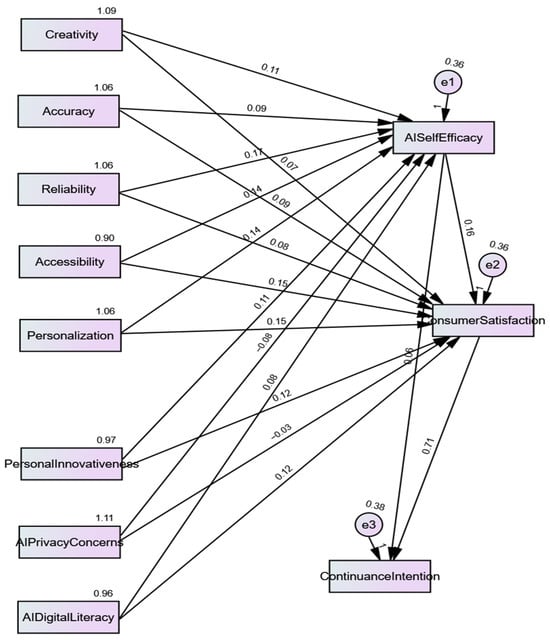
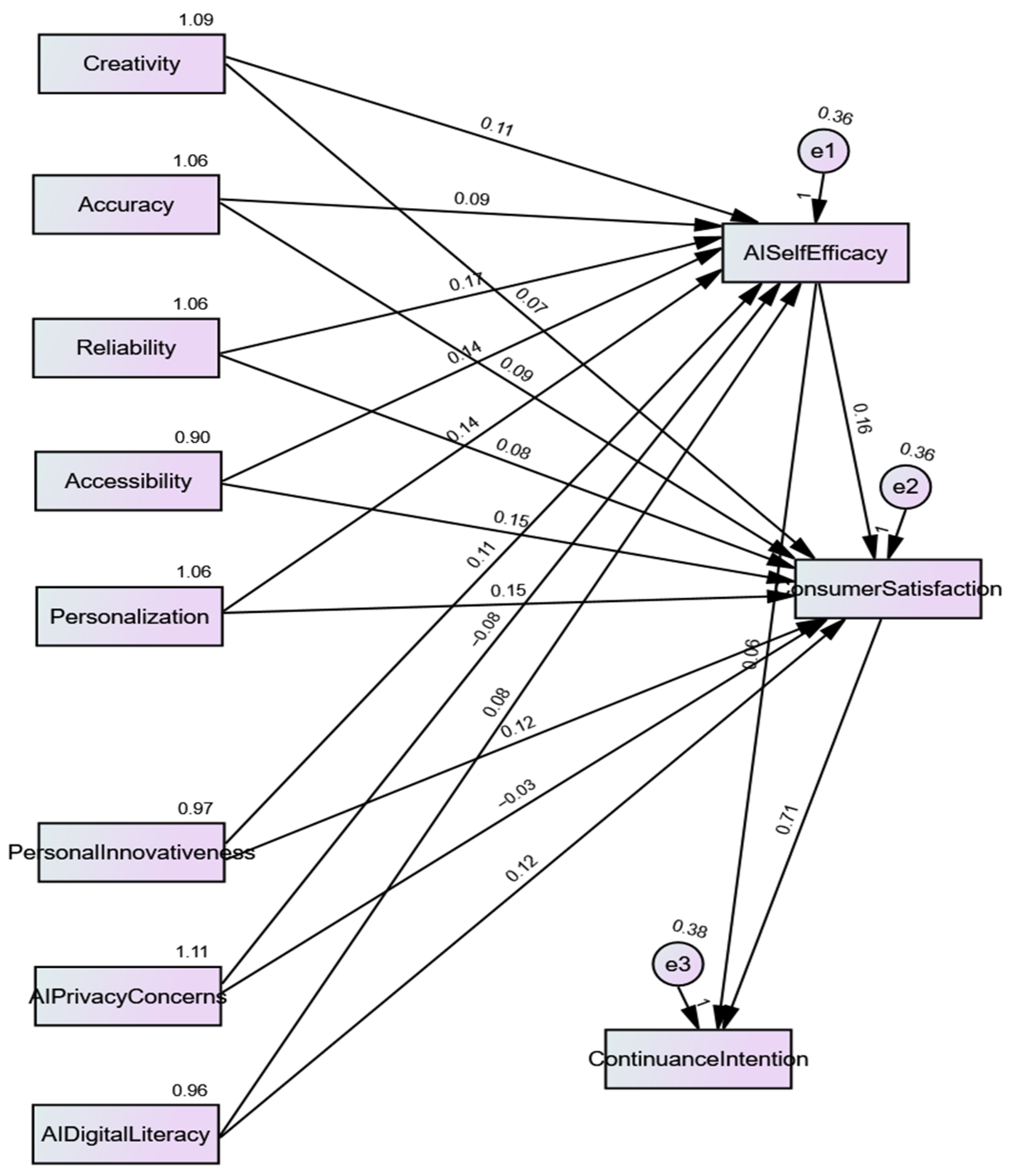
Consumer satisfaction demonstrated a strong positive effect on continuance intention (B = 0.744, S.E. = 0.038, C.R. = 19.425, p < 0.001), supporting H10. AI self-efficacy also exerted a significant positive direct effect on consumer satisfaction (B = 0.163, S.E. = 0.050, C.R. = 3.270, p = 0.001), supporting H9. To test full versus partial mediation, a supplementary model added a direct path from AI self-efficacy to continuance intention; this direct path was not significant (B = 0.063, S.E. = 0.046, C.R. = 1.377, p = 0.168). In the supplementary model testing partial mediation, the CS → CI path remained strong (B = 0.712, C.R. = 15.904, p < 0.001), further supporting the full-mediation specification (Table 8, Suppl. model; Figure 2).
Figure 2.
Structural model results for the supplementary model (unstandardized path coefficients). The supplementary model differs from the primary model only by the added direct AISE → CI path (B = 0.063, n.s.), which was examined as a full- versus partial-mediation test and was not hypothesized. In this model the CS → CI path is B = 0.712; the corresponding estimate in the primary model, reported in Table 8, is B = 0.744.
Among the individual characteristics, personal innovativeness exerted significant positive effects on both AI self-efficacy (B = 0.113, p < 0.001) and consumer satisfaction (B = 0.116, p < 0.001), supporting H6a and H6b. AI digital literacy also demonstrated significant positive effects on AI self-efficacy (B = 0.077, p = 0.020) and consumer satisfaction (B = 0.123, p < 0.001), supporting H8a and H8b. In contrast, AI privacy concerns exerted a significant negative effect on AI self-efficacy (B = −0.079, p = 0.011), supporting H7a. However, the direct effect of AI privacy concerns on consumer satisfaction was not statistically significant (B = −0.034, p = 0.283); therefore, H7b was not supported. This finding is consistent with the privacy paradox literature [53].
The primary model explained 43.3% of the variance in AI self-efficacy (R2 = 0.433), 45.6% of the variance in consumer satisfaction (R2 = 0.456), and 48.6% of the variance in continuance intention (R2 = 0.486), indicating moderate-to-substantial explanatory power.
4.4. Robustness Check
To examine the robustness of the structural estimates to potential confounding, frequency of use was entered as a control variable predicting consumer satisfaction and continuance intention, with the hypothesized model structure otherwise unchanged. Frequency of use had no significant effect on either consumer satisfaction (B = 0.011, S.E. = 0.028, C.R. = 0.380, p = 0.704) or continuance intention (B = −0.009, S.E. = 0.029, C.R. = −0.321, p = 0.748), and the key structural paths remained virtually identical (e.g., CS → CI: B = 0.745, C.R. = 19.431, compared with B = 0.744, C.R. = 19.425 in the original model), indicating that the reported findings are robust to the inclusion of this control variable (Table 10).
Table 10.
Robustness check: comparison of structural estimates.
5. Conclusions
5.1. Summary of Findings
This study empirically examined the structural relationships through which platform service characteristics (creativity, accuracy, reliability, accessibility, and personalization) and individual characteristics (personal innovativeness, AI privacy concerns, and AI digital literacy) influence continuance intention among Midjourney users, via the sequential mediation of AI self-efficacy and consumer satisfaction. A total of 18 direct-effect hypotheses (H1a–H10) and three mediation hypotheses (H11–H13) were proposed and tested within a sequential dual-mediation framework. The findings specify one process-oriented pathway through which continuance intention is formed in generative AI environments, within the bounds of the antecedents and mediators modeled here.
First, all five platform service characteristics exerted significant indirect effects on continuance intention through AI self-efficacy and consumer satisfaction (H1a–H5b: all supported). The pattern differed across the two mediators. Reliability exerted the strongest effect on AI self-efficacy (B = 0.173), underscoring the role of output consistency in shaping users’ confidence in directing the system. Consumer satisfaction, by contrast, was most strongly predicted by accessibility and personalization (both B = 0.149), while reliability ranked sixth among the seven positive antecedents (B = 0.076). Perceived dependability therefore appears to operate primarily on the cognitive rather than the affective component of the evaluation process.
Second, consumer satisfaction functioned as a central mediating mechanism for all platform service characteristics (H11 supported) as well as for personal innovativeness and AI digital literacy; for AI privacy concerns, however, the single mediation path through satisfaction was not significant, so H12 was partially supported. The findings suggest that user perceptions of both platform characteristics and individual attributes shape continuance intention through satisfaction, consistent with the core assumptions of ECT [15]. Third, AI self-efficacy did not directly predict continuance intention but instead functioned as a cognitive antecedent of satisfaction, supporting H9. The sequential mediation pathway (H13) was significant across all independent variables. Fourth, personal innovativeness and AI digital literacy positively influenced continuance intention by enhancing AI self-efficacy and consumer satisfaction, whereas AI privacy concerns exerted a significant negative effect through AI self-efficacy (H7a: supported) but not through consumer satisfaction (H7b: not supported), consistent with the privacy paradox literature [53].
The relatively small coefficients observed for personal innovativeness and AI digital literacy should also be interpreted in light of range restriction inherent in the VPN-based sample. Users who consistently access Midjourney through VPN or relay services in mainland China represent a self-selected population that is likely already homogeneous in innovativeness and digital literacy relative to the general population. This restricted variance would statistically attenuate the observed relationships between these individual-difference variables and the downstream outcomes, independent of their true theoretical importance (see Section 5.4).
5.2. Theoretical Implications
This study contributes to information systems continuance research by conceptualizing generative AI platforms as interactive socio-technical systems characterized by iterative human–AI co-creation, drawing on the notion of machine agency [19] as interpretive background. While prior continuance intention research has primarily applied Expectation-Confirmation Theory (ECT) and Self-Efficacy Theory to passive technology services, this study argues that generative AI changes the nature of technology use by introducing an active computational partner into the interaction process. Within this framework, the study introduces and empirically validates a sequential cognitive–affective mechanism in which AI self-efficacy and consumer satisfaction jointly mediate the relationship between antecedent characteristics and continuance intention (H9, H10, H13). This mechanism extends existing single-mediator models and provides a more complete explanation of sustained human–AI engagement. In doing so, this study also extends research on continued participation in online platforms [4,5,6] to the emerging context of generative AI image platforms. Whereas prior studies have examined continued participation primarily in community-based and socially interactive environments, this study demonstrates how AI self-efficacy and consumer satisfaction help explain users’ continuance intention in human–AI interaction.
Additionally, by identifying AI privacy concerns as a negative factor operating through AI self-efficacy (H7a: supported) but not through consumer satisfaction (H7b: not supported), this study highlights the differentiated role of risk perception in generative AI usage behavior. The findings extend prior research on the privacy paradox [53] by demonstrating that privacy concerns primarily influence cognitive evaluations rather than affective satisfaction.
A further point warrants discussion. The path from consumer satisfaction to continuance intention was notably strong (B = 0.744), raising the question of whether the two constructs reflect overlapping rather than fully distinct attitudes. To address this concern, heterotrait–monotrait (HTMT) ratios were computed for all construct pairs; the CS–CI value was 0.785, below the conservative threshold of 0.85 [51], supporting the discriminant validity of the two constructs. Substantively, a strong CS–CI linkage is consistent with the theoretical core of expectation–confirmation theory, which positions satisfaction as the most proximal and dominant determinant of continuance intention [15]; the strength of this path is therefore theoretically expected rather than indicative of construct redundancy. Nevertheless, the continuance-intention items used here capture an attitudinal rather than behavioral form of continuance and thus share conceptual proximity with satisfaction. Future research would benefit from more behaviorally grounded dependent variables—such as actual renewal and payment behavior or objectively logged usage frequency—to further disentangle continuance intention from satisfaction.
5.3. Practical Implications
For Midjourney and platforms with structurally similar subscription-based, community-embedded image-generation configurations, the findings offer several implications, which—given the modest magnitudes of the individual effects—should be read as directional guidance rather than as a basis for major resource reallocation. First, given that all platform service characteristics influence continuance intention through a sequential cognitive–affective process, developers should prioritize the overall quality of the human–AI interaction experience. In particular, improving the consistency, predictability, and interpretability of AI-generated outputs is critical, since reliability was the strongest antecedent of AI self-efficacy. Where the objective is to raise satisfaction directly, however, accessibility and personalization were the stronger levers in this sample. Second, platforms should design user experiences that enhance both self-efficacy and consumer satisfaction through intuitive interfaces, onboarding support, and interactive guidance. Third, transparent data governance policies and effective privacy protection mechanisms are essential for reducing user uncertainty surrounding data collection and usage practices, thereby supporting self-efficacy formation and long-term user retention. Finally, given the small absolute magnitudes of the sequential mediation effects (0.009–0.021), these implications should be interpreted as suggestive evidence of the proposed cognitive–affective mechanism, to be verified in future studies with larger and more diverse samples.
5.4. Limitations and Future Research
Despite its contributions, this study has several limitations. First, the data were collected from users in mainland China, where Midjourney is not officially accessible. Users therefore relied on VPN services or comparable workarounds to access the platform. As a result, the sample may be biased toward users with relatively high levels of technological proficiency and innovativeness. Future research should recruit participants from multiple countries with different regulatory and technological environments. Relatedly, the self-selected nature of this population implies range restriction on individual-level variables such as personal innovativeness and AI digital literacy, which attenuates their estimated effects and should inform the interpretation of the corresponding coefficients (see Section 5.1). Second, the cross-sectional design limits the ability to establish causal relationships. In particular, the direction specified from AI self-efficacy to satisfaction is a theoretical assumption rather than an established empirical result; reverse or reciprocal relations between the two constructs are plausible, and alternative specifications—including reversed and non-recursive models—cannot be adjudicated with the present design. Future studies should adopt longitudinal or experimental designs to examine the dynamic formation of continuance intention over time. Third, this study focused exclusively on Midjourney, which may constrain the generalizability of the findings to other generative AI systems. Future research should test the proposed model across multiple generative AI platforms and usage contexts. Beyond external validity, the single-platform design also bears on construct validity. Although Midjourney has been directly accessible through its web interface since August 2024 and no longer requires Discord, the platform retains a community-embedded, prompt-centric workflow that originated in Discord, operates a predominantly subscription-based access model without a meaningful free tier, and—at the time of data collection—produced image-only output (video generation was introduced only after the survey window). For the sampled population in mainland China, moreover, both the Discord client and the web interface require VPN or relay access, so the practically binding entry barrier relevant to accessibility and AI self-efficacy operates at the level of network access rather than interface choice. The constructs and estimates reported here should therefore be interpreted as platform-situated, and replication across platforms with different interaction modes, pricing structures, and output modalities is required before broader generalization. The model also does not capture vicarious experience as a source of AI self-efficacy, although observation of other users’ prompts and outputs is a routine feature of practice on this platform; incorporating this source is a priority for subsequent work. Relatedly, the access channel through which respondents reached the platform (web interface or Discord client) was not recorded; future studies should record the access channel and examine it as a control variable or moderator. Fourth, additional factors such as social influence, emotional engagement, switching costs, and perceived creativity support may further explain continuance intention in generative AI contexts and should be incorporated in future studies.
Author Contributions
Conceptualization, L.L. and J.K.; methodology, L.L.; formal analysis, L.L.; investigation, L.L.; data curation, L.L.; writing—original draft preparation, L.L.; writing—review and editing, J.K.; supervision, J.K.; project administration, J.K. All authors have read and agreed to the published version of the manuscript.
Funding
The present research was supported by the research fund of Dankook University in 2025.
Institutional Review Board Statement
Ethical review and approval were waived for this study in accordance with Article 15(2) of the Bioethics and Safety Act of the Republic of Korea and Article 13(1)(2) of its Enforcement Rule, under which research that neither identifies participants nor collects or records sensitive information is exempt from institutional review board review. The study involved only anonymous online survey data with no identifiable participant information and no risk to participants. As the participants were located in mainland China, the study would likewise qualify for exemption from ethical review under Article 32(2) of China’s Measures for Ethical Review of Life Sciences and Medical Research Involving Humans (2023), which exempts research using anonymized information data that neither causes harm to the human body nor involves sensitive personal information or commercial interests.
Informed Consent Statement
Informed consent was obtained from all subjects involved in the study.
Data Availability Statement
The data presented in this study are available on request from the corresponding author.
Acknowledgments
During the preparation of this manuscript, the authors used ChatGPT (OpenAI, version 4.0) for language editing and proofreading. The authors have reviewed and edited all output and take full responsibility for the content of this publication.
Conflicts of Interest
The authors declare no conflicts of interest. The funders had no role in the design of the study; in the collection, analyses, or interpretation of data; in the writing of the manuscript; or in the decision to publish the results.
References
- Holzner, N.; Maier, S.; Feuerriegel, S. Generative AI and creativity: A systematic literature review and meta-analysis. arXiv 2025, arXiv:2505.17241. [Google Scholar]
- Ramaswamy, A.; Navaratnarajah, M.; Chockler, H. It’s a feature, not a bug: Measuring creative fluidity in image generators. arXiv 2024, arXiv:2406.18570. [Google Scholar]
- Long, D.; Magerko, B. What is AI literacy? Competencies and design considerations. In Proceedings of the 2020 CHI Conference on Human Factors in Computing Systems; ACM: New York, NY, USA, 2020; pp. 1–16. [Google Scholar]
- Sun, Y.; Fang, Y.; Lim, K.H. Understanding Sustained Participation in Transactional Virtual Communities. Decis. Support Syst. 2012, 53, 12–22. [Google Scholar] [CrossRef] [Scilit]
- Zhang, C.; Hahn, J.; De, P. Research Note—Continued Participation in Online Innovation Communities: Does Community Response Matter Equally for Everyone? Inf. Syst. Res. 2013, 24, 1112–1130. [Google Scholar] [CrossRef] [Scilit]
- Zhang, X.; Sun, F.; Cheng, Y.; Meng, F.; Lai, K.H. Peer Effects on Physicians’ Participation in Online Medical Teams: A Social Comparison Perspective. IEEE Trans. Eng. Manag. 2026, in press. [Google Scholar]
- Ramesh, A.; Dhariwal, P.; Nichol, A.; Chu, C.; Chen, M. Hierarchical text-conditional image generation with CLIP latents. arXiv 2022, arXiv:2204.06125. [Google Scholar]
- Saharia, C.; Chan, W.; Saxena, S.; Li, L.; Whang, J.; Denton, E.L.; Norouzi, M. Photorealistic text-to-image diffusion models with deep language understanding. Adv. Neural Inf. Process. Syst. 2022, 35, 36479–36494. [Google Scholar] [CrossRef] [Scilit]
- Dwivedi, Y.K.; Kshetri, N.; Hughes, L.; Slade, E.L.; Jeyaraj, A.; Kar, A.K.; Baabdullah, A.M.; Koohang, A.; Raghavan, V.; Ahuja, M.; et al. Opinion Paper: “So what if ChatGPT wrote it?” Multidisciplinary perspectives on opportunities, challenges and implications of generative conversational AI for research, practice and policy. Int. J. Inf. Manag. 2023, 71, 102642. [Google Scholar] [CrossRef] [Scilit]
- Feuerriegel, S.; Hartmann, J.; Janiesch, C.; Zschech, P. Generative AI. Bus. Inf. Syst. Eng. 2024, 66, 111–126. [Google Scholar] [CrossRef] [Scilit]
- Oppenlaender, J. The creativity of text-to-image generation. In Proceedings of the 25th International Academic Mindtrek Conference; ACM: New York, NY, USA, 2022; pp. 192–202. [Google Scholar]
- Yin, H.; Zhang, Z.; Liu, Y. The exploration of integrating the Midjourney artificial intelligence generated content tool into design systems to direct designers towards future-oriented innovation. Systems 2023, 11, 566. [Google Scholar] [CrossRef] [Scilit]
- Bandura, A. Social Foundations of Thought and Action: A Social Cognitive Theory; Prentice-Hall: Englewood Cliffs, NJ, USA, 1986. [Google Scholar]
- Compeau, D.R.; Higgins, C.A. Computer self-efficacy: Development of a measure and initial test. MIS Q. 1995, 19, 189–211. [Google Scholar] [CrossRef] [Scilit] [PubMed]
- Bhattacherjee, A. Understanding information systems continuance: An expectation-confirmation model. MIS Q. 2001, 25, 351–370. [Google Scholar] [CrossRef] [Scilit]
- Yong, Y.; Koo, J.-J. The influence of accuracy and creativity of image generation AI on users’ intention of continuous use: Focused on Midjourney. J. Commun. Des. 2025, 91, 295–311. [Google Scholar] [CrossRef] [Scilit]
- Yu, X.; Yang, Y.; Li, S. Users’ continuance intention towards an AI painting application: An extended expectation confirmation model. PLoS ONE 2024, 19, e0301821. [Google Scholar] [CrossRef] [Scilit] [PubMed]
- Xu, J.; Ren, X.; Huang, Y.; Wu, R.; Pan, Y. Persist or abandon? Exploring Chinese users’ continuance intentions toward AI painting tools. IEEE Access 2024, 12, 135469–135488. [Google Scholar] [CrossRef] [Scilit]
- Sundar, S.S. Rise of machine agency: A framework for studying the psychology of human–AI interaction (HAII). J. Comput.-Mediat. Commun. 2020, 25, 74–88. [Google Scholar] [CrossRef] [Scilit]
- Taylor, S.A.; Baker, T.L. An assessment of the relationship between service quality and customer satisfaction in the formation of consumers’ purchase intentions. J. Retail. 1994, 70, 163–178. [Google Scholar] [CrossRef] [Scilit]
- Rogers, E.M. Diffusion of Innovations, 5th ed.; Free Press: New York, NY, USA, 2003. [Google Scholar]
- Malhotra, N.K.; Kim, S.S.; Agarwal, J. Internet users’ information privacy concerns (IUIPC): The construct, the scale, and a causal model. Inf. Syst. Res. 2004, 15, 336–355. [Google Scholar] [CrossRef] [Scilit]
- Oppenlaender, J.; Linder, R.; Silvennoinen, J. Prompting AI art: An investigation into the creative skill of prompt engineering. Int. J. Hum.–Comput. Interact. 2025, 41, 10207–10229. [Google Scholar] [CrossRef] [Scilit]
- Goodfellow, I.J.; Pouget-Abadie, J.; Mirza, M.; Xu, B.; Warde-Farley, D.; Ozair, S.; Bengio, Y. Generative adversarial nets. Adv. Neural Inf. Process. Syst. 2014, 27, 2672–2680. [Google Scholar]
- Don-Yehiya, S.; Choshen, L.; Abend, O. Human learning by model feedback: The dynamics of iterative prompting with Midjourney. arXiv 2023, arXiv:2311.12131. [Google Scholar]
- Tan, L.; Luhrs, M. Using generative AI Midjourney to enhance divergent and convergent thinking in an architect’s creative design process. Des. J. 2024, 27, 677–699. [Google Scholar] [CrossRef] [Scilit]
- Barve, S.; Mao, A.; Shi, J.M.; Juneja, P.; Saha, K. Can we debias social stereotypes in AI-generated images? arXiv 2025, arXiv:2505.20692. [Google Scholar]
- Ba, Z.; Zhong, J.; Lei, J.; Cheng, P.; Wang, Q.; Qin, Z.; Ren, K. SurrogatePrompt: Bypassing the safety filter of text-to-image models via substitution. In Proceedings of the 2024 ACM SIGSAC Conference on Computer and Communications Security; ACM: New York, NY, USA, 2024; pp. 1166–1180. [Google Scholar]
- Midjourney. The Web Is Open to All! Available online: https://updates.midjourney.com/the-web-is-open-to-all/ (accessed on 1 May 2025).
- Oh, J.; Kim, G.-Y. A study on the intention of ChatGPT usage in the characteristics of generative artificial intelligence services. Asia-Pac. J. Converg. Res. Interchange 2024, 10, 265–282. [Google Scholar] [CrossRef] [Scilit]
- Chen, Y. Pandora’s pixel box: The rise of AI art and the ethical dilemma of creativity. Lect. Notes Educ. Psychol. Public Media 2023, 38, 135–143. [Google Scholar] [CrossRef] [Scilit]
- Epstein, Z.; Schroeder, H.; Newman, D. When happy accidents spark creativity: Bringing collaborative speculation to life with generative AI. arXiv 2022, arXiv:2206.00533. [Google Scholar]
- Mayer, R.C.; Davis, J.H.; Schoorman, F.D. An integrative model of organizational trust. Acad. Manag. Rev. 1995, 20, 709–734. [Google Scholar] [CrossRef] [Scilit]
- Venkatesh, V.; Morris, M.G.; Davis, G.B.; Davis, F.D. User acceptance of information technology: Toward a unified view. MIS Q. 2003, 27, 425–478. [Google Scholar] [CrossRef] [Scilit]
- Ning, L.; Jeong, H.-Y. Impact of ChatGPT characteristics on user intention to use. Asia-Pac. J. Converg. Res. Interchange 2024, 10, 133–143. [Google Scholar] [CrossRef] [Scilit]
- Sundar, S.S.; Marathe, S.S. Personalization versus customization: The importance of agency, privacy, and power usage. Hum. Commun. Res. 2010, 36, 298–322. [Google Scholar] [CrossRef] [Scilit]
- Agarwal, R.; Karahanna, E. Time flies when you’re having fun: Cognitive absorption and beliefs about information technology usage. MIS Q. 2000, 24, 665–694. [Google Scholar] [CrossRef] [Scilit]
- Son, Y.-W.; Moon, H.-J.; Park, S.-S. Research on the usage intention of smart (AI) speakers among Chinese consumers. J. Chin. Stud. 2021, 96, 205–249. [Google Scholar] [CrossRef] [Scilit]
- Lee, W.J.; Lee, E.-H.; Kim, S. Developing a digital literacy curriculum framework. CNU J. Educ. Stud. 2019, 32, 201–221. [Google Scholar]
- Lee, J.; Oh, H.-J. Determinants of continuous use of generative AI: Focusing on the extended technology acceptance model and AI literacy. Korean J. Advert. Public Relat. 2024, 26, 96–140. [Google Scholar] [CrossRef] [Scilit]
- Fan, P.; Jiang, Q. Exploring the factors influencing continuance intention to use AI drawing tools: Insights from designers. Systems 2024, 12, 68. [Google Scholar] [CrossRef] [Scilit]
- Compeau, D.R.; Higgins, C.A.; Huff, S. Social cognitive theory and individual reactions to computing technology: A longitudinal study. MIS Q. 1999, 23, 145–158. [Google Scholar] [CrossRef] [Scilit]
- Oliver, R.L. A cognitive model of the antecedents and consequences of satisfaction decisions. J. Mark. Res. 1980, 17, 460–469. [Google Scholar] [CrossRef] [Scilit]
- No, C.-Y. The Effect of Digital Literacy Competency on Intention to Use the AI Service ChatGPT. Master’s Thesis, Hanyang University, Seoul, Republic of Korea, 2024. [Google Scholar]
- Moon, S. The impact of AI self-efficacy, AI anxiety, and AI trust on attitude and acceptance intentions toward generative AI. J. Digit. Contents Soc. 2024, 25, 3319–3327. [Google Scholar] [CrossRef] [Scilit]
- Lee, G.-H. A Study on the Factors Affecting User Satisfaction of ChatGPT. Master’s Thesis, Hoseo University, Asan, Republic of Korea, 2023. [Google Scholar]
- Yue, D. Impact of ChatGPT e-Service Quality on Reuse Intention: Focusing on the Mediating Effects of Social Presence and Perceived Usefulness. Master’s Thesis, University of Ulsan, Ulsan, Republic of Korea, 2024. [Google Scholar]
- Podsakoff, P.M.; MacKenzie, S.B.; Lee, J.-Y.; Podsakoff, N.P. Common method biases in behavioral research: A critical review of the literature and recommended remedies. J. Appl. Psychol. 2003, 88, 879–903. [Google Scholar] [CrossRef] [Scilit] [PubMed]
- Cheung, G.W.; Rensvold, R.B. Evaluating goodness-of-fit indexes for testing measurement invariance. Struct. Equ. Model. 2002, 9, 233–255. [Google Scholar] [CrossRef] [Scilit] [PubMed]
- Hair, J.F.; Black, W.C.; Babin, B.J.; Anderson, R.E. Multivariate Data Analysis, 8th ed.; Cengage Learning: Andover, UK, 2019. [Google Scholar]
- Henseler, J.; Ringle, C.M.; Sarstedt, M. A new criterion for assessing discriminant validity in variance-based structural equation modeling. J. Acad. Mark. Sci. 2015, 43, 115–135. [Google Scholar] [CrossRef] [Scilit]
- Deng, Z.; Lu, Y.; Wei, K.K.; Zhang, J. Understanding customer satisfaction and loyalty: An empirical study of mobile instant messages in China. Int. J. Inf. Manag. 2010, 30, 289–300. [Google Scholar] [CrossRef] [Scilit]
- Dinev, T.; Hart, P. An extended privacy calculus model for e-commerce transactions. Inf. Syst. Res. 2006, 17, 61–80. [Google Scholar] [CrossRef] [Scilit]

Disclaimer/Publisher’s Note: The statements, opinions and data contained in all publications are solely those of the individual author(s) and contributor(s) and not of MDPI and/or the editor(s). MDPI and/or the editor(s) disclaim responsibility for any injury to people or property resulting from any ideas, methods, instructions or products referred to in the content. |
© 2026 by the authors. Licensee MDPI, Basel, Switzerland. This article is an open access article distributed under the terms and conditions of the Creative Commons Attribution (CC BY) license.