Skip to Content
  • Tracked for
    Impact Factor
  • 5.2
    CiteScore
  • 27 days
    Time to First Decision

Sci

Sci is an international, peer-reviewed, open access journal on all research fields published monthly online by MDPI.

Get Alerted

Add your email address to receive forthcoming issues of this journal.

All Articles (561)

The increasing use of pressure-sensitive labels (PSLs), driven by growth in the packaging sector, raises concerns regarding material consumption and end-of-life management under evolving European packaging regulations. This study investigates the biodegradation potential of sustainable PSL facestocks produced from 15% agro-industrial by-products, 40% post-consumer recycled fibers, and 45% virgin wood pulp. Their biodegradation behavior was compared with bio-based polyethylene (PE) facestocks using laboratory-scale aerobic soil burial tests conducted for up to 28 days. Biodegradation was assessed through weight loss measurements, visual evaluation, Fourier transform infrared (FTIR) spectroscopy, and fluorescence analysis. Fiber-based facestocks exhibited significant degradation, reaching approximately 50–55% weight loss after 28 days, accompanied by structural changes in the cellulose matrix and reduced fluorescence intensity. In contrast, bio-based polyethylene facestocks showed negligible weight loss and only minor spectroscopic changes, indicating high stability under the tested conditions. The results demonstrate that fiber-based samples derived from agro-industrial and recycled sources possess substantially higher biodegradation potential than bio-based polymeric alternatives. These findings support the use of fiber-based PSL facestocks in applications requiring improved environmental compatibility.

28 April 2026
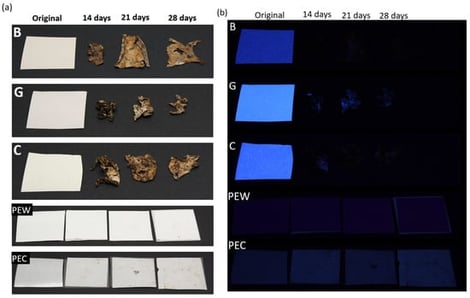
Visual evaluation of samples after aerobic biodegradation processes up to 28 days under (a) illuminant D50 and (b) illuminant UV.

Natural antioxidants are essential for protecting the body against oxidative stress and exhibit a wide range of biological activities. In this context, forty extracts derived from ten submerged cultivated mushroom species were analyzed for their mycochemical composition, antioxidant capacity, and cytotoxic effects against MCF7 breast cancer cells. Qualitative and quantitative screening revealed that, among the detected classes of bioactive compounds, the extracts were predominantly enriched in flavonoids, terpenoids, and phenolic constituents. Considerable variation was observed in the levels of total phenolics, flavonoids, and ascorbic acid among different species and solvent extracts. The highest total phenolic contents were detected in ethanol and ethyl acetate extracts of G. frondosa (110.0 ± 6.4, 227.6 ± 14.2, and 160.5 ± 5.3 mg GAE/g), while the water extract of F. velutipes also exhibited elevated phenolic levels (119.2 ± 6.5 mg GAE/g). Flavonoid concentrations ranged from 102.5 ± 10.5 to 359.9 ± 2.5 mg QE/g in biomass and culture liquid extracts obtained with organic solvents. Ascorbic acid content was generally highest in ethyl acetate culture liquid extracts, suggesting solvent-dependent enrichment of antioxidant metabolites. Free radical scavenging activity increased in a concentration-dependent manner, reaching inhibition values more than 90% at 20 mg/mL in all tested mushrooms. Cytotoxicity assays demonstrated that extract type, solvent, and incubation time strongly influenced the inhibition of MCF7 cell viability. Ethyl acetate extracts from H. erinaceus, P. ostreatus, T. versicolor, and T. pubescens exhibited the strongest cytotoxic effects, reducing cell viability by up to 70% at higher concentrations. The results demonstrate that mushroom extracts, particularly ethyl acetate extracts, possess significant antioxidant and cytotoxic activities. These findings highlight their potential as promising natural sources of medicinal bioactive compounds for antioxidant and anticancer applications.

28 April 2026

This study investigates the influence of extraction method and solvent on the UV spectral characteristics of extracts obtained from selected agro-industrial waste materials. Conventional maceration and ultrasound-assisted extraction (UAE) were applied using distilled water and 70% (v/v) ethanol as solvents. The analyzed materials included spent coffee grounds, orange peel, rosehip, milk thistle, eucalyptus leaves, and chili pepper. UV spectrophotometric analysis (190–400 nm) was used to compare the absorption profiles of the obtained extracts and to evaluate the effect of extraction conditions on spectral features. The results showed that both solvent type and extraction technique significantly influenced the intensity and shape of the absorption spectra. Ethanol generally resulted in higher absorbance values and more defined spectral features in the 250–350 nm region, while aqueous extracts exhibited stronger absorption in the lower UV range. Overall, UV spectroscopy proved to be a rapid and effective screening tool for evaluating extraction performance and comparing spectral characteristics of complex plant extracts, supporting the valorization of agro-industrial waste. Total phenolic content (TPC) was additionally determined to support the evaluation of extraction efficiency.

27 April 2026

Sci and AI

  • Claus Jacob

Artificial Intelligence (AI) is rapidly changing the format, style and content of scientific publishing. Traditional reviews are likely to give way to more personalized, AI-generated literature surveys on the one hand and more innovative, perhaps even controversial hypothesis, opinion or essay-style contributions on the other. Original publications based on experimental data are still less affected even if AI teams up with robots. Eventually, science and scientific publishing are social activities and although the AI-driven tools and technologies at hand may accelerate and also refine scientific publishing, scientists, as always, are well equipped to adapt and to turn these challenges into new opportunities, for instance in handling, processing and illustrating experimental data.

27 April 2026

News & Conferences

Volumes

Latest Issues

Open for Submission

Editor's Choice

Reprints of Collections

Advanced Oxidation Process: Applications and Prospects
Reprint

Advanced Oxidation Process: Applications and Prospects

Editors: Gassan Hodaifa, Antonio Zuorro, Joaquín R. Dominguez, Juan García Rodríguez, José A. Peres, Zacharias Frontistis, Mha Albqmi
XFacebookLinkedIn
Sci - ISSN 2413-4155