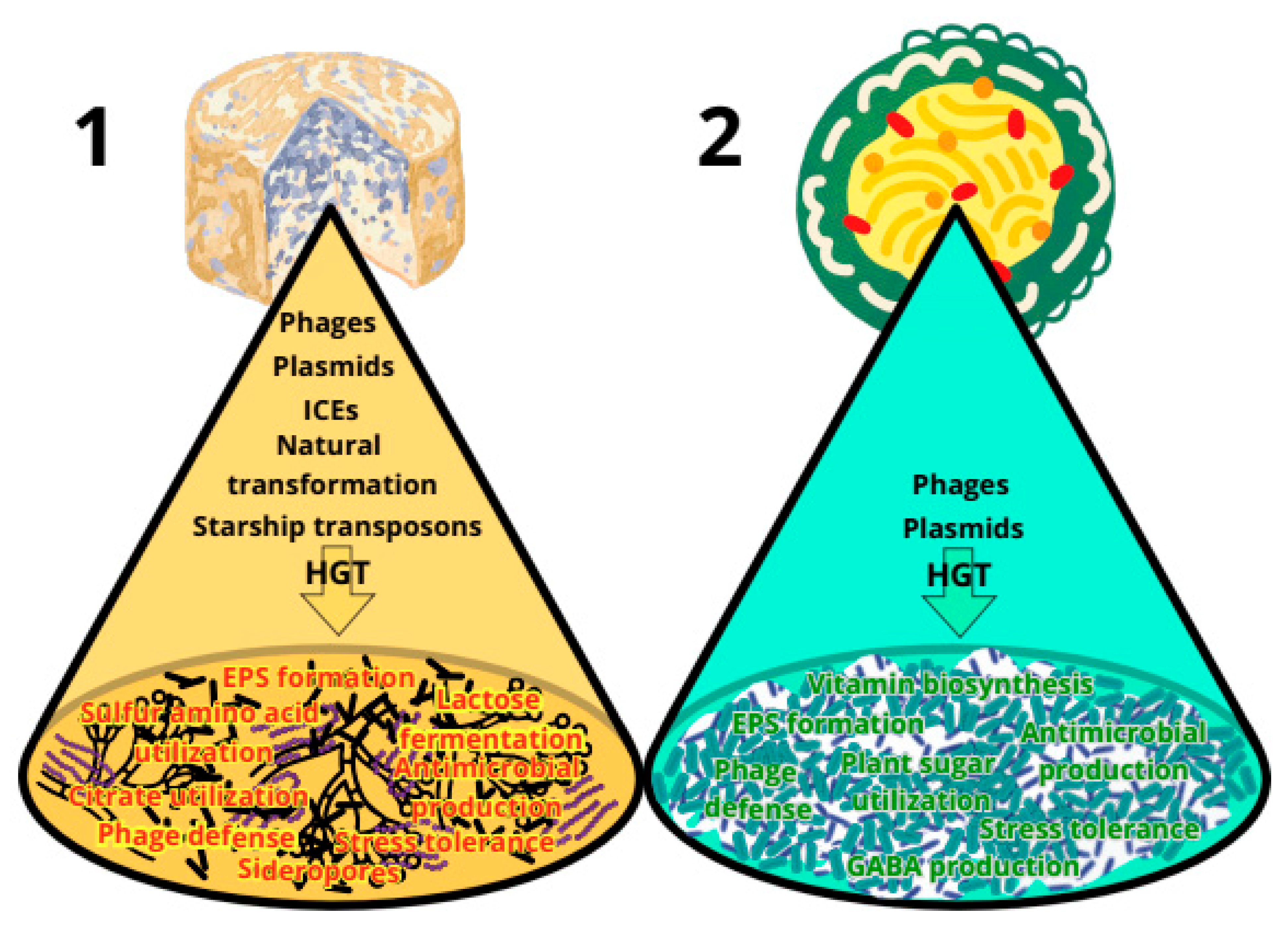

Review

A Review of Horizontal Gene Transfer for the Natural Functional Improvement of Microorganisms Relevant to Food Technology


Dipartimento di Medicina e Scienze Della Salute “V. Tiberio”, Università Degli Studi del Molise, 86100 Campobasso, Italy
*
Author to whom correspondence should be addressed.
Submission received: 16 December 2025 / Revised: 15 February 2026 / Accepted: 28 February 2026 / Published: 3 March 2026

Abstract

Different groups of microorganisms—namely lactic acid bacteria (LAB), coagulase-negative staphylococci (CNS), dairy propionibacteria, yeasts, and molds—play essential roles in producing safe fermented foods of animal and plant origin with high nutritional value and sensory quality. The acquisition of genetic traits with technological relevance by natural horizontal gene transfer (HGT) via transformation, conjugation, phage transduction, and other routes would broaden the spectrum of beneficial activities exerted by individual microbial strains with no limitations for their use in food. Therefore, this critical review aimed to identify the potential for natural genetic improvement of microbial species relevant to food technology, based on reports of natural genetic exchanges occurring in environmental niches and laboratory conditions. Results showed that the species most frequently involved in natural HGT is Lactiplantibacillus plantarum, followed by Streptococcus thermophilus and Lactococcus lactis. Extensive HGT events enabling adaptation to food have been observed in domesticated filamentous fungi. The transferred traits of technological relevance include resistance to various stress factors, exopolysaccharide (EPS) and bacteriocin production, protein and amino acid utilization, phage immunity, lactose and citrate metabolism in dairy species, and use of plant carbohydrates in vegetable adapted species. Methods suitable for detecting HGT events in microbial communities have been developed and can aid in isolating improved strains for use in fermented foods.

1. Introduction

Horizontal gene transfer (HGT) is the nonhereditary transmission of genetic material between organisms in nature that occurs through three main routes: transformation, conjugation, and phage transduction, as well as other more recently described mechanisms [1]. HGT has been shown to introduce new genetic traits relevant to food technology in microorganisms naturally present in fermented foods, either from different strains of the same species or from unrelated species [2,3].
Microorganisms that enable food preservation and transformation through fermentation and ripening have long been used to produce safe, nutritionally rich foods with unique sensory characteristics from fresh raw materials. However, the variable balance and composition of the natural microbiota can sometimes cause fermentation processes to fail. In particular, the development of microorganisms with beneficial properties may be hindered or delayed depending on interactions among the microbial components supplied by the raw materials and manufacturing environment, phage attacks, or stressful conditions. The negative consequences of this variability particularly affect the safety and quality of traditional products made from fermented raw materials [4,5].
These inconveniences are mitigated by using mixed cultures that achieve the desired effects by combining different strains with complementary features, such as rapid acidification, bacteriocin production, metabolic pathways involved in flavor formation, and phage resistance [4,6]. However, this solution is complicated by the inability of microorganisms expressing technologically relevant traits to grow equally well under production conditions and in co-culture. Therefore, transferring desirable genetic traits to microorganisms well adapted to the food ecological niche can facilitate the stabilization of safety and sensory quality in fermented food products. Random mutagenesis, adaptive mutation, and dominant selection, which have been used for the genetic improvement of food cultures, present the risk of undesirable mutations and require a long time to isolate strains with improved characteristics. Therefore, the possibility of obtaining improved food cultures through natural horizontal gene transfer (HGT) was explored [7].
Lactic acid bacteria (LAB) isolates from artisanal fermentations may encode phenotypes of interest for industrial use, such as stress robustness, enzymes involved in flavor formation, bacteriocin production, substrate utilization, and bacteriophage resistance. These traits could be transferred to industrial strains to improve their technological fitness [8]. The use of natural horizontal gene transfer (HGT) for the genetic improvement of industrial strains is not subject to the regulatory restrictions that apply to genetically modified organisms (GMOs) produced by recombinant DNA technologies and gene editing. Therefore, microbial strains that acquire new properties through transformation, transduction with natural phages, and conjugation are not considered GMOs, and their use is approved by EU legislation [3,9,10,11,12]. Plasmid mobilization mediated by lactococcal conjugative plasmids is already recognized as a tool for improving starter cultures used in the dairy fermentation industry [13]. The increasing availability of whole genome sequence data allows for the analysis of the presence and distribution of competence systems that enable natural transformation, as well as the presence of mobile genetic elements (MGEs) carrying technologically useful traits [3].
Therefore, this critical review aimed to evaluate the feasibility and perspectives for natural genetic improvement of microorganisms used in fermented food technology through the acquisition of new traits such as enhanced fermentation speed, stress tolerance, phage resistance, production of antimicrobials to counteract pathogenic and spoilage microorganisms, and compounds that improve food probiotic effects and organoleptic properties. This evaluation was based on reports of natural HGT in food and laboratory conditions, as well as on the presence of genes involved in HGT processes and past HGT events involving traits of technological importance, as revealed by studies on whole genome sequences in different microbial groups relevant to food technology. Indeed, this type of source indicates the genes more prone to undergo HGT, which constitute the accessory genome subdivided into shell genes, present in less than 95% of genomes, and cloud genes, found in less than 15% of genomes in a species [14].
Multiple literature searches were conducted by relevance in Google Scholar (https://scholar.google.com/, accessed on 29 September 2025) using the terms “gene transfer” or “horizontal transfer” or “lateral transfer,” each combined with “fermented food,” “fermented meat,” “fermented fish,” “fermented vegetables,” “fermented milk,” or “cheese.” In additional searches, the food category was replaced with the microbial genus or group name of technologically relevant food-associated microbial species, namely LAB, coagulase-negative staphylococci (CNS), dairy propionibacteria, yeasts, and molds. Microbial species included in the “Qualified Presumption of Safety” (QPS) status in the European Union for use in food production were considered, as well as some species naturally associated with fermented foods whose safety must be assessed at the strain level [15,16]. For Embase (https://www-embase-com.bibliosan.idm.oclc.org, accessed on 20 October 2025), a single search string comprising all terms separated by “AND” and “OR” was used. After discarding all articles focused on antibiotic resistance (AR) and virulence factors, a total of 370 and 344 publications from Google Scholar and Embase, respectively, which largely overlapped, were considered for full-text screening, leading to the selection of the studies discussed in this review. Taxonomic names used in this study are those currently valid as reported in the databases https://lpsn.dsmz.de/text/navigation (accessed on 7 February 2026), http://lactobacillus.ualberta.ca/ (accessed on 7 February 2026), and mycobank.org (accessed on 7 February 2026) where the classification of the microbial species mentioned in this study are available. The order in which the studies are commented follows the number of reports retrieved per microbial group, with the highest first and the chronological order of publication.

2. Mechanisms of Natural Genetic Exchange in Food-Associated Bacteria

2.1. Natural Transformation

Natural DNA transformation, which enables the uptake of extracellular double-stranded DNA without cell–cell interaction, is the simplest mechanism for exogenous DNA acquisition and occurs in all bacterial domains and fungi capable of expressing a “competence” state. In Gram-positive bacteria, competence regulatory networks are induced by and promote adaptation to stress conditions [3,17]. The competence master regulator is ComX, also known as σX or SigX in streptococci, lactococci, and Leuconostoc spp., and SigH in lactobacilli, an alternative sigma factor present in up to three paralogs in some streptococcal species. Its regulon includes late competence genes preceded by a ComX-box DNA-binding motif (cin-box), with consensus sequence TTNCGAATAA at position −10 of the promoter, which is bound by ComX for transient interaction with the RNA polymerase core enzyme [7]. The expression of comX is regulated by secreted oligopeptides called competence pheromones, whose threshold concentration for comX induction is determined by cell density, i.e., quorum sensing (QS) and diffusion in the medium. Stress factors such as the presence of antibiotics, mutagens, high acidity, oxidative, and thermal stress, or nutrient scarcity, trigger the release of competence pheromones [17].
Natural competence involves the synthesis of a cell surface structure called the “transformasome,” which internalizes extracellular DNA through contact with a pseudo-pilus formed by the major ComGC pilin and the minor pilins ComGD, ComGE, ComGF, and ComGG. These pilins are anchored to the cell surface by the transmembrane protein ComGB and are synthesized as pre-peptides, then cleaved by the ComC signal peptidase. The ATPase ComGA provides energy for pseudo-pilus assembly, coupled with the proton-motive force. Double-stranded DNA (dsDNA) interacts with the cell envelope receptor ComEA in the pseudo-pilus and is delivered to a transmembrane channel formed by the ComEC large permease. Here, one strand is degraded by the constitutive endonuclease EndA, and the single-stranded DNA (ssDNA) is introduced into the cell in a 3′-5′ orientation. Energy for DNA translocation is provided by the inner membrane-associated ATPase ComFA. The DNA forms a complex with the protein ComFC, whose function is unknown, and with the protein DprA, which protects it from nuclease attack and facilitates its interaction with RecA for homologous recombination. RecA, DprA, SsbA, SsbB, and the CoiA- and ComX-regulated proteins stabilize the newly acquired DNA [7,8]
Due to its energy and physiological burden, competence is strictly regulated by controlling the levels of ComX, which is degraded by the ClpEP and ClpCP proteases after binding to the adaptor MecA [7]. Inactivation of MecA in Streptococcus thermophilus leads to ComX stabilization and activation of late competence genes, which allow DNA uptake and processing. In S. thermophilus, 10% of cells are naturally transformed under optimal conditions when the Opp (Ami) oligopeptide transporter internalizes the competence pheromone ComS, which interacts with the cytoplasmic effector ComR. ComS is cleaved by specific proteases, releasing its C-terminal XIP (ComX-Inducing Peptide) peptide. The ComRS complex strongly induces ComX expression and natural DNA transformation. The presence of low XIP concentrations in the absence of a functional MecA increased S. thermophilus transformability [17].
Analysis of 482 complete genomes of industrial LAB revealed a great variability in com gene content. However, most S. thermophilus strains possess all the com genes, confirming the transformability observed under laboratory conditions. Among lactococci, only about 25% of strains—most of plant origin—possess the complete com gene set, while for lactobacilli, pediococci, and leuconostocs, the percentage varies between 40% and 65%, except for Latilactibacillus sakei with 95%, and Oenococcus oeni, in which com genes seem to be absent [7]. Analysis of 173 Lactobacillales genomes revealed that comX and most lactococci-specific late competence genes have homologs in the Lactococcus, Streptococcus, and Enterococcus genera, while the late competence genes of Lat. sakei 23K are distributed across all genera of Lactobacillales [3]. Although the comEB and comC genes are absent or not expressed in lactococci, these bacteria were experimentally shown to become competent, demonstrating that these genes are not essential for competence development [8].
Early studies showed that natural competence occurs in S. thermophilus and can be artificially induced in L. cremoris in which comX and dprA genes are not intact, and comEC and coiA are not functional for a nucleotide insertion and a nonsense mutation, respectively, as in most L. lactis strains. However, a few L. lactis and L. cremoris strains possess a complete set of competence genes and can internalize DNA under moderate comX overexpression. Moreover, spontaneous transformation was observed in one plant-derived strain [8,18,19,20]. Disruptive insertions were rarely found in the genes encoding the two streptococcal pheromone-dependent signaling systems, ComCDE and ComRS, indicating their essential role. However, these genes are flanked by transposable elements that might influence competence induction, transformability, and adaptive evolution [21].
Competence is difficult to reproduce under laboratory conditions, but it is active in natural ecosystems in response to signals such as the presence of specific carbohydrates and complex molecules. Notably, the yogurt isolate S. thermophilus LMD-9 becomes transformable in milk. Synthetic peptide pheromones led to competence activation in S. thermophilus, S. salivarius, S. infantarius, and S. macedonicus strains, even at extremely low concentrations and transformation rates ranging from 50% of cells in species with enhanced competence to fewer than 10−4 transformants per recipient in other species. To achieve natural transformation with a gene of interest, the donor DNA must be sufficiently homologous—for at least 500 bp on both sides—to regions in the recipient genome to allow homologous recombination. The donor DNA can be a linear fragment obtained by polymerase chain reaction (PCR). Alternatively, DNA internalized by natural transformation can be maintained as an autonomously replicating plasmid. DNA regions successfully transformed in S. thermophilus include the prtS protease genomic island (GI) and his genes for histidine prototrophy [3,7,20]. HGT in natural ecosystems can be promoted by cell autolysis, which provides DNA for transformation and is mediated by autolysins such as the acetylmuramyl-L-alanine amidase [22].

2.2. Conjugation

The conjugation process in bacteria relevant to food technology involves MGEs such as plasmids, integrative–conjugative elements (ICEs), transposons, insertion sequences (ISs), and GIs, and it enables the efficient transfer of long DNA stretches. Conjugative plasmids have functions such as DNA replication, copy number control, mating pair formation, and origin of transfer (oriT), which allow their maintenance and mobility within bacterial populations. Mobilizable plasmids are not self-transmissible but possess an oriT region and use the transfer machinery of a helper conjugative plasmid [23]. Studies on the streptococcal conjugative plasmid pIP501 have shown that the mob genes serve as sites for cointegration and mobilization of non-conjugative plasmids. It was also reported that the transfer of non-conjugative plasmid was favored by the similarity of its oriT sequence with that of a conjugative plasmid, e.g., pMRC01 [13].
The conjugative transfer of plasmids and ICEs in Gram-positive bacteria occurs after cell contact mediated by surface adhesins and requires the expression of transfer (tra) genes involved in DNA transfer, replication, and mating pair formation. These genes are encoded by or cointegrated in the transferred elements or by other genomic elements that act in trans. During conjugative transfer, a relaxase cuts the DNA at the nic site of oriT and remains covalently bound to the 5′ end of the single-stranded DNA (ssDNA) to be transferred. This complex, called the “relaxosome”, directs the ssDNA to the Type IV secretion system (T4SS) transmembrane mating channel, where its ATP-dependent translocation to the recipient occurs. Once transferred, the DNA is stabilized in the recipient by binding with anti-restriction and SOS response-inhibiting proteins. Plasmid replication occurs simultaneously, so that one of the newly formed copies remains in the donor and the other one in the recipient. Conjugation is regulated by QS signal molecules such as homoserine-lactones, which form complexes with transcriptional regulators in the producer cells and induce the expression of plasmid transfer genes [13,24].
Conjugative plasmids and ICEs encode similar oriT-dependent conjugal DNA transfer machineries; however, while plasmids encode extra-chromosomal replication functions, ICEs encode chromosomal integration and excision functions. These conserved functions can be exploited to detect these MGEs in bacterial genomes. Conjugative MGEs can encode genes that confer industrially relevant phenotypes such as substrate utilization, extracellular proteinases, polysaccharide production, and bacteriocin production [25]. A highly efficient conjugative plasmid in E. faecalis, whose type IV secretion system is tightly regulated by sex peptide pheromones released by recipient E. faecalis cells, encodes a substance that forms aggregates of donor and recipient cells on the donor cell surface, making plasmid transfer efficient even in cell suspensions [26].
The role of group II introns, such as the one found in the L. lactis sex factor (SF), in modulating the transfer efficiencies of conjugative MGEs remains to be better elucidated [19]. These introns are present in bacteria, archaea, and fungi, are frequently gained or lost, and are large RNA enzymes that self-splice and ligate their flanking regions, or exons, invading other DNA target sites by retrohoming or retrotransposition promoted by a multifunctional intron-encoded protein (IEP). The Ll.LtrB group II intron in L. lactis, homologous to the Ef.PcfG intron in E. faecalis, can invade orthologous genes in transconjugant bacteria after HGT of its host conjugative elements and is present in nearly identical copies in various species of lactococci used in the dairy industry [27].
ICEs are the most numerous streptococcal and enterococcal MGEs, and a plate mating protocol enabled observation of the in vitro transfer of ICE Tn5251 from S. pneumoniae to E. faecalis at low frequency [28]. Most ICEs of Gram-positive bacteria encode the MPFFA-type mating pore. The ICE conjugation gene clusters are phylogenetically distinct from those found in plasmids, which have a broader host range [29]. ICEs also encode a recombination module and a regulation module. ICEs integrate into the chromosome of a recipient cell by site-specific recombination and can promote the transfer of large chromosomal fragments. Moreover, they can mobilize integrative and mobilizable elements (IMEs) and cis-mobilizable elements (CIMEs), which derive from ICEs and IMEs after deletion of the conjugation/mobilization and recombination modules. CIMEs retain the recombination att sites and can be mobilized when an ICE integrates into a recombination site [25].
IMEs are widespread but understudied, and 64 putative IMEs were found in 14 Streptococcus species, and in Staphylococcus aureus, in most cases, integrated into the oriT of ICESt3, Tn916, and ICE6013 family ICEs encoding a MobT relaxase. IMEs can also integrate into another IME or into the chromosome. IMEs do not transfer with the host ICE but instead integrate into the oriT of the ICE after transfer [30]. Defining the MGE host range is important for exploiting them in industrial strain improvement [26].
GIs are gene clusters that act as hotspots of genome plasticity and can include gene cassettes of different origins that encode useful phenotypes in industrially relevant bacteria. GIs are formed after the acquisition of genetic material by the above-described HGT mechanisms, and so they include transposons and transposases, which are small, mobile elements comprising only genes for their own transposition, ICEs and prophages, and undergo mutations, rearrangements, gene loss, or acquisition with transfer potential to other hosts [14,31]. Replacement GIs are acquired by homologous recombination and can be found in both related and unrelated bacterial strains. Additive GIs are acquired by insertion at preferential sites such as transfer RNAs (tRNAs), transfer-messenger RNAs (tmRNAs), or adjacent to highly conserved core genes and are commonly preceded by 16–20 bp direct repeats [31].
The nucleotide composition of GIs often differs from the rest of the genome in guanine-cytosine (GC) content, presence of a GC skew, different codon usage, or k-mer signature, allowing their identification by sequence analysis with bioinformatic tools that use sliding windows or other methods. Alternatively, GIs can be identified by comparative genomics based on their sporadic distribution if closely related reference genomes are available. The DarkHorse analysis tool identifies GIs by recognizing HGT-acquired proteins [32] using BLAST (https://blast.ncbi.nlm.nih.gov/Blast.cgi, accessed on 25 November 2025) against the NCBI (https://www.ncbi.nlm.nih.gov/, accessed on 25 November 2025) non-redundant database and assigning a score that reflects atypical phylogenetic distances between query and subject [31].

2.3. Transduction

Transduction is the most influential form of HGT and results in the phage-mediated transfer of nonviral genes through specialized or generalized processes. Temperate phages cause specialized transduction by excising host chromosomal regions flanking the phage integration site, which can be transferred to a new host upon infection. Because only sequences adjacent to the prophage site are transferred, specialized transduction contributes little to HGT. In contrast, generalized transduction occurs when a phage packages only bacterial DNA. Phages involved in transduction use a pac packaging mechanism that initiates from a specific recognition sequence and terminates when the phage head is full. In generalized transduction, phage populations after infection consist predominantly of infectious phages and a minority of transducing particles. The transducing particles bind to a new bacterial host cell and inject the bacterial DNA, which is either degraded or recombined with the bacterial genome at a frequency of about one in 107 to 109 infection events. Despite this low frequency, the abundance of phages and the high infection rate strongly impact genetic exchange in prokaryotes [33].
Technologically relevant genetic traits transferred between LAB via transduction included chromosomal genes for sugar fermentation and proteolysis. A high frequency of plasmid transduction was observed in L. lactis for plasmids with sizes compatible with the phage head. DNA transfer by phages occurred in L. delbrueckii and between different species, such as L. lactis and S. thermophilus [18]. Prophage ϕadh of L. gasseri was found to spontaneously induce a second prophage, vB_Lga_jlb1 (jlb1), and both phage particles mediated plasmid transfer with approximately 103 spontaneous transductants/mL, demonstrating that HGT by transducing phages may significantly impact the evolution of commensal lactobacilli within the human microbiota [34].
Phage host specificity depends on phage-encoded receptor binding proteins (RBPs) that enable the phage base plate binding to polysaccharide or protein receptors on the bacterial surface. Protocols specific to each phage must be designed to prevent the lytic phase and allow generalized transduction [18]. Most S. thermophilus and L. lactis phage receptors are composed of cell wall polysaccharides (CPS), which in lactococci are encoded by the rhamnose-glucose polysaccharide rgp gene cluster. This cluster also plays a role in cell wall assembly and cell division, and its variable region encodes a cell surface side chain called the polysaccharide pellicle (PSP), which may determine the host specificity of L. lactis phages. In the rgp gene cluster of S. thermophilus, only the four genes rgpA, rgpB, rgpC, and rmlD are highly conserved. The rgp loci are possibly transferred by HGT, as indicated by their similarity in L. lactis and L. cremoris strains. The rotation of different phage-resistant variants derived from the same starter strain, each carrying a plasmid encoding a different phage resistance mechanism, is commonly used to reduce the risk of fermentation failure caused by phage attacks [35].
Clustered regularly interspaced short palindromic repeats–CRISPR and Cas-associated proteins (CRISPR-Cas) systems provide adaptive immunity in prokaryotes against phages. These systems consist of short repeats separated by spacer sequences derived from invading nucleic acids such as phages and plasmids. During the acquisition phase, spacers are incorporated into the CRISPR array, which is then expressed as short CRISPR RNAs (crRNAs). In the interference phase, foreign nucleic acids complementary to the spacers are bound and degraded by Cas-crRNA ribonucleoprotein complexes with nuclease–helicase activity.
Although CRISPR-Cas systems confer resistance to phages and other exogenous nucleic acids, they did not hinder HGT during evolution. On the contrary, viral protection is provided to bacterial strains with phage-derived spacers, thereby enhancing transduction. This was demonstrated using phage φTE from the plant pathogen Pectobacterium atrosepticum, which contains a type I-F CRISPR-Cas system with three CRISPR arrays, where the transduction of chromosomal loci not targeted by the spacers was unaffected. Although the transductants are susceptible to phage infections, it was demonstrated that phage resistance conferred by CRISPR-Cas favors the maintenance of the transduction-acquired genes. Generalized transduction can disseminate CRISPR-Cas systems themselves [33].
Spacer recombination with target phage sequences can also mediate specialized transduction of CRISPR elements, as shown for staphylococcal phages 85, ΦNM1, ΦNM4, and Φ12, leading to either the transfer of CRISPR-adjacent genes or the spread of acquired immunity to other bacteria. In support of this, in staphylococci, phylogenetic trees constructed with CRISPR repeats or Cas1 showed poor correlation with trees constructed using phylogenetic markers, indicating their HGT origin. Spacer-mediated transduction was experimentally proven for S. aureus 08BA02176 by using an erythromycin-resistance gene artificially introduced next to the chromosomal type III-A CRISPR system located within the staphylococcal cassette chromosome mec (SCCmec) and three phage 85 derivatives containing spacers of this CRISPR locus were individually used to infect the erythromycin-resistant strain. Using a wild-type phage as a control, it was shown that the introduced spacers increased the transduction of the AR gene by one order of magnitude. The transfer of genomic regions adjacent to the CRISPR locus occurs at rates that exceed those observed for generalized transduction, increasing the endowment of CRISPR-cas loci notwithstanding degradation of the spacer–protospacer pairs by Cas proteins [36].
Anti-CRISPRs (Acr) genes, four of which are called acrIIA16–19, were identified in the genomes of Listeria, Enterococcus, Streptococcus, and Staphylococcus. These genes can inhibit type II-A SpyCas9 or SauCas9 and promote the dissemination of plasmids by conjugation, as demonstrated in E. faecalis for Cas9-targeted plasmids [37].

2.4. HGT Mechanisms Other than Transformation, Conjugation, and Transduction

Other HGT mechanisms beyond transformation, conjugation, and transduction have been recently discovered. One involves “nanotubes,” which are tubular membranous bridges connecting cells and facilitating the exchange of cytoplasmic molecules and genetic material even between different species. The non-conjugative transfer of plasmids through nanotubes occurred between B. subtilis strains on solid media, so it was also investigated between B. subtilis and industrially relevant LAB [1].
B. subtilis strains 168 and PY79, transformed by electroporation with the S. thermophilus plasmid pNZ8048 encoding chloramphenicol resistance, and L. lactis MG1363, a competence defective strain, transformed with a plasmid encoding the green fluorescent protein (GFP) and erythromycin resistance were co-cultured. Examination after 6 h by scanning electron microscopy (SEM) and total internal reflection fluorescence microscopy (TIRF) visualized interspecies and intraspecies membrane connections, i.e., the nanotubes. L. lactis MG1363 colonies resistant to 5 μg/mL erythromycin, and chloramphenicol were obtained with a plasmid transfer efficiency of 10−4 to 10−5 transformants per recipient CFU. After further propagation, the transformants could grow in the presence of reduced antibiotic concentrations and maintained pNZ8048 at a low copy number [1].
The ability of L. lactis to deliver genetic material to B. subtilis through nanotubes was investigated using L. lactis MG1363 transformed with pNZ8048 and an inactivated SF cluA gene as the donor and a competence-defective B. subtilis 168 variant resistant to spectinomycin as the recipient. In this case, 10−6 transformants per recipient CFU were obtained. The transfer of pNZ521, which encodes the industrially relevant PrtP protease, was accomplished by this route and conferred casein hydrolysis capacity [1].
S. thermophilus strains ST11 and CNRZ302 transformed with the non-conjugative plasmid pNZ8048 were also used as donors for the spectinomycin-resistant, competence-defective B. subtilis 168 variant. After co-culture, B. subtilis acquired the plasmid at a rate of 10−6 transformants per recipient CFU for S. thermophilus ST11 and 10−5 transformants per recipient CFU for S. thermophilus CNRZ302, showing that HGT by this type of cell-to-cell contact has potential for the natural improvement of industrially relevant bacteria [1].
Another mechanism of HGT may involve extracellular vesicles, which are spherical structures with a bilayered membrane and diameters ranging from tens to hundreds of nanometers, released from cells after the accumulation of peptidoglycan fragments or misfolded proteins in the cell membrane caused by stress. These vesicles contain nucleic acids, proteins, ions, metabolites, and signaling molecules and may enable genetic exchange by fusing with other cells [19,22]. Extracellular vesicles have also been described in bacteria relevant to food technology [38,39].
Mathematical modeling indicated that HGT events are favored in nature because sharing genes among species reduces the advantages of the better niche-adapted members in a microbial community. This leads to convergence of growth rates and promotes species coexistence and stable diversity over long periods, as seen in Vibrio and Synechococcus communities composed of strains with different fitness levels. The occurrence of HGT in these populations was demonstrated by comparative genomics, which showed that even extremely low plasmid conjugation rates promoted coexistence under diverse natural conditions. Recent studies using comparative genomics have reported extensive diversity in microbial populations occupying similar niches, showing that HGT can be particularly relevant in environments with high cell density [40].

3. Technological Properties Acquired by Microorganisms via HGT in Food

HGT enables the rapid acquisition of phenotypes that support adaptation to new niches in response to environmental pressures [41] and, in the food environment, newly acquired genetic traits that drive niche adaptation also enhanced the technological properties of microorganisms [2,42]. HGT events are identified by combining criteria such as higher sequence similarity of specific gene regions to distant species or taxa rather than to closely related species, atypical nucleotide composition, codon usage, frequencies of di-, tri-, and tetra-nucleotides, or incongruence between a gene phylogeny and that of the species [43]. An example is given by the β-galactosidase lacZ and the metabolic pathways for lactose-6-P utilization, which allow lactose fermentation by the yogurt and cheese-associated species L. delbruecki ssp. Bulgaricus, and L. delbrueckii subsp. Lactis, enhanced by the presence of a non-functional lac repressor in L. delbruecki ssp. bulgaricus. The genes lacZ and lacS, which encode the lactose–galactose antiporter, are more similar to those found in streptococci than to those from related lactobacilli [44].
In L. lactis subsp. lactis, biovar diacetylactis, several traits relevant to dairy technology are plasmid-encoded and, therefore, potentially transferable. These include the citrate metabolism regulation and permease gene cluster citQRP, which enable the formation of high amounts of the buttery flavor metabolites acetoin and diacetyl via the chromosomal citrate utilization pathway gene cluster citM-citI-citCDEFXG, which is absent in non-dairy strains, as well as the membrane protease lactocepin, which generates bitter peptides that are further degraded by intracellular peptidases [4,45].
A computational pipeline for identifying horizontally transferred genes in cheese relies on a central database containing all ORFs from 165 cheese-associated microbial genomes. The pairwise average nucleotide identity (ANI) between species of the same genus, as well as length, higher maximum, and lower maximum ANI cutoffs, were defined. Each ORF was aligned to the database, and 4733 putative horizontally transferred protein-coding genes were identified using minimum thresholds of 99% identity and 500 nucleotides in length. Genes located within 5000 nucleotides of each other on the same contig were considered to have been transferred in a single HGT event and were grouped into 264 GIs, which were then clustered with those from other species that shared at least one coding sequence (CDS). Non-contiguous GIs were further grouped into HGT groups if they shared a transposon. These groups contained genes from several different genomic regions or genes spread across multiple contigs. Most HGT groups included only members of the same genus or phylum, with exceptions such as the firmicute Alkalibacterium kapii harboring part of HGT gene group 1, which is mostly found in Actinomycetota and HGT gene groups 2 and 3, which are found in three different phyla and are more prevalent in Actinomycetota [42].
BlastKOALA (https://www.kegg.jp/blastkoala/, accessed on 21 November 2025) annotation showed that transposase, conjugal transfer, phage-related proteins, and other MGEs were the most abundant encoded functions found in one third of HGT gene groups, followed by metal ion transporters, siderophores, vitamin B12 synthesis, and nutrient transporters. About half of the genes could not be annotated. Siderophores, which can be advantageous in niches with low iron availability, such as cheese, were encoded by five of the ten largest HGT groups. Lactate import and metabolism, including lactate permeases and lactate dehydrogenases, constituted 2.8% of the annotated genes. Moreover, transporters for glutamate, short peptides/nickel, and micronutrients such as phosphonate, molybdate, zinc, and manganese were identified [42].
Less than 1% of the annotated genes encoded drug resistance, specifically tetracycline resistance in eight Brevibacterium species and a multidrug resistance (MDR) system in three Pseudomonas species. The largest HGT region was approximately 47 kb in size, contained 34 genes, and was found in whole or in part in 15 species of the Actinomycetota genera Brachybacterium, Brevibacterium, Corynebacterium, Microbacterium and Glutamicibacter, and the Bacillota genus Alkalibacterium. One ICE designated Actinomycetota-associated iRon Uptake/Siderophore Transport Island (ActinoRUSTI) was detected by PCR in a Brevibacterium starter strain, so it was hypothesized that this starter was implicated in its dissemination [42].
In shotgun metagenomic datasets from 75 cheese samples, 624 HGT events were identified mostly in Lactobacillales, particularly in Streptococcaceae, with a mean HGT frequency between 10−5 and 10−4 /kb, and phage-related and transposase genes among the transferred regions. Additionally, all spacers from the CRISPRs on Lactococcus metagenome assembled genomes (MAGs) and a spacer from a CRISPR on a Staphylococcus MAG aligned to a Streptococcus phage, indicating either an HGT event, the presence of phages with a broad host range, or closely related phages targeting distinct genera. Sequences from Streptococcus phages were associated with those from Lactococcus phages in the CRISPR loci, possibly as a consequence of HGT of plasmid-encoded CRISPR [46].
In a metagenome study aimed at uncovering the HGT events that favored microbiota adaptation to the Cabrales blue-veined cave cheese microenvironment, MAGs showed evidence of approximately 23,000 HGT events involving 67,411 coding regions and 56 taxa, with the genera Lactococcus, Tetragenococcus, and Staphylococcus involved in approximately 59%, 52%, and 23% of HGT events, respectively. HGT most often occurred at the intermediate and final ripening stages between Lactococcus and Tetragenococcus, Staphylococcus and Tetragenococcus, and Lactococcus and Staphylococcus in cheese core and rind, as well as on surfaces. PlasFlow [47] analysis indicated that approximately 35% of HGT events involved plasmids, of which only 0.5% encoded relaxases. Prophages, transposases, and integrases accounted for 11%, 8%, and 0.9% of HGT events, respectively [48].
Among the coding regions of horizontally transferred genes, about half did not match any entry in the Kyoto Encyclopedia of Genes and Genomes (KEGG) Orthology (KO) database (https://www.genome.jp/kegg/ko.html, accessed on 21 November 2025), about 10% were assigned to signaling and cellular processes, 7% to carbohydrate metabolism, and 5% to genetic information processing. Defense systems, galactose, fructose, mannose and purine metabolism, and glycolysis/gluconeogenesis were identified among the predominant transferred functions. The pairs Lactococcus-Tetragenococcus and Alkalibacterium-Tetragenococcus exchanged contigs longer than 20 kb, containing 12 to 45 CDS clustered into 26 groups, half of which included MGE-related genes. Nine groups were related to protein, carbohydrate, or lipid metabolism, and three encoded β-lactam resistance. Blastn alignment against the ResFinder database (https://genepi.food.dtu.dk/resfinder, accessed on 21 November 2025) revealed 10 HGT hits matching β-lactam and tetracycline resistance genes in L. lactis, T. koreensis, and S. equorum [48].
In fermented vegetables, 34 MGEs were identified by the MobileElementFinder (https://pypi.org/project/MobileElementFinder/, accessed on 11 November 2025) software in five isolates of Lpb. plantarum, Pediococcus pentosaceus, Weissella hellenica, Lentilactobacillus buchneri, and Enterococcus spp. These included 27 ISs and 7 composite transposons. Three plasmids, rep28, rep38, and repUS1, were found in Lpb. plantarum, Len. buchneri, and Enterococcus spp., respectively. Four unique conjugative transposons were detected in all LAB except W. hellenica, which contained putative MGEs capable of mobilizing transposase genes. The IS-associated mobilizable genes were found to encode carbohydrate metabolism and bacteriocin production, in addition to AR [49].
Whole-genome sequencing (WGS) and metagenomic analyses were used to investigate intra-species adaptive evolution in the microbiota of 12 naturally fermented milk products collected in China, Kyrgyzstan, Mongolia, Morocco, and Tajikistan. In the L. helveticus, isolates from one sample, genes were likely acquired from L. kefiranofaciens, Len. kefiri, S. parauberis, and from phages of lactobacilli. In L. delbrueckii subsp. bulgaricus isolates, from another sample, 54 genes were likely acquired from Limosilactobacillus fermentum, L. helveticus, and from phages of lactobacilli. In L. lactis subsp., lactis isolates from a third sample, genes likely derived from L. raffinolactis, L. garvieae, and from phages of lactococci, were identified. Horizontally acquired genes enriched in L. helveticus were found to encode phosphate and amino acid transport, carbon fixation, and central carbohydrate metabolism, while L. lactis subsp. lactis isolates acquired genes encoding transport systems for carbohydrates, polyols, lipids, and other molecules [50].
The genomes of 611 Lactobacillaceae were found to contain 19,555 genes present only in a few strains, including rare genes encoding transporters, glycosyl hydrolases, glycosyltransferases, transposases, phage genes, transcriptional regulators, and genes of unknown function, each present in an average of only three strains. These genes are located near hypothetical proteins considered pseudogenes resulting from transposition disruption, suggesting they were probably acquired by HGT. A correlation was established between the abundance of these elements and pangenome openness, indicating that this depends on genome instability rather than the source of isolation [51].
Genes for bacteriocin production are often located on plasmids that are transferred among bacterial genera and rearranged, resulting in the production of novel peptides. An example is the lactococcal lactolisterin BU gene cluster in L. lactis subsp. lactis bv. Diacetylactis, which shows highly conserved regions with the gene clusters for bacteriocin BHT-B of S. ratti, aureocin A53 of S. aureus, and a similar bacteriocin of Corynebacterium jeikeium. The presence of homologous bacteriocin operons in various genera indicates the selective advantage of bacteriocin production [52]. Among 18 LAB isolates from Algerian dairy products screened by PCR for the presence of 12 enterocin-encoding genes, eight isolates carried the genes for EntAS-48 and EntQ, both with antimicrobial activity against Gram-positive bacteria. Of these, two isolates were identified as Lcb. paracasei and Levilactobacillus brevis, which had probably acquired the bacteriocins via conjugative plasmids. A Lev. brevis isolate harbored both genes and expressed stronger antimicrobial activity than the two Lcb. paracasei isolates harboring only one gene [53].

4. HGT in Food Technology Relevant Genera and Species

4.1. Lactic Acid Bacteria

4.1.1. Lactiplantibacillus

The studies indicating HGT in the Lactiplantibacillus genus were found in the literature to be more numerous than those regarding other microbial groups. Lpb. plantarum is the species of the genus most frequently occurring in a variety of habitats, including dairy products, meat, vegetables, silage, wine, and the human and animal intestine. These bacteria are used to produce fermented foods of both animal and plant origin. A large-scale genome analysis and a genome-wide association study involving 455 genomes identified two main Lpb. plantarum clades, A and B, with about 90% of animal and meat isolates assigned to clade A, and most dairy isolates to clade B. Environment-specific genes numbered 88 for animal sources, 34 for dairy products, 9 for other foods, 4 for plants, and 1 for meat products. Genes involved in carbohydrate, amino acid, and other nutrient transport and metabolism were enriched in dairy isolates. Human, animal, and meat isolates exhibited a high recombination rate (ratio of recombination to mutation events r/m > 2) [54]. While most Lactobacillaceae reduced their genome size by removing unnecessary functions to adapt to the nutrient-rich food environments, Lpb. plantarum increased its genome size through the acquisition of plasmids, transposons, and prophages [55].
Some Lpb. plantarum strains can synthesize vitamins, and most strains possess the genes for class IIb and IId plantaricins, which inhibit Gram-positive and Gram-negative bacteria, favoring food preservation [54,56]. The gene clusters for these bacteriocins are considered part of the species core genome [57]. Most Lpb. plantarum genomes encode plantaricin EF, while about 50% encode plantaricins J, K, A, and N [58,59]. Multiple gene clusters are required for the production of these plantaricins that encode the plantaricin E/F class IIb two-peptide bacteriocin, HlyD and LanT accessory factors for the ABC-transporter PlnH, the bacteriocin ABC-transporter PlnG, PlnJ, and the PlnA alpha/beta enterocin family class IId bacteriocin, the class IId bacteriocins PlnN, and PlnJK, the immunity proteins PlnI, PlnP, PlnM, and PlnL, the response regulators PlnD and PlnC, a glycosyltransferase family 2 gene GlyS, PlnQ, PlnR, a putative Na+/H+ MFS antiporter, a sugar O-acetyltransferase, and two Cof-type HAD-IIB family hydrolases [56,60,61]. Plantaricin genes were found to be transferred in fermented olives from Lpb. plantarum to the related species Lpb. pentosus and Lpb. paraplantarum [2].
The glutamic acid decarboxylase gad operon for γ-aminobutyric acid (GABA) production is found in all Lpb. plantarum genomes, but in only four of the 577 genomes analyzed by Surachat et al. [58], this operon might be not functional due to the gadB gene deletion [57,58]. The glutamic acid decarboxylation system transports extracellular glutamate into the cell and converts it to GABA by removing intracellular protons, thereby increasing tolerance to acidic conditions. GABA is a stable molecule that does not re-ionize and thus does not alter the intracellular ion balance. It can also be transported outside the cell by the glutamate/GABA antiporter [62]. GABA is a beneficial molecule with anti-obesity and anti-diabetic effects and serves as an inhibitory neurotransmitter. Administration of GABA-producing LAB to mice improved depressive-like behaviors [63]. Genome sequencing showed that in Lpb. plantarum ZR79, both gadA and gadB genes are present, and gadB, which is mainly responsible for GABA production and acid resistance, was found to be plasmid located in a gadRCB operon flanked by transposases, indicating that this operon was acquired by HGT and can constitute a transmissible trait [64].
Different studies found that Lpb. plantarum isolates from food products acquired genes from various bacterial species and genera. In particular, Lpb. plantarum 5-2 isolated from fermented soybean acquired 81 genes, of which 45 were phage-related, mostly from Lpb. pentosus but also from Bacillus, Clostridium, and Mogibacterium genera, E. faecalis, E. faecium, E. italicus, E. malodoratus, Eubacterium rectale, Haemophilus paraphrohaemolyticus, Ligilactobacillus acidipiscis, Lev. brevis, Lcb. casei, Loigolactobacillus coryniformis, Companilactobacillus farciminis, L. murinus, Len. otakiensis, Lcb. paracasei, Lpb. paraplantarum, Furfurilactobacillus rossiae, Paucilactobacillus suebicus, Liquorilactobacillus vini, Leuconostoc kimchii, Leuc. mesenteroides, Listeria monocytogenes, Melissococcus plutonius, O. oeni, P. pentosaceus, Peptostreptococcus anaerobius, and W. ceti [65].
In five Lpb. plantarum strains isolated from a fermented Argentinian maize beverage, ISfinder (http://www-is.biotoul.fr, accessed on 13 November 2025 but no longer accessible) detected ISs and transposases of Lat. sakei (ISLsa1, IS1163), F. sanfranciscensis (IS153), L. helveticus (ISLhe4, ISLhe30), P. pentosaceus (ISLpp1), E. faecium (ISEfa9), E. hirae (IS1310), B. thuringiensis (IS240F), Desulfitobacterium hafniense (ISDha13), E. coli (Tn2), and S. enterica (Tn3) [66].
In the genome of Lpb. plantarum DY46 isolated from fermented milk, HGT-acquired transposases and phage-related genes had homologs in Pediococcus spp., Lpb. pentosus, Lpb. paraplantarum, Leuconostoc species, Pa. suebicus, Lq. hordei, F. lindneri, Lcb. paracasei, Lo. coryniformis, L. kefiranofaciens, W. jogaejeotgali, F. sanfranciscensis, Lpb. argentoratensis, Companilactobacillus spp., Levilactobacillus spp., Len. buchneri, L. lactis subsp. lactis bv. diacetylactis, Lpb. daowaiensis, Lat. sakei, Bifidobacterium longum, Lapidilactobacillus mulanensis, Lim. fermentum, and Len. diolivorans [67].
The GIs of Lpb. plantarum JS21 isolated from Jiangshui fermented beverage contained integrases, transposases, and about 2% genes probably acquired from Lpb. argentoratensis, Lpb. nangangensis, Len. buchneri, Lev. brevis, Lpb. xiangfangensis, Lim. reuteri, Caudoviricetes sp., Lev. fuyuanensis, L. japonicus, Lpb. mudanjiangensis, W. confusa, W. cibaria, B. fragilis, Lo. backii, Gluconobacter oxydans, F. sanfranciscensis, and L. delbrueckii subsp. bulgaricus [68].
In Lpb. plantarum 5-2, gene clusters involved in cell envelope biogenesis and DNA replication, recombination, and repair derived from Lo. coryniformis subsp. coryniformis as indicated by the proximity to two of three transposases acquired from this species [65]. In Lpb. plantarum GB-LP3 isolated from Korean fermented vegetables among 10 GIs identified by IslandPick [69], five included a prophage and genes for an ATP-binding protein of an alkylphosphonate ABC transporter, DNA expression, QS, integrase/recombinase, oligopeptide metabolism, and bacteriocins [70]. Lpb. plantarum GB-LP1 isolated from traditional fermented Korean food was found to possess nine GIs encoding prophage-like proteins, transcriptional regulators, enzymes, and two CRISPR regions acquired from other bacteria [71].
GIs with low similarity among five Lpb. plantarum strains isolated from fermented maize mainly contained MGEs, phage proteins, transposases, and the conjugative gene transfer machinery genes par and trs. Four strains isolated from the same fermentation phase showed high genome similarity, while Lpb. plantarum CECT 8962, isolated from a different fermentation phase, had 240 unique genes, including 140 hypothetical proteins and an over-representation of carbohydrate transport and metabolism genes such as sugar phosphotransferase system (PTS), glycosyl transferases, two pullulanases for starch hydrolysis, exopolysaccharide (EPS) biosynthesis genes, including O-antigen, teichoic and lipoteichoic acid exporters, and a nitrate/sulfonate/bicarbonate ABC transporter for osmotic stress tolerance. Additionally, genes for sortases, internalin-like proteins, a mucus-binding protein, the opp operon, type I and III restriction/modification (RM) systems, iron homeostasis, and plasmid replication genes were identified [72].
Among the encoded functions, sortases modify the cell surface by covalently binding pilins, enzymes, and glycoproteins, influencing adhesion and pathogenesis. Internalin-like proteins can attach to E-cadherin in epithelial cells. The opp operon, beyond oligopeptide uptake, is also involved in adhesion, biofilm formation, and cell wall recycling [66]. The RM systems protect bacteria from foreign DNA and comprise HsdS and HsdM, which form a methyltransferases complex, and HsdR which carries out the restriction of unmethylated foreign DNA. The HsdS subunit contains two target recognition domains (TRDs) that determine the target sequence specificity for restriction and modification [72].
The Lpb. plantarum probiotic MF1298 isolated from a fermented sausage was found to harbor 12 circular plasmids ranging in size from 2273 to 47,476 bp and assembled by the combination of Illumina MiSeq short-reads and ONT MinION (Oxford Nanopore, Oxford, UK) long-read sequencing. These showed a significantly lower GC content than the chromosome, indicating a possible HGT origin. The larger plasmids are conjugative, and some smaller plasmids are mobilizable. Plasmid regions unique for the strain encode functions related to vitamin B12 turnover, including a coenzyme B12-dependent ribonucleotide reductase NrdJ, a cobalamin adenosyltransferase CobA, homologs of the cobalamin synthesis proteins CblT, CblS, CobS, and CobC, and an energy coupling factor (ECF) transporter with the genes CbrV, CbrU, and CbrT that enable cobalamin production in presence of precursors. This region is flanked by two retron-type reverse transcriptases not described in other Lpb. plantarum strains. Other plasmids encode heavy-metal resistance, including two identical copies of the arsenate and cadmium resistance gene operon ars/cad, also present on two plasmids of Lpb. plantarum WCFS1 [73].
Among 49 genomes of Lpb. plantarum food isolates examined in one study, the riboflavin synthesis genes ribA, ribB, ribD, and ribH were found only in 10 strains. Strain-specific genes included those for a lactobin A/cerein 7B class IIb bacteriocin shared by six strains, and the plnC8αβ plantaricin characterized in Lpb. plantarum NC8 and active against the periodontitis agent Porphyromonas gingivalis, which was found in Lpb. plantarum MF1298 and Lpb. plantarum LZ206 isolated from cow milk. A class IIa bacteriocin, similar to pediocin PA-1, described in P. acidilactici H, was found in one strain [57].
Lpb. plantarum UNQLp 11 from Patagonian wine contained the highest number of protein-coding genes compared to other strains. Strain-specific genes encoded ATP-dependent Clp proteases, α-glucosidases, ABC transporters, PTS for different carbohydrates, a universal stress protein USP, and a MutS DNA repair protein. The α- may be involved in utilizing yeast macromolecules as a nutrient source. Xenobiotic-sensitive element Xre genes, which are related to acid tolerance in L. acidophilus, were more numerous than in the reference strain WCFS1 [74].
Lpb. plantarum NCU116, isolated from traditional Chinese sauerkraut, was found to carry 11 genes involved in the hydrolysis of vegetable macromolecules, presumably acquired by HGT from L. lactis. These genes include those encoding a family 13 glycoside hydrolase (GH13), an α-amylase, a trehalose-6-phosphate hydrolase, a glucan 1,6-α-glucosidase, two neopullulanases, two α-glucosidases, and four oligo-1,6-glucosidases of the α-amylase family. Twelve unique genes in this strain are associated with MGEs and include a fructose/mannose transporter. A type I RM complex sharing homology with genes of P. claussensii, Lev. Brevis, and Lpb. plantarum strains involved in vegetable fermentation is located in a plasmid GI. This strain possesses the plnNC8αβ plantaricin genes [75].
Lpb. plantarum UTNGt2 isolated from white cacao harbors a bacteriocin gene cluster for a sactipeptide class of ribosomally synthesized peptides (RiPP), the gene for one component of a class IIb lactococcin-like protein with 53% identity to enterocin X from E. faecium KU-B5, which is also found in another Lpb. plantarum genome, two radical S-adenosylmethionine-modified RiPP (rSAM-modified_RiPP) that may have antimicrobial function, a bovicin_225_variant with a homolog in S. gallolyticus, and a Blp gene with a homolog in S. pneumoniae. Additionally, genes for processing and transport of lactococcin A and lactococcin G were present [60]. A sactipeptide class bacteriocin was also detected in the raw milk isolate Lpb. plantarum DJF10 whose operon comprises the structural gene bmbF, two ABC transporters, and other ORFs [56].
EPSs from Lpb. plantarum strains differ significantly in monosaccharide composition, linkage positions, branching pattern, and post-synthesis modifications that influence bioactivity. The EPS synthesis clusters identified in Lpb. plantarum WCFS1 were designated cps1, cps2, cps3, and cps4. The cps1 cluster determines the EPS molecular mass and rhamnose composition, while the cps2 cluster determines the galactose composition. No functions have been identified for the cps3 and cps4 gene clusters. These clusters show high variability in gene composition and integrity among strains [76,77]. A new EPS synthesis 11-gene cluster, cpsWc, located on the large plasmid pYZ1 and horizontally acquired from W. cibaria, was identified in the probiotic strain Lpb. plantarum LTC-113, which was isolated from a healthy chicken in Tibet, China. This cluster contains an intact galE gene for UDP-glucose 4-epimerase cpsWcC, a priming glycosyltransferase cpsWcD, glycosyltransferases cpsWcFGHIJ, a Wzy polymerase cpsWcE, a Wzx flippase cpsWcK and truncated chain-length modulators cpsWcA, cpsWcB, and cpsWcM.
Plasmid curing and complementation by transformation with the artificial plasmid pcpsWcA-M, which carries the complete cpsWc region, showed that this operon prevents cell aggregation and enhances biofilm formation, heat, acid, bile tolerance, and adhesion to intestinal epithelial CaCo-2 cells by at least 24% in Lpb. plantarum LTC-113. Moreover, compared to the plasmid-cured strain, the wild-type strain reduced the adhesion of Salmonella Typhimurium and pathogenic Escherichia coli to CaCo-2 cells and displaced them after adhesion. Transfer of pcpsWcA-M to Lpb. plantarum Z01, which is unable to form biofilm, conferred biofilm-forming ability to this strain [76,78].
Among 576 Lpb. plantarum genomes, strain DW12 displayed unique regions, including csn1, cas1, cas2, and cas9, which might confer high levels of phage resistance. BLASTX (https://blast.ncbi.nlm.nih.gov/, accessed on 11 November 2025) alignment of all genomes against the bacteriocin database showed that five strains possessed class I bacteriocins, including enterocin W alpha, alpha and beta plantaricin W, mutacin III, and gassericin A. Ten percent strains harbored genes encoding the class III bacteriocins zoocin A and enterolysin A [58]. AntiSMASH analysis identified four secondary metabolite synthesis gene clusters in Lpb. plantarum ZY-1, with no homology to known clusters and RiPP-like and T3PKS clusters associated with bacteriocin synthesis [61]. An enterolysin_A from Lpb. plantarum UTNGt21A, homologous to the M23 family of β-lytic metallopeptidases identified in Lactobacillaceae, showed high identity with a homolog in W. cibaria UTNGt21O from fermented vegetables, where it could have been acquired by HGT [79].
In Lpb. plantarum LP9010 isolated from naturally fermented paocai in China, the l_eps1 cluster, which includes about 26 EPS biosynthesis genes, showed 99.95% identity and 96% coverage with the corresponding gene cluster in Lpb. plantarum IDCC3501 and Lpb. plantarum PMO08, both isolated from kimchi Korean fermented food, indicating HGT in fermented vegetables [80].
One study examined three Lpb. plantarum genomes, which were found to contain between 16 and 25 putative GIs ranging in size from 4 to 57 kb. In one strain, some GIs did not encode predicted functions, while others included integrated prophages, an integrated plasmid containing a MobA protein, a toxin/antitoxin system, a heavy metal resistance operon, and a putative opp oligopeptide uptake system possibly acquired by HGT from L. lactis. This operon, also identified in the other two strains, included the genes oppE for a dipeptide binding protein, oppB and oppC for two integral hydrophobic membrane proteins, and oppD and oppF for two nucleotide-binding proteins. In another strain, two GIs comprised integrated prophages, and one corresponded to an integrated plasmid with the replication initiation gene repB, mobA, and a plasmid conjugation operon. Two integrated regions contained a large number of EPS production genes. In the third strain, a GI region encoded an incomplete myo-inositol metabolism operon. A unique csp cluster was present in Lpb. plantarum C9O4, and none of the strains possessed the cps1 cluster [78].
The analysis of 21 Lpb. plantarum draft genomes revealed that a cpsYC41 gene cluster was present only in eight strains with a ropy phenotype. This cluster was newly described in Lpb. plantarum YC41, where it is located on plasmid pYC41 and includes the dTDP-rhamnose precursor biosynthesis operon, the repeating-unit biosynthesis operon, and the wzx gene, which is mainly responsible for CPS yield and ropy phenotype as shown by comparison with knock-out mutants. The knock-out mutants for the rmlA and cpsC genes showed 56.47% to 93.67% lower survival rates under acid, NaCl, and H2O2 stresses [81].
Among plasmids from 105 Lpb. plantarum strains, 71 were smaller than 10 kb, 189 ranged from 10 to 50 kb, 128 from 50 to 100 kb, and 7 were megaplasmids larger than 100 kb. Plasmids encoded 17.1% of genome functions, of which 12% were also encoded by the chromosomes, possibly enhancing the efficiency of certain cellular processes. Some plasmids showed 100% BLASTn (https://blast.ncbi.nlm.nih.gov/, accessed on 3 November 2025) query coverage with the chromosomes of a different strain, but not with the host strain chromosome, suggesting that the presence of these genes on a plasmid and on the chromosome is mutually exclusive. The plasmid genes had significantly lower GC content, and, in most cases, less than 70% identity with the chromosomal isoform, suggesting different functional specificities [82].
The plasmid-encoded functions were not conserved between strains, so they could contribute to strain-specific phenotypes such as EPS biosynthesis, cell wall metabolism, biofilm formation, adhesion, and interaction with the external environment mediated by cell surface proteins. Genes encoding proteins similar to YdhK, which is involved in biofilm formation in B. subtilis and BapA in S. enterica, and a collagen-binding protein from Lcb. paracasei, which could favor colonization of the gastrointestinal tract, were identified. An EPS biosynthesis cluster included a β-fructosidase that enables the hydrolysis of the prebiotic fructan, showing 70% identity to a counterpart in Lcb. paracasei. Fructansucrases involved in the production of fructan and fructooligosaccharides, as well as a mannose-6-phosphate isomerase for mannose utilization during vegetable fermentation, were present in 13 strains [82].
Other plasmid-encoded functional genes included osmC, which is induced by cold temperature, osmotic stress, and cadmium in L. lactis, and in E. coli, which provides protection from oxidative stress caused by organic hydroperoxides, a complete kdpABCDE operon involved in K+ uptake at low extracellular concentrations, which was shown by plasmid curing to increase salt tolerance, a complete proVWX operon for a for glycine betaine/proline compatible solute transport and osmoprotection, an arsRABDC operon for arsenate resistance, not including arsC, which is chromosomally encoded, genes for oxidative stress protection arsR, trxA, trxB, gshR, and frnE possibly regulated by ArsR, genes for a K+ uptake protein, and an additional Na+/H+ antiporter beyond the chromosomal one required for salt tolerance. Genes encoding enzymes involved in carbohydrate metabolism, particularly the mannose/fructose/sorbose PTS, major facilitator superfamily (MFS), and other transporters, were most often shared between plasmids and chromosomes. However, the plasmid and chromosomal counterparts belonged to different families, possibly increasing the number of utilizable carbohydrates [82].
Genes found alternatively on plasmids or the chromosome included rfbA, rfbC, and rfbD for EPS biosynthesis and two glycosyltransferases [82]. A plasmid-encoded EPS biosynthesis gene cluster, in addition to two chromosomal clusters, was also described in the probiotic Lpb. plantarum strains P06 and DMDL 9010 [83], as predicted by the antiSMASH genome mining tool used to identify genes encoding the production of beneficial metabolites [84].
The genome of Lpb. plantarum SPS109, a cholesterol-lowering GABA producer, comprises 267 genes that are unique or present in only a few other strains. Of these, 89 were functionally annotated and include the glycerol uptake facilitator glpF_1, gbuABC, which encodes a glycine betaine/carnitine permease that favors survival under osmotic stress; genes for central metabolism functions; cofactor biosynthesis; DNA repair; adaptive response sensor kinases; amino acid and oligopeptide transport and metabolism; ATP synthase; bacitracin transport; catabolite control; chromosome partition; DNA repair; sugar utilization; antimicrobial peptide production; teichoic acids and EPS; riboflavin and vitamin B12 biosynthesis; nucleotide biosynthesis; ion transporters; hydric equilibrium; regulators for stress adaptation and other functions; cell cycle; a urocanate reductase involved in anaerobic respiration; and two transposon invertases [85].
The analysis of 49 Lpb. plantarum genomes showed that sequences of phage origin represent about 48% of the genome, with a predominance of those from Sha1 and Phig1 phages. CRISPR-Cas systems were identified in nine strains. These systems varied in length from 300 to 2111 bp, and the number of spacers ranged from four to 31. The degenerate repeat DR-consensus (5′-GTCTTGAATAGTAGTCATATCAAACAGGTTTAGAAC-3′) was identical in two Lpb. pentosus genomes. Additionally, the spacer sequences indicated invasions by phages of C. alimentarius, Lev. brevis, and L. helveticus, as well as Lpb. plantarum phages [56]. Five phages isolated from Lpb. plantarum A exhibited distinctive characteristics compared to other Lactobacillus phages, so they were assigned to a new genus named “Semelevirus,” which includes the founder Semele and others named Bacchae, Iacchus, Dionysus, and Bromius. These phages encode genes for a nicotinamide riboside transporter, a nicotinamide–nucleotide adenylyltransferase, and ADP-ribose pyrophosphatase, possibly involved in a pyridine nucleotide (NAD+) salvage pathway also observed in a Vibrio bacteriophage [86].
A gene encoding a nicotinamide mononucleotide transporter found in many other phages, such as Lpb. plantarum phages LpeD and LP65, can transfer nicotinamide mononucleotide molecules across the membrane and was possibly acquired through a recent HGT event from phages. The striking difference in GC content between the five phages and Lpb. plantarum indicates that their host range is not limited to Lpb. plantarum. Indeed, phage transposases show significant homology with those found in more than 20 species of lactobacilli [86].
In a study on the homology of prophages from 1497 Lpb. plantarum genomes, it was observed that these prophages were randomly distributed across different evolutionary branches and were not clustered by isolation source. However, prophages from dairy, fermented plant products, and the human gut exhibited 17, 18, and 4 unique sets of functional genes, respectively, reflecting specific adaptation. Notably, an acetylmuramoyl-L-alanine amidase enzyme involved in cell wall synthesis in Lpb. plantarum was prophage-encoded in strains of plant origin and may facilitate the adaptation to suboptimal pH and salt concentration conditions [87].
Variable characters derived from HGT were identified in other Lactiplantibacillus species. In particular, in Lpb. paraplantarum BGCG11, the pCG1 plasmid, is responsible for the ropy phenotype conferred by the EPS-CG11 cluster adjacent to a rfb gene cluster containing the rfbACBD genes encoding dTDP-l-rhamnose biosynthesis. Cloning and gene disruption experiments showed that these gene clusters are both necessary for the production of high molecular weight EPS. The presence of transposases and ISs indicate HGT and homologous recombination events in these gene clusters [88].
The Lpb. pentosus 9D3 strain, isolated from pickled weeds, produced higher levels of GABA compared to other strains of the same species and carried a glutamate decarboxylase gene, gadA, responsible for GABA production, as well as a glutamate-GABA antiporter gene, gadC, on the plasmid pLPE-70 K. These genes showed high sequence similarity and synteny with those of Lpb. plantarum KB1253, a reference strain for GABA production, and were probably acquired by HGT from Lpb. plantarum or from a common donor. The genome of Lpb. pentosus 68-1 comprised ISs acquired from Lpb. plantarum (ISP1, ISLpl3, ISP2, ISLpl2), Pa. hokkaidonensis (ISLho3), and L. helveticus (SLhe65), as well as the plantaricin plnEF gene cluster, which was absent in other Lpb. pentosus strains. This gene cluster of approximately 20 kb in size showed 82.1% identity and 48% coverage with that of Lpb. plantarum WCFS1 [89]. The Alien Hunter tool (https://www.sanger.ac.uk/tool/alien_hunter/, accessed on 11 November 2025 [90]) predicted many putative HGT events and the presence of the plnEF cluster, a two-peptide bacteriocin with immunity genes, an ABC transporter, accessory genes, lactococcin, and a putative bovicin 255 variant in a Lpb. pentosus strain isolated from fermented rice [91]. Lpb. pentosus L33 encodes a class IIb bacteriocin homologous to plantaricin NC8αβ [92].
Variable regions in the genome of six Lpb. argentoratensis strains isolated from Greek wheat sourdoughs, encoded L-rhamnose fermentation genes, including an AraC family transcriptional regulator, a permease RhaY, an L-rhamnose mutarotase RhaM, an L-rhamnose isomerase RhaA, an L-rhamnulose kinase RhaB, and an L-rhamnulose-1-phosphate aldolase RhaD (in one strain); a multiple-sugar metabolism (msm) gene cluster homologous to one described in S. mutans (one strain), a pyruvate dehydrogenase for the conversion of pyruvate to acetate (one strain), a gene cluster for the reduction of nitrate to nitrite similar to that found in S. carnosus, encoding the nitrate/nitrite transporter NarT, the oxygen-sensing two-component system sensor histidine kinase NreBC, and the respiratory nitrate reductase alpha, beta, gamma, and delta chains NarGHIJ (in two strains); a fructose- and mannose-inducible PTS system; an alternative mannose uptake system similar to that present in S. salivarius (four strains), and the gene clusters for the plantaricins, plnJK, plnEF, and plnC8βα (two strains), with an operon structure similar to that in Lpb. plantarum NC8 [93].
Lpb. mudanjiangensis, a species described in 2013, has one of the largest genomes in the Lactiplantibacillus genus. In strains Lpb. mudanjiangensis AMBF209 and AMBF249, isolated from different Chinese carrot household fermented juices, five conjugative regions were found, two of which were associated with two plasmids. One plasmid contained only genes of unknown function and showed high similarity to a plasmid from an L. carnosum strain isolated from fermented kimchi, so it was hypothesized that it could encode functions that favor survival in a fermented vegetable environment. The other plasmid encodes pili produced in three of the four Lpb. mudanjiangensis strains studied [94].

4.1.2. Dairy Streptococci

Streptococcus thermophilus is a nonpathogenic member of the Streptococcus genus that can persist in dairy environments and grow spontaneously in various traditional dairy products. It belongs to the salivarius group of the viridans streptococci, which also includes the human commensals S. salivarius and S. vestibularis [95]. S. thermophilus evolved from a S. salivarius ancestor through adaptation to food ecosystems by gene loss and HGT. HGT between S. salivarius and S. thermophilus has been demonstrated for ICE_SsaF1-4_fda of S. salivarius, shares a high percentage of identity in the conjugation module and regulators arp1, orfQ, and arp2 with the transferable ICESt3 of S. thermophilus. PCR amplification of the attI and attB sites of the circular excised form, the empty chromosomal site, and the ICE integrase gene in two transconjugants demonstrated the interspecies transfer of ICE_SsaF1-4_fda in mating assays between S. salivarius strains F1-4 or F4-2 and S. thermophilus LMG18311 or E. faecalis JH2-2 harboring pMG36e, which allowed their selection based on erythromycin resistance [25].
Rapid acidification of milk by lactose fermentation, which inhibits the growth of spoilage and pathogenic microorganisms, is the main function of S. thermophilus in dairy technology. In addition, it helps lower lactose levels in dairy products through its β-galactosidase (LacZ) enzyme, which remains active in the products and in the small intestine. The horizontally acquired genomic regions in this species include industrially relevant genotypic traits such as amino acid metabolism, milk protein degradation, bacteriocin and EPS production, RM systems, and oxygen tolerance. These events, observed in 79 S. thermophilus genomes studied by Roux et al., do not appear to be recent [95].
Most S. thermophilus strains are not, or are only weakly, transformable in a chemically defined medium (CDM) [96]. However, environmental parameters that affect membrane or cell wall integrity—including non-optimal pH, the presence of oxygen, salt, divalent cations, antibiotics, and antimicrobial peptides—activate the competence regulatory cascade. In addition, nitrogen availability influences Opp activity, impacting ComRS signaling. Notably, in S. thermophilus, peptides released from casein by microbial proteases can substitute XIP in activating natural transformation. In the S. thermophilus strain LMD-9, export of QS peptides that induce the ComSR system is mediated by the PptAB ABC exporter of signaling peptides [97].
Although all the strains contain the galKTEM operon, which encodes the Leloir pathway for galactose catabolism, and the phosphoglucomutase PgmA gene for its utilization in glycolysis, most do not ferment galactose because these genes are expressed at low levels. However, some strains efficiently ferment galactose either due to mutations in the galK promoter region that increase galKTEM operon expression or due to the presence of genes encoding the tagatose-6-phosphate pathway (T6P). These genes appear to have been acquired through HGT in a few S. thermophilus strains and are clustered in a single 10 kb genomic region flanked by a transposase that is more than 96% identical to plasmid or chromosome regions of numerous Enterococcus and Lactococcus strains in the segment from lacR to lacX. The galactose-degrading strains eliminate residual galactose in fermented milk, which is harmful to persons with galactosemia [95].
In S. thermophilus isolates from S. Nectaire cheese, accessory genes that may have been partially acquired by HGT belong to 23 functional KEGG pathways (https://www.genome.jp/kegg/pathway.html, accessed on 27 November 2025). Of these, 18% encode proteins involved in signaling and cellular processes, 16% in genetic information processing (including transposases and putative transposases), 10% in membrane transport, 7% in carbohydrate metabolism, 7% in genetic information processing, and 12% in central and amino acid metabolism [14].
S. thermophilus EPS commonly contains glucose, galactose, rhamnose, and less frequently, N-acetylglucosamine, galactosamine, and fucose, and are encoded by gene clusters that vary extensively in size and gene composition. Most S. thermophilus strains excrete galactose into the medium via LacS. This galactose can be used for the synthesis of nucleotide sugars for EPS production. Therefore, the S. thermophilus strains that produce high amounts of EPS can reduce residual galactose in dairy foods, also improving their texture [98]. The eps gene cluster in S. thermophilus comprises the regulatory genes epsA, and epsB, the chain length control genes epsC and epsD, the repeat unit forming genes, and the genes related to polymerization and export of sugar units [99,100]. In S. thermophilus, the cell wall rhamnose/glucose polysaccharide (RGP) is encoded by a 20–30 kb gene cluster, with upstream genes encoding the synthesis of the cell surface side chain, while the downstream genes encode the RGP backbone embedded in the peptidoglycan layer. Seven rgp genotypes, with three backbone and five side-chain types, were found in 78 S. thermophilus strains [98].
S. thermophilus is used in the fermentation of plant products made from oat, soy, and various nuts, where EPS contribute to texture and mouthfeel. The amounts of EPS produced range from 20 to 600 mg/L and depend on the available carbon sources and the presence of other microorganisms. The molecular structure and combination of different EPS influence the structural properties of the fermented products [99].
In some S. thermophilus strains, EPSs facilitate adhesion to the gastric mucosa, which prevents the adhesion of Helicobacter pylori and the expression of pro-inflammatory markers. The EPS of S. thermophilus ST 538 may exert antiviral activity, as shown by its ability to activate toll-like receptor 3, leading to increased expression of interferon β, interleukin 6, and C-X-C motif chemokine 10 in cells from the porcine intestinal epithelium. S. thermophilus ST 1275, which produces higher amounts of EPS (approximately 1000 g/L of milk), was found to possess two chain length-regulating gene pairs, eps1C-eps1D and eps2C-eps2D, possibly producing two types of EPSs [99].
In a survey of six S. thermophilus isolates for genotypic and industrial properties, the phylogenetic tree of CRISPR1 showed that strains SMQ-301 and LMD-9 were closely related, sharing an identical fragment from the seventh to the sixteenth spacer. Blastn analysis revealed that the fifth spacer from S. thermophilus SMQ-301 was homologous to a plasmid from S. thermophilus LMD-9, suggesting that the two strains may have exchanged genetic material [101].
The prtS gene found in fast-acidifying S. thermophilus strains is encoded by a 15 kb GI located between a ciaH pseudogene and the rpsT gene, and it is flanked by two ISs. In addition to prtS, the GI contains the genes potC (truncated), potD, which encode components of a peptide/polyamine ABC transporter, and the chloride channel gene eriC. All four genes share strong sequence identities and the same synteny with their counterparts in S. suis. Therefore, this GI was probably acquired by HGT from a species closely related to S. suis [2,102].
S. thermophilus LMD-9 also contains a small peptide transport system called the oligopeptide transporter of S. thermophilus (OTS), which consists of a peptide/nickel-binding protein OtsA with a cell envelope association motif, two permeases OtsB and OtsC, and an ATPase OtsD, showing 99% and 100% identity with the corresponding proteins in L. raffinolactis. The OTS-encoding genes are located in an unstable genome region comprising GIs and different genes in various S. thermophilus strains, such as genes for the synthesis of a yellow pigment probably acquired from S. agalactiae in S. thermophilus JIM8232, and genes for the synthesis and efflux of a lantibiotic in 11 other strains. The OTS gene cluster is part of the core genome of Actinomycetota, particularly bifidobacteria, and was presumably acquired by HGT from E. asini possibly with L. lactis as an intermediate host. It is involved in the utilization of specific nitrogen sources and does not enhance growth in milk [102,103].
Analysis with the Alien Hunter software of eight genomes of dairy S. thermophilus strains identified four HGT-acquired regions, including two GIs, ISL1 of 37.5 kb and ISL2 of 77.5 kb. ISL1 encodes functions common to the Streptococcus genus, while ISL2 includes genes that also share similarity with other genera. Two smaller GIs, Island3 of 15 kb and Island4 of 7.5 Kb mostly encode proteins of unknown functions and stress response, such as four genes encoding a glutamate transporter involved in acid tolerance in S. thermophilus CNRZ1066 and LMG 18311, as well as proteins for protection from reactive oxygen species (ROS) and glutathione homeostasis involved in oxidative stress [104].
The genome of S. thermophilus ACA-DC 2 contains twelve GIs with a total of 213 genes. The technologically relevant GI-encoded traits include stress tolerance, cold shock proteins CspA and CspG, the acid resistance (locus arl7), bacteriocins, a type I RM system, a putative agmatinase that may promote protocooperation between S. thermophilus and L. bulgaricus in polyamine metabolism, metal transport, DNA repair, and ribosome binding [105].
The pangenome of 23 S. thermophilus strains was found to contain 2516 genes, of which 1082 were assigned to the core genome and 997 to the accessory genome. Unique genes in the accessory genome included one or two galE genes in addition to the one located in the Leloir gene cluster, which are possibly involved in EPS production in Gal–S. thermophilus strains. The identified GIs encode EPS biosynthesis, CRISPR-Cas immunity, RM systems, prophage functions, bacteriocin production, amino acid transport, including the glutamate-GABA antiporter, a dicarboxylate/amino acid/cation symporter, and a complete amino acid ABC transporter, genes for fatty acid biosynthesis, cold-shock proteins, and the cbs-cblB-cysE gene cluster for the metabolism of sulfur amino acids, probably acquired by HGT from L. delbrueckii subsp. Bulgaricus, or L. helveticus [106].
A histidine decarboxylase hdc cluster, previously described in a minority of S. thermophilus strains, was present in one strain, while the histidine biosynthesis gene cluster was found in another strain [2,106]. This region shares 92% identity with the counterpart in S. equinus, which belongs to the S. bovis/S. equinus complex (SBSEC) present in the GIT of ruminants. Blastn analysis, using coverage greater than 70% and identity greater than 90% as cutoffs, identified the SBSEC species S. macedonicus, S. infantarius subsp. infantarius, S. gallolyticus, and S. equinus as GI gene donors. Among these, S. macedonicus and S. infantarius are associated with fermented dairy products. Some GI regions were highly identical to plasmids pLd7/p229C of L. lactis subsp. lactis, pBD-II/pLC2W of Lcb. casei, and plasmid 1 of Leuc. gelidum subsp. gasicomitatum [106].
S. thermophilus strains CS5, CS9, CS18, and CS20, isolated from fermented milk, contained 20, 19, 17, and 19 GIs comprising 255, 288, 286, and 306 genes, respectively, with pseudogenes present in more than 80% of cases. These strains also harbored 23, 15, 25, and 19 functional transposases, respectively, which shared high similarity with those described in other S. thermophilus strains. HGT events involving functional genes were particularly evident in strain S. thermophilus CS9, with the encoded functions including replication, recombination, and stress resistance. This includes a heavy metal ion transporter, CzcA, which shares 100% identity with a gene from S. pneumoniae [98].
Additional genes eps2C and eps2D were found in three strains, and the eps gene cluster of S. thermophilus CS9, mostly located on GIs, was found to differ from those in other S. thermophilus strains due to the presence of two regulatory gene units, eps1A-eps1B and eps2A-eps2B, as well as four glycosyltransferases likely originating from Clostridium butyricum, an Eubacteriaceae member, S. equinus, and L. lactis. One of these contains a conserved L-rhamnosyltransferase domain indicating that the EPS of S. thermophilus CS9 might contain rhamnose. Moreover, this strain possesses a relatively rare galactofuranose transferase, previously found in only four S. thermophilus strains, which shows 92% identity and 100% coverage with a counterpart in S. gallolyticus [98].
In this strain, a capsular biosynthesis protein shared 98.11% identity and 100% coverage with a corresponding gene in S. infantarius subsp. infantarius CJ18, and a galactose-1-phosphate transferase gene shared 99.07% identity and 100% coverage with a corresponding gene in L. cremoris NIZO B35. Moreover, an IS256 transposase and four hypothetical proteins showed similarity with L. delbrueckii, L. lactis subsp. lactis, S. macedonicus, and Bacillus species. This strain produced more than 300 mg/mL of EPS containing small amounts of rhamnose, ribose, xylose, fucose, galacturonic acid, glucuronic acid, glucosamine, and galactosamine in milk, a yield that is technologically relevant since more than 200 mg/mL is generally considered high [98].
S. thermophilus CS9 was also able to produce GABA at a concentration of 950.36 mg/L in 24 h, comparable to industrial S. thermophilus GABA producers used in functional foods. GABA production in S. thermophilus is strain-dependent and linked to the presence of the gadB gene acquired by HGT. GABA production resulted in a higher survival rate of S. thermophilus CS9 at pH 2.5, 75.34% in M17 medium supplemented with 1% monosodium glutamate as a precursor compared to 44.30% without the precursor [98].
Pan-genome analysis of 185 isolates and 32 S. thermophilus genome sequences available from the public domain database identified 315 genes in the soft-core genome. Glycolysis/gluconeogenesis and starch and sucrose metabolism pathways were enriched in shell genes, which are shared by 15–95% of genomes. The cloud genes were enriched in QS and β-lactam resistance determinants. Among these, 53% were homologous to those from other streptococci and 8% to genes of Lactobacillaceae and lactococci found in naturally fermented dairy products, indicating acquisition by HGT [107].
In the genome sequences of 23 S. thermophilus strains isolated from unpasteurized dairy products, five novel eps genotypes and variants of the rgp gene cluster were identified. The diversity of rgp genotypes positively correlated with phage diversity in phageomes of eight representative dairy products, indicating that phageome analysis is a sensitive marker of the dominant microbiota involved in the fermentation of traditional dairy products. This approach can lead to the development of optimal starter culture mixtures comprising strains with distinct phage sensitivities to minimize the risk of fermentation failure [108].
In the industrial dairy strain S. thermophilus CKDB027, gene clusters responsible for producing the RiPP streptide, bovicin, and sactipeptides were detected [109]. S. thermophilus DMST-H2 contains a gene cluster for the biosynthesis of antimicrobial compounds with 85% coverage of the streptide (str) cluster from S. thermophilus LMD-9, which is regulated by the streptococcal pheromone/regulator gene of glucosyltransferase (shp/rgg) QS system. Streptide is a macrocyclic peptide featuring an intramolecular Lys-Trp cross-link. The str operon in S. thermophilus DMST-H2 includes a core peptide gene strA, a strB cyclic peptide S-adenosyl-L-methionine (SAM) maturase gene, and a putative transporter gene strC, with 100%, 98.56%, and 97.62% identity to the corresponding genes in S. thermophilus LMD-9, respectively. Additionally, a transcriptional regulator gene with 99.88% identity to the rgg transcriptional regulator is present in this strain [110].
A novel auto-aggregation-promoting factor belonging to the category of Snowflake Forming Collagen Binding Aggregation Factors (SFCBAFs), a probiotic trait, was described in S. thermophilus CC40-4S and found to be encoded by the chromosomal gene aggS flanked by two ISs. Its function was elucidated by gene disruption and cloning in L. cremoris MG1363 [111].
Anti-CRISPR (Acr) proteins are encoded by variable genome regions in S. thermophilus phages, several of which were recently described as able to inhibit type I-E, type II-A, or type III-A Sth CRISPR-Cas systems, demonstrating effective interference with these phage immunity systems [112].
For dairy SBSEC, comparative genomics suggested that gene gain in many strains can be explained by natural competence inherited from a common ancestor. A conserved double-tryptophan motif in ComRS enabled its identification in all SBSEC species, indicating that all could be naturally competent. Moreover, synthetic ComS fragments induced competence in SBSEC strains, explaining the HGT of large genome regions revealed by comparative genomics in this bacterial group. The acquired genes also originated from other groups of streptococci sharing ecological niches such as the dairy environment, the rumen, and the GIT [113].
Unlike clinical isolates, the dairy SBSEC strain S. infantarius subsp. infantarius ATCC BAA-102 contains a 25-kb region highly similar to one found in S. thermophilus, which includes a gal-lac operon galT (truncated)/galE1M/lacSZ with LacS and LacZ likely enabling its adaptation to dairy environments. This strain also harbors other genes important for food texture, such as those involved in EPS and capsular polysaccharide (CPS) production and oligopeptide transport. Similar to S. thermophilus, a high number of pseudogenes indicates gene loss in the nutrient-rich milk environment. S. infantarius subsp. infantarius CJ18 shares many proteins with S. macedonicus ACA-DC198, which was isolated from Greek cheese, and also shows an increased number of pseudogenes. The latter strain contains two lactose PTS operons that appear to be independently acquired by HGT. These two strains lost two of the three pilus gene clusters found in S. gallolyticus clinical strains [113].
Italian S. macedonicus strains possess GIs predicted by IslandViewer 4 [114] compared to S. macedonicus ACA-DC 198 and a remarkably high percentage (~18.19%) of genes acquired by HGT [115].
Metagenome analyses showed that HGT is frequent in the human microbiome, so it was investigated between S. thermophilus LMG18311 carrying ICESt3 as the donor and E. faecalis JH2-2 harboring pMG36e as a recipient during in vitro digestion of milk in the TNO gastro-Intestinal tract Model 1 (TIM-1), which simulates the upper part of the intestine, in the ARtificial COLon (ARCOL) system simulating the colon, and in a mouse model. Less than 5% of S. thermophilus LMG18311 cells and 50% of E. faecalis cells survived after 5 h of incubation in TIM-1, but transconjugants were obtained. When S. thermophilus LMD-9 carrying ICESt3 was used as a donor, and the three strains S. thermophilus LMG18311 transformed with pMG36e, S. thermophilus LMD-9 ΔcomX, and E. faecalis JH2-2 harboring pMG36e as recipients, similar levels of transconjugants were obtained for all mating pairs. In the colon model, in presence of fecal microbial communities from healthy donors one transconjugant was obtained after 5 h for the mating pair S. thermophilus LMG18311(ICESt3) and E. faecalis JH2-2(pMG36e). Transconjugants were not obtained in the mouse model. Results indicated that HGT events involving S. thermophilus are rare but possible in the human GIT [116].

4.1.3. Lactococci

The species L. lactis and L. cremoris are important starter LAB with the ability to produce lactic acid and preserve fermented dairy foods [20]. Comparative analysis of 1008 genomes of L. lactis isolated worldwide from various sources identified ten lineages of diverse strains with single-nucleotide polymorphisms (SNPs) greater than 100, and three dairy-associated lineages with lower diversity, indicating high selective pressure. The dairy lineages exhibited the highest number of HGT events, followed by a plant lineage from which they were derived after acquiring genetic material. The dairy lineages contained more numerous MGEs, mainly plasmids, except for one lineage in which phages and replication, recombination, and repair systems predominated [117].
In L. cremoris MG1363, lactose utilization and proteolysis are linked to the 55 kb plasmid pLP712, which can be transferred to other lactococcal strains by conjugation through a co-integrate with a chromosomally encoded SF. About half of the transconjugants display an aggregating phenotype conferred by the SF-encoded surface protein CluA and transfer the lactose/protease plasmid at high frequency. Some L. lactis strains express type I pili involved in adhesion to cells and surfaces, or type IV pili involved in motility, encoded by the chromosome or by plasmids. The six plasmids of L. cremoris NCDO712 encode nisin immunity, copper resistance, and a functional pilus that is most likely assembled by two plasmid-encoded sortases and linked to the cell wall by the chromosomal sortase SrtA. The pil operon encoded by pSH74 was probably acquired from Leuc. citreum, which possesses a corresponding gene cluster with more than 90% protein sequence identity and similar GC content. The pilus, overexpressed in a pIL253-based vector, was shown to confer cell aggregation, rapid sedimentation, and formation of chains with more than 10 cells to L. cremoris MG1363, and to increase pLP712 transfer efficiency by 16–22-fold, indicating that the pSH74 pilus contributes to efficient DNA exchange among lactococci [118].
The strain L. lactis FM03P was found to harbor twelve plasmids, ten of which encode genes relevant for growth and survival in the dairy environment. These include the lactose utilization operon lacR-lacABCDFEGX, a PTS and the tagatose-6-phosphate pathway, the citQRP gene cluster, the endopeptidase genes pepO and pepE, and oppDFBCA for peptide degradation and uptake. Additionally, two mntH genes and corA are present for the uptake of manganese and magnesium, respectively, which are required for surviving oxidative stress. The plasmids also encode EPS production by the Wzy-dependent pathway with genes similar to those found in lactobacilli, a type I RM system, a putative type II RM system homologous to one found in Leuc. mesenteroides, an abortive phage infection abi gene, two uspA stress resistance genes, a cold shock protein gene cspC, cadmium and zinc resistance genes cadCA and cadC, orf22 for a putative large-conductance mechanosensitive channel involved in the response to hypo-osmotic shock, and putative FAD-dependent D-lactate dehydrogenases for D-lactate utilization and increased ATP production [72].
Some plasmids were lost after a single propagation step, indicating instability in the absence of selective pressure. The genes citQ and citR regulate the expression of citP, which is mainly expressed at a pH of about 5.5, when divalent citrate is more abundant, thereby minimizing the metabolic burden of maintaining the plasmid. The L. lactis FM03P strain also contains a chromosomally encoded Leloir pathway operon, so the presence of two pathways for lactose utilization provides a competitive advantage for growth in milk. Moreover, the LacR repressor is non-functional, allowing the utilization of both glucose and lactose [72].
In 53 lactococcal strains, 207 plasmids ranging in size from 1 to 50 Kb were identified. Most of those plasmids use a theta replication mechanism, while a minority use the rolling circle (RCR) replication mechanism. In addition to the lac and the citQRP operons, plasmid-encoded genes of technological relevance included mucin-binding proteins that may favor gastrointestinal persistence, sortases, a cell surface-associated protein with an LPXTG anchor domain, five putative surface collagen-binding proteins (in one strain), and cell wall-associated peptidases that mediate adhesion to mucin, fibronectin, and HT29-MTX cells (in one strain). Other identified genes included 194 putative prtP genes, EPS biosynthesis gene clusters, among which epsRXABCDEFGHIJK with the conserved genes epsRXABCD, lactococcin A and B, mainly active against closely related lactococci, the lantibiotic lacticin 3147, phage defense systems such as a type III CRISPR-Cas system, 21 single gene or multigene Abi systems, AbiE, AbiR, and AbiT, Type I and II RM systems and methylases and restriction endonucleases occurring separately [45].
L. lactis subsp. lactis bv. diacetylactis S50 contains numerous plasmids that encode technologically relevant functions. In particular, the pS140 (renamed pS127) self-conjugative megaplasmid encodes the lcnA gene for lactococcin A, the proteinase prtPI, two CSP family-cold-shock proteins, the tRNA-Met-CAT that enhances translation initiation and gene expression, the uvrX2 stress protein, a type II restriction endonuclease, a kinase enzyme, a CaaX protease and bacteriocin processing (CPBP) family intramembrane metalloprotease, and a ComC/BlpC family pheromone/bacteriocin with two genes for putative novel bacteriocins. It also contains two comA genes encoding ABC transporters for a competence stimulating peptide, a serine/threonine protein kinase, a transglutaminase-like protease with a ChW cell adhesion domain, a cysteine, histidine-dependent amidohydrolases/peptidases (CHAP) domain-containing protein probably involved in peptidoglycan hydrolysis, an AbiD/F protein, genes for cytochrome O ubiquinol oxidase, a shikimate dehydrogenase, a 3-dehydroquinate synthase, a hydrolase dehalogenase-like family protein, a drug exporter, an IS982 element, a FAD-dependent oxidoreductase, a cysteine hydrolase, a TetR/AcrR family transcriptional regulator, and the proteinase system prt/prtM which shares almost 100% identity with modules of the plasmid pSK11P from L. cremoris SK11 [119,120].
Other genes found on this plasmid encode a putative xenobiotic sensing selenium-binding protein, the Abi proteins AbiGi and AbiGii_2, protein UreD required for urease maturation, components of a nickel/cobalt ECF transporter, MobC and MobD plasmid mobilization proteins, a RepB family plasmid replication initiator, and a pleiotropic regulator of EPS synthesis, competence, and biofilm formation [119].
The megaplasmid pS80 (renamed pS74) encodes functions related to EPS production, while the small plasmids pS6, pS7a, pS7b, and pS19 harbor type I RM systems, metal transporters, enzymes, transcriptional regulators, a uspA universal stress protein, the arginine-ornithine antiporter ArcD of the arginine deiminase system (ADS) for energy supply and nutritional adaptation, an ldhA gene for an NADH-dependent D-lactate deyhdrogenase for the reduction of pyruvate to D-lactate that improves survival under anaerobic conditions, 28 EPS production genes, a membrane-spanning protein possibly involved in environmental sensing, an oxlT MFS oxalate-formate antiporter coupled with ATP synthesis, and an MFS transporter probably involved in resistance to macrolides [119].
Thirty-six ICEs from 69 L. lactis and L. cremoris strains were classified into three families capable of modular exchanges [29]. In L. lactis, seven chromosomal ICE-insertion sites corresponding to the target sites of the encoded integrases are conserved among strains. Twenty-six ICEs identified in a comparative genomic study encode functions of technological relevance, such as stress resistance, Abi and RM systems, utilization of carbon sources, and antimicrobial production. In particular, group 6 ICEs encode two CSPs in tandem with a highly conserved nucleic acid binding domain that may play a role in the ICE life cycle, an Abi protein, a gene cluster containing a 3-dehydroquinate dehydratase of the shikimate pathway for the biosynthesis of aromatic amino acids, and an amino acid or drug efflux protein. These genes could promote the formation and release of volatile compounds.
Four ICEs from group 6 encode a GalE protein involved in galactose and sugar nucleotide metabolism for the synthesis of EPS, which may contribute to the texture of dairy products. ICE184_1 encodes an ABC-type multidrug transport ATPase component, a two-component system for responding to environmental stimuli, a type III RM system, and a type I HsdR-type RM R protein. An ICE shared by strains 229 and UC77 contains an SPP1 phage holin for membrane permeabilization during late phage infection, located near a bacteriocin-like protein, a cell wall-associated hydrolase, and a N-acetylmuramoyl-L-alanine amidase that may play a role in autolysis or lysis of neighboring cells to release enzymes that promote flavor formation. Finally, ICEUC06_1 contains a prtP cell wall proteinase gene relevant for casein degradation and growth in milk [121].
The first observation of spontaneous competence in L. lactis was reported for the plant-derived strain DGCC12653, which showed a transformation rate of about 5 × 10⁻⁶ with the rpsL streptomycin resistance gene in CDM. After aspartate, glutamate, and nitrogen bases were removed from the CDM medium, the transformation rate increased fivefold. Spontaneous transformation, though with lower efficiency, was also observed in 8 other strains among 18 tested that possessed a complete set of competence genes. A time-lapse experiment showed that transformation occurred at the early stationary phase. In CDM with 0.5% glucose as the sole carbon source, fewer than 10 transformants were obtained, while the plant sugars maltose, xylose, cellobiose, galactose, and arabinose stimulated competence. This prompted an investigation into the role of the global catabolite control protein A, CcpA, in competence, as it regulates the diauxic shift between glucose and alternative sugars. A ccpA-deletion mutant of L. lactis DGCC12653 transformed with the PcomX-luxAB luminescence reporter system, which expresses the luciferase genes luxAB under the control of the comX promoter, showed increased comX expression in the early growth phase but also exhibited a growth defect and a decreased transformation rate. In the PcomX region, which includes four possible promoters (P1 to P4), three CcpA binding cre-boxes (WGWAARCGYTWWMA) overlap the putative promoter P2, indicating that CcpA directly represses PcomX in the presence of glucose, while repression is alleviated in the presence of alternative carbon sources such as maltose [20].
Since an excess of isoleucine decreased comX expression and spontaneous transformation, the role of the nitrogen transcriptional regulator CodY, which is controlled by branched-chain amino acid (BCAA) availability in L. lactis and L. cremoris, was investigated in a codY-deletion mutant of L. lactis DGCC12653 using the PcomX-luxAB reporter system. CodY inactivation resulted in a nearly 10-fold increase in comX expression and a strong improvement in the transformation rate in the presence of excess leucine, indicating that CodY downregulates comX in L. lactis by directly binding to PcomX. Therefore, competence in L. lactis is regulated by the availability of carbon and nitrogen substrates [20].
Inactivation of the stress sensor CovRS also led to a 15-fold increase in comX expression and transformation rate. CovRS activity is influenced by pH in streptococci, and in L. lactis, spontaneous transformation in the wild-type strain did not occur below pH 6.6. Finally, deletion of the mecA adaptor gene in 12 strains allowed transformation in eight of them [20].
Most L. lactis antiphage systems are active against phages of the genus Skunavirus, the most common in the dairy environment. Of these, 13 are encoded by pMRC01- or pNP40-like conjugative plasmids and could therefore be transferred to other strains by conjugation, improving the phage resistance of the recipients [122].
Lytic phages CHPC966, 5171F, and 5105F, selected from a L. lactis phage collection, were tested for their ability to transduce plasmid pLP712, which contained a transposon library cloned from the L. lactis MG1363 plasmid-free strain and was transformed to obtain derivatives expressing erythromycin resistance and GFP. The transformants were infected with the phages, and the resulting particles were used to infect a derivative of L. lactis MG1363 expressing streptomycin and rifampicin resistance. No transduction events were observed, possibly due to interactions between the cloned chromosomal fragments and homologous parental regions. However, the phages were able to transduce the plasmids pNZ8048 and pGKV552, which had been transformed into L. lactis MG1363. Since these plasmids were smaller than the phage genomes, more than one copy was packaged by the phage. Therefore, it was demonstrated that the terminase of lytic phages capable of infecting both donor and recipient bacteria can bind plasmid DNA, package it into the capsid, and transduce non-conjugative plasmids that may carry industrially relevant traits [123].
L. garvieae is a lactococcal species found in cheese and active in flavor formation, but it has not gained QPS status because some strains are pathogenic to animals and humans [14]. Lactose utilization in dairy L. garvieae strains was most likely acquired through the HGT of pLG42 from L. lactis and represented a key step in its adaptation to the dairy environment [124]. L. garvieae also acquired from an unknown species a gene cluster for the production of equol, a highly estrogenic isoflavonoid produced by bacteria from the phytoestrogen isoflavone daidzein found in soy and other plants, which reduces the risk of prostate and breast cancer, mitigates menopause symptoms, and improves bone mineral density [125].

4.1.4. Lacticaseibacillus

The Lacticaseibacillus genus includes the species Lcb. paracasei, Lcb. rhamnosus, Lcb. casei, and Lcb. zeae, which are adapted to fermented foods, mainly dairy products, but also fermented vegetables. The strains Lcb. rhamnosus GG and Lcb. paracasei Shirota, are among the most frequently used and studied probiotics [126,127].
Among 23 strains of Lcb. paracasei and the reference dairy strain ATCC 334, 16 could grow with methionine as the sole sulfur source due to the presence in their genomes of three gene clusters, cysK-ctl-cysE, which contain a cysteine synthase, a cystathionine lyase, and a serine acetyltransferase. Two of these gene clusters, designated cysK2-ctl1-cysE2 and cysK3-ctl2-cysE3, were previously described in Lcb. paracasei. The first is phylogenetically related to those of S. thermophilus, L. helveticus, Lim. fermentum, and L. delbrueckii, and the second to those of Lcb. rhamnosus, Lcb. casei, L. gallinarum, and Leuc. pseudomesenteroides. Both clusters are located on plasmids and are close to transposases in Lcb. casei ATCC 393, most lactobacilli and streptococci, except for Leuconostoc spp. and Lpb. plantarum [128]. The encoded trait is important for cheese sensory properties [129].
In Lcb. paracasei SD1, plasmid pSD1-1 contains regions from Lcb. paracasei, Lcb. casei, and L. gallinarum, including genes encoding eight hypothetical proteins, an ABC transporter, a cell division protein FtsX, mobilization Mob and replication RepB proteins, and Gassericin A, a circular bacteriocin active against S. aureus isolates from mastitic milk. Other proteins encoded on plasmids in Lcb. paracasei strains include a serine protease, a peptidoglycan-binding protein, an SMI1/KNR4 family protein, and a protein not found in databases. The SMI1/KNR4 protein, originally described in a yeast cell wall, is involved in oxidative stress tolerance, cell cycle, morphogenesis, growth, and pathogenesis in fungi, and is present in other lactobacilli, streptococci, Geobacillus, Listeria, Bacillus, and other genera [130,131]. The Lcb. paracasei SD1 genome also contains a Carnocin-CP52 immunity protein and Enterocin Xβ acquired from other species [130].
Among three Lcb. paracasei strains isolated from Cheddar cheese, strain DPC2071 was found to harbor 11 plasmids encoding a pulullanase, a thiol disulfide isomerase, a collagen adhesin, a cation transport ATPase and a pyridine-nucleotide disulfide oxidoreductase. The plasmids displayed homology with those of Lcb. rhamnosus, L. helveticus, Lpb. plantarum, Pa. hokkaidoensis, and Lo. backii, the latter two occurring in plants and spoiled beer, respectively. The plasmid encoded hypothetical proteins had close homologs in Pediococcus spp., Len. diolivorans, Len. parakefiri, Lev. brevis, and Pa. suebicus. Among these, Pa. suebicus and Len. diolivorans were isolated from cider or maize silage. The high number of plasmids and their genetic content indicate that the evolution of strain Lcb. paracasei DPC2071 was shaped in different environments through numerous HGT events. Strains Lcb. paracasei DPC4206 and DPC4536 shared the same pulsed-field gel electrophoresis (PFGE) profile, but DPC4206 harbors a unique plasmid containing a 6-phospho-β-galactosidase gene lacG, which is the first enzyme in lactose degradation in Lcb. casei, where lactose utilization genes are plasmid-encoded. Moreover, two homologs of cystathionine β-synthase involved in the conversion of homocysteine to cystathionine were identified [129].
The raw milk isolate Lcb. paracasei IBB3423 was found to carry the plasmids pLCAKO.1 and pLCAKO.2, one approximately 51 kb and the other about 10 times smaller, comprising 67 genes, 64 of which code for proteins. The largest plasmid encodes segregation stability functions, a serine acetyltransferase, a cystathionine gamma-lyase, a cystathionine β-synthase, a lactose uptake and fermentation operon comprising the lacTEGF genes absent from the chromosome, and the pilus spaCBA-srtC genes previously described in two Lcb. paracasei plasmids. The gene content is similar to other plasmids in the species but the gene order indicates multiple rearrangements. After plasmid curing, the strain lost cell hydrophobicity and the ability to adhere to glass, gelatin, polystyrene, collagen, and mucus, as well as its strong capacity to adhere to intestinal epithelial Caco-2 cells, indicating the primary role of the plasmid in adhesion [132].
Genes acquired by HGT in Lcb. casei and Lcb. paracasei include the fructo-olisaccharide fos operon for inulin metabolism, which comprises a conserved β-fructosidase gene. This operon is strain-specific and, in some cases, is incomplete due to the absence of fosE or inactivation by a transposase insertion. It is absent in Lcb. rhamnosus. Plasmids with the same genetic structure and a conserved β-fructosidase gene have been found in Lpb. plantarum, P. pentosaceus and P. acidilactici strains, indicating HGT among different species [133].
In Lcb. paracasei NC4 isolated from fermented eggplant the eps gene cluster, which is highly diverse in Lacticaseibacillus species [38,134], showed the gdp pathway for the synthesis of GDP-nucleotide sugars present only in a few plant-derived bacteria [135].
A total of 98 ISs originating from LAB present in fermented food such as Lcb. casei, Lcb. rhamnosus, Lpb. plantarum, and P. pentosaceus were identified in the genome of Lcb. paracasei SRX10 [136].
The mucus-binding pili encoded by the spaCBA-srtC gene cluster in Lcb. rhamnosus are composed of multimers of SpaA, covered by the mucus-binding protein SpaC, and covalently linked to the bacterial peptidoglycan through SpaB. In initial studies, only Lcb. rhamnosus GG (LGG) among the strains tested was found to express functional SpaCBA pili, as determined by immunoblotting analysis, electron microscopy, and mucus-binding assays. In this strain, pili expression was shown to be activated by an IS insertion in the promoter region [137]. In the probiotic strain Lcb. casei LOCK 0919 the spaCBA-srtC operon is located on the plasmid pLOCK 0919, which also encodes proteins highly similar to those of other lactobacilli and enterococci, five transposases, and a DNA integration/recombination/inversion protein, indicating a high degree of plasticity. Two proteins are likely involved in the SOS response to DNA damage. This plasmid lacks conjugation and mobilization genes, as well as a putative oriT, and is therefore not transferable by conjugation. Lcb. casei LOCK 0919 exhibited the highest in vitro rates of hydrophobicity, aggregation, and adhesion to polystyrene, glass, mucus, and gelatin among the strains tested, showed moderate adhesion to collagen, and persisted in the gut of germ-free mice for 48 h [138].
Lcb. rhamnosus GG is used to supplement foods, but it grows poorly in milk because it does not utilize lactose and does not efficiently degrade casein. A Lcb. rhamnosus GG variant, Lcb. rhamnosus LAB49, which is able to metabolize lactose and is protease positive, was obtained after conjugation with the dairy strain L. cremoris NCDO712. This strain carries the plasmid pLP712, which contains the lactose catabolism operon and the serine protease PrtP gene. Conjugation was performed in MRS broth, and transconjugants were selected in MRS without glucose and meat extract, supplemented with 1% lactose, 100 μg/mL vancomycin to prevent the growth of the lactococcus, and 50 μg/mL bromocresol purple to indicate acidification. The lactose-hydrolyzing Lcb. rhamnosus GG transconjugant was identified by microscope observation and PCR with LGG- and pLP712-specific primers. Lcb. rhamnosus LAB49 also carried four other L. lactis plasmids. effectively degraded β-casein, and grew rapidly in milk, reaching the exponential phase in 2 to 4 h and the stationary phase, with levels of about 109 CFU/mL, in 12 h. Moreover, it began to coagulate milk within a few hours, with complete coagulation after 12 h. Therefore, Lcb. rhamnosus LAB49 could be used alone in dairy fermentations and as a probiotic according to EU legislation [139].

4.1.5. Leuconostoc

The genus Leuconostoc, a group of heterofermentative LAB, includes species with technologically useful properties that are exploited in dairy products, sourdough, and fermented vegetables [140,141,142]. A relevant trait acquired by HGT and highly conserved in dairy Leuconostoc spp. for its role in flavor formation in cheese is citrate uptake and metabolism, encoded by the cit operon. This operon comprises the citrate lyase ligase citC, the citrate lyase citDEF, the holo-acyl carrier protein (ACP) synthase citG, the transcriptional regulator citO, and the Na+ dependent citrate transporter citS. In Leuc. cremoris and Leuc. pseudomesenteroides, this operon is chromosomally located and flanked by two IS116/IS110/IS902 family transposases, while in Leuc. mesenteroides and Leuc. Lactis, it is plasmid encoded [143].
A fructose-bisphosphate aldolase gene, a key enzyme in homolactic fermentation that converts fructose 1,6-bisphosphate into dihydroxyacetone-phosphate and glyceraldehyde-3-phosphate, was acquired from a homofermentative LAB by Leuc. mesenteroides P45, which was isolated from kimchi. However, this strain was unable to carry out homolactic fermentation for the absence of the 6-phosphofructokinase. Leuc. mesenteroides P45 harbors a unique fructose-bisphosphate aldolase gene with 99% amino acid sequence identity to its homolog in Leuc. pseudomesenteroides, indicating its acquisition from the latter species. Moreover, the strain Leuc. mesenteroides LbT16 has a unique lactate dehydrogenase ldh gene with 98% amino acid sequence identity to a homolog found in Leuc. pseudomesenteroides, which was also probably acquired via HGT in fermented foods [144].
Among the 29 Leuc. lactis strains studied, one possessed a functional operon for the biosynthesis of lactococcin 972, a homodimeric bacteriocin produced by L. lactis subsp. lactis and active against L. lactis, which could confer a competitive advantage in dairy products [145]. The Leuconostoc strain Ln7 was selected from 249 strains for its ability to produce EPS with exceptional texturing properties in milk. This property was conferred by the presence of a Wzy-dependent EPS synthesis pathway and was the first described to be independent of sucrase activity and to produce heteropolysaccharides instead of homopolysaccharides in Leuconostoc species [146].

4.1.6. Heterofermentative Lactobacilli

Heterofermentative lactobacilli are found in various fermented foods, and selected strains are intentionally added to achieve specific organoleptic properties [147,148,149]. In Lev. brevis, two gad genes for GABA production are present: gad1, which clusters with gad genes included in an operon in other species, and gad2, which clusters with that gad genes that are not included in an operon in other species. This suggests that gad2 did not arise from gene duplication, but from HGT. Moreover, its phylogeny differs from that of the 16S rRNA gene, and it shows lower divergence from gad sequences in distant genera and species than from those in closely related species [62].
Reutericyclin production in Lim. reuteri strains is encoded by a GI comprising 14 open reading frames (ORFs), including genes for a nonribosomal peptide synthetase (NRPS), a polyketide synthase (PKS), homologues of PhlA, PhlB, and PhlC acyltransferase components, as well as transport and regulatory proteins. Genomic analyses suggest that the reutericyclin GI was acquired through a HGT event from an unknown species [150].
In the heterofermentative LAB strains Len. parabuchneri IPLA11150 and IPLA11151, a pilus gene cluster is located on the plasmid pIPLA1302 and is flanked by IS elements, suggesting it was likely acquired by HGT. This cluster shares sequence identity ranging from 93.18% to 97.36% with the corresponding genes in Lev. brevis, Lpb. plantarum, and L. delbrueckii. Plasmid pIPLA1302 also encodes a mobA-like gene, a transposon and IS elements that may facilitate the transfer of the pilus gene cluster to other strains. A plasmid containing the Len. parabuchneri pilus gene cluster was used to transform L. cremoris NZ9000, resulting in a transformant with increased biofilm-forming capacity. Therefore, acquisition of this PGC may confer the ability to adhere to surfaces [151].

4.1.7. Latilactobacillus

The Latilactobacillus genus includes species involved in meat fermentation [5]. Unique motility genes flanked by and comprising MGEs were identified in the genome of Lat. curvatus NRIC 0822. These shared 96% to 100% amino acid sequence similarity across 46 proteins involved in flagellum assembly, export, and chemotaxis, and exhibited similar organization and GC content to those found in Lig. acidipiscis KCTC 13900. They might have been acquired by HGT in the Japanese fermented food narezushi, in which both species are commonly present [152].

4.1.8. Pediococcus

The food technology relevance of pediococci is related to the fermented meat and vegetables sectors [5,153]. Horizontally transferred genes in this genus are mainly bacteriocin encoding genes, namely pediocin PA-1, enterolysin A, and colicin-B, as found in 11 P. acidilactici strains among 41 examined [154].

4.1.9. Tetragenococcus

Tetragenococci are naturally present in, or intentionally added to, various types of fermented foods, such as fermented meat, fish, and soy [155,156,157]. Tetragenococcus strains of dairy origin, which possess desirable traits for use as adjunct cultures and are unable to form biogenic amines, harbor a possibly horizontally acquired tagatose-6-phosphate pathway located in three chromosomal loci. These loci were found near mobile genetic elements and were flanked by sequences with high nucleotide identity to those of Streptococcus and Staphylococcus species [158].

4.2. Coagulase Negative Staphylococci

Different species of CNS are naturally present in raw fermented meats or are added as cultures to improve the flavor, safety and appearance of products [5,159]. S. equorum, is a common component of the microbiota of fermented meats and cheeses and is able to produce aromatic compounds, such as esters, amino acids, aldehydes and free fatty acids. S. equorum is also the dominant species in jeotgal, a Korean fermented seafood with high salt content. Some S. equorum strains possess genes encoding potassium voltage-gated channels that contribute to their salt tolerance as shown by their cloning and expression in E. coli BL21. These genes are flanked on both sides by transposase genes suggesting their exogenous acquisition [160].
From the comparative analysis of 1876 CNS genomes, it appears that HGT within and between species played a significant role in evolution, with transfer frequencies varying considerably depending on the partners involved. Among the species groups associated with fermented meats, interspecies HGT involved S. epidermidis, S. saprophyticus, and S. simulans, with several hundred transfer events, while S. equorum was involved in 28 transfer events with S. haemolyticus. This demonstrates that these bacteria can share genes with pathogenic members of the genus [161].
The genome of the fermented meat isolate S. shinii IMDO-S216, previously classified as S. xylosus, contains the genes encoding lactococcin 972 production, which are located on a plasmid and were possibly acquired by HGT in the milk environment. A similar gene cluster, with 70.97% amino acid sequence identity in the pre-bacteriocin gene, is also present and expressed in S. equorum KS1039, a strain suitable as a starter culture for fermented high-salt foods that can inhibit S. aureus RN4220, and in S. xylosus [162].

4.3. Dairy Propionibacteria

Dairy propionibacteria include the genera Acidipropionibacterium and Propionibacterium and belong to the high GC% phylum of Gram-positive bacteria Actinomycetota. These produce propionate, acetate, and CO2 as the main products of carbon metabolism and play important roles in cheese production. In particular, P. freudenreichii, used as a starter in Swiss-type cheeses, shows non-conserved genome regions that are co-localized with or close to putative GIs possibly acquired through recent HGT. In the commercial strain P. freudenreichii JS, these regions contain genes without orthologs in other strains, such as two lacZ genes, two galE genes, and a lactose transporter. The lactose degradation genes are flanked by transposases and integrases, suggesting their origin from transposition and phage transduction [163,164]. Other genes probably acquired horizontally by P. freudenreichii strains encode melibiose degradation, found in a low GC content GI and possibly acquired from L. lactis or a common donor, and nitrate reductase, which is undesirable due to the risk of toxic nitroso compound release in the gut [163].

4.4. Brevibacterium

The Brevibacterium species B. casei, B. linens, B. antiquum, and B. aurantiacum are Actinomycetota that contribute to cheese aroma through their lipolytic and proteolytic activities, as well as the production of sulfur volatile compounds and red-orange pigments. Genome comparison of 23 strains belonging to the phylogenetic groups B. aurantiacum/sandarakinum/antiquum, B. linens/siliguriense/iodinum, and B. casei, showed that the accessory genome was enriched in the categories of defense mechanisms, prophages, and transposons and that recent HGT events, inferred from 95–100% amino acid identity with corresponding proteins in other genera and the close presence of transposases, involved the gene clusters Iron-Brev1, Iron-Brev2, Iron-Brev3 and Iron-Brev4 for iron uptake. The Iron-Brev1 cluster corresponds to the ActinoRUSTI region [42]. Additionally, a putative lantipeptide gene cluster in four cheese-associated strains belonging to B. antiquum, B. aurantiacum, and B. linens, located in a ~96 kb GI, probably an ICE, is also present in the genome of Corynebacterium casei LMG S-19264 isolated from a smear-ripened cheese. RiPP gene clusters for a lactococcin 972 precursor peptide (weak homology), for linear azol(in)e-containing peptides, characterized by multiple thiazole and (methyl)oxazole heterocycles, and for the sporulation delaying protein, a toxin characterized in B. subtilis, were identified on GIs in six, four, and three cheese-associated strains, respectively [165].

4.5. Kokuria

The Actinomycetota genus Kokuria includes species adapted to high-salt and other harsh conditions, such as those found in some foods [166]. Two Kocuria isolates from sake, belonging to different species, shared ISL3 family transposase ISAar30 genes not associated with technologically relevant functions. These genes were found both on a plasmid and on the chromosome and differed by only 1 or 2 nucleotides from sequences found in other high-GC-content Gram-positive bacteria, including A. jensenii, P. freudenreichii, and K. palustris. These species were not present in the sake brewery, so they must have shared other common environments in which HGT occurred [167].

5. Fungi

5.1. Yeasts

The baker’s yeast Saccharomyces cerevisiae, which belongs to the phylum Ascomycota, subphylum Saccharomycotina [mycobank.org, accessed on 7 February 2026], is one of the most economically important microorganisms in food technology, both for the production of leavened goods and alcoholic beverages. The facultative anaerobic metabolism of this species is a trait acquired after the transfer of a dihydroorotate dehydrogenase (DHODase) gene encoding a cytoplasmic enzyme that is phylogenetically closely related to the corresponding enzyme in L. lactis. Unlike the yeast mitochondrial DHODase enzymes, the cytoplasmic enzyme allows growth in the absence of oxygen, enabling adaptation to food fermentation [168].
Notably, the genome of the commercial S. cerevisiae diploid wine-making strain EC1118 (Lallemand Inc., Montreal, QC, Canada) showed multiple HGT events that shaped its adaptation to the wine fermentation process. Genes present in this strain but absent in the laboratory strain S. cerevisiae S288c encode a heat-resistant killer toxin located in a 1.6-kb region of chromosome IX flanked by two long terminal repeats (LTRs), and an N-acetyltransferase that confers tolerance to oxidative stress and ethanol. Both genes were also found in other wine yeasts. Moreover, three large gene clusters comprising 34 genes and five pseudogenes encoding proteins involved in the metabolism and transport of sugar or nitrogen, including putative glucose transporters, a fructose symporter, a proline metabolism gene, an ammonia permease, and two neutral amino acid permeases, were most probably acquired by HGT. One of these regions has genes most closely related to those in Zygosaccharomyces rouxii, and the presence of a transposase found in Eremothecium gossypii suggests its derivation from a yeast clade comprising the genera Lachancea, Zygosaccharomyces, Kluyveromyces, Saccharomyces, and Eremothecium. A second region carries genes with closest relatives belonging to a yeast clade comprising Debaryomyces, some Pichia spp., and some medically important Candida. These were found in Z. bailii CBS 680 in nearly the same order [169].
The asparagine degradation pathway gene cluster ASP3, unique to S. cerevisiae, encodes the hydrolysis of D-asparagine to aspartate and ammonia and is induced in response to nitrogen starvation. It was acquired via HGT from the wine yeast Wickerhamomyces anomalus (former names Pichia anomala and Hansenula anomala) [170].
Two tandemly duplicated genes, FOT1 and FOT2, which encode oligopeptide transporters, were recently acquired by S. cerevisiae EC1118 from Torulaspora microellipsoides. Together with eighteen other genes, they form a 65 kb genomic region present only in wine strains of S. cerevisiae. In some strains, this region also includes a probable fluconazole resistance protein, a hexose transporter, a putative complete ATP-binding protein Arb1-like, a Cog1 protein, a pyrimidine nucleotidase Sdt1, a killer toxin resistance protein Kre29-like, and a Golgi GDP-mannose transporter Vrg4-like. This region is located in thesubtelomeric region of chromosome XV, where it was inserted by homologous recombination between poly (T) sequences. Only the first four genes of this region, i.e., an ATPase, a transcription factor, an allantoate permease, and one copy of FOT, are conserved in most strains, indicating their essential adaptive function.
FOT gene deletion mutants showed a 12% lower biomass production, faster mortality, and incomplete fermentation of Chardonnay grape must, most probably caused by nitrogen deficiency. Moreover, the FOT transporter was shown to be involved in the uptake of oxidized glutathione (GSSG) for redox homeostasis and response to oxidative stress. When grown in co-culture with the wild type strain, the FOT mutant disappeared after two culturing steps, thus showing that the FOT genes confer a strong competitive advantage [171].
Another example of HGT in S. cerevisiae involves the FSY1 gene, possibly transferred from S. pastorianus, which has a functional role in fructose transport [172,173].
The yeast clade Wickerhamiella/Starmerella, which includes S. bombicola of enological interest, has acquired a high number of genes through HGT [174,175]. In particular, alcoholic fermentation pathways were previously lost and then re-acquired from bacteria, including the genes ADH1, ADH6, and PDC1, and from fungi with the FFZ1 transporter gene, which determined the preferred utilization of fructose over glucose as a carbon source. The alcohol dehydrogenase gene ADH1 and an enzyme alternative to the pyruvate decarboxylase Pdc, which converts pyruvate into acetaldehyde in the first step of alcoholic fermentation, allow the NADH-dependent interconversion of acetaldehyde and ethanol and were possibly acquired from Acetobacteraceae, Enterobacterales, or Acinetobacter species. The ADH6 genes encoding NADPH-dependent enzymes active on various aldehydes probably originated from Sphingomonadales and Alteromonadales. The different alcohol dehydrogenases confer distinct fermentative phenotypes to these yeasts [175].

5.2. Filamentous Fungi

Filamentous fungi used in food technology belong to the genera Aspergillus and Penicillium, both classified in the phylum Ascomycota, subphylum Eurotiomycetes, and including species and strains of clinical relevance. The genus Penicillium was studied for HGT events [176,177,178,179].
Penicillium species colonize the surfaces of various ripened cheeses and originate from natural fungal populations in the cheese-making environment or are intentionally added as selected cultures. It has been shown that production of the mycotoxin cyclopiazonic acid (CPA) and pigments, which promote competition with other microorganisms and confer tolerance to oxidative stress, was rapidly reduced during adaptation to the cheese environment (domestication) of a P. commune strain isolated from a dairy plant mycobiota. This reduction is possibly because these traits, which are coregulated by central regulators, are costly and unnecessary in nutrient-rich environments [180].
Penicillia can represent 50% to 90% of fungi found on the surface of traditional dry-fermented meats, with P. nalgiovense being the most prevalent, followed by P. olsonii, P. chrysogenum, P. commune, P. solitum, and P. salamii [181,182].
Studies on HGT events among filamentous fungi that enabled adaptation to the food environment have focused on Penicillium species used in cheese production, specifically P. camemberti and P. roqueforti, which serve as starter cultures for blue-veined cheeses. A genomic region in the P. roqueforti FM164 strain, named Wallaby, was found to be identical in P. rubens and P. camemberti, with rearrangements occurring after transfer among the three species. The absence of non-synonymous substitutions in all these species indicates its recent acquisition through HGT. Wallaby encodes genes involved in regulating conidia production and antimicrobial activity, which can enhance competition with other microorganisms. Notably, the expressed afp gene encodes a protein cytotoxic to fungi that regulates spore production. Another expressed putative antimicrobial protein contains an Ecp2 domain common to a virulence factor of Cladosporium fulvum fused to a GH18 chitinase domain very similar to the α subunit of the yeast killer toxin zymocin from the dairy yeast Kluyveromyces lactis. PCR amplicons from the Wallaby region, whose identity was confirmed by sequencing, were obtained from 441 P. camemberti strains, some P. roqueforti strains, the P. chrysogenum/P. rubens clade and the species P. caseifulvum, P. biforme, P. fuscoglaucum, P. palitans, P. solitum, P. nordicum and P. polonicum are closely related to P. camemberti and present in dairy environments and food. The amplicons were not obtained from non-dairy P. roqueforti strains or other Penicillium species [176].
The genomes of cheese-associated Penicillium species exhibited 104 HGT events distributed across 77 orthologous groups involving P. camemberti, P. biforme, their common ancestor, and P. roqueforti, which is genetically diverse due to the acquisition of many xenologs in environments such as silage and wood. P. roqueforti possesses 21 horizontally acquired genes, probably originating from recent HGT in the cheese ecological niche from P. camemberti and P. biforme. Among these, five encode a protein kinase, two encode transcription factors, one encodes a cation transporter, and one encodes a putative integrase, while the others have unknown functions. Cation transport efficiency is advantageous in the cheese environment, where ions can be limiting [177].
Extensive HGT in Penicillium species was also demonstrated by the presence of large GIs sharing almost 100% nucleotide identity with distant species and absent in closely related species. Seven of these regions, larger than 10 kb, were found in P. roqueforti. The acquisition of these GIs by recent HGT is suggested by their presence at non-homologous locations in Penicillium genomes and by the mean genome sequence identity between Penicillium species sharing these regions being less than 90%, which does not allow interspecific crosses. In P. roqueforti, these GIs are flanked by copies of rare transposable elements not found elsewhere. This evidence indicates that HGT occurs frequently among Penicillium species and could be facilitated by mycelial fusions. The P. roquefortii GIs include Wallaby, and a second region of 80 kb called CheesyTer, found in all genomes of cheese-associated Penicillium species. This region comprises a lactose permease and a β-galactosidase that most likely confer the ability to utilize lactose, favoring growth during the initial phases of cheese maturation. Indeed, these two genes were among the most strongly expressed in P. camemberti during the early cheese rind maturation phase [177].
HGT events that favored adaptation to food conditions also involved the dry-cured meat species P. nalgiovense and P. salami, as well as other distantly related Penicillium species used in cheese and meat production. These events were driven by Starships, a superfamily of giant transposons ranging from tens to hundreds of kilobases, characterized by a conserved tyrosine recombinase called “Captain” and cargo genes involved in resistance to chemicals, heavy metals, and food-related stress. Their complete characterization was made possible by assembling genomes using long-read sequencing methods. Analysis of 1600 fungal genomes revealed that gene functions enriched in Starships and relevant for adaptation to food showed adaptive convergence [178].
CheesyTer and Wallaby were reclassified as Starships and identified in blue-veined cheeses worldwide, as well as in a new fungal population from an artisanal cheese in Termignon, France. Cheese-associated fungi carry more Starships than environmental strains of closely related species. Similarly, strains of P. nalgiovense, P. chrysogenum, P. rubens and P. salamii from cured-dry meats and Aspergillus soiae and A. oryzae from soybean and rice fermented products carry more Starships than strains from other environments. In cheese-associated species, the enriched cargo genes encode amino acid, lipid, and inorganic ion transport and metabolism, cell wall and membrane biogenesis, and cytoskeleton. Moreover, a cell-wall di-tyrosine biosynthesis gene cluster common to Saccharomycetales, including S. cerevisiae, that confers stress resistance was identified in both cheese and dry-cured meat strains. A gene cluster comprising a central component involved in Na+ efflux, which may confer salt tolerance, was identified in P. salamii, P. solitum, and P. camemberti var. caseifulvum from cured meat and cheese [178].

6. Synthesis of the Retrospective Evidence of HGT in Food Microorganisms

The HGT events occurring in microorganisms relevant to food technology appear to differ according to food type, with certain traits typically exchanged in dairy products, such as lactose, citrate, protein, and peptide utilization, and plant carbohydrate utilization exchanged in vegetable substrates. Other exchanged traits are common to both environments, as summarized in Figure 1.
The components of the food microbiota that exchanged technologically relevant genetic traits are shown in Table 1. Table 2 presents a summary of the number of reports indicating HGT of genetic determinants, separated by functional category and microbial species that acquired new traits potentially improving their fitness in food technology.

7. Discussion and Future Directions

This survey summarizes the mechanisms that drive natural HGT in microorganisms used in food fermentation and ripening and identifies the microbial species most prone to acquiring genetic material in food microbial communities, as well as the most frequently acquired new traits. Therefore, it can serve as a basis for selecting strain associations and environmental conditions to obtain naturally genetically improved food cultures.
It was found that microbial species used in food technology exhibit varying degrees of permissiveness to the acquisition of exogenous genetic material, with Lpb. plantarum standing out as a species with a strong tendency to acquire new genetic traits. The prominent position of this species in terms of the number of HGT events may be partly due to the greater number of comparative genomic studies and genome sequences available (Table 2). On the other hand, it could result from the adaptability of this species to a wide variety of ecosystems inhabited by diverse bacterial populations and its tendency to expand its genome size [54,55].
The number of bacterial genera and species that have transferred genetic material to Lpb. plantarum is much more diverse than other bacteria relevant to food technology, resulting in the physiological versatility of this species. Its high genome plasticity even involves conserved genetic markers. In particular, an additional copy of the 23S rRNA, absent in Lpb. plantarum WCFS1, was observed in strains associated with vegetable fermentations [79]. However, the underlying regulatory and genotypic features that determine the ability of Lpb. plantarum to easily acquire new genes must still be elucidated to support the improvement of members of the species or genus with additional desired properties for application in dairy, fermented vegetables, silage technology, and as a probiotic.
S. thermophilus and L. lactis follow Lpb. plantarum as LAB in which a larger amount of information on HGT mechanisms and occurrence is available, most likely due to their significant industrial relevance. Table 2 shows that the genes most frequently acquired by Lpb. plantarum, S. thermophilus, and L. lactis belong to the functional categories of “detoxification/stress tolerance,” “bacteriocin production,” and “EPS biosynthesis.” All these activities promote competition and persistence within microbial populations in natural niches and during food fermentation processes. The acquisition of traits for nutritional source utilization was shared by a greater number of groups compared to other functions, even across kingdoms, demonstrating its crucial role in adaptation to food niches. Specific HGT events involving genes that encode functions favoring adaptation to the fermented food niche were pivotal for the evolution of microbial groups that play key roles in food technology. Notable examples include lactose, citrate, and casein utilization in dairy species, as well as alcoholic fermentation and anaerobic metabolism in yeasts [44,45,168,169,170,171,172,175].
Whether HGT occurs in fermented food microbial communities during the short time frame of a single manufacturing process must be clarified through dedicated studies using shotgun metagenomic analyses conducted at different time intervals. Such studies may reveal the acquisition of desired genetic traits by bacteria relevant to food technology and could suggest conditions and microorganism combinations to obtain genetically improved cultures in a targeted manner. Co-culturing only selected potential HGT partners, under optimized conditions, that lack hazardous genetic traits such as AR determinants, virulence factors, and biogenic amine production genes—which have been shown to be transferred to strains of technologically relevant species [2,42,48,49,107,119,121,162]—could eliminate the risk of transmission of unwanted genes.
Other methods suitable for identifying MGEs, their host range, and transfer frequency in microbial populations can also be adopted [41]. Monitoring MGE transfer events can be performed using a culture-dependent procedure that relies on isolating plasmids acquired from donor strains co-cultured with a single bacterial strain or a bacterial community. However, this technique is limited to bacterial strains that are cultivable under laboratory conditions. Therefore, the use of culture-independent techniques is required to obtain a realistic picture of multiple HGT events occurring in natural environments. Among culture-independent techniques, quantitative PCR (qPCR) can be used to determine plasmid transfer in situ by monitoring the increase in the plasmid/donor DNA ratio resulting from plasmid replication in new hosts. However, this methodology does not provide information on the plasmid host range or the identity of transconjugants [23].
The technique Emulsion, Paired Isolation and Concatenation PCR (epicPCR), with a recently described “long-read” evolution, enabled identification of the components of a lake water microbiota that underwent HGT. In this method, single cells are encapsulated in polyacrylamide beads, where they are lysed to release DNA. Fusion PCR, which links phylogenetic markers such as the 16S rRNA gene with functional genes of interest, is then applied to identify bacterial hosts of horizontally transferred genes at the single-cell level. This technique can screen millions of cells in a single sequencing library, though it requires a reduction in experimental variability [179,183].
Microbial communities associated with fermented foods have already been used as a model system to assign MGEs to their respective hosts using a method based on the recognition of specific methylation profiles generated by RM systems. Methylome analysis of single-molecule real-time (SMRT) sequencing data was used to assign plasmids to their hosts in a natural whey starter culture comprising one S. thermophilus, one L. delbrueckii, and two L. helveticus strains. Among the three identified plasmids, two were assigned to L. helveticus, but one could not be assigned to a host, possibly due to its low plasmid coverage and small size. The limitation of this method is the decreased uniqueness of methylomes among bacterial community members [41].
Techniques targeting specific groups of MGEs can enable the identification of those carrying genes of interest. In particular, a bioinformatic tool was developed to detect chromosomal MGEs in the human gut microbiota and identified many that encode adaptive functions. Another technique for identifying horizontally transferred genes determines the proximity of DNA regions with MGEs in intact cells by allowing the cross-linking of DNA-binding proteins, followed by cell lysis. DNA digestion with restriction enzymes, dilution, and ligation favors the formation of ligation products between DNA ends within the same protein-DNA complex, which can be identified by PCR or next-generation sequencing after protein cross-link removal and DNA purification. An evolution of this technique is based on the circularization of the ligation products and amplification by inverse PCR with primers targeted to MGEs of known sequence. The amplified products are then identified by DNA microarray or sequencing to detect HGT events [41].
High-throughput chromosomal conformation capture (Hi-C) is a technique that links MGEs to host species in microbial consortia by estimating the probability of physical proximity between DNA regions. In this method, DNA from a microbial community is digested with a restriction enzyme, diluted, and ligated to obtain “anchor-union pairs” that are sequenced and mapped onto the metagenome-assembled genomes (MAGs) of the studied community to determine the number of anchor-union pairs shared by different MAGs. When applied to the gut microbial community of one individual, this technique identified sequences shared by different microbial families. An increase in amino acid identity from 50% to 60% for microbial host pairs led to an increase from 4% to 84% in the shared elements, indicating that higher phylogenetic relatedness favored HGT [184].
Ninety-six elements were shared by three to six microbial hosts, with some persisting in the same individual for at least 10 years. Nine shared elements were highly clonal, with fewer than 2 × 10⁻⁴ single-nucleotide polymorphisms (SNPs) per base pair, indicating ongoing spread. Comparison of two individuals showed that about 70% of MGEs were broad-host-range, and each MAG contributed 12–13% of these, mostly identified as conjugative elements and, to a lesser extent, phages. Despite limitations such as interference among strains of the same species and variable efficiency of cell lysis, restriction, and sequencing depth, the Hi-C method is a reference-free, culture-independent approach suitable for studying HGT in complex microbial ecosystems [184].
Long-read technologies generate reads of many kilobases, preserving genomic context and improving MGE assembly. For example, combining Illumina short-read sequencing with PacBio SMRT (Pacific Biosciences, CA, US) and Oxford Nanopore long-read sequencing enabled the assembly of complete genomes from two natural whey starter cultures, distinguishing microbes at the strain level and assigning prophages to their hosts by matching protospacer sequences with CRISPR spacer sequences for S. thermophilus and L. delbrueckii subsp. lactis strains [185]. Metagenomic studies using long-read or hybrid short-read and long-read sequencing techniques have the potential to identify exogenous genetic regions in MAGs and could be successfully applied to analyze the occurrence of HGT in co-cultures and natural microbial consortia. Finally, artificial intelligence (AI) methods using supervised machine learning (ML) and deep learning (DL) have also been applied to the analysis of HGT events in microbial communities by identifying prophages, GIs, and horizontally transferred genes, demonstrating their suitability for studying food microbial communities [186].
The stability of genetic traits acquired through natural HGT has not been specifically investigated and should be established for cultures relevant to food technology. Although some newly acquired traits, such as substrate utilization capacity, ability to grow under anaerobic conditions, and alcoholic fermentation in yeasts, were stably maintained in the fermenting food environment, instability was reported for plasmids in lactococci [72]. Therefore, the stability of newly acquired traits must be assessed over multiple generations under both culture and application conditions. Allowing genetic improvement to occur spontaneously in real microbial ecosystems, as a process of adaptation with genetic material released or transferred by microorganisms naturally present in the ecological niche, could potentially increase the stability of new genetic features.
Procedures such as that recently described by Wang et al. [187] for the natural transformation of S. thermophilus, which use synthetic DNA fragments and the synthetic competence-inducing peptide ComS17–24 in optimized culture conditions, should be further evaluated for the stability of the conferred traits and the consequences of the manipulations used for selecting transformants. A two-step transformation protocol using an AR selection marker in the first step, which was lost in the second step, was employed to facilitate identification of transformants. Redefining the safety status of the resulting genetically improved cultures by whole genome sequencing would be desirable to exclude any possible modification of the strain genome by the applied procedure. On the other hand, the same requirement also applies to all bacteria intentionally added to food products [188].
The multiple evidence of HGT among microbial species relevant to food technology, along with the study reporting the transfer via conjugation of lactose-fermenting and proteolytic activity from L. cremoris to Lcb. rhamnosus GG [139], encourage similar investigations aimed at improving microbial cultures to produce safer fermented foods with high sensory, nutritional, and functional quality. Bacterial groups commonly found in food, such as CNS, dairy propionibacteria, Kokuria spp., and the LAB leuconostocs, heterofermentative lactobacilli, pediococci, and tetragenococci, were understudied compared to species with greater commercial importance. However, these groups should be considered potential donors of technologically relevant traits for species used as starter or adjunct cultures, or as recipients of traits that could increase their technological significance.
Finally, the technological implications of many HGT events summarized in this review have not yet been studied. Therefore, investigations aimed at defining the phenotypic changes resulting from the acquisition of new genetic information that might improve the performance of microbial strains in food technology should be conducted.

Author Contributions

Conceptualization, F.R. and G.C.; methodology, S.S.; investigation, F.R. and S.S.; data curation, F.R. and S.S.; writing—original draft preparation, F.R.; writing—review and editing, F.R. and G.C.; supervision, G.C. All authors have read and agreed to the published version of the manuscript.

Funding

This research received no external funding.

Data Availability Statement

No new data were created.

Conflicts of Interest

The authors declare no conflicts of interest.

Abbreviations

The following abbreviations are used in this manuscript:
ACPAcyl carrier protein
AcrsAnti-CRISPRs genes
ADSArginine deiminase system
ANIAverage nucleotide identity
ARAntibiotic resistance
ARCOLARtificial COLon
CDMChemically defined medium
CDSCoding sequence
CHAPHistidine-dependent amidohydrolases/peptidases
CNSCoagulase negative staphylococci
CPBPCaaX protease and bacteriocin processing
CRISPR-CasClustered regularly interspaced short palindromic repeats–CRISPR-associated proteins
crRNAsCRISPR RNAs
CSPCold shock protein
CWPScell wall polysaccharides
DHODasedihydroorotate dehydrogenase
ECFEnergy coupling factor
EPSexopolysaccharide
GABAγ-aminobutyric acid
GFPGreen fluorescent protein
GIGenomic island
GITGastrointestinal tract
GMOGenetically modified organisms
GSSGoxidized glutathione
HGTHorizontal gene transfer
ICEIntegrative conjugative element
IEPintron-encoded protein
IMEintegrative and mobilizable element
ISInsertion sequence
KEGGKyoto Encyclopedia of Genes and Genomes
LABLactic acid bacteria
LGGLcb. rhamnosus GG
LTRlong terminal repeats
MAGMetagenome assembled genome
MGEMobile genetic elements
NRPSnonribosomal peptide synthetase
PCRPolymerase chain reaction
PFGEPulsed field electrophoresis
PKSpolyketide synthase
qPCRQuantitative PCR
QPSQualified presumption of safety
QSQuorum sensing
RBPreceptor binding proteins
RCRRolling circle replication
RiPPribosomally synthesized peptides
RMRestriction-Modification
SAMS-adenosyl-L-methionine
SCCmecstaphylococcal cassette chromosome mec
SEMScanning electron microscopy
SFSex factor
SFCBAFSnowflake Forming Collagen Binding Aggregation Factor
SNPSingle nucleotide polymorphism
T4SSType IV secretion system
TIM-1TNO gastro-Intestinal tract Model 1
TIRFTotal internal reflection fluorescence microscopy
TRDTarget recognition domain
USPUniversal stress protein
WGSWhole genome sequencing

References

  1. Morawska, L.P.; Kuipers, O.P. Cell-to-Cell Non-Conjugative Plasmid Transfer between Bacillus Subtilis and Lactic Acid Bacteria. Microb. Biotechnol. 2023, 16, 784–798. [Google Scholar] [CrossRef]
  2. Rossi, F.; Rizzotti, L.; Felis, G.E.; Torriani, S. Horizontal Gene Transfer among Microorganisms in Food: Current Knowledge and Future Perspectives. Food Microbiol. 2014, 42, 232–243. [Google Scholar] [CrossRef]
  3. O’Connell, L.M.; Kelleher, P.; van Rijswijck, I.M.H.; de Waal, P.; van Peij, N.N.M.E.; Mahony, J.; van Sinderen, D. Natural Transformation in Gram-Positive Bacteria and Its Biotechnological Relevance to Lactic Acid Bacteria. Annu. Rev. Food Sci. Technol. 2022, 13, 409–431. [Google Scholar] [CrossRef] [PubMed]
  4. Thierry, A.; Valence, F.; Deutsch, S.-M.; Even, S.; Falentin, H.; Le Loir, Y.; Jan, G.; Gagnaire, V. Strain-to-Strain Differences within Lactic and Propionic Acid Bacteria Species Strongly Impact the Properties of Cheese–A Review. Dairy Sci. Technol. 2015, 95, 895–918. [Google Scholar] [CrossRef]
  5. Rossi, F.; Tucci, P.; Del Matto, I.; Marino, L.; Amadoro, C.; Colavita, G. Autochthonous Cultures to Improve Safety and Standardize Quality of Traditional Dry Fermented Meats. Microorganisms 2023, 11, 1306. [Google Scholar] [CrossRef] [PubMed]
  6. Kamarinou, C.S.; Papadopoulou, O.S.; Doulgeraki, A.I.; Tassou, C.C.; Galanis, A.; Chorianopoulos, N.G.; Argyri, A.A. Application of Multi-Functional Lactic Acid Bacteria Strains in a Pilot Scale Feta Cheese Production. Front. Microbiol. 2023, 14, 1254598. [Google Scholar] [CrossRef]
  7. Di Giacomo, S.; Toussaint, F.; Ledesma-García, L.; Knoops, A.; Vande Capelle, F.; Fremaux, C.; Horvath, P.; Ladrière, J.-M.; Ait-Abderrahim, H.; Hols, P.; et al. Expanding Natural Transformation to Improve Beneficial Lactic Acid Bacteria. FEMS Microbiol. Rev. 2022, 46, fuac014. [Google Scholar] [CrossRef]
  8. Mulder, J.; Wels, M.; Kuipers, O.P.; Kleerebezem, M.; Bron, P.A. Unleashing Natural Competence in Lactococcus lactis by Induction of the Competence Regulator ComX. Appl. Environ. Microbiol. 2017, 83, e01320-17. [Google Scholar] [CrossRef]
  9. Organisation for Economic Co-Operation and Development. Directive 2009/41/EC of the European Parliament and of the Council of 6 May 2009 on the contained use of genetically modified micro-organisms. Off. J. Eur. Union 2009, 125, 75–97. [Google Scholar]
  10. Organisation for Economic Co-Operation and Development. Commission Directive (EU) 2018/350 of 8 March 2018 amending Directive 2001/18/EC of the European Parliament and of the Council as regards the environmental risk assessment of genetically modified organisms. Off. J. Eur. Union 2018, 67, 30–45. [Google Scholar]
  11. Ruffell, D. The EU Court of Justice Extends the GMO Directive to Gene-Edited Organisms. FEBS Lett. 2018, 592, 3653–3657. [Google Scholar] [CrossRef]
  12. Plavec, T.V.; Berlec, A. Safety Aspects of Genetically Modified Lactic Acid Bacteria. Microorganisms 2020, 8, 297. [Google Scholar] [CrossRef]
  13. Ortiz Charneco, G.; McDonnell, B.; Kelleher, P.; Buivydas, A.; Dashko, S.; de Waal, P.P.; van Rijswijck, I.; van Peij, N.N.M.E.; Mahony, J.; Van Sinderen, D. Plasmid-Mediated Horizontal Gene Mobilisation: Insights from Two Lactococcal Conjugative Plasmids. Microb. Biotechnol. 2024, 17, e14421. [Google Scholar] [CrossRef]
  14. Grizon, A.; Theil, S.; Callon, C.; Gerber, P.; Helinck, S.; Dugat-Bony, E.; Bonnarme, P.; Chassard, C. Genetic and Technological Diversity of Streptococcus thermophilus Isolated from the Saint-Nectaire PDO Cheese-Producing Area. Front. Microbiol. 2023, 14, 1245510. [Google Scholar] [CrossRef]
  15. EFSA Panel on Biological Hazards (BIOHAZ). Update of the List of QPS-Recommended Biological Agents Intentionally Added to Food or Feed as Notified to EFSA 14: Suitability of Taxonomic Units Notified to EFSA until March 2021. EFSA J. 2021, 19, e06689. [Google Scholar] [CrossRef]
  16. EFSA Panel on Biological Hazards (BIOHAZ). Update of the List of Qualified Presumption of Safety (QPS) Recommended Microbiological Agents Intentionally Added to Food or Feed as Notified to EFSA 22: Suitability of Taxonomic Units Notified to EFSA until March 2025. EFSA J. 2025, 23, e9510. [Google Scholar] [CrossRef] [PubMed]
  17. Fontaine, L.; Wahl, A.; Fléchard, M.; Mignolet, J.; Hols, P. Regulation of Competence for Natural Transformation in Streptococci. Infect. Genet. Evol. 2015, 33, 343–360. [Google Scholar] [CrossRef] [PubMed]
  18. David, B.; Radziejwoski, A.; Toussaint, F.; Fontaine, L.; de Frahan, M.H.; Patout, C.; van Dillen, S.; Boyaval, P.; Horvath, P.; Fremaux, C.; et al. Natural DNA Transformation Is Functional in Lactococcus lactis Subsp. Cremoris KW2. Appl. Environ. Microbiol. 2017, 83, e01074-17. [Google Scholar] [CrossRef] [PubMed]
  19. Bron, P.A.; Marcelli, B.; Mulder, J.; van der Els, S.; Morawska, L.P.; Kuipers, O.P.; Kok, J.; Kleerebezem, M. Renaissance of Traditional DNA Transfer Strategies for Improvement of Industrial Lactic Acid Bacteria. Curr. Opin. Biotechnol. 2019, 56, 61–68. [Google Scholar] [CrossRef]
  20. Toussaint, F.; Henry de Frahan, M.; Poncelet, F.; Ladrière, J.-M.; Horvath, P.; Fremaux, C.; Hols, P. Unveiling the Regulatory Network Controlling Natural Transformation in Lactococci. PLoS Genet. 2024, 20, e1011340. [Google Scholar] [CrossRef]
  21. Fléchard, M.; Lucchetti-Miganeh, C.; Hallet, B.; Hols, P.; Gilot, P. Intensive Targeting of Regulatory Competence Genes by Transposable Elements in Streptococci. Mol. Genet. Genom. 2019, 294, 531–548. [Google Scholar] [CrossRef]
  22. García-Aljaro, C.; Ballesté, E.; Muniesa, M. Beyond the Canonical Strategies of Horizontal Gene Transfer in Prokaryotes. Curr. Opin. Microbiol. 2017, 38, 95–105. [Google Scholar] [CrossRef]
  23. Pinilla-Redondo, R.; Cyriaque, V.; Jacquiod, S.; Sørensen, S.J.; Riber, L. Monitoring Plasmid-Mediated Horizontal Gene Transfer in Microbiomes: Recent Advances and Future Perspectives. Plasmid 2018, 99, 56–67. [Google Scholar] [CrossRef]
  24. Bañuelos-Vazquez, L.A.; Torres Tejerizo, G.; Brom, S. Regulation of Conjugative Transfer of Plasmids and Integrative Conjugative Elements. Plasmid 2017, 91, 82–89. [Google Scholar] [CrossRef]
  25. Dahmane, N.; Libante, V.; Charron-Bourgoin, F.; Guédon, E.; Guédon, G.; Leblond-Bourget, N.; Payot, S. Diversity of Integrative and Conjugative Elements of Streptococcus salivarius and Their Intra- and Interspecies Transfer. Appl. Environ. Microbiol. 2017, 83, e00337-17. [Google Scholar] [CrossRef]
  26. Kurushima, J.; Tomita, H. Advances of Genetic Engineering in Streptococci and Enterococci. Microbiol. Immunol. 2022, 66, 411–417. [Google Scholar] [CrossRef]
  27. LaRoche-Johnston, F.; Prattico, C.; Monat, C.; Hinse, O.; Cousineau, B. First Unraveling of the Hidden and Intricate Evolutionary History of a Bacterial Group II Intron Family. Evolution 2023, 77, 1382–1395. [Google Scholar] [CrossRef]
  28. Iannelli, F.; Santoro, F.; Fox, V.; Pozzi, G. A Mating Procedure for Genetic Transfer of Integrative and Conjugative Elements (ICEs) of Streptococci and Enterococci. Methods Protoc. 2021, 4, 59. [Google Scholar] [CrossRef]
  29. van der Els, S.; Sheombarsing, R.; van Kempen, T.; Wels, M.; Boekhorst, J.; Bron, P.A.; Kleerebezem, M. Detection and Classification of the Integrative Conjugative Elements of Lactococcus lactis. BMC Genom. 2024, 25, 324. [Google Scholar] [CrossRef] [PubMed]
  30. Libante, V.; Sarica, N.; Mohamad Ali, A.; Gapp, C.; Oussalah, A.; Guédon, G.; Leblond-Bourget, N.; Payot, S. Mobilization of IMEs Integrated in the oriT of ICEs Involves Their Own Relaxase Belonging to the Rep-Trans Family of Proteins. Genes 2020, 11, 1004. [Google Scholar] [CrossRef] [PubMed]
  31. Bertelli, C.; Tilley, K.E.; Brinkman, F.S.L. Microbial Genomic Island Discovery, Visualization and Analysis. Brief. Bioinform. 2019, 20, 1685–1698. [Google Scholar] [CrossRef]
  32. Podell, S.; Gaasterland, T. DarkHorse: A Method for Genome-Wide Prediction of Horizontal Gene Transfer. Genome Biol. 2007, 8, R16. [Google Scholar] [CrossRef]
  33. Watson, B.N.J.; Staals, R.H.J.; Fineran, P.C. CRISPR-Cas-Mediated Phage Resistance Enhances Horizontal Gene Transfer by Transduction. MBio 2018, 9, e02406-17. [Google Scholar] [CrossRef]
  34. Baugher, J.L.; Durmaz, E.; Klaenhammer, T.R. Spontaneously Induced Prophages in Lactobacillus gasseri Contribute to Horizontal Gene Transfer. Appl. Environ. Microbiol. 2014, 80, 3508–3517. [Google Scholar] [CrossRef]
  35. Romero, D.A.; Magill, D.; Millen, A.; Horvath, P.; Fremaux, C. Dairy Lactococcal and Streptococcal Phage-Host Interactions: An Industrial Perspective in an Evolving Phage Landscape. FEMS Microbiol. Rev. 2020, 44, 909–932. [Google Scholar] [CrossRef] [PubMed]
  36. Varble, A.; Meaden, S.; Barrangou, R.; Westra, E.R.; Marraffini, L.A. Recombination between Phages and CRISPR-Cas Loci Facilitates Horizontal Gene Transfer in Staphylococci. Nat. Microbiol. 2019, 4, 956–963. [Google Scholar] [CrossRef]
  37. Mahendra, C.; Christie, K.A.; Osuna, B.A.; Pinilla-Redondo, R.; Kleinstiver, B.P.; Bondy-Denomy, J. Broad-Spectrum Anti-CRISPR Proteins Facilitate Horizontal Gene Transfer. Nat. Microbiol. 2020, 5, 620–629. [Google Scholar] [CrossRef] [PubMed]
  38. Rossi, F.; Amadoro, C.; Pallotta, M.L.; Colavita, G. Variability of Genetic Characters Associated with Probiotic Functions in Lacticaseibacillus Species. Microorganisms 2022, 10, 1023. [Google Scholar] [CrossRef]
  39. Rossi, F.; Santonicola, S.; Giaccone, V.; Truant, A.; Colavita, G. Dairy Propionibacteria: Probiotic Properties and Their Molecular Bases. Biomolecules 2025, 15, 886. [Google Scholar] [CrossRef] [PubMed]
  40. Zhu, S.; Hong, J.; Wang, T. Horizontal Gene Transfer Is Predicted to Overcome the Diversity Limit of Competing Microbial Species. Nat. Commun. 2024, 15, 800. [Google Scholar] [CrossRef]
  41. Saak, C.C.; Dinh, C.B.; Dutton, R.J. Experimental Approaches to Tracking Mobile Genetic Elements in Microbial Communities. FEMS Microbiol. Rev. 2020, 44, 606–630. [Google Scholar] [CrossRef] [PubMed]
  42. Bonham, K.S.; Wolfe, B.E.; Dutton, R.J. Extensive Horizontal Gene Transfer in Cheese-Associated Bacteria. eLife 2017, 6, e22144. [Google Scholar] [CrossRef] [PubMed]
  43. van de Guchte, M. Horizontal Gene Transfer and Ecosystem Function Dynamics. Trends Microbiol. 2017, 25, 699–700. [Google Scholar] [CrossRef]
  44. El Kafsi, H.; Binesse, J.; Loux, V.; Buratti, J.; Boudebbouze, S.; Dervyn, R.; Kennedy, S.; Galleron, N.; Quinquis, B.; Batto, J.-M.; et al. Lactobacillus delbrueckii ssp. Lactis and ssp. Bulgaricus: A Chronicle of Evolution in Action. BMC Genomics 2014, 15, 407. [Google Scholar] [CrossRef]
  45. Kelleher, P.; Mahony, J.; Bottacini, F.; Lugli, G.A.; Ventura, M.; van Sinderen, D. The Lactococcus lactis Pan-Plasmidome. Front. Microbiol. 2019, 10, 707. [Google Scholar] [CrossRef] [PubMed]
  46. Walsh, A.M.; Macori, G.; Kilcawley, K.N.; Cotter, P.D. Meta-Analysis of Cheese Microbiomes Highlights Contributions to Multiple Aspects of Quality. Nat. Food 2020, 1, 500–510. [Google Scholar] [CrossRef] [PubMed]
  47. Krawczyk, P.S.; Lipinski, L.; Dziembowski, A. PlasFlow: Predicting Plasmid Sequences in Metagenomic Data Using Genome Signatures. Nucleic Acids Res. 2018, 46, e35. [Google Scholar] [CrossRef]
  48. Alexa, E.A.; Cobo-Díaz, J.F.; Renes, E.; Callaghan, T.F.O.; Kilcawley, K.; Mannion, D.; Skibinska, I.; Ruiz, L.; Margolles, A.; Fernández-Gómez, P.; et al. The Detailed Analysis of the Microbiome and Resistome of Artisanal Blue-Veined Cheeses Provides Evidence on Sources and Patterns of Succession Linked with Quality and Safety Traits. Microbiome 2024, 12, 78. [Google Scholar] [CrossRef]
  49. Okoye, C.O.; Dong, K.; Wang, Y.; Gao, L.; Li, X.; Wu, Y.; Jiang, J. Comparative Genomics Reveals the Organic Acid Biosynthesis Metabolic Pathways among Five Lactic Acid Bacterial Species Isolated from Fermented Vegetables. New Biotechnol. 2022, 70, 73–83. [Google Scholar] [CrossRef]
  50. You, L.; Jin, H.; Kwok, L.-Y.; Lv, R.; Zhao, Z.; Bilige, M.; Sun, Z.; Liu, W.; Zhang, H. Intraspecific Microdiversity and Ecological Drivers of Lactic Acid Bacteria in Naturally Fermented Milk Ecosystem. Sci. Bull. 2023, 68, 2405–2417. [Google Scholar] [CrossRef]
  51. Rajput, A.; Chauhan, S.M.; Mohite, O.S.; Hyun, J.C.; Ardalani, O.; Jahn, L.J.; Sommer, M.O.; Palsson, B.O. Pangenome Analysis Reveals the Genetic Basis for Taxonomic Classification of the Lactobacillaceae Family. Food Microbiol. 2023, 115, 104334. [Google Scholar] [CrossRef]
  52. Lozo, J.; Mirkovic, N.; O’Connor, P.M.; Malesevic, M.; Miljkovic, M.; Polovic, N.; Jovcic, B.; Cotter, P.D.; Kojic, M. Lactolisterin BU, a Novel Class II Broad-Spectrum Bacteriocin from Lactococcus lactis Subsp. Lactis Bv. diacetylactis BGBU1-4. Appl. Environ. Microbiol. 2017, 83, e01519-17. [Google Scholar] [CrossRef]
  53. Belkacem, R.; Benameur, Q.; Crăciun, S.; Lengliz, S.; Kilani, H.; Nadăş, G.C.; Györke, A.; Abbassi, M.S. First Report of Enterocin Genes in Autochthonous Lacticaseibacillus paracasei and Levilactobacillus brevis Strains Isolated from Artisanal Dairy Products Made from Raw Cow Milk. Int. Dairy J. 2025, 169, 106337. [Google Scholar] [CrossRef]
  54. Li, K.; Wang, S.; Liu, W.; Kwok, L.-Y.; Bilige, M.; Zhang, W. Comparative Genomic Analysis of 455 Lactiplantibacillus plantarum Isolates: Habitat-Specific Genomes Shaped by Frequent Recombination. Food Microbiol. 2022, 104, 103989. [Google Scholar] [CrossRef]
  55. Liu, G.; Liu, Y.; Ro, K.-S.; Du, L.; Tang, Y.-J.; Zhao, L.; Xie, J.; Wei, D. Genomic Characteristics of a Novel Strain Lactiplantibacillus plantarum X7021 Isolated from the Brine of Stinky Tofu for the Application in Food Fermentation. Lebenson. Wiss. Technol. 2022, 156, 113054. [Google Scholar] [CrossRef]
  56. Kandasamy, S.; Yoo, J.; Yun, J.; Lee, K.-H.; Kang, H.-B.; Kim, J.-E.; Oh, M.-H.; Ham, J.-S. Probiogenomic In-Silico Analysis and Safety Assessment of Lactiplantibacillus plantarum DJF10 Strain Isolated from Korean Raw Milk. Int. J. Mol. Sci. 2022, 23, 14494. [Google Scholar] [CrossRef]
  57. Evanovich, E.; de Souza Mendonça Mattos, P.J.; Guerreiro, J.F. Comparative Genomic Analysis of Lactobacillus plantarum: An Overview. Int. J. Genom. 2019, 2019, 4973214. [Google Scholar] [CrossRef]
  58. Surachat, K.; Deachamag, P.; Kantachote, D.; Wonglapsuwan, M.; Jeenkeawpiam, K.; Chukamnerd, A. In Silico Comparative Genomics Analysis of Lactiplantibacillus plantarum DW12, a Potential Gamma-Aminobutyric Acid (GABA)-Producing Strain. Microbiol. Res. 2021, 251, 126833. [Google Scholar] [CrossRef]
  59. Isaac, S.L.; Abdul Malek, A.Z.; Hazif, N.S.; Roslan, F.S.; Mohd Hashim, A.; Song, A.A.-L.; Abdul Rahim, R.; Wan Nur Ismah, W.A.K. Genome Mining of Lactiplantibacillus plantarum PA21: Insights into Its Antimicrobial Potential. BMC Genom. 2024, 25, 571. [Google Scholar] [CrossRef]
  60. Tenea, G.N.; Ortega, C. Genome Characterization of Lactiplantibacillus plantarum Strain UTNGt2 Originated from Theobroma grandiflorum (White Cacao) of Ecuadorian Amazon: Antimicrobial Peptides from Safety to Potential Applications. Antibiotics 2021, 10, 383. [Google Scholar] [CrossRef]
  61. Zeng, Y.; He, W.; Li, K.; Zeng, X.; Wu, Z.; Guo, Y.; Bao, W.; Pan, D. The Potential Mechanism and Key Genes of Bacteriocin Production in Lactiplantibacillus plantarum ZY-1 Induced by Co-Cultivation with Limosilactobacillus fermentum RC4. Lebenson. Wiss. Technol. 2025, 228, 118059. [Google Scholar] [CrossRef]
  62. Sezgin, E.; Tekin, B. Molecular Evolution and Population Genetics of Glutamate Decarboxylase Acid Resistance Pathway in Lactic Acid Bacteria. Front. Genet. 2023, 14, 1027156. [Google Scholar] [CrossRef]
  63. Raethong, N.; Santivarangkna, C.; Visessanguan, W.; Santiyanont, P.; Mhuantong, W.; Chokesajjawatee, N. Whole-Genome Sequence Analysis for Evaluating the Safety and Probiotic Potential of Lactiplantibacillus pentosus 9D3, a Gamma-Aminobutyric Acid (GABA)-Producing Strain Isolated from Thai Pickled Weed. Front. Microbiol. 2022, 13, 969548. [Google Scholar] [CrossRef]
  64. Fan, C.; Cao, Z.; Liu, X.; Hao, Y.; Zhai, Z.; Hao, Y. A Plasmid-Borne gadRCB Operon Contributes to Acid Tolerance in Lactiplantibacillus plantarum ZR79. Appl. Microbiol. Biotechnol. 2025, 109, 251. [Google Scholar] [CrossRef]
  65. Liu, C.-J.; Wang, R.; Gong, F.-M.; Liu, X.-F.; Zheng, H.-J.; Luo, Y.-Y.; Li, X.-R. Complete Genome Sequences and Comparative Genome Analysis of Lactobacillus plantarum Strain 5-2 Isolated from Fermented Soybean. Genomics 2015, 106, 404–411. [Google Scholar] [CrossRef]
  66. Rodrigo-Torres, L.; Yépez, A.; Aznar, R.; Arahal, D.R. Genomic Insights into Five Strains of Lactobacillus plantarum with Biotechnological Potential Isolated from Chicha, a Traditional Maize-Based Fermented Beverage from Northwestern Argentina. Front. Microbiol. 2019, 10, 2232. [Google Scholar] [CrossRef]
  67. Yetiman, A.E.; Keskin, A.; Darendeli, B.N.; Kotil, S.E.; Ortakci, F.; Dogan, M. Characterization of Genomic, Physiological, and Probiotic Features Lactiplantibacillus plantarum DY46 Strain Isolated from Traditional Lactic Acid Fermented Shalgam Beverage. Food Biosci. 2022, 46, 101499. [Google Scholar] [CrossRef]
  68. Liu, Y.; Wang, S.; Wang, L.; Lu, H.; Zhang, T.; Zeng, W. Characterization of Genomic, Physiological, and Probiotic Features of Lactiplantibacillus plantarum JS21 Strain Isolated from Traditional Fermented Jiangshui. Foods 2024, 13, 1082. [Google Scholar] [CrossRef]
  69. Langille, M.G.I.; Hsiao, W.W.L.; Brinkman, F.S.L. Evaluation of Genomic Island Predictors Using a Comparative Genomics Approach. BMC Bioinform. 2008, 9, 329. [Google Scholar] [CrossRef]
  70. Jeon, S.; Jung, J.; Kim, K.; Yoo, D.; Lee, C.; Kang, J.; Cho, K.; Kang, D.-K.; Kwak, W.; Yoon, S.H.; et al. Comparative Genome Analysis of Lactobacillus plantarum GB-LP3 Provides Candidates of Survival-Related Genetic Factors. Infect. Genet. Evol. 2017, 53, 218–226. [Google Scholar] [CrossRef]
  71. Yu, J.; Ahn, S.; Kim, K.; Caetano-Anolles, K.; Lee, C.; Kang, J.; Cho, K.; Yoon, S.H.; Kang, D.-K.; Kim, H. Comparative Genomic Analysis of Lactobacillus plantarum GB-LP1 Isolated from Traditional Korean Fermented Food. J. Microbiol. Biotechnol. 2017, 27, 1419–1427. [Google Scholar] [CrossRef]
  72. van Mastrigt, O.; Di Stefano, E.; Hartono, S.; Abee, T.; Smid, E.J. Large Plasmidome of Dairy Lactococcus lactis Subsp. Lactis Biovar diacetylactis FM03P Encodes Technological Functions and Appears Highly Unstable. BMC Genom. 2018, 19, 620. [Google Scholar] [CrossRef]
  73. McLeod, A.; Fagerlund, A.; Rud, I.; Axelsson, L. Large Plasmid Complement Resolved: Complete Genome Sequencing of Lactobacillus plantarum MF1298, a Candidate Probiotic Strain Associated with Unfavorable Effect. Microorganisms 2019, 7, 262. [Google Scholar] [CrossRef]
  74. Iglesias, N.G.; Brizuela, N.S.; Tymczyszyn, E.E.; Hollmann, A.; La Hens, D.V.; Semorile, L.; Bravo-Ferrada, B.M. Complete Genome Sequencing of Lactobacillus plantarum UNQLp 11 Isolated from a Patagonian Pinot Noir Wine. S. Afr. J. Enol. Vitic. 2020, 41, 197–209. [Google Scholar] [CrossRef]
  75. Huang, T.; Xiong, T.; Peng, Z.; Xiao, Y.-S.; Liu, Z.-G.; Hu, M.; Xie, M.-Y. Genomic Analysis Revealed Adaptive Mechanism to Plant-Related Fermentation of Lactobacillus plantarum NCU116 and Lactobacillus spp. Genomics 2020, 112, 703–711. [Google Scholar] [CrossRef]
  76. Gao, Y.; Liu, Y.; Sun, M.; Zhang, H.; Mu, G.; Tuo, Y. Physiological Function Analysis of Lactobacillus plantarum Y44 Based on Genotypic and Phenotypic Characteristics. J. Dairy Sci. 2020, 103, 5916–5930. [Google Scholar] [CrossRef]
  77. Garcia-Gonzalez, N.; Bottacini, F.; van Sinderen, D.; Gahan, C.G.M.; Corsetti, A. Comparative Genomics of Lactiplantibacillus plantarum: Insights into Probiotic Markers in Strains Isolated from the Human Gastrointestinal Tract and Fermented Foods. Front. Microbiol. 2022, 13, 854266. [Google Scholar] [CrossRef]
  78. Gao, Y.; Niu, M.; Yu, X.; Bao, T.; Wu, Z.; Zhao, X. Horizontally Acquired Polysaccharide-Synthetic Gene Cluster from Weissella Cibaria Boosts the Probiotic Property of Lactiplantibacillus plantarum. Front. Microbiol. 2021, 12, 692957. [Google Scholar] [CrossRef] [PubMed]
  79. Tenea, G.N.; Ascanta, P. Bioprospecting of Ribosomally Synthesized and Post-Translationally Modified Peptides through Genome Characterization of a Novel Probiotic Lactiplantibacillus plantarum UTNGt21A Strain: A Promising Natural Antimicrobials Factory. Front. Microbiol. 2022, 13, 868025. [Google Scholar] [CrossRef]
  80. Liu, D.-M.; Huang, Y.-Y.; Liang, M.-H. Analysis of the Probiotic Characteristics and Adaptability of Lactiplantibacillus plantarum DMDL 9010 to Gastrointestinal Environment by Complete Genome Sequencing and Corresponding Phenotypes. Lebenson. Wiss. Technol. 2022, 158, 113129. [Google Scholar] [CrossRef]
  81. An, J.; Zhang, Y.; Zhao, Z.; Huan, R.; Yi, H.; Wang, H.; Luan, C.; Feng, S.; Huang, H.; Li, S.; et al. Molecular Organization and Functional Analysis of a Novel Plasmid-Borne Cps Gene Cluster from Lactiplantibacillus plantarum YC41. Microbiol. Spectr. 2023, 11, e04150-22. [Google Scholar] [CrossRef]
  82. Davray, D.; Bawane, H.; Kulkarni, R. Non-Redundant Nature of Lactiplantibacillus plantarum Plasmidome Revealed by Comparative Genomic Analysis of 105 Strains. Food Microbiol. 2023, 109, 104153. [Google Scholar] [CrossRef] [PubMed]
  83. Peng, S.; Guo, C.; Cui, H.; Duan, Z. Complete Genome Analysis of Lactiplantibacillus plantarum VHProbi P06, a Novel Probiotic That Resists Streptococcus Pneumoniae in the Upper Respiratory Tract. Int. J. Biol. Macromol. 2023, 253, 127320. [Google Scholar] [CrossRef]
  84. Blin, K.; Shaw, S.; Medema, M.H.; Weber, T. The antiSMASH Database Version 4: Additional Genomes and BGCs, New Sequence-Based Searches and More. Nucleic Acids Res. 2024, 52, D586–D589. [Google Scholar] [CrossRef]
  85. Chintakovid, N.; Singkhamanan, K.; Yaikhan, T.; Nokchan, N.; Wonglapsuwan, M.; Jitpakdee, J.; Kantachote, D.; Surachat, K. Probiogenomic Analysis of Lactiplantibacillus plantarum SPS109: A Potential GABA-Producing and Cholesterol-Lowering Probiotic Strain. Heliyon 2024, 10, e33823. [Google Scholar] [CrossRef]
  86. Kyrkou, I.; Byth Carstens, A.; Ellegaard-Jensen, L.; Kot, W.; Zervas, A.; Djurhuus, A.M.; Neve, H.; Hansen, M.; Hestbjerg Hansen, L. Expanding the Diversity of Myoviridae Phages Infecting Lactobacillus plantarum-A Novel Lineage of Lactobacillus Phages Comprising Five New Members. Viruses 2019, 11, 611. [Google Scholar] [CrossRef]
  87. Lv, R.; Ma, W.; Liu, R.; Chen, Y.; Wang, L.; Chen, X. Large-Scale Analysis of Predicted Phages in 1497 Lactiplantibcillus plantarum Strains—Unveiling the Functional Diversity and Conservation of Prophage Genomes. Lebenson. Wiss. Technol. 2025, 216, 117334. [Google Scholar] [CrossRef]
  88. Zivkovic, M.; Miljkovic, M.; Ruas-Madiedo, P.; Strahinic, I.; Tolinacki, M.; Golic, N.; Kojic, M. Exopolysaccharide Production and Ropy Phenotype Are Determined by Two Gene Clusters in Putative Probiotic Strain Lactobacillus paraplantarum BGCG11. Appl. Environ. Microbiol. 2015, 81, 1387–1396. [Google Scholar] [CrossRef]
  89. Xue, W.; Liu, C.; Liu, Y.; Ding, H.; An, C.; Zhang, S.; Ma, S.; Zhang, Q. Probiotic Evaluation of Lactiplantibacillus pentosus 68-1, a Rutin Conversion Strain Isolated from Jiangshui, by Genomic Analysis and Tests In Vitro. Fermentation 2024, 10, 87. [Google Scholar] [CrossRef]
  90. Vernikos, G.S.; Parkhill, J. Interpolated Variable Order Motifs for Identification of Horizontally Acquired DNA: Revisiting the Salmonella Pathogenicity Islands. Bioinformatics 2006, 22, 2196–2203. [Google Scholar] [CrossRef]
  91. Cheruvari, A.; Kammara, R. Genomic Characterization and Probiotic Properties of Lactiplantibacillus pentosus Isolated from Fermented Rice. Probiotics Antimicrob. Proteins 2025, 17, 4442–4464. [Google Scholar] [CrossRef]
  92. Stergiou, O.S.; Tegopoulos, K.; Kiousi, D.E.; Tsifintaris, M.; Papageorgiou, A.C.; Tassou, C.C.; Chorianopoulos, N.; Kolovos, P.; Galanis, A. Whole-Genome Sequencing, Phylogenetic and Genomic Analysis of Lactiplantibacillus pentosus L33, a Potential Probiotic Strain Isolated from Fermented Sausages. Front. Microbiol. 2021, 12, 746659. [Google Scholar] [CrossRef] [PubMed]
  93. Syrokou, M.K.; Paramithiotis, S.; Drosinos, E.H.; Bosnea, L.; Mataragas, M. A Comparative Genomic and Safety Assessment of Six Lactiplantibacillus plantarum Subsp. Argentoratensis Strains Isolated from Spontaneously Fermented Greek Wheat Sourdoughs for Potential Biotechnological Application. Int. J. Mol. Sci. 2022, 23, 2487. [Google Scholar] [CrossRef]
  94. Wuyts, S.; Allonsius, C.N.; Wittouck, S.; Thys, S.; Lievens, B.; Weckx, S.; De Vuyst, L.; Sarah, L. Comparative Genome Analysis of Lactobacillus mudanjiangensis, an Understudied Member of the Lactobacillus plantarum Group. Microb. Genom. 2019, 5, e000286. [Google Scholar] [CrossRef] [PubMed]
  95. Roux, E.; Nicolas, A.; Valence, F.; Siekaniec, G.; Chuat, V.; Nicolas, J.; Le Loir, Y.; Guédon, E. The Genomic Basis of the Streptococcus thermophilus Health-Promoting Properties. BMC Genom. 2022, 23, 210. [Google Scholar] [CrossRef] [PubMed]
  96. Haustenne, L.; Bastin, G.; Hols, P.; Fontaine, L. Modeling of the ComRS Signaling Pathway Reveals the Limiting Factors Controlling Competence in Streptococcus thermophilus. Front. Microbiol. 2015, 6, 1413. [Google Scholar] [CrossRef]
  97. Lingeswaran, A.; Metton, C.; Henry, C.; Monnet, V.; Juillard, V.; Gardan, R. Export of Rgg Quorum Sensing Peptides Is Mediated by the PptAB ABC Transporter in Streptococcus thermophilus Strain LMD-9. Genes 2020, 11, 1096. [Google Scholar] [CrossRef]
  98. Lavelle, K.; McDonnell, B.; Fitzgerald, G.; van Sinderen, D.; Mahony, J. Bacteriophage-Host Interactions in Streptococcus thermophilus and Their Impact on Co-Evolutionary Processes. FEMS Microbiol. Rev. 2023, 47, fuad032. [Google Scholar] [CrossRef]
  99. Wu, Q.; Tun, H.M.; Leung, F.C.-C.; Shah, N.P. Genomic Insights into High Exopolysaccharide-Producing Dairy Starter Bacterium Streptococcus thermophilus ASCC 1275. Sci. Rep. 2014, 4, 4974. [Google Scholar] [CrossRef]
  100. Hu, T.; Cui, Y.; Zhang, Y.; Qu, X.; Zhao, C. Genome Analysis and Physiological Characterization of Four Streptococcus thermophilus Strains Isolated from Chinese Traditional Fermented Milk. Front. Microbiol. 2020, 11, 184. [Google Scholar] [CrossRef]
  101. Tian, H.; Muhammad, Z.; Evivie, S.E.; Gu, C.T.; Huo, G.C. Exact Identification of Six Starter-Strain Candidates of Streptococcus thermophilus by Analysing Genotypic and Industrial Properties. Int. J. Dairy Technol. 2018, 71, 11–21. [Google Scholar] [CrossRef]
  102. Goh, Y.J.; Goin, C.; O’Flaherty, S.; Altermann, E.; Hutkins, R. Specialized Adaptation of a Lactic Acid Bacterium to the Milk Environment: The Comparative Genomics of Streptococcus thermophilus LMD-9. Microb. Cell Fact. 2011, 10, S22. [Google Scholar] [CrossRef]
  103. Jameh, N.; Galia, W.; Awussi, A.A.; Roux, E.; Genay, M.; Perrin, C.; Dary-Mourot, A. Characterization of a New Peptide Transport System in Streptococcus thermophilus. Food Res. Int. 2016, 86, 34–45. [Google Scholar] [CrossRef]
  104. Vendramin, V.; Treu, L.; Campanaro, S.; Lombardi, A.; Corich, V.; Giacomini, A. Genome Comparison and Physiological Characterization of Eight Streptococcus thermophilus Strains Isolated from Italian Dairy Products. Food Microbiol. 2017, 63, 47–57. [Google Scholar] [CrossRef]
  105. Alexandraki, V.; Kazou, M.; Blom, J.; Pot, B.; Tsakalidou, E.; Papadimitriou, K. The Complete Genome Sequence of the Yogurt Isolate Streptococcus thermophilus ACA-DC 2. Stand. Genom. Sci. 2017, 12, 18. [Google Scholar] [CrossRef]
  106. Alexandraki, V.; Kazou, M.; Blom, J.; Pot, B.; Papadimitriou, K.; Tsakalidou, E. Comparative Genomics of Streptococcus thermophilus Support Important Traits Concerning the Evolution, Biology and Technological Properties of the Species. Front. Microbiol. 2019, 10, 2916. [Google Scholar] [CrossRef]
  107. Zhao, J.; Wu, L.; Li, W.; Wang, Y.; Zheng, H.; Sun, T.; Zhang, H.; Xi, R.; Liu, W.; Sun, Z. Genomics Landscape of 185 Streptococcus thermophilus and Identification of Fermentation Biomarkers. Food Res. Int. 2021, 150, 110711. [Google Scholar] [CrossRef] [PubMed]
  108. Parlindungan, E.; McDonnell, B.; Lugli, G.A.; Ventura, M.; van Sinderen, D.; Mahony, J. Dairy Streptococcal Cell Wall and Exopolysaccharide Genome Diversity. Microb. Genom. 2022, 8, 000803. [Google Scholar] [CrossRef] [PubMed]
  109. Kim, M.-S.; Min, B.; Kim, I.; Kwon, Y.-J.; Park, S.-Y.; Kim, B.-Y.; Kim, B.-K.; Park, S.S. Complete Genome Sequencing and Comparative Genomic Analysis of Streptococcus thermophilus CKDB027, a Promising Probiotic Bacterial Strain. Food Suppl. Biomater. Health 2021, 1, e28. [Google Scholar] [CrossRef]
  110. Xu, Y.-Q.; Hu, J.-S.; Liu, D.-M.; Tang, J.; Liang, M.-H.; Wu, J.-J.; Xiong, J. Assessment of the Safety and Metabolism Characteristics of Streptococcus thermophilus DMST-H2 Based on Complete Genome and Phenotype Analysis. Lebenson. Wiss. Technol. 2023, 184, 114907. [Google Scholar] [CrossRef]
  111. Tsibulskaya, D.; Slavić, M.Š.; Terzić-Vidojević, A.; Živković, I.; Blagojević, V.; Prodanović, M.; Serrano, M.; Kojić, M. A Novel Type of Autoaggregation in Lactic Acid Bacteria Promoted by New AggS Aggregation Factor from Streptococcus thermophilus CC40-4S. Int. J. Biol. Macromol. 2025, 321, 146517. [Google Scholar] [CrossRef] [PubMed]
  112. Johnson, K.A.; Cooper, C.; Philippe, C.; Catchpole, R.J.; Mitchell, S.; Terns, M.P. A Phage Variable Region Encodes Anti-CRISPR Proteins Inhibiting All Streptococcus thermophilus CRISPR Immune Systems. CRISPR J. 2025, 8, 333–352. [Google Scholar] [CrossRef] [PubMed]
  113. Jans, C.; Meile, L.; Lacroix, C.; Stevens, M.J.A. Genomics, Evolution, and Molecular Epidemiology of the Streptococcus Bovis/Streptococcus Equinus Complex (SBSEC). Infect. Genet. Evol. 2015, 33, 419–436. [Google Scholar] [CrossRef]
  114. Bertelli, C.; Laird, M.R.; Williams, K.P.; Lau, B.Y.; Hoad, G.; Winsor, G.L.; Brinkman, F.S.L.; Simon Fraser University Research Computing Group. IslandViewer 4: Expanded Prediction of Genomic Islands for Larger-Scale Datasets. Nucleic Acids Res. 2017, 45, W30–W35. [Google Scholar] [CrossRef]
  115. Silva Duarte, V.; Pakroo, S.; Corich, V.; Giacomini, A. Genomic and Phenotypic Assessments of Safety and Probiotic Properties of Streptococcus macedonicus Strains of Dairy Origin. Food Res. Int. 2020, 130, 108931. [Google Scholar] [CrossRef]
  116. Herviou, P.; Balvay, A.; Bellet, D.; Bobet, S.; Maudet, C.; Staub, J.; Alric, M.; Leblond-Bourget, N.; Delorme, C.; Rabot, S.; et al. Transfer of the Integrative and Conjugative Element ICESt3 of Streptococcus thermophilus in Physiological Conditions Mimicking the Human Digestive Ecosystem. Microbiol. Spectr. 2023, 11, e0466722. [Google Scholar] [CrossRef]
  117. Li, W.; Sun, J.; Wu, Q.; Kwok, L.-Y.; Dong, G.; Sun, Z. Global Genomics of Lactococcus lactis: Horizontal Gene Transfer and Intergenic Variation Drive Multiple Domestication and Dairy Adaptation. J. Adv. Res. 2025; in press. [Google Scholar] [CrossRef]
  118. Tarazanova, M.; Beerthuyzen, M.; Siezen, R.; Fernandez-Gutierrez, M.M.; de Jong, A.; van der Meulen, S.; Kok, J.; Bachmann, H. Plasmid Complement of Lactococcus lactis NCDO712 Reveals a Novel Pilus Gene Cluster. PLoS ONE 2016, 11, e0167970. [Google Scholar] [CrossRef]
  119. Malesevic, M.; Stanisavljevic, N.; Miljkovic, M.; Jovcic, B.; Filipic, B.; Studholme, D.J.; Kojic, M. The Large Plasmidome of Lactococcus lactis Subsp. Lactis Bv. diacetylactis S50 Confers Its Biotechnological Properties. Int. J. Food Microbiol. 2021, 337, 108935. [Google Scholar] [CrossRef]
  120. Siezen, R.J.; Renckens, B.; van Swam, I.; Peters, S.; van Kranenburg, R.; Kleerebezem, M.; de Vos, W.M. Complete Sequences of Four Plasmids of Lactococcus lactis Subsp. Cremoris SK11 Reveal Extensive Adaptation to the Dairy Environment. Appl. Environ. Microbiol. 2005, 71, 8371–8382. [Google Scholar] [CrossRef] [PubMed]
  121. van der Els, S.; Boekhorst, J.; Bron, P.A.; Kleerebezem, M. The Lactococcal ICE-Ome Encodes a Repertoire of Exchangeable Traits with Potential Industrial Relevance. BMC Genom. 2024, 25, 734. [Google Scholar] [CrossRef]
  122. Grafakou, A.; Mosterd, C.; Beck, M.H.; Kelleher, P.; McDonnell, B.; de Waal, P.P.; van Rijswijck, I.M.H.; van Peij, N.N.M.E.; Cambillau, C.; Mahony, J.; et al. Discovery of Antiphage Systems in the Lactococcal Plasmidome. Nucleic Acids Res. 2024, 52, 9760–9776. [Google Scholar] [CrossRef]
  123. Marcelli, B.; Karsens, H.; Nijland, M.; Oudshoorn, R.; Kuipers, O.P.; Kok, J. Employing Lytic Phage-Mediated Horizontal Gene Transfer in Lactococcus lactis. PLoS ONE 2020, 15, e0238988. [Google Scholar] [CrossRef]
  124. Flórez, A.B.; Mayo, B. The Plasmid Complement of the Cheese Isolate Lactococcus Garvieae IPLA 31405 Revealed Adaptation to the Dairy Environment. PLoS ONE 2015, 10, e0126101. [Google Scholar] [CrossRef]
  125. Dufault-Thompson, K.; Hall, B.; Jiang, X. Taxonomic Distribution and Evolutionary Analysis of the Equol Biosynthesis Gene Cluster. BMC Genom. 2022, 23, 182. [Google Scholar] [CrossRef] [PubMed]
  126. Capurso, L. Thirty Years of Lactobacillus rhamnosus GG: A Review: A Review. J. Clin. Gastroenterol. 2019, 53, S1–S41. [Google Scholar] [CrossRef]
  127. Kikuchi-Hayakawa, H.; Ishikawa, H.; Suda, K.; Gondo, Y.; Hirasawa, G.; Nakamura, H.; Takada, M.; Kawai, M.; Matsuda, K. Effects of Lacticaseibacillus paracasei Strain Shirota on Daytime Performance in Healthy Office Workers: A Double-Blind, Randomized, Crossover, Placebo-Controlled Trial. Nutrients 2023, 15, 5119. [Google Scholar] [CrossRef]
  128. Wüthrich, D.; Irmler, S.; Berthoud, H.; Guggenbühl, B.; Eugster, E.; Bruggmann, R. Conversion of Methionine to Cysteine in Lactobacillus paracasei Depends on the Highly Mobile cysK-Ctl-cysE Gene Cluster. Front. Microbiol. 2018, 9, 2415. [Google Scholar] [CrossRef] [PubMed]
  129. Stefanovic, E.; McAuliffe, O. Comparative Genomic and Metabolic Analysis of Three Lactobacillus paracasei Cheese Isolates Reveals Considerable Genomic Differences in Strains from the Same Niche. BMC Genom. 2018, 19, 205. [Google Scholar] [CrossRef] [PubMed]
  130. Surachat, K.; Sangket, U.; Deachamag, P.; Chotigeat, W. In Silico Analysis of Protein Toxin and Bacteriocins from Lactobacillus paracasei SD1 Genome and Available Online Databases. PLoS ONE 2017, 12, e0183548. [Google Scholar] [CrossRef]
  131. Kroll, E.; Bayon, C.; Rudd, J.; Armer, V.J.; Magaji-Umashankar, A.; Ames, R.; Urban, M.; Brown, N.A.; Hammond-Kosack, K. A Conserved Fungal Knr4/Smi1 Protein Is Crucial for Maintaining Cell Wall Stress Tolerance and Host Plant Pathogenesis. PLoS Pathog. 2025, 21, e1012769. [Google Scholar] [CrossRef] [PubMed]
  132. Koryszewska-Bagińska, A.; Gawor, J.; Nowak, A.; Grynberg, M.; Aleksandrzak-Piekarczyk, T. Comparative Genomics and Functional Analysis of a Highly Adhesive Dairy Lactobacillus paracasei Subsp. Paracasei IBB3423 Strain. Appl. Microbiol. Biotechnol. 2019, 103, 7617–7634. [Google Scholar] [CrossRef]
  133. Cui, Y.; Qu, X. Genetic Mechanisms of Prebiotic Carbohydrate Metabolism in Lactic Acid Bacteria: Emphasis on Lacticaseibacillus casei and Lacticaseibacillus paracasei as Flexible, Diverse and Outstanding Prebiotic Carbohydrate Starters. Trends Food Sci. Technol. 2021, 115, 486–499. [Google Scholar] [CrossRef]
  134. Smokvina, T.; Wels, M.; Polka, J.; Chervaux, C.; Brisse, S.; Boekhorst, J.; Van Vlieg, J.E.T.H.; Siezen, R.J. Lactobacillus paracasei Comparative Genomics: Towards Species Pan-Genome Definition and Exploitation of Diversity. PLoS ONE 2013, 8, e68731. [Google Scholar] [CrossRef]
  135. Quach, N.T.; Nguyen, T.T.A.; Vu, T.H.N.; Nguyen, T.T.N.; Tran, X.K.; Chu, N.H.; Ta, T.T.T.; Chu, H.H.; Phi, Q.-T. New insight into protective effect against oxidative stress and biosynthesis of exopolysaccharides produced by Lacticaseibacillus paracasei NC4 from fermented eggplant. Curr. Genet. 2024, 70, 7. [Google Scholar] [CrossRef] [PubMed]
  136. Kamarinou, C.S.; Kiousi, D.E.; Repanas, P.; Argyri, A.A.; Chorianopoulos, N.G.; Galanis, A. Dissecting the Genetic Basis of the Technological, Functional, and Safety Characteristics of Lacticaseibacillus paracasei SRX10. Microorganisms 2024, 12, 93. [Google Scholar] [CrossRef] [PubMed]
  137. Douillard, F.P.; Ribbera, A.; Järvinen, H.M.; Kant, R.; Pietilä, T.E.; Randazzo, C.; Paulin, L.; Laine, P.K.; Caggia, C.; von Ossowski, I.; et al. Comparative Genomic and Functional Analysis of Lactobacillus casei and Lactobacillus rhamnosus Strains Marketed as Probiotics. Appl. Environ. Microbiol. 2013, 79, 1923–1933. [Google Scholar] [CrossRef] [PubMed]
  138. Aleksandrzak-Piekarczyk, T.; Koryszewska-Bagińska, A.; Grynberg, M.; Nowak, A.; Cukrowska, B.; Kozakova, H.; Bardowski, J. Genomic and Functional Characterization of the Unusual pLOCK 0919 Plasmid Harboring the spaCBA Pili Cluster in Lactobacillus casei LOCK 0919. Genome Biol. Evol. 2015, 8, 202–217. [Google Scholar] [CrossRef]
  139. Hussain, N.; Li, R.; Takala, T.M.; Tariq, M.; Zaidi, A.H.; Saris, P.E.J. Generation of Lactose- and Protease-Positive Probiotic Lacticaseibacillus rhamnosus GG by Conjugation with Lactococcus lactis NCDO 712. Appl. Environ. Microbiol. 2021, 87, e02957-20. [Google Scholar] [CrossRef]
  140. Abarquero, D.; Duque, C.; Bodelón, R.; López, I.; Muñoz, J.; María Fresno, J.; Eugenia Tornadijo, M. Autochthonous Cultures to Improve the Quality of PGI Castellano Cheese: Impact on Proteolysis, Microstructure and Texture during Ripening. Food Res. Int. 2024, 186, 114306. [Google Scholar] [CrossRef]
  141. Lee, S.; Kim, M.; Heo, S.; Moon, Y.; Lee, G.; Jeong, D.-W. Functional and Genomic Analysis of Leuconostoc citreum DMLC16 Reveals Its Potential as a Probiotic and Antimicrobial Starter. J. Microbiol. Biotechnol. 2025, 35, e2507004. [Google Scholar] [CrossRef]
  142. Das, S.; Bhattacharjee, M.J.; Mukherjee, A.K.; Khan, M.R. Insights into the Role of Leuconostoc mesenteroides SB1075 Fermentation in Enhancing the Shelf-Life of Soy Yogurt. J. Food Sci. 2025, 90, e70220. [Google Scholar] [CrossRef]
  143. Frantzen, C.A.; Kot, W.; Pedersen, T.B.; Ardö, Y.M.; Broadbent, J.R.; Neve, H.; Hansen, L.H.; Dal Bello, F.; Østlie, H.M.; Kleppen, H.P.; et al. Genomic Characterization of Dairy Associated Leuconostoc Species and Diversity of Leuconostocs in Undefined Mixed Mesophilic Starter Cultures. Front. Microbiol. 2017, 8, 132. [Google Scholar] [CrossRef]
  144. Chun, B.H.; Kim, K.H.; Jeon, H.H.; Lee, S.H.; Jeon, C.O. Pan-Genomic and Transcriptomic Analyses of Leuconostoc mesenteroides Provide Insights into Its Genomic and Metabolic Features and Roles in Kimchi Fermentation. Sci. Rep. 2017, 7, 11504. [Google Scholar] [CrossRef] [PubMed]
  145. Gumustop, I.; Ortakci, F. Comparative Genomics of Leuconostoc Lactis Strains Isolated from Human Gastrointestinal System and Fermented Foods Microbiomes. BMC Genom. Data 2022, 23, 61. [Google Scholar] [CrossRef]
  146. Poulsen, V.K.; Koza, A.; Al-Nakeeb, K.; Oeregaard, G. Screening for Texturing Leuconostoc and Genomics behind Polysaccharide Production. FEMS Microbiol. Lett. 2020, 367, fnaa179. [Google Scholar] [CrossRef] [PubMed]
  147. Sionek, B.; Okoń, A.; Łepecka, A.; Zielińska, D.; Jaworska, D.; Kajak-Siemaszko, K.; Neffe-Skocińska, K.; Trząskowska, M.; Karbowiak, M.; Szymański, P.; et al. The Role of Autochthonous Levilactobacillus brevis B1 Starter Culture in Improving the Technological and Nutritional Quality of Cow’s Milk Acid-Rennet Cheeses—Industrial Model Study. Foods 2024, 13, 392. [Google Scholar] [CrossRef]
  148. Reffai, Y.M.; Fechtali, T. A Critical Review on the Role of Lactic Acid Bacteria in Sourdough Nutritional Quality: Mechanisms, Potential, and Challenges. Appl. Microbiol. 2025, 5, 74. [Google Scholar] [CrossRef]
  149. Thierry, A.; Madec, M.-N.; Chuat, V.; Bage, A.-S.; Picard, O.; Grondin, C.; Rué, O.; Mariadassou, M.; Marché, L.; Valence, F. Microbial Communities of a Variety of 75 Homemade Fermented Vegetables. Front. Microbiol. 2023, 14, 1323424. [Google Scholar] [CrossRef]
  150. Lin, X.B.; Lohans, C.T.; Duar, R.; Zheng, J.; Vederas, J.C.; Walter, J.; Gänzle, M. Genetic Determinants of Reutericyclin Biosynthesis in Lactobacillus reuteri. Appl. Environ. Microbiol. 2015, 81, 2032–2041. [Google Scholar] [CrossRef]
  151. Sarquis, A.; Ladero, V.; Díaz, M.; Sánchez-Llana, E.; Fernández, M.; Alvarez, M.A. The Gene Cluster Associated with Strong Biofilm-Formation Capacity by Histamine-Producing Lentilactobacillus parabuchneri Encodes a Sortase-Mediated Pilus and Is Located on a Plasmid. Food Res. Int. 2024, 175, 113777. [Google Scholar] [CrossRef]
  152. Cousin, F.J.; Lynch, S.M.; Harris, H.M.B.; McCann, A.; Lynch, D.B.; Neville, B.A.; Irisawa, T.; Okada, S.; Endo, A.; O’Toole, P.W. Detection and Genomic Characterization of Motility in Lactobacillus curvatus: Confirmation of Motility in a Species Outside the Lactobacillus salivarius Clade. Appl. Environ. Microbiol. 2015, 81, 1297–1308. [Google Scholar] [CrossRef] [PubMed]
  153. Xu, J.; Peng, S.; Xiong, Y.; Zheng, Z.; Liu, M.; Xu, J.; Chen, W.; Liu, M.; Kong, J.; Wang, C.; et al. A Review on Fermented Vegetables: Microbial Community and Potential Upgrading Strategy via Inoculated Fermentation. Compr. Rev. Food Sci. Food Saf. 2024, 23, e13362. [Google Scholar] [CrossRef] [PubMed]
  154. Li, Z.; Song, Q.; Wang, M.; Ren, J.; Liu, S.; Zhao, S. Comparative Genomics Analysis of Pediococcus acidilactici Species. J. Microbiol. 2021, 59, 573–583. [Google Scholar] [CrossRef] [PubMed]
  155. Amadoro, C.; Rossi, F.; Piccirilli, M.; Colavita, G. Tetragenococcus koreensis Is Part of the Microbiota in a Traditional Italian Raw Fermented Sausage. Food Microbiol. 2015, 50, 78–82. [Google Scholar] [CrossRef]
  156. Wang, Q.; Cui, R.; Liu, X.; Zheng, X.; Yao, Y.; Zhao, G. Examining the Impact of Tetragenococcus halophilus, Zygosaccharomyces rouxii, and Starmerella etchellsii on the Quality of Soy Sauce: A Comprehensive Review of Microbial Population Dynamics in Fermentation. Crit. Rev. Food Sci. Nutr. 2024, 64, 10873–10884. [Google Scholar] [CrossRef]
  157. Wang, Y.; Chen, Q.; Li, L.; Chen, S.; Zhao, Y.; Li, C.; Xiang, H.; Wu, Y.; Sun-Waterhouse, D. Transforming the Fermented Fish Landscape: Microbiota Enable Novel, Safe, Flavorful, and Healthy Products for Modern Consumers. Compr. Rev. Food Sci. Food Saf. 2023, 22, 3560–3601. [Google Scholar] [CrossRef]
  158. Rodríguez, J.; González-Guerra, A.; Vázquez, L.; Fernández-López, R.; Flórez, A.B.; de la Cruz, F.; Mayo, B. Isolation and Phenotypic and Genomic Characterization of Tetragenococcus spp. from Two Spanish Traditional Blue-Veined Cheeses Made of Raw Milk. Int. J. Food Microbiol. 2022, 371, 109670. [Google Scholar] [CrossRef]
  159. Amadoro, C.; Rossi, F.; Poltronieri, P.; Marino, L.; Colavita, G. Diversity and Safety Aspects of Coagulase-Negative Staphylococci in Ventricina del Vastese Italian Dry Fermented Sausage. Appl. Sci. 2022, 12, 13042. [Google Scholar] [CrossRef]
  160. Jeong, D.-W.; Heo, S.; Ryu, S.; Blom, J.; Lee, J.-H. Genomic Insights into the Virulence and Salt Tolerance of Staphylococcus equorum. Sci. Rep. 2017, 7, 5383. [Google Scholar] [CrossRef]
  161. Smith, J.T.; Andam, C.P. Extensive Horizontal Gene Transfer within and between Species of Coagulase-Negative Staphylococcus. Genome Biol. Evol. 2021, 13, evab206. [Google Scholar] [CrossRef]
  162. Sosa-Fajardo, A.; Díaz-Muñoz, C.; Van der Veken, D.; Pradal, I.; Verce, M.; Weckx, S.; Leroy, F. Genomic Exploration of the Fermented Meat Isolate Staphylococcus Shinii IMDO-S216 with a Focus on Competitiveness-Enhancing Secondary Metabolites. BMC Genom. 2024, 25, 575. [Google Scholar] [CrossRef] [PubMed]
  163. Loux, V.; Mariadassou, M.; Almeida, S.; Chiapello, H.; Hammani, A.; Buratti, J.; Gendrault, A.; Barbe, V.; Aury, J.-M.; Deutsch, S.-M.; et al. Mutations and Genomic Islands Can Explain the Strain Dependency of Sugar Utilization in 21 Strains of Propionibacterium freudenreichii. BMC Genom. 2015, 16, 296. [Google Scholar] [CrossRef]
  164. Ojala, T.; Laine, P.K.S.; Ahlroos, T.; Tanskanen, J.; Pitkänen, S.; Salusjärvi, T.; Kankainen, M.; Tynkkynen, S.; Paulin, L.; Auvinen, P. Functional Genomics Provides Insights into the Role of Propionibacterium freudenreichii ssp. Shermanii JS in Cheese Ripening. Int. J. Food Microbiol. 2017, 241, 39–48. [Google Scholar] [CrossRef] [PubMed]
  165. Pham, N.-P.; Layec, S.; Dugat-Bony, E.; Vidal, M.; Irlinger, F.; Monnet, C. Comparative Genomic Analysis of Brevibacterium Strains: Insights into Key Genetic Determinants Involved in Adaptation to the Cheese Habitat. BMC Genom. 2017, 18, 955. [Google Scholar] [CrossRef]
  166. Yun, J.-H.; Roh, S.W.; Jung, M.-J.; Kim, M.-S.; Park, E.-J.; Shin, K.-S.; Nam, Y.-D.; Bae, J.-W. Kocuria salsicia sp. Nov., Isolated from Salt-Fermented Seafood. Int. J. Syst. Evol. Microbiol. 2011, 61, 286–289. [Google Scholar] [CrossRef] [PubMed]
  167. Terasaki, M.; Kimura, Y.; Yamada, M.; Nishida, H. Genomic Information of Kocuria Isolates from Sake Brewing Process. AIMS Microbiol. 2021, 7, 114–123. [Google Scholar] [CrossRef]
  168. Gojković, Z.; Knecht, W.; Zameitat, E.; Warneboldt, J.; Coutelis, J.-B.; Pynyaha, Y.; Neuveglise, C.; Møller, K.; Löffler, M.; Piskur, J. Horizontal Gene Transfer Promoted Evolution of the Ability to Propagate under Anaerobic Conditions in Yeasts. Mol. Genet. Genom. 2004, 271, 387–393. [Google Scholar] [CrossRef]
  169. Novo, M.; Bigey, F.; Beyne, E.; Galeote, V.; Gavory, F.; Mallet, S.; Cambon, B.; Legras, J.-L.; Wincker, P.; Casaregola, S.; et al. Eukaryote-to-Eukaryote Gene Transfer Events Revealed by the Genome Sequence of the Wine Yeast Saccharomyces cerevisiae EC1118. Proc. Natl. Acad. Sci. USA 2009, 106, 16333–16338. [Google Scholar] [CrossRef]
  170. League, G.P.; Slot, J.C.; Rokas, A. The ASP3 Locus in Saccharomyces Cerevisiae Originated by Horizontal Gene Transfer from Wickerhamomyces. FEMS Yeast Res. 2012, 12, 859–863. [Google Scholar] [CrossRef][Green Version]
  171. Marsit, S.; Mena, A.; Bigey, F.; Sauvage, F.-X.; Couloux, A.; Guy, J.; Legras, J.-L.; Barrio, E.; Dequin, S.; Galeote, V. Evolutionary Advantage Conferred by an Eukaryote-to-Eukaryote Gene Transfer Event in Wine Yeasts. Mol. Biol. Evol. 2015, 32, 1695–1707. [Google Scholar] [CrossRef]
  172. Gonçalves, P.; Gonçalves, C. Horizontal Gene Transfer in Yeasts. Curr. Opin. Genet. Dev. 2022, 76, 101950. [Google Scholar] [CrossRef] [PubMed]
  173. Mudoor Sooresh, M.; Willing, B.P.; Bourrie, B.C.T. Opportunities and Challenges of Understanding Community Assembly in Spontaneous Food Fermentation. Foods 2023, 12, 673. [Google Scholar] [CrossRef]
  174. Canonico, L.; Galli, E.; Agarbati, A.; Comitini, F.; Ciani, M. Starmerella bombicola and Saccharomyces cerevisiae in Wine Sequential Fermentation in Aeration Condition: Evaluation of Ethanol Reduction and Analytical Profile. Foods 2021, 10, 1047. [Google Scholar] [CrossRef]
  175. Pontes, A.; Paraíso, F.; Silva, M.; Lagoas, C.; Aires, A.; Brito, P.H.; Rosa, C.A.; Lachance, M.-A.; Sampaio, J.P.; Gonçalves, C.; et al. Extensive Remodeling of Sugar Metabolism through Gene Loss and Horizontal Gene Transfer in a Eukaryotic Lineage. BMC Biol. 2024, 22, 128. [Google Scholar] [CrossRef]
  176. Cheeseman, K.; Ropars, J.; Renault, P.; Dupont, J.; Gouzy, J.; Branca, A.; Abraham, A.-L.; Ceppi, M.; Conseiller, E.; Debuchy, R.; et al. Multiple Recent Horizontal Transfers of a Large Genomic Region in Cheese Making Fungi. Nat. Commun. 2014, 5, 2876. [Google Scholar] [CrossRef]
  177. Ropars, J.; Rodríguez de la Vega, R.C.; López-Villavicencio, M.; Gouzy, J.; Sallet, E.; Dumas, É.; Lacoste, S.; Debuchy, R.; Dupont, J.; Branca, A.; et al. Adaptive Horizontal Gene Transfers between Multiple Cheese-Associated Fungi. Curr. Biol. 2015, 25, 2562–2569. [Google Scholar] [CrossRef] [PubMed]
  178. O’Donnell, S.; Rezende, G.; Vernadet, J.-P.; Snirc, A.; Ropars, J. Harboring Starships: The Accumulation of Large Horizontal Gene Transfers in Domesticated and Pathogenic Fungi. Genome Biol. Evol. 2025, 17, evaf125. [Google Scholar] [CrossRef] [PubMed]
  179. Spencer, S.J.; Tamminen, M.V.; Preheim, S.P.; Guo, M.T.; Briggs, A.W.; Brito, I.L.; Weitz, D.A.; Pitkänen, L.K.; Vigneault, F.; Juhani Virta, M.P.; et al. Massively Parallel Sequencing of Single Cells by epicPCR Links Functional Genes with Phylogenetic Markers. ISME J. 2016, 10, 427–436. [Google Scholar] [CrossRef]
  180. Liu, D. Chapter 138—Classification of medically important fungi. In Molecular Medical Microbiology, 3rd ed.; Academic Press: Cambridge, MA, USA, 2024; pp. 2763–2777. [Google Scholar] [CrossRef]
  181. Bodinaku, I.; Shaffer, J.; Connors, A.B.; Steenwyk, J.L.; Biango-Daniels, M.N.; Kastman, E.K.; Rokas, A.; Robbat, A.; Wolfe, B.E. Rapid Phenotypic and Metabolomic Domestication of Wild Penicillium Molds on Cheese. MBio 2019, 10, e02445-19. [Google Scholar] [CrossRef]
  182. Magistà, D.; Susca, A.; Ferrara, M.; Logrieco, A.F.; Perrone, G. Penicillium Species: Crossroad between Quality and Safety of Cured Meat Production. Curr. Opin. Food Sci. 2017, 17, 36–40. [Google Scholar] [CrossRef]
  183. Liu, S.; Dai, S.; Deng, Y.; Li, J.; Zhang, Y.; Yang, M. Long-Read epicPCR Enhances Species-Level Host Identification of Clinically Relevant Antibiotic Resistance Genes in Environmental Microbial Communities. Environ. Int. 2025, 197, 109337. [Google Scholar] [CrossRef] [PubMed]
  184. Yaffe, E.; Relman, D.A. Tracking Microbial Evolution in the Human Gut Using Hi-C Reveals Extensive Horizontal Gene Transfer, Persistence and Adaptation. Nat. Microbiol. 2020, 5, 343–353. [Google Scholar] [CrossRef] [PubMed]
  185. Somerville, V.; Lutz, S.; Schmid, M.; Frei, D.; Moser, A.; Irmler, S.; Frey, J.E.; Ahrens, C.H. Long-Read Based de Novo Assembly of Low-Complexity Metagenome Samples Results in Finished Genomes and Reveals Insights into Strain Diversity and an Active Phage System. BMC Microbiol. 2019, 19, 143. [Google Scholar] [CrossRef] [PubMed]
  186. Wijaya, A.J.; Anžel, A.; Richard, H.; Hattab, G. Current State and Future Prospects of Horizontal Gene Transfer Detection. NAR Genom. Bioinform. 2025, 7, lqaf005. [Google Scholar] [CrossRef]
  187. Wang, B.; Sun, K.; Sun, Y.; Wang, J.; Jiang, Y.; Liu, X.; Li, J.; Liu, H.; Zhao, Y.; Zhang, L.; et al. Optimisation of natural transformation procedure and development of genome editing methods for Streptococcus thermophilus B-6. Int. J. Dairy Technol. 2025, 78, e70065. [Google Scholar] [CrossRef]
  188. EFSA Scientific Committee; Bennekou, S.H.; Allende, A.; Bearth, A.; Casacuberta, J.; Castle, L.; Coja, T.; Crépet, A.; Halldorsson, T.I.; Hoogenboom, R.; et al. Guidance on the Characterisation of Microorganisms in Support of the Risk Assessment of Products Used in the Food Chain. EFSA J. 2025, 23, e9705. [Google Scholar] [CrossRef]
Figure 1. Categories of encoded functions for genes exchanged in dairy products (1), and fermented vegetables (2) [42,44,45,46,48,49,56,70,71,72,73,74,75,76,77,78,79,80,92,93,94,95,98,101,102,103,104,105,106,108,109,110,113,119,120,122,124,128,129,132,135,143,145,146,158,163,164,165,177,178].
Sci 08 00056 g001
Table 1. Gene exchange partners among food technology-relevant microorganisms involved in natural HGT events and respective MGEs.
RecipientDonorsMGEReference
L. delbruecki ssp. bulgaricus, L. delbrueckii subsp. lactisStreptococcus spp.Unknown[44]
L. helveticusL. kefiranofaciens, Len. kefiri, S. parauberisPhage[50]
L. delbrueckii subsp. bulgaricus Lim. fermentum, L. helveticus
L. lactis subsp. lactis L. raffinolactis, L. garvieae
L. lactis subsp. lactis bv. diacetylactisS. ratti, S. aureus, Corynebacterium jeikeiumUnknown[52]
Lcb. paracasei, Lev. brevisEnterococcus spp.Unknown[53]
Lpb. plantarumLpb. pentosus, Bacillus spp., B. thuringiensis, Clostridium spp., Mogibacterium spp., E. faecalis, E. faecium, E. italicus, E. malodoratus, E. hirae, Eubacterium rectale, Haemophilus paraphrohaemolyticus, Lig. acidipiscis, Lev. brevis, Lcb. casei, Lo. coryniformis, Co. farciminis, L. murinus, L. otakiensis, Lcb. paracasei, Lpb. paraplantarum, Furfurilactobacillus rossiae, Pa. suebicus, Lq. vini, Leuconostoc kimchii, Leuc. mesenteroides, Listeria monocytogenes, Melissococcus plutonius, O. oeni, P. pentosaceus, P. acidilactici, P. claussensii, Peptostreptococcus anaerobius, W. ceti, F. sanfranciscensis, Desulfitobacterium hafniense, E. coli, S. enterica, Lq. hordei, F. lindneri, L. kefiranofaciens, W. jogaejeotgali, Lpb. argentoratensis, Len. buchneri, L. lactis subsp. lactis bv. diacetylactis, L. daowaiensis, Lat. sakei, Bifidobacterium longum, Lapidilactobacillus mulanensis, Lim. fermentum, L. diolivorans, L. nangangensis, L. xiangfangensis, Lim. reuteri, Caudoviricetes sp., L. fuyuanensis, L. japonicus, Lpb. mudanjiangensis, W. confusa, W. cibaria, B. fragilis, L. backii, Gluconobacter oxydans, L. delbrueckii subsp. bulgaricus, L. lactis, S. gallolyticus, S. pneumoniae, C. alimentarius,Phage, GIs[57,60,65,66,67,68,74,76,78,79,82]
Lpb. pentosusLpb. plantarumPlasmid[64]
Lpb. pentosusPa. hokkaidonensis, L. helveticusIS[89]
Lpb. argentoratensisS. mutans, S. carnosus, S. salivarius, Lpb. plantarumUnknown[93]
Lpb. mudanjiangensisL. carnosum Plasmid[94]
S. thermophilusL. delbrueckii subsp. bulgaricus or L. helveticus, S. equinus, S. macedonicus, S. infantarius subsp. infantarius, S. gallolyticus, L. lactis subsp. lactis, L. gelidum subsp. gasicomitatum, Clostridium butyricum, Eubacteriaceae member, L. cremoris, Bacillus spp., S. salivariusUnknown, GIs, ICE[25,95,102,103,106,108,112]
S. infantarius subsp. infantariusS. thermophilus, S. macedonicus,Unknown[114]
L. lactisLeuc. citreum, Leuc. mesenteroides, L. cremorisPlasmid, unknown[72,118,119]
Lcb. paracaseiS. thermophilus, L. helveticus, Lim. fermentum, and L. delbrueckii, Lcb. rhamnosus, Lcb. casei, L. gallinarum, Leuc. pseudomesenteroides, Lpb. plantarum, L. hokkaidoensis, L. backii, P. pentosaceus, P. acididactici, L. diolivorans, L. parakefiri, Lev. brevis, Pa. suebicusPlasmid[128,129,130,133]
Lcb. rhamnosusL. cremorisPlasmid[139]
Leuconostoc lactisL. lactis subsp. lactis Unknown[145]
Len. parabuchneriLev. brevis, I. plantarum, and L. delbrueckiiPlasmid[151]
Lat. curvatusLig. acidipiscisUnknown[152]
Tetragenococcus spp.Streptococcus spp., Staphylococcus spp.Unknown[158]
S. shinii, S. equorum, S. xylosusL. lactis subsp. lactis Plasmid[162]
P. freudenreichiiL. lactisGI[163]
B. antiquum, B. aurantiacum, B. linensCorynebacterium caseiICE[165]
Kokuria spp.A. jensenii, P. freudenreichii, K. palustrisIS[167]
S. cerevisiaeL. lactis, Z. rouxii, W. anomalus, T. microellipsoides, S. pastorianusUnknown[168,169,170,171,172]
S. bombicolaAcinetobacter spp., Sphingomonadales, AlteromonadalesUnknown[175]
HGT orientation unknown *
Lactococcus spp./Tetragenococcus spp., Staphylococcus spp./Tetragenococcus spp., Lactococcus spp./Staphylococcus spp., Alkalibacterium spp./Tetragenococcus spp.Unknown[48]
Leuconostoc cremoris, Leuc. pseudomesenteroides, Leuc. mesenteroides, Leuconostoc lactisPlasmid/ISs[143,144]
S. epidermidis, S. saprophyticus, S. simulansUnknown[161]
S. equorum, S. haemolyticus
Penicillium spp. isolated from cheese and dry-cured meats, A. soiae, A. orizaeMycelia fusion, Starships giant transposons[176,177,178]
* HGT events with no specification of a recipient and a donor.
Table 2. Number of reports regarding natural HGT per functional category of genes and recipient microorganisms relevant in food technology [45,56,57,58,60,61,62,65,66,70,71,72,73,74,75,76,77,78,79,80,81,82,83,85,87,88,89,91,92,93,94,95,97,101,102,104,105,106,107,108,109,110,112,118,119,120,121,122,129,130,132,133,134,135,138,143,144,154,158,160,162,163,164,165,168,169,170,171,172,173,175,177].
Cell-Wall BiogenesisDNA Replication/Recombination/RepairTranscription RegulationCarbohydrate UtilizationProtein/Peptide/Amino Acid UtilizationIon TransportDetoxification/Stress ToleranceBacteriocin ProductionEPS BiosynthesisPhage ResistanceQSAdhesion/InternalizationVitamin/Secondary Metabolite BiosynthesisCentral MetabolismCell CycleNutrient Transport and MetabolismMotilityKiller Toxin ResistanceNumber of Studies
Lpb. plantarum5734338993122111 22
Lpb. paraplantarum 1 1
Lpb. pentosus 13 2
Lpb. argentoratensis 1 111 1
Lpb. mudanjiangensis 1 1
S. thermophilus 2 241555411 1 1 10
S. infantarius 1 1
L. lactis1 115 4335 3 2 4 6
L. garvieae 1 1 1
Lcb. paracasei 33111 2 11 5
Lcb. rhamnosus 2 1 1
Leuconostoc spp. 1 11 1 1 3
Lev. brevis 1 1
Lim. reuteri 1 1
Len. parabuchneri 1 1
Lat. curvatus 1 1
P. acidilactici 1 1
Tetragenococcus spp. 1 1
S. equorum 1 1
S. shinii 1 1
P. freudenreichii 1 1
Brevibacterium spp. 1 1 1
S. cerevisiae 33 1 1 16
Starmerella spp. 1 1
Penicillium roqueforti 1 1 1
Penicillium spp. 111 2
In the category “carbohydrate utilization” lactose operons acquired in the dairy environment are included; citrate utilization is included in the category other “nutrient transport and metabolism”; GABA production is included in the category “detoxification/stress tolerance”; pili gene clusters were included in the category “adhesion/internalization”; reutericyclin production was included in the category “vitamin/secondary metabolite biosynthesis”.
Disclaimer/Publisher’s Note: The statements, opinions and data contained in all publications are solely those of the individual author(s) and contributor(s) and not of MDPI and/or the editor(s). MDPI and/or the editor(s) disclaim responsibility for any injury to people or property resulting from any ideas, methods, instructions or products referred to in the content.