
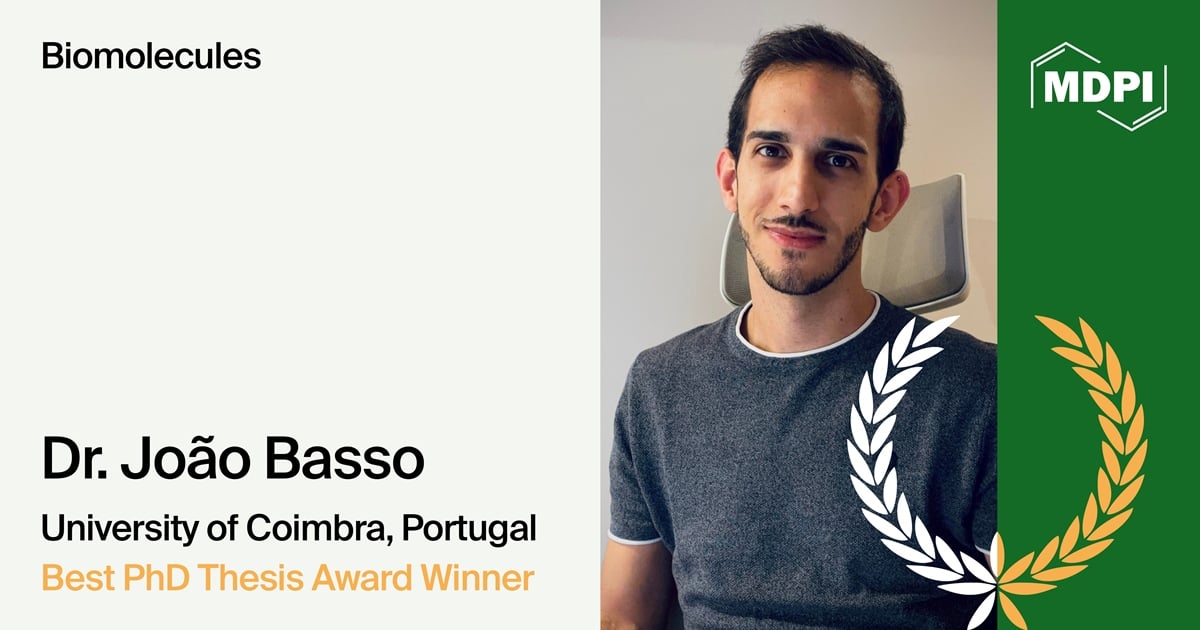
Interview with Dr. João Basso—Winner of the Biomolecules Best PhD Thesis Award
1. Could you tell us a little bit about yourself and the scientific research you conducted during your doctoral studies?
After finishing my master’s in pharmaceutical sciences, I had the opportunity to join a research group focused on developing novel carriers for glioblastoma treatment, the most common and deadliest form of brain cancer. Pursuing a PhD felt like the natural next step, so I applied for and secured a national PhD research scholarship.
The premise of my doctoral research was to advance glioblastoma treatment by combining drug and gene delivery into a single nanoparticle. To select the ideal therapeutic entities, I conducted a systematic review on drug repurposing for glioblastoma alongside a bioinformatic research study on miRNAs. From there, the carrier development was driven by a Quality by Design approach, emphasizing step-by-step systematic methods, multivariate analysis, and Design of Experiments (DoE). However, I wanted to take the work a step further by giving it a strong multidisciplinary stamp. This involved extensive studies using brain cancer models (both 2D cells and 3D spheroids), proteomics, as well as in vivo biodistribution and efficacy studies in a rodent model.
2. Your thesis focused on developing biohybrid nanosystems for the co-delivery of drugs and nucleic acids in glioblastoma. What makes this combined approach a promising direction for treating such an aggressive brain tumor, and what was the most exciting finding of your work?
Glioblastoma patients face a very limited prognosis and we still lack a cure. Temozolomide was approved decades ago, and combined with radiotherapy, it yields a five-year survival rate of only 7%. My PhD work served as a proof-of-concept for achieving better outcomes by combining drug and miRNA delivery to tackle brain cancer. The platform not only performed exceptionally well in vitro, but it also led to tumor regression in vivo and significantly longer-term survival compared to temozolomide (the gold standard of care) without compromising safety or well-being of the animals.
Most excitingly, it was the inclusion of the miRNA that showed the best in vivo results, outperforming the carrier delivering the drug alone. We hope this work, alongside contributions from other international research groups, helps highlight the clinical potential of combined miRNA and drug therapy, thereby accelerating the industrial translation of such technologies.
3. Did you encounter any difficulties in carrying out this research? If yes, how did you overcome them, and what strategies did you use to stay focused and motivated?
I faced many challenges during my PhD, but I view them as an essential part of professional growth and building a resilient scientific career. Optimizing test conditions was often laborious, especially when the root causes of unexpected hurdles weren’t immediately clear; yet this troubleshooting is crucial for generating reliable and robust results. For instance, I spent several months trying to engineer a positively charged system capable of efficiently interacting with miRNAs. We ultimately learned that simply having a cationic nanoparticle is not enough to guarantee complexation with polyanions, and we went through dozens of formulations before cracking it. Beyond experimental optimization, the workload itself was demanding. Managing complex in vivo studies often meant enduring long hours of brain surgeries, frequently stretching late into the night and on weekends, while balancing strict project milestones, tight deadlines, and the need to maintain moments of distraction and a healthy lifestyle.
I overcame these mental and physical roadblocks through perseverance, teamwork, and adaptability. Engaging in regular scientific discussions with my supervision team, friends, and colleagues was also vital to keeping my motivation high and the project on track.
4. As an author, what aspects of a journal do you value the most when choosing a journal in which to publish your academic work?
As both an author and a researcher, I deeply value journals that provide a rigorous and constructive peer-review process, as this genuinely elevates the quality of the scientific work for the broader community. Timely feedback from the editorial board and reviewers is also critical to ensure findings are published while maintaining their novelty and aligning with authors’ expectations. Beyond that, I carefully consider a journal’s impact factor, scope, target audience, and the reputation of its editors when planning a submission.
5. What is your current research interest and how do you plan to continue building on your research in the future? What are your long-term career aspirations?
I’ve embraced a new professional challenge, working on diverse projects involving oral medicines, including generics, hybrids, and value-added medicines for CNS disorders and cancer. Although I am no longer working exclusively on brain cancer, my goal remains the same: developing medicines that reach patients worldwide and meaningfully improve their health and well-being, which I believe is the ultimate purpose of health sciences. This role allows me to translate the knowledge and hands-on experience gained during my PhD into real-world scenarios, sometimes applying complex and out-of-the box strategies with a sharp focus on industrial development, application, and large-scale manufacturing.
6. How does it feel to receive this recognition for your work? Is there something you would like to express or someone you would like to thank the most?
Receiving the Best PhD Award from Biomolecules is an incredible way to cap off my doctoral journey. Six years of constant work and dedication are demanding, but earning this recognition from an international evaluation committee is deeply rewarding. It serves as a great affirmation of the hard work, curiosity, and passion that went into this milestone.
Above all, this award reflects a collaborative multidisciplinary effort involving supervisors, colleagues, and institutional staff who contributed to the project. It simply wouldn’t have been possible without them. I want to give a very special thank you to my supervisors, Carla Vitorino, Ana Fortuna, and Rui Vitorino, who stood behind every single page of the thesis, as well as to the Faculty of Pharmacy and the Coimbra Chemistry Centre at the University of Coimbra, Portugal.