
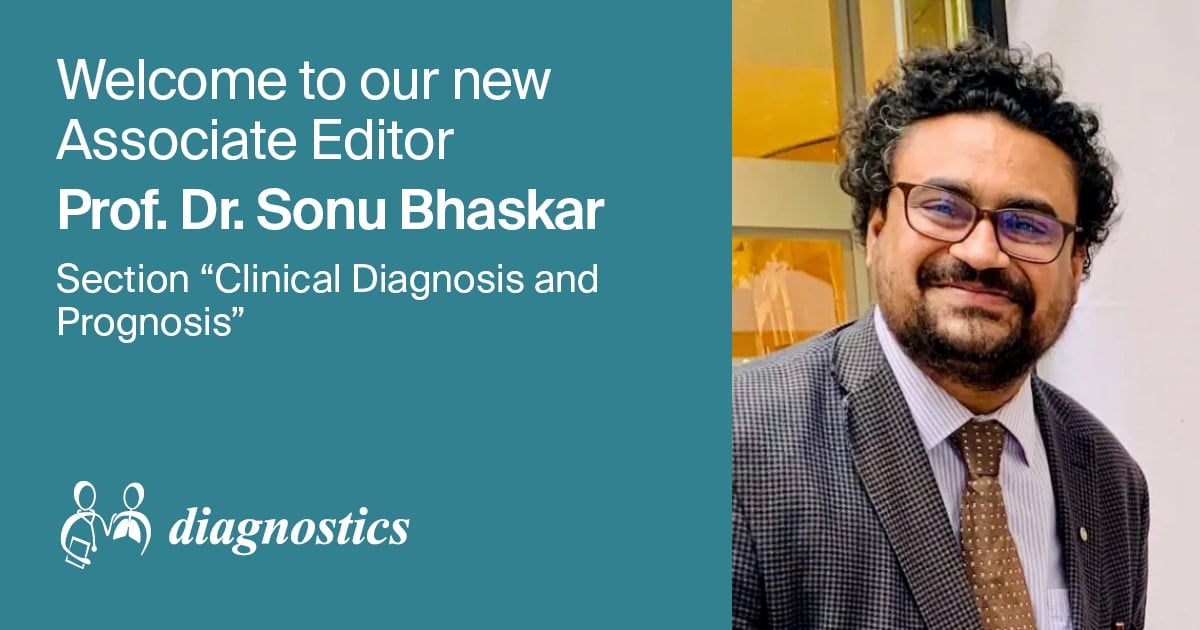
Prof. Dr. Sonu Bhaskar Appointed Associate Editor of Section “Clinical Diagnosis and Prognosis” in Diagnostics
We are pleased to announce that Prof. Dr. Sonu Bhaskar has been appointed Associate Editor of the Section “Clinical Diagnosis and Prognosis” in Diagnostics (ISSN 2075-4418).
Name: Prof. Dr. Sonu Bhaskar
Affiliations: 1 Global Health Neurology Lab, Sydney, NSW 2000, Australia; 2 NSW Brain Clot Bank, Sydney, NSW 2170, Australia; 3 Ingham Institute for Applied Medical Research and Department of Neurology, Liverpool Hospital & South West Sydney Local Health District, Liverpool, NSW 2170, Australia; 4 Department of Neurology, National Cerebral and Cardiovascular Center, Osaka, Japan
Interests: cerebrovascular disorders; stroke; biomarkers; cardiovascular diseases; global health; social inequalities in health
Prof. Dr. Sonu Bhaskar, MD, PhD, FANA, is a physician-scientist and neurologist specialising in vascular neurology and neuroradiology. He directs the Global Health Neurology Lab in Sydney and is Founding Director and Chief Investigator of the NSW Brain Clot Bank, a statewide initiative supported by the NSW Ministry of Health in partnership with NSW Health Pathology, local health districts, stroke centres and research institutes.
His research focuses on stroke prevention and treatment, translational neuroscience, biomarkers, and the reduction in health disparities in under-resourced settings. He has held leadership and governance roles in academic, clinical and research organisations and has contributed to international collaborations on health systems and policy, including COVID-19-related work through the REPROGRAM consortium.
Prof. Dr. Bhaskar is a Fellow of the American Neurological Association and a recipient of the EU Marie Curie Fellowship, the Spanish Ministry of Health Fellowship, the Dutch Ministry Top Talent Award, the 2019 European Academy of Neurology Investigator Award, the 2022 Australian Global Talent Award, the 2023 JSPS International Fellowship and the 2025 Overall Winner of the Asian–Australian Leadership Award. Most recently, he was awarded the Lundbeck Foundation Visiting Professorship in Neuroscience at the University of Copenhagen, Denmark (2026–2027).
We were honored to interview Prof. Dr. Sonu Bhaskar; in this review, he shares his insights on emerging trends in neurology and translational research, in addition to his vision for the journal and advice to young scholars.
1. What appealed to you about the journal that made you want to take the role as its Associate Editor?
What drew me to Diagnostics is its emphasis on connecting scientific findings with clinical decisions. In neurology and translational research, a diagnostic method’s value is determined by whether it changes clinical management and patient outcomes, not solely by its technical novelty. The journal’s scope across imaging, biomarkers, clinical medicine and emerging methods offers a practical forum for this connection. I was also interested in supporting work that is methodologically sound and applicable across varied healthcare settings. Editorial work, in this sense, involves helping reliable evidence reach clinical practice while upholding the standards required for scientific trust.
2. In the field of neurology, which research themes do you consider particularly trending or likely to attract significant attention?
Several areas in neurological diagnostics are advancing. Multimodal approaches that combine neuroimaging, molecular markers and physiological data show potential for earlier detection and more individualized prognosis. In cerebrovascular disease, attention is shifting from time-based criteria alone toward tissue viability, collateral status, microvascular integrity and longer-term recovery; my Time–Tissue–Systems framework reflects this change in acute stroke care. Other developments include blood-based biomarkers for neurodegeneration, refined vascular and neuroinflammatory imaging, and artificial intelligence for interpretable risk estimates. The central challenge will be whether these methods perform reliably across populations and yield measurable clinical benefit. Progress will depend less on diagnosing earlier in isolation and more on determining when a diagnosis should alter management.
3. To identify and address potential ethical risks in academic publishing, could you share a few strategies or best practices for handling them?
Integrity depends on study design, transparent reporting, ethical approval, responsible authorship and reproducibility before a manuscript reaches an editor. In review, independent peer assessment, verification of data sources where appropriate and scrutiny of methodological claims remain essential. Studies involving artificial intelligence, secondary datasets or prediction models require particular attention to data suitability, bias, leakage and whether conclusions are supported by the evidence. Disclosure of competing interests, clear description of AI-assisted processes and accountability for the work are also necessary. Concerns should be examined consistently and in line with established publication ethics standards. The aim is not to create barriers but to protect patients, preserve public confidence and ensure published findings merit the trust placed in them.
4. As the Associate Editor of Diagnostics, what qualities do you consider essential for high-impact manuscripts for the journal?
A high-impact manuscript starts with a clinically relevant question rather than a sophisticated technique. Strong studies address a genuine diagnostic or prognostic uncertainty, apply suitable methods and present results that clinicians can interpret. I value transparent reporting, well-characterized populations, appropriate reference standards, sound statistics, external validation when relevant and explicit consideration of bias and generalizability. Diagnostic performance should be assessed beyond discrimination alone; calibration, clinical utility, feasibility and the consequences of error also matter. A study does not need large datasets or costly technology to contribute. Carefully conducted work that reduces uncertainty or improves care in less-resourced settings can be equally valuable. Impact is best judged by the quality of evidence and its capacity to advance patient care.
5. What is your vision for the journal?
I hope to support Diagnostics as a venue for evidence that links diagnostic methods to clinical value. This includes encouraging work that moves from technical performance toward improvements in diagnosis, treatment selection, prognostication and outcomes. Priorities include multimodal diagnostics, longitudinal risk assessment, real-world validation and responsible clinical AI, together with rigorous evaluation of established approaches. Broader representation across regions, populations and healthcare systems is also needed; innovation that remains limited to well-resourced centers has limited reach. I would aim for an editorial process marked by independence, constructive review, methodological care and international collaboration. The practical goal is to publish evidence that clinicians can use, researchers can build on and that ultimately benefits patients.
6. What advice would you give to early career researchers?
Begin with a problem that matters in practice rather than a publication target. Useful advances often arise from questions that appear in ordinary clinical work and have been overlooked because they are difficult or poorly funded. Develop solid methodological and reasoning skills. Learn the limits of your own data, accept criticism and work with colleagues who question assumptions. Select mentors for integrity and support as well as standing. Curiosity is worth protecting, as progress is rarely linear. Academic recognition and scientific contribution are not the same. Publications have a role, yet the longer purpose of research is to expand reliable knowledge and improve care. A career grounded in honesty, persistence and service tends to retain value beyond individual papers.
We are honored to introduce Prof. Dr. Sonu Bhaskar to our editorial team, and we are confident that, with the guidance of our new Associate Editor, we will continue to improve the reputation and quality of Diagnostics.