
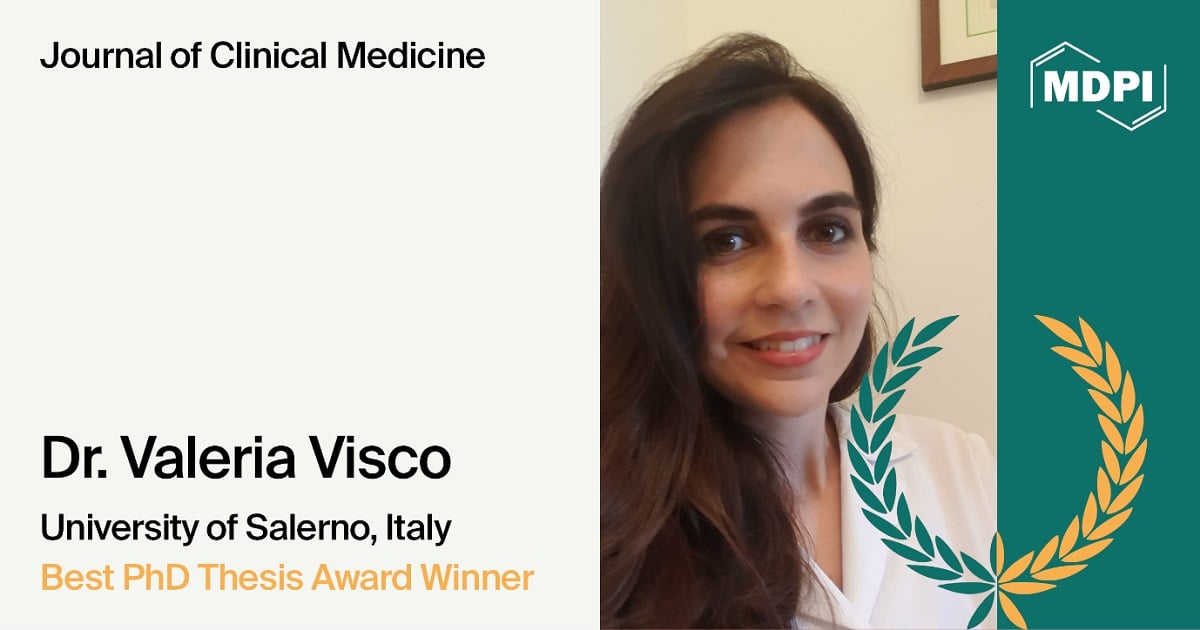
Interview with Dr. Valeria Visco—Winner of the Journal of Clinical Medicine Best PhD Thesis Award
Dr. Valeria Visco received a doctorate in translational medicine from the University of Salerno (Italy) and a postdoctoral research grant at the same university. Her scientific interests include basic and translational research on heart failure, with a focus on new remote heart failure monitoring devices and the application of artificial intelligence algorithms in heart failure management. Among others, she is a nucleus member of the European Society of Cardiology (ESC) Working Group on Myocardial Function, which focuses on the molecular, cellular, and integrative mechanisms underlying cardiac function and dysfunction. She is also a nucleus member of the Working Group on “Cardiac Rehabilitation” of the Italian Society of Cardiology. We offer our congratulations to Dr. Valeria Visco as the winner of the JCM 2025 Best PhD Thesis Award.
The following is a short interview with Dr. Valeria Visco:
1. Could you please introduce yourself and give us a brief overview of your doctoral research? What motivated you to choose this particular area of study?
My name is Valeria Visco, and I am a cardiologist and researcher at the University of Salerno in Italy. My clinical and research interests are mainly focused on heart failure, particularly advanced heart failure. During my PhD, my research focused on “The favourable alliance between CardioMEMS and levosimendan in patients with advanced heart failure”. The aim of my research was to explore a new strategy for the management of patients with advanced heart failure by combining remote haemodynamic monitoring through the CardioMEMS system with levosimendan infusions. I chose this area because, as a cardiologist, I am particularly interested in finding practical strategies that can address the challenges faced by patients with advanced heart failure. In particular, I wanted to investigate whether this approach could help reduce the number and duration of hospitalizations, improve patients’ quality of life, and potentially reduce healthcare costs. I believe that research is most valuable when it can translate into meaningful improvements in everyday clinical practice.
2. How did you manage your time and prioritize multiple tasks during your doctoral program? Are there any specific strategies or habits that helped you maintain productivity and balance?
During my doctoral program, careful weekly planning was essential to balancing my clinical responsibilities with my research activities. At the beginning of each week, I would identify the most important tasks, trying to set realistic priorities and deadlines. I mainly worked on my research during the time available outside my clinical activities. This required flexibility, as the amount of time available for research could vary considerably depending on my clinical workload.
3. Many doctoral students face pressure to publish and worry about delayed graduation. What practical advice would you offer to those who are currently in the middle of or nearing the end of their thesis work?
My main advice would be to plan carefully, set realistic priorities, and remain consistent throughout the PhD journey. Research can sometimes progress more slowly than expected, and there may be periods of uncertainty or frustration, so it is important not to become discouraged by temporary setbacks. For those who are also involved in clinical activities, as I was, finding a balance between clinical work and research can be particularly challenging. However, even dedicating small but regular periods of time to research can make a significant difference in the long term. I would also encourage doctoral students to focus on the quality and relevance of their research rather than feeling pressured to publish as quickly as possible. Having a clear research question, working consistently, and maintaining motivation throughout the process are, in my experience, key to successfully completing a PhD.
4. As an early career researcher, what factors do you consider most important when selecting a journal for your publications? What is your view on the open access publishing model, especially in your field?
As an early career researcher, the scientific quality of a journal is my primary consideration when deciding where to submit my work. I also pay close attention to the journal’s impact factor, as it can provide an indication of its influence and visibility within the scientific community. At the same time, I consider open access to be an increasingly important aspect of scientific publishing. I believe that greater accessibility can increase the visibility and dissemination of scientific work and can help researchers reach clinicians and scientists beyond the traditional academic community. For these reasons, when choosing a journal, I try to find a balance between scientific quality, reputation, visibility, and accessibility.
5. How did you first learn about our journal and this award, and what motivated you to apply?
I was already familiar with the journal, as I have published in it several times and I am also part of the journal’s reviewer community. Precisely, I learned about the award through the journal’s website. When I read about the opportunity, I thought that my PhD thesis could be a good fit because of its potential impact on clinical practice, particularly in the management of patients with advanced heart failure. I therefore decided to apply because I felt that the award would be a valuable opportunity to further share the results of my research, and highlight the potential clinical relevance of the work.
6. From your perspective, what could we do better to help early career researchers discover our journal, navigate the application process, and feel more supported? Could you share your experience collaborating with us?
My experience with the journal has been very positive. I have published several papers in the journal, I regularly serve as a reviewer, and I have also had the opportunity to work as a Guest Editor. These different roles have given me a broader perspective on the journal and its editorial process. I have always found the editorial team to be very supportive and approachable. The editors are highly available, manuscripts are handled efficiently, and authors receive valuable support throughout the publication process. This has made my experience of collaborating with the journal particularly positive. For early career researchers, I think it is important to continue increasing the visibility of the journal through opportunities that actively engage young researchers, such as dedicated awards, webinars, early career researcher initiatives, and opportunities to participate in peer review or editorial activities. Clear and accessible information about these opportunities can also make it easier for young researchers to become familiar with the journal and feel part of its scientific community.
7. What does receiving this award mean to you personally and professionally? How do you plan to build on your research in the coming years, and what are your long-term career aspirations?
Receiving this award is a great honour for me, both personally and professionally. It represents international recognition of the value and potential clinical impact of my research, and this is particularly meaningful to me as an early-career researcher. At the same time, the award is an important motivation to continue my research activities and to develop new strategies for improving the management of patients with heart failure. I would like to build on the experience gained during my PhD by continuing to investigate innovative and personalized approaches, with the ultimate goal of improving patients’ outcomes and quality of life while reducing the burden of hospitalizations. In the long term, I hope to continue combining clinical practice and research. My ambition is to contribute to clinically relevant research in the field of heart failure and to translate scientific findings into practical strategies that can make a real difference in the care of patients.
Finally, we would like to extend our gratitude to Dr. Valeria Visco and all the distinguished scholars for their significant contributions and support. Your achievements and insights are an inspiration to the community. You can keep up to date on our awards and academic initiatives at https://www.mdpi.com/journal/jcm/awards.