
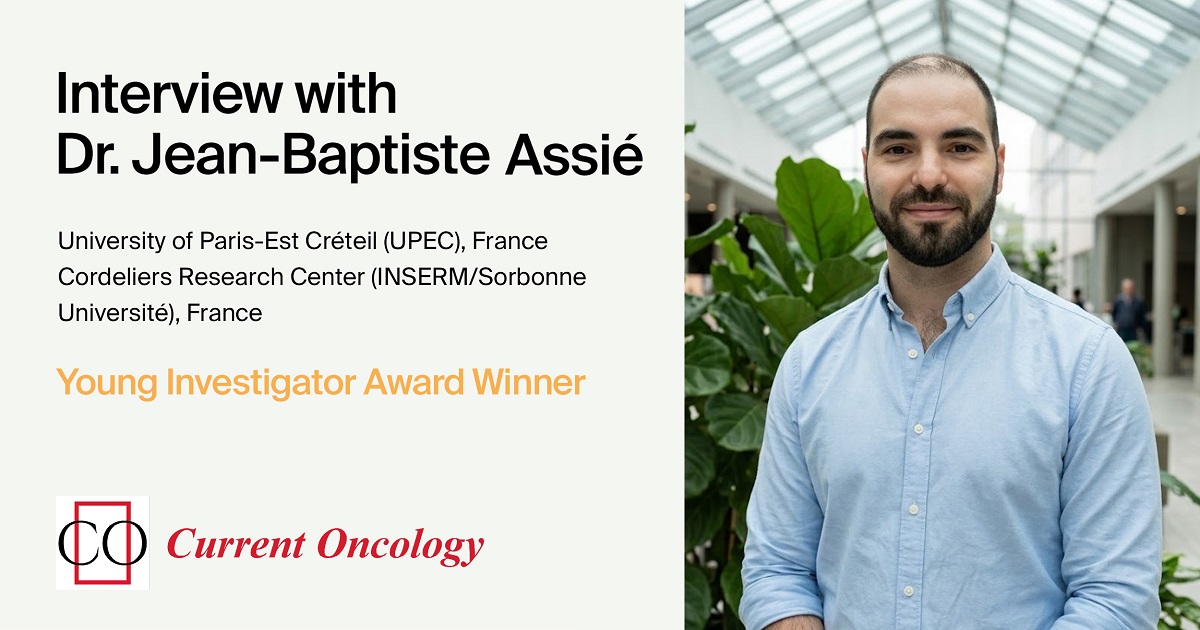
Interview with Dr. Jean-Baptiste Assié—Winner of the Current Oncology Young Investigator Award
Current Oncology (ISSN: 1718-7729) is proud to present the winner of the Current Oncology Young Investigator Award, Dr. Jean-Baptiste Assié of Paris-Est University, France.
Name: Dr. Jean-Baptiste Assié
Affiliations:
 |
1. Department of Pneumology, Paris-Est University, Centre Hospitalier Inter-Communal de Créteil, UPEC, IMRB, 94010 Creteil |
 |
2. Centre de Recherche des Cordeliers, Inserm, Sorbonne Université, Université de Paris, Functional Genomics of Solid Tumors laboratory, F-75006 Paris, France |
Research interests: functional genomics, tumor heterogeneity, pleural mesothelioma, drug repurposing, pharmacogenomics, real-world data
Dr. Jean-Baptiste Assié is an Assistant Professor affiliated with the University of Paris-Est Créteil (UPEC), CHI Créteil, and the Cordeliers Research Center (INSERM/Sorbonne Université), where he is a member of the FunGEST/mesothelioma research group led by Dr. Didier Jean. He completed his medical training and obtained his PhD in the field of thoracic oncology, with a focus on pleural mesothelioma, a rare and aggressive malignancy characterized by limited therapeutic options and a need for novel treatment strategies. His research interests include tumor heterogeneity, CDK4/6 inhibition, pharmacogenomics, real-world studies and the development of translational approaches to improve patient care in this disease. He is an investigator in several national mesothelioma research projects, leads real-world cohort studies, including the MESOIMMUNE first-line French cohort, and regularly presents his work at major international congresses.
The following is an interview with Dr. Assié:
1. Could you briefly introduce yourself and tell us about your field of research?
I am an Associate Professor affiliated with the University of Paris-Est Créteil, CHI Créteil, and the Cordeliers Research Center in Paris. My research focuses on pleural mesothelioma, a rare and aggressive thoracic malignancy with very limited therapeutic options. I work at the interface of clinical practice and translational research, with a particular interest in tumor heterogeneity, therapeutic strategies including pharmacogenomics and cell therapies, and real-world data on immunotherapy outcomes. I am part of the FunGEST/mesothelioma group led by Dr. Didier Jean, and I am an investigator in several research projects in this field, including the MESOIMMUNE first-line French real-world cohort.
2. Congratulations on winning the Current Oncology Young Investigator Award! How did you first learn about the journal Current Oncology? How do you feel about winning the award?
I became familiar with Current Oncology through my regular reading of the thoracic oncology literature; the journal consistently publishes clinically meaningful work, including real-world data studies that are central to my own research interests. Winning this award is both an honor and a real source of motivation. Mesothelioma is a disease that affects a relatively small patient population, and recognition from the broader oncology community reinforces the importance of continuing to advance research in this area. I am particularly grateful to my team and mentors at the Cordeliers Research Center for their support.
3. As a scientific researcher, how do you balance life and research work?
Balancing a clinical position, research, and family life is genuinely challenging, and I will not pretend it is always straightforward. I find that structure and prioritization are essential, identifying what truly matters in both professional and personal spheres and protecting time for each. Having young children reminds me that the pace of everyday life outside the hospital and the laboratory is itself grounding. I also believe that collegial collaboration, rather than working in isolation, makes research more sustainable and more enjoyable.
4. Which research topics do you think will be of particular interest to the research community in the coming years?
In thoracic oncology broadly, antibody-drug conjugates (ADCs) represent one of the most rapidly evolving therapeutic classes, and understanding how to position them, and how resistance mechanisms develop, will be a major focus. For mesothelioma specifically, I expect significant interest in predictive biomarkers for immunotherapy response, the role of the tumor microenvironment, and novel combinations leveraging emerging targets. Real-world data methodologies will also continue to gain importance as a complement to randomized trials, particularly for rare cancers where large prospective studies remain difficult to conduct.
5. As a recipient of this Young Investigator Award, what advice or insights would you share with contemporary young researchers?
I would encourage young investigators to build their research agenda around questions that genuinely matter to patients; this keeps the work meaningful even through the inevitable difficulties. Choose your mentors carefully, and do not hesitate to seek collaborations across disciplines and borders. Also, learn to value negative or inconclusive results: they are part of honest science. Finally, do not underestimate the importance of communicating your findings clearly, whether in scientific publications, congresses, or increasingly through real-world data frameworks that can inform clinical practice rapidly.
6. What are your thoughts on the impact of open access (OA) publishing on authors in academia? Are you considering further collaboration with Current Oncology in the future?
Open access has been transformative, particularly for rare disease research. When our findings on mesothelioma are freely accessible to clinicians, patients, and researchers worldwide, including in countries where institutional subscriptions may be limited, the potential impact is substantially greater. The counterpoint remains the issue of article processing charges, which can be burdensome for investigators without dedicated funding. I would certainly welcome the opportunity to collaborate further with Current Oncology, which occupies a valuable position as a peer-reviewed OA journal with broad clinical reach.
7. In your view, how can academic journals and publishers further support young investigators and the broader academic community?
Several measures come to mind: waiving or reducing APCs for early career researchers, offering structured mentorship in the peer-review process, providing rapid and constructive editorial feedback, and ensuring visibility for work on rare cancers that might otherwise struggle to find an appropriate outlet. More broadly, fostering a culture where replications, null results, and real-world studies are treated with the same rigor and respect as landmark randomized trials would benefit the entire field.
8. Looking ahead, what are your main goals or projects for the coming years?
My immediate priorities include advancing the analysis of the MESOIMMUNE first-line cohort to better characterize real-world immunotherapy outcomes in pleural mesothelioma, and contributing to translational work on tumor heterogeneity within the FunGEST group. Over the medium term, I hope to develop prospective research integrating novel biomarkers and exploring rational therapeutic combinations, including ADC-based strategies or cell therapies, in this disease. More broadly, I aim to strengthen the national and international collaborative networks that are essential for making progress in a rare cancer, and to contribute to training the next generation of clinician-researchers in this field.
Thank you for participating in this interview and congratulations again on being selected as one of the winners of the Current Oncology Young Investigator Award. We look forward to sharing your perspectives with the wider research community and wish you continued success in your future research and professional endeavors.