
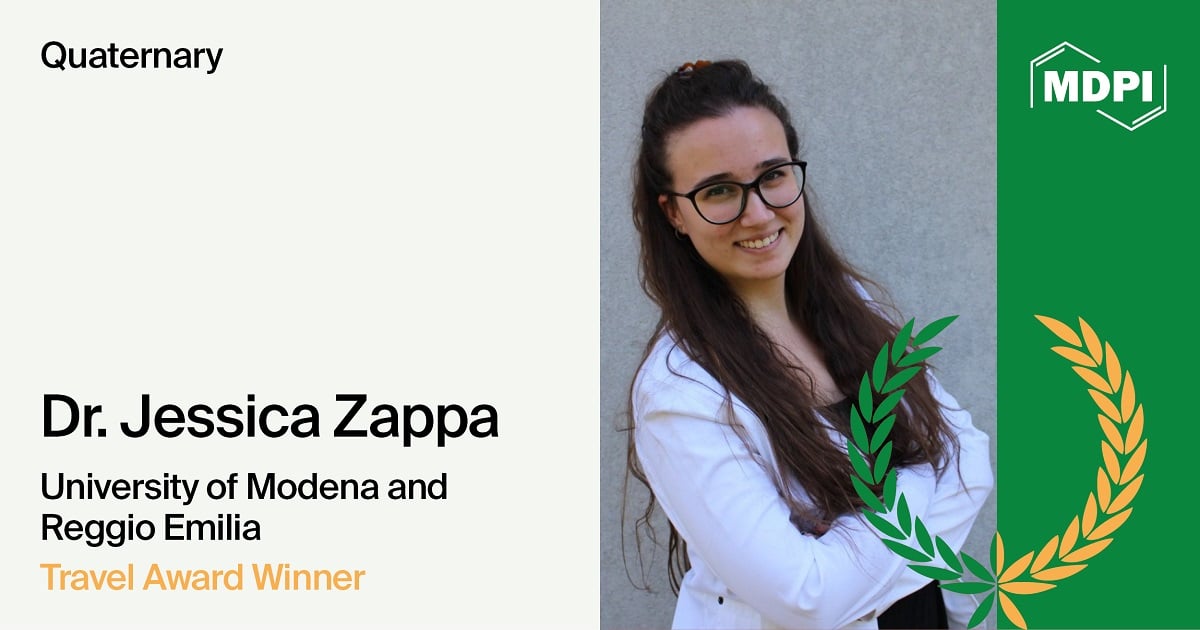
Interview with Dr. Jessica Zappa—Winner of the Quaternary Travel Award
We are pleased to announce that Dr. Jessica Zappa has been awarded the Quaternary Travel Award. This award supports early career researchers by facilitating their participation in key international conferences in the field of quaternary science, enabling them to present their outstanding work and engage with the global scientific community.
We were honored to interview Dr. Jessica Zappa and learn about her views on and experiences of scientific research and the award. The interview is summarized below:
1. Could you please give us a brief introduction of yourself (including your research field and research findings)?
I am a palynologist working in palaeoenvironmental research. My work focuses on the reconstruction of past landscapes and human–environment interactions through the integration of pollen analysis with geomorphological data, archaeological evidence, and GIS-based approaches. In particular, I am interested in how vegetation, land use, climate variability, and geomorphic processes interacted in shaping Quaternary landscapes, especially in Mediterranean and African and Near-East environments.
2. What was the biggest challenge you encountered during the research process? How did you overcome it?
The main challenge was integrating different types of data, from field observations to pollen analyses to spatial modelling. I addressed this by developing a clear interdisciplinary workflow and by carefully comparing evidence across different spatial and temporal scales, and of course by collaborating constructively with experts of the different fields.
3. How does it feel to receive the Quaternary Travel Award? What does this recognition mean to you?
Receiving the Travel Award is a great honor. It represents an important recognition of my research and gives me the opportunity to share my work with the scientific community.
4. What attracted you to submit your paper to Quaternary? What benefits do you believe authors gain from publishing in this journal?
I was attracted by the journal’s interdisciplinary scope, which fits well with research combining palaeoecology, geomorphology, archaeology, and in general environmental sciences. I believe authors benefit from publishing in Quaternary because it offers visibility within a focused scientific community.
5. Which research topics do you think will be of particular interest to the research community in the coming years?
I think future research will increasingly focus on human–environment interactions, climate-driven landscape change, and the integration of palaeoenvironmental records with spatial modelling and other new proxies.
6. Is there anything else you’d like to share—perhaps thoughts on how journals like Quaternary can better support researchers, or reflections that haven’t come up yet?
I believe journals like Quaternary can support early career researchers by promoting awards, special issues, and opportunities for international networking, as you already do.
Initiatives such as this one are in fact especially valuable because they help young researchers present their work and build collaborations.