
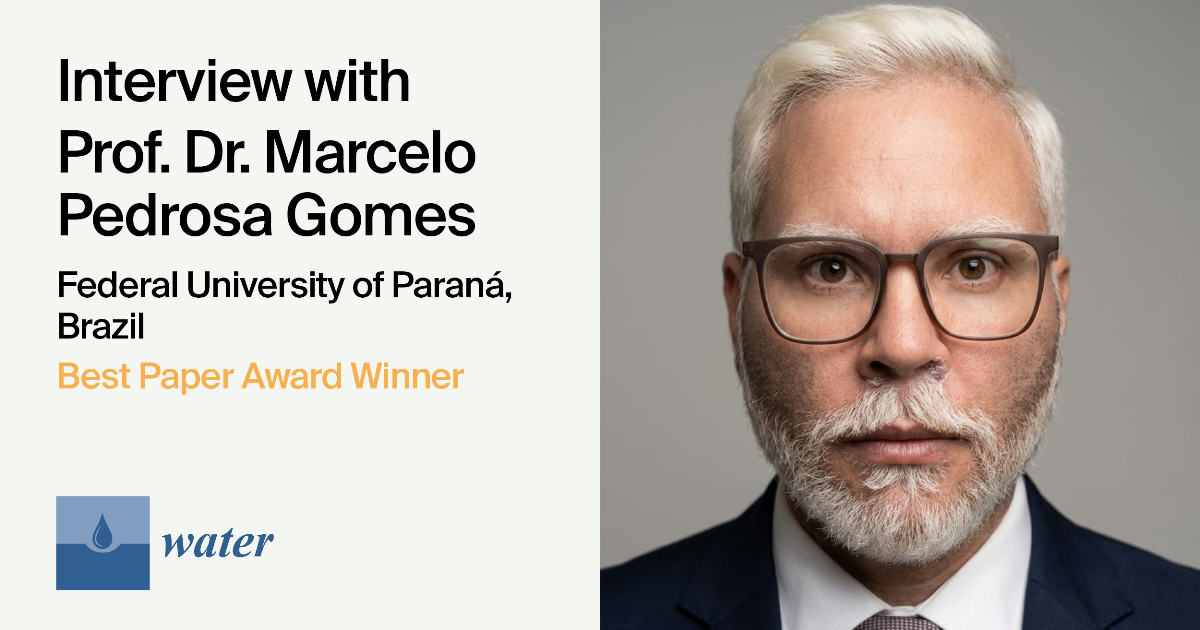
Interview with Prof. Dr. Marcelo Pedrosa Gomes—Winner of the Water Best Paper Award
The following is an interview with Prof. Dr. Marcelo Pedrosa Gomes:
1. Congratulations on winning the Water 2024 Best Paper Award! Could you please briefly introduce yourself?
My name is Marcelo Pedrosa Gomes, and I am an Associate Professor in the Department of Botany at the Federal University of Paraná (UFPR), Brazil, where I lead the Laboratory of Plant Physiology under Stress (LAFIPE). My research lies at the intersection of plant ecophysiology, environmental toxicology, and biotechnology, with a particular focus on emerging contaminants, antimicrobial resistance, and nature-based solutions for environmental remediation.
Over the years, I have become particularly interested in understanding how contaminants, such as pharmaceuticals, pesticides, and other anthropogenic stressors, affect aquatic ecosystems and how biological systems—particularly plants and microorganisms—can be used to mitigate these impacts. I strongly believe that environmental problems require interdisciplinary and translational approaches, especially from a One Health perspective, connecting ecosystem, animal, and human health.
2. Could you introduce the research focus and the key findings of this award-winning paper?
This study emerged from the growing concern that three major environmental challenges—antibiotic contamination, antimicrobial resistance (AMR), and climate change—are usually discussed separately, even though they are strongly interconnected in real freshwater ecosystems. I felt that there was an important gap in bringing these issues together from a single environmental and public health perspective. The main focus of the paper was to explore how climate dynamics, including rising temperatures, altered precipitation patterns, droughts, and extreme weather events, may influence the environmental fate of antibiotics and intensify the spread of antimicrobial resistance in freshwater ecosystems. The review also examined the pathways through which antibiotics enter aquatic environments and how these contaminants affect biodiversity, microbial communities and ecosystem functioning.
One of the central messages of this study is that antibiotic contamination should not be understood only as a pollution problem. It is also an ecological, evolutionary, and One Health challenge because resistant microorganisms and resistance genes can spread across environmental, animal, and human systems. In addition to discussing the mechanisms and risks, this paper highlights important research gaps and explores possible mitigation strategies, including improved wastewater treatment, nature-based solutions, and stronger environmental policies. I believe that the paper resonated with the scientific community because it offered an integrative perspective on a highly urgent and still underexplored global issue.
3. What were the biggest challenges you faced during this research, and how did you overcome them?
One of the biggest challenges was dealing with the highly interdisciplinary nature of this topic. This research required the integration of fields that are often studied independently, including environmental contamination, microbial ecology, antimicrobial resistance, freshwater ecology, and climate science. Bringing these perspectives together in a scientifically coherent and balanced manner is intellectually demanding.
Another important challenge was the limited integrative literature. There is a substantial body of research on antibiotics in aquatic systems, antimicrobial resistance, and climate change. However, studies explicitly addressing how these issues converge are scarce. This meant that, in many cases, I had to synthesize fragmented evidence from different disciplines and attempt to identify broader patterns and interactions.
On a more personal level, I would say that one challenge was emotional. As I immersed myself in the literature, I sometimes felt a sense of urgency and concern about the trajectory we may be facing regarding freshwater quality and antimicrobial resistance. The more I read, the clearer it became that this is not only a scientific issue, but also a societal one. I overcame these challenges through persistence, extensive reading, and by trying to maintain a broad and integrative perspective on the subject. Rather than viewing the fragmentation of the literature as a limitation, I tried to see it as an opportunity to build bridges between disciplines and stimulate a broader discussion of this issue.
4. What advice would you give to young researchers who aspire to produce high-impact research results?
My first advice would be: do not chase impact; chase meaningful questions. High-impact research often emerges when we genuinely try to answer important and unresolved problems, especially those that matter beyond academia.
I would also encourage young researchers to be intellectually curious and not be afraid of crossing disciplinary boundaries. Many of today’s most important scientific questions—such as those regarding climate change, antimicrobial resistance, biodiversity loss, and environmental contamination— cannot be solved within a single field. Some of the most exciting discoveries occur at the interface between disciplines.
Simultaneously, I believe it is essential to develop scientific rigor and patience. Good science requires time. Read deeply, question assumptions, be critical of your own interpretations, and do not be discouraged by setbacks or rejected manuscripts. Rejections are part of academic life and often strengthen our work.
Finally, I would say: never lose sight of why science matters. Publishing papers is important, but research becomes truly meaningful when it contributes to society, helps people understand the world better, and supports solutions to real problems. Try to conduct science with purpose.
5. Could you tell us what attracted you to submit your paper to Water, and what your experience with the publication process was?
I chose Water because the journal has a broad and interdisciplinary scope that aligns very well with the type of research I am trying to develop. This paper sits at the intersection of environmental contamination, freshwater ecology, antimicrobial resistance, and climate dynamics, and I believe that Water would provide the right audience for this type of integrative discussion.
Another important factor is that the journal welcomes both applied and conceptual contributions related to freshwater systems, environmental management, and emerging global challenges. Since this paper aimed not only to synthesize knowledge but also to stimulate discussion and highlight future directions, Water seemed like a natural fit.
My experience with the publication process was very positive. The editorial and peer-review processes were professional, constructive, and efficient. I particularly appreciated the reviewers’ comments, which helped strengthen the clarity and scope of this manuscript. As researchers, we sometimes see peer review only as an evaluation process, but in the best situations, it also becomes an opportunity to improve the work—and that was certainly my experience.
Receiving this recognition through the Water Best Paper Award is especially meaningful to me, as it reinforces the importance of discussing urgent environmental issues from integrative and forward-looking perspectives.
6. As a Best Paper Award winner, what suggestions do you have for Water to further enhance its service or impact?
First, I would like to say that Water is already playing an important role in promoting interdisciplinary research on aquatic systems and emerging environmental challenges. Receiving this award has reinforced my positive perception of this journal and its contributions to the scientific community.
If I could offer a suggestion, it would be to further strengthen the bridge between scientific knowledge and its societal impact. Many challenges related to water resources, such as pollution, antimicrobial resistance, climate change, and ecosystem degradation, require not only strong science but also broader communication with policymakers, stakeholders, and the public.
I believe that the journal could further expand its visibility and impact by investing even more in accessible science communication, such as short research highlights, policy-oriented summaries, interviews with authors, visual abstracts, and thematic discussions that help translate scientific findings into broader societal dialogue.
I would also encourage continued support for highly interdisciplinary and forward-looking topics, particularly those integrating environmental science, human health, biotechnology, and sustainability from a One Health perspective. Some of the most urgent environmental problems today require this type of scientific integration.
Overall, my experience with Water has been very positive, and I sincerely look forward to continuing to contribute to this journal in the future.