
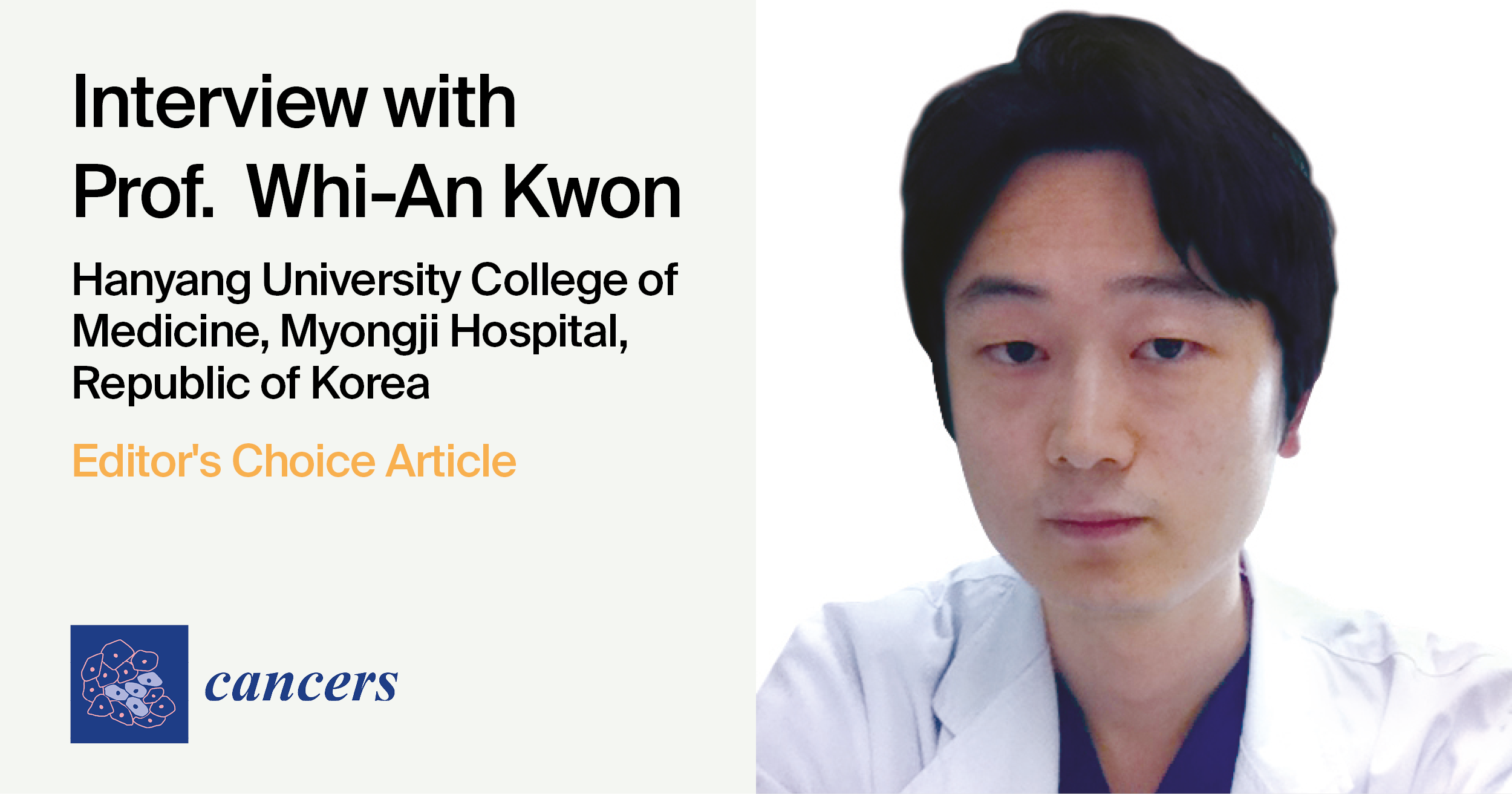
Cancers | Interview with the Author of the Editor’s Choice Article—Prof. Whi-An Kwon
We had the pleasure of speaking with Prof. Whi-An Kwon, the first and corresponding author of the Editor’s Choice Article in Cancers (ISSN: 2072-6694). Here, he shares insights into his paper, research focus, area of expertise and daily life.
“T-Cell Engager Therapy in Prostate Cancer: Molecular Insights into a New Frontier in Immunotherapy”
by Whi-An Kwon and Jae Young Joung
Cancers 2025, 17(11), 1820; https://doi.org/10.3390/cancers17111820
Available online: https://www.mdpi.com/2072-6694/17/11/1820
The following is an interview with Prof. Whi-An Kwon.
1. Could you briefly introduce yourself and describe your main research focus?
I am Whi-An Kwon, a professor in the Department of Urology at Hanyang University College of Medicine and Myongji Hospital in South Korea. I serve as the Director of the Research Institute of Precision Medicine and Geroscience and as the Academic Chair of the Exercise Subcommittee for the Korean Society of Cancer Prevention (KSCP). My core research focus is dynamic precision oncology, with a particular emphasis on the intersection of cancer and geroscience. I am deeply interested in how conventional cancer treatments—such as chemotherapy and radiation—influence the “biologic aging clock” (e.g., epigenetic clocks). My goal is to quantify treatment-induced aging and develop strategies, including exercise oncology, to mitigate these effects. To maintain this focus, I systematically review core insights from Nature and Nature Reviews regarding cancer and aging, while actively tracking breakthroughs at ASCO, ASCO GU, ESMO, and AACR.
2. In your own words, what are the key findings or main messages of your Editor’s Choice Article?
Our paper synthesizes the rapidly evolving landscape of T-cell engager (TCE) therapy in advanced prostate cancer. The main message is that while prostate cancer has historically been an “immune-cold” malignancy, TCEs offer a potent, MHC-independent mechanism to redirect the patient's own T-cells. We highlight that while agents targeting PSMA, STEAP1, and DLL3 show remarkable responses, realizing their full potential requires continuous molecular engineering to mitigate toxicities like cytokine release syndrome (CRS) and the development of rational combination strategies to prevent antigen escape.
3. What current developments in your area of expertise are most exciting to you?
The most exciting development is the ability to monitor “biological age” in real-time using epigenetic and molecular clocks during cancer treatment. Understanding the relationship between systemic cancer therapies and the acceleration of biological aging opens new doors for “precision geroscience”. I am particularly fascinated by how exercise can act as a biological modulator to slow down these aging clocks and improve the T-cell fitness required for successful immunotherapy. Integrating these molecular aging insights into pan-cancer treatment algorithms is a thrilling frontier.
4. What does a typical day in your lab (or at work) look like? Do you have any personal routines or habits that help you stay creative and productive?
A typical day is a demanding blend of clinical practice, surgical cases, managing the Research Institute, and academic writing. To maintain high productivity, I prioritize structured time management and dedicated “deep work” sessions. By rigorously organizing my schedule and collaborating closely with my research team, I can efficiently navigate daily administrative and clinical duties. This focused routine allows me to preserve my cognitive energy for high-level scientific synthesis and strategic planning for upcoming trials.
Finding balance is essential to sustain long-term creativity. I am passionate about high-fidelity audio and maintain a tailored listening environment to unwind; optimizing bit-perfect audio output provides a profound mental reset. Additionally, I am an active retail investor and enjoy applying quantitative models to financial markets. Analyzing these data-driven strategies exercises a different, yet highly complementary, analytical part of my brain outside of medicine.