
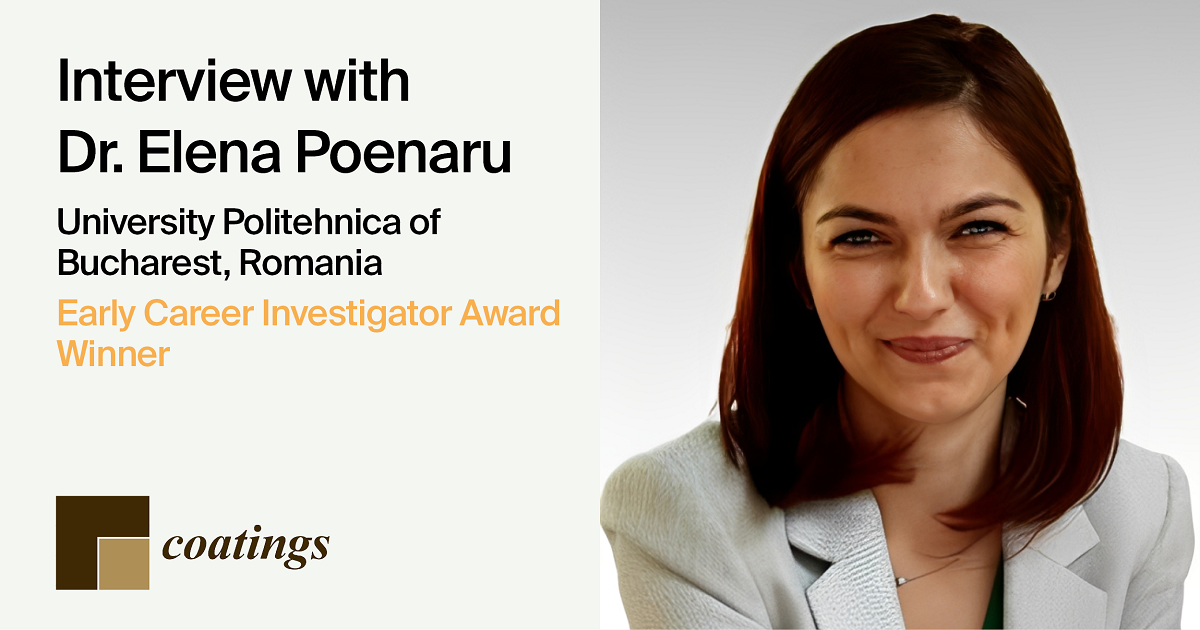
Interview with Dr. Elena Ungureanu (Poenaru)—Winner of the Coatings Early Career Investigator Award
Coatings (ISSN: 2079-6412) is pleased to present the first-place winner of the Coatings Early Career Investigator Award—Dr. Elena Ungureanu (Poenaru)!
Dr. Elena Poenaru is a lecturer and scientific researcher at the National University of Science and Technology POLITEHNICA Bucharest, with study interests in hydroxyapatite, coatings, and corrosion. Her research focuses on the electrochemical deposition and functionalization of metal surfaces, particularly bioactive hydroxyapatite coatings for titanium implants. She has contributed to multiple national and international research projects involving bioactivity testing, in vitro electrochemical behavior in artificial body fluids, and surface engineering. Her academic portfolio includes teaching practical courses in materials science, corrosion, biomaterials degradation, and surface engineering.
The following is an interview with Dr. Elena Poenaru:
1. Could you please briefly introduce yourself, including your current affiliation and main research areas?
My name is Elena Poenaru, and I am currently affiliated with the National University of Science and Technology POLITEHNICA Bucharest, where I work as a lecturer. My main research areas include electrochemical deposition, corrosion science, and surface biofunctionalization, with a particular focus on hydroxyapatite coatings.
2. What inspired you to pursue research in the field of coatings and corrosion science?
My motivation for pursuing research in coatings and surface engineering arises from my long-standing interest in understanding how surface-driven phenomena govern material performance and durability. I am particularly drawn to the field’s interdisciplinary nature and its ability to combine fundamental science with impactful solutions, from corrosion protection to the development of sustainable materials.
3. What challenges have you encountered during your research journey, particularly as a young investigator? Do you have anything to say to your fellow scholars?
As a young researcher, one of the main challenges I faced was finding a balance between time constraints, limited resources, and the expectations of the academic community.
To my colleagues at the beginning of their careers, I would emphasize the importance of perseverance and collaboration, as well as the need to accept that challenges and failures are an integral part of academic development.
4. Which emerging topics in coatings and corrosion do you believe will critically influence the academic community in the coming years?
Emerging research in coatings and corrosion is increasingly centered on advanced, sustainable materials and smart functionality. Rapid growth is seen in smart/self-healing coatings that respond to triggers such as pH or temperature, alongside nanomaterial-based systems (e.g., nanoceramic and superhydrophobic coatings) that deliver stronger barrier performance. At the same time, advanced characterization combined with high-throughput testing is accelerating discovery and improving the reliability of performance assessment.
5. What would you perceive to be the important qualities that young scholars should possess?
In my view, young scholars should possess a strong foundation in critical thinking and scientific rigor, coupled with intellectual curiosity and the ability to ask meaningful questions. Resilience and adaptability are essential, given the iterative nature of research and the challenges associated with funding, publication, and experimentation. Equally important are ethical integrity, collaborative skills, and effective communication, both within interdisciplinary teams and with the broader scientific community. Finally, an openness to learning new methods and embracing emerging technologies is crucial for sustaining long‑term academic growth and impact.
6. As the winner of this award, is there something you want to express or someone to thank most?
I am deeply honored to receive this award and sincerely grateful for the support that made it possible. I would like to especially thank my mentors, Associate Professor Dr. Eng. Cosmin Cotrut and Lecturer Dr. Eng. Diana Vranceanu, for their guidance and trust. This recognition is both an encouragement and a responsibility, and it motivates me to continue contributing significantly to the field and to the academic community.
7. Do you have any other suggestions for how journals and publishers can further support young researchers and the academic community?
Journals and publishers can further support young researchers by fostering more constructive and transparent peer review, creating recognition opportunities for early‑career scientists, and reducing publication barriers. In addition, free online conferences and webinars play an important role, as they provide accessible platforms for learning, visibility, and networking, especially for researchers at the beginning of their academic careers.