
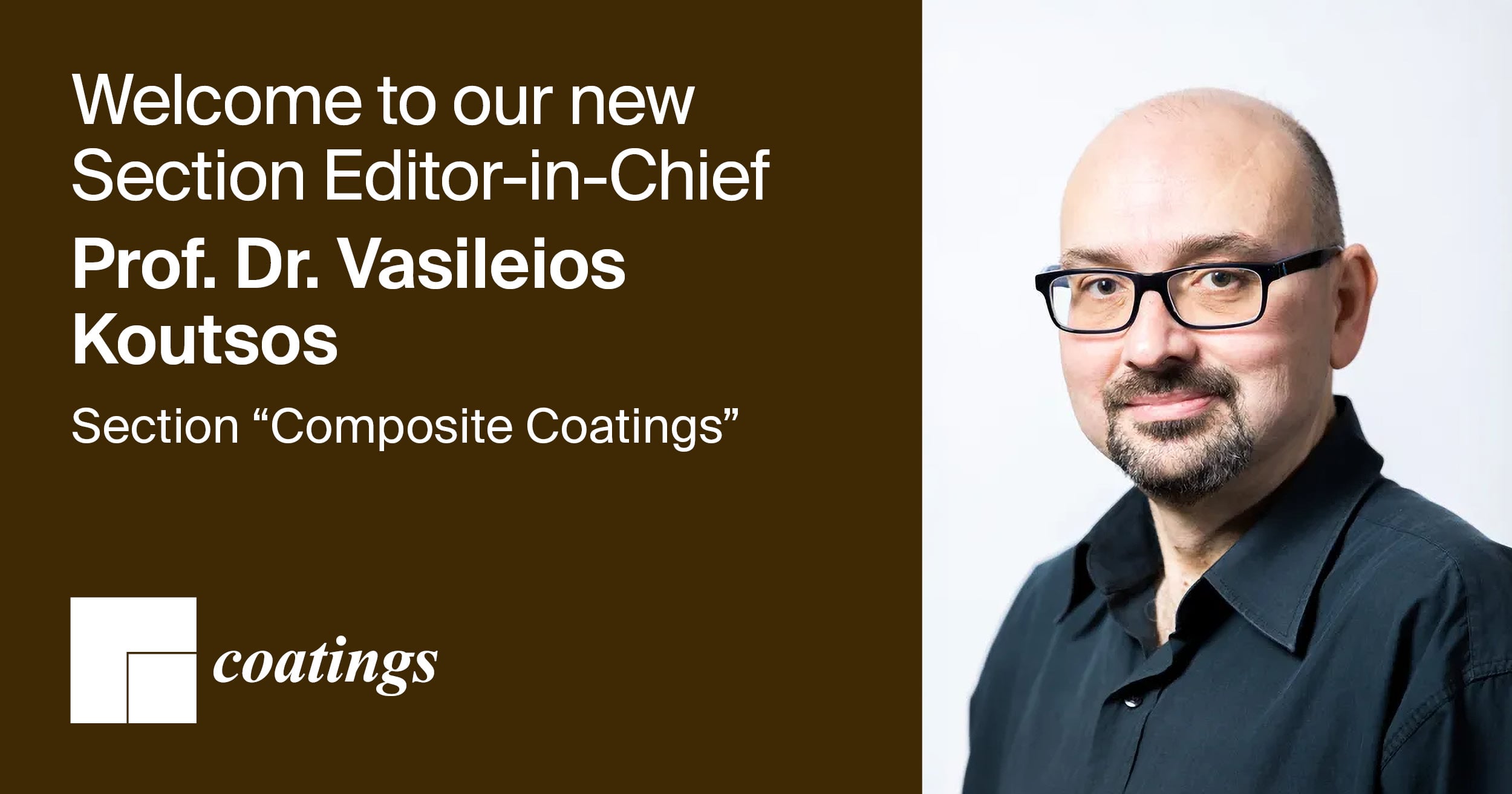
Prof. Dr. Vasileios Koutsos Appointed Section Editor-in-Chief of Section “Composite Coatings” in Coatings
Coatings (ISSN: 2079-6412) is pleased to announce the appointment of Prof. Dr. Vasileios Koutsos (The University of Edinburgh, UK) as Section Editor-in-Chief (SEiC) of the “Composite Coatings” Section. Prof. Dr. Koutsos has been a member of the Coatings Editorial Board since 2018 and brings extensive editorial experience across multiple fields, including surfaces and interfaces and related disciplines.
Prof. Dr. Koutsos is a Professor (Chair in Soft Materials and Surfaces) with the Institute for Materials and Processes at the School of Engineering, the University of Edinburgh. His research focuses on materials science and engineering, with a strong focus on surfaces and interfaces, composites and nanocomposites, polymers, complex fluids, and soft condensed matter.
In his role as SEiC, Prof. Dr. Koutsos will work with the Editorial Office and Academic Editors to support the publication of high-quality submissions and to further strengthen the “Composite Coatings” Section as an open forum for fundamental and translational research.
The following is a short Q&A with Prof. Dr. Vasileios Koutsos, who shared with us his vision for the journal, as well as his perspective on the field and on open access publishing:
1. What appealed to you about the journal?
I have long admired Coatings for its ability to bridge fundamental surface science with practical engineering applications. The “Composite Coatings” Section, in particular, sits at a fascinating multidisciplinary crossroads. The opportunity to shape the direction of this section and support a platform that prioritises rapid, high-quality dissemination of research was highly compelling.
2. What is your vision for the section?
My vision is to establish this section as the premier destination for high-impact research on multi-phase coating systems. I want to emphasise understanding, i.e., moving beyond just “what” a coating does to “how” its internal structure and interfaces govern its performance. This understanding will enable the development of superior composite coatings for a variety of applications. I also aim to increase our focus on sustainability, encouraging submissions on bio-based composites and recyclable coating systems.
3. What does the future of this field look like?
The future lies in smart, multi-functional coatings. We are moving away from passive barriers toward active systems that can self-heal, sense environmental changes, or harvest energy. Additionally, integrating nanotechnology with advanced characterisation (e.g., high-resolution AFM) will enable us to design composite coatings with atomic-level precision for the aerospace, biomedical, and energy sectors.
4. What do you think of the development of open access?
Open access is essential for the democratisation of science. It ensures that breakthroughs in coating technologies are immediately available to researchers and industrial engineers worldwide, regardless of their institution's budget. In a field as fast-moving as materials science and engineering, the transparency and speed of open access are vital for driving global innovation.
We warmly welcome Prof. Dr. Vasileios Koutsos as the Section Editor-in-Chief of “Composite Coatings”, and we look forward to his leading Coatings to achieve many more milestones.