
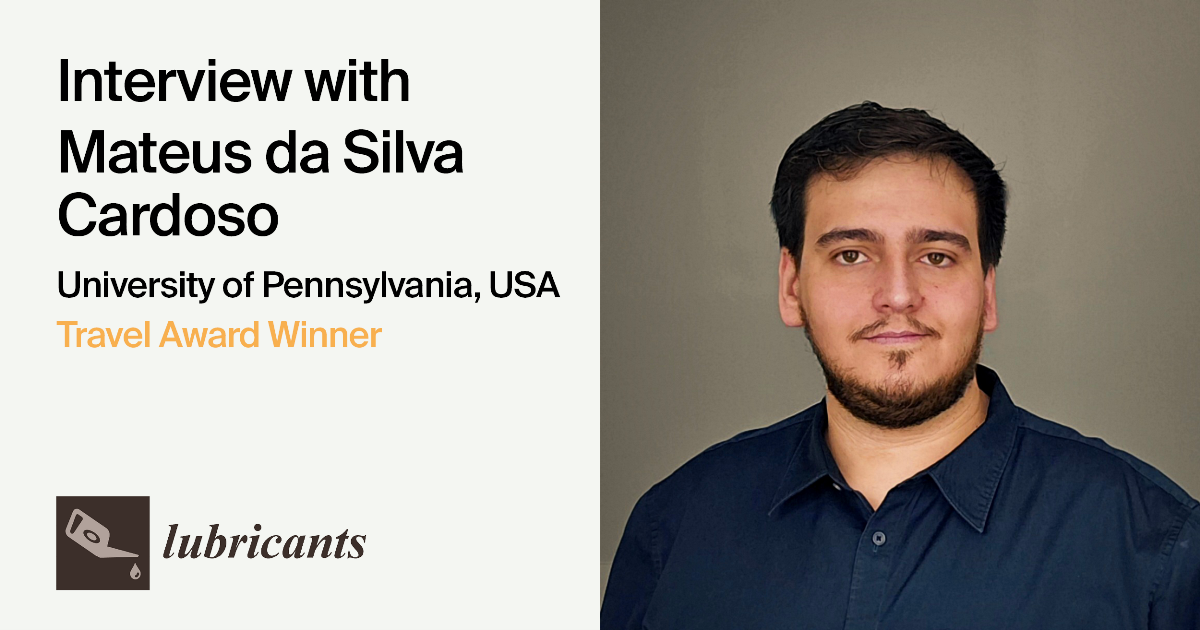
Interview with Mr. Mateus da Silva Cardoso—Winner of the Lubricants Travel Award
Mr. Mateus da Silva Cardoso is a PhD student in mechanical engineering and applied mechanics at the University of Pennsylvania, USA, where he is advised by Prof. Robert W. Carpick. He completed both his BSc in mechanical engineering and his MSc in materials science and engineering at the Federal University of Santa Catarina, Brazil, where he was part of the Materials Laboratory (LabMat). His time at LabMat played a key role in shaping his interest in tribology. His current research focuses on understanding how metal oxide nanoparticles can enhance grease lubrication by forming protective tribofilms under mechanical stress.
1. What are your current research areas? What motivated you to pursue this area of study?
My current research focuses on grease lubrication, particularly on understanding how metal oxide nanoparticles can enhance lubrication by forming protective tribofilms under mechanical stress. I combine experimental techniques and multiscale characterization to study how these films form, evolve, and improve performance in demanding conditions.
I became interested in this area during my time at the Materials Laboratory (LabMat) at the Federal University of Santa Catarina, where I was first exposed to the complexity and importance of friction, wear, and lubrication. What motivated me to pursue this field is its broad impact; tribological systems are responsible for a significant portion of global energy losses, and even small improvements in lubrication can lead to meaningful gains in efficiency and reliability. This combination of multidisciplinary fundamental science and real-world impact is what continues to drive my research.
2. How did you first become aware of this award, and what inspired you to submit your application?
I first became aware of the Lubricants Travel Award through my advisor, Robert W. Carpick, who encouraged me to apply. I decided to apply because I value the opportunities that attending and presenting at conferences provide, and this support helps make those experiences more accessible.
3. How does it feel to receive the Travel Award? What does this recognition mean to you or your team?
I am very grateful to receive the Travel Award. It is encouraging to have my work recognized, especially at this stage of my PhD, and it gives me additional motivation to continue developing this research. This recognition also reflects the collaborative nature of the project. I work closely with my advisor and with a broader team of researchers, so it is rewarding to see our collective efforts acknowledged.
4. In your view, how can academic journals and publishers further support early career researchers and the broader academic community?
Academic journals and publishers play an important role in supporting early career researchers, not only by disseminating research but also by creating opportunities for visibility and engagement within the community. Travel awards and similar initiatives are very valuable and increasing both the level of support and the number of opportunities available could make an even greater impact, particularly by enabling broader participation in conferences and scientific exchange.
It is also important to continue expanding efforts to reach and support researchers from less represented or under-resourced communities, where access to funding and opportunities can be more limited. This includes not only inclusive selection processes, but also increasing awareness of available opportunities so that a wider range of researchers can benefit from them.
5. What qualities do you believe are most essential for a young researcher today?
I believe curiosity, persistence, self-motivation, and adaptability are among the most essential qualities for a young researcher today. Curiosity drives the desire to understand complex problems, while persistence is important because research often involves setbacks and uncertainty. Self-motivation is also key, as much of research requires taking initiative, staying focused over long periods, and pushing projects forward independently. Adaptability is critical as well, especially in interdisciplinary fields, where learning new techniques and perspectives is part of the process.
6. Looking ahead, what are your main goals or projects for the coming years?
In the coming years, my main goal is to continue developing my research on grease lubrication and deepen my understanding of how nanoparticles interact within grease systems and how they contribute to tribofilm formation across different length scales. More broadly, I am particularly interested in bridging fundamental tribology with practical applications, helping translate scientific insights into solutions that can improve the performance and durability of real-world mechanical systems.