
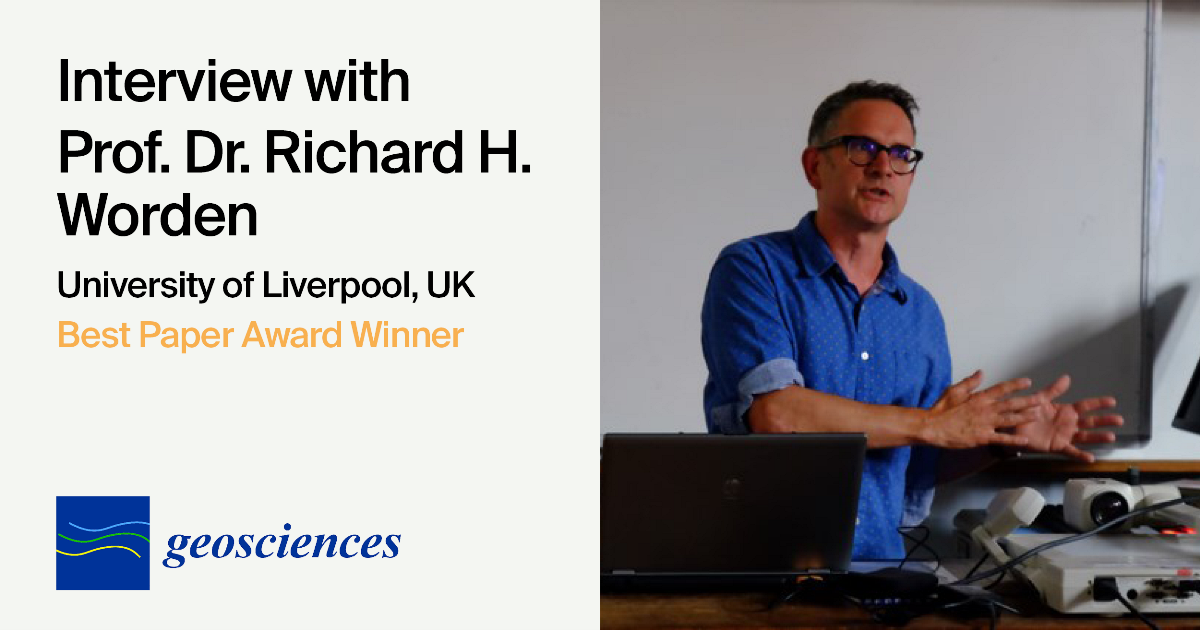
Interview with Prof. Dr. Richard H. Worden—Winner of the Geosciences Best Paper Award
Name: Richard H. Worden
Affiliation: University of Liverpool, UK
Award-winning article:
“Carbon Dioxide Capture and Storage (CCS) in Saline Aquifers versus Depleted Gas Fields”
by Richard H. Worden
Geosciences 2024, 14(6), 146; https://doi.org/10.3390/geosciences14060146
Available online: https://www.mdpi.com/2076-3263/14/6/146
1. Congratulations on winning the 2025 Geosciences Best Paper Award! Could you briefly introduce yourself and tell us what sparked your interest in the field of carbon capture and storage?
I am a professor of geology at the University of Liverpool with wide experience in geochemistry, reservoir quality, and subsurface storage site description, modelling, and integrity, as applied to the energy transition. My research and applied interest in CCS were sparked by early work in the late 1990s on CO2 storage integrity and the study of natural CO2-rich gas field analogues, and then co-editing the 2004 Geological Society volume on geological CO2 storage. This work has evolved into studies of In Salah, the Captain, and Lista Moray Firth CCS sites, as well as CCS sites in the Southern North Sea, East Irish Sea, Mediterranean, and SE Asia.
2. Could you introduce the research focus and the key findings of this award-winning paper?
The paper contrasts CCS in saline aquifers and depleted gas fields, showing they behave differently and should not be treated as a single storage type. Depleted gas fields offer richer subsurface data, lower initial pressures, potentially higher storage efficiency, and distinct stress paths compared with saline aquifers, whose efficiency is typically much lower, and where buoyant CO2 plumes, halite scaling, and brine-mediated reactions are more significant. It concludes that pressure evolution, trapping mechanisms, leakage risks, and monitoring options diverge sufficiently that project design and regulation must be site‑type-specific.
3. Throughout this research journey, you must have experienced many memorable moments. Could you share with us some unexpected challenges or interesting anecdotes from this study?
Detailed work on Mercia Mudstone, Rodby, and Lista shales has revealed strong spatial heterogeneity in permeability, fabric, and geomechanical behaviour, undermining simple caprock‑integrity assumptions that were common even a decade ago.
My experience has highlighted that complex stress paths, residual brine distributions, and legacy‑well issues complicate what initially looked like straightforward, high‑efficiency storage options.
The paucity of detailed, timely disclosure from major industrial CCS projects means that we have often had to infer key behaviours from incomplete datasets, slowing the community’s learning curve and making it harder to build robust best‑practice guidance.
A final comment is that there is an increasingly obvious overlap in interest in mudstones from many aspects of the energy transition, evolving from conventional hydrocarbon trapping, of course, into CO2 trapping, but now including deep geological disposal of nuclear waste, hydrogen storage, and even hydrothermal systems. More focused work on mudstones remains of paramount importance.
4. What do you believe are the main challenges currently facing the field of CO2 storage research? In which areas do you believe breakthrough innovations are most likely to emerge?
The field is being held back less by individual geoscience or engineering questions and more by how we integrate all the various aspects involved in CCS at scale and under financial, regulatory, and societal constraints. Fluctuating political will to make CCS work, as well as recidivistic questions about global heating, need to be overcome.
Geoscience and engineering questions remain about the caprock’s response to high-pressure CO2, geomechanical behaviour of repressurized depleted gas fields, near-wellbore response to the injecting CO2, quantification of structural, residual, solubility, and mineral trapping of CO2, and legacy-well leakage risks.
Breakthroughs seem likely via digital subsurface and machine learning, coupled with modelling grounded in experiments, smart wells, distributed sensing, engineered trapping, and pressure management.
5. As the winner of this award, is there something you want to express or someone you wish to thank most?
Various people at Geologica, RPS/Tetratech, BP, Pale Blue Dot, and other companies have provided valuable advice and support. University colleagues, post-docs, PhD, and MSc students have made the journey fun and creative.
6. Could you tell us what attracted you to submit your paper to Geosciences, and what your experience with the publication process was?
Geosciences has a good mix of modern geoscience topics that is appealing. Being open access allows all researchers, practitioners, and policy makers to read Geosciences publications. As a young-ish journal, its reputation is growing, and it is good to be part of that process.
In practical terms, ease of formatting, once an author has gotten familiar with the MDPI approach, was a definite appeal. Publication was straightforward. Honestly, it is easy being a sole author.
7. Do you have any suggestions on how we could better support researchers or improve our editorial process?
Perhaps the journal could make the recommendation for less-experienced authors to write all data-driven papers with classical structures (introduction, definition of explicit research questions, background, methods, results, discrete discussion, simple one-line conclusions) even clearer. Plus, you could make explicit recommendations on how to structure review papers, which would also help reduce the amount of work that needs to be undertaken by reviewers. One aspect of peer review that can be annoying from the author’s perspective is when a resubmitted paper is sent to a new set of reviewers; this should be avoided at all costs. These are general comments and not specific to Geosciences.
Beyond this award-winning article, Prof. Dr. Richard H. Worden has been steadily building a strong body of work. For those interested in the broader arc of their research, the following journal articles offer valuable insights:
- “Simulating Compaction and Cementation of Clay Grain Coated Sands in a Modern Marginal Marine Sedimentary System”;
- “Carbon Dioxide Capture and Storage (CCS) in Saline Aquifers versus Depleted Gas Fields”;
- “Geochemistry of Sub-Depositional Environments in Estuarine Sediments: Development of an Approach to Predict Palaeo-Environments from Holocene Cores”;
- “Reservoir Quality of Upper Jurassic Corallian Sandstones, Weald Basin, UK”.